12.50: PROBLEM DEFINITION
Situation: A rocket nozzle with area ratio of 4 and total pressure of 1.3 MPa exhausts
to a back pressure of 30 kPa, abs.
Find: The state of exit conditions.
Properties: From Table A.1, (EFM 10e),k=1.4.
SOLUTION From Table A.1:
58
12.51: PROBLEM DEFINITION
Situation: A rocket nozzle with area ratio of 4 and total pressure of 1.3 MPa exhausts
to a back pressure of 30 kPa, abs.
Find: State of exit conditions.
Properties:k=1.2.
SOLUTION The Mach number-area ratio equation for k=1.2is
Carrying out calculations for area ratio for a range of Mach number yields
From interpolation, the exit Mach number is 2.6195. The exit pressure is
59
12.52: PROBLEM DEFINITION
Situation: A Laval nozzle with expansion ratio of 1.688 exhausts air into 100 kPa
back pressure.
Find: (a) Show reservoir pressure must be 782.5 kPa for ideal expansion at Mach 2.
(b) Static pressure and temperature at throat for total temperature of 17oC
(c) Exit conditions for reservoir pressure of 700 kPa..
(d) Reservoir pressure for normal shock at exit.
SOLUTION a) p=ptin reservoir because V=0in reservoir
From Table A.1 (EFM 10e), p/pt=0.1278 for A/A∗=1.688 and M=2
b) Throat conditions for M=1:
c) Conditions for pt=700kPa:
d) ptfor normal shock at exit: Assume shock exists at M=2From Table A.1 (EFM
10e) for pressure across normal shock, p2/p1=4.5. Nozzle exhausts to 100 kPa
60
12.53: PROBLEM DEFINITION
Situation:FlowinaLavalnozzlewithair.
Find: (a) Mach number and (b) area ratio where dynamic pressure is maximized.
Properties:k=1.4.
SOLUTION Find Mach number
Mach number-area ratio relationship
61
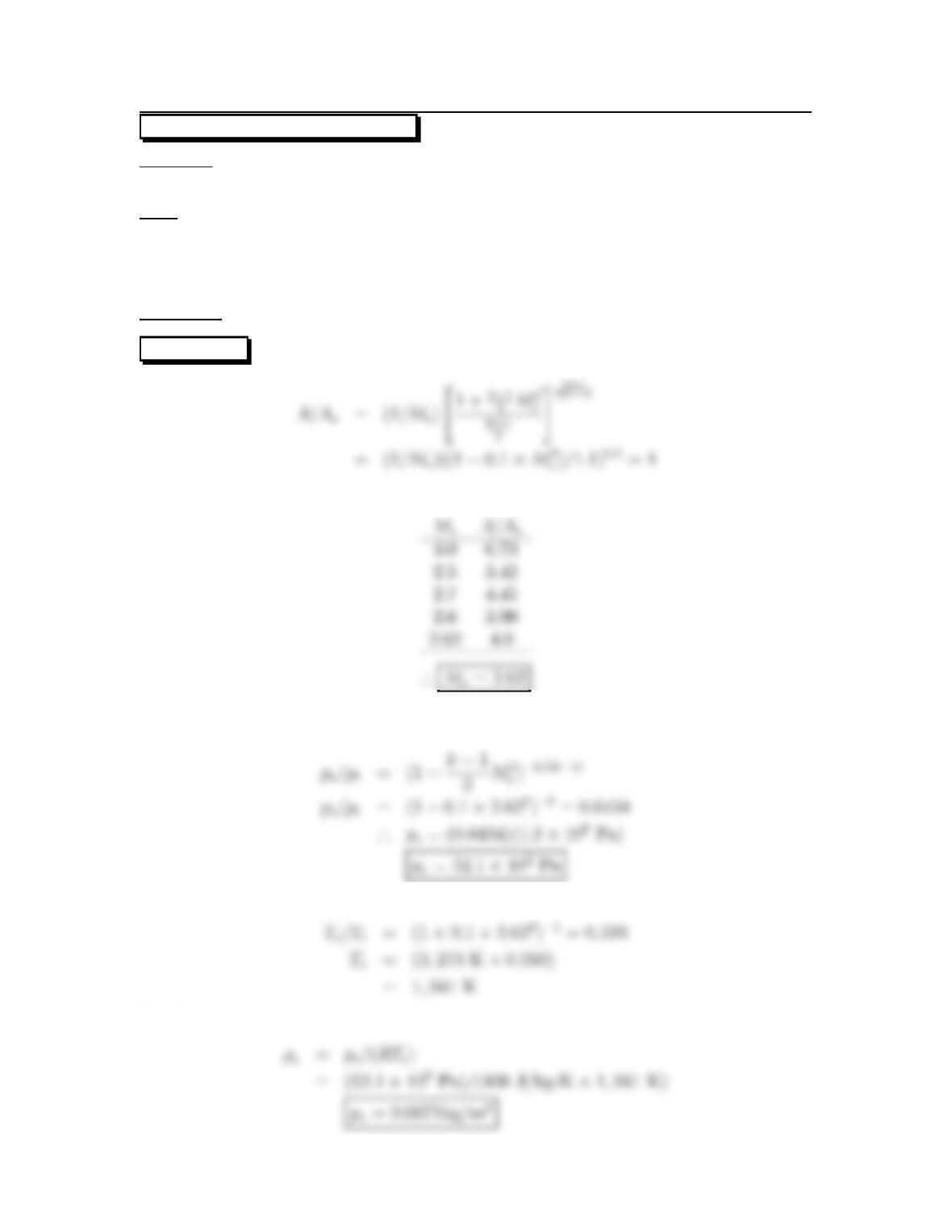
12.54: PROBLEM DEFINITION
Situation: A rocket motor with expansion ratio of 4 operates where back pressure is
30 kPa The chamber pressure and temperature are 1.2 MPa and 3000oC.
Find: (a) Mach number, pressure and density at exit.
(b) Mass flow rate.
(c) Thrust.
(d) Chamber pressure for ideal expansion.
Properties:k=1.2,.R=400J/kg-K
SOLUTION Mach number-area ratio relationship
a) Solve for Mby iteration:
Total properties
Pressure
Temperature
Ideal gas law
62
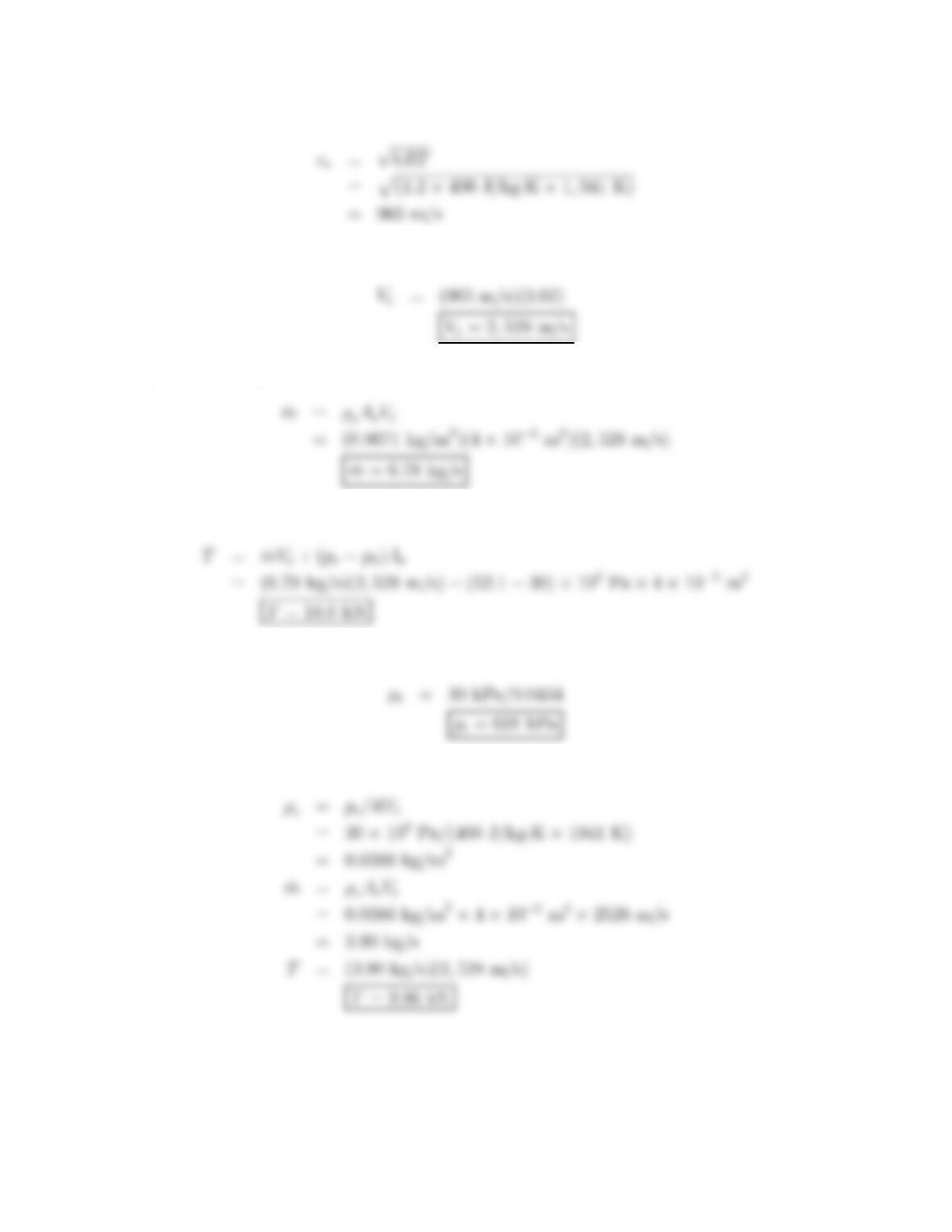
Speed of sound
Mach number
b) Flow rate equation
c) Thrust
d) Chamber pressure
Mass flow rate and thrust
63
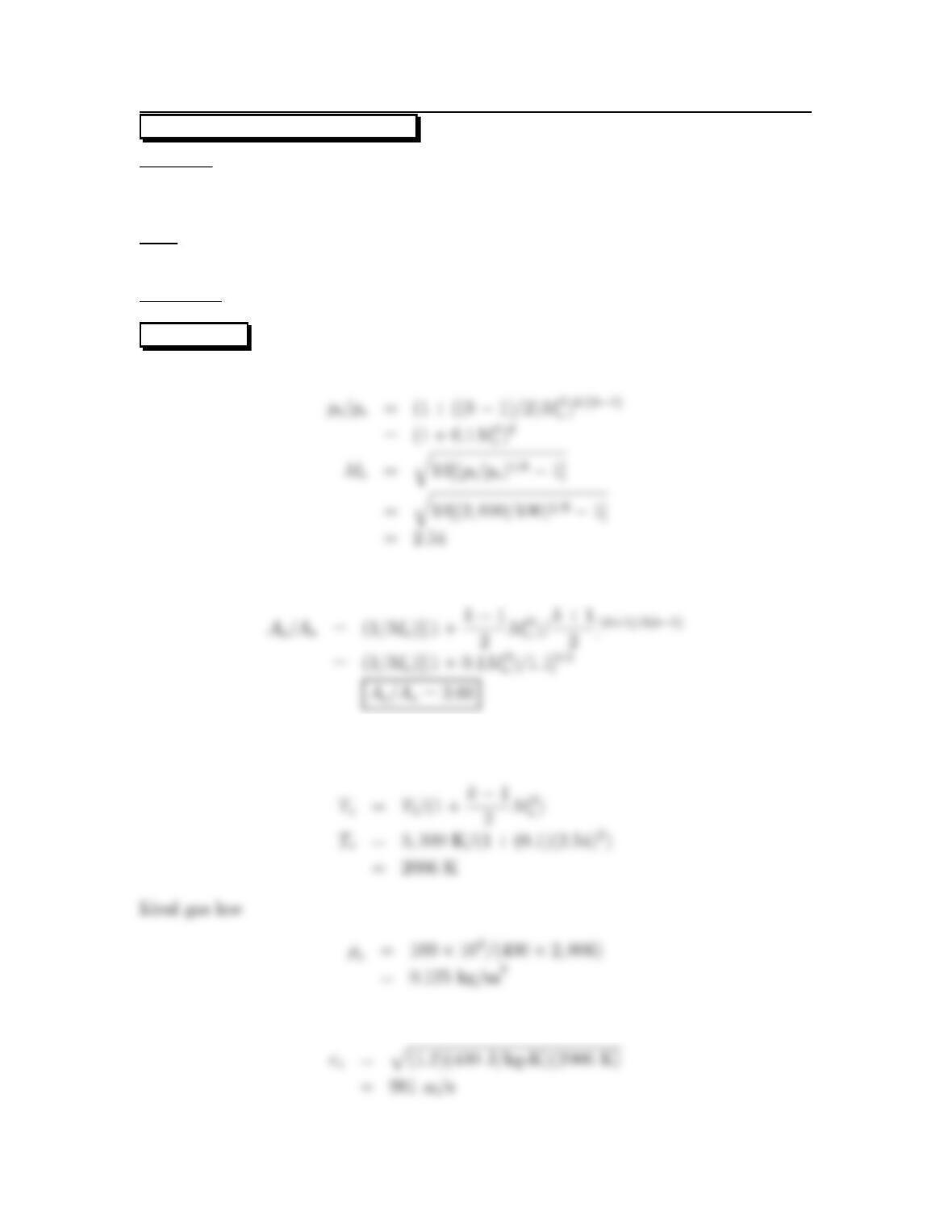
12.55: PROBLEM DEFINITION
Situation: A rocket motor with 2 MPa and 3300 K chamber pressure and temperature
and 10 cm2throat area designed for sea-level operation where back pressure is 100
kPa.
Find: (a) Nozzle expansion ratio for ideal expansion and thrust.
(b) Thrust if expansion ratio reduced by 10%.
Properties:k=1.2,.R=400J/kg-K
SOLUTION Total pressure ratio and exit Mach number
Mach number-area ratio relationship
Total properties (temperature)
Speed of sound
64
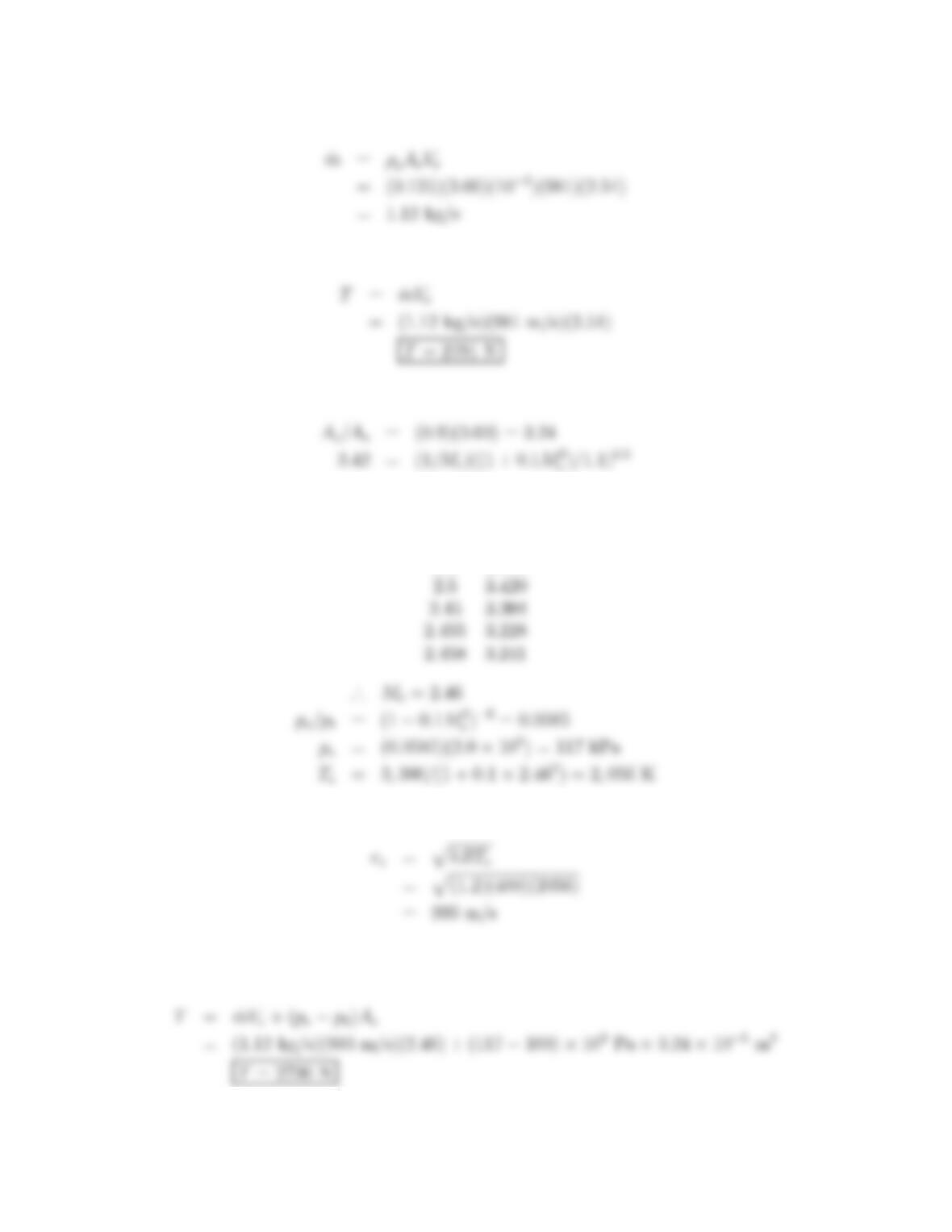
Flow rate equation
Thrust equation for ideal expansion
(b) Expansion ratio reduced by 10%
Solve by iteration:
MeA/A∗
2.4 3.011
Speed of sound
Thrust
65
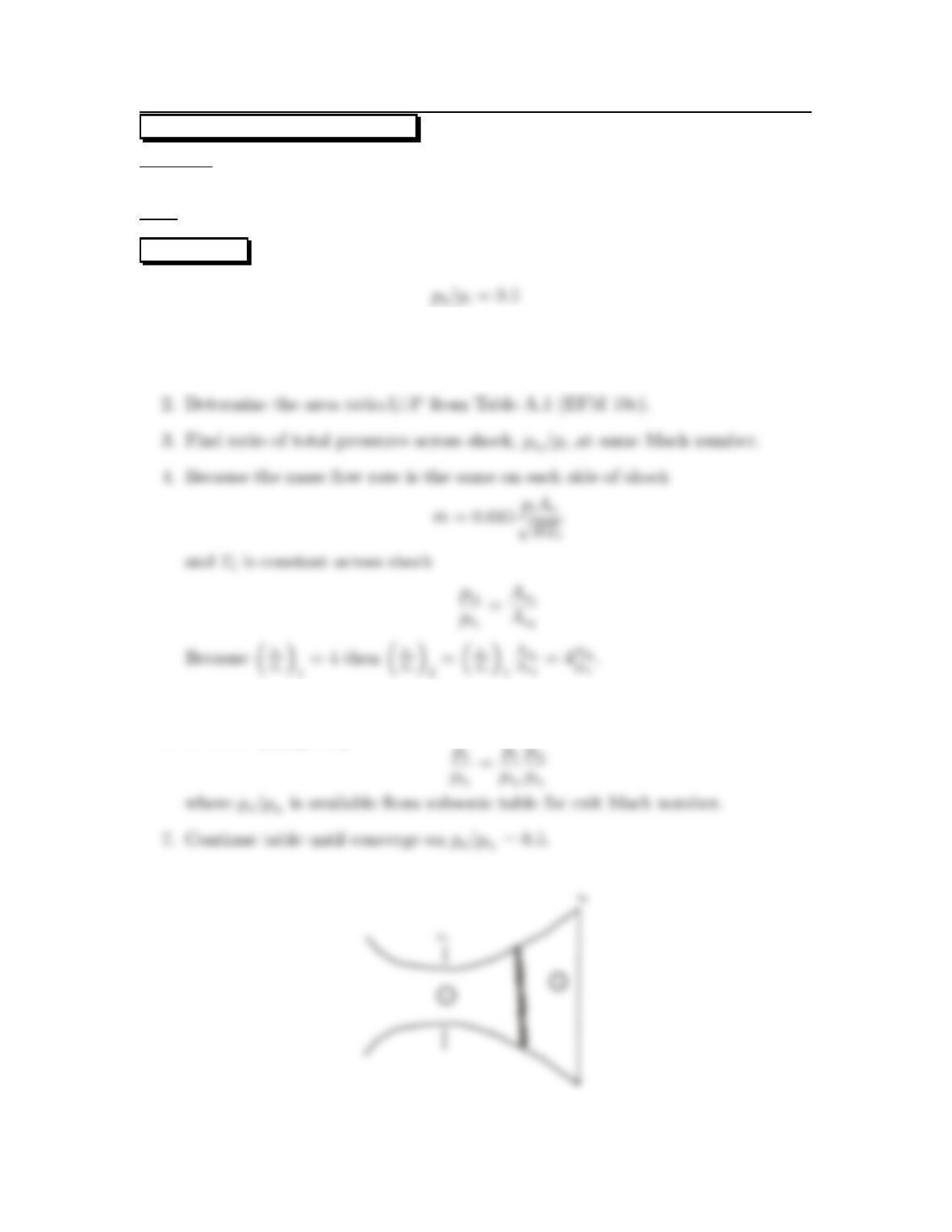
12.56: PROBLEM DEFINITION
Situation:Airflows through Laval nozzle with expansion ratio of 4. The total pressure
is 200 kPa and back ;pressure 100 kPa.
Find: Area ratio where shock occurs in nozzle.
SOLUTION Back pressure/total pressure ratio
Solution by iteration:
1. Choose M
5. From Table A.1 for subsonic flow Mach number at exit, Me.
6. Evaluate pe/pt1using pe
66
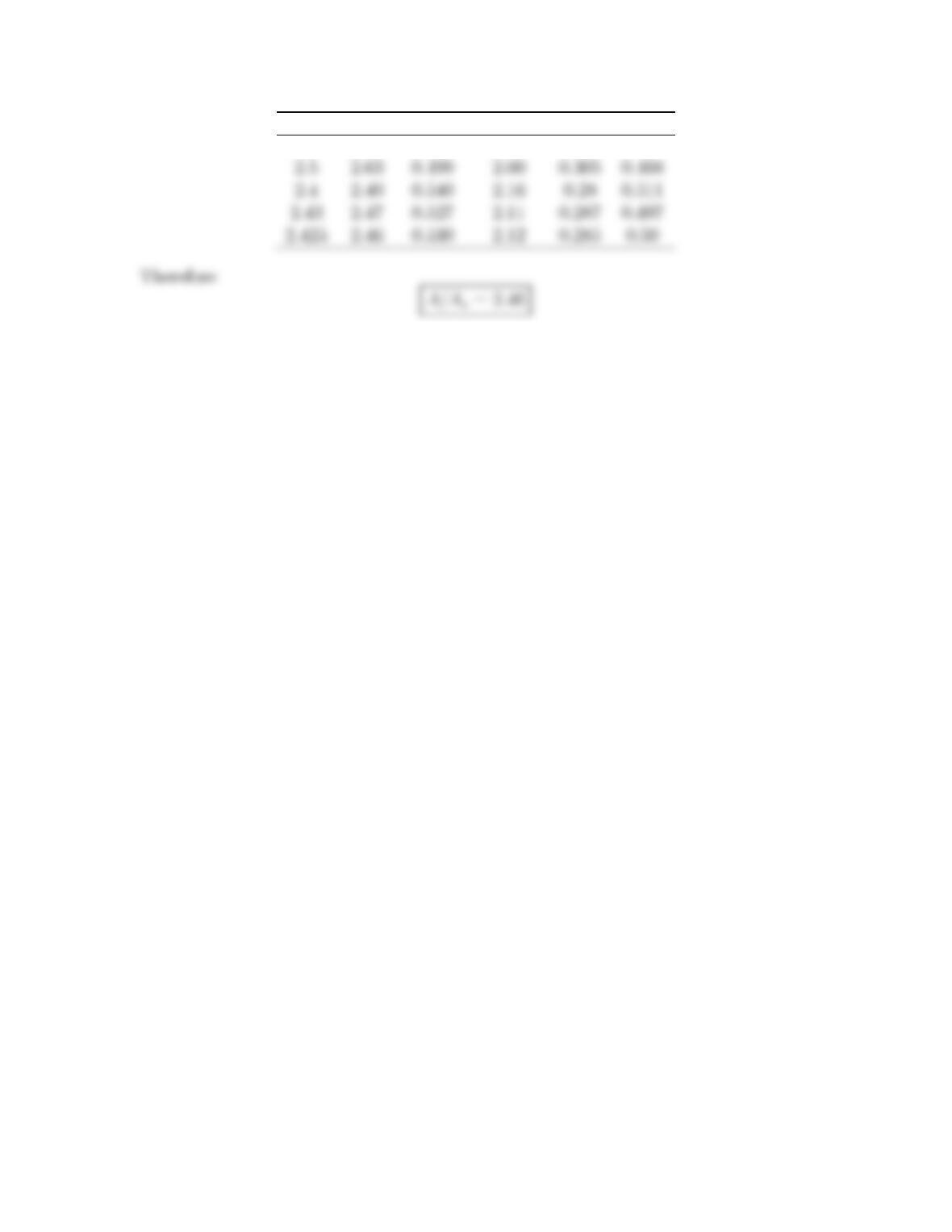
MA/A
∗pt2/pt1(Ae/A∗)Mepe/pt1
2 1.69 0.721 2.88 0.206 0.7
67
12.57: PROBLEM DEFINITION
Situation: A shock wave occurs in a expansion ratio 4 rocket nozzle. Total pressure is
250 kPa and back ;pressure is 100 kPa. The ratio of specific heats is 1.2. The nozzle
has a linear shape with expansion angle of 15o.
Find: Area ratio and location of shock wave.
SOLUTION
Exit pressure and area ratio
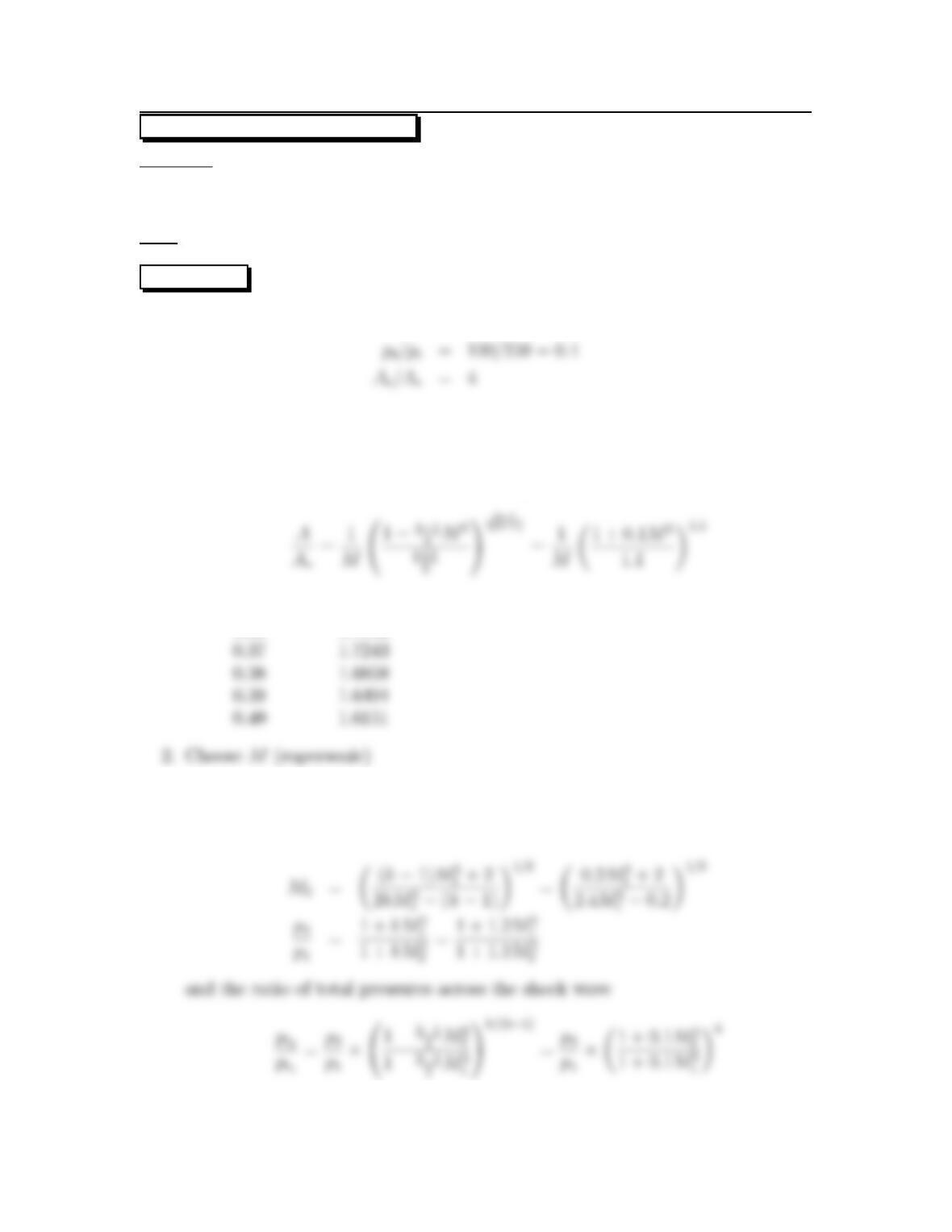
Aniterativemethodmustbeusedtofind area ratio at which shock occurs. Table
A.1 (EFM 10e) is not applicable since the gas has different ratio of specificheats.
1. Create a subsonic flow table for later using
Mach number Area ratio
0.36 1.7652
3. Determine the area ratioA/A∗from equation for Step 1
4. Find Mach number and pressure ratio across shock at same Mach number.
68
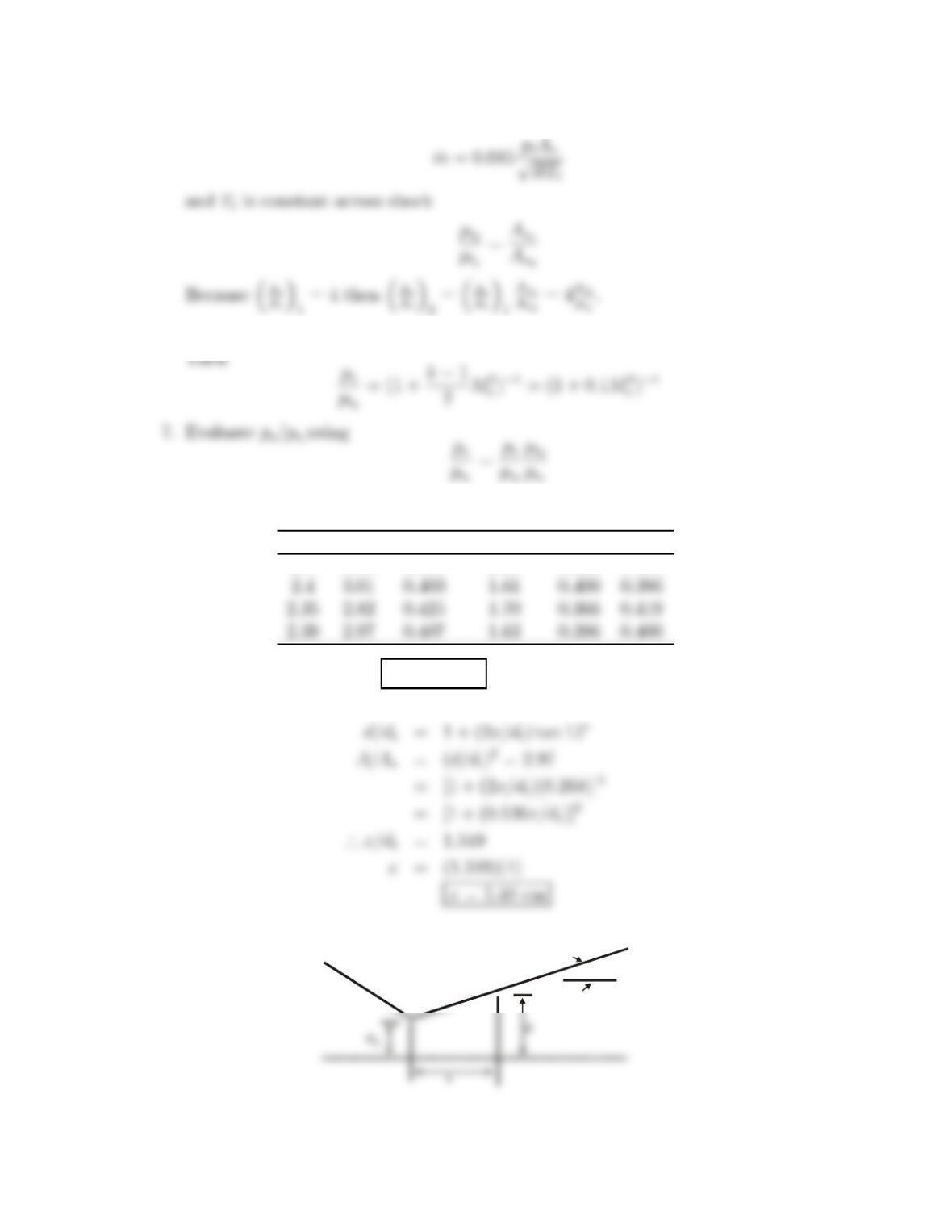
5. Because the mass flowrateisthesameoneachsideofshock
6. Solve iteratively for Mach number at exit, Me,using table generated in step 1.
8. Continue table until converge on pe/pt1=0.4.
MA/A
∗pt2/pt1(Ae/A∗)2Mepe/pt1
2.0 1.88 0.600 2.40 0.255 0.596
Thearearatiooftheshockis A/A∗=2.97 .
From geometry: d=dt+2×tan 15◦
15
o
69
12.58: PROBLEM DEFINITION
Situation: A normal shock wave occurs in a nozzle with hydrogen at area ratio of 5.
Find: Entropy increase.
Properties:FromTableA.2(EFM10e),k=1.41.
SOLUTION
Solve iteratively for M(to give A/A∗=5)
MA/A
∗
3.0 2.61
M1=3.196
70
12.59: PROBLEM DEFINITION
Situation: Supersonic airflow with Mach number 2.1 enters in a variable–area chan–
nel with shock wave at throat. Inlet area is 100 cm2,throat area is 0.75 cm2and
downstream area is 120 cm2. Upstream static pressure is 65 kPa.
Find: At station 3, find (a) Mach number, (b) static pressure and (c) stagnation
pressure.
Properties:Airwithk=1.4.
SOLUTION From Table A.1 (EFM 10e), M=2.1,A/A
∗=1.837,p/p
t=0.1094
A2/A∗=(1/M )((1 + 0.2M2)/1.2)3
=1.155
71
12.60: PROBLEM DEFINITION
Situation: A shock wave in air exists in a Laval nozzle where cross-sectional area is
120 cm2.The inlet Mach number, area and static pressure are 0.3, 200 cm2and 400
kPa. Exit area is 140 cm2.
Find: Back pressure for shock position.
SOLUTION From Table A.1 (EFM 10e)
Therefore
Thearearatioattheshocklocation
By interpolation from Table A.1 (EFM 10e):
72
12.61: PROBLEM DEFINITION
Situation: Design of a supersonic wind tunnel with a Mach number of 1.5 in a 5cm by
5 cm test section. The tunnel operates by drawdown into a vacuum tank and must
operate for 30 seconds.
Find: Carry out a preliminary design of a the system.
SOLUTION The area of the test section is
The area of the throat is
The speed of sound and velocity in the test section is
The mass flow rate is obtained using
The pressure and temperature in the vacuum tank can be analyzed using the re-
lationships for an open, unsteady system. The system consists of a volume (the
vacuum tank) and an inlet coming from the test section. In this case, the first law of
thermodynamics gives
73
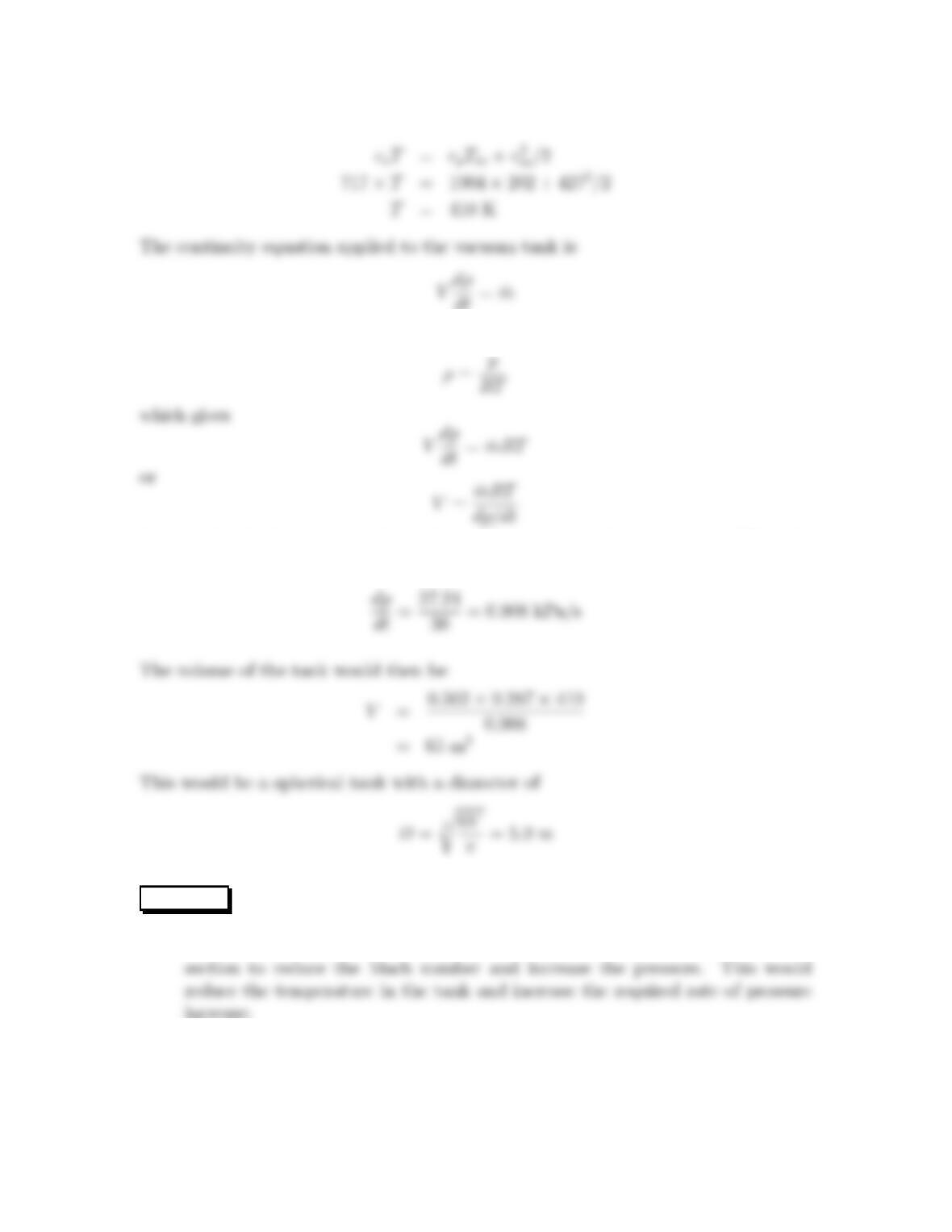
since min =m2.Thus the temperature in the tank will be constant and given by
dt =˙m
The density from the ideal gas law is
Assume the final pressure in the tank is the pressure in the test section. Thus the
rate of change of pressure will be
REVIEW
1. The tank volume could be reduced if the channel was narrowed after the test
2. The tunnel would be designed to have a contour between the throat and test
section to generate a uniform velocity profile. Also a butterflyvalvewouldhave
to be used to open the channel in minium time.
74