12-12 Soil Strength Chap. 12
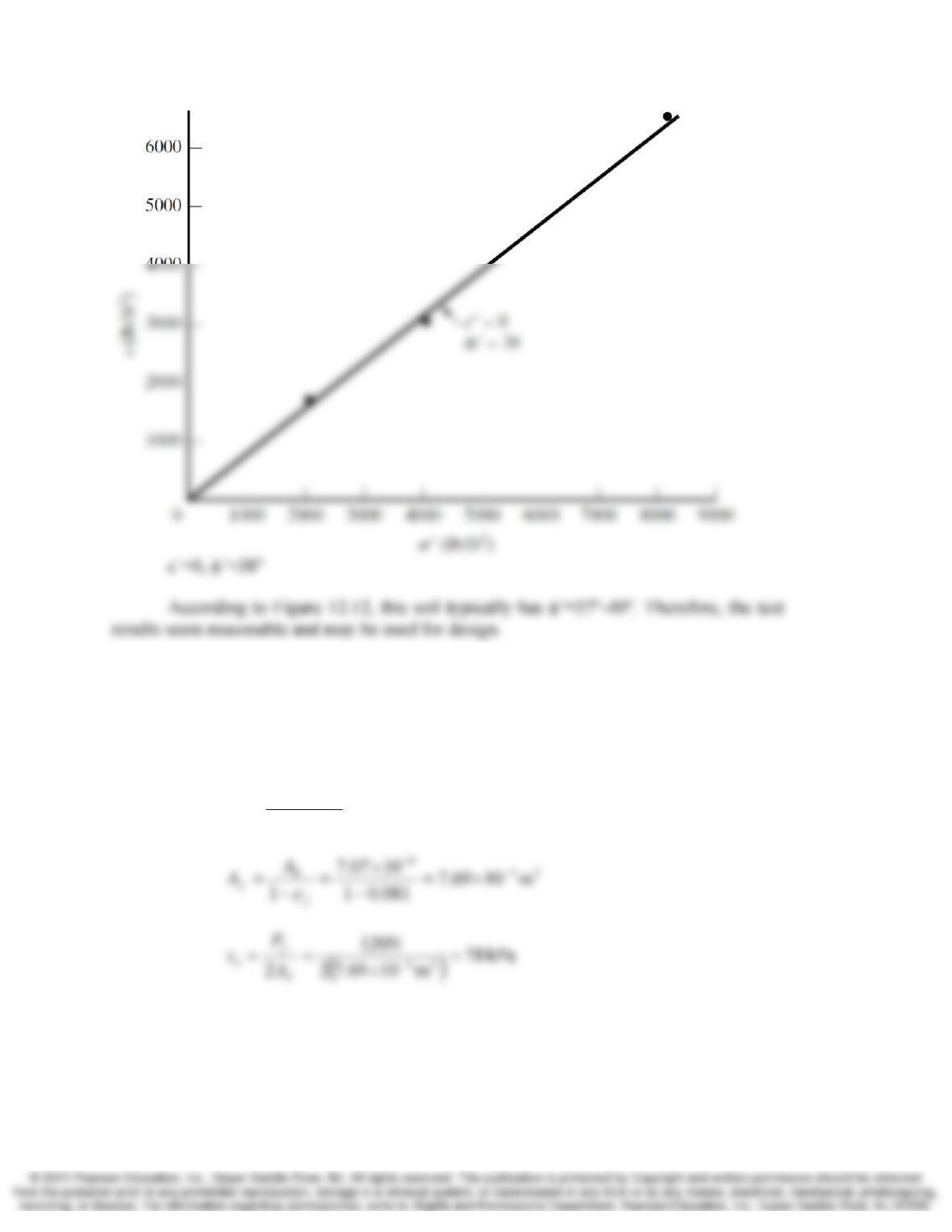
12.31 An unconfined compression test has been performed on a 30 mm diameter, 75 mm long
specimen of clay. The axial load and axial strain at failure were 120 N and 8.1%,
respectively. Compute the undrained shear strength.
Solution
()
24
2
01007.7
4
030.0 mA −
×==
π
Chap. 12 Soil Strength 12-13
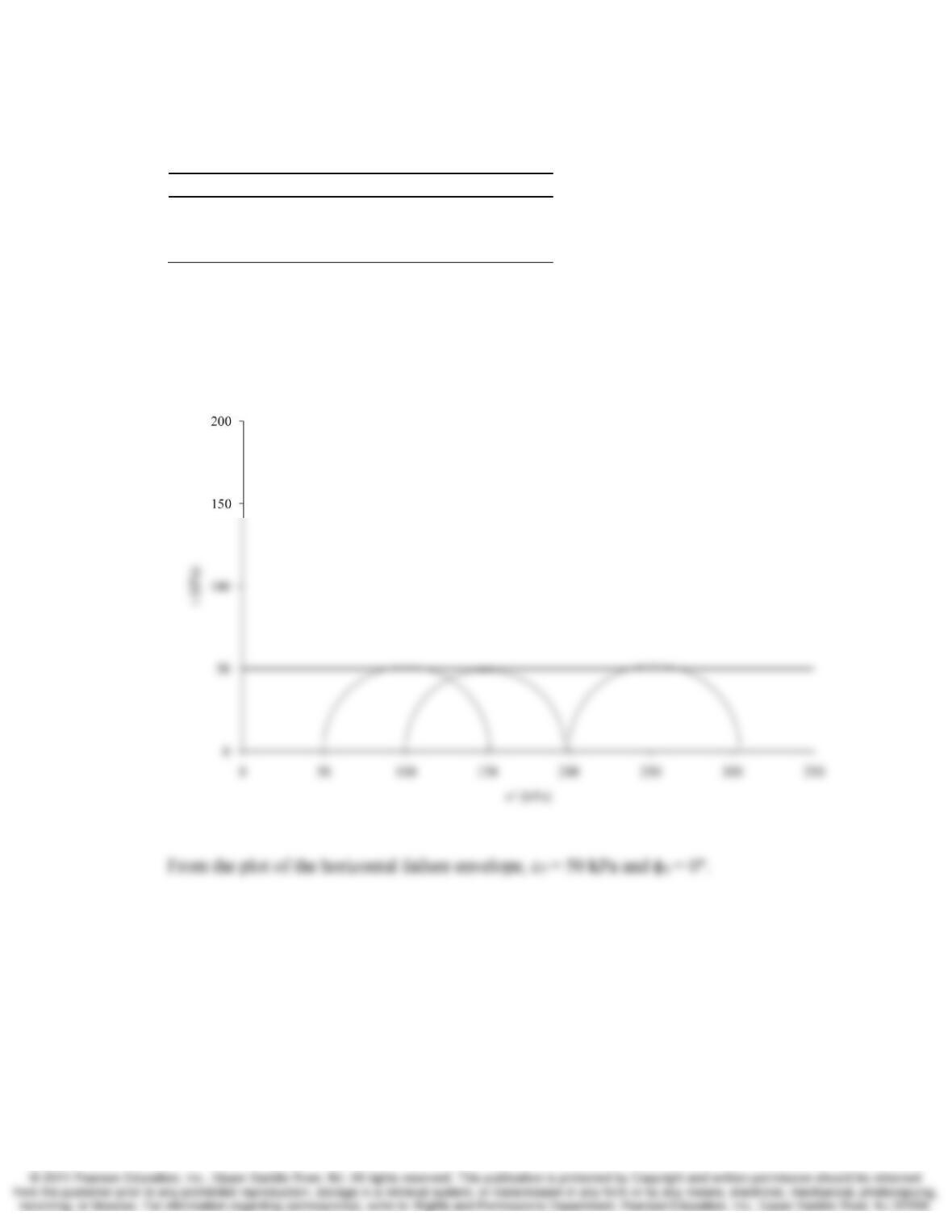
12.32 A series of UU triaxial compression tests have been performed on “identical” clay
specimens. The test results were as follows:
Test Number σ3
f
(kPa) σ1
f
(kPa)
1 50 152
2 100 196
3 200 305
Plot the total stress Mohr circles at failure and draw the total stress Mohr–
Coulomb failure envelope. Estimate the undrained shear strength.
Solution
12-14 Soil Strength Chap. 12
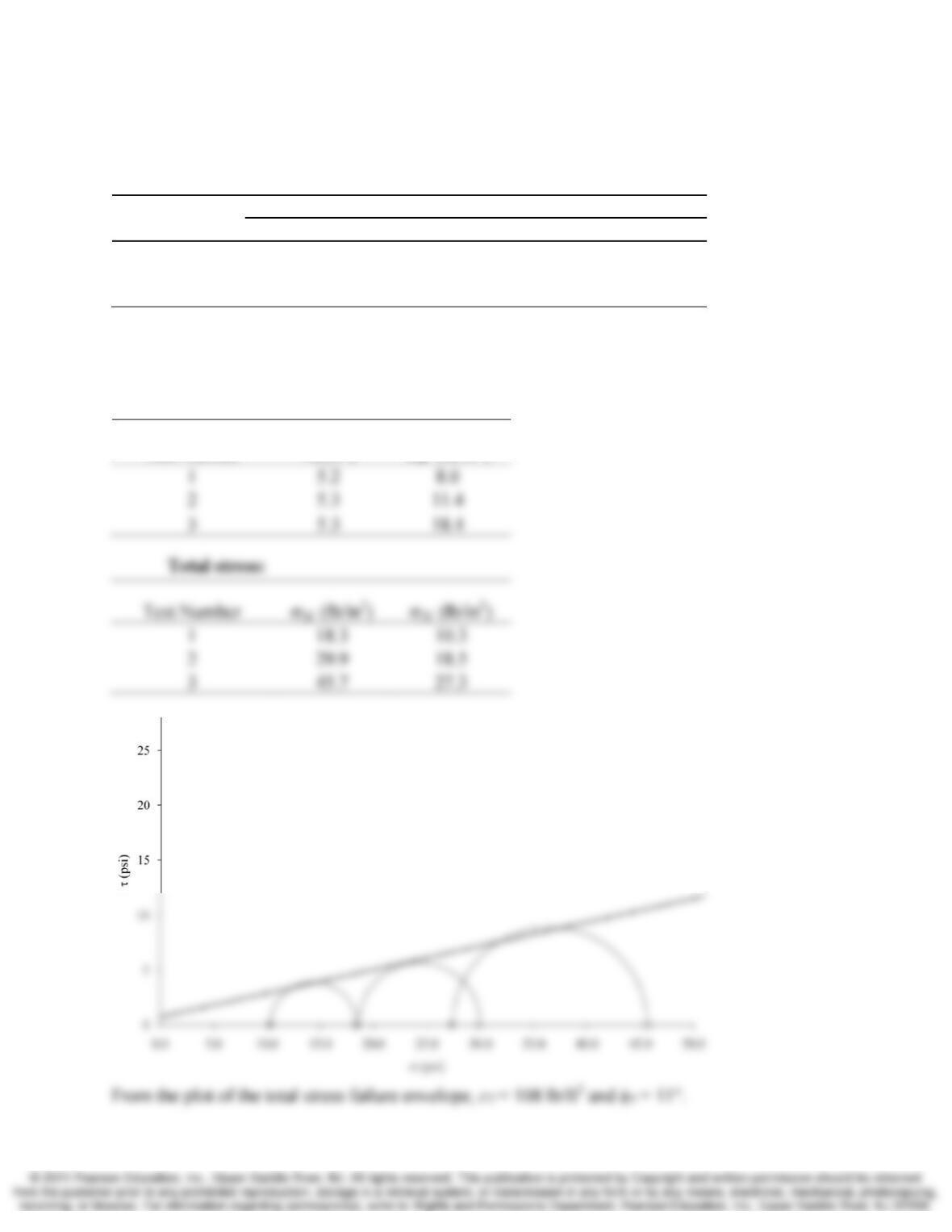
12.33 A series of CU triaxial compression tests have been performed with pore pressure
measurements on “identical” 2.50-in. diameter specimens of a clay. All of the specimens
had an initial height of 6.00 in. The test results were as follows:
Test No. Conditions at Failure
P
f
(lb) ε
f
(%) σ3
f
(lb/in2) u
f
(lb/in2)
1 41.7 5.5 10.3 4.3
2 59.9 6.9 18.5 5.6
3 97.1 6.8 27.3 7.1
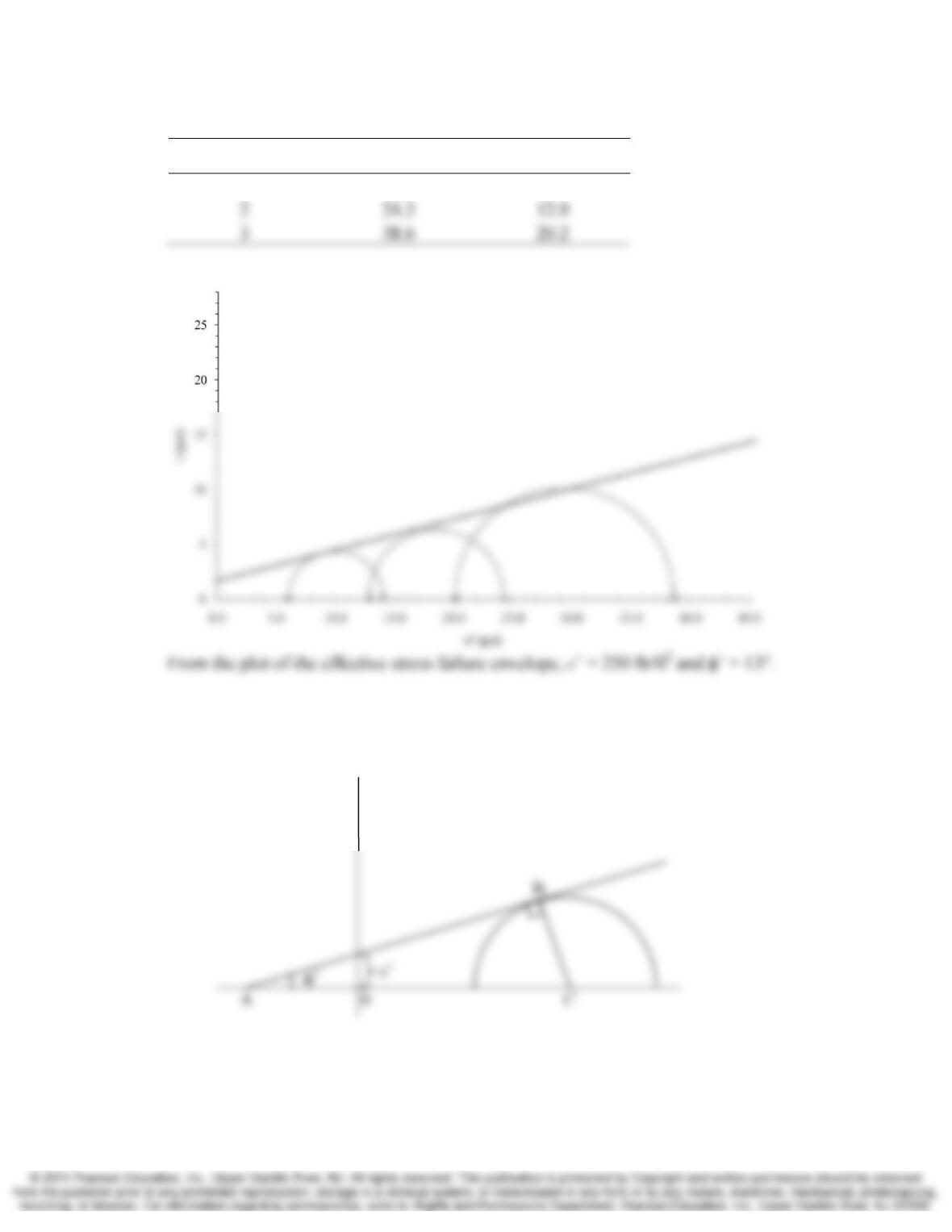
Plot the total stress and effective stress Mohr circles at failure and draw the total
stress and effective stress Mohr–Coulomb failure envelopes. Determine c′ and
φ′
, and cT
and
φ
T. Express c′ and cT in lb/ft2.
Solution
Test Number Af (in2) σdf (lb/in2)
Chap. 12 Soil Strength 12-15
Effective stress:
Test Number σ‘1f (lb/in2) σ‘3f (lb/in2)
1 14.0 6.0
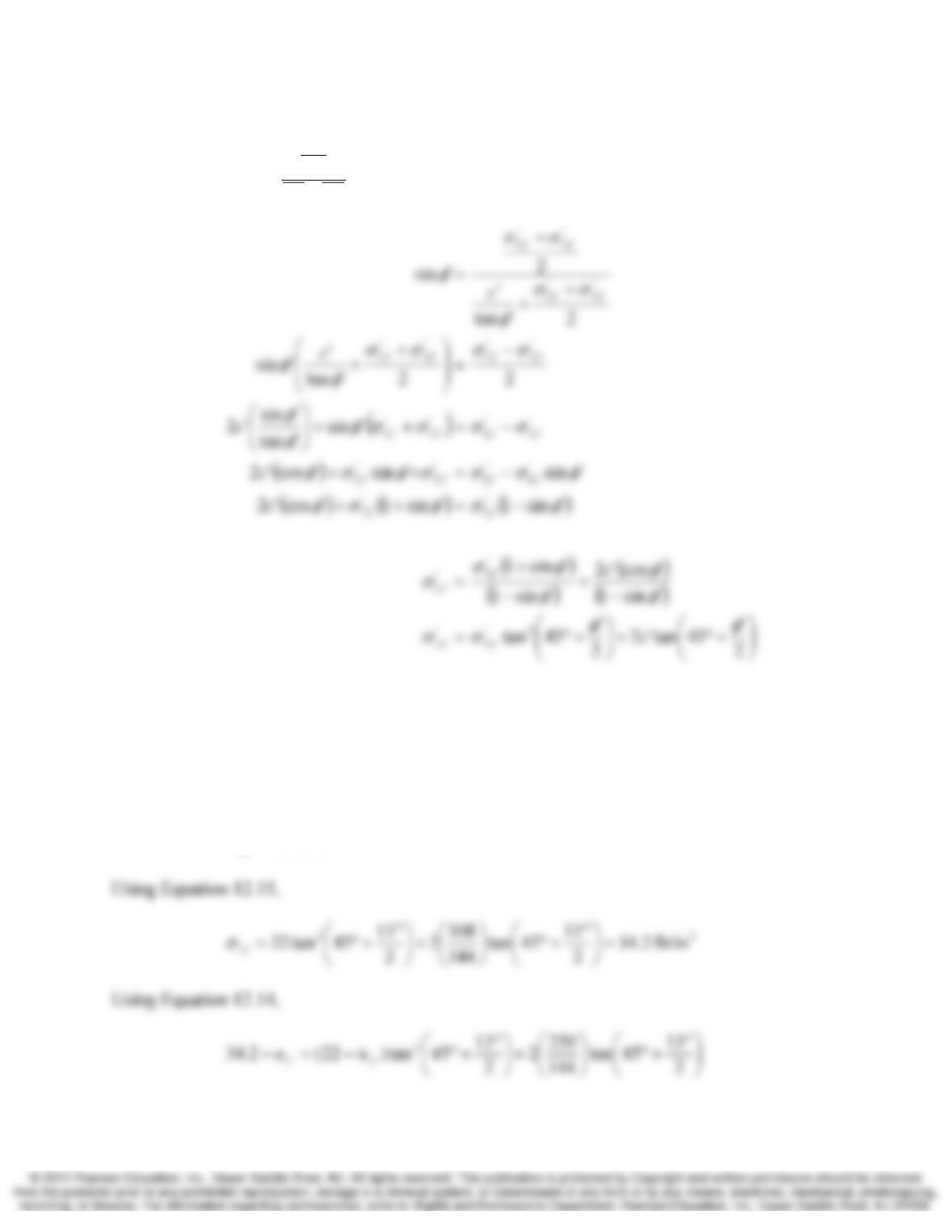
12.34 Derive Equation 12.14 or 12.15.
Solution
12-16 Soil Strength Chap. 12
Derive Equation 12.14:
C
A
BC
00
‘sin +
=
φ
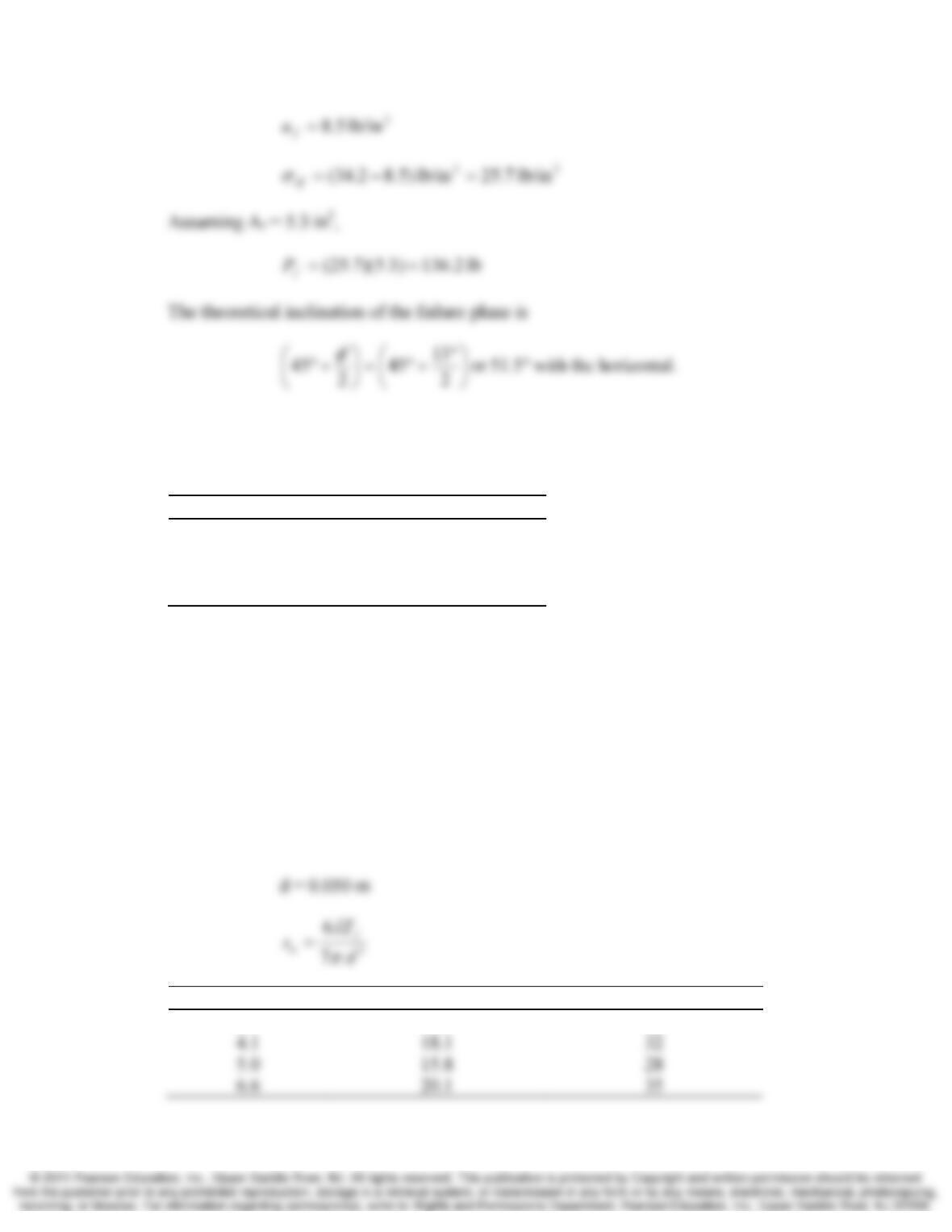
12.35 If an additional CU test with pore pressure measurement is to be performed using a σ3 of
22 lb/in.2 (typo in book) on a specimen identical to those in Problem 12.33, estimate the
Pf and uf for this additional test. What is theoretically the orientation of the failure plane
in the specimen?
Solution
2
3lb/in 22=
f
σ
Chap. 12 Soil Strength 12-17
12.36 A series of vane shear tests has been performed in a stratum of inorganic clay that has a
plasticity index of 50. The vane had a diameter of 50 mm and a height of 100 mm. The
test results were as follows:
Depth (m) Torque at Failure (N-m)
3.4 12.7
4.1 18.1
5.0 15.8
6.6 20.1
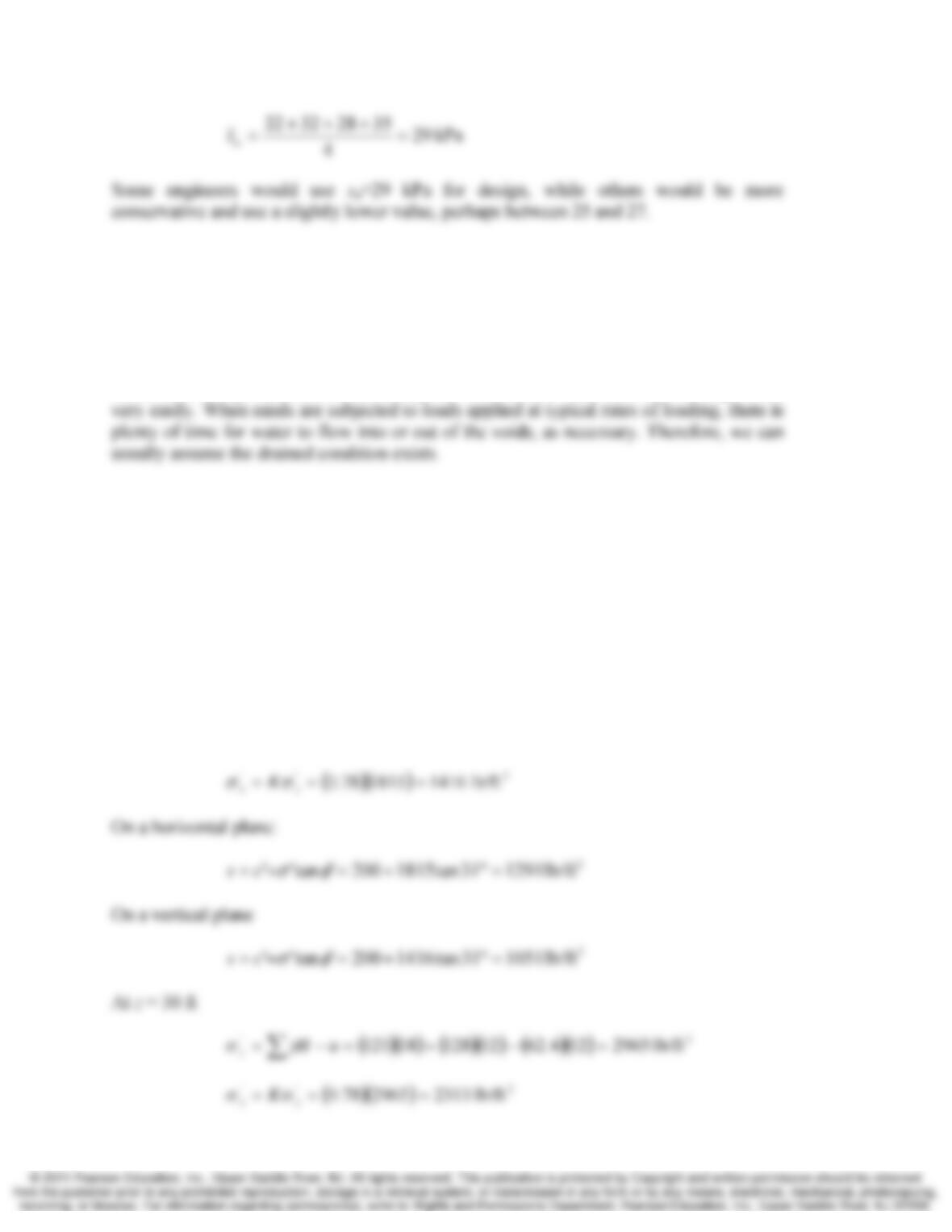
Compute the undrained shear strength, su, for each test, then combine this data to
determine a single su value for this stratum.
Note: Geotechnical engineers frequently perform multiple tests on a single
stratum, and then combine these results into one value for design. The process of doing
so is somewhat subjective, and requires the use of engineering judgement. Values
significantly larger than the mean are typically discarded, then a design value is typically
chosen somewhere between the mean and the minimum values.
Solution
80.0=
λ
(per Figure 12.39)
Depth (m) Torque at Failure (N-m) su(kPa)
3.4 12.7 22
12-18 Soil Strength Chap. 12
Comprehensive
12.37 When subjected to typical rates of loading in the field, sands are usually considered to be
under the drained condition. Why?
Solution
Sands have a high hydraulic conductivity, k, which means water can flow through them
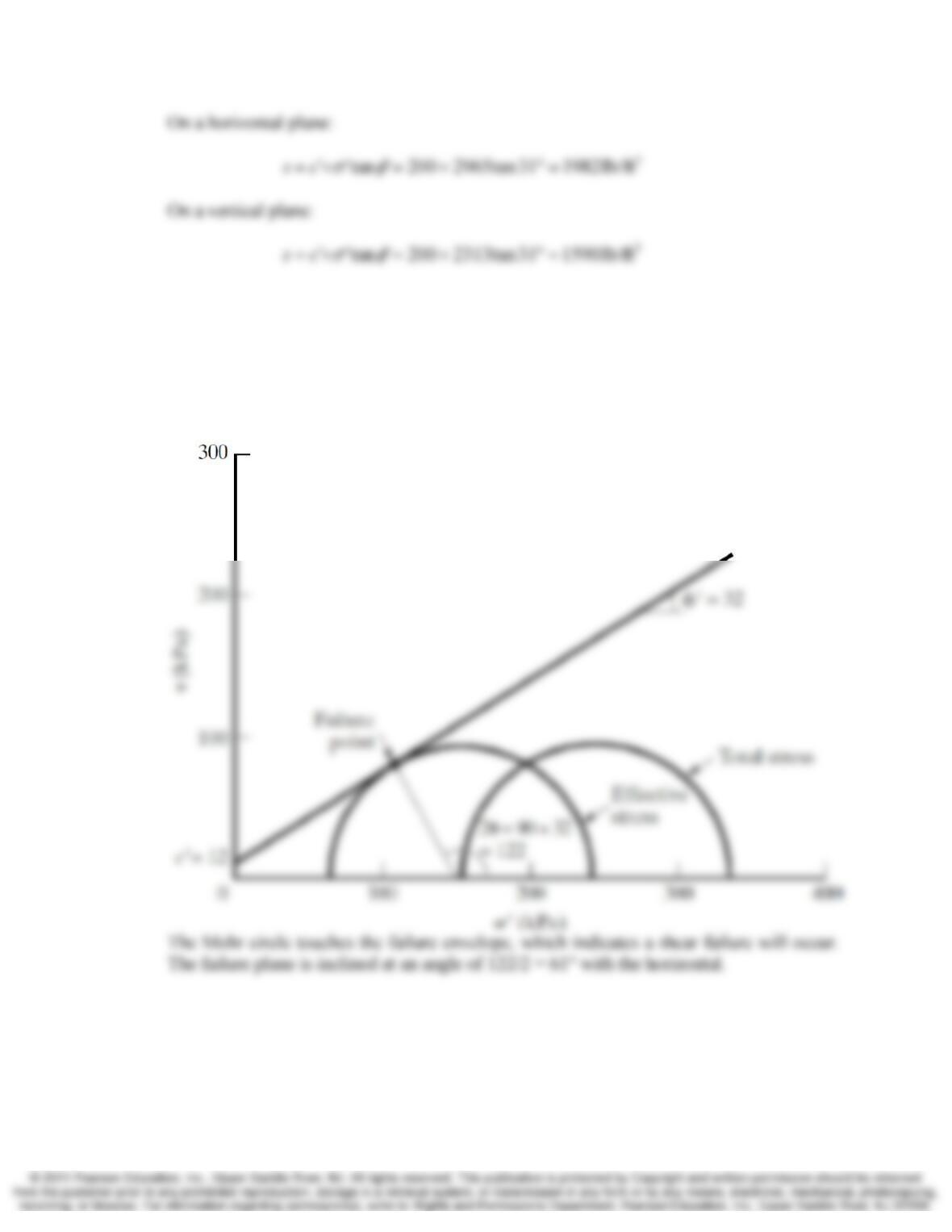
12.38 A certain soil has a unit weight of 121 lb/ft3 above the groundwater table and 128 lb/ft3
below. It has an effective cohesion of 200 lb/ft2, an effective friction angle of 31°, and
extends from the ground surface down to a great depth. The groundwater table is at a
depth of 18 ft below the ground surface, and K = 0.78. Compute the shear strength of this
soil on both vertical and horizontal planes at depths of 15 and 30 ft below the ground
surface.
Solution
At z = 15 ft
()
(
)
2‘ lb/ft 181515121 ==−= ∑uH
z
γσ
Chap. 12 Soil Strength 12-19
12.39 A certain soil has c′ = 12 kPa and
φ′
= 32°. The major and minor total principal stresses
at a point in this soil are 348 and 160 kPa, respectively, and the pore water pressure at
this point is 96 kPa. Draw the failure envelope and the Mohr circle and determine if a
shear failure will occur at this point in the soil. If so, determine the angle between the
failure plane and the plane on which the major principal stress acts.
Solution
12-20 Soil Strength Chap. 12
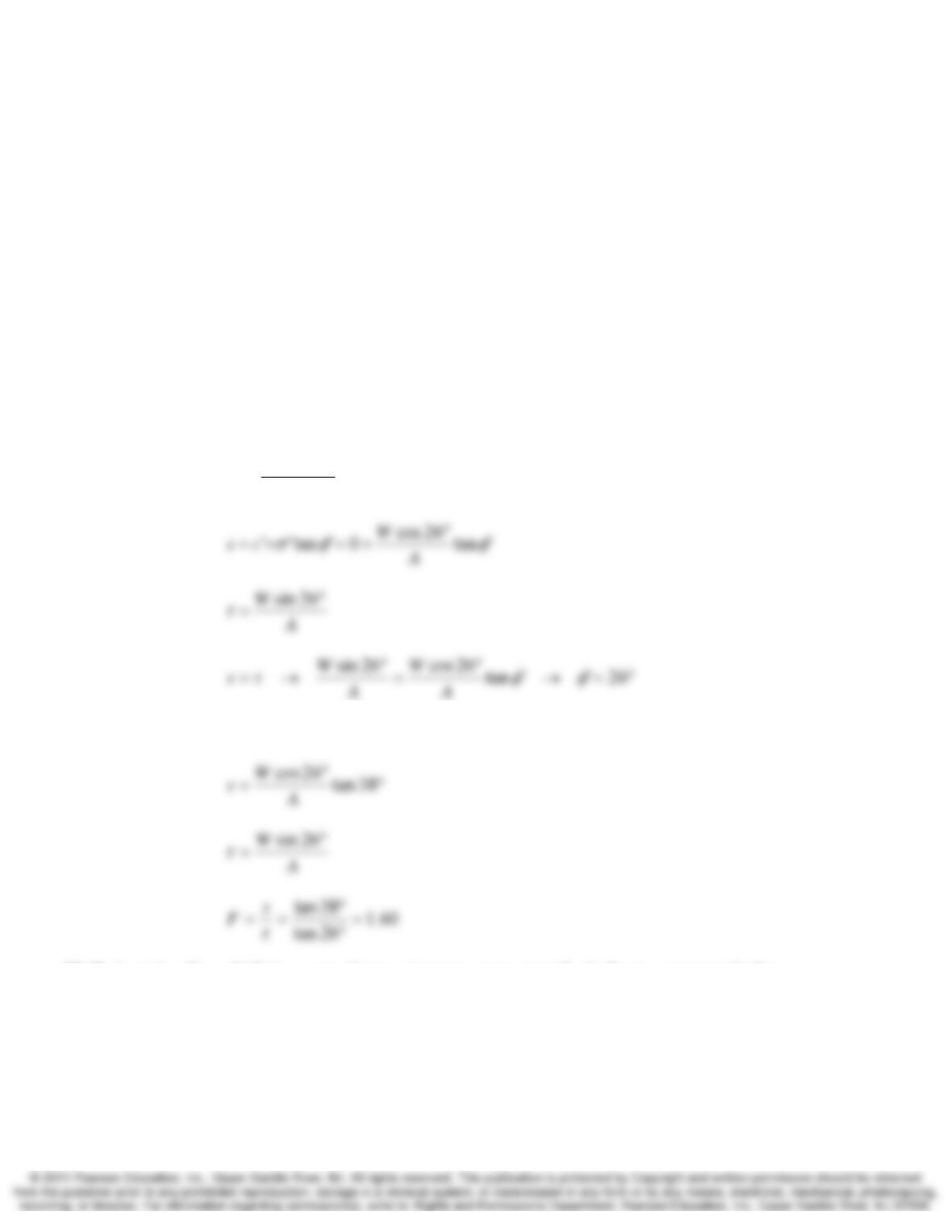
12.40 The rock outcrop shown in Figure 12.42 contains an inclined fracture. The fracture is
inclined at an angle of 26° from the horizontal.
(a) Assuming the effective cohesion along the fracture is zero, compute the lowest
possible value of the effective friction angle along the fracture. Do this
computation by assuming the factor of safety against sliding is equal to 1.0.
Hint: Set the weight of the rock above the fracture equal to W and the area of the
fracture equal to A. Then compute the vector component of W that acts parallel to the
fracture, and determine what
φ′
would be required to resist this force.
(b) If the effective cohesion and friction angle along the fracture are 0 and 38°,
respectively, compute the factor of safety against sliding.
Solution
a.
A
W°
=26cos
‘
σ
b.
12.41 A grain silo, which is a very heavy structure, was recently built on a saturated clay.
Because the harvest season was fairly short and intense, the silo was completely loaded
with grain fairly quickly (i.e., within a couple of weeks). This is the first time the silo has
been loaded. The grain weighs about twice as much as the empty silo. The combined
weight of this grain and the silo has induced both compressive and shear stresses in the
soil below.
Chap. 12 Soil Strength 12-21
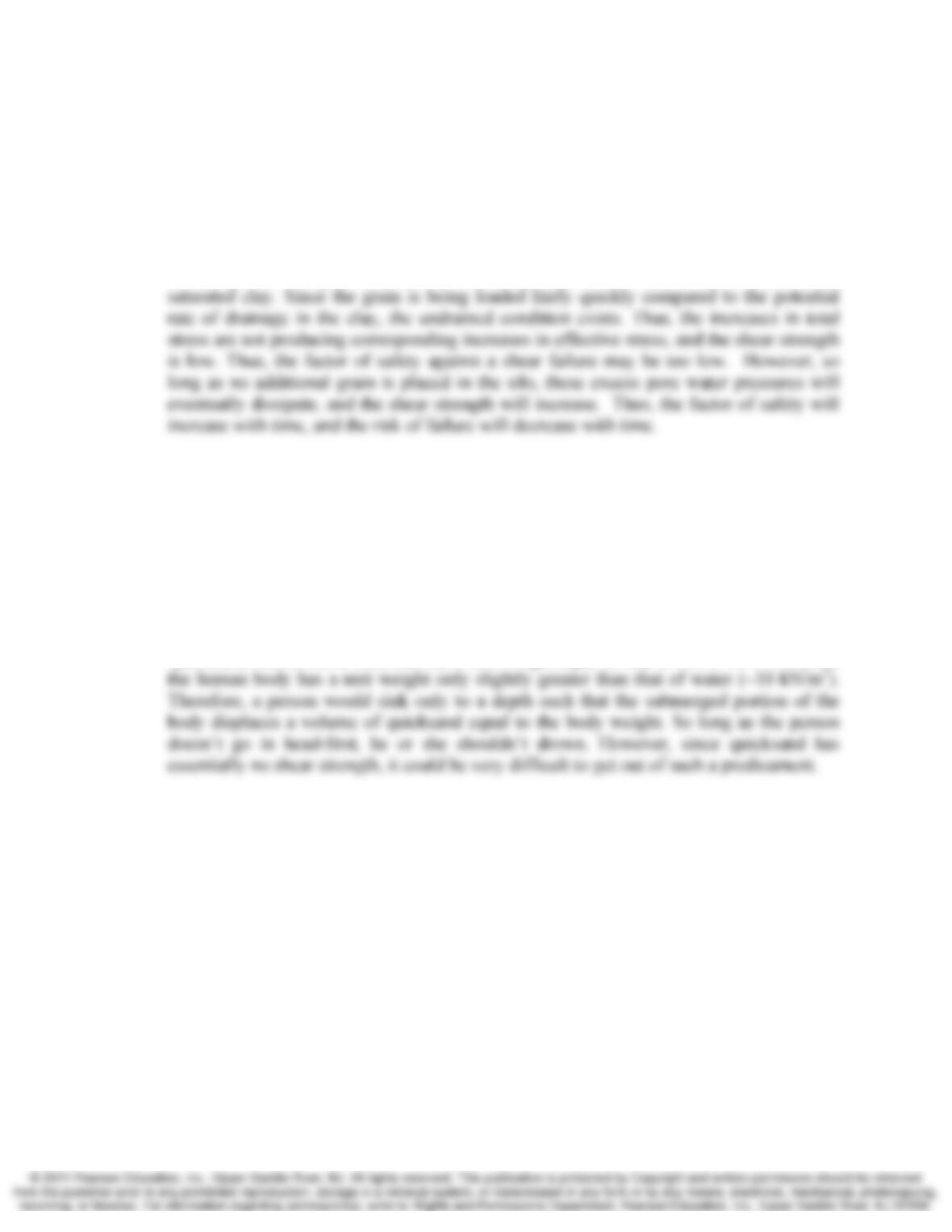
Suddenly, someone has become concerned that the soil may be about to fail in
shear under the weight of the silo and the grain. This is a legitimate concern, because
such failures have occurred before. Discuss the soil mechanics aspects of this situation
and determine whether the risk of failure in the soil is increasing, decreasing, or
remaining constant with time.
Solution
The weight of the grain and silo are inducing large normal and shear stresses in the
12.42 Hollywood movies sometimes show people “drowning” in quicksand and sinking to the
bottom. Do such scenes accurately depict reality? What would happen in real life to a
person who accidently ventured into quicksand? Explain the reasoning behind your
answer.
Hint: Compare the unit weight of a human with the unit weight of the quicksand.
Solution
Quicksand behaves as a fluid that has a unit weight equal to that of soil (~18 kN/m3), but