seCtion i • Future Value oF an annuity: ordinary and annuity due 377
REviEw ExERcisEs
Note: Round to the nearest cent when necessary.
use table 12-1 to calculate the future value of the following ordinary annuities.
Annuity
Payment
Payment
Frequency
Time
Period (years)
Nominal
Rate (%)
Interest
Compounded
Future Value
ofthe Annuity
1. $1,000 every 3 months 4 8 quarterly $18,639.29
use table 12-1 to calculate the future value of the following annuities due.
Annuity
Payment
Payment
Frequency
Time
Period (years)
Nominal
Rate (%)
Interest
Compounded
Future Value
of the Annuity
6. $400 every 6 months 12 10 semiannually $18,690.84
Solve the following exercises by using table 12-1.
11. Paragon Savings & Loan is paying
6%
interest compounded monthly. How much will
$100
deposited at the end of each month be worth after 2 years?
12. Suntech Distributors, Inc. deposits
$5,000
at the beginning of each 3-month period for 6 years
in an account paying
8%
interest compounded quarterly.
a. How much will be in the account at the end of the 6-year period?
b. What is the total amount of interest earned in this account?
13. Jess Thomas deposits
$100
each payday into an account at
6%
interest compounded monthly.
She gets paid on the last day of each month. How much will her account be worth at the end of
30 months?
14. Jorge Otero has set up an annuity due with the United Credit Union. At the beginning of each
month,
$170
is electronically debited from his checking account and placed into a savings
account earning
6%
interest compounded monthly. What is the value of Jorge’s account after
18 months?
12
Section i
Complete worked-out solutions for
Exercises 1–10 appear in Appendix B.

378 Chapter 12 • annuities
15. When Ben Taylor was born, his parents began depositing
$500
at the beginning of every yearinto
an annuity to save for his college education. If the account paid
7%
interest compounded annually
for the first 10 years and then dropped to
5%
for the next 8 years, how much is the account worth
now that Ben is 18 years old and ready for college?
Solve the following exercises by using formulas.
ordinary Annuities
Annuity
Payment
Payment
Frequency
Time
Period (years)
Nominal
Rate (%)
Interest
Compounded
Future Value
ofthe Annuity
16. $2,000 every 6 months 3 3.0 semiannually $12,459.10
Annuities due
Annuity
Payment
Payment
Frequency
Time
Period (years)
Nominal
Rate (%)
Interest
Compounded
Future Value
ofthe Annuity
19. $675 every month 5 1.5 monthly $42,082.72
22. To establish a “rainy day” cash reserve account, Bonanza Industries deposits
$10,000
of
its profit at the end of each quarter into a money market account that pays
1.75%
interest
compounded quarterly.
a. How much will the account be worth in 3 years?
b. How much will the account be worth in 4
1
2
years?
i
.004375
23. As a part of his retirement planning strategy, Mark Woodson deposits
$125
each payday into
an investment account at
3%
interest compounded monthly. Mark gets paid on the first day of
each month.
a. How much will his account be worth in 5 years?
b. How much will his account be worth in 15 years?
Complete worked-out
solutionsforExercises
16–21 appear in Appendix B.
Learning Tip
seCtion ii • present Value oF an annuity: ordinary and annuity due 379
24. Hi-Tech Hardware has been in business for a few years and is doing well. The owner has
decided to save for a future expansion to a second location. He invests
$1,000
at the end of
every month at
12%
interest compounded monthly.
a. How much will be available for the second store after 2
1
years?
b. How much would be in the account if the owner saved for 5 years?
c. How much would be in the account after 5 years if it had been an annuity due?
businEss DEcision: PlAnning YouR nEst Egg
25. As part of your retirement plan, you have decided to deposit
$3,000
at the beginning of each
year into an account paying
5%
interest compounded annually.
a. How much would the account be worth after 10 years?
b. How much would the account be worth after 20 years?
c. When you retire in 30 years, what will be the total worth of the account?
d. If you found a bank that paid
6%
interest compounded annually rather than
5%
, how much
would you have in the account after 30 years?
e. Use the future value of an annuity due formula to calculate how much you would have in the
account after 30 years if the bank in part d switched from annual compounding to monthly
compounding and you deposited
$250
at the beginning of each month instead of
$3,000
at
the beginning of each year.
Present value of an annuity:
ordinary and annuity due
In Section I of this chapter, we learned to calculate the future value of an annuity. This busi-
ness situation requires that a series of equal payments be made into an account, such as a
savings account. The annuity starts with nothing and accumulates at compound interest to
a future amount. Now consider the opposite situation. What if we wanted an account from
Section ii
12
In 1950,
16
workers contributed
to the Social Security benefit of a
single retiree. Today, approximately
and Sense
85461_ch12_hr_369-405_1.indd 379 9/23/15 4:56 PM
Review exeRcises
Note: Round to the nearest cent when necessary.
use table 12-2 to calculate the present value of the following ordinary annuities.
Annuity
Payment
Payment
Frequency
Time
Period(years)
Nominal
Rate (%)
Interest
Compounded
Present Value
of the Annuity
1. $300 every 6 months 7 10 semiannually $2,969.59
use table 12-2 to calculate the present value of the following annuities due.
Annuity
Payment
Payment
Frequency
Time
Period(years)
Nominal
Rate (%)
Interest
Compounded
Present Value
of the Annuity
6. $1,400 every year 10 11 annually $9,151.87
Solve the following exercises by using table 12-2.
11. Diamond Savings & Loan is paying
6%
interest compounded monthly. How much must be
deposited now to withdraw an annuity of
$400
at the end of each month for 2 years?
12. Jami Minard wants to receive an annuity of
$2,000
at the beginning of each year for the
next10 years. How much should be deposited now at
6%
compounded annually to accomplish
this goal?
13. As the chief accountant for Proline Industries, you have estimated that the company must pay
$100,000
income tax to the IRS at the end of each quarter this year. How much should be
deposited now at
8%
interest compounded quarterly to meet this tax obligation?
Complete worked-out solutions for
Exercises 1–10 appear in Appendix B.
tryitexerciSe 6
Use the present value of an annuity formula to solve the following.
a. Angus McDonald wants
$500
at the end of each 3-month period for the next 6 years. If Angus’s
CHECK YOUR ANSWERS WITH THE SOLUTIONS ON PAGE 398.
12
Section ii

386 Chapter 12 • annuities
14. Ron Sample is the grand prize winner in a college tuition essay contest awarded through a local
organization’s scholarship fund. The winner receives
$2,000
at the beginning of each year for
the next 4 years. How much should be invested at
7%
interest compounded annually to award
the prize?
15. Silver Tip Golf Course management has contracted to pay a golf green maintenance specialist
a
$680
monthly fee at the end of each month to provide advice on improving the quality of the
greens on its
18
-hole course. How much should be deposited now into an account that earns
6%
compounded monthly to be able to make monthly payments to the consultant for the
next year?
16. Analysts at Sky West Airlines did a 3-year projection of expenses. They calculated that the
company will need
$15,800
at the beginning of each 6-month period to buy fuel, oil, lube, and
parts for aircraft operations and maintenance. Sky West can get
6%
interest compounded semi-
annually from its bank. How much should Sky West deposit now to support the next 3 years of
operations and maintenance expenses?
Solve the following exercises by using formulas.
Present value of an ordinary annuity
Annuity
Payment
Payment
Frequency
Time
Period(yrs)
Nominal
Rate (%)
Interest
Compounded
Present Value
ofthe Annuity
17. $500 every 3 months
3
1
6.0 quarterly $5,865.77
Present value of an annuity due
Annuity
Payment
Payment
Frequency
Time
Period(yrs)
Nominal
Rate (%)
Interest
Compounded
Present Value
ofthe Annuity
20. $1,100 every year 5 5.8 annually $4,929.14
23. As part of an inheritance, Joan Townsend will receive an annuity of
$1,500
at the end of each
month for the next 6 years. What is the present value of this inheritance at a rate of
2.4%
interest
compounded monthly?
i
.002
24. Norm Legend has been awarded a scholarship from Canmore College. For the next 4 years, he
will receive
$3,500
for tuition and books at the beginning of each quarter. How much must the
school set aside now in an account earning
3%
interest compounded quarterly to pay Norm’s
scholarship?
Complete worked-out solutions for
Exercises 17–22 appear in Appendix B.
seCtion iii • sinking funds and amortization 387
business Decision: The insuRance seTTlemenT
25. Apollo Enterprises has been awarded an insurance settlement of
$5,000
at the end of each
6-month period for the next 10 years.
a. As the accountant, calculate how much the insurance company must set aside now at
6%
interest compounded semiannually to pay this obligation to Apollo.
b. How much would the insurance company have to invest now if the Apollo settlement
was changed to
$2,500
at the end of each 3-month period for 10 years and the insurance
company earned
8%
interest compounded quarterly?
c. How much would the insurance company have to invest now if the Apollo settlement was
paid at the beginning of each 3-month period rather than at the end?
sinking funds and amortization
Sinking funds and amortization are two common applications of annuities. In the previous
sections of this chapter, the amount of the annuity payment was known and you were asked
to calculate the future or present value (lump sum) of the annuity. In this section, the future
or present value of the annuity is known and the amount of the payments is calculated.
A sinking fund situation occurs when the future value of an annuity is known and the
payment required each period to amount to that future value is the unknown. Sinking funds
are accounts used to set aside equal amounts of money at the end of each period at compound
interest for the purpose of saving for a future obligation. Businesses use sinking funds to
accumulate money for such things as new equipment, facility expansion, and other expensive
CalCulating the amount of a sinking
fund Payment by table
In a sinking fund, the future value is known; therefore, we use the future value of an annuity
table (Table 12-1) to calculate the amount of the payment.
sinking fundsAccounts used to set
aside equal amounts of money at the end
of each period at compound interest for the
purpose ofsaving for a future obligation.
amortizationA financial arrangement
whereby a lump-sum obligation is incurred
at compound interest now, such as a loan,
127
Section iii
12
85461_ch12_hr_369-405_2.indd 387 9/23/15 4:56 PM
seCtion iii • sinking funds and amortization 391
Review exeRcises
Note: Round to the nearest cent when necessary.
For the following sinking funds, use table 12-1 to calculate the amount of the periodic
payments needed to amount to the financial objective (future value of the annuity).
Sinking Fund
Payment
Payment
Frequency
Time Period
(years)
Nominal
Rate (%)
Interest
Compounded
Future Value
(Objective)
1. $2,113.50 every 6 months 8 10 semiannually $50,000
you have just been hired as a loan officer at the eagle national Bank. your first assignment is
to calculate the amount of the periodic payment required to amortize (pay off) the following
loans being considered by the bank (use table 12-2).
Loan
Payment
Payment
Period
Term of
Loan(years)
Nominal
Rate(%)
Present Value
(Amount of Loan)
6. $4,189.52 every year 12 9 $30,000
ExamplE10
CalCulating amortization
payments by formula
What amortization payment is required each month at
18%
interest to pay off
$5,000
in3 years?
SolutionStrategy
To solve this amortization problem, we use
1.5%
interest rate per period
(18% ÷12)
and
36
periods
(3 years ×12 periods per year)
.
Calculator Sequence:
1 .015 36
+/
–
M
+
1
MR
MC M
+
.015
MR
5,000
tryitexerciSe 10
Apex Manufacturing recently purchased a new computer system for
$150,000
. What amortization
payment is required each month at
12%
interest to pay off this obligation in 8 years?
CHECK YOUR ANSWER WITH THE SOLUTION ON PAGE 399.
12
Section iii
392 Chapter 12 • annuities
Loan
Payment
Payment
Period
Term of
Loan(years)
Nominal
Rate(%)
Present Value
(Amount of Loan)
Solve the following exercises by using tables.
11. Everest Industries established a sinking fund to pay off a
$10,000,000
loan that comes due in
8years for a corporate yacht.
a. What equal payments must be deposited into the fund every 3 months at
6%
interest
compounded quarterly for Everest to meet this financial obligation?
40.68829
b. What is the total amount of interest earned in this sinking fund account?
12. Jennifer Kaufman bought a used Toyota Prius for
$15,500
. She made a
$2,500
down payment
and is financing the balance at Imperial Bank over a 3-year period at
12%
interest. As her
banker, calculate what equal monthly payments will be required by Jennifer to amortize the
carloan.
13. Green Thumb Landscaping buys new lawn equipment every 3 years. It is estimated that
$25,000
will be needed for the next purchase. The company sets up a sinking fund to save for
this obligation.
a. What equal payments must be deposited every 6 months if interest is
8%
compounded
semiannually?
b. What is the total amount of interest earned by the sinking fund?
14. Paul and Donna Kelsch are planning a Mediterranean cruise in 4 years and will need
$7,500
for
the trip. They decide to set up a “sinking fund” savings account for the vacation. They intend to
make regular payments at the end of each 3-month period into the account that pays
6%
interest
compounded quarterly. What periodic sinking fund payment will allow them to achieve their
vacation goal?
Complete worked-out solutions for
Exercises 8–10 appear in Appendix B.
Corporate yachts provide
companieswith ways to
recognizeemployees; secure the
undivided attention of valued
Paul Vinten/Shutterstock.com
Classroom aCtivity
To demonstrate their
understandingofthe subject,
havestudents break intosmall
answers, and resolve any differences.
seCtion iii • sinking funds and amortization 393
15. Valerie Ross is ready to retire and has saved
$200,000
for that purpose. She wants to amortize
(liquidate) that amount in a retirement fund so that she will receive equal annual payments over
the next 25 years. At the end of the 25 years, no funds will be left in the account. If the fund
earns
4%
interest, how much will Valerie receive each year?
Solve the following exercises by using the sinking fund or amortization formula.
Sinking fund payment
Sinking Fund
Payment
Payment
Frequency
Time
Period(years)
Nominal
Rate (%)
Interest
Compounded
Future Value
(Objective)
16. $345.97 every 3 months 5 6.0 quarterly $8,000
amortization payment
Loan
Payment
Payment
Frequency
Time
Period(years)
Nominal Rate
(%)
Present Value
(Amount of Loan)
19. $3,756.68 every year 10 10.6 $22,500
22. Turnberry Manufacturing has determined that it will need
$500,000
in 8 years for a new roof
on its southeastern regional warehouse. A sinking fund is established for the roof at
3.4%
compounded semiannually. What equal payments are required every 6 months to accumulate
the needed funds for the roof?
23. Randy Scott purchased a motorcycle for
$8,500
with a loan amortized over 5 years at
7.2%
interest. What equal monthly payments are required to amortize this loan?
1
−
(1
+
i)−n
1−(1 +.006)
24. Betty Price purchased a new home for
$225,000
with a
20%
down payment and the remainder
amortized over a 15-year period at
9%
interest.
a. What amount did Betty finance?
b. What equal monthly payments are required to amortize this loan over 15 years?
c. What equal monthly payments are required if Betty decides to take a 20-year loan rather
thana 15-year loan?
Exercises 16–21 appear in Appendix B.
withdrawn each year
20
40
50
Years
85461_ch12_hr_369-405_3.indd 393 9/23/15 4:56 PM
394 Chapter 12 • annuities
25. The Shangri-La Hotel has a financial obligation of
$1,000,000
due in 5 years for kitchen
equipment. A sinking fund is established to meet this obligation at
7.5%
interest compounded
monthly.
a. What equal monthly sinking fund payments are required to accumulate the needed amount?
b. What is the total amount of interest earned in the account?
Business Decision: Don’t FoRget inFlation!
26. You are the vice president of finance for Neptune Enterprises, Inc., a manufacturer of scuba
diving gear. The company is planning a major plant expansion in 5 years. You have decided to
start a sinking fund to accumulate the funds necessary for the project. Your company’s invest-
ments yield
8%
compounded quarterly. It is estimated that
$2,000,000
in today’s dollars will
be required; however, the inflation rate on construction costs and plant equipment is expected to
average
5%
per year for the next 5 years.
a. Use the compound interest concept from Chapter 11 to determine how much will be required
for the project, taking inflation into account.
b. What sinking fund payments will be required at the end of every 3-month period to
accumulate the necessary funds?
9.0
11.0
7.0
10.5
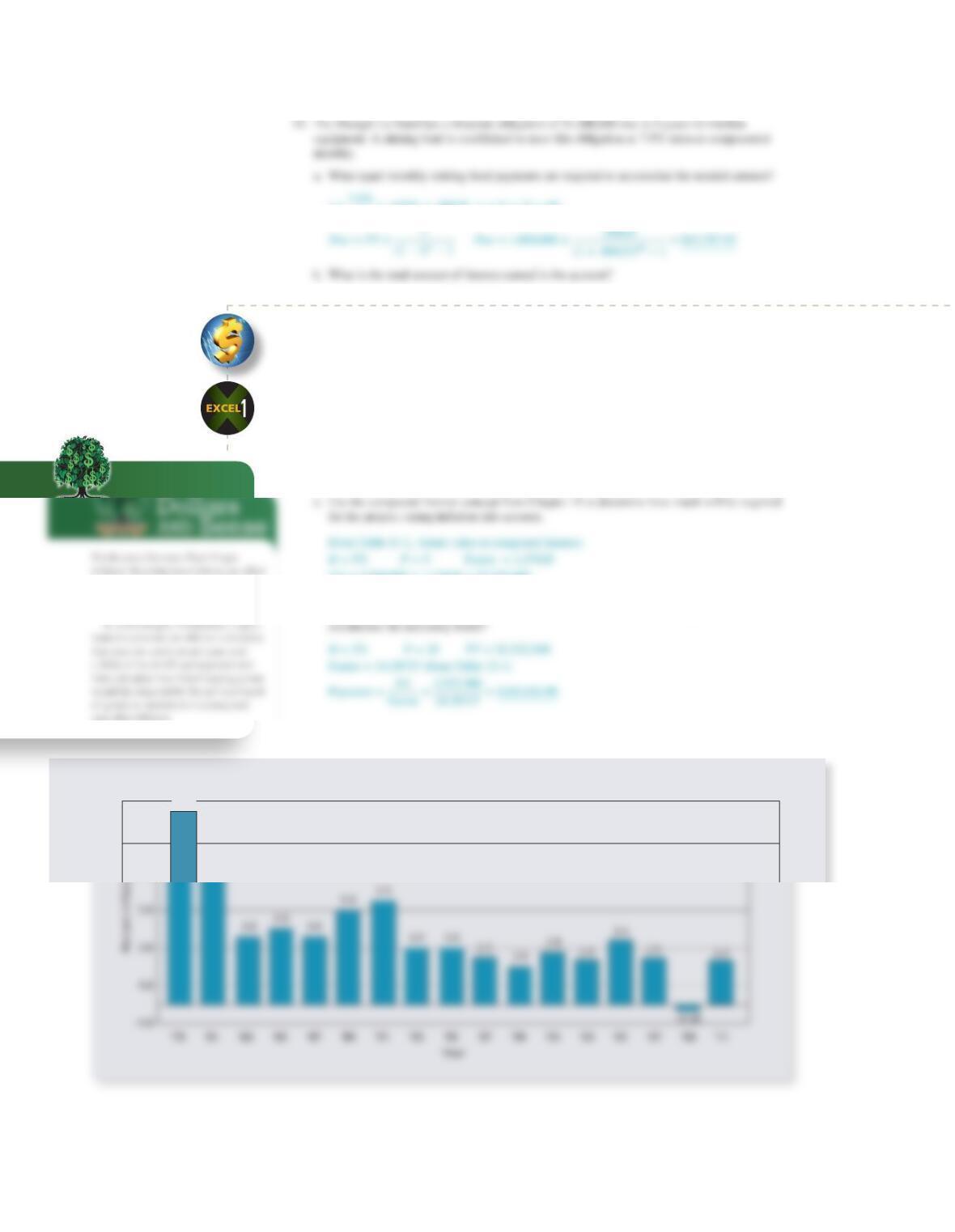
Inflation Rates 1979–2011
Notice how much more the project will
cost in 5 years because of rising prices.
At www.bls.gov, the Bureau of Labor
Dollars
85461_ch12_hr_369-405_3.indd 394 9/23/15 4:56 PM