12-1
CHAPTER 12
Intangible Assets
ASSIGNMENT CLASSIFICATION TABLE (BY TOPIC)
Topics
Questions
Brief
Exercises
Exercises
Problems
Concepts
for Analysis
1.
Intangible assets;
concepts, definitions;
items comprising
intangible assets.
1, 2, 3, 4, 5, 6,
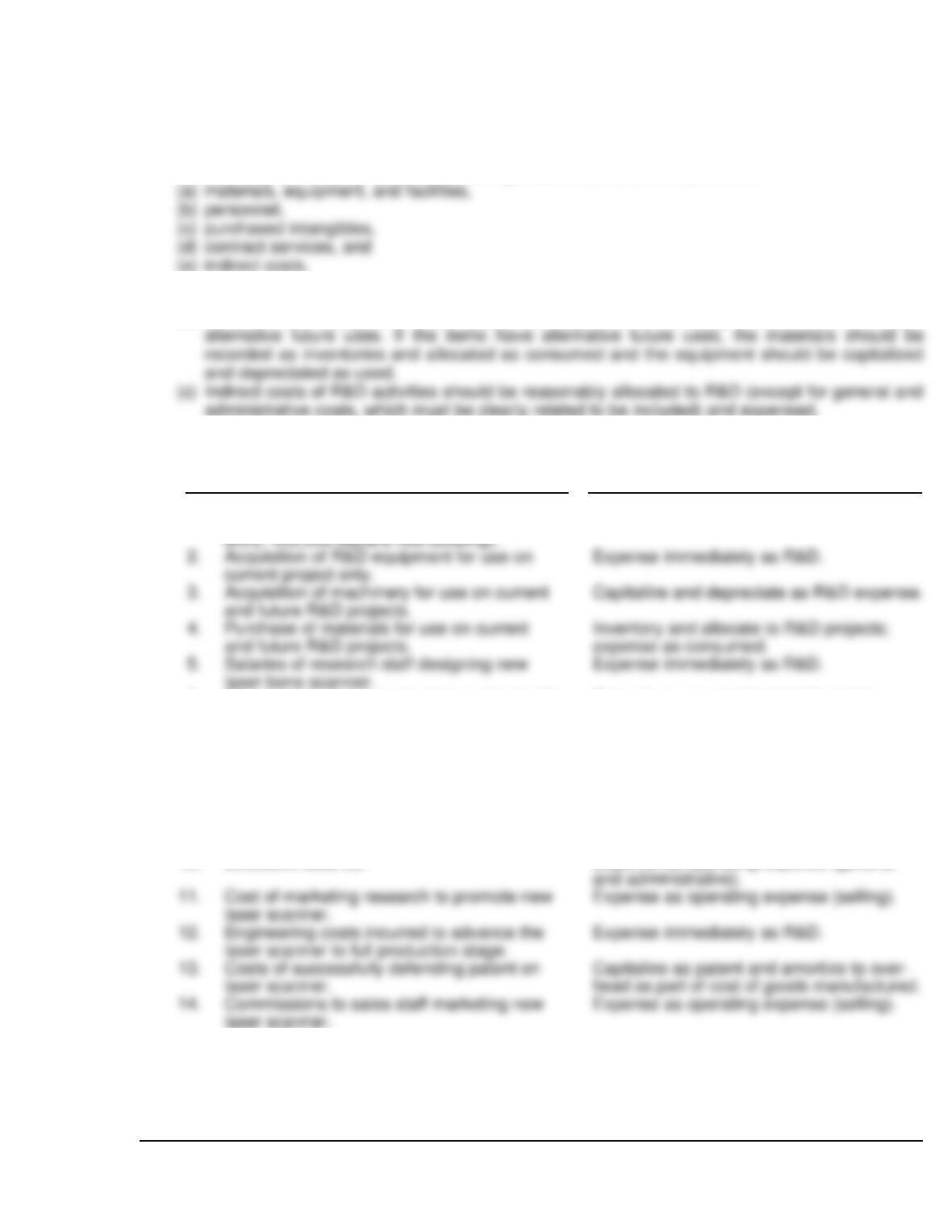
7, 8, 9, 10, 11,
12, 13, 14
1, 2, 3,
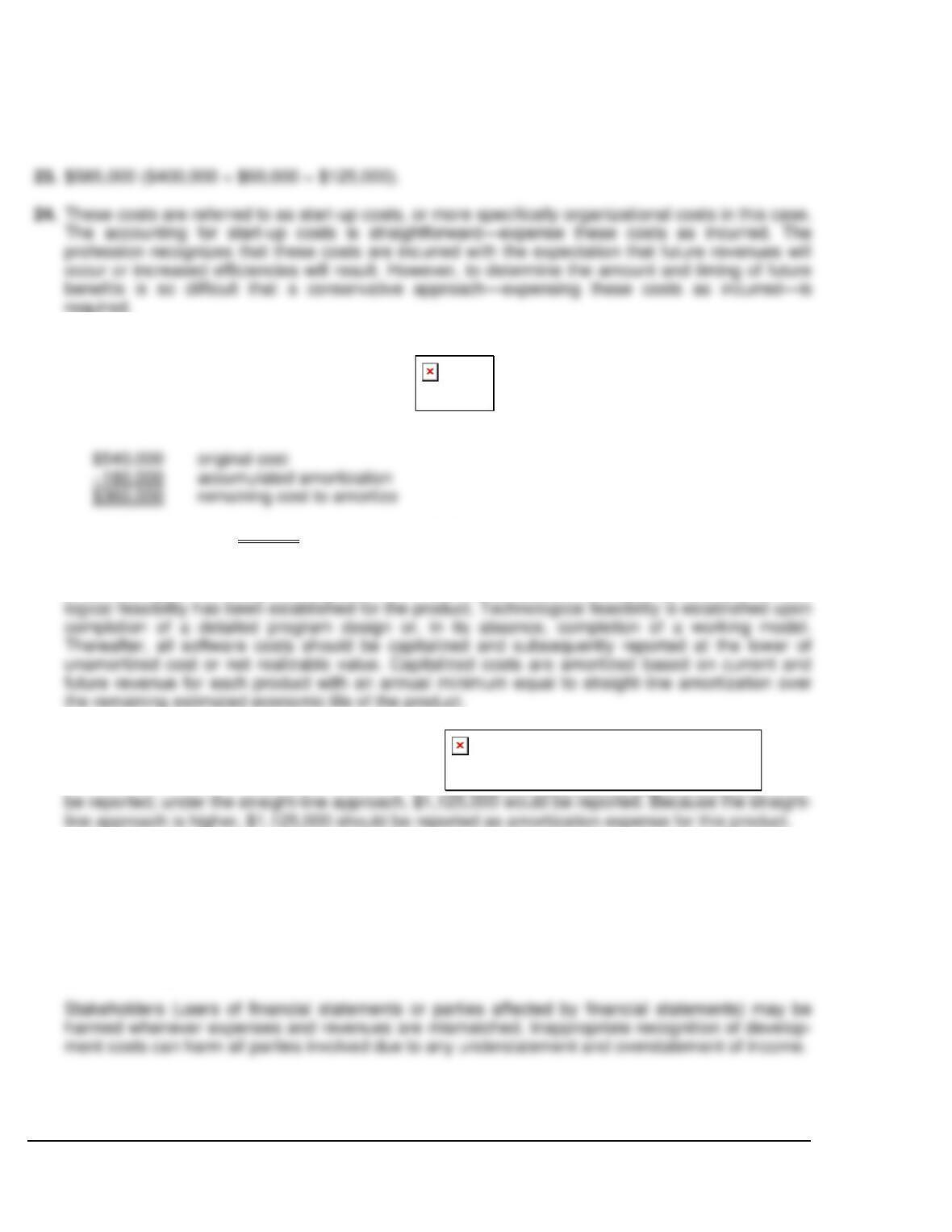
5, 6
1, 2, 3, 4
1, 2, 3
4.
Impairment of
intangibles.
15, 16, 17, 18
6, 7, 8
14, 15
6
5.
Research and
development costs
and similar costs.
19, 20, 21,
22, 23, 24
9, 10, 11, 12
4, 16, 17
1, 2, 3
4, 5
Computer software
costs.
26, 27, 28
14
18, 19
organization costs;
trade name.
7, 12, 13
8, 9, 10,
4, 6
3.
Goodwill.
12, 13, 14, 18
5, 7, 8
6, 12, 13,
5, 6
12-2
ASSIGNMENT CLASSIFICATION TABLE (BY LEARNING OBJECTIVE)
Learning Objectives
Brief
Exercises
Exercises
Problems
1.
Describe the characteristics of intangible assets.
1, 2, 3
4.
Describe the types of intangible assets.
1, 2, 3
5.
Explain the conceptual issues related to goodwill.
12, 13
6.
Describe the accounting procedures for recording
goodwill.
5
12, 13, 15
5, 6
7.
Explain the accounting issues related to intangible–
asset impairments.
6, 7, 8
14, 15
5, 6
Identify the conceptual issues related to research
and development costs.
5, 9
9.
Describe the accounting for research and
development and similar costs.
9, 10, 11, 12
4, 6, 8,
16, 17
4
10.
Indicate the presentation of intangible assets
and related items.
13
4, 6
*11.
Understand the accounting treatment for computer
software costs.
14
18, 19
2.
Identify the costs to include in the initial valuation
of intangible assets.
1, 2, 3, 4
5, 7, 9,
10, 11
1, 2, 3, 6
3.
Explain the procedure for amortizing intangible
assets.
1, 2, 3, 4,
12, 13
4, 5, 6, 7, 9,
10, 11, 13
1, 2, 3, 6
12-3
ASSIGNMENT CHARACTERISTICS TABLE
Item
Description
Level of
Difficulty
Time
(minutes)
E12-1
Classification issues—intangibles.
Moderate
15–20
E12-2
Classification issues—intangibles.
Simple
10–15
E12-3
Classification issues—intangible asset.
Moderate
10–15
E12-10
Accounting for patents.
Moderate
20–25
E12-11
Accounting for patents.
Moderate
15–20
E12-12
Accounting for goodwill.
Moderate
20–25
E12-13
Accounting for goodwill.
Simple
10–15
E12-14
Copyright impairment.
15–20
E12-15
Goodwill impairment.
Simple
15–20
E12-16
Accounting for R&D costs.
Moderate
15–20
E12-17
Accounting for R&D costs.
Moderate
10–15
Accounting for computer software costs.
Moderate
10–15
Accounting for computer software costs.
Moderate
15–20
P12-1
Correct intangible asset account.
Moderate
15–20
P12-2
Accounting for patents.
Moderate
20–30
P12-3
Accounting for franchise, patents, and trade name.
Moderate
20–30
P12-4
Accounting for R&D costs.
Moderate
15–20
P12-5
Goodwill, impairment.
Complex
25–30
P12-6
Comprehensive intangible assets.
Moderate
30–35
CA12-1
Accounting for pollution expenditure.
Moderate
25–30
CA12-2
Accounting for pre-opening costs.
Moderate
20–25
CA12-3
Accounting for patents.
Moderate
25–30
CA12-4
Accounting for research and development costs.
Moderate
25–30
CA12-5
Accounting for research and development costs.
Moderate
20–25
E12-4
Intangible amortization.
Moderate
15–20
E12-5
Correct intangible asset account.
Moderate
15–20
E12-6
Recording and amortization of intangibles.
Simple
15–20
E12-7
Accounting for trade name.
Simple
10–15
E12-8
Accounting for organization costs.
Simple
10–15
E12-9
Accounting for patents, franchises, and R&D.
Moderate
15–20
SOLUTIONS TO CODIFICATION EXERCISES
CE12-1
According to the Master Glossary:
(a) Intangible assets are assets (not including financial assets) that lack physical substance. (The
term intangible assets is used to refer to intangible assets other than goodwill.)
(c) Research and Development:
Research is planned search or critical investigation aimed at discovery of new knowledge with the
hope that such knowledge will be useful in developing a new product or service (referred to as
product) or a new process or technique (referred to as process) or in bringing about a significant
improvement to an existing product or process.
CE12-2
See FASB ASC 350-30–35. In the discussions related to “Determining the Useful Life of an Intangible
Asset”
35-1 The accounting for a recognized intangible asset is based on its useful life to the reporting
35-2 The useful life of an intangible asset to an entity is the period over which the asset is expected
to contribute directly or indirectly to the future cash flows of that entity. The useful life is not the
12-5
CE12-2 (Continued)
35-3 The estimate of the useful life of an intangible asset to an entity shall be based on an analysis of
all pertinent factors, in particular, all of the following factors with no one factor being more
presumptive than the other:
a. The expected use of the asset by the entity.
b. The expected useful life of another asset or a group of assets to which the useful life of the
intangible asset may relate.
Further, if an income approach is used to measure the fair value of an intangible asset, in
determining the useful life of the intangible asset for amortization purposes, an entity shall
consider the period of expected cash flows used to measure the fair value of the intangible
asset adjusted as appropriate for the entity-specific factors in this paragraph.
35-4 If no legal, regulatory, contractual, competitive, economic, or other factors limit the useful life of
an intangible asset to the reporting entity, the useful life of the asset shall be considered to be
certain trademarks, and taxicab medallions.
CE12-3
According the FASB ASC 730-10-50:
50-1 Disclosure shall be made in the financial statements of the total research and development
12-6
CE12-4
According the FASB ASC 926-720-25,
General
Overall Deals
25-1 An entity may enter into an overall deal arrangement. An entity shall charge the costs of overall
ANSWERS TO QUESTIONS
1. The two main characteristics of intangible assets are:
2. If intangibles are acquired for stock, the cost of the intangible is the fair value of the consideration
given or the fair value of the consideration received, whichever is more clearly evident.
4. When intangibles are created internally, it is often difficult to determine the validity of any future
service potential. To permit deferral of these types of costs would lead to a great deal of subject-
5. Companies cannot capitalize self-developed, self-maintained, or self-created goodwill. These expen-
ditures would most likely be reported as selling expenses.
6. Factors to be considered in determining useful life are:
(a) The expected use of the asset by the entity.
(b) The expected useful life of another asset or a group of assets to which the useful life of the
7. The amount of amortization expensed for a limited-life intangible asset should reflect the pattern in
8. This trademark is an indefinite life intangible and, therefore, should not be amortized.
9. The $190,000 should be expensed as research and development expense in 2012. The $91,000 is
10. Amortization Expense ………………………………………………………….. 35,000
Patents (or Accumulated Patent Amortization) ……………………. 35,000
Straight-line amortization is used because the pattern of use cannot be reliably determined.
11. Artistic-related intangible assets involve ownership rights to plays, pictures, photographs, and
Questions Chapter 12 (Continued)
12. Varying approaches are used to define goodwill. They are
(a) Goodwill should be measured initially as the excess of the fair value of the acquisition cost
over the fair value of the net assets acquired. This definition is a measurement definition but
does not conceptually define goodwill.
13. Goodwill is recorded only when it is acquired by purchase. Goodwill acquired in a business
combination is considered to have an indefinite life and therefore should not be amortized, but
should be tested for impairment on at least an annual basis.
14. Many analysts believe that the value of goodwill is so subjective that it should not be given the
same status as other types of assets such as cash, receivables, inventory, etc. The analysts are
15. Accounting standards require that if events or changes in circumstances indicate that the carrying
amount of such assets may not be recoverable, then the carrying amount of the asset should be
assessed. The assessment or review takes the form of a recoverability test that compares the sum
16. Under U.S. GAAP, impairment losses on assets held for use may not be restored.
17. Impairment losses are reported as part of income from continuing operations, generally in the
“Other expenses and losses” section. Impairment losses (and recovery of losses for assets to be
18. The amount of goodwill impaired is $40,000, computed as follows:
Recorded goodwill ………………………………………… $400,000
Implied goodwill ……………………………………………. (360,000)
Impaired goodwill ………………………………………….. $ 40,000
12-9
Questions Chapter 12 (Continued)
19. Research and development costs are incurred to develop new products or processes, to improve
present products, or to discover new knowledge. R&D expenditures present problems of
(1) identifying the costs associated with particular activities, projects, or achievements, and
(2) determining the magnitude of the future benefits and the length of time over which such
benefits may be realized. R&D activities may incur costs classified as follows:
20. (a) Personnel (labor) type costs incurred in R&D activities should be expensed as incurred.
(b) Materials and equipment costs should be expensed immediately unless the items have
21. See Illustration 12-14 (page 683).
Type of Expenditure
Accounting Treatment
2. Acquisition of R&D equipment for use on
current project only.
Expense immediately as R&D.
3. Acquisition of machinery for use on current
and future R&D projects.
Capitalize and depreciate as R&D expense.
5. Salaries of research staff designing new
laser bone scanner.
Expense immediately as R&D.
1. Construction of long-range research facility
for use in current and future projects (three-
Capitalize and depreciate as R&D expense
6. Research costs incurred under contract with
New Horizon, Inc., and billable monthly.
Record as a receivable (reimbursable
expenses).
7. Material, labor, and overhead costs of
prototype laser scanner.
Expense immediately as R&D.
8. Costs of testing prototype and design
modifications.
Expense immediately as R&D.
9. Legal fees to obtain patent on new laser
scanner.
Capitalize as patent and amortize to
overhead as part of cost of goods
manufactured.
10. Executive salaries.
laser scanner to full production stage.
Expense immediately as R&D.
Capitalize as patent and amortize to over-
laser scanner.
Expense as operating expense (selling).
Expense as operating expense (general
(a) Expense as R&D.
(b) Expense as R&D.
(c) Capitalize as patent and/or license and amortize.
12–10
Questions Chapter 12 (Continued)
22. Each of these items should be charged to current operations. Advertising costs have some minor
exceptions to this general rule. However, the specific accounting is beyond the scope of this
textbook.
required.
25. The total life, per revised facts, is 40 years (10 + 30). There are 30 (40 – 10) remaining years for
amortization purposes. Original amortization: = $18,000 per year; $18,000 X 10 years
expired = $180,000 accumulated amortization.
$360,000 ÷ 30 years = $12,000 amortization for 2012 and years thereafter.
*26. The profession’s position is that costs incurred internally in creating a computer software product
to be sold should be charged to expense when incurred as research and development until techno-
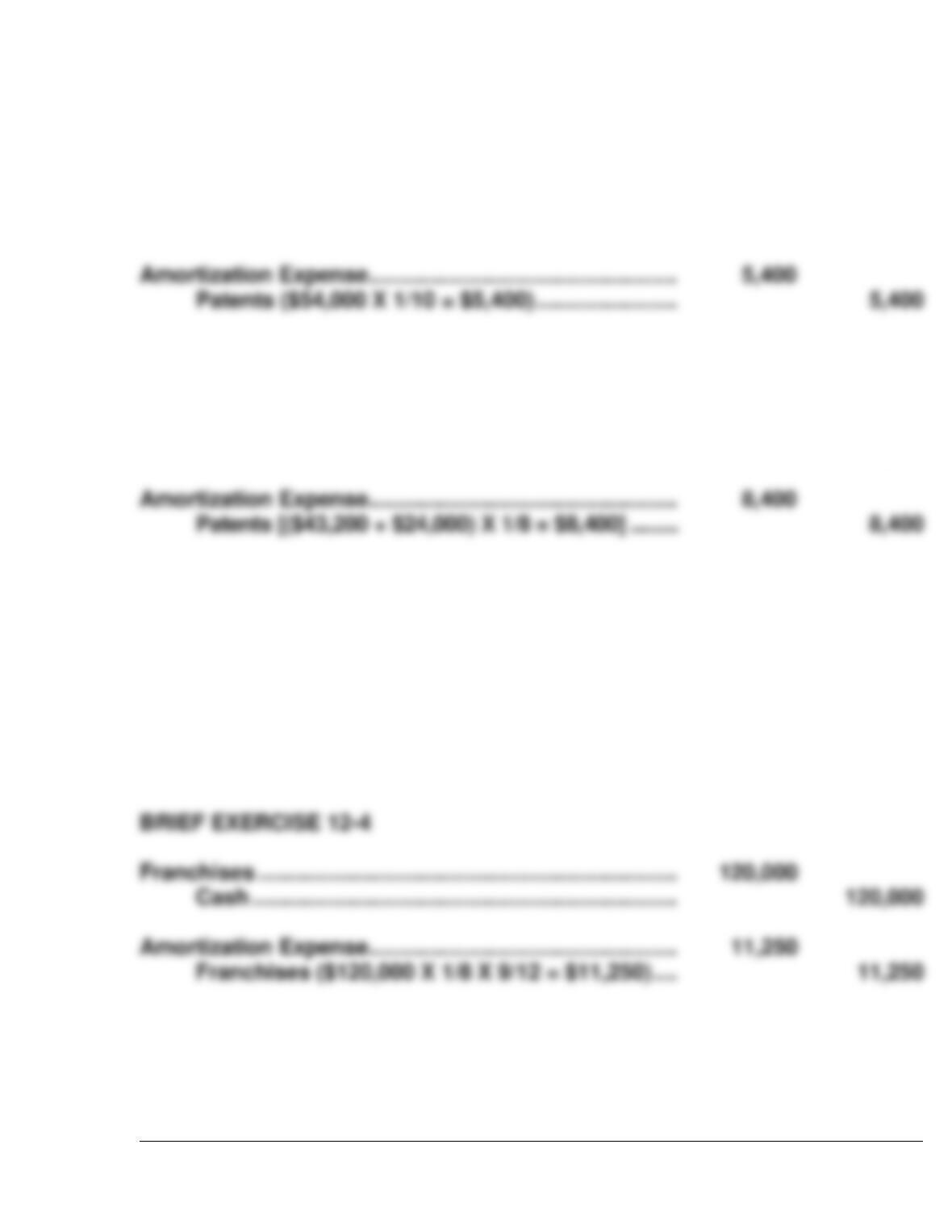
*27. Under the percent of revenue approach, $900,000 would
*28. Expensing the development cost in the current year is appropriate when the costs are classified as
research and development costs and the computer software is to be sold, leased, or marketed to
third parties.
Capitalizing the development cost of the software package over its estimated useful life is
appropriate if the costs are subsequent to achieving technological feasibility and future benefits
are reasonably certain.
12–11
SOLUTIONS TO BRIEF EXERCISES
BRIEF EXERCISE 12-1
Patents …………………………………………………………………..
54,000
Cash ………………………………………………………………
54,000
BRIEF EXERCISE 12-2
Patents …………………………………………………………………..
24,000
Cash ………………………………………………………………
24,000
Amortization Expense ……………………………………………..
Patents [($43,200 + $24,000) X 1/8 = $8,400] ………..
8,400
BRIEF EXERCISE 12-3
Trade Names …………………………………………………………..
68,000
Cash ………………………………………………………………
68,000
Amortization Expense ……………………………………………..
8,500
Trade Names ($68,000 X 1/8 = $8,500) ………………
8,500
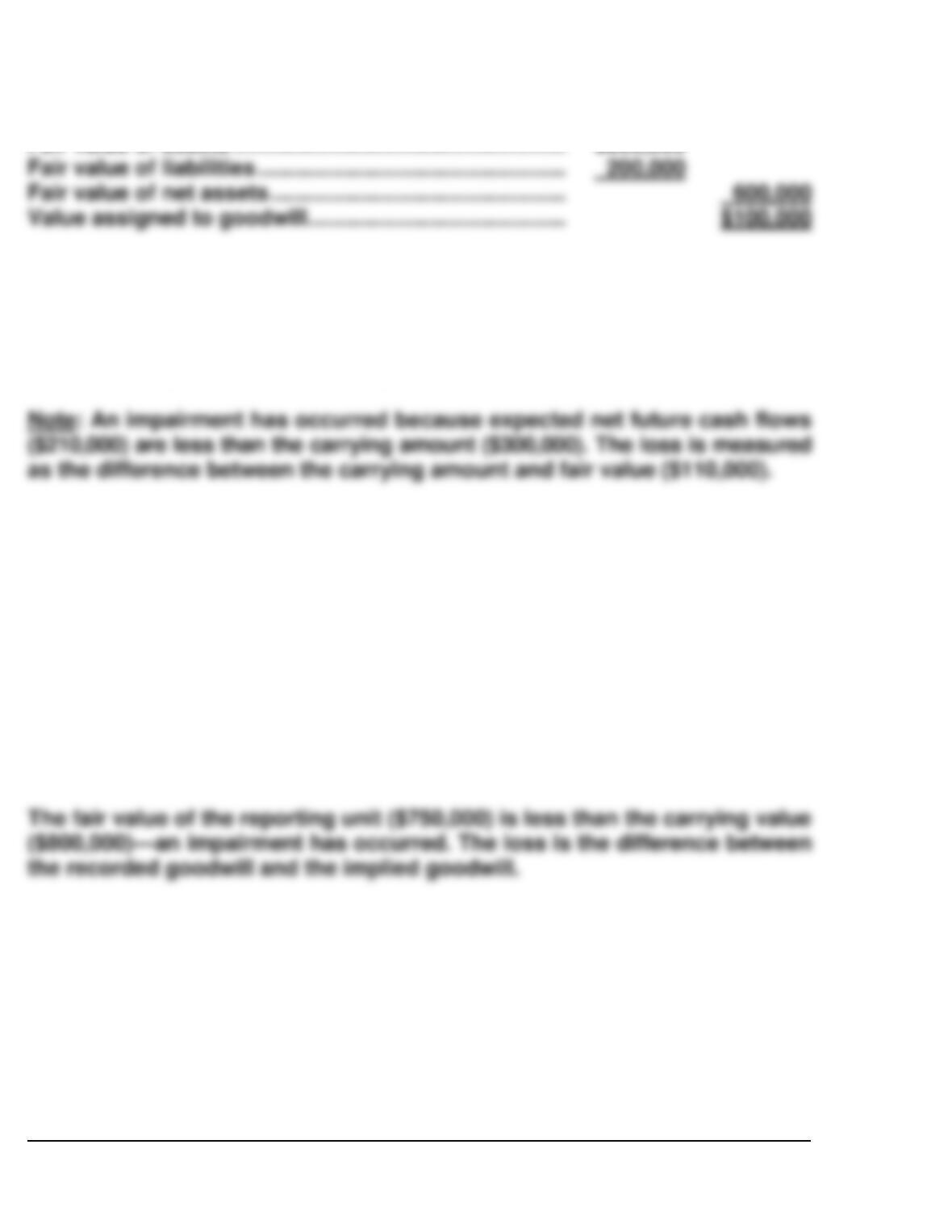
Franchises ……………………………………………………………..
Cash ………………………………………………………………
Amortization Expense ……………………………………………..
Franchises ($120,000 X 1/8 X 9/12 = $11,250) …….
11,250
Amortization Expense ……………………………………………..
Patents ($54,000 X 1/10 = $5,400) ……………………..
5,400
12–12
BRIEF EXERCISE 12-5
Purchase price ……………………………………………………..
$700,000
Fair value of assets ………………………………………………
$800,000
BRIEF EXERCISE 12-6
Loss on Impairment ………………………………………………..
190,000
Patents ($300,000 – $110,000) ………………………….
190,000
BRIEF EXERCISE 12-7
Because the fair value of the division exceeds the carrying amount of the
assets, goodwill is not considered to be impaired. No entry is necessary.
BRIEF EXERCISE 12-8
Loss on Impairment ($400,000 – $350,000) ………………..
50,000
Goodwill ……………………………………………………….
50,000
BRIEF EXERCISE 12-9
Organization Expense ……………………………………………..
60,000
Cash ………………………………………………………………
60,000
Fair value of liabilities …………………………………………..
Fair value of net assets …………………………………………
12–13
BRIEF EXERCISE 12-10
Research and Development Expense ……………………….
430,000
Cash ………………………………………………………………
430,000
BRIEF EXERCISE 12-11
BRIEF EXERCISE 12-12
Carrying
Amount
Life in
Months
Amortization
Per Month
Months
Amortization
Carrying amount ………………………………………………
$373,000
Less: Amortization of patent (12 X $3,000) …………
(36,000)
Legal costs amortization (1 X $1,000) ………
(1,000)
Carrying amount 12/31/12 ………………………………….
$336,000
BRIEF EXERCISE 12-13
*BRIEF EXERCISE 12-14
Percent of revenue approach
$800,000 X
$420,000
= $240,000
$1,400,000*
SOLUTIONS TO EXERCISES
EXERCISE 12-1 (15–20 minutes)
(a) 10, 13, 15, 16, 17, 19, 23
(b) 1. Long-term investments in the balance sheet.
2. Property, plant, and equipment in the balance sheet.
8. Operating losses in the income statement.
9. Charge as expense in the income statement.
11. Not recorded; any costs related to creating goodwill incurred
internally must be expensed.
EXERCISE 12-2 (10–15 minutes)
The following items would be classified as an intangible asset:
Cable television franchises Film contract rights
Music copyrights Customer lists
12–16
EXERCISE 12-2 (Continued)
Research and development costs would be classified as an operating
expense.
EXERCISE 12-3 (10–15 minutes)
(a)
Trademarks ……………………………………………………….………
$20,000
Excess of cost over fair value of net identifiable
assets of acquired subsidiary (goodwill) ………………….
75,000
Total intangible assets ……………………………………………….
$95,000
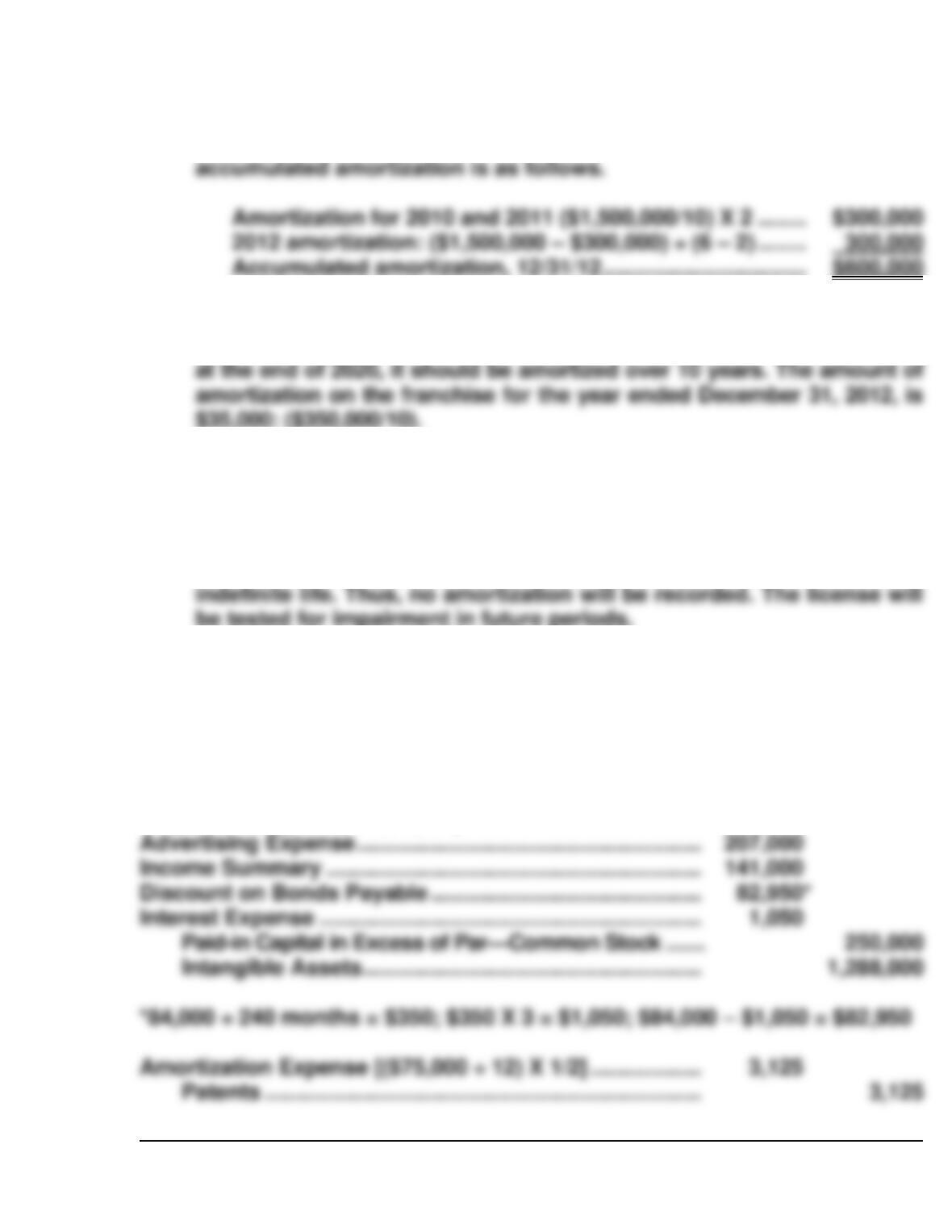
(b) Organization costs, $24,000, should be expensed.
Discount on bonds payable, $35,000, should be reported as a contra
account to bonds payable in the long-term liabilities section.
12–17
EXERCISE 12-4 (15–20 minutes)
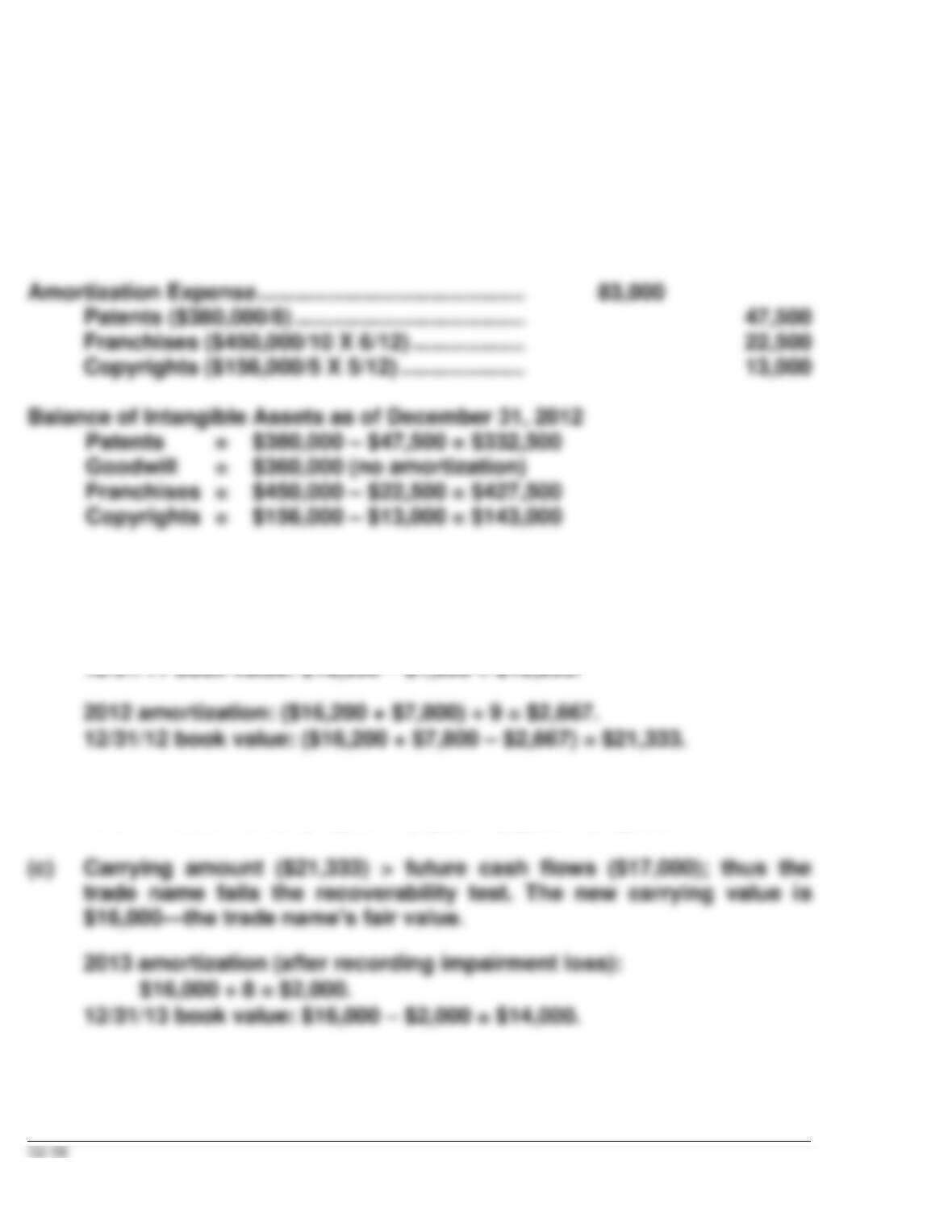
1. Palmiero should report the patent at $900,000 (net of $600,000
accumulated amortization) on the balance sheet. The computation of
2. Palmiero should amortize the franchise over its estimated useful life.
Because it is uncertain that Palmiero will be able to retain the franchise
3. These costs should be expensed as incurred. Therefore $275,000 of
organization expense were reported in income for 2010 with none
expensed in 2012.
4. Because the license can be easily renewed (at nominal cost), it has an
EXERCISE 12-5 (15–20 minutes)
Research and Development Expense ………………………..
940,000
Patents ……………………………………………………………………
75,000
Rent Expense [(5 ÷ 7) X $91,000] ……………………………….
65,000
Prepaid Rent [(2 ÷ 7) X $91,000] ………………………………..
26,000
Advertising Expense ………………………………………………..
Income Summary …………………………………………………….
Discount on Bonds Payable ……………………………………..
82,950*
Interest Expense ……………………………………………………..
Paid–in Capital in Excess of Par—Common Stock …….
Intangible Assets ……………………………………………….
Amortization for 2010 and 2011 ($1,500,000/10) X 2 ……..
2012 amortization: ($1,500,000 – $300,000) ÷ (6 – 2) ……..
EXERCISE 12-6 (15–20 minutes)
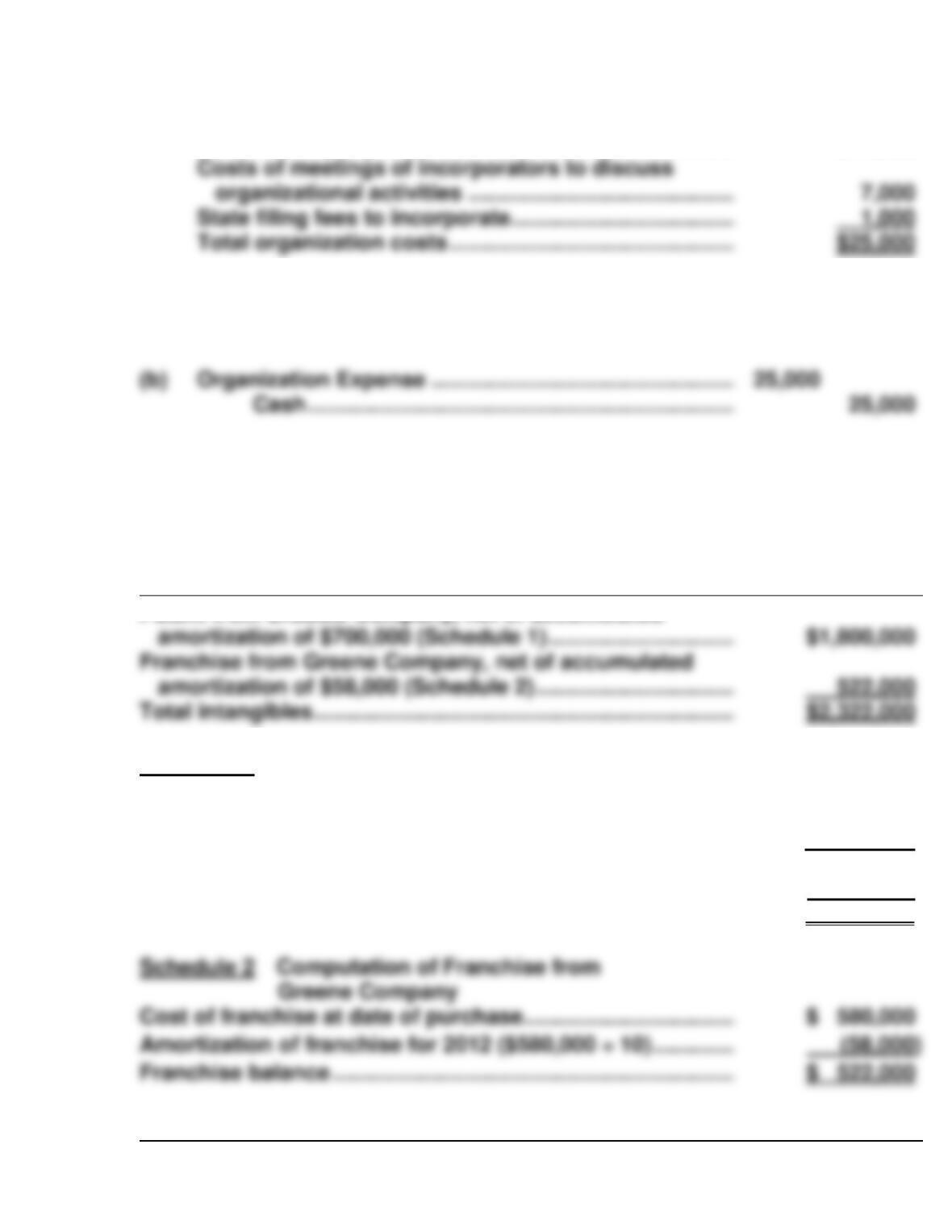
Patents …………………………………………………………………..
380,000
Goodwill …………………………………………………………………
360,000
Franchises …………………………..…………………………..
450,000
Copyrights ……………………………………………………….
156,000
Research and Development Expense ……………………….
215,000
Intangible Assets …………………………………………….
1,561,000
Amortization Expense ……………………………………………..
Patents ($380,000/8) ………………………………………..
Franchises ($450,000/10 X 6/12) ……………………….
Copyrights ($156,000/5 X 5/12) …………………………
EXERCISE 12-7 (10–15 minutes)
(a) 2011 amortization: $18,000 ÷ 10 = $1,800.
(b) 2012 amortization: ($16,200 + $7,800) ÷ 4 = $6,000.
12/31/12 book value: $16,200 + $7,800 – $6,000 = $18,000.
12–19
EXERCISE 12-8 (10–15 minutes)
(a)
Attorney’s fees in connection with organization
of the company ………………………………………………………
$17,000
Drafting and design equipment, $10,000, should be classified as part of fixed
assets, rather than as organization costs.
Cash ………………………………………………………………
EXERCISE 12-9 (15–20 minutes)
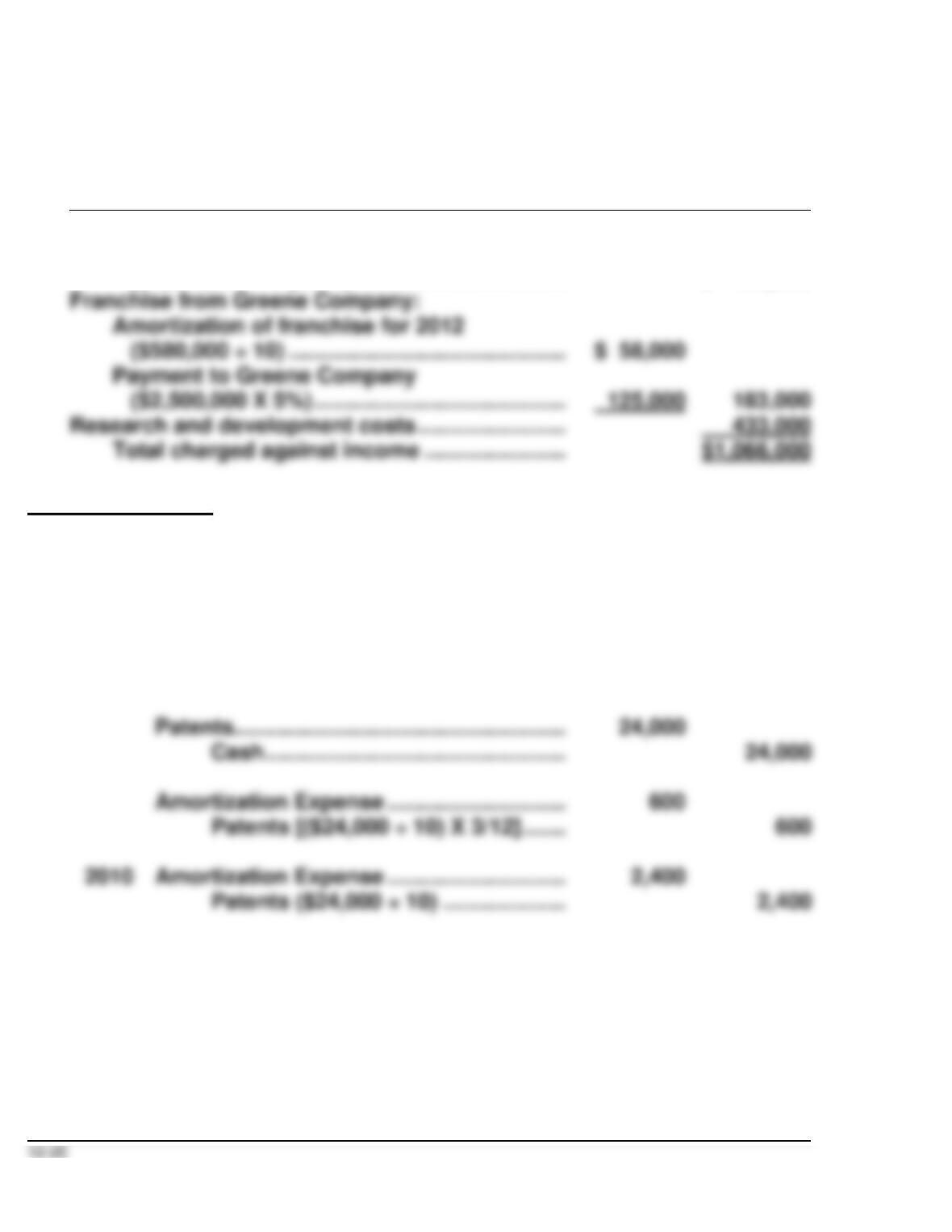
(a) DEVON HARRIS COMPANY
Intangibles Section of Balance Sheet
December 31, 2012
Franchise from Greene Company, net of accumulated
Patent from Bradtke Company, net of accumulated
Schedule 1 Computation of Patent from
Bradtke Company
Cost of patent at date of purchase ………………………………………
$2,500,000
Amortization of patent for 2011 ($2,500,000 ÷ 10 years) ………..
(250,000)
2,250,000
Amortization of patent for 2012 ($2,250,000 ÷ 5 years) ………….
(450,000)
Patent balance …………………………………………………………………..
$1,800,000
Greene Company
Cost of franchise at date of purchase………………………………….
$ 580,000
Amortization of franchise for 2012 ($580,000 ÷ 10) ……………….
Costs of meetings of incorporators to discuss
organizational activities ………………………………………….
State filing fees to incorporate ……………………………………
1,000
Total organization costs …………………………………………….
EXERCISE 12-9 (Continued)
(b) DEVON HARRIS COMPANY
Income Statement Effect
For the Year Ended December 31, 2012
Patent from Bradtke Company:
Amortization of patent for 2012
($2,250,000 ÷ 5 years) …………………………………….
$ 450,000
Franchise from Greene Company:
Amortization of franchise for 2012
($580,000 ÷ 10) ………………………………………………
Payment to Greene Company
($2,500,000 X 5%) …………………………………………..
Research and development costs …………………………..
433,000
Note to instructor: This solution only shows the expense effects. Revenue
under the franchise is $2,500,000.
EXERCISE 12-10 (15–20 minutes)
(a)
2009
Research and Development Expense ……………………….
170,000
Cash ……………………………………………………….
170,000
Patents ……………………………………………………….
Cash ……………………………………………………….
Amortization Expense …………………………..
Patents [($24,000 ÷ 10) X 3/12] ………………………….
2010
Amortization Expense …………………………..