CHAPTER 12
Investments
LEARNING OBJECTIVES
1. EXPLAIN HOW TO ACCOUNT FOR DEBT
INVESTMENTS.
2. EXPLAIN THE ACCOUNTING FOR STOCK
INVESTMENTS.
3. DISCUSS HOW DEBT AND STOCK INVESTMENTS ARE
REPORTED IN FINANCIAL STATEMENTS.
CHAPTER REVIEW
Why Corporations Invest
1. (L.O. 1) Corporations purchase investments because (1) they may have excess cash, (2) they
generate earnings from investment income, and (3) for strategic reasons.
Accounting for Debt Investments
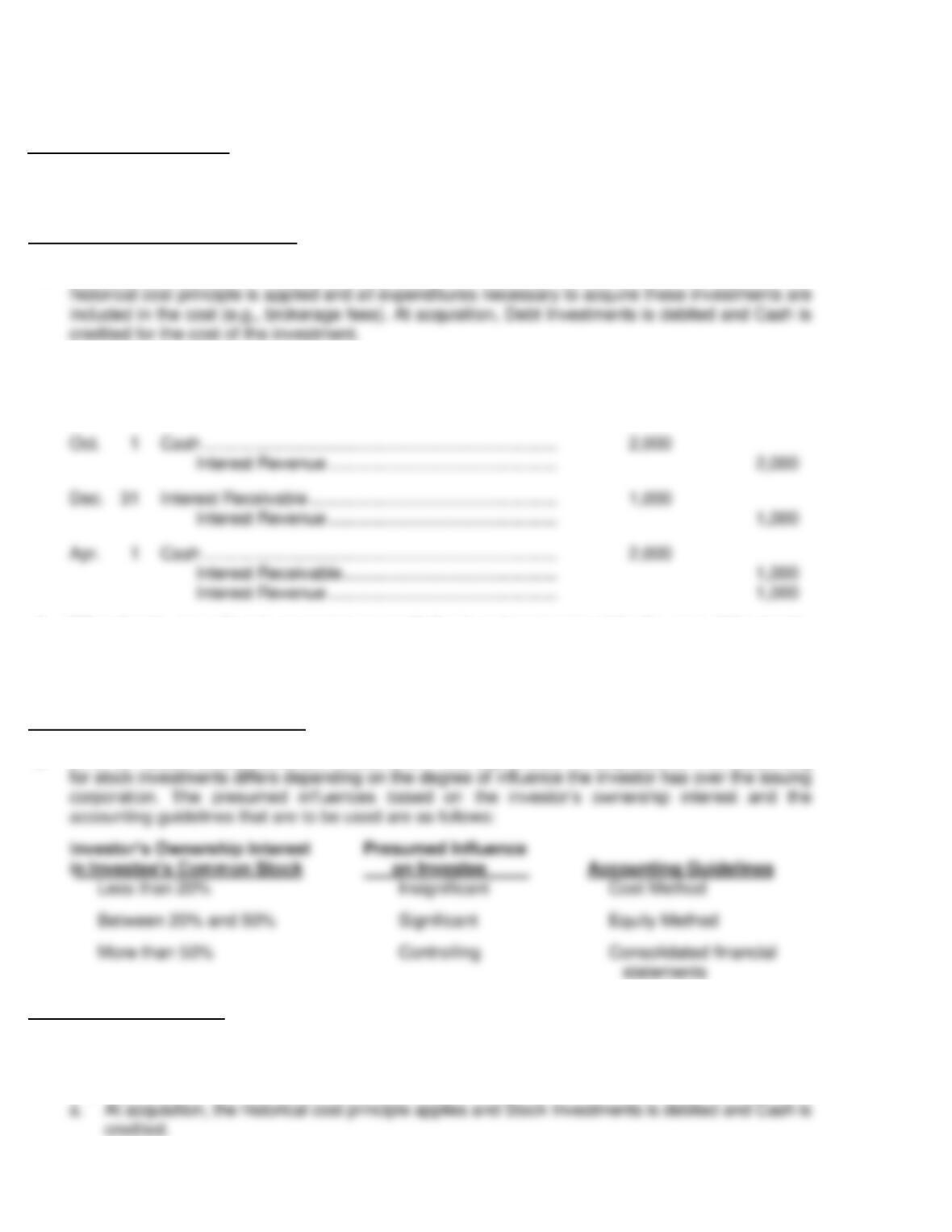
2. Debt investments are investments in government and corporation bonds. At acquisition, the
3. Interest revenue must also be recorded on debt investments. Assume Bodhi Company (fiscal year
ends December 31) receives $2,000 interest every six months on a debt investment purchased
April 1, 2015. The following entries are required:
4. When bonds are sold, it is necessary to credit the Investment account for the cost of the bonds,
debit Cash, and any difference between the sale price and cost of bonds is recorded as a gain or
loss. The gain or loss on the sale of debt investments is reported under Other Revenues and
Gains or Other Expenses and Losses, respectively, in the income statement.
Accounting for Stock Investments
5. (L.O. 2) Stock investments are investments in the capital stock of corporations. The accounting
Holdings Less than 20%
6. In accounting for stock investments of less than 20%, the cost method is used. Under the cost
method, the investment is recorded at cost and revenue is recognized only when cash dividends
are received.
Holdings Between 20% and 50%
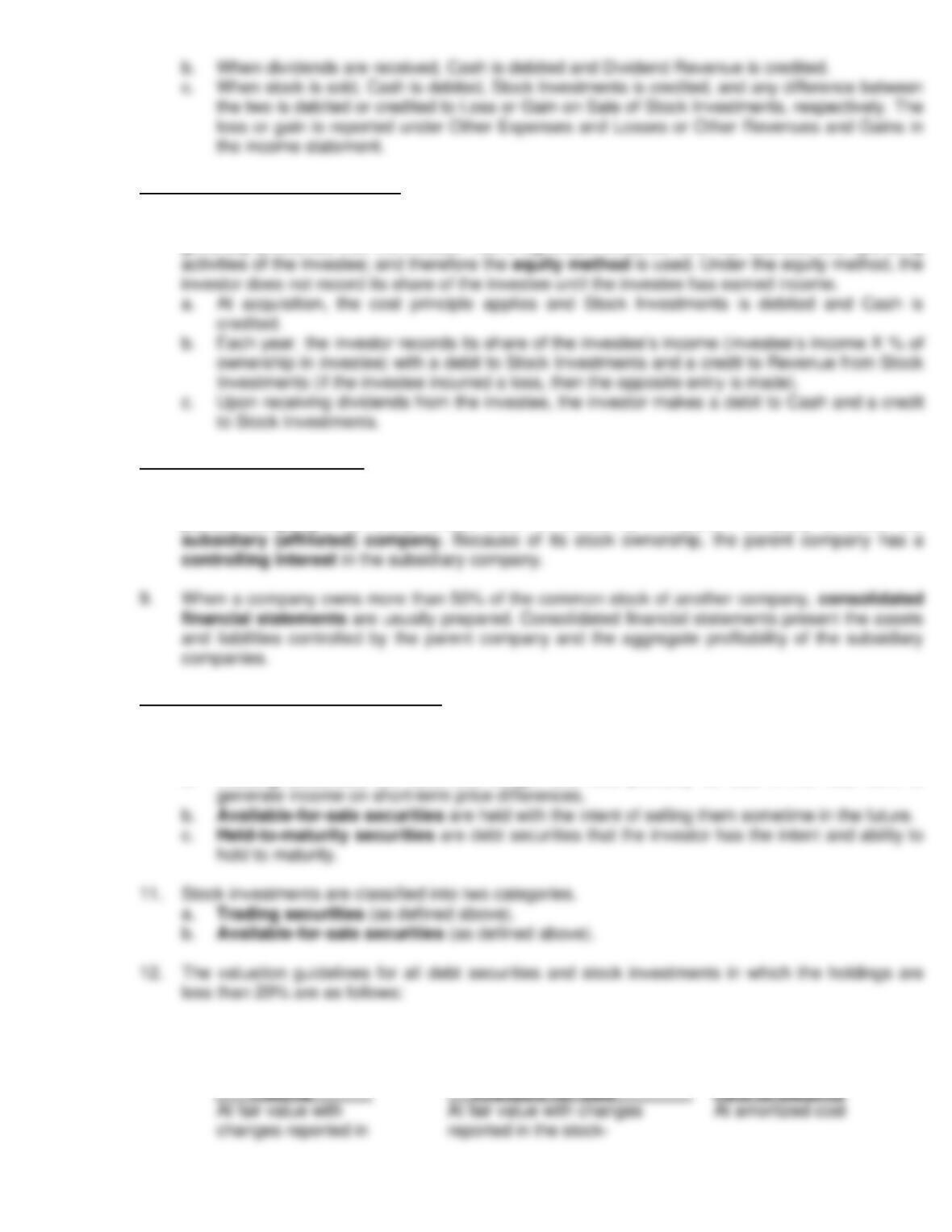
7. When an investor owns between 20% and 50% of the common stock of a corporation, it is
generally presumed that the investor has a significant influence over the financial and operating
Holdings of More Than 50%
8. A company that owns more than 50% of the common stock of another entity is known as the
parent company. The entity whose stock is owned by the parent company is called the
Valuation and Reporting Investments
10. (L.O. 3) For purposes of valuation and reporting at a financial statement date, debt investments
are classified into three categories.
a. Trading securities are securities bought and held primarily for sale in the near term to
Trading Available-for-Sale Held-to-Maturity
net income holders’ equity section
Trading Securities
Available-for-Sale
14. If available-for-sale securities are held with the intent to sell them within the next year or operating
cycle, the securities are classified as current assets in the balance sheet. Otherwise, they are
classified as long-term assets in the investments section of the balance sheet.
Balance Sheet Presentation
18. Short-term investments are listed immediately below cash in the current assets section of the
balance sheet. Short-term investments are reported at fair value. Long-term investments are
19. In the income statement, the following items are reported in the nonoperating section:
Other Revenue and Gains Other Expenses and Losses
*Preparing a Consolidated Balance Sheet
*20. (L.O. 4) Consolidated balance sheets are prepared from the individual balance sheets of the
affiliated companies. All items in the individual balance sheets are included in the consolidated
*Cost Above Book Value
*22. When the cost of acquiring the common stock of another company is above the book value, this
amount is separately recognized in eliminating the parent company’s investment account.
Through the worksheet, the excess of cost over book value is first allocated to specific assets,
such as inventory and plant equipment, if their fair values on the acquisition date exceed their
book values. Any remainder is considered to be goodwill.
*Consolidated Income Statement
*Compare the Accounting for Investments Under GAAP and IFRS
*24. (L.O. 5) The following are the key similarities and differences between GAAP and IFRS as related
to investments.
a. Similarities
(1) The basic accounting entries to record the acquisition of debt securities, the receipt of
comprehensive income under GAAP and IFRS.
b. Differences
(1) Under IFRS both the investor and an associate company should follow the same
accounting policies. GAAP does not require this.
LECTURE OUTLINE
A. Why Corporations Invest.
1. Corporations purchase investments in debt or stock securities for one of
three reasons:
B. Accounting for Debt Investments.
1. Companies record investments in debt securities when they purchase bonds,
receive or accrue interest, and sell the bonds.
C. Accounting for Stock Investments.
1. The accounting for investments in common stock depends on the extent
of the investor’s influence over the operating and financial affairs of the
issuing corporation (the investee). The general guidelines for stock
investments are:
2. Companies record common stock investments of less than 20% when
they purchase the stock, receive dividends, and sell the stock.
3. When an investor owns between 20% and 50% of the common stock of
a corporation, it is presumed that the investor has significant influence over
the financial and operating activities of the investee, and the investment
should be accounted for by the equity method.
a. Under the equity method, the investor company initially records the
4. A company that owns more than 50% of the common stock of another
entity is known as the parent company and has a controlling interest in the
5. Consolidated financial statements present the total assets and liabilities
ACCOUNTING ACROSS THE ORGANIZATION
Recently, Procter & Gamble acquired Gillette Company for $53.4 billion. The
common stockholders of Procter & Gamble are in a position to elect the board of
directors of Gillette and, in effect, control its operations.
Where on Procter & Gamble’s balance sheet will you find its investment in
Gillette Company?
D. Valuing and Reporting Investments.
1. Companies classify all debt securities and stock investments in which
the holdings are less than 20% into three categories for valuation and
reporting purposes: (1) trading securities, (2) available-for-sale securities
and (3) held-to–maturity securities.
ACCOUNTING ACROSS THE ORGANIZATION
Many companies have equity investments of some type. For example, the total
amount of equity-method investments appearing on company balance sheets is
approximately $403 billion.
Why might the use of the equity method not lead to full disclosure in the financial
statements?
4. Companies report available-for-sale securities at fair value and the
unrealized gains or losses as a separate component of stockholders’
equity.
E. Short-Term and Long-Term Investments.
1. Short-term investments (marketable securities) are securities held by a
company that are (1) readily marketable and (2) intended to be converted
into cash within the next year or operating cycle, whichever is longer.
2. Investments that do not meet both criteria are classified as long-term
investments.
a. An investment is readily marketable when it can be sold easily when–
ever the need for cash arises. Short-term paper (CDs, money market
certificates, treasury bills) meets this criterion as do stocks and
F. Presentation of Realized and Unrealized Gain or Loss.
1. Companies must report in the income statement in the nonoperating activi-
ties section gains and losses on trading securities, whether realized or
unrealized.
*G. Consolidated Balance Sheet
1. Transactions between affiliated companies are identified as intercom–
2. The preparation of consolidated balance sheets is usually facilitated by
5. When the parent acquires 100% ownership and the acquisition cost is
greater than the book value of the subsidiary’s net assets, the
intercompany elimination entry in 4 will also include a debit to Excess of
Cost Over Book Value of Subsidiary.
*H. Consolidated Income Statements
1. A consolidated income statement shows the results of operations of
affiliated companies as though they are one economic unit.
IFRS
A Look at IFRS
Until recently, when the IASB issued IFRS 9, the accounting and reporting for
investments under IFRS and GAAP were for the most part very similar. However,
IFRS 9 introduces a new framework for classifying investments.
KEY POINTS
SIMILARITIES
• The basic accounting entries to record the acquisition of debt securities, the
receipt of interest, and the sale of debt securities are the same under IFRS
and GAAP.
DIFFERENCES
• Under IFRS, both the investor and an associate company should follow the
same accounting policies. As a result, in order to prepare financial information,
adjustments are made to the associate’s policies to conform to the investor’s

20 MINUTE QUIZ
Circle the correct answer.
True/False
1. To be considered a short-term investment, the investment must be readily marketable
and management should intend to convert the investment into cash within the next year
or operating cycle, whichever is longer.
True False
2. Accounting for short-term investments involves entries for the acquisition, interest and
dividend revenue, and the sale.
True False
3. The accounting guidelines for long-term investments in stock are based on the extent of
the investor’s influence over the operating affairs of the issuing corporation.
True False
4. Under the equity method of accounting, the investment account is credited for the investor’s
share of investee earnings and is debited for dividends received from the investee.
True False
5. A parent/subsidiary relationship exists only when the parent company has a controlling
interest in the subsidiary company.
True False
6. Consolidated financial statements are useful to parent company stockholders and managers
because they indicate the magnitude and scope of operations of the companies under
common control.
True False
7. The Fair Value Adjustment balance could be added to the cost of the investments to
arrive at their fair value.
True False
8. Under the fair value method, companies report the unrealized gain in the income state-
ment for available-for-sale securities.
True False
9. Companies report both realized and unrealized gains and losses on trading securities in
the income statement.
True False
*10. The consolidated income statement shows only revenue and expense transactions
between the consolidated entity and companies and individuals who are outside the
affiliated group.
True False

Multiple Choice
1. Ross Corporation purchased 6,000 shares of Hunter common stock at $60 per share
plus $7,200 brokerage fees as a short-term investment. The shares were subsequently
sold at $65 per share less $8,400 brokerage fees. The cost of the securities purchased
and gain or loss on the sale were
Cost Gain or Loss
a. $360,000 $30,000 gain
b. $360,000 $14,400 gain
c. $367,200 $14,400 gain
d. $367,200 $14,400 loss
2. A company pays $600,000 for 30% of the common stock of X, Inc. In the first year, X,
Inc. reports net income of $120,000 and pays a cash dividend of $45,000. The balance in
Stock Investments-X, at year end under the equity method is:
a. $577,500.
b. $622,500.
c. $636,000.
d. $675,000.
3. The equity method is used when the investor
a. makes long-term investments in stocks.
b. plans to sell the investments within one year.
c. owns less than 20% of the investee’s common stock.
d. owns between 20% and 50% of the investee’s common stock.
4. At the end of its first year, the trading securities portfolio consisted of the following securities:
Cost Fair Value
Magnum Corp. $38,000 $40,000
Spencer Inc. 49,000 43,000
$87,000 $83,000
The unrealized loss to be recognized is
a. $2,000.
b. $6,000.
c. $4,000.
d. none of the above.
5. Which of the following would not appear in an income statement?
a. Unrealized gain on trading securities.
b. Realized gain on available-for-sale securities.
c. Unrealized loss on available-for-sale securities.
d. Realized loss on trading securities.

ANSWERS TO QUIZ
True/False
Multiple Choice