Exercise 12–16 (15 minutes)
Relevant Costs
Item
Make
Buy
Direct materials (60,000 @ $4.00) ………….
$240,000
Direct labor (60,000 @ $2.75) ……………….
165,000
Fixed manufacturing overhead, traceable
$600,000
Total cost ………………………………………….
$495,000
$600,000
Variable manufacturing overhead
Exercise 12–17 (30 minutes)
1. The relevant costs of a fishing trip would be:
Fuel and upkeep on boat per trip …..
$25
Junk food consumed during trip*…..
8
Snagged fishing lures………………….
7
Total ……………………………………….
$40
2. If he fishes for the same amount of time as he did on his last trip, all of
his costs are likely to be about the same as they were on his last trip.
3. In a decision of whether to give up fishing altogether, nearly all of the
costs listed by Steve’s wife are relevant. If he did not fish, he would not
need to pay for boat storage, new fishing gear, a fishing license, fuel
and upkeep, junk food, or snagged lures. In addition, he would be able
to sell his boat, the proceeds of which would be considered relevant in
this decision. The original cost of the boat, which is a sunk cost, would
not be relevant.
Exercise 12-17 (continued)
These three requirements illustrate the slippery nature of costs. A cost
that is relevant in one situation can be irrelevant in the next. None of
Problem 12-18 (30 minutes)
1.
Contribution margin lost if the tour is discontinued ..
$(2,100)
Less tour costs that can be avoided if the tour is
discontinued:
Tour promotion …………………………………………
$600
Fee, tour guide …………………………………………
700
Fuel for bus ……………………………………………..
125
Overnight parking fee, bus…………………………..
50
Room & meals, bus driver and tour guide ……….
175
1,650
Net decrease in profits if the tour is discontinued ….
$ (450)
The following costs are not relevant to the decision:
fleet.
Liability insurance, bus
There would be no change in the
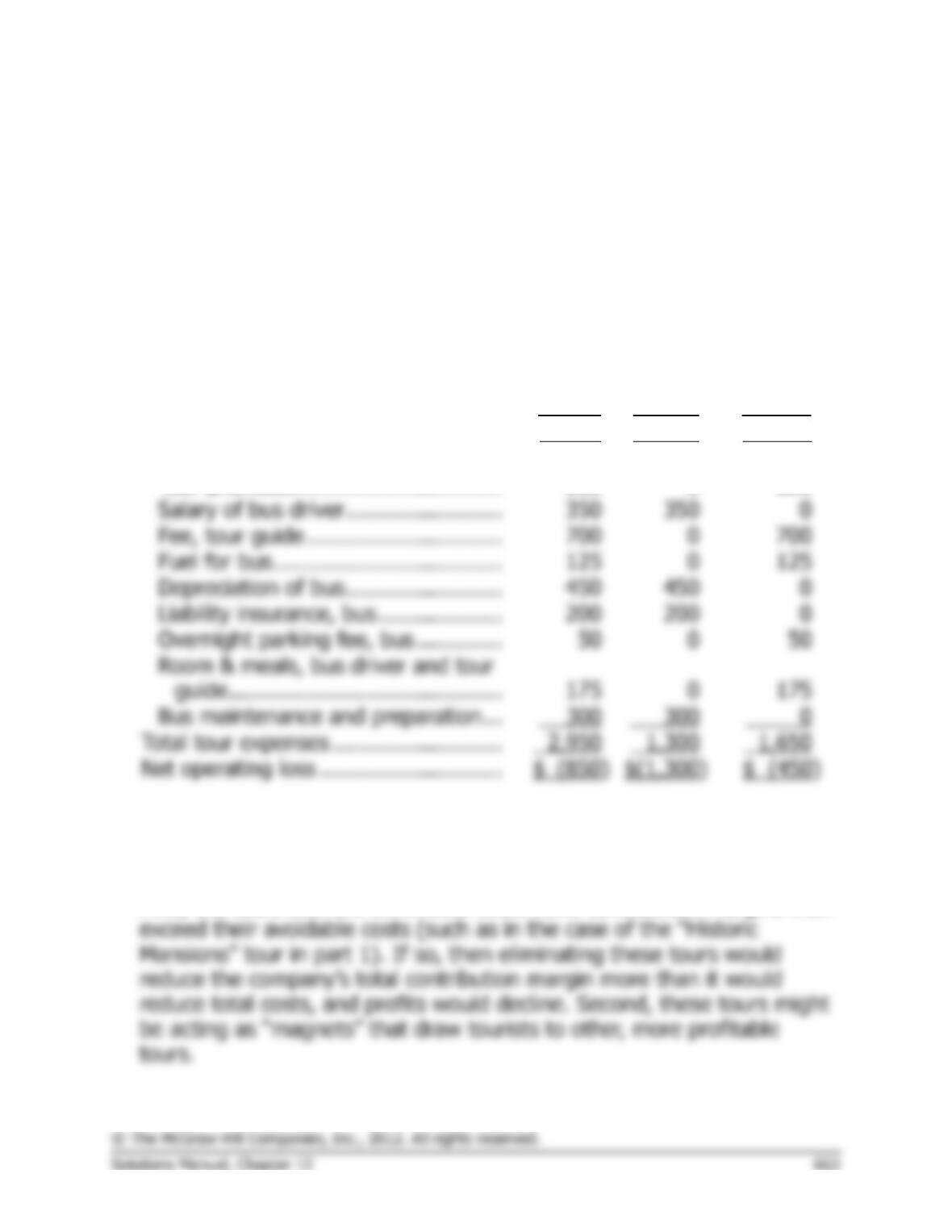
Problem 12-18 (continued)
Alternative Solution:
Keep
the
Tour
Drop
the Tour
Difference:
Net
Operating
Income
Increase or
(Decrease)
Ticket revenue …………………………...
$3,000
$ 0
$(3,000)
Less variable expenses …………………
900
0
900
Contribution margin ……………………..
2,100
0
(2,100)
Less tour expenses:
Tour promotion …………………………
600
0
600
Salary of bus driver ……………………
350
0
Fee, tour guide …………………………
700
0
700
Fuel for bus ……………………………..
125
0
125
175
0
175
Total tour expenses ……………………..
Net operating loss ……………………….
2. The goal of increasing average seat occupancy could be accomplished
by dropping tours like the Historic Mansions tour with lower-than-
average seat occupancies. This could reduce profits in at least two ways.
First, the tours that are eliminated could have contribution margins that
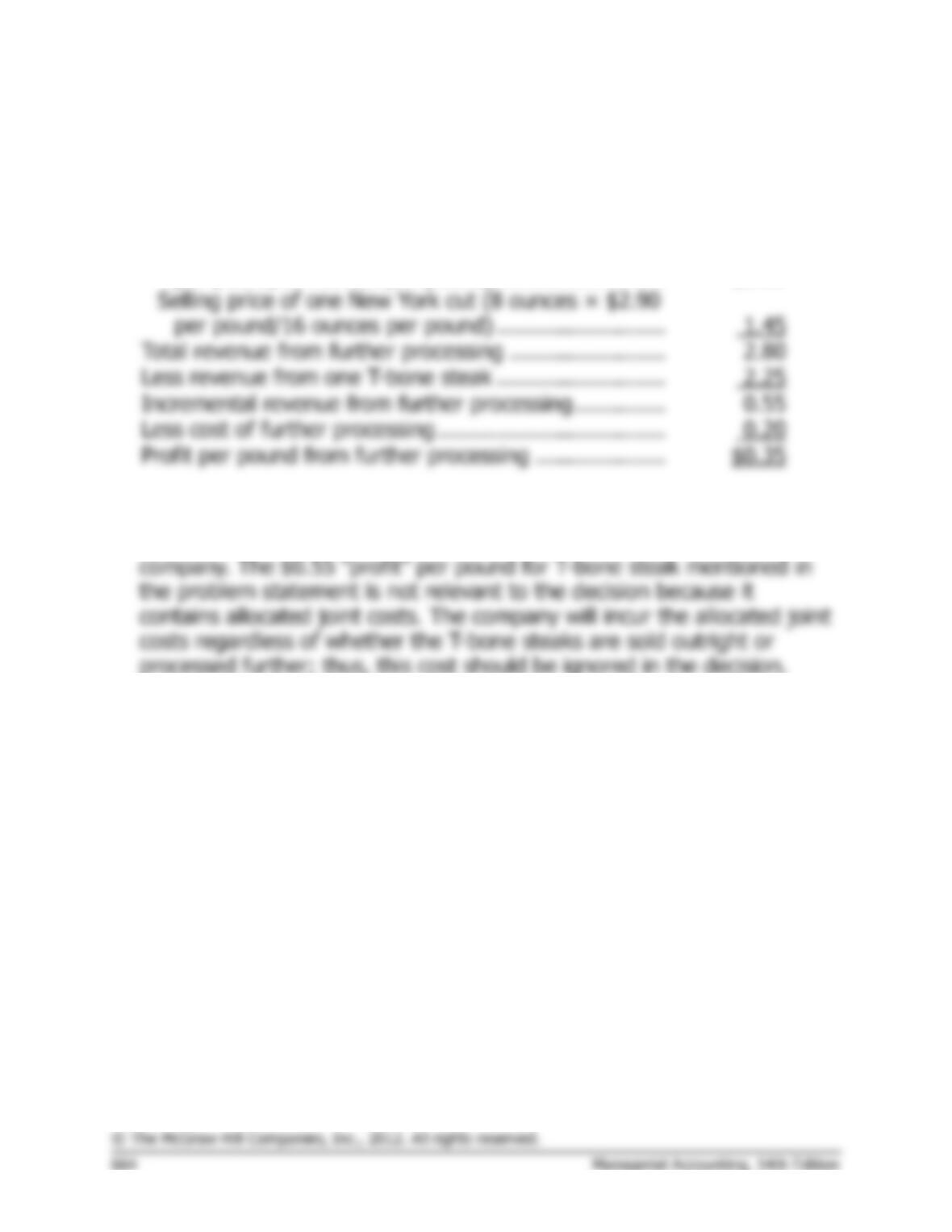
Problem 12-19 (15 minutes)
1.
Per 16-Ounce
T-Bone
Revenue from further processing:
Selling price of one filet mignon (6 ounces × $3.60
per pound/16 ounces per pound) ……………………..
$1.35
Incremental revenue from further processing …………..
Less cost of further processing ……………………………..
Profit per pound from further processing ………………..
$0.35
2. The T-bone steaks should be processed further into filet mignon and the
New York cuts. This will yield $0.35 per pound in added profit for the
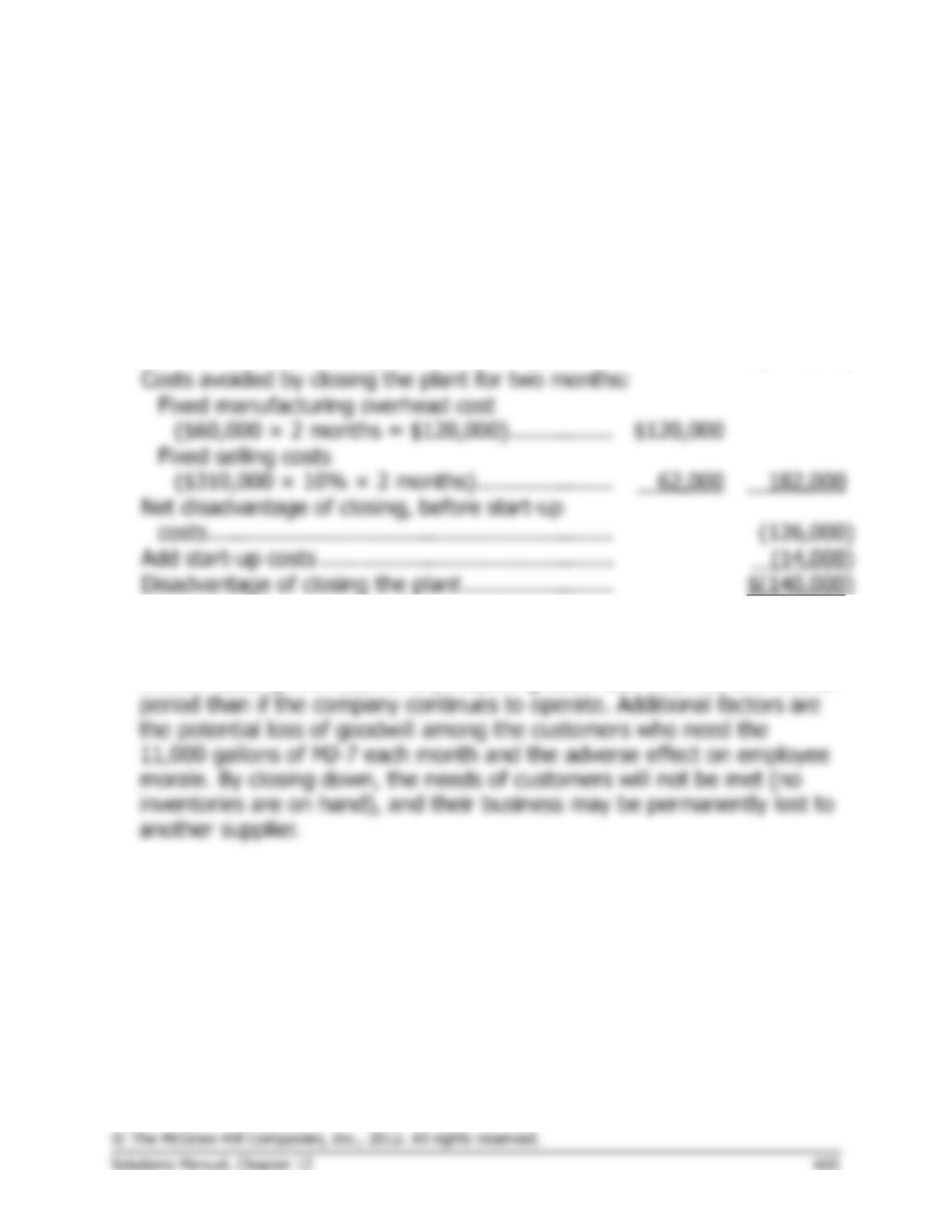
Problem 12-20 (45 minutes)
1. Product MJ-7 has a contribution margin of $14 per gallon ($35 – $21 =
$14). If the plant closes, this contribution margin will be lost on the
22,000 gallons (11,000 gallons per month × 2 = 22,000 gallons) that
could have been sold during the two-month period. However, the
company will be able to avoid some fixed costs as a result of closing
down. The analysis is:
Contribution margin lost by closing the plant for
two months ($14 per gallon × 22,000 gallons) .
$(308,000)
$(140,000)
No, the company should not close the plant; it should continue to
operate at the reduced level of 11,000 gallons produced and sold each
month. Closing will result in a $140,000 greater loss over the two-month
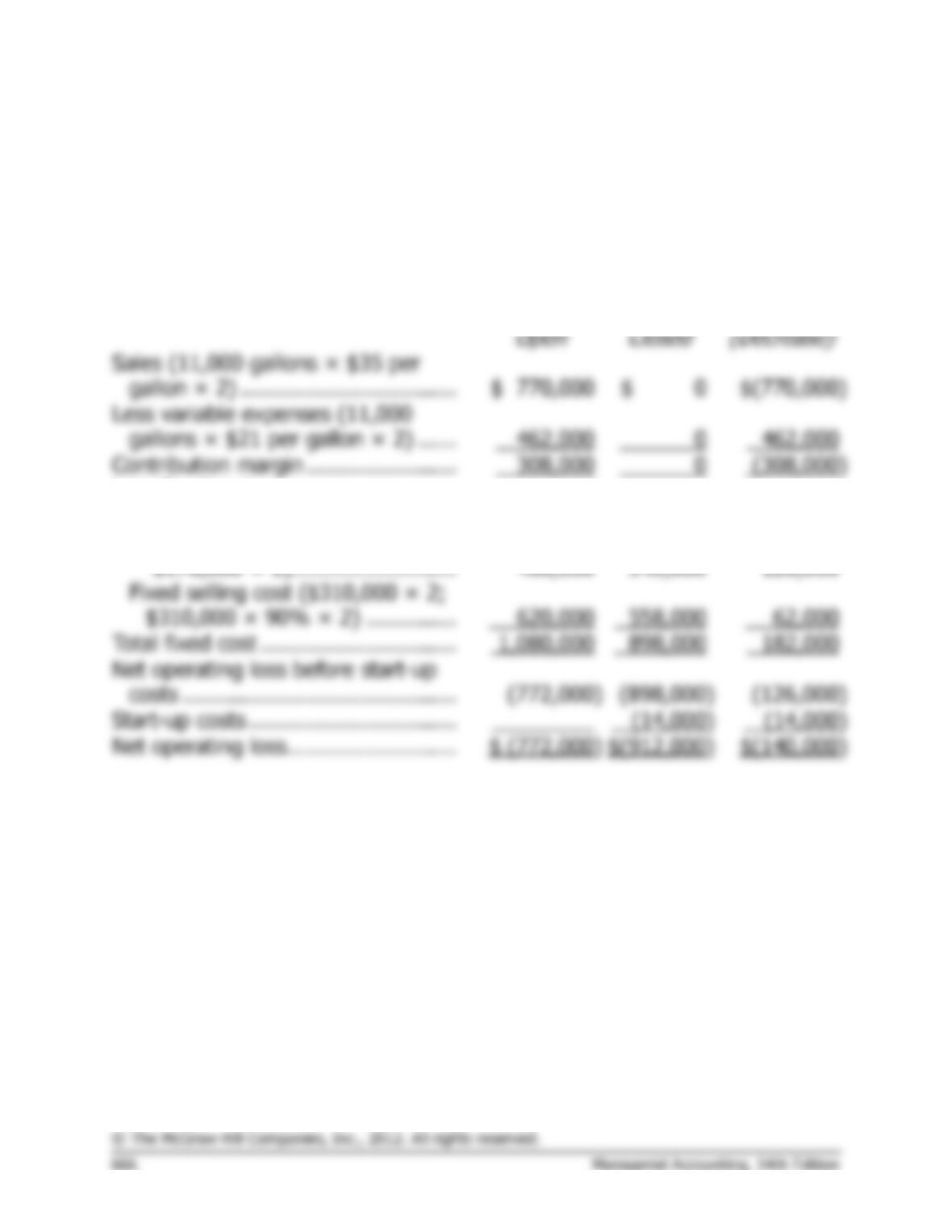
Problem 12-20 (continued)
Alternative Solution:
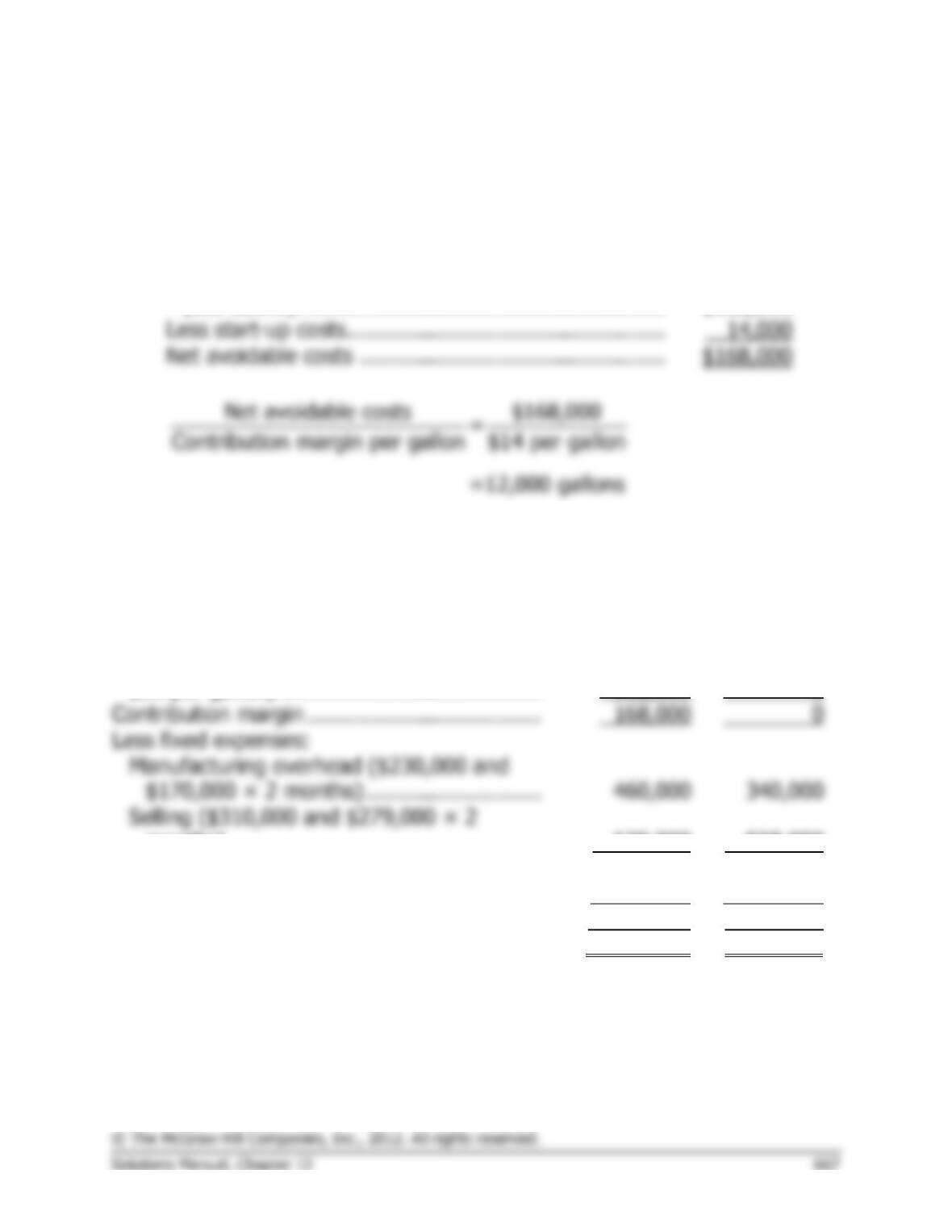
Contribution margin …………………..
Plant Kept
Plant
Difference—
Net
Operating
Income
Increase
Less fixed costs:
Start-up costs …………………………..
Fixed manufacturing overhead
cost ($230,000 × 2;
Problem 12-20 (continued)
2. Ignoring the additional factors cited in part (1) above, Hallas Company
should be indifferent between closing down or continuing to operate if
the level of sales drops to 12,000 gallons (6,000 gallons per month)
over the two-month period. The computations are:
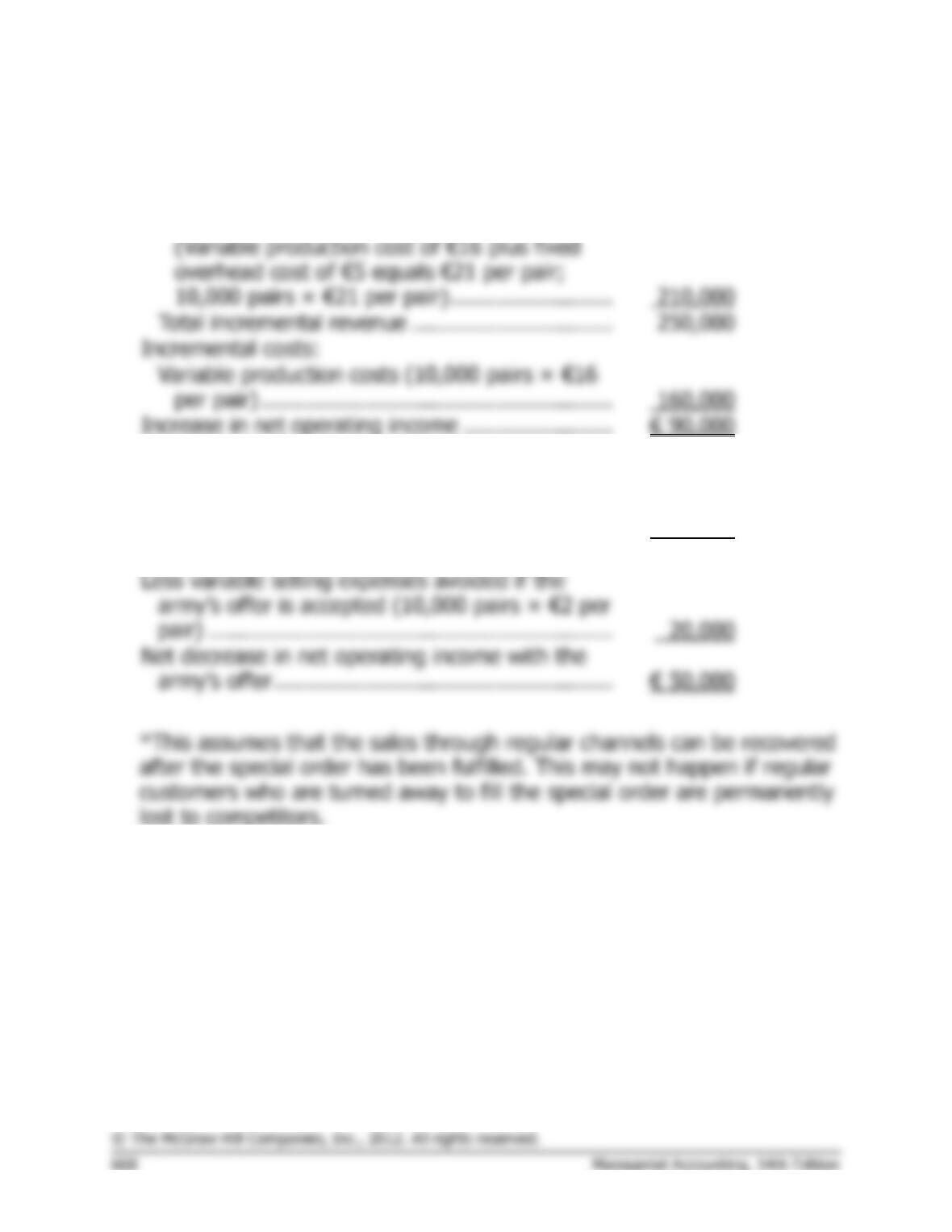
Cost avoided by closing the plant for two months
(see above) ………………………………………………..
$182,000
Less start-up costs ………………………………………….
Net avoidable costs ………………………………………..
$168,000
Verification:
Operate at
12,000
Gallons for
Two Months
Close for
Two Months
Sales (12,000 gallons × $35 per gallon) …….
$ 420,000
$ 0
Less variable expenses (12,000 gallons ×
$21 per gallon) ………………………………….
252,000
0
Contribution margin ………………………………
0
Less fixed expenses:
months) …………………………………………
620,000
558,000
Total fixed expenses ………………………………
1,080,000
898,000
Start-up costs ………………………………………
0
14,000
Total costs …………………………………………..
1,080,000
912,000
Net operating loss …………………………..…….
$ (912,000)
$(912,000)
Problem 12-21 (30 minutes)
1.
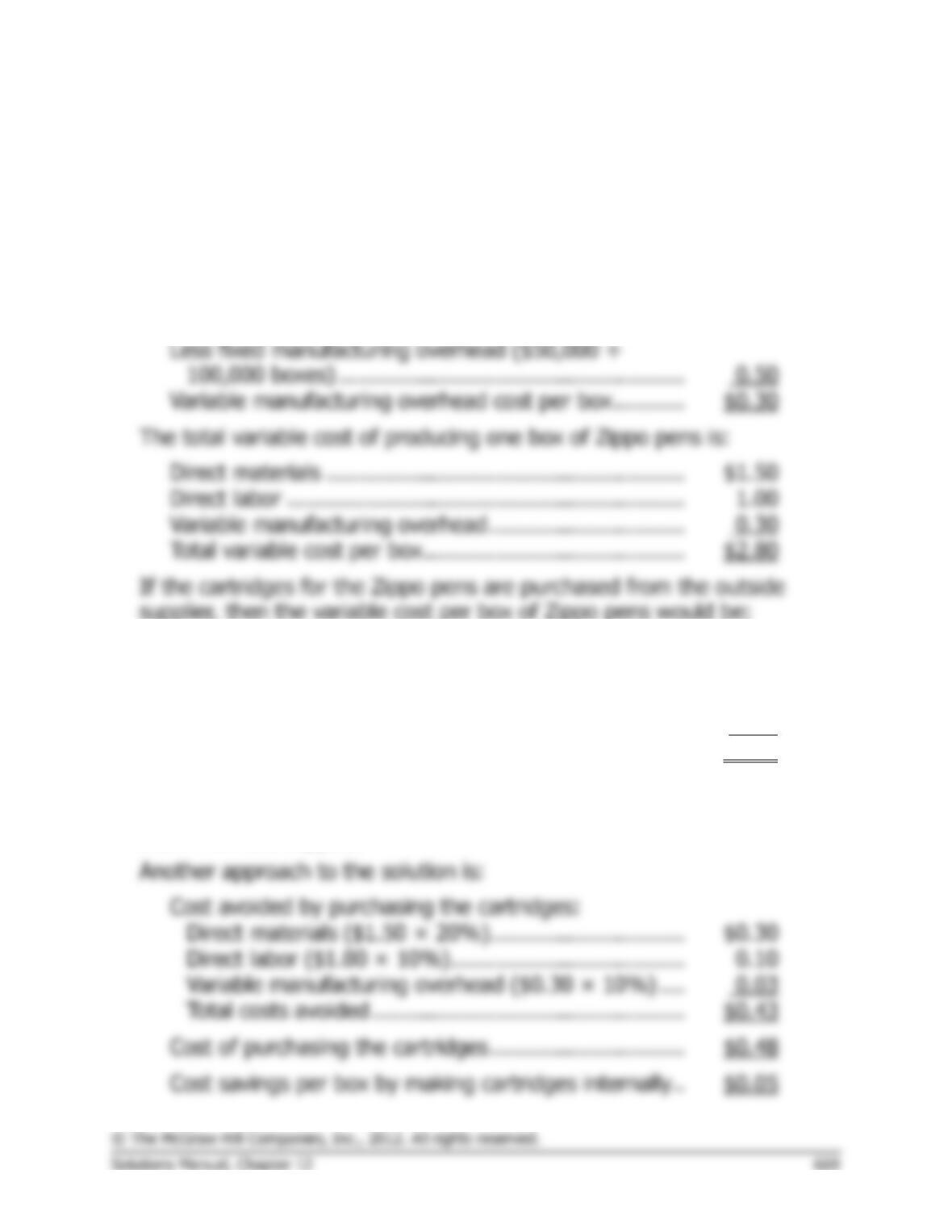
Incremental revenue:
Fixed fee (10,000 pairs × €4 per pair) …………..
€ 40,000
210,000
160,000
Increase in net operating income …………………..
€ 90,000
Reimbursement for costs of production:
2.
Sales revenue through regular channels
(10,000 pairs × €32 per pair)* ……………………
€320,000
Sales revenue from the army (above) ……………..
250,000
Decrease in revenue received ………………………..
70,000
Net decrease in net operating income with the
Problem 12-22 (60 minutes)
1. The fixed overhead costs are common and will remain the same
regardless of whether the cartridges are produced internally or
purchased outside. Hence, they are not relevant. The variable
manufacturing overhead cost per box of pens is $0.30, as shown below:
Total manufacturing overhead cost per box of pens …
$0.80
Variable manufacturing overhead cost per box ………..
$0.30
Direct materials ……………………………………………….
$1.50
Direct labor …………………………………………………….
1.00
Variable manufacturing overhead …………………………
0.30
Total variable cost per box ………………………………….
$2.80
Direct materials ($1.50 × 80%) …………………………..
$1.20
Direct labor ($1.00 × 90%) ………………………………..
0.90
Variable manufacturing overhead ($0.30 × 90%) …….
0.27
Purchase of cartridges ……………………………………….
0.48
Total variable cost per box ………………………………….
$2.85
The company should reject the outside supplier’s offer. Producing the
cartridges internally costs $0.05 less per box of pens than purchasing
them from the supplier.
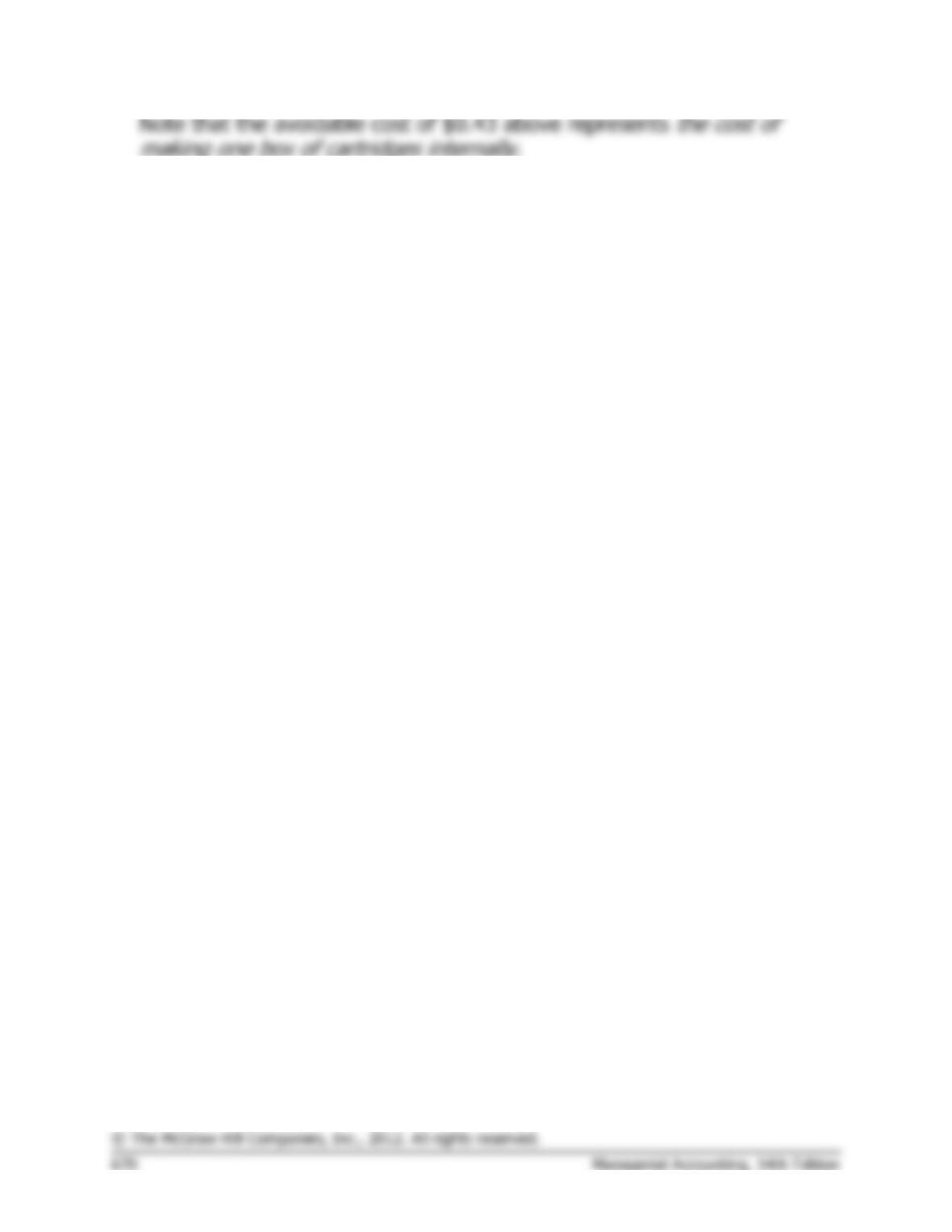
Cost avoided by purchasing the cartridges:
$0.30
0.10
0.03
$0.43
Cost of purchasing the cartridges …………………………
$0.48
Problem 12-22 (continued)
2. The company would not want to pay any more than $0.43 per box
because it can make the cartridges for this amount internally.
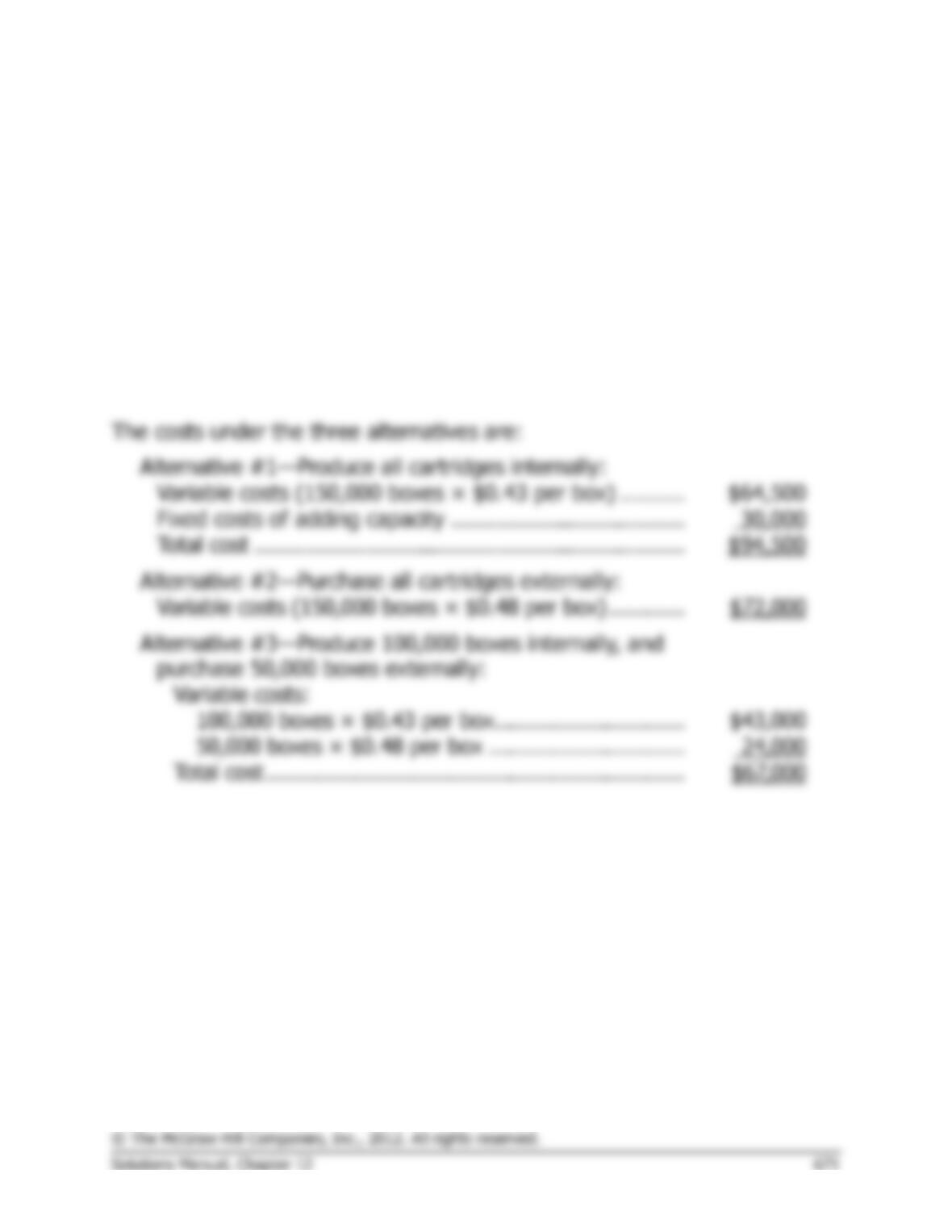
3. The company has three alternatives for obtaining the necessary
cartridges. It can:
#1
Produce all cartridges internally.
#2
Purchase all cartridges externally.
#3
Produce the cartridges for 100,000 boxes internally and purchase
the cartridges for 50,000 boxes externally.
Problem 12-22 (continued)
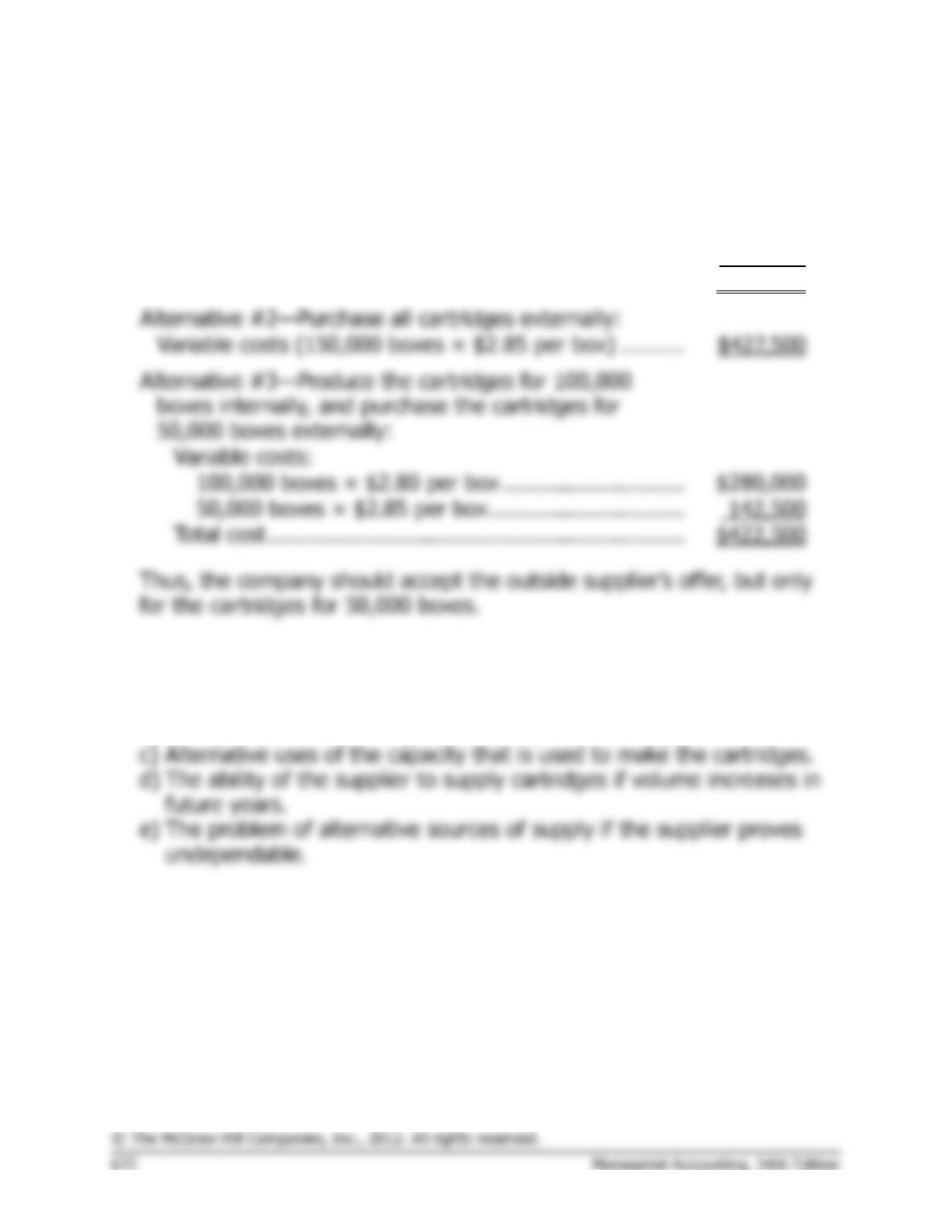
Or, in terms of total cost per box of pens, the answer would be:
Alternative #1—Produce all cartridges internally:
Variable costs (150,000 boxes × $2.80 per box) ……….
$420,000
Fixed costs of adding capacity ………………………………
30,000
Total cost …………………………………………………………
$450,000
Variable costs (150,000 boxes × $2.85 per box) ……….
$427,500
50,000 boxes externally:
$280,000
$422,500
4. In addition to cost considerations, Bronson should take into account the
following factors:
a) The ability of the supplier to meet required delivery schedules.
b) The quality of the cartridges purchased from the supplier.
Problem 12-23 (60 minutes)
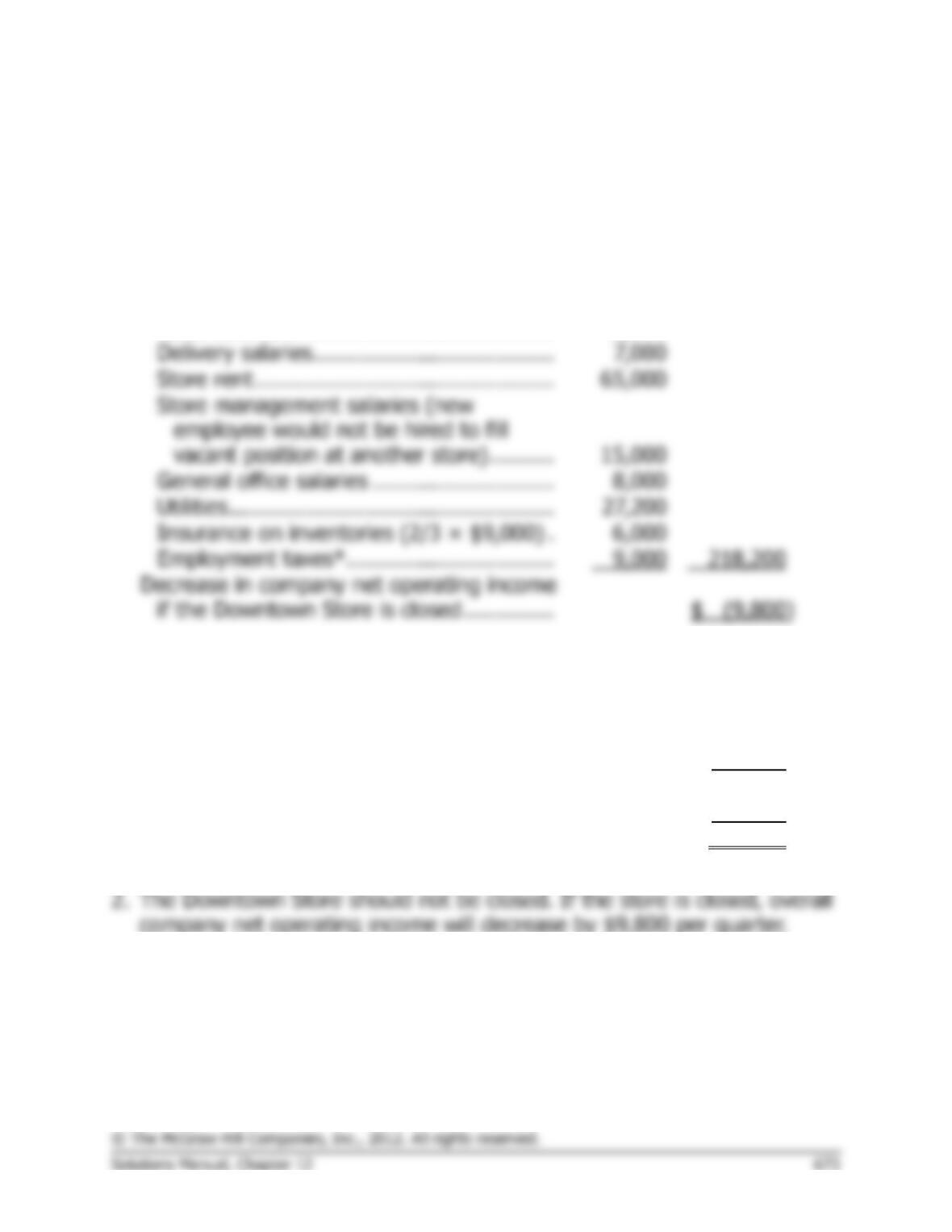
1. The simplest approach to the solution is:
Gross margin lost if the store is closed …….
$(228,000)
Less costs that can be avoided:
Direct advertising ……………………………..
$36,000
Sales salaries …………………………………..
45,000
Delivery salaries ……………………………….
15,000
General office salaries ……………………….
Utilities …………………………………………..
Insurance on inventories (2/3 × $9,000) .
Employment taxes* …………………………..
9,000
218,200
*Salaries avoided by closing the store:
Sales salaries ………………………………………………..
$45,000
Delivery salaries …………………………………………….
7,000
Store management salaries ………………………………
15,000
General office salaries …………………………………….
8,000
Total salaries …………………………………………………
75,000
Employment tax rate ………………………………………
× 12%
Employment taxes avoided ………………………………
$ 9,000
Problem 12-23 (continued)
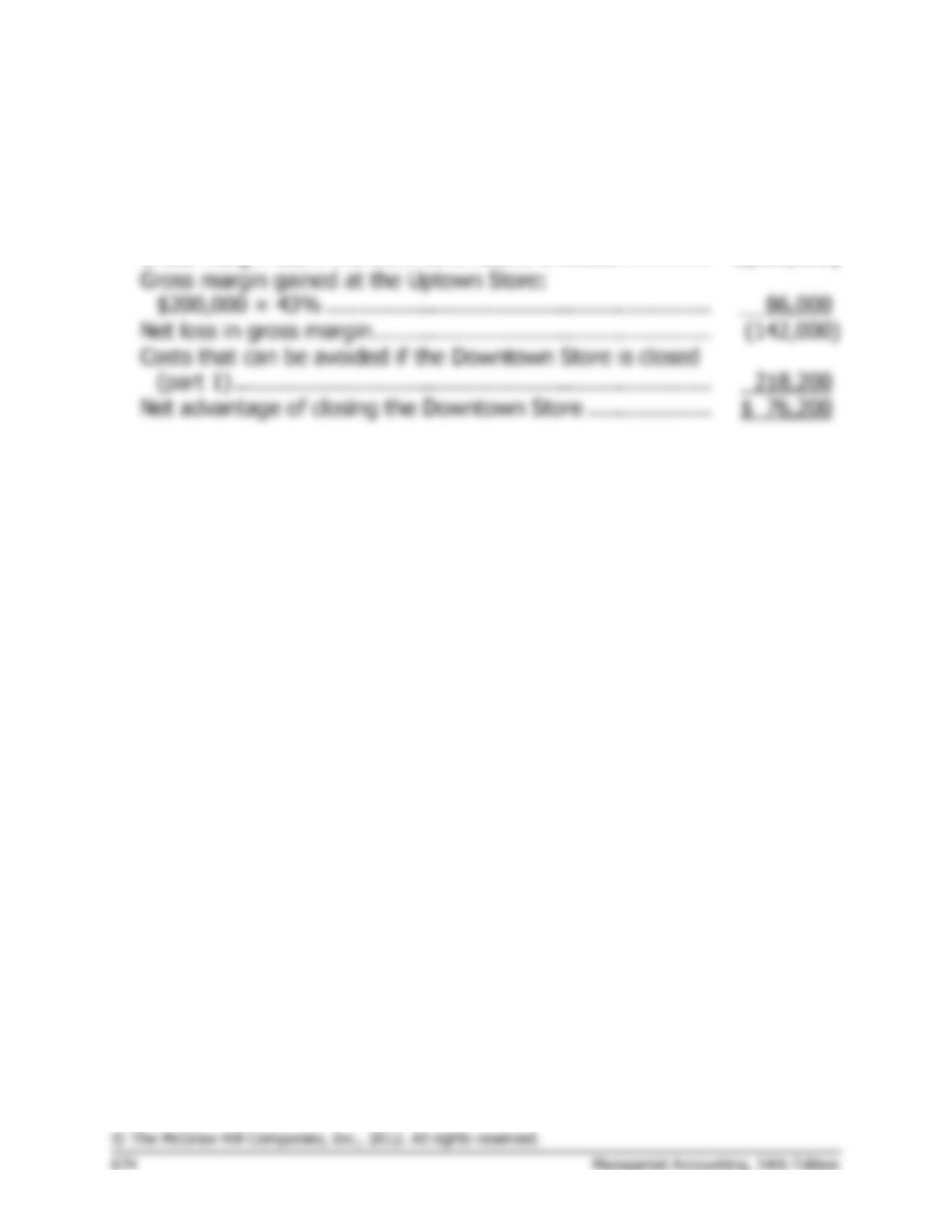
3. The Downtown Store should be closed if $200,000 of its sales are picked
up by the Uptown Store. The net effect of the closure will be an increase
in overall company net operating income by $76,200 per quarter:
Gross margin lost if the Downtown Store is closed …………..
$(228,000)
Net advantage of closing the Downtown Store ……………….
Problem 12-24 (60 minutes)
1.
Selling price per unit …………………..
$40
Variable expenses per unit* …………
24
Contribution margin per unit ………..
$16
*$9.50 + $10.00 + $2.80 + $1.70 = $24.00
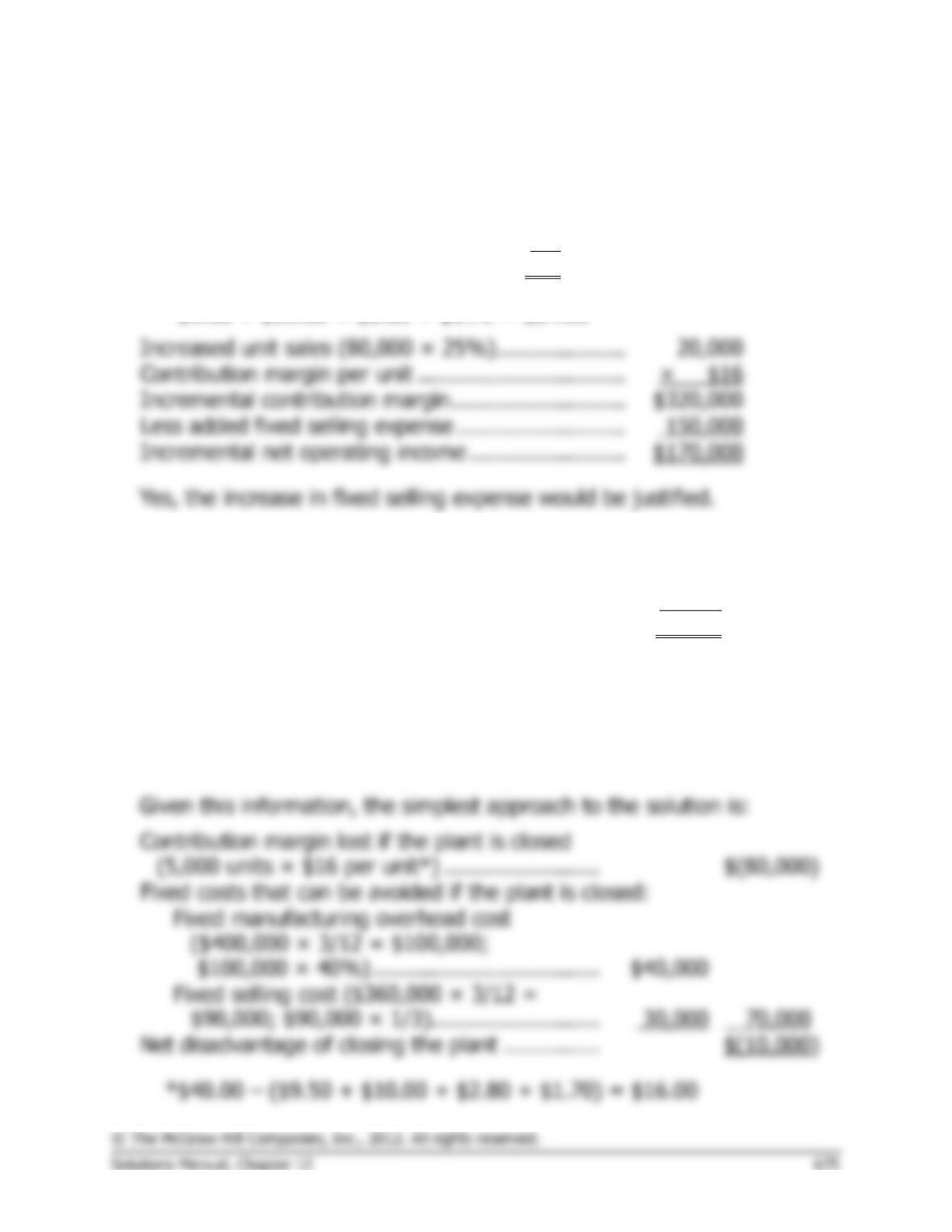
Increased unit sales (80,000 × 25%) ………………..
Contribution margin per unit …………………………..
Incremental contribution margin ………………………
Less added fixed selling expense ……………………..
Incremental net operating income ……………………
2.
Variable production cost per unit ……………………..
$22.30
Import duties, etc. ($14,000 ÷ 20,000 units) ……..
0.70
Shipping cost per unit ……………………………………
1.50
Break-even price per unit ……………………………….
$24.50
3. If the plant operates at 25% of normal levels, then only 5,000 units will
be produced and sold during the three-month period:
80,000 units per year × 3/12 = 20,000 units.
20,000 units × 25% = 5,000 units produced and sold.
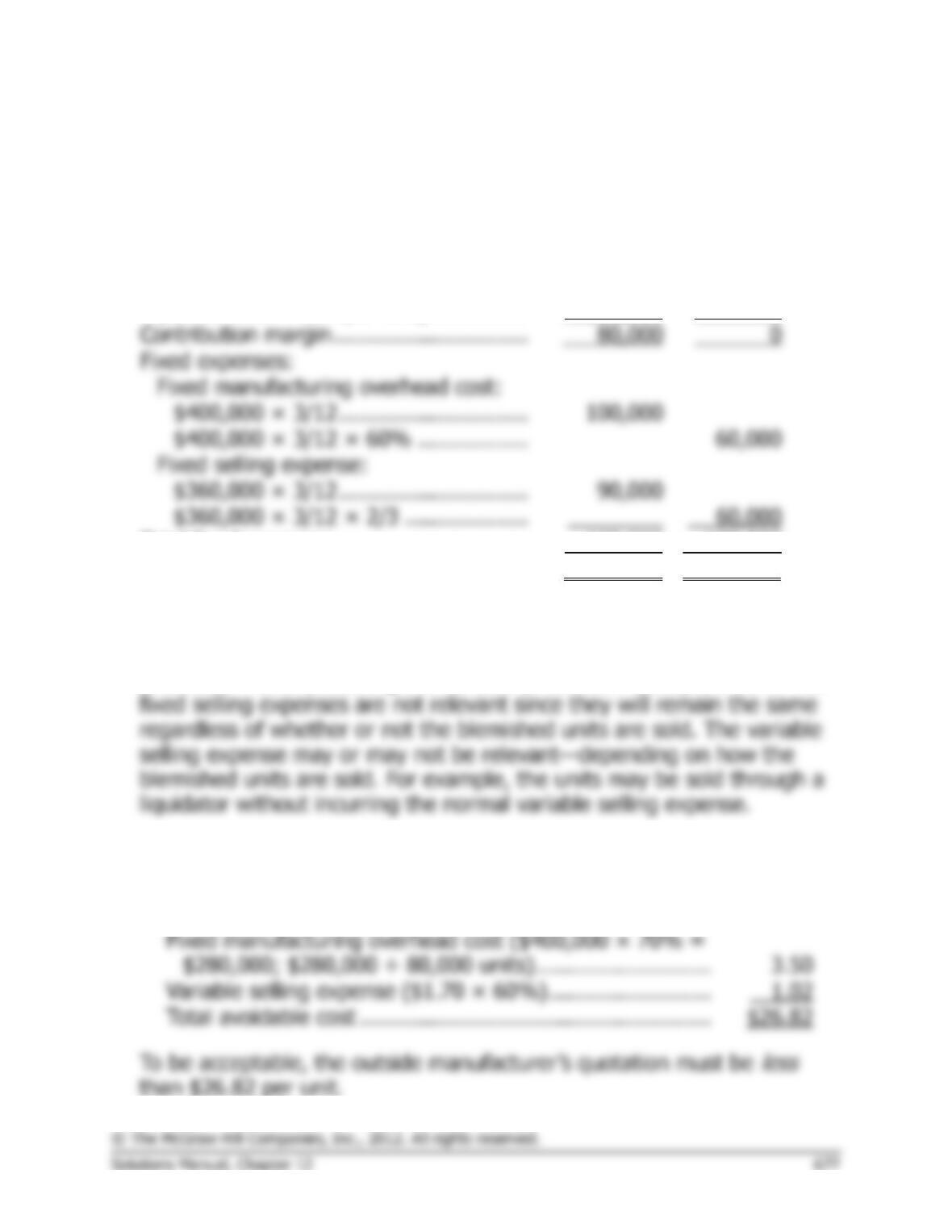
Fixed costs that can be avoided if the plant is closed:
Net disadvantage of closing the plant ……………

Problem 12-24 (continued)
Alternative approach:
Keep the
Plant Open
Close the
Plant
Sales (5,000 units × $40 per unit) ………
$ 200,000
$ 0
Variable expenses
(5,000 units × $24 per unit) ……………
120,000
0
Contribution margin …………………………
0
Fixed expenses:
Total fixed expenses ………………………..
190,000
120,000
Net operating income (loss) ………………
$(110,000)
$(120,000)
4. The relevant cost is $1.70 per unit, which is the variable selling expense
per Zet. Since the blemished units have already been produced, all
production costs (including the variable production costs) are sunk. The
5. The costs that can be avoided by purchasing from the outside supplier are
relevant. These costs are:
Variable production costs ……………………………………….
$22.30
Fixed manufacturing overhead cost ($400,000 × 70% =
$280,000; $280,000 ÷ 80,000 units) ………………………
Variable selling expense ($1.70 × 60%) …………………….
Total avoidable cost ………………………………………………
$26.82
Problem 12-25 (75 minutes)
1. The $2.00 per unit general overhead cost is not relevant to the decision
because the total general company overhead cost will be the same
regardless of whether the company decides to make or buy the
subassemblies. Also, the depreciation on the old equipment is not a
relevant cost because it represents a sunk cost and the old equipment is
worn out and must be replaced. The cost of supervision is relevant
because this cost can be avoided by buying the subassemblies.
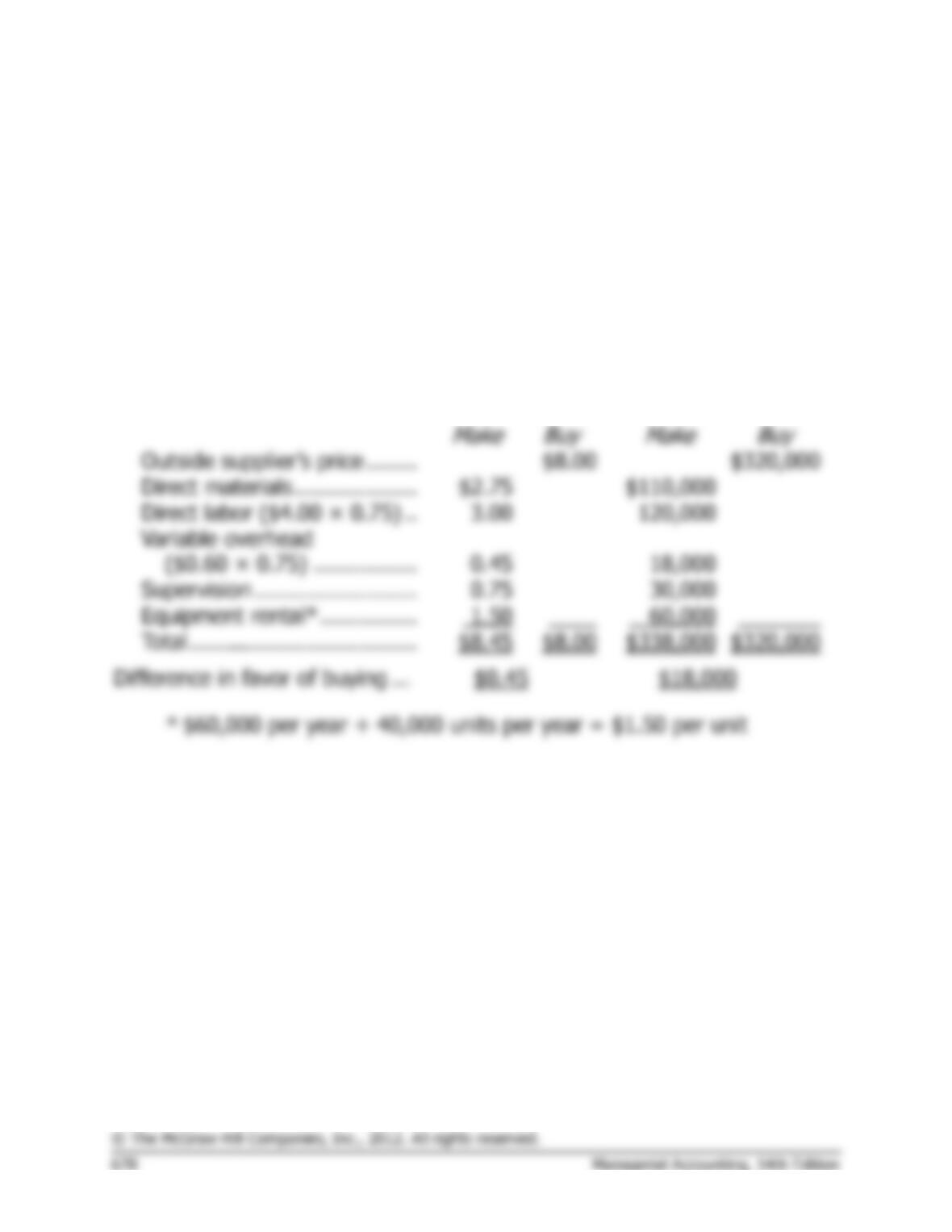
Differential
Costs Per Unit
Total Differential
Costs for
40,000 Units
Direct materials ……………….
Supervision …………………….
Equipment rental* ……………
*
$60,000 per year ÷ 40,000 units per year = $1.50 per unit