12–41
CA 12-2 (Continued)
The amount of interest cost for the first nine months of 2012 is the measure of the 2012 loss resulting
from the tornado. The extension of the construction period to October 2012 because of the tornado
does not warrant its capitalization as construction period interest. It is in effect an uninsured loss
CA 12-3
(a) A dollar to be received in the future is worth less than a dollar received today because of an
interest or discount factor—often referred to as the time value of money. The discounted value of
the expected royalty receipts can be thought of either in terms of the present value of an annuity of
1 or in terms of the sum of several present values of 1.
CA 12-3 (Continued)
(c) The basis of valuation for patents that is generally accepted in accounting is cost. Evidently the
cartons were developed and the patents obtained directly by the client corporation. Those costs
related to the research and development of the cartons must be expensed in accordance with
GAAP. The costs of securing the patent should be capitalized. If the infringement suit is
(e) The amortization policy is implied in the definition of intangible assets as rights to future benefits.
As the benefits are received by the firm, the cost or other value should be charged to expense or
to inventory to provide a proper matching of revenues and expenses. Under the discounted value
approach, the periodic amortization would be the decline during the year in the present value of
expected net receipts. In practice, generally straight-line amortization is used because it is simple
the client were the successful defendant in an infringement suit on these patents, the generally
accepted accounting practice would be to add the costs of the legal defense to the Patents
account.
subsequent events) disclosure.
CA 12-4
(a) Research, as defined in GAAP (FASB ASC 730-10-25), is “planned search or critical investigation
aimed at discovery of new knowledge with the hope that such knowledge will be useful in developing
a new product or service . . . or a new process or technique . . . or in bringing about a significant
12–43
CA 12-4 (Continued)
(b) The current accounting and reporting practices for research and development costs were
promulgated by the Financial Accounting Standards Board (FASB) in order to reduce the number
of alternatives that previously existed and to provide useful financial information about research
(3) immediate recognition. The FASB found little or no evidence of a direct causal relationship
between current research and development expenditures and subsequent future benefits. The
FASB also stated that the high degree of uncertainty surrounding future benefits, if any, of
individual research and development projects make it doubtful that there is any useful purpose to
be served by capitalizing the costs and allocating them over future periods. In view of the above,
CA 12-5
(a) Investors and creditors are concerned with corporate profits, dividends, and cash flow. Employees
in Czeslaw Corporation’s R&D department are concerned about job security if the company begins
to hire outside firms rather than have work done internally. Reid must be concerned with his
performance and reputation within the company as well.
12–44
FINANCIAL REPORTING PROBLEM
(a) P&G reports Goodwill of $56,512 million for 2009. P&G also reports
(net of amortization) Trademarks and other intangible assets of
$32,606 million in 2009.
COMPARATIVE ANALYSIS CASE
(2) Coca-Cola: Intangible assets are 26.36% of total assets.
PepsiCo: Intangible assets are 22.98% of total assets.
(3) At Coca-Cola, intangible assets increased $323M from $12,505M
to $12,818M. At PepsiCo, intangibles increased $2,173M from
(2) Coca-Cola had accumulated amortization of $233M and $175M
on December 31, 2009 and 2008, respectively. PepsiCo had accu–
mulated amortization of $1,129M and $1,039M at year-end 2009
and 2008, respectively.
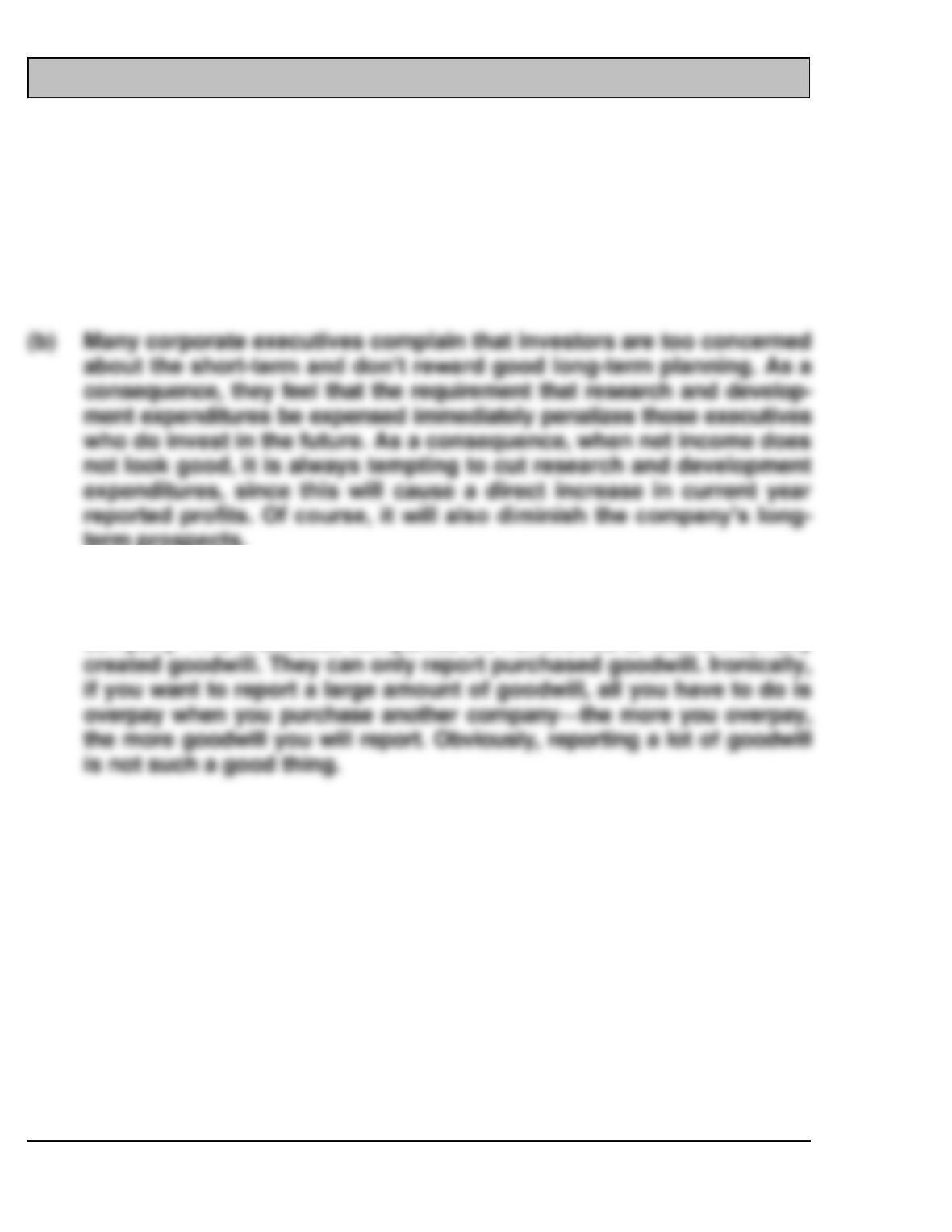
(3) Coca-Cola identified the composition of its intangible assets as
follows:
$ 9,157M
12–46
FINANCIAL STATEMENT ANALYSIS CASE 1
MERCK AND JOHNSON & JOHNSON
(a) The primary intangible assets of a healthcare products company
would probably be patents, goodwill and trademarks. The nature of
each of these is quite different; thus, an investor would normally want
to know what the composition of intangible assets is if it is material.
term prospects.
(c) If a company reports goodwill on its balance sheet, it can only have
resulted from one thing—the company must have purchased another
company. This is because companies are not allowed to record internally
12–47
FINANCIAL STATEMENT ANALYSIS CASE 2
(a) The depressed market values (less than book value) suggest that
market participants are not very optimistic about the future prospects
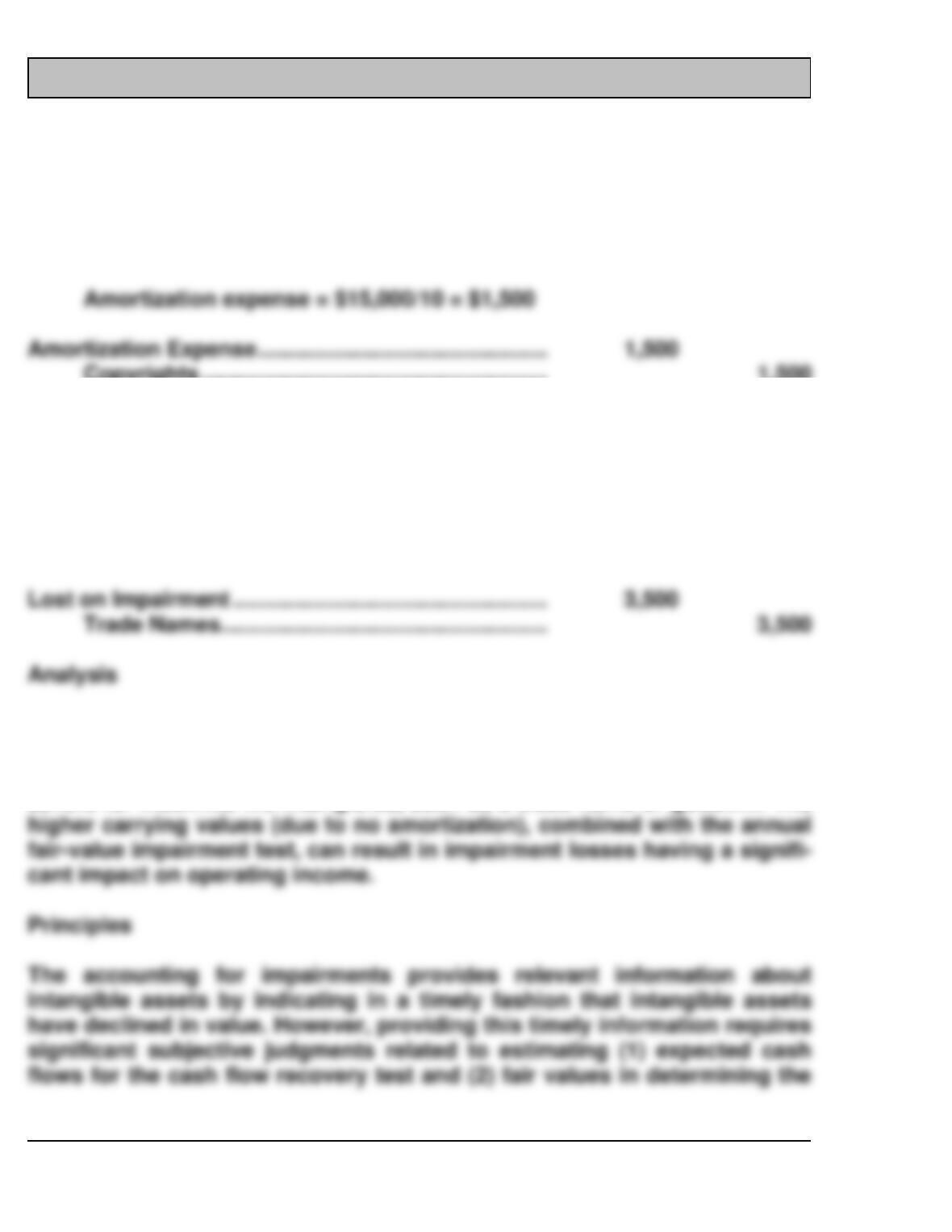
(b) Because the market (fair) value of each company is less than its book
value of its net assets, it fails the first step in the goodwill impairment
test; an impairment should be recorded.
A
B
C
D
E
F
G
H
(Columns C–D)
(Columns B–F)
(Columns D–G)
Company
Market
Value
Book Value
(Net Assets)
Carrying
Value of
Goodwill
ROA
Estimated Fair
Value of Net
Assets
Implied GW
(NA-Market
Value)
Goodwill
Impairment
Sprint Nextel
$36,361
$51,271
$30,718
3.5%
$20,553
$15,808
$14,910
Washington Mutual
11,742
23,941
9,062
2.4%
14,879
0
9,062
E Trade Financial
1,639
4,104
2,035
5.6%
2,069
0
2,035
Total
$26,007
12–48
ACCOUNTING, ANALYSIS, AND PRINCIPLES
Accounting
There is a full year of amortization on the copyright. There is no
amortization for the trade name, which is considered an indefinite-life
intangible.
Copyrights ……………………………………………………..
1,500
The recoverability test for the copyright indicates that the copyright is not
impaired: The expected cash flows (undiscounted) of $20,000 are greater
than the carrying value of $13,500 ($15,000 – $1,500). The trade name is tested
for impairment using a fair value test. Thus, Raconteur writes it down to the
fair value of $5,000, recording an impairment charge of $8,500 – $5,000 =
$3,500.
Lost on Impairment …………………………..…………………….
3,500
Trade Names …………………………………………………..
3,500
Impairment losses are recorded in operating income. Because impairments
tend to be nonrecurring items, their recognition can make operating income
more volatile from year to year. This volatility effect can be particularly
severe for indefinite-life intangibles, such as a trade name or goodwill. The
Amortization Expense ……………………………………………..
1,500

12–49
12–50
PROFESSIONAL RESEARCH
(a) FASB ASC 350-10–05.
(b) Codification String: Assets > 350 Intangibles – Goodwill and other >
10 Overall > 20 Glossary
Goodwill
(c) Overall Accounting for Goodwill: Codification String; Assets > 350
Intangibles – Goodwill and other > 20 Goodwill > 35 Subsequent
Measurement.
35-1 Goodwill shall not be amortized. Instead, goodwill shall be
tested for impairment at a level of reporting referred to as a
35–48 All goodwill recognized by a public or nonpublic subsidiary
(subsidiary goodwill) in its separate financial statements that
are prepared in accordance with generally accepted accounting

12–51
PROFESSIONAL RESEARCH (Continued)
with impaired goodwill resides must be tested for impairment if
12–52
PROFESSIONAL SIMULATION
Journal Entries
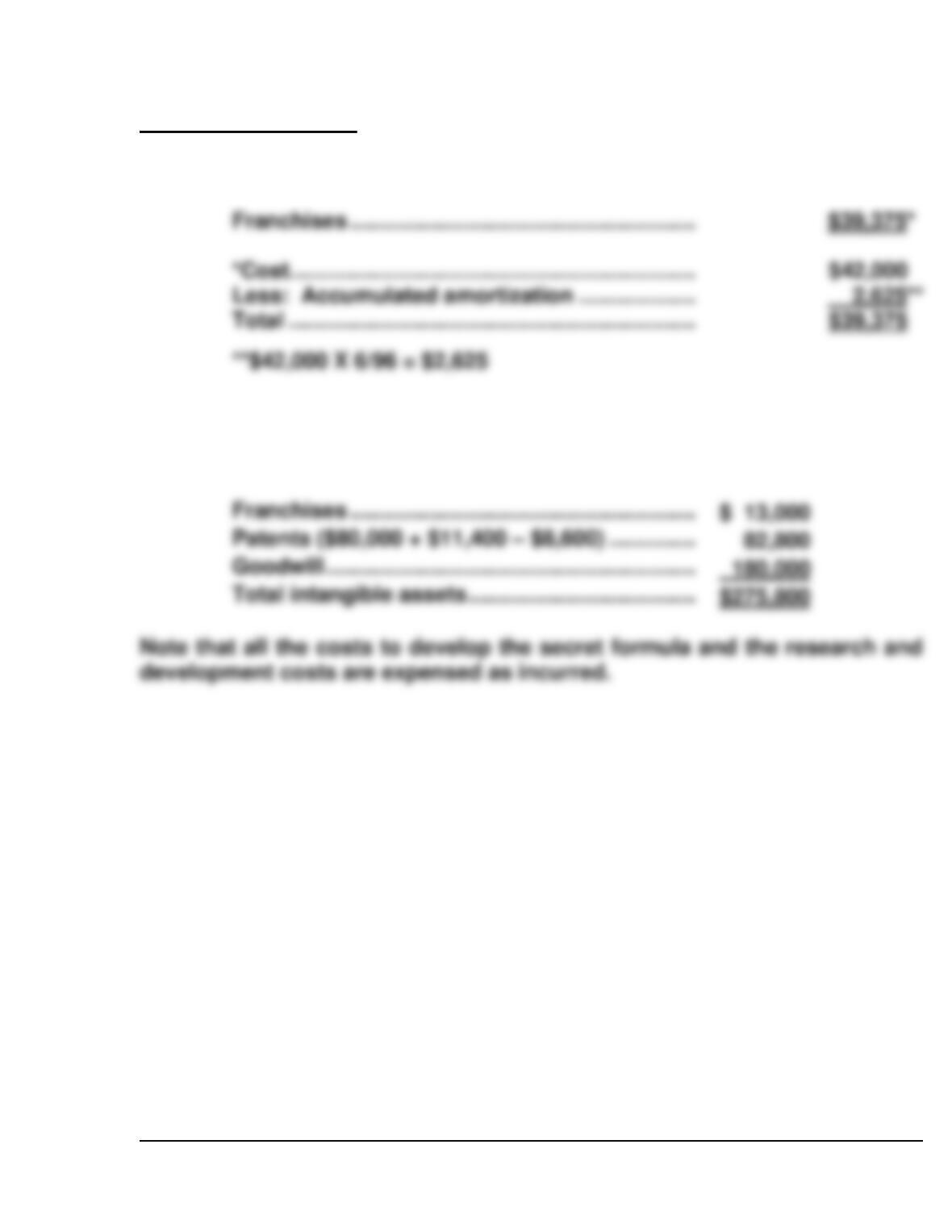
January 2, 2012
Patents …………………………………………………….. 80,000
Cash …………………………………………………… 80,000
Computation of patent expense:
$80,000 X 12/120 =
$11,400 X 6/114 =
Total
Measurement
Computation of impairment loss:
Cost ………………………………………………………….
$42,000
Less: Accumulated amortization ………………..
7,875*
Book value ………………………………………………..
$34,125
*$42,000 X 18/96 = $7,875
Book value ………………………………………………..
Less: Fair value ………………………………………..
Loss on impairment …………………………………..
12–53
PROFESSIONAL SIMULATION (Continued)
Financial Statements
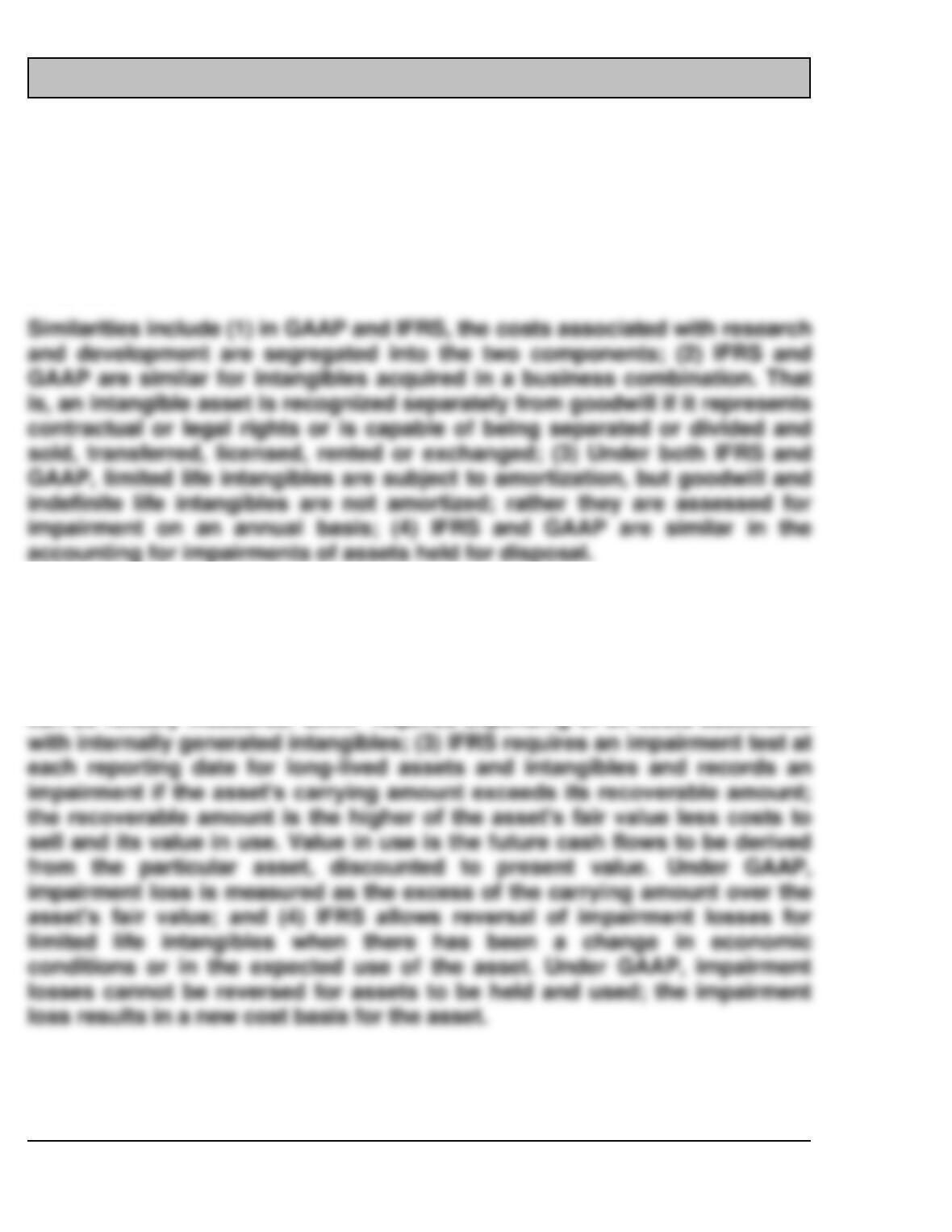
Intangible assets as of December 31, 2011
Note that the net loss and all organization costs are expensed in 2011.
Intangible assets as of December 31, 2012
12–54
IFRS CONCEPTS AND APPLICATION
IFRS12-1
IFRS guidance related to intangible assets is presented in IAS 38, “Intangible
Assets.” IFRS related to impairments is found in IAS 36, “Impairment of
Assets.”
IFRS12-2
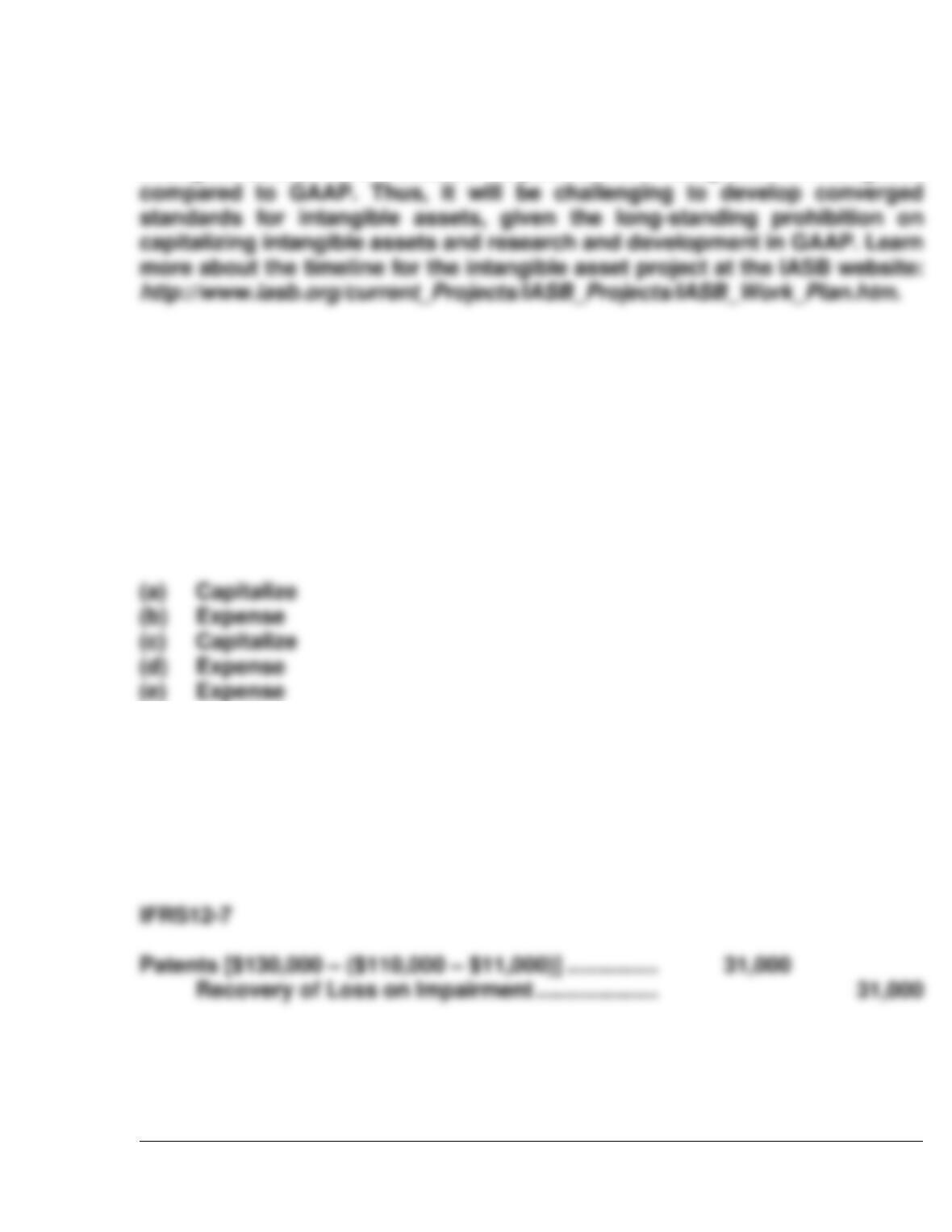
Notable differences are: (1) while costs in the research phase are always
expensed under both IFRS and GAAP, under IFRS costs in the development
phase are capitalized once technological feasibility is achieved; (2) IFRS
permits some capitalization of internally generated intangible assets (e.g.,
brand value), if it is probable there will be a future benefit and the amount
can be reliably measured. GAAP requires expensing of all costs associated
12–55
IFRS12-3
The IASB and FASB have identified a project, in a very preliminary stage,
which would consider expanded recognition of internally generated
intangible assets. As indicated, IFRS permits more recognition of intangibles
IFRS12-4
Research and Development Expense ……………………….
430,000
Intangible Assets…………………………………………………….
75,000
Accounts Payable …………………………………………..
505,000
IFRS12-5
IFRS12-6
Loss on Impairments ………………………………………………
190,000
Patents ($300,000 – $110,000) ………………………….
190,000
Patents [$130,000 – ($110,000 – $11,000)] …………………
Recovery of Loss on Impairment ……………………..
31,000
12–56
IFRS12-8
Because the recoverable amount of the division exceeds the carrying
amount of the assets, goodwill is not considered to be impaired. No entry is
necessary.
IFRS12-9
IFRS12-10
(a) In accordance with IFRS, the $325,000 is a research and development
cost that should be charged to R&D Expense and, if not separately
disclosed in the income statement, the total cost of R&D should be
separately disclosed in the notes to the financial statements.
12–57
IFRS12-10 (Continued)
(c)
Patents …………………………………………………………………..
47,200
Cash …………………………..………………………………….
47,200
(To record legal costs of successfully
defending patent)
Or
Carrying value after 1 year $48,000 + Cost to defend $47,200 = $95,200
Expense: $95,200 ÷ 8 = $11,900
IFRS12-11
(a) IFRS 3 addresses goodwill, while IAS 38 addresses intangible assets.
Amortization Expense …………………………………………….
11,900
Patents ……………………………………………………….
12–58
IFRS12-11 (Continued)
(d) Goodwill recognised in a business combination is an asset represent–
ing the future economic benefits arising from other assets acquired in
a business combination that are not individually identified and
separately recognised. Goodwill does not generate cash flows
Applying the requirements in paragraph 80 results in goodwill being
tested for impairment at a level that reflects the way an entity
manages its operations and with which the goodwill would naturally
be associated. Therefore, the development of additional reporting
systems is typically not necessary (par. 82).
If the initial allocation of goodwill acquired in a business combination
cannot be completed before the end of the annual period in which the
business combination is effected, that initial allocation shall be
completed before the end of the first annual period beginning after
the acquisition date (par. 84).
12–59
IFRS12-11 (Continued)
In accordance with IFRS 3 Business Combinations, if the initial
accounting for a business combination can be determined only
provisionally by the end of the period in which the combination is
effected, the acquirer:
IFRS12-12
(a) M&S shows Intangible Assets on the statement of financial position. In
its footnotes, M&S reposts Goodwill, Brands, and Computer Software.
Goodwill of £452.8 million was reported at 3 April 2010.