x
f
ⴚ1
(x) ⴝ 兹
苵苵苵
苵苵苵
3
x ⴚ 1
y ⴝ log
3
x
Chapter 12 Summary and Review: Review Exercises 363
13. log3(2x+3)=2
32=2x+3
Chapter 12 Review Exercises
1. We interchange the coordinates of the ordered pairs.
The inverse of the relation is
2. The graph of f(x)=4−x2fails the horizontal-line test,
3. The graph of g(x)=2x−3
7passes the horizontal-line test,
so it is one-to-one.
We find a formula for the inverse.
4. The graph of f(x)=8x3passes the horizontal-line test, so
it is one-to-one.
3. Solve for y:x
8=y3
5. The graph of f(x)= 4
3−2xpasses the horizontal-line test,
1. Replace f(x)byy:y=4
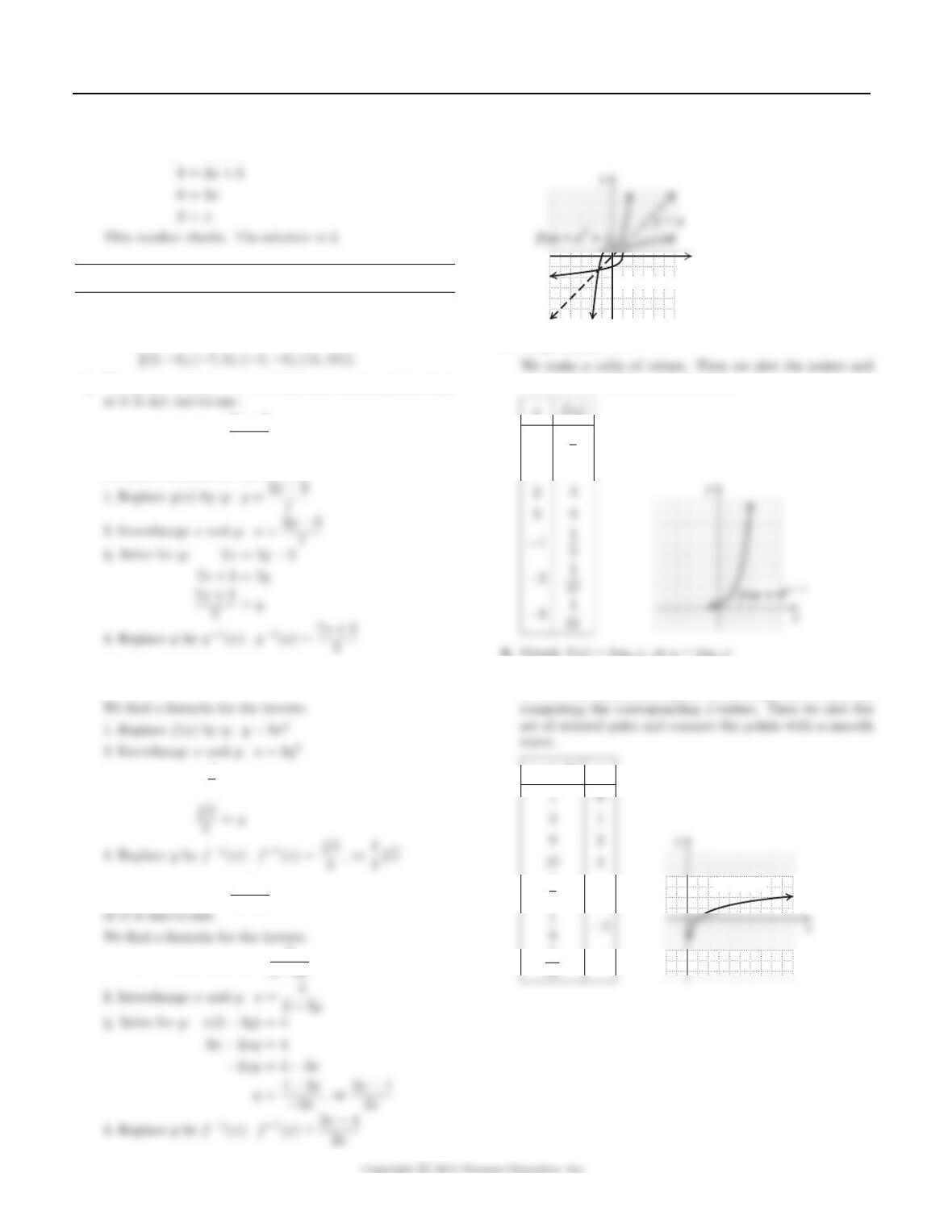
6. First graph f(x)=x3+ 1. Then, to graph the inverse,
reflect the graph of the function across the line y=x.
7. Graph: f(x)=3
x−1
connect them with a smooth curve.
01
3
1 1
8. Graph f(x) = log3x,ory= log3x
The equation f(x)=y= log3xis equivalent to
3y=x. We find ordered pairs by choosing values for yand
x, or 3yy
1
3−1
1
y
364 Chapter 12: Exponential and Logarithmic Functions
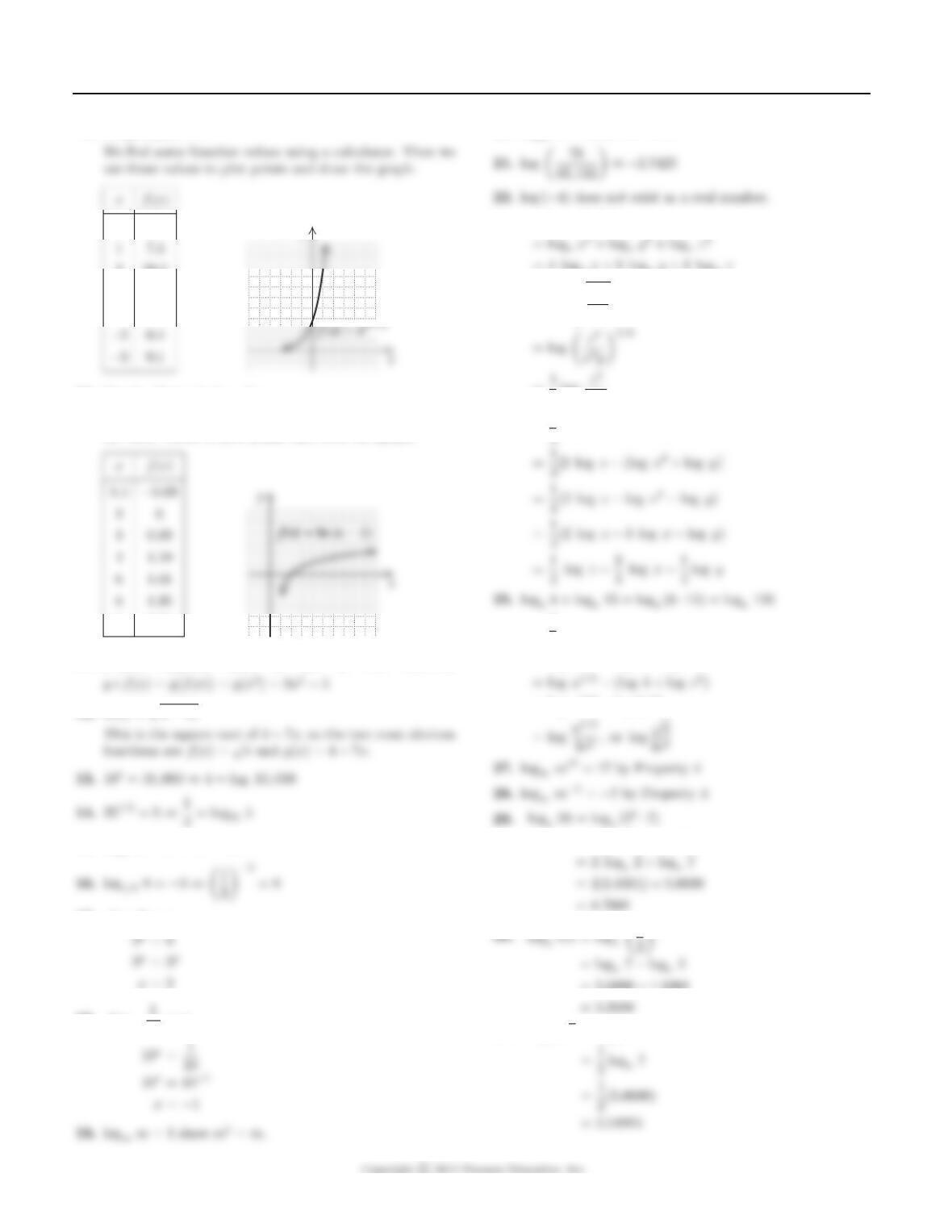
9. Graph: f(x)=ex+1
0 2.7
2 20.1
3 54.6
−1 1
10. Graph: f(x) = ln (x−1)
We find some function values using a calculator. Then we
use these values to plot points and draw the graph.
9 2.08
11. f◦g(x)=f(g(x)) = f(3x−5) = (3x−5)2=9x2−30x+25
12. h(x)=√4−7x
15. log416 = x⇒4x=16
17. log39=x
18. log10
10 =x
20. logm1 = 0 since m0=1.
23. logax4y2z3
24. log 4
z2
x3y
=1
4log z2
x3y
=1
4[log z2−log (x3y)]
26. 1
2log a−log b−2 log c
= log a1/2−log b−log c2
= log a1/2−log (bc2)
= loga22+ loga7
=5.0999 −1.8301
31. loga√7 = loga71/2
Chapter 12 Summary and Review: Review Exercises 365
32. loga
1
4= loga4−1
40. log12 70 = ln 70
ln 12 ≈1.7097
41. log3x=−2
x5=2
5
x=2
43. log x=−4
44. 3lnx=−6
45. 42x−5=16
42x−5=4
2
46. 2x2·24x=32
2x2+4x=2
5
47. 4x=8.3
48. e−0.1t=0.03
49. log416 = x
50. log4x+ log4(x−6) = 2
log4[x(x−6)]=2
51. log2(x+3)−log2(x−3)=4
log2
x+3
x−3=4
x−3
The number 17
5checks. It is the solution.
27 = x2−16
43=x2
366 Chapter 12: Exponential and Logarithmic Functions
53. L=10·log I
I0
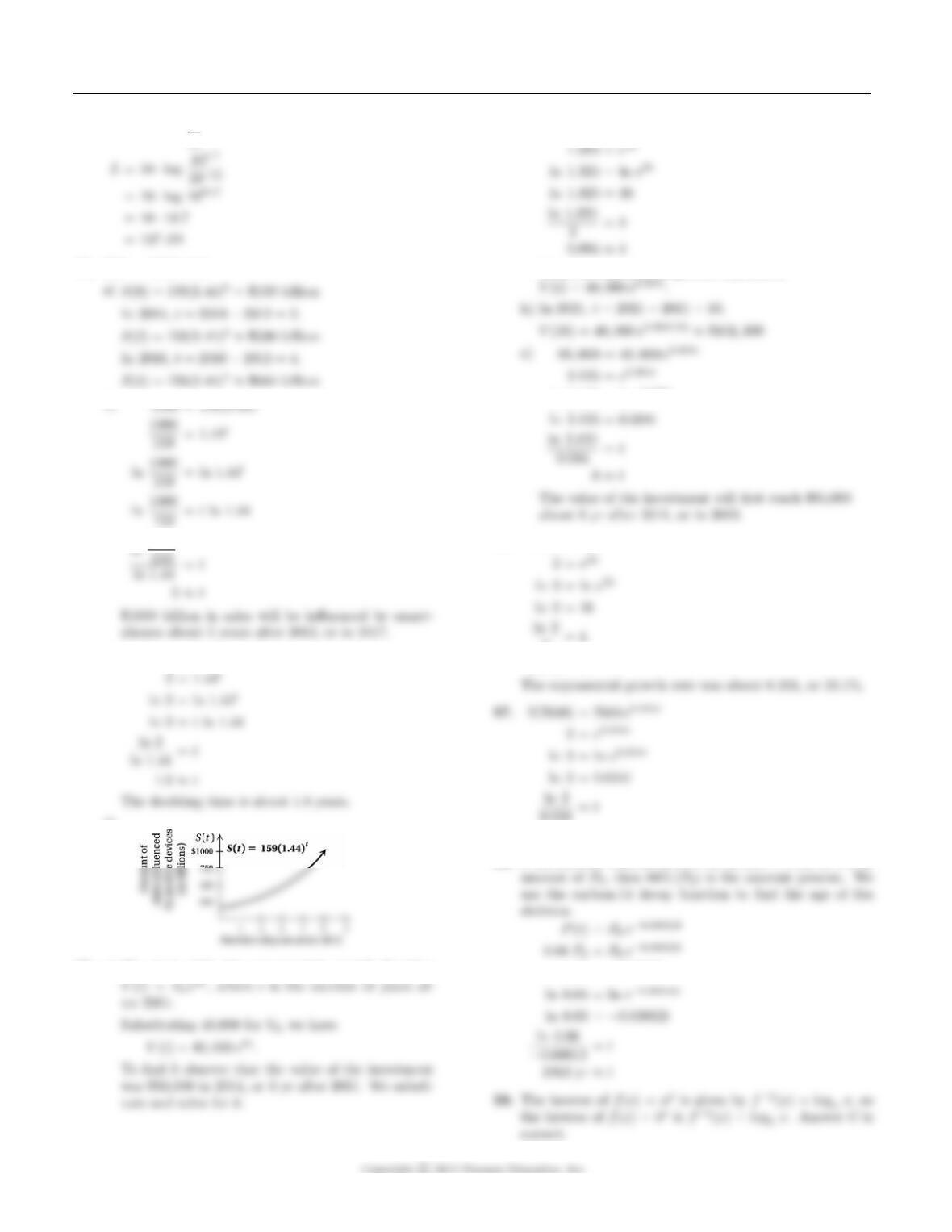
54. S(t) = 159(1.44)t
b) 1000 = 159(1.44)t
c) 2(159) = 159(1.44)t
d)
55. a) We start with the exponential growth function
53,000=40,000 ek·3
Thus the exponential growth function is
ln 2.125=lne0.094t
56. 2P0=P0ek·3
3=k
0.231 ≈k
0.034 =t
20.4 yr ≈t
58. If the skeleton had lost 34% of its carbon-14 from an initial
0.66 = e−0.00012t
x
f(x) ⴝ 2x ⴙ 1
Chapter 12 Test 367
log x2−9
x+3 =1
10(x+3)= x2−9
x−13=0 or x +3=0
The number 13 checks, but −3 does not. The solution is
61. ln (ln x)=3
62. 5x+y=25 2
2x−y=64
We have a system of equations. We solve using the elimi-
nation method.
Now substitute 8
Chapter 12 Discussion and Writing Exercises
2. Christina mistakenly thinks that, because negative num-
3. C(x)=100+5x
x
4. To solve ln x= 3, graph f(x)=ln xand g(x)=3on
5. You cannot take the logarithm of a negative number be-
6. Answers will vary.
Chapter 12 Test
a table.
0+1 =2
1=2
f(−2) = 2−2+1 =2
−1=1
21=1
2
0 2
−1 1
Next we plot these points and connect them with a smooth
The equation y= log2xis equivalent to 2y=x. We can
find ordered pairs by choosing values for yand computing
For y=1,x=2
1=2.
y
y
x
f(x) ⴝ e
x ⴚ 2
y
x
f(x) ⴝ 2 ⴚ 円x円
368 Chapter 12: Exponential and Logarithmic Functions
x, or 2yy
1 0
4 2
8 3
1
We plot the set of ordered pairs and connect the points
with a smooth curve.
3. Graph: f(x)=ex−2
We find some function values with a calculator. Use these
values to plot points and draw the graph.
x f(x)
−1 0.05
1 0.47
2 1
4 7.39
4. Graph: f(x) = ln(x−4)
5. f(x)=x+x2,g(x)=5x−2
6. Interchange the first and second coordinates of each or-
dered pair.
7. The graph of f(x)=4x−3 passes the horizontal-line test,
so it is one-to-one.
8. The graph of f(x)=(x+1)
3passes the horizontal-line
test, so it is one-to-one.
We find a formula for the inverse.
9. The graph of f(x)=2−|x|is shown below. It fails the
horizontal-line test, so it is not one-to-one.
10. 2561/2=16⇒1
2= log256 16
16. log (−5) does not exist as a real number.
17. log a3b1/2
c2
18. 1
3logax−3 logay+ 2 logaz
19. loga
2
= loga2 + loga6
25. logx25=2
25 = x2
26. log4x=1
2
x=4
1/2=√4
28. ln x=1
4
29. 7x=1.2
x≈0.1823
1.9459
x≈0.0937
log (x+ 1)(x−1)
x−1=1
32. pH = −log [H+]
The pH is approximately 4.2.
33. H(t)=2.37(1.076)t
log 5
2.37 =tlog 1.076
370 Chapter 12: Exponential and Logarithmic Functions
c) 2(2.37) = 4.74
34. a) P(t)=P0ekt
1150.27 = 1000ek·5
c) 1439 = 1000e0.028t
1.439 = e0.028t
d) 2000 = 1000e0.028t
2=e0.028t
35. 2P0=P0ek·23
ln 2=23k
36. If the bone has lost 43% of its carbon-14 from an initial
amount of P0, then 57%(P0), or 0.57P0, is the amount
The bone is about 4684 years old.
x=−5
3or x =2
log(3x−1) + log x=1
log(3 ·2−1) + log 2 ? 1
The number −5
3does not check, but 2 does. The solution
38. log3|2x−7|=4
Cumulative Review Chapters 1 – 12 371
39. loga
3
√x2z
3
y2z−1
= loga
3
x2z
y2z−1
=1
3logax2z2
y2
=1
=1
3(4 + 8 −6)
Cumulative Review Chapters 1 – 12
3x−1
5≥1
5x−1
3
151
2. |x|>6.4
−|4−x|=−15
|4−x|= 15 Multiplying by −1
x=19 or x =−11
4. 3x+y=4,(1)
−6x−y=−3 (2)
Substitute −1
3for xin Equation (1) and solve for y.
3−1
3+y=4
−1+y=4
5. x4−13x2+36=0
Let u=x2.
6. 2x2=x+3
2x=3 or x =−1
7. 3x−6
x=7
3x+2=0 or x −3=0
8. |x+6|≤13
−13 ≤x+6≤13
9. x(x+ 10) = −21
x2+10x+21=0
(x+ 3)(x+7)=0
372 Chapter 12: Exponential and Logarithmic Functions
10. 2x2+x+1=0
a=2,b=1,c=1
11. 4(y−1)+6= −8−y
4y−4+6= −8−y
4y+2= −8−y
12. x+1
x−2>0
Solve the related equation.
intervals as shown:
1
4TRUE
The number 0 is not a solution of the inequality, so the
interval Bis not part of the solution set.
32=x
9=x
14. x2−1≥0
✲✛
−11
A
B
C
15. log2x+ log2(x+7) = 3
log2x(x+7)=3
16. √x+5= x−1
(√x+5)
2=(x−1)2
Years since 2000
Cumulative Review Chapters 1 – 12 373
17. |x−2|=|3x+1|
18. 7x=30
19. x−y+2z=3,(1)
−x+z=4,(2)
2x+y−z=−3
Multiply Equation (2) by −1 and then add.
Now substitute −1 for xin Equation (2) and solve for z.
−(−1) + z=4
20. 3≤4x+7<31
−4≤4x<24
21. 3
x−3−x+2
x2+2x−15 =1
x+5
2x+13=x−3
4(M+2N)
4P=3(M+2N) Multiplying by 4
4P=3M+6N
23. N(t) = 65(1.018)t
b) N0= 65, so 2 N0=2·65 = 130.
log 2
log 1.108 =t
24. a) A(t) = $50,000(1 + 0.04)t= $50,000(1.04)t
A(t)
374 Chapter 12: Exponential and Logarithmic Functions
25. (2x+ 3)(x2−2x−1)
26. (3x2+x3−1) −(2x3+x+5)
27. 2m2+11m−6
m+1
28. x
x−1+2
x+1−2x
x2−1
=x(x+1)+2(x−1) −2x
(x−1)(x+1)
(x−1)(x+1)
x
1−5
x
=x−5
x2−4x−5
x+1 x4+3x3+0x2−x+4
x4+x3
31. 75x5y2
√3xy =75x5y2
3xy =25x4y=√25x4·√y=
34. (2 −i√2)(5 + 3i√2)= 10+6i√2−5i√2−3i2·2
35. 5+i
2−4i=5+i
2−4i·2+4i
2+4i
x
y ⴚ x ⬍ ⴚ2
x
1
Cumulative Review Chapters 1 – 12 375
38. 1000 ÷102·25 ÷4 = 1000 ÷100 ·25 ÷4
39. 5x−3[4(x−2) −2(x+ 1)]
40. 7x−14 = 28y
x-intercept:
41. a) m=−3−13
8−(−3) =−16
8+3 =−16
11 =−16
11
42. First we will find the slope of the line.
43. First solve the given equation for yto determine its slope.
2x−y=3
y=mx +b
5
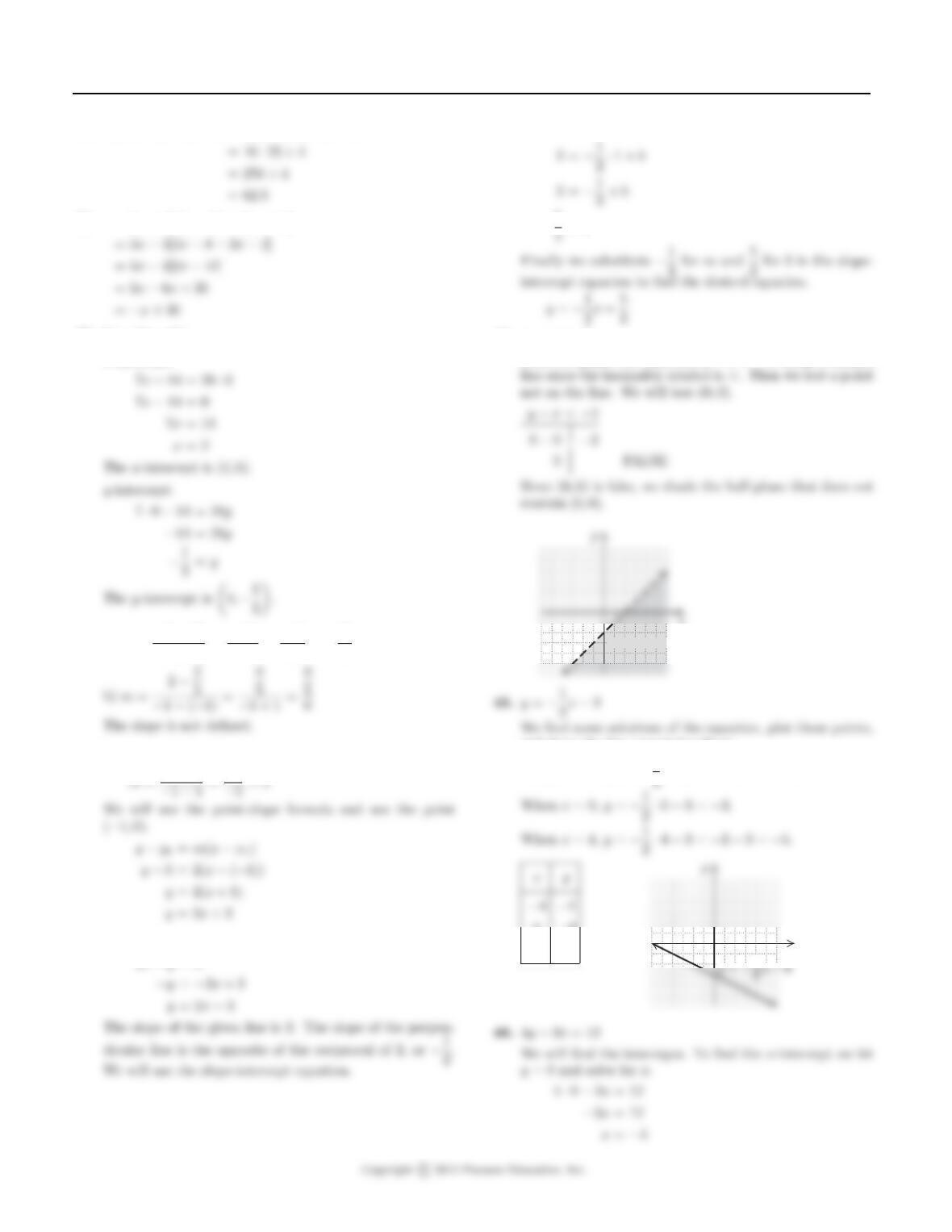
44. y−x<−2
First we graph the equation y−x=−2 using a dashed
and draw the line containing them.
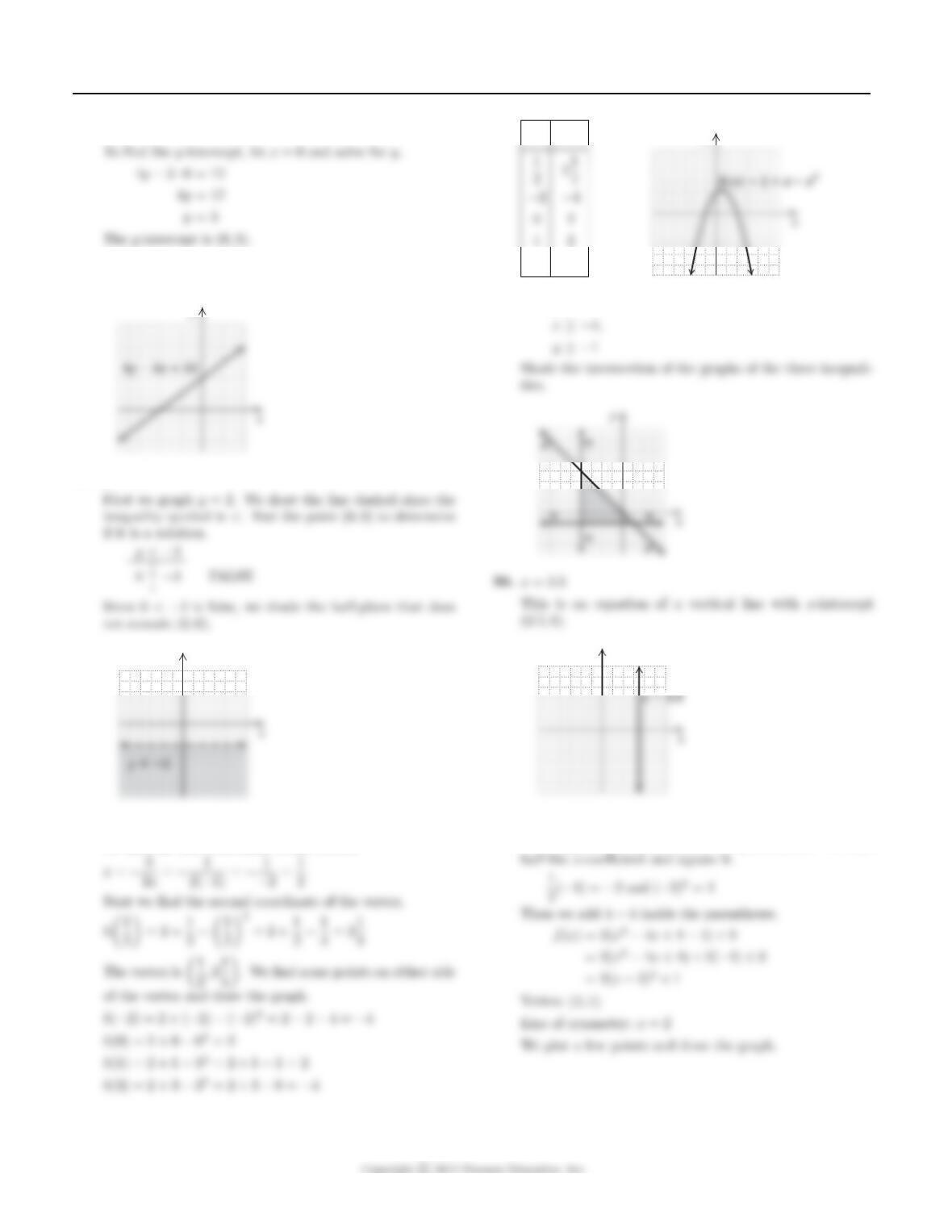
When x=−4, y=−1
0−3
4−5
y
y
y
y
376 Chapter 12: Exponential and Logarithmic Functions
The x-intercept is (−4,0).
We plot these points and draw the line. A third point can
be plotted as a check.
47. y<−2
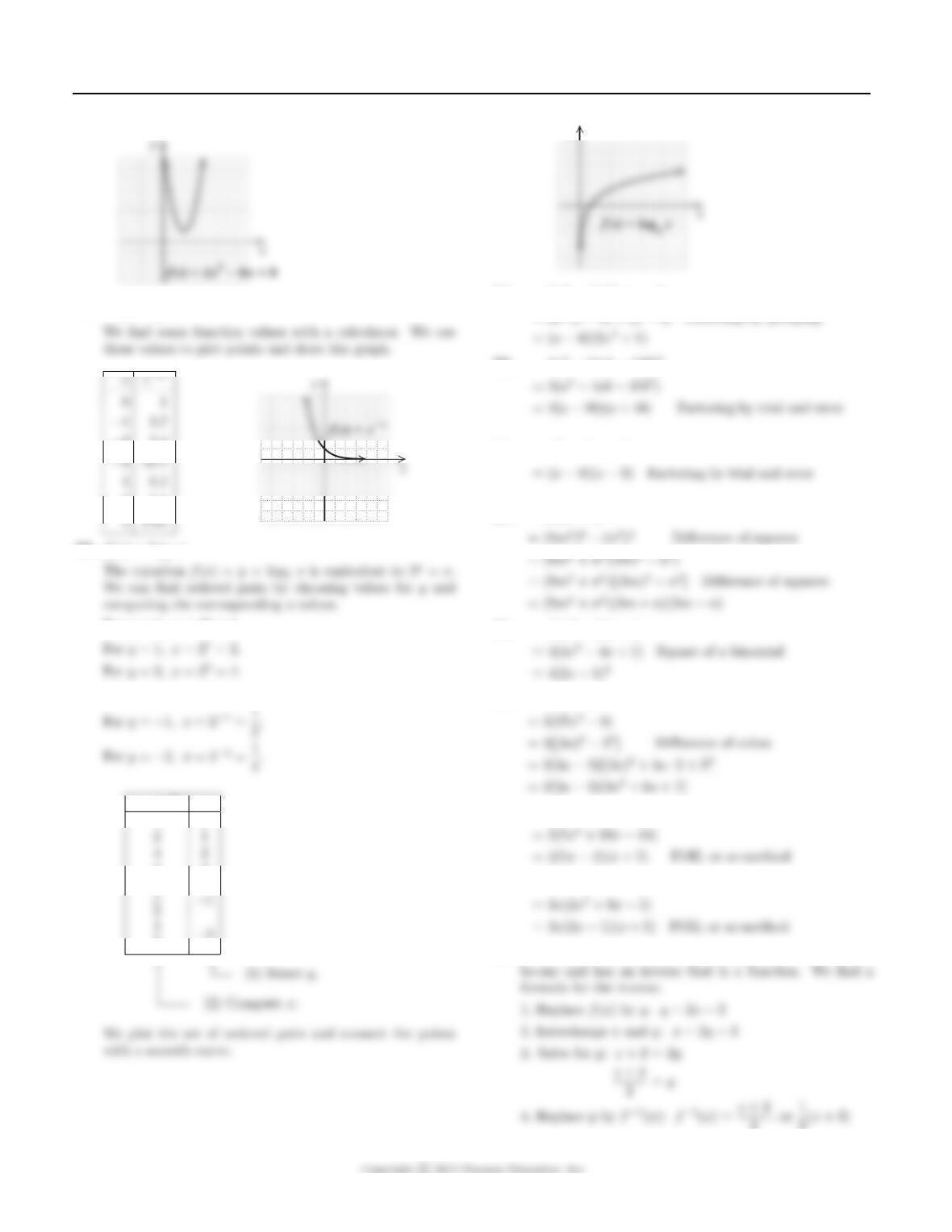
48. h(x)=2+x−x2
We find the first coordinate of the vertex.
x h(x)
3−4
49. x+y≤0,
51. f(x)=2x2−8x+9=2(x2−4x)+9
We complete the square inside the parentheses. We take
y
Cumulative Review Chapters 1 – 12 377
52. Graph: f(x)=e−x
−2 7.4
2 0.1
53. f(x) = log2x
For y=0,x=2
0=1.
For y=3,x=2
3=8.
x, or 2yy
1 0
8 3
4−2
54. 2x4−12x3+x−6
=2x3(x−6)+(x−6) Factoring by grouping
55. 3a2−12ab −135b2
56. x2−17x+72
57. 81m4−n4
58. 16x2−16x+4
59. 81a3−24
60. 10x2+66x−28
61. 6x3+27x2−15x
62. f(x)=2x−3 passes the horizontal-line test so it is one-
2,or1
2(x+3)
400
600
S(t) ⴝ 18t ⴙ 344.7
63. z=kx
y3
z=10x
y3Equation of variation
64. f(x)=x3−2
65. g(x)=−30
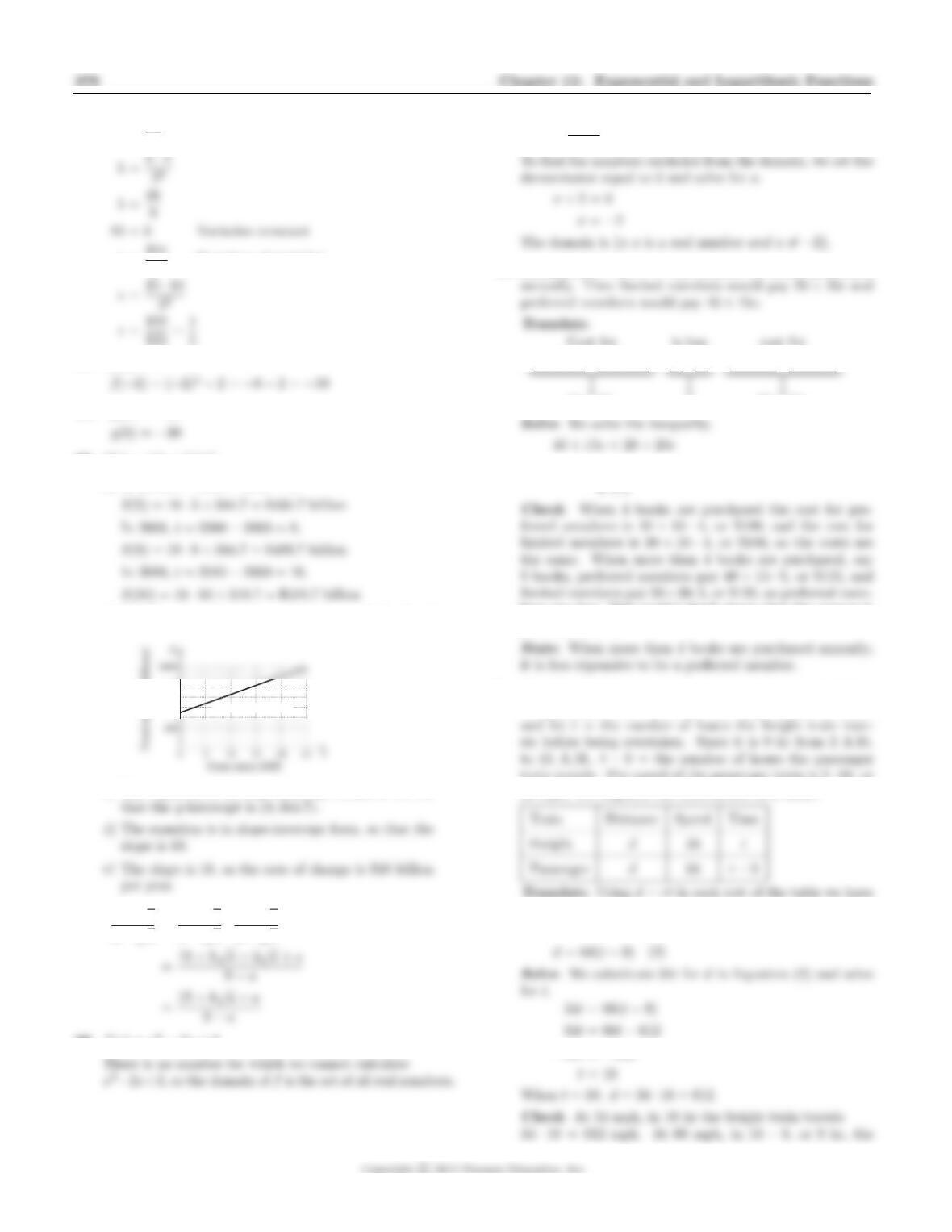
66. S(t)=18t+344.7
a) In 2005, t= 2005 −2000 = 5.
b) Use the points found in part (a) to graph the function.
c) The equation is in slope-intercept form, so we see
67. 5+√a
3−√a=5+√a
3−√a·3+√a
3+√a
68. f(x)=x2−2x+3
69. h(x)=2−x
x+2
70. Familiarize. Let c= the number of books purchased
Cost for
preferred members
is less
than
cost for
limited members.
40+15c<20+20c
20 <5c
bers pay less. This partial check shows that the answer is
probably correct.
71. Familiarize. Let d= the distance the trains travel before
the passenger train overtakes the freight train, in miles,
train travels. The speed of the passenger train is 2 ·34, or
68 mph. We organize the information in a table.
two equations.
d=34t, (1)
−34t=−612
Cumulative Review Chapters 1 – 12 379
72. Familiarize. Let s= the length of a side of the octagon.
Then 3s−2 = the length of a side of the pentagon. The
perimeter of the pentagon is 5(3s−2) and the perimeter
of pentagon
same as
of octagon.
Check.Ifs=10
7, then the perimeter of the octagon is
73. Familiarize. Let aand brepresent the number of liters
of solutions A and B to be used, respectively. We organize
Percent of
ammonia 6% 2% 3.2%
74. Familiarize. Let r= the speed of the plane in still air.
Then r+ 30 = the speed with the wind and r−30 = the
Distance Speed Time
With
Solve. We solve the equation.
and it takes 190/380, or 1/2 hr, to fly 190 mi. The speed
against the wind is 350 −30, or 320 mph, and it takes
75. Familiarize. Let t= the time, in minutes, it would take
76. F=kv2
77. Familiarize. Using the labels on the drawing in the text,
we let w= the width of the rectangular region, in feet,
78. If a bone has lost 25% of its carbon-14 from an initial
amount P0, then 75% (P0) is the amount present.
79. W=k
L
80. First we find the slope of the line.
4=a(−2)2+b(−2) + c,
−6=a(−5)2+b(−5) + c,
=1
5(logbx7−logby−logbz8)
=1
z−6
=−6 logb
xy5
86. Familiarize. Let xand yrepresent the numbers.
Translate. The sum of the numbers is 26, so we have
x+y= 26. Solving for y, we get y=26−x. The product
87. The graph of f(x)=4−x2is shown below. We use the
horizontal-line test. Since it is possible for a horizontal line
88. a) Locate 2 on the horizontal axis and the find the
point on the graph for which 2 is the first coordinate.
89. a) P(t)=P0ekt
2,600,167 = 1,998,257 ek·8
3,500,000
1,998,257 =e0.03t
90. 9
x−9
x+12 =108
x2+12x
9
91. log2(log3x)=2
22= log3x
92. ax2−bx =0
x(ax −b)=0
93. a3
+2b
94. 1
(−3)−2−(−3)1·[(−3)2+(−3)−2]