Solution 12.39
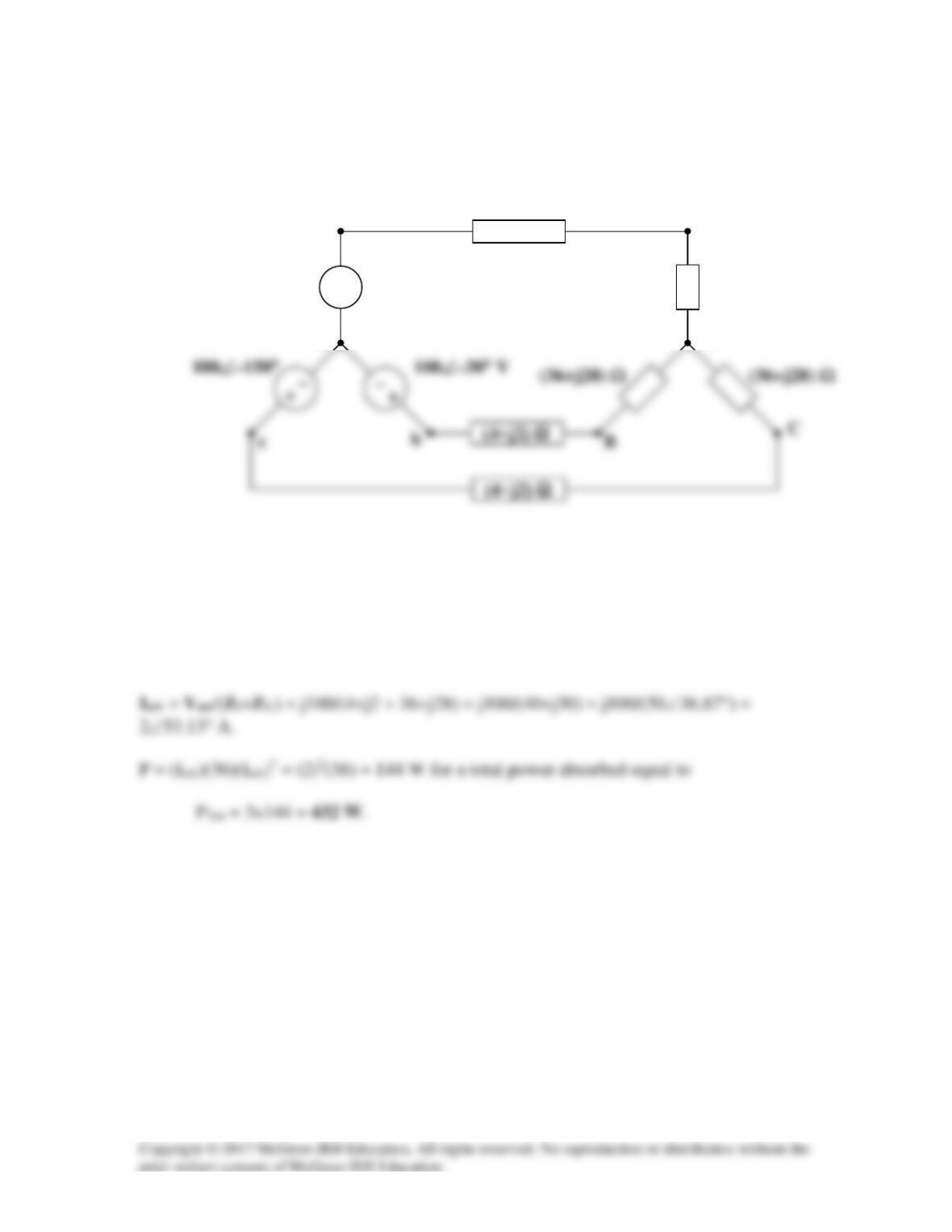
Find the real power absorbed by the load in Fig. 12.58.
b
(4+j2) Ω
(4+j2) Ω
Figure 12.58
For Prob. 12.39.
Solution
To find power delivered to the load, we need to determine the current through the load.
Since the load is balanced, the current through the load is equal to
(4+j2) Ω
(36+j28) Ω
A
N
+
−
100∠90° V
a
n
Solution 12.40
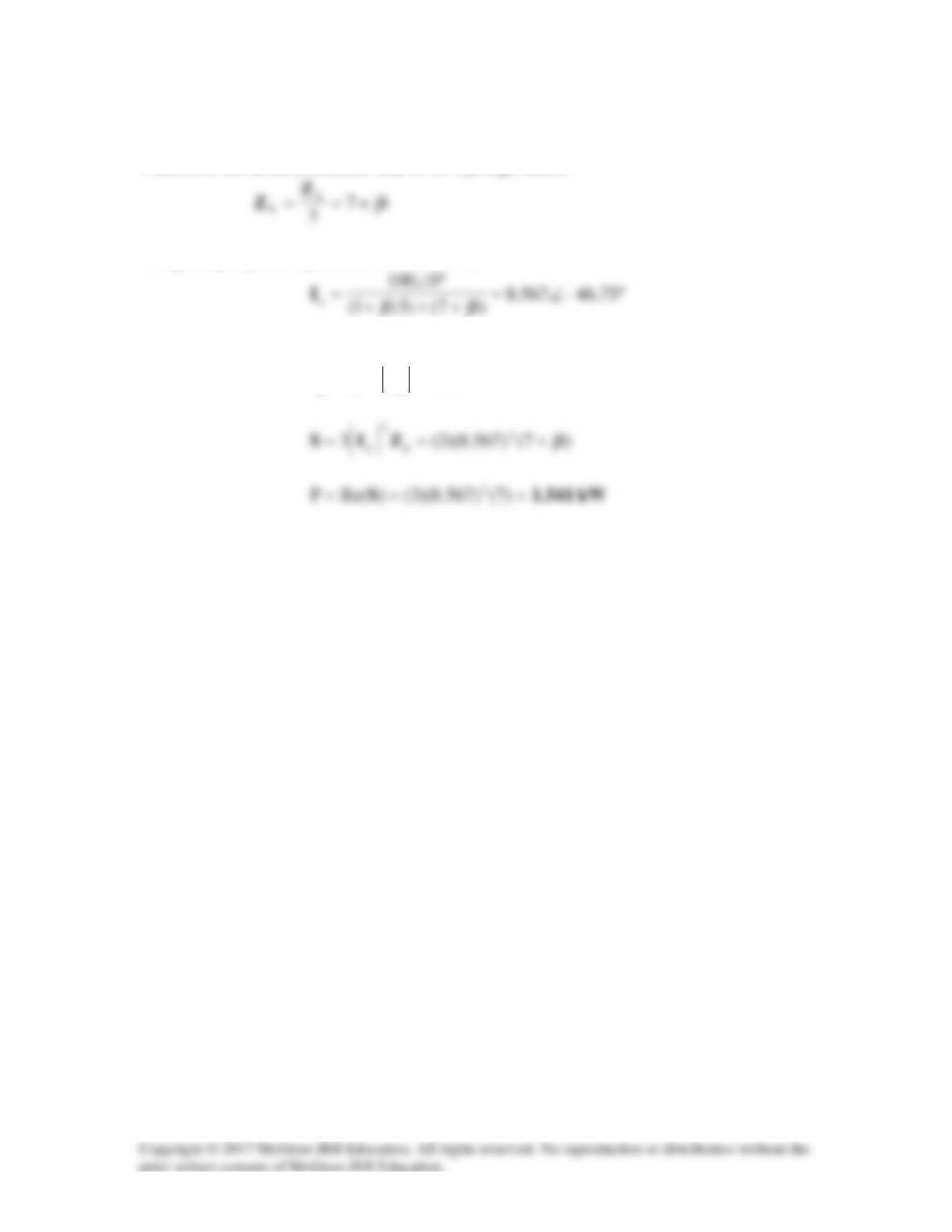
Transform the delta–connected load to its wye equivalent.
Using the per-phase equivalent circuit above,
For a wye-connected load,
567.8II aap === I
Solution 12.41
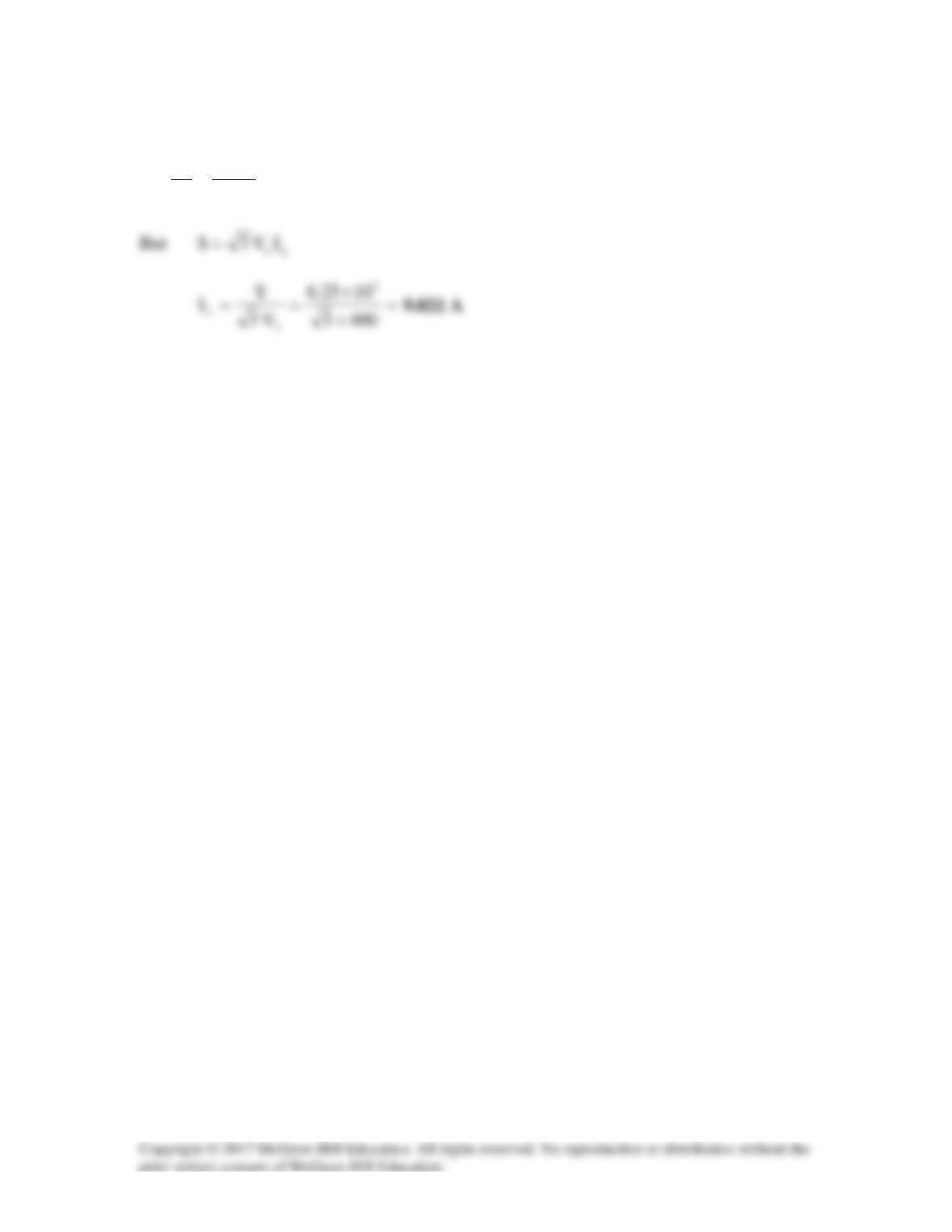
kVA25.6
8.0
kW5
pf
P
S===
Solution 12.42
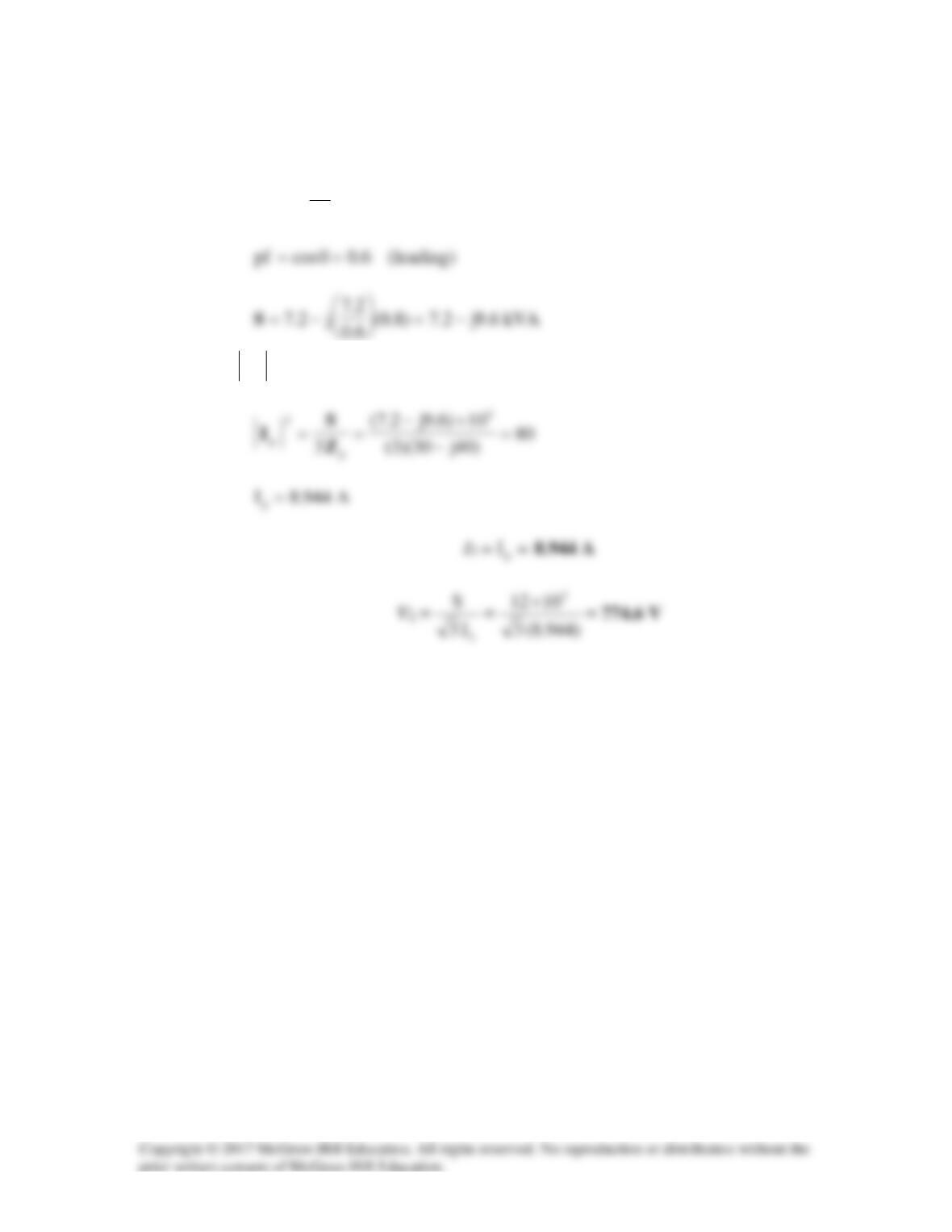
The load determines the power factor.
°−=θ→==θ 13.53333.1
30
40
tan
But
p
2
p
3ZIS =
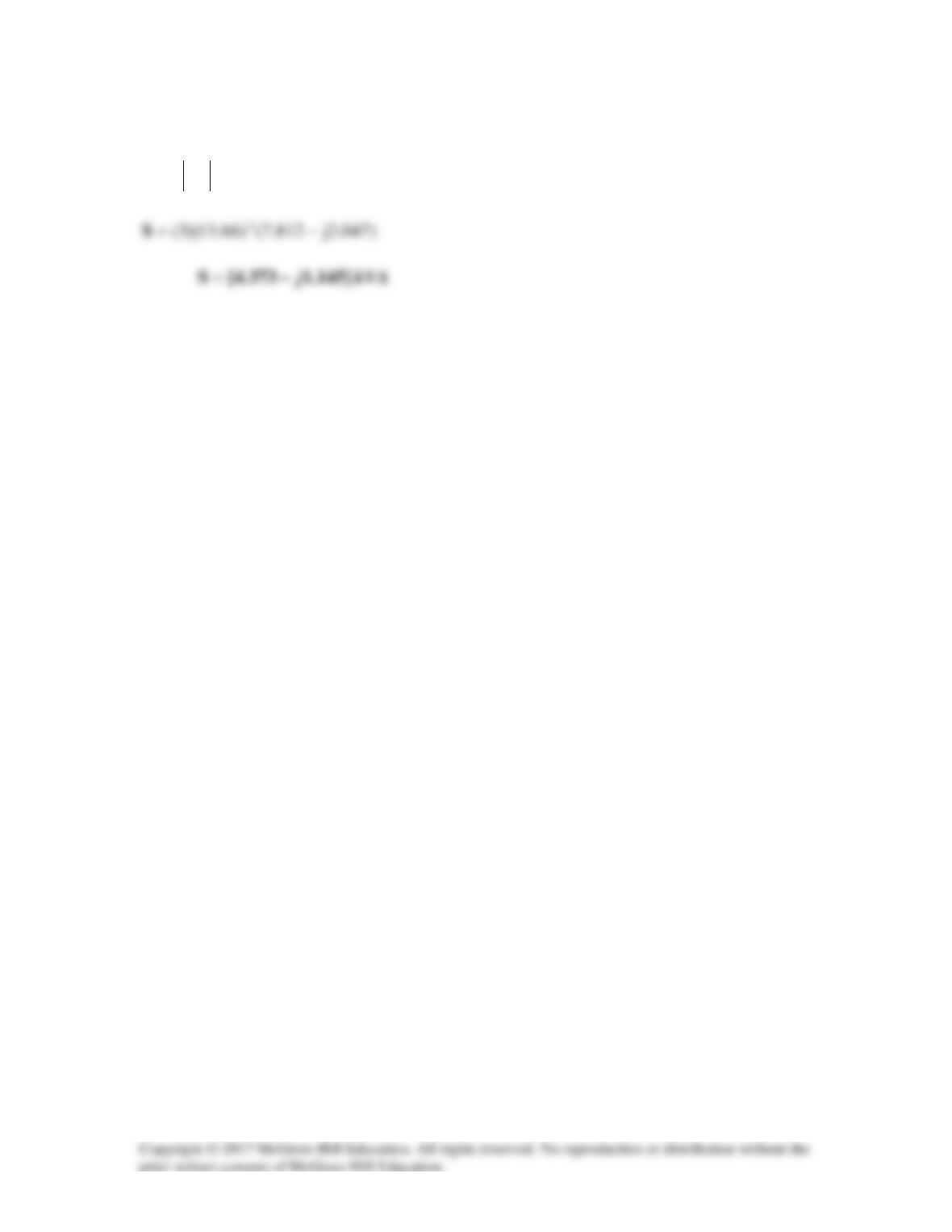
Solution 12.43
p
2
p
3ZIS =
,
Lp II =
for Y–connected loads
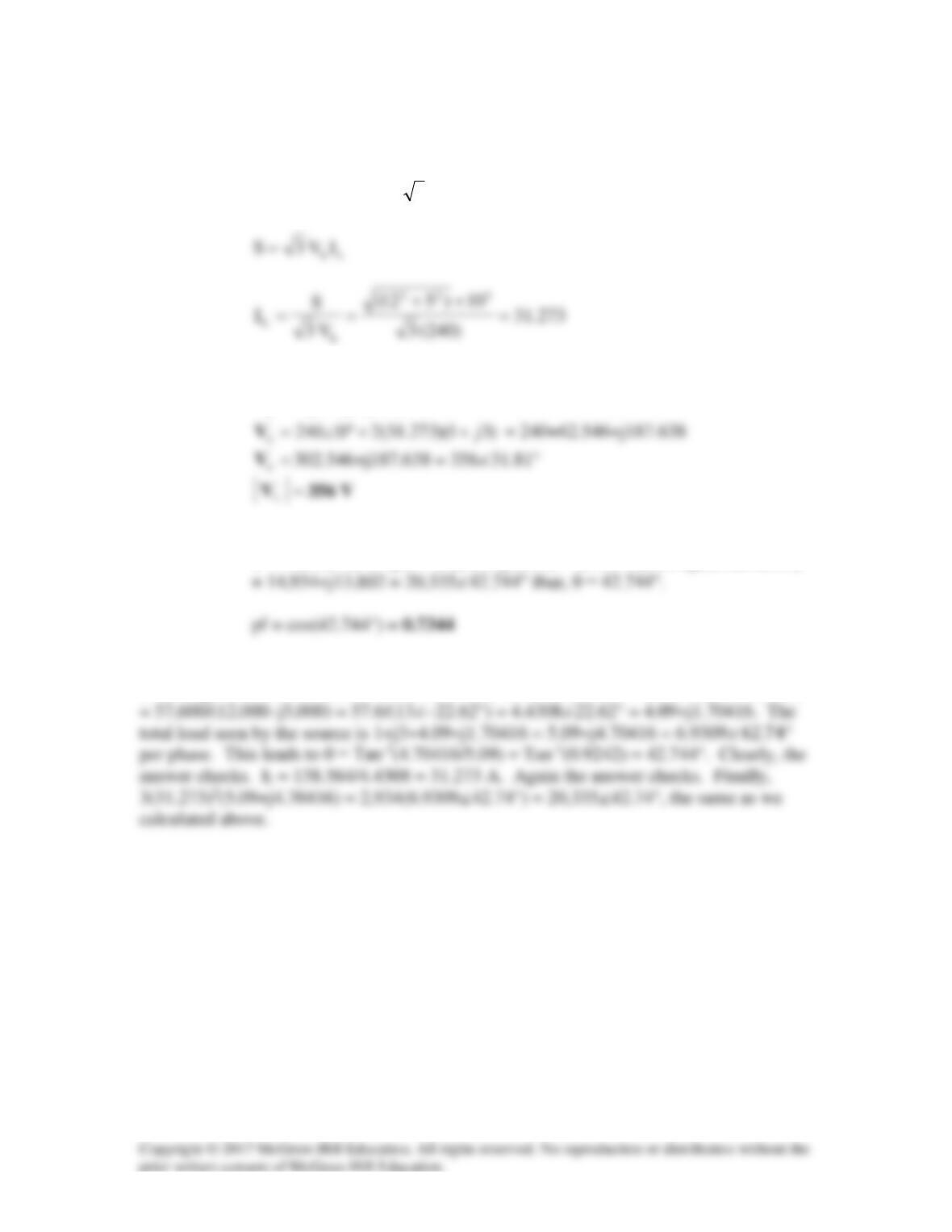
Solution 12.44
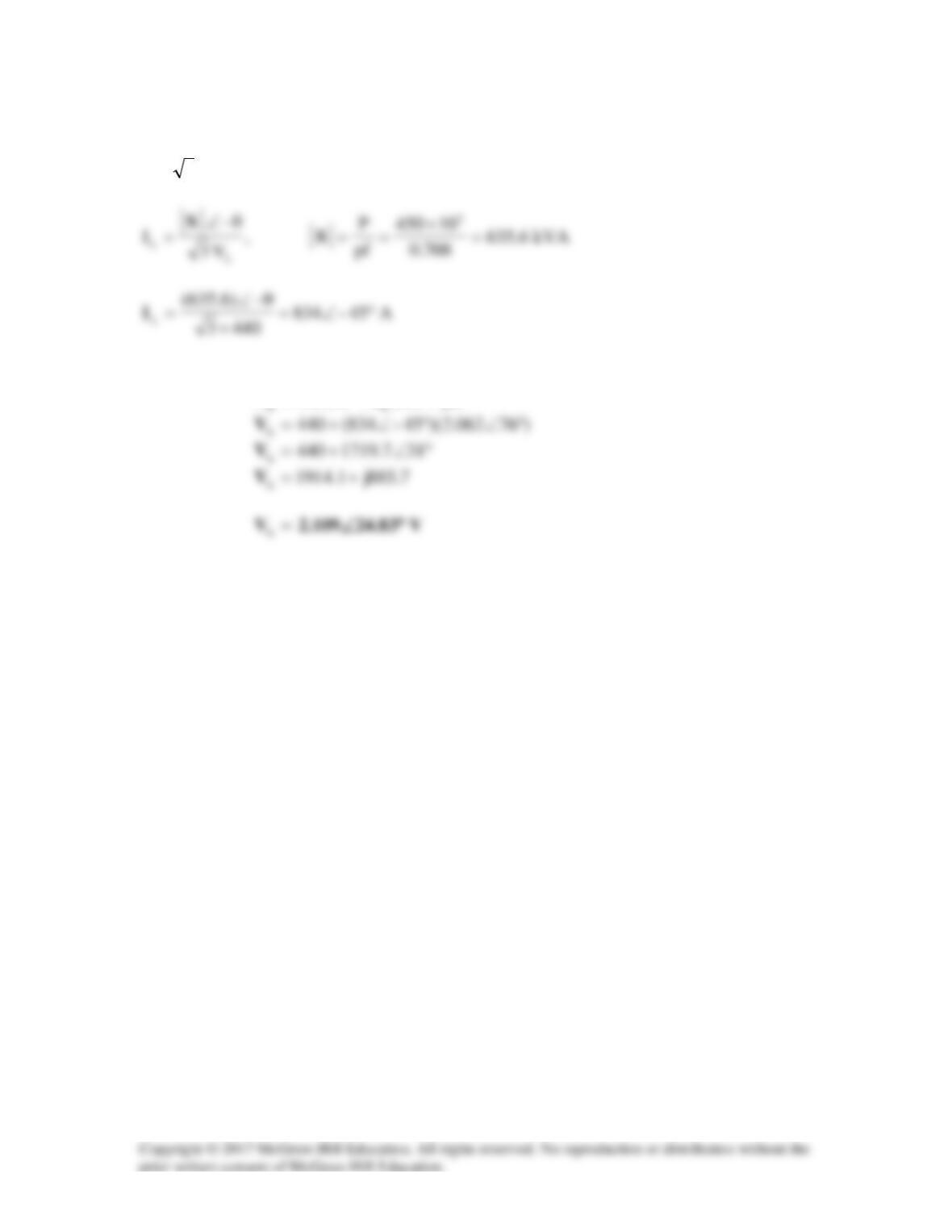
For a ∆–connected load,
Lp
VV =
,
pL I3I =
At the source,
lLLL ZIVV‘+=
+ ILZl
Also, at the source,
S’ = 3(31.273)2(1+j3) + (12,000+j5,000) = 2,934+12,000+j(8,802+5,000)
Checking, VY = 240/1.73205 = 138.564, S = 3(138.564)2/(ZY)* = 12,000+l5,000, and ZY
Solution 12.45
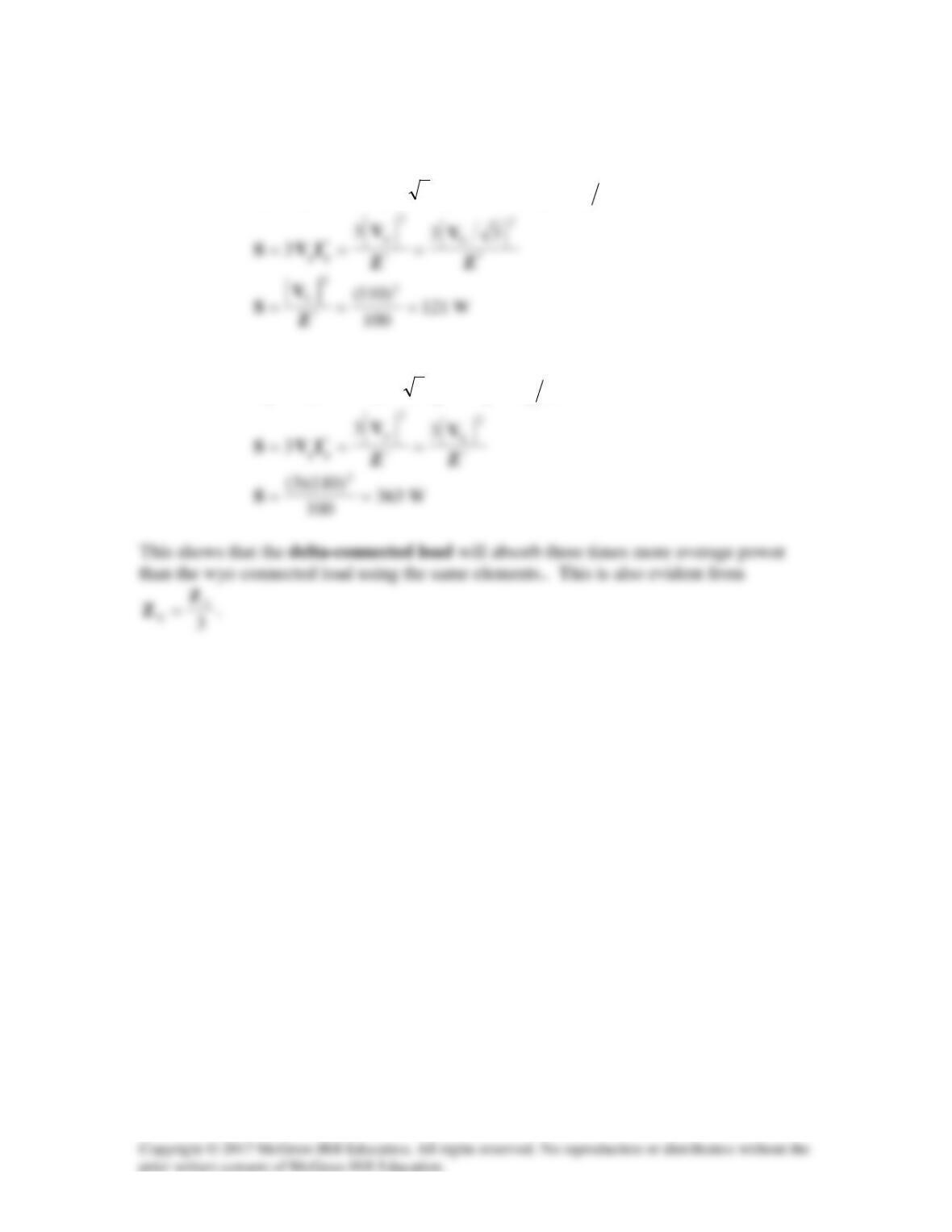
θ∠= LL IV3S
At the source,
)2j5.0(0440 LL ++°∠= IV
Solution 12.46
For the wye-connected load,
pL II =
,
pL
V3V =
Z
pp VI =
For the delta-connected load,
Lp
VV =
,
pL I3I =
,
Z
pp VI =
Solution 12.47
°==θ
→= 87.36)8.0(cos(lagging)8.0pf -1
Solution 12.48
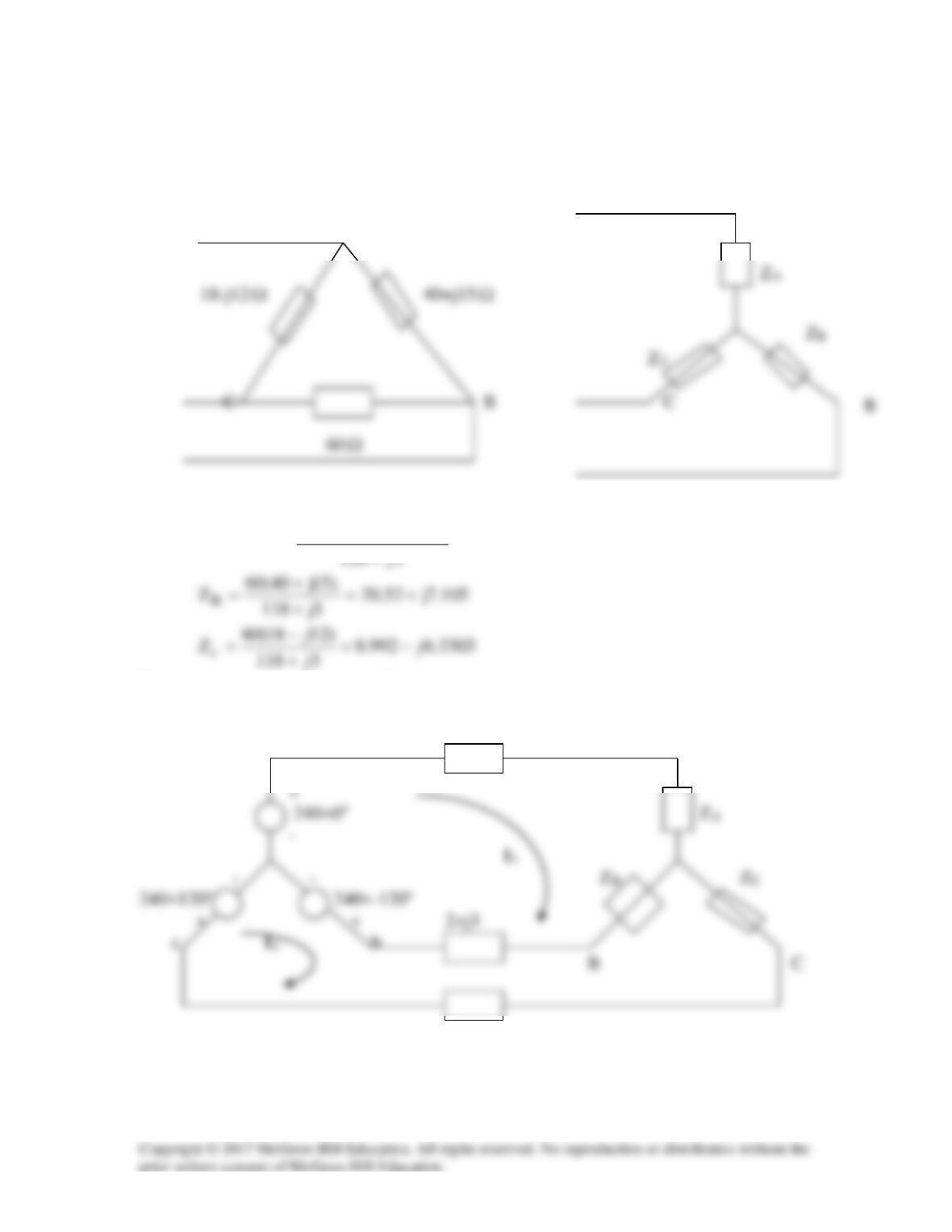
(a) We first convert the delta load to its equivalent wye load, as shown below.
A
A
`
923.1577.7
)1218)(1540( j
jj
Z
A
−=
−+
=
The system becomes that shown below.
a 2+j3 A
2+j3
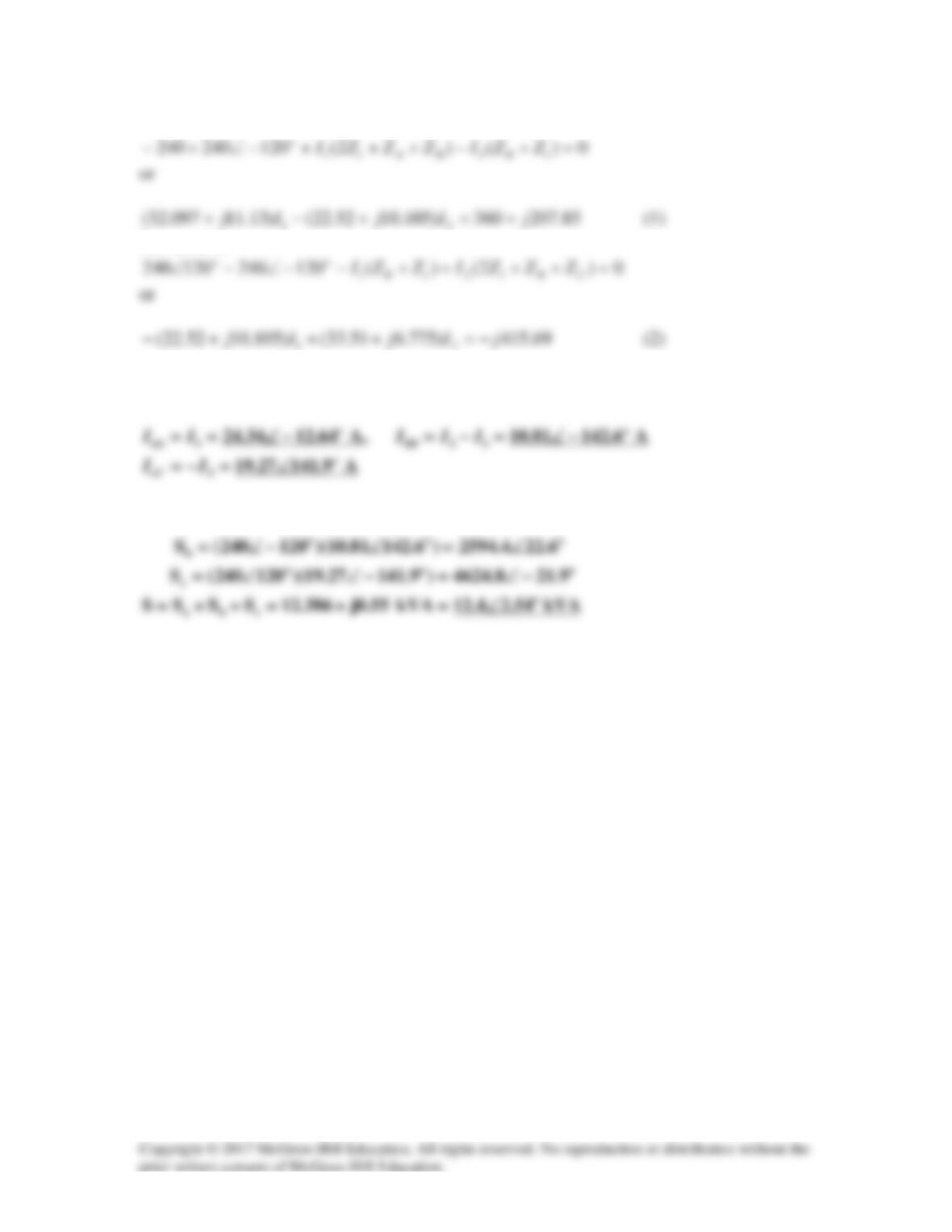
We apply KVL to the loops. For mesh 1,
For mesh 2,
Solving (1) and (2) gives
89.11165.15,328.575.23 21 jIjI −=−=
(b)
ooo
a64.126.5841)64.1234.24)(0240(S ∠=∠∠=
Solution 12.49
Each phase load consists of a 20-ohm resistor and a 10-ohm inductive reactance. With a
line voltage of 480 V rms, calculate the average power taken by the load if:
(a) the three phase loads are delta-connected,
(b) the loads are wye-connected.
Solution
(a) For the delta-connected load,
(rms) 480,1020 ==Ω+=
Lpp
VVjZ
,
(b) For the wye-connected load,
3/,1020
Lpp
VVjZ =Ω+=
,
Solution 12.50
kVA 3kVA, 4.68.4)8.06.0(8
121
=+=+=+= SjjSSS
Hence,
Solution 12.51
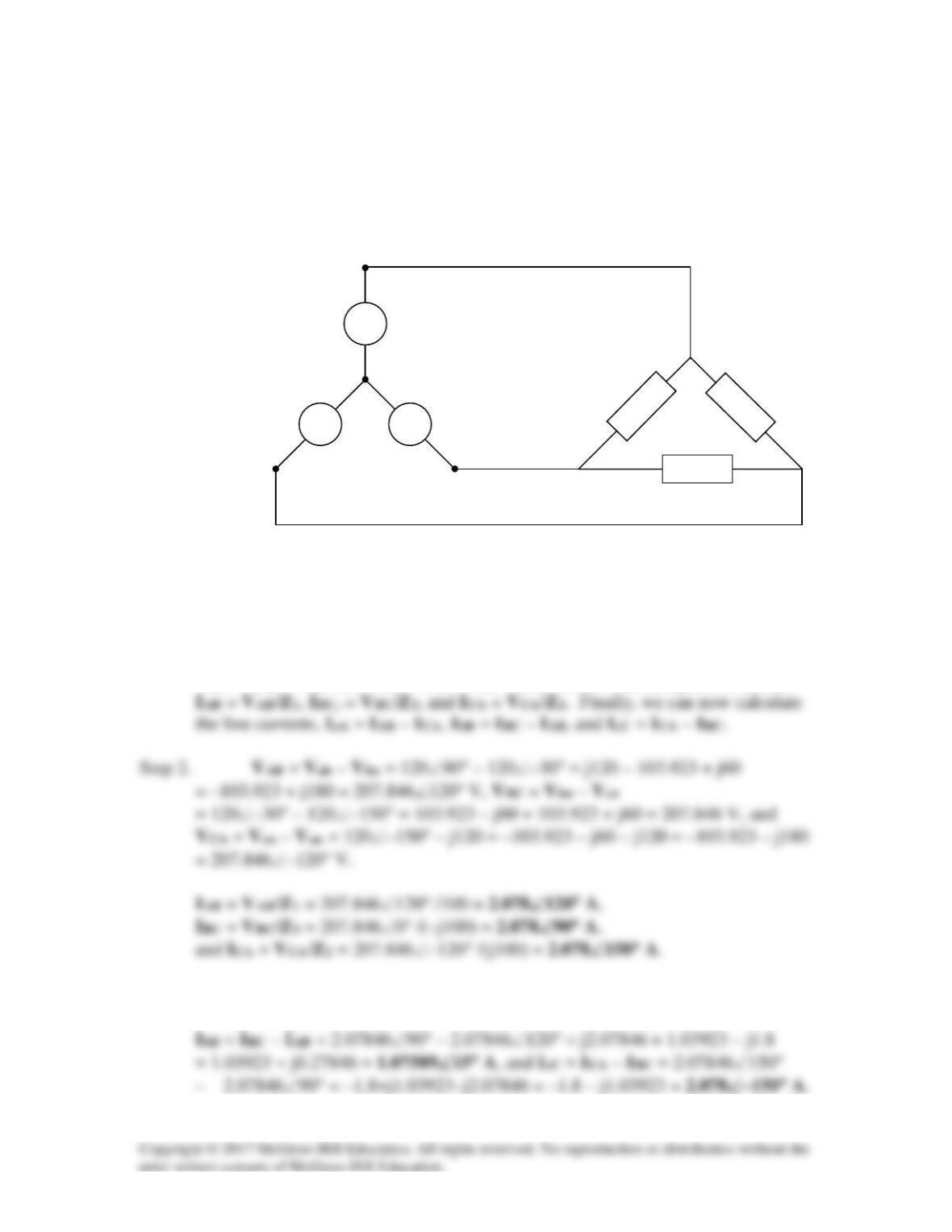
Consider the wye-delta system shown in Fig. 12.60. Let Z1 = 100 Ω, Z2 = j100 Ω, and
Z3 = –j100 Ω. Determine the phase currents, IAB, IBC, and ICA, and the line currents,
IaA, IbB, and IcC.
Figure 12.60
For Prob. 12.51.
Solution
Step 1. First we need to determine the Phase voltages, VAB = Van – Vbn,
VBC = Vbn – Vcn, and VCA = Vcn – Van. Then we can calculate phase currents,
Finally, IaA = IAB – ICA = 2.07846∠120° – 2.07846∠30°
= –1.03923+j1.8 – 1.8 – j1.03923 = –2.83923 + j0.76077 = 2.939∠165° A,
+
−
120∠–30° V
120∠–150° V
120∠90° V
a
Z
3
Z
2
Z
1
C
B
A
c
b
–
+
+
–
n
Solution 12.52
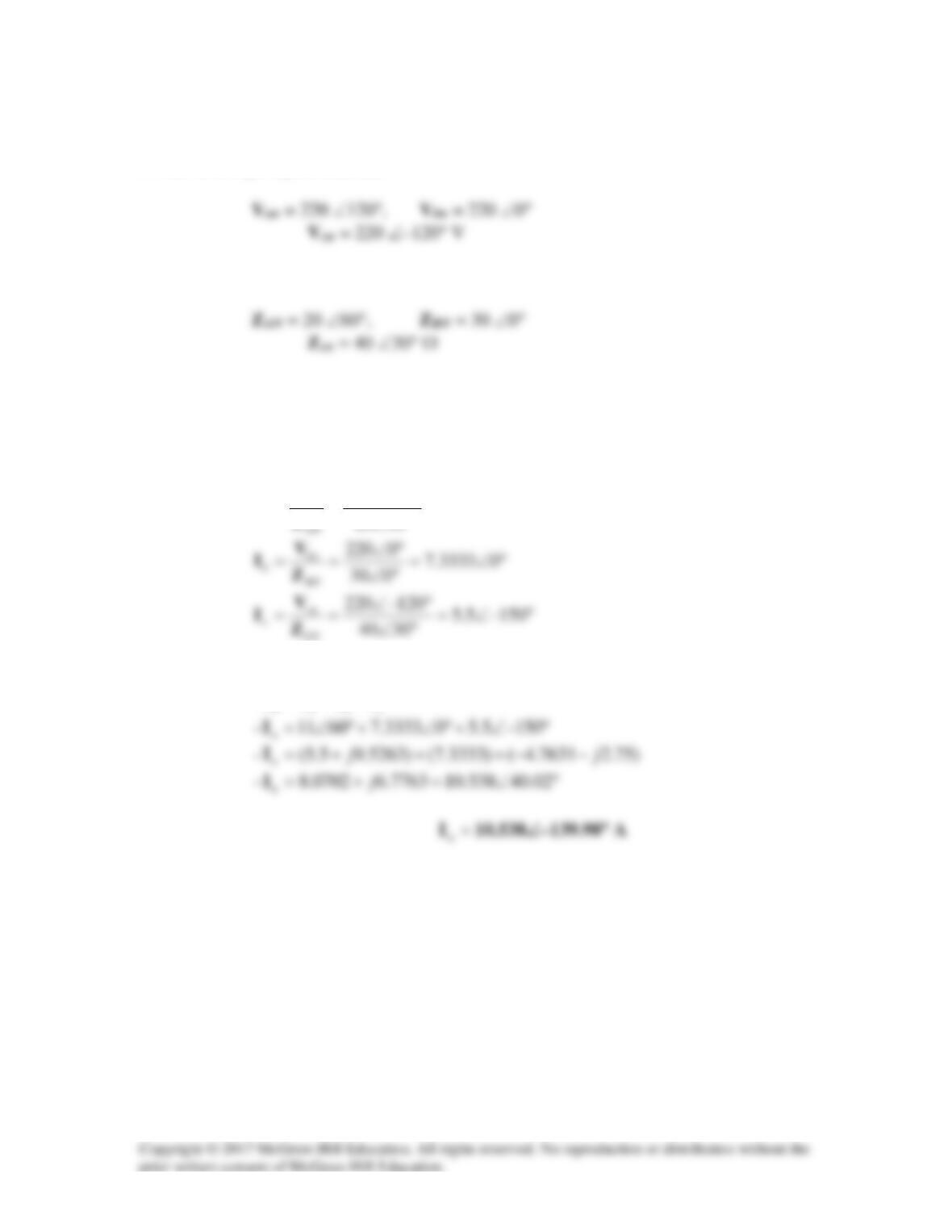
A four-wire wye–wye circuit has
If the impedances are
find the current in the neutral line.
Solution
Since the neutral line is present, we can solve this problem on a per-phase basis.
°∠=
°∠
°∠
== 6011
6020
120220
an
aZ
V
I
Thus,
cban
–IIII ++=
Solution 12.53
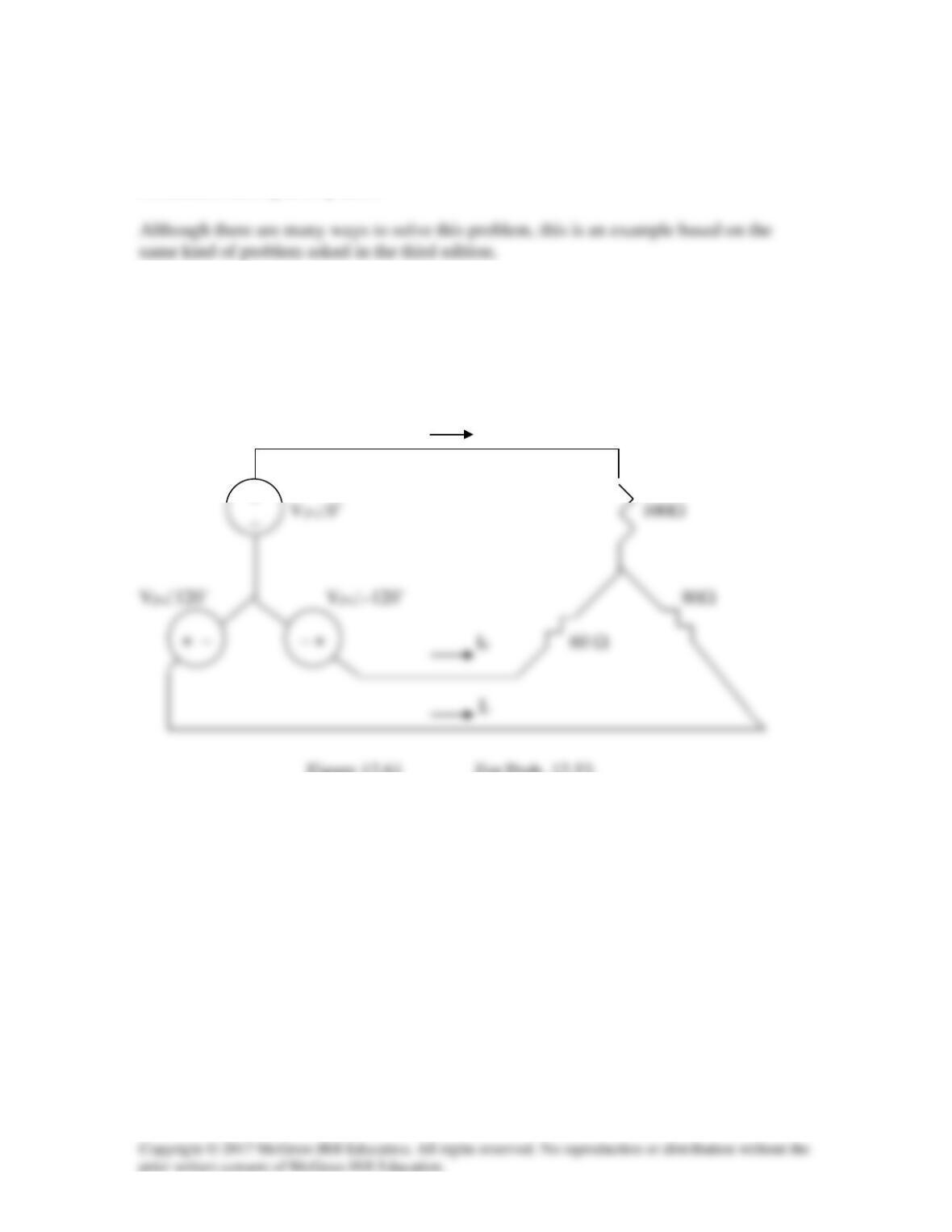
Using Fig. 12.61, design a problem that will help other students to better understand
unbalanced three-phase systems.
Problem
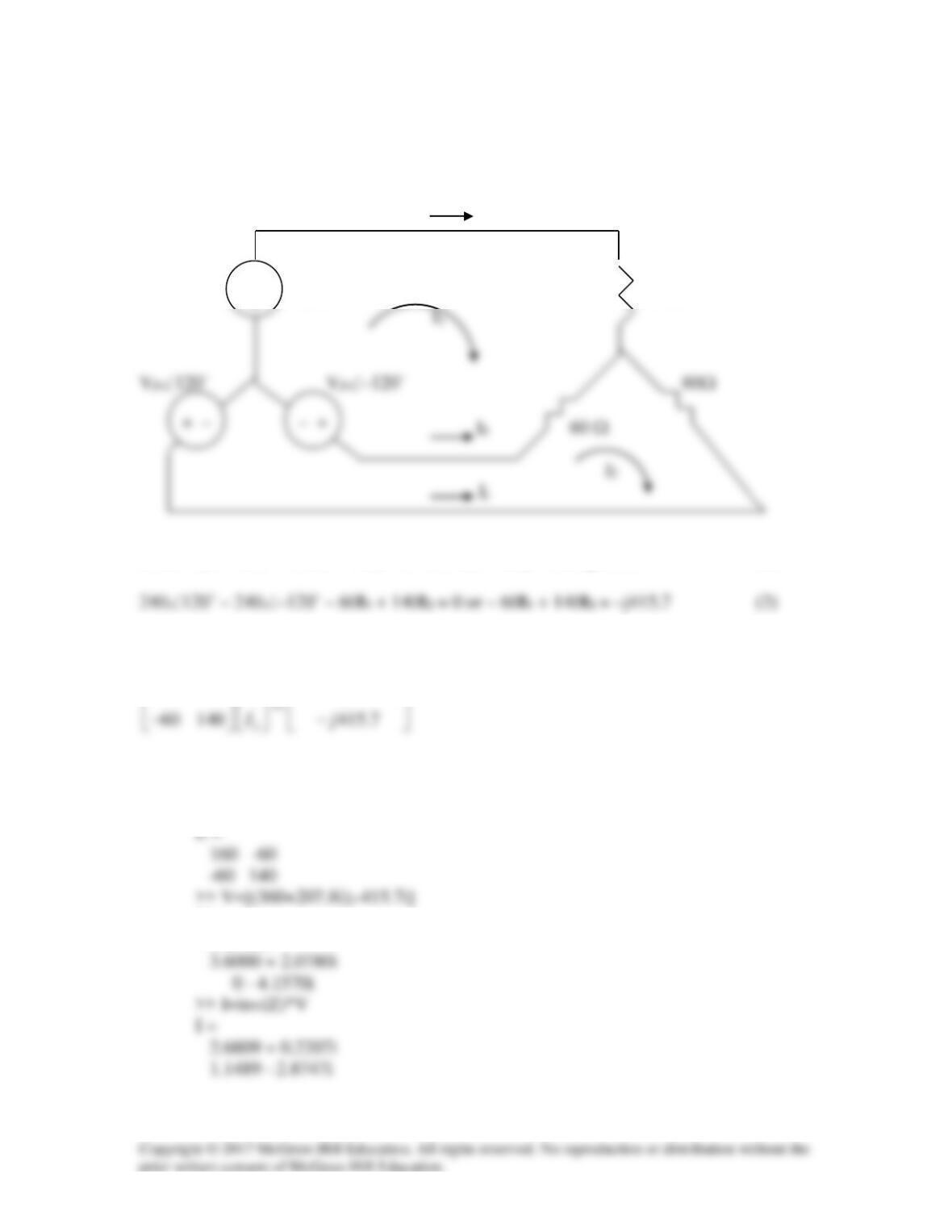
In the wye-wye system shown in Fig. 12.61, loads connected to the source are
unbalanced. (a) Calculate Ia, Ib , and Ic. (b) Find the total power delivered to the load.
Take VP = 240 V rms.
Ia
Figure 12.61 For Prob. 12.53.
+
Solution
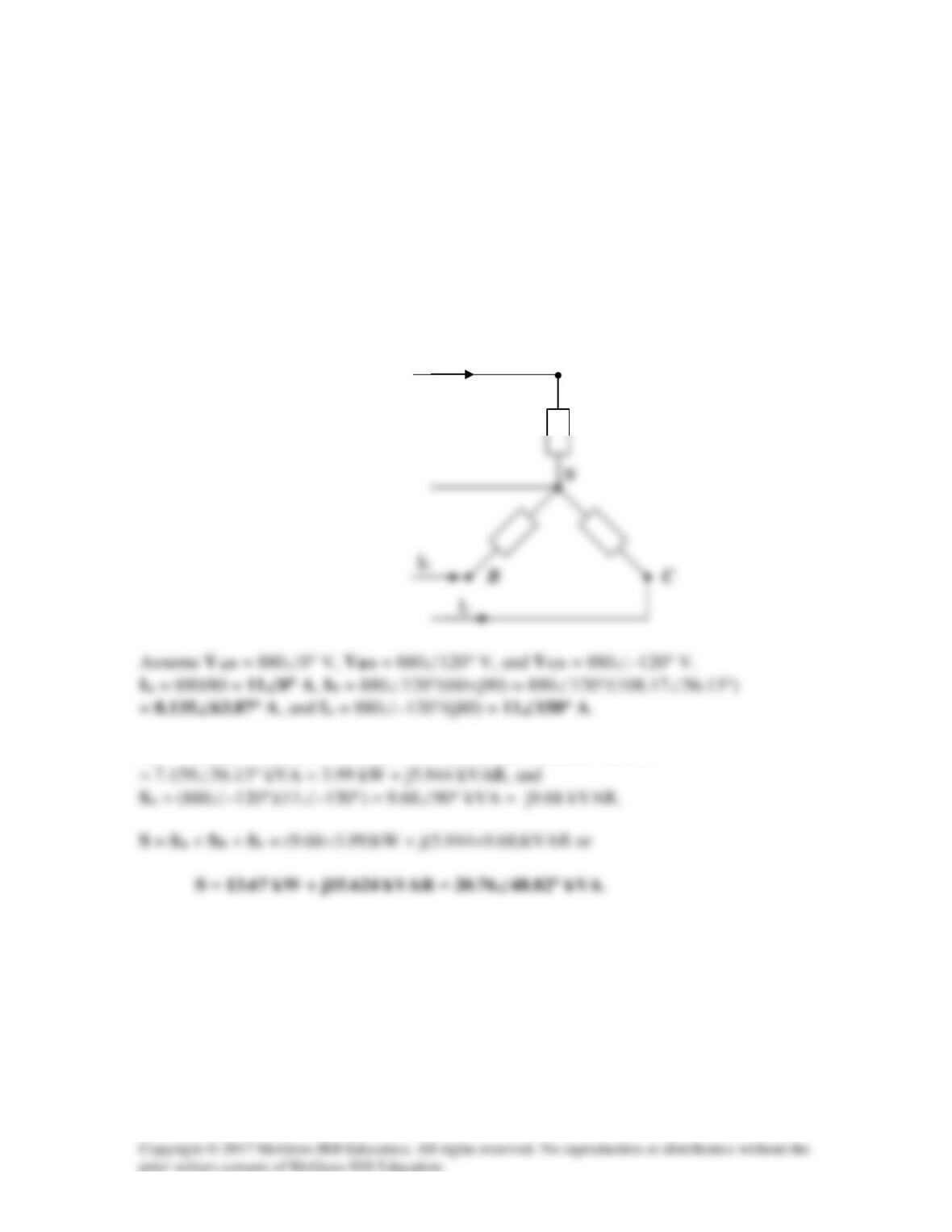
Applying mesh analysis as shown below, we get.
Ia
VP∠0˚ 100Ω
240∠–120˚ – 240 + 160I1 – 60I2 = 0 or 160I1 – 60I2 = 360+j207.84 (1)
In matrix form, (1) and (2) become
1
160 60 360 207.84
Ij
−+
Using MATLAB, we get,
>> Z=[160,-60;-60,140]
V =
1.0e+002 *
+
_
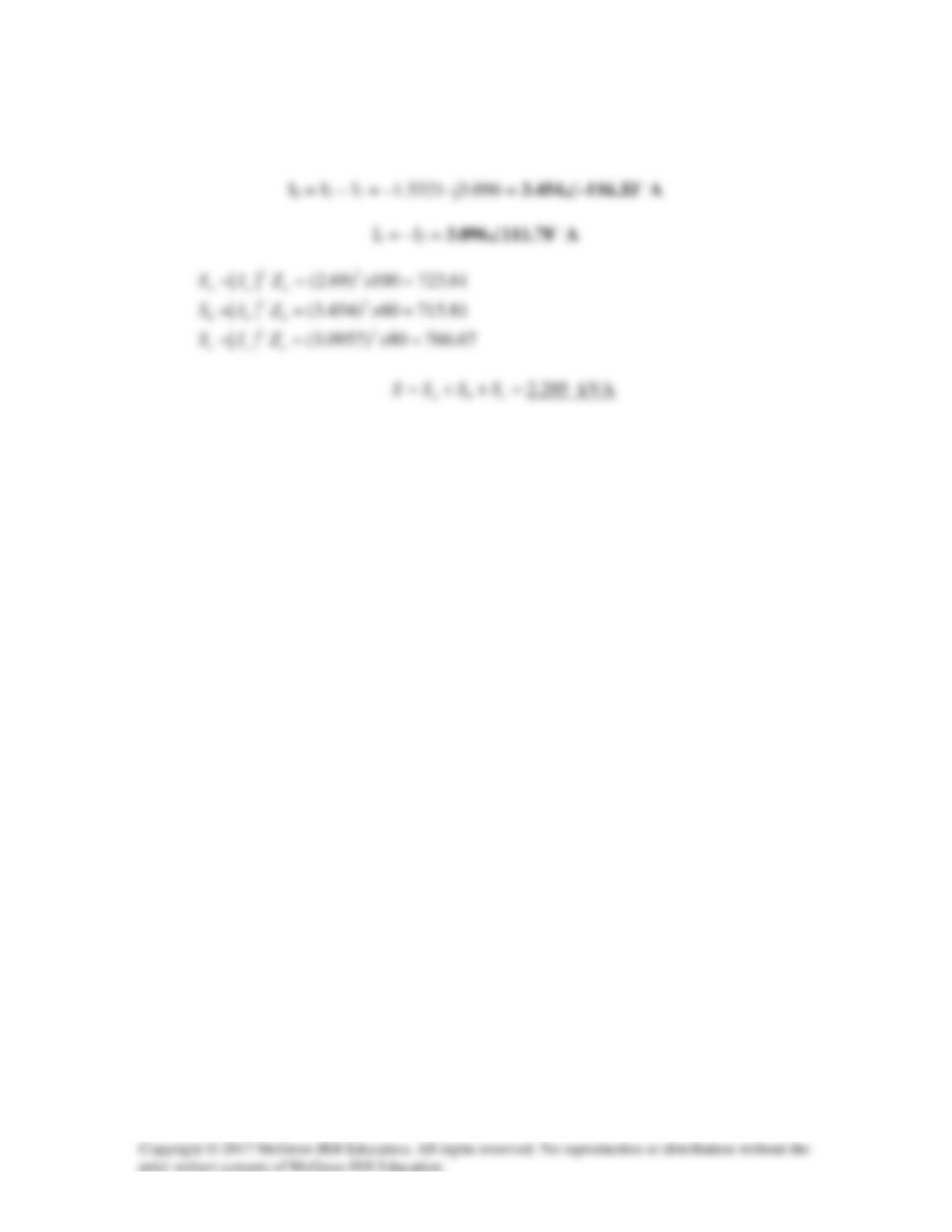
I1 = 2.681+j0.2207 and I2 = 1.1489–j2.875
Ia = I1 = 2.69∠4.71˚ A
Solution 12.54
A balanced three–phase Y-source with VP = 880 V rms drives a wye-connected three–
phase load with phase impedance ZAN = 80 Ω, ZBN = 60+j90 Ω, and ZCN = j80 Ω.
Calculate the line currents and total complex power delivered to the load. Assume that
the neutrals are connected.
Solution
Consider the load as shown below.
Sa = VAN(Ia)* = 880×11 = 9.68 kW, Sb = 880∠120°(8.135∠–63.87°)
Ia
A
Chapter 12, Solution 55.
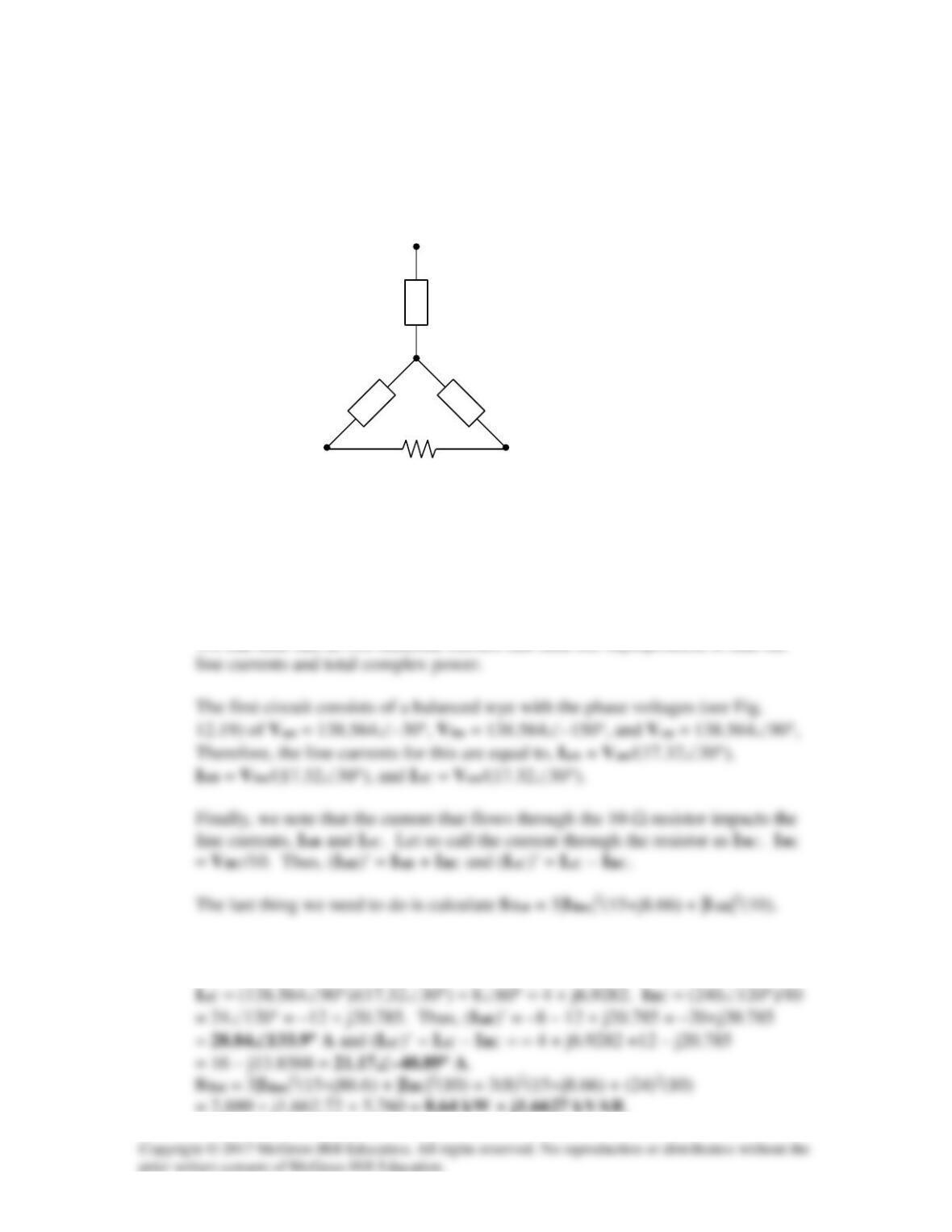
A three-phase supply, with the line-to-line voltage of 240 V rms, has the unbalanced load
as shown in Fig. 12.62. Find the line currents and the total complex power delivered to
the load.
Figure 12.62
For Prob. 12.55.
Solution
To solve this problem we need to arbitrarily select phase angles for the sources which
then enables us to find line currents as well as complex power delivered to the load.
Step 1. Let VAB = 240∠0° V, VBC = 240∠120° V, and VCA = 240∠–120° V.
We can treat this as two different circuits and then use superposition to find the
Step 2. IaA = (138.564∠–30°)/(17.32∠30°) = 8∠–60° A,
IbB = (138.564∠–150°)/(17.32∠30°) = 8∠180° = –8, and
(15+j8.66)
Ω
A
N
(15+j8.66) Ω
(15+j8.66) Ω
B
C
10 Ω