12–21
EXERCISE 12-10 (Continued)
(b)
2011
Patents ……………………………………………………….
12,400
Cash ……………………………………………………….
12,400
Amortization Expense ……………………………………………..
2,575
Patents ($1,000 + $1,575) …………………………..
2,575
2012
Amortization Expense ……………………………………………..
2,700
Patents ($32,400 ÷ 12) …………………………..
2,700
(c)
2013 and 2014
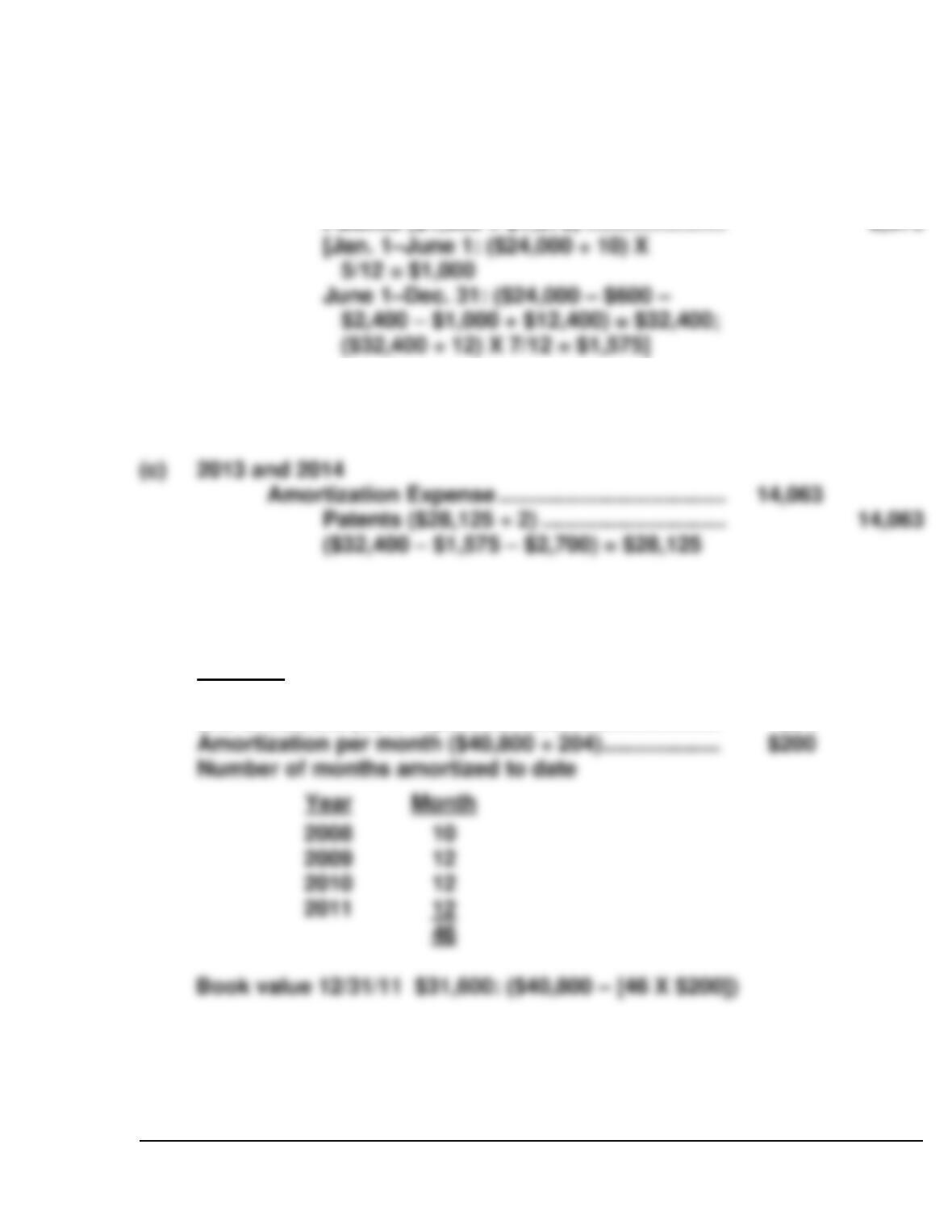
Amortization Expense ……………………………………………..
Patents ($28,125 ÷ 2) …………………………..
14,063
($32,400 – $1,575 – $2,700) = $28,125
EXERCISE 12-11
(a)
Patent A
Life in years ……………………………………………………….
17
Life in months (12 X 17) ………………………………………
204
Amortization per month ($40,800 ÷ 204) ……………….
Number of months amortized to date
[Jan. 1–June 1: ($24,000 ÷ 10) X
5/12 = $1,000
June 1–Dec. 31: ($24,000 – $600 –
$2,400 – $1,000 + $12,400) = $32,400;
($32,400 ÷ 12) X 7/12 = $1,575]
12–22
EXERCISE 12-11 (Continued)
Patent B
Life in years …………………………………………………….
10
Life in months (12 X 10) ……………………………………
120
Amortization per month ($15,000 ÷ 120) …………….
$125
Book value 12/31/11 $11,250: ($15,000 – [$125 X 30])
Patent C
Life in years …………………………………………………….
4
Life in months (12 X 4) ……………………………………..
48
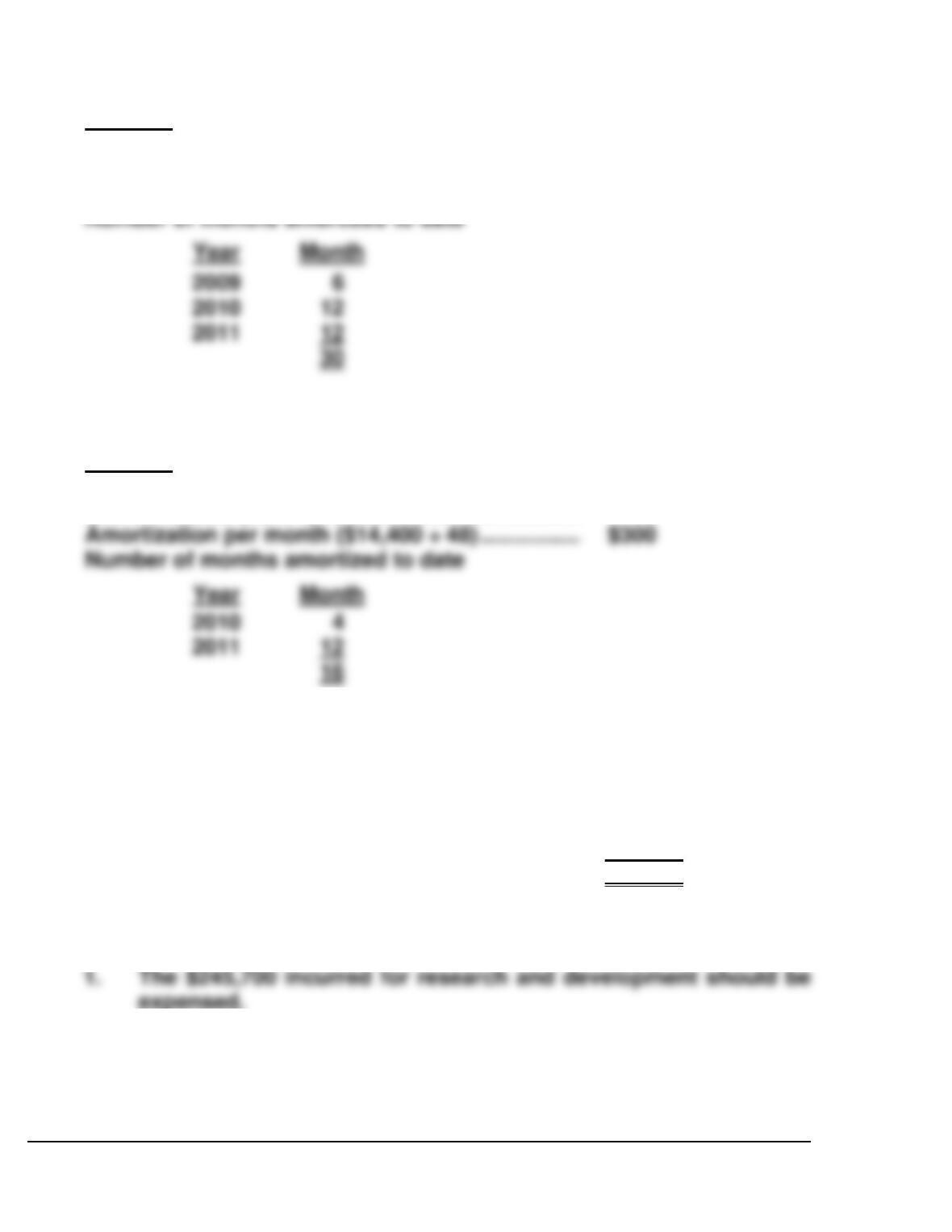
Amortization per month ($14,400 ÷ 48) ………………
$300
Number of months amortized to date
Book value 12/31/11 $9,600: ($14,400 – [$300 X 16])
At December 31, 2011
Patent A ………………………………………………….
$31,600
Patent B ………………………………………………….
11,250
Patent C ………………………………………………….
9,600
Total ……………………………………………………………….
$52,450
(b) Analysis of 2012 transactions
Number of months amortized to date
12–23
EXERCISE 12-11 (Continued)
2. The book value of Patent B is $11,250 and its estimated future
cash flows are $6,000: (3 X $2,000); therefore Patent B is impaired.
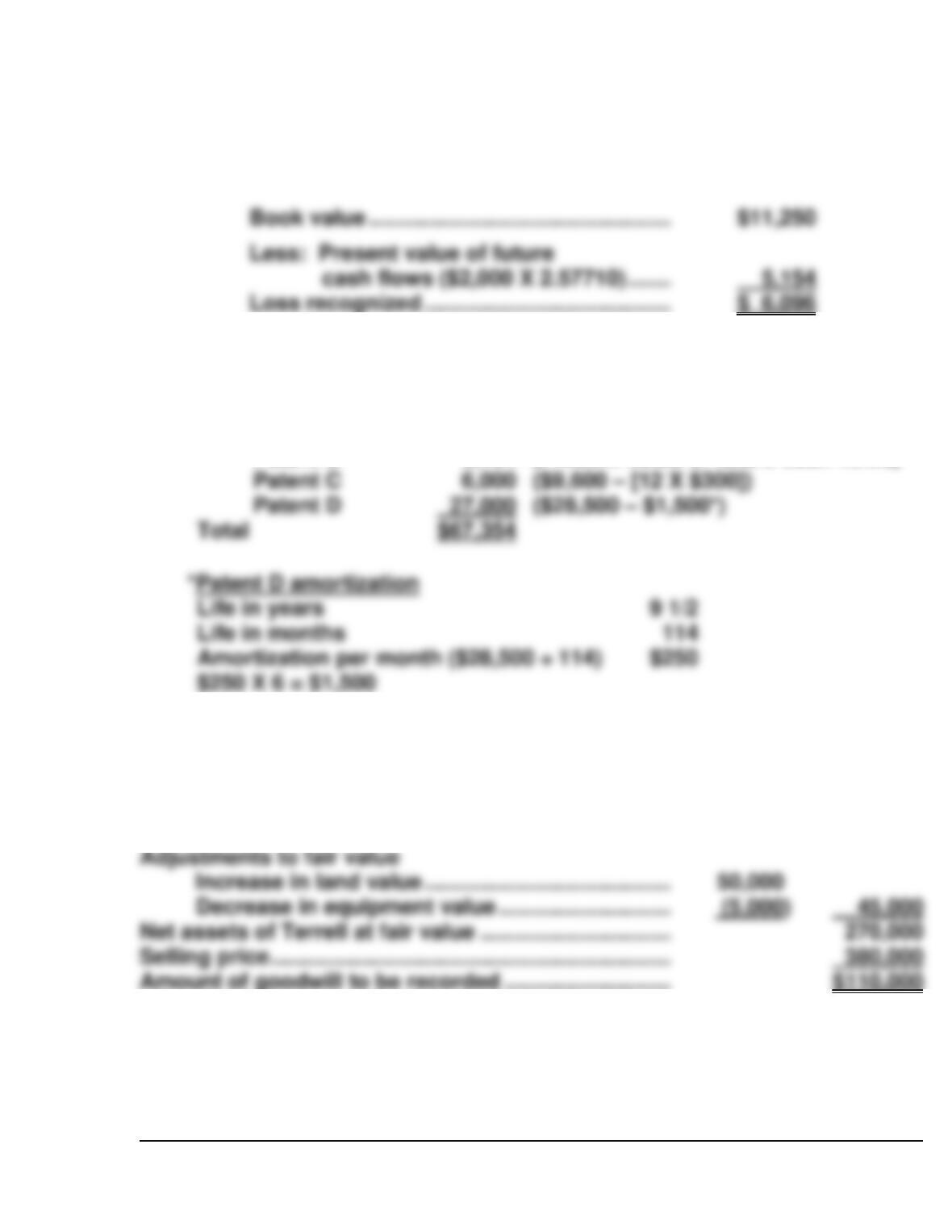
The impairment loss is imputed as follows:
Patent B carrying amount (12/31/12) $5,154
At December 31, 2012
Patent A
$29,200
($31,600 – [12 X $200])
Patent B
5,154
(Present value of future cash flows)
Patent C
6,000
($9,600 – [12 X $300])
Patent D
($28,500 – $1,500*)
*Patent D amortization
Life in years
Life in months
Amortization per month ($28,500 ÷ 114)
$250 X 6 = $1,500
EXERCISE 12-12 (20–25 minutes)
Net assets of Terrell as reported
($575,000 – $350,000) ………………………………………….
$225,000
Adjustments to fair value
Increase in land value ……………………………………
Decrease in equipment value …………………………
Net assets of Terrell at fair value …………………………..
Selling price ………………………………………………………….
Less: Present value of future
cash flows ($2,000 X 2.57710) …………
EXERCISE 12-12 (Continued)
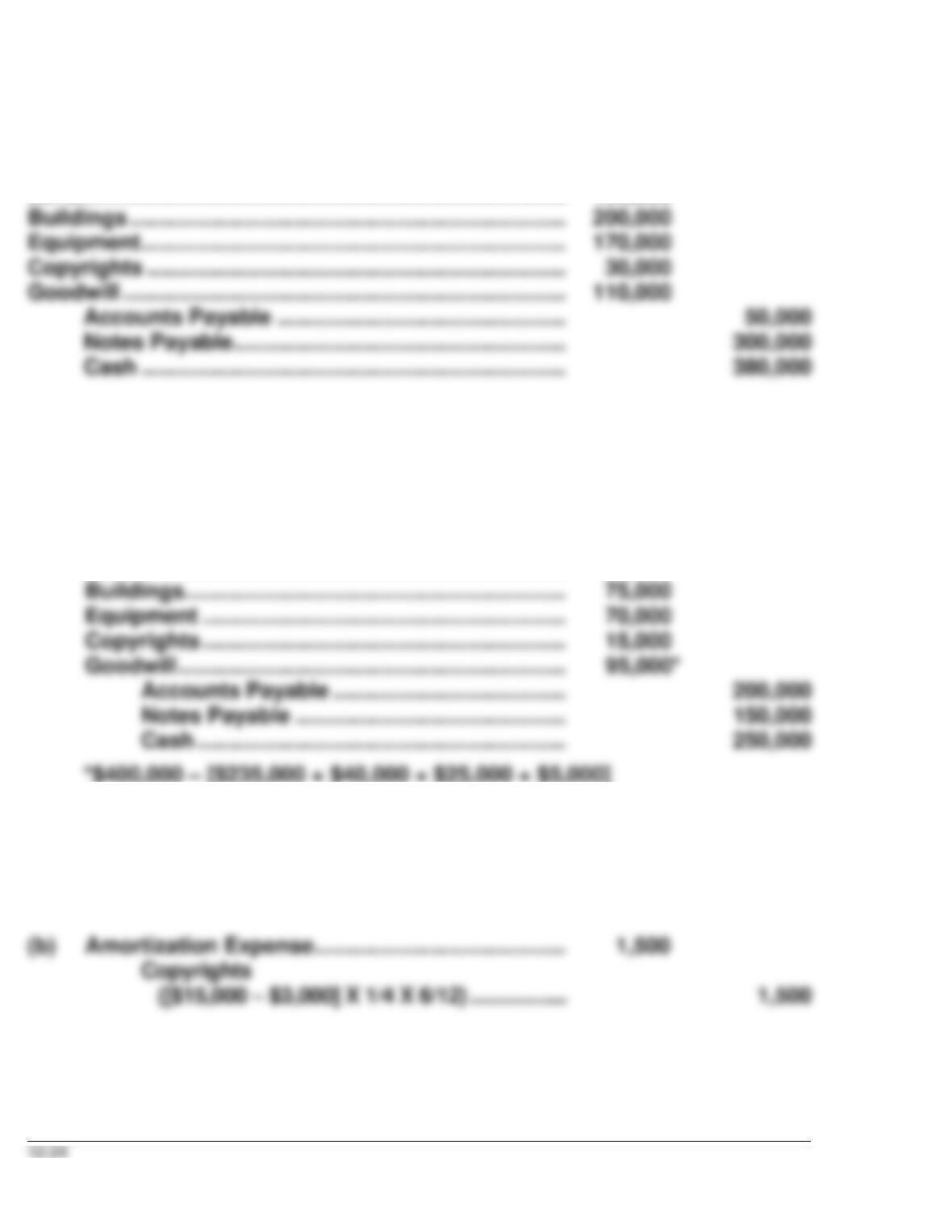
The journal entry to record this transaction is as follows:
Cash …………………………………………………………………….
100,000
Land……………………………………………………………………..
120,000
Buildings ………………………………………………………………
200,000
Equipment …………………………………………………………….
170,000
Copyrights ……………………………………………………………
30,000
Goodwill ……………………………………………………………….
110,000
Accounts Payable …………………………………………
Notes Payable ……………………………………………….
Cash …………………………………………………………….
EXERCISE 12-13 (10–15 minutes)
(a)
Cash ………………………………………………………………………
50,000
Accounts Receivable ………………………………………………
90,000
Inventory ……………………………………………………….
125,000
Land ………………………………………………………………………
80,000
Buildings ……………………………………………………….
75,000
Equipment ……………………………………………………….
Goodwill ……………………………………………………….
95,000*
Accounts Payable …………………………………………..
Notes Payable ………………………………………………..
Cash ……………………………………………………….
Note that the building and equipment would be recorded at the 7/1/12
cost to Gissel; accumulated depreciation accounts would not be
recorded.
(b)
Amortization Expense ……………………………………………..
12–25
EXERCISE 12-14 (15–20 minutes)
(a)
December 31, 2012
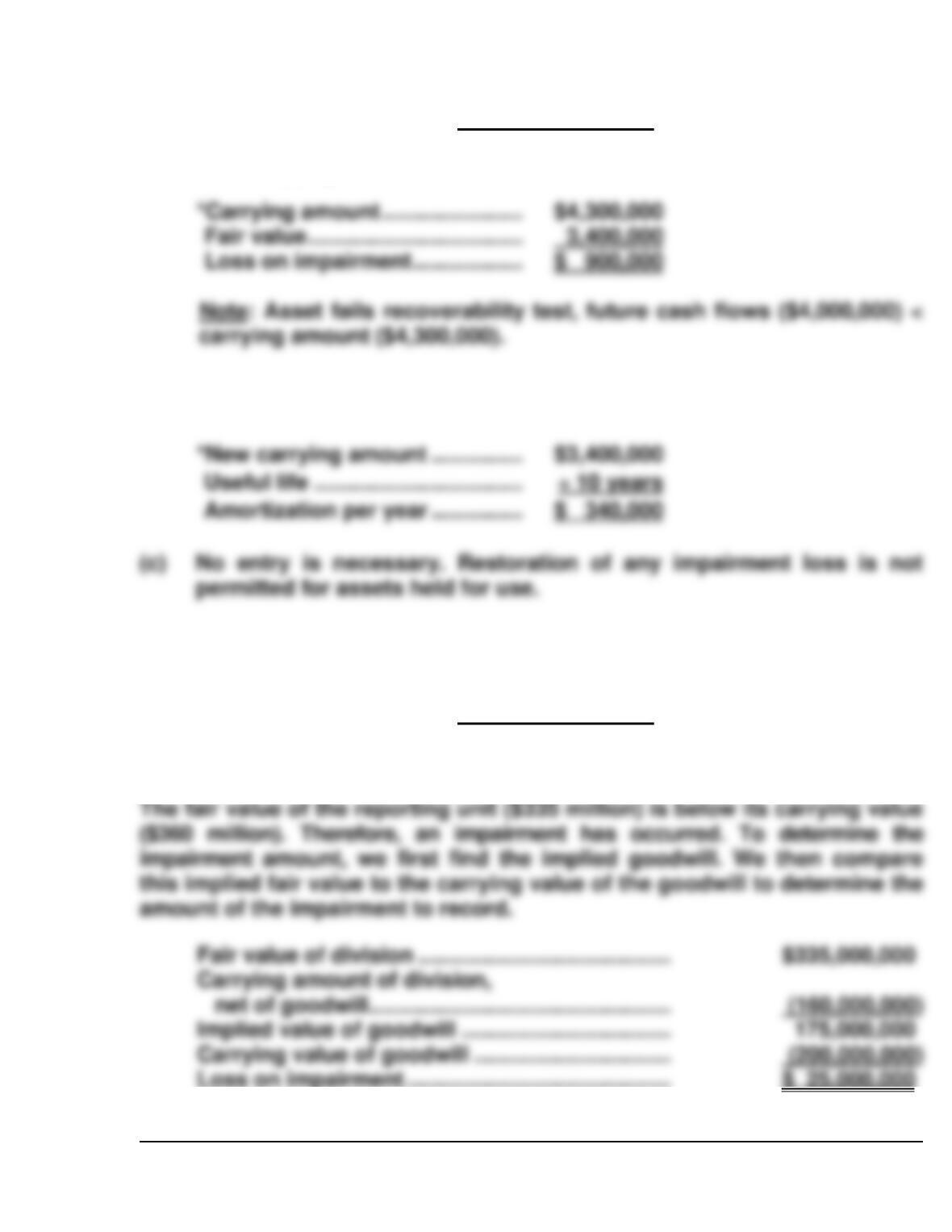
Loss on Impairment …………………………………….
900,000*
Copyrights ………………………………………….
900,000
(b)
Amortization Expense …………………………………
340,000*
Copyrights ………………………………………….
340,000
EXERCISE 12-15 (15–20 minutes)
(a)
December 31, 2012
Loss on Impairment …………………………………….
25,000,000
Goodwill …………………………………………….
25,000,000
Fair value of division …………………………..………………….
Implied value of goodwill ………………………………………..
175,000,000
Carrying value of goodwill …………………………..
*Carrying amount …………………..
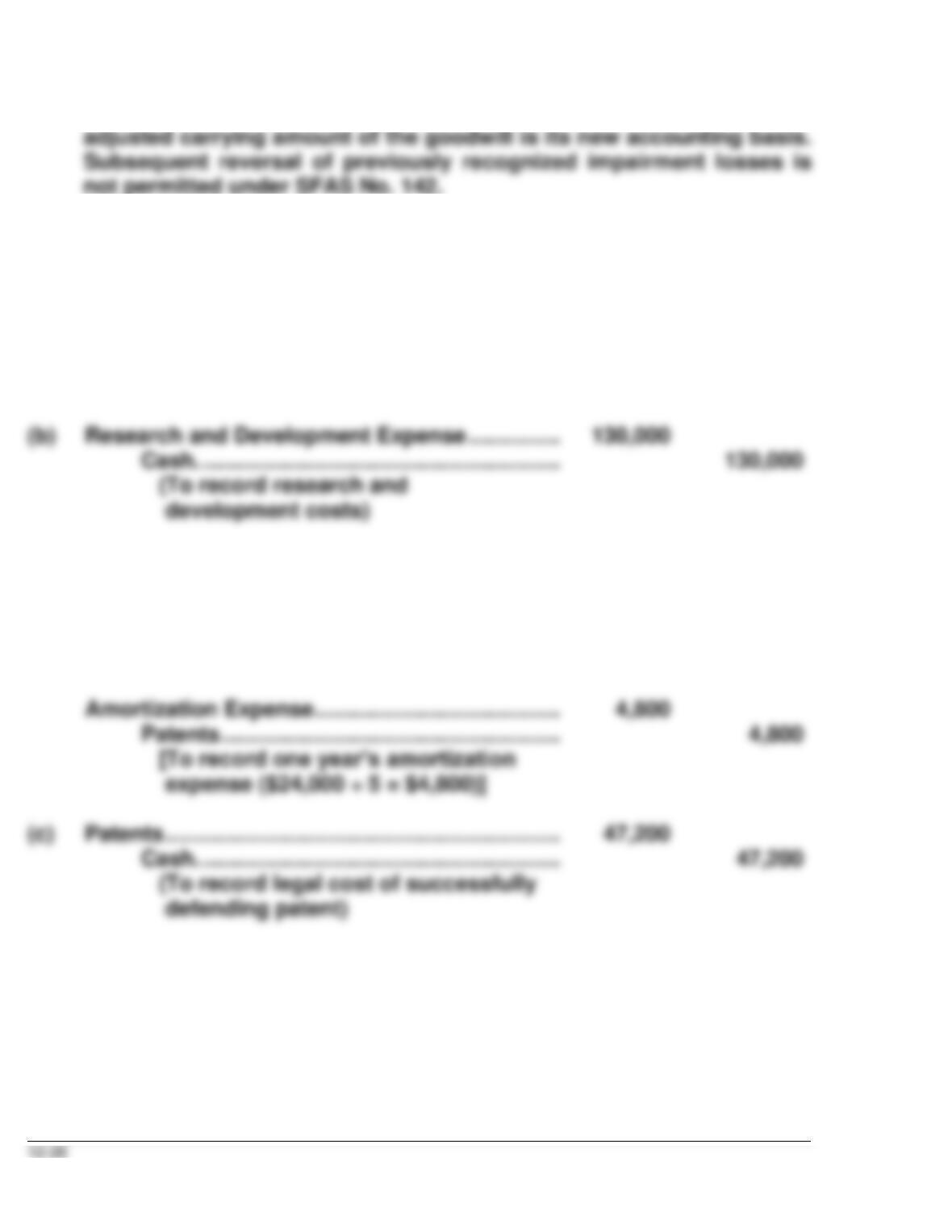
EXERCISE 12-15 (Continued)
(b) No entry necessary. After a goodwill impairment loss is recognized, the
EXERCISE 12-16 (15–20 minutes)
(a) The $325,000 is a research and development cost that should be
charged to R&D Expense and, if not separately disclosed in the income
statement, the total cost of R&D should be separately disclosed in the
notes to the financial statements.
(b)
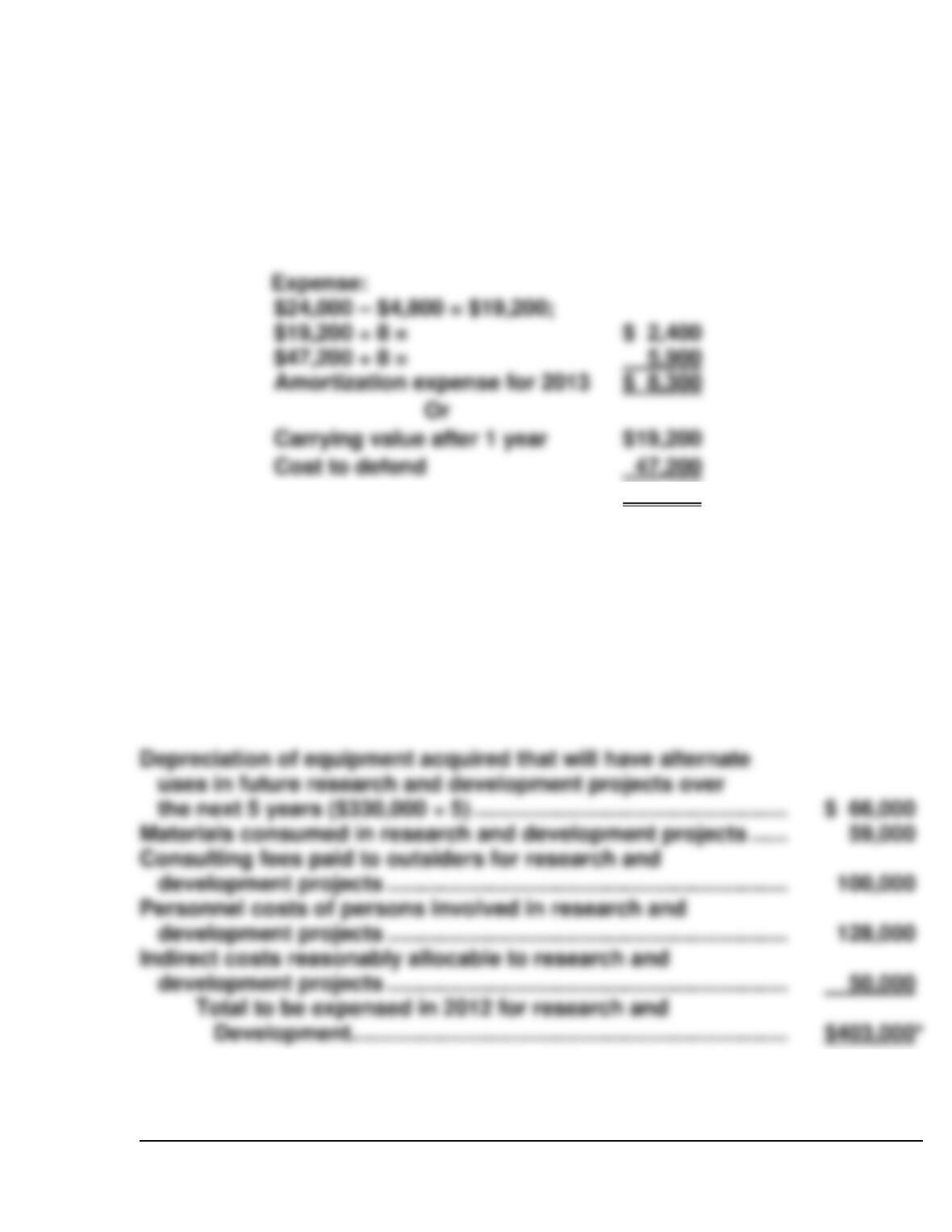
Research and Development Expense ……………………….
Cash. ……………………………………………………….
(To record research and
development costs)
Patents ……………………………………………………….
24,000
Cash. ……………………………………………………….
24,000
(To record legal and administrative
costs incurred to obtain patent
#472-1001–84)
Amortization Expense ……………………………………………..
Patents ……………………………………………………….
[To record one year’s amortization
expense ($24,000 ÷ 5 = $4,800)]
(c)
Patents ……………………………………………………….
Cash. ……………………………………………………….
(To record legal cost of successfully
defending patent)
12–27
EXERCISE 12-16 (Continued)
The cost of defending the patent is capitalized because the defense
was successful and because it extended the useful life of the patent.
Amortization Expense …………………………………………….
8,300
Patents ……………………………………………………….
8,300
To record one year’s amortization
$66,400
Expense: $66,400 ÷ 8 = $8,300
(d) Additional engineering and consulting costs required to advance the
design of a product to the manufacturing stage are R&D costs. As
indicated in the chapter it is R&D because it translates knowledge into
a plan or design for a new product.
EXERCISE 12-17 (10–12 minutes)
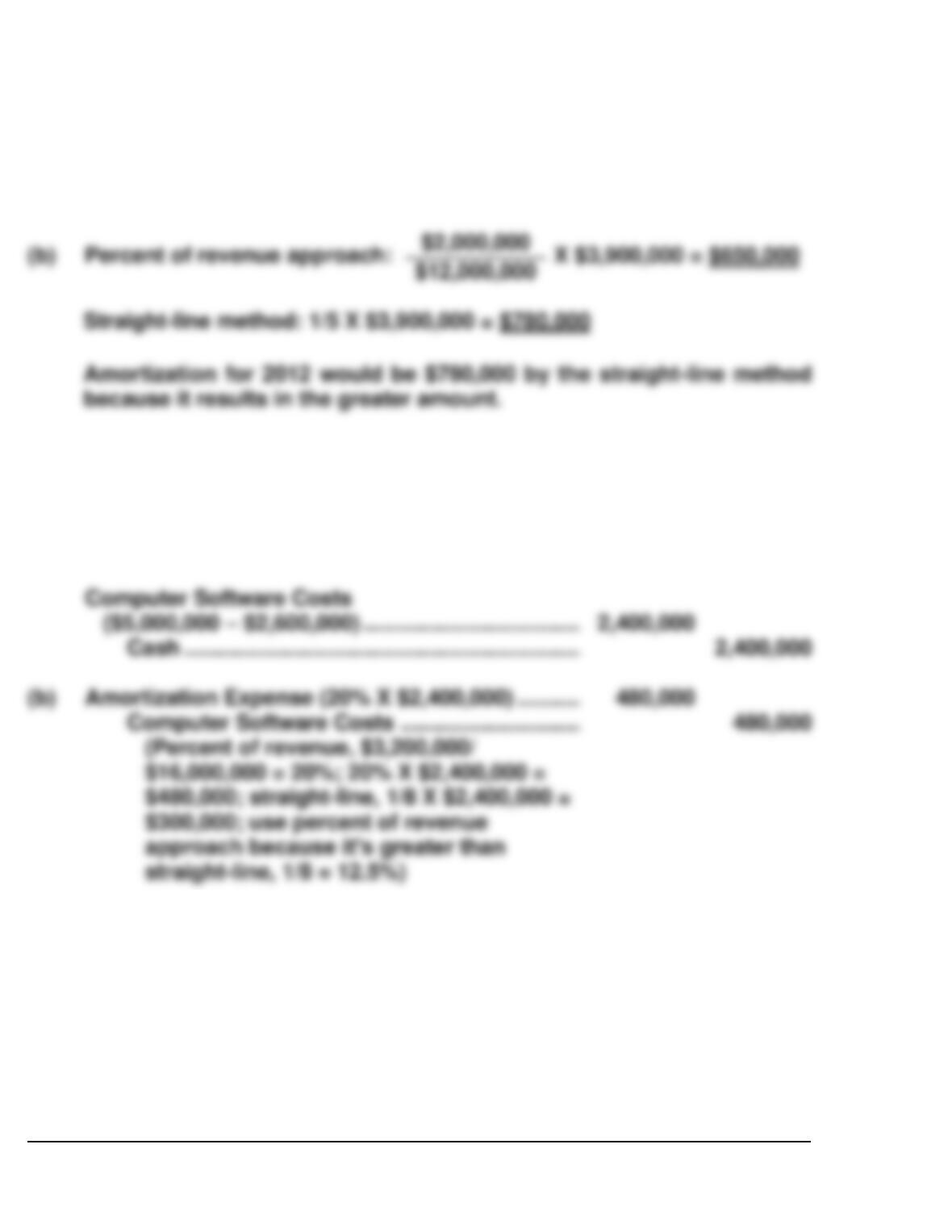
Depreciation of equipment acquired that will have alternate
uses in future research and development projects over
the next 5 years ($330,000 ÷ 5) ……………………………………………
Materials consumed in research and development projects ……
Consulting fees paid to outsiders for research and
development projects ………………………………………………………..
Personnel costs of persons involved in research and
development projects ………………………………………………………..
Indirect costs reasonably allocable to research and
development projects ………………………………………………………..
Total to be expensed in 2012 for research and
Development ……………………………………………………………..
*Materials purchased for future R&D projects should be reported as an asset.
$24,000 – $4,800 = $19,200;
$19,200 ÷ 8 =
$47,200 ÷ 8 =
Carrying value after 1 year
$19,200
Cost to defend
12–28
*EXERCISE 12-18 (10–15 minutes)
(a) Companies are required to use the greater of (1) the ratio of current
revenues to current plus anticipated revenues (percent of revenue
approach) or (b) the straight-line method over the remaining useful
life of the asset to amortize capitalized computer software costs.
*EXERCISE 12-19 (15–20 minutes)
(a)
Research and Development Expense ……………………….
2,600,000
Cash ………………………………………………………………..
2,600,000
Computer Software Costs
($5,000,000 – $2,600,000) ………………………………………
2,400,000
(b)
Amortization Expense (20% X $2,400,000) ………………..
(Percent of revenue, $3,200,000/
$16,000,000 = 20%; 20% X $2,400,000 =
$300,000; use percent of revenue
approach because it’s greater than
(c) The computer software costs should be reported in the 12/31/13
balance sheet at unamortized cost ($2,400,000 – $480,000 = $1,920,000)
unless net realizable value is lower.
12–29
*EXERCISE 12-19 (Continued)
(d) Botosan Enterprises should disclose in its December 31, 2013, financial
statements the unamortized computer software costs included in the
balance sheet presented, and the total amount charged to expense in
the income statement presented for amortization of capitalized computer
software costs and for amounts written down to net realizable value.
12–30
TIME AND PURPOSE OF PROBLEMS
Problem 12-1 (Time 15–20 minutes)
Purpose—to provide the student with an opportunity to appropriately reclassify amounts charged to a
single intangible asset account. Capitalized in the account are amounts representing franchise costs,
prepaid rent, organization fees, prior net loss, patents, goodwill, and R&D costs. The student must also
be alert to the fact that several transactions require that an adjustment of Retained Earnings be made.
The problem provides a good summary of accounting for intangibles.
Problem 12-2 (Time 20–30 minutes)
Purpose—to provide the student with an opportunity to compute the carrying value of a patent at three
balance sheet dates. The student must distinguish between expenditures that are properly included in
the patent account and R&D costs which must be expensed as incurred. Computation of amortization is
slightly complicated by additions to the account and a change in the estimated useful life of the patents.
A good summary of accounting for patents and R&D costs.
Problem 12-3 (Time 20–30 minutes)
Purpose—the student determines the cost and amortization of a franchise, patent, and trademark and
shows how they are disclosed on the balance sheet. The student prepares a schedule of expenses
resulting from the intangibles transactions.
Problem 12-4 (Time 15–20 minutes)
Purpose—to provide the student with an opportunity to determine income statement and balance sheet
presentation for costs related to research and development of patents. The problem calls on the student
to determine whether costs incurred are properly capitalized or expensed. The problem addresses the
basic issues involved in accounting for R&D costs and patents.
Problem 12-5 (Time 25–30 minutes)
Purpose—to provide the student with an opportunity to determine the amount of goodwill in a business
combination and to determine the goodwill impairment.
Problem 12-6 (Time 30–35 minutes)
Purpose—to provide the student with an opportunity to determine carrying value of intangible assets
(limited life, indefinite life, and goodwill) at two balance sheet dates. The problem also requires students
to determine impairments, if necessary on the intangible assets.
12–31
SOLUTIONS TO PROBLEMS
PROBLEM 12-1
Franchises ……………………………………………………………
48,000
Prepaid Rent …………………………………………………………
24,000
Retained Earnings (Net loss) ………………………………….
16,000
Patents ($84,000 + $12,650) ……………………………………
96,650
Amortization Expense ($48,000 ÷ 8) ………………………..
6,000
Retained Earnings ($48,000 ÷ 8 X 6/12) ……………………
3,000
Franchises ……………………………………………………
9,000
Rent Expense ($24,000 ÷ 2) ……………………………………
12,000
Retained Earnings ($24,000 ÷ 2 X 3/12) ……………………
3,000
Prepaid Rent …………………………………………………
Amortization Expense ……………………………………………
9,170
Patents
($84,000 ÷ 10) + ($12,650 X 7/115) ………………..
Research and Development Expense
($75,000 + $160,000) ……………………………………………
Goodwill ……………………………………………………………….
Intangible Assets ………………………………………….
PROBLEM 12-2
(a)
Costs to obtain patent Jan. 2006 ……………….
$59,500
2006 amortization ($59,500 ÷ 17) ………………..
(3,500)
Carrying value, 12/31/06 …………………………...
$56,000
(b)
1/1/07 carrying value of patent …………………………..
2008 amortization ……………………………………………………
3,500
49,000
Legal fees to defend patent 12/08 …………………………..
42,000
Carrying value, 12/31/08 ………………………………………….
91,000
2009 amortization ($91,000 ÷ 14) …………………………..
6,500
2010 amortization ……………………………………………………
6,500
(13,000)
Carrying value, 12/31/10 ………………………………………….
$78,000
(c)
1/1/11 carrying value …………………………..…………………..
2011 amortization ($78,000 ÷ 5) …………………………..
2012 amortization ……………………………………………………
2013 amortization ……………………………………………………
(46,800)
Carrying value, 12/31/13 ………………………………………….
$31,200
The legal costs in 2013 were expensed because the suit was
unsuccessful.
12–33
PROBLEM 12-3
(a)
SANDRO CORPORATION
Intangible Assets
December 31, 2012
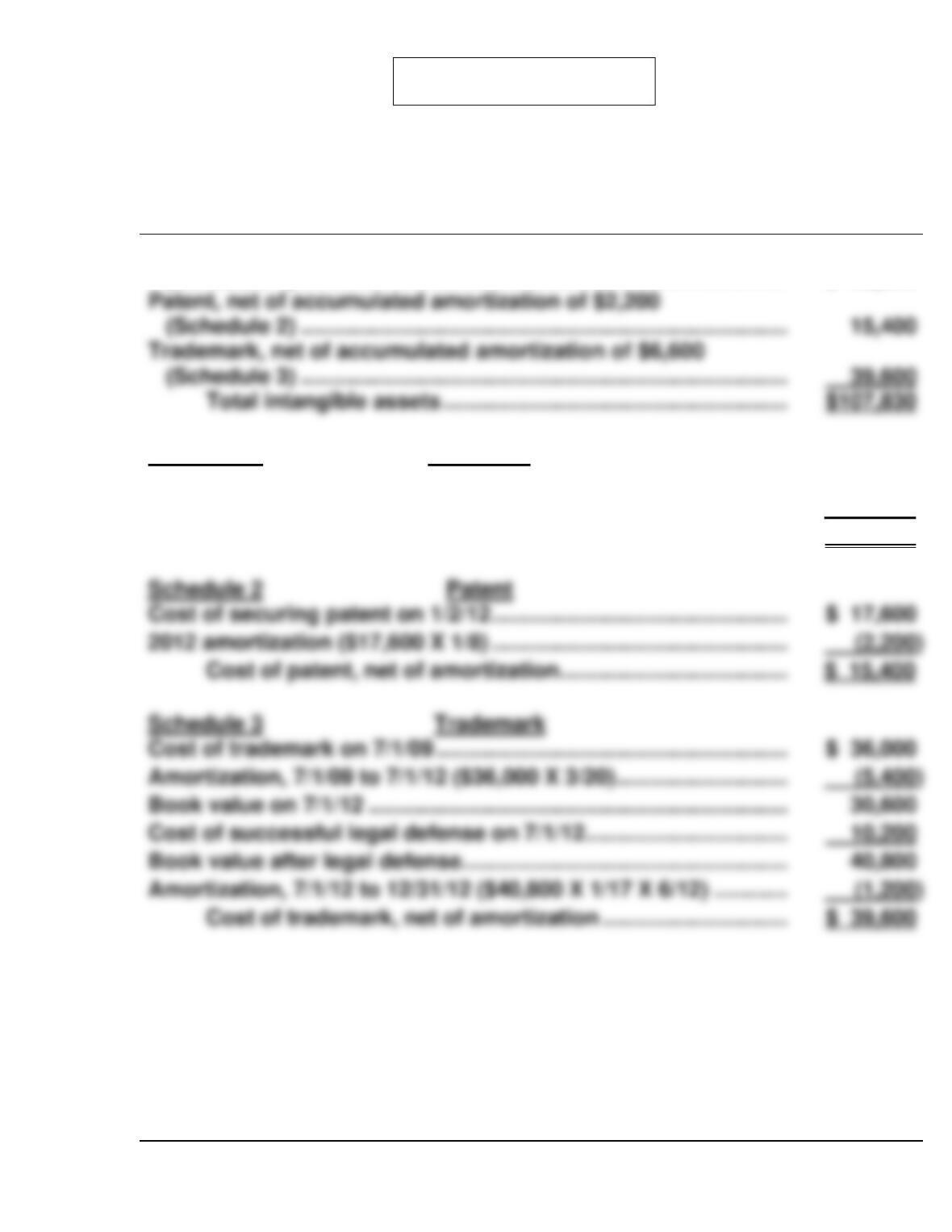
Franchise, net of accumulated amortization of $5,870
(Schedule 1) …………………………………………………………………….
$ 52,830
Schedule 1 Franchise
Cost of franchise on 1/1/12 ($15,000 + $43,700)……………………..
$ 58,700
2012 amortization ($58,700 X 1/10) ……………………………………….
(5,870)
Cost of franchise, net of amortization …………………………..
$ 52,830
Schedule 2 Patent
Cost of securing patent on 1/2/12 …………………………………………
$ 17,600
Schedule 3 Trademark
Cost of trademark on 7/1/09 …………………………………………………
$ 36,000
Book value on 7/1/12 …………………………………………………………..
Cost of successful legal defense on 7/1/12…………………………...
10,200
Book value after legal defense……………………………………………..
Amortization, 7/1/12 to 12/31/12 ($40,800 X 1/17 X 6/12) …………
(1,200)
Cost of trademark, net of amortization …………………………
$ 39,600
Patent, net of accumulated amortization of $2,200
(Schedule 2) …………………………………………………………………….
Trademark, net of accumulated amortization of $6,600
(Schedule 3) …………………………………………………………………….
Total intangible assets ………………………………………………..
$107,830
PROBLEM 12-3 (Continued)
(b)
SANDRO CORPORATION
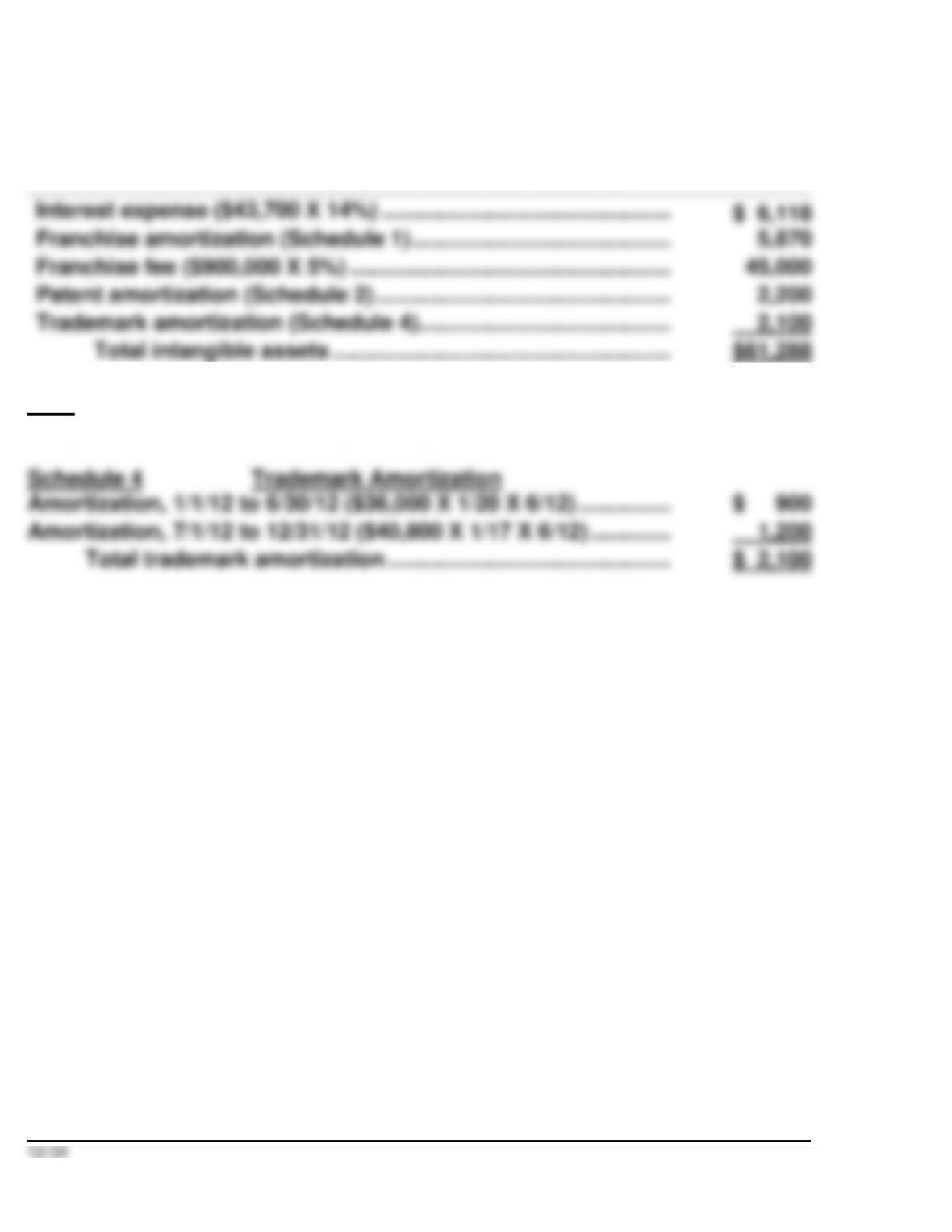
Expenses Resulting from Selected Intangible Assets Transactions
For the Year Ended December 31, 2012
Note: The $65,000 of research and development costs incurred in developing
the patent would have been expensed prior to 2012.
12–35
PROBLEM 12-4
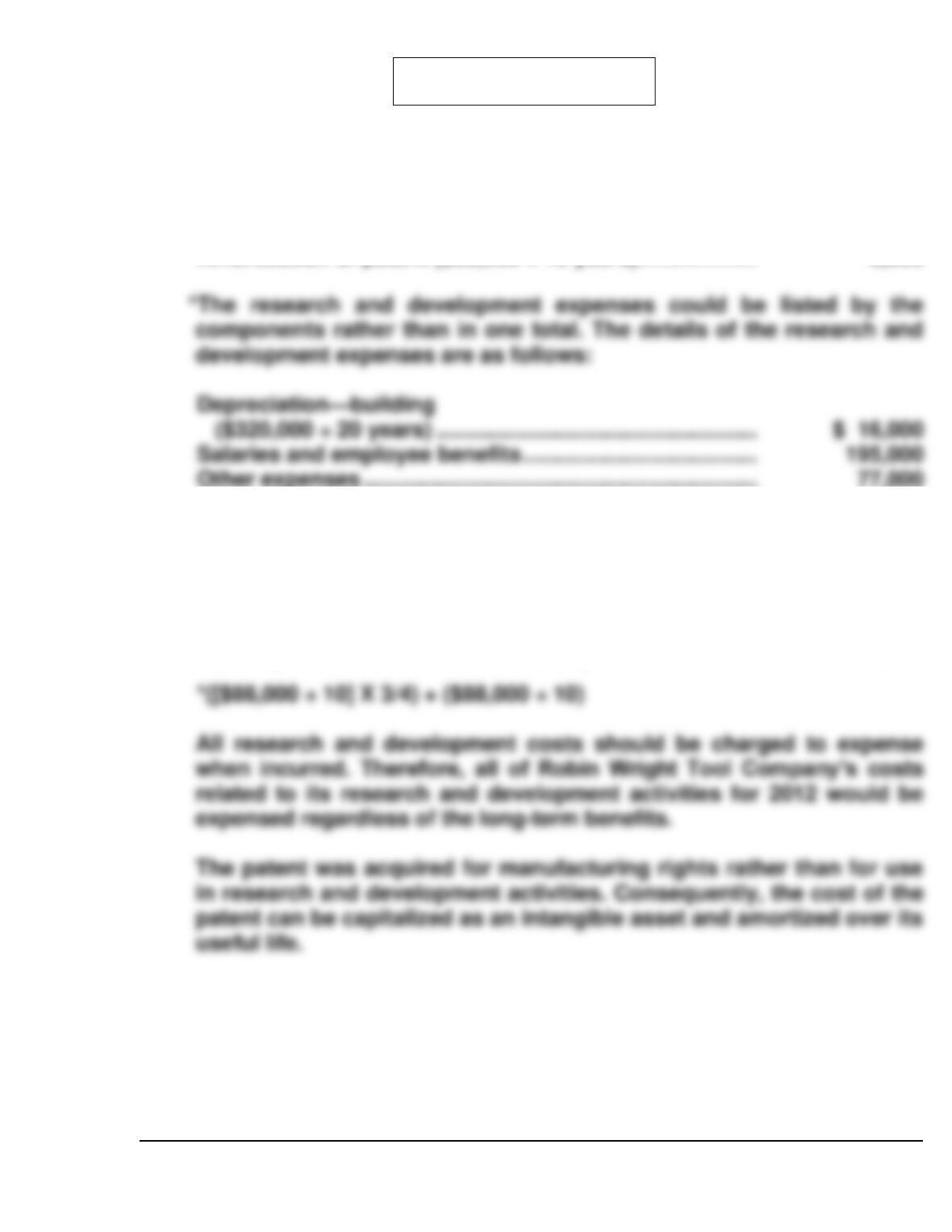
(a) Income statement items and amounts for the year ended December 31,
2012:
Research and development expenses* ……………………..
$288,000
Amortization of patent ($88,000 ÷ 10 years) ……………….
8,800
Other expenses ……………………………………………………….
77,000
(b) Balance sheet items and amounts as of December 31, 2012:
Land ……………………………………………………………………….
$ 60,000
Building (net of accumulated depreciation
of $16,000) ……………………………………………………………
304,000
Patent (net of amortization of $15,400)* …………………….
72,600
*([$88,000 ÷ 10] X 3/4) + ($88,000 ÷ 10)
($320,000 ÷ 20 years) …………………………………………….
$ 16,000
Salaries and employee benefits ………………………………..
PROBLEM 12-5
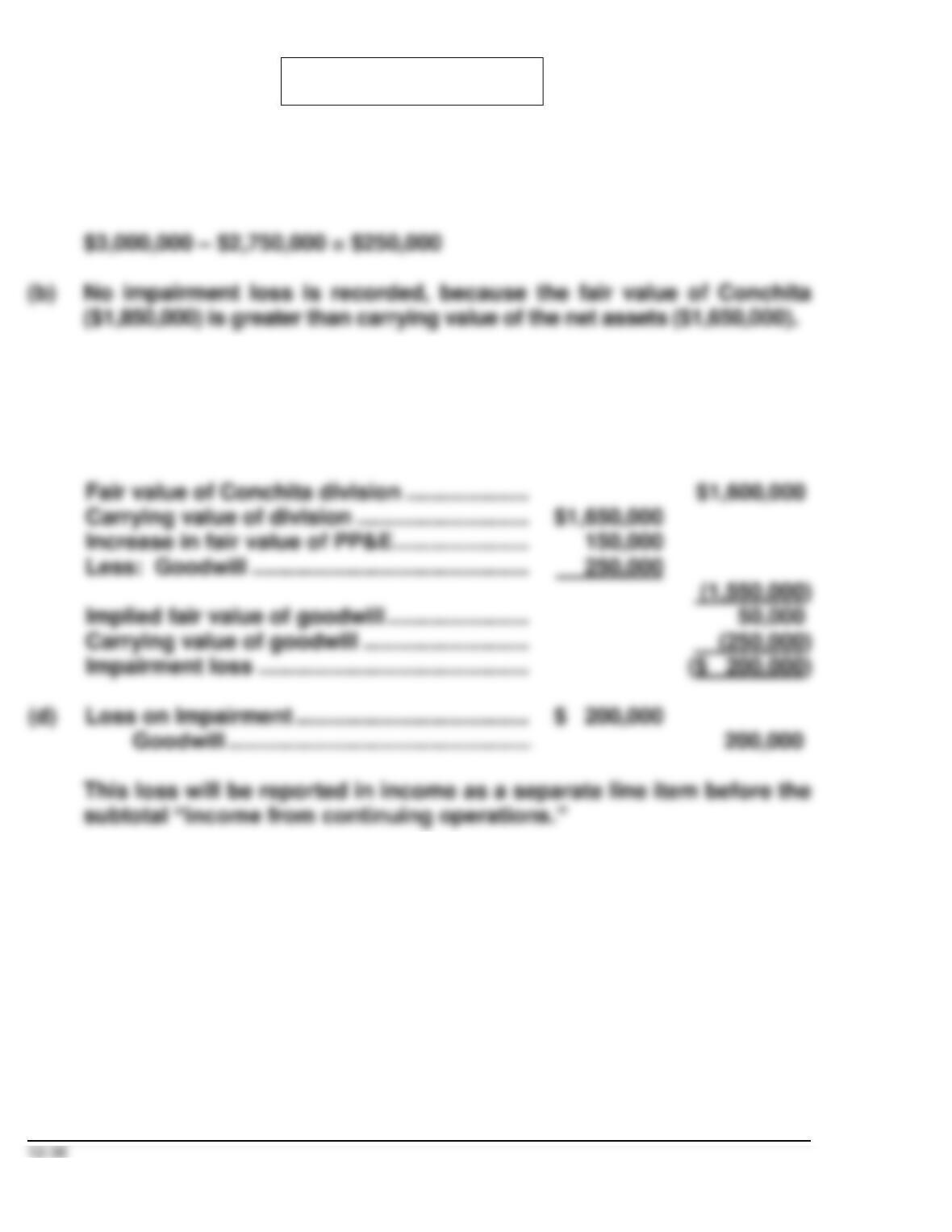
(a) Goodwill = Excess of the cost of the division over the fair value of the
identifiable assets:
(c) Computation of impairment:
Implied fair value of goodwill = Fair value of division less the carrying
value of the division (adjusted for fair value changes), net of goodwill:
12–37
PROBLEM 12-6
(a)
MONTANA MATT’S GOLF INC.
Intangibles Section of Balance Sheet
December 31, 2011
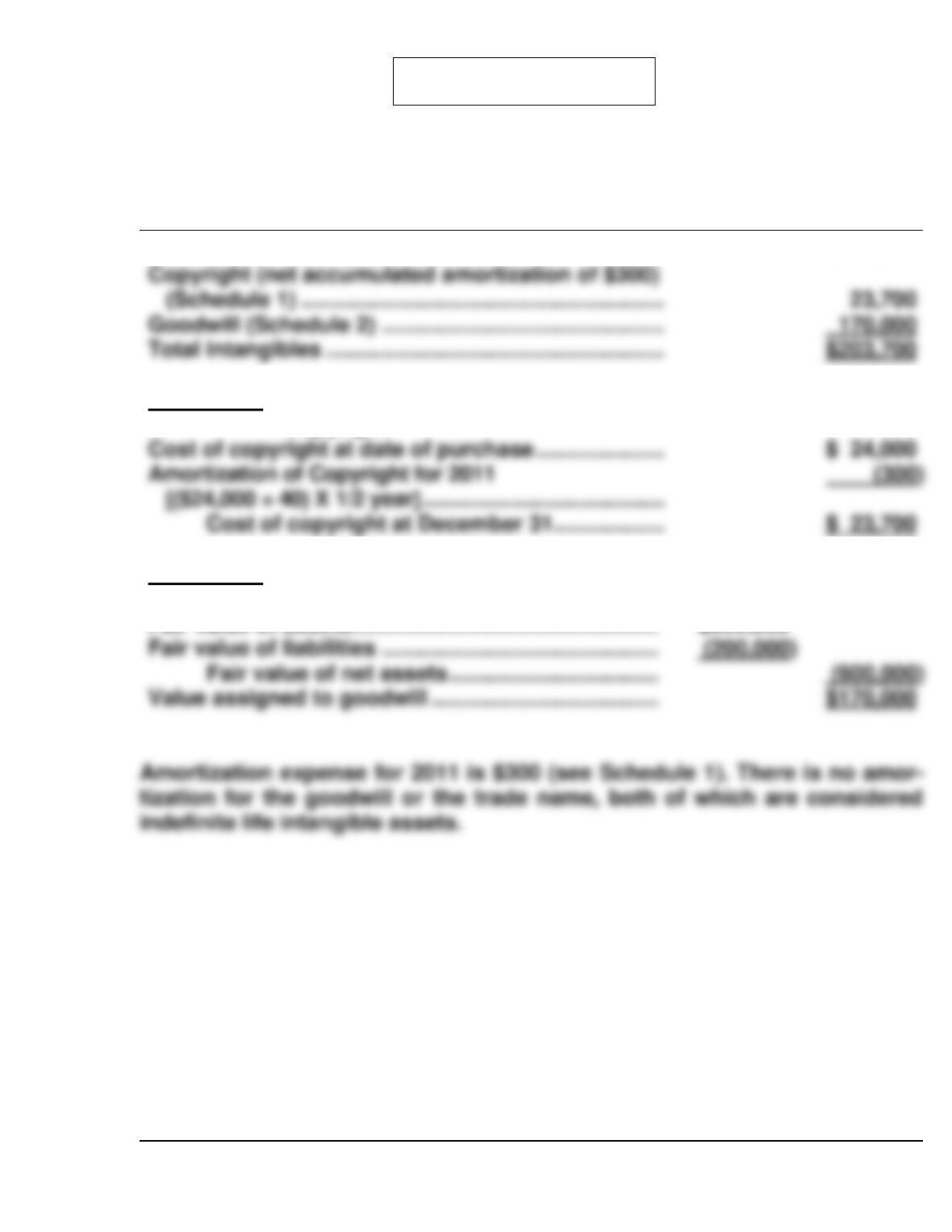
Trade name ……………………………………………………….
$ 10,000
Schedule 1 Computation of Value of Old Master
Copyright
Cost of copyright at date of purchase …………………………..
$ 24,000
Amortization of Copyright for 2011
Cost of copyright at December 31 …………………………..
$ 23,700
Schedule 2 Goodwill Measurement
Purchase price …………………………………………………
$770,000
Fair value of assets …………………………………………..
$800,000
Fair value of liabilities ………………………………………
Fair value of net assets …………………………….
Value assigned to goodwill ……………………………….
$170,000
(b) Amortization Expense ……………………………………
600
Copyrights ($24,000 ÷ 40) …………………………..
600
There is a full year of amortization on the Copyright. There is no amortiz–
ation for the goodwill or the trade name, which is considered an indefinite
life intangible.
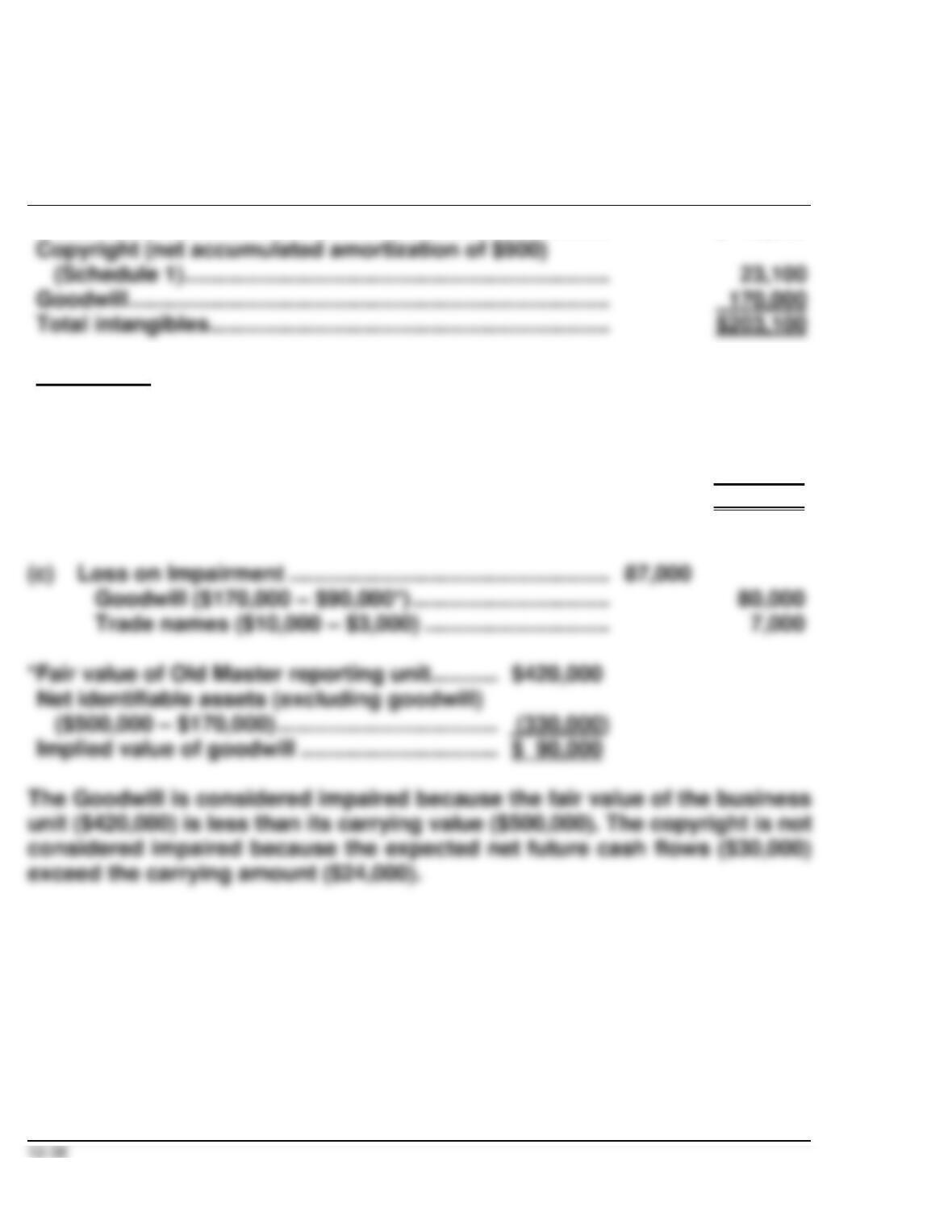
Goodwill (Schedule 2) ……………………………………………………….
Total intangibles ……………………………………………………….
PROBLEM 12-6 (Continued)
MONTANA MATT’S GOLF INC.
Intangibles Section of Balance Sheet
December 31, 2012
Trade name …………………………..………………………………………………
$ 10,000
Goodwill ………………………………………………………………………………
Total intangibles……………………………………………………………………
Schedule 1 Computation of Value of Old Master
Copyright
Cost of Copyright at date of purchase …………………………..
$ 24,000
Amortization of Copyright for 2011, 2012
[($24,000 ÷ 40) X 1.5 years] ………………………………………………….
(900)
Cost of copyright at December 31 …………………………..
$ 23,100
Goodwill ($170,000 – $90,000*) …………………………..
Trade names ($10,000 – $3,000) …………………………
Net identifiable assets (excluding goodwill)
Implied value of goodwill ………………………….. $ 90,000

12–39
TIME AND PURPOSE OF CONCEPTS FOR ANALYSIS
CA 12-1 (Time 25–30 minutes)
Purpose—to provide the student with an opportunity to discuss the conceptual merits and reporting re–
quirements of three methods of accounting for a penalty assessment. The student is required to evaluate
the merits of expensing the item currently, treating it as a prior period adjustment, or capitalizing the
amount of the penalty and amortizing it over future periods. This case presents a good illustration of a
realistic situation in which the accountant faces the question of capitalizing or expensing an expenditure.
It should be emphasized that a thorough justification for each method should be presented.
CA 12-2 (Time 20–25 minutes)
Purpose—to provide the student with an opportunity to determine the proper classification of certain
expenditures related to organizing a business. The student is required to deal with such issues as costs
incurred for interest expense during construction, the cost of promotional advertising, and expenditures
related to obtaining tenants for a shopping center. Classification of these items is complicated due to a
postponement in the starting of business operations. A challenging and interesting case which should
provide good background for a discussion of the theoretical support for capitalizing organization costs.
CA 12-3 (Time 25–30 minutes)
Purpose—to present an opportunity for the student to discuss accounting for patents from a theoretical
and a practical viewpoint. The student is required to explain the “discounted value of expected net
receipts” method of accounting for patents and to provide support for using cost as the generally
accepted valuation method. The student is also required to comment on the theoretical basis of patent
amortization. Finally the student must determine proper disclosure in the financial statements for a
patent infringement suit which is in progress at the balance sheet date. This case challenges the
student to present theoretical support and practical application beyond that presented in the text.
CA 12-4 (Time 25–30 minutes)
Purpose—to provide the student with an opportunity to discuss the theoretical support for and practical
applications of the FASB’s position on research and development costs. The student is required to
define the terms “research” and “development” as used in the codification to provide theoretical support
for the FASB’s position, and to apply the provisions to a situation presented in the case. A good case to
thoroughly cover research and development costs.
CA 12-5 (Time 20–25 minutes)
Purpose—to provide the student with an opportunity to examine the ethical issues related to expensing
research and development costs.
SOLUTIONS TO CONCEPTS FOR ANALYSIS
CA 12-1
(a) Accounting for the penalty as a charge to the current period is justified if the penalty is considered
the result of an unusual event (the assessment) occurring within the period. The penalty may be
an extraordinary item rather than a part of income before extraordinary items, if it is material and is
unusual in nature and infrequent in occurrence. Installation of the air pollution control equipment
should prevent the assessment of further penalties.
CA 12-2
Interest on mortgage bonds. An amount equal to the interest cost incurred in 2011 ($720,000) is a
cost which can be associated with the normal construction period and can be regarded as a normal
element of the cost of the physical assets of the shopping center because the construction period would