Case 12-29 (continued)
Solution assuming direct labor is a variable cost
(a)
(b)
(c)
(a) × (c)
(a) × (b)
Quantity
Unit
Contri-
bution
Margin
Welding
Time
per Unit
Total
Welding
Time
Balance
of
Welding
Time
Total
Contri-
bution
Total hours available ………………..
2,000
XSX Drums—make ………………….
2,500
$103.10
0.80
2,000
0
$257,750
Mountain bike frames produced …
0.20
0
XSX Drums—buy …………………….
Total contribution margin ………….
$ 16,575
Case 12-29 (continued)
5. The case strongly suggests that direct labor is fixed: “The mountain bike
frames could be produced with existing equipment and personnel.”
Nevertheless, it would be a good idea to examine how much labor time
is really needed under the two opposing plans.
Production
Direct Labor-
Hours Per Unit
Total Direct
Labor-Hours
Plan 1:
Mountain bike frames ..
3,500
1.25*
4,375
XSX drums ………………
1,625
0.25**
406
4,781
Plan 2:
XSX drums ………………
2,500
0.25**
625
* $22.50 ÷ $18.00 per hour = 1.25 hours
** $4.50 ÷ $18.00 per hour = 0.25 hour
Some caution is advised. Plan 1 assumes that direct labor is a fixed cost.
However, this plan requires over 4,000 more direct labor-hours than Plan
2 and the present situation. A full-time employee works about 1,900
hours a year, so the added workload is about equivalent to two full-time
employees. Does the plant really have that much idle time at present? If
Case 12-29 (continued)
Contribution margin from Plan 1:
Mountain bike frames produced (3,500 × $46.50) ……
$162,750
XSX Drums—make (1,625 × $107.60) ……………………
174,850
XSX Drums—buy (1,375 × $33.15) ……………………….
45,581
Net effect of Plan 1 on net operating income …………….
Contribution margin from Plan 2: …………………………...
XSX Drums—make (2,500 × $107.60) ……………………
$269,000
XSX Drums—buy (500 × $33.15)………………………….
16,575
Case 12-29 (continued)
Amended solution assuming direct labor is fixed
Manufactured
Drums
Contribution margin per unit (from part 2) (a)…..
$46.50
XSX
Mountain
Bike
Amended solution assuming direct labor is a variable cost
Manufactured
XSX
Drums
Mountain
Bike
Frames
Contribution margin per unit (from part 2) (a)…..
$69.95*
$24.00
Welding hours per unit (b) …………………………...
0.8 hour
0.2 hour
Contribution margin per welding hour (a) ÷ (b) ..
$87.44
$120.00
Case 12-30 (75 minutes)
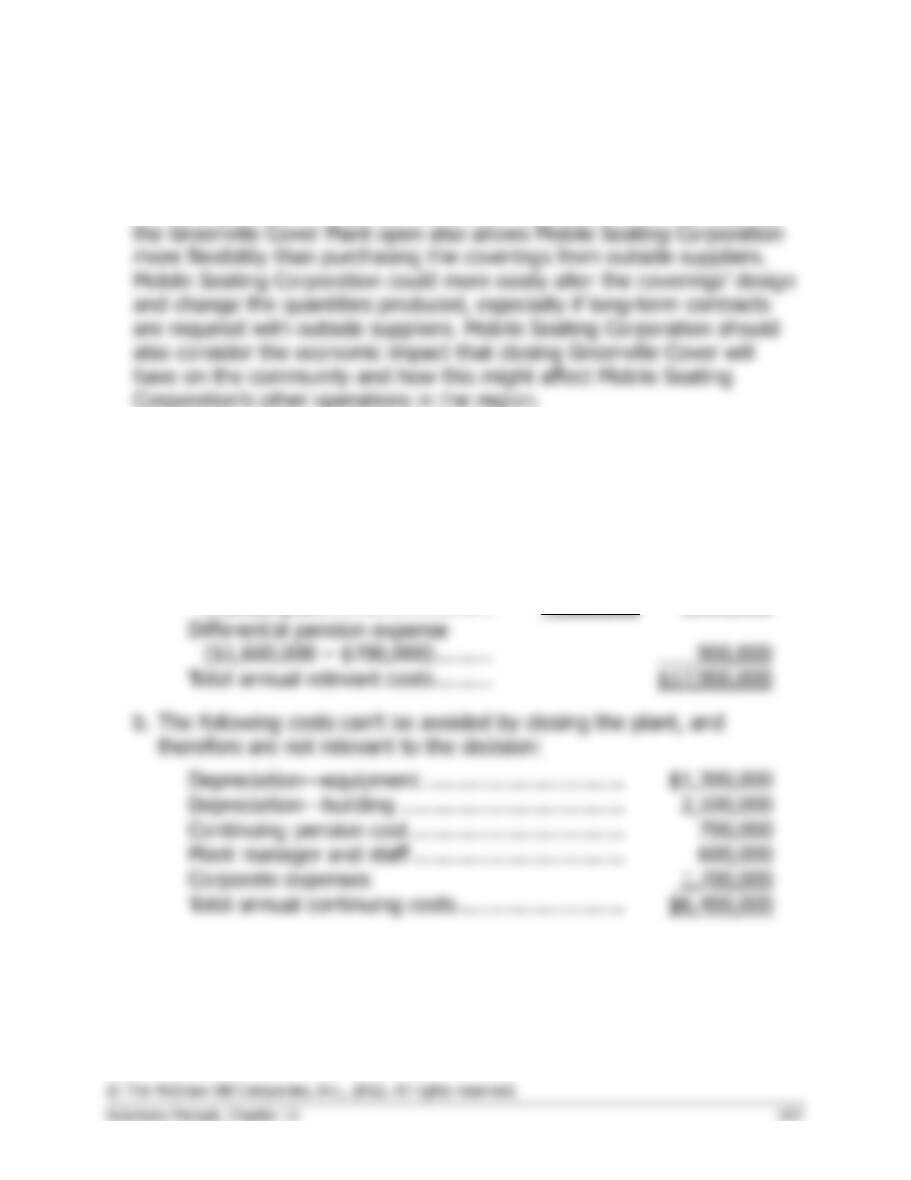
1. Continuing to obtain covers from its own Greenville Cover Plant would
allow Mobile Seating Corporation to maintain its current level of control
over the quality of the covers and the timing of their delivery. Keeping
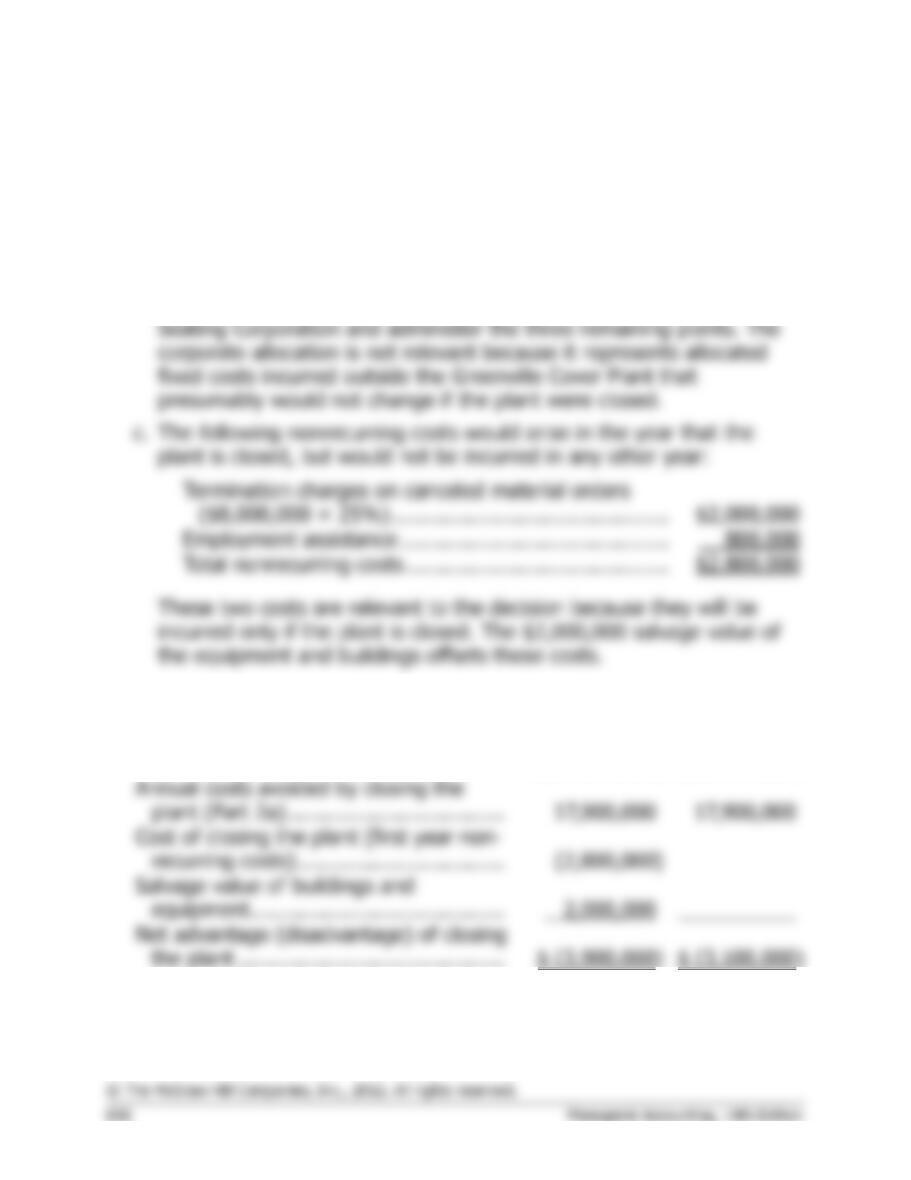
2. a. The following costs can be avoided by closing the plant, and
therefore are relevant to the decision:
Materials ……………………………..
$ 8,000,000
Labor:
Direct …………………………..…..
$6,700,000
Supervision ………………………..
400,000
Indirect plant ……………………..
1,900,000
9,000,000
700,000
600,000
1,700,000
Case 12-30 (continued)
Depreciation is not relevant to the decision because it is a sunk cost.
Moreover, whether the plant is closed or continues to operate, all of
the remaining book value of the equipment and buildings will
eventually be written off. A total of $700,000 of the annual pension
expense is not relevant because it would continue whether or not the
plant is closed. The amount for plant manager and staff is not
relevant because Restin and her staff would continue with Mobile
Total nonrecurring costs ……………………………………
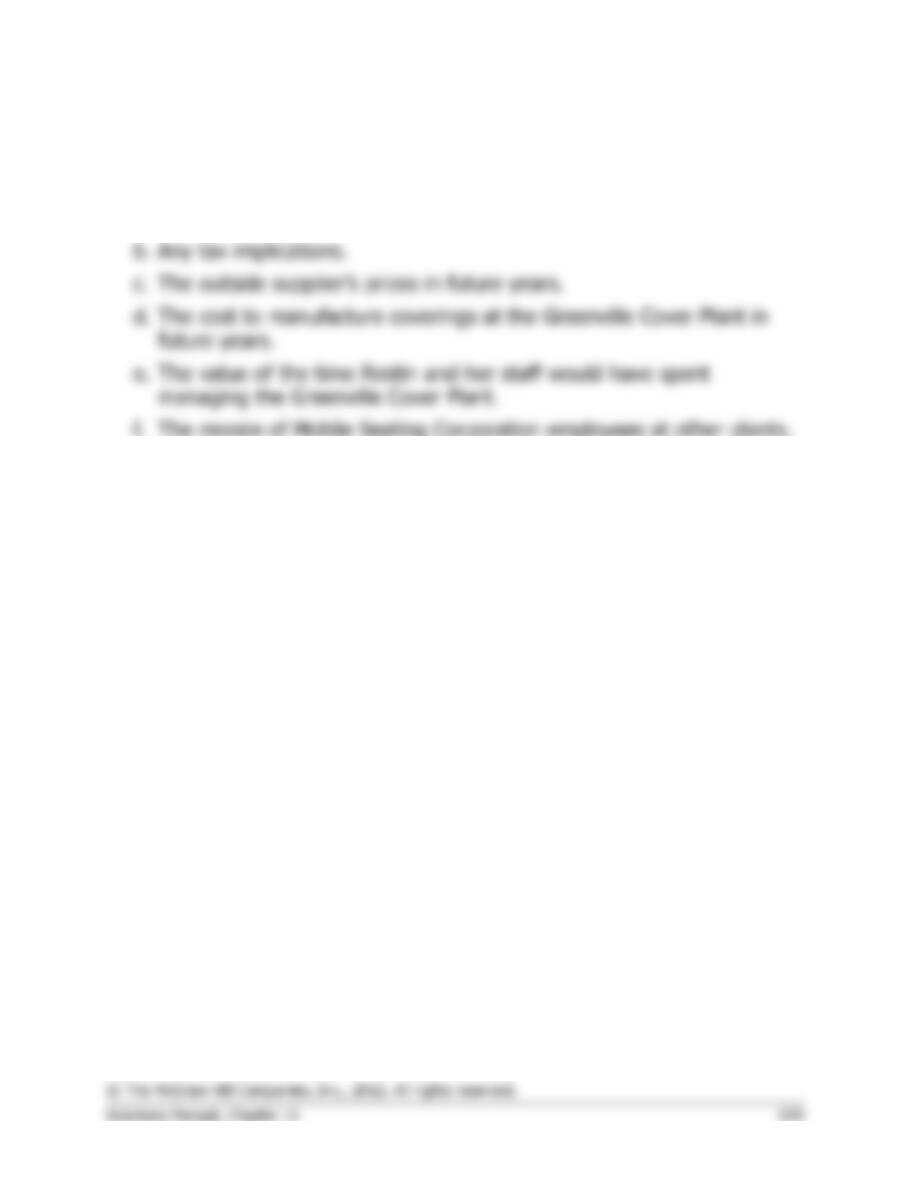
3. No, the plant should not be closed. The computations are:
First Year
Other Years
Cost of purchasing the covers outside …
$(21,000,000)
$(21,000,000)
Case 12-30 (continued)
4. Factors that should be considered by Mobile Seating Corporation before
making a decision include:
a. Alternative uses of the building and equipment.
Case 12-31 (90 minutes)
1. The lowest price Jenco could bid for the one-time special order of
25,000 pounds (25 lots) without losing money would $34,750, as shown
below.
Direct materials:
CW-3: 400 pounds per lot × 25 lots = 10,000 pounds.
Substitute CN-5 on a one-for-one basis to its total of 5,500
pounds. If CN-5 is not used in this order, it will be salvaged
for $500. Therefore, the relevant cost is ……………………….
$ 500
$0.90 per pound ……………………………………………………..
4,050
per pound ……………………………………………………………..
8,000
BE-7: 100 pounds per lot × 25 lots = 2,500 pounds at $0.55
per pound, the amount Jenco could realize by selling BE–7
[$0.65 market price – $0.10 handling charge] ……………….
1,375
Total direct materials cost ……………………………………………
18,425
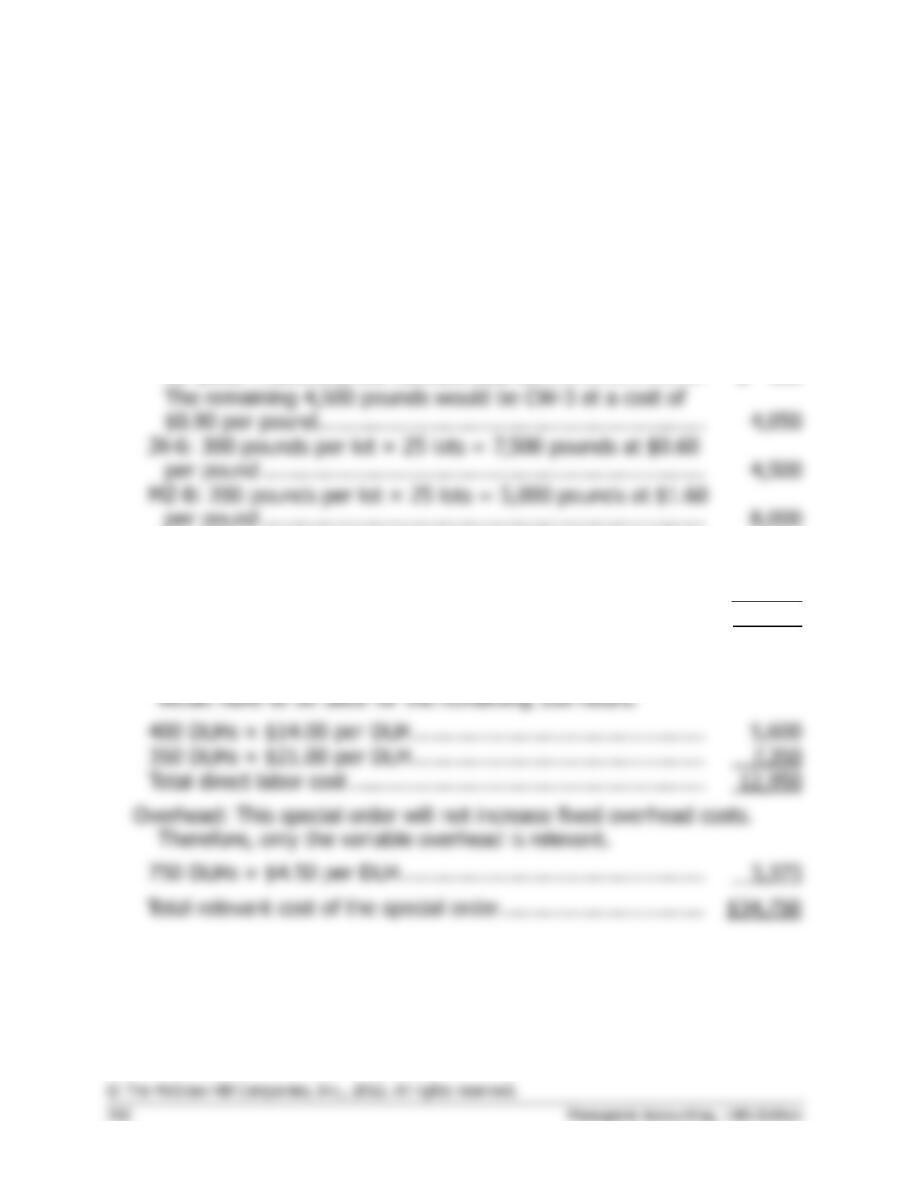
Direct labor: 30 DLHs per lot × 25 lots = 750 DLHs. Because only 400
hours can be scheduled during regular time this month, overtime
400 DLHs × $14.00 per DLH ………………………………………..
5,600
350 DLHs × $21.00 per DLH ………………………………………..
7,350
750 DLHs × $4.50 per DLH ………………………………………….
3,375
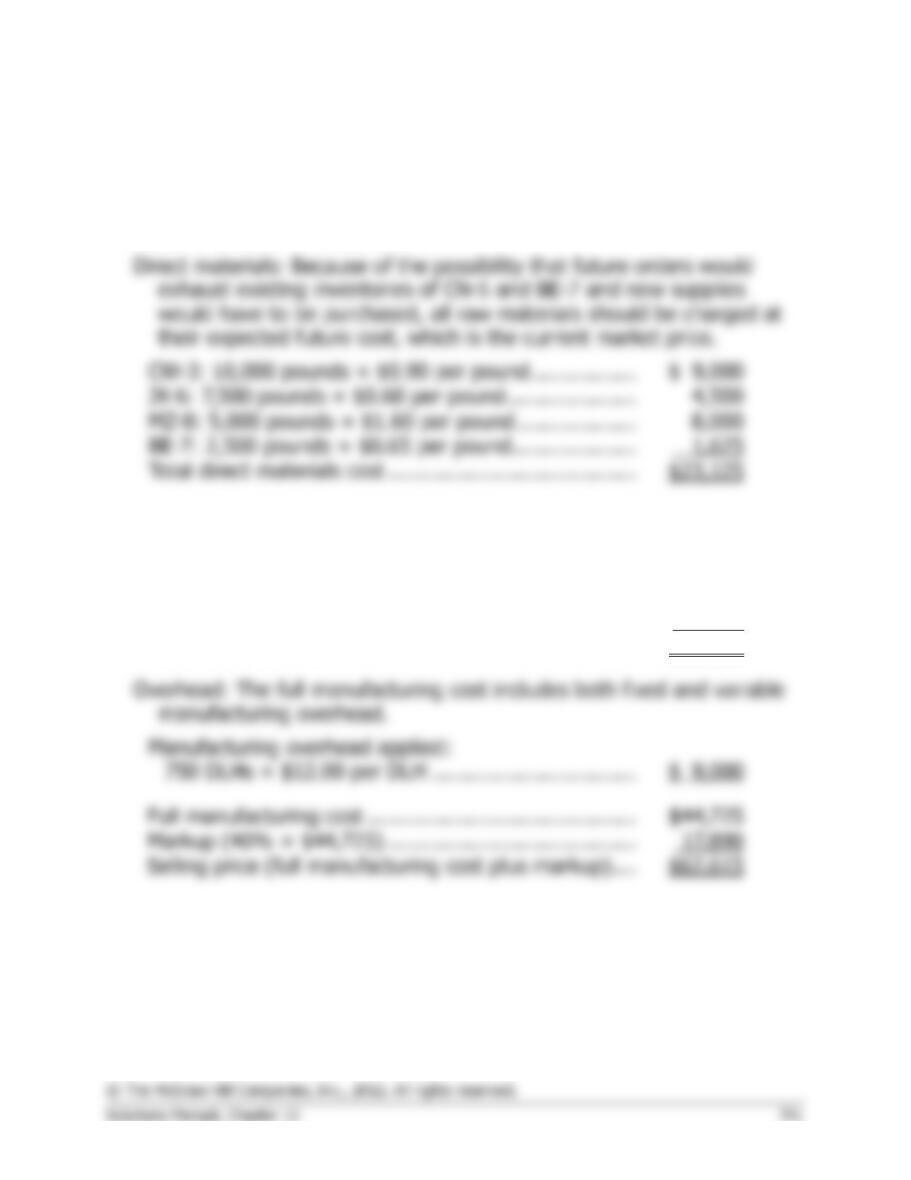
Total relevant cost of the special order …………………………...
Case 12-31 (continued)
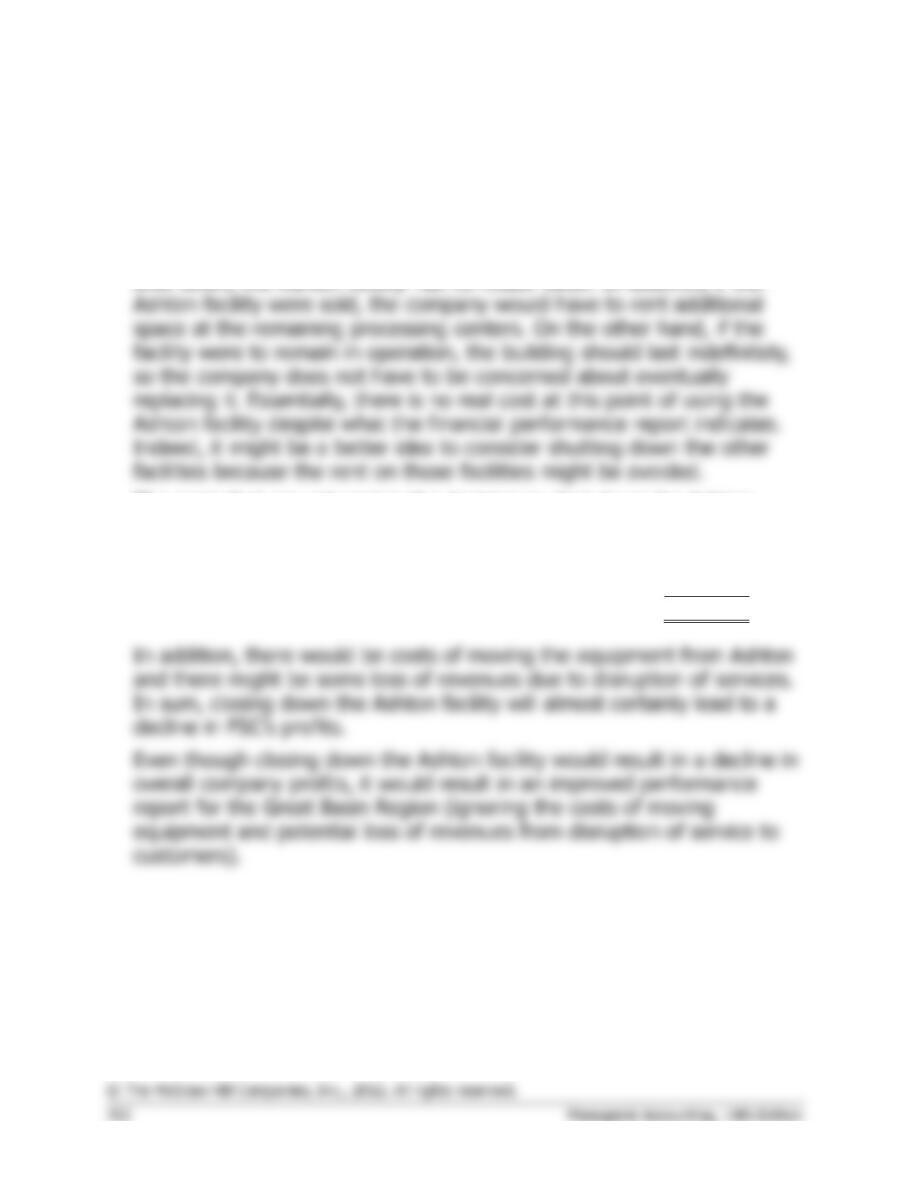
2. In this part, we calculate the price for recurring orders of 25,000 pounds
(25 lots) using the company’s rule of marking up its full manufacturing
cost. This is probably not the best pricing policy to follow, but is a
common practice in business.
1,625
Total direct materials cost ………………………………….
$23,125
Direct labor: 60% (i.e., 450 DLHs) of the production of a batch can be
done on regular time; but the remaining production (i.e., 300 DLHs)
must be done on overtime.
Regular time 450 DLHs × $14.00 per DLH …………….
$ 6,300
Overtime premium 300 DLHs × $21.00 per DLH …….
6,300
Total direct labor cost ……………………………………….
$12,600
$ 9,000
Full manufacturing cost …………………………………….
$44,725
Markup (40% × $44,725) ………………………………….
Case 12-32 (90 minutes)
1. The original cost of the facilities at Ashton is a sunk cost and should be
ignored in any decision. The decision being considered here is whether
to continue operations at Ashton. The only relevant costs are the future
facility costs that would be affected by this decision. If the facility were
The costs that are relevant in the decision to shut down the Ashton
facility are:
Increase in rent at Pocatello and Idaho Falls ………………..
$400,000
Decrease in local administrative expenses ……………………
(60,000)
Net increase in costs ……………………………………………….
$340,000
Case 12-32 (continued)
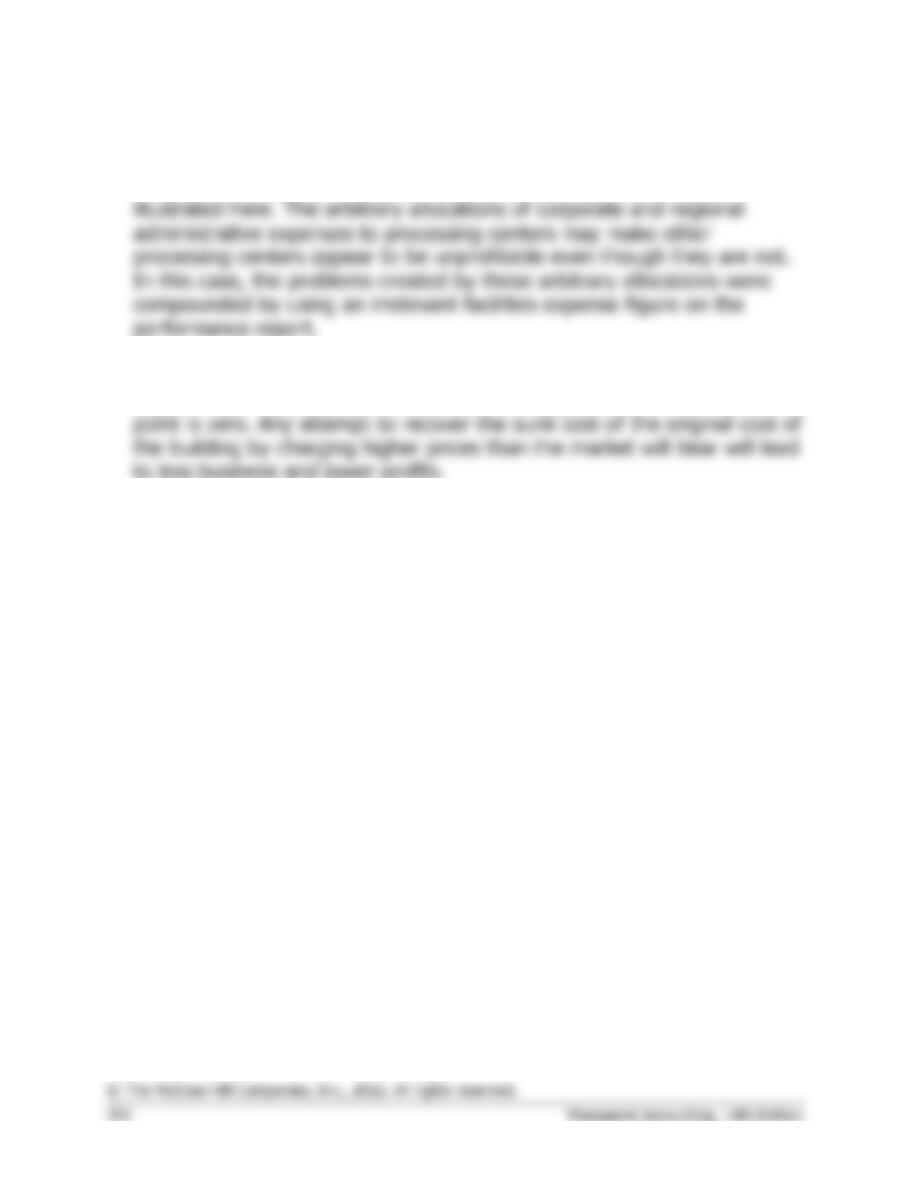
Financial Performance
After Shutting Down the Ashton Facility
Great Basin Region
Total
Revenues ………………………………………
$20,000,000
Operating expenses:
Direct labor …………………………………
12,200,000
Variable overhead …………………………
400,000
Facility expenses* …………………………
Local administrative expenses** ………
Regional administrative expenses ……..
Corporate administrative expenses ……
18,590,000
*
2. If the Ashton facility is shut down, FSC’s profits will decline, employees
will lose their jobs, and customers will at least temporarily suffer some
decline in service. Therefore, Braun is willing to sacrifice the interests of
the company, its employees, and its customers just to make his
performance report look better.
Case 12-32 (continued)
It should be noted that the performance report required by corporate
headquarters is likely to lead to other problems such as the one
3. Prices should be set ignoring the depreciation on the Ashton facility. As
argued in part (1) above, the real cost of using the Ashton facility at this
Case 12-33 (45 minutes)
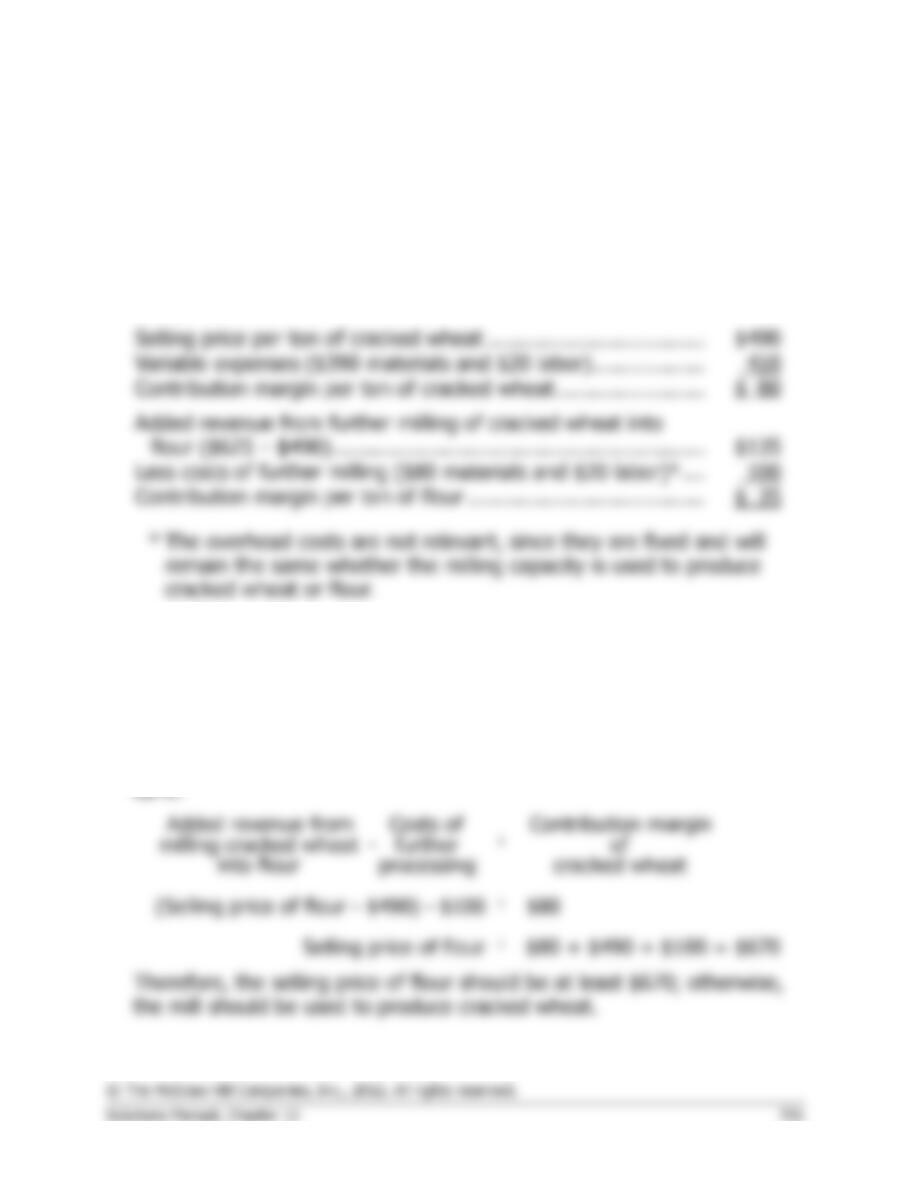
1. Yes, milling of flour should be discontinued if the price remains at $625,
but not for the reason given by the sales manager. The reason it should
be discontinued is that the
added
contribution margin that can be
obtained from milling a ton of cracked wheat into flour is
less
than the
contribution margin that can be obtained from using the milling capacity
to produce another ton of cracked wheat and selling it as cereal. The
analysis is:
Therefore, the company makes more money using its milling capacity to
produce cracked wheat than flour.
2. Because the demand for the two products is unlimited and both require
the same amount of milling time, the company should process the
cracked wheat into flour only if the contribution margin for flour is at
least as large as the contribution margin for cracked wheat. In algebraic