Chapter 12:
MANAGERIAL DECISIONS FOR FIRMS WITH MARKET POWER
Essential Concepts
1. Market power is the ability of a firm to raise price without losing all its sales. Any firm that faces a
downward sloping demand curve has market power. Market power gives the firm the ability to raise
price above average cost and earn economic profit, if demand and cost conditions so permit.
3. The degree to which a firm possesses market power is inversely related to the price elasticity of
demand. The less (more) elastic the firm’s demand, the greater (less) its degree of market power. The
4. The Lerner index measures the proportionate amount by which price exceeds marginal cost:
5. When consumers view two goods to be substitutes, the cross-price elasticity of demand (EXY) is
positive. The higher the (positive) cross-price elasticity, the greater the substitutability between two
goods, and the smaller the degree of market power possessed by the two firms.
6. A firm can possess a high degree of market power only when strong barriers to the entry of new firms
exist. Six common types of entry barriers are:
a. Economies of scale. When long-run average cost declines over a wide range of output relative to
the demand for the product, there may not be room in the market for another large producer to
enter the market—at least not without driving price below unit costs making it unprofitable to
Chapter 12: Managerial Decisions for Firms with Market Power
7. In the short run, the manager of a monopoly firm will choose to produce the output where MR =
SMC, rather than shut down, as long as total revenue at least covers the firm’s total avoidable cost,
8. In the long run, the manager of a monopoly firm maximizes profit by choosing to produce the level of
output where marginal revenue equals long-run marginal cost (MR = LMC), unless price is less than
9. Marginal revenue product (MRP) is the additional revenue attributable to hiring one additional unit of
the input: MRP = ∆TR/∆L. MRP is also equal to marginal revenue times marginal product: MRP =
MR × MP.
10. When producing with a single variable input, a firm with market power will maximize profit by
11. For a firm with market power, the profit-maximizing condition that the marginal revenue product of
the variable input must equal the price of the input (MRP = w) is equivalent to the profit-maximizing
12. Under monopolistic competition, a large number of firms sell a differentiated product. The market is
monopolistic in that product differentiation creates a degree of market power. It is competitive
because of the large number of firms and easy entry.
13. Short-run equilibrium under monopolistic competition is exactly the same as it is for monopoly.
Long-run equilibrium in a monopolistically competitive market is attained when the demand curve for
14. Making profit-maximizing pricing and output decisions for firms with market power can be
summarized in the following steps:
Step 1: Estimate the demand equation. Estimate demand for a price-setting firm using the OLS
regression procedure, as set forth in Chapter 7.
Chapter 12: Managerial Decisions for Firms with Market Power
Step 7: Check the shutdown rule. The manager can calculate the average variable cost at Q* units by
substituting Q* into the estimated AVC function
15. If a firm produces in two plants, A and B, it should allocate production between the two plants so that
. The optimal total output for the firm is that output for which
. Hence, for
MR =MCT=MCA=MCB
Answers to Applied Problems
1. a. Yes, MTA is a the only supplier of bridge and tunnel crossings in metropolitan New York City,
of market power because of the lack of good substitutes.
b. When MC is zero for each vehicle, the MC curve will be horizontal line coinciding with the
horizontal (quantity) axis. Therefore, tolls should be set where MR = MC = 0. This also happens
c. Treat the MTA as a monopolist for analytical purposes. When demand decreases, the optimal
2. a. A monopolist, although the only supplier in the market, still faces the constraint of market
demand. Suppose that a monopolist is suffering losses even though it is charging the price
associated with the level of output at which MR = SMC. If the firm raises price, even larger
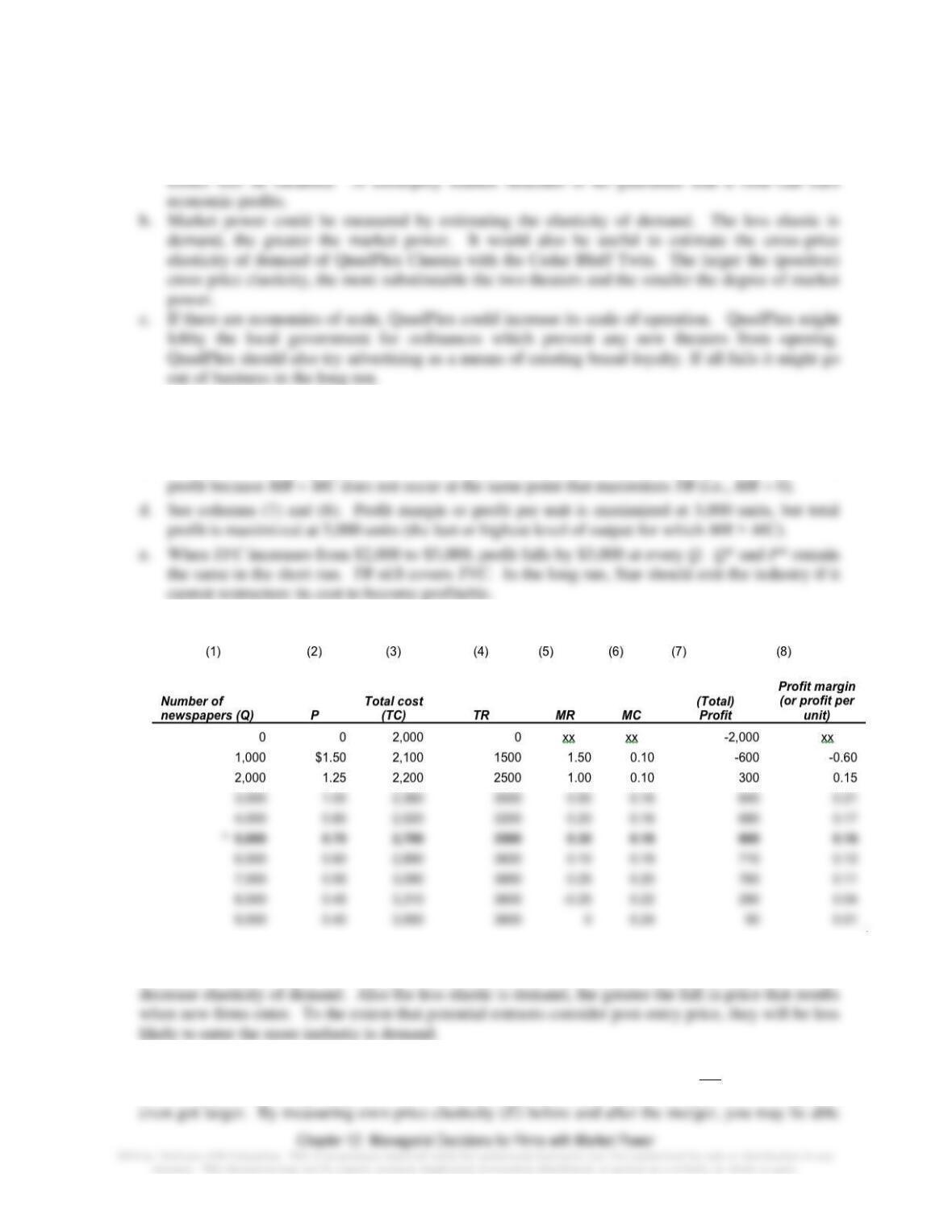
3. a. See spreadsheet columns (1) through (6) in the spreadsheet below.
b. P* = $0.70 and Q* = 5,000
c. TR is maximized at Q = 9,000, which, as expected, is not the same level of output that maximizes
4. Tots-R-US should begin advertising immediately in order to enhance brand loyalty, which will
5. One piece of evidence to support your firm’s contention that the merger did not increase market
power would be showing that your firm’s elasticity of demand either was unchanged by the merger, or
Chapter 12: Managerial Decisions for Firms with Market Power
6. Significant economies of scale could force your bank out of business if your bank is a small– scale
bank and a large-scale bank, facing lower long-run average costs, lowers price (i.e., lowers interest
7. Possibly as a barrier to the entry of other firms into Harley-Davidson’s segment of the motorcycle
market. Also the name and the engine roar increase the brand loyalty of the firm’s customers.
8. Businesses know that once a customer goes through all the trouble of setting up electronic bill
9. In the absence of entry barriers, collusion among monopolistically competitive firms will not prevent
new firms from entering causing demand to decrease and become more elastic. The price will be the
0.000012 =8,000
b. P* = 424 – 0.002(8,000) = $408
c. TR = $408(8,000) = $3,264,000:
AVC = 200 –0.012(8,000) + 0.000002(8,000)2 = $232;
TVC = $232(8,000) = $1,856,000; π = TR – TVC – TFC = $3,264,000 – $1,856,000 – $100,000 =
$1,308,000
Chapter 12: Managerial Decisions for Firms with Market Power
11. a. P = 2,400 – 5Q
b. MR = 2,400 – 10Q
c. Must set MR = SMC. SMC = 6Q2 – 30Q + 400
12. a. The firm is not maximizing profit. At the current allocation between the two factories, the last
unit produced in Michigan added more to total cost ($5) than the last unit produced in Texas ($3).
13. First, the pursuit of market share ignores the MR = MC rule for pricing. Lowering prices of soft
drinks solely for the purpose of increasing sales and market share will result in prices set close to
average cost, rather than close to marginal cost. Buying market share will likely reduce profits in the
14. First, the claim that hedging by Southwest alone will drive down airfares on all airlines is likely to be
false. Southwest will make output and pricing decisions using the spot price of jet fuel (as will all
15. Amtrak’s plan to raise ticket prices will only lead to higher total revenue if demand is inelastic at the
present price levels. If demand is indeed elastic, then raising price will not only raise total revenue,
the higher prices will also decrease ridership and total costs will fall. However, the impact on total
costs for Amtrak are likely to be rather small since most of Amtrak’s costs are quasi-fixed costs that
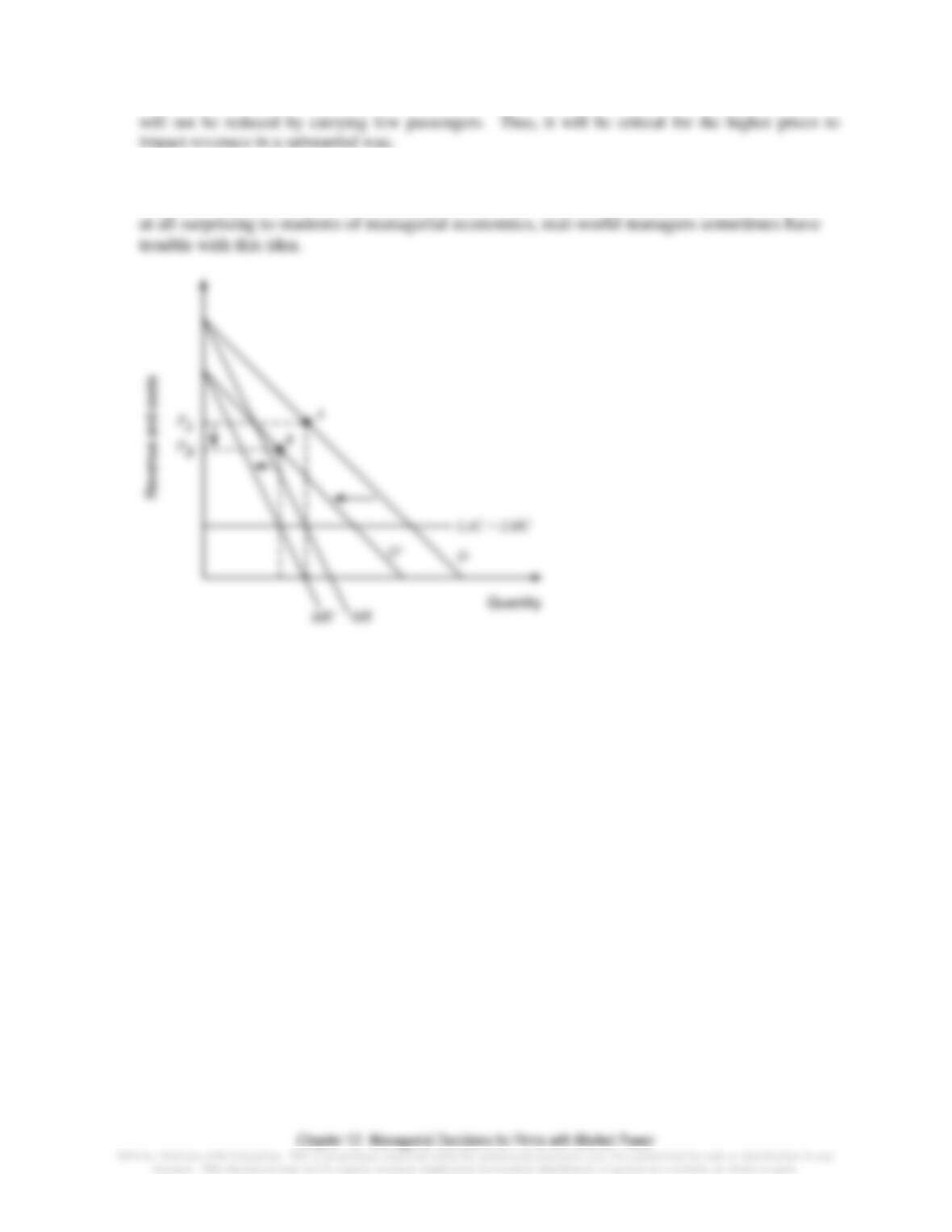
16. The graph below shows that when demand shifts leftward to D’, the new profit-maximizing price will
always be lower than the profit-maximizing price before demand decreased. While this result is not