CHAPTER 11 – 1
CHAPTER 12
COST OF CAPITAL
Answers to Concepts Review and Critical Thinking Questions
1. It is the minimum rate of return the firm must earn overall on its existing assets. If it earns more than
this, value is created.
5. The primary advantage of the DGM model is its simplicity. The method is disadvantaged in that (1)
the model is applicable only to firms that actually pay dividends; many do not; (2) even if a firm does
pay dividends, the DGM model requires a constant dividend growth rate forever; (3) the estimated
cost of equity from this method is very sensitive to changes in g, which is a very uncertain parameter;
and (4) the model does not explicitly consider risk, although risk is implicitly considered to the extent
that the market has impounded the relevant risk of the stock into its market price. While the share price
and most recent dividend can be observed in the market, the dividend growth rate must be estimated.
Two common methods of estimating g are to use analysts’ earnings and payout forecasts, or determine
some appropriate average historical g from the firm’s available data.
7. The appropriate aftertax cost of debt to the company is the interest rate it would have to pay if it were
to issue new debt today. Hence, if the YTM on outstanding bonds of the company is observed, the
company has an accurate estimate of its cost of debt. If the debt is privately placed, the firm could still
estimate its cost of debt by (1) looking at the cost of debt for similar firms in similar risk classes, (2)
CHAPTER 11 – 2
8. a. This only considers the dividend yield component of the required return on equity.
b. This is the current yield only, not the promised yield to maturity. In addition, it is based on the
9. RSuperior = .12 + .75(.08) = .18, or 18%
Both should proceed. The appropriate discount rate does not depend on which company is investing;
10. If the different operating divisions were in much different risk classes, then separate cost of capital
figures should be used for the different divisions; the use of a single, overall cost of capital would be
Solutions to Questions and Problems
NOTE: All end-of-chapter problems were solved using a spreadsheet. Many problems require multiple
steps. Due to space and readability constraints, when these intermediate steps are included in this solutions
manual, rounding may appear to have occurred. However, the final answer for each problem is found
without rounding during any step in the problem.
Basic
1. With the information given, we can find the cost of equity using the dividend growth model. Using
this model, the cost of equity is:
2. Here we have information to calculate the cost of equity, using the CAPM. The cost of equity is:
CHAPTER 11 – 3
3. We have the information available to calculate the cost of equity, using the CAPM and the dividend
growth model. Using the CAPM, we find:
RE = .035 + 1.10(.078)
RE = .1208, or 12.08%
4. To use the dividend growth model, we first need to find the growth rate in dividends. So, the increase
in dividends each year was:
g1 = ($1.33 – 1.24) / $1.24
g1 = .0726, or 7.26%
Using this growth rate in the dividend growth model, we find the cost of equity is:
RE = [$1.65(1.0741) / $55] + .0741
RE = .1063, or 10.63%
Calculating the geometric growth rate in dividends, we find:
$1.65 = $1.24(1 + g)4
g = .0740, or 7.40%
CHAPTER 11 – 4
5. The cost of preferred stock is the dividend payment divided by the price, so:
RP = $4.20 / $93
RP = .0452, or 4.52%
6. The pretax cost of debt is the YTM of the company’s bonds, so:
7. a. The pretax cost of debt is the YTM of the company’s bonds, so:
P0 = $1,070 = $31.50(PVIFAR%,44) + $1,000(PVIFR%,44)
R = 2.868%
YTM = 2 × 2.868%
YTM = 5.74%
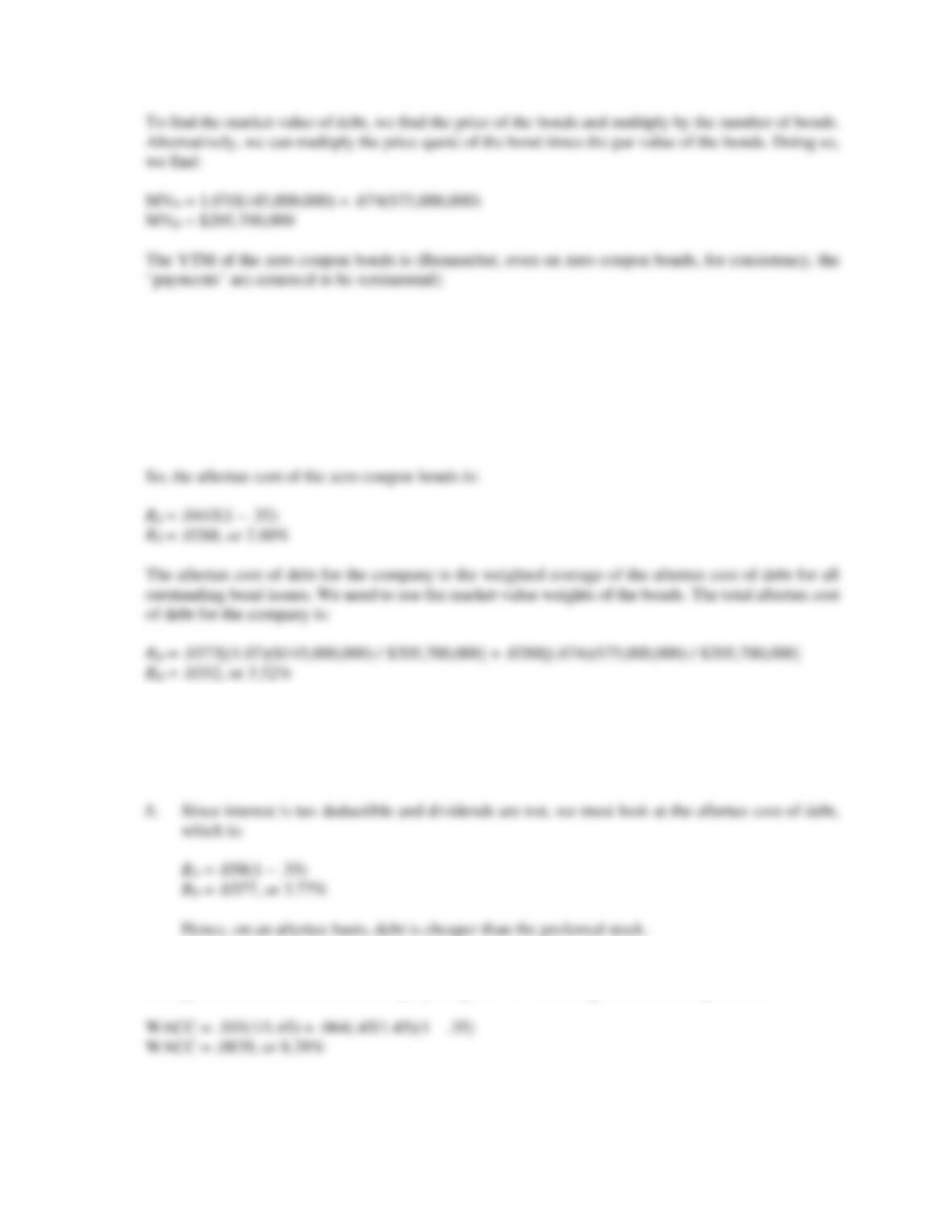
8. The book value of debt is the total par value of all outstanding debt, so:
BVD = $145,000,000 + 75,000,000
BVD = $220,000,000
CHAPTER 11 – 5
PZ = $674 = $1,000(PVIFR%,20)
R = .02216, or 2.216%
Which means the YTM is:
YTM = 2.216% × 2
YTM = 4.43%
9. a. Using the equation to calculate the WACC, we find:
WACC = .75(.1090) + .05(.051) + .20(.058)(1 – .35)
WACC = .0918, or 9.18%
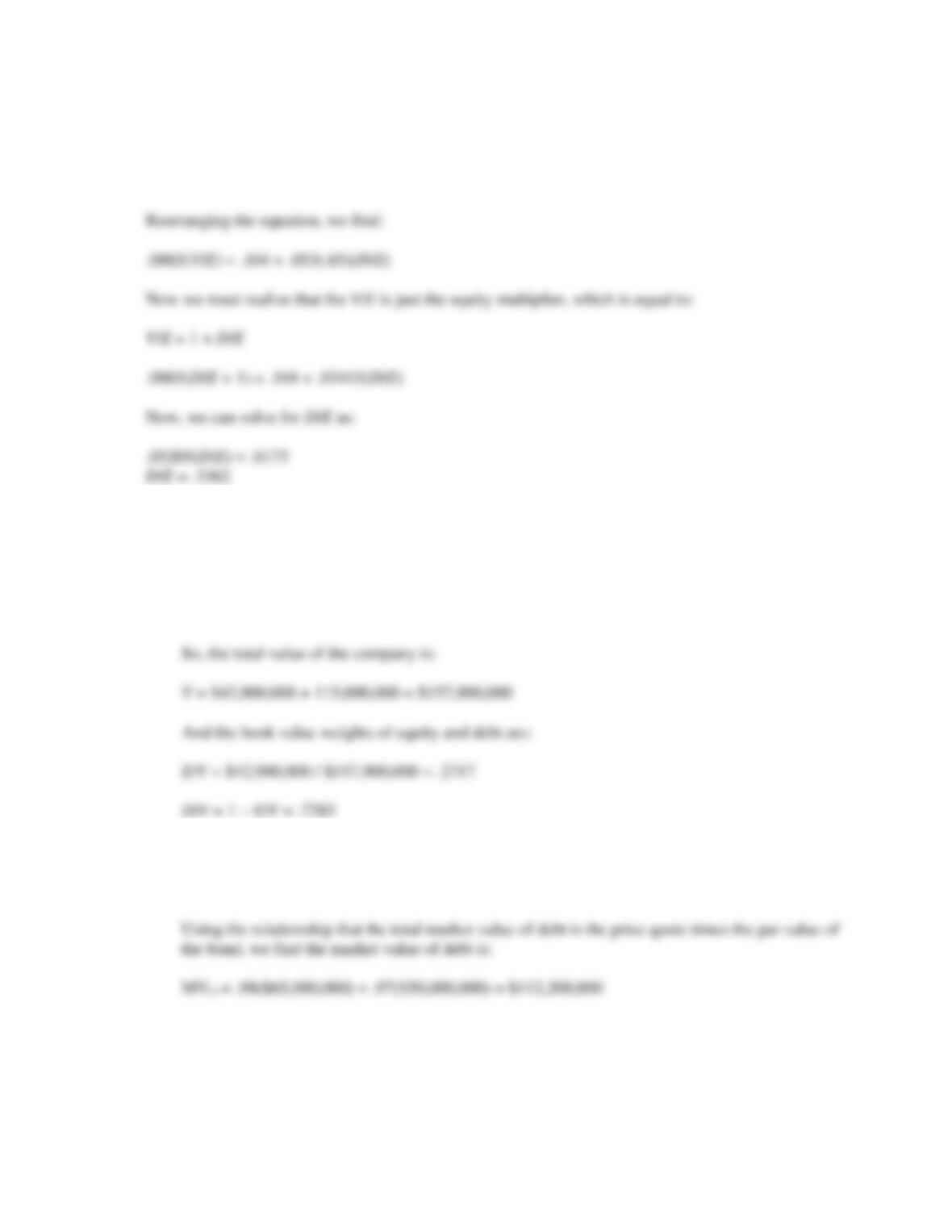
10. Here, we need to use the debt–equity ratio to calculate the WACC. A debt–equity ratio of .45 implies
a weight of debt of .45/1.45 and an equity weight of 1/1.45. Using this relationship, we find:
CHAPTER 11 – 6
11. Here, we have the WACC and need to find the debt–equity ratio of the company. Setting up the WACC
equation, we find:
WACC = .0865 = .104(E/V) + .053(D/V)(1 – .35)
12. a. The book value of equity is the book value per share times the number of shares, and the book
value of debt is the face value of the company’s debt, so:
BVE = 3,900,000($11) = $42,900,000
BVD = $65,000,000 + 50,000,000 = $115,000,000
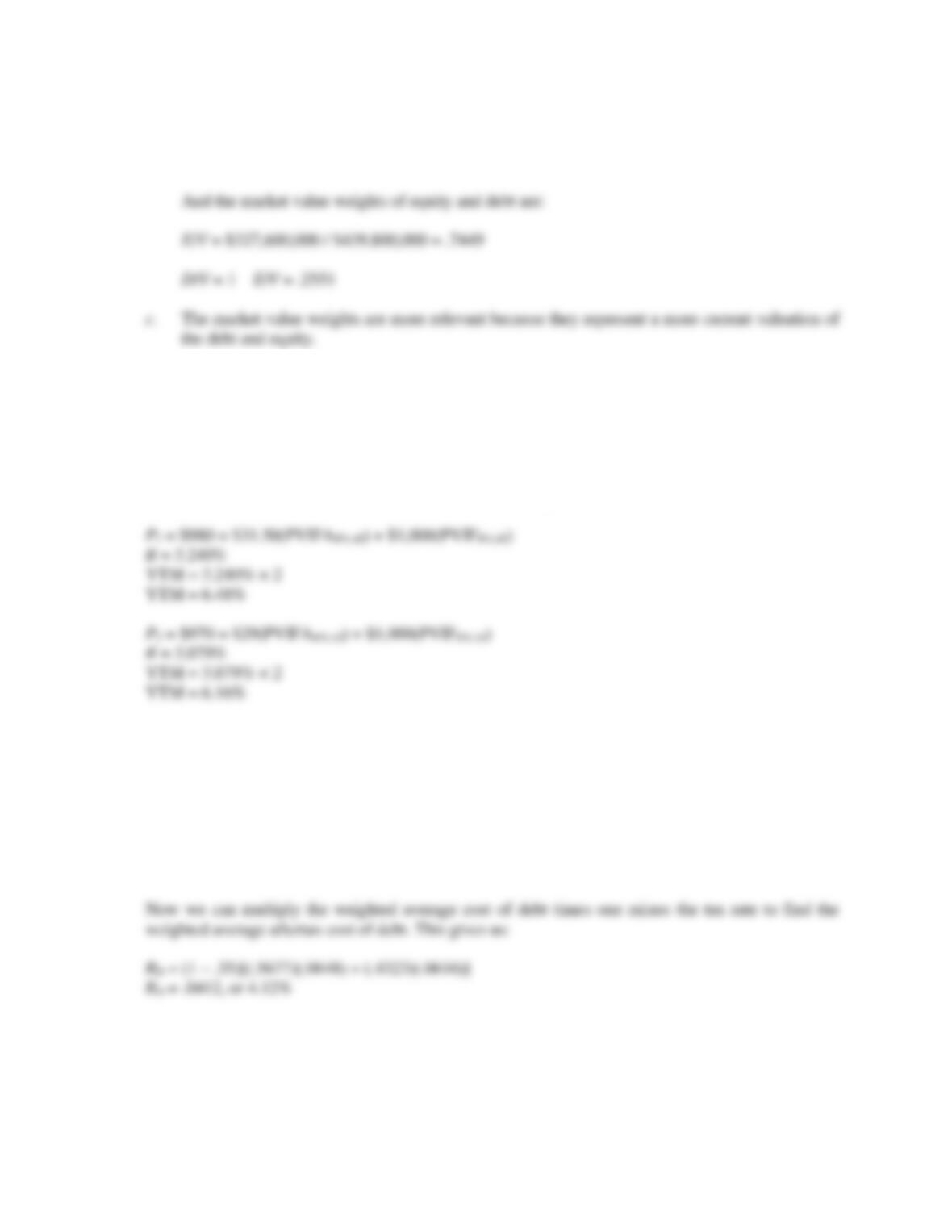
b. The market value of equity is the share price times the number of shares, so:
MVE = 3,900,000($84) = $327,600,000
CHAPTER 11 – 7
This makes the total market value of the company:
V = $327,600,000 + 112,200,000 = $439,800,000
13. First, we will find the cost of equity for the company. The information provided allows us to solve for
the cost of equity using the dividend growth model, so:
RE = [$3.85(1.05) / $84] + .05
RE = .0981, or 9.81%
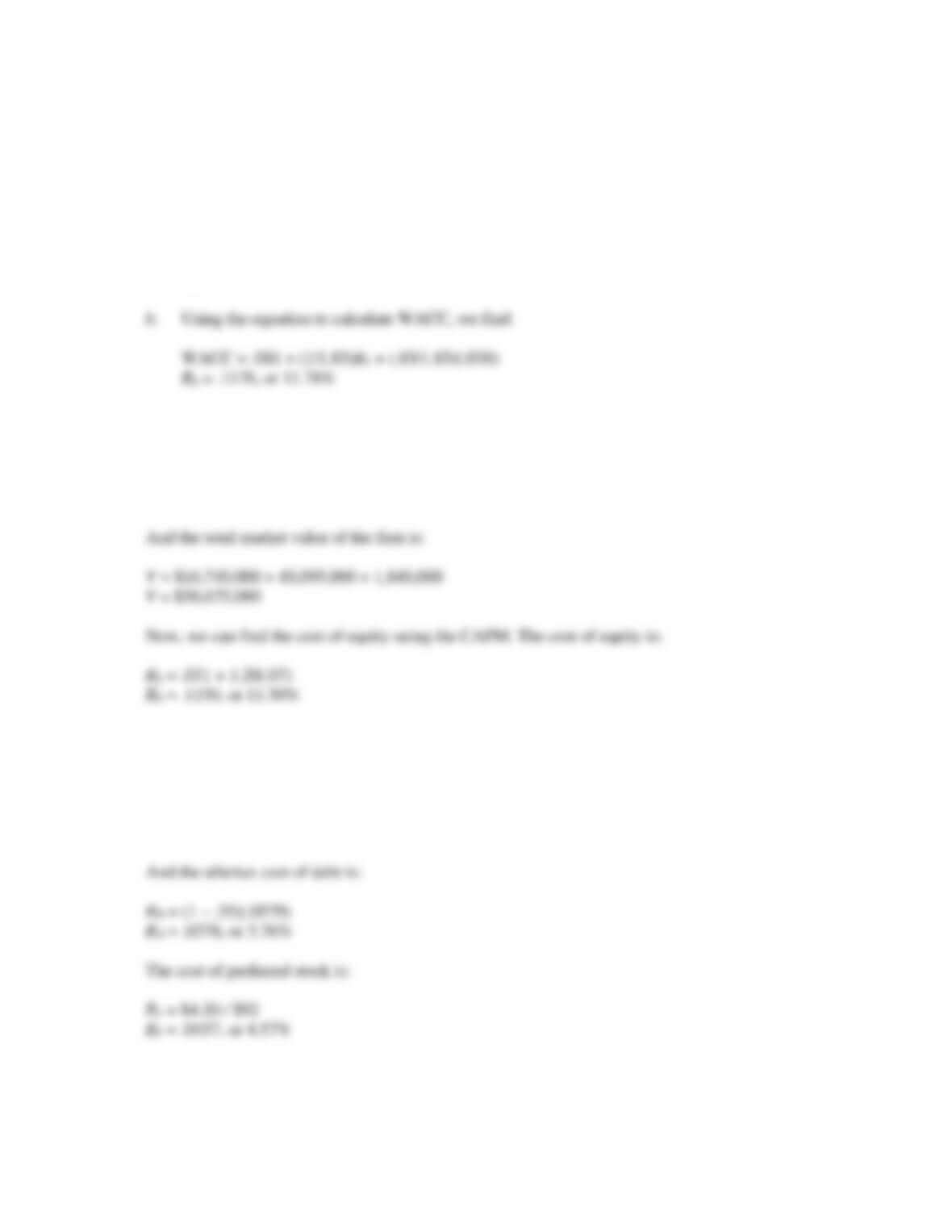
Next, we need to find the YTM on both bond issues. Doing so, we find:
To find the weighted average aftertax cost of debt, we need the weight of each bond as a percentage
of the total debt. We find:
xD1 = .98($65,000,000) / $112,200,000
xD1 = .5677
xD2 = .97($50,000,000) / $112,200,000
xD2 = .4323
CHAPTER 11 – 8
Using the costs we have found and the weight of debt we calculated earlier, the WACC is:
WACC = .7449(.0981) + .2551(.0412)
WACC = .0836, or 8.36%
14. a. Using the equation to calculate WACC, we find:
WACC = .081 = (1/1.85)(.11) + (.85/1.85)(1 – .35)RD
RD = .0721, or 7.21%
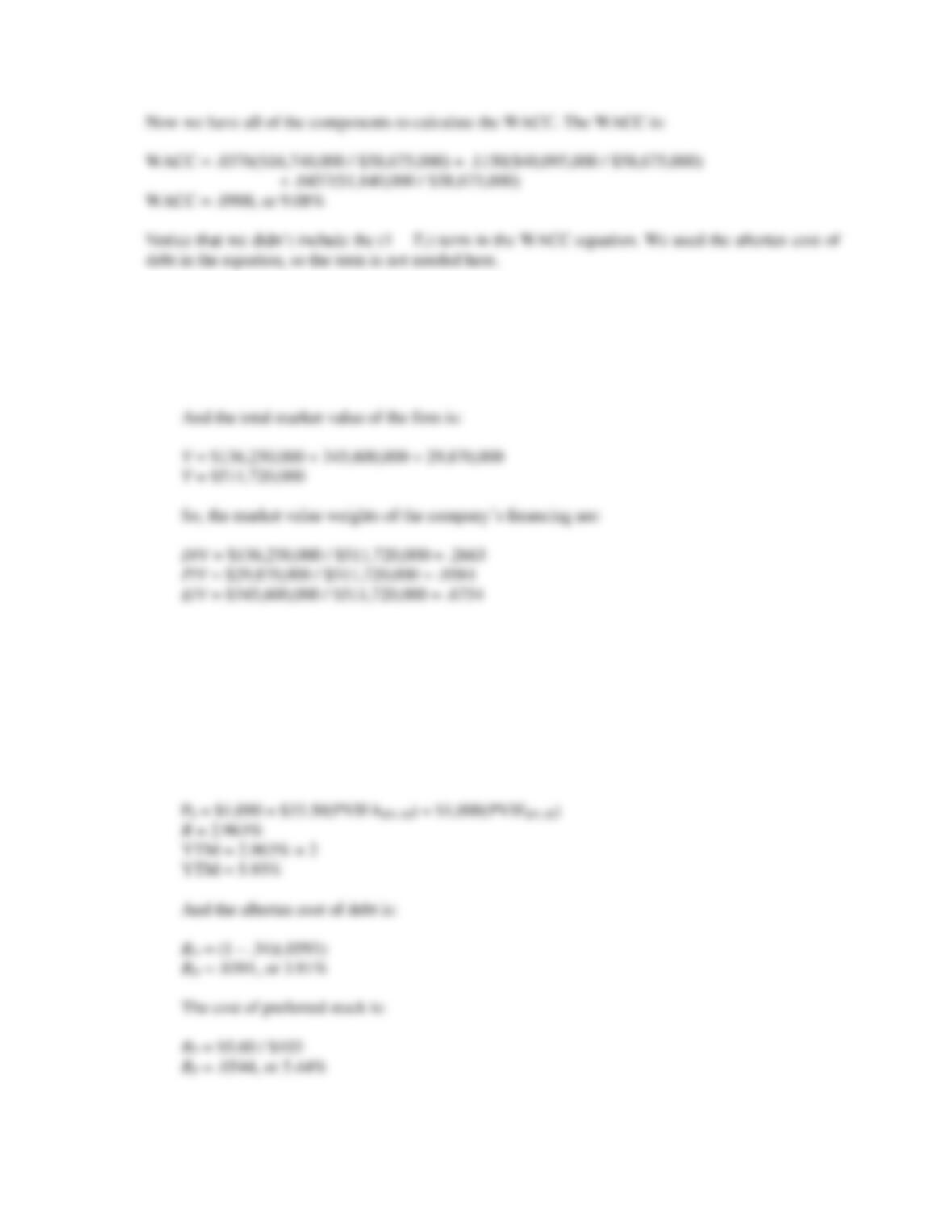
15. We will begin by finding the market value of each type of financing. We find:
MVD = 15,500($1,000)(1.08) = $16,740,000
MVE = 495,000($81) = $40,095,000
MVP = 20,000($92) = $1,840,000
The cost of debt is the YTM of the bonds, so:
P0 = $1,080 = $32(PVIFAR%,50) + $1,000(PVIFR%,50)
R = 2.895%
YTM = 2.895% × 2
YTM = 5.79%
CHAPTER 11 – 9
16. a. We will begin by finding the market value of each type of financing. We find:
MVD = 125,000($1,000)(1.09) = $136,250,000
MVE = 5,400,000($64) = $345,600,000
MVP = 290,000($103) = $29,870,000
b. For projects equally as risky as the firm itself, the WACC should be used as the discount rate.
First, we can find the cost of equity using the CAPM. The cost of equity is:
RE = .043 + 1.13(.068)
RE = .1198, or 11.98%
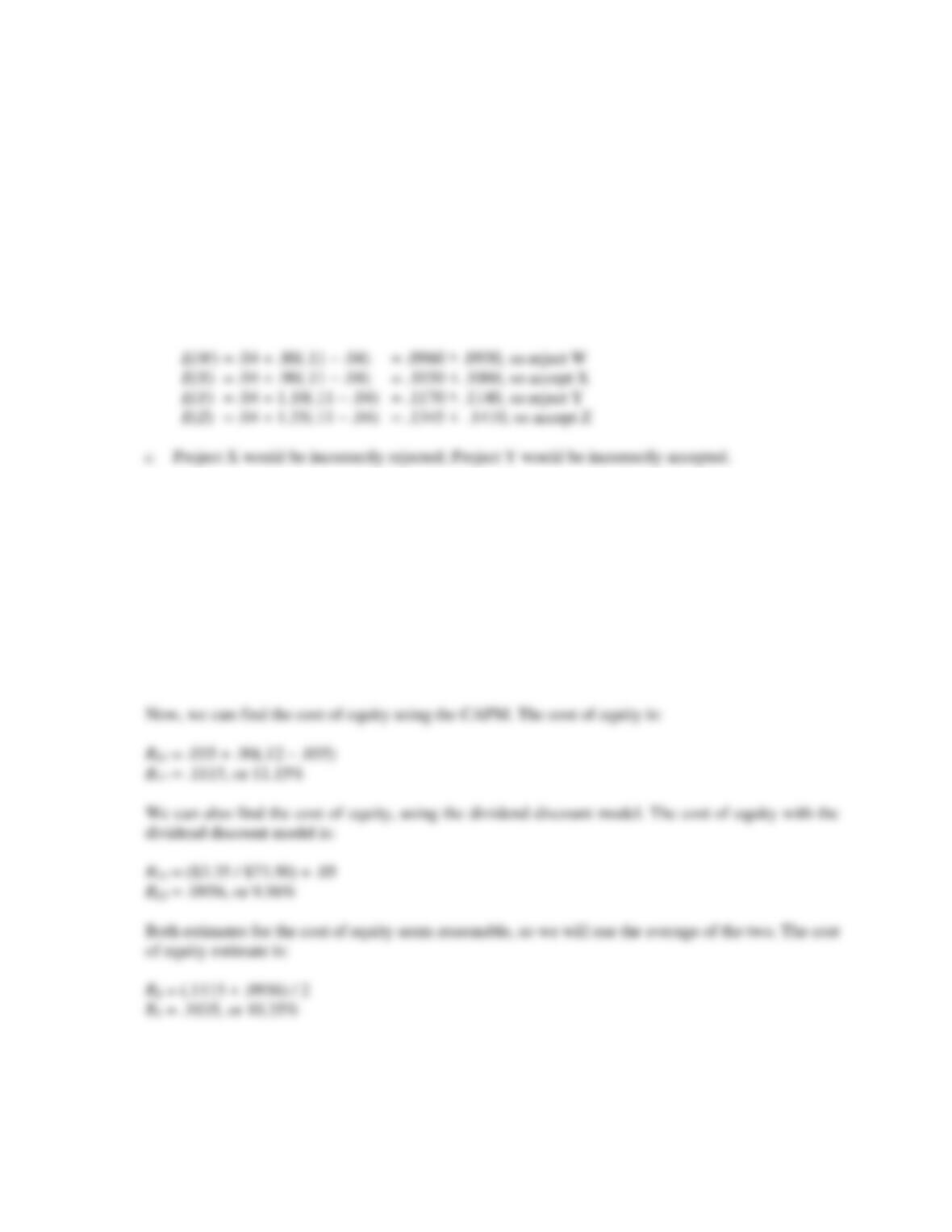
The cost of debt is the YTM of the bonds, so:
CHAPTER 11 – 10
Now, we can calculate the WACC as:
WACC = .2663(.0391) + .0584(.0544) + .6754(.1198)
WACC = .0945, or 9.45%
17. a. Projects Y and Z.
b. Using the CAPM to consider the projects, we need to calculate the expected return of the project,
given its level of risk. This expected return should then be compared to the expected return of the
project. If the return calculated using the CAPM is lower than the project expected return, we
should accept the project; if not, we reject the project. After considering risk via the CAPM:
18. We will begin by finding the market value of each type of financing. We find:
MVD = 13,000($1,000)(1.07) = $13,910,000
MVE = 345,000($73.50) = $25,357,500
MVP = 10,000($86) = $860,000
And the total market value of the firm is:
V = $13,910,000 + 25,357,500 + 860,000
V = $40,127,500
CHAPTER 11 – 11
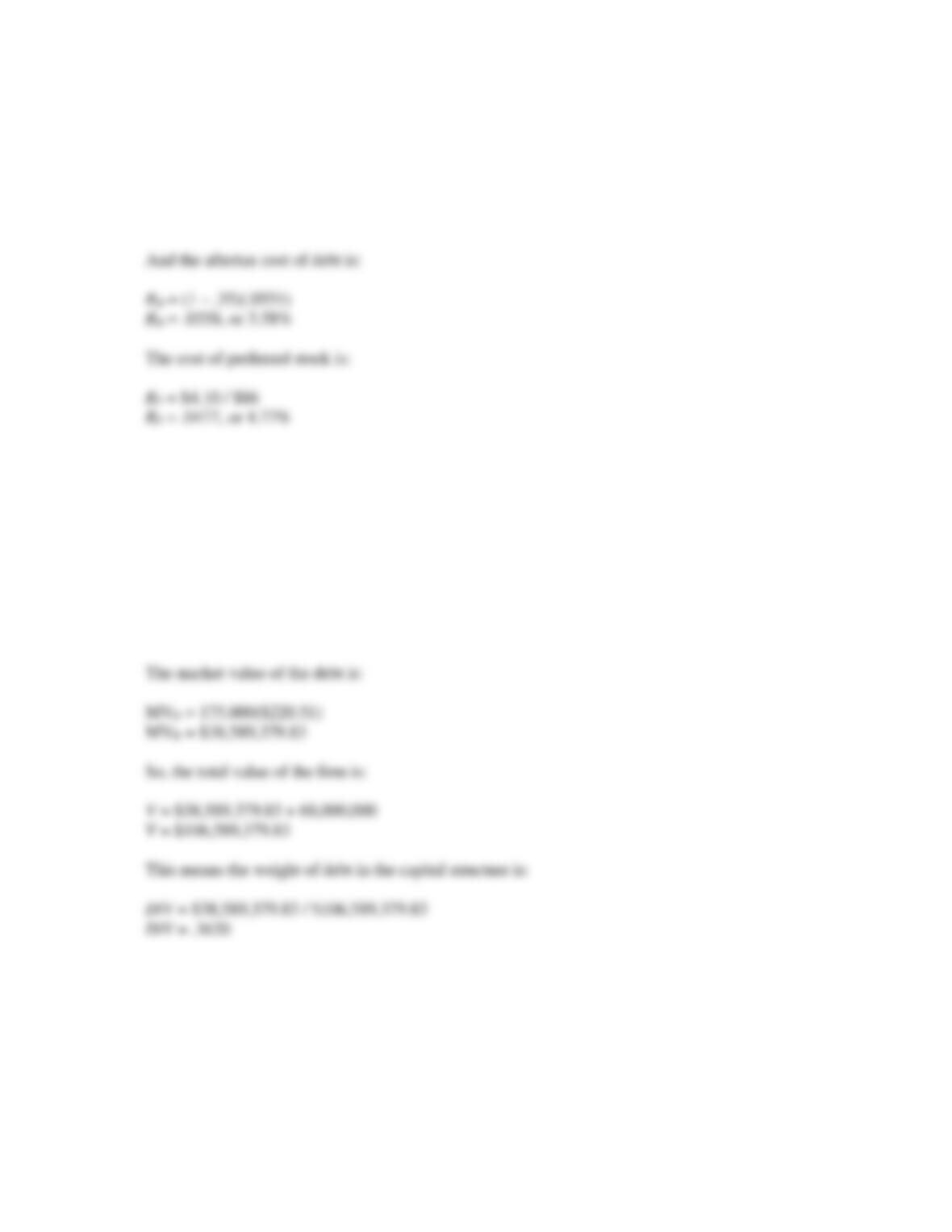
The cost of debt is the YTM of the bonds, so:
P0 = $1,070 = $31(PVIFAR%,30) + $1,000(PVIFR%,30)
R = 2.754%
YTM = 2.754% × 2
YTM = 5.51%
Now, we have all of the components to calculate the WACC. The WACC is:
WACC = .0358($13,910,000 / $40,127,500) + .0477($860,000 / $40,127,500)
+ .1035($25,357,500 / $40,127,500)
WACC = .0789, or 7.89%
19. The bonds have 26 years to maturity so the price today is:
P0 = $1,000 / (1 + .059 / 2)52
P0 = $220.51
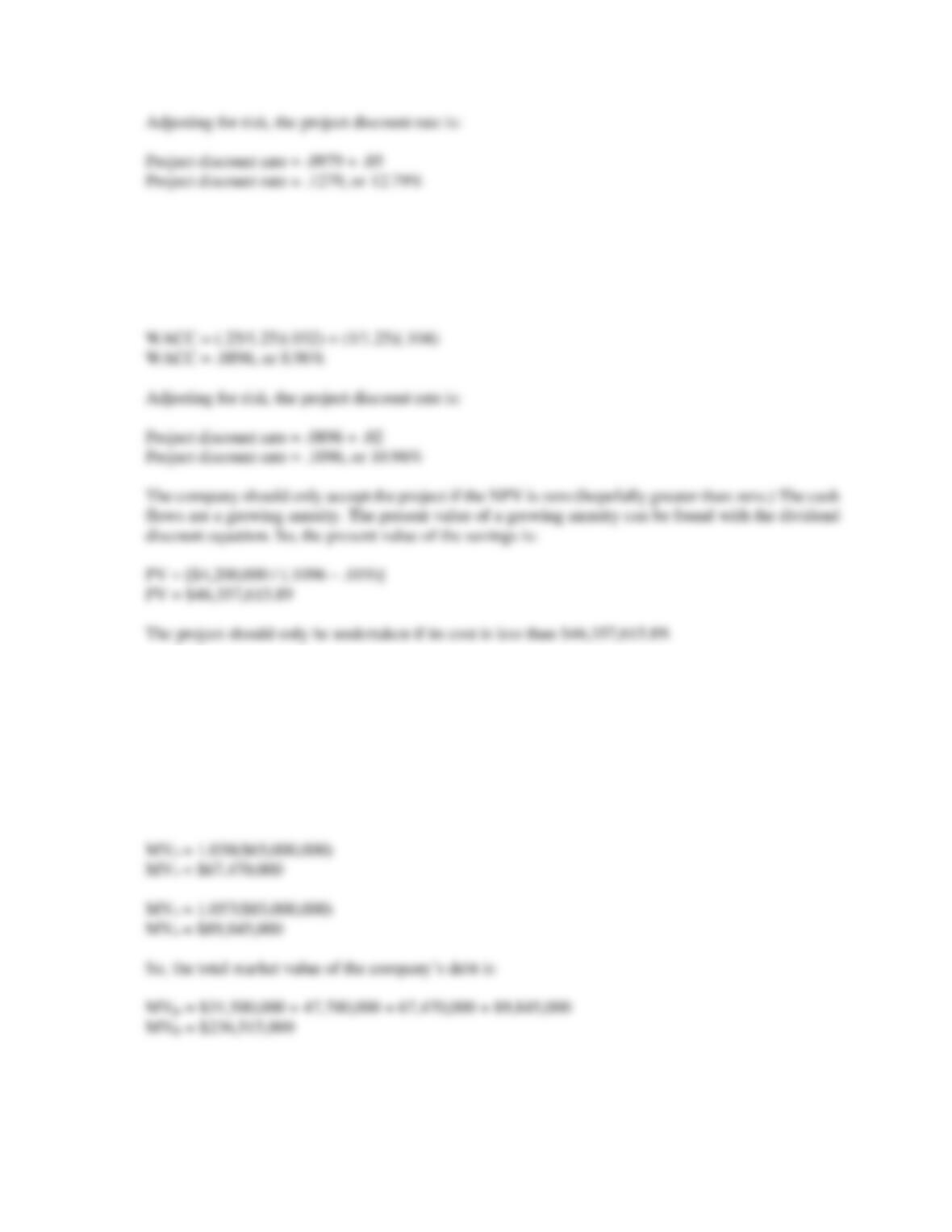
20. To find the required return for the project, we need to adjust the company’s WACC for the level of
risk in the project. A debt–equity ratio of .48 implies a weight of debt of .48/1.48 and a weight of
equity of 1/1.48, so the company’s WACC is:
WACC = (.48/1.48)(.0560) + (1/1.48)(.1180)
WACC = .0979, or 9.79%
CHAPTER 11 – 12
Intermediate
21. First, we need to find the project discount rate. The project discount rate is the company’s cost of
capital plus a risk adjustment factor. A debt–equity ratio of .25 implies a weight of debt of .25/1.25
and a weight of equity of 1/1.25, so the company’s WACC is:
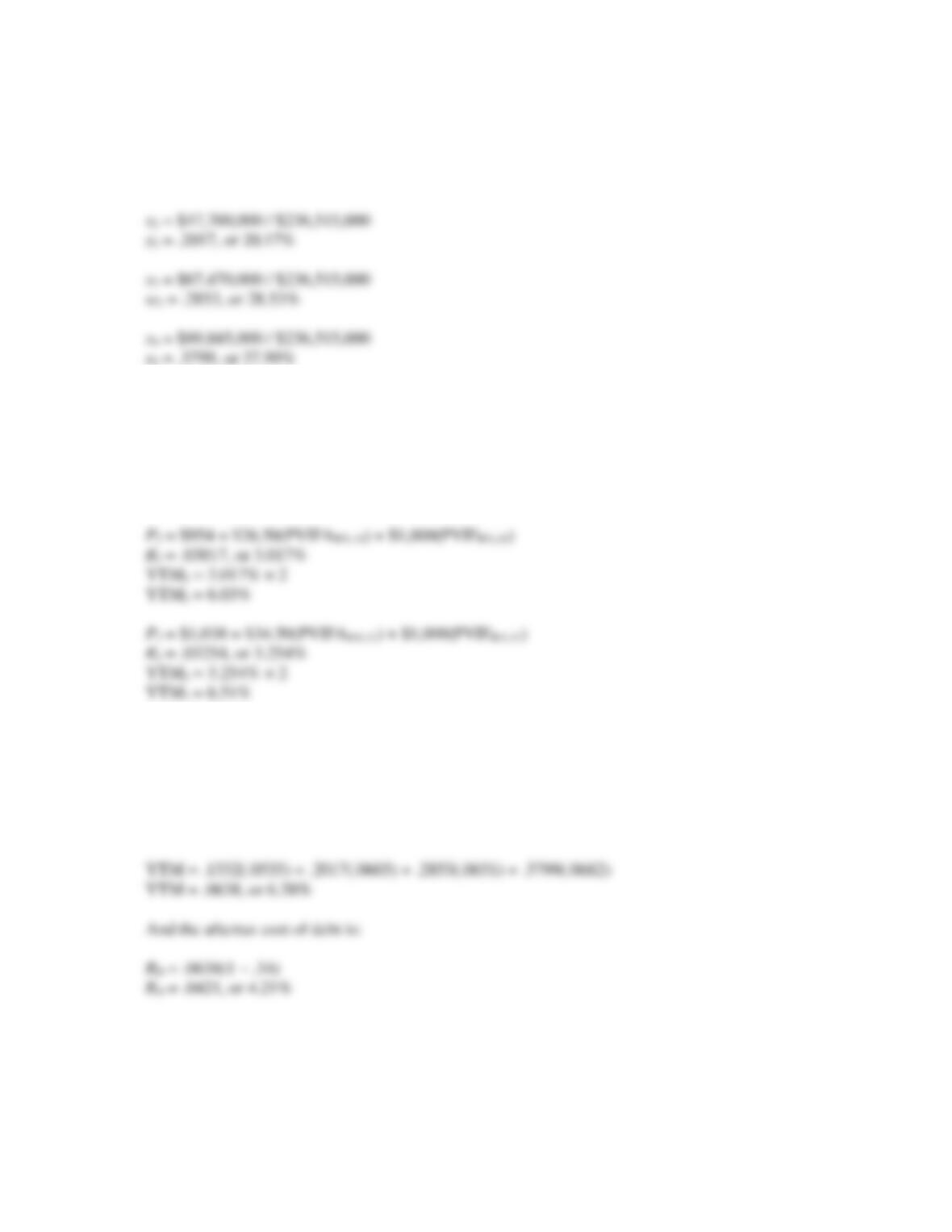
22. To find the aftertax cost of equity for the company, we need to find the weighted average of the four
debt issues. We will begin by calculating the market value of each debt issue, which is:
MV1 = 1.05($30,000,000)
MV1 = $31,500,000
MV2 = .954($50,000,000)
MV2 = $47,700,000
CHAPTER 11 – 13
The weight of each debt issue is:
x1 = $31,500,000 / $236,515,000
x1 = .1332, or 13.32%
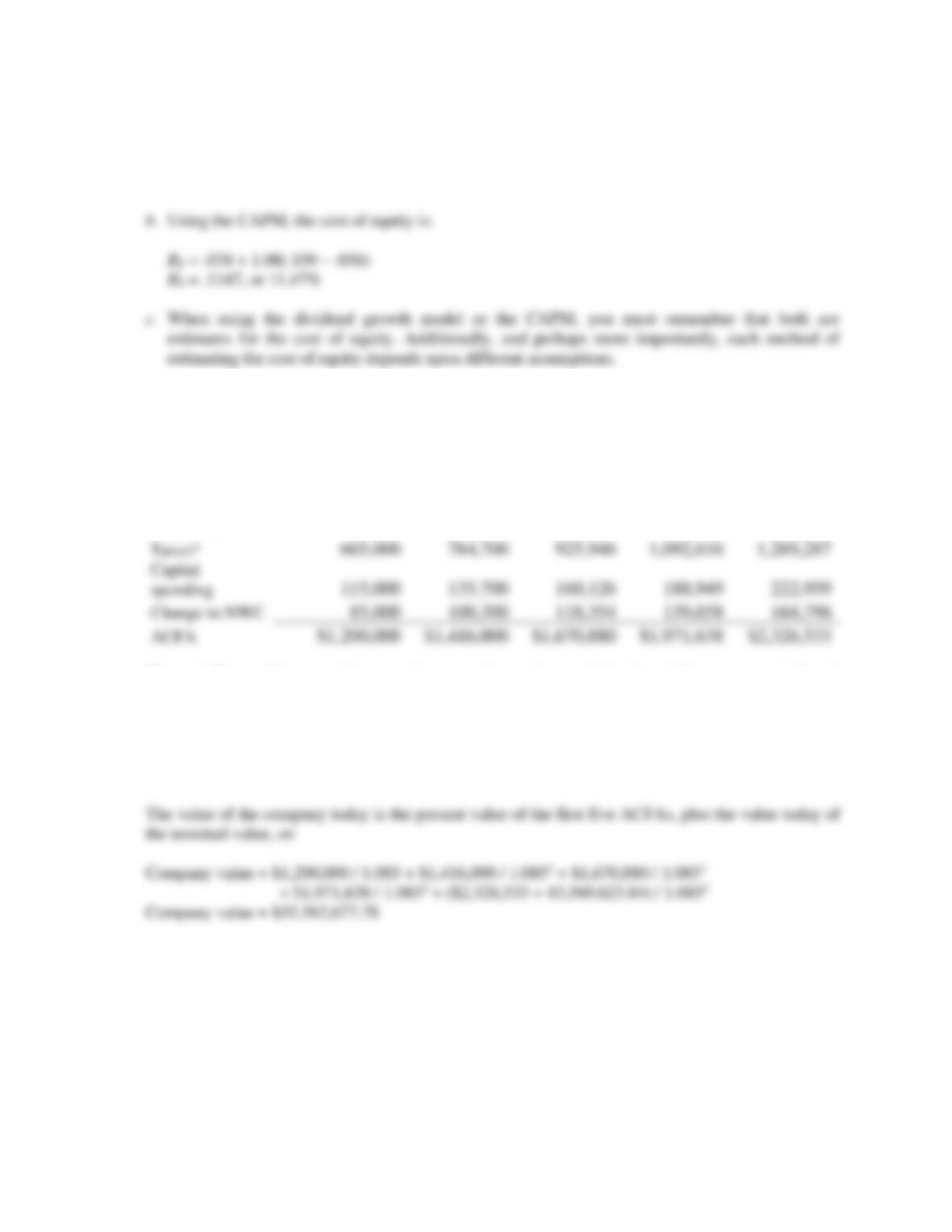
Next, we need to find the YTM for each bond issue. The YTM for each issue is:
P1 = $1,050 = $32.50(PVIFAR%,10) + $1,000(PVIFR%,10)
R1 = .02674, or 2.674%
YTM1 = 2.674% × 2
YTM1 = 5.35%
P4 = $1,057 = $36.50(PVIFAR%,50) + $1,000(PVIFR%,50)
R4 = .03411, or 3.411%
YTM4 = 3.411% × 2
YTM4 = 6.82%
The weighted average YTM of the company’s debt is thus:
CHAPTER 11 – 14
23. a. Using the dividend discount model, the cost of equity is:
RE = [(1.05)(1.04) / $83] + .04
RE = .0532, or 5.32%
24. First, we need to find the adjusted cash flow from assets (ACFA) for each year. We are given the
projected EBIT, depreciation, increase in NWC, and capital spending. Each of these accounts increase
at 18 percent per year. So, the ACFA for each of the next five years will be:
Year 1
Year 2
Year 3
Year 4
Year 5
EBIT
$1,900,000
$2,242,000
$2,645,560
$3,121,761
$3,683,678
Depreciation
165,000
194,700
229,746
271,100
319,898
Taxes*
665,000
784,700
925,946
spending
115,000
135,700
160,126
188,949
222,959
Change in NWC
100,300
118,354
139,658
164,796
ACFA
$1,200,000
$1,416,000
$1,670,880
$1,971,638
$2,326,533
The cash flows will grow at 3 percent in perpetuity, so the terminal value of the company in Year 5
will be:
Terminal value5 = ACFA6 / (WACC – g)
Terminal value5 = $2,326,533(1 + .03) / (.085 – .03)
Terminal value5 = $43,569,623.84
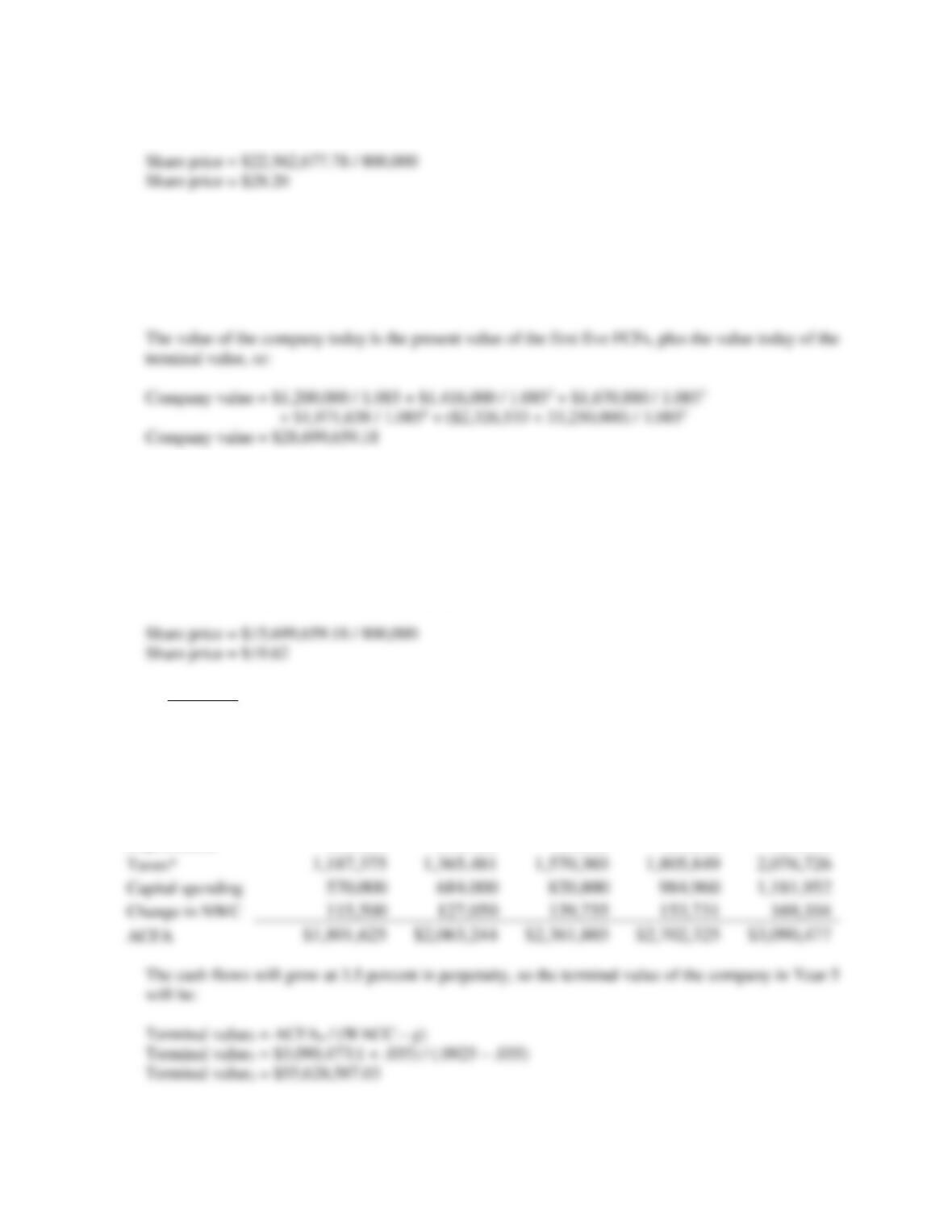
To find the value of equity, we subtract the value of the debt from the total value of the company,
which is:
Equity value = $35,562,677.78 – 13,000,000
Equity value = $22,562,677.78
CHAPTER 11 – 15
Finally, the value per share is the total equity value divided by the shares outstanding, or:
25. The ACFA for each of the first five years will be the same as the previous problem. To calculate the
terminal value, we can use the price–sales ratio, which will be:
Terminal value5 = 3.5($9,500,000)
Terminal value5 = $33,250,000
To find the value of equity, we subtract the value of the debt from the total value of the company,
which is:
Equity value = $28,699,659.18 – 13,000,000
Equity value = $15,699,659.18
Finally, the value per share is the total equity value divided by the shares outstanding, or:
Challenge
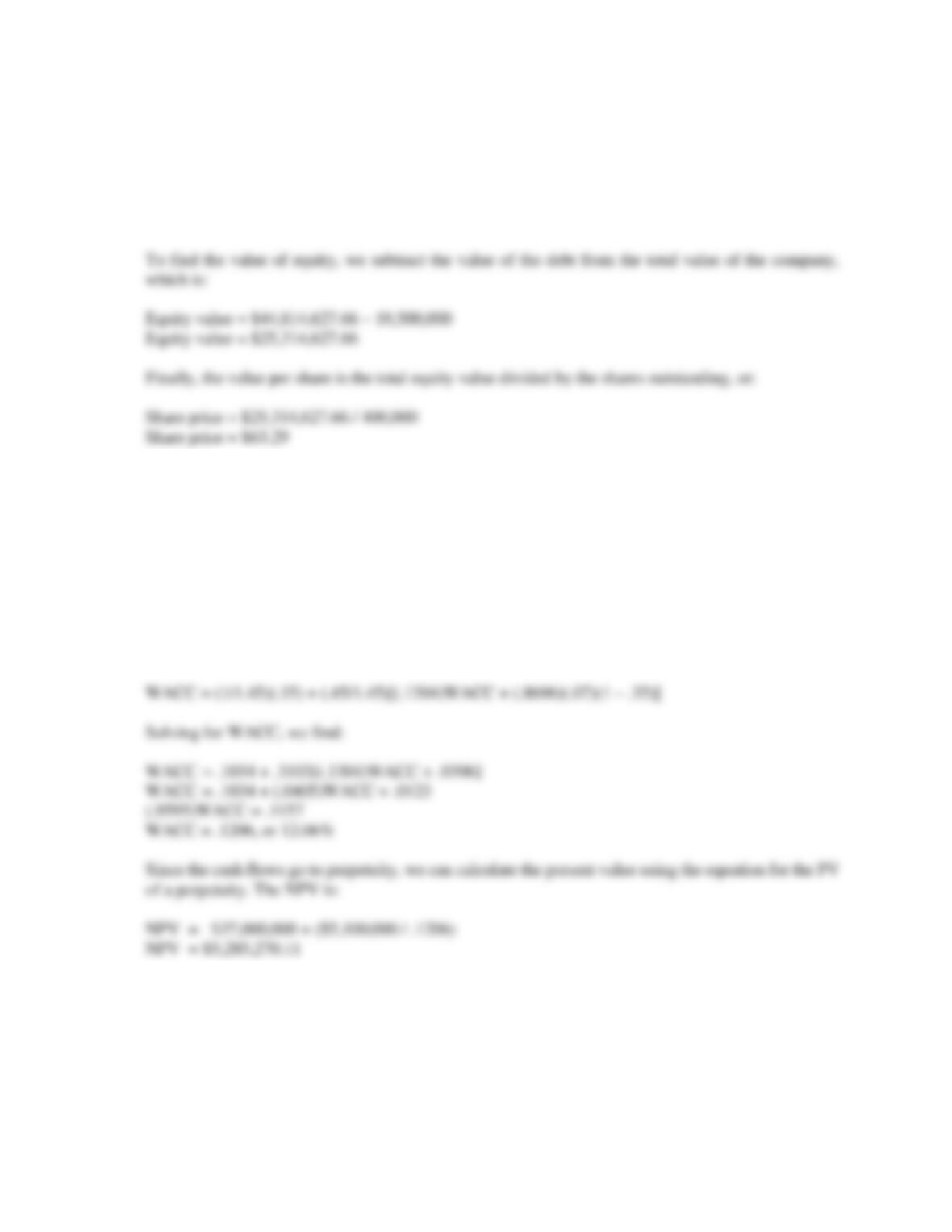
26. First, we need to find the adjusted cash flow from assets (ACFA) for each year. At the growth rates
given, the projected ACFA for each of the next five years will be:
Year 1
Year 2
Year 3
Year 4
Year 5
EBIT
$3,392,500
$3,901,375
$4,486,581
$5,159,568
$5,933,504
Depreciation
282,000
338,400
406,080
487,296
584,755
Taxes*
Capital spending
570,000
684,000
820,800
984,960
Change in NWC
115,500
127,050
139,755
153,731
169,104
$1,801,625
$2,063,244
$2,361,803
$2,702,325
$3,090,477
CHAPTER 11 – 16
The value of the company today is the present value of the first five ACFAs, plus the value today of
the terminal value, or:
Company value = $1,801,625 / 1.0925 + $2,063,244 / 1.09252 + $2,361,803 / 1.09253
+ $2,702,325 / 1.09254 + ($3,090,477 + 55,628,587.03) / 1.09255
Company value = $44,814,627.66
27. We can use the debt–equity ratio to calculate the weights of equity and debt. The debt of the company
has a weight for long-term debt and a weight for accounts payable. We can use the weight given for
accounts payable to calculate the weight of accounts payable and the weight of long-term debt. The
weight of each will be:
Accounts payable weight = .15/1.15 = .1304
Long-term debt weight = 1/1.15 = .8696
Since the accounts payable has the same cost as the overall WACC, we can write the equation for the
WACC as:
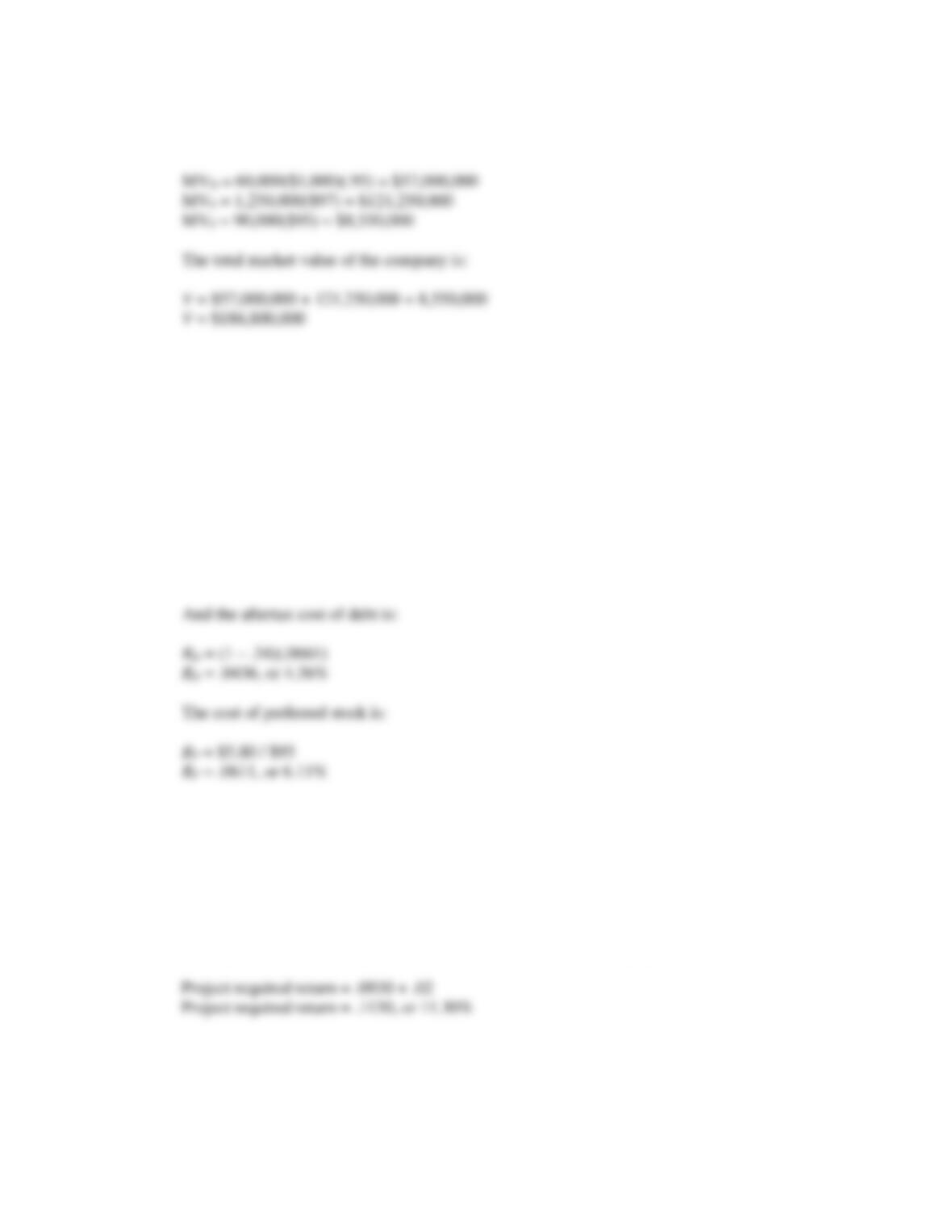
28. a. The $4.5 million cost of the land 3 years ago is a sunk cost and irrelevant; the $5 million appraised
value of the land is an opportunity cost and is relevant. So, the total initial cash flow is:
CF0 = –$5,000,000 – 19,500,000 – 825,000
CF0 = –$25,325,000
CHAPTER 11 – 17
b. To find the required return for the project, we need to adjust the company’s WACC for the level
of risk in the project. We begin by calculating the market value of each type of financing, so:
Next, we need to find the cost of funds. We have the information available to calculate the cost
of equity using the CAPM, so:
RE = .0380 + 1.15(.07)
RE = .1185, or 11.85%
The cost of debt is the YTM of the company’s outstanding bonds, so:
P0 = $950 = $31(PVIFAR%,50) + $1,000(PVIFR%,50)
R = .03306, or 3.306%
YTM = 3.306% × 2
YTM = 6.61%
So, the company’s WACC is:
WACC = .0436($57,000,000 / $186,800,000) + .0611($8,550,000 / $186,800,000)
+ .1185($121,250,000 / $186,800,000)
WACC = .0930, or 9.30%
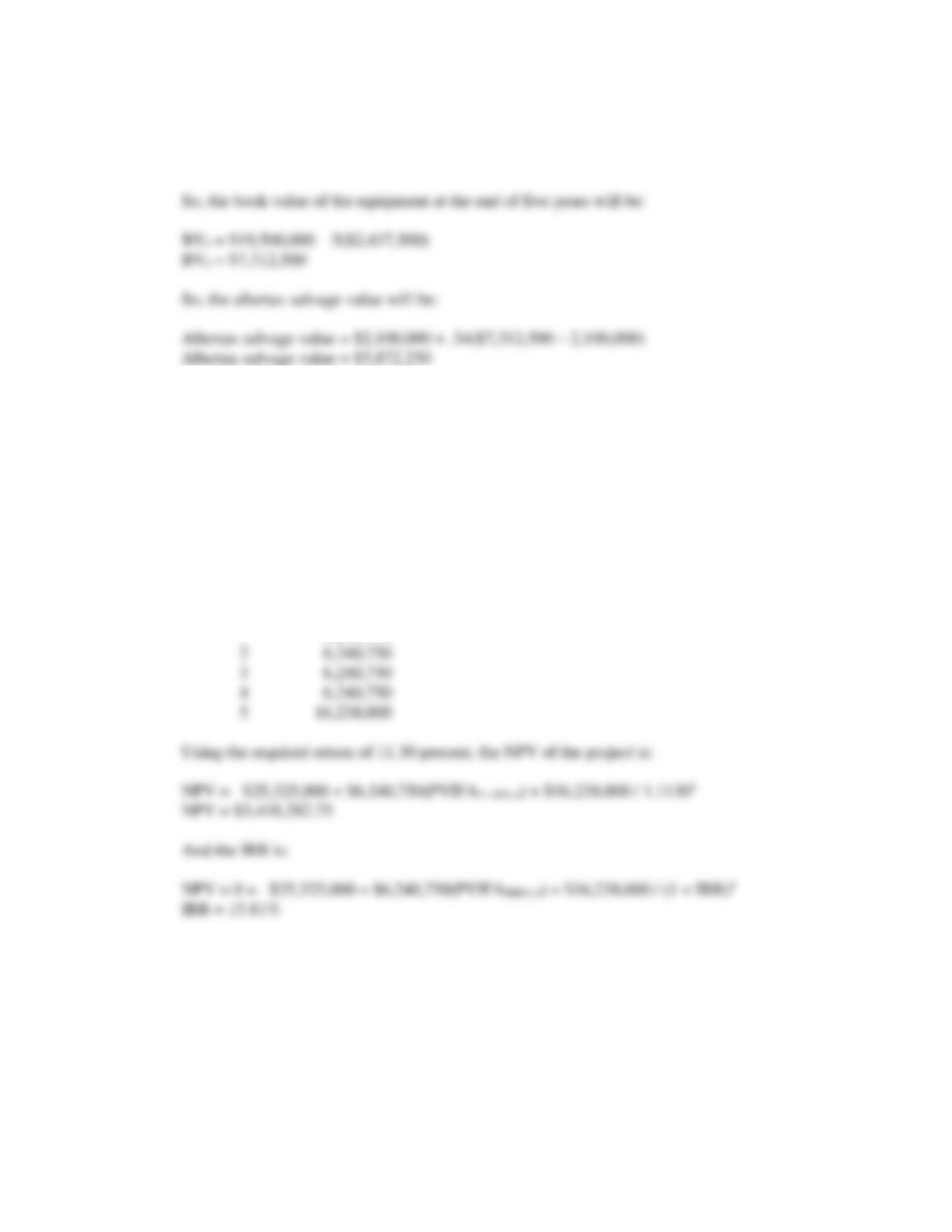
The company wants to use the subjective approach to this project because it is located overseas.
The adjustment factor is 2 percent, so the required return on this project is:
CHAPTER 11 – 18
c. The annual depreciation for the equipment will be:
$19,500,000 / 8 = $2,437,500
d. Using the tax shield approach, the OCF for this project is:
OCF = [(P – v)Q – FC](1 – TC) + TCD
OCF = [($10,800 – 9,900)(13,000) – 3,500,000](1 – .34) + .34($19,500,000/8)
OCF = $6,240,750
e. We have calculated all cash flows of the project. We just need to make sure that in Year 5 we
add back the aftertax salvage value, the recovery of the initial NWC, and the aftertax value of the
land in five years since it will be an opportunity cost. So, the cash flows for the project are:
Year Flow Cash
0 –$25,325,000
1 6,240,750