Chapter 12: Responding to Student Behavior
Chapter-At-A-Glance
Instructor’s Overview and Outline
Chapter 12 extends the options for maximizing student learning through the topic of discipline and
behavior. Specifically, this chapter is designed to help teachers understand the importance of promoting
positive classroom behavior using positive interventions and supports for groups and individuals. It also
introduces several key concepts of behavior management, including positive strategies for increasing
Learning Objectives
Instructor’s Resources
Media Resources
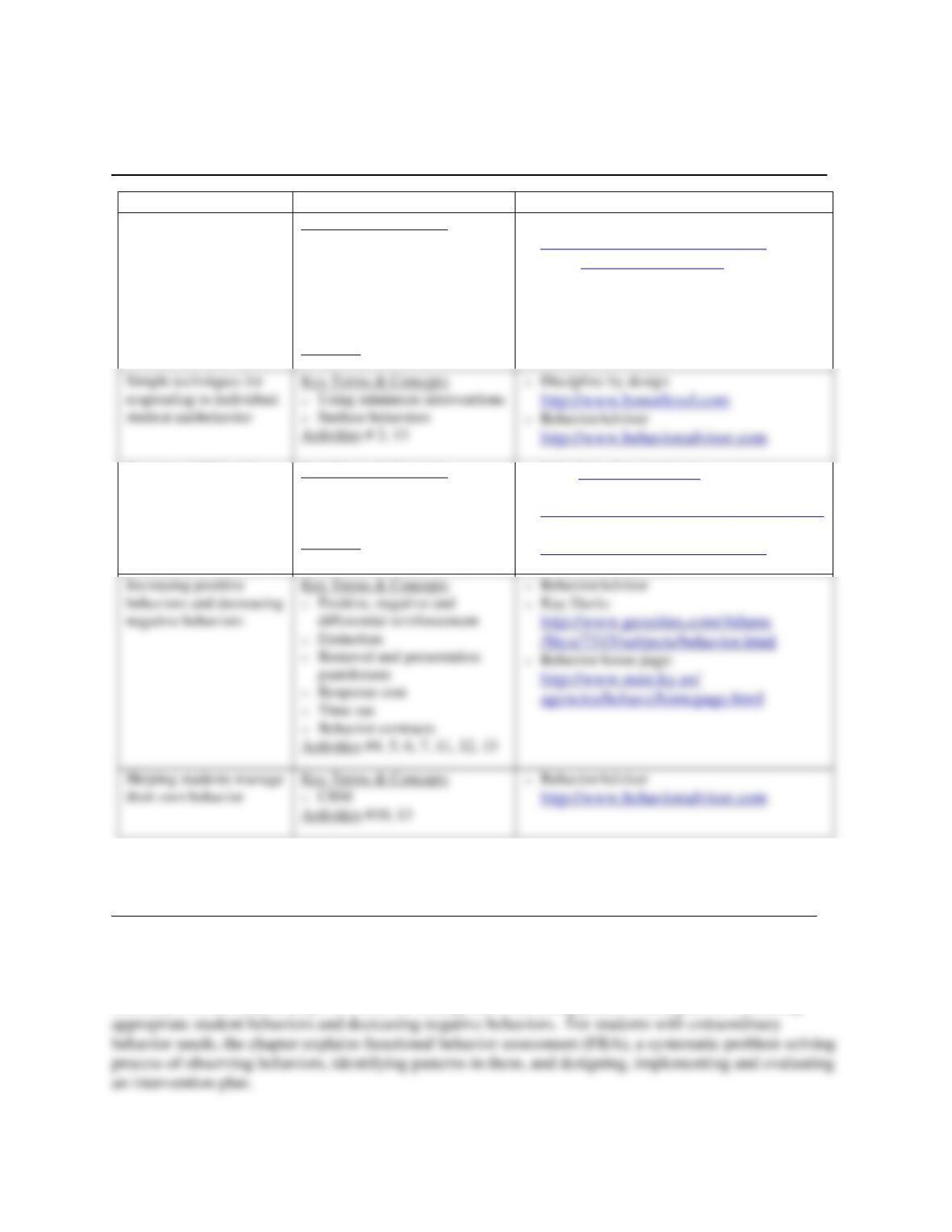
Strategies to promote
positive behavior and
prevent misbehavior
Key Terms & Concepts
o Discipline
o Preventing school violence
o PBIS and PBS
o Schoolwide strategies
o Peer-mediated instruction
o Group contingencies
Activities # 1, 13
o BehaviorAdvisor
http://www.behavioradvisor.com
o PBIS: http://www.pbis.org/
Purpose of FBA and
steps for deciding how to
respond to serious
individual student
misbehavior
Key Terms & Concepts
o FBA
o Collecting data
o BIP
Activities #3, 8, 9, 13
o FBA: http://cecp.air.org
o Collecting data:
http://www.polyxo.com/documents/#data
o Behavior advisor
http://www.behavioradvisor.com
o Response cost
o Time out
o Behavior contracts
Activities #4, 5, 6, 7, 11, 12, 13
A. How can you use positive behavior supports to prevent discipline problems?
1. Instructional environments conducive to learning
2. Schoolwide strategies
B. How can you promote positive group behavior?
1. Implement peer-mediated instruction
2. Use group contingencies
C. What are positive behavior strategies for responding to minor individual behaviors?
1. Use minimum interventions
2. Manage students’ surface behaviors
D. How can functional behavior assessment and behavior intervention plans help you respond to
serious individual behaviors?
2. Verifying the seriousness of the problem
4. Collecting data to better understand the behavior
a. Anecdotal recording
5. Analyzing the data and forming hypotheses
6. Developing a behavior intervention plan
7. Implementing the plan
8. Monitoring the plan’s effectiveness
E. How do behavior intervention plans address serious individual behaviors?
1. Increasing desirable behaviors
2. Decreasing undesirable behaviors
a. Differential reinforcement of incompatible or other behaviors
3. Using behavior contracts
F. How can you help students manage their own behavior?
1. Cognitive behavior management strategies
2. Teaching cognitive behavior management strategies
G. Final thoughts about including students with special needs and the INCLUDE strategy
H. Wrapping it up
2. Summary
Learning Objectives
1. Outline classroom strategies teachers should implement to promote students’ positive behavior
and prevent misbehavior.
2. Explain simple techniques for responding to individual student misbehavior.
4. Outline systematic approaches for increasing individual students’ positive behaviors and
decreasing their negative behaviors.
Key Terms and Concepts
Behavior contracts
Behavior intervention plan (BIP)
Cognitive behavior management (CBM)
Differential reinforcement of incompatible
behaviors
Discipline
Positive behavioral interventions and supports
(PBIS)
Positive reinforcement
Presentation punishment
Removal punishment
Response cost
Activities and Discussion Questions
1. It is important that preservice teachers think about their own beliefs and biases concerning
discipline and classroom management and examine the sources of these beliefs and biases and how
they can affect a teacher’s responses to their students. The following questions can assist in
fostering such a discussion among students. What is discipline? How is discipline affected by
teacher tolerance for student activity level? How do teachers contribute to or detract from student
discipline through their instructional approaches, choice of materials, and classroom organization?
2. Have students review the list of strategies for managing “surface” behaviors presented in the
Professional Edge on page 385 in Chapter 12. Have them work in groups and fill in three columns
on a page: Which strategies listed might be most helpful in an elementary classroom? In a middle
school classroom? In a high school classroom?
What are the potential benefits and risks of using each of these strategies?
3. Create groups of students to work in teams to work with the Case in Practice 12.2 (Supporting a
Student with Autism Using Functional Behavior Assessment). The reflections provide guiding
4. If your students have opportunities to visit and observe in classrooms, have them identify the
positive reinforcement strategies, surface management strategies, rules, procedures and other
5. Even when teachers create successful behavior programs to reward appropriate student behavior,
they may fail to realize that even the best program can deteriorate because of satiation. Therefore, it
is important that they consider the meaning of satiation, generate examples of its occurrence, and
consider strategies for avoiding this potential weakness in their responses to student behavior. The
6. Many states still permit the use of corporal punishment. A discussion might be based on questions
such as these: Does your state permit the use of physical punishment with students? If so, under
what conditions? What are local school district policies concerning this issue? According to the
7. Ethical issues related to behavior management often are raised with regard to the use of timeout.
Discuss these and other questions with your students. What are the potential negative results of
using timeout with a student? What is the teacher’s responsibility for discussing timeout with a
8. The forms provided in Handouts 12-1 and 12-2 can be used for students to experience the process of
observing and gathering systematic data about a pupil. First, students should identify a behavior
they would like to observe for a pupil they know from a practicum, field experience, or other school
experience. They should provide justification for why the behavior is important to observe and then
9. Students should have the opportunity to discuss the concept of responding to a student’s intent or
function rather than just to the demonstrated behavior. After checking to be sure students truly
10. Ask students to identify a behavioral goal they would like to personally achieve. Then, have them
collect baseline data about their target behavior, and develop a self-monitoring system and self-
11. Handout 12-3 is a blank contract form that students can use to prepare a contract on a target student
from their field experiences. As an alternative, one of the vignettes at the beginning of Chapter 12
could be used as the basis for this activity. In addition to writing the contract, students should
justify why they chose the behavior targeted, the rewards or other consequences used, and the
timeline for implementation. What possible problems could occur with the contract? How might
these be addressed? How can they be sure students understand the contract?
12. Have students work individually or in pairs to research and present examples of specific practices
13. Guest speaker: Invite an ABA therapist or other behavioral specialist to talk with your students
about his/her work with students. If appropriate, ask the speaker to introduce discrete trial training
and other techniques often used with children with autism and related disorders.
Web Links
Instructor Resources
• Additional resources for instructors are also available on the Instructor Resource Center.
Web Based Content Resources
• Positive Behavior Interventions and Supports offers resources for teachers, schools and districts to
implement a tiered positive behavior supports system. Samples of schools’ resources and programs,
Additional Readings
Babkie, A. A. (2006). Be proactive in managing classroom behavior. Intervention in School and Clinic,
41, 184–187.
Blood, E., & Neel, R. S. (2007). From FBA to implementation: A look at what is actually being delivered.
Education & Treatment of Children, 30(4), 67–80.
Carter, D., & Norman, R. (2010). Class-wide positive behavior supports in preschool: Improving teacher
implementation through consultation. Early Childhood Education Journal, 38, 279–288.
Chitiyo, M., & Wheeler, J. J. (2009). Challenges faced by school teachers in implementing positive
behavior support in their school systems. Remedial and Special Education, 30, 58–63.
Crimmins, D., & Farrell, A. F. (2006). Individualized behavior supports at 15 years: It’s still lonely at the
Katz, J. (2013). The Three-Block model of universal design for learning (UDL): Engaging students in
inclusive education. Canadian Journal of Education, 36(1), 153-194.
Ryan, J. B., Sanders, S., Katsiyannis, A., & Yell, M. L. (2007). Using time-out effectively in the
classroom. Teaching Exceptional Children, 39(4), 60-67.
Wong, H. K., & Wong, R. T. (2009). The first days of school: How to be an effective teacher. Mountain
View, CA: Harry L. Wong Publications.