126
CASE 12
SUGGESTED ANSWERS TO DISCUSSION QUESTIONS
(1)
The examination of a bank cutoff statement is a common audit procedure that
serves to generate several types of corroborative evidence. In reviewing this
document, the auditor is seeking to verify the client’s reported balance for cash
and related accounts. In addition, the auditor must always be aware of the
possibility of theft in connection with cash held by the client. Thus, the auditor is
especially attentive to any information from the cutoff statement (such as a check
that did not clear the bank in a reasonable time) suggesting the existence of a
defalcation problem.
Audit procedures that could be performed using the information obtained in a
bank cutoff statement would include:
* Review of the checks clearing the bank during the first few days of the new
year. Clearance of these checks serves as evidence of the validity of the
* Review of the specific date on which each returned check cleared the bank.
This procedure serves as a means of ascertaining the appropriateness of
the year-end cutoff made of cash disbursements.
* Verification of any unusually large check or any check of an odd nature
127
(2)
Many thefts and other illegal acts are perpetrated through the use of bank
accounts that supposedly have been closed. For example, a dishonest
(3)
a. Warehouse – The construction-in-progress on the warehouse addition must
be reported apart from the other land, buildings, and equipment on the
b. Fire Damage – Although the fire occurred subsequent to the fiscal year,
Statement on Auditing Standards 1 specifies that some events happening
after the end of the period “may be of such a nature that disclosure of them
is required to keep the financial statements from being misleading.” SAS 1
goes on to list a number of examples, including inventory destroyed by fire.
Thus, Lakeside’s 2010 fire loss will probably require disclosure in the 2009
financial statements.
Students may raise a question as to the materiality of the estimated loss
128
c. Declaration of Cash Dividend – Unless the auditor views the declaration of
(4)
For many companies, a number of transactions occur within two or three days of
the end of the fiscal year. In seeking evidence of the fair presentation of the
financial information, the auditor needs to ensure that the impact of these
(5)
Determining the fair presentation of the liability accounts is a concern to the
auditor because of the possibility that obligations may have gone unrecorded by
the client company. At least two reasons exist for this potential problem:
* Failure to record liabilities improves a company’s debt/equity ratio and,
(6)
Contingent losses such as those arising from law suits or the possible closing of
a store are frequently quite material in size. Thus, the auditor is usually faced
with a potential outcome that can have an enormous impact on reported financial
(7)
As with any confirmation, the letter of inquiry to the legal counsel must be
prepared and signed by the client but mailed by the audit firm. The confirmation
should direct the recipient to send all responses to the auditor who is attempting
to gain assurance about the existence, evaluation, and reporting of both asserted
(8)
The discovery and assessment of pending and threatened litigation has long
been an area of contention between the auditing and legal professions.
Traditionally, the independent auditor has looked to the client’s attorney for
information to help evaluate these contingent losses. The legal profession has
(9)
Related party transactions will always concern independent auditors because of
the difficulty in distinguishing the economic substance of the transaction from its
legal form. To obtain evidence that all related party transactions have been
131
(10) and (11)
In order to arrive at an estimation of the product warranty expense for 2009, the
auditors must certainly look at the past history of the company as mentioned in
this case. A schedule can be determined from the information given of the
expense incurred during the previous months. However, the auditors cannot be
satisfied with that evidence alone. Abernethy and Chapman should look for
The auditors should also look for other changes that are occurring that might
have an impact on this estimation. Some products, as an example, might be
more likely to break. If so, the auditors should determine if sales of those items
Changes at Cypress Products can also impact the product warranty. If Cypress
has recently begun to stress quality in its production, repairs may be reduced;
132
SUGGESTED ANSWERS TO EXERCISES
(1)
A good introduction to this question is to ask the students to give their
estimations of the accrued repair expenses as of December 31, 2012. A number
of different responses will probably be volunteered. The instructor can then ask
a few individuals to explain the logic used to derive their figures. This exercise
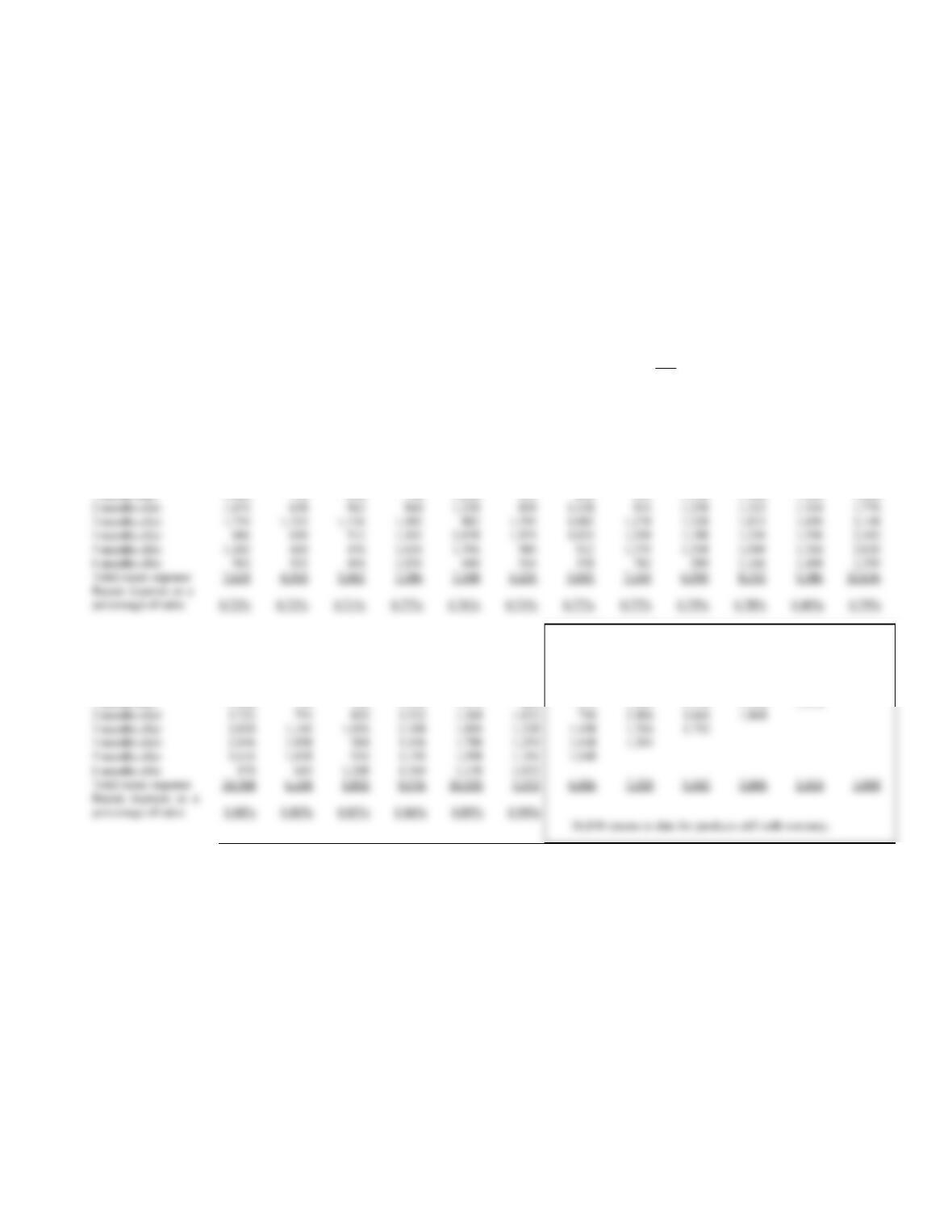
An additional factor in this case concerns the structuring of the data. Quite often,
the client will have accumulated information in a manner that is not relevant to
the needs of the auditor. Lakeside has classified its repair expense by the month
in which the item is returned while the auditors want to match the expense with
133
LAKESIDE COMPANY W.P. No. M-4
Estimated Accrued Product Warranty Expense 2
12/31/12 Accountant: AH
Date: 2/2/13
A: Sales not under warranty
Historical Data 1/11 2/11 3/11 4/11 5/11 6/11 7/11 8/11 9/11 10/11 11/11 12/11
Sales for month 1064000
632000
718000
958000
972000
828000
742000
920000
884000
1066000
1172000
1600000
Repairs:
Month of Sales 386
274
354
444
294
122
512
568
420
584
938
1,010
1 month after 1,066
776
658
738
1,028
552
626
994
1,118
1,166
1,126
1,896
B: Sales still under warranty
Historical Data Cont. 1/12 2/12 3/12 4/12 5/12 6/12 7/12 8/12 9/12 10/12 11/12 12/12
Sales for month 1221000
762000
692000
1114000
1180000
818000
844000
1100000
1022000
1205000
1284000
1748000
Repairs:
Month of Sales 646
672
468
670
842
736
1,198
502
554
440
846
1,008
1 month after 1,938
732
702
1,340
1,472
884
674
1,504
1,476
1,538
1,570
Repair expense as a
Repair expense as a
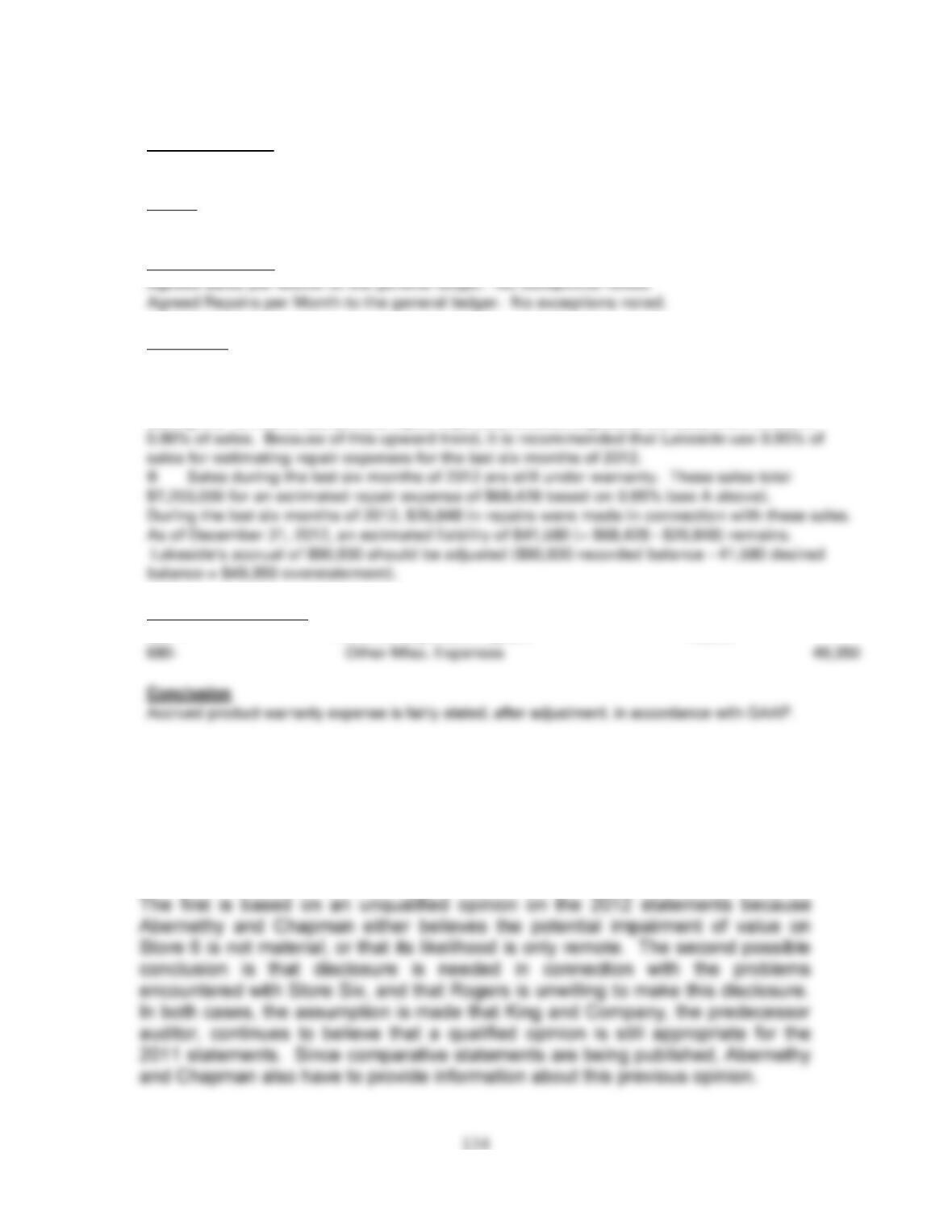
Audit Objectives:
To estimate the accrued product warranty expense as of Dec. 31, 2012.
Scope:
All sales and returns for warranty claims for 2011 and 2012.
Audit Procedures:
Comments:
A Historical data for the months from January 2011 to June 2012 (18 months) are being used
to develop an estimate of monthly repairs expense. This estimate will be applied to the last six
months sales of 2012 to determine the year-end accrual.
During the 18-month test period, repair expenses showed a gradual increase from 0.72% to
Proposed Adjustment
220-1 Accrued Expenses Payable 49,350
(2)
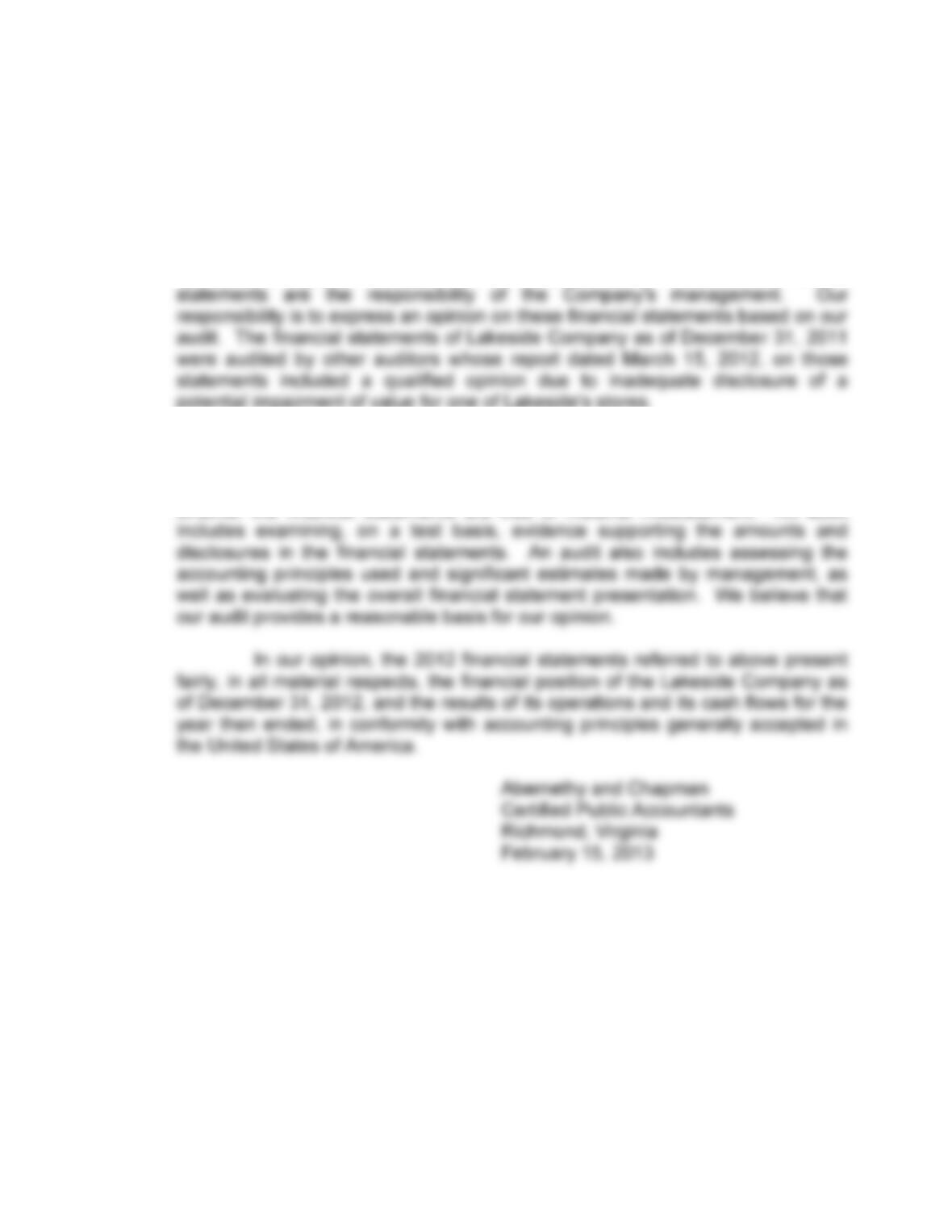
This question has been included to emphasize the audit report as the end
product of the auditor’s work. As this text has been an exploration of the attest
function rather than a full-scale audit, determination of an appropriate opinion for
2012 is not feasible. Presented below are two possible conclusions for this case.
135
UNQUALIFIED OPINION
INDEPENDENT AUDITOR’S REPORT
We have audited the accompanying balance sheet of the Lakeside
Company as of December 31, 2012, and the related statements of income,
retained earnings, and cash flows for the year then ended. These financial
potential impairment of value for one of Lakeside’s stores.
We conducted our audit in accordance with auditing standards
generally accepted in the United States of America. Those standards require
that we plan and perform the audit to obtain reasonable assurance about
whether the financial statements are free of material misstatement. An audit
136
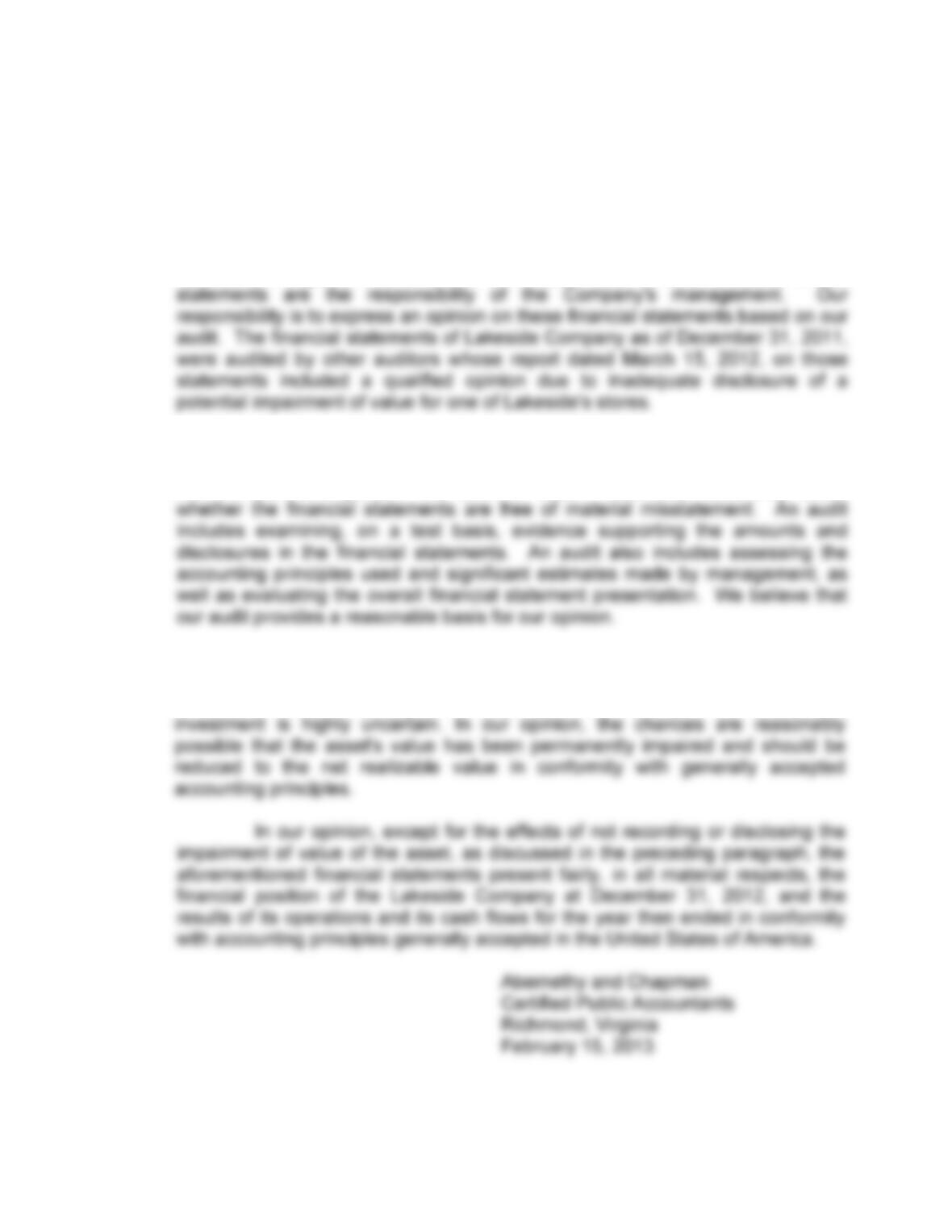
QUALIFIED OPINION
INDEPENDENT AUDITOR’S REPORT
We have audited the accompanying balance sheet of the Lakeside
Company as of December 31, 2012, and the related statements of income,
retained earnings, and cash flows for the year then ended. These financial
We conducted our audit in accordance with auditing standards
generally accepted in the United States of America. Those standards require
that we plan and perform the audit to obtain reasonable assurance about
During 2010, the company made a $186,000 investment in a retail store
located in the eastern sector of Richmond, Virginia. This store has failed to
reach a break-even sales point to date, and total recovery of the Company’s