Problem 12-25 (continued)
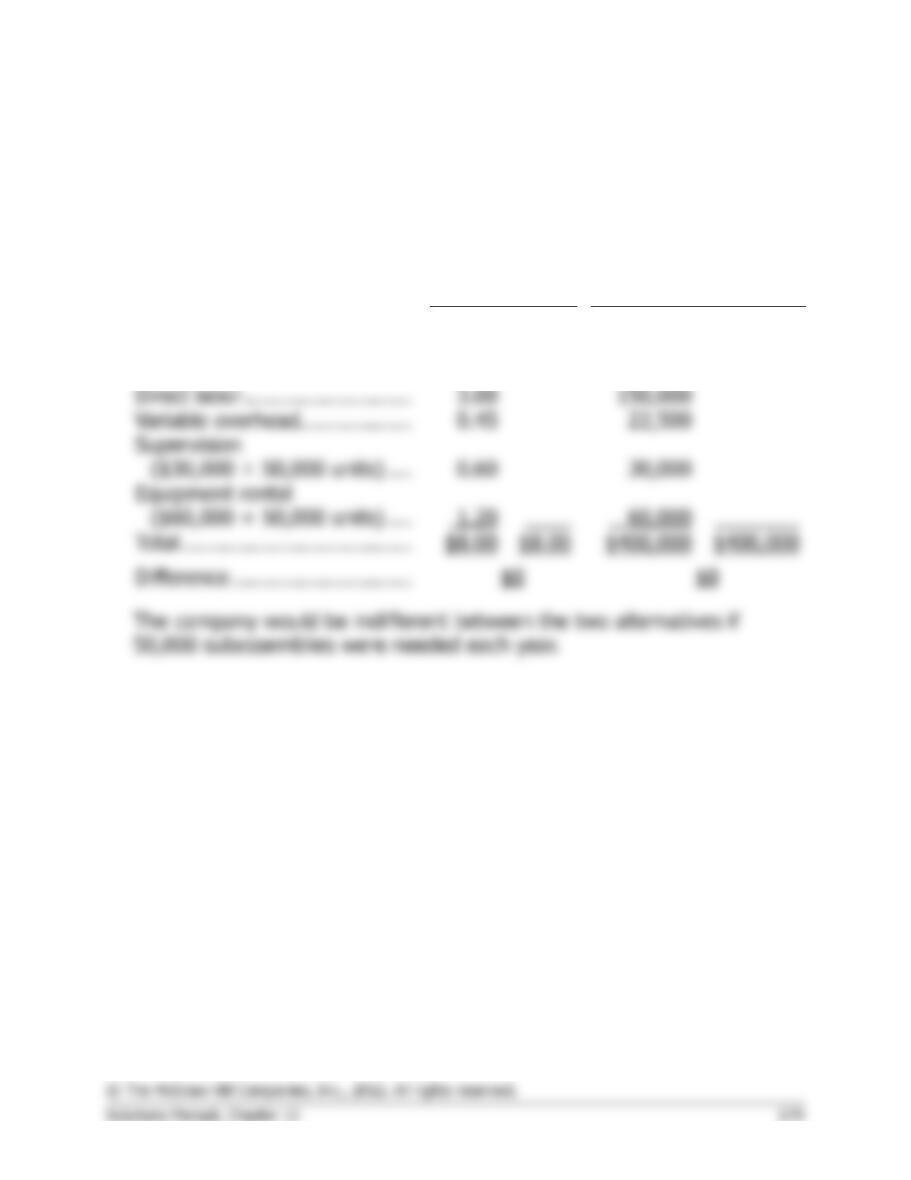
2. a. Note that unit costs for both supervision and equipment rental will
change if the company needs 50,000 subassemblies each year. These
fixed costs will be spread over a larger number of units, thereby
decreasing the cost per unit.
Differential
Costs Per Unit
Total Differential
Costs—50,000 Units
Make
Buy
Make
Buy
Outside supplier’s price ……….
$8.00
$400,000
Direct materials …………………
$2.75
$137,500
Direct labor ………………………
Variable overhead ………………
Total ……………………………….
Difference ………………………..
Problem 12-25 (continued)
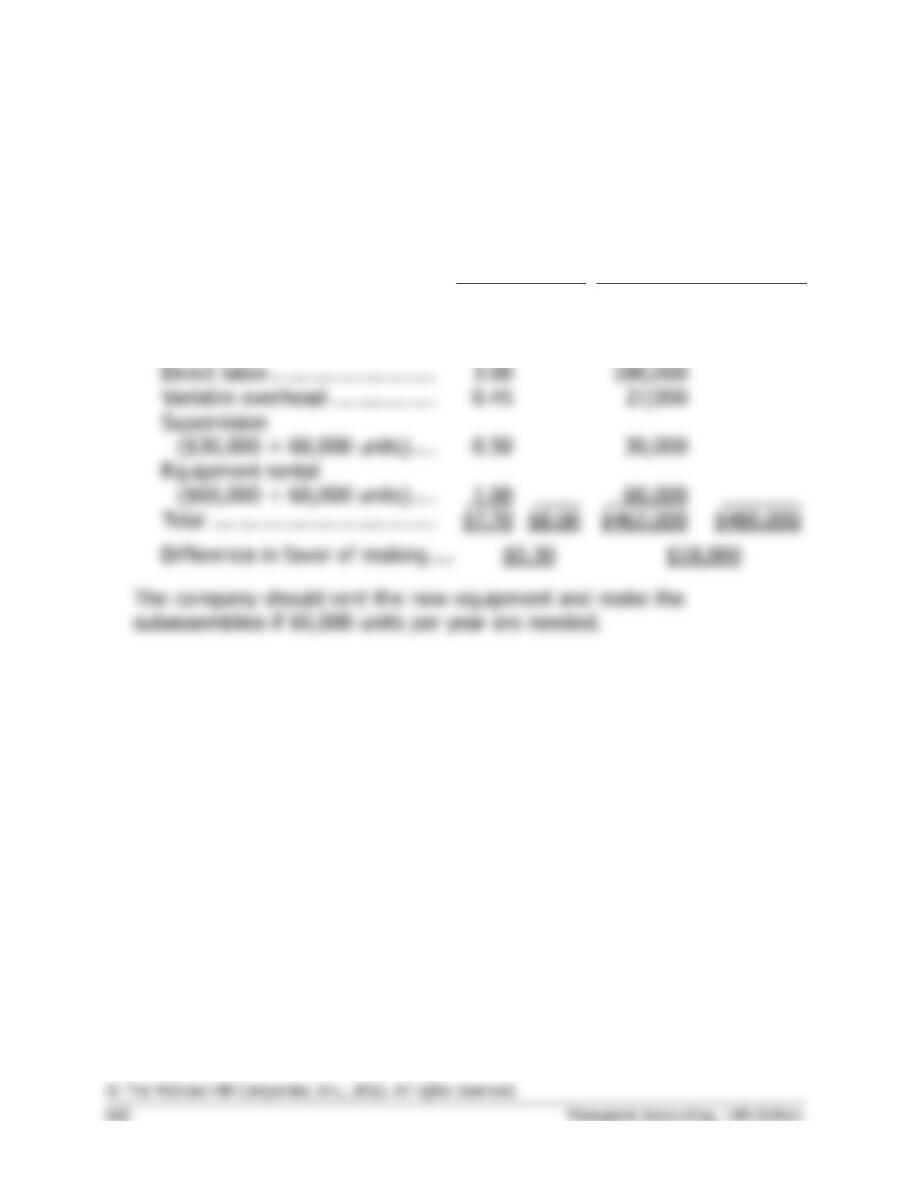
b. Again, notice that the unit costs for both supervision and equipment
rental decrease with the greater volume of units.
Differential
Costs Per
Unit
Total Differential
Costs—60,000 Units
Make
Buy
Make
Buy
Outside supplier’s price ……….
$8.00
$480,000
Direct materials…………………
$2.75
$165,000
Direct labor………………………
Variable overhead ……………..
Total ………………………………
$462,000
Difference in favor of making …………………………..
Problem 12-25 (continued)
3. Other factors that the company should consider include:
a. Will volume in future years increase, or will it remain constant at
40,000 units per year? (If volume increases, then renting the new
equipment becomes more desirable, as shown in the computations
above.)
b. Can quality control be maintained if the subassemblies are purchased
from the outside supplier?
Problem 12-26 (45 minutes)
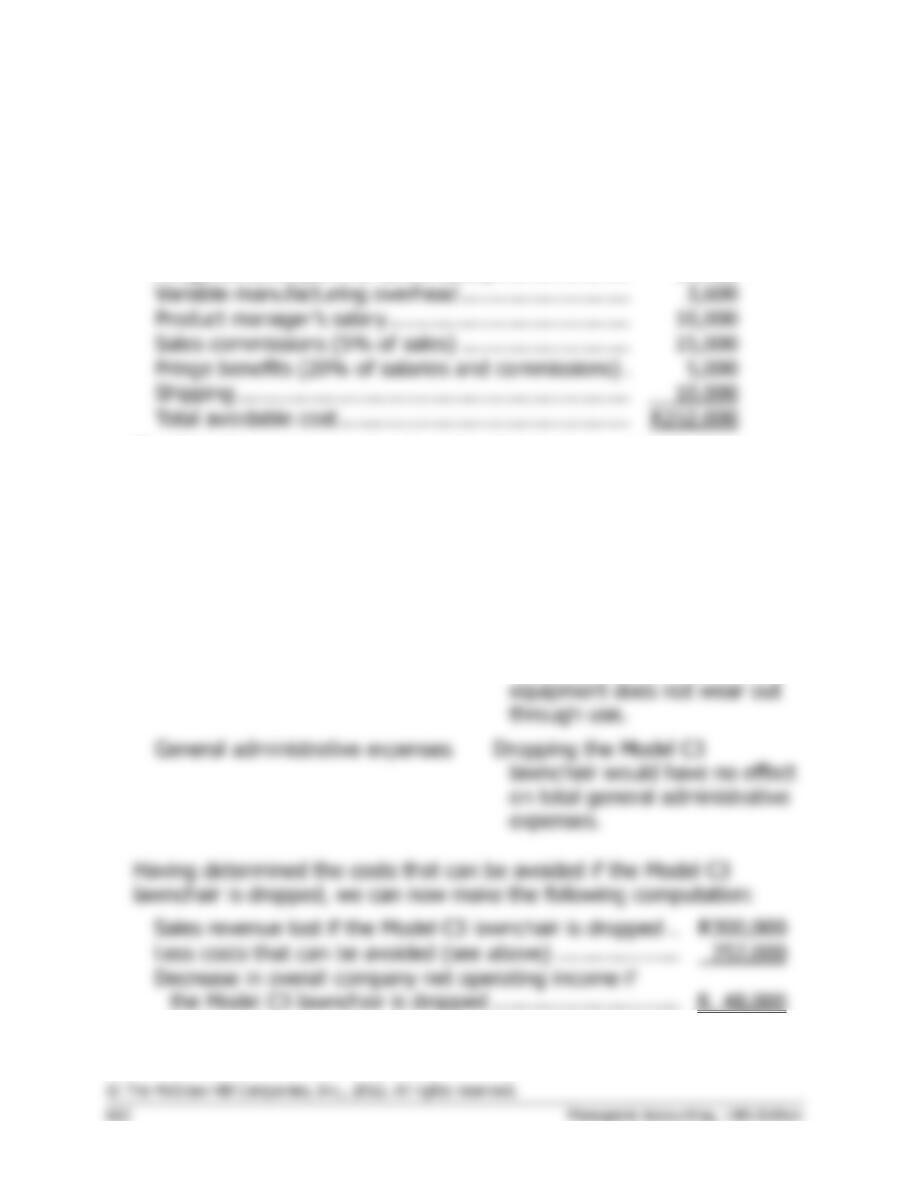
1. Only the avoidable costs are relevant in a decision to drop the Model C3
lawnchair product. The avoidable costs are:
Direct materials ……………………………………………..
R122,000
Direct labor …………………………………………………..
72,000
Fringe benefits (20% of direct labor) ………………….
14,400
Variable manufacturing overhead ………………………
10,000
Sales commissions (5% of sales) ………………………
15,000
Fringe benefits (20% of salaries and commissions) .
Shipping ………………………………………………………
Total avoidable cost ………………………………………..
The following costs are not relevant in this decision:
Cost
Reason not relevant
Building rent and maintenance
All products use the same
facilities; no space would be
freed if a product were
dropped.
General administrative expenses
Dropping the Model C3
lawnchair would have no effect
expenses.
Sales revenue lost if the Model C3 lawnchair is dropped ..
Less costs that can be avoided (see above) ………………..
Depreciation
All products use the same
equipment so no equipment
can be sold. Furthermore, the
Problem 12-26 (continued)
2. To determine the minimum acceptable level of sales, we must first
classify the avoidable costs into variable and fixed costs as follows:
Variable
Fixed
Direct materials …………………………………………
R122,000
Direct labor ………………………………………………
72,000
Fringe benefits (20% of direct labor) ……………..
14,400
Variable manufacturing overhead ………………….
3,600
Sales commissions (5% of sales) …………………..
15,000
3,000
Shipping ………………………………………………….
Total costs ……………………………………………….
Problem 12-26 (continued)
The break-even sales volume can be found using the break-even
formula:
Problem 12-27 (60 minutes)
1.
Marcy
Tina
Cari
Lenny
Sewing
Kit
Direct labor cost per unit ..
$ 4.80
$ 3.00
$ 8.40
$ 6.00
$ 2.40
Direct labor-hours per
unit* (a) …………………..
0.40
0.25
0.70
0.50
0.20
Selling price …………………
Variable costs:
Direct materials ………….
Direct labor ……………….
Contribution margin (b) ….
$ 6.30
$ 6.90
$ 9.00
* Direct labor cost per unit ÷ $12.00 per direct labor-hour
2.
Product
DLH
Per Unit
Estimated
Sales
(units)
Total
DLHs
Marcy …………………….
Tina ………………………
Sewing Kit ………………
450,000
Total DLHs required …..
3. Because the Cari doll has the lowest contribution margin per labor hour,
its production should be reduced by 17,000 dolls (11,900 excess DLHs ÷
0.70 DLH per doll = 17,000 dolls). Thus, production and sales of the Cari
doll will be reduced to 23,000 dolls for the year.
Problem 12-27 (continued)
4. Because the additional capacity would be used to produce the Cari doll,
the company should be willing to pay up to $21.00 per DLH ($12.00
5. Additional output could be obtained in a number of ways including
working overtime, adding another shift, expanding the workforce,
contracting out some work to outside suppliers, and eliminating wasted
labor time in the production process. The first four methods are costly,
but the last method can add capacity at very low cost.
Problem 12-28 (60 minutes)
1. A product should be processed further if the incremental revenue from
the further processing exceeds the incremental costs. The incremental
revenue from further processing of the honey is:
Selling price of a container of honey drop candies …
$4.40
Selling price of three-quarters of a pound of honey
($3.00 × 3/4) ……………………………………………..
2.25
Incremental revenue per container …………………….
$2.15
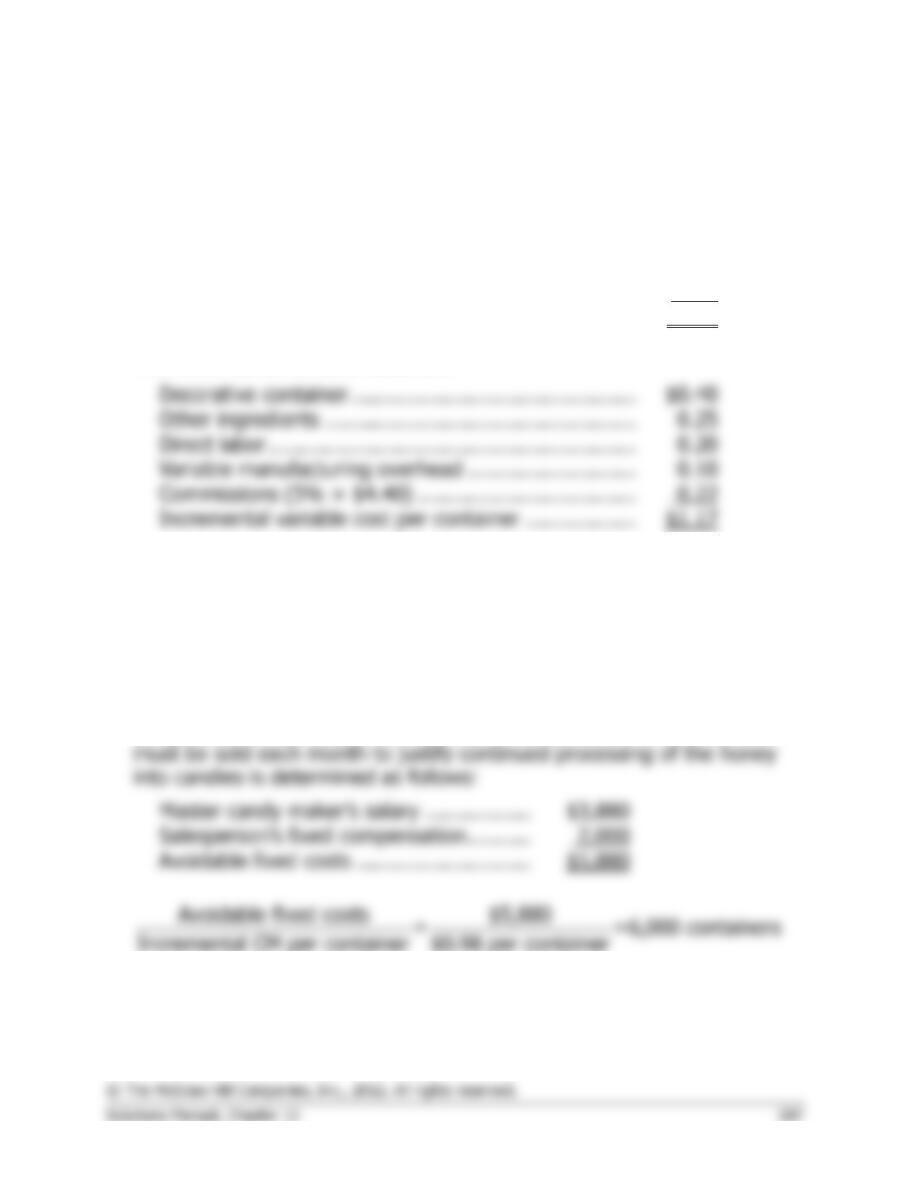
The incremental variable costs are:
Decorative container ……………………………………….
$0.40
Other ingredients …………………………………………..
Direct labor …………………………………………………..
Variable manufacturing overhead ………………………
Commissions (5% × $4.40) ……………………………..
0.22
Incremental variable cost per container ………………
$1.17
Therefore, the incremental contribution margin is $0.98 per container
($2.15 – $1.17). The cost of purchasing the honeycombs is not relevant
because those costs are incurred regardless of whether the honey is
sold outright or processed further into candies.
2. The only avoidable fixed costs of the honey drop candies are the master
candy maker’s salary and the fixed portion of the salesperson’s
compensation. Therefore, the number of containers of the candy that
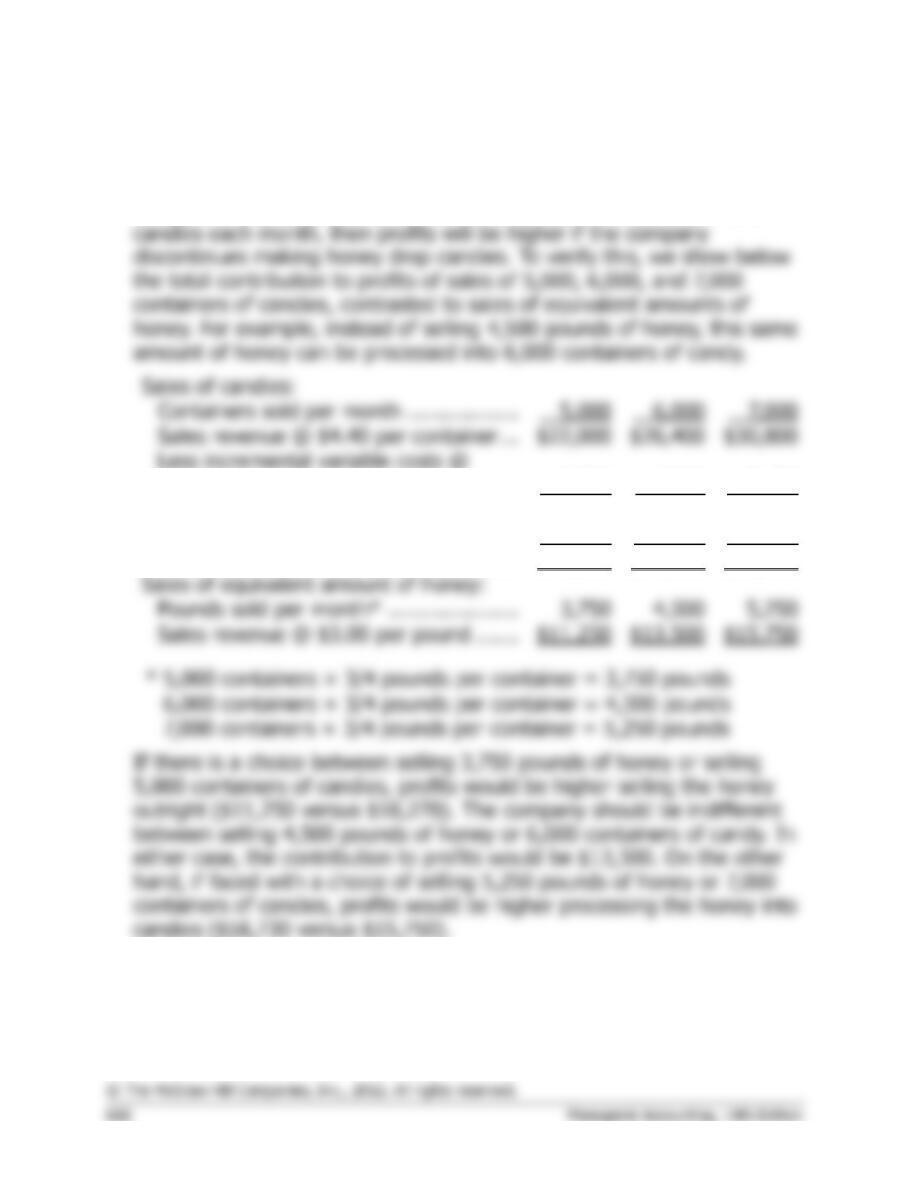
Problem 12-28 (continued)
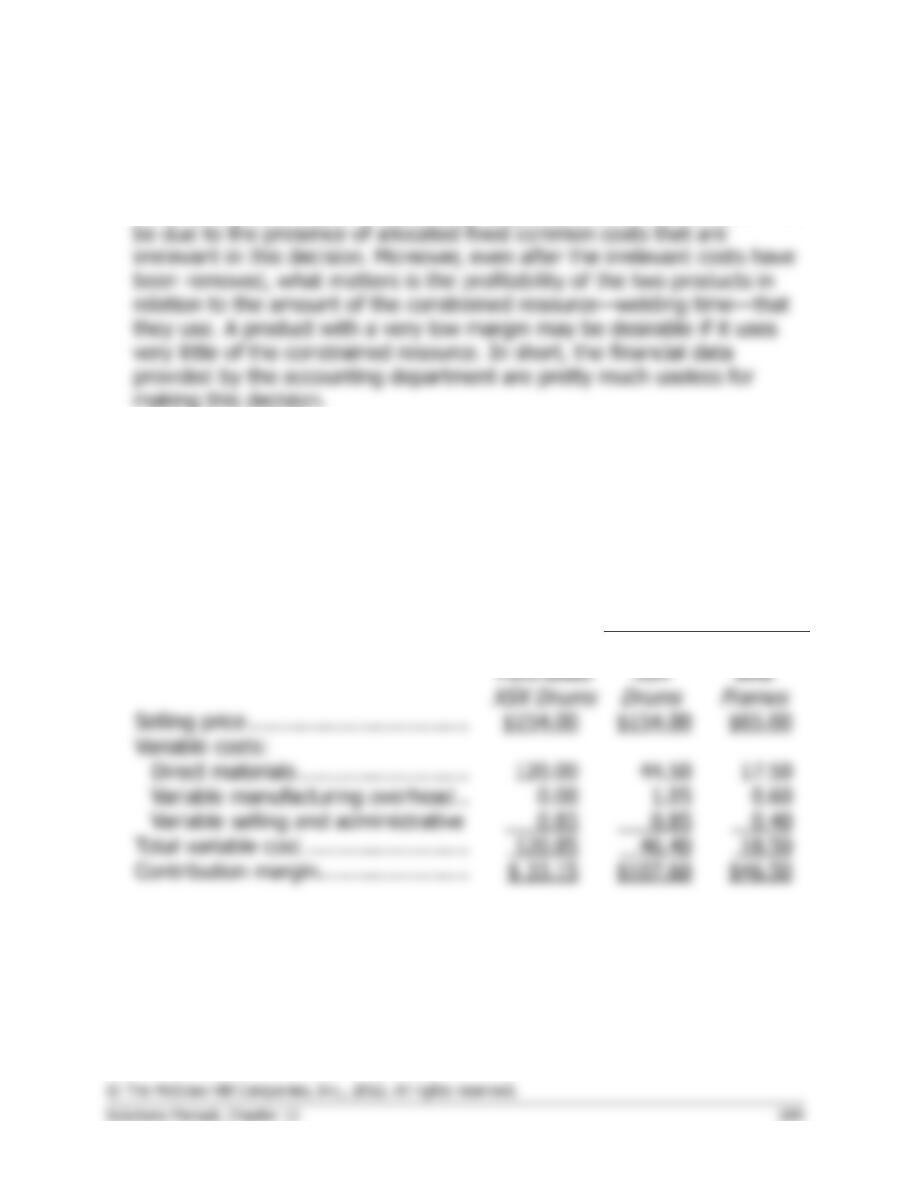
If the company can sell more than 6,000 containers of the candies each
month, then profits will be higher than if the honey were simply sold
outright. If the company cannot sell at least 6,000 containers of the
Containers sold per month ………………
5,000
6,000
7,000
Sales revenue @ $4.40 per container …
$22,000
$26,400
$30,800
$1.17 per container ……………………..
5,850
7,020
8,190
Incremental contribution margin ……….
16,150
19,380
22,610
Less avoidable fixed costs ……………….
5,880
5,880
5,880
Total contribution to profits ……………..
$10,270
$13,500
$16,730
Sales revenue @ $3.00 per pound …….
$11,250
$13,500
$15,750
Case 12-29 (120 minutes)
1. The product margins computed by the accounting department for the
drums and mountain bike frames should not be used in the decision of
which product to make. The product margins are lower than they should
2. Students may have answered this question assuming that direct labor is
a variable cost, even though the case strongly hints that direct labor is a
fixed cost. The solution is shown here assuming that direct labor is
fixed. The solution assuming that direct labor is variable will be shown in
part (4).
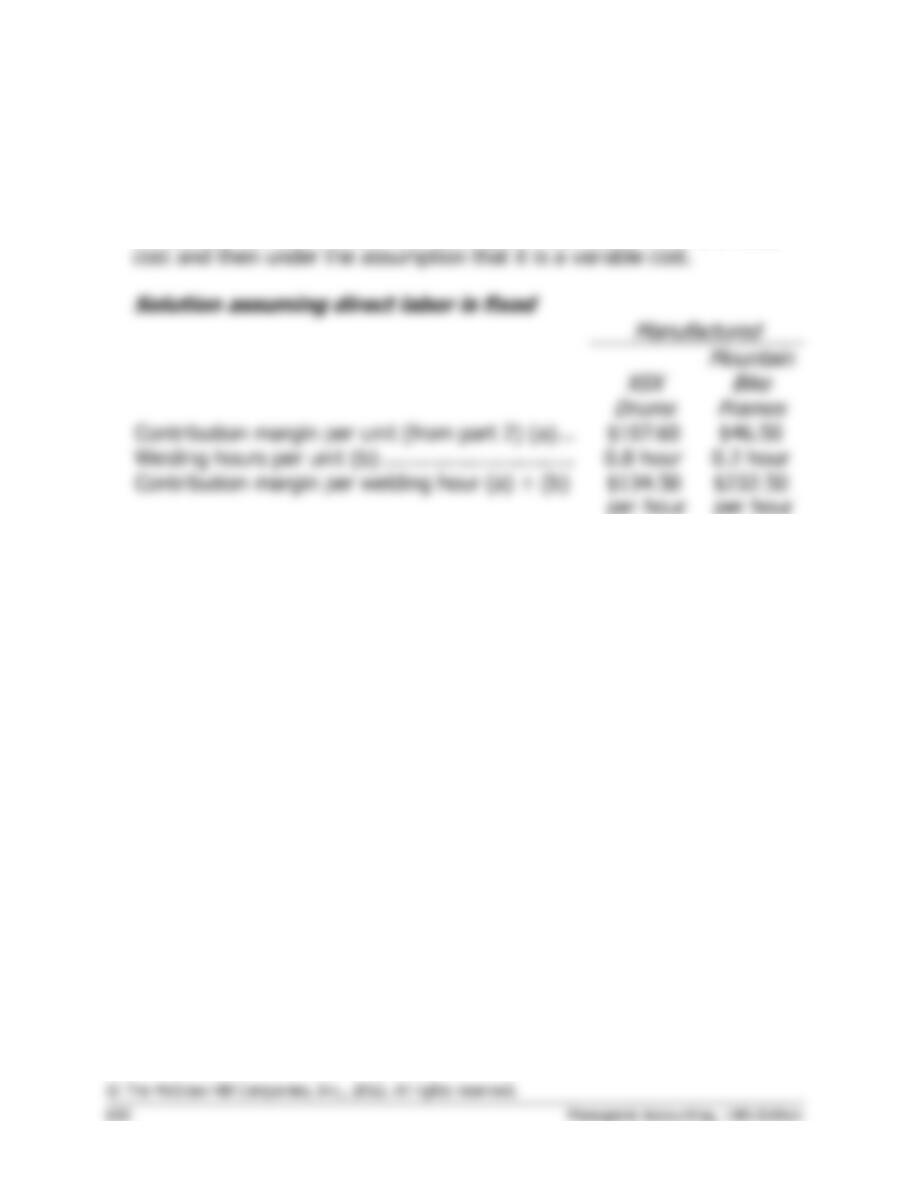
Solution assuming direct labor is fixed
Manufactured
Mountain
Case 12-29 (continued)
3. Because the demand for the welding machine exceeds the 2,000 hours
that are available, products that use the machine should be prioritized
based on their contribution margin
per welding hour
. The computations
are carried out below under the assumption that direct labor is a fixed
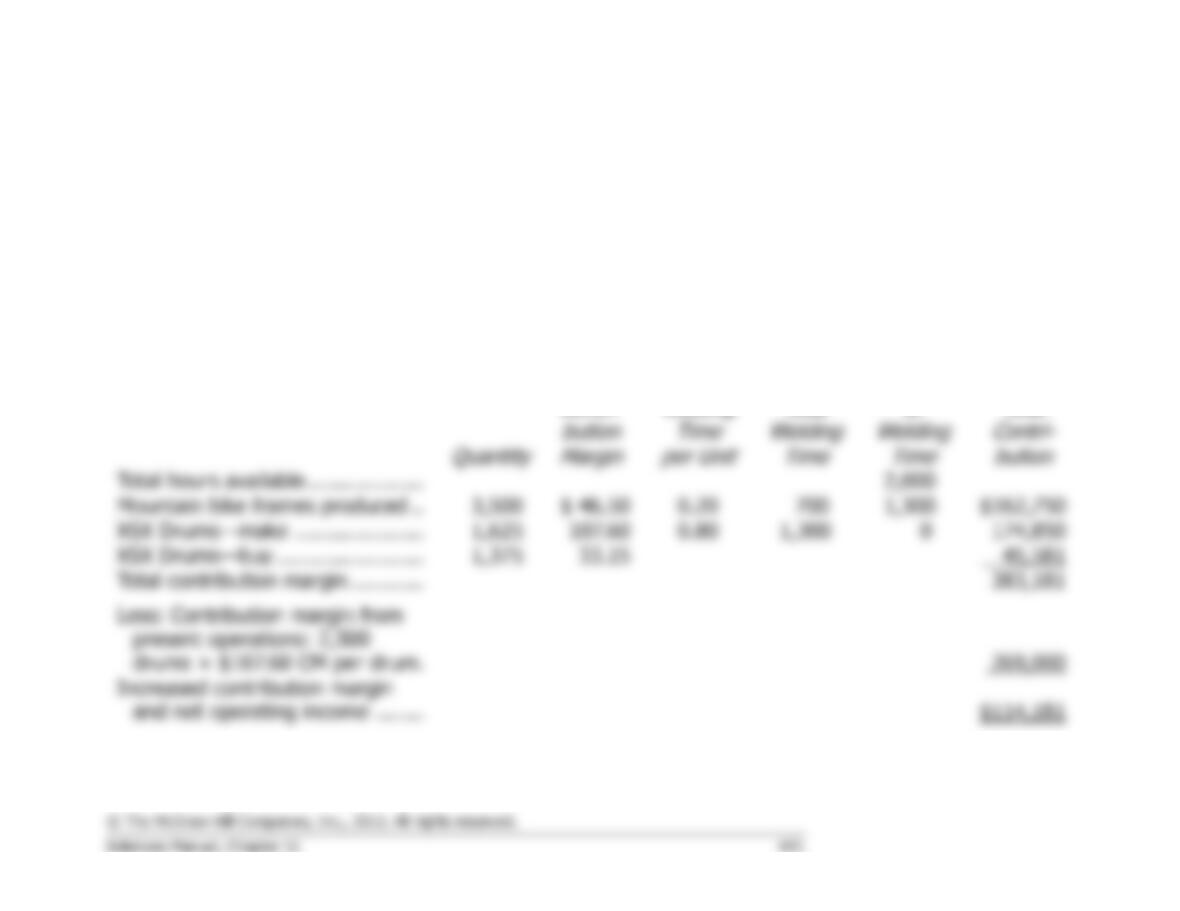
Case 12-29 (continued)
Because the contribution margin per unit of the constrained resource (i.e., welding time) is larger for the
mountain bike frames than for the XSX drums, the frames make the most profitable use of the welding
machine. Consequently, the company should manufacture as many mountain bike frames as possible up
to demand and then use any leftover capacity to produce XSX drums. Buying the drums from the
outside supplier can fill any remaining unsatisfied demand for XSX drums. The necessary calculations
are carried out below.
Analysis assuming direct labor is a fixed cost
(a)
(b)
(c)
(a) × (c)
(a) × (b)
Total hours available ……………….
XSX Drums—buy ……………………
Total contribution margin …………
Unit
Contri-
Welding
Total
Balance
of
Total
Case 12-29 (continued)
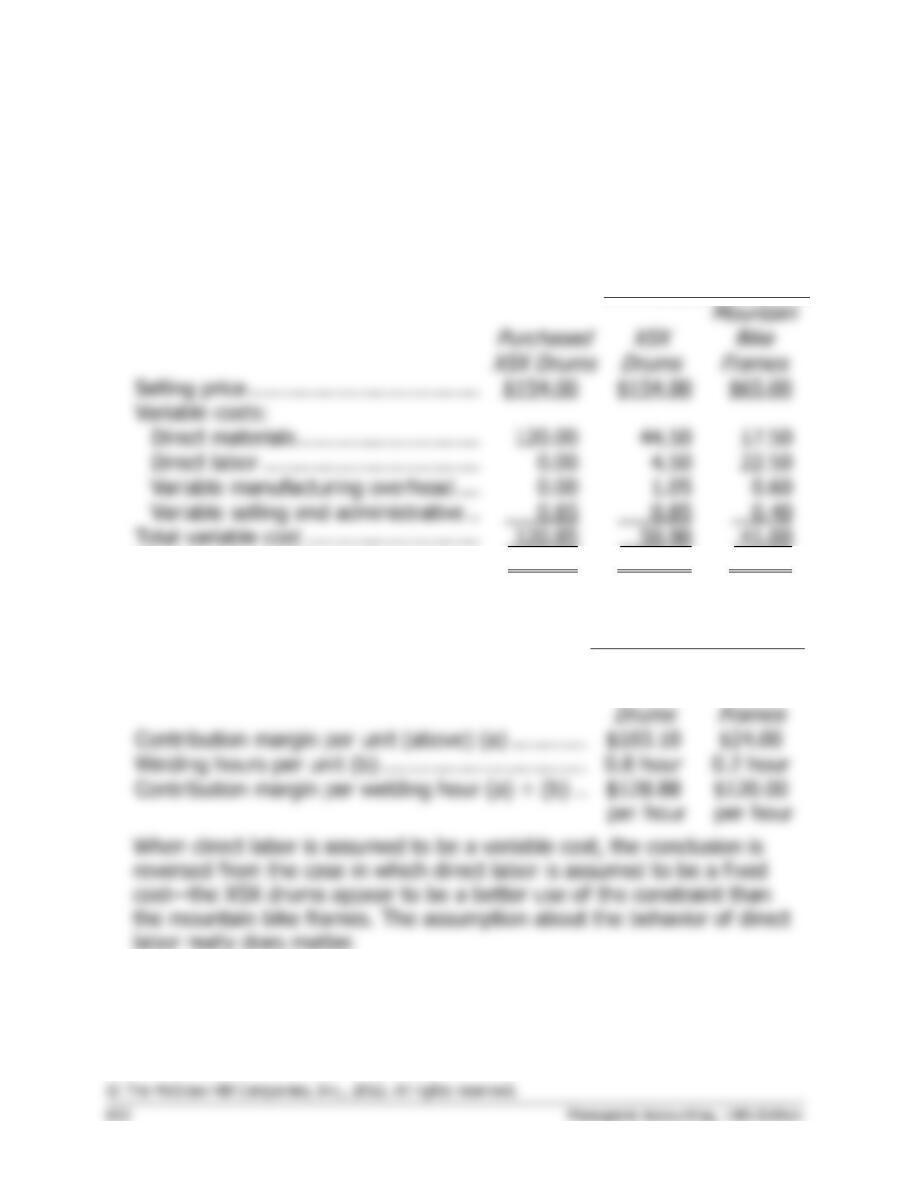
4. The computation of the contribution margins and the analysis of the
best product mix are repeated here under the assumption that direct
labor costs are variable.
Solution assuming direct labor is a variable cost
Manufactured
Selling price ……………………………….
$154.00
$65.00
Variable costs:
120.00
Total variable cost ……………………….
120.85
Contribution margin ……………………..
$ 33.15
$103.10
$24.00
Solution assuming direct labor is a variable cost
Manufactured
Contribution margin per unit (above) (a) …………
Welding hours per unit (b) …………………………...
XSX
Mountain
Bike