y
6
5
7
y
4
6
5
y
4
6
5
f(x) 2x1
y
2
1
3
7
8
9f(x) 3x2
y
2
1
3
f(x) 2x 1
y
1
y
Chapter 12
Exponential and Logarithmic Functions
Exercise Set 12.1
RC2. f(1)=3
1= 3, so it is false to say that the graph goes
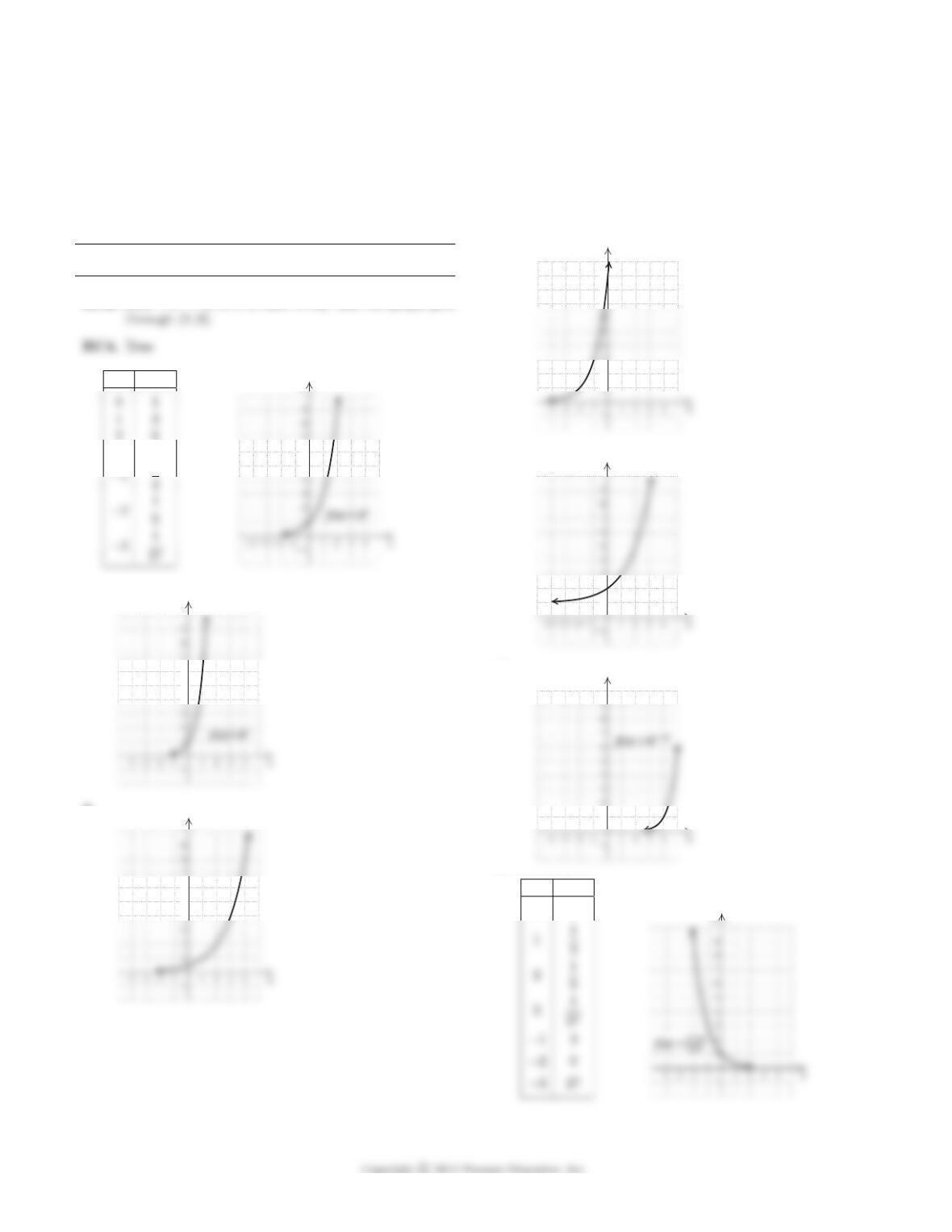
2. x f(x)
3 27
4.
6.
8.
10.
12.
14. x f(x)
0 1
y
8
9
y
⫺1
9
y
⫺
4
1
y
2146
⫺2
⫺135
⫺1
789
x
y
8
10
12
y
$300,000
A(t)
16.
18.
20.
22.
24.
26.
28. a) A(t) = $50,000(1.03)t
b) A(0) = $50,000(1.03)0= $50,000
c)
30. A= $35001+0.032
22·2
≈$3729.43
34. a) K(3) = 90,892(1.12)3≈127,697 replacements
b)
36. a) V(0) = $5200(0.8)0= $5200
$8000
7000
V
(
t
)
t
24681012
Minutes
N(t)
y
x
y
y
Exercise Set 12.2 345
b)
38. a) N(10) = 3000(2)10/20 ≈4243 bacteria
N(20) = 3000(2)20/20 = 6000 bacteria
b)
42. 2
30
=1
52.
54.
56.
Exercise Set 12.2
RC4. A function whose inverse is also a function is called a
one-to-one function.
RC6. The function g(x)=(x−1)2is the composition of the
4. (f◦g)(x) = 4(2x2−5)+3=8x2−17
6. (f◦g)(x)= 3
2x2+3
12. f(x)=x5,g(x)=3x2−7
x−1,g(x)=x3
20. {(−1,3),(2,5),(−3,5),(0,2)}
y ⫽ x
4
⫺
12
6
y
—3
—4
—5
f
(
x
) = 3 – 6
x
x
y
1—1—33254—2—4—5
—1
1
y
1
2
y
—1
—2
4
5
22. x=1
2y2−8
−8 0
24.
26.
28.
The function does not pass the horizontal-line test, so it is
30.
32. The function passes the horizontal-line test, so it is one-
to-one.
1. Replace f(x)byy:y=4+7x
34. The function passes the horizontal-line test, so it is one-
to-one.
y
36. The function passes the horizontal-line test, so it is one-
to-one.
−8
38. The function passes the horizontal-line test, so it is one-
to-one.
3. Solve for y:y−8= 1
x
2
4
3
5
y
g(x) x 4
y
⫺4
⫺5
Exercise Set 12.2 347
40. The function f(x)=−2 does not pass the horizontal-line
to-one.
1. Replace f(x)byy:y=2x−1
4. Replace yby f−1(x): f−1(x)=3x+1
2−5x
44. The function passes the horizontal-line test, so it is one-
3. Solve for y:3
4. Replace yby f−1(x): f−1(x)= 3
√x−5
46. The function passes the horizontal-line test, so it is one-
48.
50.
56. a) (f−1◦f)(x)= 3
√x3−5+5= 3
√x3=x
58. f(x) multiplies an input by 1
4and then adds 7, so f−1(x)
would subtract 7 from an input and then multiply by 4:
60. f(x) takes the cube root of an input and then subtracts 5,
so f−1(x) would add 5 to an input and then raise the sum
to the third power: f−1(x)=(x+5)
3.
62. f(x) takes an input to its reciprocal, so f−1(x) would also
take an input to its reciprocal: f−1(x)=x−1.
(f−1◦f)(x)=(x−1)−1=x
64. a) f(8) = 2(8 + 12) = 2 ·20 = 40
f(18) = 2(18 + 12) = 2 ·30 = 60
b) The function passes the horizontal line test and has
an inverse that is a function.
y=2(x+ 12) Replace f(x).
c) f−1(40) = 40 −24
2=16
2=8
66. 8
√81 = (34)1/8=3
1/2=√3
5
y
x
⫺4
⫺2
2
⫺3
3
y
f(x) log10 x
2146
⫺4
⫺2
⫺135
⫺3
⫺1
789
x
⫺
8
⫺
448
⫺
4
⫺
10
⫺
12
⫺
6
⫺
2261012
⫺
2
x
348 Chapter 12: Exponential and Logarithmic Functions
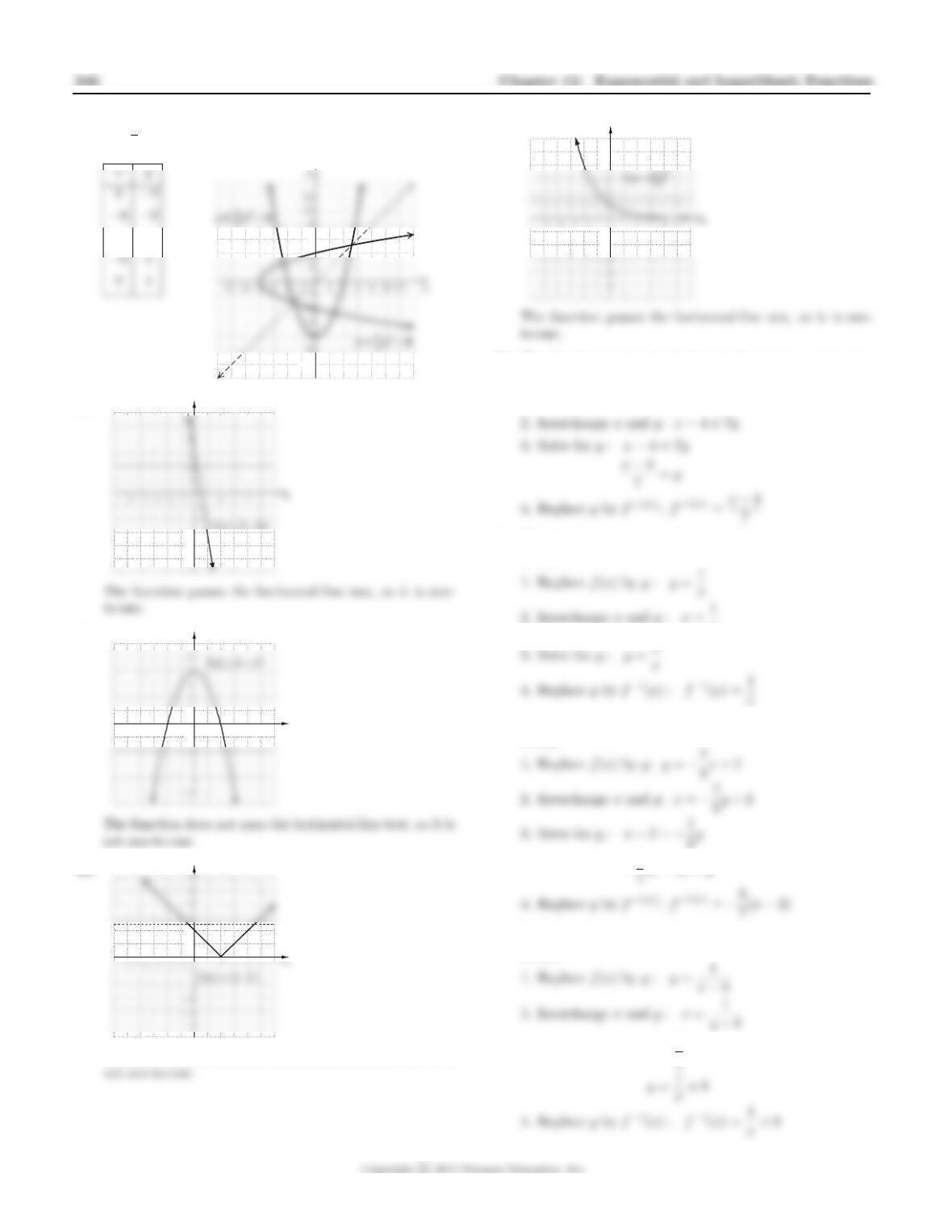
80. Reflect the graph of facross the line y=x.
82. Observe the following:
f(6) = 6 and g(6) = 6,
Exercise Set 12.3
RC2. Let log39=x. Then
RC4. Let log21024 = x. Then
2.
12. 1
4= log16 2
22. −4 = loge0.0183
32. e2.3026 =10
36. log4x=3
38. logx64 = 3
x3=64
y
Exercise Set 12.4 349
42. log416 = x
44. logx9=1
46. log2x=0
48. log3x=−2
3−2=x
50. log32 x=1
58. 6
68. 0
0.8451; 314 = 102.4969;31.4=10
1.4969;
82. c2
c−p+p2
p−c=c2
c−p+−1
−1·p2
p−c
84. (10x+ 3)(10x−3)
90.
92. log3x=3
96. log10(x2+21x)=2
98. Let log81 3log381 =x. Then
81x=3
log381
Exercise Set 12.4
350 Chapter 12: Exponential and Logarithmic Functions
12. 3 logax
16. −5 logcM
2logap−4 logaq
30. logaa6b8
34. logax
48. logb75 = logb(3 ·52) = logb3 + logb52=
68. loga(x+y)+ loga(x2−xy +y2)=
70. loga
c−d
√c2−d2=
72. The statement is false. For example, let a=10,P= 100,
74. The statement is false. For example, let a= 3 and x=9.
Then
Chapter 12 Mid-Chapter Review
125 = x
6. loga2=0.648 and loga9=2.046
Chapter 12 Mid-Chapter Review 351
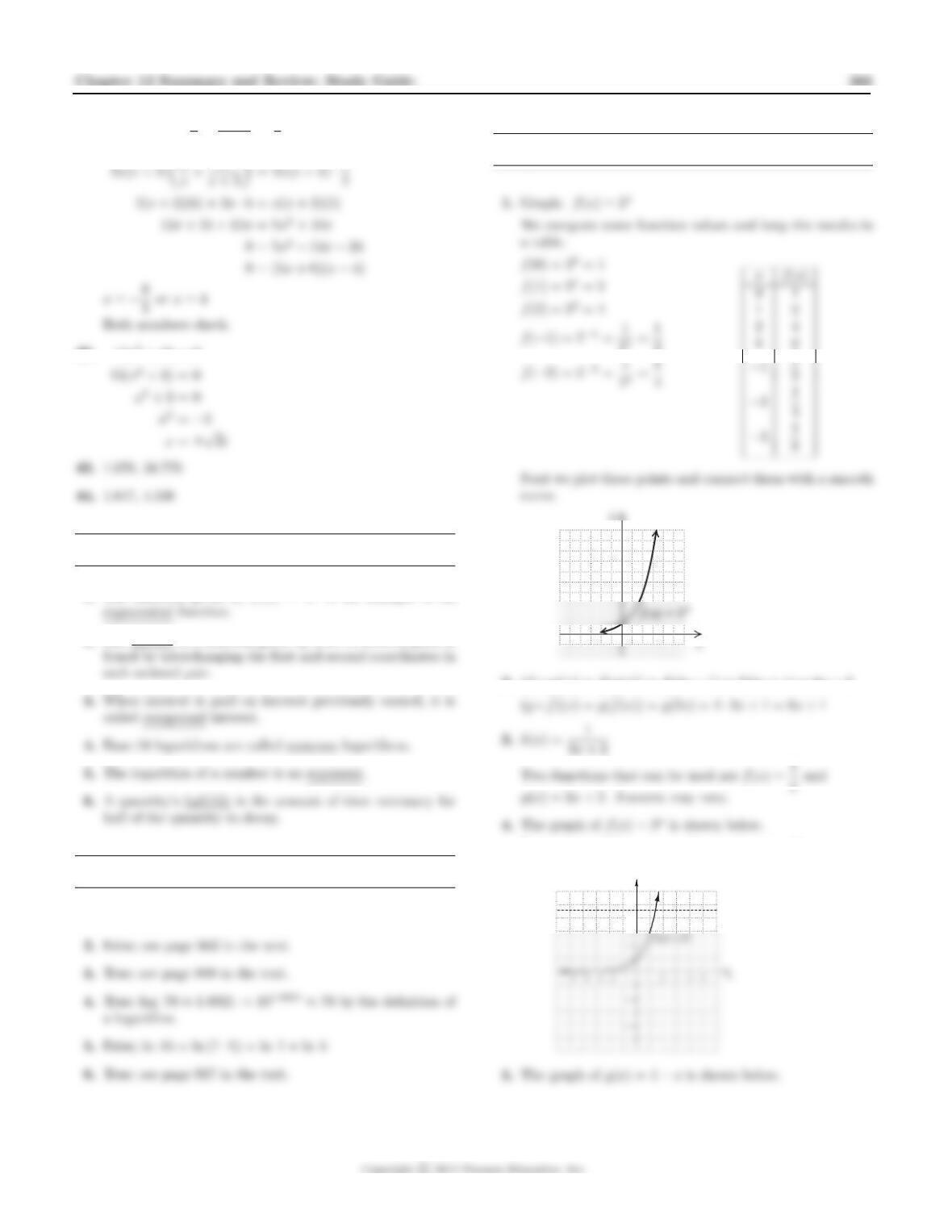
7. Graph f(x)=3
x−1.
8. Graph f(x)=3
4x
.
We construct a table of values. Then we plot the points
and connect them with a smooth curve.
f(1) = 3
=3
0 1
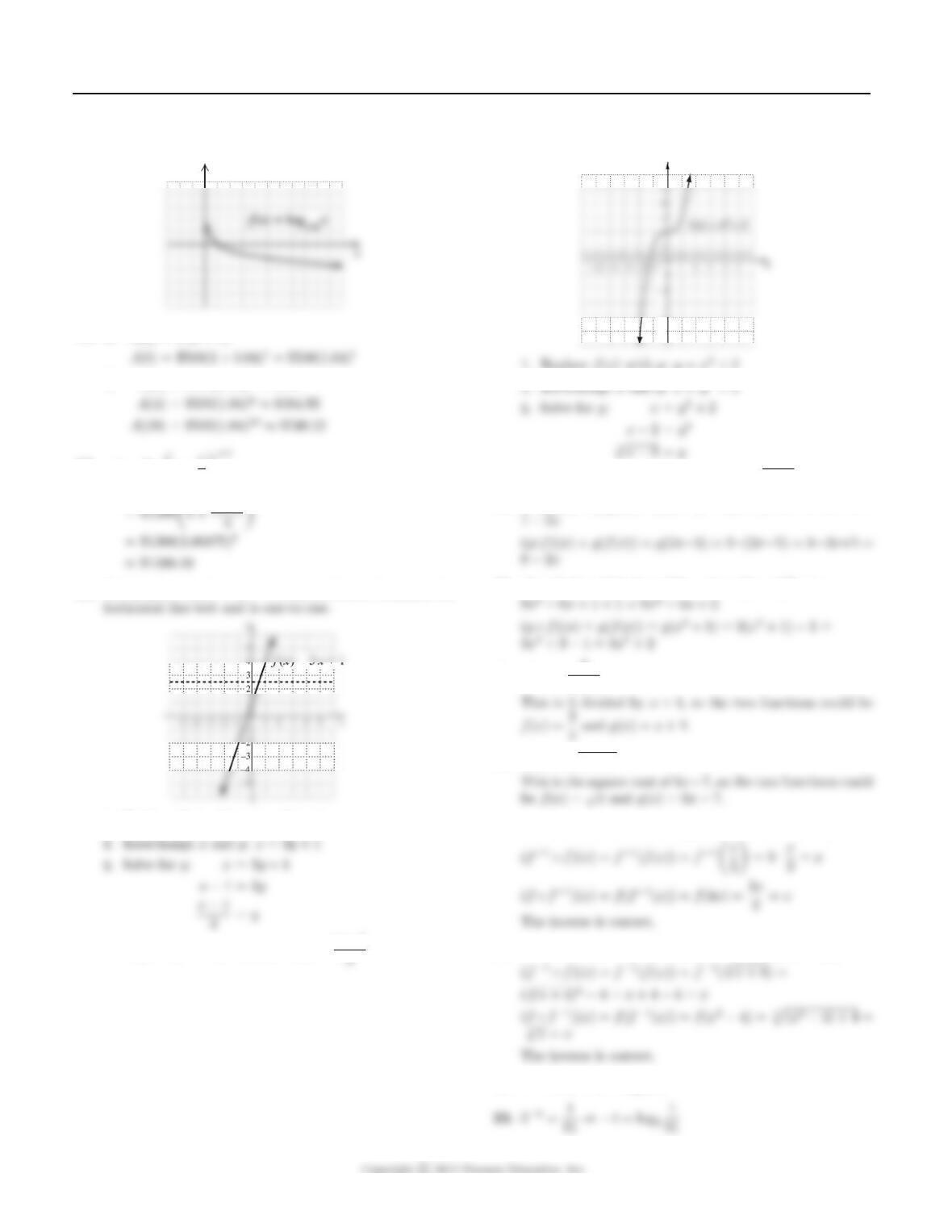
9. Graph f(x) = log4x.
For y=0,x =4
0=1.
10. Graph f(x) = log1/4x.
4y
for yand computing the corresponding x-values.
1
16 2
y
y
—4
—5
352 Chapter 12: Exponential and Logarithmic Functions
We plot these ordered pairs and connect the points with a
smooth curve.
11. a) A(t)=P(1 + r)t
b) A(0) = $500(1.04)0= $500
12. A=P·1+ r
nn·t
13. The graph of f(x)=3x+ 1 is shown below. It passes the
1. Replace f(x) with y:y=3x+1
4. Replace ywith f−1(x): f−1(x)=x−1
14. The graph of f(x)=x3+ 2 is shown below. It passes the
horizontal line test and is one-to-one.
1. Replace f(x) with y:y=x3+2
4. Replace ywith f−1(x): f−1(x)= 3
√x−2
15. (f◦g)(x)=f(g(x)) = f(3−x) = 2(3−x)−5=6−2x−5=
16. (f◦g)(x)=f(g(x)) = f(3x−1) = (3x−1)2+1=
17. h(x)= 3
x+4
18. h(x)=√6x−7
19. We check to see that (f−1◦f)(x)=xand (f◦f−1)(x)=x.
20. We check to see that (f−1◦f)(x)=xand (f◦f−1)(x)=x.
21. 73=343⇒3 = log7343
Exercise Set 12.5 353
23. log612 = t⇒6t=12
x−2=1
27. Let log749=x.
2x=2
5
31. logb
2xy2
z3
= logb(2xy2)−logbz3
=1
3logax2y5
z4
33. logax−2 logay+1
2logaz= logax−logay2+ logaz1/2
35. log81 = 0 (loga1=0)
38. logcc5= 5 (logaak=k)
40. logabis the number to which ais raised to get b. Since
41. Express x
42. The student didn’t subtract the logarithm of the entire
denominator after using the quotient rule. The correct
procedure is as follows:
1
x
Exercise Set 12.5
12. Does not exist as a real number
y
⫺1
x
y
⫺4⫺224
6
⫺3⫺113
⫺1
x
y
⫺4⫺224
⫺3⫺113
⫺1
1
9
6
5
7
f(x) ex2
8
9
y
1
f(x) 2 ln (x 2)
y
⫺
4
4
354 Chapter 12: Exponential and Logarithmic Functions
16. 2
26. log3100 = log10 100
log10 3≈4.1918
32. log0.13= ln 3
38. x f(x)
−3 0.2
40.
48. x f(x)
0 0
3 1.4
50.
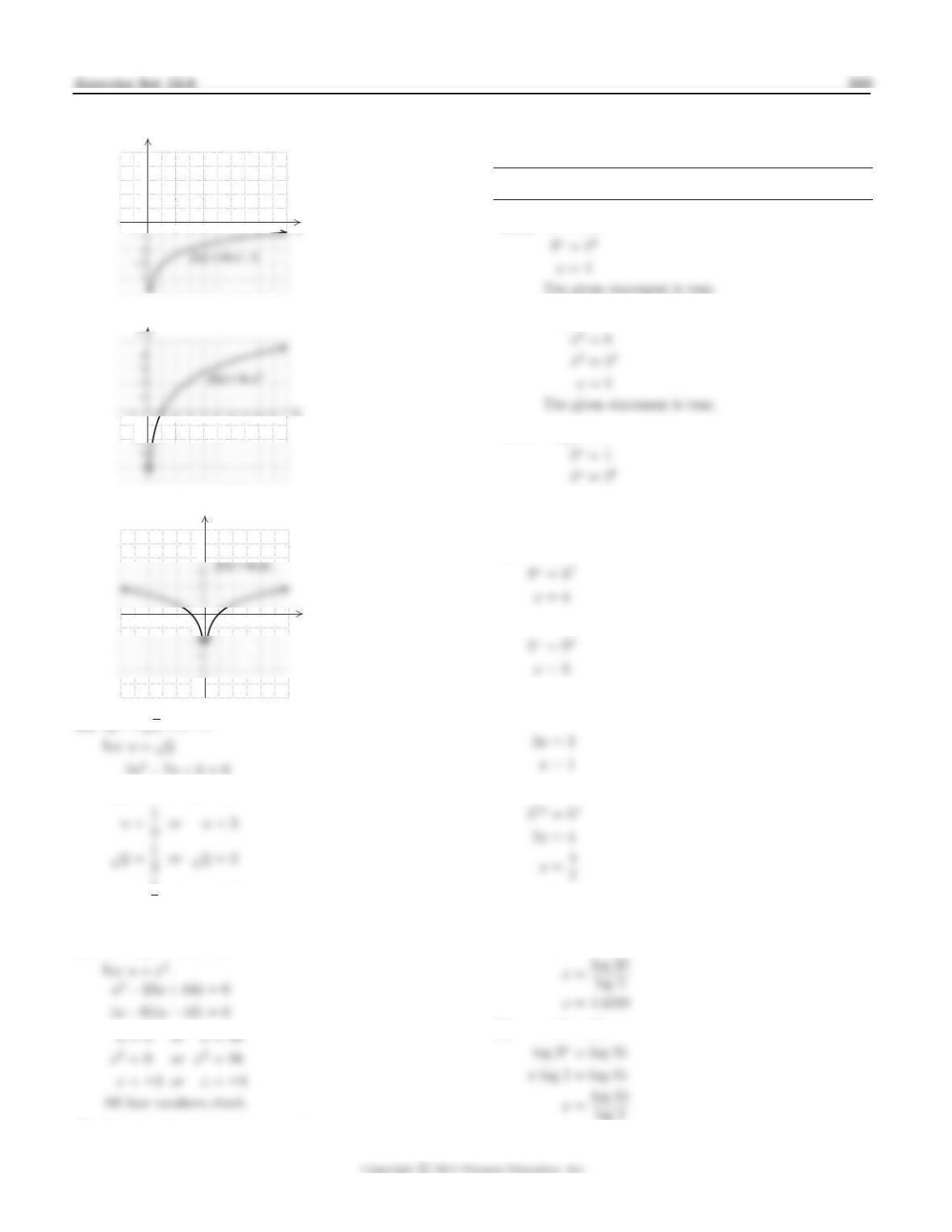
y
2
4
1
3
x
2146
⫺
2
⫺
135
⫺
1
789
x
y
⫺4⫺224
4
⫺5⫺3⫺135
⫺5
⫺1
5
1
52.
54.
56.
58. 2y−7√y+3=0
(2u−1)(u−3)=0
y=1
4or y =9
Both numbers check.
60. x4−25x2+144=0
62. Domain: (0,∞); range: (−∞,∞)
64. (−∞,0) ∪(0,∞)
Exercise Set 12.6
RC2. 2x=16
RC4. logx8=3
RC6. log21=x
x=0
The given statement is true.
2. 3x=81
4. 5x= 125
6. 43x=64
43x=4
3
8. 57x= 625
10. 2x=20
log 2x= log 20
xlog 2 = log 20
12. 2x=55
x≈5.7814
356 Chapter 12: Exponential and Logarithmic Functions
14. 43x+5 =16
x=−1
16. 35x·9x2=27
35x+2x2=3
2x2+5x−3=0
2or x =−3
18. 6x=10
20. et= 1000
−t≈−4.6052
26. 3x+2 =5
x−1
log 3x+2 = log 5x−1
28. (5.2)x=70
30. log7x=3
32. log9x=1
2
34. log x=3
36. log x=−3
38. ln x=1
42. log2(8 −2x)=6
−2x=56
44. log x+ log (x+9) =1
46. log (x+9)−log x=1
48. log2x+ log2(x−2) = 3
log2[x(x−2)]=3
Exercise Set 12.6 357
50. log4(x+3)−log4(x−5)=2
x−5=4
83
15 =x
52. log5(x+4)+log
5(x−4)=2
54. log4(2 + x)−log4(3 −5x)=3
2+x
321
56. |2x−5|>3
58. x2−x≤12
x2−x−12 ≤0
✲✛
A
B
C
Thus f(x)=x2−x−12 <0 in interval B. We also include
the endpoints of the interval in the solution set because
60. √y−3=y−5
y=4or y =7
64. a) (21.809,49.617), (−2.9999,−0.0002)
66. 27x=81
2x−3
(33)x=(3
4)2x−3
3=x3
√3=x
72. 2x2+4x=1
8
74. log5|x|=4
76. log3|5x−7|=2
78. √x·3
√x·4
√x·5
√x=146
80. log5125 = 3 and log125 5=1
Exercise Set 12.7
2. 130=10·log I
10−12
I=10W/m
2
6. pH = −log[6.3×10⁻⁷]
H+≈6.31 ×10⁻⁴moles per liter
14. a) N(5) = 20(3)5= 4860
b) 1000 = 20(3)t
50 = (3)tDividing by 20
c) 40 = 20(3)t
2 = (3)t
16. a) V(3) = 4800(0.7)3= $1646.40
log 1
4=tlog 0.7
c) 2400 = 4800(0.7)t
0.5=(0.7)t
18. a) P(t)=P0e0.054t
20. a) P(t) = 316e0.009t, where P(t) is in millions and tis
c) 350 = 316e0.009t
316 =e0.009t
ln 350
The U.S. population will be 350 million about 11 yr
after 2013, or in 2024.
d) 2(316) = 316e0.009t
22. a) P(t)=P0ekt
where P(t) is in cents and tis the number of years
after 2000.
24. P(t)=P0e−0.00012t
26. P(t)=P0e−kt,k>0
28. P(t)=P0e−kt
30. a) 2007 −1965 = 42, so we have the data points
(0,1156) and (42,750).
b) In 2002, t= 2002 −1965 = 37.
289=lne−0.01t
32. a) 2011−2005 = 6, so we have the data points (0,1460)
and (6,63,400).
b) In 2014, t= 2014 −2005 = 9.
c) 500,000 = 1460e0.629t
25,000
34. a) 2010 −1990 = 20, so we have the data points (0,9)
and (20,104.3).
V(t)=V0ekt
c) 2(9) = 9 e0.123t
ln 1000
9
38.3yr≈t
36. x+y−z=0,(1)
Multiply Equation (5) by −2 and add the result to Equa-
tion (4).
4x+2y=6
y
y
4
5
38. 6
x+6
x+2 =5
2
6
40. 15x2+45=0
Chapter 12 Vocabulary Reinforcement
1. The function given by f(x)=6
xis an example of an
2. The inverse of a function given by a set of ordered pairs is
Chapter 12 Concept Reinforcement
1. True; f(0) = a0=1,sothey-intercept is (0,1).
Chapter 12 Study Guide
21=1
2
2. (f◦g)(x)=f(g(x)) = f(4x+ 1) = 2(4x+1)=8x+2
No horizontal line crosses the graph more than once, so
the function is one-to-one.
y
5
y
x
362 Chapter 12: Exponential and Logarithmic Functions
No horizontal line crosses the graph more than once, so the
function is one-to-one. We find a formula for the inverse.
3. Solve for y:x=4−y
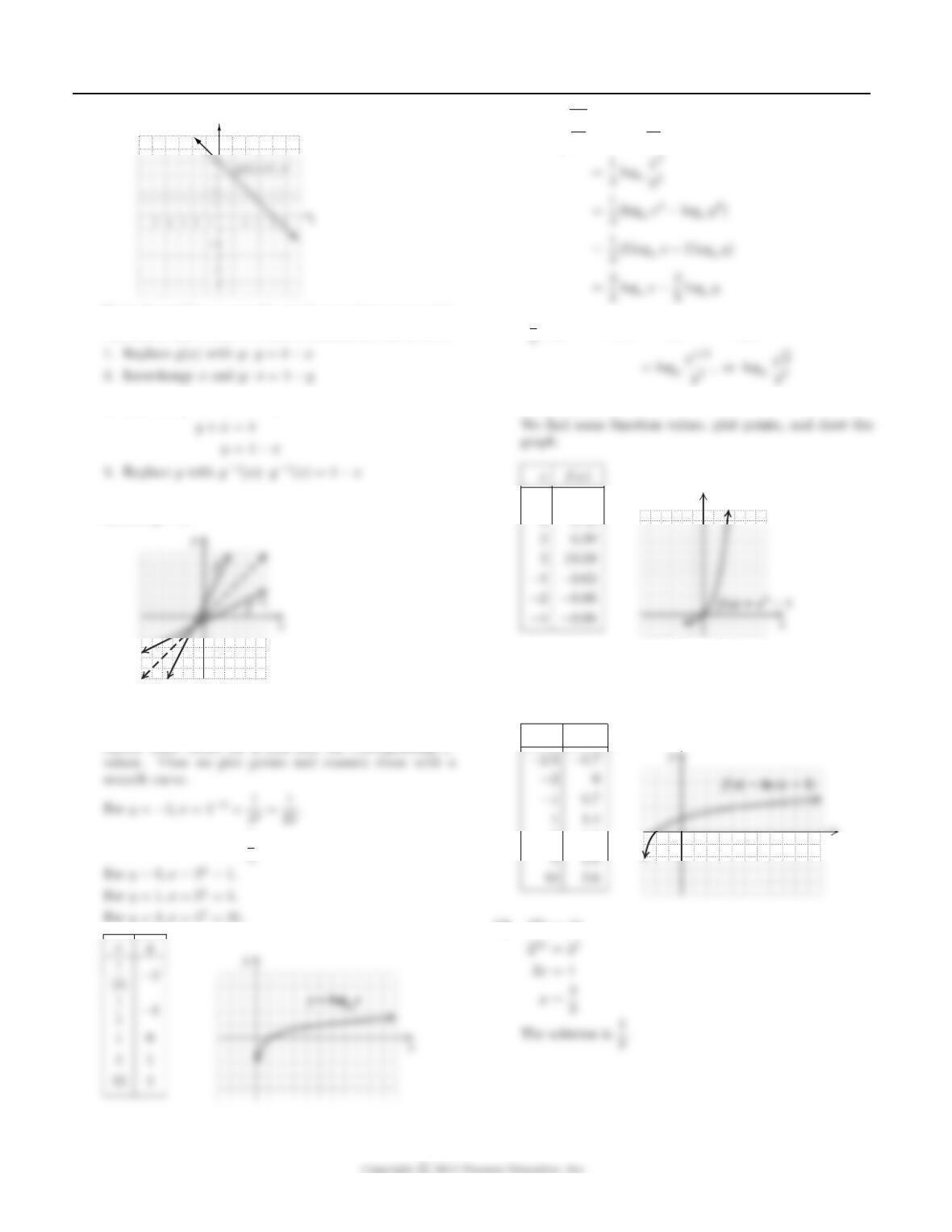
6. We graph f(x)=2x+1 and then draw its reflection across
the line y=x.
7. Graph y= log5x.
The equation y= log5xis equivalent to 5y=x.We
choose some values for yand find the corresponding x–
For y=−1,x=5
−1=1
For y=2,x =5
8. loga
5
x3
y2= logax3
y21/5
9. 1
10. Graph: f(x)=ex−1
0 0
11. Graph: f(x) = ln (x+3)
We find some function values, plot points, and draw the
graph.
x f(x)
3 1.8
12. 23x=16