Solution 12.19
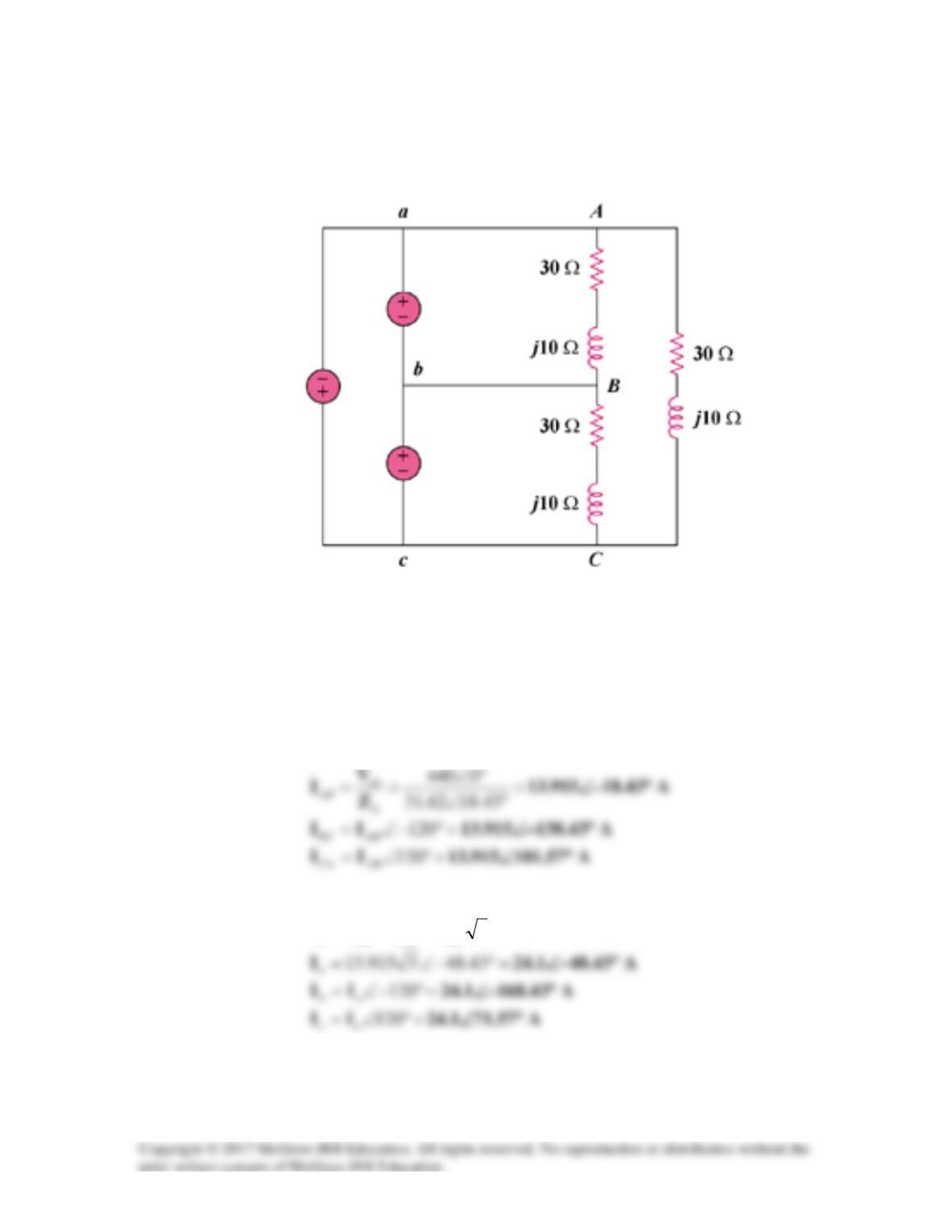
For the ∆–∆ circuit of Fig. 12.50, calculate the phase and line currents.
Figure 12.50
For Prob. 12.19.
Solution
°∠=+=
∆18.4362.3110j30Z
The phase currents are
The line currents are
°∠=−= 30–3
ABCAABa
IIII
220∠120° V
220∠–120° V
220∠0° V
Solution 12.20
Using Fig. 12.51, design a problem to help other students to better understand balanced
delta–delta connected circuits.
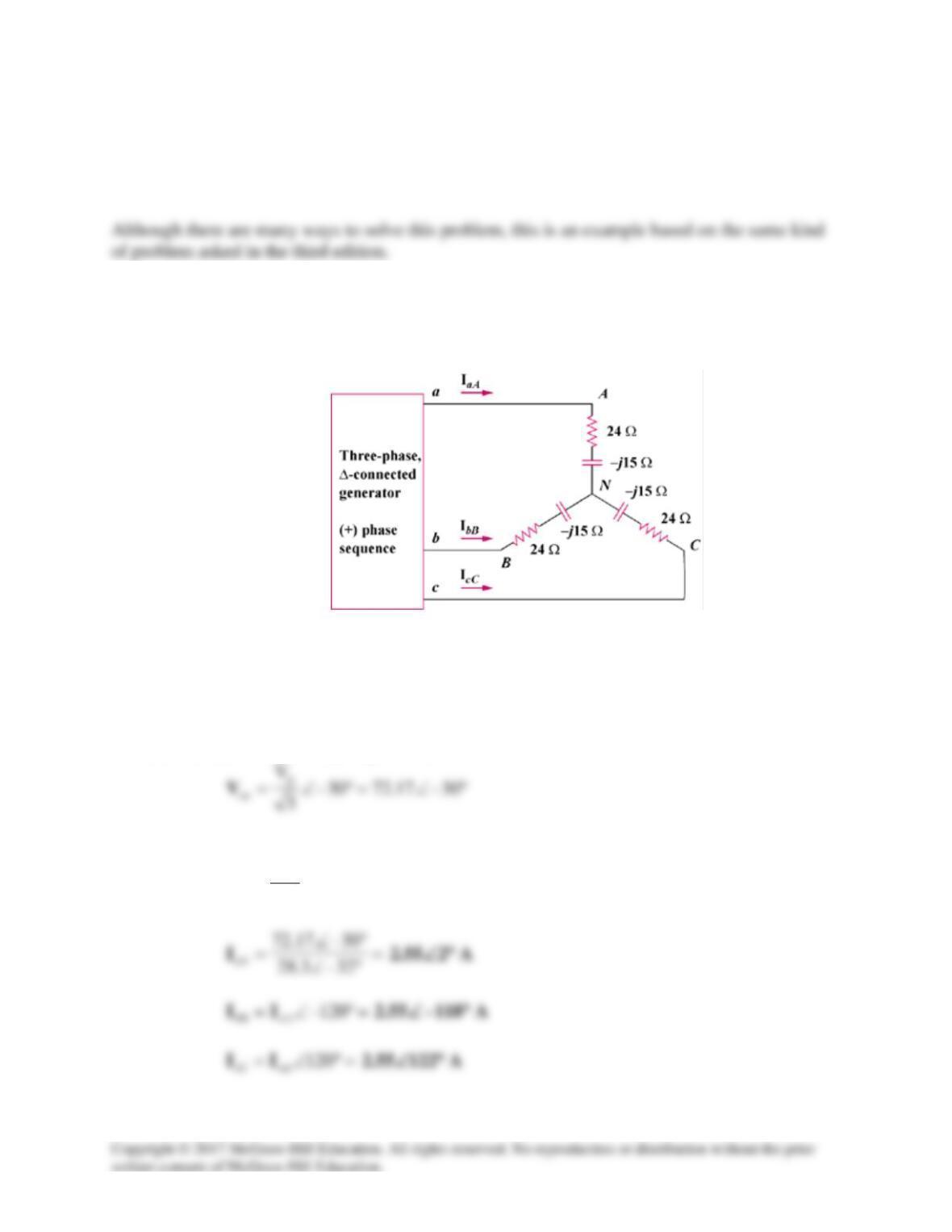
Although there are many ways to solve this problem, this is an example based on the
same kind of problem asked in the third edition.
Problem
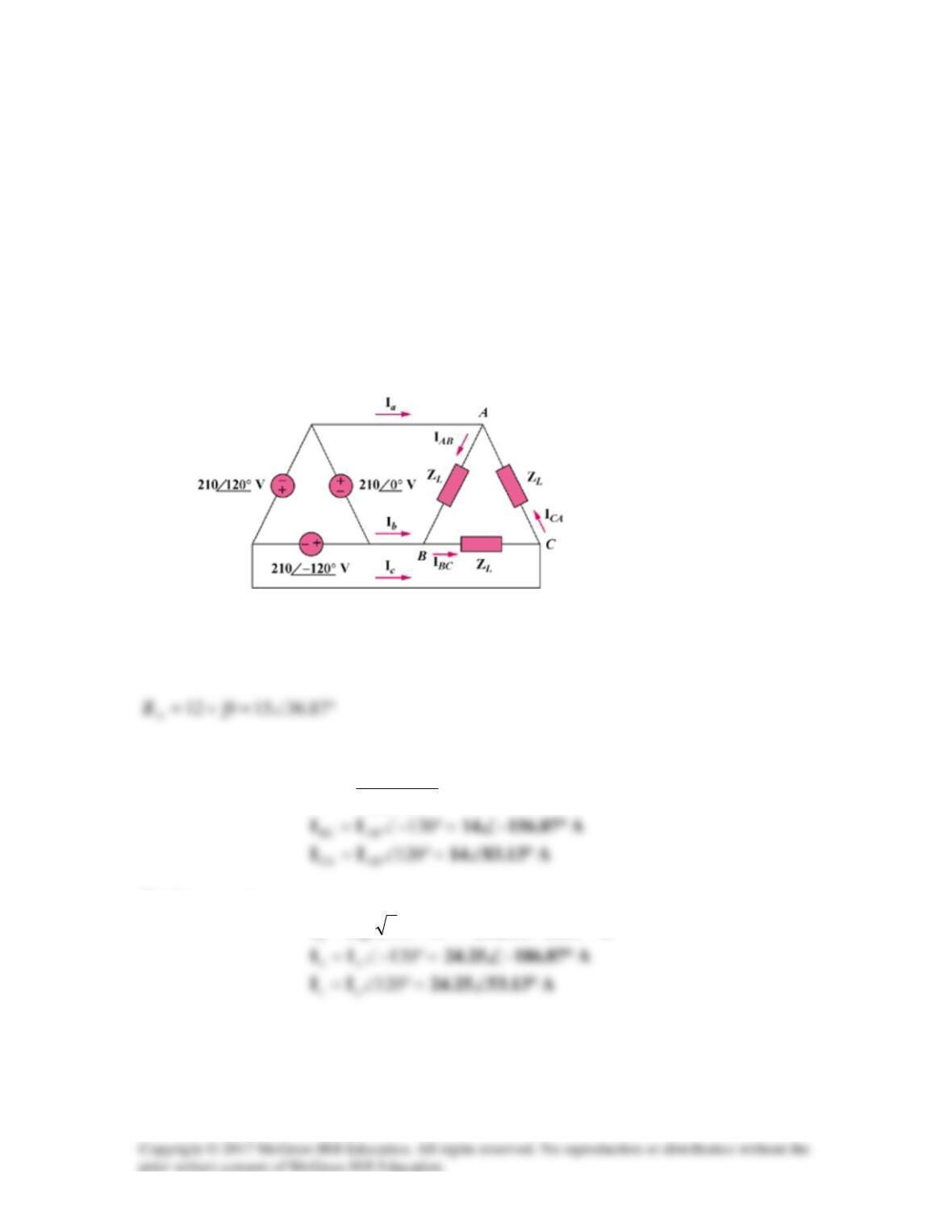
Refer to the ∆–∆ circuit in Fig. 12.51. Find the line and phase currents. Assume that the
load impedance is 12 + j9Ω per phase.
Figure 12.51
Solution
The phase currents are
=
°∠
°∠
=36.8715
0210
AB
I
A36.87–14 °∠
The line currents are
=°∠= 30–3
A66.87–25.24 °∠
Solution 12.21
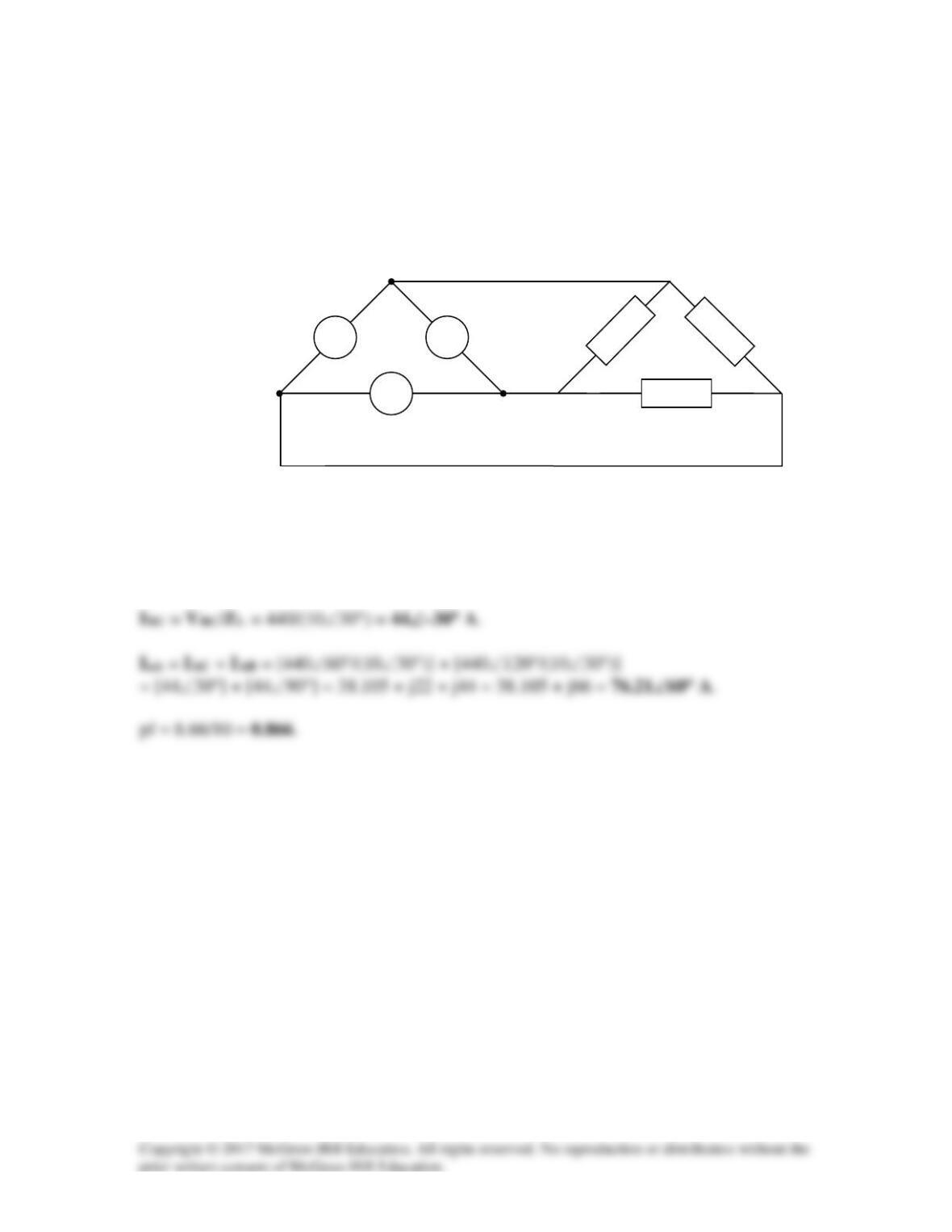
Three 440-volt generators, form a delta connected source which is connected to a
balanced delta connected load of ZL = (8.66 + j5) Ω per phase as shown in Fig. 12.52.
Determine the value of IBC and IaA. What is the pf of the load?
Figure 12.52
For Prob. 12.21.
Solution
−
+
440∠120° V
440∠–120° V
440∠0° V
−
+
−
+
Z
L
Z
L
Z
L
a
b
c
A
B
C
Solution 12.22
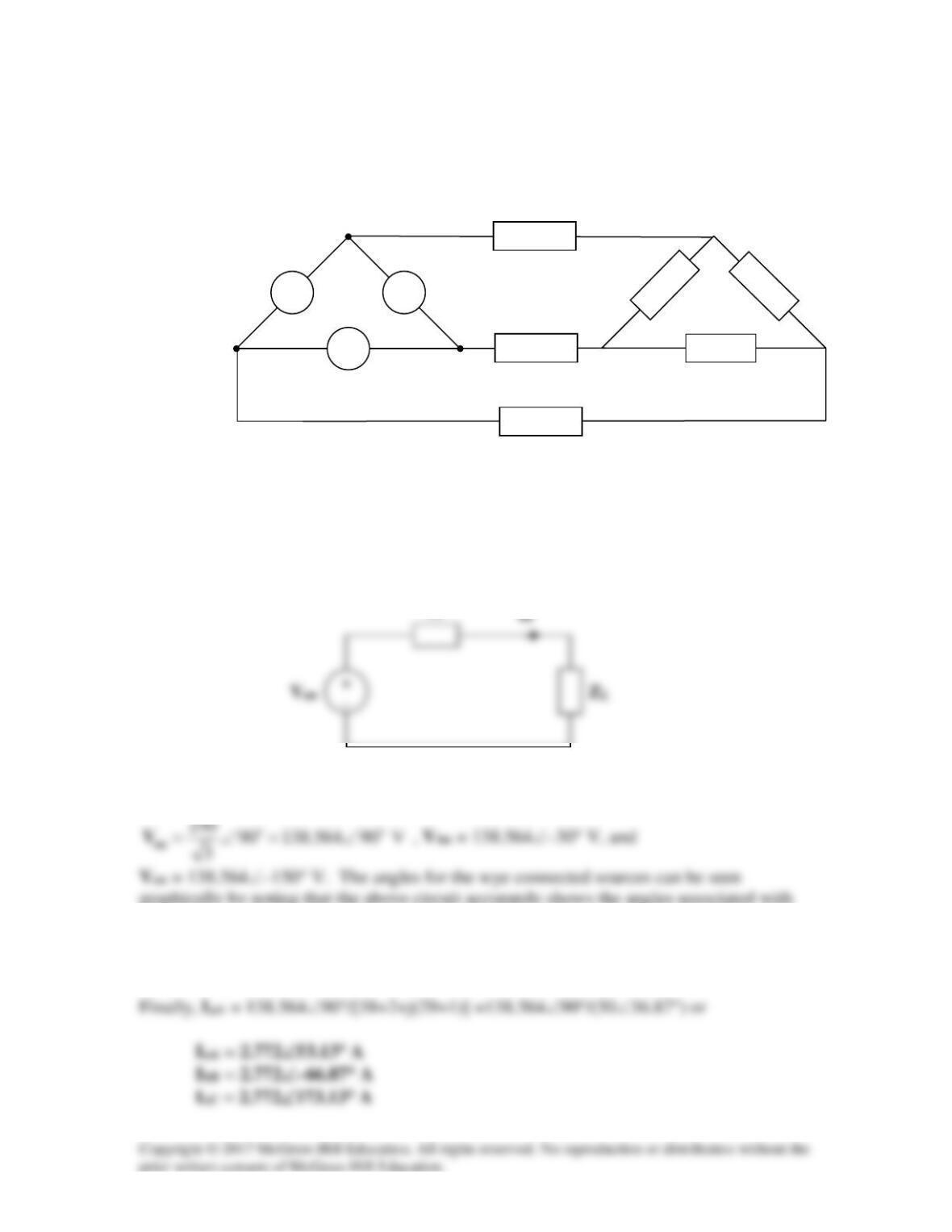
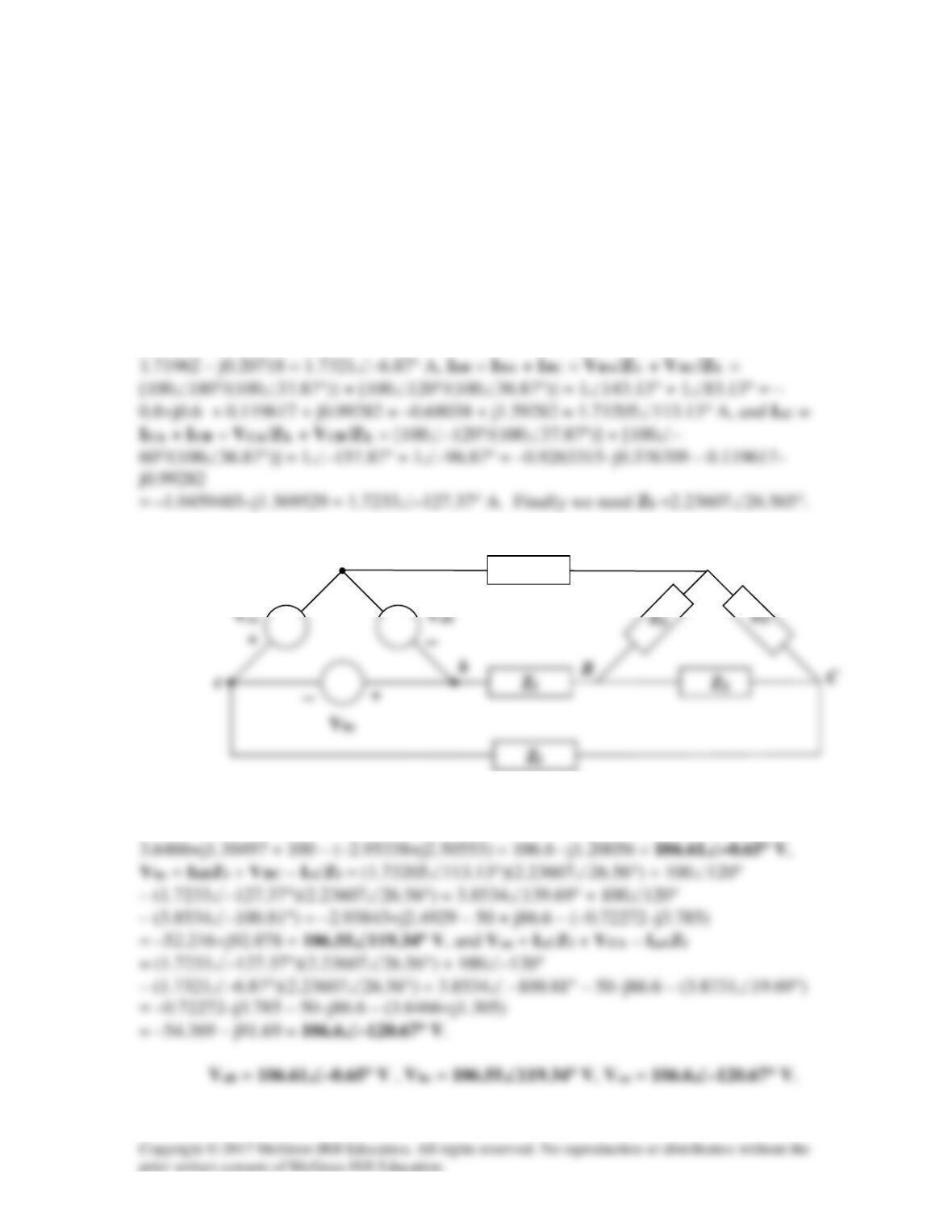
Find the line currents IaA, IbB, and IcC in the three-phase network of Fig. 12.53 below.
Take ZL= (114 + j87) Ω and Zl = (2 + j ) Ω.
Figure 12.53
For Prob. 12.22.
Solution
Due to the line impedances, converting the ∆–connected source to a Y–connected source
will make solving this problem easier.
Therefore,
graphically by noting that the above circuit accurately shows the angles associated with
the delta connected source and that the corresponding wye connected sources connect at
the center, labeled n, of the delta connected sources. Also, Zp = (114+j87)/3 = (38 + j29)
Ω.
a
b
c
−
+
240∠120° V
240∠–120° V
240∠0° V
−
+
−
+
Z
L
Z
L
Z
L
A
B
C
Zl
Zl
Zl
Zl
Solution 12.23*
A balanced delta connected source is connected to a balanced delta connected load where
ZL = (80 + j60) Ω and Zl = (2 + j) Ω. Given that the load voltages are VAB = 100∠0° V,
VBC = 100∠120° V, and VCA = 100∠–120° V. Calculate the source voltages Vab, Vbc,
and Vca.
Solution
We know that IaA = IAB + IAC = VAB/ZL + VAC/ZL = [100/(100∠37.87°)] +
[100∠60°/(100∠36.87°)] = 1∠–36.87° + 1∠23.13° = 0.8–j0.6 + 0.91962 +j0.39282 =
+
−
−
+
Zl
Zl
Clearly Vab = IaAZl + VAB – IbBZl = (1.7321∠–6.87°)(2.23607∠26.56°) + 100 –
(1.73205∠113.13°)(2.23607∠26.565°) = 3.8731∠19.69° + 100 – (3.873∠139.69°) =
a
−
+
A
Zl
Solution 12.24
A balanced delta-connected source has phase voltage Vab = 880∠30° V and a positive
phase sequence. If this is connected to a balanced delta-connected load, find the line and
phase currents. Take the load impedance per phase as 60 ∠30°Ω and line impedance per
phase as 1 + j1Ω.
Solution
Convert both the source and the load to their wye equivalents.
We now use per-phase analysis.
20∠30° Ω
1 + j Ω
+
−
Van
Ia
Solution 12.25
Convert the delta-connected source to an equivalent wye-connected source and consider
the single-phase equivalent.
a3
)3010(440
Z
I°−°∠
=
Solution 12.26
Using Fig. 12.55, design a problem to help other students to better understand balanced delta
connected sources delivering power to balanced wye connected loads.
Problem
For the balanced circuit in Fig. 12.55, Vab = 125∠0° V. Find the line currents IaA, IbB, and IcC.
Figure 12.55
Solution
Transform the source to its wye equivalent.
Now, use the per-phase equivalent circuit.
Z
V
I
an
aA
=
,
°∠=−= 32–3.2815j24Z
Solution 12.27
Since ZL and
Z
are in series, we can lump them together so that
2 6 48 5
Y
Z jj j=+++ =+
Solution 12.28
The line-to-line voltages in a wye-load have a magnitude of 880 V and are in the positive
sequence at 60 Hz. If the loads are balanced with Z1 = Z2 = Z3 = 25∠30˚, find all line
currents and phase voltages.
Solution
Solution 12.29
We can replace the delta load with a wye load, ZY = ZΔ/3 = 17+j15Ω. The per–phase
equivalent circuit is shown below.
Zl
Solution 12.30
Since this a balanced system, we can replace it by a per-phase equivalent, as shown
below.
Solution 12.31
A balanced delta-connected load is supplied by a 60-Hz three-phase source with a line
voltage of 480V. Each load phase draws 24 kW at a lagging power factor of 0.8. Find:
(a) the load impedance per phase
(b) the line current
(c) the value of capacitance needed to be connected in parallel with each load phase to
minimize the current from the source.
Solution
(a)
30kVA8.0/24
,8.0cos,000,24 =====
θ
P
pp
P
SP
and θ = 36.87°
(c ) We find C to bring the power factor to unity
Solution 12.32
Design a problem to help other students to better understand power in a balanced three-
phase system.
Although there are many ways to solve this problem, this is an example based on the
same kind of problem asked in the third edition.
Problem
A balanced wye load is connected to a 60-Hz three–phase source with Vab = 240∠0˚V.
The load has lagging pf =0.5 and each phase draws 5 kW. (a) Determine the load
impedance ZY. (b) Find Ia, Ib, and Ic.
Solution
(a)
240
| | 3 240 138.56
3
ab p p
VV V= = → = =
30o
an p
VV= <−
But
22
2
*
138.56 0.96 1.663
pp
VV
(b)
138.56 30 72.17 90 A
0.96 1.6627
o
o
an
a
Y
V
IZj
<−
= = = <−
+
= 72.17∠–90° A
Solution 12.33
θ∠= LL IV3S
LL IV3S == S
Solution 12.34
3
220
3
V
V
L
p
==
Solution 12.35
(a) This is a balanced three–phase system and we can use per phase equivalent circuit.
The delta-connected load is converted to its wye-connected equivalent
IL
+
230 V Z’y Z’’y
–
Solution 12.36
(b)
49.5252.59
42003
10)6614.075.0(
3
3
6
**
j
x
xj
V
S
IIVS
p
pp
p
+=
+
==→
=
Solution 12.37
The total power measured in a three-phase system feeding a balanced wye–connected
load is 12 kW at a power factor of 0.6 leading. If the line voltage is 440 V, calculate the
line current IL and the load impedance ZY.
Solution
20
6.0
12
pf
P
S===
kVA also θ = –53.13°
For a Y-connected load,
pL
II =
.
Solution 12.38
As a balanced three–phase system, we can use the per-phase equivalent shown below.
14j10
0110
)12j9()2j1(
0110
a+
°∠
=
+++
°∠
=I