Accounting Information Systems, 10e 1
SOLUTIONS FOR CHAPTER 12
Each end-of-chapter question in the Solutions Manual is tagged to correspond with AACSB, AICPA
and CISA standards, allowing professors to more easily manage the task of reporting outcomes to these
professional and accrediting bodies. Please see the corresponding spreadsheet file for the tagging
information.
Discussion Questions
DQ 12-1 Refer to the operations process (effectiveness) goals shown in the control matrix,
Figure 12.13. Referring to goals A (purchasing) and B (receiving), describe a
goal other than the one discussed in the chapter.
ANS. Purchasing operations goals (sample):
• (Contained in Figure 12.13.) Select a vendor who will provide the best quality
at the lowest price by the required delivery date.
• Support other organizational units through a prompt purchasing process and
through the timely notice of purchases placed.
Receiving operations goals (sample):
• (Contained in Figure 12.13.) Ensure that the right goods in the correct amount
are received in acceptable condition in a timely manner.
• Process only authorized receipts.
2 Solutions for Chapter 12
DQ 12-2 Explain why ambiguities and conflicts exist among operations process goals, and
discuss potential ambiguities and conflicts relative to the effectiveness goals you
described in DQ 12-1.
ANS. Conflicts exist because each organizational unit wants to do its best (or at least be
seen as doing its best). However, many (perhaps any) individual units cannot
perform at their best because trade-offs must be made so that the organization as a
whole can do its best.
• Adequate research may not precede a quickly prepared purchase order.
• To ensure authorized receipts, we may provide the receiving department with
complete copies of the purchase order. Without a blind copy of the purchase
order, receiving clerks may not pay attention to counting the goods.
• To maintain an adequate stock of vendors, we may purchase goods with
varying degrees of quality.
DQ 12-3 In designing vendor records, what specific data elements would you include to
help you select the best vendor for a particular purchase? Be specific as to the
nature of the data to be stored, where it would come from, and how it would be
used in the selection process.
ANS. Accumulate purchase amounts into a year–to-date purchases field to do the
following:
Accounting Information Systems, 10e 3
DQ 12-4 Without redrawing the figures, discuss how Figures 12.3, 12.4, 12.6, 12.7, and
12.9 would change as a result of purchasing a technical product that could not be
inspected in the receiving department, but had to undergo quality control testing
before being accepted.
ANS. Figure 12.9, bubble 3.1, and the related portions of Figure 12.4 would be affected.
A copy of the purchase order (including the technical specifications), the packing
DQ 12-5 Figure 12.9 (the DFD depicting the receipt of goods and services) shows an
update to the vendor master data from bubble 3.1 and another update to that
same data from bubble 3.2. Discuss the difference(s) between these two updates.
Be specific as to the nature of the data being updated in each case. How would
your answer to this question be affected by your assumption about whether the
PO receiving notification entering bubble 3.1 was “blind” as to quantities?
Explain.
ANS. The update at Figure 12.9, bubble 3.1, will be for the Product Rejection Rate
field. The update at Figure 12.9, bubble 3.2, will be for the Vendor Lead Time and
Product Fill Rate fields. The latter update cannot be performed in bubble 3.1
4 Solutions for Chapter 12
DQ 12-6 In terms of effectiveness and efficiency of operations, as well as of meeting the
generic information system control goals of validity, completeness, and accuracy,
what are the arguments for and against each of the following?
a. Sending a copy of the PO from the purchasing department to the receiving
department.
ANS. ● The receiving department can establish a tickler file to ensure complete and
timely processing of receipts. Timely processing should also lead to greater
opportunity to take cash discounts.
ANS. ● If the purchase order copy is blind as to quantities, receiving personnel must
count every item received, thus ensuring that the right amounts are received.
Accounting Information Systems, 10e 5
DQ 12-7 “Auditors will never allow an organization to adopt a paperless system, so why
do we waste our time bothering to study them?” Discuss fully.
ANS. Several points could be made regarding this statement. Some points relate to the
issues of risks and controls, whereas others relate to the behavioral issues around
the relationship of the auditor and the organization. The following points, in no
particular order, some in the form of questions, might be discussed:
• Which auditor are we talking about, the internal auditor or the external?
• Should an auditor have veto power over business process features?
6 Solutions for Chapter 12
Short Problems
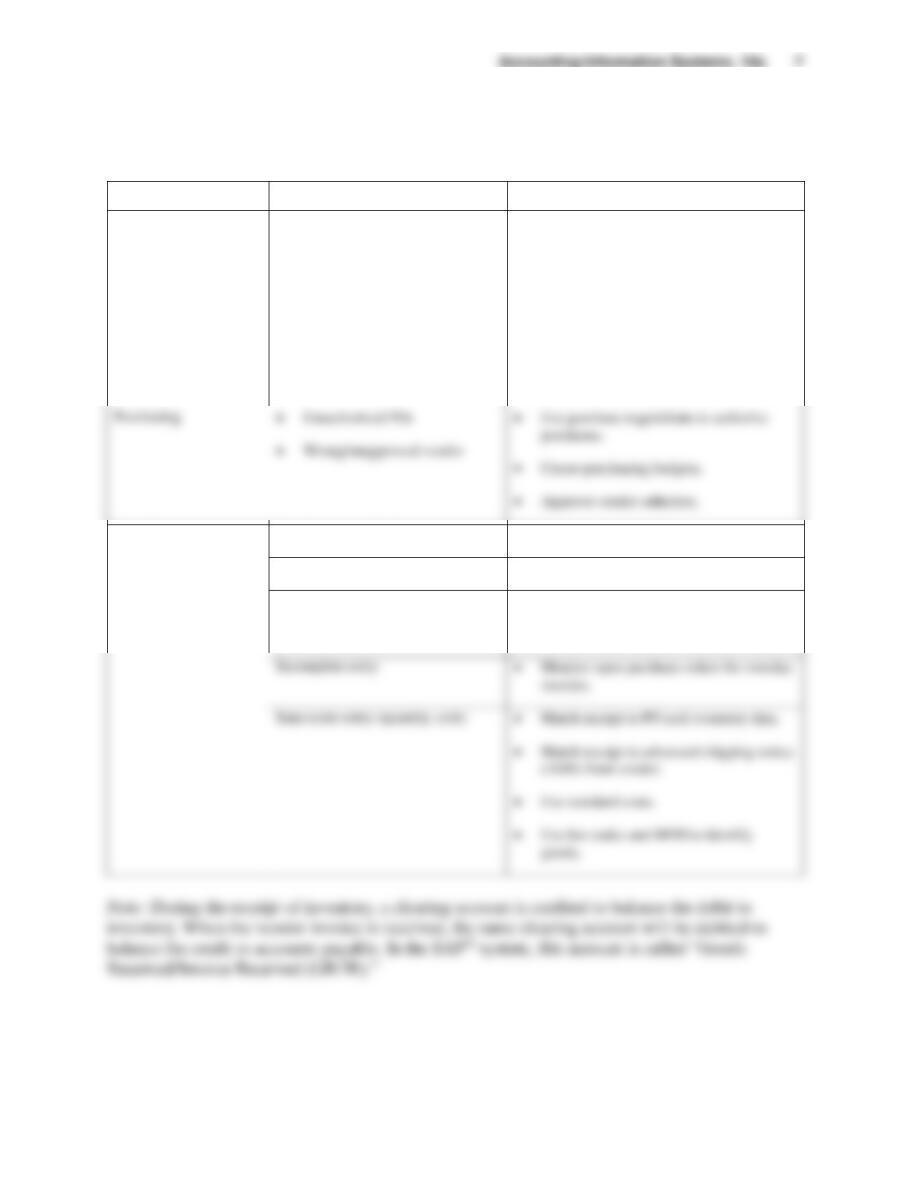
SP 12-1 ANS.1
Criteria
Bar
Code
RFID
Tag
Explanation
Need to be a geek to understand
the concept.
•
Need to understand technology, including
radio waves.
Reading of data affected by
laws of physics.
•
Metals and liquids can interfere with RFID
readers. (Although liquids may damage
barcodes.)
Can require significant data
storage.
•
RFID-enabled supply chains can generate 10
to 100 times more information than bar
codes.
Can be read at highway speeds.
•
RFID toll passes can be read at highway
speeds.
Protects privacy better.
•
Data volume is limited that can be stored
and read from bar codes.
Tracks hospital patients and
equipment.
•
•
RFID tags and barcodes can be attached to
patients and affixed to equipment. RFID
tags may also be implanted.
1 Adapted from Thomas Wailgum, “Technology Showdown: The Bar Code Versus RFID,” CIO, July 24, 2007.
Least expensive.
•
RFID tags can cost from 5 cents up to
several dollars. Bar code labels are fractions
of pennies (the cost of ink).
Oldest.
•
RFID used in World War II to identify
airplanes. Bar codes first used commercially
about 1975.
Currently necessary for logistics
at UPS and FedEx.
•
UPS and FedEx still depend mostly on bar
codes.
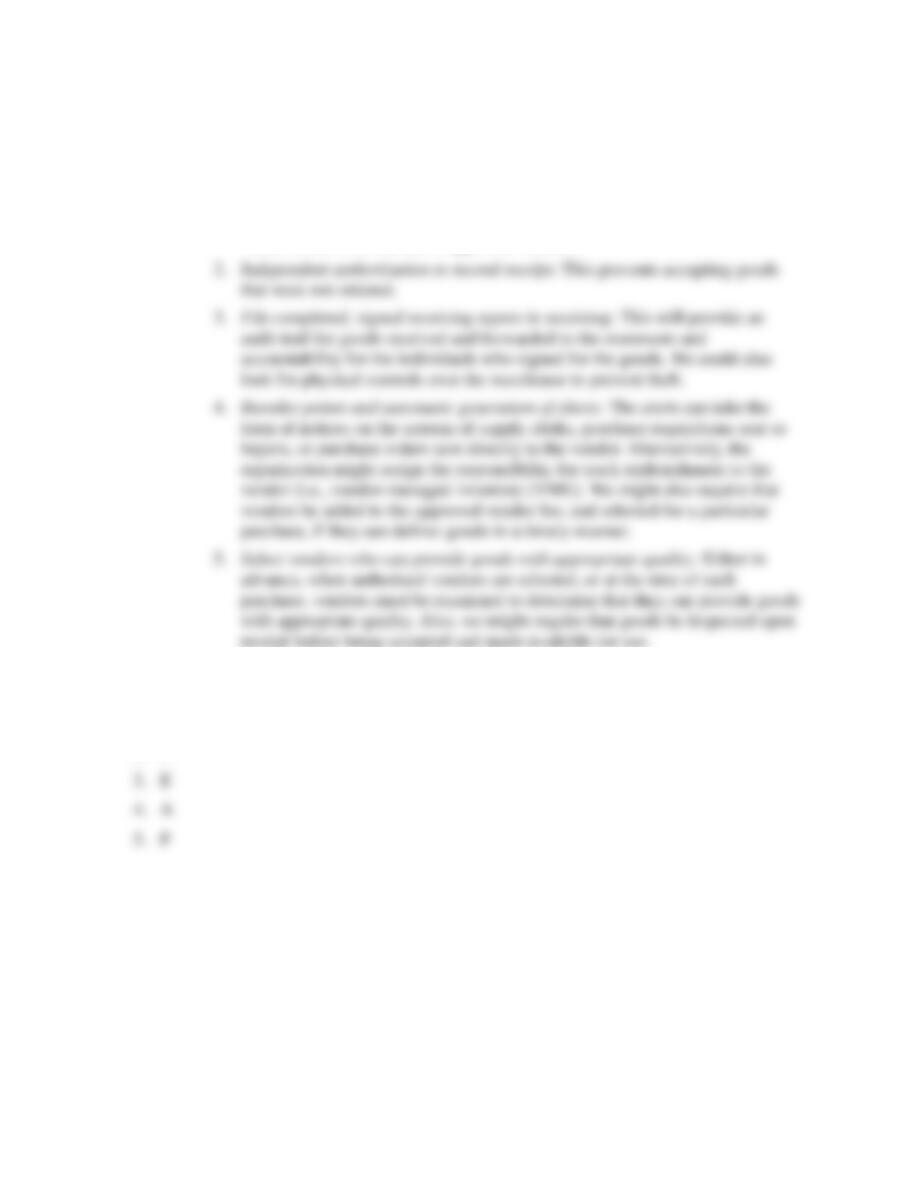
SP 12-2 ANS.
Function
Risks
Controls and Technology
Logistics
• Poor supply chain planning:
o Wrong, poor vendors
o Poor quality of goods
o Too much inventory, not
enough inventory
• Inadequate receiving capacity
and security
• Establish collaborative relationships with
suppliers, such as VMI and CPFR.
• Preapprove vendors.
• Audit vendors for process quality (e.g.,
ISO).
• Secure receiving area (locks, cameras,
etc.).
Receiving
Inventory (debit)
??? (credit)
Goods never ordered
Match receipt to open POs.
Wrong/damaged goods
Inspect and count goods.
Invalid entry (goods not received)
• Enter receipts in receiving.
• Use bar codes or electronic tags (RFID).
8 Solutions for Chapter 12
SP 12-3 ANS. 1. Approve purchase order: The purchasing agent’s selected vendor should be
approved by the purchasing manager. We might also ask employees, including
buyers, to sign a code of conduct indicating that they have no financial interest
in vendors or other organizations with which their employing firm does
business. We could also require that vendors be investigated for these
potential conflicts of interest, such as ownership by employees, before the
vendor is added to the list of approved vendors.
receipt before being accepted and made available for use.
SP 12-4 ANS.
1. D
2. C
Accounting Information Systems, 10e 9
Problems
Problems 1 and 2
Note: In the pages that follow, we provide solutions for problems 1 and 2 for both of the Case
Studies (Cases A and B), as applicable. Although the solution for each case study comprises
several pages, it is not necessarily comprehensive, nor does it represent the only acceptable
answers. Your or your students’ answers may easily vary in two areas. First, the grouping on the
annotated table of entities and activities determines the configuration of the current logical DFD.
PureProducts Company (Purchasing and receiving) Solutions (see Note on page 8)
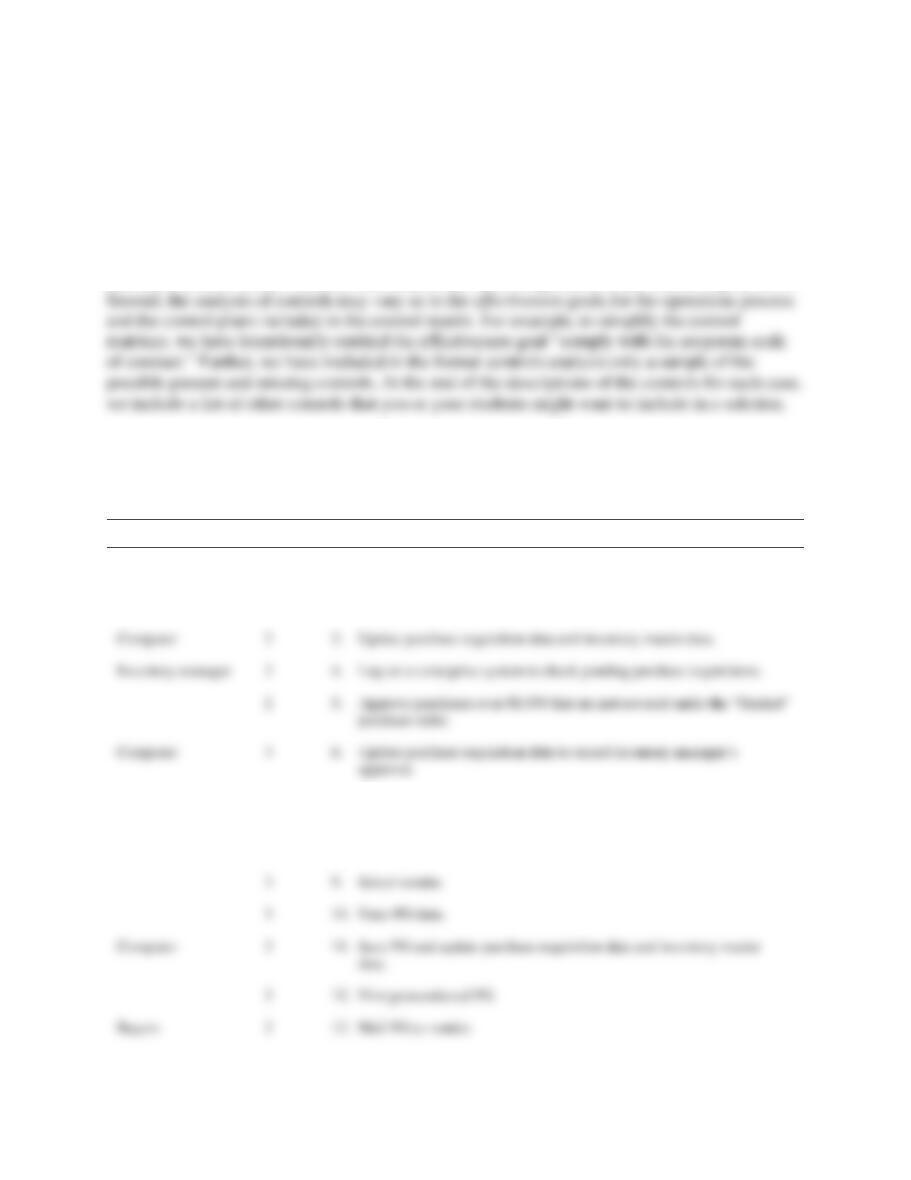
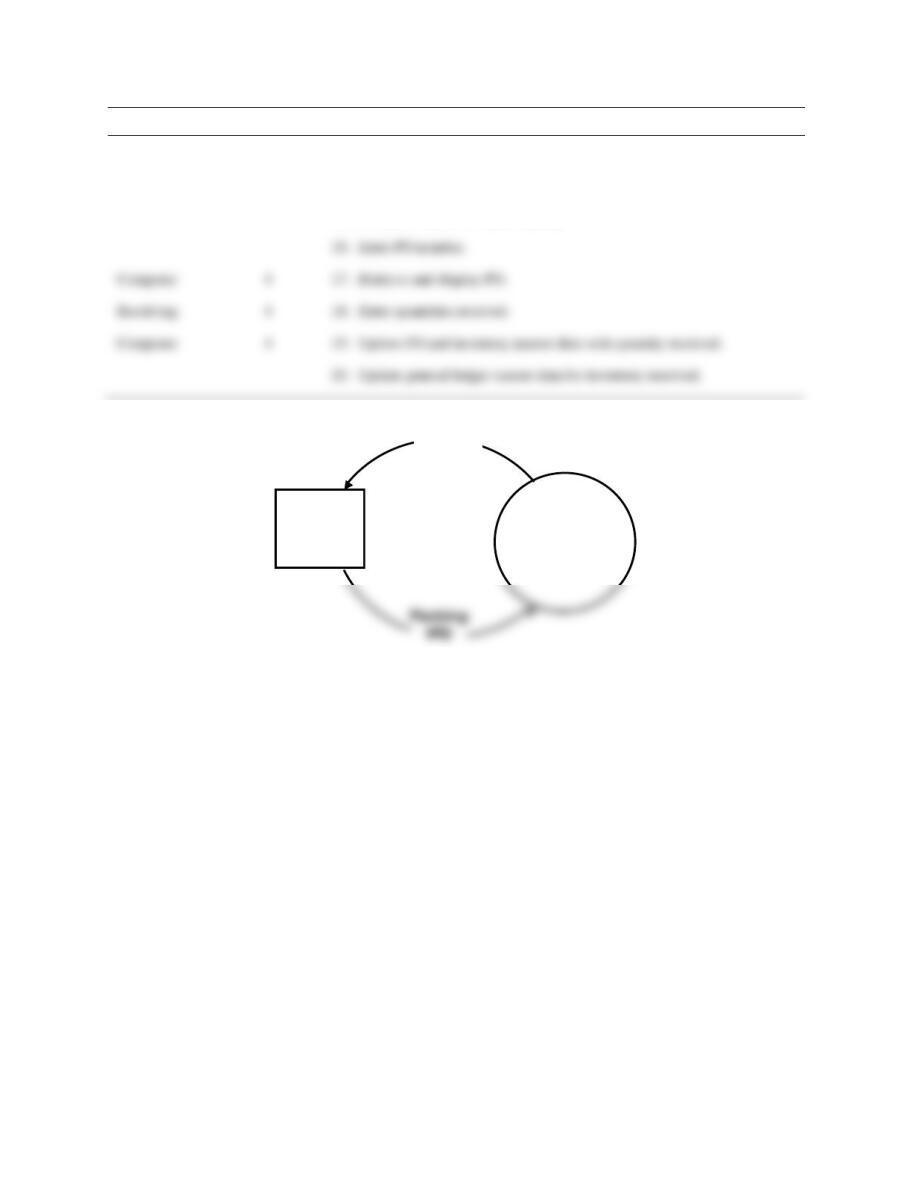
P 12-1 ANS. a. Table of Entities and Activities for PureProducts (Purchasing and receiving)
Entities
Para
Activities
Computer
2
1. Read inventory master data and prepare online report for items that have
reached reorder point.
Supplies clerk
2
2. Review online report and prepare purchase requisitions.
2
5. Approve purchases over $1,000 that are not covered under the “blanket”
purchase order.
3
6. Update purchase requisition data to record inventory manager’s
approval.
3
7. Read purchase requisition data and vendor master data and display to
buyers.
Buyers
3
8. View approved purchase requisitions and list of vendors.
Computer
3
11. Save PO and update purchase requisition data and inventory master
data.
10 Solutions for Chapter 12
Entities
Para
Activities
Vendor
3
Receiving
4
14. Inspect and count goods received from vendor.
4
15. Compare count to the packing slip.
Vendor Purchasing
process
Purchase
order
FIGURE SM-12.1 Problem 1, Part b Solution—Context Diagram for PureProducts Company
(Purchasing and Receiving)
16. Enter PO number.
Computer
4
17. Retrieve and display PO.
Receiving
4
18. Enter quantities received.
Computer
4
19. Update PO and inventory master data with quantity received.
20. Update general ledger master data for inventory received.
Accounting Information Systems, 10e 11
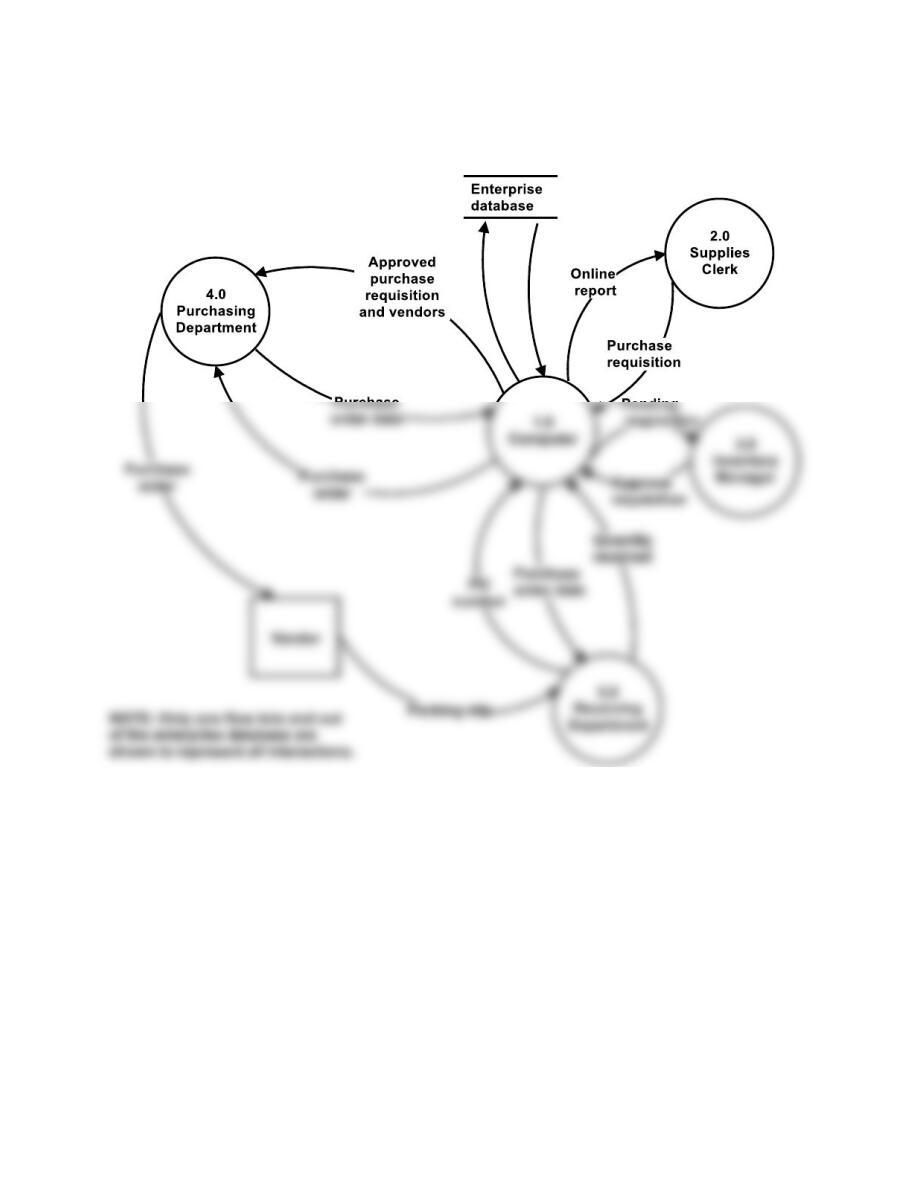
FIGURE SM-12.2 Problem 1, Part c Solution—Physical DFD for PureProducts Company
(Purchasing and Receiving)
12 Solutions for Chapter 12
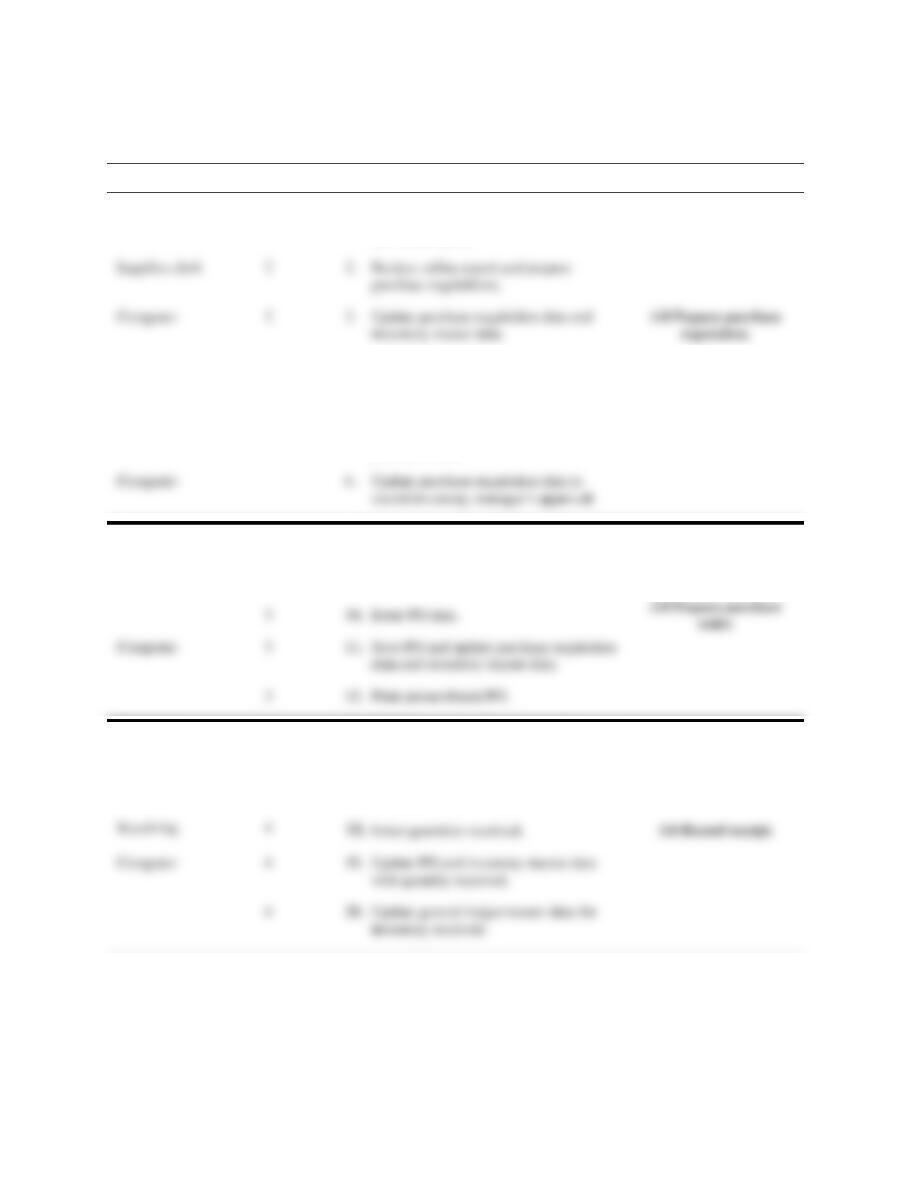
P 12-1 ANS. d. Table of Entities and Activities (Annotated) for PureProducts Company
(Purchasing and receiving)
Entities
Para
Activities
Process
Computer
2
1. Read inventory master data and prepare
online report for items that have reached
the reorder point.
Inventory manager
2
4. Log on to enterprise system to check
pending purchase requisitions.
2
5. Approve purchases over $1,000 that are
not covered under the “blanket”
purchase order.
Computer
6. Update purchase requisition data to
Buyers
3
8. View approved purchase requisitions and
list of vendors.
Computer
3
11. Save PO and update purchase requisition
data and inventory master data.
3
12. Print prenumbered PO.
3
9. Select vendor.
Receiving
4
15. Compare count to the packing slip.
Computer
4
19. Update PO and inventory master data
with quantity received.
4
20. Update general ledger master data for
inventory received.
16. Enter PO number.
Computer
4
17. Retrieve and display PO.
Supplies clerk
2
2. Review online report and prepare
purchase requisitions.
Computer
2
3. Update purchase requisition data and
inventory master data.
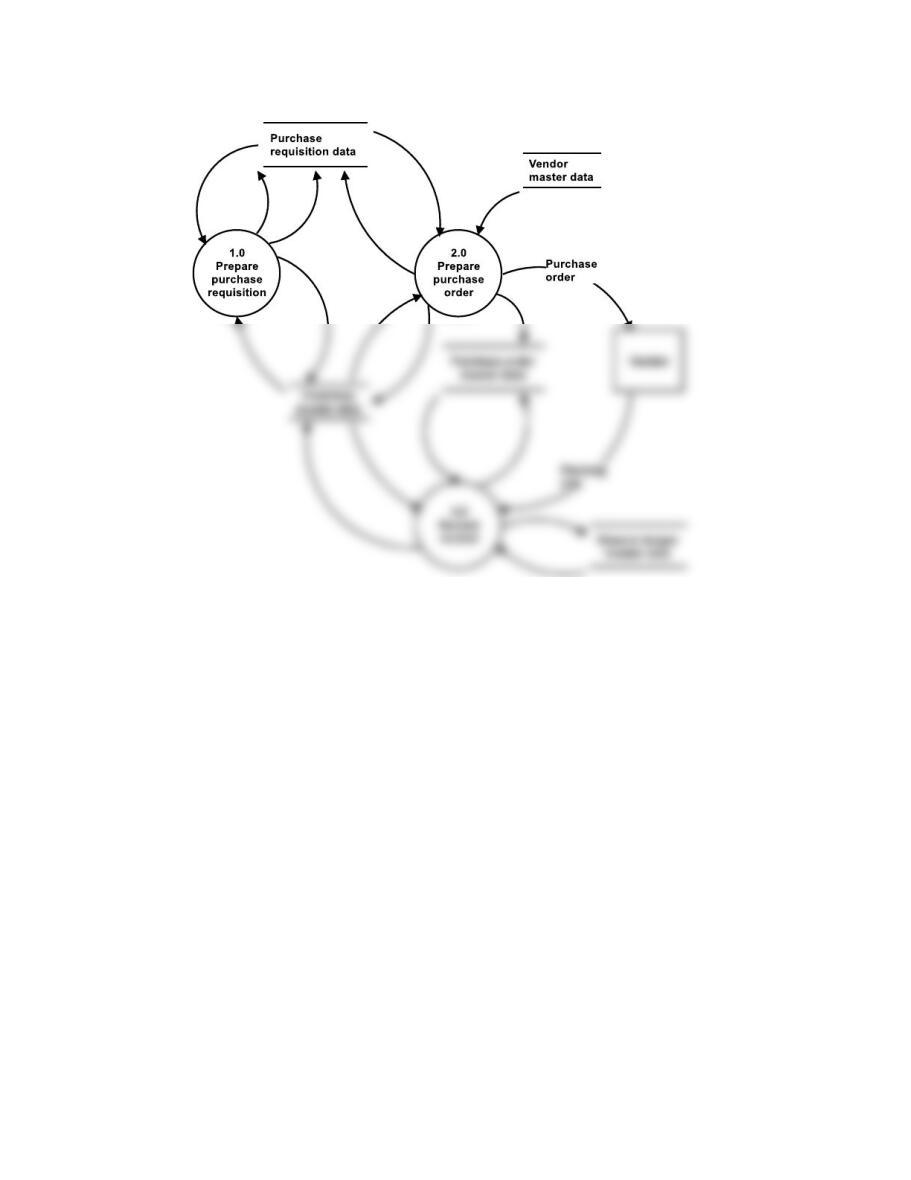
Accounting Information Systems, 10e 13
FIGURE SM-12.3 Problem 1, Part e Solution—Logical DFD for PureProducts Company
(Purchasing and Receiving)
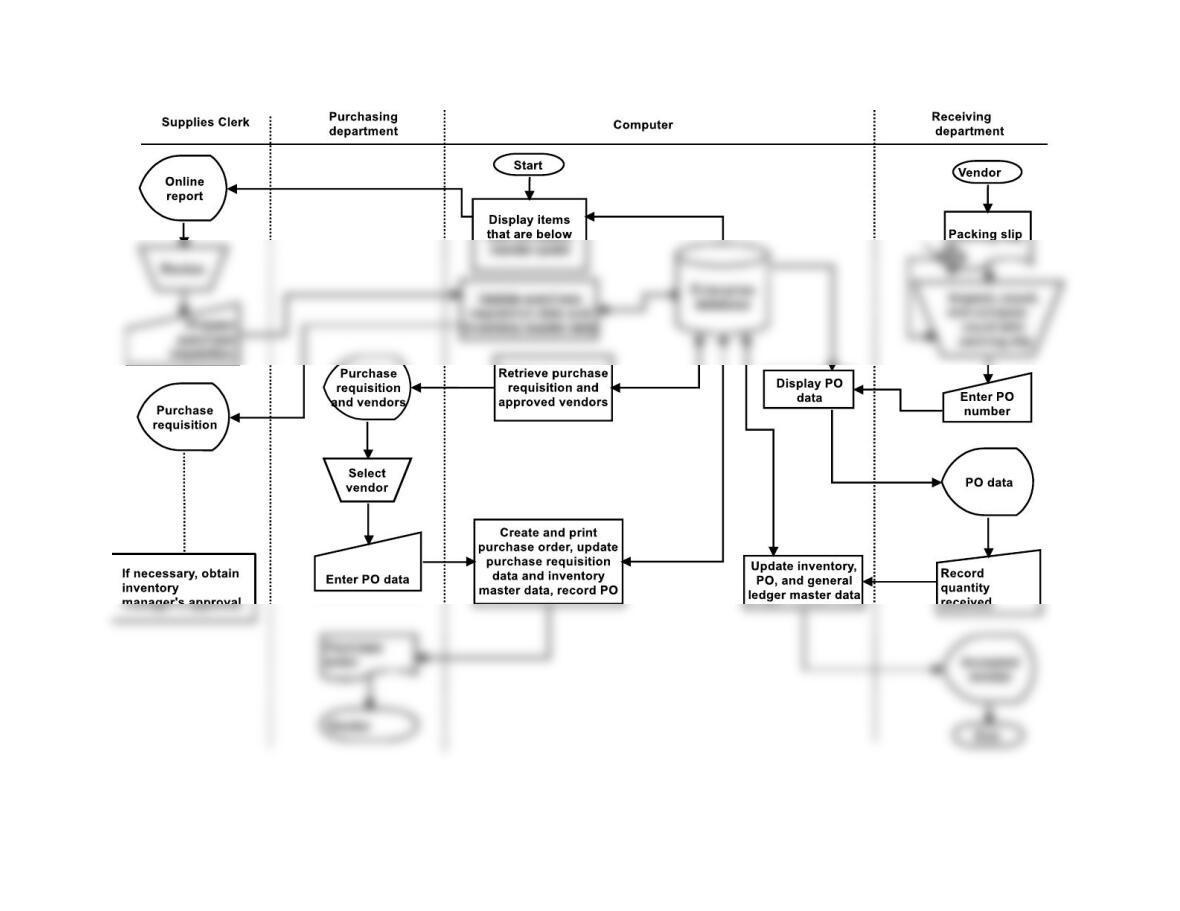
14 Solutions for Chapter 12
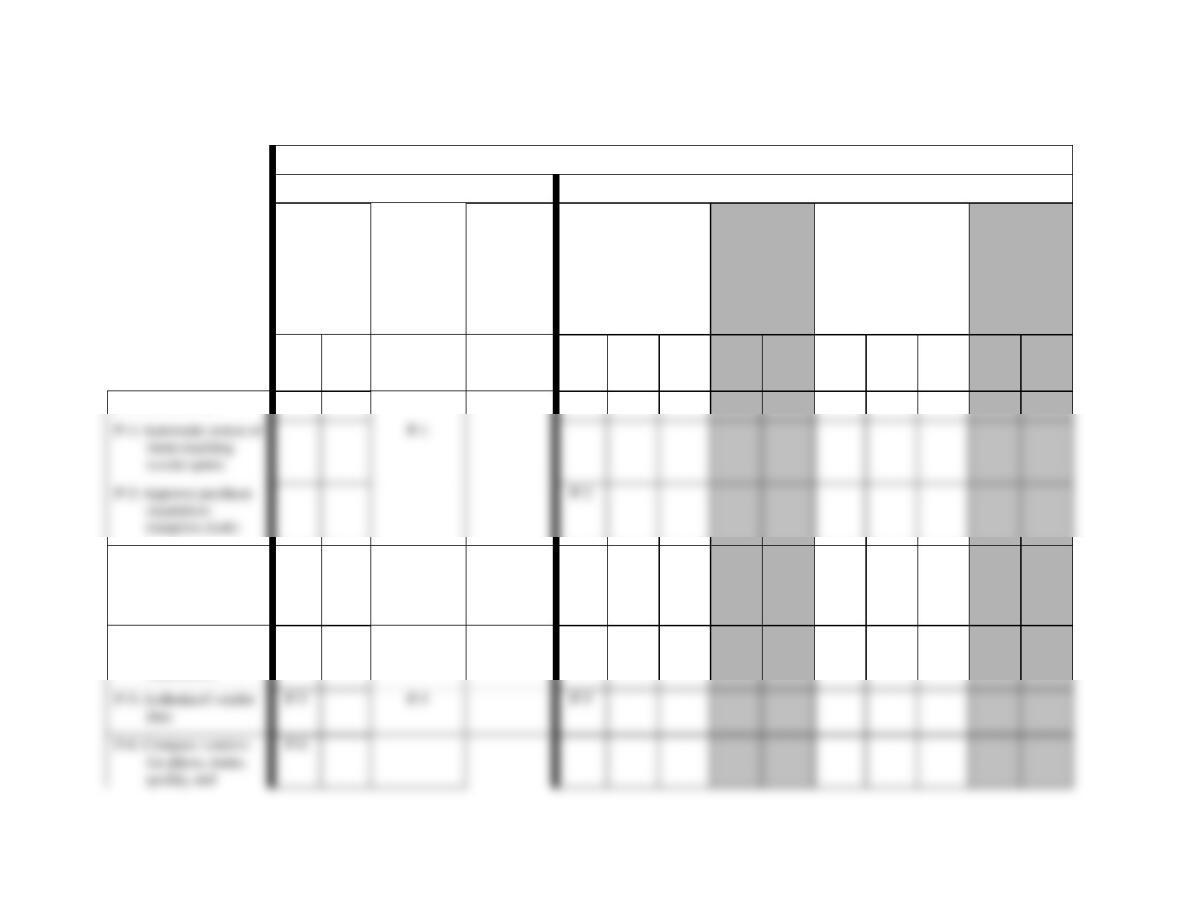
Accounting Information Systems, 10e 15
FIGURE SM-12.4 Problem 2, Part a Solution—Systems Flowchart for PureProducts Company (Purchasing and Receiving)
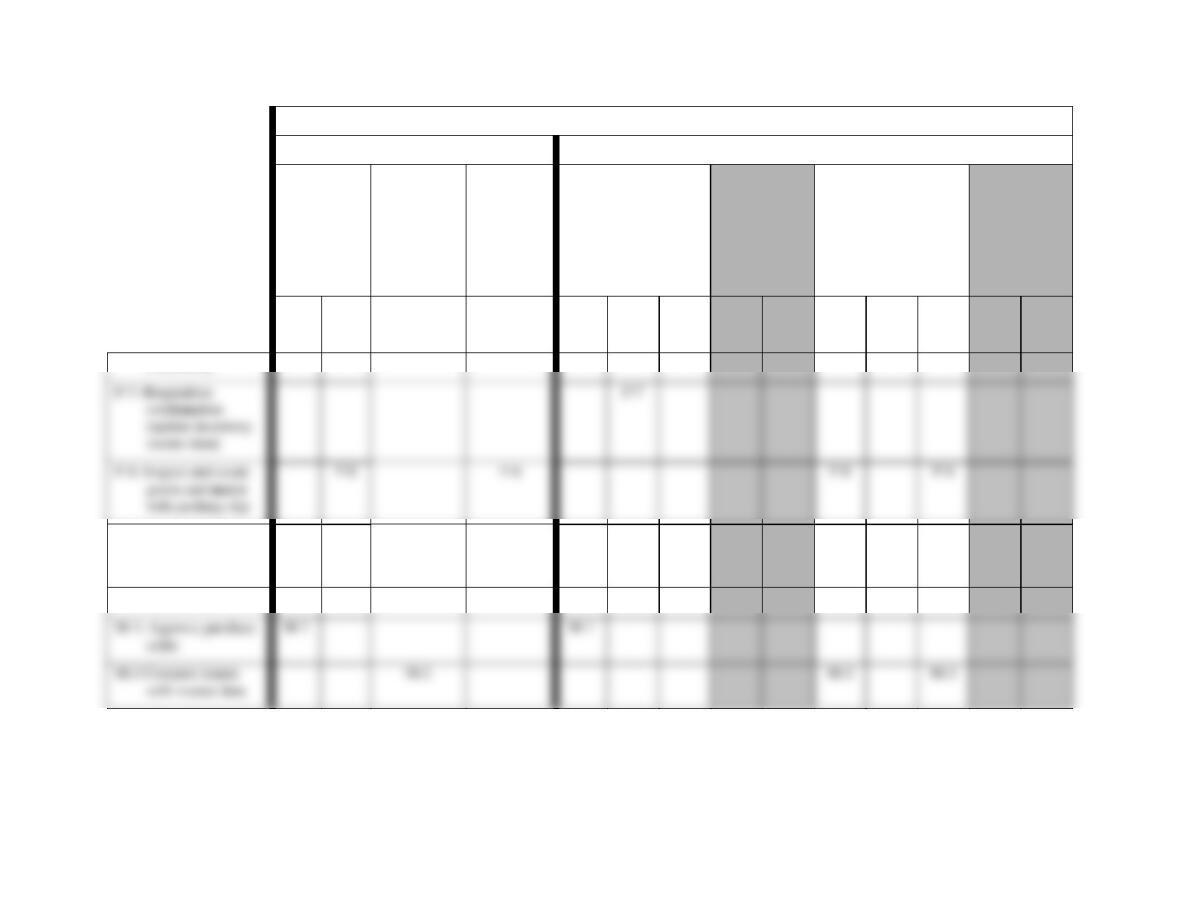
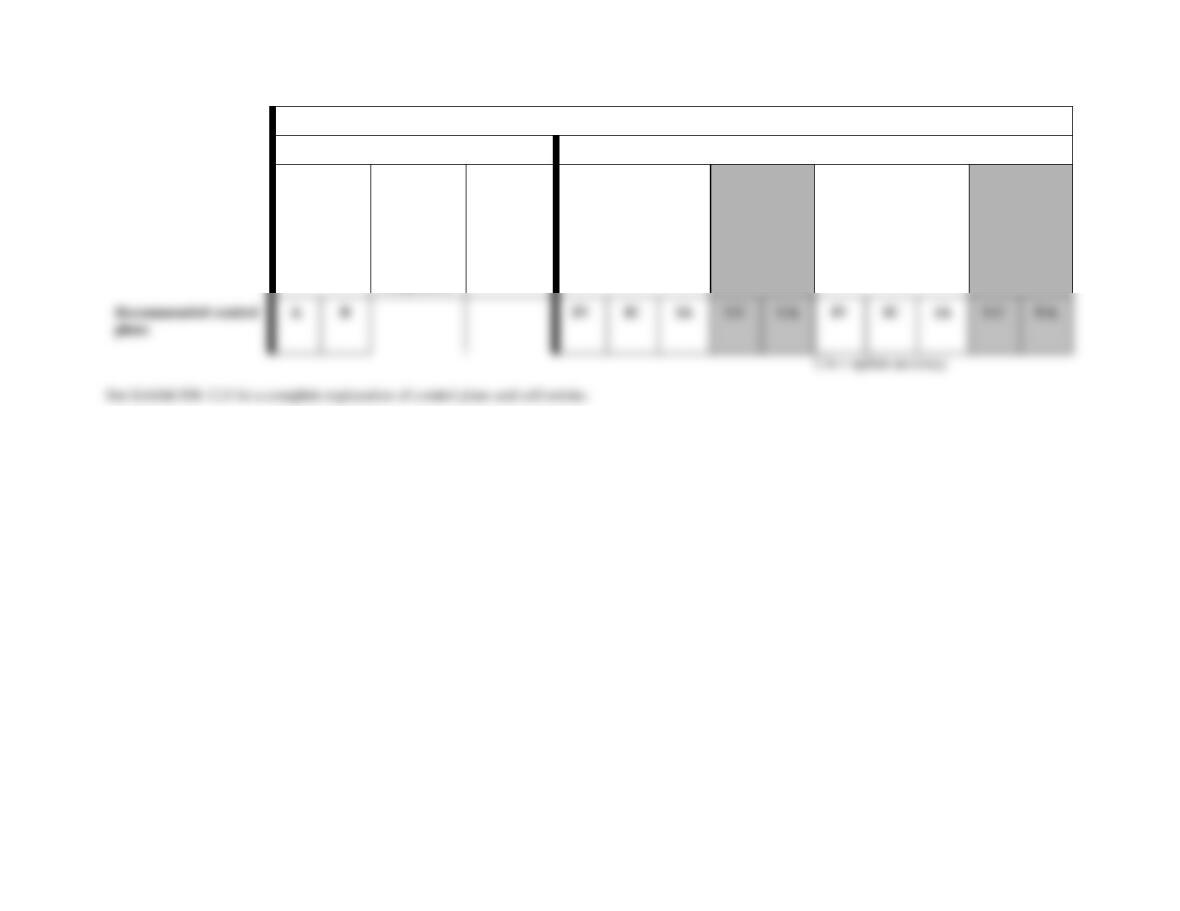
Control Goals of the PureProducts Company Purchasing and Receiving Business Process
Control Goals of the Operations Process
Control Goals of the Information Process
Ensure
effectiveness
of
operations
Ensure
efficient
employ-
ment of
resources
(people and
computers)
Ensure
security of
resources
(inventory,
PO master
data)
For purchase
requisition inputs,
ensure:
For purchase
order master
data, ensure:
For vendor packing
slip inputs, ensure:
For purchase
order master
data, ensure:
Recommended control
plans
A
B
IV
IC
IA
UC
UA
IV
IC
IA
UC
UA
Present controls
P-3: Approve purchase
requisition
(inventory
manager)
P-3
P-4: Automatic notice of
open purchase
requisitions
P-4
P-4
16 Solutions for Chapter 12
Control Goals of the PureProducts Company Purchasing and Receiving Business Process
Control Goals of the Operations Process
Control Goals of the Information Process
Ensure
effectiveness
of
operations
Ensure
efficient
employ-
ment of
resources
(people and
computers)
Ensure
security of
resources
(inventory,
PO master
data)
For purchase
requisition inputs,
ensure:
For purchase
order master
data, ensure:
For vendor packing
slip inputs, ensure:
For purchase
order master
data, ensure:
Recommended control
plans
A
B
IV
IC
IA
UC
UA
IV
IC
IA
UC
UA
availability
P-9: Populate input
screens with
master data
P-9
P-9
P-9
Missing controls
Possible effectiveness goals include the following:
A – Select a vendor who will provide the best quality at the lowest price by the required delivery date
B – Ensure that the right goods in the correct amount are received in acceptable condition in a timely manner
IV = input validity
IC = input completeness
IA = input accuracy
UC = update completeness
Accounting Information Systems, 10e 17
Control Goals of the PureProducts Company Purchasing and Receiving Business Process
Control Goals of the Operations Process
Control Goals of the Information Process
Ensure
effectiveness
of
operations
Ensure
efficient
employ-
ment of
resources
(people and
computers)
Ensure
security of
resources
(inventory,
PO master
data)
For purchase
requisition inputs,
ensure:
For purchase
order master
data, ensure:
For vendor packing
slip inputs, ensure:
For purchase
order master
data, ensure:
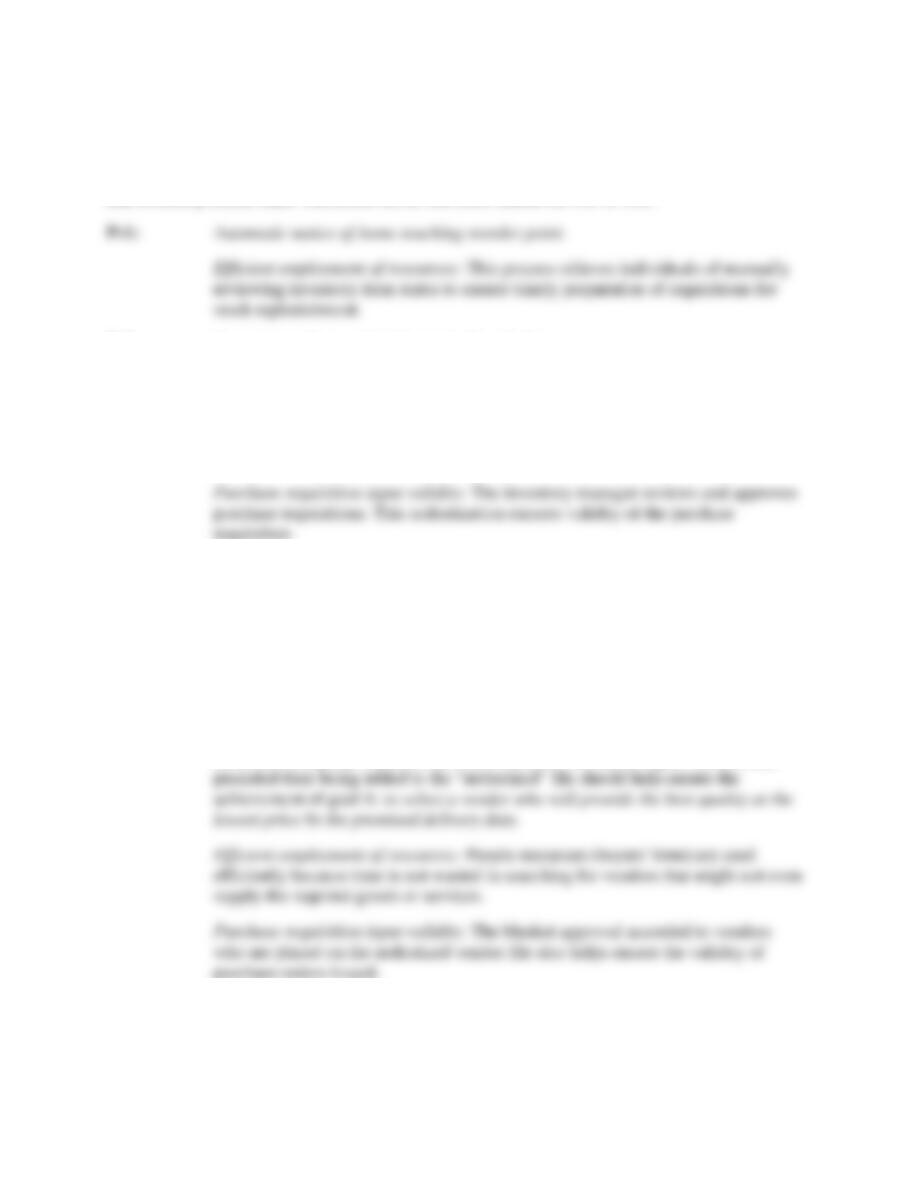
FIGURE SM-12.5 Problem 2, Part b (Partial)—Control Matrix for PureProducts Company (Purchasing and Receiving)
18 Solutions for Chapter 12
Exhibit SM-12.1 Problem 2, Part b Solution (Partial)—Explanation of Cell Entries for
Control Matrix in Figure SM-12.5
Note: Purchase requisition and packing slip inputs result in immediate updates to purchase order
and inventory master data. Therefore, we do not show entries for UC or UA.
P-2: Approve purchase requisition (supplies clerk).
Purchase requisition input validity: Supply clerks review and approve suggested
inventory replenishment purchases to ensure that the purchase should be made.
This authorization ensures validity of the purchase requisition.
P-3: Approve purchase requisition (inventory manager).
P-4: Automatic notice of open purchase requisitions.
Efficient employment of resources, purchase requisition input completeness: This
process relieves individuals of manually reviewing open purchase requisitions to
ensure timely preparation and input of purchase orders.
P-5: Authorized vendor data.
Effectiveness goal A: The computer provides the buyers in the purchasing
department with a list of appropriate vendors from a database of vendors with
which the company is authorized to do business. The screening of vendors that
Accounting Information Systems, 10e 19
P-6: Compare vendors for prices, terms, quality, and availability.
Effectiveness goal A: Buyers in the purchasing department select vendors that are
P-7: Requisition confirmation (update inventory master data).
Purchase requisition input completeness: After the purchase order has been
P-8: Inspect and count goods and match with packing slip.
Effectiveness goal B: Inspection by the receiving clerk ensures that the goods are
in acceptable condition.
Security of resources: This comparison will ensure that goods that were shipped
by the vendor have been received and will be processed into the warehouse and
not lost or otherwise diverted.
Packing slip input validity and input accuracy: This comparison should ensure
that only goods that are actually received (validity) will be entered into the system
and will be entered correctly (accuracy).
P-9: Populate input screens with master data.
Efficient employment of resources: Automatic population of inputs from master
M-1: Approve purchase order.
Effectiveness goal A: Approval by a purchasing manager would ensure that the
vendor selection rules had been followed.
20 Solutions for Chapter 12
Efficient employment of resources: The computer would be better able to compare
the quantity on order on the PO data to the quantities entered than would the
receiving personnel who must perform the comparison manually.
Packing slip input validity and input accuracy: The computer comparison should
ensure entry only of items on order, and any differences would be flagged for
correction and re-input.