Chapter 12
Differential Analysis: The Key to Decision
Making
Solutions to Questions
12-1 A relevant cost is a cost that differs in
total between the alternatives in a decision.
12-2 An incremental cost (or benefit) is the
change in cost (or benefit) that will result from
12-3 No. Variable costs are relevant costs
only if they differ in total between the
alternatives under consideration.
12-4 No. Not all fixed costs are sunk—only
those for which the cost has already been
12-5 No. A variable cost is a cost that varies
in total amount in direct proportion to changes
12-6 No. Only those future costs that differ
between the alternatives are relevant.
12-7 Only those costs that would be avoided
as a result of dropping the product line are
12-8 Not necessarily. An apparent loss may
be the result of allocated common costs or of
sunk costs that cannot be avoided if the product
is dropped. A product should be discontinued
only if the contribution margin that will be lost
as a result of dropping the product is less than
the fixed costs that would be avoided. Even in
that situation the product may be retained if it
promotes the sale of other products.
internally rather than to buy it from an outside
supplier, then a portion of the company’s
facilities have to be used to make the part. The
company’s opportunity cost is measured by the
benefits that could be derived from the best
alternative use of the facilities.
customers could be a constraint. Some examples
are machine time, direct labor time, floor space,
12–12 Assuming that fixed costs are not
affected, profits are maximized when the total
contribution margin is maximized. A company
can maximize its total contribution margin by
12–13 Joint products are two or more products
that are produced from a common input. Joint
costs are the costs that are incurred up to the
split-off point. The split-off point is the point in
the manufacturing process where joint products
can be recognized as individual products.
12–14 Joint costs should not be allocated
among joint products for decision-making
purposes. If joint costs are allocated among the
joint products, then managers may think they
12–15 If the incremental revenue from further
processing exceeds the incremental costs of
further processing, the product should be
processed further.
12–16 Most costs of a flight are either sunk
costs, or costs that do not depend on the
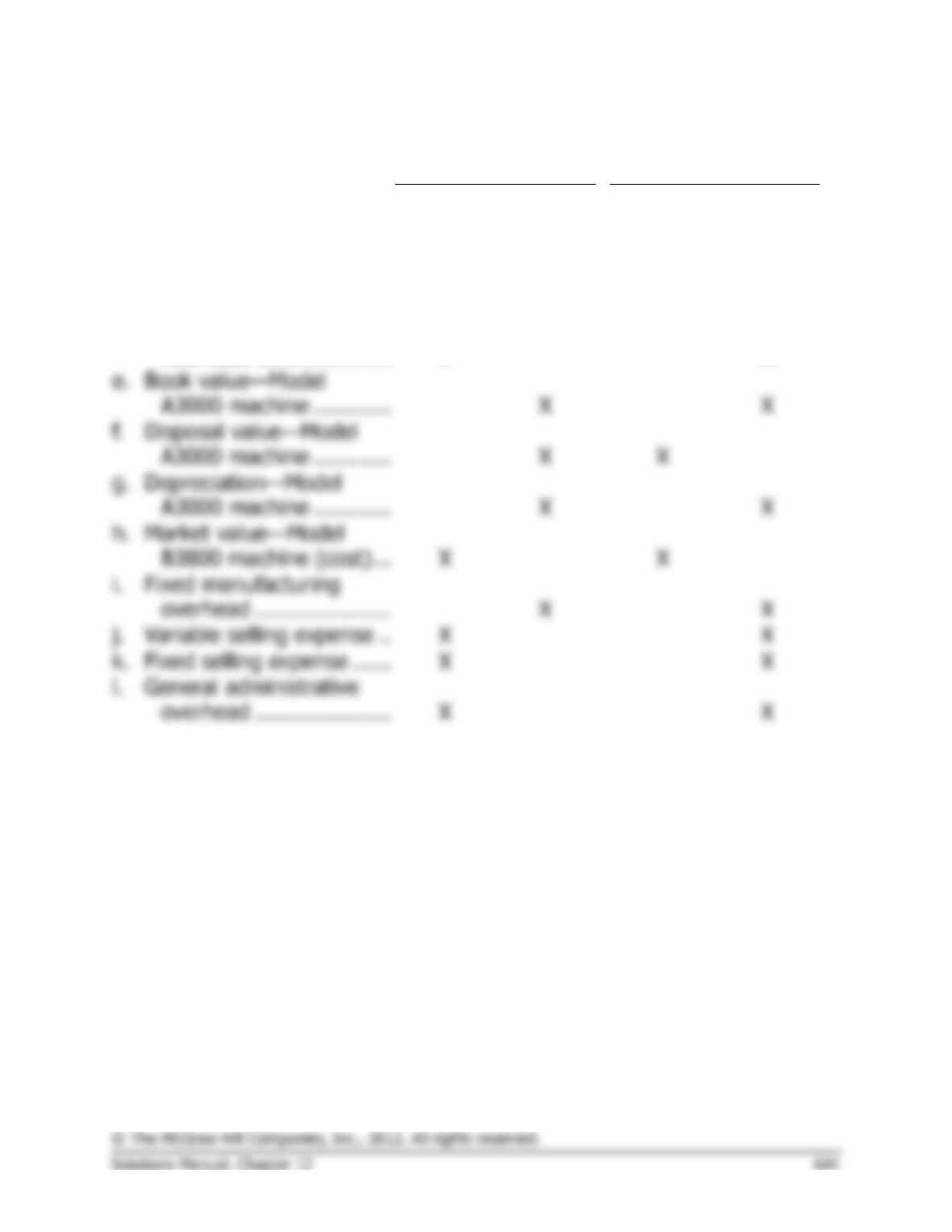
Exercise 12-1 (15 minutes)
Case 1
Case 2
Item
Relevant
Not
Relevant
Relevant
Not
Relevant
a.
Sales revenue ……………..
X
X
b.
Direct materials …………..
X
X
c.
Direct labor ………………..
X
X
d.
Variable manufacturing
overhead …………………
X
X
X
X
Disposal value—Model
X
X
g.
X
X
Market value—Model
B3800 machine (cost) …
X
X
Fixed manufacturing
X
X
Variable selling expense ..
X
X
Fixed selling expense ……
X
X
X
X
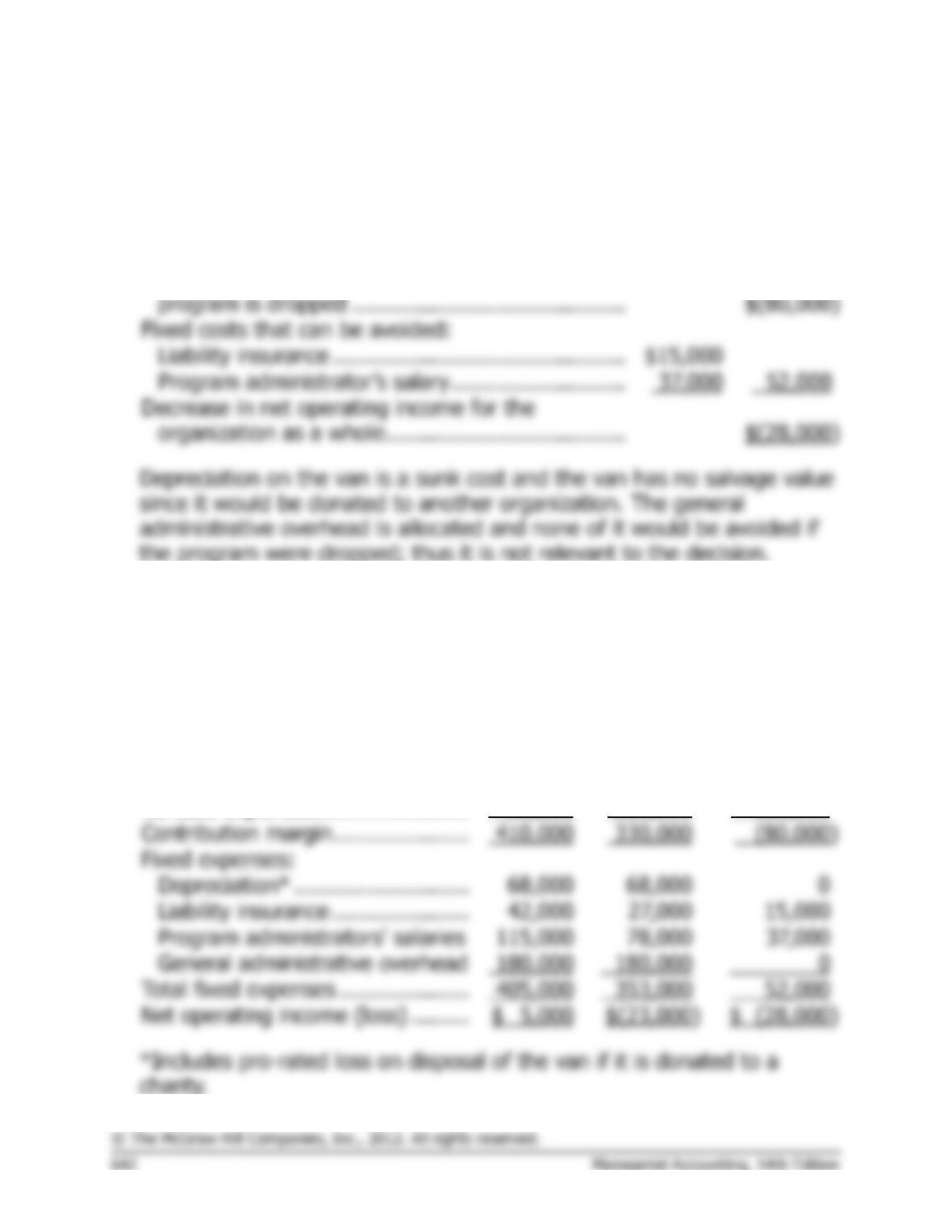
Exercise 12-2 (30 minutes)
1. No, the housekeeping program should not be discontinued. It is actually
generating a positive program segment margin and is, of course,
providing a valuable service to seniors. Computations to support this
conclusion follow:
Fixed costs that can be avoided:
$15,000
Decrease in net operating income for the
Contribution margin lost if the housekeeping
The same result can be obtained with the alternative analysis below:
Current
Total
Total If
House-
keeping Is
Dropped
Difference:
Net
Operating
Income
Increase or
(Decrease)
Revenues ………………………………
$900,000
$660,000
$(240,000)
Variable expenses ……………………
490,000
330,000
160,000
Contribution margin …………………
410,000
330,000
Fixed expenses:
180,000
Total fixed expenses ………………..
405,000
Net operating income (loss) ………
Exercise 12-2 (continued)
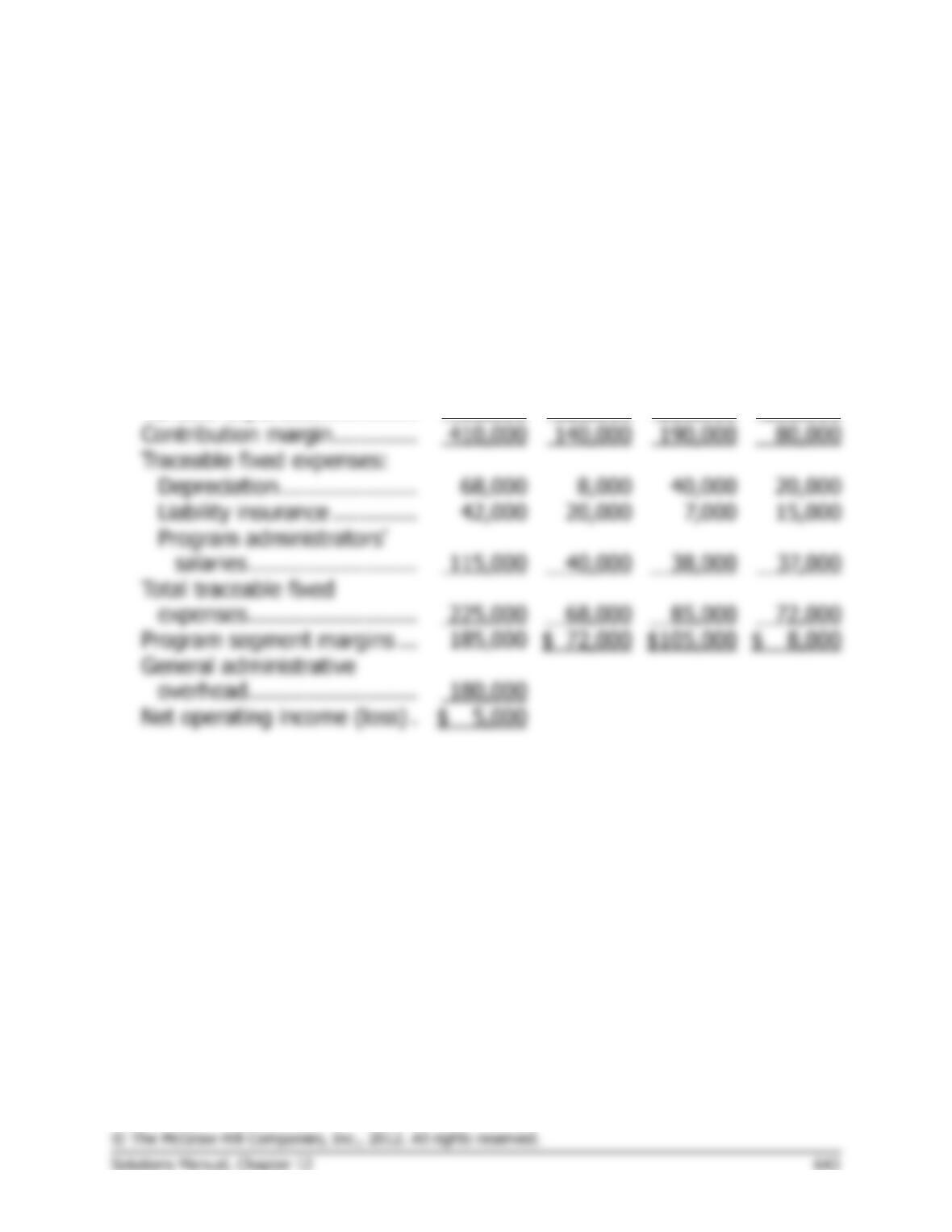
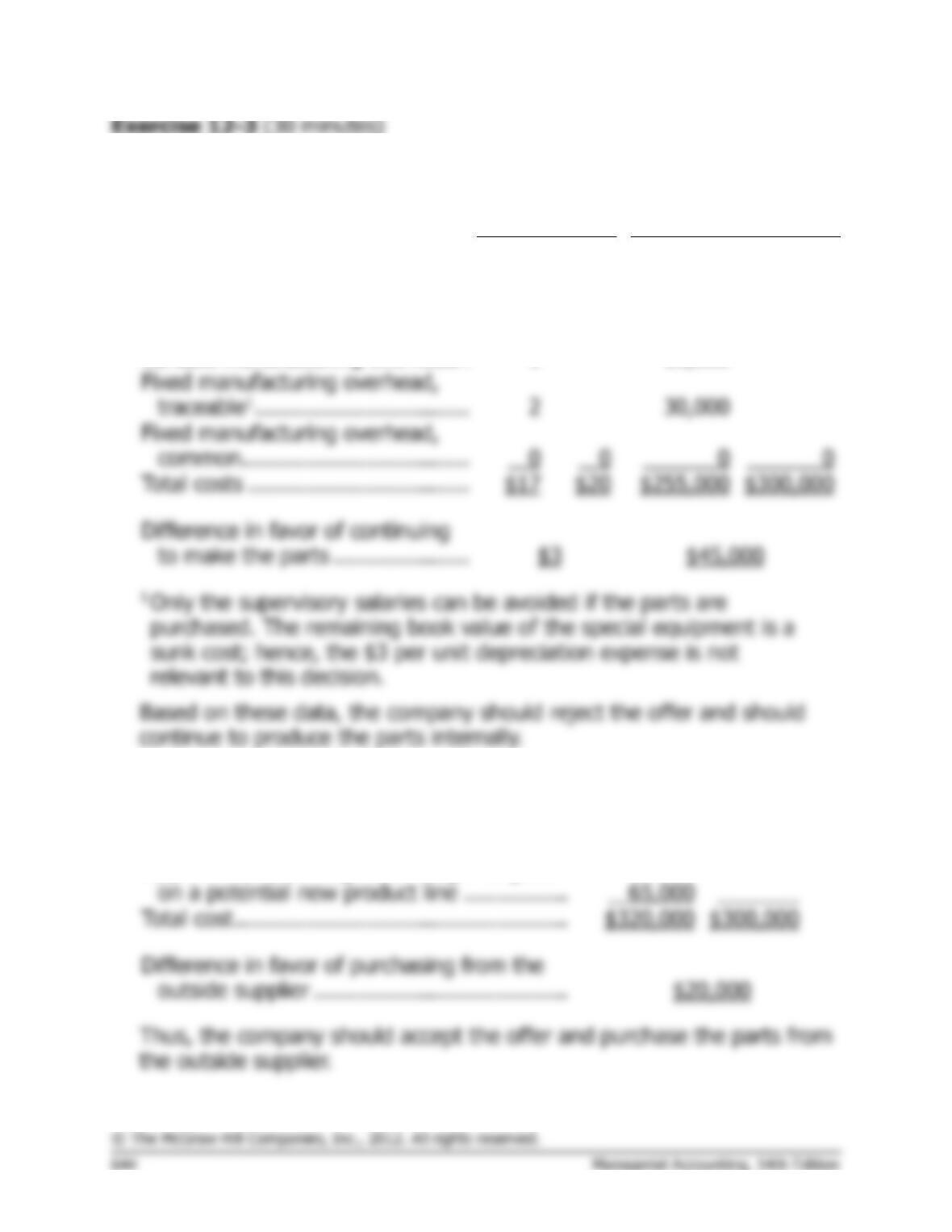
2. To give the administrator of the entire organization a clearer picture of
the financial viability of each of the organization’s programs, the general
administrative overhead should not be allocated. It is a common cost
that should be deducted from the total program segment margin.
Following the format introduced in an earlier chapter for a segmented
income statement, a better income statement would be:
Total
Home
Nursing
Meals on
Wheels
House-
keeping
Revenues ……………………….
$900,000
$260,000
$400,000
$240,000
Variable expenses …………….
490,000
120,000
210,000
160,000
Contribution margin ………….
410,000
140,000
190,000
Traceable fixed expenses:
115,000
37,000
Net operating income (loss) .
1.
Per Unit
Differential
Costs
15,000 units
Make
Buy
Make
Buy
Cost of purchasing ………………….
$20
$300,000
Direct materials ………………………
$ 6
$ 90,000
Direct labor …………………………...
8
120,000
Variable manufacturing overhead .
1
15,000
2
Fixed manufacturing overhead,
0
0
Total costs …………………………….
$300,000
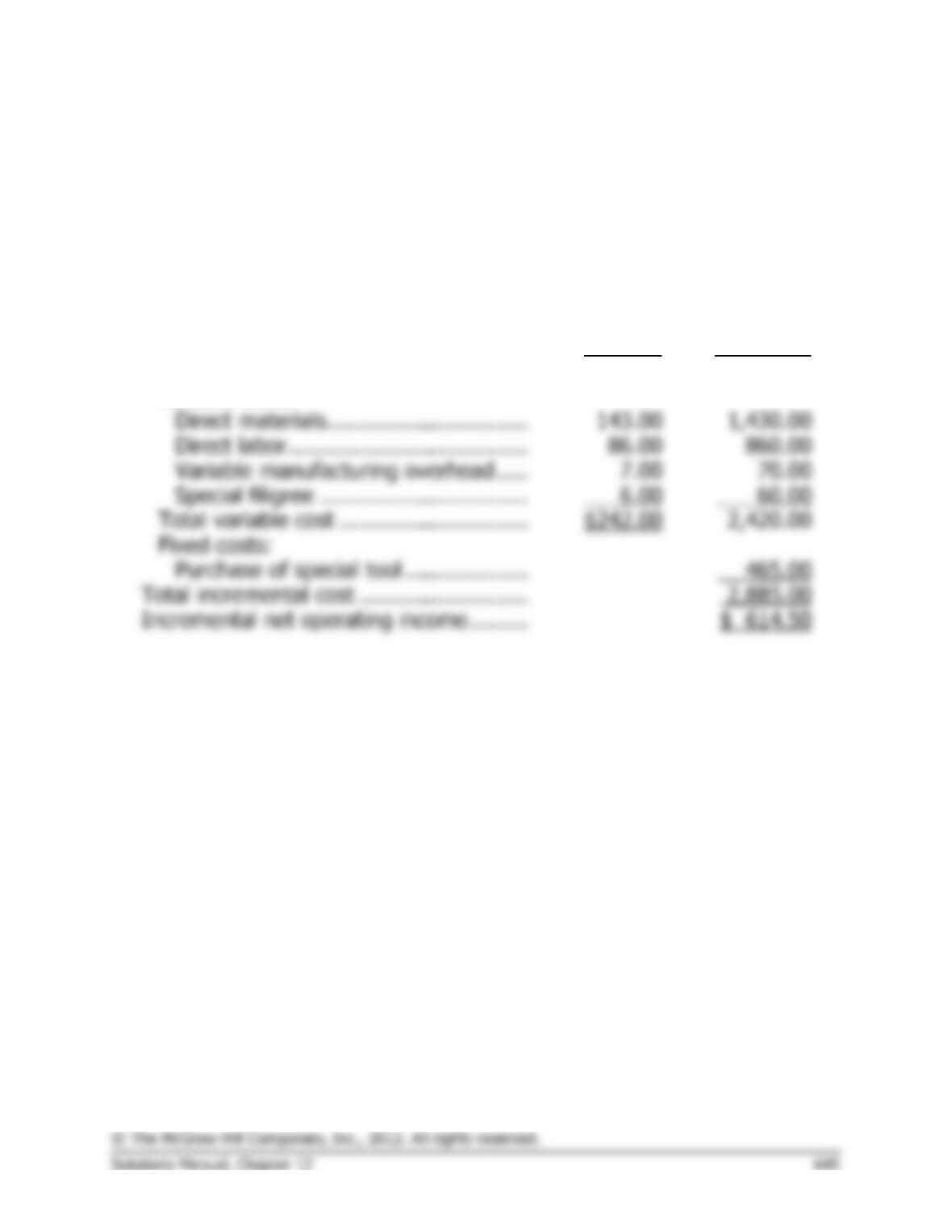
Difference in favor of continuing
relevant to this decision.
2.
Make
Buy
Cost of purchasing (part 1) …………………….
$300,000
Cost of making (part 1) …………………………
$255,000
Total cost …………………………..……………….
$300,000
$20,000
Opportunity cost—segment margin forgone
Exercise 12-4 (15 minutes)
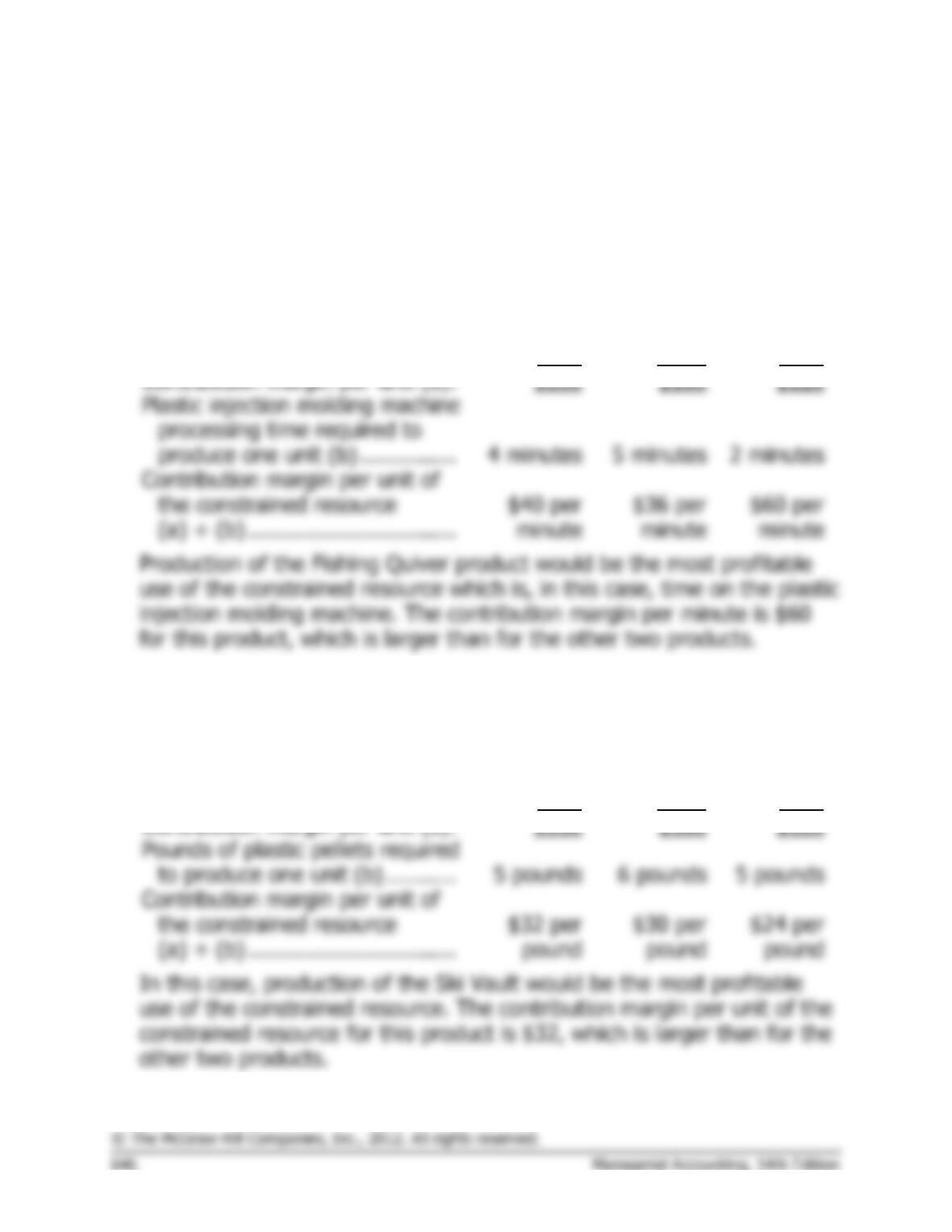
Only the incremental costs and benefits are relevant. In particular, only the
variable manufacturing overhead and the cost of the special tool are
relevant overhead costs in this situation. The other manufacturing
overhead costs are fixed and are not affected by the decision.
Per
Total
Unit
10 bracelets
Incremental revenue ……………………….
$349.95
$3,499.50
Incremental costs:
Variable costs:
Fixed costs:
Total incremental cost ……………………..
Incremental net operating income ………
Even though the price for the special order is below the company’s regular
price for such an item, the special order would add to the company’s net
operating income and should be accepted. This conclusion would not
necessarily follow if the special order affected the regular selling price of
bracelets or if it required the use of a constrained resource.
Exercise 12-5 (20 minutes)
1. The most profitable use of the constrained resource is determined by
the contribution margin per unit of the constrained resource. In part 1,
the constrained resource is time on the plastic injection molding
machine. Therefore, the analysis would proceed as follows:
Ski
Golf
Fishing
Vault
Caddy
Quiver
Selling price per unit ………………
$220
$300
$175
Variable cost per unit …………….
60
120
55
2 minutes
2. In this part, the constraint is the available pounds of plastic pellets.
Ski
Golf
Fishing
Vault
Caddy
Quiver
Selling price per unit ………………
$220
$300
$175
Variable cost per unit …………….
60
120
55
Contribution margin per unit (a) .
$160
$180
$120
Exercise 12-5 (continued)
3. The Golf Caddy product has the largest unit contribution margin, but it
is not the most profitable use of the constrained resource in either case
Exercise 12-6 (20 minutes)
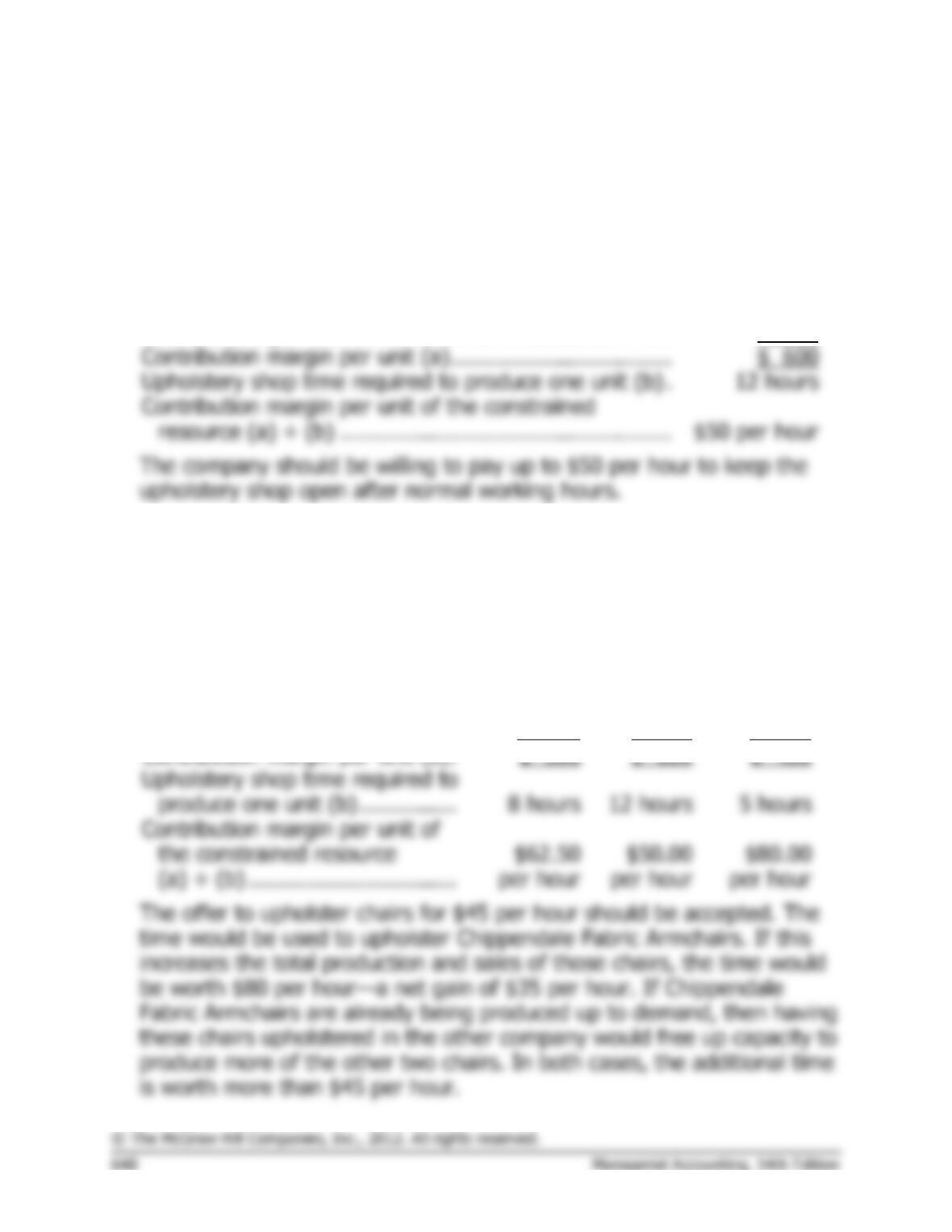
1. The value of relaxing the constraint can be determined by computing
the contribution margin per unit of the constrained resource:
Leather
Library
Chair
Selling price per unit ……………………………………………
$1,800
Variable cost per unit ………………………………………….
1,200
Contribution margin per unit (a) …………………………….
$50 per hour
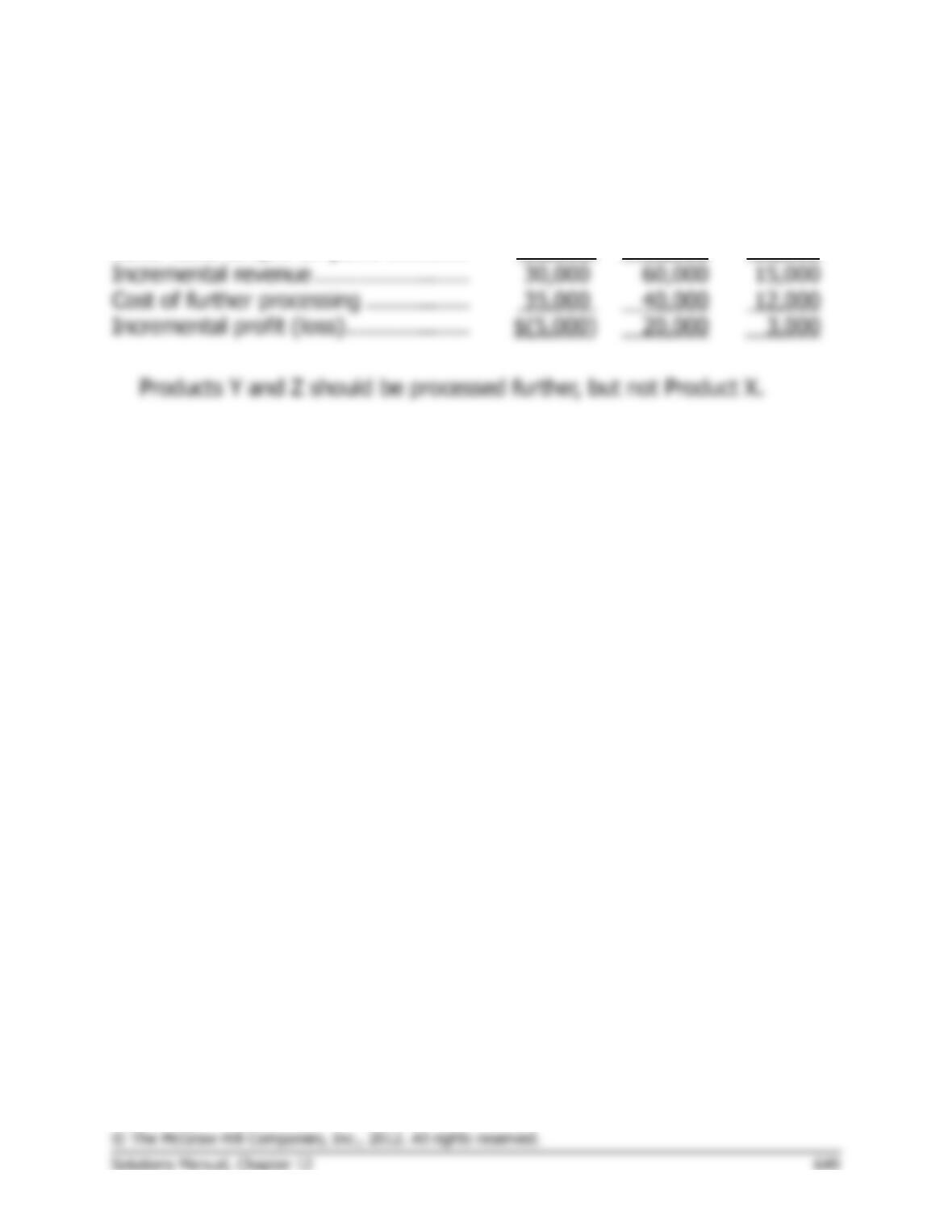
2. To answer this question, it is desirable to compute the contribution
margin per unit of the constrained resource for all three products:
Gains-
borough
Armchair
Leather
Library
Chair
Chippen-
dale
Fabric
Armchair
Selling price per unit ………………
$1,300
$1,800
$1,400
Variable cost per unit …………….
800
1,200
1,000
Contribution margin per unit (a) .
Exercise 12-7 (10 minutes)
Product X
Product Y
Product Z
Sales value after further processing ..
$80,000
$150,000
$75,000
Sales value at split-off point ………….
50,000
90,000
60,000
Incremental revenue ……………………
Cost of further processing …………….
35,000
40,000
12,000
Incremental profit (loss) ……………….
Exercise 12-8 (10 minutes)
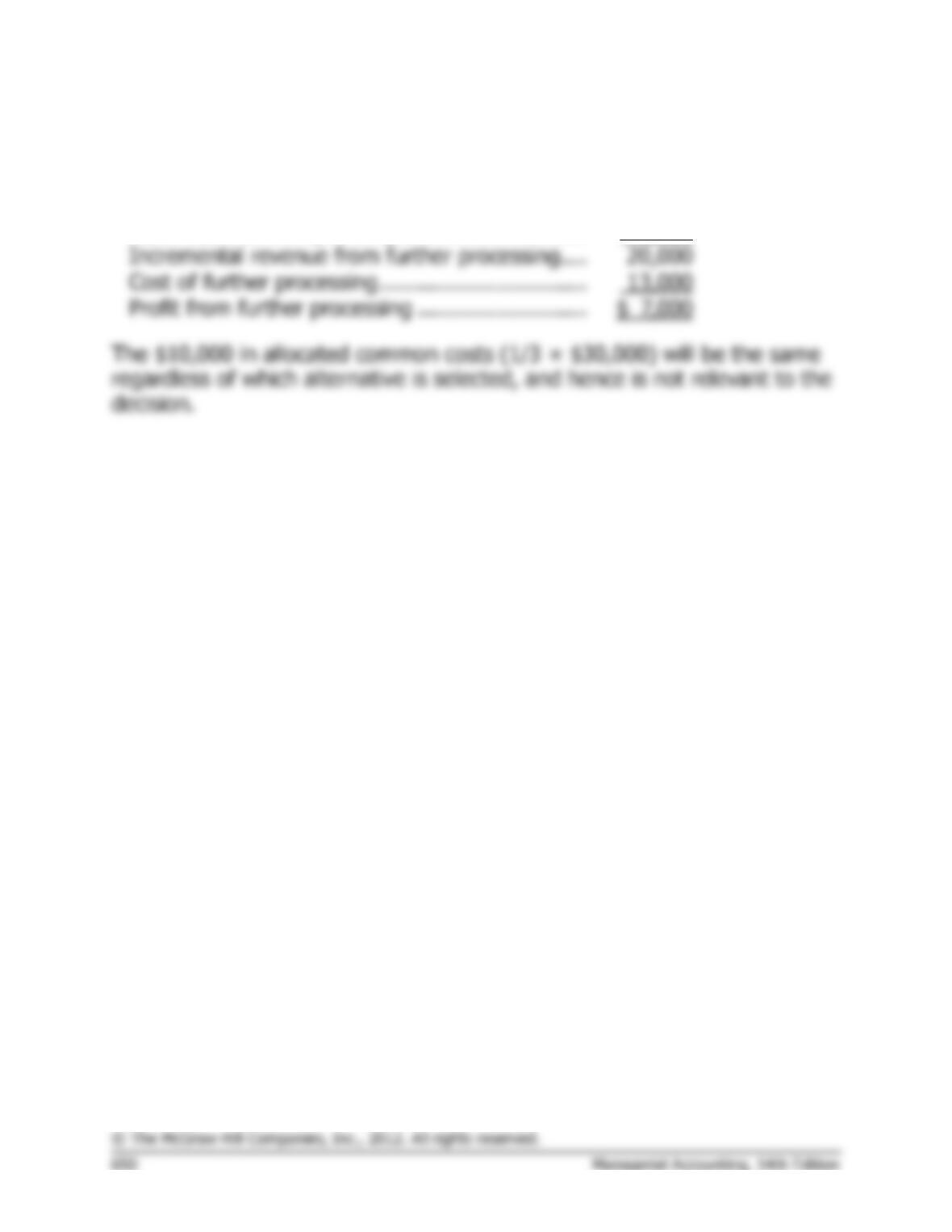
Merifulon should be processed further:
Sales value after further processing ………………
$60,000
Sales value at the split-off point …………………..
40,000
Profit from further processing ……………………..
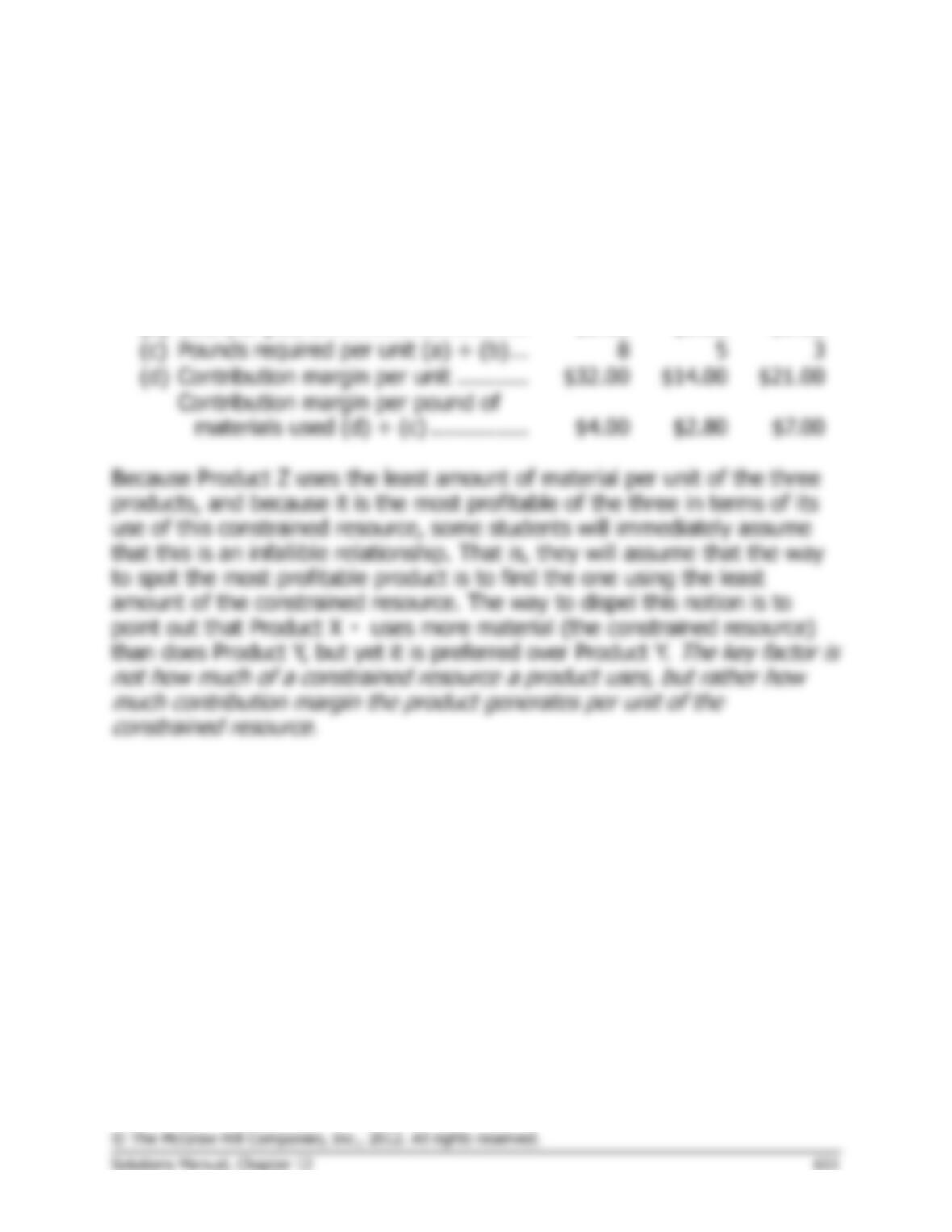
Exercise 12-9 (15 minutes)
The company should accept orders first for Product Z, second for Product
X, and third for Product Y. The computations are:
Product
X
Product
Y
Product
Z
(a)
Direct materials required per unit ….
$24.00
$15.00
$9.00
(b)
Cost per pound ………………………….
$3.00
$3.00
$3.00
(c)
Pounds required per unit (a) ÷ (b) …
(d)
Contribution margin per unit ………..
$32.00
$14.00
$21.00
$2.80
Exercise 12-10 (30 minutes)
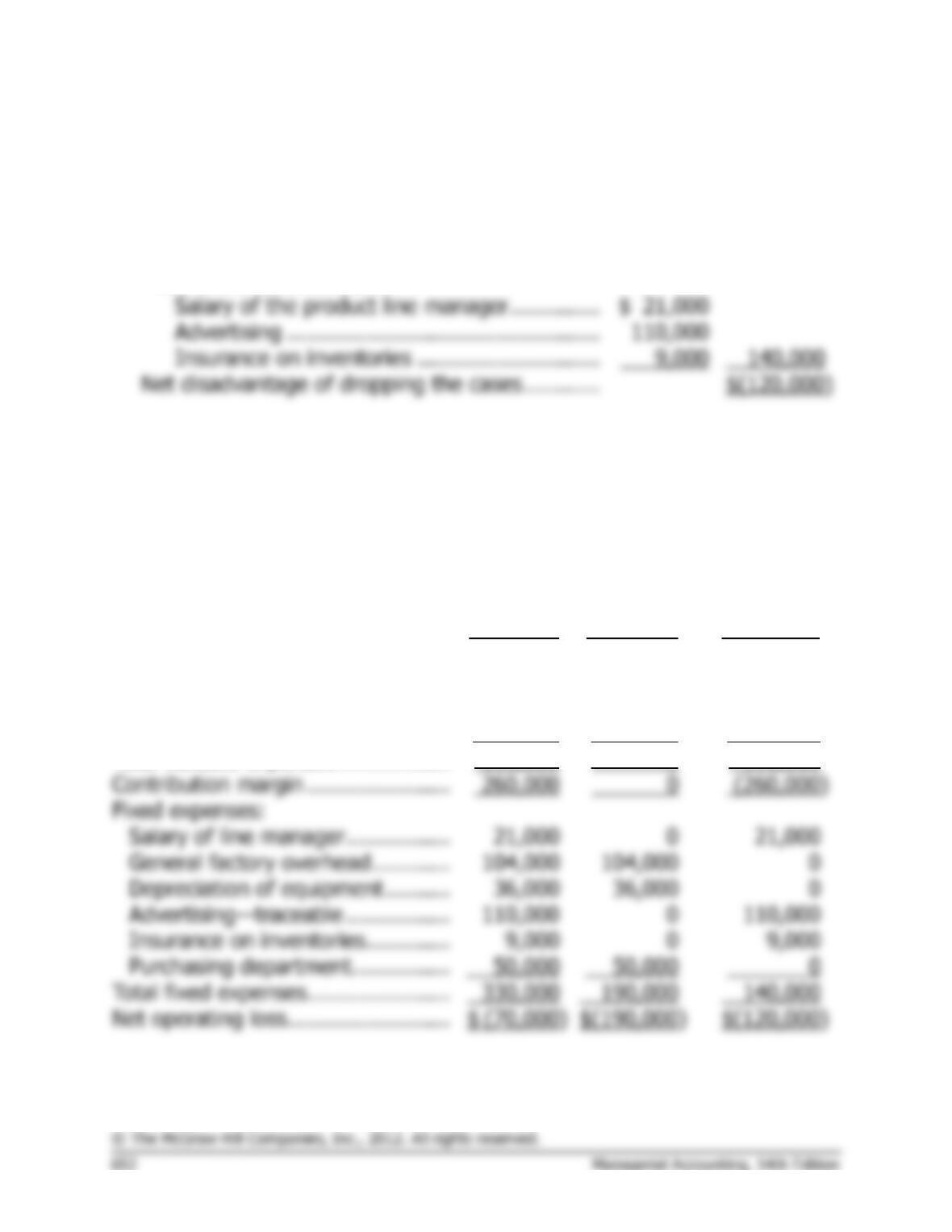
No, the overnight cases should not be discontinued. The computations are:
Contribution margin lost if the cases are
discontinued …………………………..……………..
$(260,000)
Less fixed costs that can be avoided if the
cases are discontinued:
Insurance on inventories ……………………….
140,000
Net disadvantage of dropping the cases …………
$(120,000)
The same solution can be obtained by preparing comparative income
statements:
Keep
Overnight
Cases
Drop
Overnight
Cases
Difference:
Net Operating
Income
Increase or
(Decrease)
Sales ……………………………………..
$450,000
$ 0
$(450,000)
Variable expenses:
Variable manufacturing expenses
130,000
0
130,000
Sales commissions …………………
48,000
0
48,000
Shipping ………………………………
12,000
0
12,000
Total variable expenses ……………..
190,000
0
190,000
Contribution margin ………………….
260,000
Fixed expenses:
Salary of line manager …………….
21,000
0
21,000
General factory overhead …………
104,000
Depreciation of equipment ……….
36,000
110,000
0
110,000
0
Total fixed expenses ………………….
Net operating loss …………………….
Exercise 12-11 (20 minutes)
1.
Fixed cost per mile ($3,500* ÷ 10,000 miles) .
$0.35
Variable operating cost per mile …………………
0.08
Average cost per mile ………………………………
$0.43
*
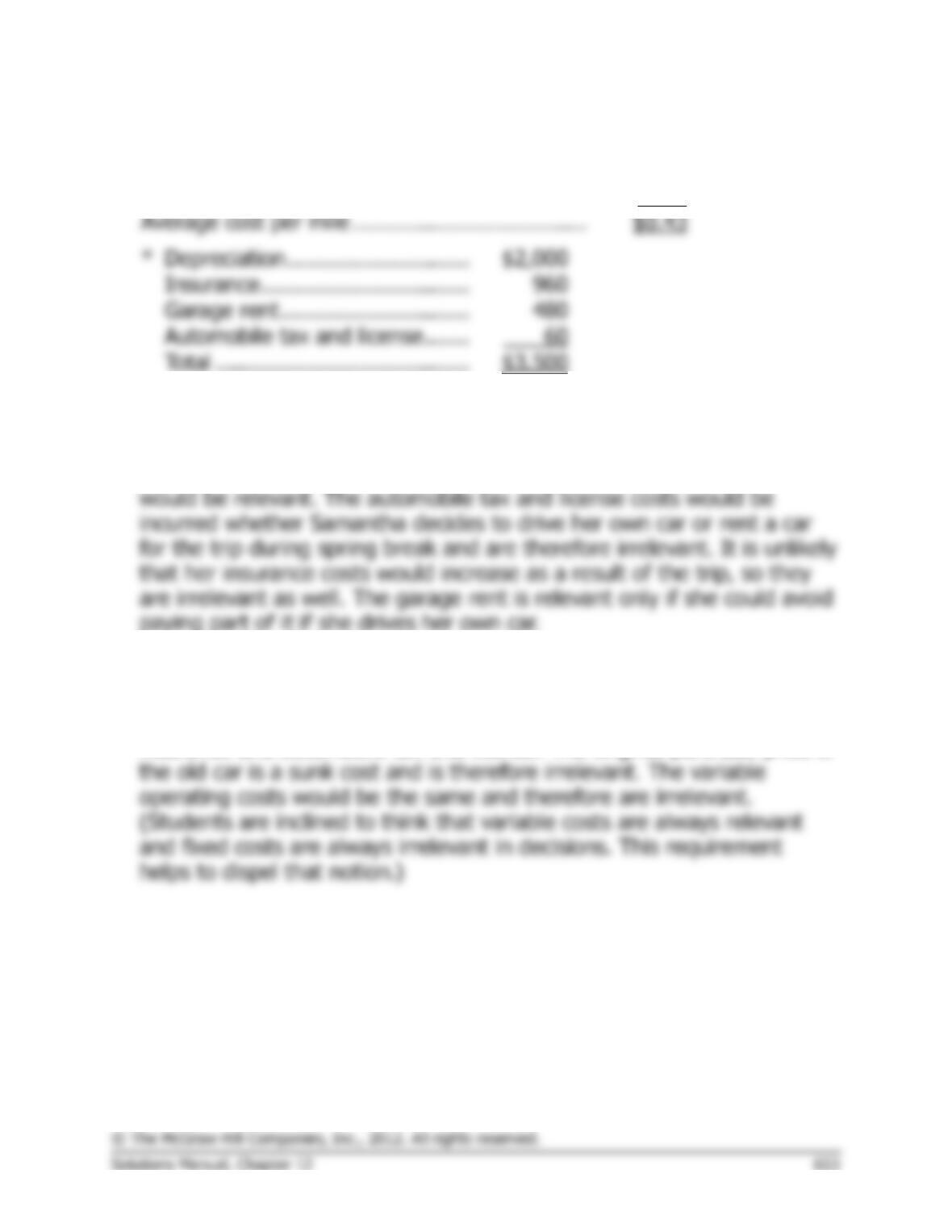
2. The variable operating costs would be relevant in this situation. The
depreciation would not be relevant since it relates to a sunk cost.
However, any decrease in the resale value of the car due to its use
3. When figuring the incremental cost of the more expensive car, the
relevant costs would be the purchase price of the new car (net of the
resale value of the old car) and the increases in the fixed costs of
insurance and automobile tax and license. The original purchase price of
Exercise 12-12 (20 minutes)
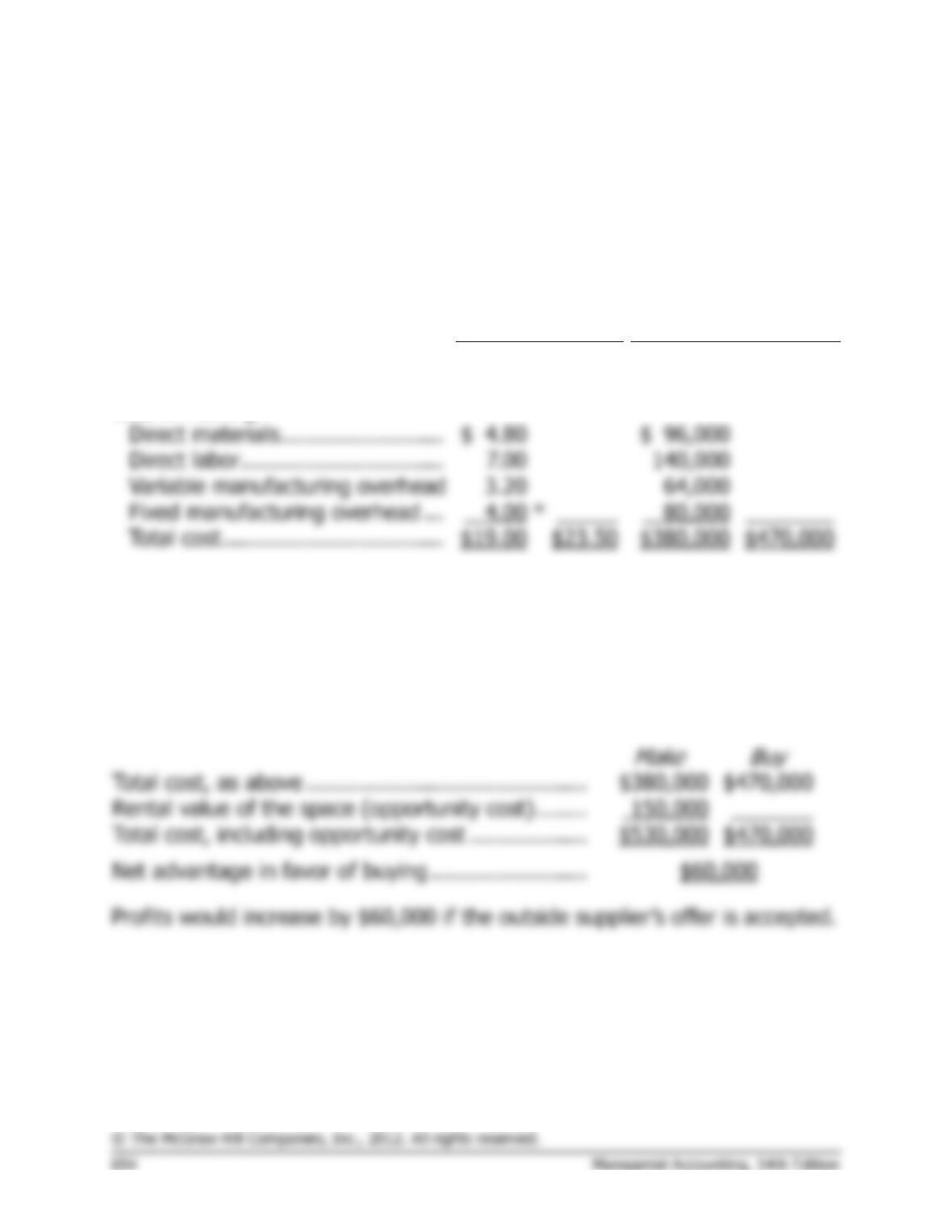
The costs that can be avoided as a result of purchasing from the outside
are relevant in a make-or-buy decision. The analysis is:
Per Unit
Differential
Costs
20,000 Units
Make
Buy
Make
Buy
Cost of purchasing …………………..
$23.50
$470,000
Cost of making:
*
*
The remaining $6 of fixed manufacturing overhead cost would
not be relevant because it will continue regardless of whether
the company makes or buys the parts.
The $150,000 rental value of the space being used to produce part R-3 is
an opportunity cost of continuing to produce the part internally. Thus, the
complete analysis is:
Buy
Total cost, as above …………………………………….
Rental value of the space (opportunity cost) ……..
Total cost, including opportunity cost ………………
Net advantage in favor of buying ……………………
Exercise 12-13 (30 minutes)
1.
A
B
C
(1)
Contribution margin per unit …………………………...
$18
$36
$20
(2)
Direct labor cost per unit ………………………………..
$12
$32
$16
(3)
Direct labor rate per hour ……………………………….
8
8
8
(4)
Direct labor–hours required per unit (2) ÷ (3) ……..
1.5
4.0
2.0
Contribution margin per direct labor-hour (1) ÷ (4)
$12
$ 9
$10
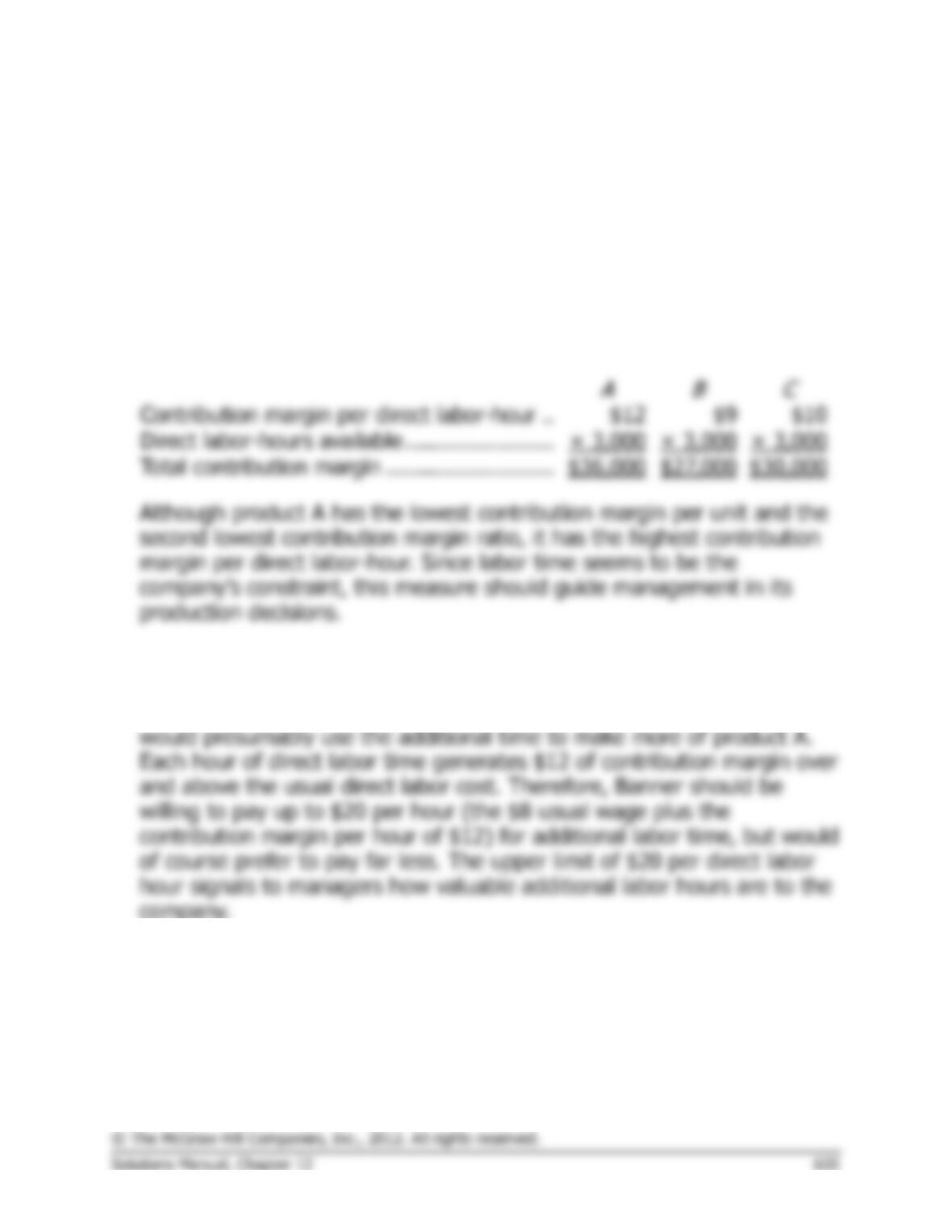
2. The company should concentrate its labor time on producing product A:
Contribution margin per direct labor-hour ..
Direct labor–hours available …………………..
Total contribution margin ……………………..
$36,000
$30,000
3. The amount Banner Company should be willing to pay in overtime
wages for additional direct labor time depends on how the time would
be used. If there are unfilled orders for all of the products, Banner
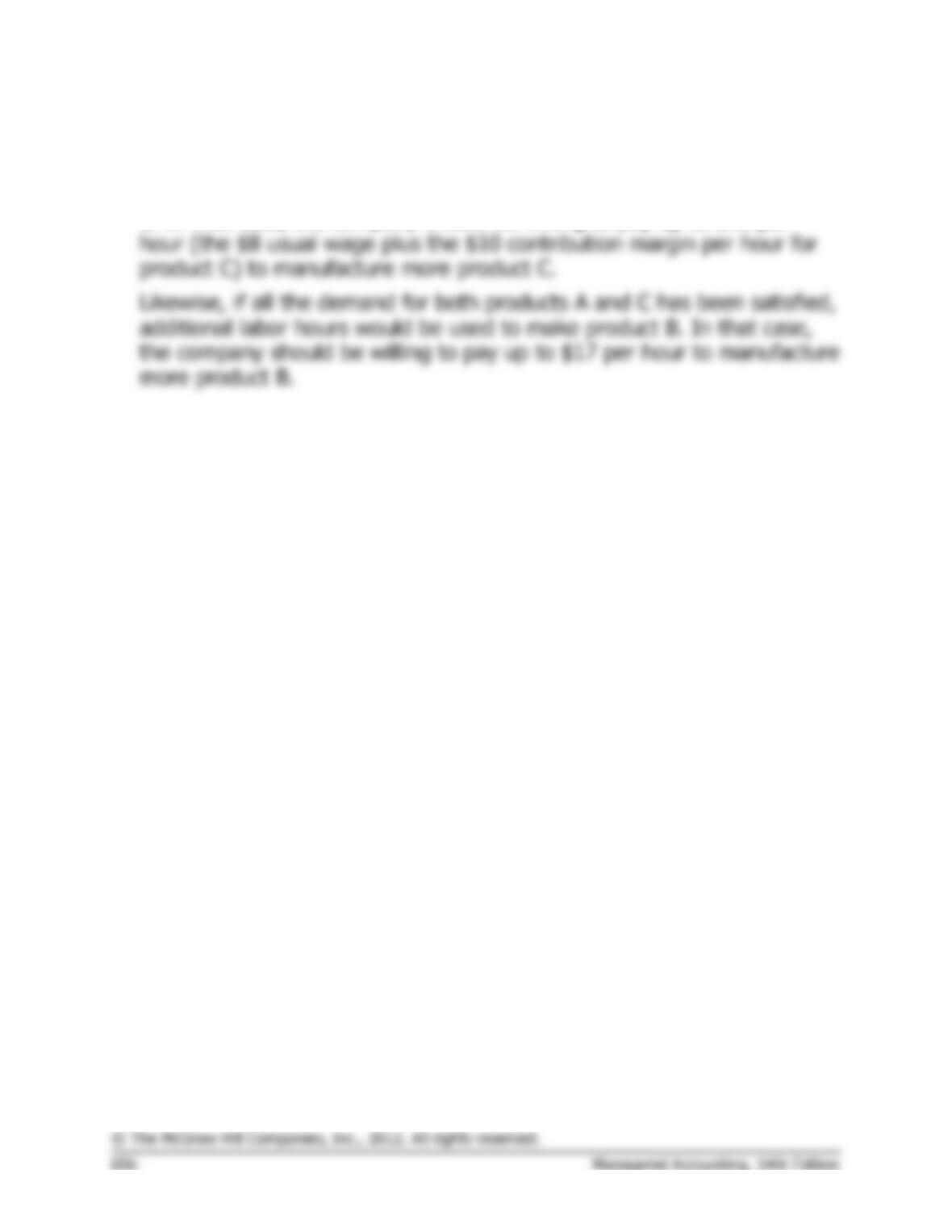
Exercise 12-13 (continued)
If all the demand for product A has been satisfied, Banner Company
would then use any additional direct labor-hours to manufacture product
C. In that case, the company should be willing to pay up to $18 per
Exercise 12-14 (15 minutes)
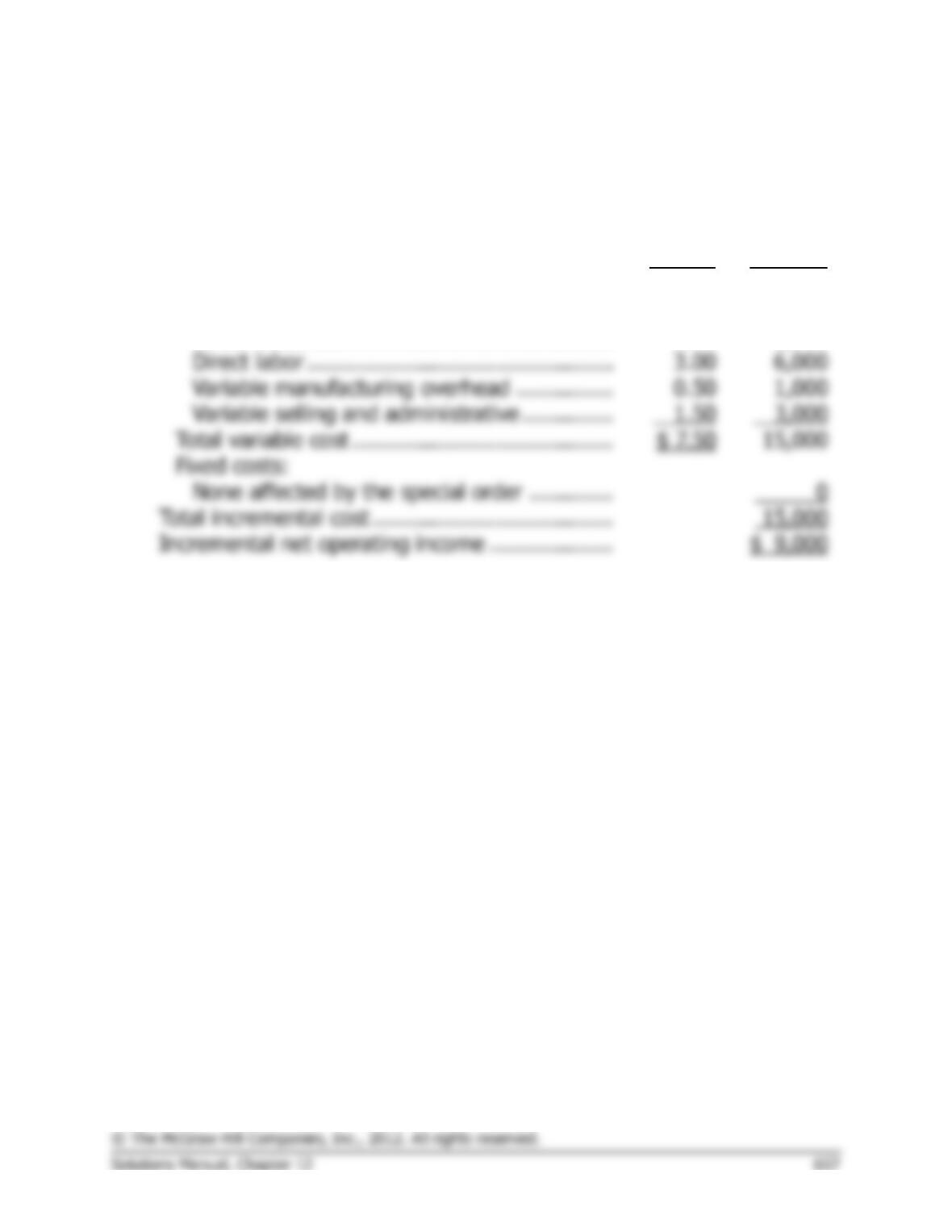
1. Monthly profits would increase by $9,000:
Per Unit
Total for
2,000 Units
Incremental revenue …………………………………
$12.00
$24,000
Incremental costs:
Variable costs:
Direct materials …………………………………..
2.50
5,000
Direct labor ………………………………………..
3.00
6,000
Total variable cost ………………………………….
Fixed costs:
None affected by the special order ………….
Total incremental cost ……………………………….
Incremental net operating income ……………….
2. The relevant cost is $1.50 (the variable selling and administrative costs).
All other variable costs are sunk because the units have already been
produced. The fixed costs are not relevant because they would not be
affected by the sale of leftover units.
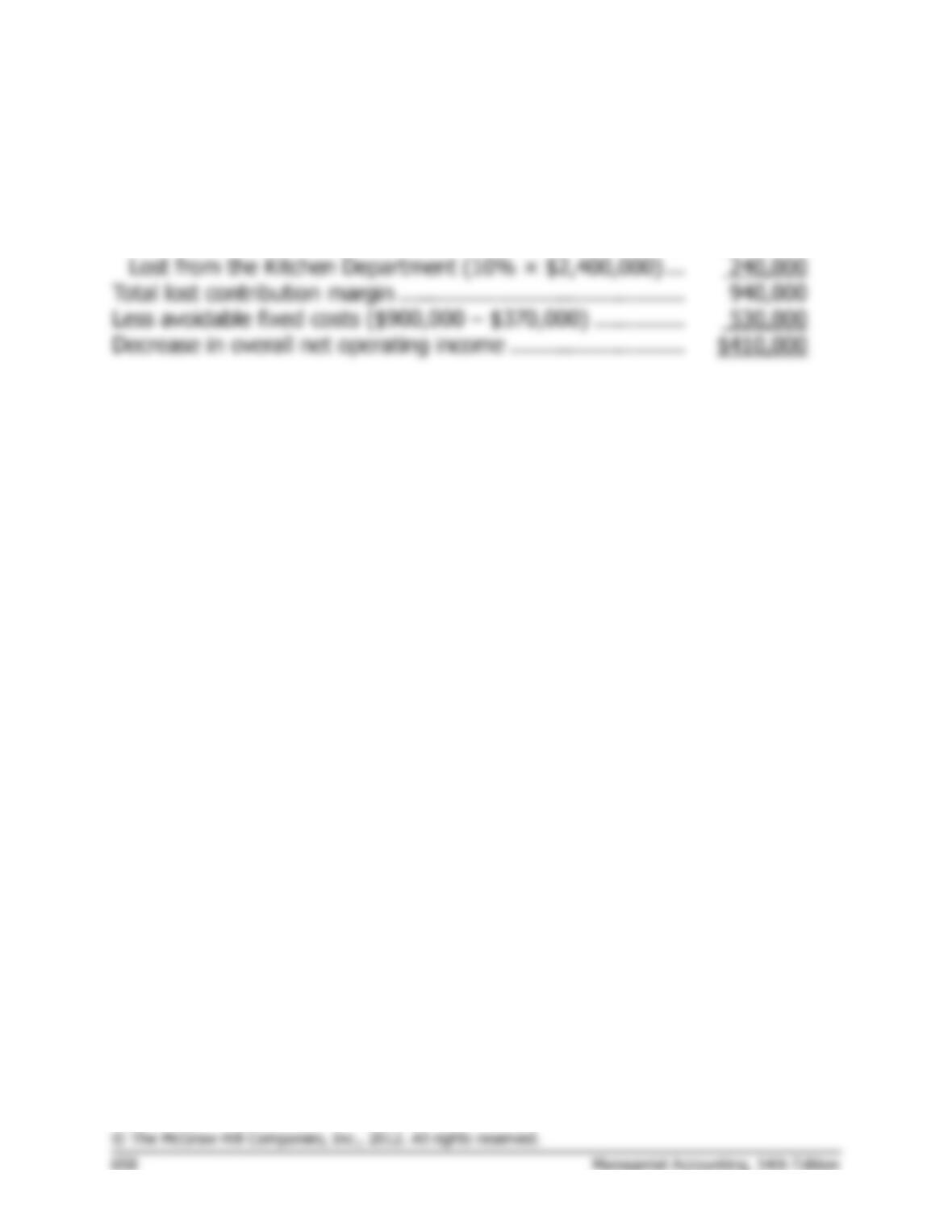
Exercise 12-15 (10 minutes)
Contribution margin lost if the Bath Department is dropped:
Lost from the Bath Department …………………………………
$700,000
Lost from the Kitchen Department (10% × $2,400,000) …
Decrease in overall net operating income ………………………