PROBLEM 12.17
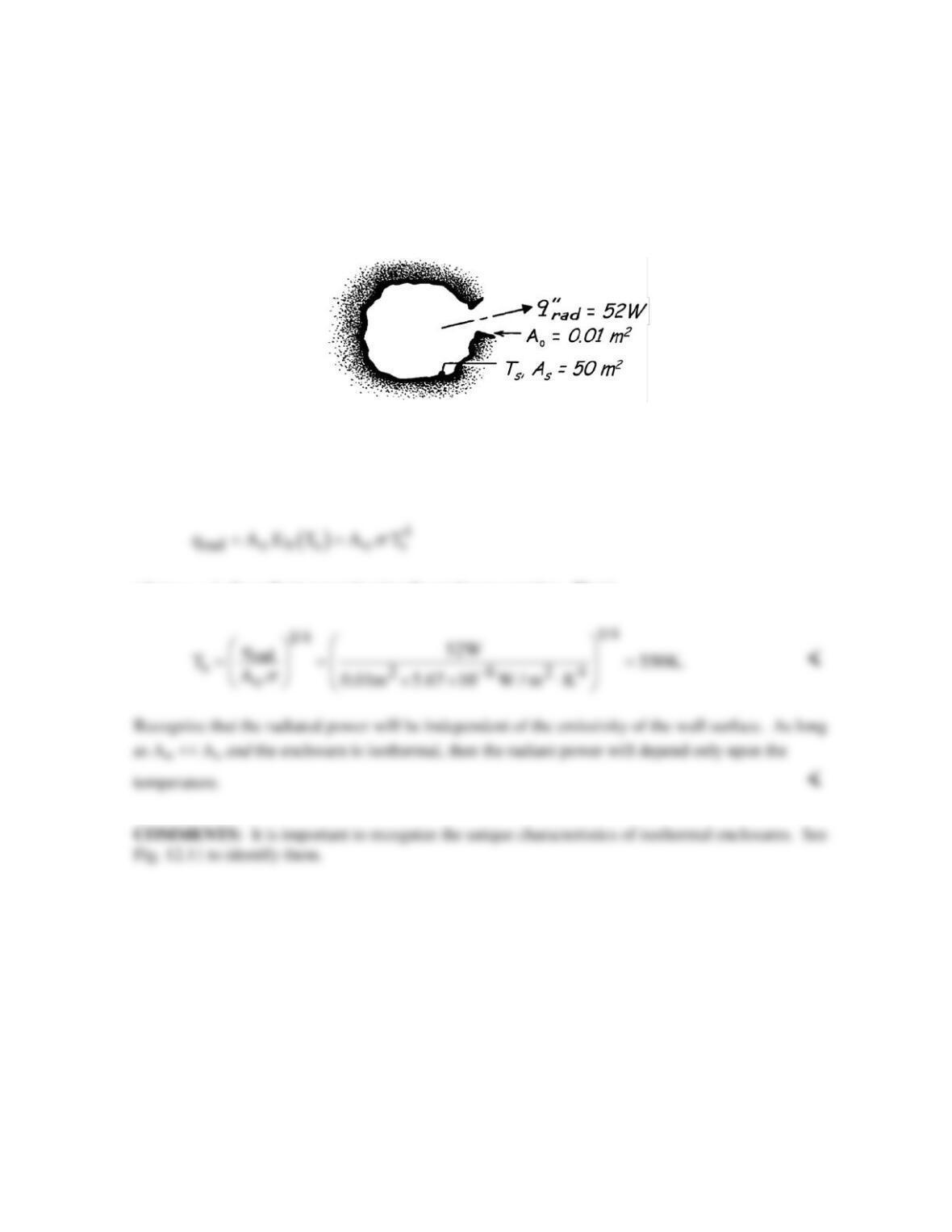
KNOWN: Isothermal enclosure of surface area, As, and small opening, Ao, through which 52W
emerges.
FIND: (a) Temperature of the interior enclosure wall if the surface is black, (b) Temperature of the
wall surface having ε = 0.15.
SCHEMATIC:
ASSUMPTIONS: (1) Enclosure is isothermal, (2) Ao << As.
ANALYSIS: A characteristic of an isothermal enclosure, according to Section 12.4, is that the
radiant power emerging through a small aperture will correspond to blackbody conditions. Hence
where qrad is the radiant power leaving the enclosure opening. That is,
PROBLEM 12.18
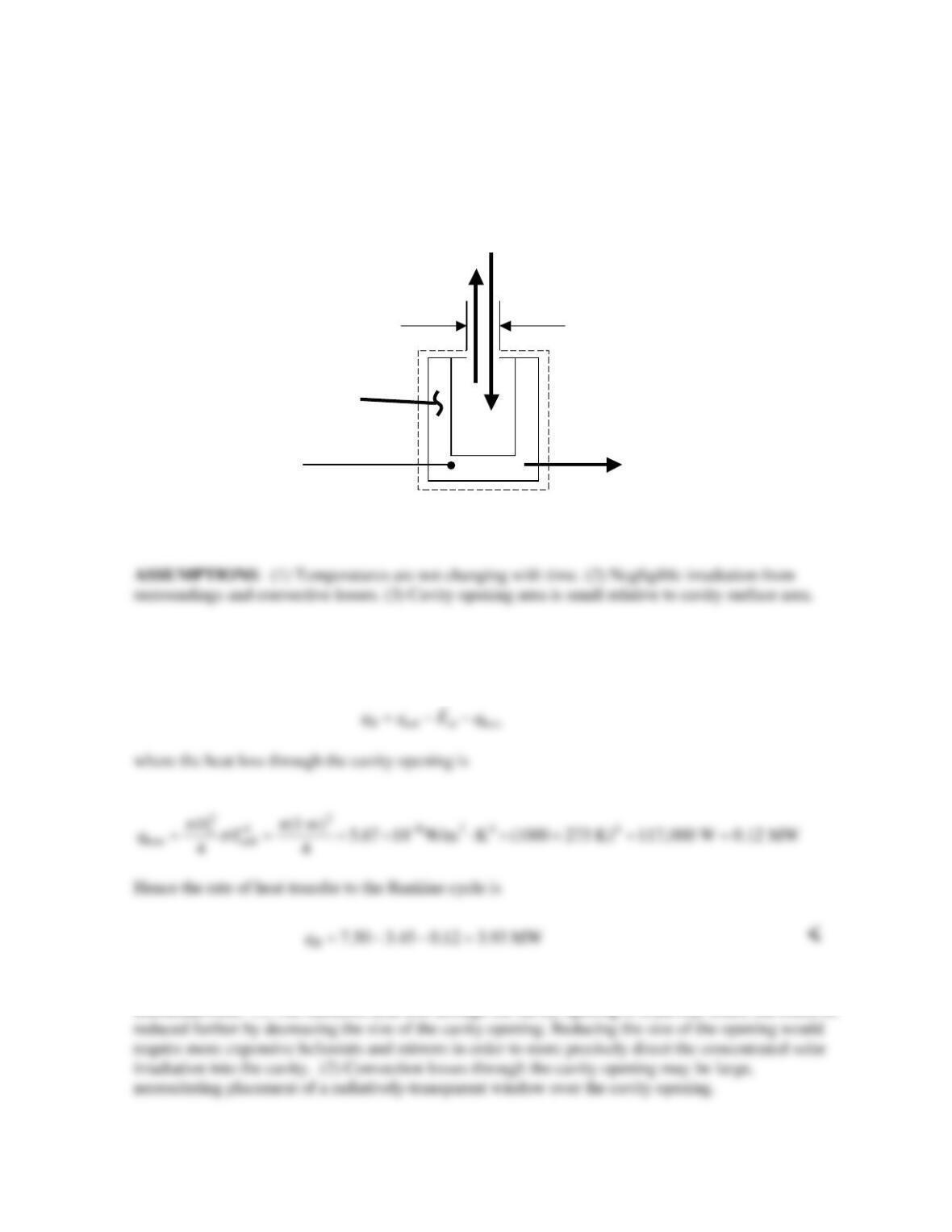
KNOWN: Solar power concentrated into cavity, energy storage rate for salt, salt temperature, cavity
opening diameter.
FIND: Rate of thermal energy delivered to the Rankine cycle.
SCHEMATIC:
ANALYSIS:
(a) An energy balance on the control volume shown in the schematic yields
COMMENTS: (1) The radiation heat loss through the cavity opening is relatively small, but could be
Salt
T
salt
= 1000°C
D
s
q
R
E
st
·
E
st
·= 3.45 MW
q
sol
= 7.50 MW
q
loss
PROBLEM 12.19
KNOWN: Spectral distribution of the emissive power given by Planck’s distribution.
FIND: Approximations to the Planck distribution for the extreme cases when (a) C2/λT >> 1,
Wien’s law and (b) C2/λT << 1, Rayleigh–Jeans law.
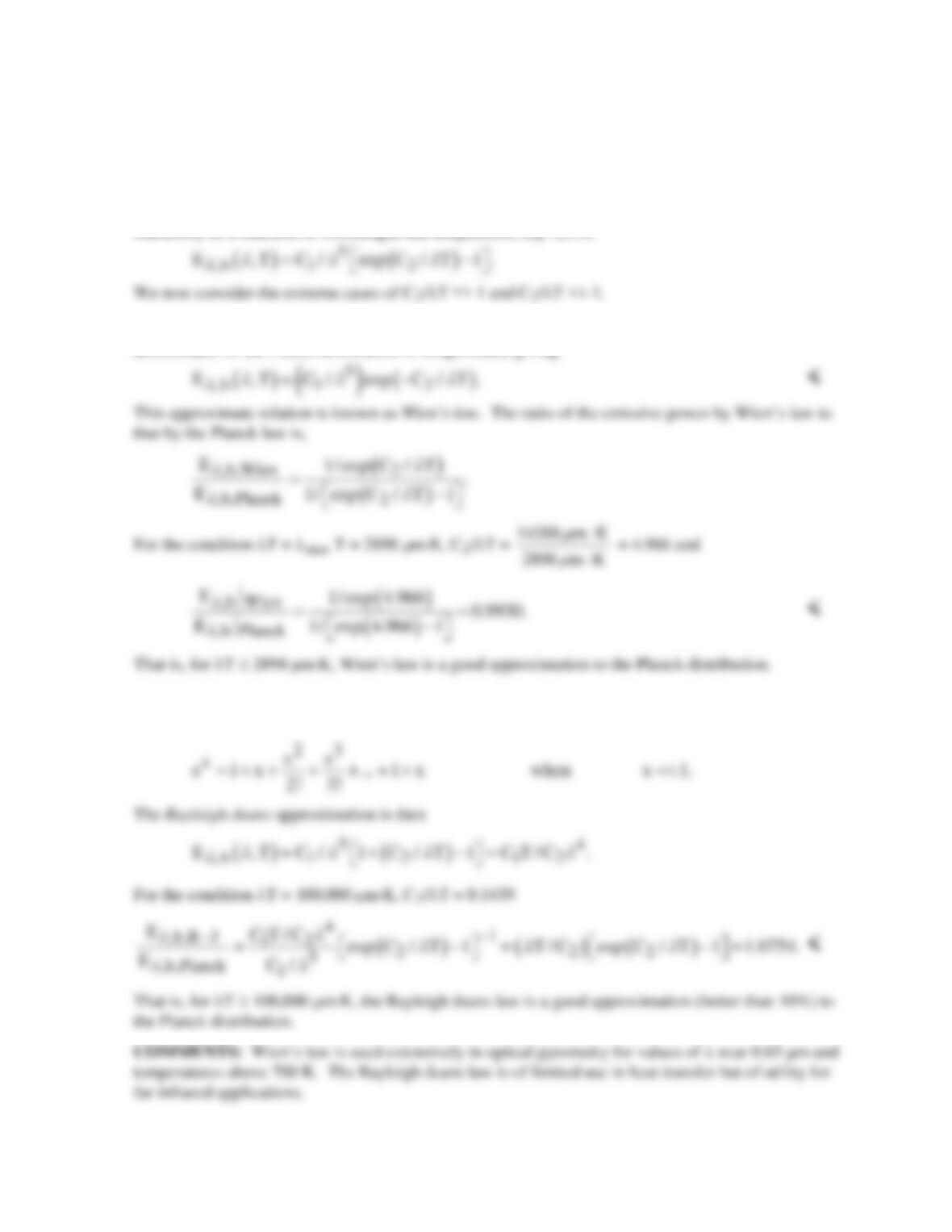
ANALYSIS: Planck’s distribution provides the spectral, hemispherical emissive power of a
blackbody as a function of wavelength and temperature, Eq. 12.30,
(a) When C2/λT >> 1 (or λT << C2), it follows exp(C2/λT) >> 1. Hence, the –1 term in the
denominator of the Planck distribution is insignificant, giving
(b) If C2/λT << 1 (or λT >> C2), the exponential term may be expressed as a series that can be
approximated by the first two terms. That is,
PROBLEM 12.20
KNOWN: Various surface temperatures.
FIND: (a) Wavelength corresponding to maximum emission for each surface, (b) Fraction of solar
emission in UV, VIS and IR portions of the spectrum.
ASSUMPTIONS: (1) Spectral distribution of emission from each surface is approximately that of a
blackbody, (2) The sun emits as a blackbody at 5800 K.
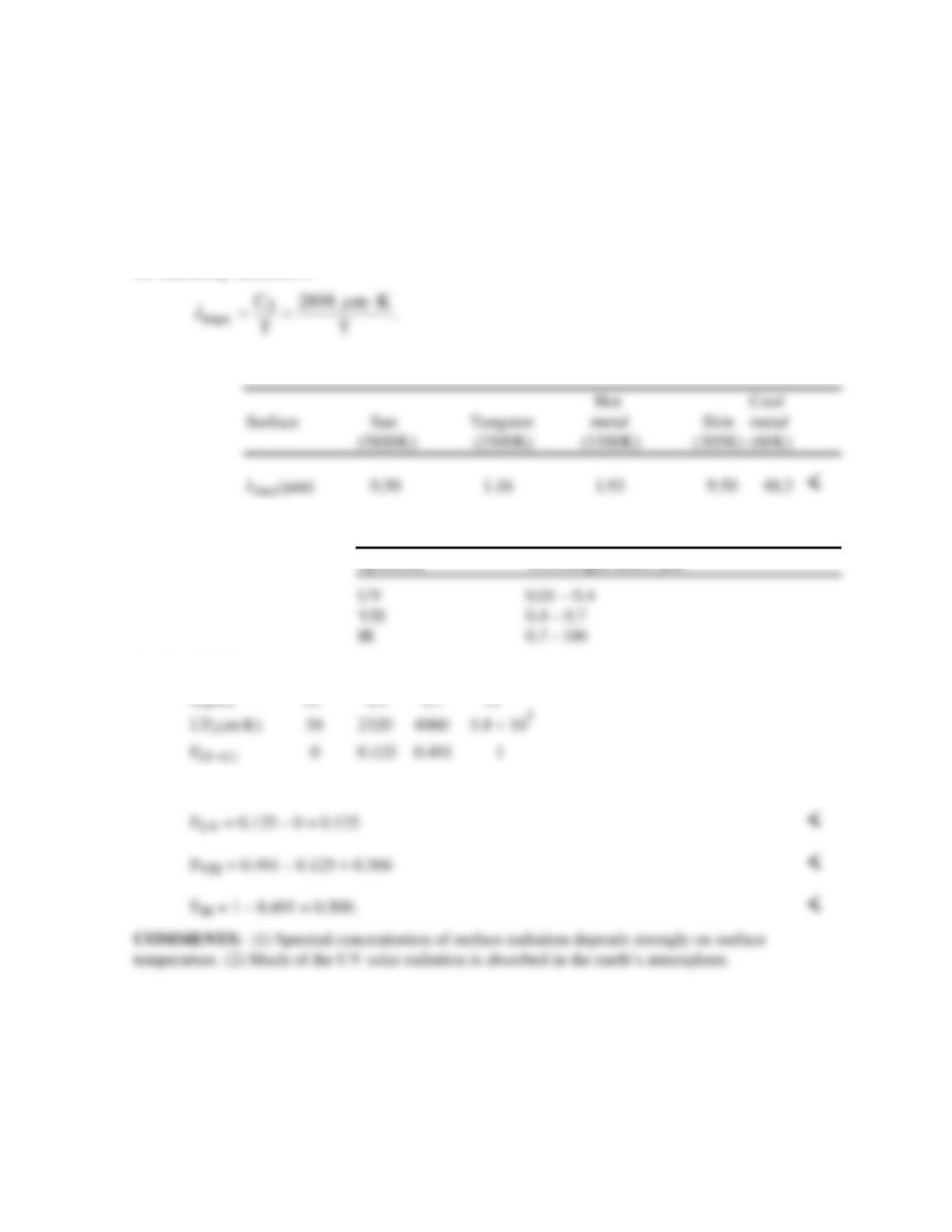
ANALYSIS: (a) From Wien’s displacement law, Eq. 12.31, the wavelength of maximum emission
for blackbody radiation is
For the prescribed surfaces
(b) From Fig. 12.3, the spectral regions associated with each portion of the spectrum are
Spectrum Wavelength limits, µm
For T = 5800K and each of the wavelength limits, from Table 12.2 find:
Hence, the fraction of the solar emission in each portion of the spectrum is:
PROBLEM 12.21
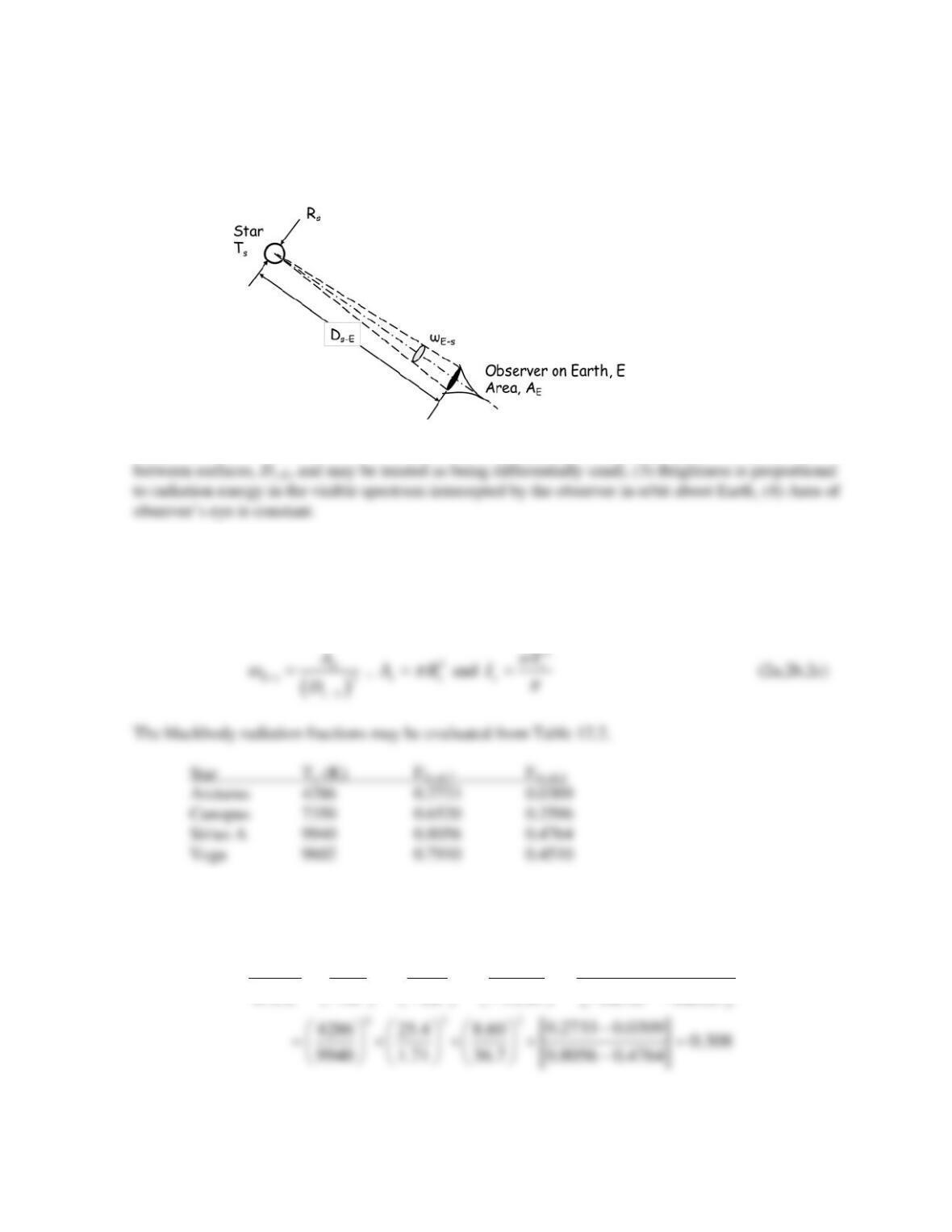
KNOWN: Temperature, radius, and distance from Earth associated with four stars.
FIND: Order of decreasing star brightness as observed from Earth orbit.
SCHEMATIC:
ASSUMPTIONS: (1) Stars emit as blackbodies, (2) Surface areas are small relative to the distance
ANALYSIS: Using Equation 12.11 and following the analysis of Example 12.1, the energy incident
on the observer’s eye in the visible spectrum (0.4 µm ≤ λ ≤ 0.7 µm) is
[ ]
0 0.7 0 0.4sE s s Es
q IA F F
ω
− −→ →
= −
(1)
where
Combining Equations 1 and 2, the ratio of the energy incident on the observer’s eye when viewing
Arcturus relative to Sirius A is
42 2
0 0.7, 0 0.4,
,, , ,
,, , , 0 0.7, 0 0.4,
Arc Arc
s E Arc s Arc s Arc s E Sir
s E Sir s Sir s Sir s E Arc Sir Sir
FF
qTR D
qTRD FF
→→
−−
−−
→→
−
=×× ×
−
Continued…
PROBLEM 12.21 (Cont.)
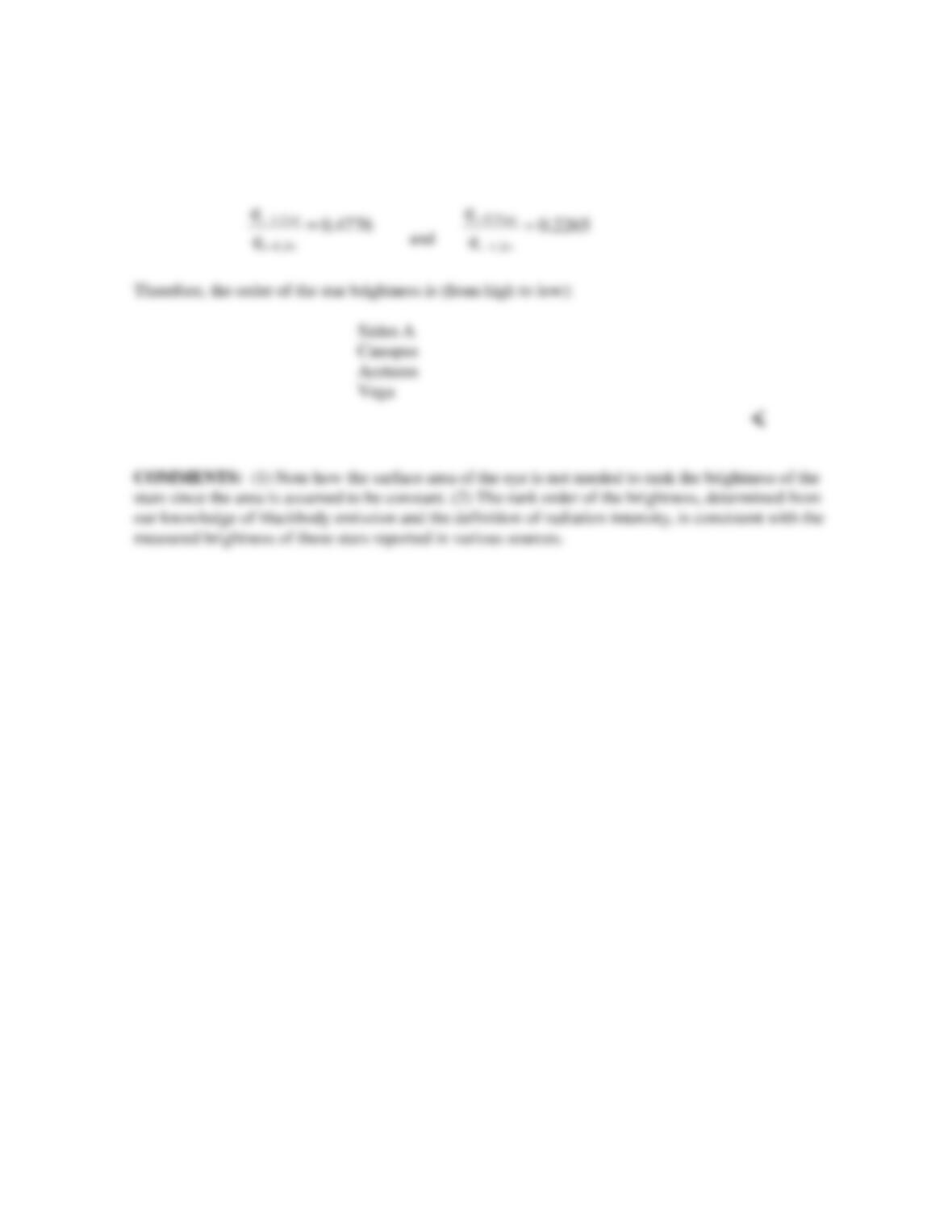
Repeating the calculation for Canopus and Vega yields
PROBLEM 12.22
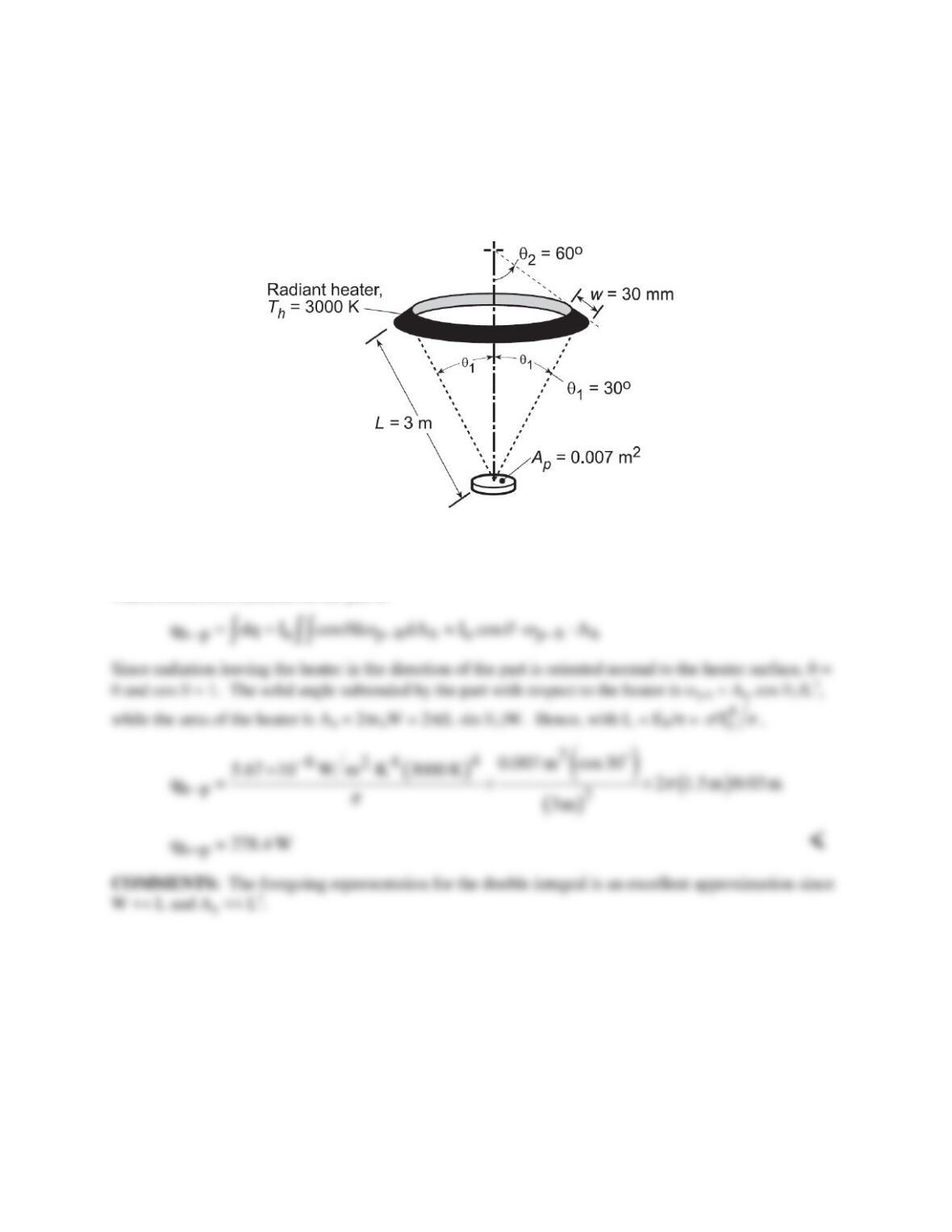
KNOWN: Geometry and temperature of a ring–shaped radiator. Area of irradiated part and distance
from radiator.
FIND: Rate at which radiant energy is incident on the part.
SCHEMATIC:
ASSUMPTIONS: (1) Heater emits as a blackbody.
ANALYSIS: Expressing Eq. 12.12 on the basis of the total radiation, dq = Ie dAh cosθ dω, the rate at
which radiation is incident on the part is
PROBLEM 12.23
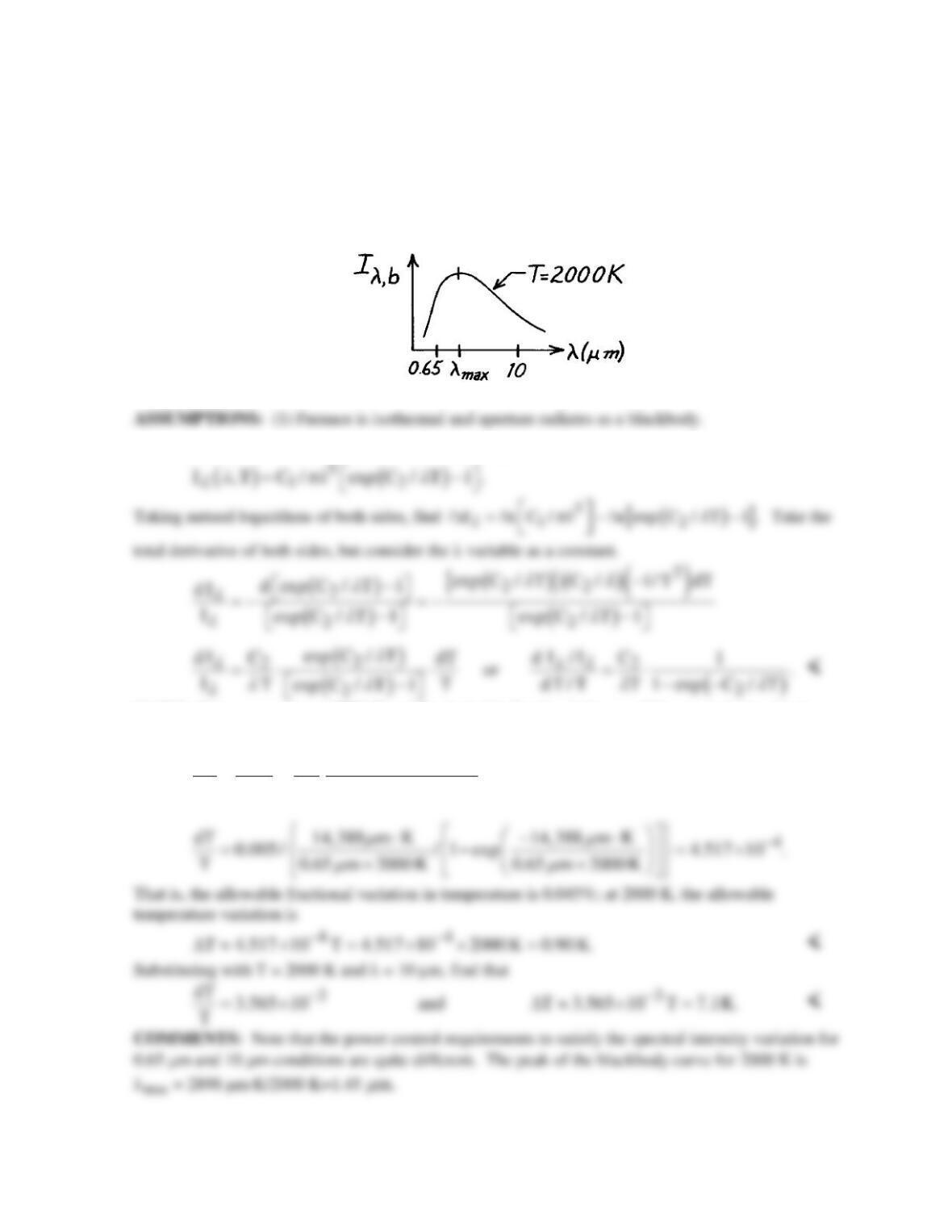
KNOWN: Aperture of an isothermal furnace emits as a blackbody.
FIND: (a) An expression for the ratio of the fractional change in the spectral intensity to the
fractional change in temperature of the furnace aperture, (b) Allowable variation in temperature of a
furnace operating at 2000 K such that the spectral intensity at 0.65µm will not vary by more than
1/2%. Allowable variation for 10µm.
SCHEMATIC:
ANALYSIS: (a) The Planck spectral distribution, Eq. 12.30, is
(b) If the furnace operates at 2000 K and the desirable fractional change of the spectral intensity is
0.5% at 0.65 µm, the allowable temperature variation is
( )
2
2
dI
dT C 1
/
TI T
1 exp C / T
λ
λ
λλ
=
−−
PROBLEM 12.24
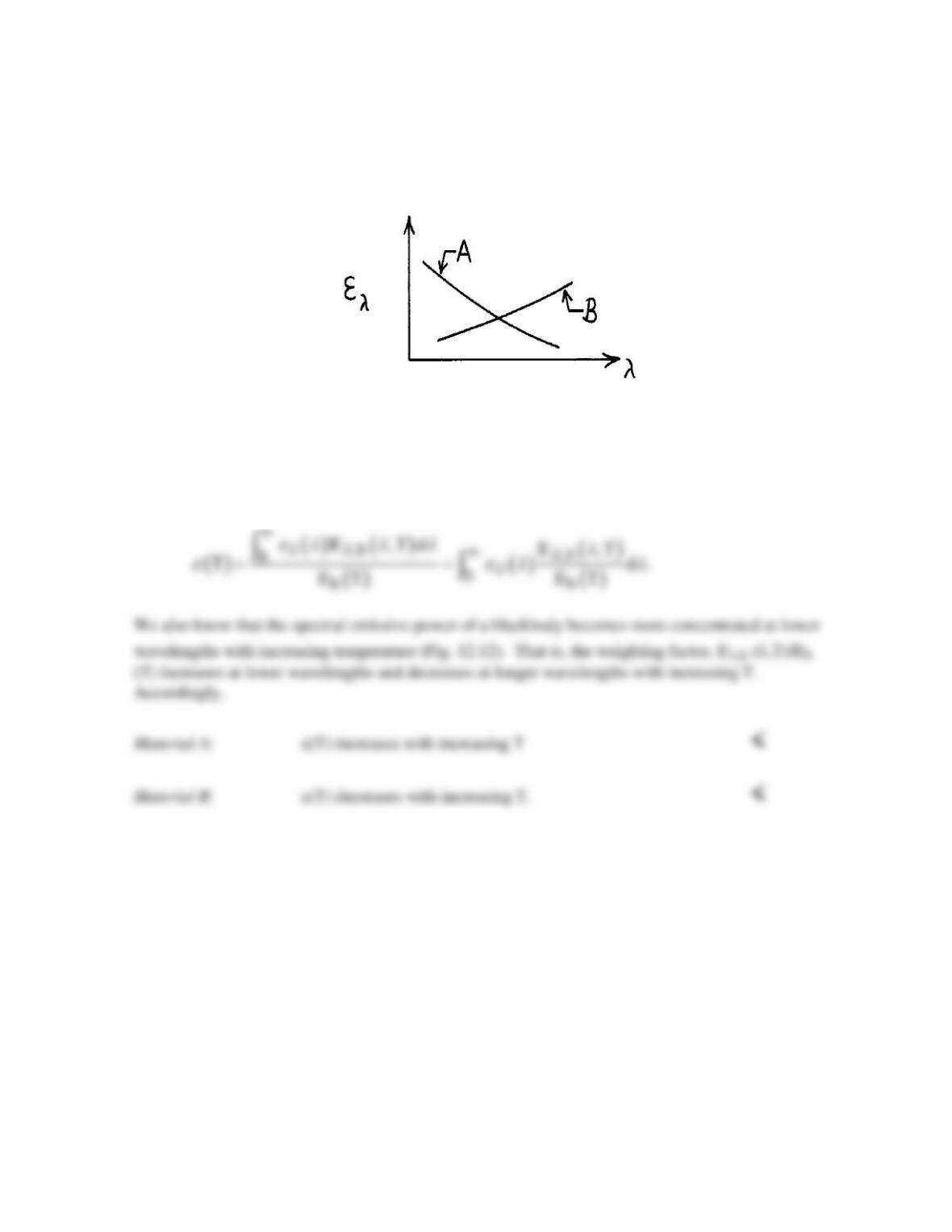
KNOWN: Variation of spectral, hemispherical emissivity with wavelength for two materials.
FIND: Nature of the variation with temperature of the total, hemispherical emissivity.
SCHEMATIC:
ASSUMPTIONS: (1) ελ is independent of temperature.
ANALYSIS: The total, hemispherical emissivity may be obtained from knowledge of the spectral,
hemispherical emissivity by using Eq. 12.43
PROBLEM 12.25
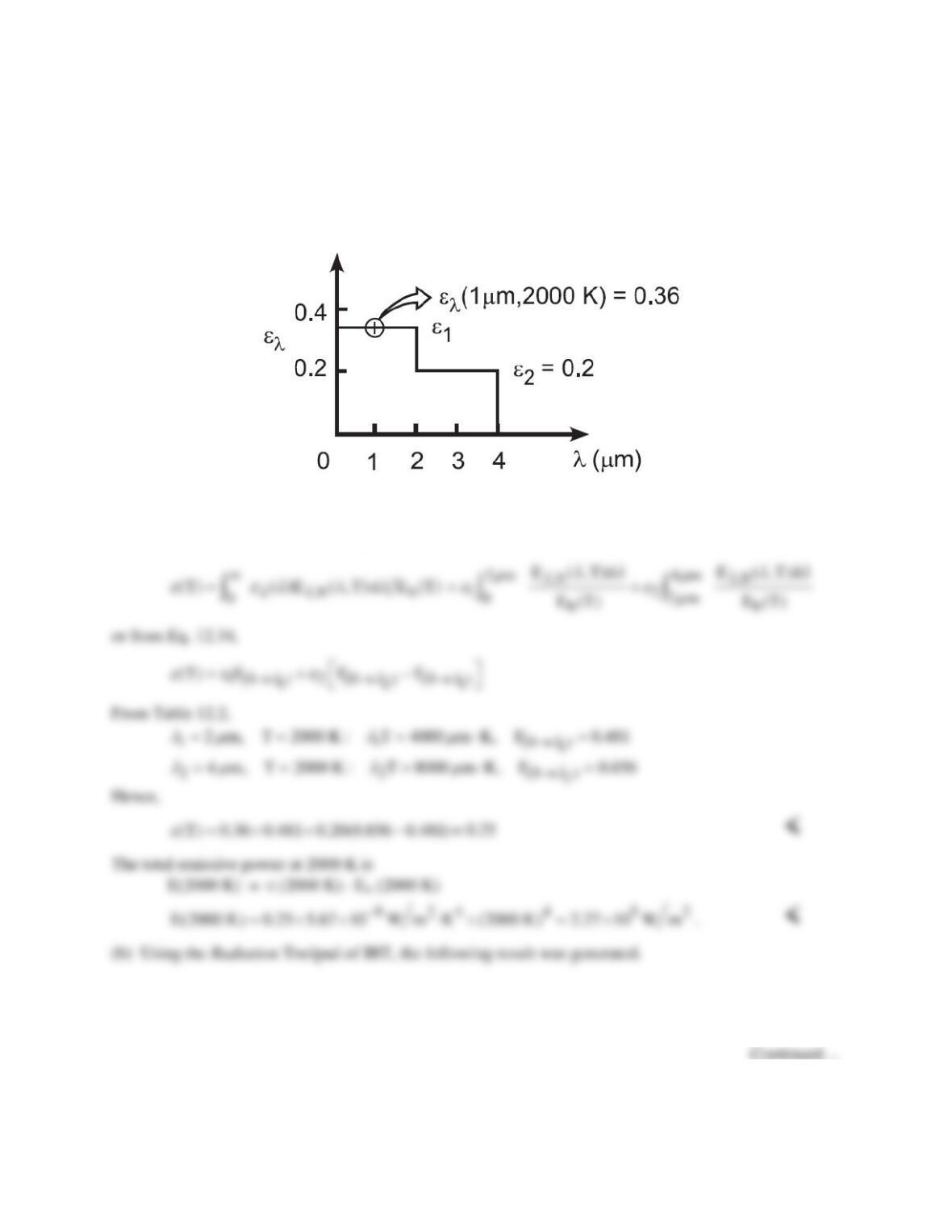
KNOWN: Metallic surface with prescribed spectral, directional emissivity at 2000 K and 1 µm (see
Example 12.7) and additional measurements of the spectral, hemispherical emissivity.
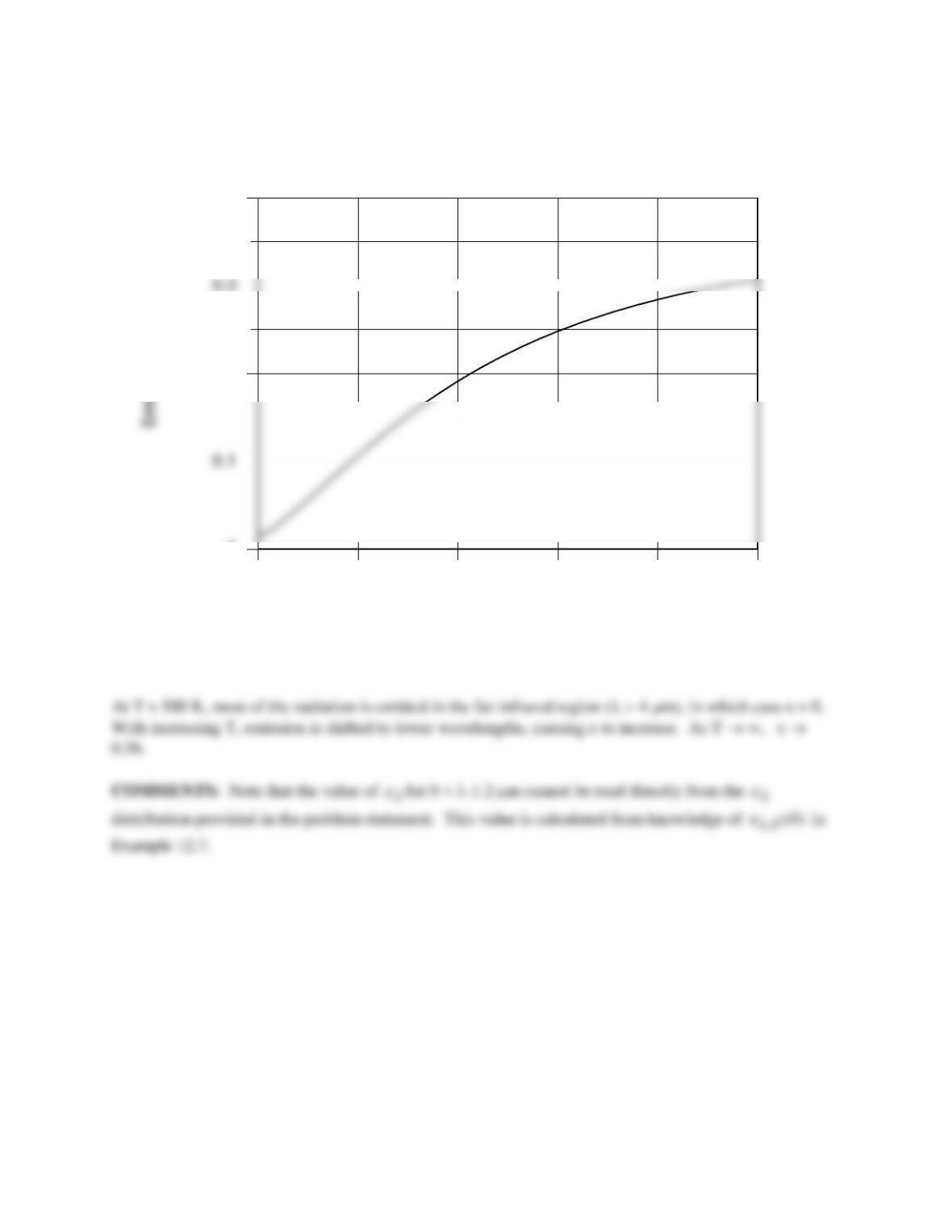
FIND: (a) Total hemispherical emissivity, ε, and the emissive power, E, at 2000 K, (b) Effect of
temperature on the emissivity.
SCHEMATIC:
ANALYSIS: (a) The total, hemispherical emissivity, ε, may be determined from knowledge of the
spectral, hemispherical emissivity,
λ
ε
, using Eq. 12.43.
PROBLEM 12.25 (Cont.)
500 1000 1500 2000 2500 3000
Surface temperature, T(K)
0
0.2
0.4
PROBLEM 12.26
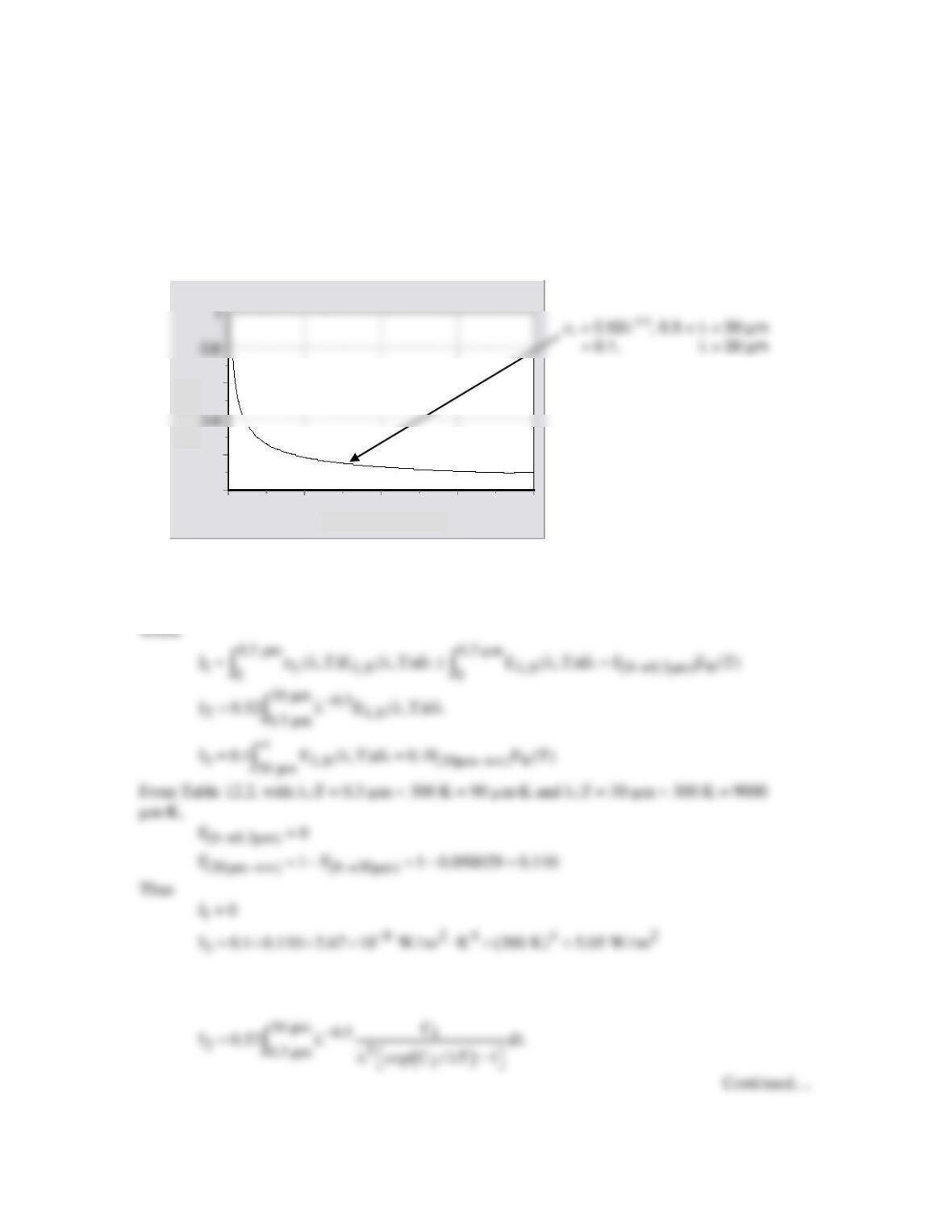
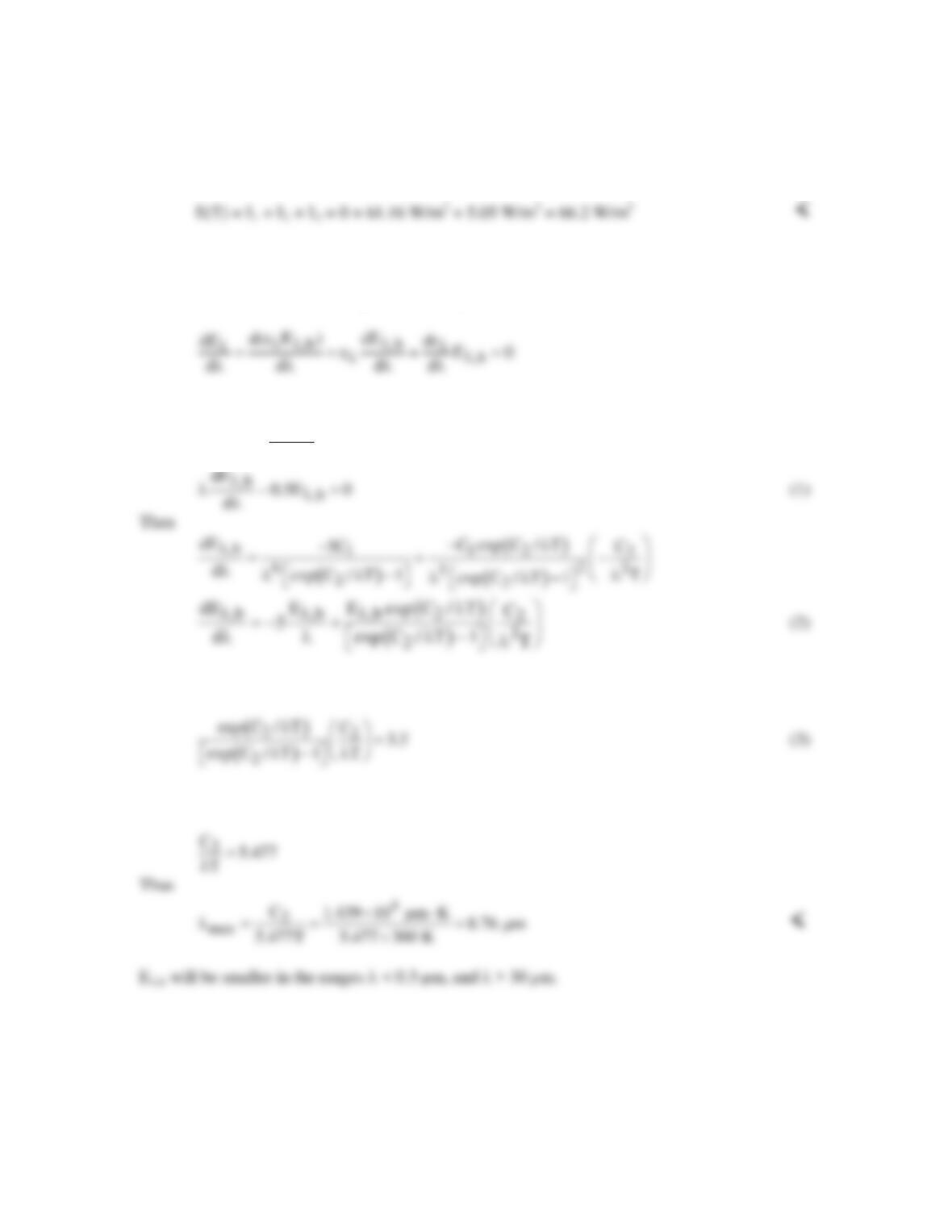
KNOWN: Expression for spectral emissivity of titanium at room temperature.
FIND: (a) Emissive power of titanium surface at 300 K. (b) Value of λmax for emissive power of
surface in part (a).
SCHEMATIC:
ANALYSIS: (a) Combining Eqs. 12.40 and 12.43, the emissive power is given by
b ,b 1 2 3
0
E(T) (T)E (T) ( ,T)E ( ,T)d I I I
∞λλ
=ε = ε λ λ λ= + +
∫
The integral I2 must be evaluated numerically. Making use of Eq. 12.30 for Eλ,b,
lambda (microns)
32241680
ε
0.6
0.2
0
λ (µm)
ε
λ
PROBLEM 12.26 (Cont.)
This integral can be evaluated using the INTEGRAL function of IHT. The result is I2 = 61.16
W/m2. Thus,
(b) The value of λmax is the value of λ for which Eλ is maximum. The maximum in Eλ,b occurs
for λmax T = 2898 µm⋅K, or at 300 K, λmax = 9.66 µm. However, for Eλ = ελEλ,b, the maximum
will be shifted because of the dependence of ελ on λ. We consider
Considering the range 0.3 µm ≤ λ ≤ 30 µm, for which ελ = 0.52λ-0.5, this becomes
()
,b
0.5 1.5 ,b
dE
0.52 0.5 0.52 E 0
d
λ
−−
λ
λ −λ =
λ
Substituting Eq. (2) into Eq. (1) and simplifying,
Solving this implicit equation for C2/λT yields
COMMENTS: Because the titanium has an emissivity that increases with decreasing
wavelength, the value of λmax is smaller than would have been predicted with use of Wien’s
displacement law, λmax,W = 2898 µm⋅K/300K = 9.66 µm.
PROBLEM 12.27
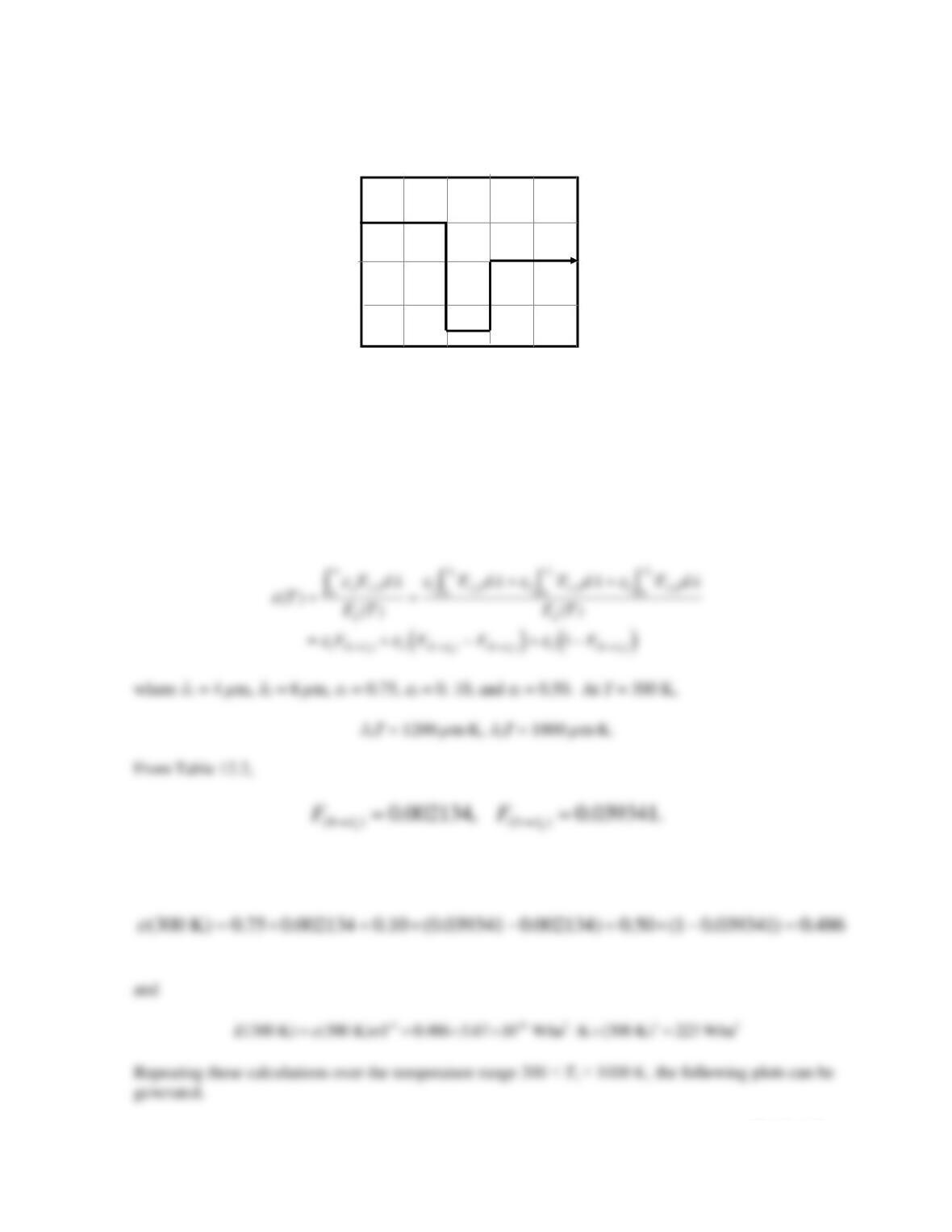
KNOWN: Spectral directional emissivity of a diffuse material at 2500K.
FIND: (a) Total, hemispherical emissivity, (b) Emissive power over the spectral range 0.8 to 2.5 µm
and for directions 0 ≤ θ ≤ π/12.
SCHEMATIC:
ASSUMPTIONS: (1) Surface is diffuse emitter.
ANALYSIS: (a) Since the surface is diffuse, ελ,θ is independent of direction; from Eq. 12.42, ελ,θ =
ελ. Using Eq. 12.43,
( ) ( ) ( ) ( )
,b b
0
T E ,T d /E T
λλ
ε ελ λ λ
∞
=∫
Written now in terms of F(0 → λ), with F(0 → 1.5) = 0.4334 at λT = 1.5 × 2500 = 3750 µm⋅K, (Table
12.2) find,
(b) For the prescribed spectral and geometric limits, from an equation similar to Eq. 12.15,
1.5 2.5
2 /12
sin T
ππ
θs
[ ] [ ]
{ }
E 2 0.2 0.4334 0.06673 0.8 0.7579 0.4334
ππ
∆= × ⋅ − + −
()
PROBLEM 12.28
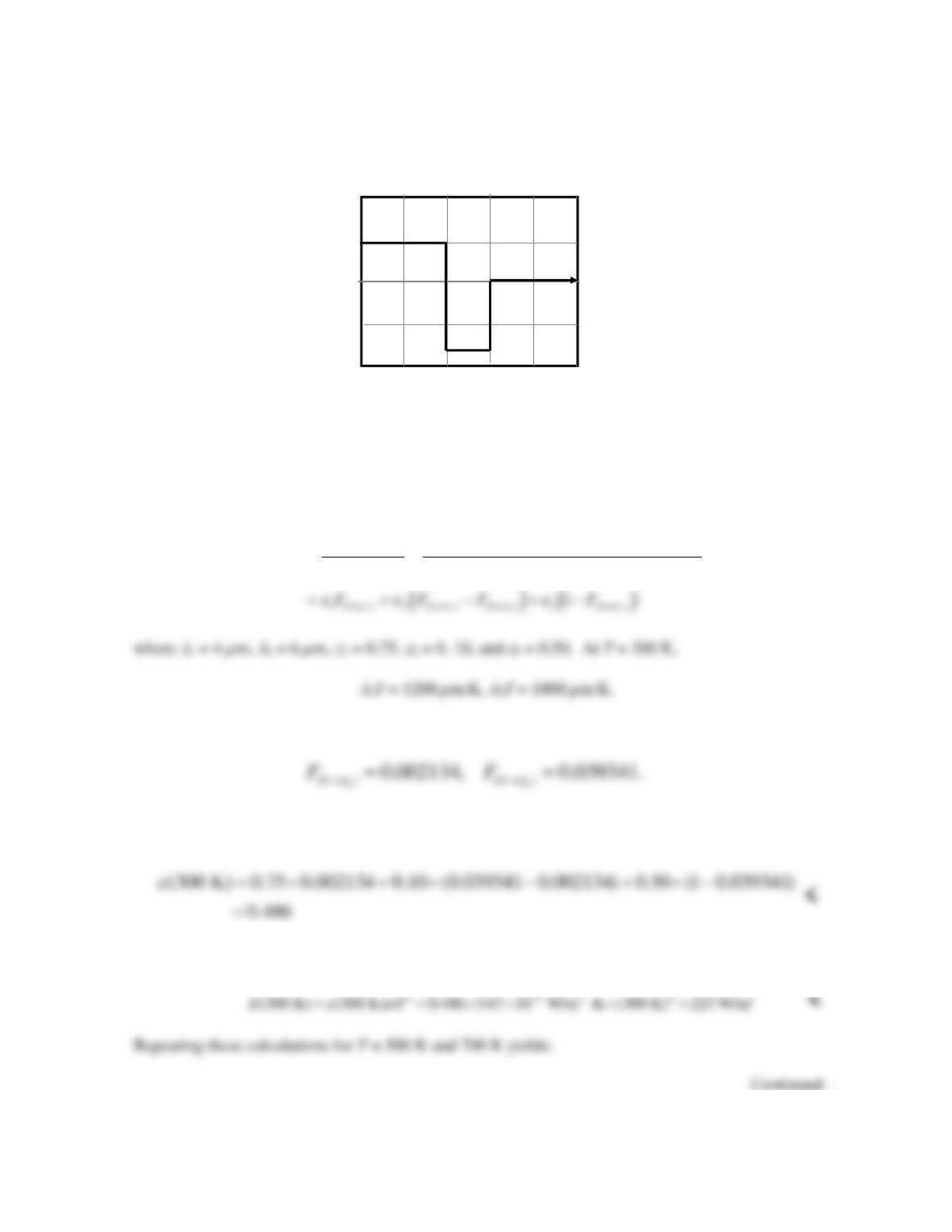
KNOWN: Spectral emissivity distribution of diffuse surface. Surface temperature range.
FIND: Temperature at which the emissive power is minimized.
SCHEMATIC:
ASSUMPTIONS: Surface is a diffuse emitter.
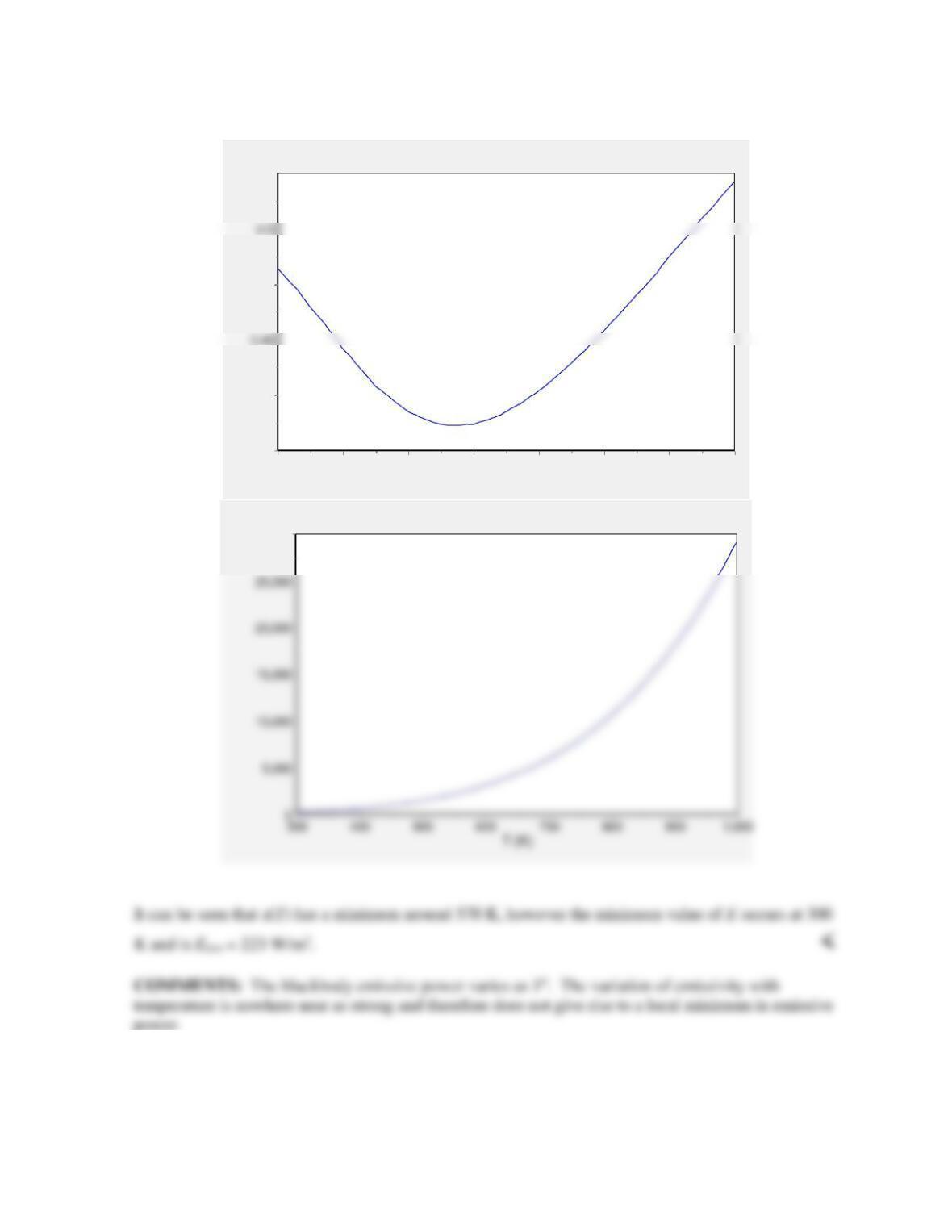
ANALYSIS: The emissive power is E(T) =
(T)Eb(T). It is known that Eb(T) increases with T, but it
is not immediately obvious how
(T) varies with temperature since as temperature increases, the
heaviest weighting of the spectral emissivity distribution shifts from higher to lower wavelengths.
From Eq. 12.43,
Thus,
Continued…
010
(m)
0
1.0
0.5
2 4 6 8
= 0.10
= 0.75
= 0.50
PROBLEM 12.28 (Cont.)
T (K)
1,000900800700600500400300
0.48
0.44
0.42
30,000
PROBLEM 12.29
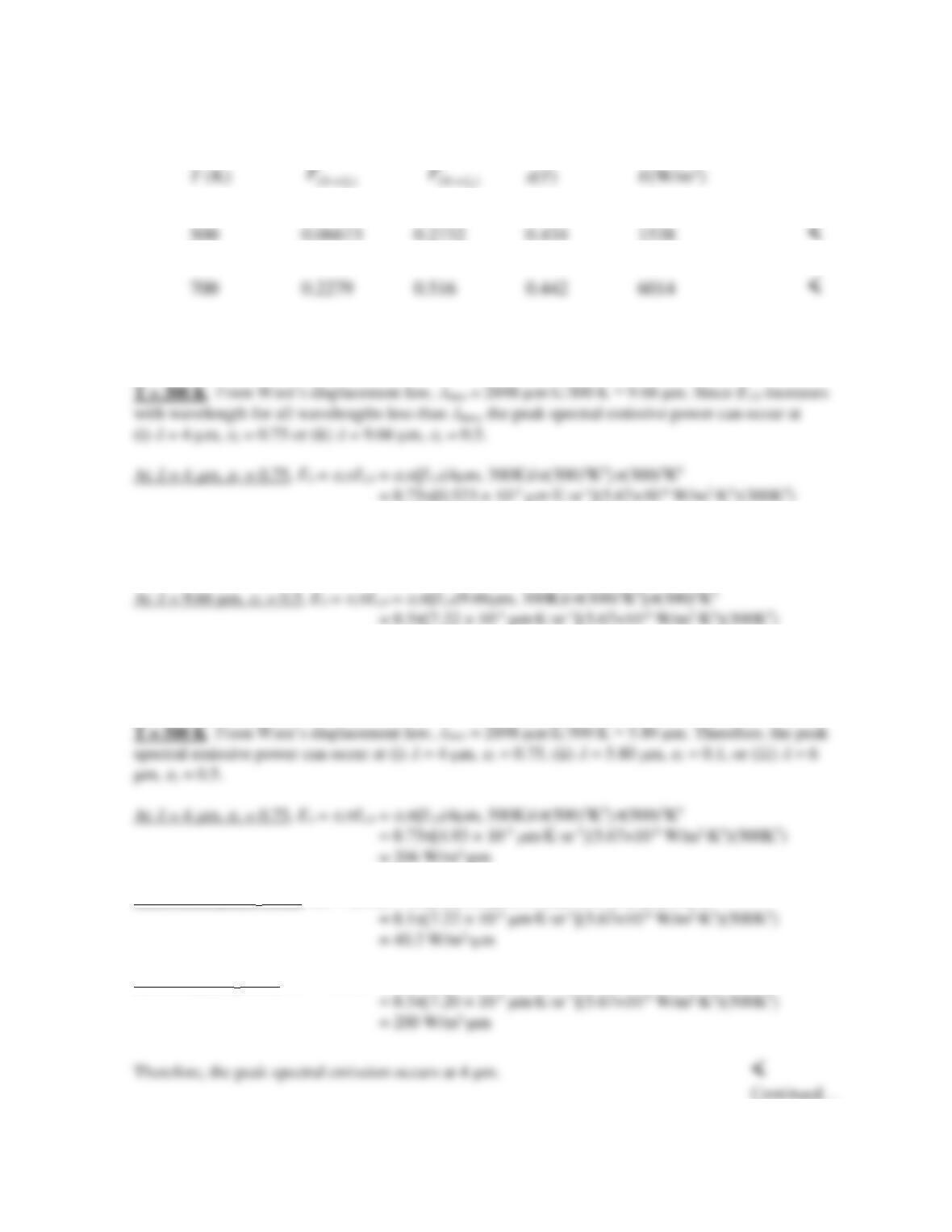
KNOWN: Spectral emissivity distribution of diffuse surface. Surface temperature values.
FIND: Surface hemispherical emissivity and emissive power at T = 300, 500, and 700 K. Wavelength
corresponding to peak spectral emission at these temperatures.
SCHEMATIC:
ASSUMPTIONS: Surface is a diffuse emitter.
ANALYSIS: The emissive power is E(T) =
(T)Eb(T). From Eq. 12.43,
1 2 3
, 1 , 2 , 3 ,
0 0 0 0
() ( ) ( )
b b b b
bb
E d E d E d E d
TE T E T
From Table 12.2,
Thus,
and
010
(m)
0
1.0
0.5
2 4 6 8
= 0.10
= 0.75
= 0.50
PROBLEM 12.29 (Cont.)
To determine the wavelength at which the peak spectral emission occurs, proceed as follows.
= 1.698 W/m2∙m
where [I
,b(4m, 300K)/
(300)5K5] is found from Table 12.2.
= 15.62 W/m2∙m
Therefore, the peak spectral emission occurs at 9.66 m. <
At
= 5.80 m,
= 0.1, E
=
I
,b =
I
,b(5.80m, 500K)/
(500)5K5]
(500)5K5
At
= 6 m,
= 0.5, E
=
I
,b =
I
,b(6m, 500K)/
(500)5K5]
(500)5K5
PROBLEM 12.29 (Cont.)
T = 700 K From Wien’s displacement law,
max = 2898 m∙K/700 K = 4.14 m. Therefore, the peak
PROBLEM 12.30
KNOWN: Directional emissivity, εθ, of a selective surface.
FIND: Ratio of the normal emissivity, εn, to the hemispherical emissivity, ε.
SCHEMATIC:
ASSUMPTIONS: Surface is isotropic in φ direction.
0 /4
2 0.8 0.3
22
π
ε
= +