SOLUTIONS TO CONCEPTS FOR ANALYSIS
CA 11-1
(a) The purpose of depreciation is to distribute the cost (or other book value) of tangible plant assets,
less salvage, over their useful lives in a systematic and rational manner. Under generally accepted
(b) The proposed depreciation method is, of course, systematic. Whether it is rational in terms of cost
allocation depends on the facts of the case. It produces an increasing depreciation charge, which
is usually not justifiable in terms of the benefit from the use of the asset because manufacturers
typically prefer to use their new equipment as much as possible and their old equipment only as
needed to meet production quotas during periods of peak demand. As a general rule, then, the
benefit declines with age. Assuming that the actual operations (including equipment usage) of
(c) (1) Depreciation charges neither recover nor create funds. Revenue-producing activities are the
sources of funds from operations: if revenues exceed out-of-pocket costs during a fiscal period,
funds are available to cover other than out-of-pocket costs; if revenues do not exceed out-of–
pocket costs, no funds are made available no matter how much, or little, depreciation is charged.
(2) Depreciation may affect funds in two ways. First, depreciation charges affect reported income
and hence may affect managerial decisions such as those regarding pricing, product selection,
and dividends. For example, the proposed method would result initially in higher reported
income than would the straight-line method, consequently stockholders might demand higher
dividends in the earlier years than they would otherwise expect.
CA 11-1 (Continued)
If Burnitz is not profitable now, it would not benefit from higher deductions now and should
consider an increasing charge method for tax purposes, such as the one proposed. If Burnitz
CA 11-2
(a) (1) The unit method of recording depreciation involves the treatment of plant assets or substantial
(2) Under the group or composite-life methods, assets are aggregated into accounting units. Such
grouping might be horizontal, vertical, or geographical. Horizontal grouping assembles together
all assets of similar physical characteristics, such as trucks, presses, returnable containers,
(b) 1. Arguments for the use of the unit method are:
i. The method is simple in that it does not require involved mathematical computations.
Arguments against the unit method are:
i. Considerable additional bookkeeping is necessary to account for each asset and its
related depreciation. (Computers reduce the work burden, however.)
ii. There is a point of diminishing returns in the accumulation of accounting data under this
2. Arguments for the use of the group and composite-life methods are:
i. The methods require less detailed bookkeeping.
ii. The application of depreciation to the whole group tends to average out or offset errors,
economic or operating, caused by under-depreciation or over-depreciation.
CA 11-2 (Continued)
Arguments against the use of the group and composite-life methods would include:
i. The methods would conceal faulty estimates for a long period of time.
ii. When there is an early heavy retirement of assets a debit balance might appear in the
Accumulated Depreciation account and present an accounting problem.
(c) Under the unit method, retirements are recorded by removing from the accounts the cost of the
asset and its related accumulated depreciation. The difference between the two accounts, adjusted
for salvage and disposal costs, if any, is recognized as gain or loss.
Under the group and composite-life methods the cost of the retired asset is removed from the
CA 11-3
Situation I. This position relates to the omission of a provision for depreciation during a strike. The same
question could be raised with respect to plant shut-downs for many reasons, such as for a lack of sales
or for seasonal business.
The method of depreciation used should be systematic and rational. The annual provision for
CA 11-3 (Continued)
(b) In determining the depreciation method to be used for the machine, the objective should be to
allocate the cost of the machine over its useful life in a systematic and rational manner, so that
costs will be matched with the benefits expected to be obtained. In addition to demand, considera-
tion should be given to the items discussed below, their interrelationships, the relative importance
of each, and the degree of certainty with which each can be predicted:
The expected pattern of costs of repairs and maintenance should be considered. Costs which
vary with use of the machine may suggest the use of the units-of-production method. Costs
Another consideration is the expiration of the physical life of the machine. If the machine wears
out in relation to the passage of time, the straight-line method is indicated. Within this maximum
life, if the usage per period varies, the units-of–production method may be appropriate.
The machine may become obsolete because of technological innovation; it may someday be
more efficient to replace the machine even though it is far from worn out. If the probability is
high that such obsolescence will occur in the near future, the shortened economic life should
be recognized. Within this shortened life, the depreciation method used would be determined
by evaluating such consideration as the anticipated periodic usage.
Situation III. Depreciation rates should be adjusted in order that the operating sawmills which are to be
replaced will be depreciated to their residual value by the time the new facility becomes available. The
step-up in the depreciation rates should be considered as a change in estimate and prior years’
financial statements should not be adjusted.
CA 11-4
To: Phil Perriman, Supervisor of Canning Room
From: Your name, Accountant
Date: January 22, 2014
Subject: Annual depreciation charge to the canning department
This memo addresses the questions you asked about the depreciation charge against your department.
Admittedly this charge of $625,000 is very high; however, it is not intended to reflect the wear and tear
which the machinery has undergone over the last year. Rather, it is a portion of the machines’ cost
which has been allocated to this period.
You also mentioned that using straight-line depreciation would result in a smaller charge than would
the current double-declining-balance method. This is true during the first years of the equipment’s life.
Straight-line depreciation expenses even amounts of depreciation for each canning machine’s twelve–
year life. Thus the straight-line charge for this and all subsequent years would be $47,500 per machine
for total annual depreciation of $285,000.
During the earlier years of an asset’s life, the double-declining-balance method results in higher
depreciation charges because it doubles the straight-line rate which would have been made under the
straight-line method. However, the same percentage depreciation in the first year is applied annually to
the asset’s declining book value. Therefore, the double–declining-balance charge becomes lower than
CA 11-5
(a) The stakeholders are Beeler’s employees, including Prior, current and potential investors and
creditors, and upper-level management.

CA 11-5 (Continued)
(c) Prior should review the estimated useful lives and salvage values of the depreciable assets.
Since they are estimates, it is possible that some should be changed. Any changes should be
FINANCIAL REPORTING PROBLEM
(a) P&G classifies its property, plant and equipment under three descrip–
tions in its balance sheet: Buildings, Machinery and equipment, and
Land.
(d) P&G’s Statement of Cash Flows reports depreciation and amortization
of $2,838 million in 2011, $3,108 million in 2010, and $3,082 million was
charged to expense in 2009.
COMPARATIVE ANALYSIS CASE
(a) Property, plant, and equipment, net of accumulated depreciation:
(b) Coca-Cola and PepsiCo depreciate property, plant, and equipment
principally by the straight-line method over the estimated useful lives
of the assets. Depreciation expense was reported by Coca-Cola (includes
(c) (1) Asset turnover:
Coca-Cola
PepsiCo
(2) Profit margin on sales:
Coca-Cola
PepsiCo
COMPARATIVE ANALYSIS CASE (Continued)
(3) Return on assets:
Coca-Cola
PepsiCo
$8,634
$6,462
(d) Coca-Cola’s capital expenditures were $2,920 million in 2011 while
PepsiCo’s capital expenditures were $3,339 million in 2011.
FINANCIAL STATEMENT ANALYSIS CASE
(a) McDonald’s used the straight–line method for depreciating its property
and equipment.
(b) Depreciation and amortization charges do not increase cash flow
from operations. In a cash flow statement, these two items are often
(c) The schedule of cash flow measures indicates that cash provided by
operations is expected to cover capital expenditures over the next few
ACCOUNTING, ANALYSIS, AND PRINCIPLES
Accounting
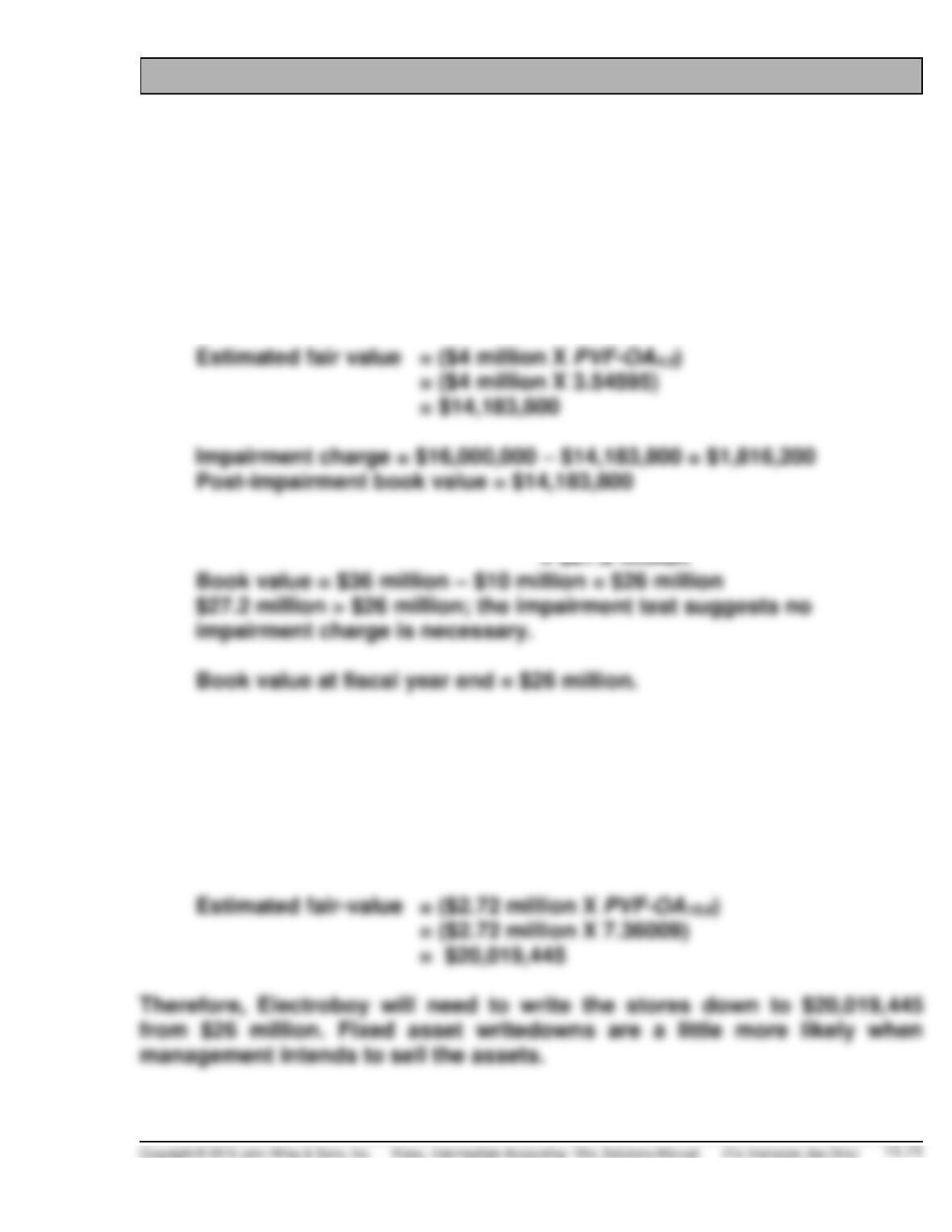
(a) Undiscounted future cash flows = (4 years X $4 million per year)
= $16 million
Book value = $36 million – $10 million = $26 million
$16 million < $26 million; the impairment test suggests an impairment
charge is necessary.
(b) Undiscounted future cash flows = (10 years X $2.72 million per year)
Analysis
If the stores are in the process of being sold, they would likely be
considered ‘held for sale’ for financial reporting purposes. If they are held
for sale, the impairment test is based on the discounted cash flows, instead
of undiscounted. Essentially, it is a lower-of–cost-or-market approach.
ACCOUNTING, ANALYSIS, AND PRINCIPLES (Continued)
Principles
Under GAAP, once an asset is written down to an impairment value, it can
not be subsequently written back up. This provision is based in part on
PROFESSIONAL RESEARCH
(a) According to FASB ASC 360-10-05 (Property, Plant, and Equipment)
05-2 The guidance in the Overall Subtopic is presented in the
following two Subsections:
a. The General Subsections address the accounting and
05-4 The Impairment of Disposal of Long-Lived Assets Subsections
provide guidance for:
35–21 A long-lived asset (asset group) shall be tested for recoverability
whenever events or changes in circumstances indicate that its
carrying amount may not be recoverable. The following are
examples of such events or changes in circumstances:
a. A significant decrease in the market price of a long-lived
asset (asset group) [FAS 144, paragraph 8, sequence 115]
b. A significant adverse change in the extent or manner in
which a long-lived asset (asset group) is being used or in its
PROFESSIONAL RESEARCH (Continued)
e. A current-period operating or cash flow loss combined with
a history of operating or cash flow losses or a projection or
forecast that demonstrates continuing losses associated
(c) According to FASB ASC 360–10–35-36, For long-lived assets (asset
groups) that have uncertainties both in timing and amount, an expected
present value technique will often be the appropriate technique with
which to estimate fair value.
According to FASB ASC 820-10–35–37 through 43 (Fair Value Hierarchy):
35–37 To increase consistency and comparability in fair value
measurements and related disclosures, the fair value hierarchy
prioritizes the inputs to valuation techniques used to measure
fair value into three broad levels. The fair value hierarchy gives
PROFESSIONAL RESEARCH (Continued)
35–38 The availability of inputs relevant to the asset or liability and
the relative reliability of the inputs might affect the selection of
appropriate valuation techniques. However, the fair value
35–39 The remainder of this guidance is organized as follows:
a. Level 1 inputs
b. Level 2 inputs
35–40 Level 1 inputs are defined in this Subtopic as quoted prices
(unadjusted) in active markets for identical assets or liabilities
that the reporting entity has the ability to access at the
measurement date.
35–41 A quoted price in an active market provides the most reliable
35–41A A Level 1 fair value measurement for the liability is a quoted
price in an active market for the identical liability at the
measurement date. In addition, the quoted price for the
identical liability when traded as an asset in an active market
PROFESSIONAL RESEARCH (Continued)
35–42 If the reporting entity holds a large number of similar assets or
liabilities (for example, debt securities) that are required to be
measured at fair value, a quoted price in an active market
35–43 In some situations, a quoted price in an active market might
not represent fair value at the measurement date. That might
be the case if, for example, significant events (principal-to–
Alternative methods for estimating fair value are addressed at FASB ASC
820–10–35-28 through 36:
35–28 Valuation techniques consistent with the market approach,
income approach, and/or cost approach shall be used to
measure fair value. The definitions and key aspects of those
approaches follow.