11-1
CHAPTER 11
DEPRECIATION AND DEPLETION
CONTENT ANALYSIS OF EXERCISES AND PROBLEMS
Number
Content
Time Range
(minutes)
E11-1
Depreciation Methods. (Easy) Straight-line, hours worked, units
of output.
5-10
E11-5
Rate of Return. (Moderate) Determination under straight-line
and double-declining balance methods.
10-15
E11-6
Acquisition Cost. (Moderate) Computation under straight-line,
sum-of-the-years’-digits, and double-declining-balance
methods.
15-20
E11-7
Group Depreciation. (Easy) Straight-line. Journal entries to
record transactions.
5-15
11-2
Number
Content
Time Range
(minutes)
E11-13
Changes and Corrections. (Moderate) Increased asset life.
Straight-line to sum-of-the-years’-digits. Residual value ignored.
Journal entries.
15-20
P11-2
Depreciation Methods. (Moderate) Straight-line, hours worked,
units of output.
15-20
P11-3
Depreciation Methods. (Challenging) Straight-line, sum-of-the-
years’-digits, double-declining-balance, 150% declining-
balance. Return on assets.
20-25
P11-8
Group and Composite Depreciation. (Challenging) Straight-
line. Journal entries to record various transactions
(depreciation, retirement).
30-40
P11-9
Composite Depreciation. (Moderate) Straight-line. Journal
entries to record various transactions (depreciation, acquisition,
retirement).
15-20
11-3
Number
Content
Time Range
(minutes)
P11-12
Depletion. (Moderate) FIFO. Calculation of depletion amount
in ending inventory and the income statement. Balance sheet
preparation.
20-30
P11-16
Comprehensive: Various Issues. (Challenging) Journal entries
to record various transactions. Determination of account
balances. Includes topics from Chapter 9.
40-60
P11-17
(AICPA adapted). Comprehensive: Capitalized Costs and
Depreciation. (Challenging) Prepare schedules to determine
land and building costs, and depreciation expense.
30-40
P11-21
(AICPA adapted). Comprehensive: Acquisitions, Disposals,
Depreciation. (Challenging) Schedules for changes in plant
assets, depreciation expense, and gain or loss on asset
disposal.
40-60
P11-22
Comprehensive: Financial Statements. (Challenging)
40-60
ANSWERS TO QUESTIONS
Q11-1 All three terms–depreciation, depletion, and amortization–refer to the process of
allocating the cost of an asset to the periods in which the benefits are recognized as
Q11-2 The four factors used in a company’s computation of the periodic depreciation
amount are:
1. Asset cost – all the costs needed to acquire, install, and prepare the asset for use.
Q11-3 The depreciation base is the cost of an asset less the estimated residual value. This is
the amount that is allocated over the estimated service life of the asset.
Q11-4 The objective of accounting for depreciation is to match the cost of an asset with the
Q11-5 Note: Part c involves an understanding of cash flow concepts discussed briefly in
Chapter 5. The recording of depreciation affects a company’s financial statements
as follows:
a. Income statement – the company expenses depreciation directly or through cost
11-5
Q11-6 Depreciation is not a means of generating funds for the replacement of an asset. It is
Q11-7 By definition, a cost is considered variable if it changes in proportion to changes in
Q11-8 Depreciation results primarily from physical causes and functional causes. Wear and
tear, which is due to operational usage, suggests the use of an activity method of
depreciation. Deterioration and decay are more dependent upon time and thus a
time method of depreciation, such as the straight-line, declining-balance, or sum-of-
Q11-9 Accelerated methods of depreciation are the most appropriate when it can be
Q11-10 The upward revaluation of property, plant, and equipment that is allowed under IFRS
Q11-11 The group and composite methods of depreciation are similar in that they are both
applied to a combination of assets. The group method is used when the assets are
Q11-12 A manufacturing company debits depreciation on manufacturing assets to a Work in
Process account (an inventory account). In this way, it recognizes the expense of
11-6
Q11-13 The depreciation on an asset is not intended to produce a book value equal to the
Q11-14 Depreciation of an asset is not an attempt to measure the value of an asset. Thus, a
Q11-15 The manager seems to be using the term “depreciate” in another sense. With regular
repairs and maintenance, perhaps the transmission lines have extended useful lives
Q11-16 The required disclosures for depreciation are as follows:
1. Depreciation expense for the period
Q11-17 Because the underlying purposes behind depreciation are different for financial
reporting and for income tax reporting, the method for each is different. Accounting
principles require the depreciation method to be “systematic and rational” and that it
match the depreciation amounts to the benefits received from the assets. For
Q11-18 A company’s depletion for income tax purposes and financial reporting are the same
if it uses the cost method for both. However, for income tax purposes it may use the
Q11-19 In determining whether an asset is impaired, IFRS compare the higher of the asset’s
value less costs to sell (or value in use) to the asset’s carrying value. Under U.S. GAAP,
ANSWERS TO MULTIPLE CHOICE
11-8
SOLUTIONS TO REVIEW EXERCISES
RE11-1
RE11-2
Year
Depreciation
Base
Fraction
Depreciation
Book Value of
Asset at End of Year
1 $360,000 5/15* $120,000 $255,000#
RE11-3
Year
Book Value of Asset
at Beginning of Year
Rate
Depreciation
Book Value of
Asset at End of Year
1 $75,000 25%* $18,750 $56,250
RE11-4
RE11-5
RE11-6
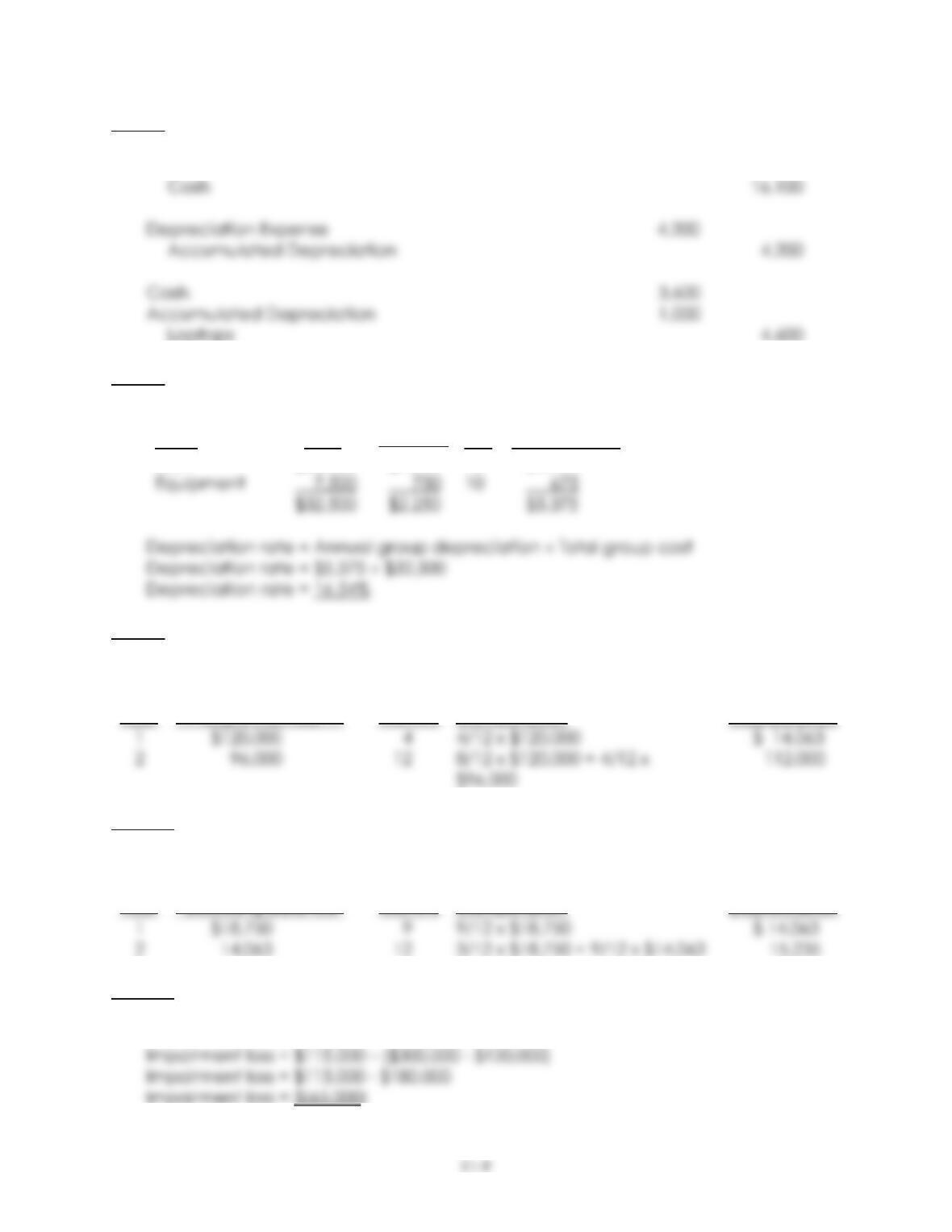
RE11-7
Laptops 16,100
RE11-8
Asset
Cost
Residual
Value
Life
Annual
Depreciation
Car $25,000 $1,500 5 $4,700
RE11-9
Year
Annual Depreciation
by-Sum-of-the- Years’-
Digits Method
Months
Computation
Annual
Depreciation
RE11-10
Year
Annual Depreciation
by the Double-
Declining-Balance
Months
Computation
Reported
Annual
Depreciation
RE11-11
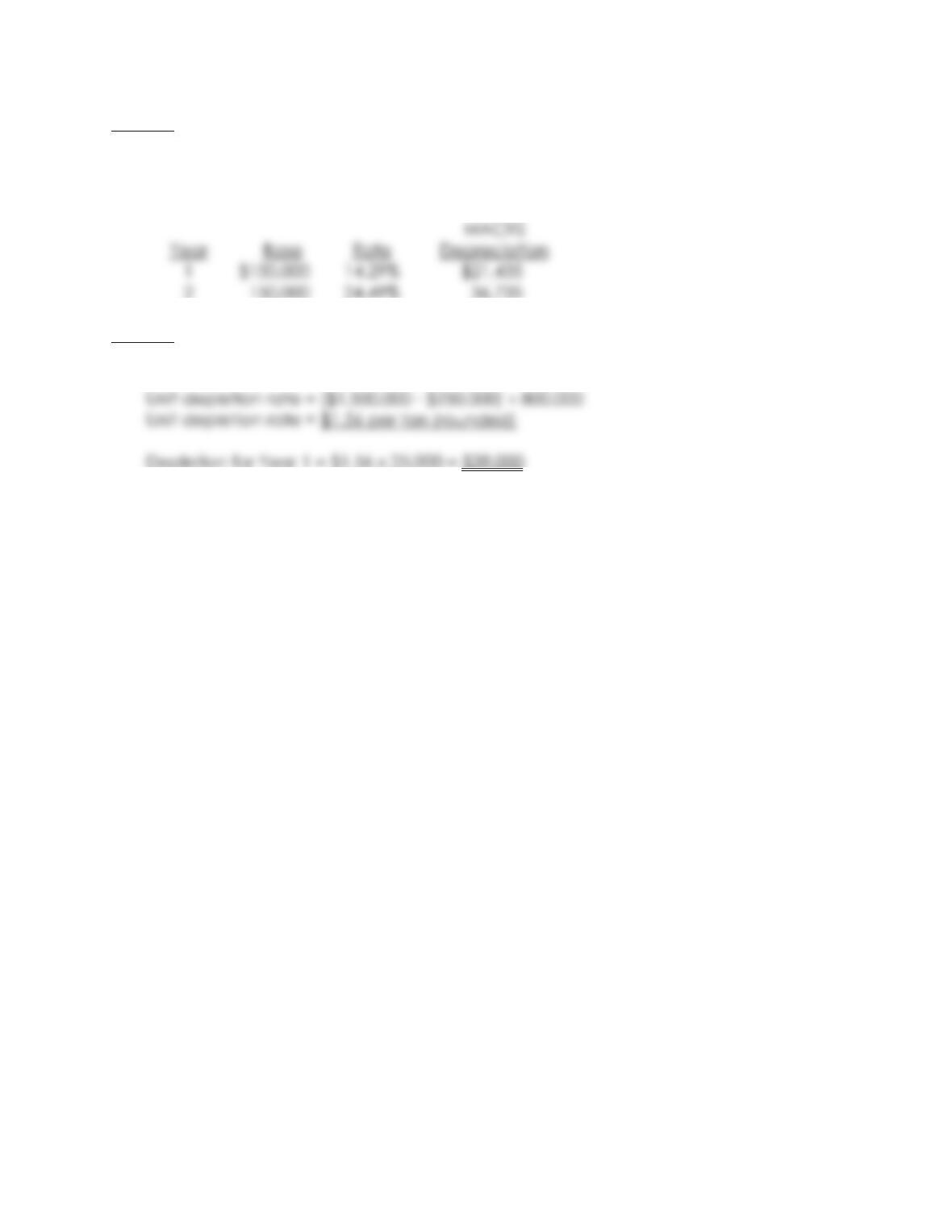
Impairment loss = Fair value – Book value
11-10
RE11-12
MACRS Depreciation (use rates for 7-year life in Exhibit 11-3)
RE11-13
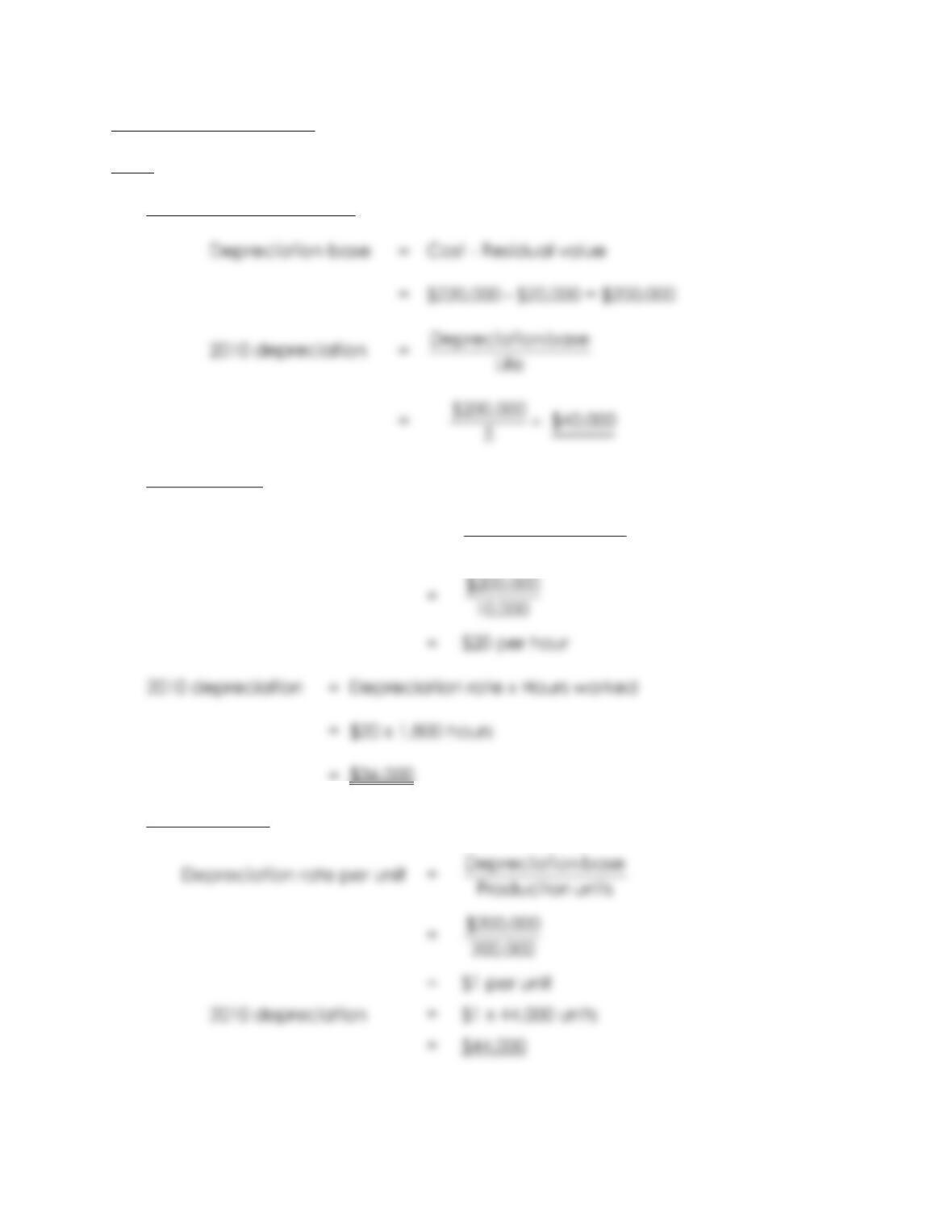
Unit depletion rate = (Cost – Residual value) ÷ Units
11-11
SOLUTIONS TO EXERCISES
E11-1
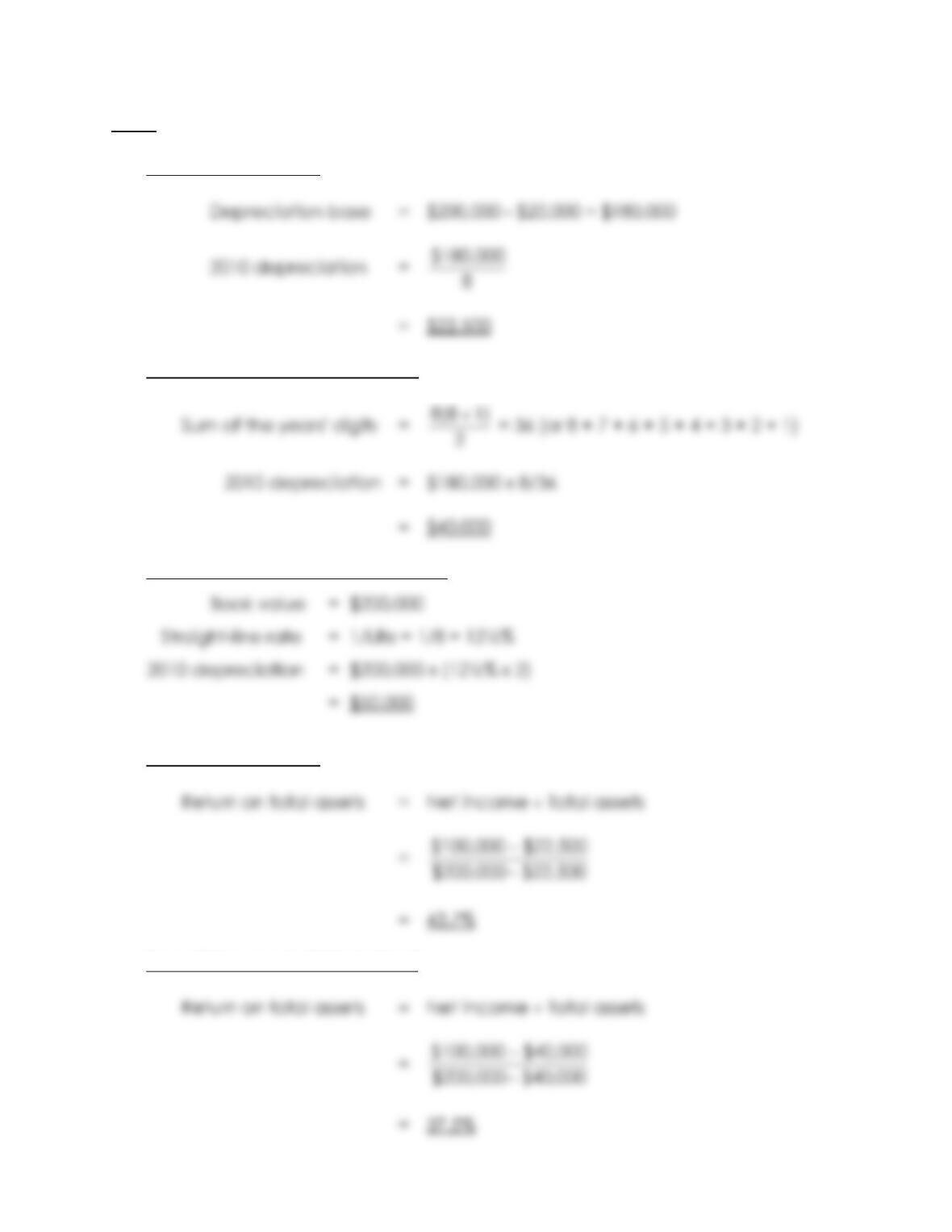
1. Straight-line depreciation:
2. Hours worked:
Depreciation rate per hour = hoursinlifeService
baseonDepreciati
3. Units of output:
11-12
E11-2
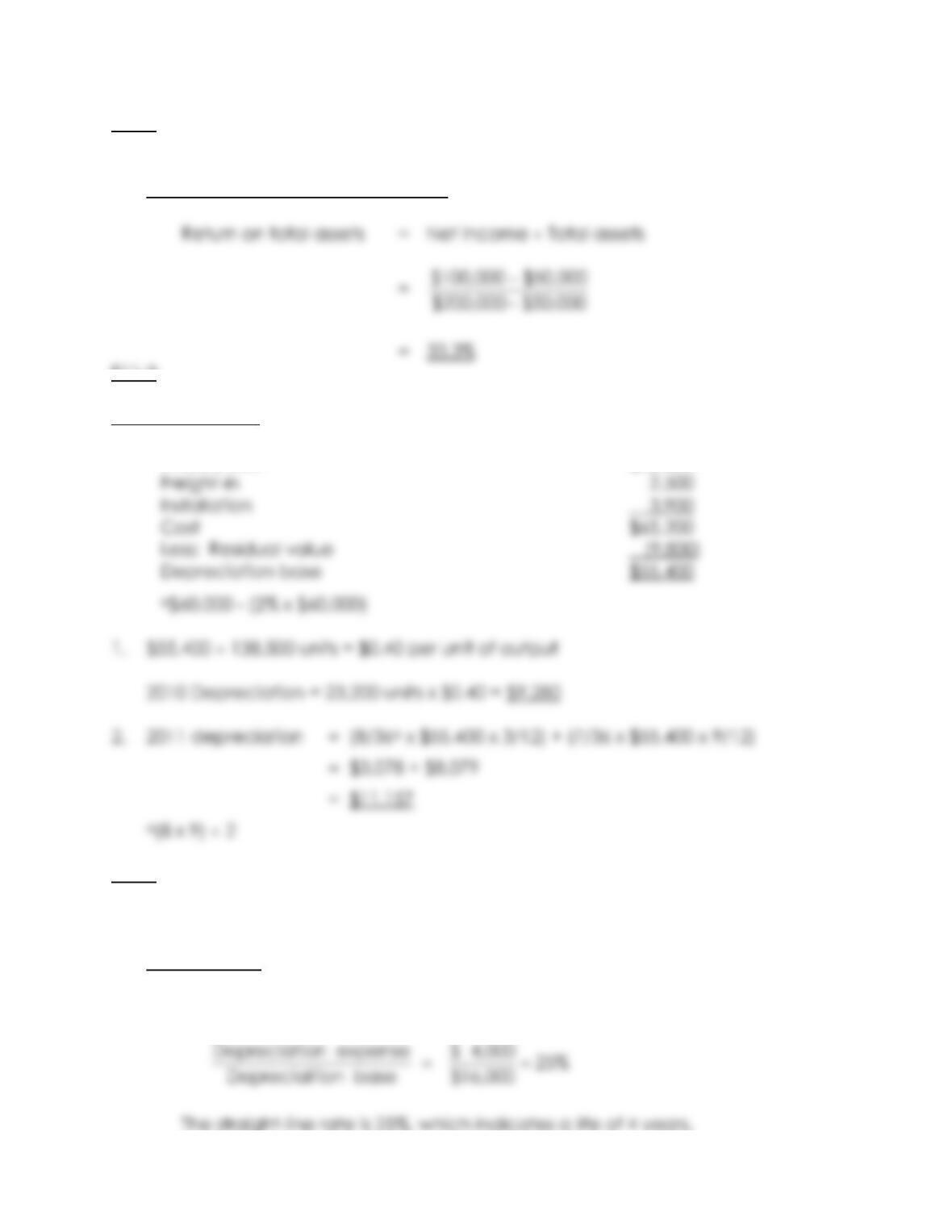
1. Straight-line method:
2. Sum-of-the-years’-digits method:
3. Double-declining balance method:
4. Straight-line method:
Sum-of-the-years’ digits method:
11-13
E11-2 (continued)
4. (continued)
Double-declining balance method:
E11-3
Note to Instructor: This exercise includes material from the previous chapter.
Invoice cost $58,800a
E11-4
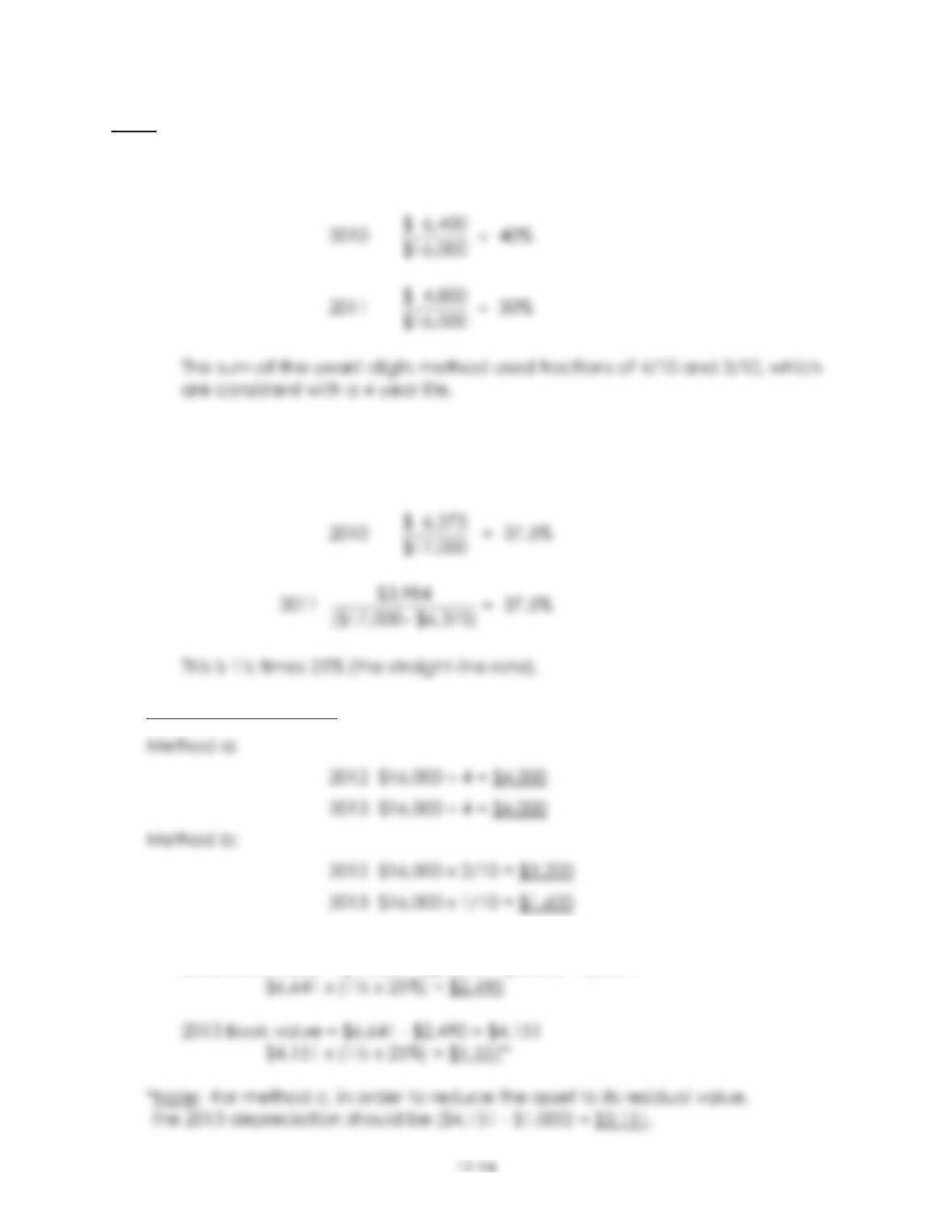
Depreciation base = $17,000 – $1,000 = $16,000
1. Method used:
a. Straight-line method
E11-4 (continued)
1. (continued)
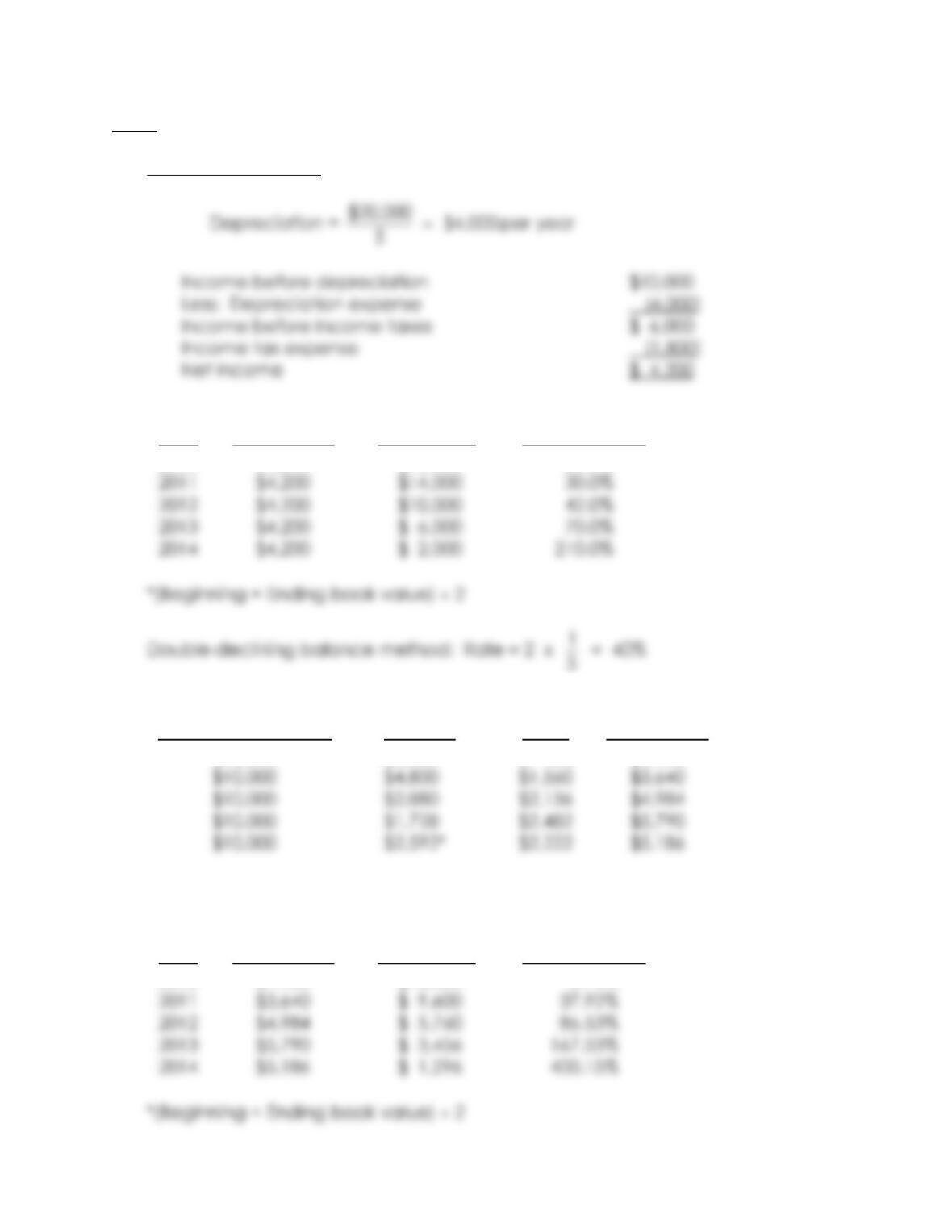
b. Sum-of-the-years’-digits method
c. 150% declining balance method. In this case, the depreciation expense is
divided by the book value (dividing by the depreciation base shows no
pattern).
2. Depreciation expense:
Method c:
2012 Book value = $17,000 – ($6,375 + $3,984) = $6,641
11-15
E11-5
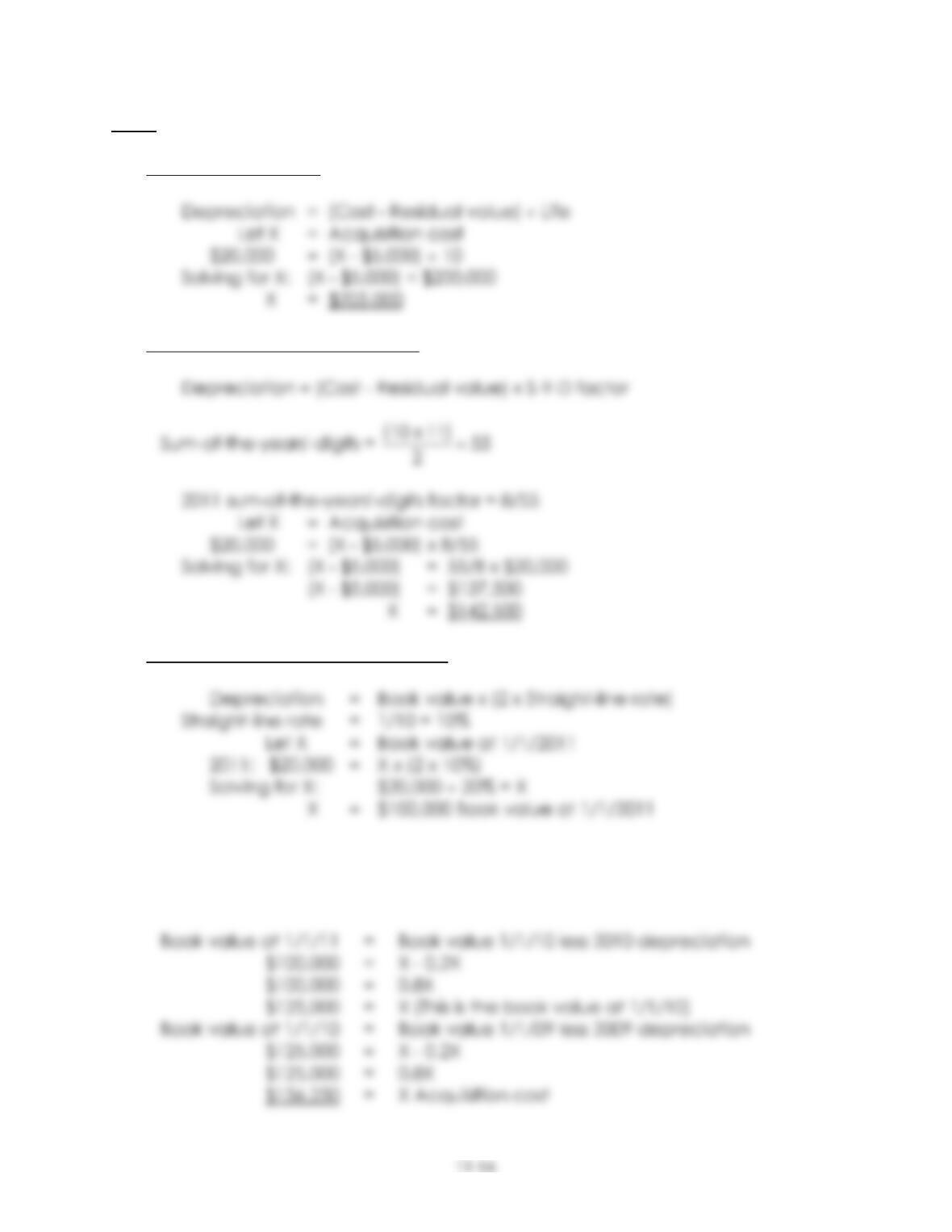
Straight-line method:
Year
Net Income
Average
Book Value*
Rate of Return
2010
$4,200
$18,000
23.3%
Income
Before Depreciation
Depreciation
Expense
Income
Taxes
Net Income
$10,000
$8,000
$ 600
$1,400
*To reduce to zero residual value.
Year
Net Income
Average
Book Value*
Rate of Return
2010
$1,400
$16,000
8.75%
E11-6
1. Straight-line method:
2. Sum-of-the-years’-digits method:
3. Double-declining balance method:
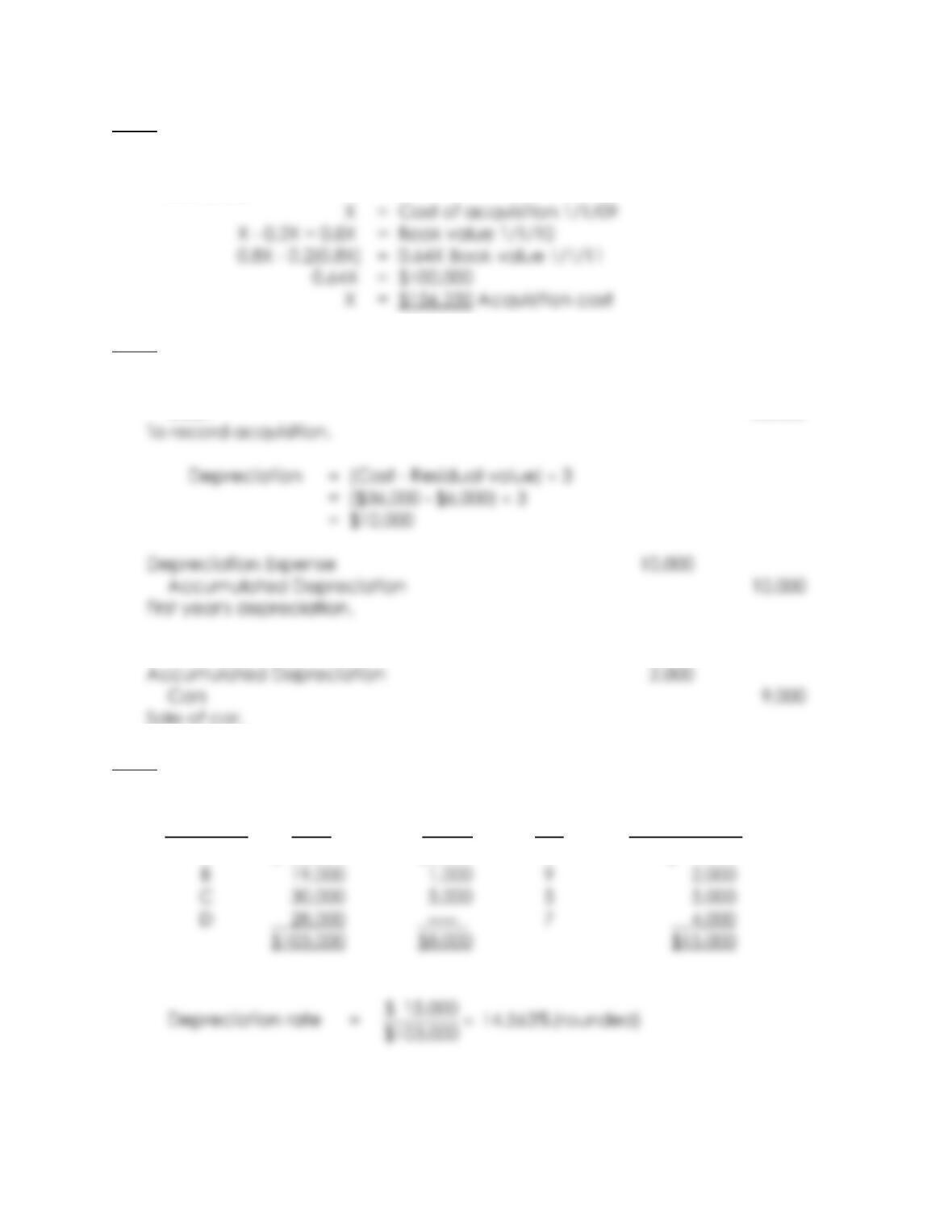
To find the original cost at the beginning of 2009:
Method 1: Working backward from 2011:
11-17
E11-6 (continued)
3. (continued)
Method 2:
E11-7
1. Automobiles 36,000
Cash 36,000
2. Cash 7,000
E11-8
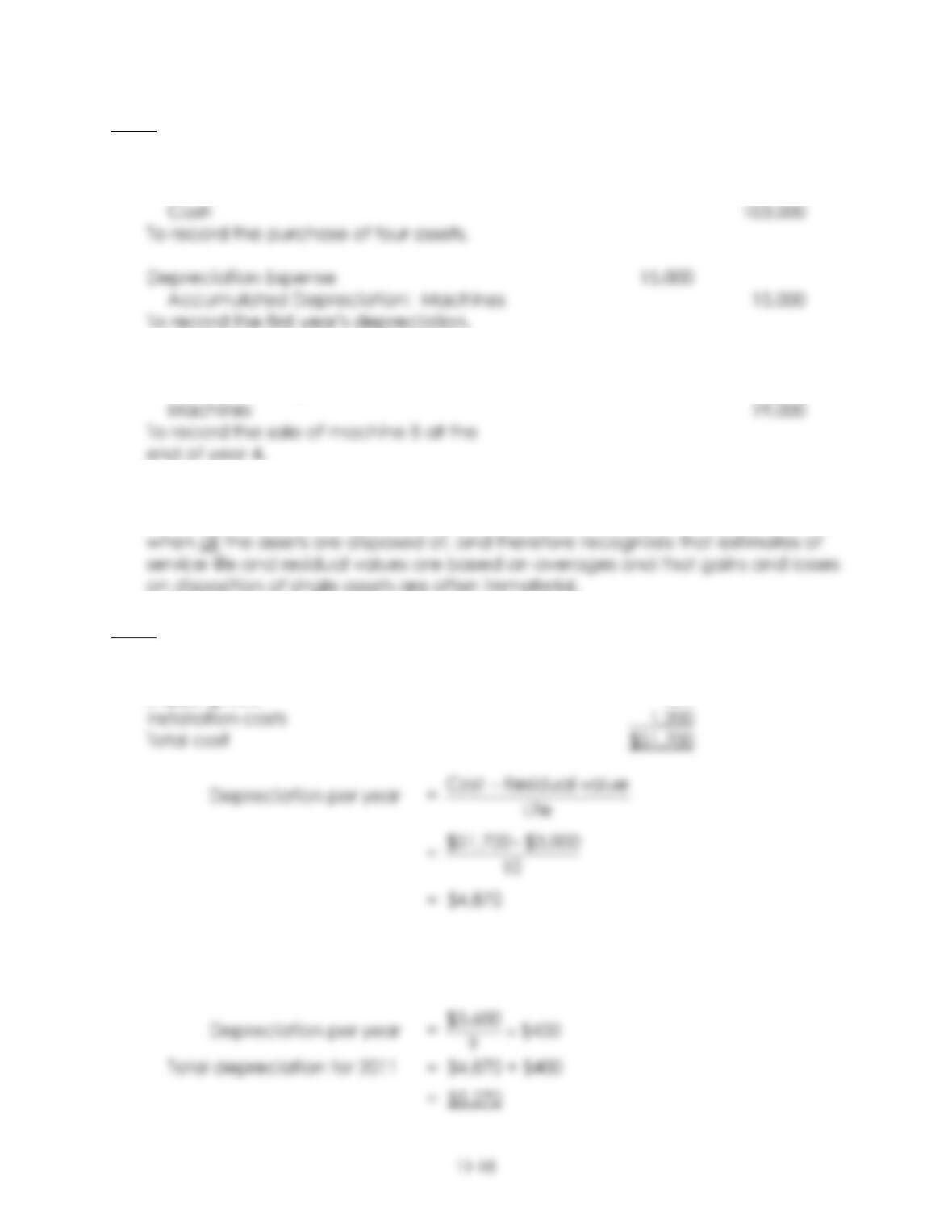
1.
Machines
Cost
Residual
Value
Life
Annual
Depreciation
A
$ 26,000
$2,000
6
$ 4,000
E11-8 (continued)
1. (continued)
Machines 103,000
2. Cash 10,000
Accumulated Depreciation: Machine 9,000
3. The composite-depreciation method simplifies the bookkeeping when a large
number of assets are acquired. Also, this method only recognizes gains or losses
E11-9 (AICPA adapted solution)
Purchase price $50,000
Shipping cost 500
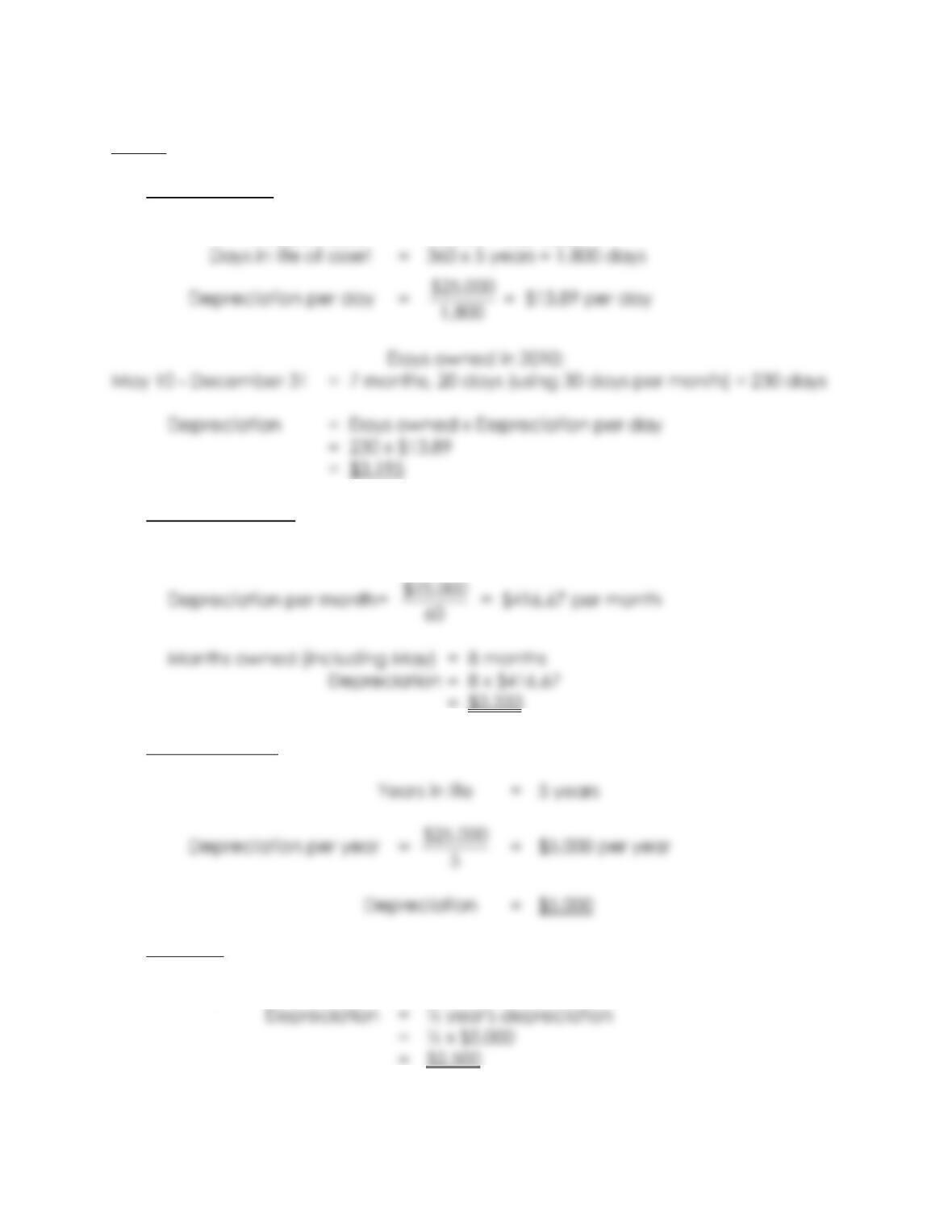
The pollution-control additions are depreciated over the remaining economic
life of the asset (9 years).
11-19
E11-10
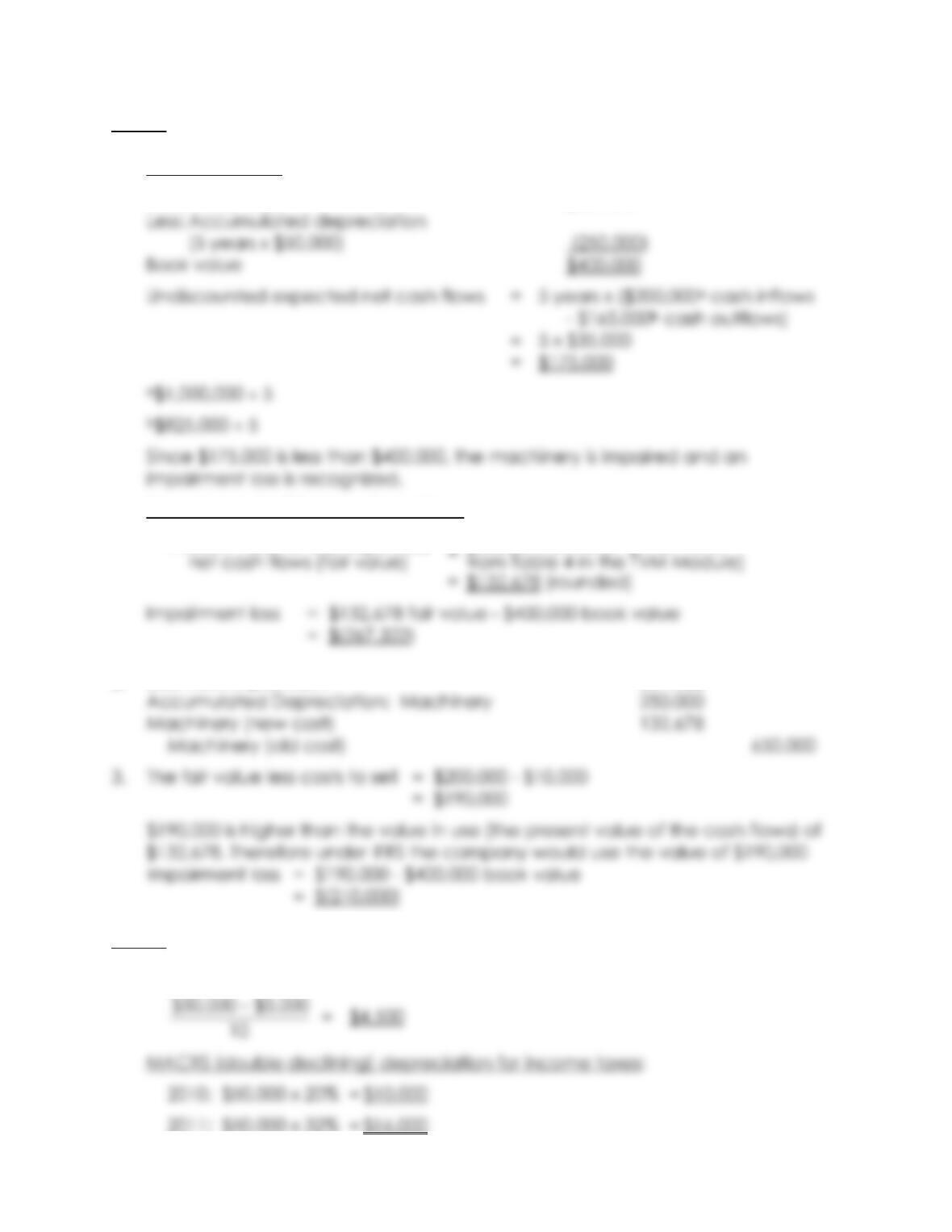
1. To nearest day:
Days in year = 12 x 30 = 360 days
2. To nearest month:
Months in life = 12 x 5 = 60 months
3. To nearest year:
4. Half-year:
Depreciation per year = $5,000
11-20
E11-11
1. Impairment Test (December 31, 2010)
Machinery cost $650,000
Measurement of the Impairment Loss
Present value of the expected $35,000 x 3.790787 (n=5, i=0.10
2. Loss from Impairment 267,322
E11-12
Financial statement depreciation: