Problem 11.14
Steam ( 2
HO
vapor) flows in a pipeline in a power station. The steam pressure is 150 psia,
its temperature is 500 °F, and it flows with velocity 750ft/s. Calculate the stagnation
pressure and stagnation temperature. If you are familiar with Steam Tables or steam
property software, use these tools to make an “exact” calculation. If you are not familiar
with these tools, model the steam as an ideal gas with molecular weight of 18 and =1.3.k
Solution 11.14
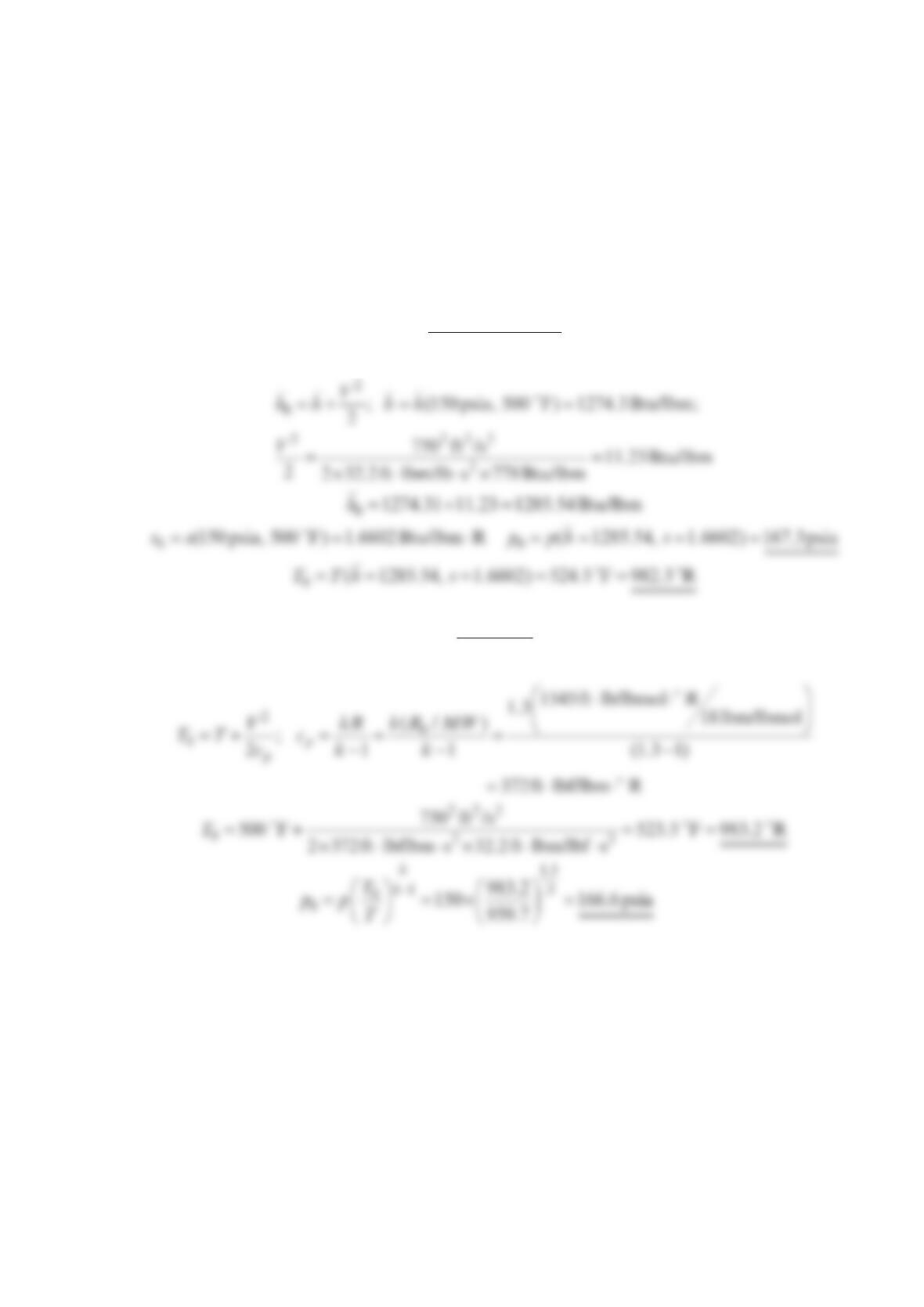
Steam properties
Ideal Gas
Problem 11.15
An ideal gas flows with velocity ,V pressure ,p temperature ,T and density
ρ
. Determine
a set of equations for stagnation properties, including entropy, if the stagnation process is
defined to be isothermal =)cons(tantT rather than isentropic =constant .()s
Solution 11.15
Stagnation properties are the properties that would result if a flow fluid is brought to rest in
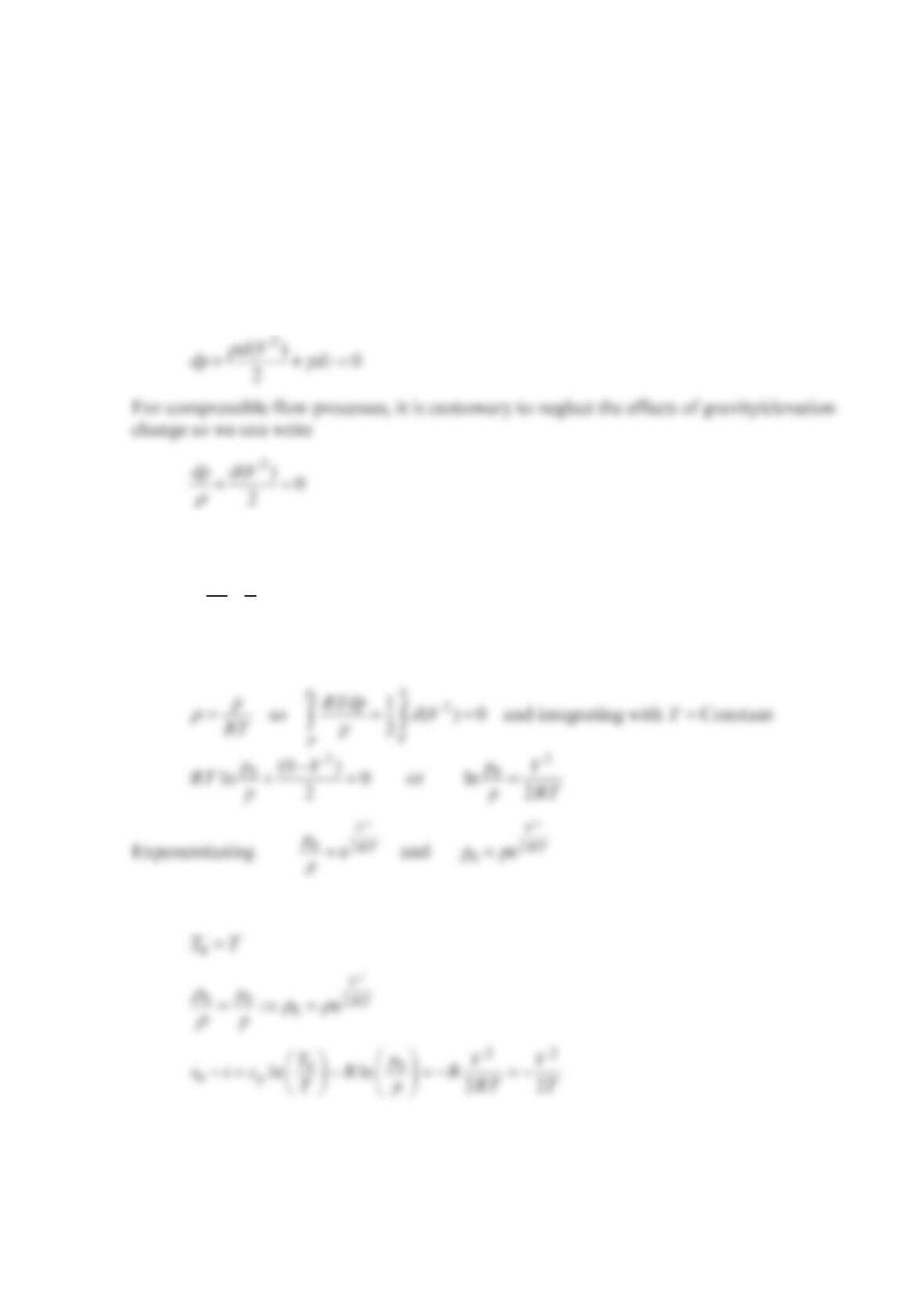
a steady flow process with no work and no friction. For such a process, the Euler equation:
Integrating for a stagnation process
ρ
+=
00
2
1()0
2
p
pV
dp dV
Assuming an ideal gas
Other stagnation properties are given by

Summarizing
Problem 11.16
If the observed speed of sound in steel is 5300 m/s, determine the bulk modulus of elasticity
of steel in N/m3. The density of steel is nominally 7790 kg/m3. How does your value of v
E
for steel compare with v
E for water at 15.6 °C? Compare the speeds of sound in steel,
water, and air at standard atmospheric pressure and 15 °C and comment on what you
observe.
Solution 11.16
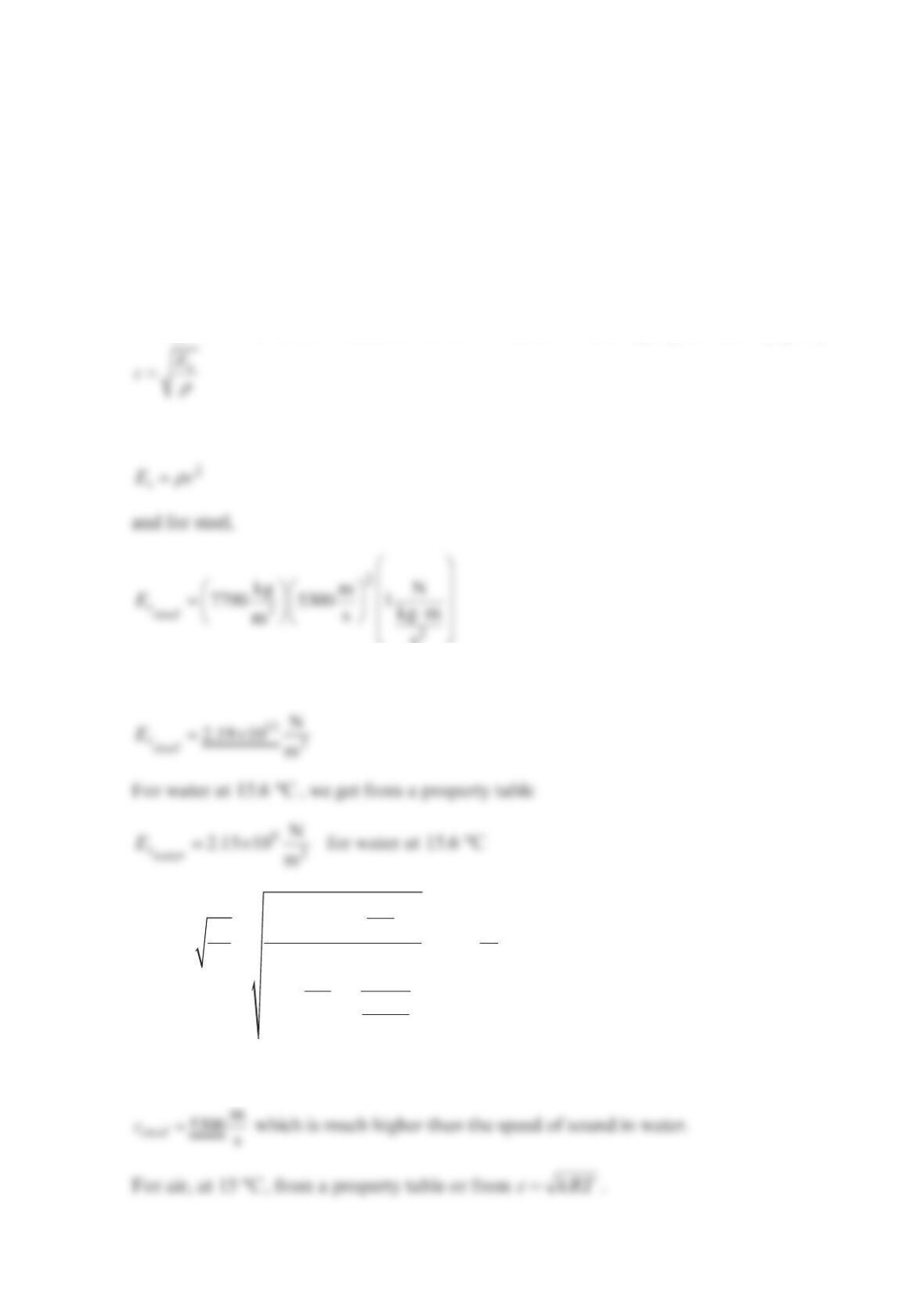
The speed of sound, c, is related to the bulk modulus of elasticity, v
E
, and density,
ρ
, by
Thus
s
or
ρ
×
== =
⋅
9
2
3
2
N
2.15 10 m
m1470 s
kg N
999 1 kg m
m
s
v
water
E
c
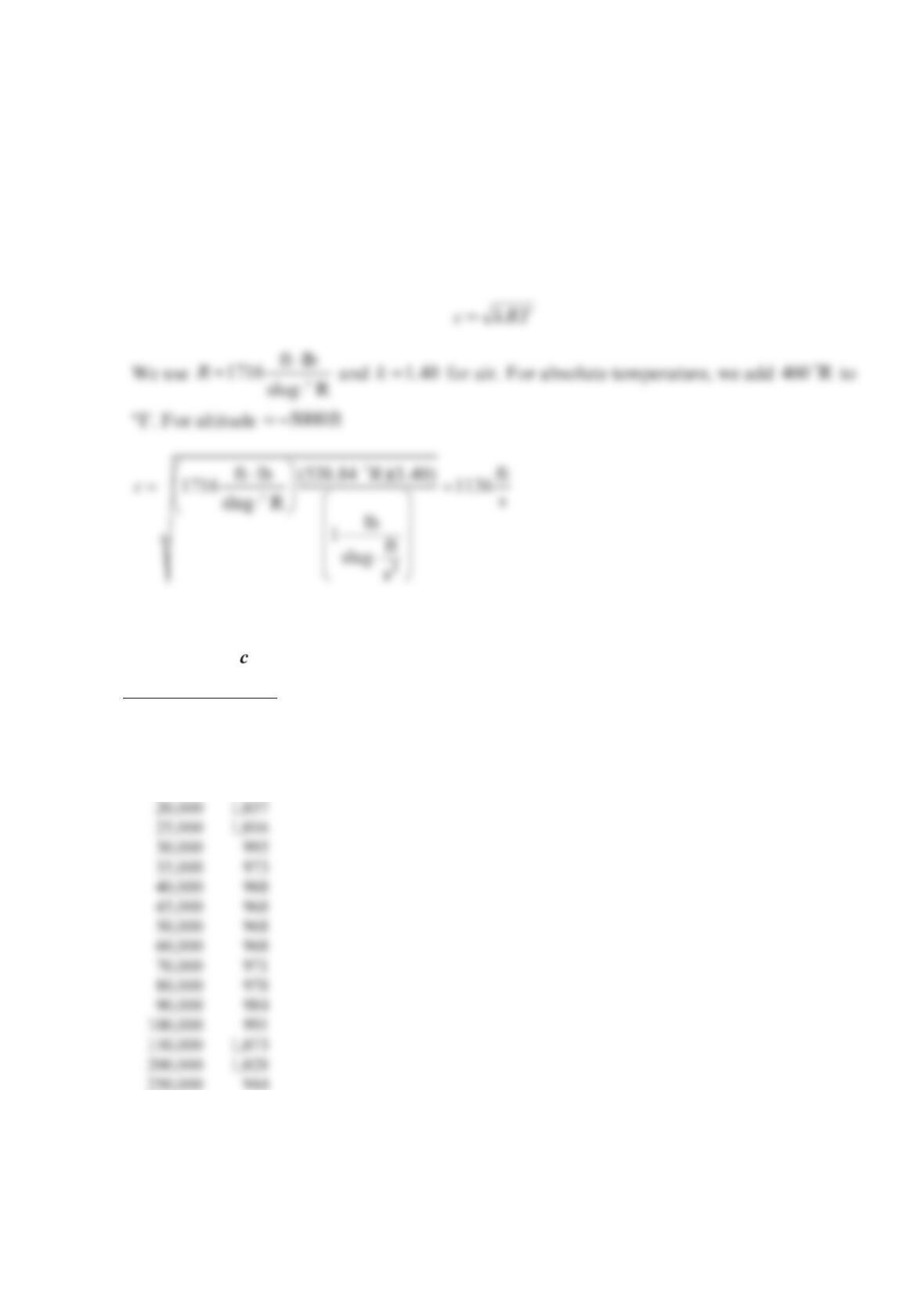
For steel,
Problem 11.17
Using information provided in Table C.1 Properties of the U.S. Standard Atmosphere
(BG/EE Units), develop a table of speed of sound in ft/s as a function of elevation for U.S.
standard atmosphere.
Solution 11.17
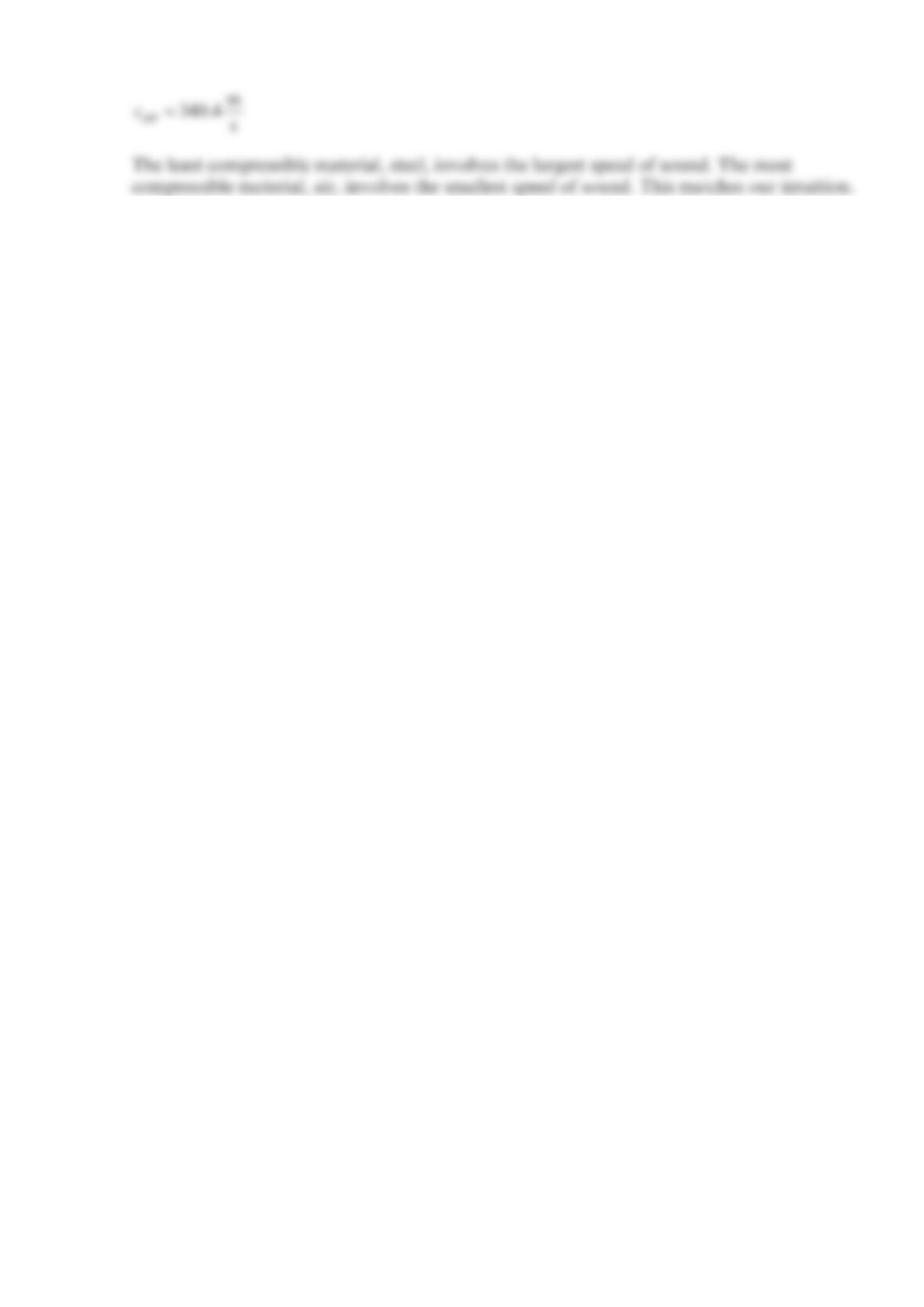
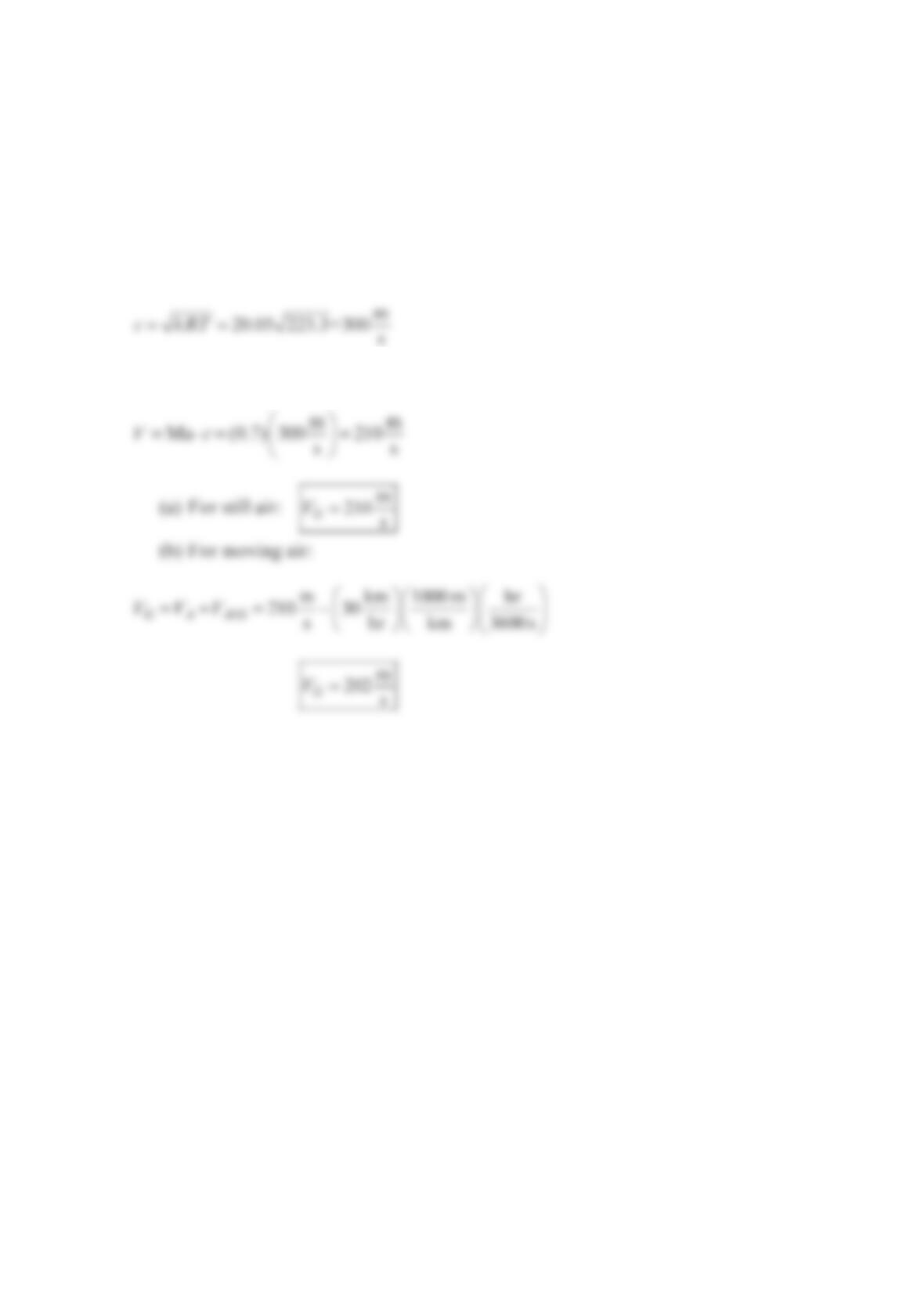
We can use equation for an ideal gas to determine the speed of sound in U.S. standard
atmosphere at the elevations listed in the problem. Thus,
For all equations, the same procedure shown above was used. The results are:
Altitude
(ft)
(ft/s)
-5,000 1,136
0 1,117
5,000 1,097
10,000 1,078
15,000 1,058
Problem 11.18
An airplane is flying at a flight (or local) Mach number of 0.70 at 10,000 m in the Standard
Atmosphere. Find the ground speed (a) if the air is not moving relative to the ground and
(b) if the air is moving at 30 km/hr in the opposite direction from the airplane.
Solution 11.18
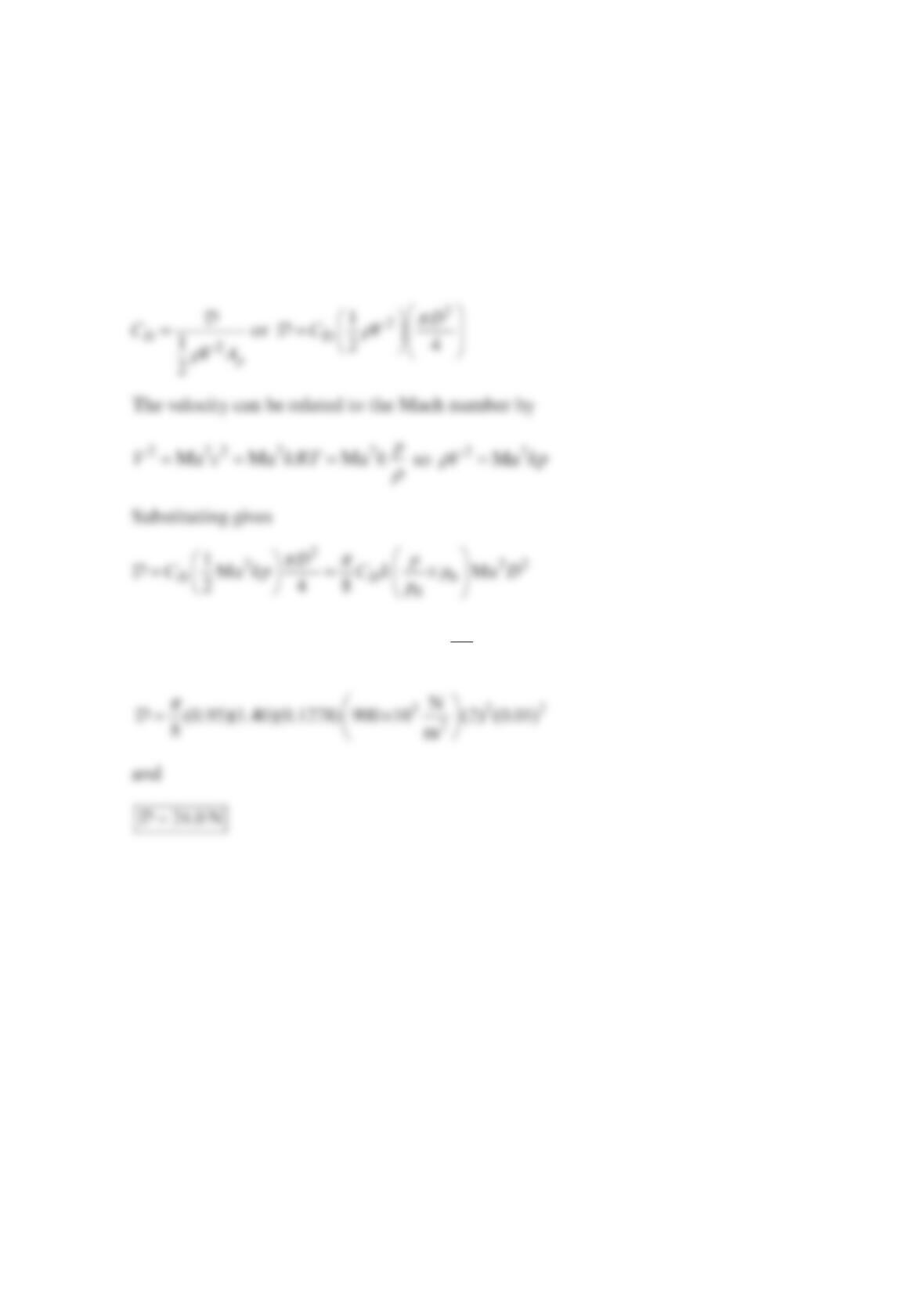
For the Standard Atmosphere, =223.3 KT at 10,000 m. For an ideal gas,
The velocity relative to the air is:
Problem 11.19
The stagnation pressure in a Mach 2 wind tunnel operating with air is 900 kPa. A 1.0-cm-
diameter sphere positioned in the wind tunnel has a drag coefficient of 0.95. Calculate the
drag force on the sphere.
Solution 11.19
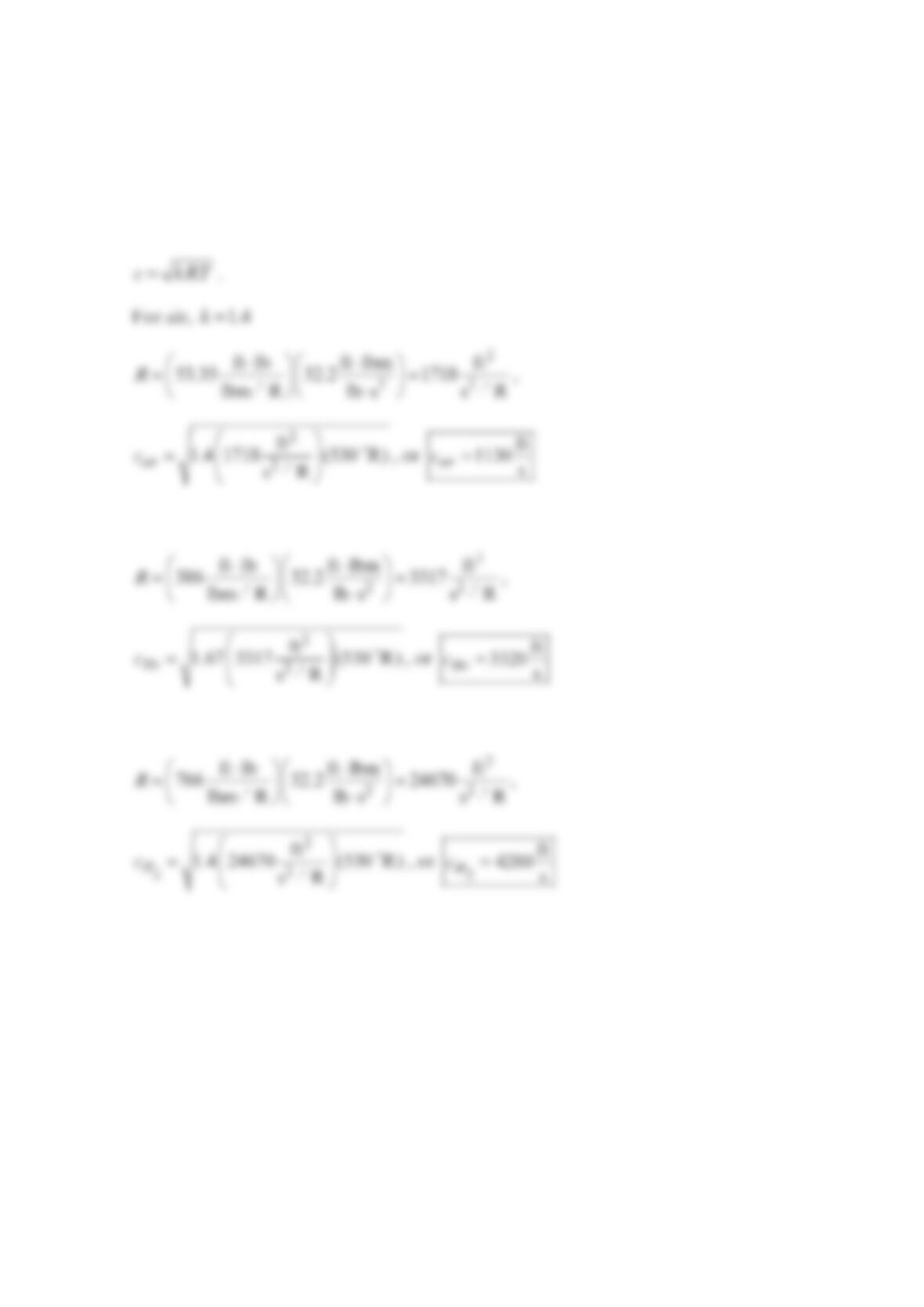
The drag force is related to the drag coefficient by
From the Isentropic Flow Table below, =
0
0.1278
p
p at =Ma 2 so
Problem 11.20
Calculate the speed of sound in air, helium, and hydrogen. The temperature is 70 °F.
Solution 11.20
The speed of sound is related to temperature by
For helium (He), =1.67k
For hydrogen (H2), =1.4k
Problem 11.21
Determine the Mach number of a car moving in standard air at a speed of (a) 25 mph , (b)
55 mph , and (c) 100 mph .
Solution 11.21
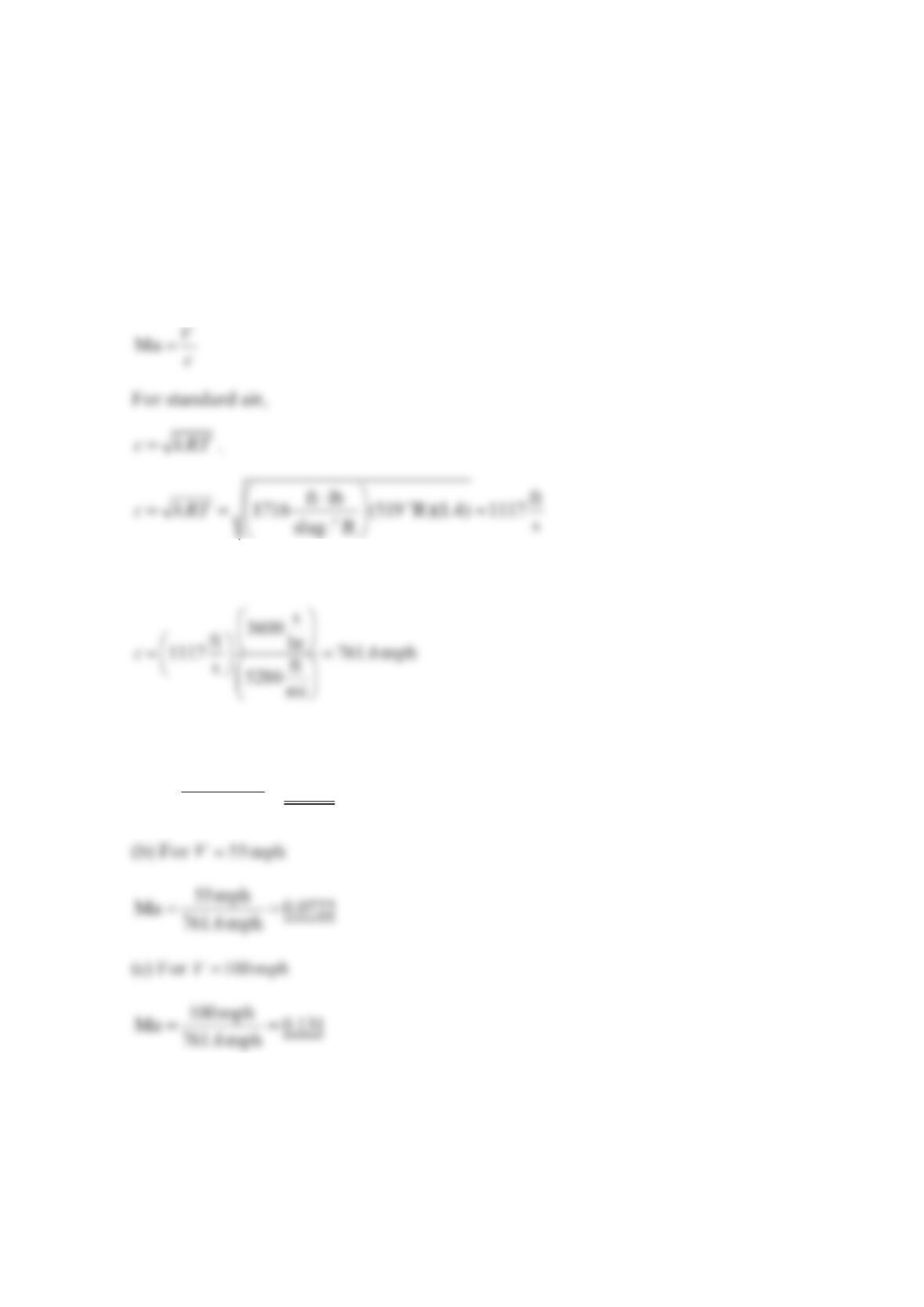
The Mach number is the ration of local velocity to speed of sound.
Thus
or
(a) For =25 mphV
==
25 mph
Ma 0.0328
761.6 mph
Comment None of these speeds are high enough to cause significant compressibility effects
in the flow.
Problem 11.22
A jet-propelled airliner flies at an altitude of 15,000 m and a velocity of 265 m/s. What is
the stagnation pressure and stagnation temperature of the air entering the engine? If the
airliner is stationary on the ground, the engines are running with the same Mach number
flow into the engines, and the air flow to each engine is 40 kg/s, what is the airflow to each
engine at the above flight conditions?
Solution 11.22
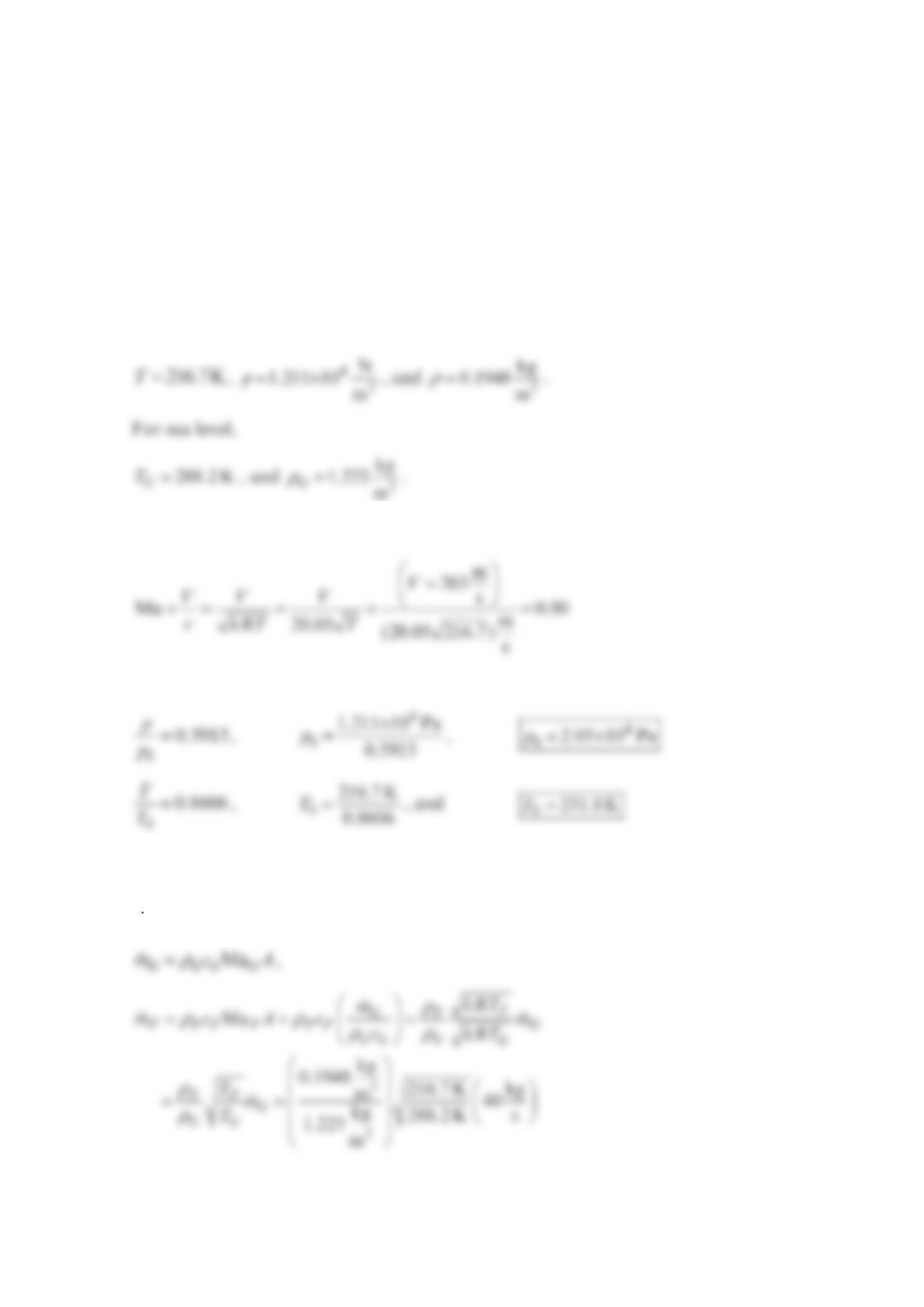
For =15000 mz, a table of the Standard Atmosphere gives
At 15,000 m,
The Isentropic Flow Table gives at Ma = 0.90
To relate mass flowrates, denote the flight condition by the subscript F and the ground
conditions by the subscript G. Then
ρρ
==MamVAcA
,

Problem 11.23
A schlieren photo of a bullet moving through air at 14.7 psia and 68 °Findicates a Mach
cone angle of 28°. How fast was the bullet moving in: (a) m
s, (b) ft
s, and (c) mph?
Solution 11.23
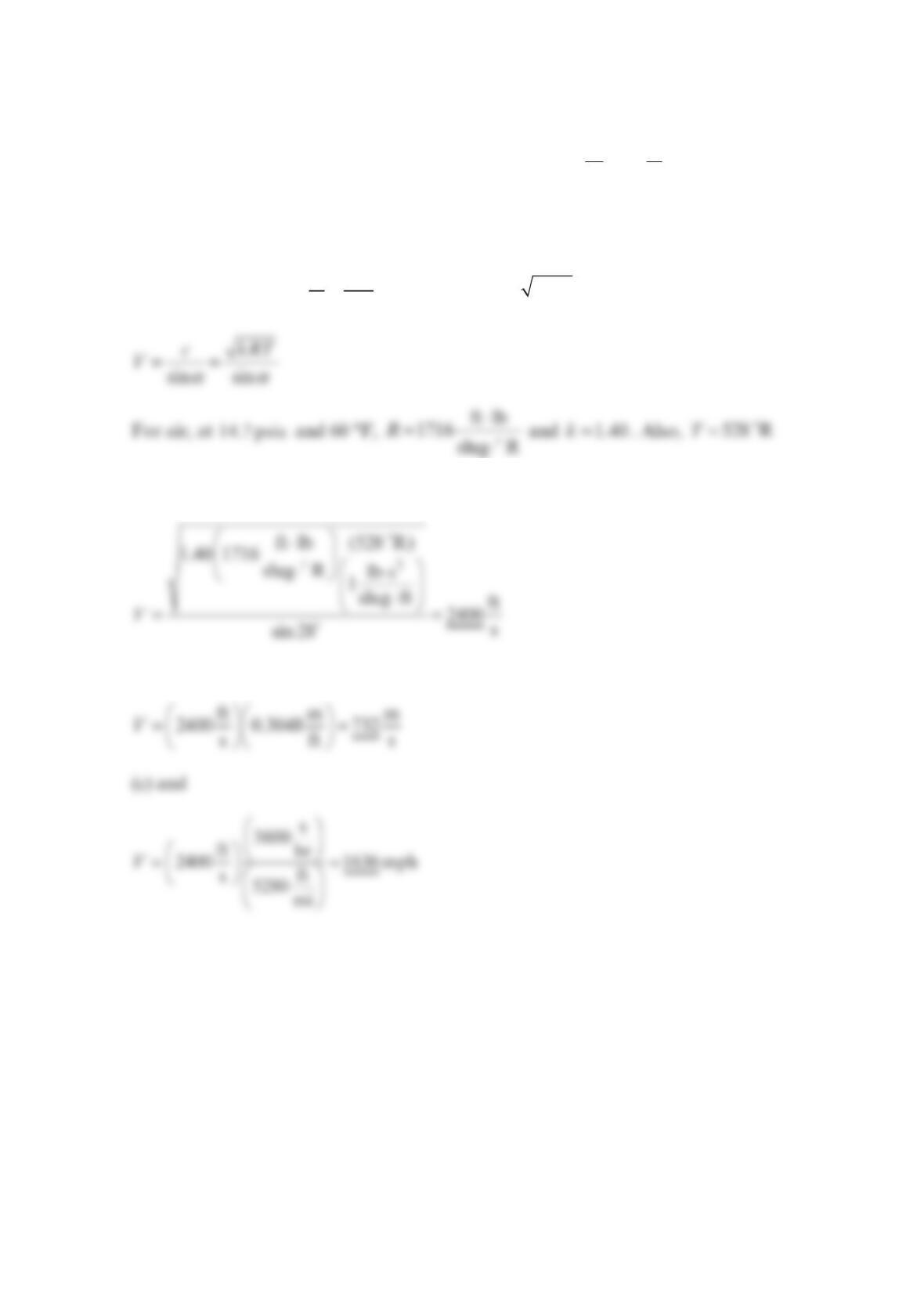
With equation
α
==
1
sin Ma
c
V and equation =ckRT
, we obtain
(b) Thus,
(a) or
Problem 11.24
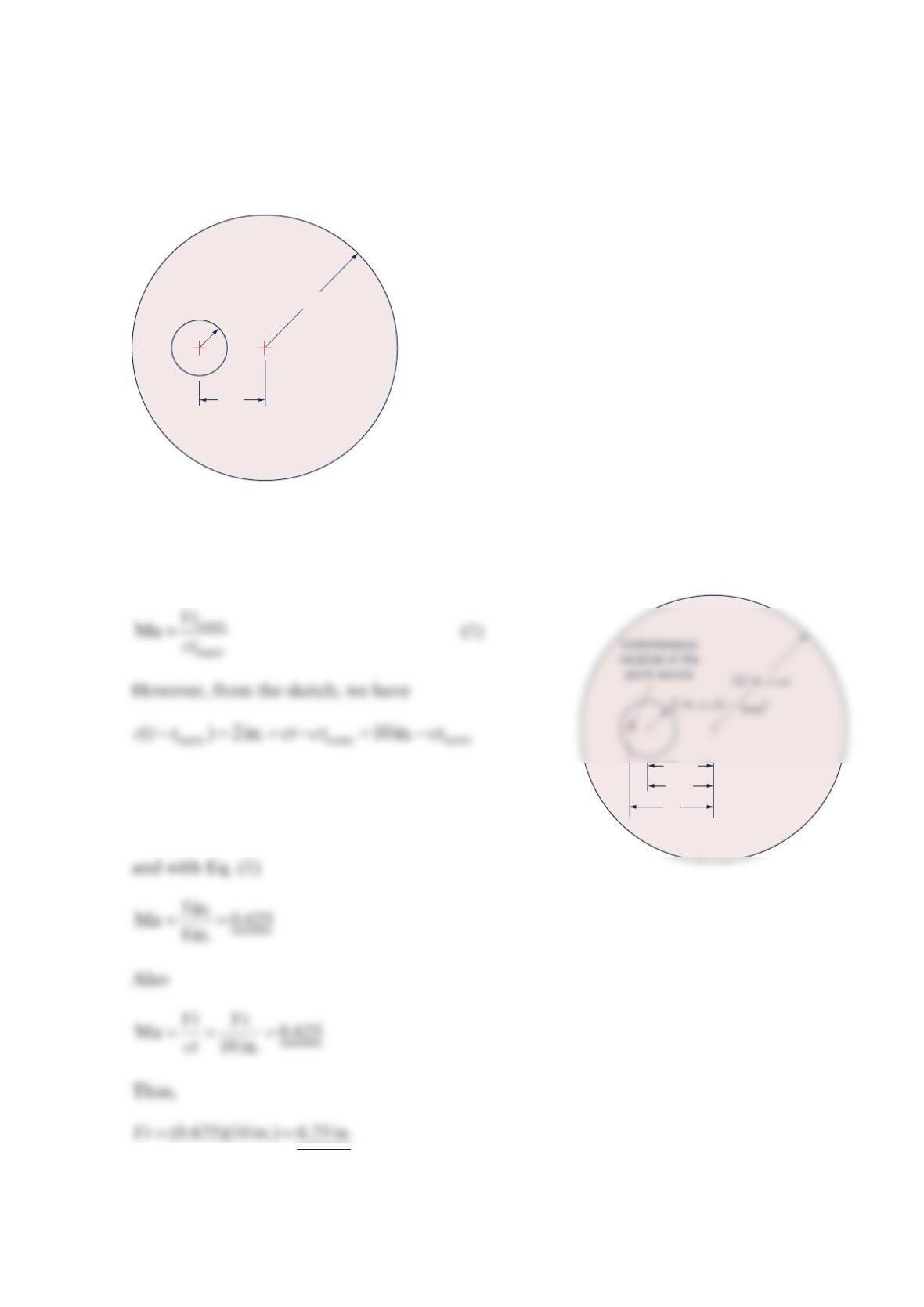
At a given instant of time, two pressure waves, each moving at the speed of sound, emitted
by a point source moving with constant velocity in a fluid at rest, are shown in the figure
below. Determine the Mach number involved and indicate the instantaneous location of the
point source with a sketch.
Solution 11.24
To determine the Mach number,
M
a, we use
Thus,
=−=10 in. 2 in. 8in.
wave
ct
10 in.
2 in.
5 in.
5 in.
Vt
wave
Vt

Problem 11.25
Sound waves are very small-amplitude pressure pulses that travel at the “speed of sound.”
Do very large-amplitude waves such as a blast wave caused by an explosion travel less than,
equal to, or greater than the speed of sound? Explain.
Solution 11.25
The speed of sound is the speed at which an infinitesimal pressure disturbance travels
Problem 11.26
If a new Boeing 787 Dreamliner cruises at a Mach number of 0.87 at an altitude of
30,000 ft , how fast is this in (a)
m
ph, (b) ft/s, (c) m/s?
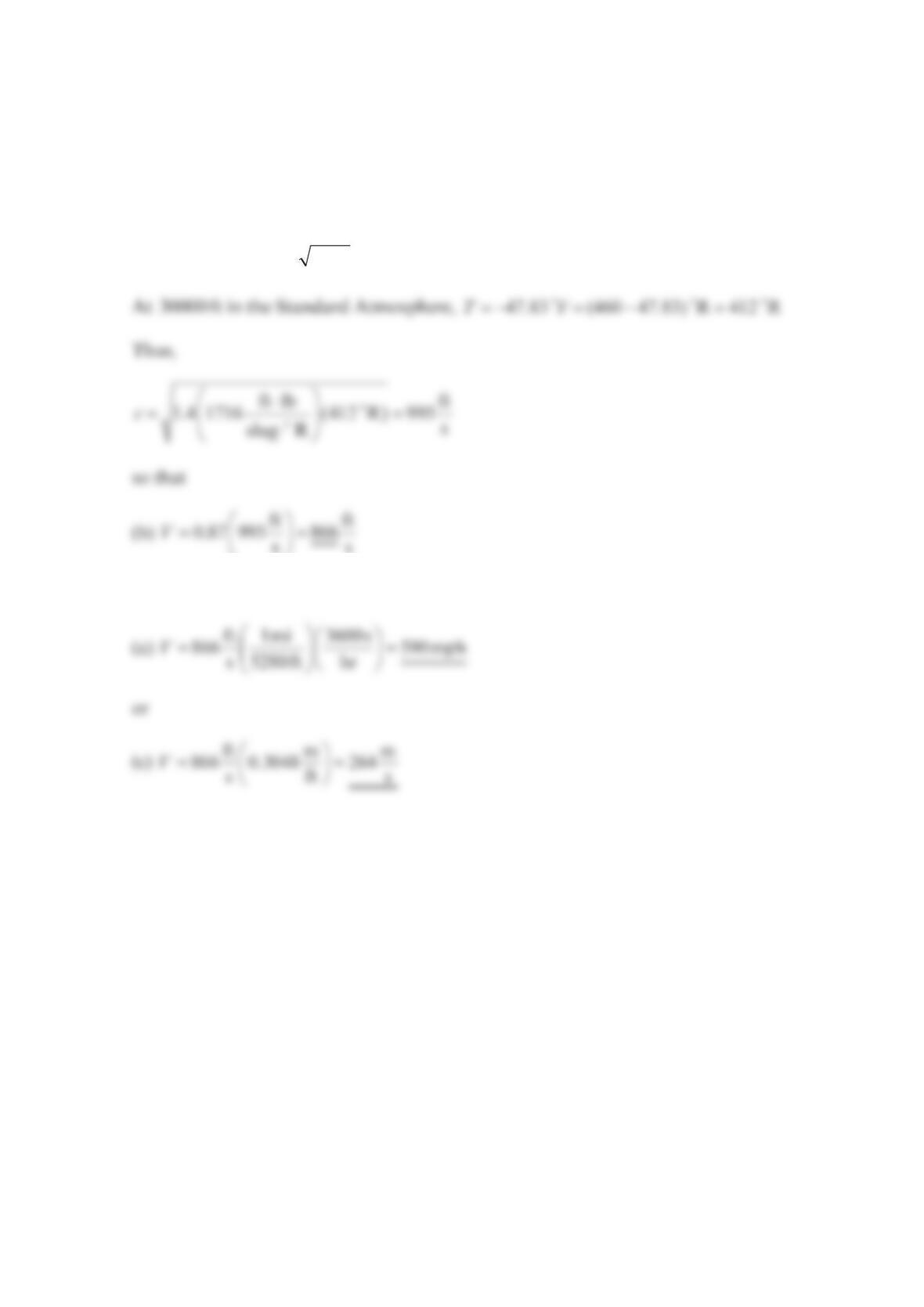
Solution 11.26
MaV
c
=⋅, where =ckRT
or
Problem 11.27
Explain how you could vary the Mach number but not the Reynolds number in airflow
past a sphere. For a constant Reynolds number of
3
00,000, estimate how much the drag
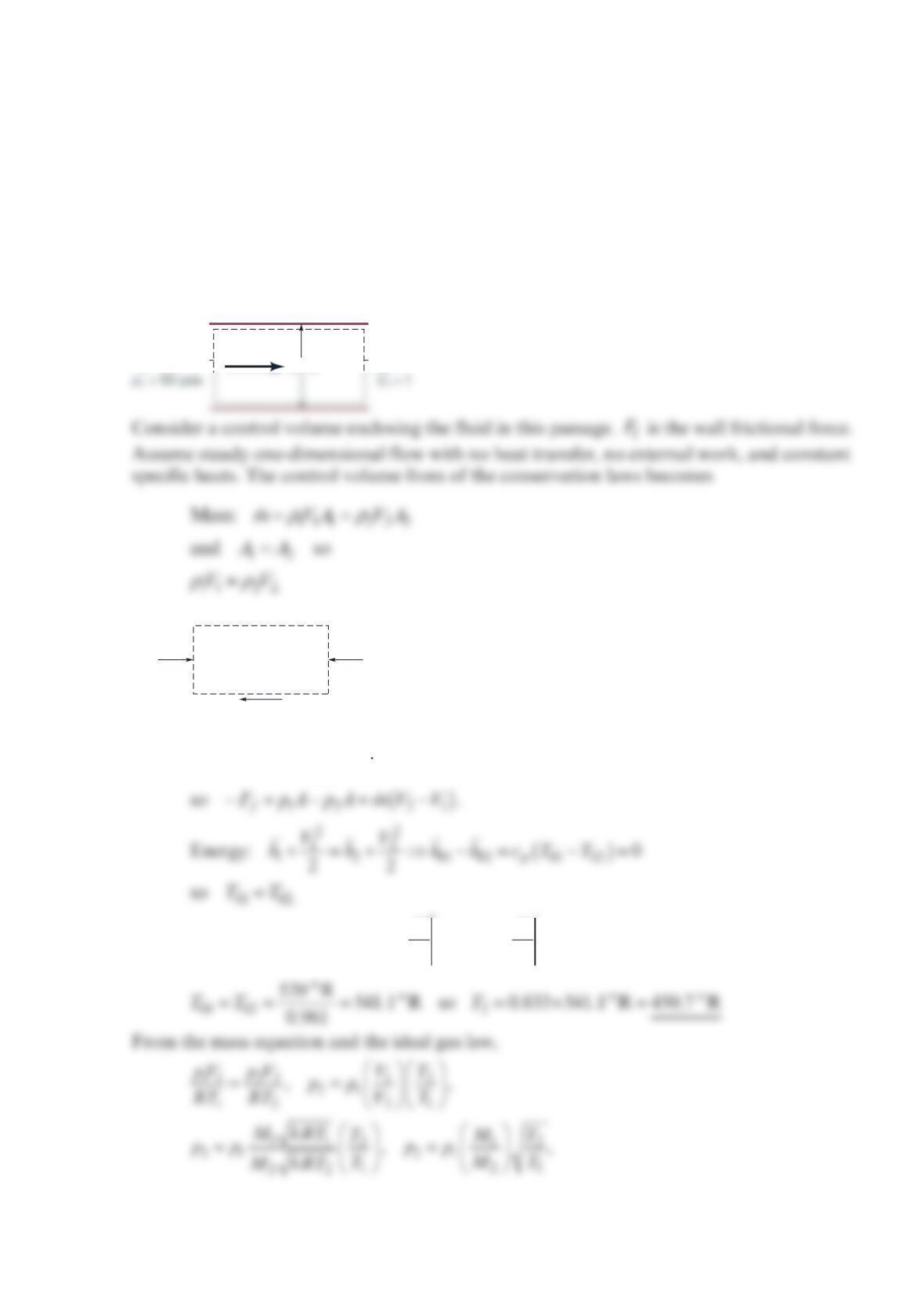
coefficient will increase as the Mach number is increased from 0.3 to
1
.0.
Solution 11.27
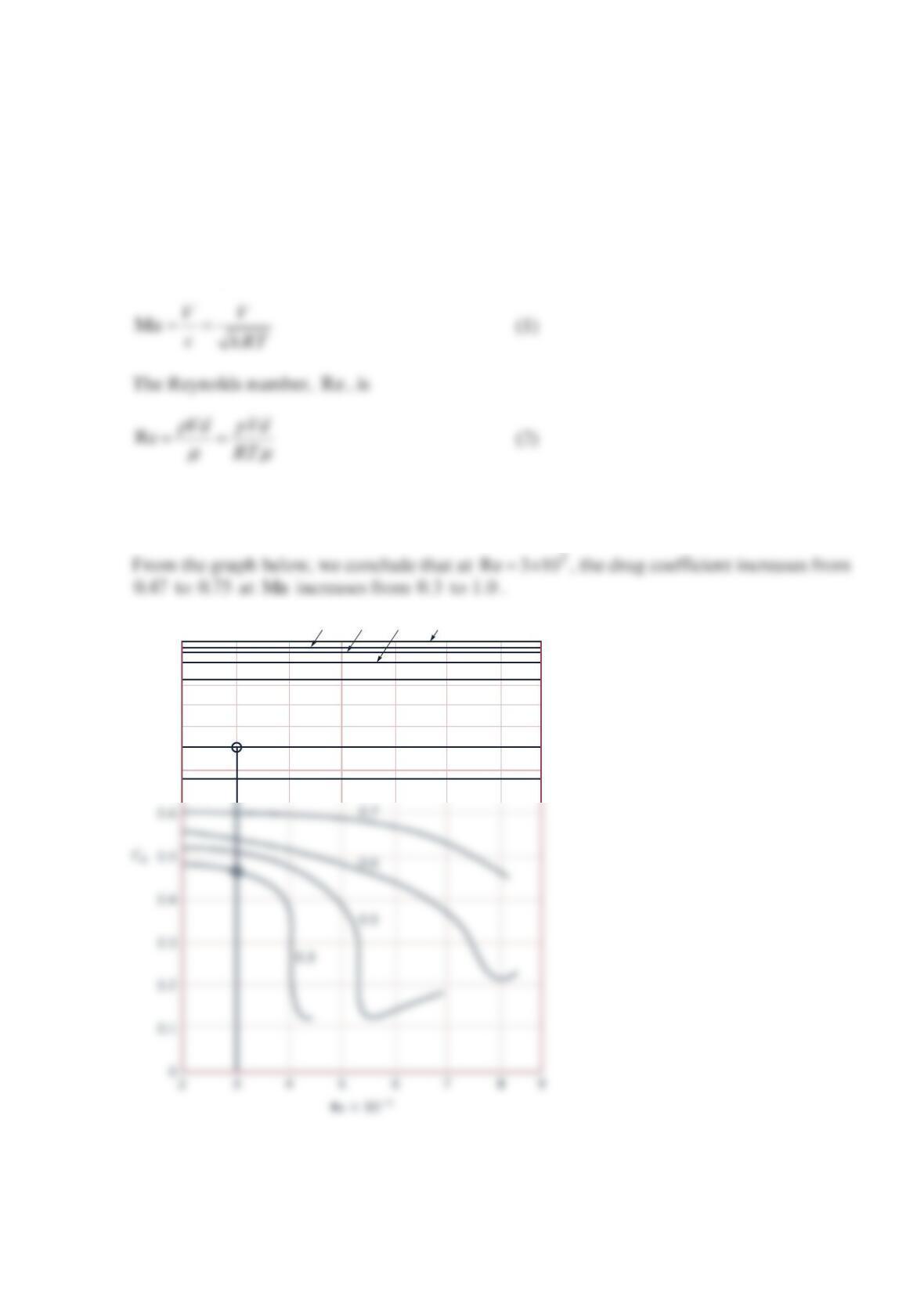
Considering air as an ideal gas, we can express the Mach number, as
Looking at Eqs. (1) and (2), we reason that we can vary Ma while holding Re constant by
varying V and p only with pV held constant.
1.0
0.9
0.8
0.7
0.9
1.0
1.1
4.5
1.53.02.0
Ma
=
1.2
Problem 11.28
Air flows in a constant-area, insulated duct. The air enters the duct at 520 °R 50 psia, and
=Ma 0.45. At a downstream location, the Mach number is one. Find:
(a) The pressure and temperature at the downstream location
(b) The change in specific entropy
(c) The frictional force if the duct is circular and 1ft in diameter.
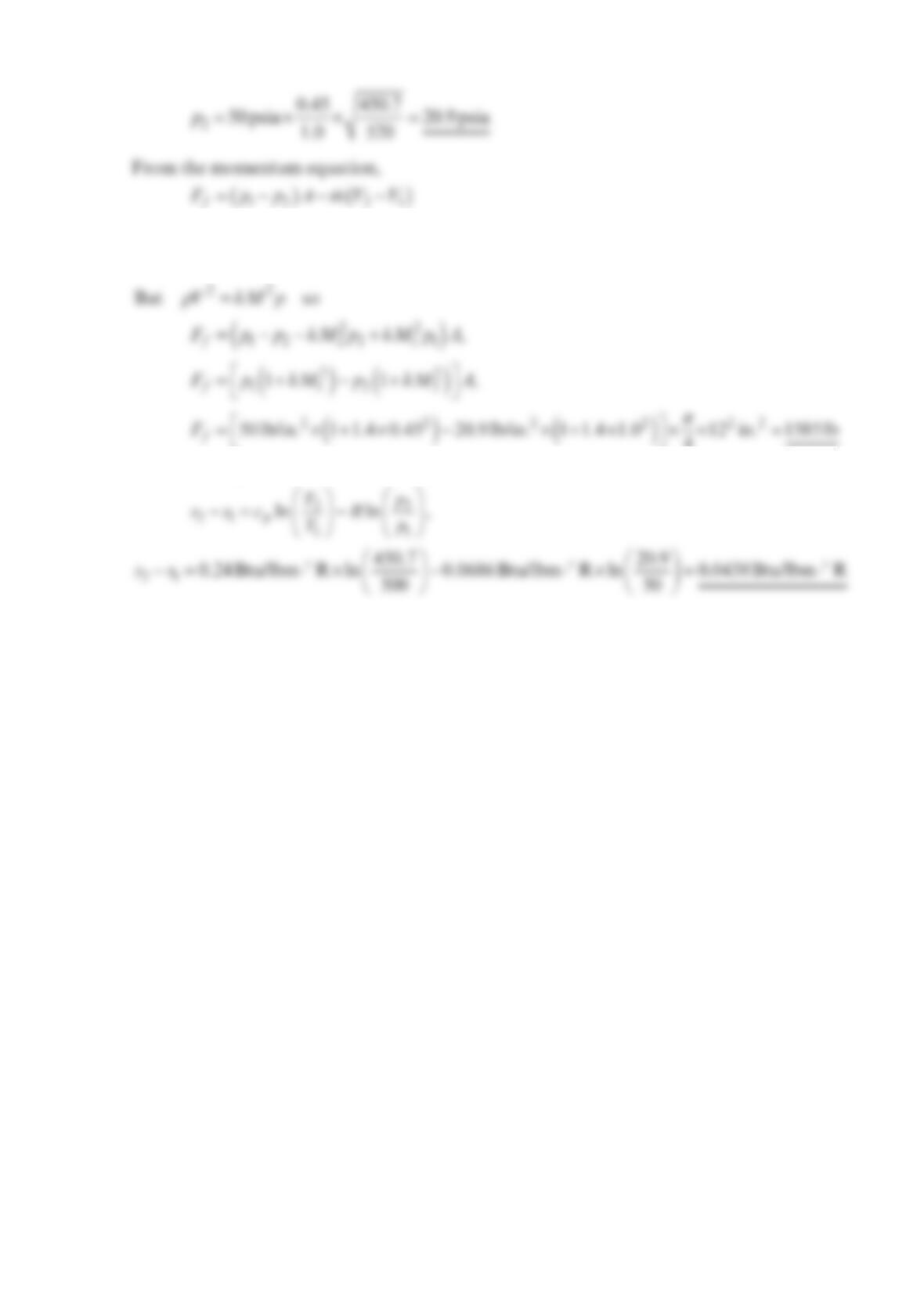
Solution 11.28
()
=−
21
Momentum : FmVV
From the Isentropic Flow Table, ==
00
12
0.961; 0.833
TT
TT
so
1.0 ft
Ma = 0.45
T
1 = 520 °R
Ma = 1.0
p
2 = ?
p
1
Ap
2
A
F
f
or
()
ρρ
=− − +
22
12 22 11
.
f
F p p A VA VA
4
For an ideal gas,
Problem 11.29
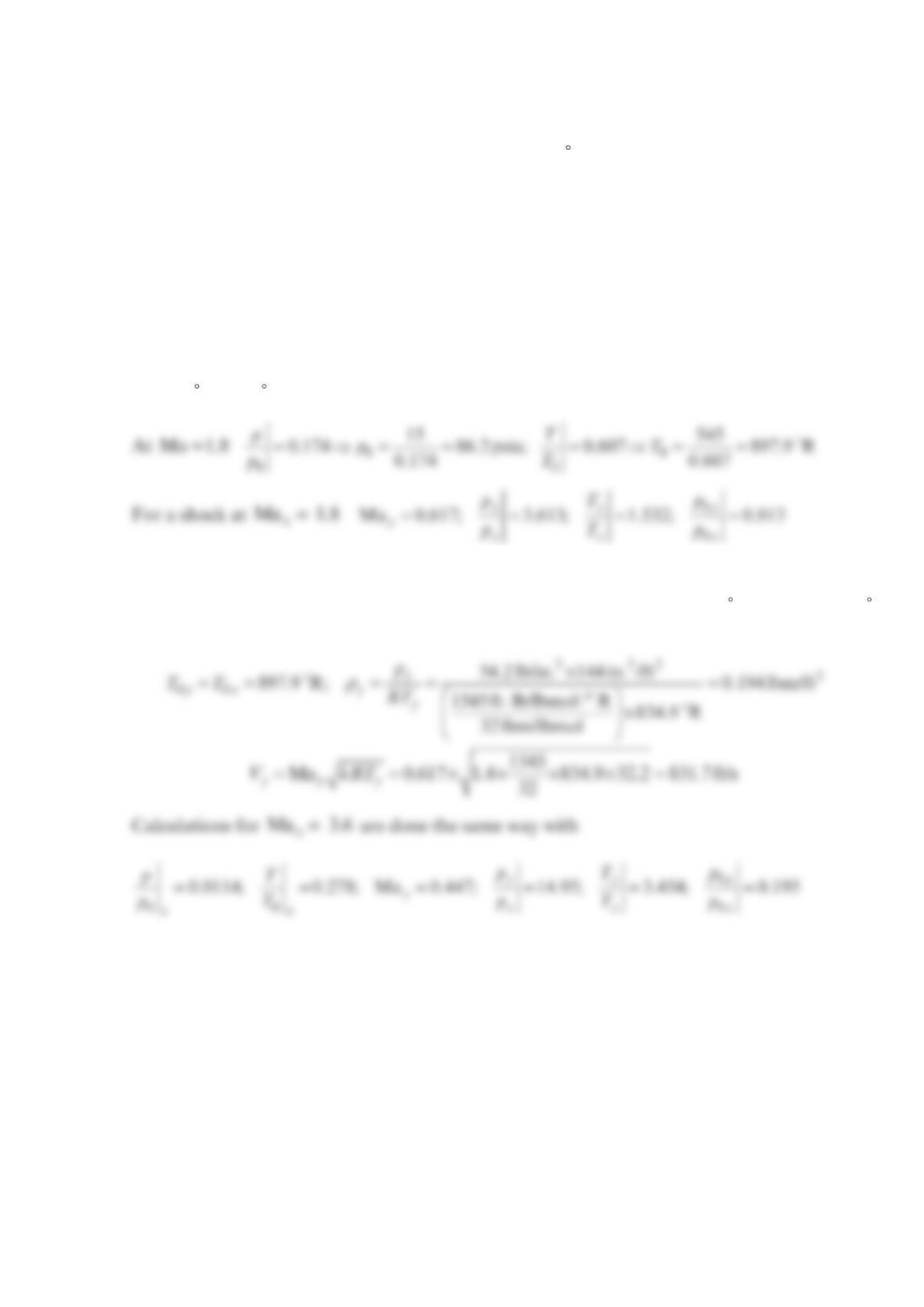
A normal shock occurs in a stream of oxygen. The oxygen flows at =Ma 1.8 and the
upstream pressure and temperature are 15psia and 85 F.
(a) Calculate the following on the downstream side of the shock: static pressure,
stagnation pressure, static temperature, stagnation temperature, static density, and
velocity.
(b) If the Mach number is doubled to 3.6, what will be the resulting values of the
parameters listed in part (b)?
Solution 11.29
== =
2
85 F 545 R for Oxygen (O ) 1.4
x
Tk
so
=×= = ×= =×=
0
15 psia 3.613 54.2 psia; 86.2 psia 0.813 70.1psia; 545 R 1.532 834.9 R
yy y
pp T