Chapter 11
Transcription of the Genetic Code: Biosynthesis of RNA
1
SUMMARY
Section 11.1
Transcription is the process of using a DNA template to produce RNA
Section 11.2
Prokaryotic transcription is catalyzed by RNA polymerase, which is a 470,000
Dalton enzyme with 5 types of subunit, , , , ’, and .
RNA polymerase moves along the template strand of DNA and produces a
Section 11.3
There are four principal control mechanisms for prokaryotic transcription –
alternative factors, enhancers, operons, and transcription attenuation.
Alternative factors can direct RNA polymerase to different promoters, altering
the choice of RNA product.
Enhancers and silencers are DNA sequences usually found upstream of
promoters that stimulate or reduce transcription, respectively. These sequences
2 Chapter 11
Section 11.4
Eukaryotic transcription is far more complicated than the prokaryotic version.
There are 3 principal RNA polymerases in eukaryotes, of which Pol II produces
mRNA.
Pol II is a large protein with at least 12 subunits. Some of the subunits share
Section 11.5
Control of eukaryotic transcription includes many of the same concepts seen with
prokaryotic transcription.
The use of enhancers and silencers is more extensive and the promoters are
more complicated.
A protein called Mediator is involved in activation of transcription. Mediator
bridges the promoter region and specific enhancers or silencers.
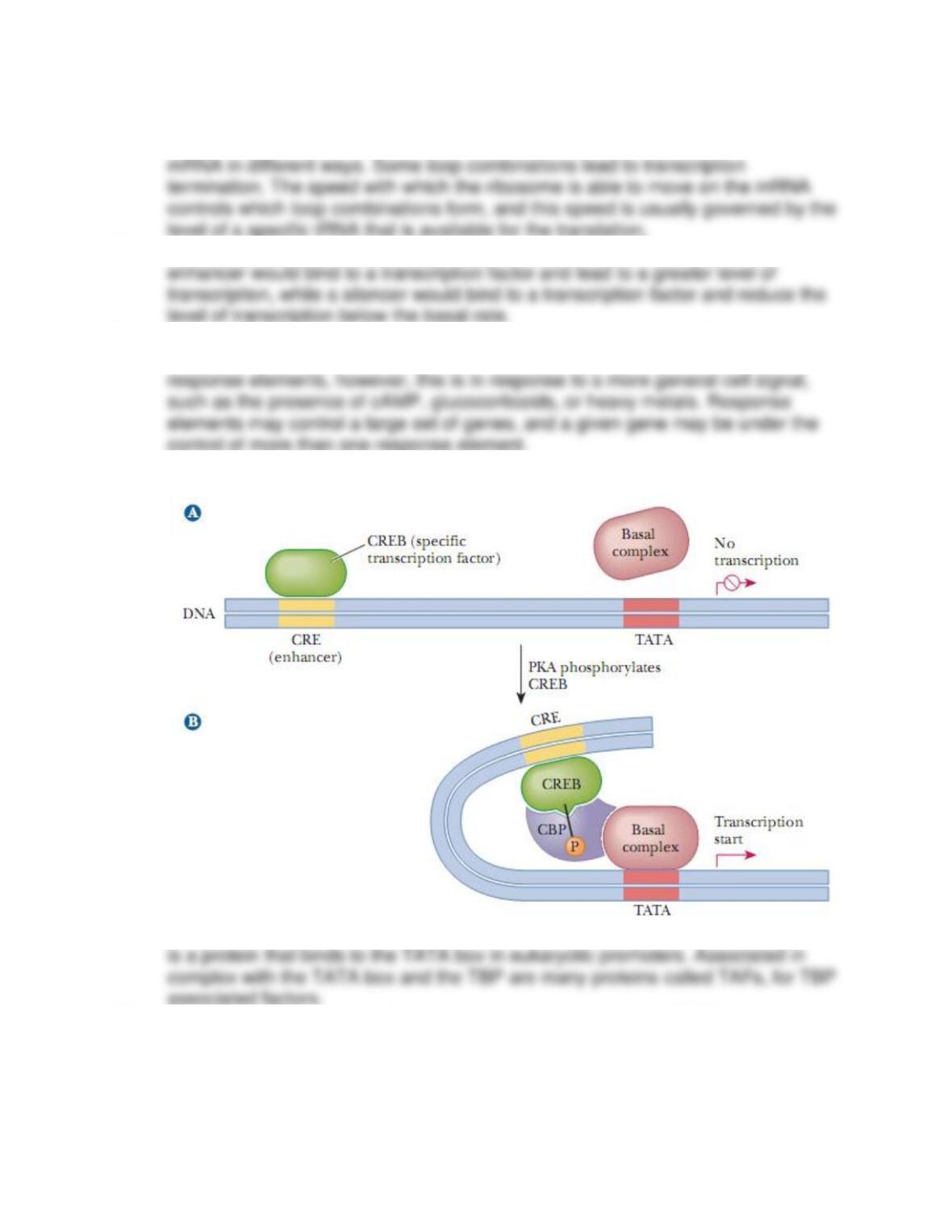
.
Section 11.6
Most of the transcription of DNA to RNA does not lead to RNA’s that code for
proteins, rather it leads to non-coding RNA
The two principal types of non-coding RNA’s are micro RNA’s (MiRNA) and small
Biosynthesis of RNA 3
Section 11.7
Proteins such as transcription factors that bind to DNA often have recognizable
structural motifs.
Common motifs are the helix-turn-helix, zinc fingers, and basic-region leucine
Section 11.8
After being transcribed from DNA, many RNA molecules are modified, often
extensively, before they arrive at their final form.
Several modifications are common with tRNA and rRNA, such as trimming,
addition of terminal sequences, and base modification.
Section 11.9
Proteins are not the only biological molecules with catalytic properties. Some
LECTURE NOTES
Most students will have seen much of the material in this chapter in earlier
courses, particularly in beginning biology courses, but they are unlikely to have gone
into any of the molecular details. A good method of presenting this information is to
point out similarities and differences between DNA replication (chapter 10) and the
4 Chapter 11
material covered here. In this manner each topic reinforces the other. This chapter is
likely to comprise two full lectures.
LECTURE OUTLINE
I. Transcription in prokaryotes
A. RNA polymerase in E. coli
1. Core vs. holoenzyme
2. Template vs. nontemplate strand
C. Chain initiation
1. Closed complex formation
2. Open complex formation
D. Chain elongation
II. Regulation of transcription in prokaryotes
A. Alternative factors
B. Enhancers
1. Enhancers
2. Transcription factors
3. Silencers
C. Operons
1. Induction
2. Regulatory vs. structural genes
6. Co-repressors and autoregulation
D. Transcription attenuation in the trp operon
III. Eukaryotic transcription
A. RNA polymerase variants
B. RNA pol II structure
C. Pol II promoters
1. Upstream elements – enhancers and silencers
Biosynthesis of RNA 5
IV. Regulation of transcription in eukaryotes
A. Basal level transcription
V. Non-Coding RNA’s
A. Micro RNA’s
B. Small Interfering RNA’s
C. RNA Silencing
VI. Structural motifs in DNA-binding proteins
A. DNA-binding domains
B. Transcription-activation domains
1. Acidic domains
2. Glutamine-rich domains
3. Proline-rich domains
VII. Posttranscriptional modification of RNA
A. RNA and rRNA
B. mRNA
1. Capping
2. Polyadenylation
3. Splicing out of introns
C. Details of mRNA splicing
ANSWERS TO PROBLEMS
11.2 Transcription in Prokaryotes
1. No primer is required for transcription of DNA into RNA.
2. RNA polymerase from E. coli has a molecular weight of about 500,000 and four
6 Chapter 11
5. The strand that the RNA polymerase uses as a template for its RNA is called the
template strand, the noncoding strand, the antisense strand, and the (–) strand.
6. The promoter region is the portion of DNA to which RNA polymerase binds at the
start of transcription. This region lies upstream (nearer the 3′ end of the template
7. Moving from 5′ to 3′ on the coding strand, the order is the following: Fis site, UP
element, –35 region, Pribnow box, TSS.
8. Intrinsic termination of transcription involves the formation of a hairpin loop in the
RNA being formed, which stalls the RNA polymerase over a region rich in A–U
9. See Figure 11.1. The top DNA strand is the nontemplate strand because it is not
used to create the RNA. It is called the coding strand because it has the same
sequence as the RNA produced, except for the change of T for U. It is called the
11.3 Transcription Regulation in Prokaryotes
10. An inducer is a substance that leads to transcription of the structural genes in an
operon. A repressor is a substance that prevents transcription of the structural
genes in an operon.
11. The factor is a subunit of prokaryotic RNA polymerase. It directs the
12. 70 is the normal -subunit for RNA polymerase in E. coli. It directs RNA
polymerase to most of the genes that are transcribed under normal
Biosynthesis of RNA 7
13. The catabolite activator protein is a transcription factor in E. coli that stimulates
14. Transcription attenuation is the process found in prokaryotes in which
transcription can continue or be prematurely aborted based on the concurrent
translation of the mRNA produced. This is often seen in genes whose protein
products lead to amino acid synthesis.
15. An operon consists of an operator gene, a promoter gene, and structural genes.
When a repressor is bound to the operator, RNA polymerase cannot bind to the
16. See Figure 11.5.
17. With phage SPO1, which infects the bacteria B. subtilis, the virus has a set of
gp28. This protein is another -subunit, which directs the RNA polymerase to
18. See Figure 11.14. When the level of tryptophan is low, the trptRNAtrp becomes
limiting. This stalls the ribosome over the tryptophan codons on the mRNA. By
19. It is the sensing domain of a riboswitch found at the 5’ end.
20. It is mRNA that has two functions – sensing and decision making.
21. Translation can be prevented when a hairpin loop forms that blocks the
translation initiation site. Another translation halting processes is when a
22. Researchers are hoping to find molecules that can act like a competitive inhibitor
11.4 Transcription in Eukaryotes
23. Exons are the portions of DNA that are expressed, which means that they are
reflected in the base sequence of the final mRNA product. Introns are the
8 Chapter 11
24. There are three RNA polymerases in eukaryotes, compared with one in
prokaryotes. There are many more transcription factors in eukaryotes, including
25. RNA polymerase I produces most of the rRNA. RNA polymerase II produces
mRNA, and RNA polymerase III produces tRNA, the 5S ribosomal subunit, and
snRNA.
26. The first component includes a variety of upstream elements, which act as
enhancers and silencers. Two common ones are close to the core promoter and
are the GC box (–40), which has a consensus sequence of GGGCGG, and the
27. TFIIA, TFIIB, TFIID, TFIIE, TFIIF, and TFIIH are the general transcription factors.
TFIID is also the TATA-box binding protein and is associated with TAFs (TBP
associated factors).
28. Its primary function is as a general transcription factor involved in the formation of
the open complex for transcription initiation. It binds to the basal unit and is
11.5 Transcription Regulation in Eukaryotes
29. The heat-shock element responds to increased temperature. The metal-response
30. CREB is a transcription factor that binds to the cAMP-response element. It is
involved with the transcription of hundreds of genes based on the cAMP levels of
31. Regulation in eukaryotes is much more complicated. Prokaryotic regulation is
controlled by the choice of -subunit, the nature of the promoters, and the use of
Biosynthesis of RNA 9
32. As the mRNA is being produced, ribosomes are bound and begin to translate. A
leader sequence on the mRNA leads to a leader peptide. Loops can form in the
33. Assuming that there is a basal transcription rate for a particular gene, an
34. A response element is an enhancer element that binds to a specific transcription
factor and increases the level of transcription of target genes. In the case of
35. As seen here, CREB binds to the CRE. When phosphorylated, it also binds to
CBP and bridges to the basal transcription complex.
36. TFIID is one of the general transcription factors for RNA polymerase II. Part of it
37. The statement is untrue. Many eukaryotic promoters do have TATA boxes, but
there are also genes that lack one.
10 Chapter 11
38. Transcription elongation in eukaryotes is controlled in several ways. There are
pause sites at which RNA polymerase tends to hesitate. There is also
antitermination at which RNA polymerase can transcribe past a normal
39. CREB is a ubiquitous transcription factor that has been found involved in many
genes. It is phosphorylated when cAMP levels are high, which triggers the
40. Acidic domains, glutamine-rich domains, and proline-rich domains.
41. Mediator is a giant complex with a mass of over one million Daltons comprising
over twenty distinct subunits in yeast, and more than 30 subunits in humans.
Mediator bridges the promoter, RNA polymerase and general transcription
machinery with specific remote enhancers and silencers.
42. Mediator bridges the promoter region with the enhancer region to activate
transcription, or in the opposite case, it binds to the silencer element, but does
45. Two sets of factors are important: chromatin remodeling complexes that mediate
ATP-dependent conformational changes in nucleosome structure and histone-
modifying enzymes that introduce covalent modifications into the N-temrinal tails
of the histone core octamer.
46. Chromatin remodeling complexes are huge assemblies containing ATP–
dependent enzymes that loosen the DNA:protein interactions in nucleosomes by
a variety of mechanisms involving sliding, ejecting, inserting, and otherwise
Biosynthesis of RNA 11
49. The most important modification of the histones is the acetylation of the ε-amino
groups of lysine on the histone tails. Acetylating the lysine removes the positive
11.6 Non-coding RNA’s
51. Micro RNAs are about 22 nucleotides long, and are cut from a longer, hairpin–
shaped RNA by the enzyme Dicer (These miRNAs bind imperfectly to specific
mRNAs and block their transcription.
52. siRNAs are formed in a similar way to miRNA, by the enzyme dicer When a cell
protein stability, and protein translocation.
54. siRNAs bind to mRNA molecules targeting them for destruction.
55. RNA Silencing is believed to be an evolutionarily conserved process that is
analogous to an immune system for protecting our genomes. Researchers have
56. Loss of miRNA-101 leads to overexpression of a particular histone
methyltransferase that helps the progression of prostate cancer.
57. In normal mice, sciatic nerve injury results in loss of nerve function in the muscle
and leads to an increase in miRNA-206. Using a line of mice that had ALS and
inactivated miRNA-206, the time from onset of the disease was shortened,
indicating this miRNA had a protective effect on nerves in the muscle.
12 Chapter 11
11.7 Structural Motifs in DNA-Binding Proteins
63. Helix–turn–helix motifs, zinc fingers, and basic-region leucine zippers.
64. The major DNA binding protein motifs are helix–turn–helix, zinc fingers, and
basic-region leucine zippers. The helix–turn–helix motifs are organized so that
the two helices of the protein fit into the major groove of the DNA. Zinc fingers
11.8 Posttranscriptional RNA Modification
65. Introns are spliced out. Bases are modified. A poly-A tail is put on the 3′ end of
mRNA. A 5′-cap is put on mRNA.
66. They both have multiple isoforms created by differential splicing of mRNA.
70. Besides its traditional role in mRNA, tRNA, and rRNA, RNA serves other
functions, such as splicing reactions, trimming reactions, and the peptide
71. See Figure 11.37.
72. The Human Genome Project concluded that humans had far fewer genes than
previously thought, yet we seem to be more biologically and biochemically
Biosynthesis of RNA 13
11.9 Ribozymes
73. A ribozyme is RNA that has catalytic activity without the intervention of protein at
74. Two mechanisms for RNA self-splicing are known. In Group I ribozymes, an
external guanosine is covalently bonded at the splice site, releasing one end of
75. Proteins are more efficient catalysts than RNA because they have wider
variations in structure and thus can tailor the active site for maximum efficiency
for a given reaction.
76. Epigenetics roughly translates to heritable changes in DNA that do not involve a
change in the primary structure or sequence of the DNA
77. Epimutations are similar to DNA mutations but affect the DNA scaffolding or
modifications without affecting the sequence
78. Over 30 molecules associated with cancer have been found to be chromatin