11-1
Chapter 11
Decentralization, Performance Evaluation,
and the Balanced Scorecard
Concept Questions
1. (LO 1—Advantages and disadvantages of decentralization)
Benefits of decentralization include higher job satisfaction and on-the-job training
for managers, freeing up top management to devote time to long-range strategic
2. (LO 2—Responsibility accounting)
Responsibility accounting holds managers accountable only for things under their
3. (LO 3—Investment centers)
An investment center has control over costs, revenues, and the investment of
4. (LO 4—Segment costs vs. common costs)
Segment costs are incurred due to the existence of the segment and would not
5. (LO 5—Residual income vs. ROI)
Residual income is measured in dollars and is the amount of income earned in
Solutions Manual
11-2
6. (LO 5—ROI vs. residual income)
ROI is a more useful performance measure than residual income when a
7. (LO 1—Balanced scorecard)
The balanced scorecard approach integrates financial and nonfinancial
8. (LO 3—Definition of quality)
In today’s environment, quality includes many facets and can be measured in
9. (LO 3—Costs of quality)
Prevention and appraisal costs are costs of controlling quality while internal and
external failure costs are costs of failing to control quality. Prevention costs
10. (LO 8—Noncash compensation)
Noncash compensation is important for motivational purposes. Companies that
do not wish to provide cash compensation either in the short term or long term
Chapter 11: Decentralization, Performance Evaluation, and the Balanced Scorecard
Exercises
1. (LO 2 and 3—Performance measures and centers)
a. investment center
b. cost center
2. (LO 4—Segmented income statement)
BTO Inc.
Contribution Format Segment Statement
X-100
X-200
Total
Sales revenue
$425,000
$513,000
$938,000
Variable costs
182,750
361,000
543,750
Contribution margin
$242,250
$152,000
$394,250
Traceable fixed expenses
142,000
54,000
196,000
Segment margin
$100,250
$198,250
Less: Common fixed costs
125,000
Net income
$ 73,250
3. (LO 5—ROI with margin and turnover and residual income)
A. Margin = Net operating income/Sales = $80,000/$800,000 = 10%
Solutions Manual
11-4
4. (LO 5—ROI and residual income)
Store A ROI:
5. LO 6—Dimensions of the balanced scorecard)
Financial perspective: costs, variances, profits, segment margin, return on
investment
6. (LO 7—Quality costs)
a. external failure costs
Chapter 11: Decentralization, Performance Evaluation, and the Balanced Scorecard
11-5
7. (LO 7—Quality costs)
A.
Quality training
$ 305,000
Total prevention costs
$ 305,000
B.
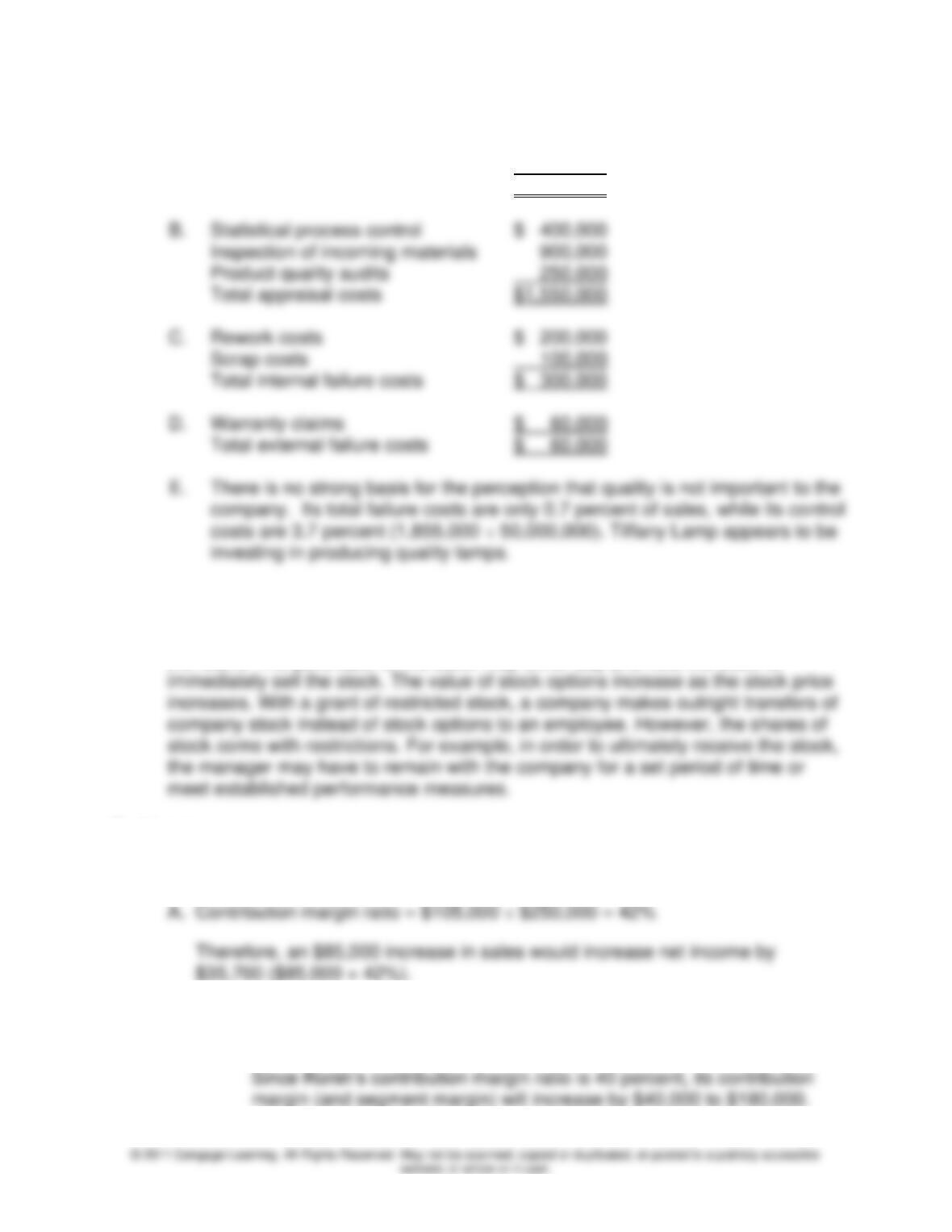
Statistical process control
$ 400,000
Inspection of incoming materials
Product quality audits
250,000
Total appraisal costs
$ 200,000
Scrap costs
100,000
Warranty claims
$ 60,000
Total external failure costs
$ 60,000
investing in producing quality lamps.
8. (LO 8—Stock options and restricted stock)
A stock option is the right to buy a share of stock at a set price at some point in
the future. The purchaser of the stock may either buy and hold the stock or
Problems
9. (LO 4—Segment margin and contribution margin)
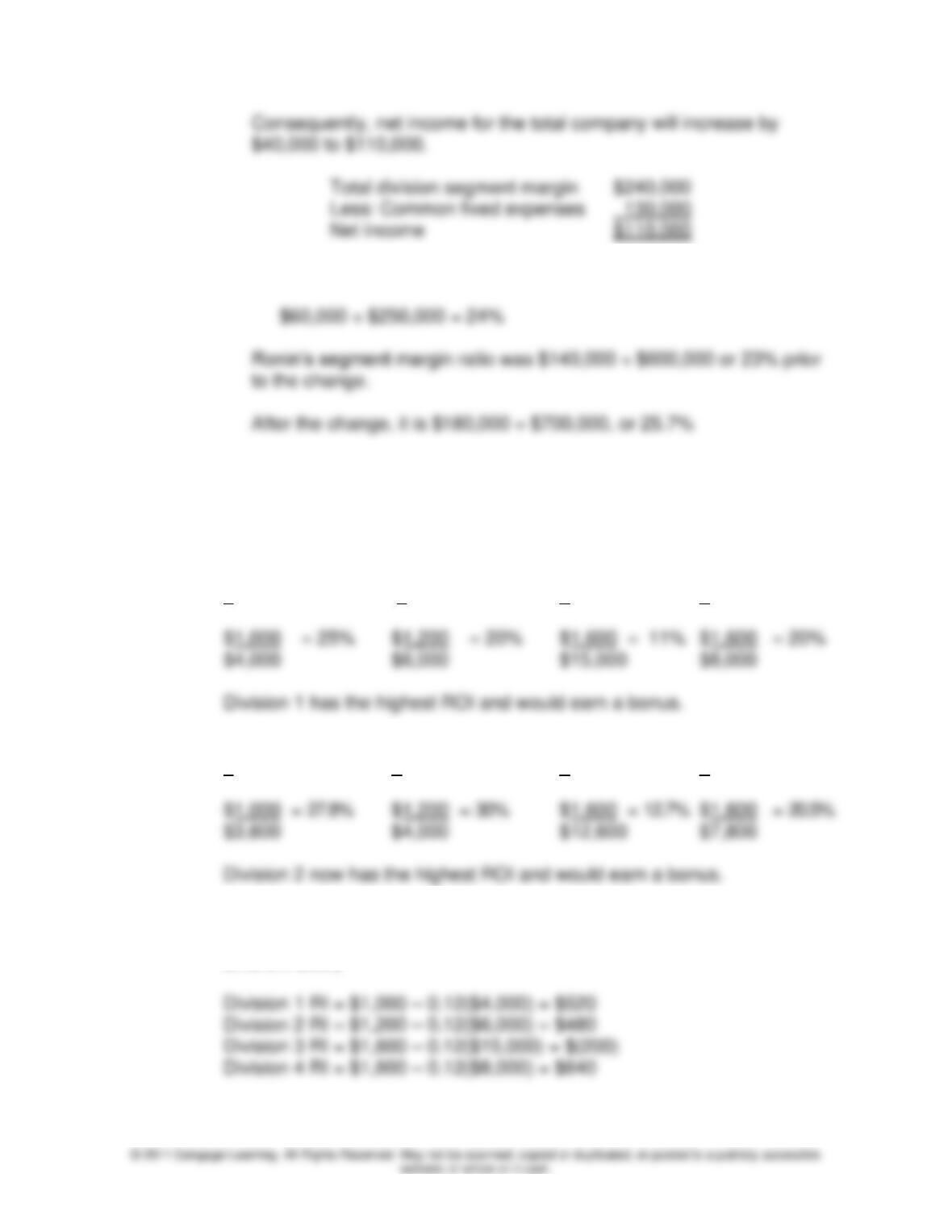
B. 1. Gordon’s segment margin remains the same.
Solutions Manual
11-6
2. Gordon’s segment margin ratio remains the same.
C. Students should note that while the contribution margin ratio remains constant
as sales increase and decrease, the segment margin ratio does not.
10. (LO 5—ROI vs. residual income using different asset measures)
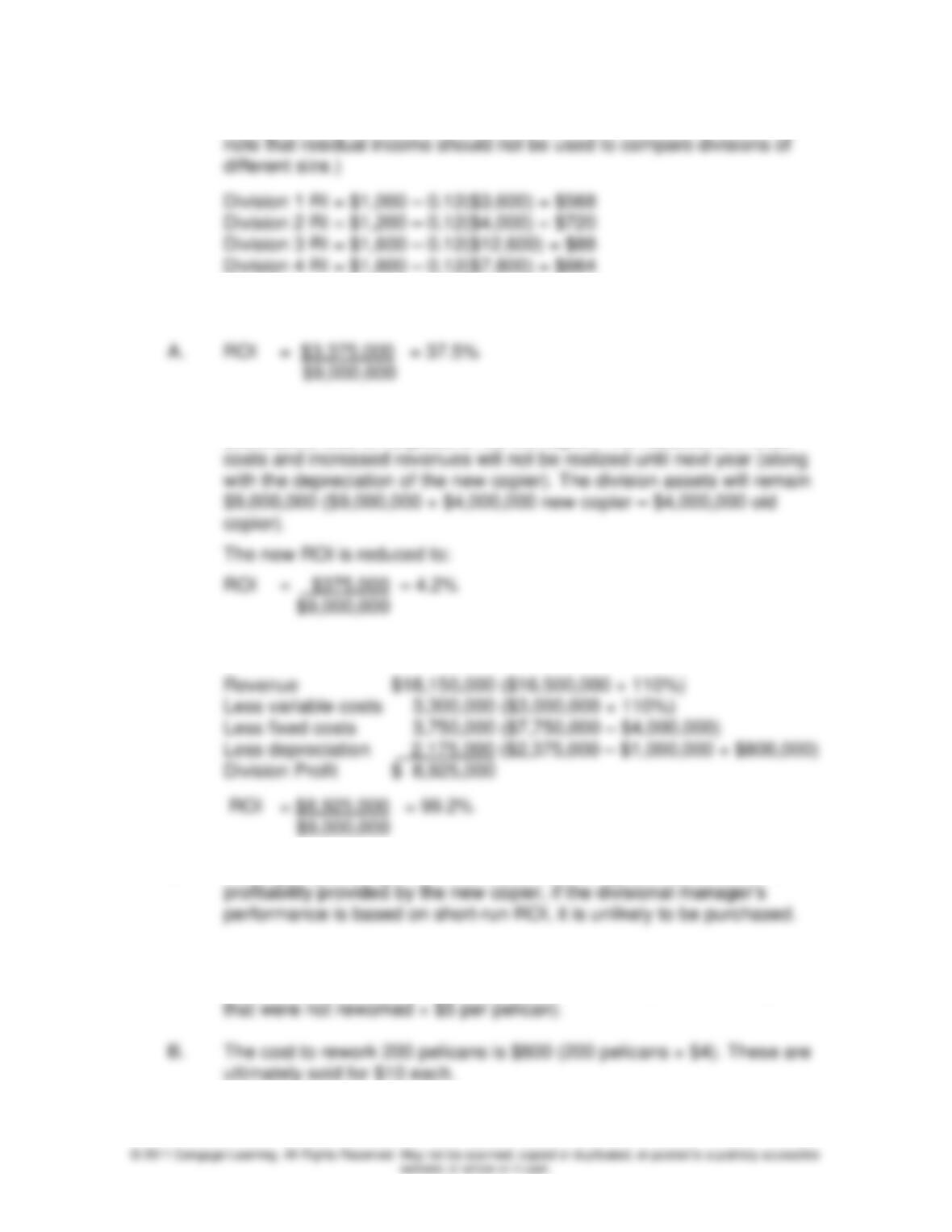
A.
1 2 3 4
B. 1 2 3 4
C. Using this approach, Division 4 would earn a bonus. (Students should
note that residual income should not be used to compare divisions of
different size.)
Chapter 11: Decentralization, Performance Evaluation, and the Balanced Scorecard
11-7
D. Using this approach, Division 2 would earn a bonus. (Students should
11. (LO 5—ROI: Decision focus)
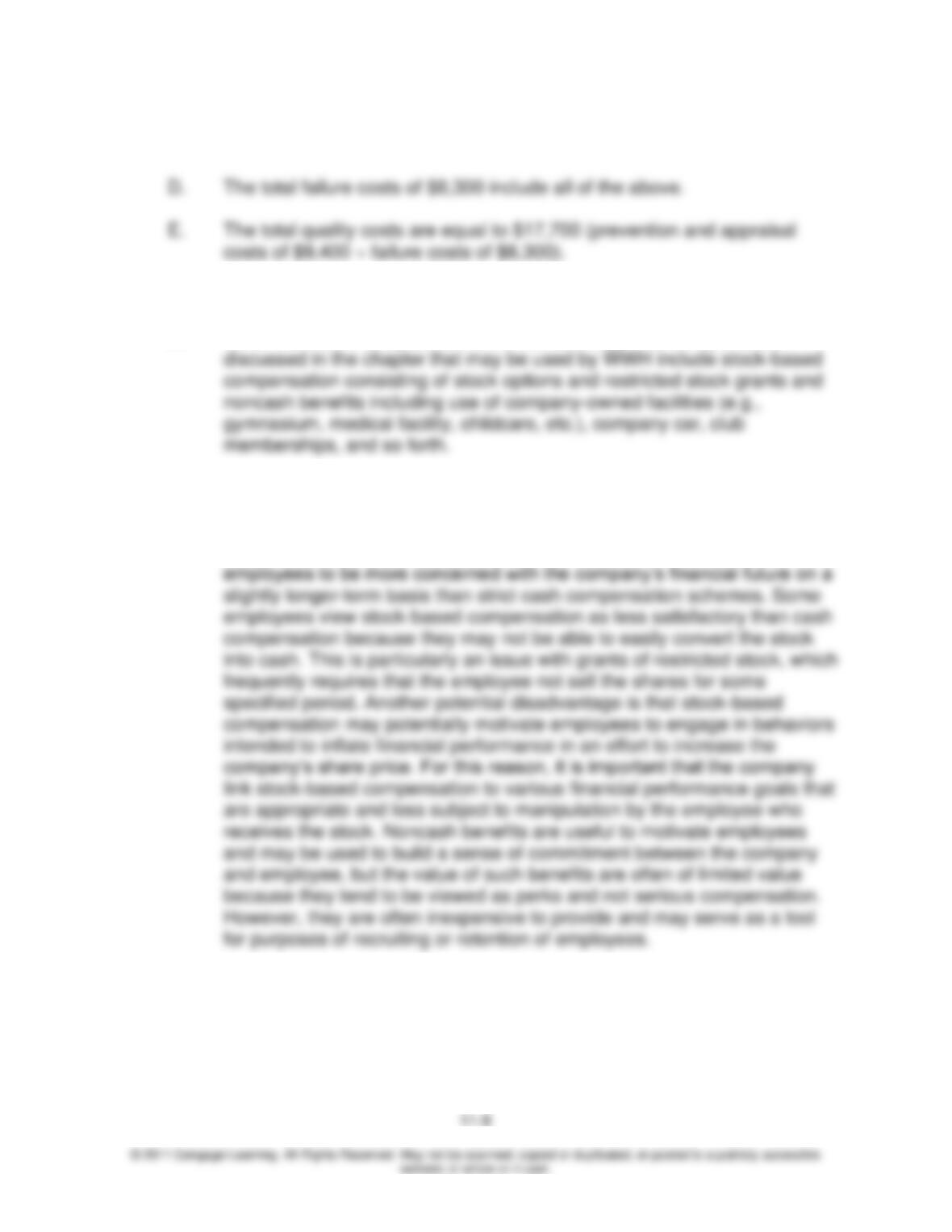
B. If the machine is purchased, the division profit will be reduced by the
$3,000,000 loss on disposal of the old copier. The reductions in fixed
C. Next year, division profit will increase to $8,925,000 as calculated below:
D. Although top management would prefer the long-run improvement in
12. (LO 7—Quality costing)
A. The total profit lost on defective pelicans is $4,500 (900 defective pelicans
Solutions Manual
C. The cost of processing returned pelicans is $3,000 (150 pelicans × $20).
This would presumably include the refund of the purchase price.
13. (LO 8—Forms of management compensation)
A. Other than cash compensation, the two basic types of compensation
B. Stock-based compensation schemes such as stock options or restricted
stock grants reduce the company’s cash outlay, which can be
advantageous for a company that is experiencing cash-flow problems.
Stock-based compensation schemes also are believed to motivate
C. The answer to this question will vary by student. It is important that the
student provide some basis for his or her recommendation.