CHAPTER 11
Depreciation, Impairments, and Depletion
ASSIGNMENT CLASSIFICATION TABLE (BY TOPIC)
Topics
Questions
Brief
Exercises
Exercises
Problems
Concepts
for Analysis
1.
Depreciation methods;
meaning of depreciation;
choice of depreciation
methods.
1, 2, 3, 4, 5,
6, 10, 14,
20, 21, 22
1, 2, 3, 4, 5,
8, 14, 15
1, 2, 3
1, 2, 3, 4, 5
Computation of
depreciation.
7, 8, 9, 13
1, 2, 3, 4
1, 2, 3, 4,
5, 6, 7,
10, 15
1, 2, 3,
4, 8, 10,
11, 12
1, 2, 3
3.
Depreciation base.
6, 7
5
8, 14
1, 2, 3,
8, 10
3
4.
Errors; changes in
estimate.
13
7
11, 12,
13, 14
3, 4
3
5.
Depreciation of partial
periods.
15
2, 3, 4
3, 4, 5, 6,
7, 15
1, 2, 3,
10, 11
6.
Composite method.
11, 12
6
9
2
7.
Impairment of value.
16, 17,
18, 19
8
16, 17, 18
9
8.
22, 23, 24,
25, 26, 27
9
19, 20, 21,
22, 23
5, 6, 7
9.
Ratio analysis.
Tax depreciation
(MACRS).
29
11
25, 26
12
ASSIGNMENT CLASSIFICATION TABLE (BY LEARNING OBJECTIVE)
Learning Objectives
Questions
Brief
Exercises
Exercises
Problems
Concepts
for
Analysis
1. Explain the concept of
depreciation.
1
CA11-1
7, 8, 9, 10,
11, 12, 13,
4. Explain special depreciation
methods.
11, 12, 13,
6, 7
9, 11, 12, 13
CA11-5
5. Explain the accounting issues
related to asset impairment.
17, 18, 19,
20
8
16, 17, 18
9
6. Explain the accounting
procedures for depletion of
natural resources.
21, 22, 23,
24, 25, 26,
27
9
19, 20, 21,
22, 23
5, 6, 7
equipment, and natural
resources.
depreciation.
25, 26
ASSIGNMENT CHARACTERISTICS TABLE
Item
Description
Level of
Difficulty
Time
(minutes)
E11-1
Depreciation computations—SL, SYD, DDB.
Simple
15–20
E11-2
Depreciation—conceptual understanding.
Moderate
20–25
E11-3
Depreciation computations—SYD, DDB—partial periods.
Simple
15–20
E11-4
Depreciation computations—five methods.
Simple
15–25
E11-5
Depreciation computations—four methods.
Simple
20–25
E11-6
Depreciation computations—five methods, partial periods.
Moderate
20–30
E11-7
Different methods of depreciation.
Simple
25–35
exchange.
E11-9
Composite depreciation.
Simple
15–20
E11-10
Depreciation computations, SYD.
Simple
10–15
E11-11
Depreciation—change in estimate.
Simple
10–15
E11-12
Depreciation computation—addition, change in estimate.
Simple
20–25
E11-13
Depreciation—replacement, change in estimate.
Simple
15–20
E11-14
Error analysis and depreciation, SL and SYD.
Moderate
20–25
E11-15
Moderate
25–35
E11-16
Impairment.
Simple
10–15
E11-17
Impairment.
Simple
15–20
E11-18
Impairment.
Simple
15–20
E11-19
Depletion computations—timber.
Simple
15–20
E11-20
Depletion computations—oil.
10–15
E11-21
Depletion computations—timber.
Simple
15–20
E11-22
Depletion computations—mining.
Simple
15–20
E11-23
Depletion computations—minerals.
Simple
15–20
E11-24
Ratio analysis.
Moderate
15–20
*E11-25
Book vs. tax (MACRS) depreciation.
Moderate
20–25
*E11-26
Book vs. tax (MACRS) depreciation.
Moderate
15–20
P11-1
Depreciation for partial period—SL, SYD, and DDB.
Simple
25–30
P11-2
Depreciation for partial periods—SL, Act., SYD, and DDB.
Simple
25–35
P11-3
Depreciation—SYD, Act., SL, and DDB.
Moderate
40–50
P11-4
Depreciation and error analysis.
45–60
P11-5
Depletion and depreciation—mining.
Moderate
25–30
P11-6
Depletion, timber, and extraordinary loss.
Moderate
25–30
P11-7
Natural resources—timber.
Moderate
25–35
P11-8
Comprehensive fixed asset problem.
Moderate
25–35
P11-9
Impairment.
Moderate
15–25
P11-10
Comprehensive depreciation computations.
45–60
ASSIGNMENT CHARACTERISTICS TABLE (Continued)
Item
Description
Level of
Difficulty
Time
(minutes)
P11-11
and DDB.
Moderate
25–35
Depreciation for partial periods—SL, Act., SYD,
Moderate
30–35
CA11-1
Depreciation basic concepts.
Moderate
25–35
Unit, group, and composite depreciation.
20–25
CA11-3
Moderate
25–35
CA11-4
Depreciation concepts.
Moderate
25–35
CA11-5
Depreciation choice—ethics.
Moderate
20–25
SOLUTIONS TO CODIFICATION EXERCISES
CE11-1
(a) The master glossary provides two entries for amortization:
Amortization
The process of reducing a recognized liability systematically by recognizing revenues or reducing
a recognized asset systematically by recognizing expenses or costs. In pension accounting,
Amortization
The process of reducing a recognized liability systematically by recognizing revenues or by
reducing a recognized asset systematically by recognizing expenses or costs. In accounting for
postretirement benefits, amortization also means the systematic recognition in net periodic postre–
tirement benefit cost over several periods of amounts previously recognized in other comprehen-
sive income, that is, gains or losses, prior service cost or credits, and any transition obligation or
asset.
(b) Impairment is the condition that exists when the carrying amount of a long-lived asset (asset
group) exceeds its fair value.
CE11-2
According to FASB ASC 360-10–40-4 through 6 (Impairment or Disposal of Long-Lived Assets . . .
Long-Lived Assets to Be Exchanged or to Be Distributed to Owners in a Spinoff):
40-4 For purposes of this Subtopic, a long-lived asset to be disposed of in an exchange measured
based on the recorded amount of the nonmonetary asset relinquished or to be distributed to
owners in a spinoff is disposed of when it is exchanged or distributed. If the asset (asset group)
CE11-2 (Continued)
40-5 A gain or loss not previously recognized that results from the sale of a long-lived asset
(disposal group) shall be recognized at the date of sale.
40-6 See paragraphs 360–10–35-47 through 35-48 for guidance related to the disposition of an asset
upon its abandonment.
CE11-3
According to FASB ASC 360-10–35-1 through 10 (Subsequent Measurement):
35-1 This Subsection addresses property, plant, and equipment, subsequent measurement issues
related to depreciation and the acquisition of an interest in the residual value of a leased asset.
35-3 Depreciation expense in financial statements for an asset shall be determined based on the
asset’s useful life.
35-4 The cost of a productive facility is one of the costs of the services it renders during its useful
economic life. Generally accepted accounting principles (GAAP) require that this cost be spread
35-5 See paragraph 360–10–35–20 for a discussion of depreciation of a new cost basis after recognition
of an impairment loss.
35-6 See paragraph 360–10–35–43 for a discussion of cessation of deprecation on long-lived assets
classified as held for sale.
35-7 The declining-balance method is an example of one of the methods that meet the requirements
of being systematic and rational. If the expected productivity or revenue-earning power of the
55-8 In practice, experience regarding loss or damage to depreciable assets is in some cases one of the
factors considered in estimating the depreciable lives of a group of depreciable assets, along with
such other factors as wear and tear, obsolescence, and maintenance and replacement policies.
35-9 If the number of years specified by the Accelerated Cost Recovery System of the Internal
CE11-4
According to FASB ASC 210-10-S99 (Balance Sheet-Overall-SEC Materials)
SEC Rules, Regulations, and Interpretations
S99-1 The following is the text of Regulation S-X Rule 5-02, Balance Sheets.
The purpose of this rule is to indicate the various line items and certain additional disclosures
Assets And Other Debits
13. Property, plant and equipment.
– (a) State the basis of determining the amount.
– (b) Tangible and intangible utility plant of a public utility company shall be segregated
14. Accumulated depreciation, depletion, and amortization of property, plant and equipment.
The amount is to be set forth separately in the balance sheet or in a note thereto.
ANSWERS TO QUESTIONS
1. The differences among the terms depreciation, depletion, and amortization are that they imply a
cost allocation of different types of assets. Depreciation is employed to indicate that tangible plant
2. The factors relevant in determining the annual depreciation for a depreciable asset are the initial
recorded amount (cost), estimated salvage value, estimated useful life, and depreciation method.
Assets are typically recorded at their acquisition cost, which is in most cases objectively determinable.
But cost assignment in other cases—“basket purchases” and the selection of an implicit interest rate in
asset acquisitions under deferred-payment plans—may be quite subjective, involving considerable
judgment.
The salvage value is an estimate of an amount potentially realizable when the asset is retired from
service. The estimate is based on judgment and is affected by the length of the useful life of the asset.
3. Disagree. Accounting depreciation is defined as an accounting process of allocating the costs of
tangible assets to expense in a systematic and rational manner to the periods expected to benefit from
the use of the asset. Thus, depreciation is not a matter of valuation but a means of cost allocation.
4. The carrying value of a fixed asset is its cost less accumulated depreciation. If the company estimates
5. A change in the amount of annual depreciation recorded does not change the facts about the decline
in economic usefulness. It merely changes reported figures. Depreciation in accounting consists of
allocating the cost of an asset over its useful life in a systematic and rational manner. Abnormal
Questions Chapter 11 (Continued)
Ordinarily higher depreciation will not lead to higher sales prices and thus to more rapid “recovery”
of the cost of the asset, and the economic factors present would have permitted this higher price
regardless of the excuse given or the particular rationalization used. The price could have been
increased without a higher depreciation charge.
The funds of a firm operating profitably do increase, but these may be used as working capital
policy may dictate. The measure of the increase in these funds from operations is not merely net
6. Assets are retired for one of three reasons: physical factors or economic factors—or a combination
of both. Physical factors are the wear and tear, decay, and casualty factors which hinder the asset
from performing indefinitely. Economic factors can be interpreted to mean any other constraint that
7. Before the amount of the depreciation charge can be computed, three basic questions must be
answered:
8.
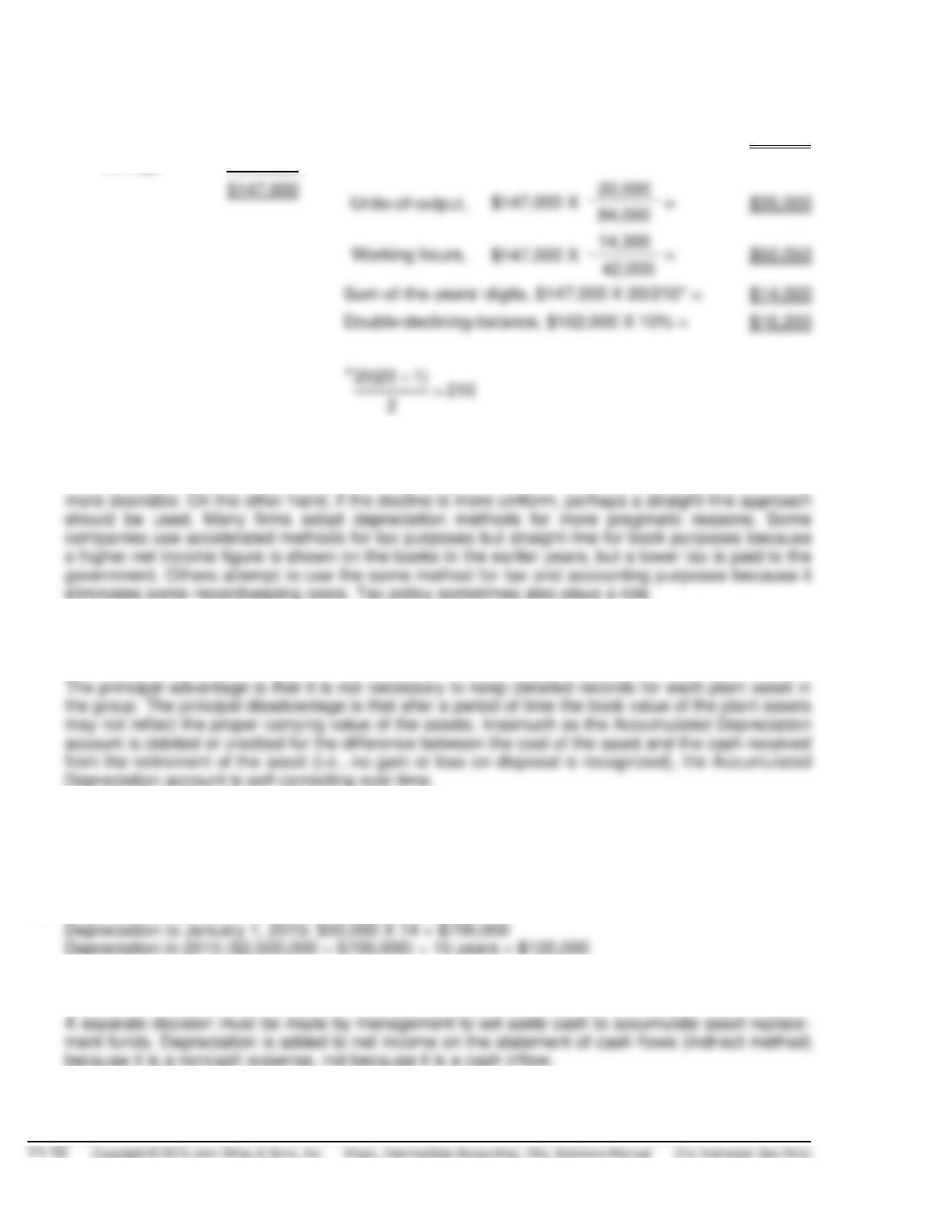
Cost
$800,000
Cost
$800,000
Depreciation rate
X 30%*
Depreciation for 2014
(240,000)
Depreciation for 2014
$240,000
Undepreciated cost in 2015
560,000
2014 Depreciation
$240,000
Depreciation for 2015
Questions Chapter 11 (Continued)
9.
Depreciation base:
Cost
$162,000
Straight-line, $147,000 ÷ 20 =
$ 7,350
Salvage
(15,000)
$147,000
20,000
84,000
14,300
10. From a conceptual point of view, the method which best matches revenue and expenses should
be used; in other words, the answer depends on the decline in the service potential of the asset. If
the service potential decline is faster in the earlier years, an accelerated method would seem to be
11. The composite method is appropriate for a company which owns a large number of heterogeneous
plant assets and which would find it impractical to keep detailed records for them.
12. Cash ……………………………………………………………………………………… 14,000
Accumulated Depreciation—Plant Assets ……………………………………. 36,000
Plant Assets …………………………………………………………….. 50,000
No gain or loss is recognized under the composite method.
13. Original estimate: $2,500,000 ÷ 50 = $50,000 per year
14. No, depreciation does not provide cash; revenues do. The funds for the replacement of the assets
come from the revenues; without the revenues no income materializes and no cash inflow results.
Questions Chapter 11 (Continued)
15. 25% straight-line rate X 2 = 50% double-declining rate
16. The accounting standards require that if events or changes in circumstances indicate that the
carrying amount of such assets may not be recoverable, then the carrying amount of the asset
should be assessed. The assessment or review takes the form of a recoverability test that
17. Under U.S. GAAP, impairment losses on assets held for use may not be restored.
18. An impairment is deemed to have occurred if, in applying the recoverability test, the carrying
amount of the asset exceeds the expected future net cash flows from the asset. In this case, the
19. Impairment losses are reported as part of income from continuing operations, generally in the “Other
expenses and losses” section. Impairment losses (and recovery of losses for assets to be disposed
of) are similar to other costs that would flow through operations. Thus, gains (recoveries of losses)
on assets to be disposed of should be reported as part of income from continuing operations in the
“Other revenues and gains” section.
20. In a decision to replace or not to replace an asset, the undepreciated cost of the old asset is not a
factor to be considered. Therefore, the decision to replace plant assets should not be affected by
the amount of depreciation that has been recorded. The relative efficiency of new equipment as
compared with that presently in use, the cost of the new facilities, the availability of capital for the
new asset, etc., are the factors entering into the decision. Normally, the fact that the asset had
Questions Chapter 11 (Continued)
It should be noted that to the extent that increased depreciation causes management to alter its
decision about replacement, and to the extent it results in capital gains at the time of disposition, it
is not matching costs and revenues in the closest possible manner.
21. In lieu of recording depreciation on replacement costs, management might elect to make annual
appropriations of retained earnings in contemplation of replacing certain facilities at higher price
22. (a) Depreciation and cost depletion are similar in the accounting sense in that:
1. The cost of the asset is the starting point from which computation of the amount of the
periodic charge to operations is made.
2. The estimated life is based on economic or productive life.
3. The accumulated total of past charges to operations is deducted from the original cost of
the asset on the balance sheet.
(b) Depreciation and cost depletion are dissimilar in the accounting sense in that:
1. Depletion is almost always based on output whereas depreciation is usually based on time.
2. Many formulas are used in computing depreciation but only one is used to any extent in
computing depletion.
3. Depletion applies to natural resources while depreciation applies to plant and equipment.
4. Depletion refers to the physical exhaustion or consumption of the asset while depreciation
23. Cost depletion is the procedure by which the capitalized costs, less residual land values, of a natural
resource are systematically charged to operations. The purpose of this procedure is to match the
Questions Chapter 11 (Continued)
Percentage depletion is the procedure, authorized by the Internal Revenue Code, by which a certain
percentage of gross income is charged to operations in arriving at taxable income. Percentage
depletion is not considered to be a generally accepted accounting principle because it is not
24. Percentage depletion does not necessarily measure the proper share of the cost of land to be charged
to expense for depletion and, in fact, may ultimately exceed the actual cost of the property.
25. The maximum dividend permissible is the amount of accumulated net income (after depletion) plus
26. Reserve recognition accounting (RRA) is the method that was proposed by the SEC to account for
oil and gas resources. Proponents of this approach argue that oil and gas should be valued at the
date of discovery. The value of the reserve still in the ground is estimated and this amount,
27. Using full-cost accounting, the cost of unsuccessful ventures as well as those that are successful is
capitalized, because a cost of drilling a dry hole is a cost that is needed to find the commercially
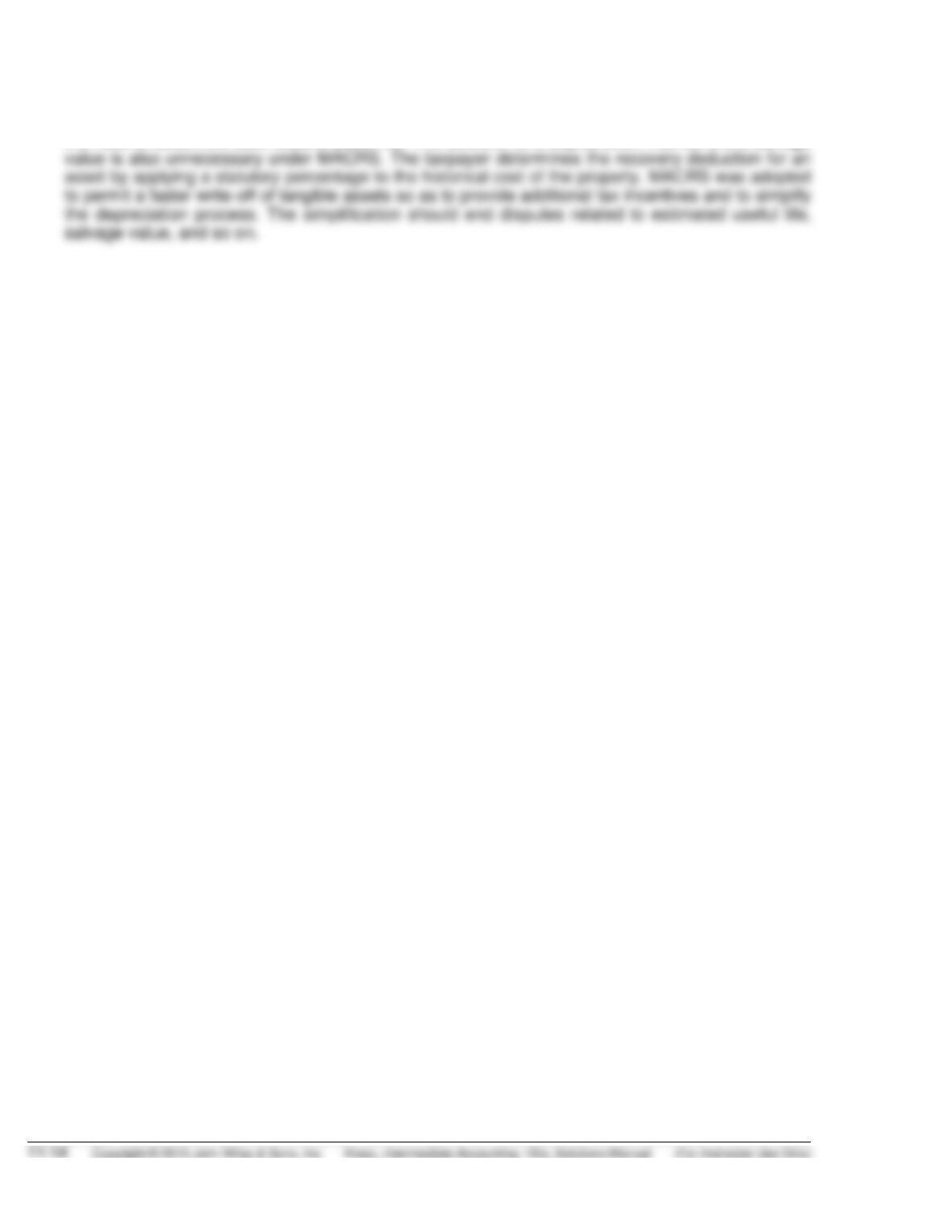
28. Asset turnover:
$69.8
= 1.54 times
$45.2
Return on assets:
= 6.4%
Questions Chapter 11 (Continued)
*29. The modified accelerated cost recovery system (MACRS) has been adopted by the Internal
Revenue Service. It applies to depreciable assets acquired in 1987 and later. MACRS eliminates
the need to determine each asset’s useful life. The selection of a depreciation method and a salvage
SOLUTIONS TO BRIEF EXERCISES
BRIEF EXERCISE 11-1
= $6,900
BRIEF EXERCISE 11-2
(a)
$80,000 – $8,000
= $9,000
8
BRIEF EXERCISE 11-3
(a) ($80,000 – $8,000) X 8/36* = $16,000
BRIEF EXERCISE 11-4
(a) $80,000 X 25%* = $20,000
BRIEF EXERCISE 11-5
Depreciable Base = ($28,000 + $200 + $125 + $500 + $475) – $3,000 = $26,300.
BRIEF EXERCISE 11-6
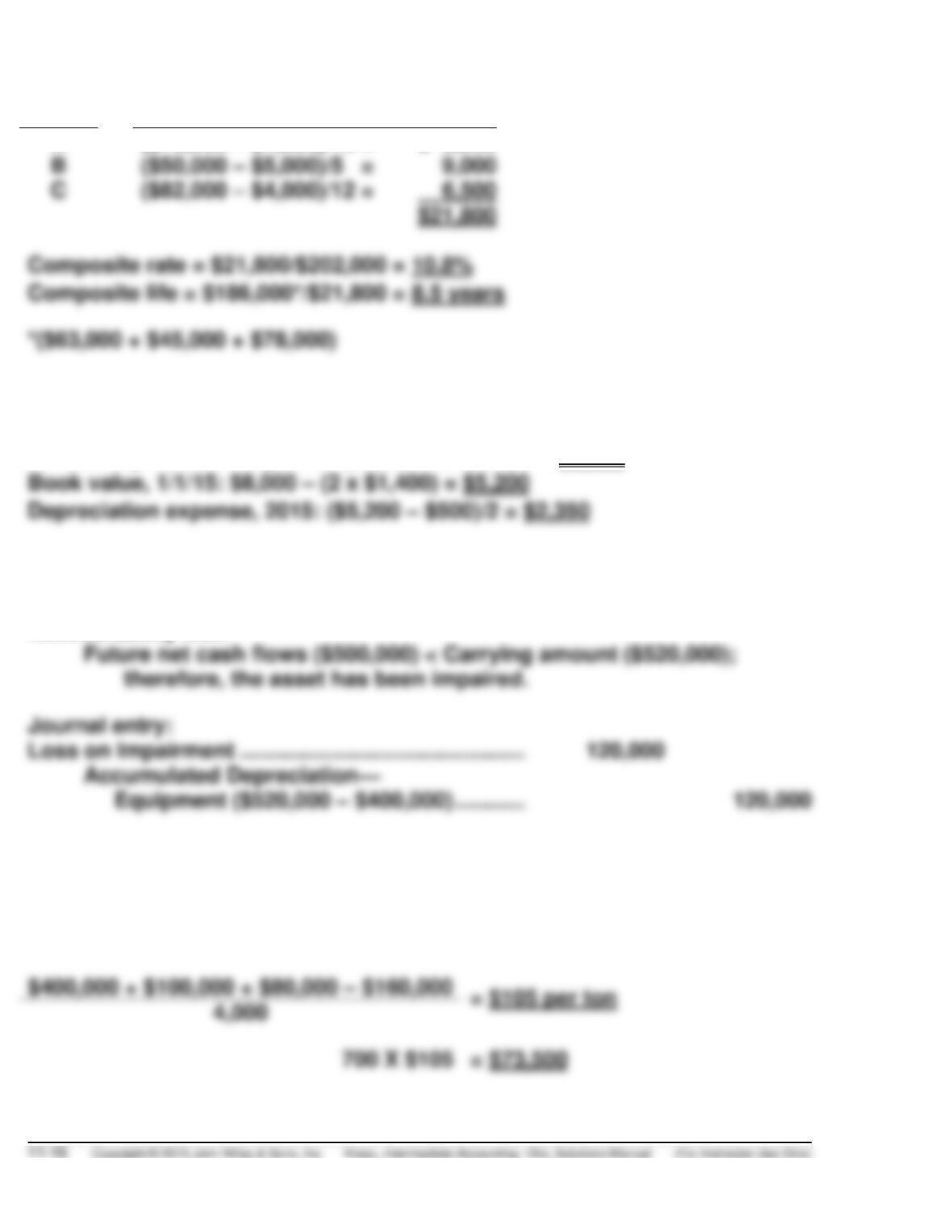
Asset
Depreciation Expense
A
($70,000 – $7,000)/10 =
$ 6,300
B
($50,000 – $5,000)/5 =
BRIEF EXERCISE 11-7
Annual depreciation expense: ($8,000 – $1,000)/5 = $1,400
BRIEF EXERCISE 11-8
Recoverability test:
BRIEF EXERCISE 11-9
Inventory ………………………………………………………………..
73,500
Coal Mine ……………………………………………………….
73,500
$400,000 + $100,000 + $80,000 – $160,000
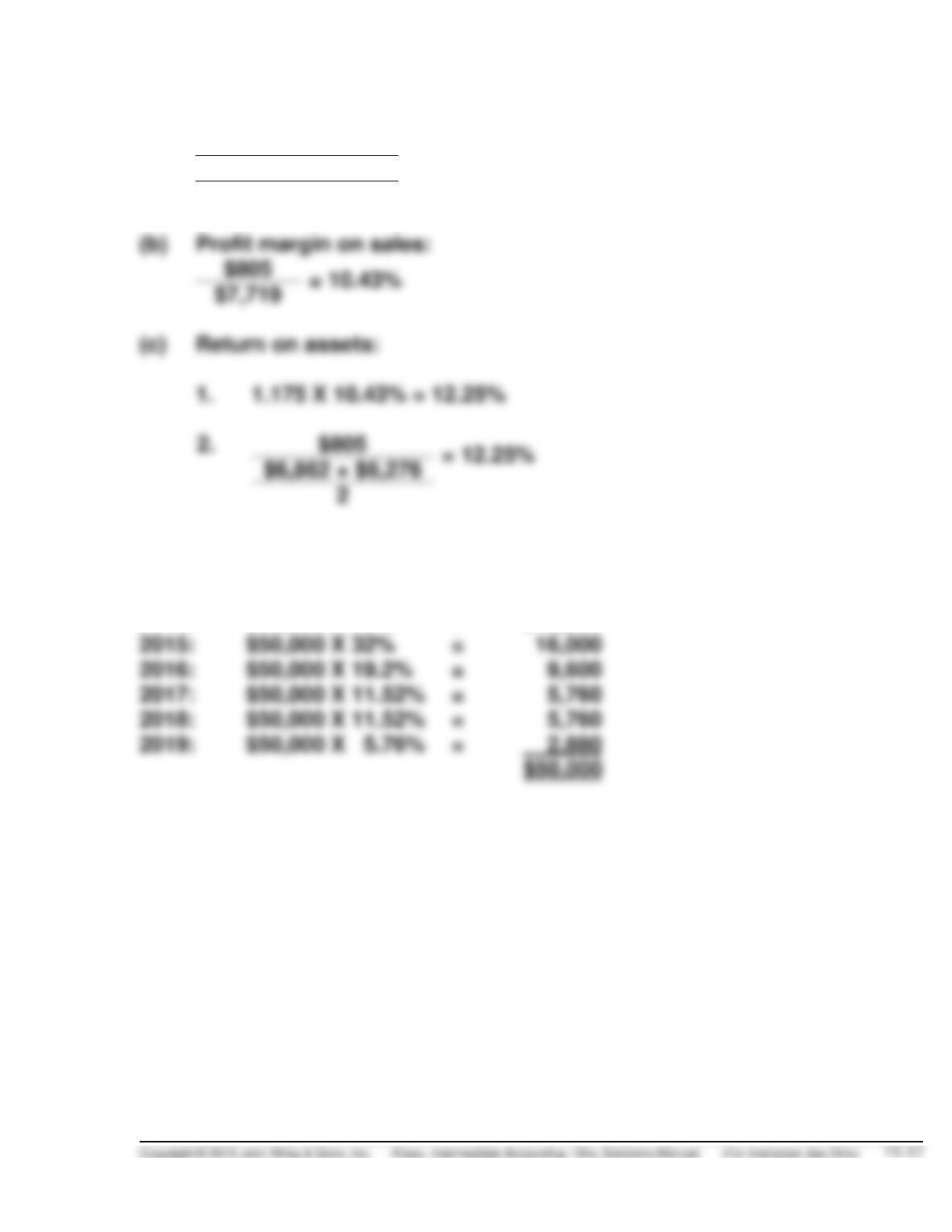
BRIEF EXERCISE 11-10
(a) Asset turnover:
$7,719
= 1.175 times
$6,862 + $6,276
2
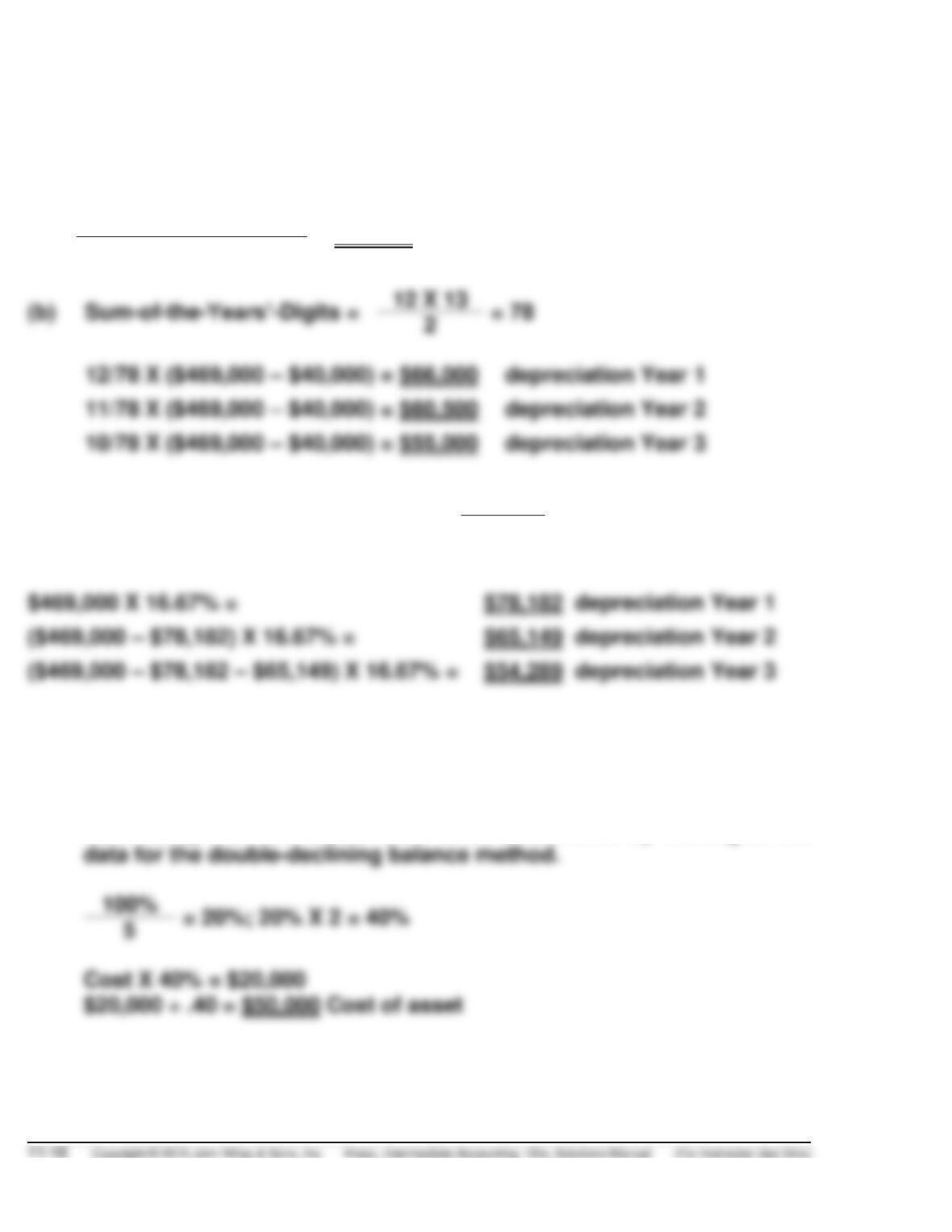
*BRIEF EXERCISE 11-11
2014:
$50,000 X 20%
=
$10,000
$50,000 X 32%
$50,000 X 19.2%
2017:
$50,000 X 11.52%
=
$50,000 X 11.52%
$50,000 X 5.76%
SOLUTIONS TO EXERCISES
EXERCISE 11-1 (15–20 minutes)
(a) Straight-line method depreciation for each of Years 1 through 3 =
$469,000 – $40,000
= $35,750
12
(b)
= 78
(c)
Double-Declining Balance method
depreciation rate.
100%
X 2 = 16.67%
12
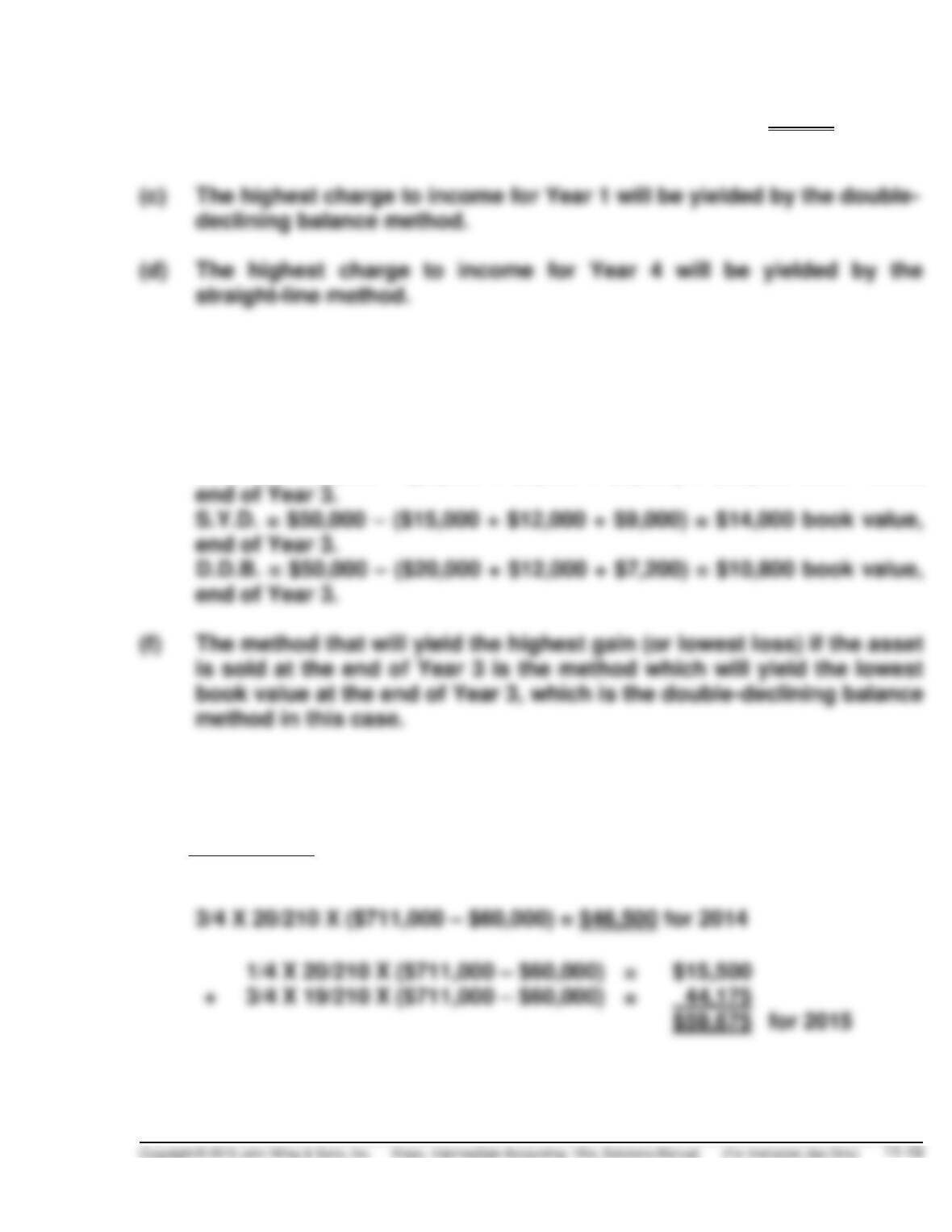
EXERCISE 11-2 (20–25 minutes)
(a) If there is any salvage value and the amount is unknown (as is the
case here), the cost would have to be determined by looking at the
= 20%; 20% X 2 = 40%
EXERCISE 11-2 (Continued)
(b) $50,000 cost [from (a)] – $45,000 total depreciation = $5,000 salvage
value.
(e) The method that produces the highest book value at the end of Year 3
would be the method that yields the lowest accumulated depreciation
at the end of Year 3, which is the straight-line method.
Computations:
St.-line = $50,000 – ($9,000 + $9,000 + $9,000) = $23,000 book value,
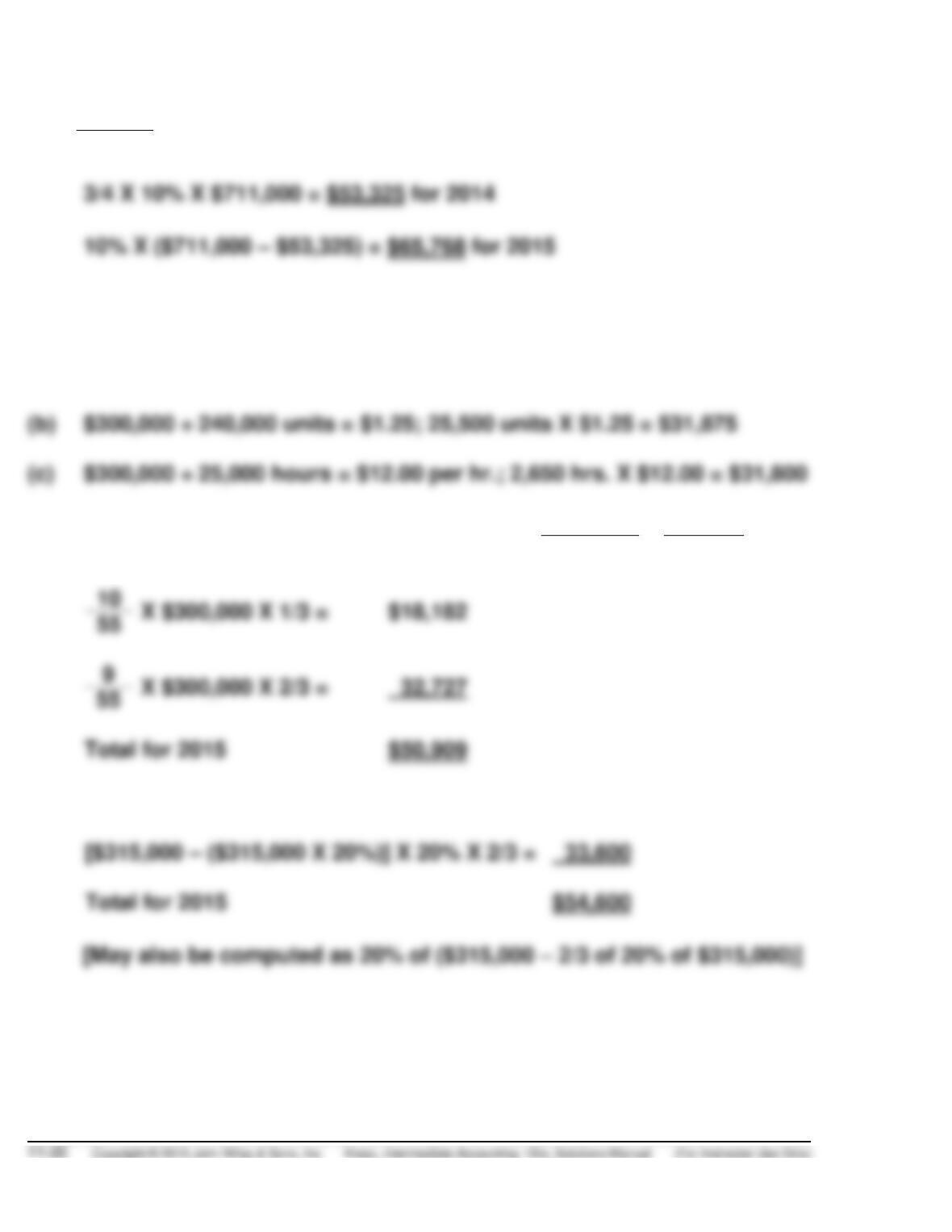
EXERCISE 11-3 (15–20 minutes)
(a)
20 (20 + 1)
= 210
2
EXERCISE 11-3 (Continued)
(b)
100%
= 5%; 5% X 2 = 10%
20
EXERCISE 11-4 (15–25 minutes)
(a) $315,000 – $15,000 = $300,000; $300,000 ÷ 10 yrs. = $30,000
(d)
10 + 9 + 8 + 7 + 6 + 5 + 4 + 3 + 2 + 1 = 55 OR
n(n + 1)
=
10(11)
= 55
2
2
X $300,000 X 1/3 =
(e)
$315,000 X 20% X 1/3 =
$21,000