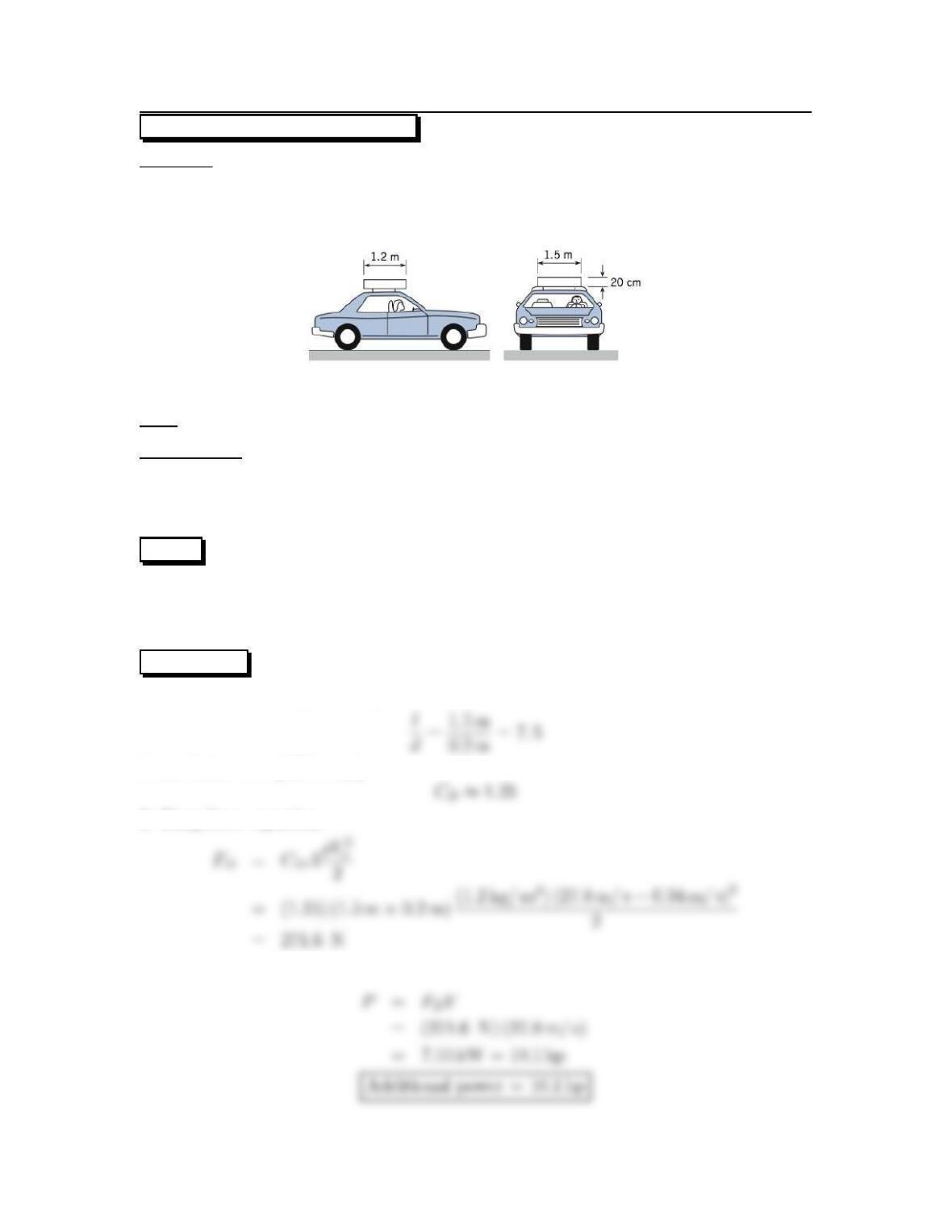
11.33: PROBLEM DEFINITION
Situation:
A cartop carrier is used on an automobile.
Vc=100km/h=27.8m/s,
Vw=25km/h=6.94 m/s.
Find: Additional power required due to the carrier.
Assumptions:
Density of air is ρ=1.2kg/m3.
The coefficient of drag is not influenced by the car.
CDis best approximated as a rectangular plate.
PLAN
1. Find CD.
2. Find the force of drag.
3. Calculate power as the product of drag force and speed.
SOLUTION
1. Coefficient of drag. The aspect ratio is
From Table 11.1 (EFM 10e)
2. Drag force equation.
3. Power equation.
41
11.34: PROBLEM DEFINITION
Situation: The problem statement describes motion of an automobile.
Find: Percentage savings in gas mileage when travelling at 55 mph instead of 65 mph.
SOLUTION
Work is force times distance. Thus, energy is
The energy, E,perunitdistanceissimplytheforceor
Substituting drag force
Then energy savings are
42
11.35: PROBLEM DEFINITION
Situation:
Acar(W= 2000 lbf) coasting down a hill (Slope =6%)has reached steady speed.
μrolling =μ=0.01
CD=0.29 AP=18ft
2
ρair =ρ=0.002 slug/ft3
Find: Maximum coasting speed.
SOLUTION
Slope of a hill is rise over run, so the angle of the hill is
where FD=drag force, Fr=rolling friction and W=weight of car.
Insert expressions for drag force and rolling friction.
43
11.36: PROBLEM DEFINITION
Situation: The problem statement describes a car being driven up a hill
Find: Power required.
SOLUTION
The power required is the product of the forces acting on the automobile in the
direction of travel and the speed. The drag force is
44
11.37: PROBLEM DEFINITION
Situation: A bicyclist is coasting down a hill–additional details are provided in the
problem statement
Find: Speed of the bicycle.
SOLUTION
Equilibrium (direction parallel to motion of the bicyclist)
Then
45
11.38: PROBLEM DEFINITION
Situation:
A bicyclist is traveling into a 3 m/s head wind.
P=275W,A
p=0.5m
3,C
D=0.3.
Find: Speed of the bicyclist.
Assumptions:
Neglect rolling resistance.
All power is used to overcome drag. (neglect power losses in the chain and gears)
Properties:Air.ρ=1.2kg/m3.
PLAN
1. Relate the cyclist’s speed Vcto the drag force.
SOLUTION
1. Drag equation (use velocity of air relative to the cyclist).
2. Power equation.
3. Solving the cubic equation (we used a computer program) for speed gives
46
11.39: PROBLEM DEFINITION
Situation: The problem statement describes a 1932 Fiat Balillo that is “souped up”
by the addition of a 220-bhp engine.
Find: Maximum speed of a “souped up” Balillo.
SOLUTION
From Table 11.2 (EFM 10e), CD=0.60.
“Souped up” version:
47
11.40: PROBLEM DEFINITION
Situation:
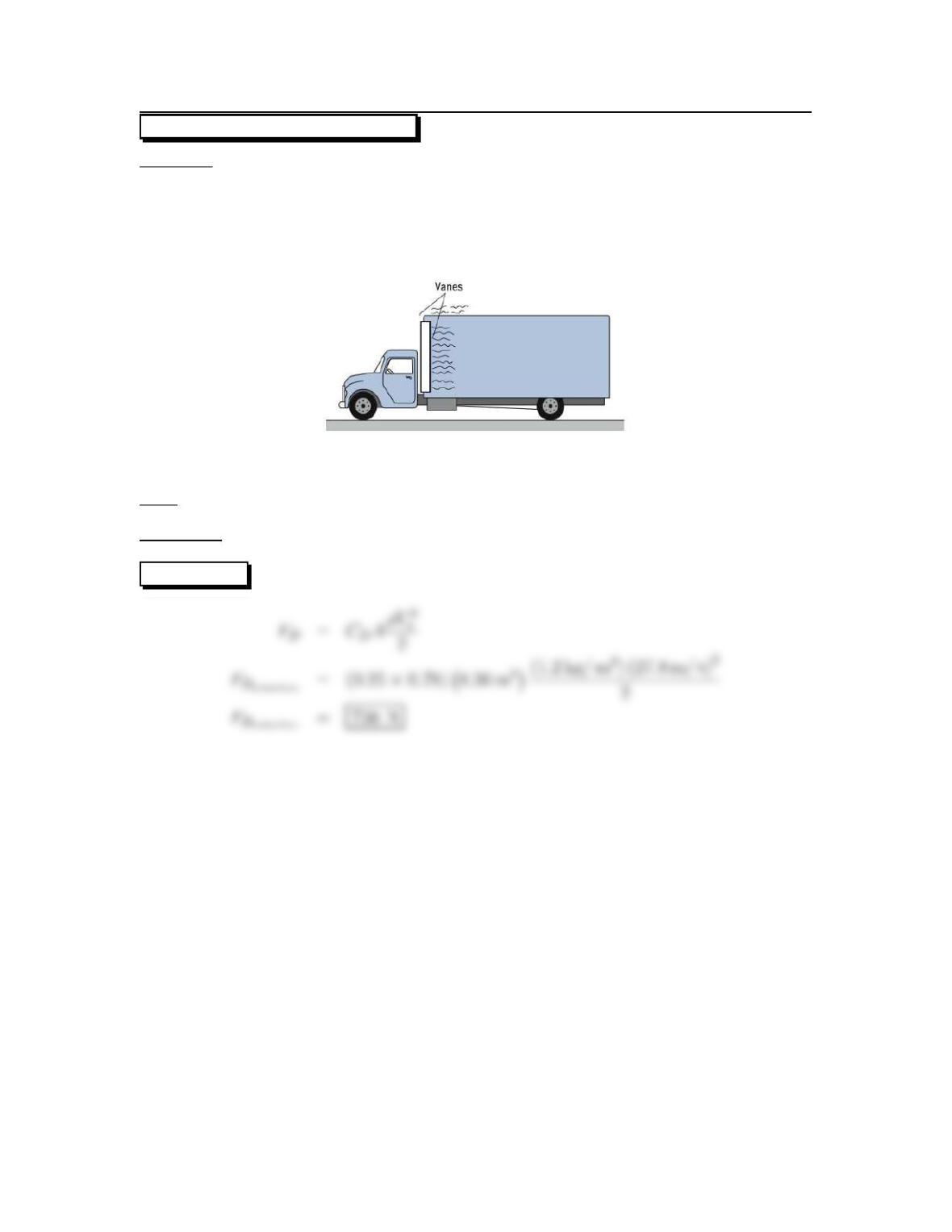
To reduce drag, vanes are added to a truck.
CD(no vanes) = 0.78.
Vanes reduce drag by 25%.
Ap=8.36 m2,V=100km/h=27.8m/s.
Find: Reduction in drag force due to the vanes.
Properties:Air(20 ◦C,1atm), Table A.3 (EFM 10e), ρ=1.2kg/m3.
SOLUTION
48
11.41: PROBLEM DEFINITION
Situation:
To reduce drag, vanes are added to a truck.
CD(no vanes) = 0.78.
Vanes reduce drag by 25%.
Ap=8.36 m2,V=100km/h=27.8m/s.
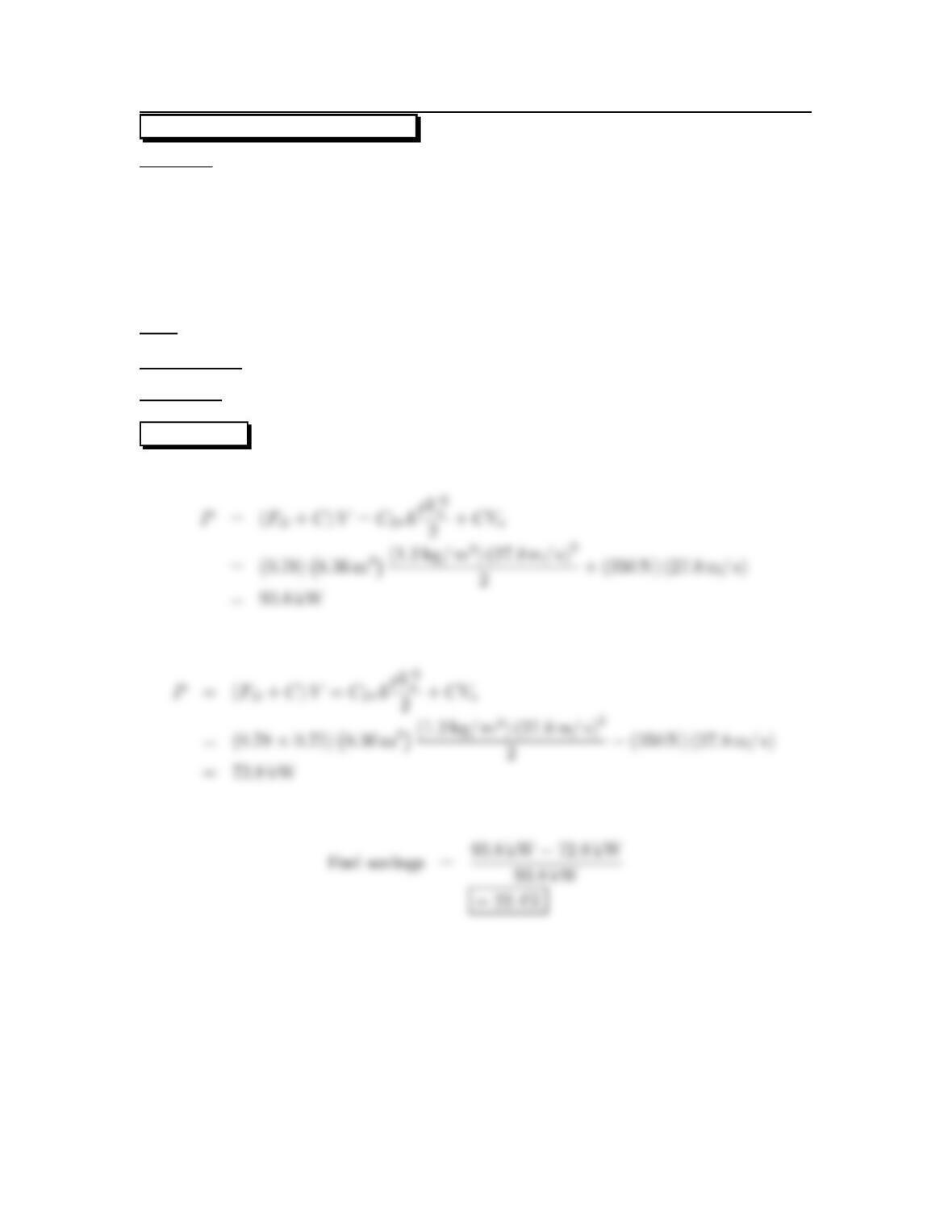
Total resistance is given by R=FD+Cwhere C=350Naccounts for bearing
friction.
Find: Percentage savings in fuel.
Assumptions: Fuel savings are directly proportional to power savings
Properties:Air(20 ◦C,1atm), Table A.3 (EFM 10e), ρ=1.2kg/m3.
SOLUTION
1. Power (no vanes).
2. Power (vanes are installed)
3. Fuel savings.
49
Problem 11.42
Situation: An engineer is designing an object to fall at a speed of 1 m/s in seawater.
Find: Identify the variables that have the most influence on terminal velocity.
PLAN
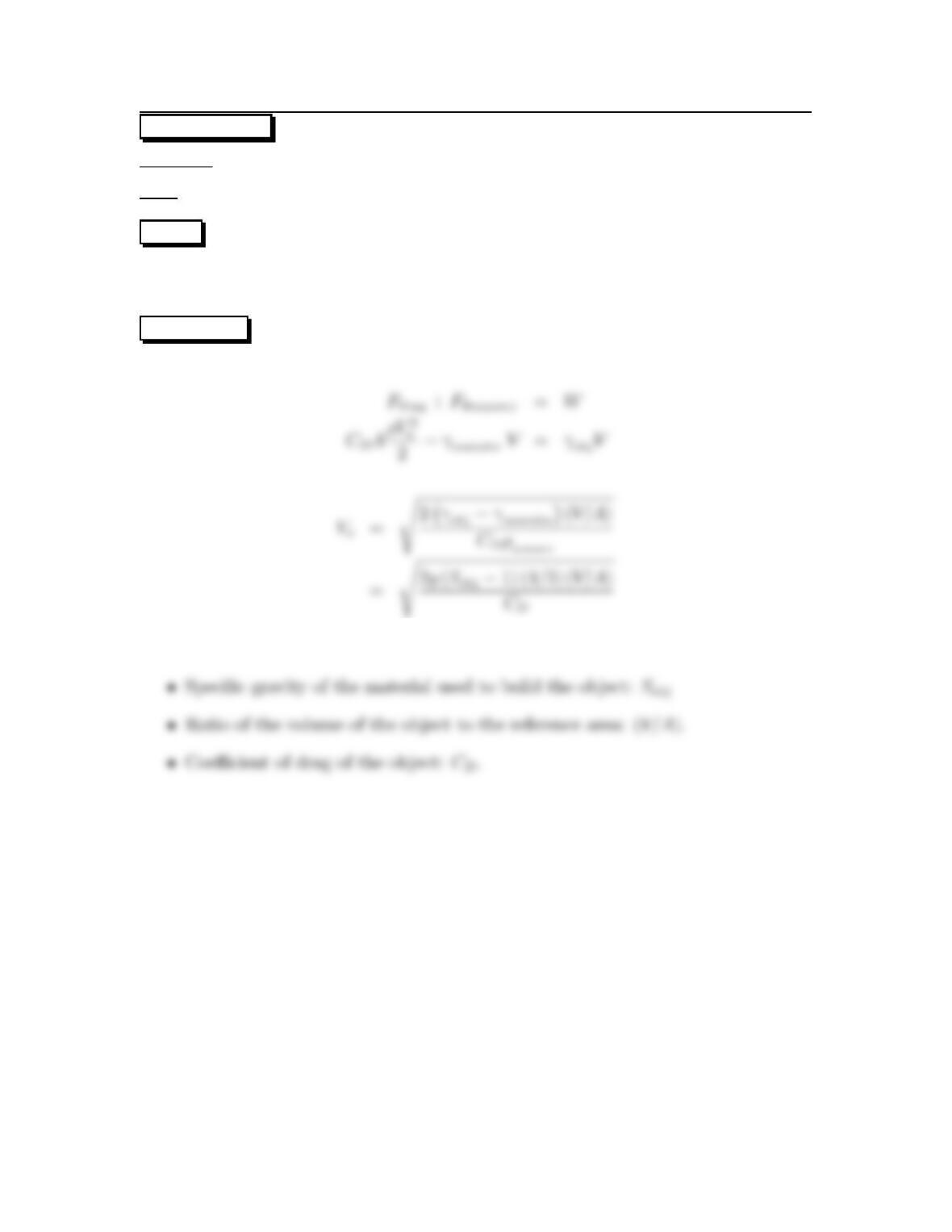
1. Derive the governing equation by applying force equilibrium.
2. Use the governing equation to identify which variables influence terminal velocity.
SOLUTION
1. Force equilibrium.
2. Variables that influence terminal velocity:
50
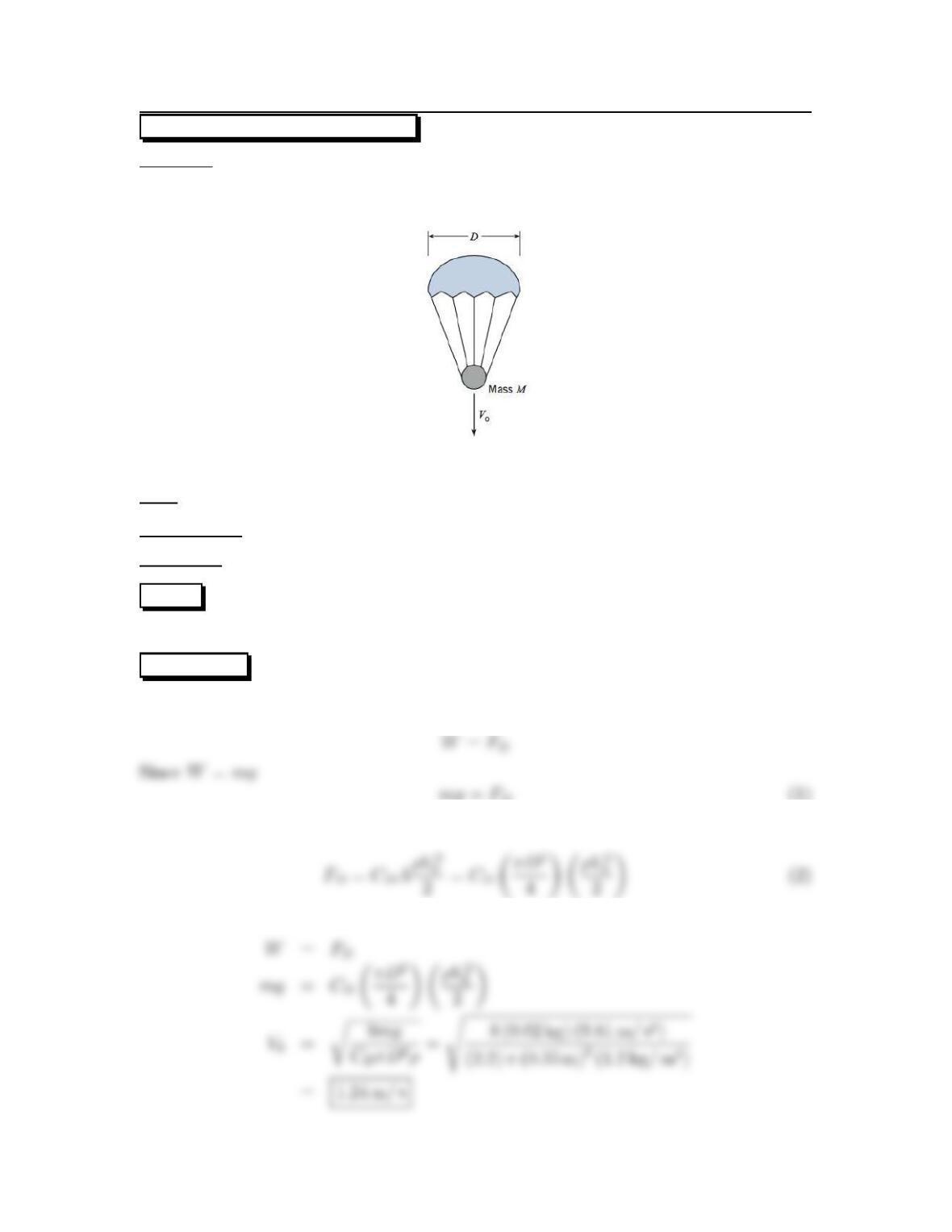
11.43: PROBLEM DEFINITION
Situation:
Aparachute(D=0.35 m) is falling through the air.
m=0.02 kg,C
D=2.2,A
p=πD2/4.
Find: Terminal velocity (in m/s).
Assumptions: Neglect mass of the chute.
Properties:Air(20 ◦C,1atm), Table A.3 (EFM 10e), ρ=1.2kg/m3.
PLAN
Develop an equation for terminal velocity by applying force equilibrium.
SOLUTION
1. Force equilibrium.
2. Drag force equation.
3. Combine Eq. (1) and (2).
51
11.44: PROBLEM DEFINITION
Situation: A small air bubble is rising in a very tall column of liquid—additional details
are provided in the problem statement.
Find:
(a)Acceleration of the bubble.
(b)Form of the drag (mostly skin-friction or form).
SOLUTION
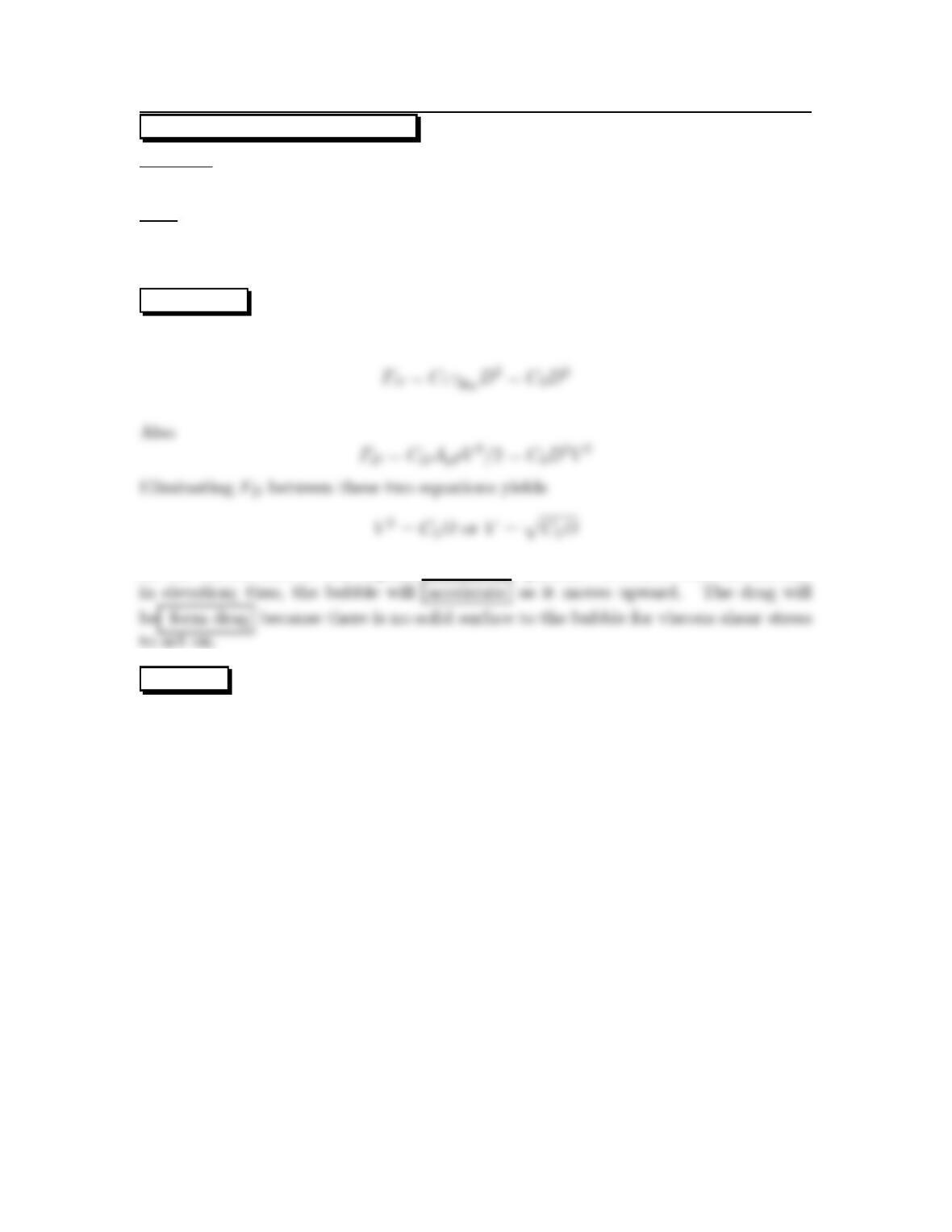
Equating the drag force and the buoyancy force.
As the bubble rises it will expand because the pressure decreases with an increase
REVIEW
As a matter of interest, the surface tension associated with contaminated fluids creates
a condition which acts like a solid surface.
52
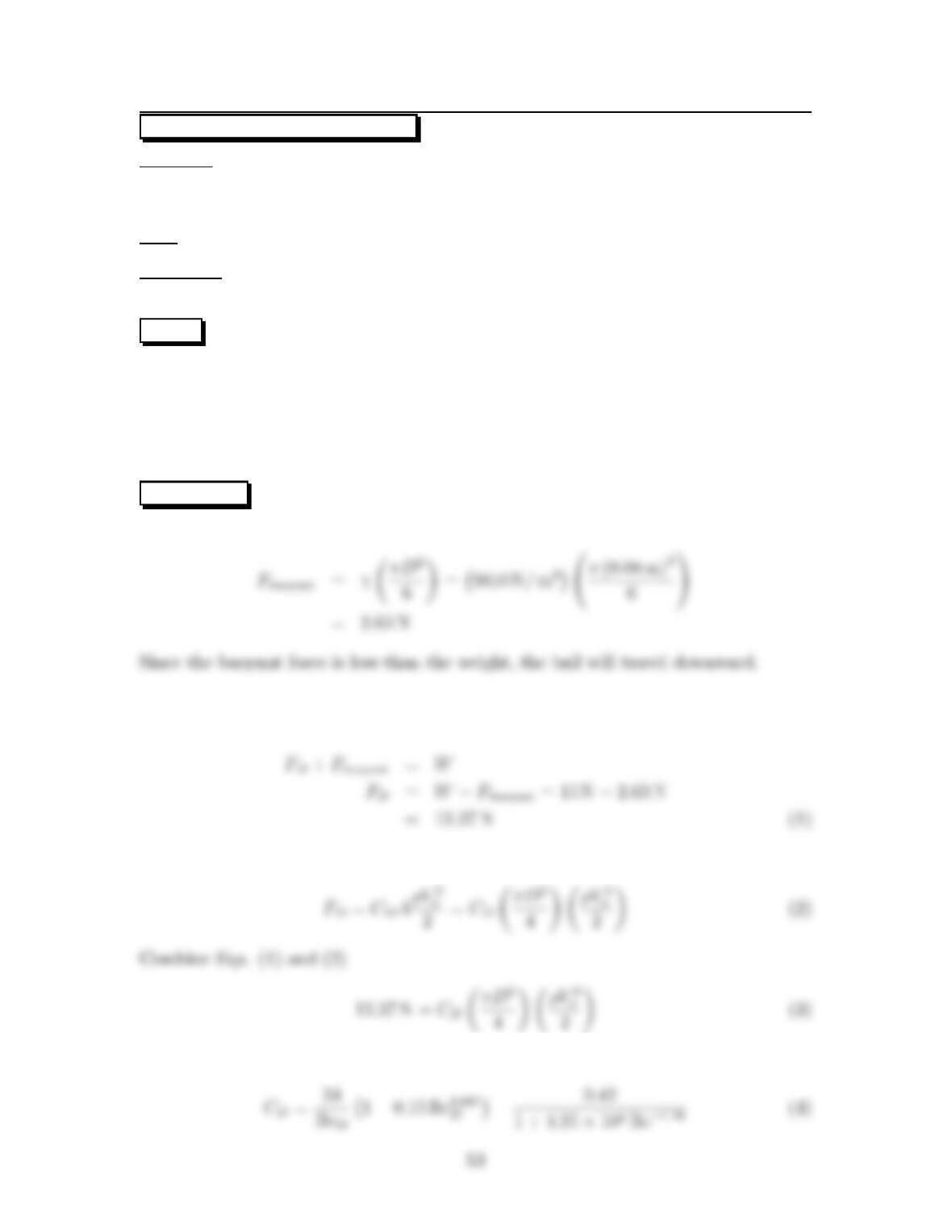
11.45: PROBLEM DEFINITION
Situation:
Aball(D=0.08 m) falls through water.
Weight of the ball in air is 15 N.
Find: Terminal velocity (in m/s) of the ball.
Properties:Water(10 ◦C), Table A.5 (EFM 10e), ρ=1000kg/m3,γ=9810N/m3,ν=
1.31 ×10⁻⁶m2/s.
PLAN
1. Determine if the ball is falling or rising by comparing the buoyant force and the
weight.
2. Relate terminal velocity to weight and buoyancy.
3. Develop equations for CDand Re .
4. Solve the resulting set of equations using a computer program.
SOLUTION
1.Comparebuoyantforceandweight
2. Equilibrium
Drag force equation.
3. Clift and Gauvin correlation (drag on a sphere)
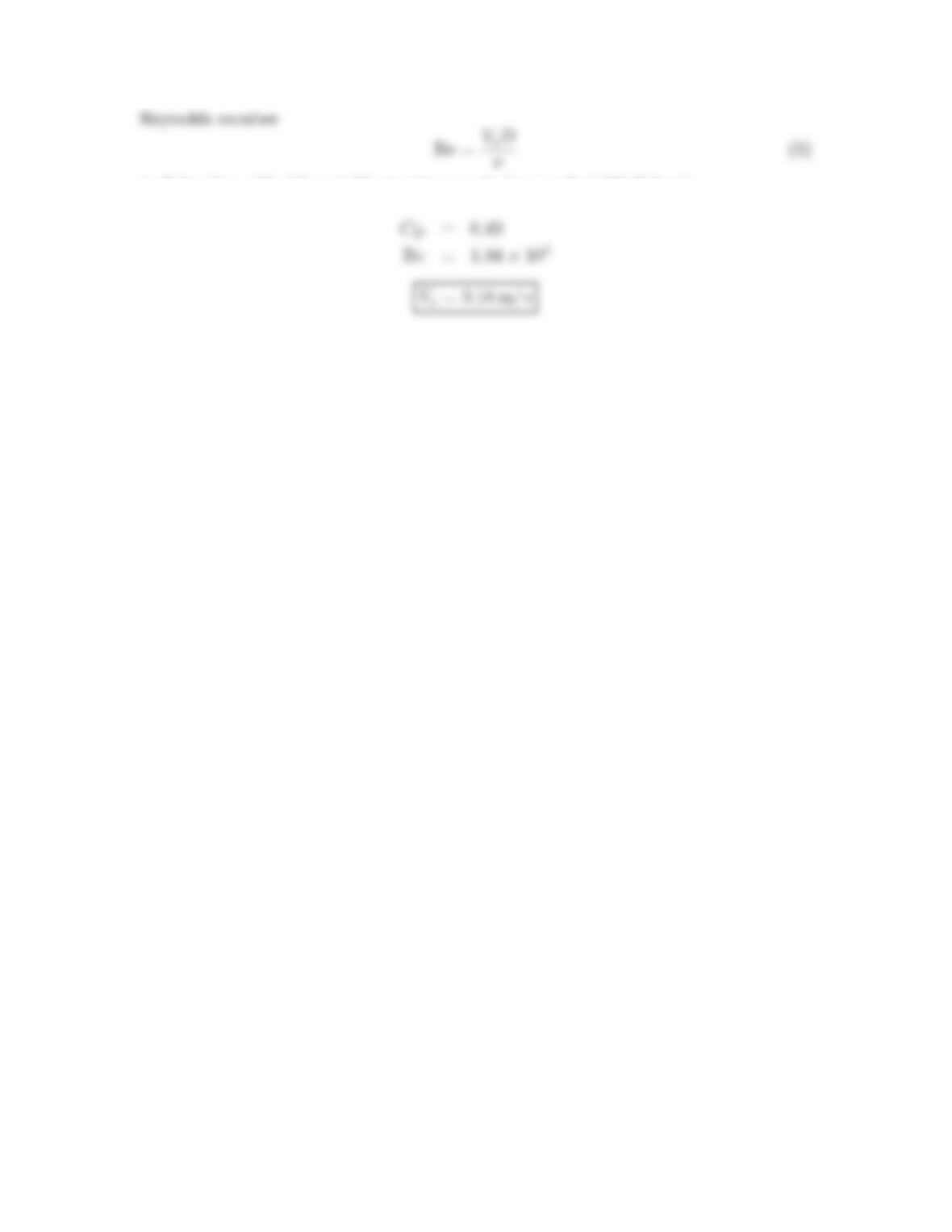
4. Solve Eqs. (3), (4) and (5) simultaneously (we applied TK Solver).
54
11.46: PROBLEM DEFINITION
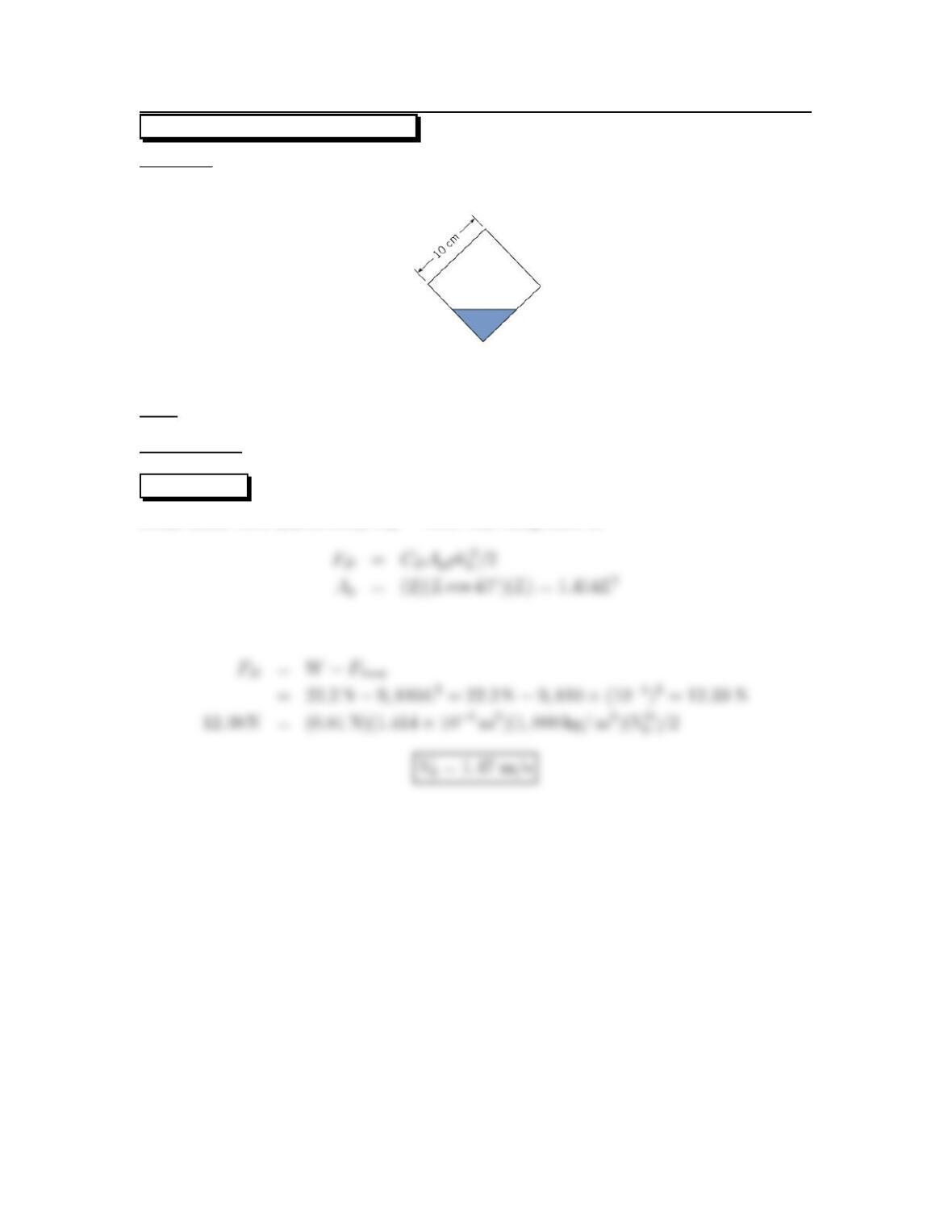
Situation: A weighted cube falls through water (see the problem statement for all the
details).
Find: Terminal velocity in water.
Assumptions: Density of water: ρ=1000kg/m3.
SOLUTION
From Table 11.1 (EFM 10e), CD=0.81.The drag force is
Equilibrium
55
11.47: PROBLEM DEFINITION
Situation:
A spherical rock fall in water.
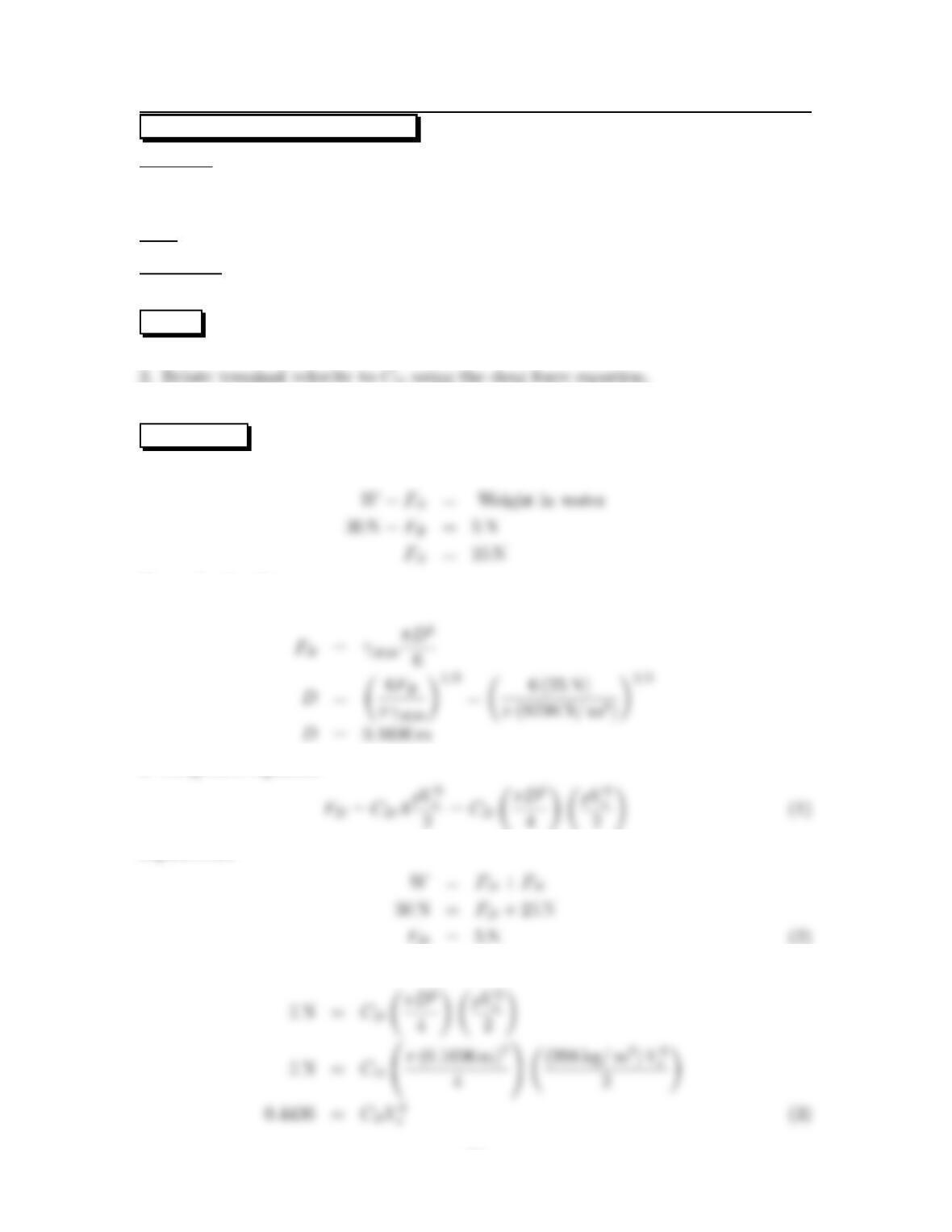
W=30N.Weight in water is 5N.
Find: Terminal velocity (in m/s) of the rock.
Properties:Water(20 ◦C), Table A.5 (EFM 10e), ρ=998kg/m3,γ =9790N/m3,ν=
1.00 ×10⁻⁶m2/s.
PLAN
1. Find diameter by using known buoyant force.
3. Solve the resulting equation using an iterative approach.
SOLUTION
1. Buoyant force equation
Now solve for diameter
2. Drag force equation
Equilibrium
Combine Eqs. (1) and (2)
56
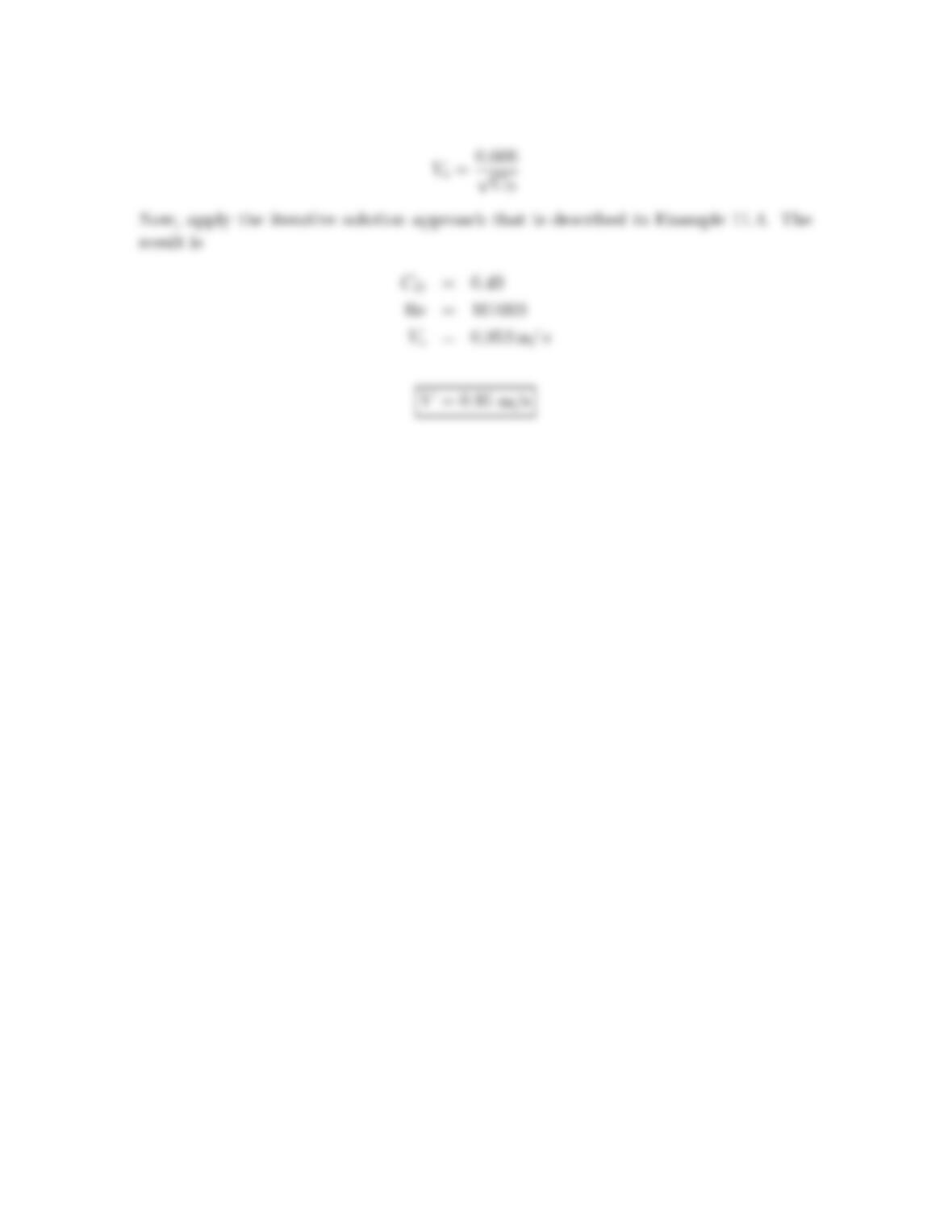
3. Solve Eq. (3). Begin by rewriting the equation
57
11.48: PROBLEM DEFINITION
Situation:
A helium–filled balloon is ascending in air.
Standard atmosphere.
WBalloon(empty) = WB=3N.
Find: Terminal velocity (in m/s) of balloon.
Properties:Air(15 ◦C), Table A.2 (EFM 10e), ρ=1.22 kg/m3,ν=1.46×10−5m2/s.
PLAN
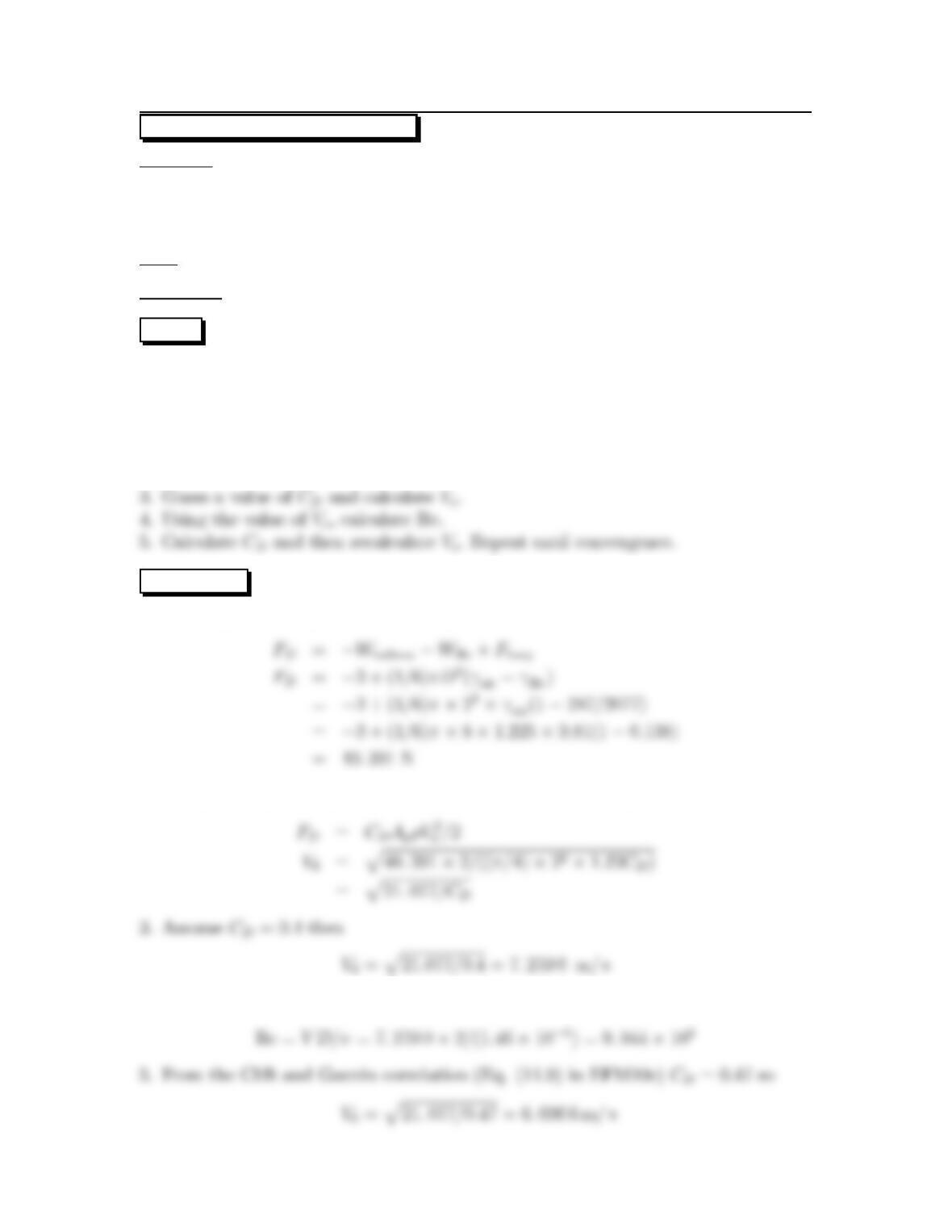
Thegoal(velocity)appearsinthedragforceequationThus,find the drag force using
equilibrium and then solve for the velocity. This requires an iterative or a numerical
approach. The solution below is an iterative approach. The steps are
1. Relate the drag force to other forces using equilibrium.
2. Develop an algebraic equation for terminal velocity (Vo)using the drag force
equation.
SOLUTION
1. Force equilibrium (vertical direction).
2. Drag force equation (to find equation for terminal velocity).
4. Reynolds number
58
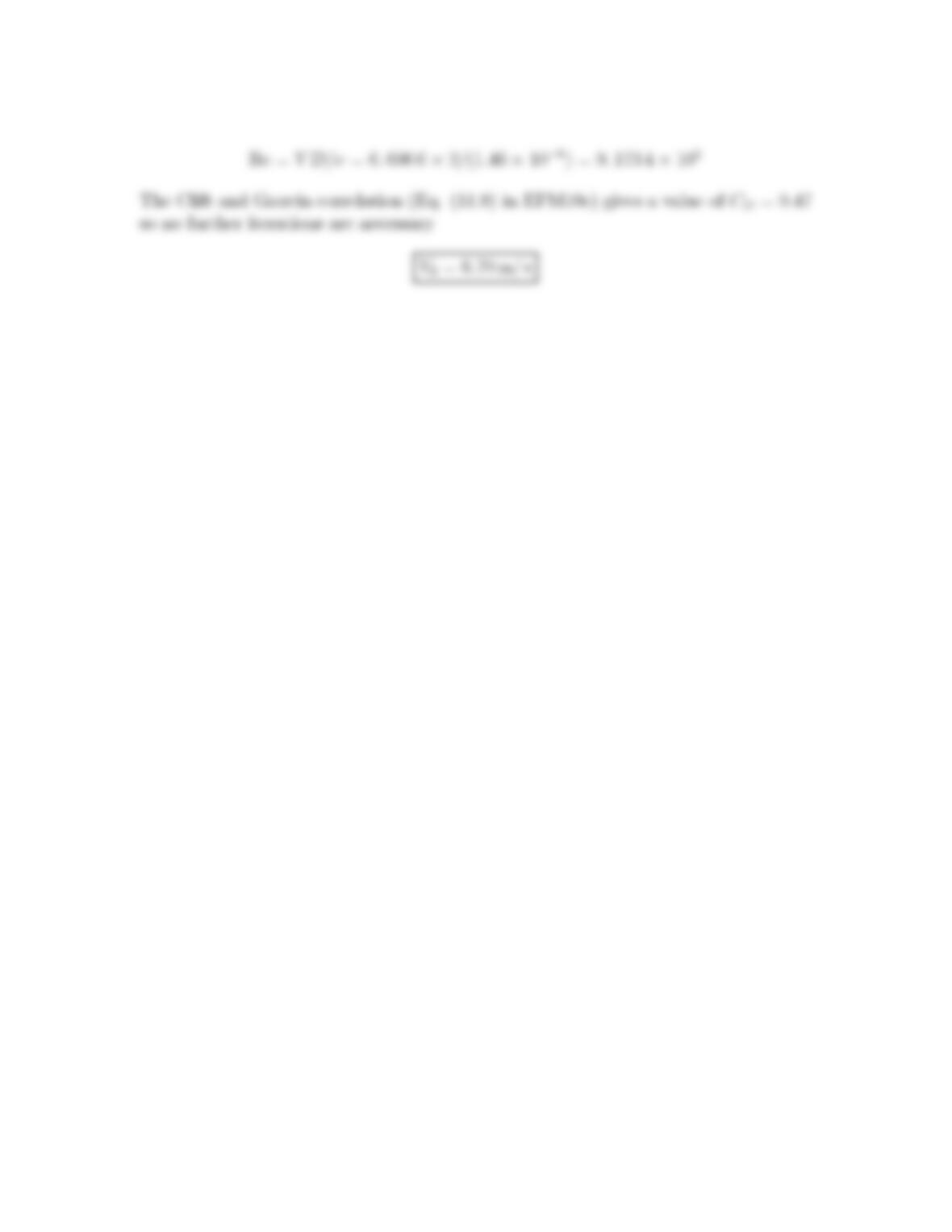
Reynolds number
59
11.49: PROBLEM DEFINITION
Situation: A sphere 2 cm in diameter rises in oil at a velocity of 1.5 cm/s.
Find: Specific weight of the sphere material.
SOLUTION
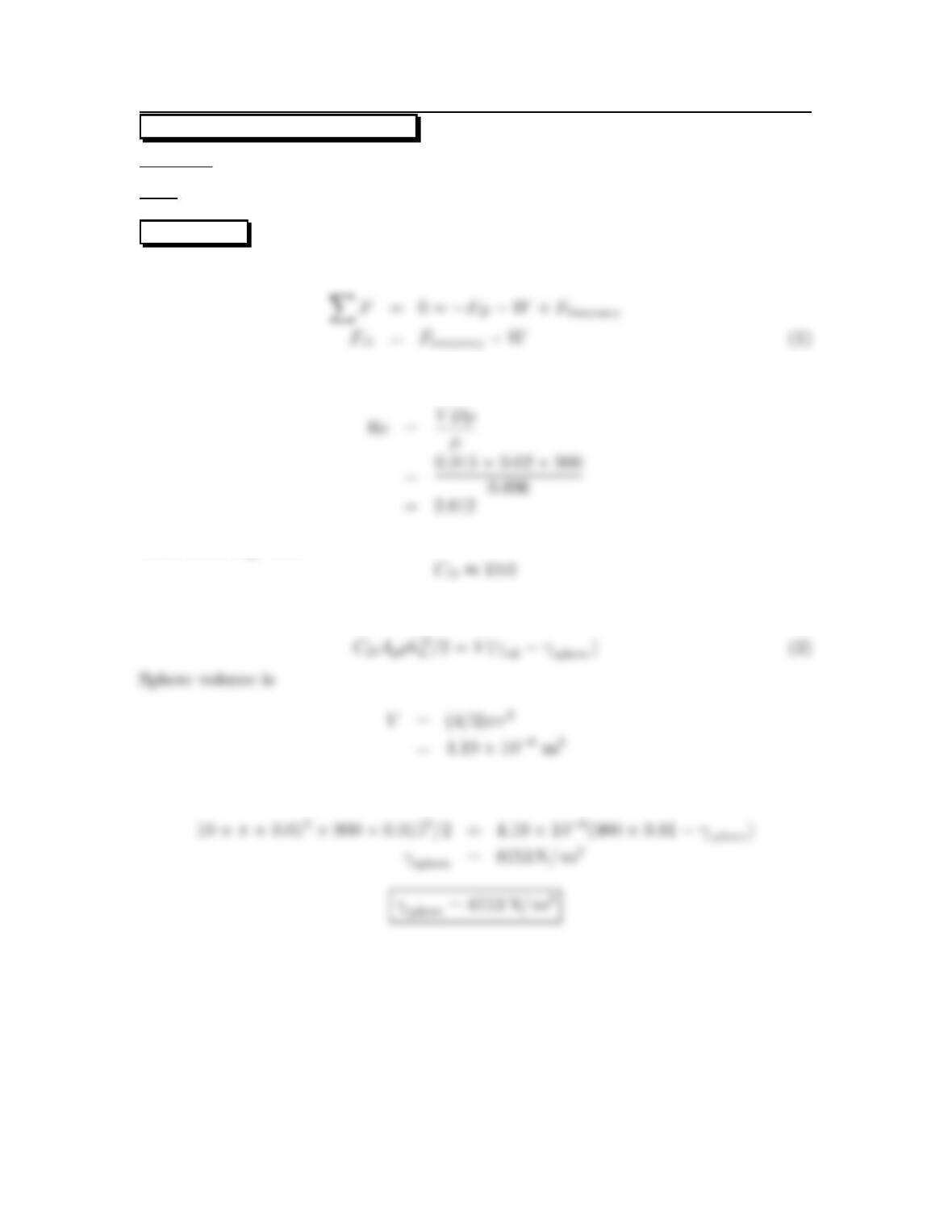
Equilibrium
Reynolds number
Then from Fig. 11.8
Substitute drag force, weight and buoyancy force into Eq. (1)
Eq. (2) becomes
60