Problem 11.42
The static pressure to stagnation pressure ratio at a point in a gas flow field is measured
with a Pitot-static probe as being equal to 0.6. The stagnation temperature of the gas is
20 °C. Determine the flow speed in m/s and the Mach number if the gas is air. What error
would be associated with assuming that the flow is incompressible?
Solution 11.42
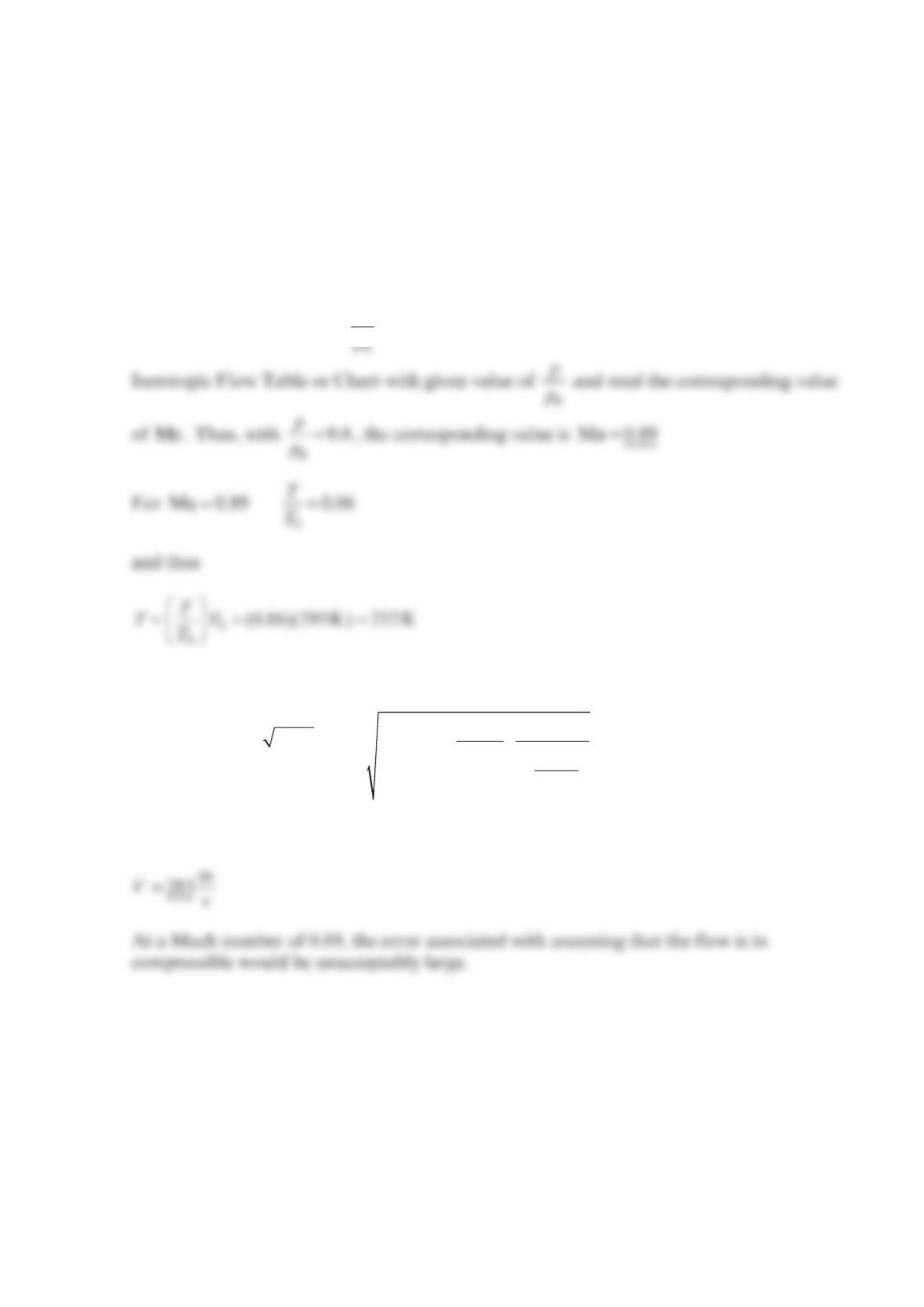
To determine the flow speed and Mach number having been given the static pressure to
stagnation pressure ration,
p
, and stagnation temperature, 0
T, for air, we use an
Then
⋅
== =
⋅
2
N m (252 K)
(Ma) Ma 0.89 1.4 286.9 kg K Ns
1kg m
VckRT
or
Problem 11.43
Air flows steadily and isentropically from standard atmospheric conditions to a receiver
pipe through a converging duct. The cross-sectional area of the throat of the converging
duct is 2
0.05 ft . Determine the mass flowrate through the duct if the receiver pressure is
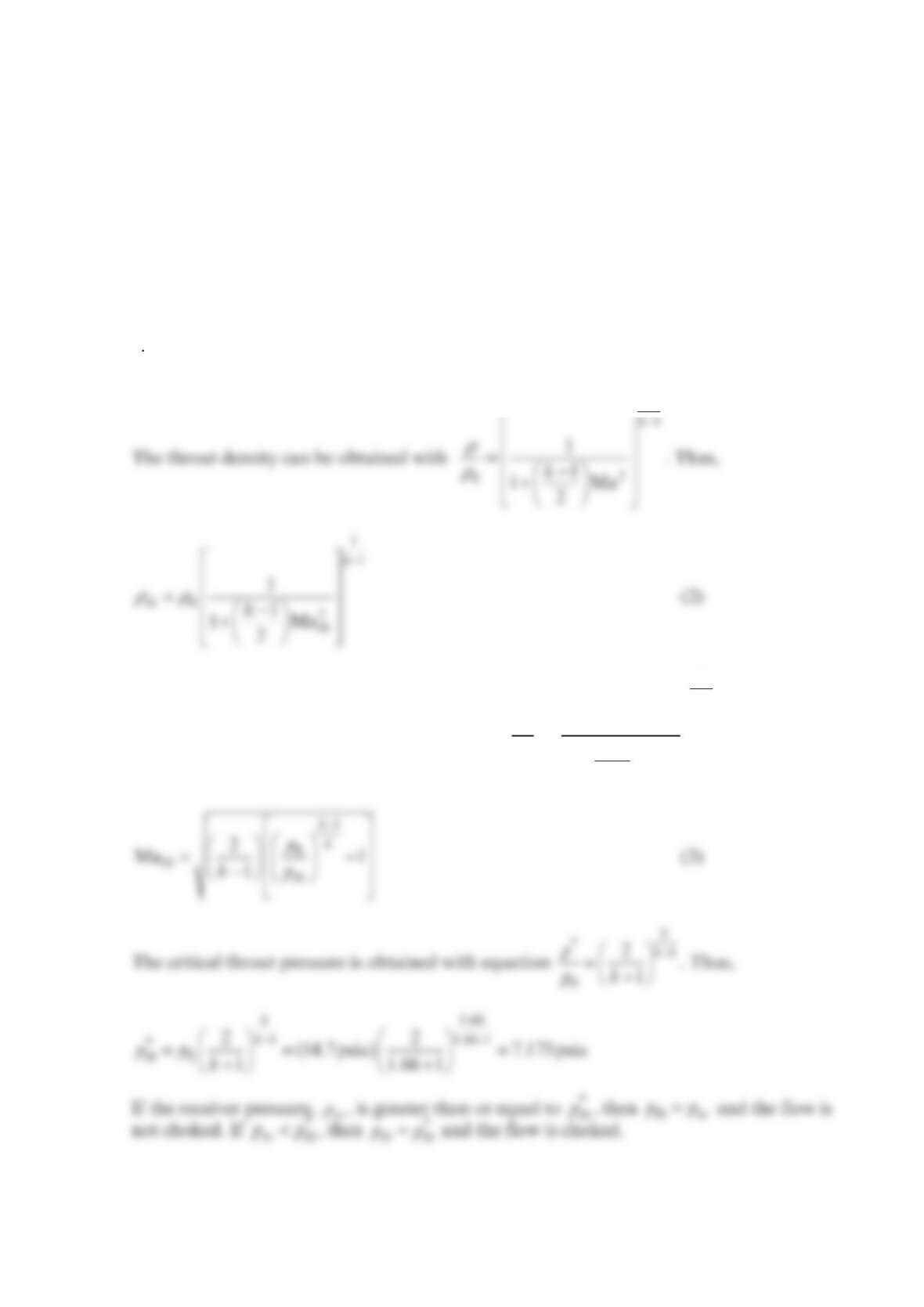
(a) 10 psia , (b) 5psia. Sketch temperature–entropy diagrams for situations (a) and (b).
Verify results obtained with values from the appropriate graph in Appendix D with
calculations involving ideal gas equations. Is condensation of water vapor a concern?
Explain.
Solution 11.43
The mass flowrate at the throat is,
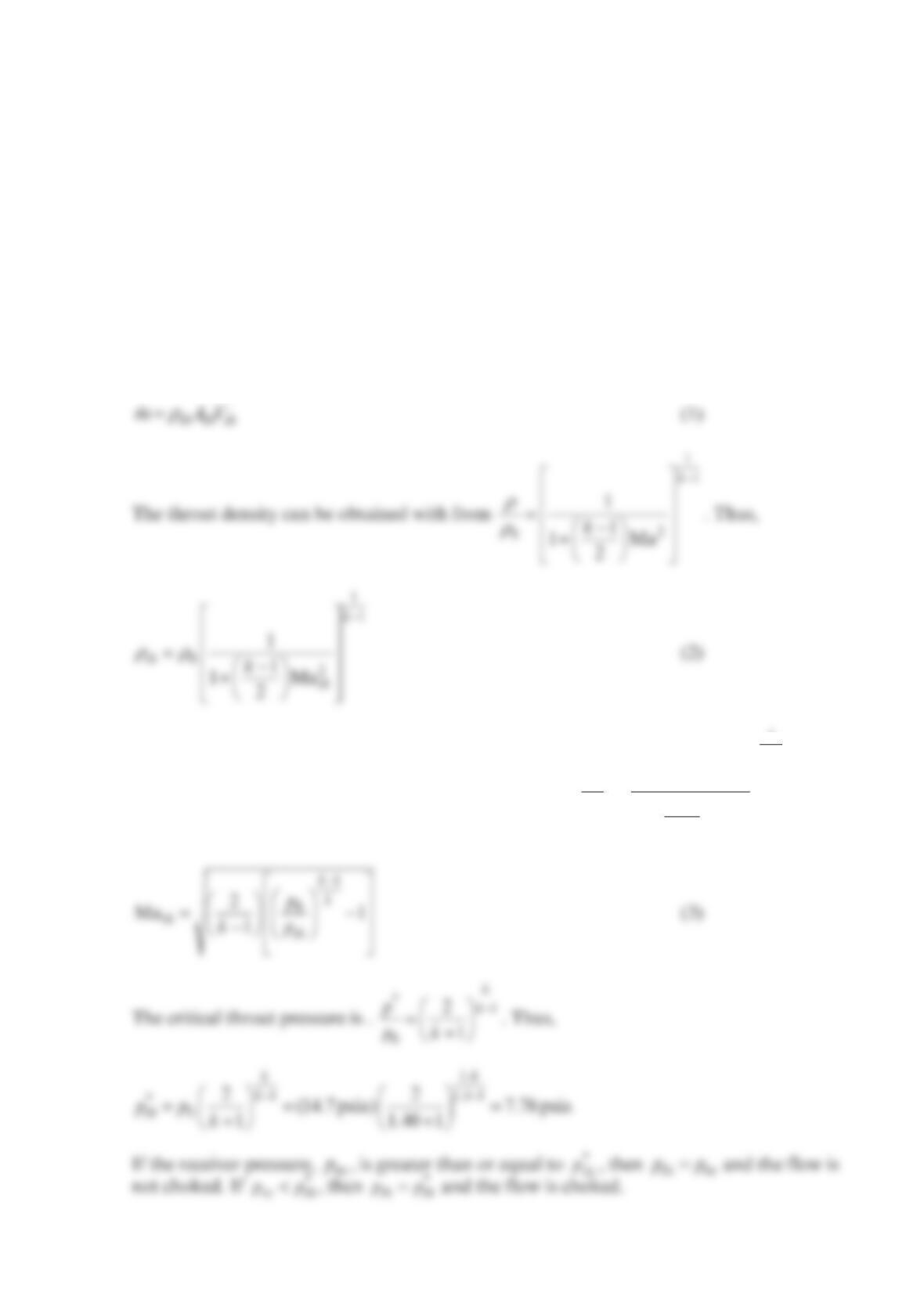
To determine the throat Mach number, we use equation
−
=−
+
1
1
2
0
1
1
1Ma
2
k
p
k
p. Thus,
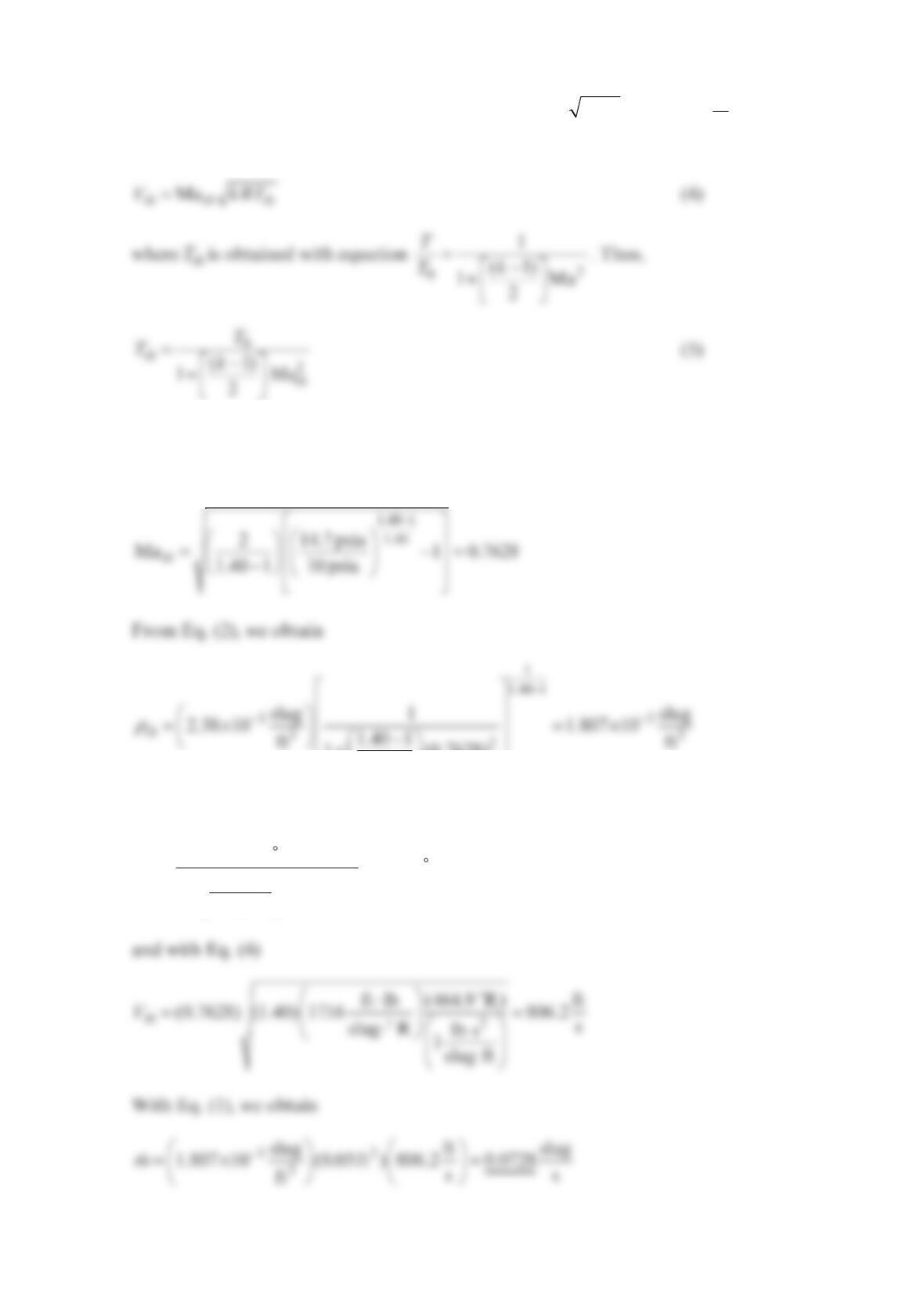
The velocity at the throat is obtained with euations =ckRT
and =Ma V
c combined to
yield
(a) For =>=
*
10 psia 7.76 psia
re th
pp
, =10 psia
th
p, and we use Eq. (3) to calculate the
throat Mach number. Thus,
+
1 (0.7628)
2
From Eq. (5), we get
==
−
+
2
519 R 464.9 R
1.40 1)
1 (0.7628)
2
th
T
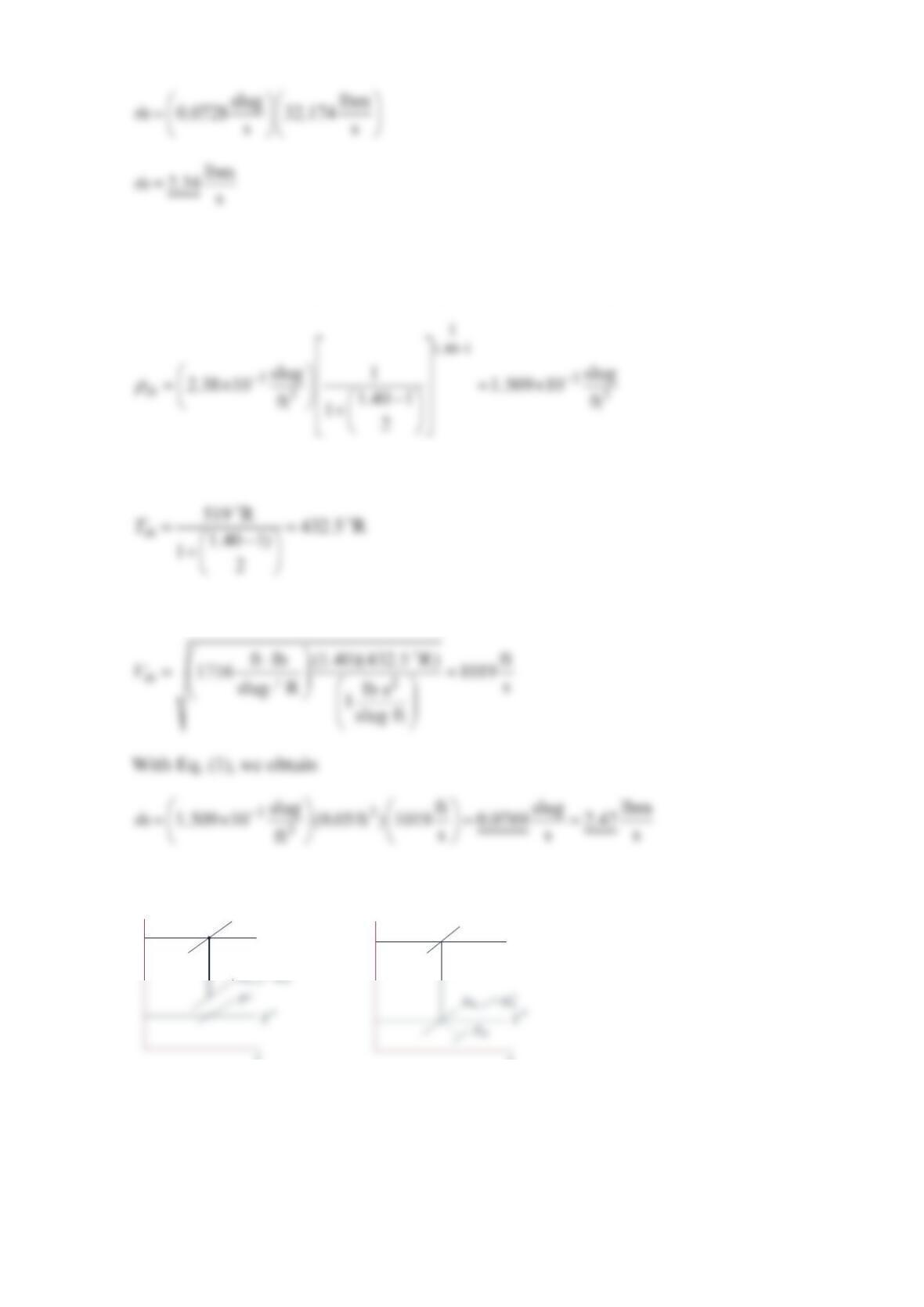
(b) For =<=
*
5psia 7.76psia
re th
pp , =7.76 psia
th
p and =Ma 1.0
th . From Eq. (2),
From Eq. (5), we obtain
and with Eq. (4)
T
s
p
0
p
0
T
0
T
0
(a)(b)
p
= p
T
s
Problem 11.44
Helium at 68 °F and 14.7 psia in a large tank flows steadily and isentropically through a
converging nozzle to a receiver pipe. The cross-sectional area of the throat of the
converging passage is 2
0.05 ft . Determine the mass flowrate through the duct if the receiver
pressure is (a) 10 psia and (b) 5psia. Sketch temperature–entropy diagrams for situations
(a) and (b).
Solution 11.44
The mass flowrate at the throat is obtained with,
ρ
=th th th
mAV
(1)
1
To determine the throat Mach number, we use
−
=−
+
1
1
2
0
1
1
1Ma
2
k
p
k
p. Thus,
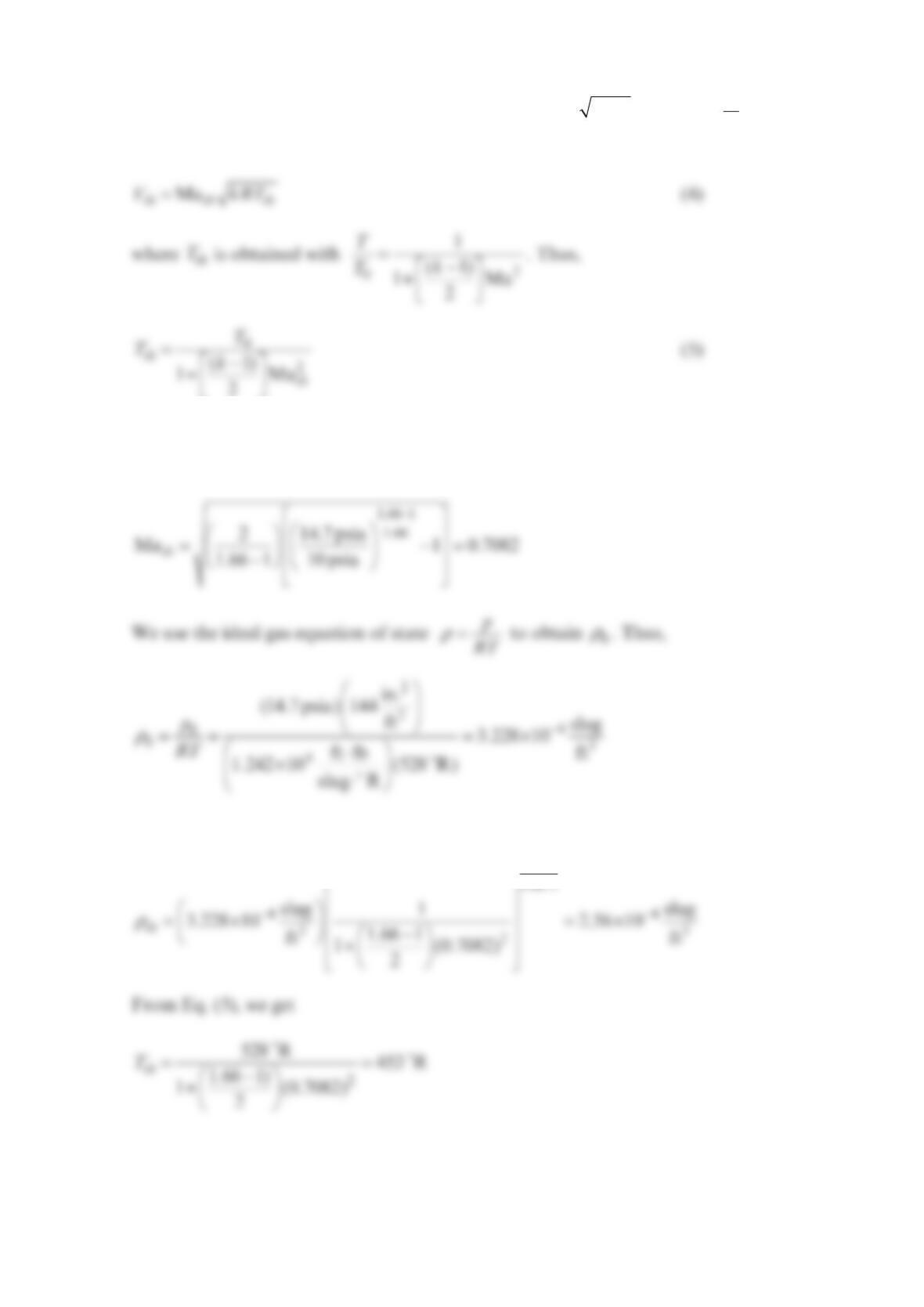
The velocity at the throat is obtained with equations =ckRT
and =Ma V
c combined to
yield
(a) For =>=
*
10 psia 7.175 psia
re th
pp , =10 psia
th
p and we use Eq. (3) to calculate the
throat Mach number. Thus,
From Eq. (2), we obtain
1
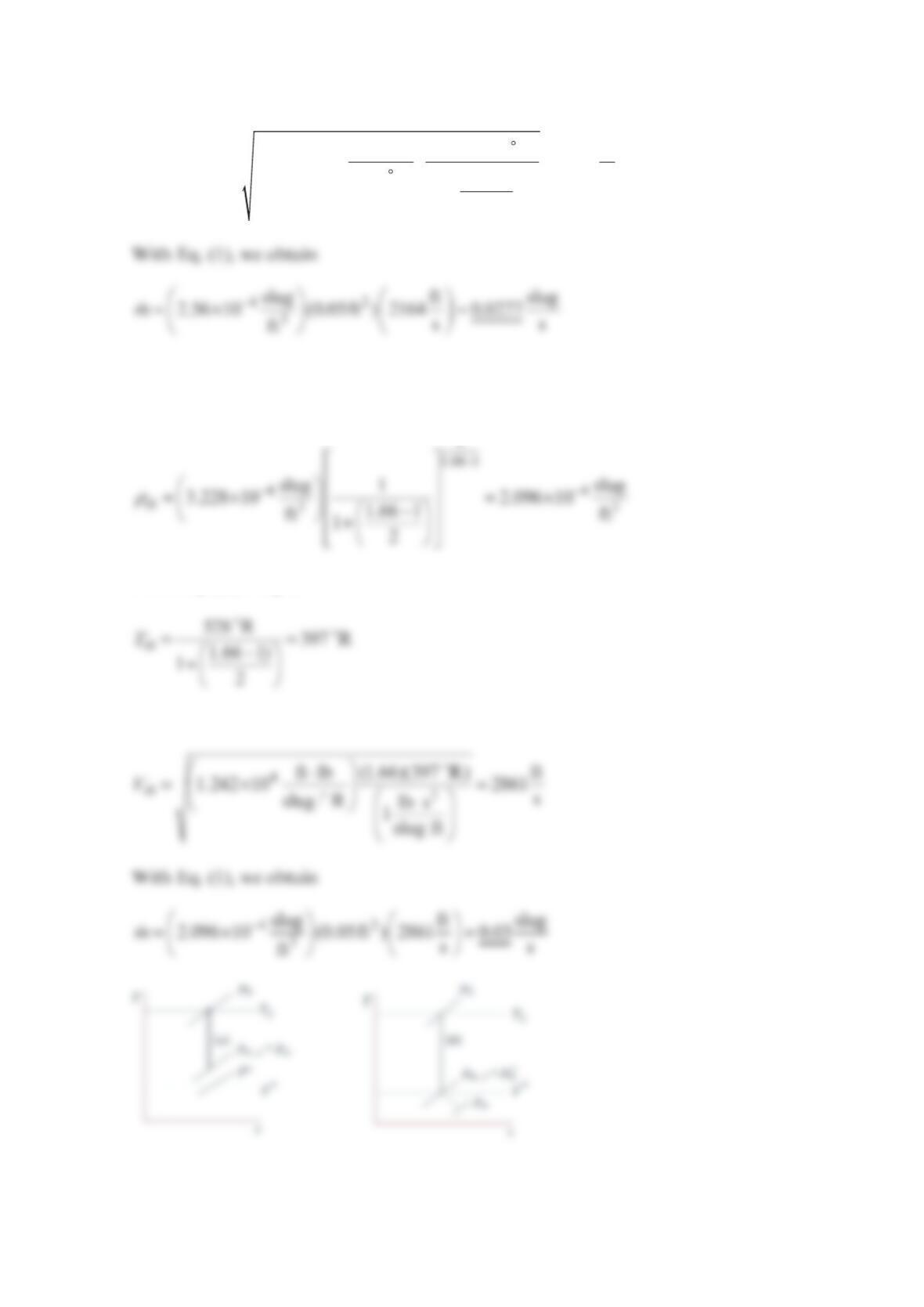
and with Eq. (4)
⋅
=× =
⋅
4
2
ft lb (1.66)(453 R) ft
(0.7082) 1.242 10 2164 s
slug R lb s
1slug ft
th
V
(b) For =<=
*
5psia 7.175psia
re th
pp , =7.175psia
th
p and =Ma 1.0
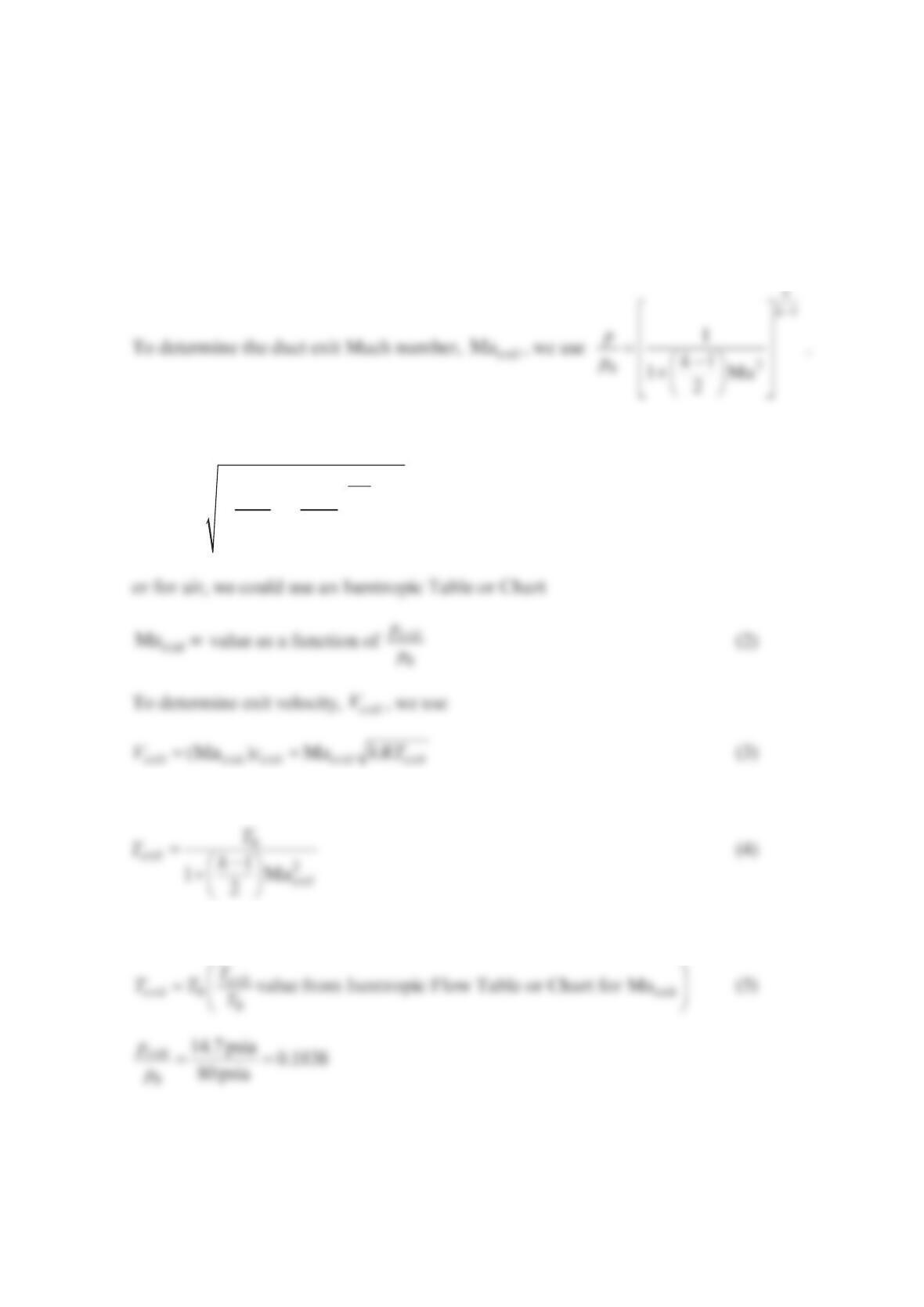
th . From Eq. (2), we
obtain
From Eq. (5), we get,
and with Eq. (4)
Problem 11.45
An ideal gas is to flow isentropically from a large tank where the air is maintained at a
temperature and pressure of 59 °F and 80 psia to standard atmospheric discharge
conditions. Describe in general terms, the kind of duct involved and determine the duct exit
Mach number and velocity in ft/s if the gas is air.
Solution 11.45
Thus,
−
=−
−
1
0
2
Ma 1
1
k
k
exit
exit
p
kp (1)
where
or for air,
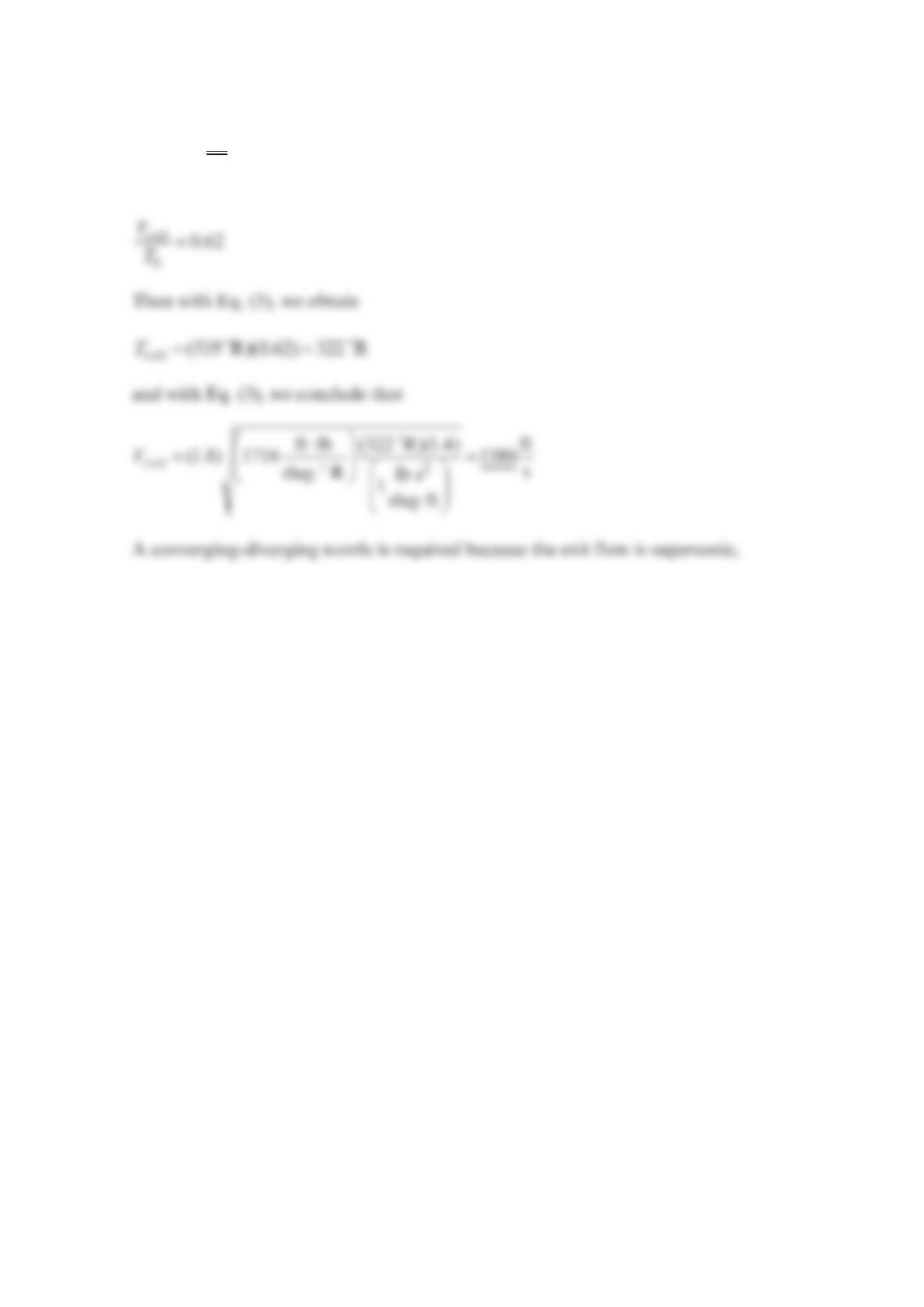
and thus from the Table or Chart, the corresponding values are
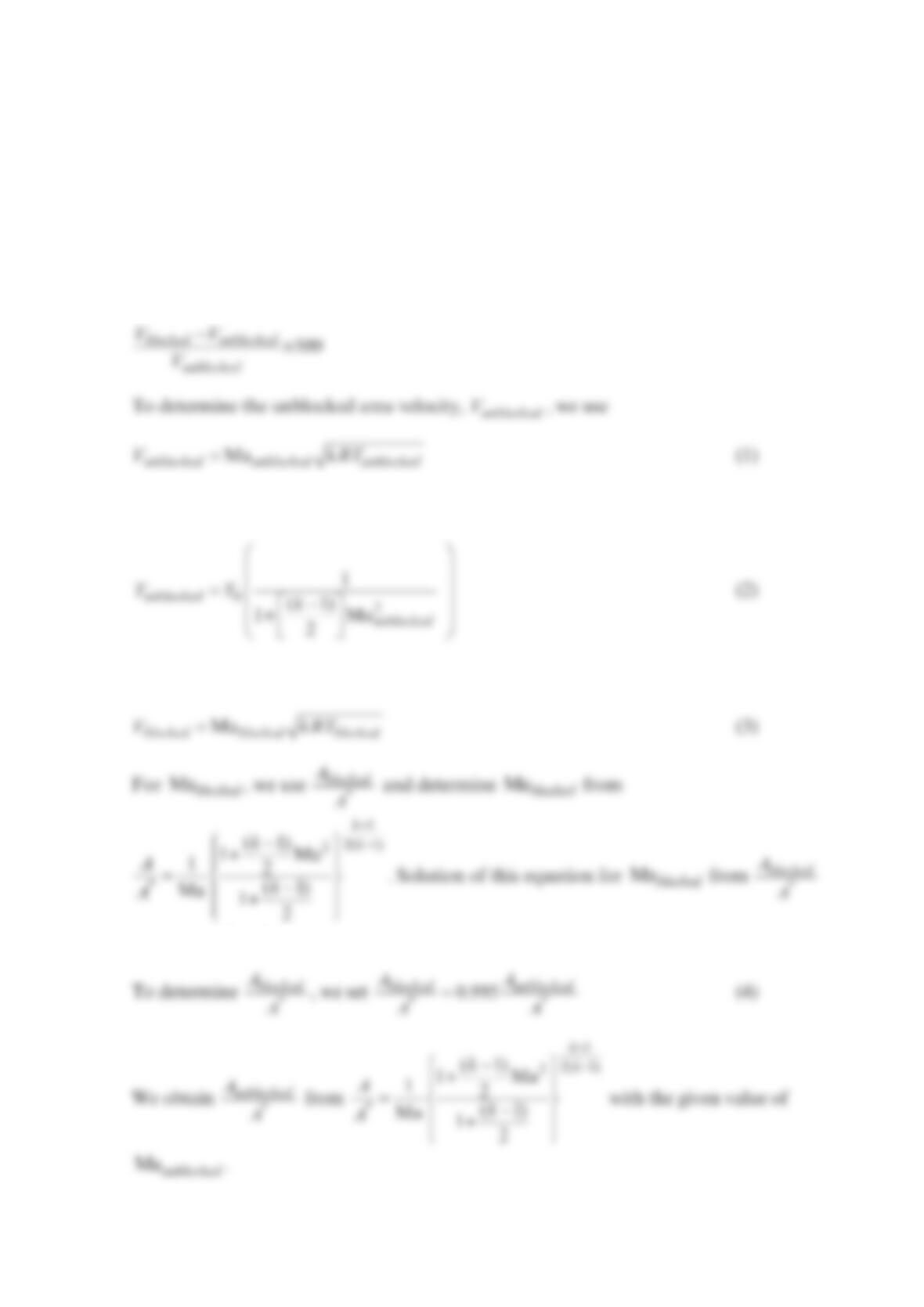
=Ma 1.8
exit
and
Problem 11.46
The flow blockage associated with the use of an intrusive probe can be important.
Determine the percentage increase in section velocity corresponding to a 0.5% reduction in
flow area due to probe blockage for airflow if the section area is 2
1.0 m , =°
020 CT, and the
unblocked flow Mach numbers are (a)
M
a0.2=, (b)
M
a0.
8
=, (c)
M
a1.
5
=, (d)
M
a3.0=.
Solution 11.46
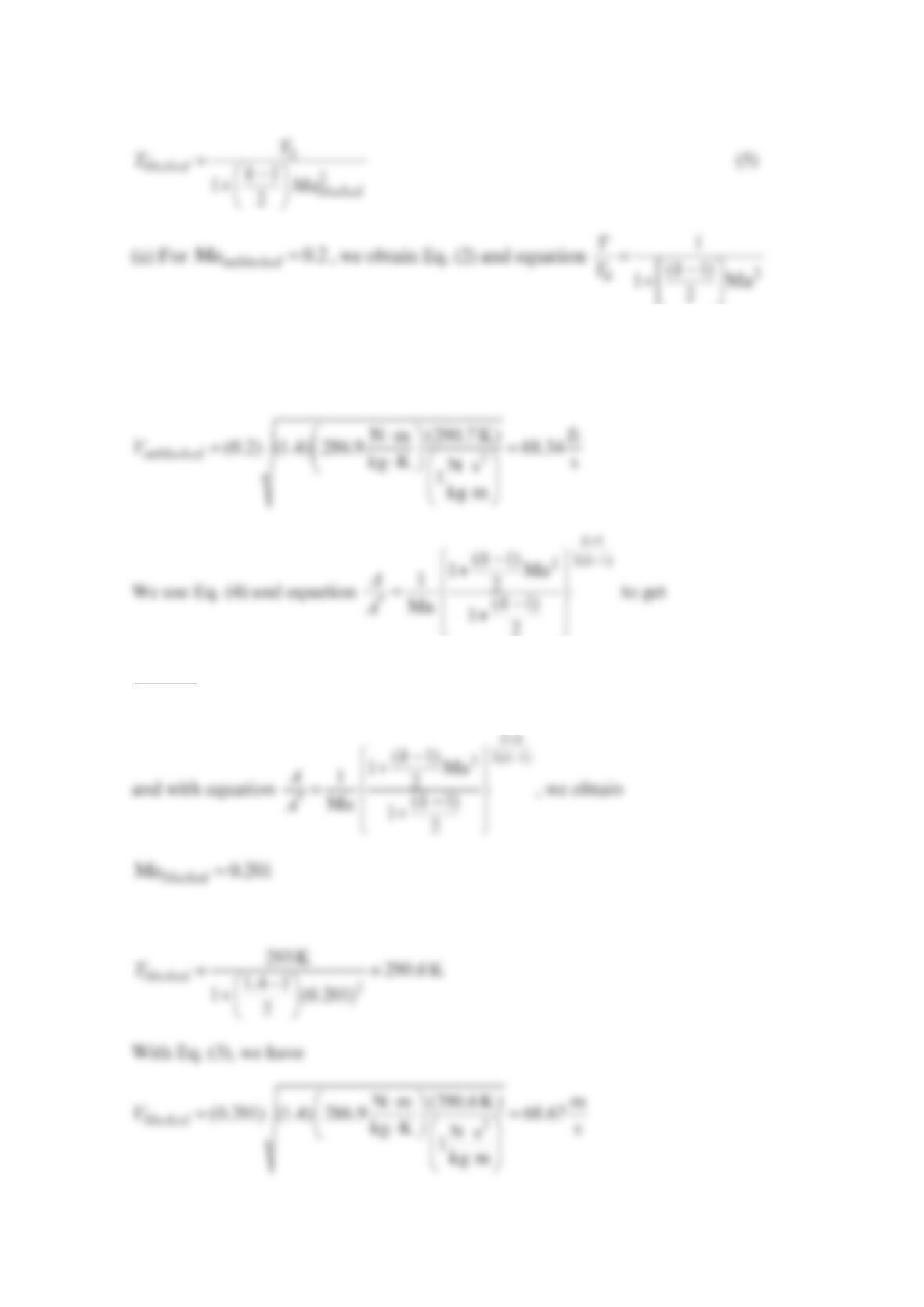
We want to ascertain
For unblocked
T, we use
To determine the blocked area velocity, blocked
V, we use
requires trial and error.
To determine blocked
T, we use
==(293K)(0.99206) 290.7 K
unblocked
T
Then with Eq. (1), we have
==
*(0.995)(2.9635) 2.949
blocked
A
A
With Eq. (5), we get
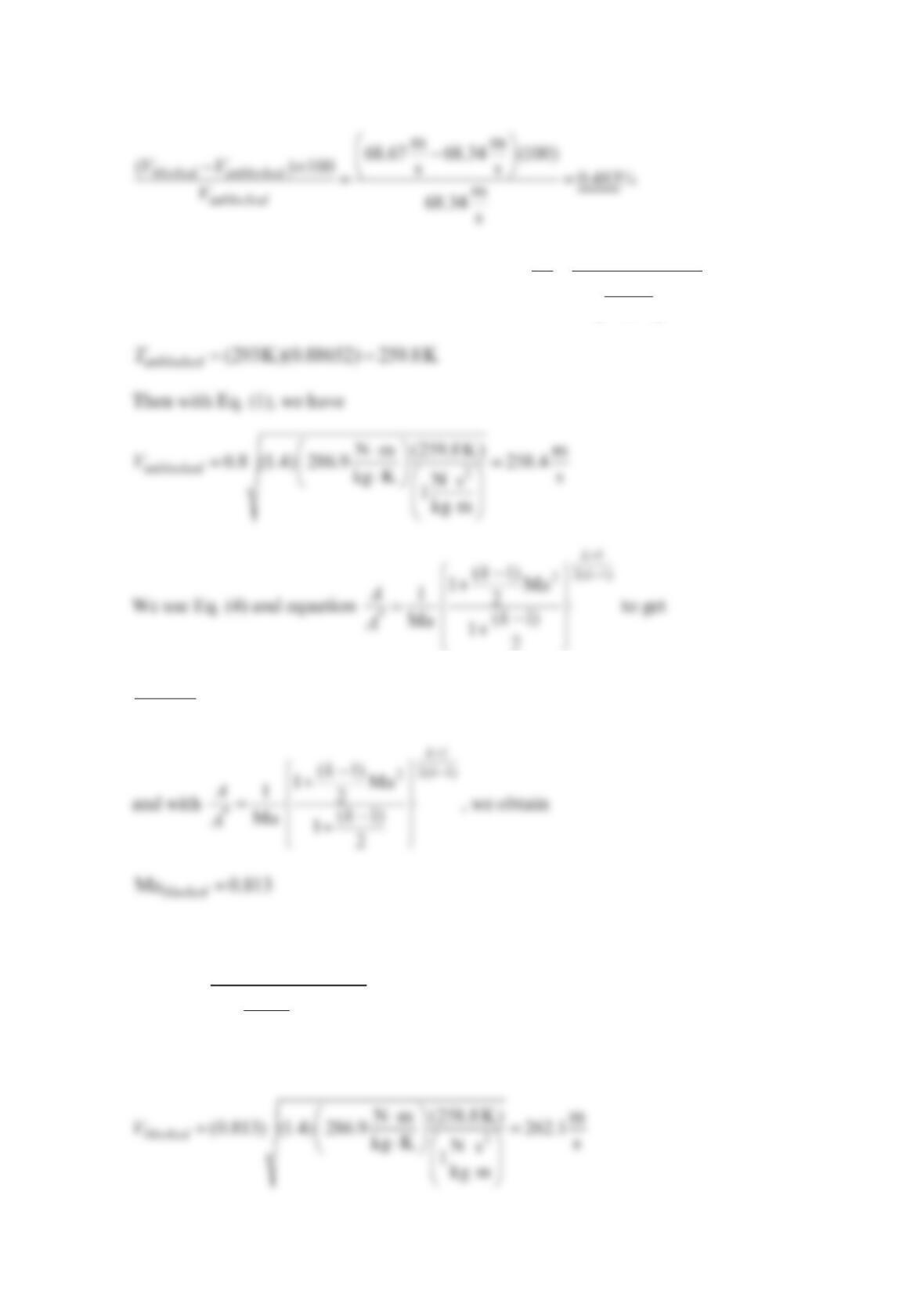
and
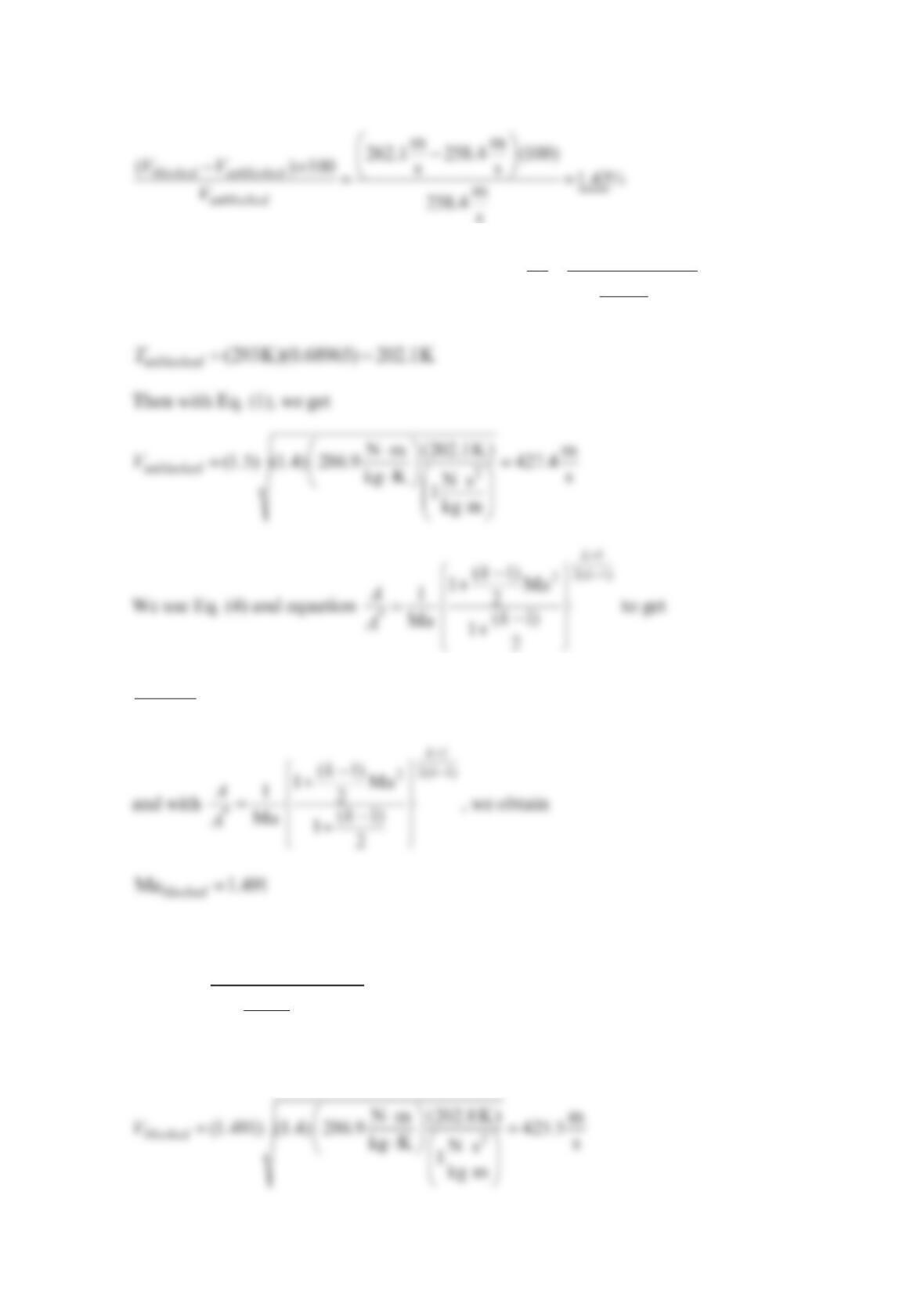
(b) For =Ma 0.8, we obtain Eq. (2) and equation =−
+
2
0
1
(1)
1Ma
2
T
k
T
==
*(0.995)(1.03823) 1.033
blocked
A
A
With Eq. (5), we get
==
−
+
2
293K 258.8K
1.4 1
1 (0.813)
2
blocked
T
With Eq. (3), we have
and
(c) For =Ma 1.5 , we obtain Eq. (2) and equation =−
+
2
0
1
(1)
1Ma
2
T
k
T
==
*(0.995)(1.1762) 1.17
blocked
A
A
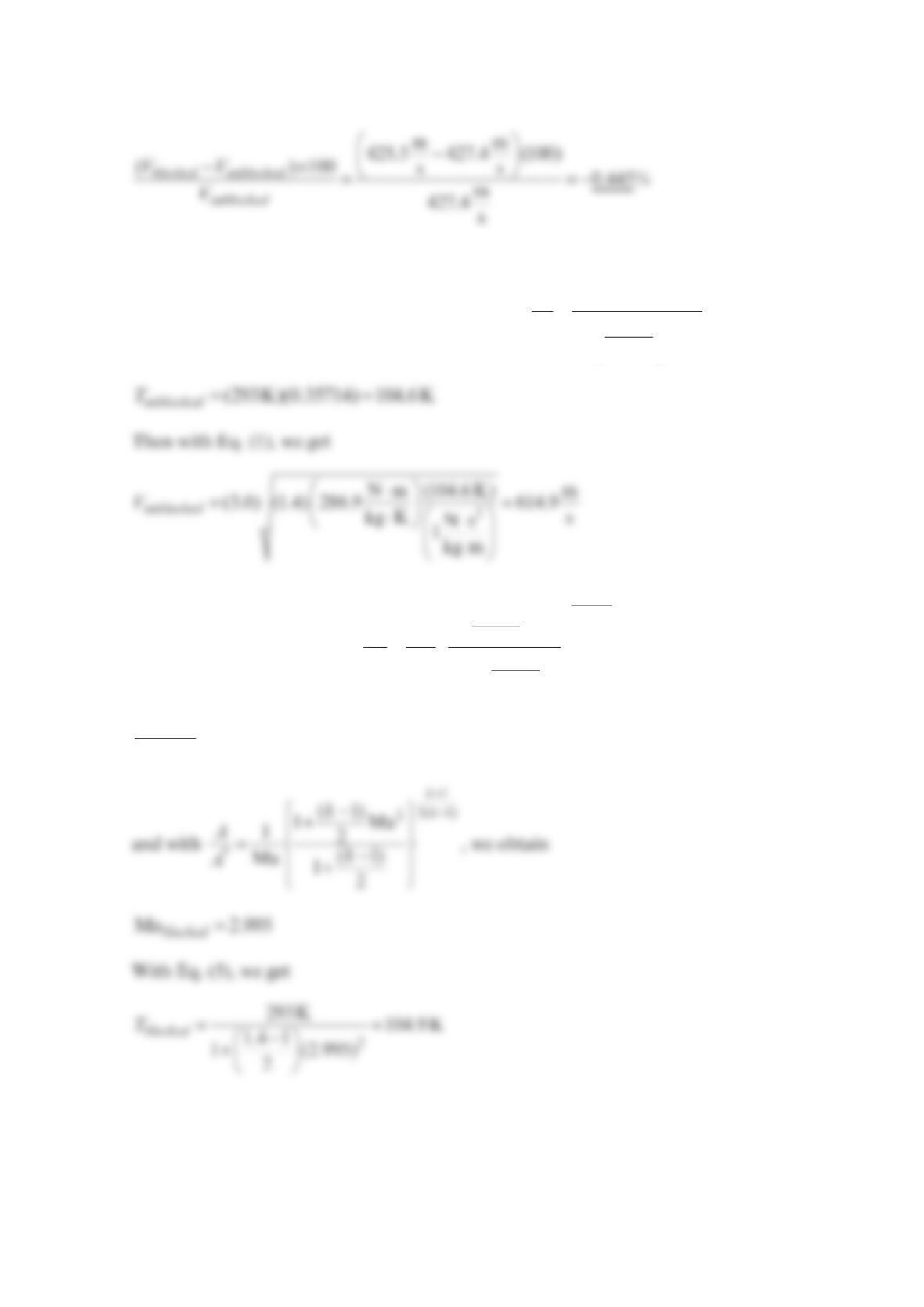
With Eq. (5), we get
==
−
+
2
293K 202.8K
1.4 1
1 (1.491)
2
blocked
T
With Eq. (3), we have
and
(d) For =Ma 3.0 , we obtain Eq. (2) and equation =−
+
2
0
1
(1)
1Ma
2
T
k
T
We use Eq. (4) and equation
+
−
−
+
=
−
+
1
2( 1)
2
*
(1)
1Ma
12
(1)
Ma 12
k
k
k
A
k
A to get
==
*(0.995)(4.2346) 4.213
blocked
A
A
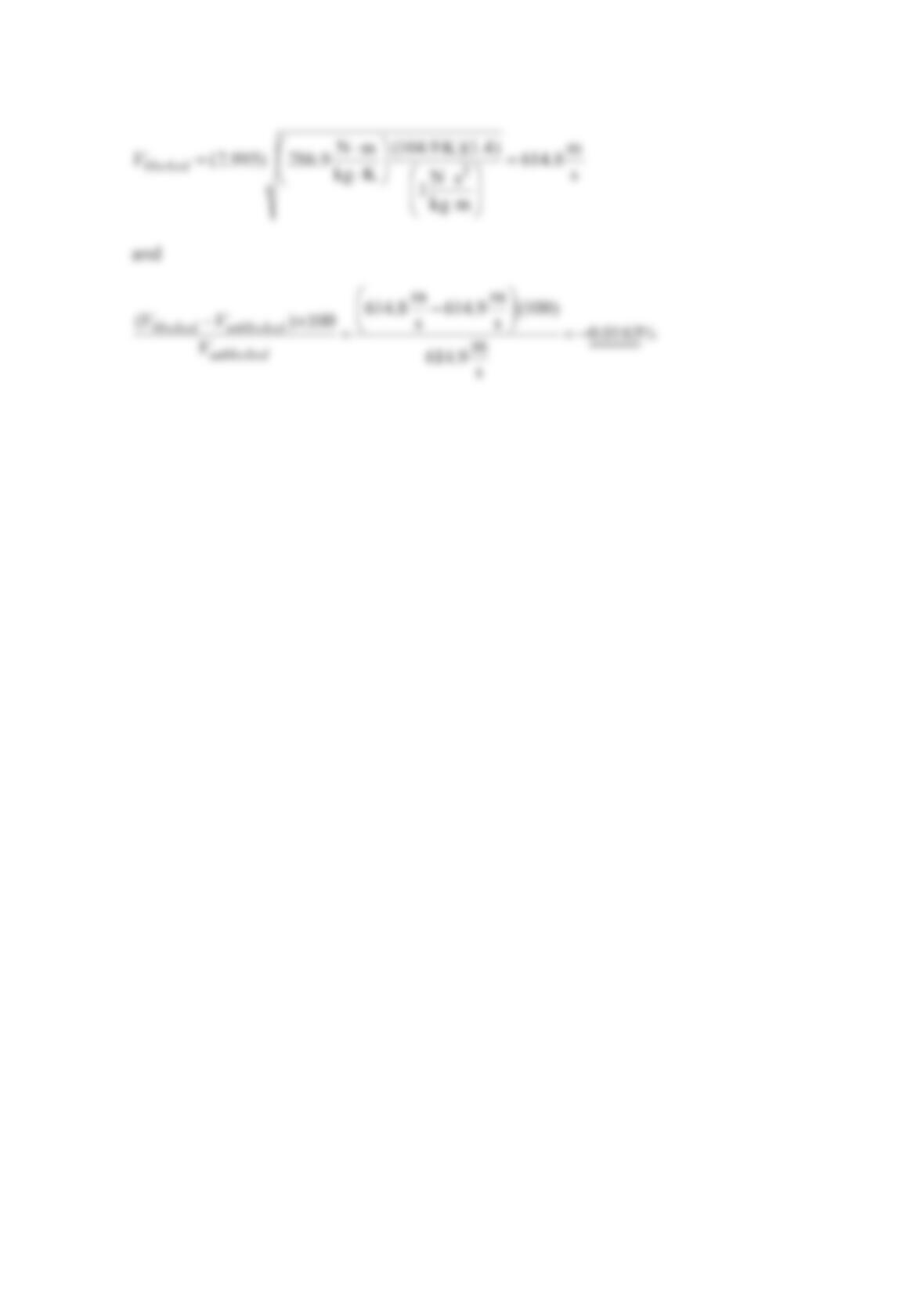
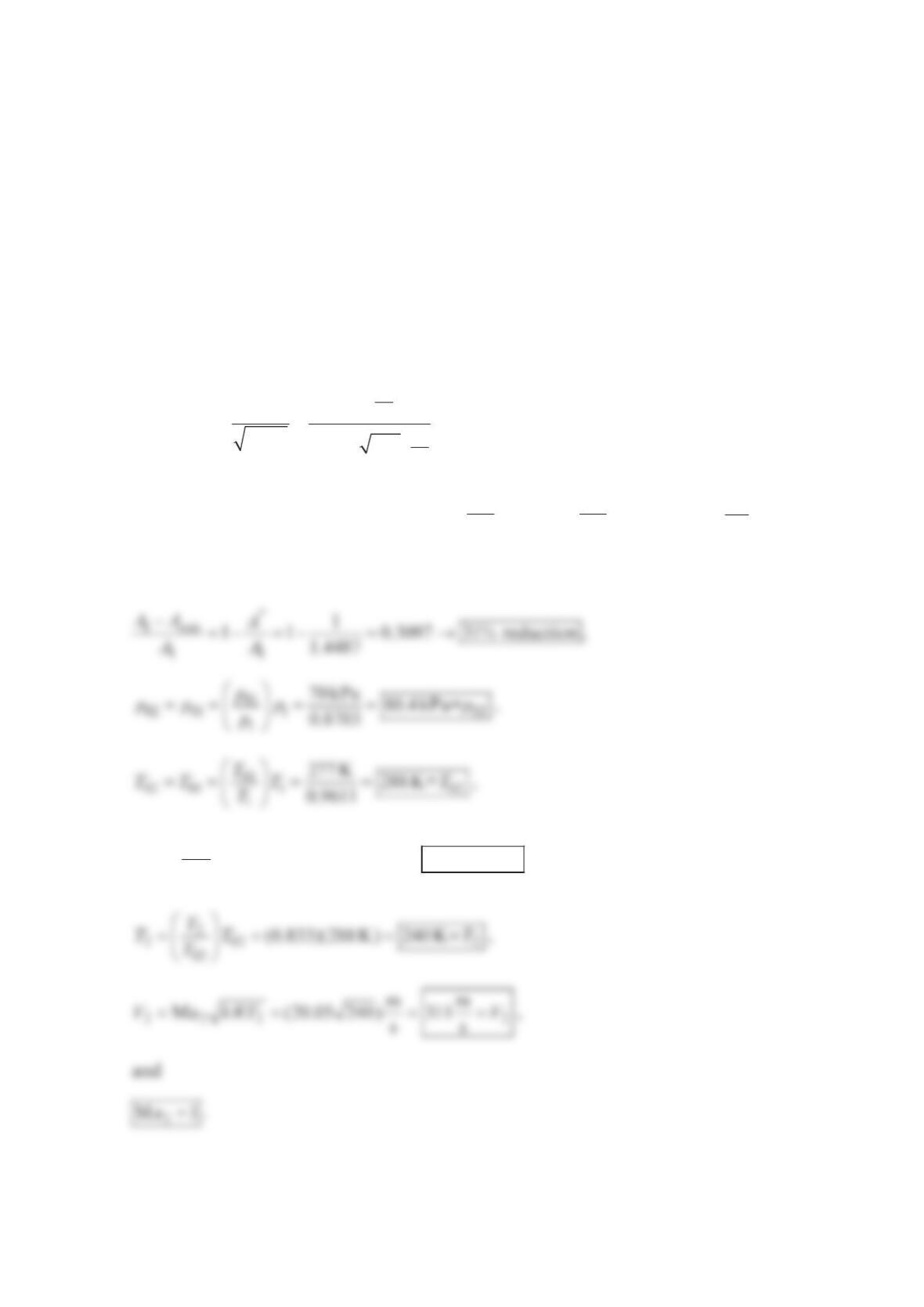
With Eq. (3), we have
Problem 11.47
At a certain point in a pipe, air flows steadily with a velocity of 150 m/s and has a static
pressure of 70 kPa and a static temperature of 4 °C. The flow is adiabatic and frictionless.
(a) Calculate the maximum possible reduction in area and the following quantities for that
minimum area: stagnation pressure, stagnation temperature, static pressure, static
temperature, velocity, and Mach number.
(b) Calculate the quantities listed in (a) at a point where the area is 15% smaller than the
initial area.
Solution 11.47
At 1, == =
1
1
1
m
150 s
Ma 0.45
m
(20.05 277 ) s
V
kRT .
The Isentropic Flow Table or Chart gives =
1
01
0.8703
p
p, =
1
01
0.9611
T
T, and =
1
*1.4487
A
A.
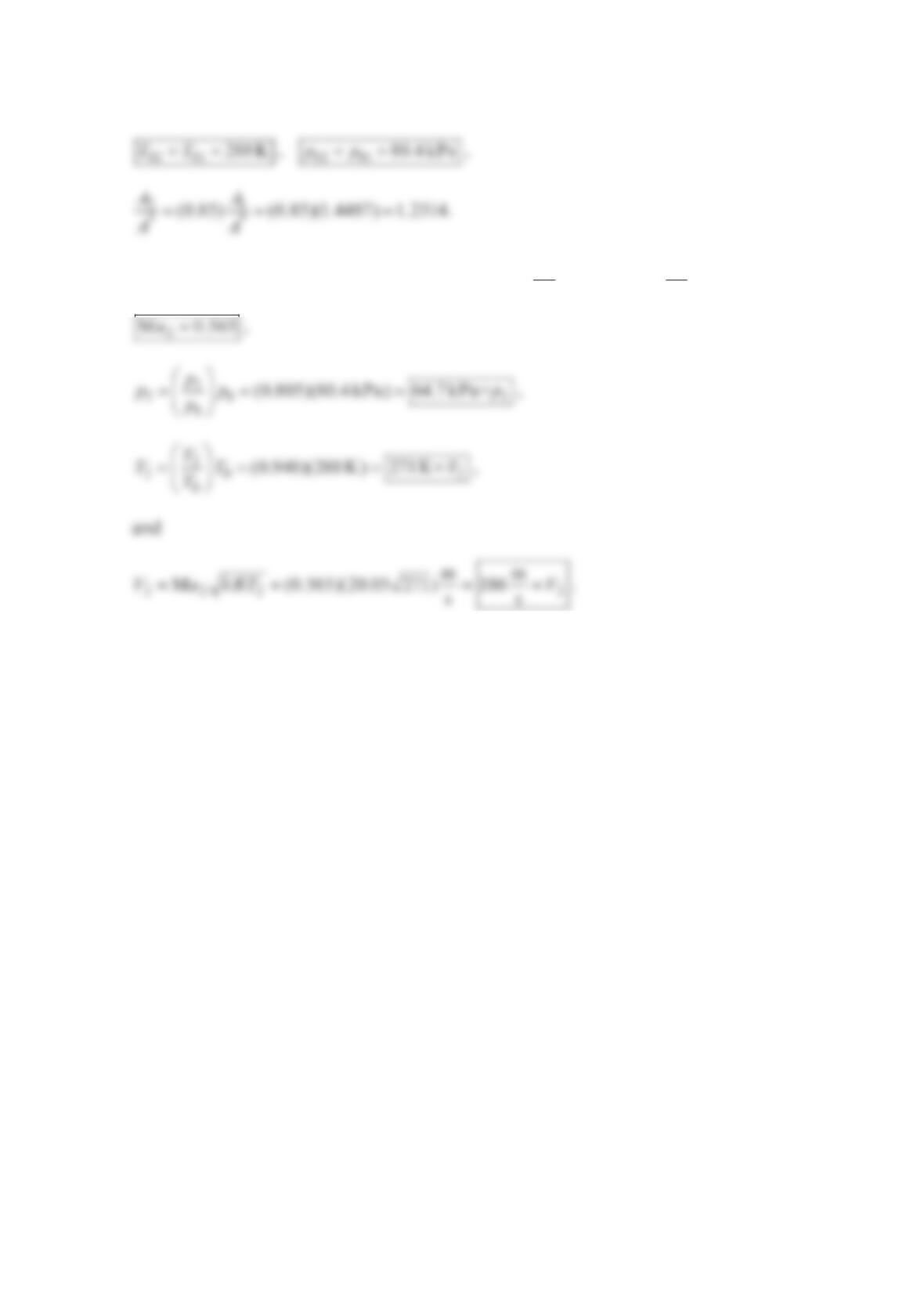
(a) The minimum area occurs for =Ma 1 and =*
AA. Then
== =
2
202 2
02
(0.528)(80.4 kPa) 42.5kPa=
p
p
pp
p,
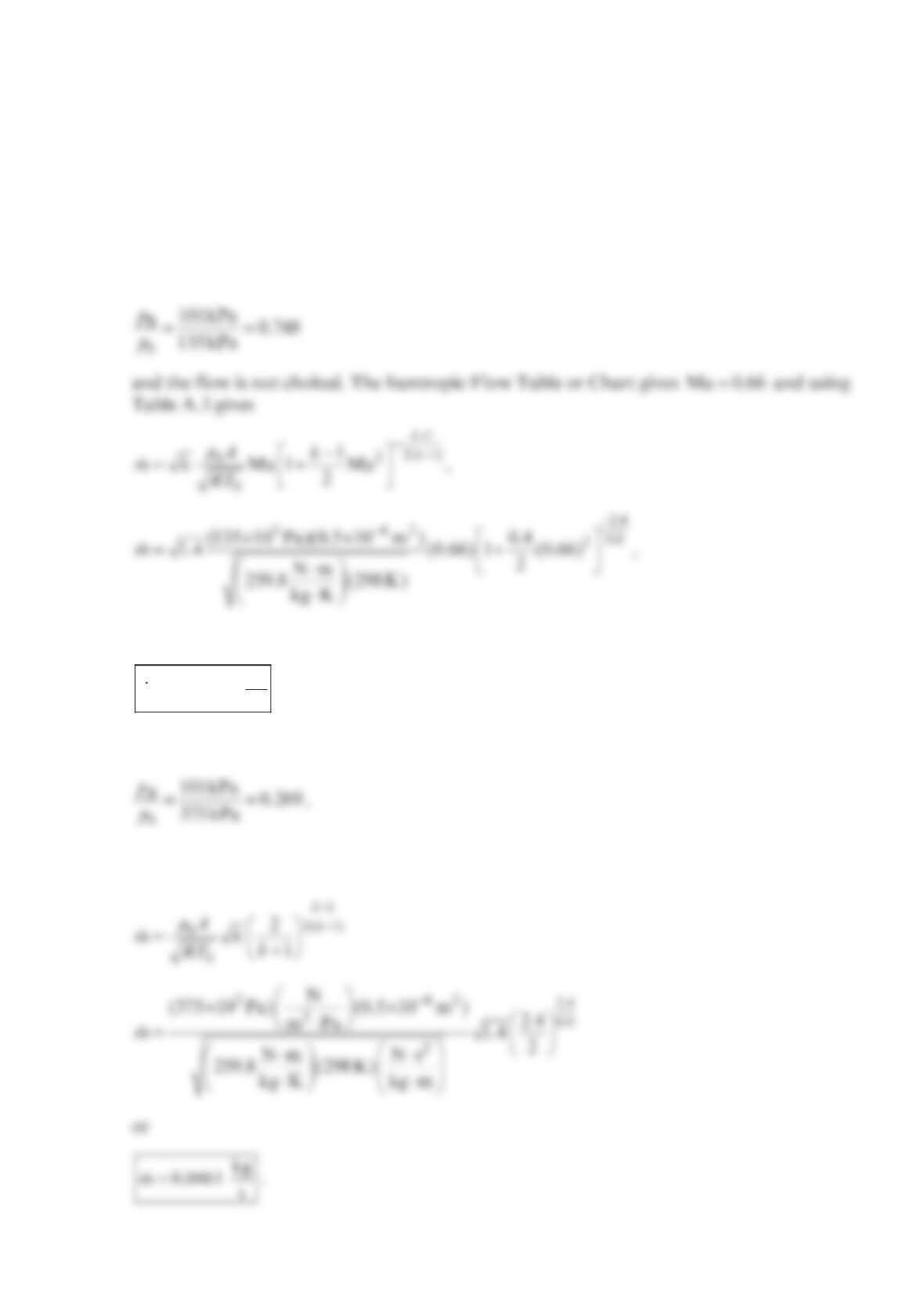
(b) At =
21
0.85AA
The Isentropic Table or Chart gives =
2
Ma 0.565 , =
2
0
0.805
p
p, and =
2
0
0.940
T
T so
Problem 11.48
A tank of oxygen has a hole of area 2
0.5cm in its wall. The temperature of the oxygen in
the tank is 25 °C. Calculate the rate (kg/s) at which oxygen leaks to the atmosphere for tank
pressures of 135kPa and 375kPa . Assume frictionless flow.
Solution 11.48
Assume adiabatic ==
B101kPa
atm
pp . First consider =
0135kPap. Then
and
=
135
kg
0.0147 s
m.
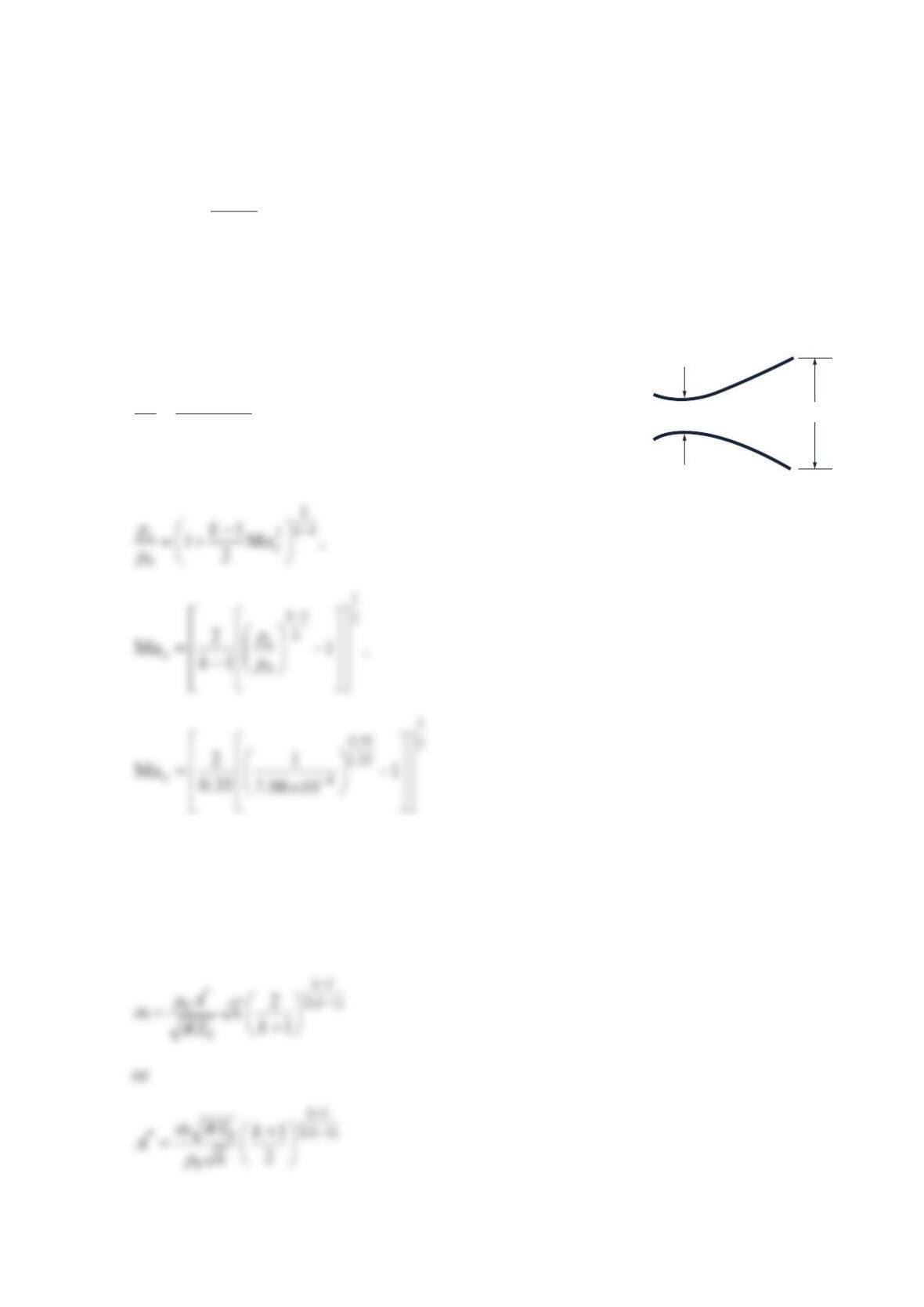
Now consider =
0375kPap. Since
The table gives =Ma 1.51. However, Ma cannot be >1 at the end of passage. Hence
=Ma 1 and the flow is choked. For choked flow
Problem 11.49
The gas entering a rocket nozzle has a stagnation pressure of 1500 kPa and a stagnation
temperature of 3000 °C. The rocket is traveling in the still Standard Atmosphere at
30,000 m . Find the throat and exit area for a flowrate of 10 kg/s. Assume 1.35
k
=,
⋅
=⋅
Nm
287.0 kg K
R. The gas is perfectly, expanded to the ambient pressure.
Solution 11.49
Assume isentropic expansion, From Standard Atmosphere
Table, =1.197 kPap. Thus
−
==×
4
0
1.197 kPa 7.98 10
1500 kPa
e
p
p.
But
or
=Ma 5.53
e
Since >Ma 1
e, the flow at the throat is sonic and =*
t
AA
. Then
Ae
At
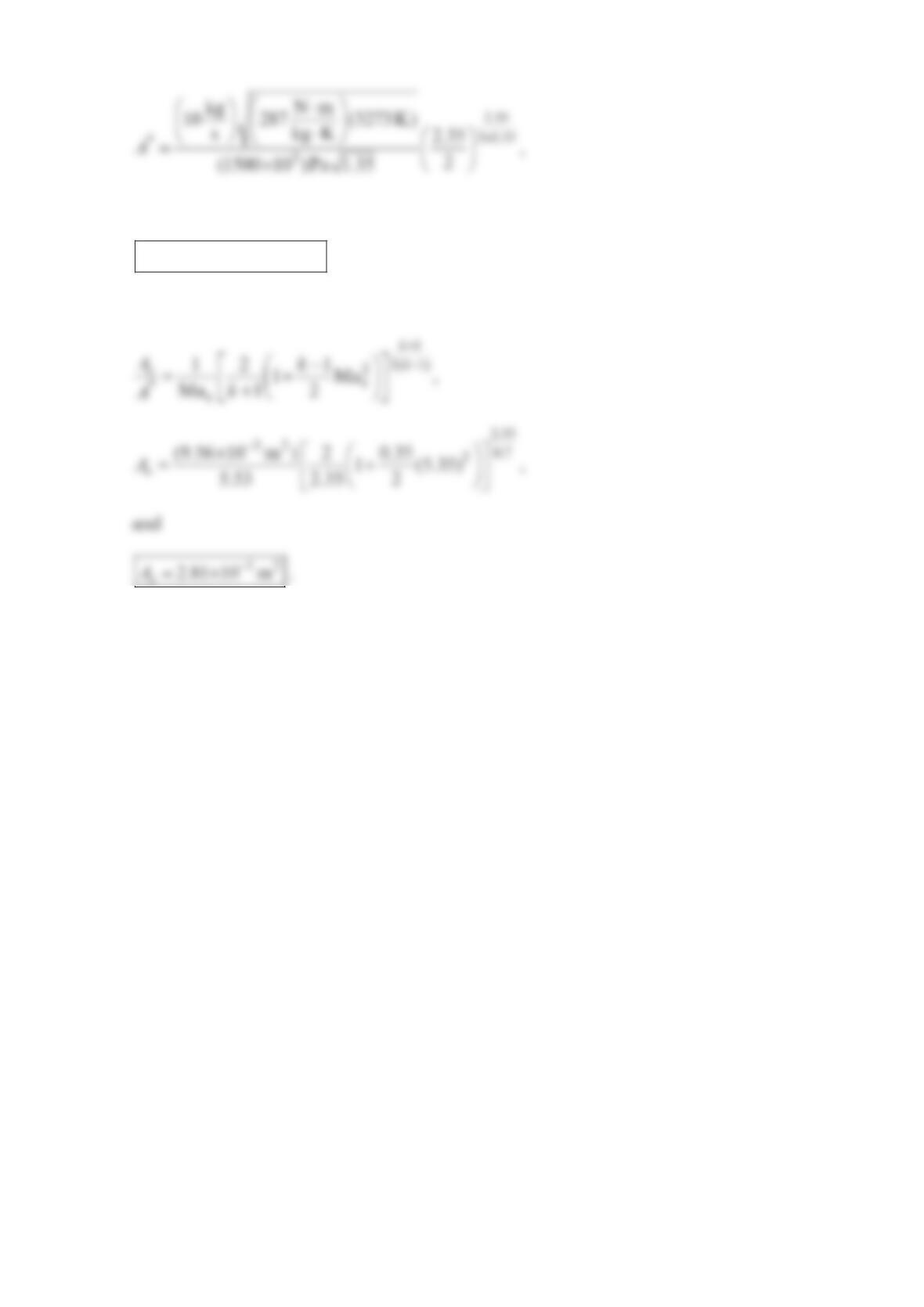
and
−
=× =
*32
9.56 10 m t
AA
Then