This file contains the exercises, hints, and solutions for Chapter 11 of the
book ”Introduction to the Design and Analysis of Algorithms,” 3rd edition, by
Exercises 11.1
1. Prove that any algorithm solving the alternating-disk puzzle (Problem 14
inExercises3.1)mustmakeatleast(+1)2moves to solve it. Is this
lower bound tight?
2. Prove that the classic recursive algorithm for the Tower of Hanoi problem
3. Find a trivial lower-bound class for each of the following problems and
indicate, if you can, whether this bound is tight.
4. Consider the problem of identifying a lighter fake coin among identical-
looking coins with the help of a balance scale. Can we use the same
information-theoretic argument as the one in the text for the number of
questions in the guessing game to conclude that any algorithm for identi-
fying the fake will need at least dlog2eweighings in the worst case?
5. Prove that any comparison-based algorithm for finding the largest element
of an -element set of numbers must make −1comparisons in the worst
case.
9. Find the product of matrices and through a transformation to a
product of two symmetric matrices if
b. Show that multiplication of two matrices of order can be reduced
to squaring a matrix of order 2
11. Find a tight lower bound class for the problem of finding two closest
2
Hints to Exercises 11.1
1. Is it possible to solve the puzzle by making fewer moves than the brute-
force algorithm? Why?
2. Since you know that the number of disk moves made by the classic algo-
rithm is 2−1you can simply prove (e.g., by mathematical induction)
3. All these questions have straightforward answers. If a trivial lower bound
4. Reviewing Section 4.4, where the fake-coin problem was introduced, should
help in answering the question.
5. Pay attention to comparison losers.
9. Simply follow the transformation formula suggested in the section.
10. a. Check whether the formulas hold for two arbitrary square matrices.
b. Use a formula similar to the one showing that multiplication of ar-
bitrary square matrices can be reduced to multiplication of symmetric
matrices.
Solutions to Exercises 11.1
1. In the initial position of the puzzle, the th light disk has exactly dark
disks to the left of it (=12 )Hence the total number of the dark
2. Let ()be the number of disk moves made by some algorithm solving
the Tower of Hanoi problem. We’ll prove by induction that
()≥2−1for ≥1
For the basis case of =1(1) ≥21−1holds. Assume now that the
3. a. All elements of a given array need to be processed to find its largest
element (otherwise, if an unprocessed element is larger than all the others,
the output cannot be correct) and just one item needs to be produced (if
just the value of the largest element or a position of the largest element
needs to be returned). Hence the trivial lower bound is linearIt is tight
4. The answer is no. The problem can be solved with fewer weighings by
dividing the coins into three rather than two subsets with about the same
5. Every comparison of two (distinct) elements produces one “winner” and
6. Recall that an inversion in an array is any pair of its elements that are
out of order, i.e., [][]while The maximum number of
inversions in an -element array is attained when its elements are strictly
7. Consider the following rule for the adversary to follow: Divide the set
of vertices of an input graph into two disjoints subsets and hav-
ing b2cand d2evertices respectively (e.g., by putting the first b2c
vertices into and the remaining d2evertices into )Whenever an
algorithm inquires about an edge between two vertices, reply yes if and
8. Any comparison-based algorithm will need at least 2comparisons to
merge two arbitrary sorted lists of sizes and +1, respectively. The
9. For =∙1−1
23
¸and =∙01
−12
¸the respective transposes are
=∙12
−13
¸and =∙0−1
12
¸
10. a. The formula =1
4[(+)2−(−)2]does not hold for arbitrary
square matrices because it relies on commutativity of multiplication (i.e.,
=):
11. The element uniqueness problem can be reduced to the closest numbers
problem. (After solving the latter, it suffices to check whether the distance
12. Sorting a list of numbers is a special case of the number placement prob-
lem. This implies that Ω(log )the lower bound for sorting, is also a
Exercises 11.2
1. Prove by mathematical induction that
2. Consider the problem of finding the median of a three-element set {
}of orderable items
a. What is the information-theoretic lower bound for comparison-based
algorithms solving this problem?
3. Draw a decision tree and find the number of key comparisons in the worst
and average cases for
4. Design a comparison-based algorithm for sorting a four-element array with
the smallest number of element comparisons possible.
7. BCompare the two lower bounds for searching a sorted array–dlog3(2+
1)eand dlog2(+1)e–to show that
9. A tournament tree is a complete binary tree reflecting results of a
“knockout tournament”: its leaves represent players entering the tour-
nament, and each internal node represents a winner of a match played by
the players represented by the node’s children. Hence, the winner of the
tournament is represented by the root of the tree.
a. What is the total number of games played in such a tournament?
10. Advanced fake-coin problem There are ≥3coins identical in appear-
ance; either all are genuine or exactly one of them is fake. It is unknown
whether the fake coin is lighter or heavier than the genuine one. You have
a balance scale with which you can compare any two sets of coins. That
a. Prove that any algorithm for this problem must make at least dlog3(2+
1)eweighings in the worst case.
b. Draw a decision tree for an algorithm that solves the problem for
=3coins in two weighings.
11. Jigsaw puzzle A jigsaw puzzle contains pieces. A “section” of the
puzzle is a set of one or more pieces that have been connected to each
other. A “move” consists of connecting two sections. What algorithm
will minimize the number of moves required to complete the puzzle?
Hints to Exercises 11.2
1. a. Prove first that 2≥by induction on
b. Prove first that 3≥by induction on
3. This is a straightforward question. You may assume that three elements
to be sorted are distinct. (If you need help, see decision trees for the three-
element selection sort and three-element insertion sort in the section).
4. Compute a nontrivial lower bound for sorting a four-element array and
7. a. Start by transforming the logarithms to the same base.
b. The easiest way is to prove that
8. The answer to the first question follows directly from inequality (11.1).
The answer to the second is no (why?).
9. a. Think losers.
10. a. How many outcomes does this problem have?
b. Draw a ternary decision tree that solves the problem.
11. If you want to solve the problem in the spirit of the section, represent a
process of assembling the puzzle by a binary tree.
Solutions to Exercises 11.2
1. a. We’ll prove by induction on that that 2≥for any nonempty binary
tree with height ≥0and the number of leaves For the basis case of
=0we have 20≥1For the general case, assume that 2≥holds
for any binary tree whose height doesn’t exceed Consider an arbitrary
2. a. Since the problem has three possible outcomes, the information-theoretic
lower bound is dlog23e=2
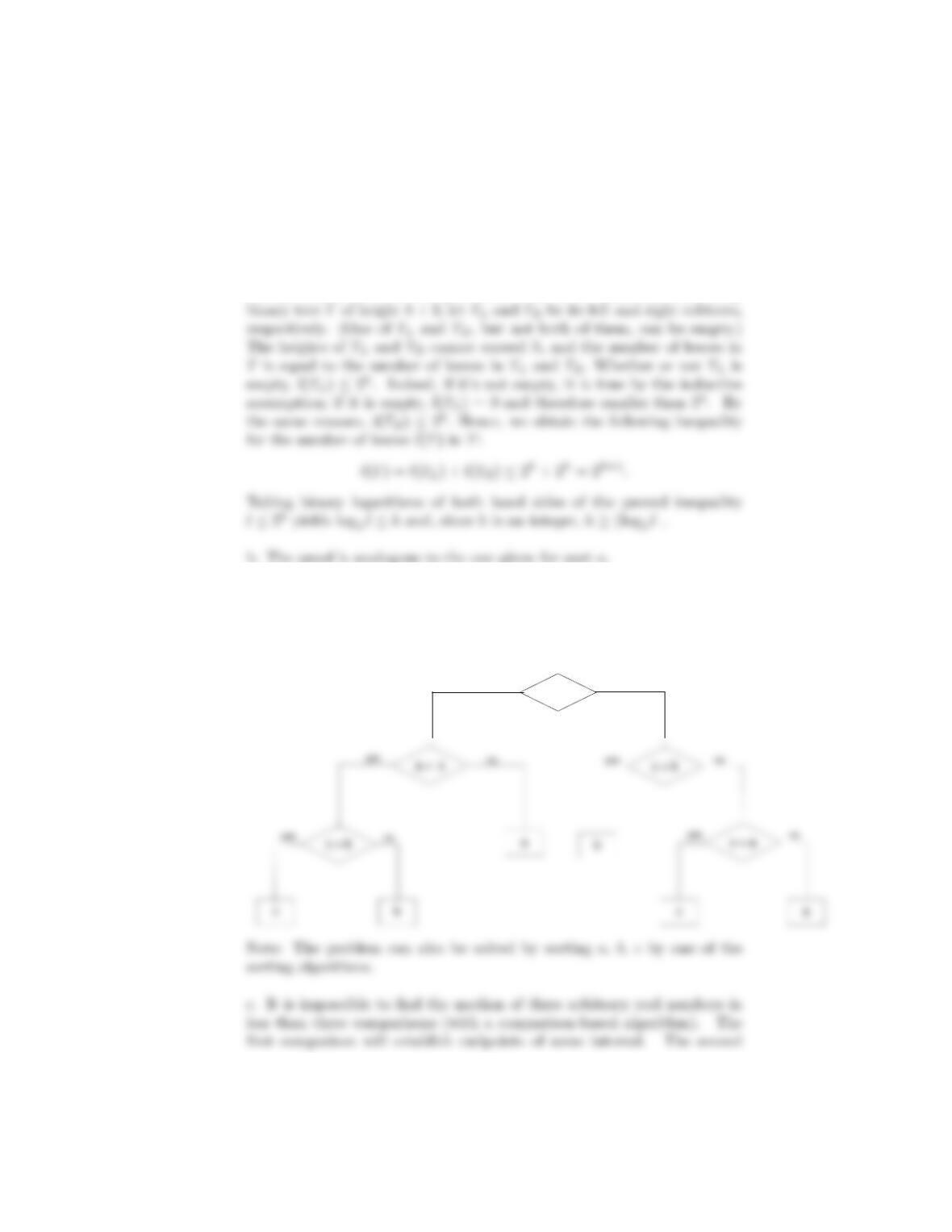
b. Here is a decision tree for an algorithm for the problem of finding
the median of a three-element set { }:
a < b
yes no
12
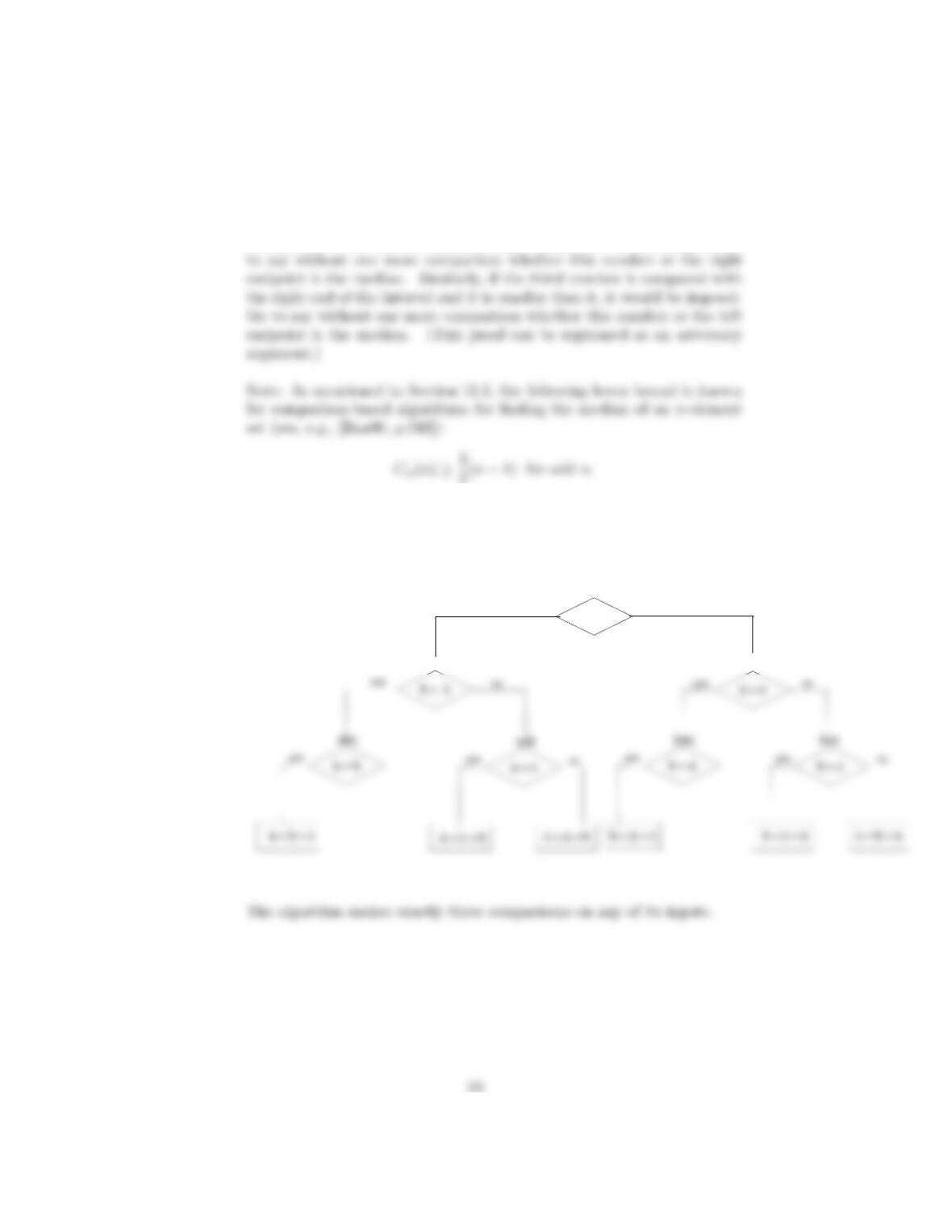
comparison (unless it’s the same as the first one) will compare the third
number with one of these endpoints. If that third number is compared to
the left end of the interval and it is larger than it, it would be impossible
3. a. Here is a decision tree for sorting an array of three distinct elements a,
b, and c by basic bubble sort:
a < b
yes no
abc
abc bac
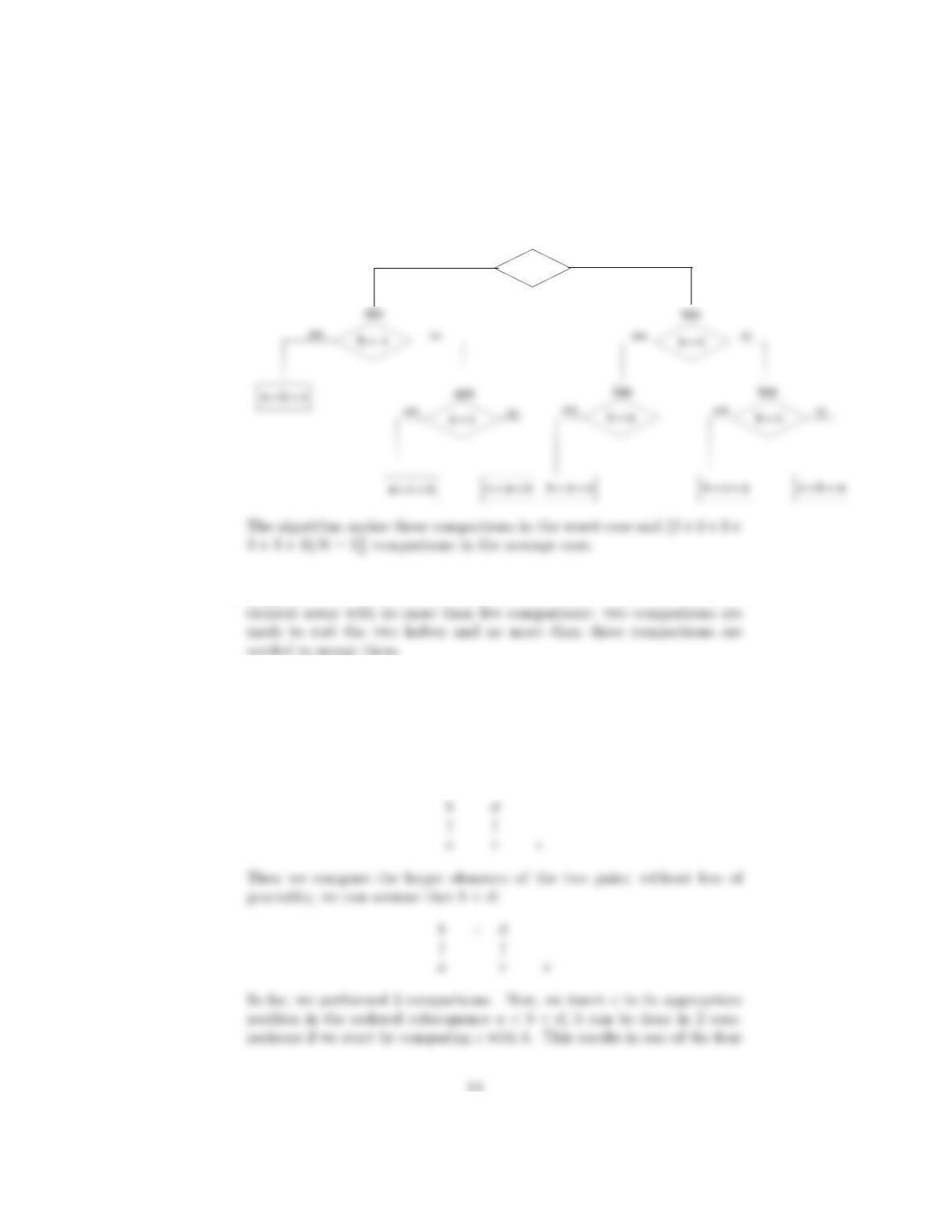
b. Here is a decision tree for sorting an array of three distinct elements
by enhanced bubble sort:
a < b
yes no
abc
4. dlog24!e=5Mergesort (as described in Section 5.1) sorts any four-
5. The following solution is presented by Knuth [KnuIII, pp. 183—184]. Let
be five distinct elements to be sorted. First, we compare with
and with Without loss of generality we can assume that and
This can be depicted by the following digraph of five vertices, in
which a path indicates an ordered subsequence:
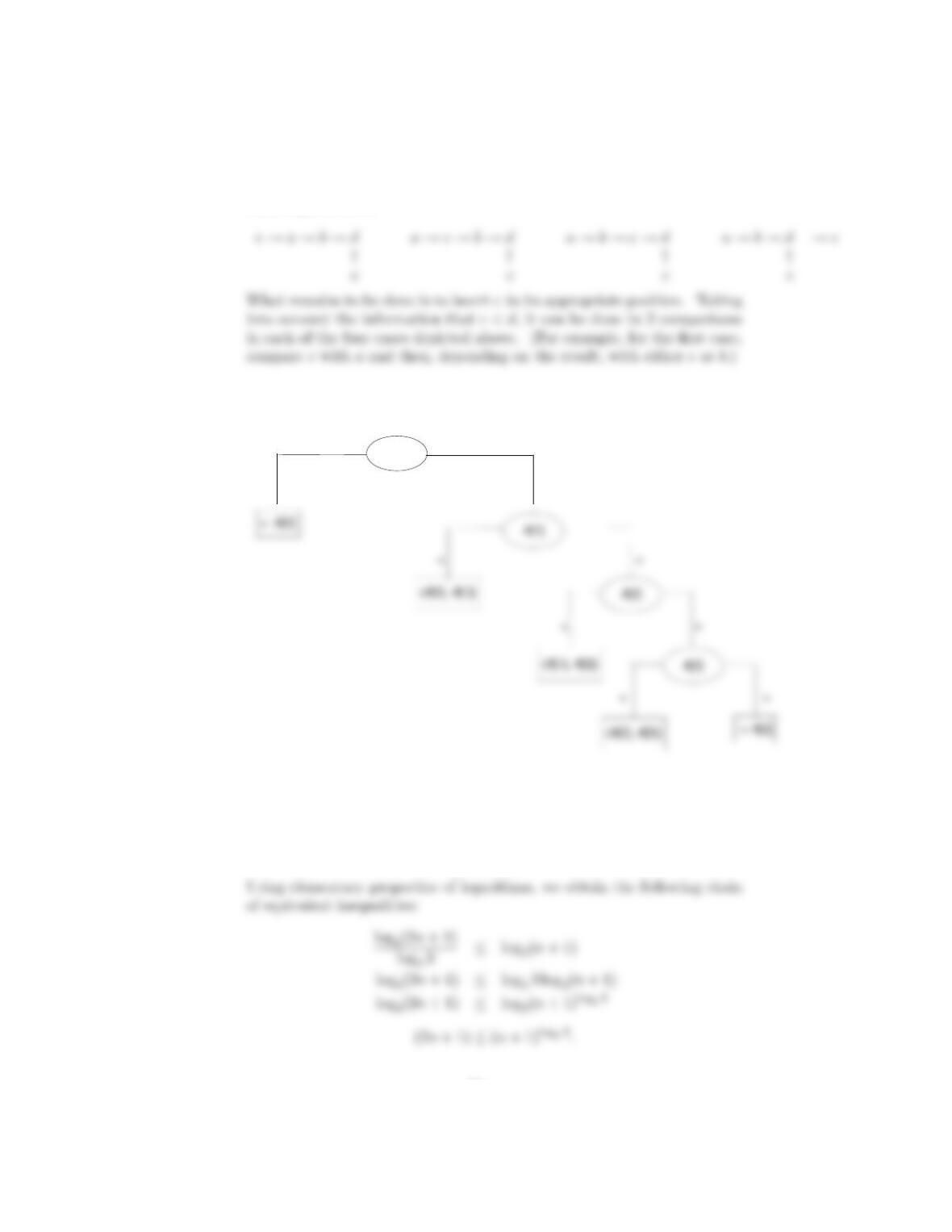
following situations:
6. Here is a decision tree for searching a four-element ordered list (indexed
from0to3)bysequentialsearch:
<>
A[0]
7. a. Since ≤implies de≤de(because ≤≤deand therefore, since
deis an integer, de≤deby the definition of de)it will suffice to show
that
log3(2+1)≤log2(+1)for every ≥1
15
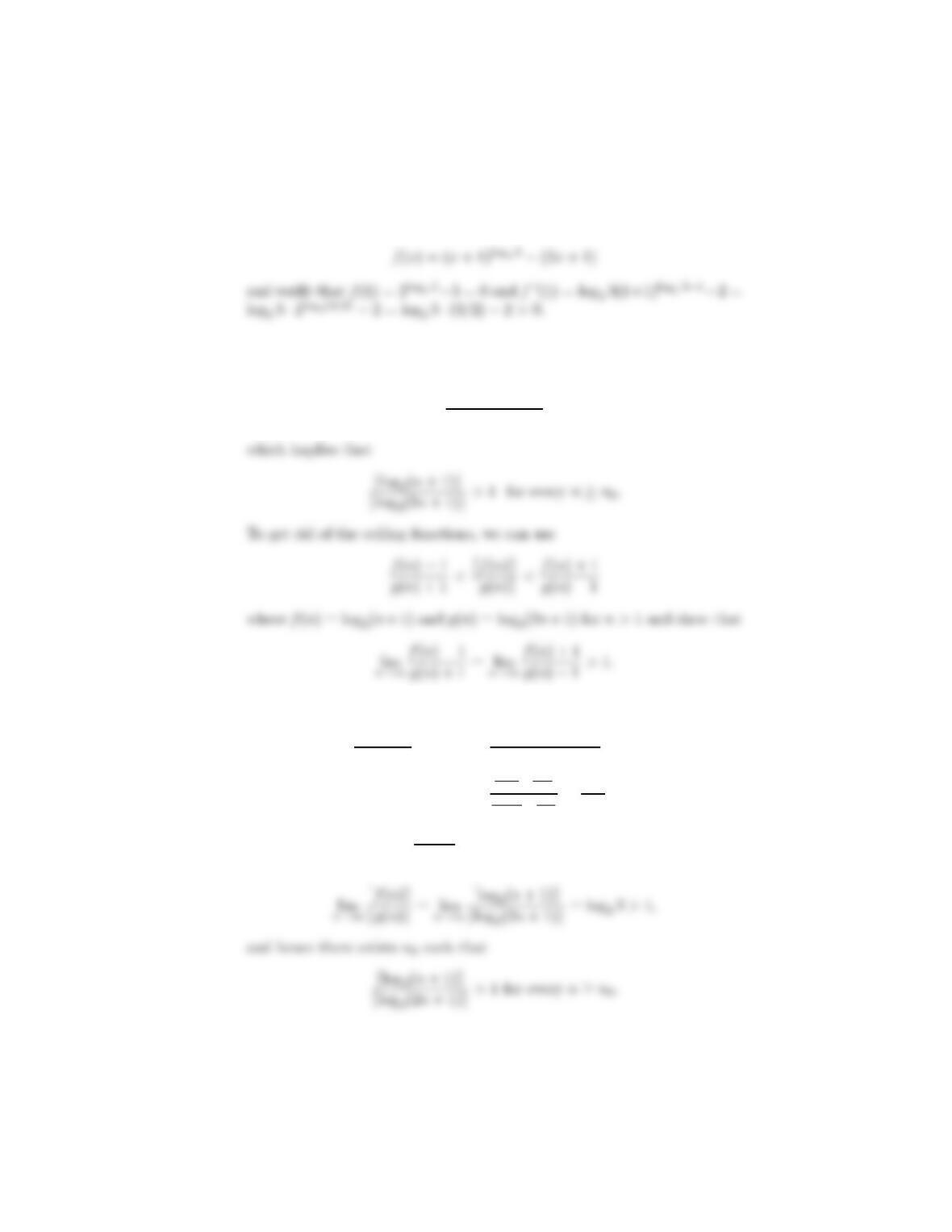
One way to prove that the last inequality holds for every ≥1is to
consider the function
b. The easiest way is to prove a stronger assertion:
lim
→∞
dlog2(+1)e
dlog3(2+1)e1
Indeed, using l’Hôpital’s Rule, we obtain the following:
lim
→∞
()−1
()+1 =lim
→∞
log2(+1)−1
log3(2+1)+1
=lim
→∞
1
+1 ·1
ln 2
1
2+1 ·2
ln 3
=ln 3
ln 2 =log
23
Computing the limit of ()+1
()−1in the exactly same way yields the same
result. Therefore, according to a well-known theorem of calculus,
16
8. Since any of the numbers can be the maximum, the number of leaves
in a decision tree of any algorithm solving the problem will be at least
9. a. Before a winner can be determined, −1players must lose a game.
Since each game results in one loser, −1games are played in a single-
elimination tournament with players.
b. The tournament tree has leaves (the number of players) and −1in-
ternal nodes (the number of games–see part a). Hence the total number
of nodes in this binary tree is 2−1and, since it is complete, its height
10. a. Since each of the coins can be either lighter or heavier than all the
others and all the coins can be genuine, the total number of possible out-
comes is 2+1Since each weighing can have three results, the smallest
number of weighings must be at least dlog3(2+1)e
b. In the decision tree below, the coins are numbered from 1 to 3. Internal
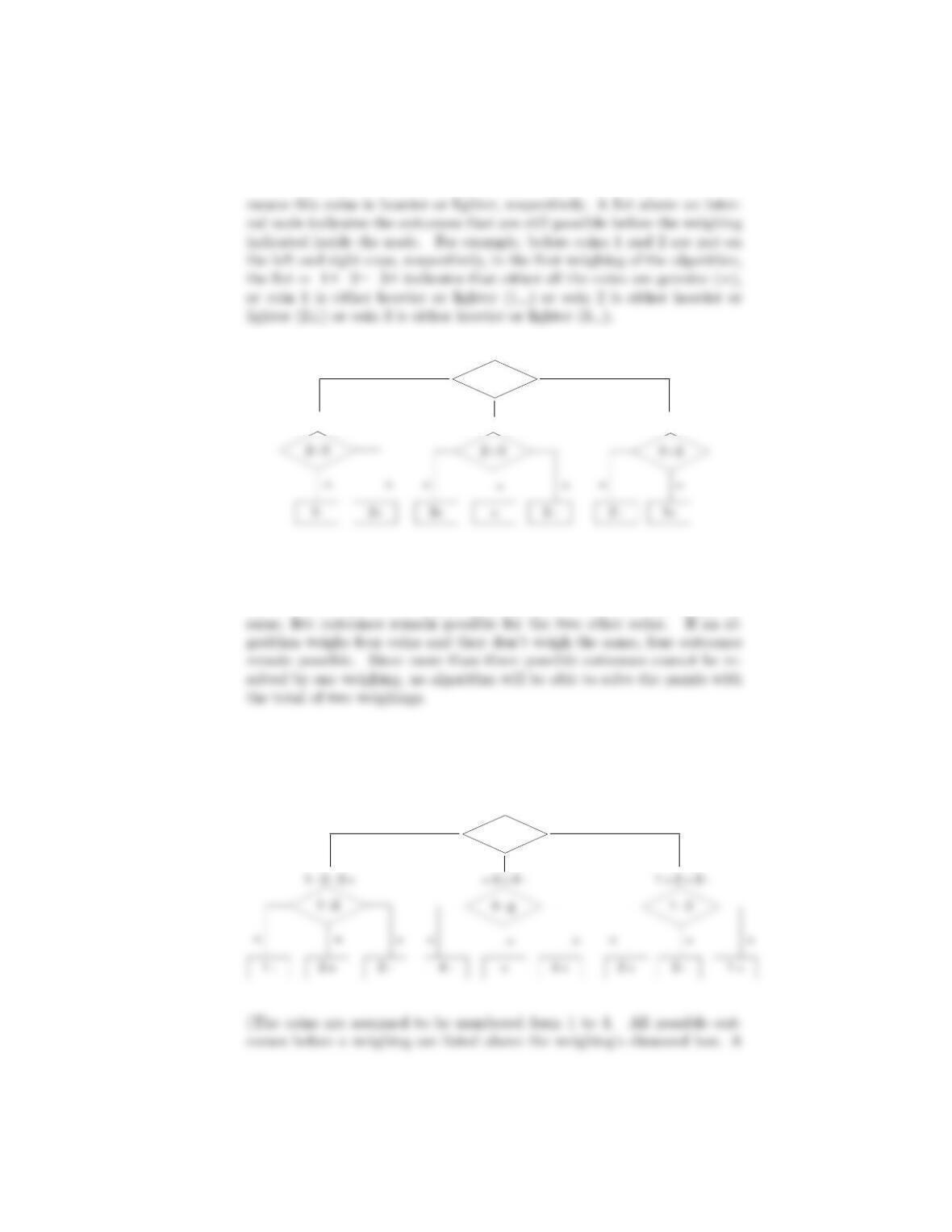
1:2
<
>
1 – 2 + = 3 1+ 2 –
= +
–
+
–
=
+
–
123
+
–
c. There are two reasonable possibilities for the first weighing: to weigh
two coins (i.e., one on each cup of the scale) and to weigh four coins (i.e.,
two on each cup). If an algorithm weighs two coins and they weigh the
d. Here is a decision three of an algorithm that solves the fake-coin puzzle
for =4in two weighings by using an extra coin (denoted )knownto
be genuine:
–
1, 2 : 3, g
<
>
= 1 2 3 4
+
– ++
–+
–
=
18
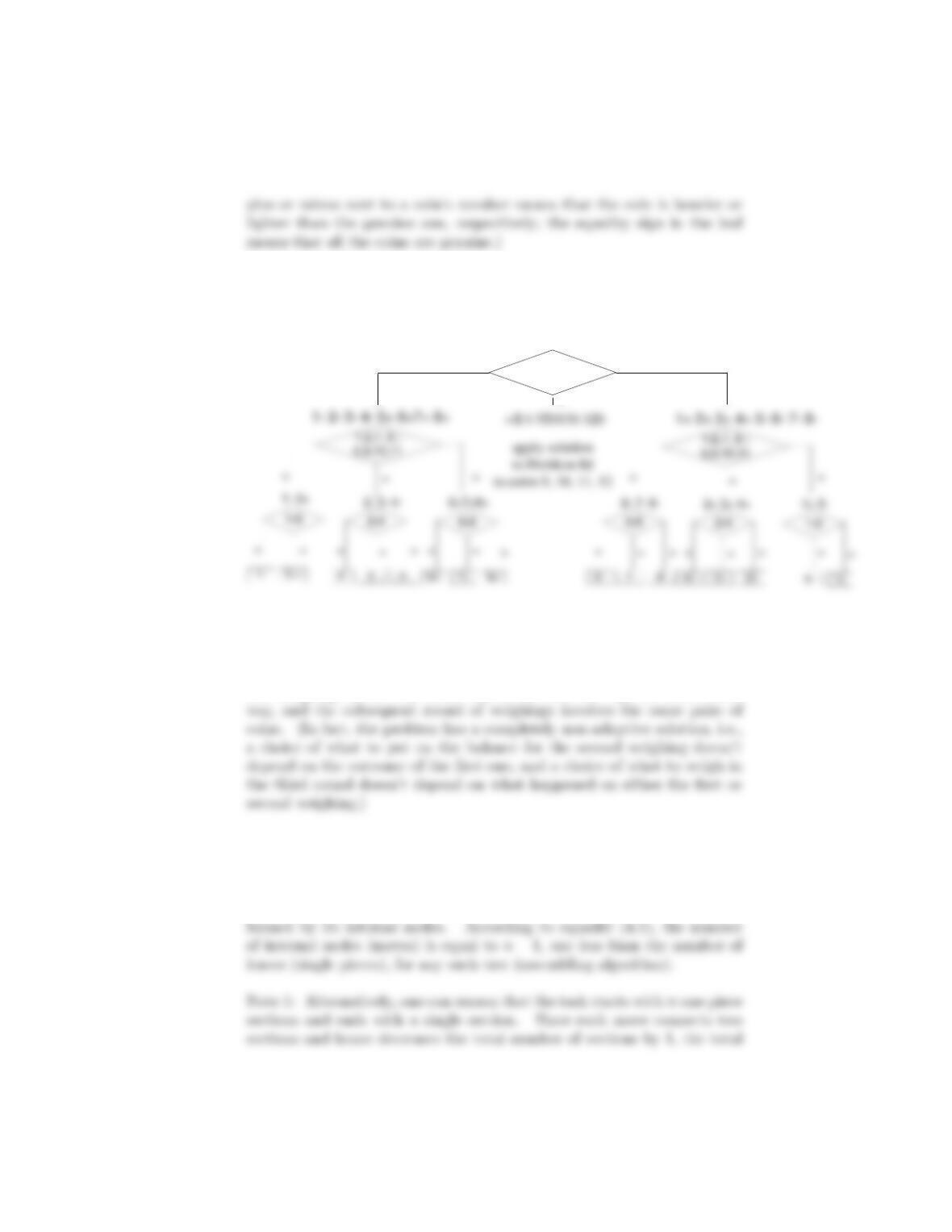
e. Here is a decision tree of an algorithm that solves the fake-coin puzzle
for 12 coins in three weighings
1,2,3,4 : 5,6,7,8
<>
=
–
+–
+
1 2–
+
3–
+
4–
+
5–
+–
+
7–
+
8–
+
9
6–
+–
+
11 –
+
12
10
=
Note: This problem is discussed on many puzzle-related sites on the In-
ternet (see, e.g., http://www.cut-the-knot.com/blue/weight1.shtml). The
attractiveness of the solution given above lies in its symmetry: the sec-
ond weighings involve the same coins if the first one tips the scale either
11. Any algorithm to assemble the puzzle can be represented by a binary tree
whose leaves represents the single pieces and internal nodes represent con-
necting two sections (its children). Since each internal node in such a tree
has two children, the leaves can be interpreted as extended nodes of a tree
19