Problem 11A-5 (continued)
b. The loss in potential profits to the company as a whole will be:
Division B’s outside purchase price …………………………
$39
Division A’s variable cost on the internal transfer ………
36
Potential added contribution margin lost to the
company as a whole …………………………………………
$ 3
Number of units ………………………………………………..
×70,000
Division A’s variable cost on the internal transfer ………
36
Potential added contribution margin per unit ……………
$ 2
Number of units ………………………………………………..
×70,000
Outside purchase price per unit …………………………….
$39
Suggested price per unit inside ……………………………..
38
Potential cost avoided per unit ………………………………
$ 1
Potential added contribution margin and divisional
profits forgone ………………………………………………..
Potential added contribution margin and company
Problem 11A-5 (continued)
3. a. From the standpoint of the selling division, Division A:
Total contribution margin on lost sales
Variable cost
Transfer price +
per unit Number of units transferred
³
$0
Transfer price $35 + = $35
20,000
³
b. Division A’s ROI should increase. The division has idle capacity, so
selling 20,000 units a year to Division B should require no increase in
operating assets. Therefore, Division A’s turnover should increase.
The division’s margin should also increase, because its contribution
margin will increase by $340,000 as a result of the new sales, with no
offsetting increase in fixed costs:
Problem 11A-5 (continued)
4. From the standpoint of the selling division, Division A:
Problem 11A-6 (60 minutes)
1. The lowest acceptable transfer price from the perspective of the selling
division is given by the following formula:
+ ³Total contribution margin on lost sales
Variable cost
Transfer price per unit Number of units transferred
The Tuner Division has no idle capacity, so transfers from the Tuner
Therefore, the Tuner Division will refuse to transfer at a price less than
$20 per tuner.
The Assembly Division can buy tuners from an outside supplier for $20,
less a 10% quantity discount of $2, or $18 per tuner. Therefore, the
Division would be unwilling to pay more than $18 per tuner.
Cost of buying from outside supplier = $18£Transfer price
The requirements of the two divisions are incompatible. The Assembly
Division won’t pay more than $18 and the Tuner Division will not accept
less than $20. Thus, there can be no mutually agreeable transfer price
and no transfer will take place.
Problem 11A-6 (continued)
Profits in the Assembly Division will remain unchanged because it will be
paying the same price internally as it is now paying externally.
3. The Tuner Division has idle capacity, so transfers from the Tuner
Division to the Assembly Division do not cut into normal sales of tuners
to outsiders. In this case, the minimum price as far as the Assembly
Division is concerned is the variable cost per tuner of $11. This is
4. Yes, $16 is a bona fide outside price. Even though $16 is less than the
Tuner Division’s $17 “full cost” per unit, it is within the range given in
Part 3 and therefore will provide some contribution to the Tuner
5. No, the Assembly Division should probably be free to go outside and get
the best price it can. Even though this would result in lower profits for
the company as a whole, the buying division should probably not be
forced to purchase inside if better prices are available outside.
Problem 11A-6 (continued)
6. The Tuner Division will have an increase in profits:
Selling price ………………………….
$20
Variable costs ……………………….
11
Inside purchase price ……………..
$20
Outside purchase price ……………
16
Increased cost per tuner …………
30,000 tuners × $4 per tuner = $120,000 decreased profits
The company as a whole will have an increase in profits:
Increased contribution margin in the Tuner Division …….
$ 9
Decreased contribution margin in the Assembly Division .
4
Increased contribution margin per tuner ……………………
$ 5
30,000 tuners × $5 per tuner = $150,000 increased profits
Case 11A-7 (60 minutes)
1. The Electronics Division is presently operating at capacity; therefore,
any sales of the XL5 circuit board to the Clock Division will require that
the Electronics Division give up an equal number of sales to outside
$12.50³Transfer price
Thus, the Electronics Division should not supply the circuit board to the
Clock Division for $9 each. The Electronics Division must give up
revenues of $12.50 on each circuit board that it sells internally. Because
management performance in the Electronics Division is measured by
ROI and dollar profits, selling the circuit boards to the Clock Division for
$9 would adversely affect these performance measurements.
2. The key is to realize that the $10 in fixed overhead and administrative
costs contained in the Clock Division’s $69.75 cost per timing device is
not relevant. There is no indication that winning this contract would
actually affect any of the fixed costs. If these costs would be incurred
Case 11A-7 (continued)
Selling price of the timing devices ……………………….
$70.00
Less:
50.75
3. As shown in part (1) above, the Electronics Division would insist on a
transfer price of at least $12.50 for the circuit board. Would the Clock
Division make any money at this price? Again, the fixed costs are not
Selling price of the timing devices ………………………
20.75
Clock Division contribution margin ………………………
4. It is in the best interests of the company and of the divisions to come to
an agreement concerning the transfer price. As demonstrated in part (3)
above, any transfer price within the range $12.50 to $19.25 would
improve the profits of both divisions. What happens if the two managers
do not come to an agreement?
Case 11A-7 (continued)
In this case, top management knows that there should be a transfer and
could step in and force a transfer at some price within the acceptable
range. However, such an action, if done on a frequent basis, would
undermine the autonomy of the managers and turn decentralization into
themselves. Third, the managers may not be able to correctly analyze
the situation and may not understand what is actually in their own best
interests. For example, the manager of the Clock Division may believe
that the fixed overhead and administrative cost of $10 per timing device
really does have to be covered in order to avoid a loss.
Appendix 11B
Service Department Charges
Exercise 11B-1 (20 minutes)
1.
Long-Run Average
Number of
Employees
Percentage
Cutting Department ……
Fixed cost charges:
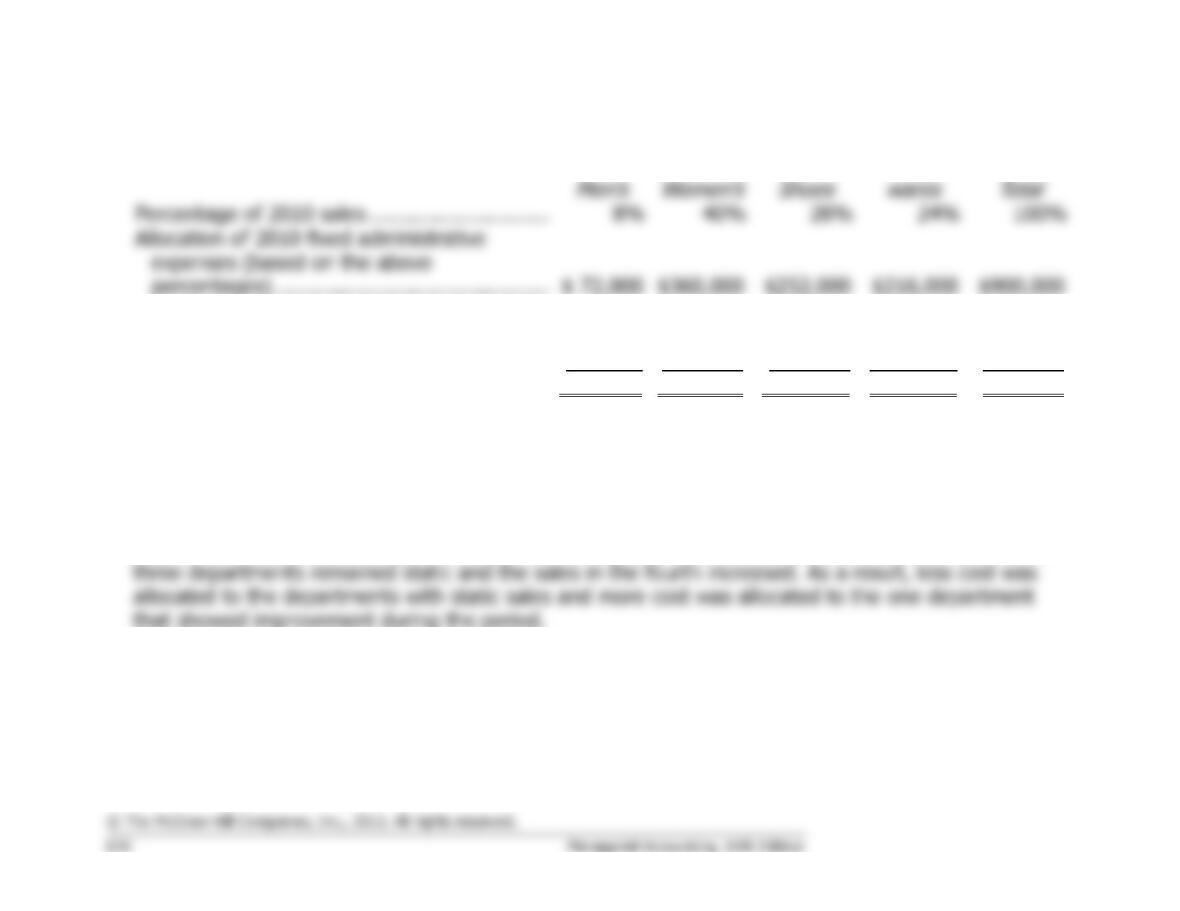
2. Part of the total actual cost is not charged to the operating departments
as shown below:
Spending variance ……………………..
Variable
Fixed
Exercise 11B-2 (20 minutes)
1.
Percentage of 2010 sales …………………………..
$ 72,000
$360,000
House-
2.
2010 allocation (above) …………………………..
$ 72,000
$360,000
$252,000
$216,000
$900,000
2009 allocation ………………………………………………………
90,000
225,000
315,000
270,000
900,000
Increase (decrease) in allocation …………………………..
$(18,000)
$135,000
$ (63,000)
$ (54,000)
$ 0
The manager of the Women’s Department undoubtedly will be upset about the increased allocation to
the department but will feel powerless to do anything about it. Such an increased allocation may be
viewed as a penalty for an outstanding performance.
3. Sales dollars is not ordinarily a good base for allocating fixed costs. The costs allocated to a
department will be affected by the sales in
other
departments. In our illustration above, the sales in
Exercise 11B-3 (15 minutes)
1. and 2.
Arbon
Refinery
Beck
Refinery
Total
Variable cost charges:
Total charges ……………………………….
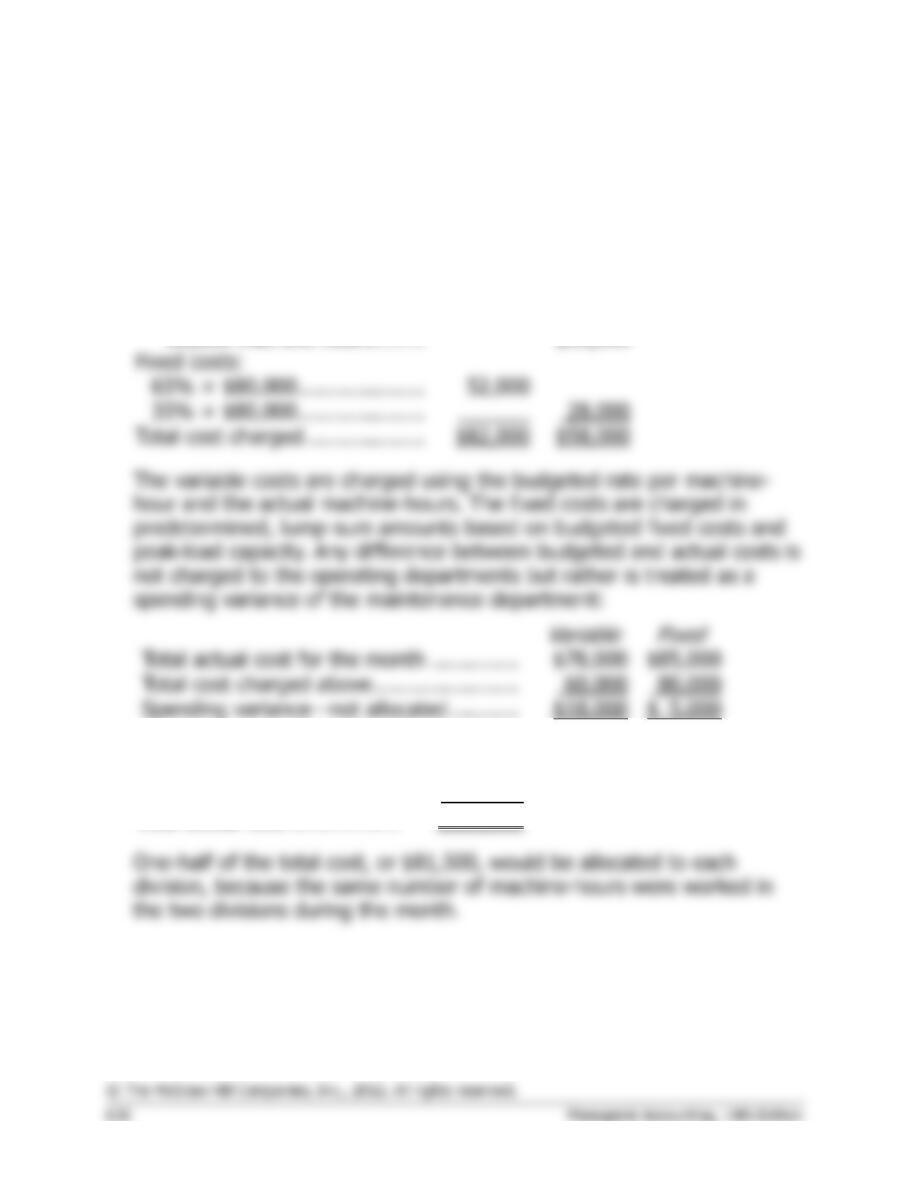
3. Part of the $365,000 in total actual cost will not be allocated to the
refineries, as follows:
Variable
Fixed
Problem 11B-4 (45 minutes)
1.
Machine
Tools
Division
Special
Products
Division
Variable costs:
$0.50 per machine-hour ×
60,000 machine-hours ……..
$30,000
$0.50 per machine-hour ×
60,000 machine-hours ……..
$30,000
Fixed costs:
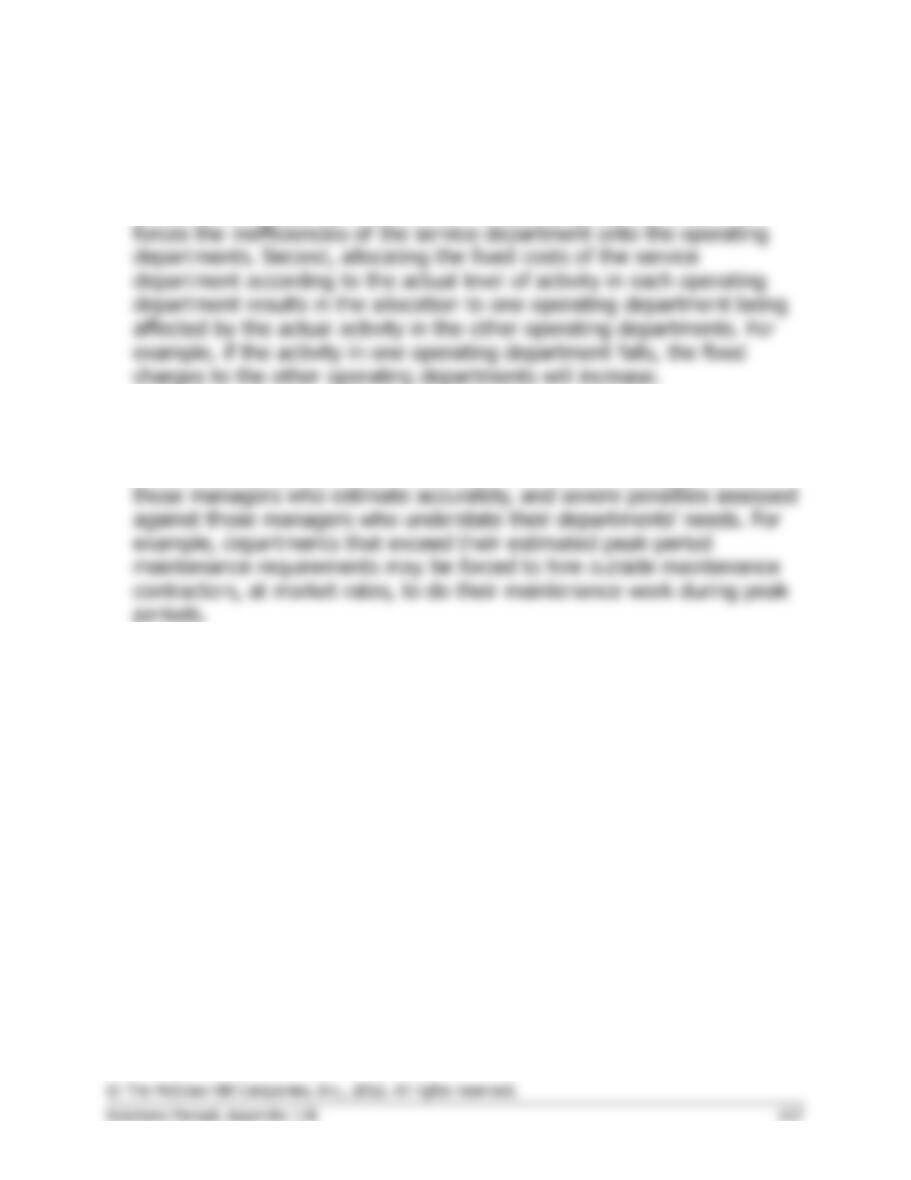
Total cost charged ……………….
$58,000
Total actual cost for the month …………..
Total cost charged above …………………..
Spending variance—not allocated ………..
2.
Actual variable cost ………….
$ 78,000
Actual fixed cost ………………
85,000
Total actual cost ………………
$163,000
Problem 11B-4 (continued)
3. This method has two major problems. First, allocating the total actual
cost of the service department to the operating departments essentially
allocates the spending variances to the operating departments. This
4. Managers may understate their peak-period needs to reduce their
charges for fixed service department costs. Top management can
control such ploys by careful follow-up, with rewards being given to
Problem 11B-5 (20 minutes)
1.
Milling
Department
Finishing
Department
Total
K
K
Fixed costs:
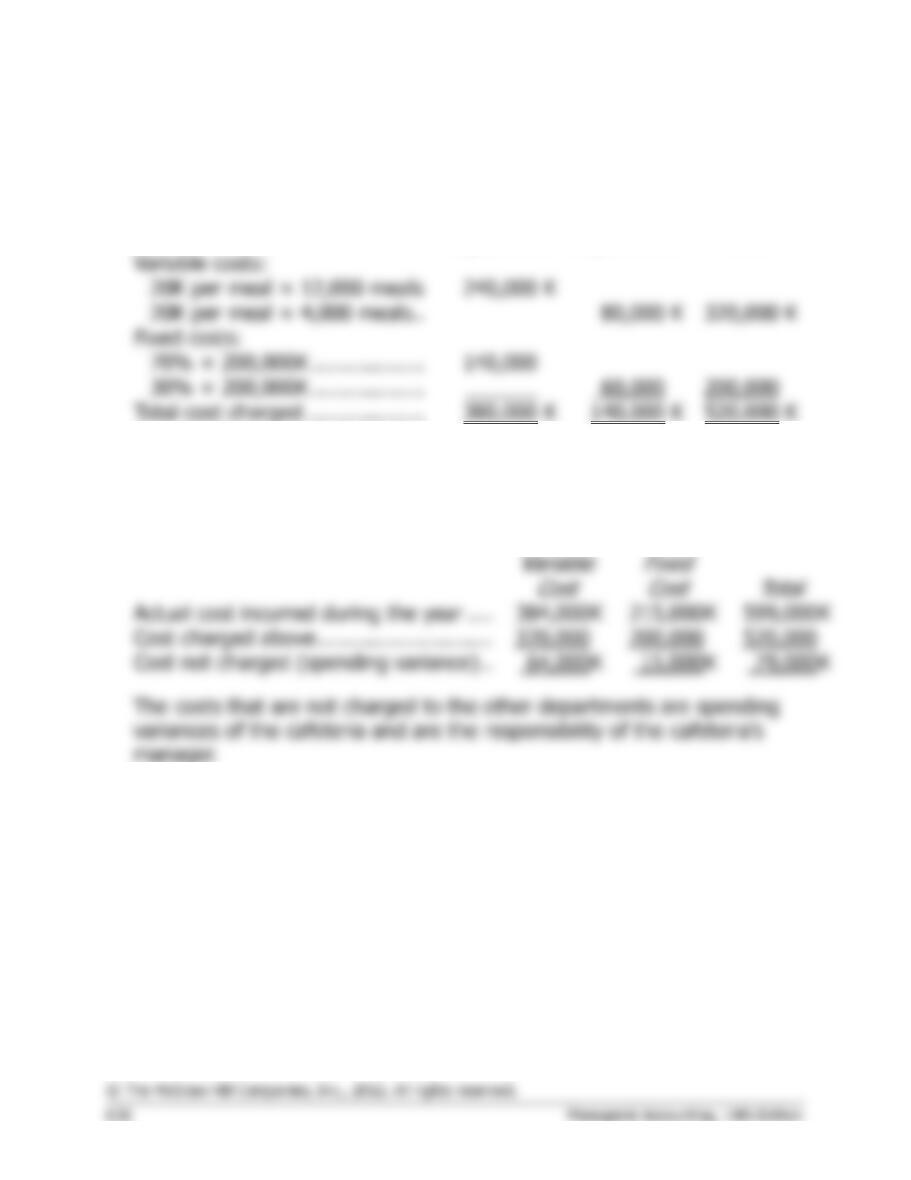
2. Any difference between the budgeted and actual variable cost per meal
or between the budgeted and actual total fixed cost would not be
charged to the other departments. The amount not charged would be:
Total
Cost charged above ……………………….