11–21
EXERCISE 11-5 (20–25 minutes)
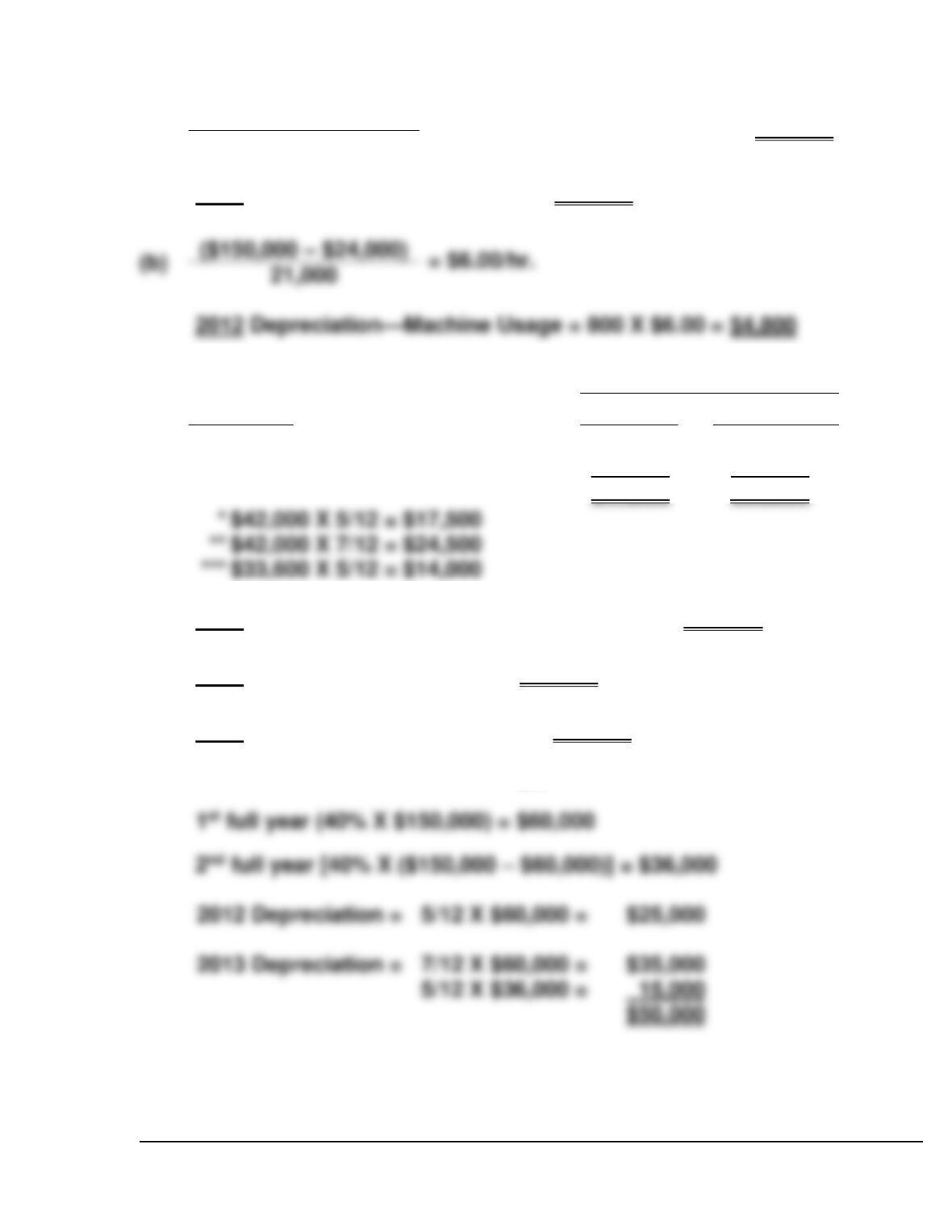
(a)
($150,000 – $24,000)
= $25,200/yr. = $25,200 X 5/12 = $10,500
5
2012 Depreciation—Straight line = $10,500
(c)
Machine
Allocated to
Year
Total
2012
2013
1
5/15 X $126,000 = $42,000
$17,500*
$24,500**
2
4/15 X $126,000 = $33,600
14,000***
$17,500
$38,500
2013 Depreciation—Sum-of-the-Years’-Digits = $38,500
(d) 2012 40% X ($150,000) X 5/12 = $25,000
2013 40% X ($150,000 – $25,000) = $50,000
OR
2012 Depreciation =
5/12 X $60,000 =
5/12 X $36,000 =
15,000
$50,000
= $6.00/hr.
EXERCISE 11-6 (20–30 minutes)
(a)
2012
Straight-line
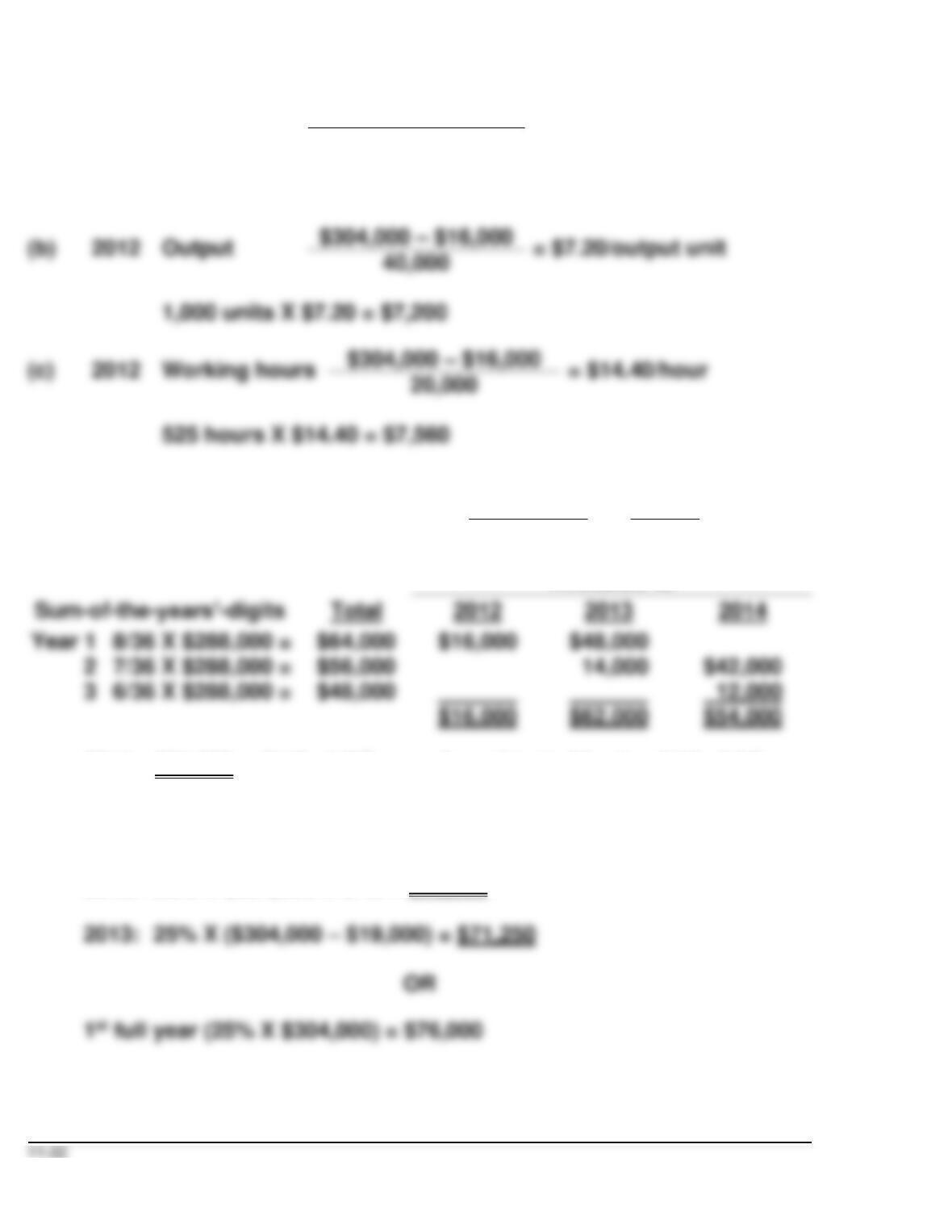
$304,000 – $16,000
= $36,000/year
8
3 months—Depreciation ($36,000 X 3/12) = $9,000
1,000 units X $7.20 = $7,200
525 hours X $14.40 = $7,560
(d)
8 + 7 + 6 + 5 + 4 + 3 + 2 + 1 = 36 OR
n(n + 1)
=
8(9)
= 36
2
2
Allocated to
7/36 X $288,000 =
$42,000
6/36 X $288,000 =
$48,000
2014: $54,000 = (9/12 of 2nd year of machine’s life plus 3/12 of 3rd year
of machine’s life)
(e) Double-declining-balance 2013: 1/8 X 2 = 25%.
2012: 25% X $304,000 X 3/12 = $19,000
11–23
EXERCISE 11-6 (Continued)
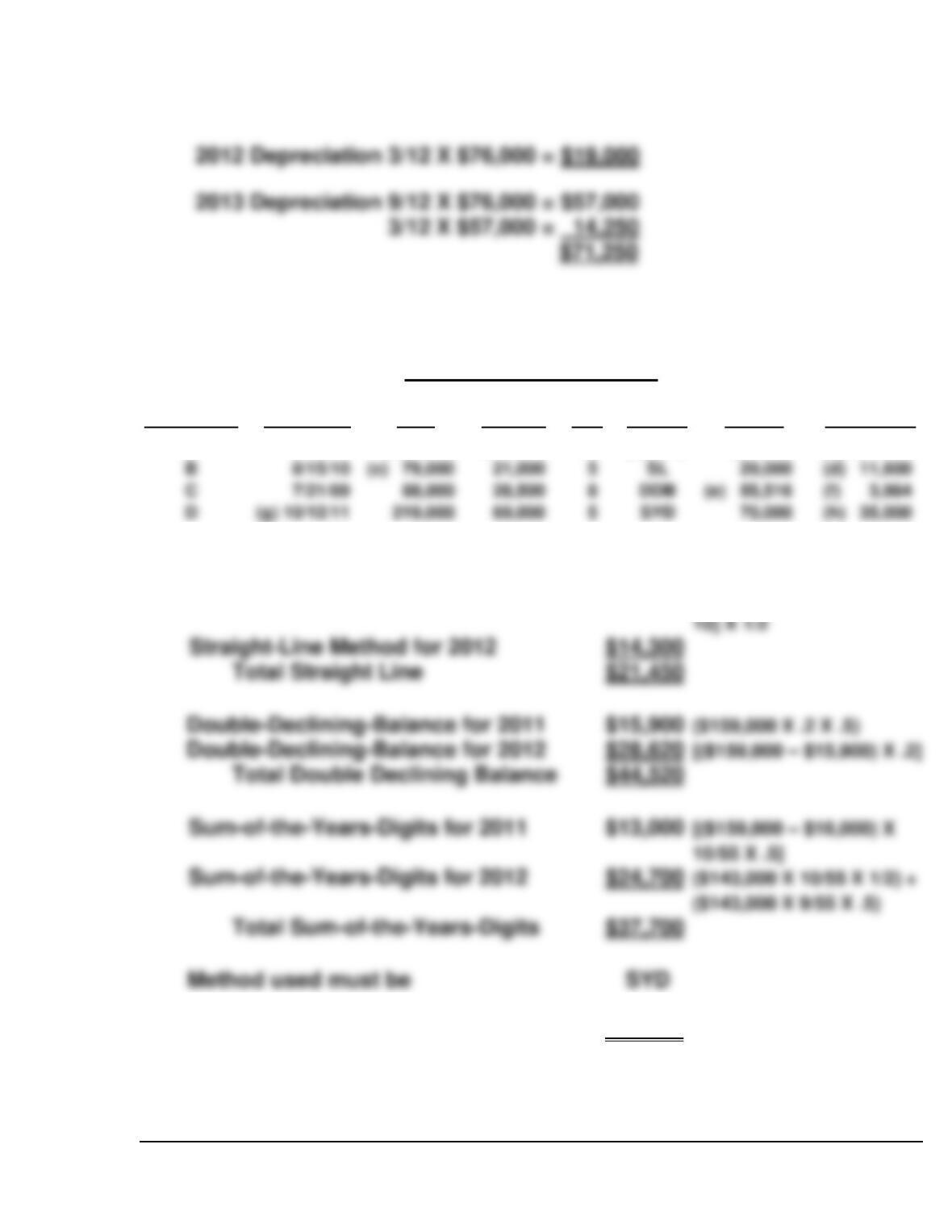
2nd full year [25% X ($304,000 – $76,000)] = $57,000
EXERCISE 11-7 (25–35 minutes)
Methods of Depreciation
Description
Date
Purchased
Cost
Salvage
Life
Method
Accum. Depr.
to 2012
2013 Depr.
A
2/12/11
$159,000
$16,000
10
(a) SYD
$37,700
(b) $22,100
B
8/15/10
(d) 11,600
C
(e) 55,516
(f) 3,984
D
(g) 10/12/11
69,000
(h) 35,000
Machine A—Testing the methods
(a) Straight-Line Method for 2011
$ 7,150
[($159,000 – $16,000) ÷
(b) Using SYD, 2013 Depreciation is
$22,100
($143,000 X 9/55 X 1/2) +
($143,000 X 8/55 X .5)
EXERCISE 11-7 (Continued)
Machine B—Computation of the cost
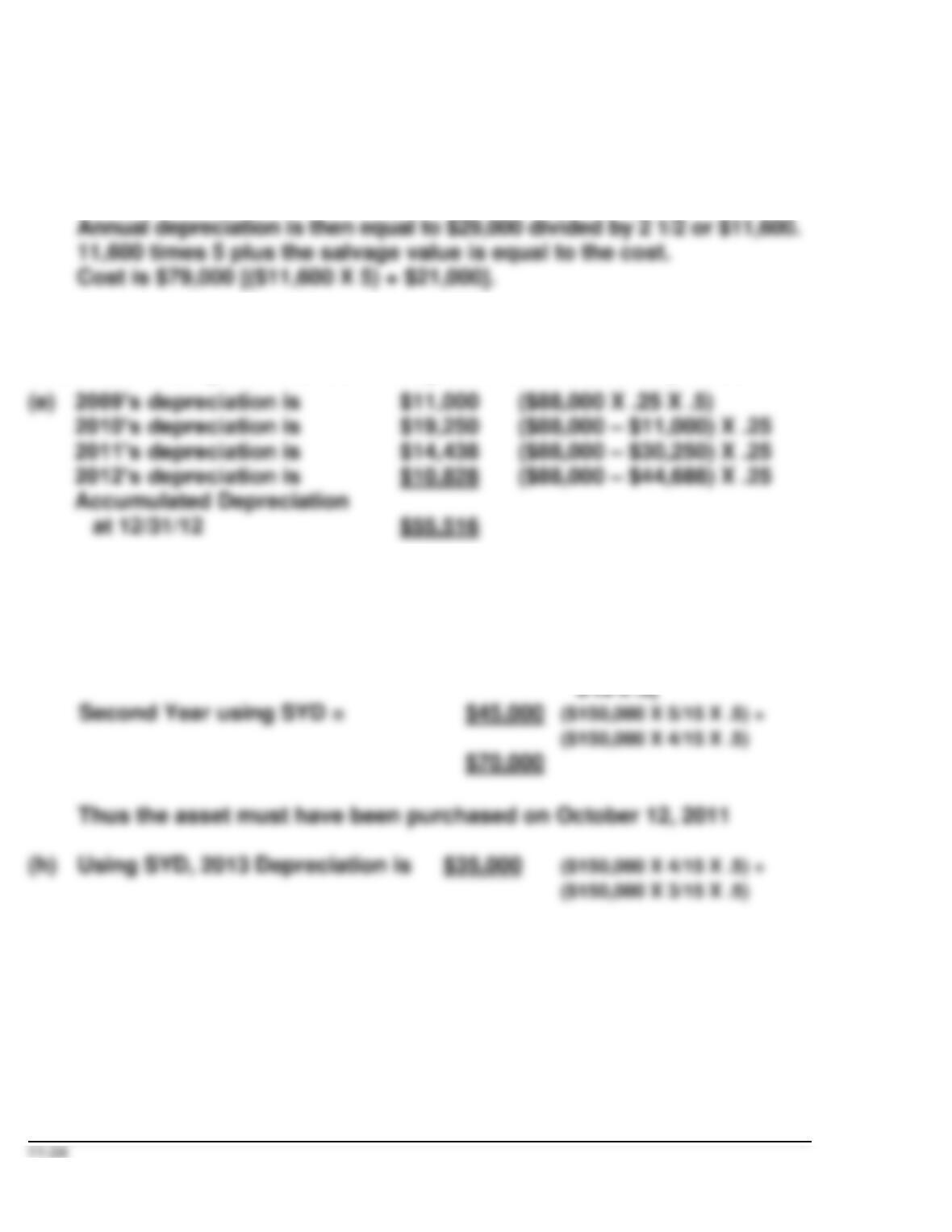
(c) Asset has been depreciated for 2 1/2 years using the straight-line
method.
(d) Using SL, 2013 Depreciation is $11,600.
Machine C—Using the double-declining-balance method of depreciation
(f) Using DDB, 2013 Depreciation is $8,121 [($88,000 – $55,516) X 0.25]
Machine D—Computation of Year Purchased
(g) First Half Year using SYD =
$25,000
(h) Using SYD, 2013 Depreciation is
($150,000 X 4/15 X .5) +
[($219,000 – $69,000) X
11–25
EXERCISE 11-8 (20–25 minutes)
Old Machine
June 1, 2010
Purchase ………………………………..
$31,800
Freight ……………………………………
200
Installation ………………………………
500
Total cost ……………………….
$32,500
Annual depreciation charge: ($32,500 – $2,500) ÷ 10 = $3,000
(Note to instructor: The above computation is done to determine whether
there is a gain or loss from the exchange of the old machine with the new
machine and to show how the cost of removal might be reported. Also, if a
gain occurs, the gain is not deferred (1) because the exchange has commer-
cial substance and (2) the cash paid exceeds 25% of the total value of the
property received.)
Basis of new machine
Cash paid ($35,000 – $20,000)
Fair value of old machine
Installation cost
Total cost of new machine
Book value, old machine, June 1, 2014:
[$35,200 – $3,000 – ($3,300 X 3)] = …………………………
Fair value ……………………………………………………………….
Loss on exchange …………………………………………………..
Cost of removal ………………………………………………………
Total loss ……………………………………………………….
EXERCISE 11-9 (15–20 minutes)
(a)
Asset
Cost
Estimated
Salvage
Depreciable
Cost
Estimated
Life
Depreciation
per Year
A
$ 40,500
$ 5,500
$ 35,000
10
$ 3,500
B
4,800
28,800
3,200
36,000
19,000
23,500
2,500
21,000
3,500
Composite life = $134,700 ÷ $16,750, or 8.04 years
Composite rate = $16,750 ÷ $152,600, or approximately 11.0%
EXERCISE 11-10 (10–15 minutes)
Sum-of-the-years’-digits =
8 X 9
= 36
2
Using Y to stand for the years of remaining life:
The year in which there are five remaining years of life at the beginning of
that given year is 2012.
11–27
EXERCISE 11-11 (10–15 minutes)
(a) No correcting entry is necessary because changes in estimate are
handled in the current and prospective periods.
EXERCISE 11-12 (20–25 minutes)
(a) 1986–1995—($1,900,000 – $60,000) ÷ 40 = $46,000/yr.
(b) 1996–2013—Building ($1,900,000 – $60,000) ÷ 40 = $46,000/yr.
Addition ($ 470,000 – $20,000) ÷ 30 = 15,000/yr.
$61,000/yr.
EXERCISE 11-12 (Continued)
Addition
Book value: ($470,000 – $270,000**) ……………….
$200,000
Salvage value ………………………………………………..
(20,000)
Remaining useful life …………………………..
Annual depreciation ……………………………………….
$ 5,625
EXERCISE 11-13 (15–20 minutes)
(a) $2,400,000 ÷ 40 = $60,000
(b)
Loss on Disposal of Plant Assets …………………………..
90,000
Accumulated Depreciation—Buildings
($180,000 X 20/40) ………………………………………………..
90,000
Buildings …………………………..…………………………..
180,000
Buildings ………………………………………………………………..
Cash ………………………………………………………………
300,000
Accumulated Depreciation—Buildings …………………….
Cash ………………………………………………………………
300,000
EXERCISE 11-13 (Continued)
(c) No entry necessary.
(d) (Assume the cost of the old roof is removed)
Building ($2,400,000 – $180,000 + $300,000) ……………………
$2,520,000
Accumulated Depreciation ($60,000 X 20 – $90,000) ………..
(1,110,000)
Remaining useful life …………………………………………………….
÷ 25 years
Depreciation—2013 ……………………………………………………….
$ 56,400
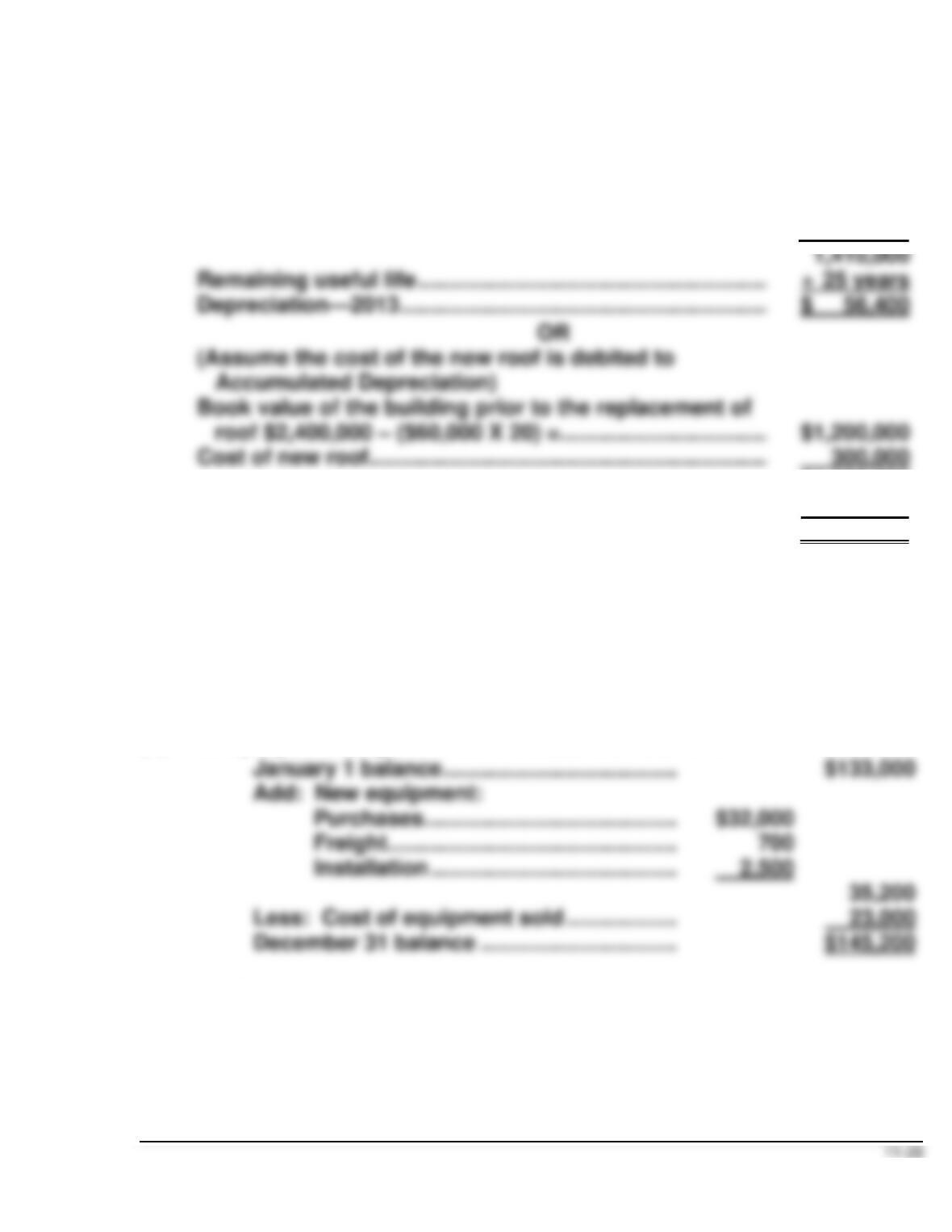
(Assume the cost of the new roof is debited to
Book value of the building prior to the replacement of
roof $2,400,000 – ($60,000 X 20) = ………………………………..
$1,200,000
Cost of new roof ……………………………………………………………
$1,500,000
Remaining useful life …………………………………………………….
÷ 25 years
Depreciation—2013 ……………………………………………………….
$ 60,000
EXERCISE 11-14 (20–25 minutes)
(a)
Maintenance and Repairs Expense ………………………….
500
Equipment ……………………………………………………..
500
(b)
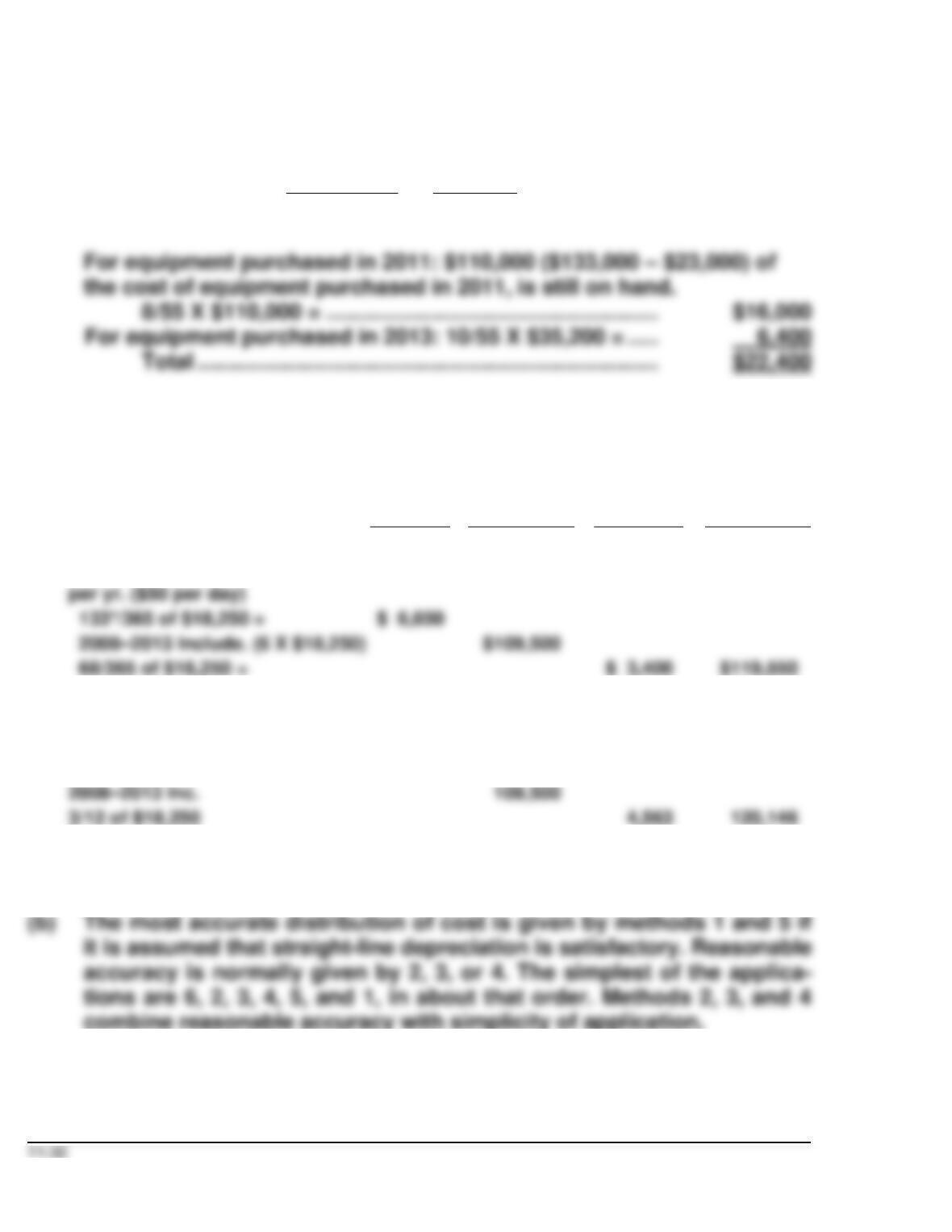
The proper ending balance in the asset account is:
January 1 balance ………………………………..
Add: New equipment:
Purchases …………………………………..
Freight ………………………………………..
700
Installation ………………………………….
Less: Cost of equipment sold ………………
December 31 balance …………………………..
(1) Straight-line: $145,200 ÷ 10 = $14,520
EXERCISE 11-14 (Continued)
(2) Sum-of-the-years’-digits: 10 + 9 + 8 + 7 + 6 + 5 + 4 + 3 + 2 + 1 = 55
OR
n(n + 1)
=
10(11)
= 55
2
2
EXERCISE 11-15 (25–35 minutes)
(a)
2007
2008–2013
Incl.
2014
Total
(1)
$240,000 – $21,000 = $219,000
$219,000 ÷ 12 = $18,250
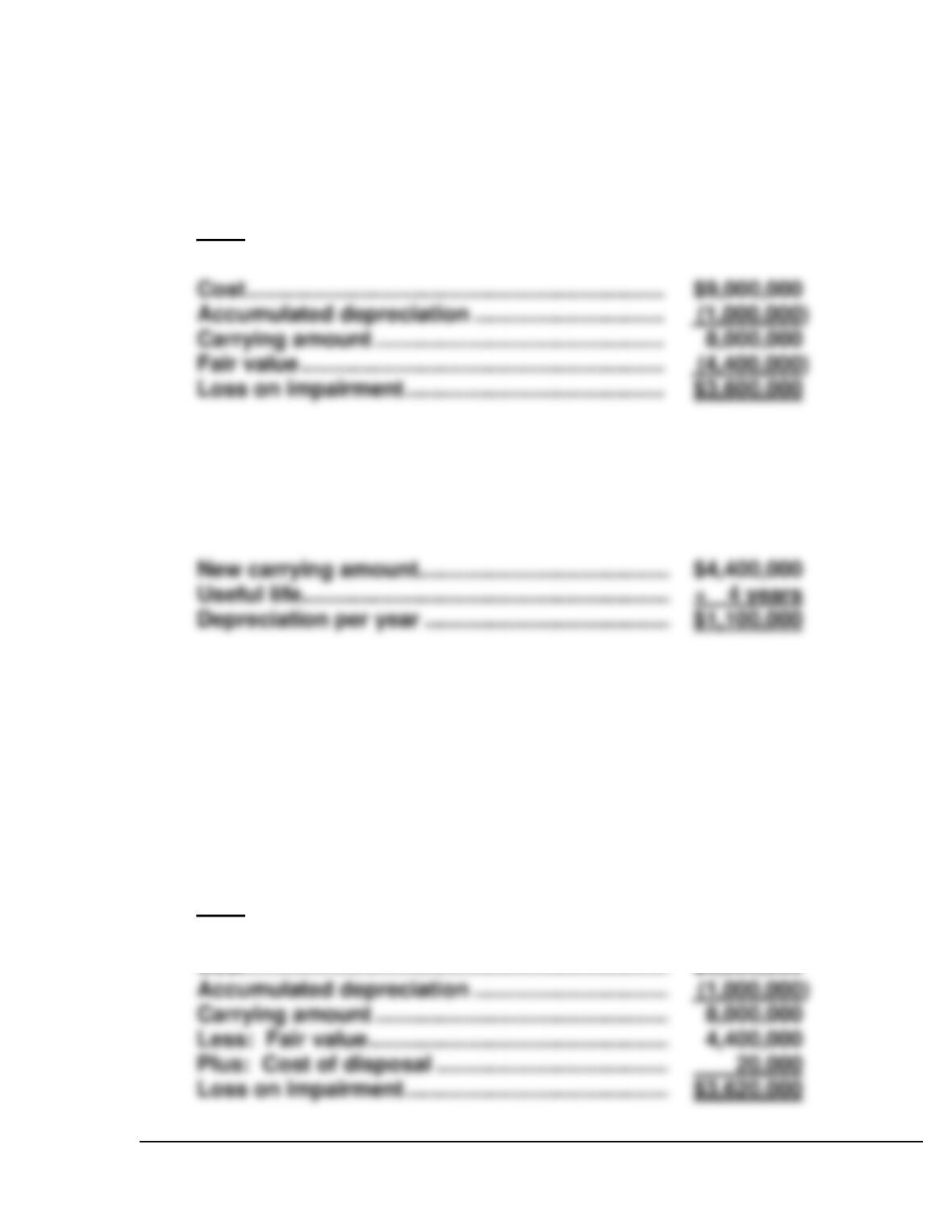
per yr. ($50 per day)
133*/365 of $18,250 =
$ 6,650
68/365 of $18,250 =
$ 3,400
(2)
0
109,500
18,250
127,750
(3)
18,250
109,500
0
127,750
(4)
9,125
109,500
9,125
127,750
(5)
4/12 of $18,250
6,083
109,500
3/12 of $18,250
4,563
120,146
(6)
0
109,500
0
109,500
*(11 + 30 + 31 + 30 + 31)
11–31
EXERCISE 11-16 (10–15 minutes)
(a)
December 31, 2012
Loss on Impairment ………………………………………………..
3,600,000
Accumulated Depreciation—
Equipment …………………………………………………..
3,600,000
Note: The asset fails the recoverability test ($7,000,000 < $8,000,000)
(b)
December 31, 2013
Depreciation Expense ……………………………………………..
1,100,000
Accumulated Depreciation—
Equipment …………………………………………………..
1,100,000
New carrying amount ………………………………………………
Useful life ……………………………………………………….
Depreciation per year ……………………………………………..
(c) No entry necessary. Under GAAP, restoration of any impairment loss is
not permitted.
EXERCISE 11-17 (15–20 minutes)
(a)
Loss on Impairment ………………………………………………..
3,620,000
Accumulated Depreciation—
Equipment …………………………………………………..
3,620,000
Note: The asset fails the recoverability test ($7,000,000 < $8,000,000)
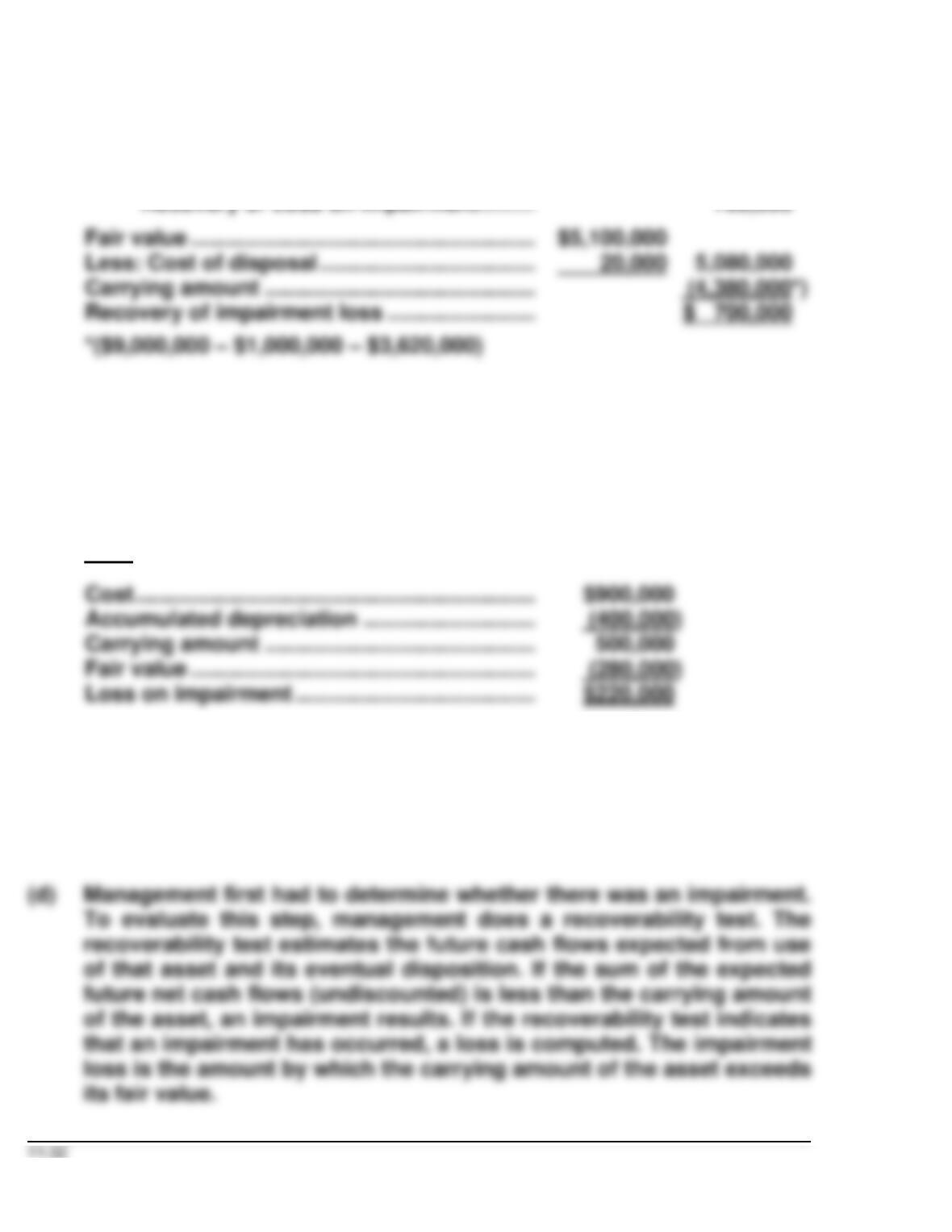
Cost ……………………………………………………………………….
$9,000,000
Accumulated depreciation …………………………..
Carrying amount …………………………………………………….
8,000,000
Less: Fair value ……………………………………………………..
4,400,000
Cost …………………………………………………………..
Accumulated depreciation ………………………….
Carrying amount ………………………………………..
8,000,000
Fair value …………………………………………………..
Loss on impairment ……………………………………
EXERCISE 11-17 (Continued)
(b) No entry necessary. Depreciation is not taken on assets intended to
be sold.
(c)
Accumulated Depreciation—Equipment ……
700,000
Recovery of Loss on Impairment ………
Fair value ………………………………………………..
Less: Cost of disposal ……………………………..
Carrying amount ……………………………………..
Recovery of impairment loss ……………………
EXERCISE 11-18 (15–20 minutes)
(a)
December 31, 2012
Loss on Impairment …………………………..…….
220,000
Accumulated Depreciation—
Equipment ……………………………………
220,000
Note: The asset fails the recoverability test ($300,000 < $500,000)
Cost ………………………………………………………..
Accumulated depreciation ……………………….
Carrying amount ……………………………………..
Fair value ………………………………………………..
Loss on impairment …………………………..…….
(b) It may be reported in the other expenses and losses section or it may
be highlighted as an unusual item in a separate section. It is not
reported as an extraordinary item.
(c) No entry necessary. Under GAAP, restoration of any impairment loss is
not permitted.
11–33
EXERCISE 11-19 (15–20 minutes)
(a)
Depreciation Expense:
$87,000
= $2,900 per year
30 years
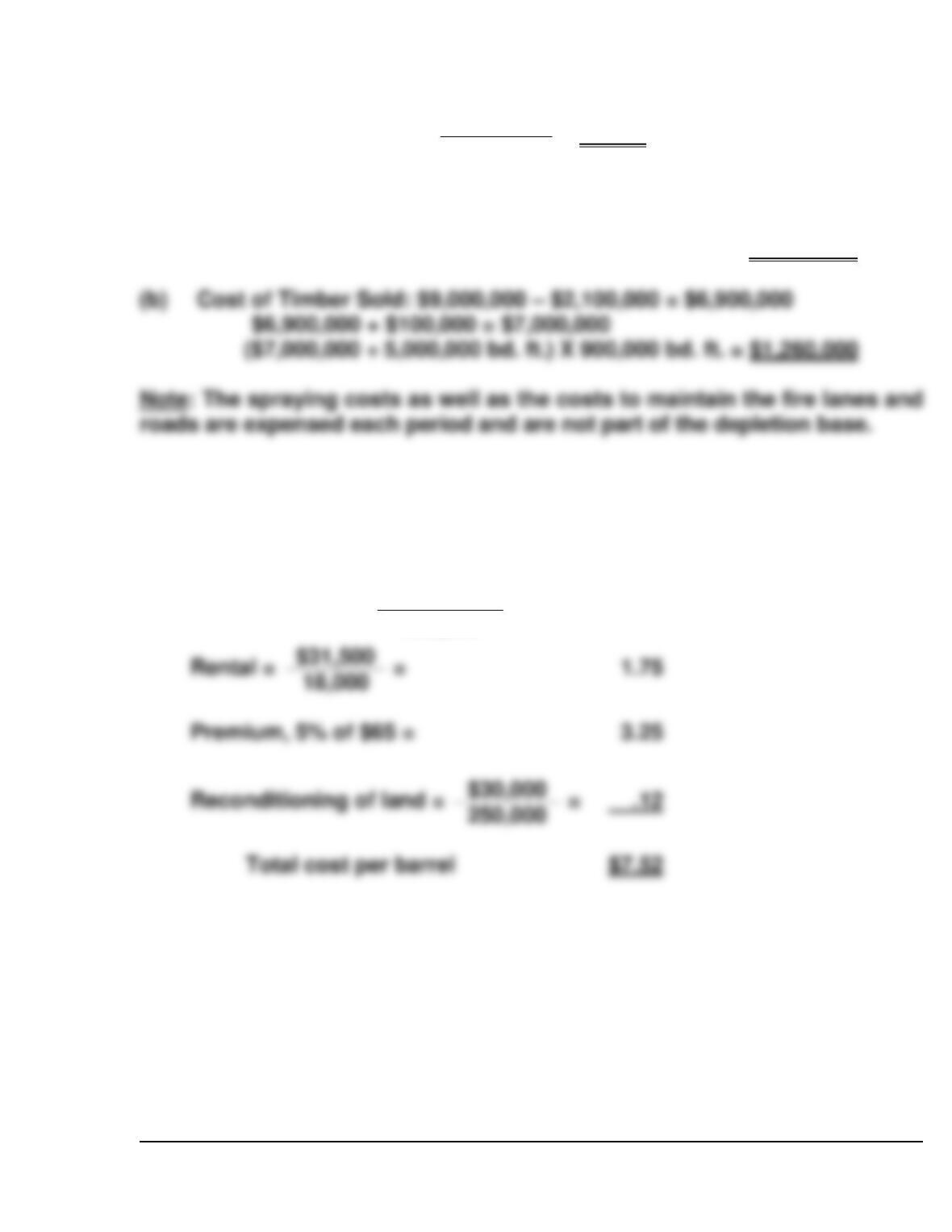
Cost of Timber Sold: $1,400 – $400 = $1,000
$1,000 X 9,000 acres = $9,000,000 of value of timber
($9,000,000 ÷ 3,000,000 bd. ft.) X 700,000 bd. ft. = $2,100,000
EXERCISE 11-20 (10–15 minutes)
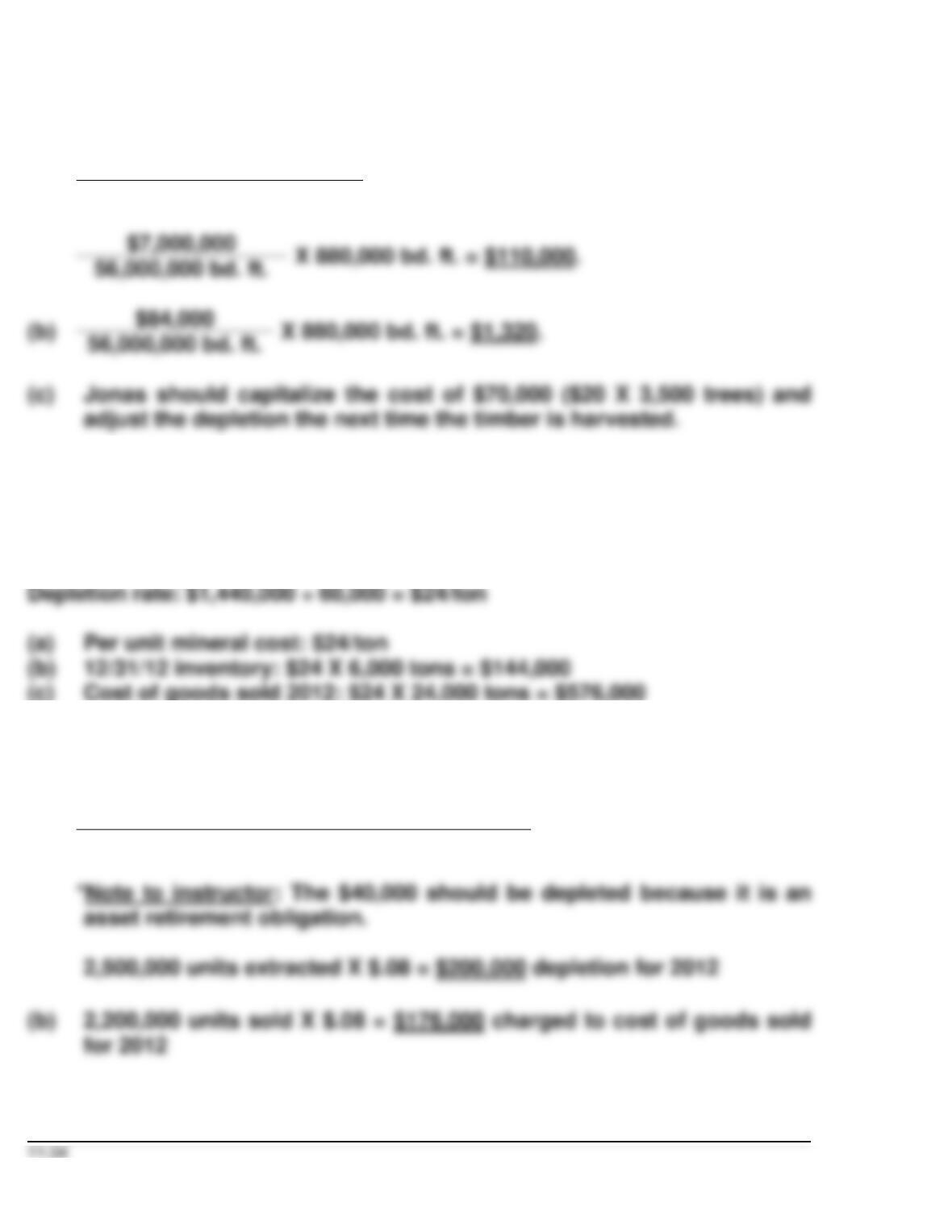
Cost per barrel of oil:
Initial payment =
$600,000
=
$2.40
250,000
Rental =
=
Premium, 5% of $65 =
Reconditioning of land =
$30,000
=
.12
EXERCISE 11-21 (15–20 minutes)
(a) $1,300 – $300 = $1,000 per acre for timber
$1,000 X 7,000 acres
X 880,000 bd. ft. =
8,000 bd. ft. X 7,000 acres
X 880,000 bd. ft. = $110,000.
EXERCISE 11-22 (15–20 minutes)
Depletion base: $1,250,000 + $90,000 – $100,000 + $200,000 = $1,440,000
EXERCISE 11-23 (15–20 minutes)
(a)
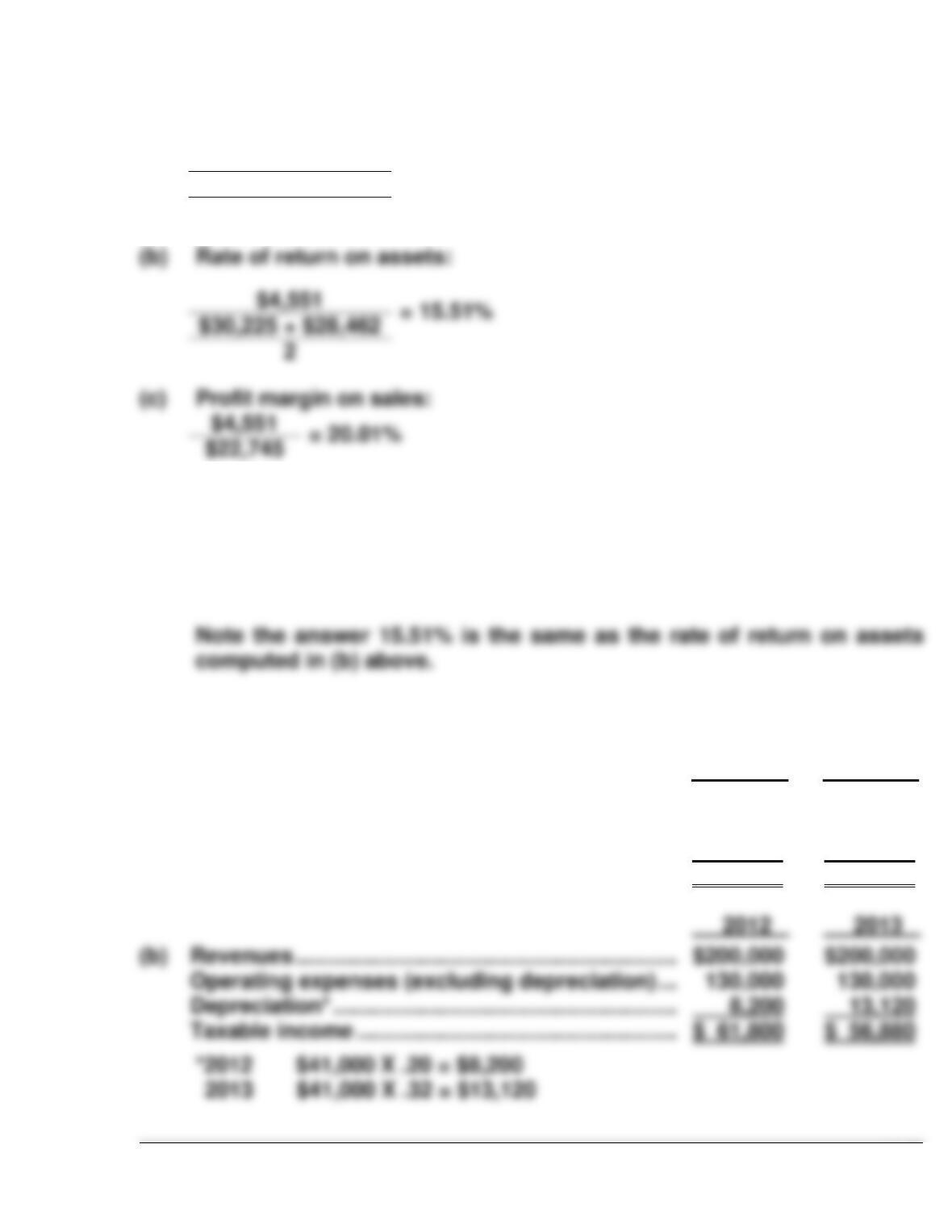
$850,000 + $170,000 + $40,000* – $100,000
= .08 depletion per unit
12,000,000
11–35
EXERCISE 11-24 (15–20 minutes)
(a) Asset turnover ratio:
$22,745
= 0.775 times
$30,225 + $28,462
2
$30,225 + $28,462
= 20.01%
(d) The asset turnover ratio times the profit margin on sales provides the
rate of return on assets computed for McDonald’s as follows:
Profit margin on sales
X
Asset Turnover
Return on Assets
20.01%
X
0.775
=
15.51%
*EXERCISE 11-25 (20–25 minutes)
2012
2013
(a)
Revenues ……………………………………………………..
$200,000
$200,000
Operating expenses (excluding depreciation) …
130,000
130,000
Depreciation [($41,000 – $6,000) ÷ 7] ………………
5,000
5,000
Income before income taxes ………………………….
$ 65,000
$ 65,000
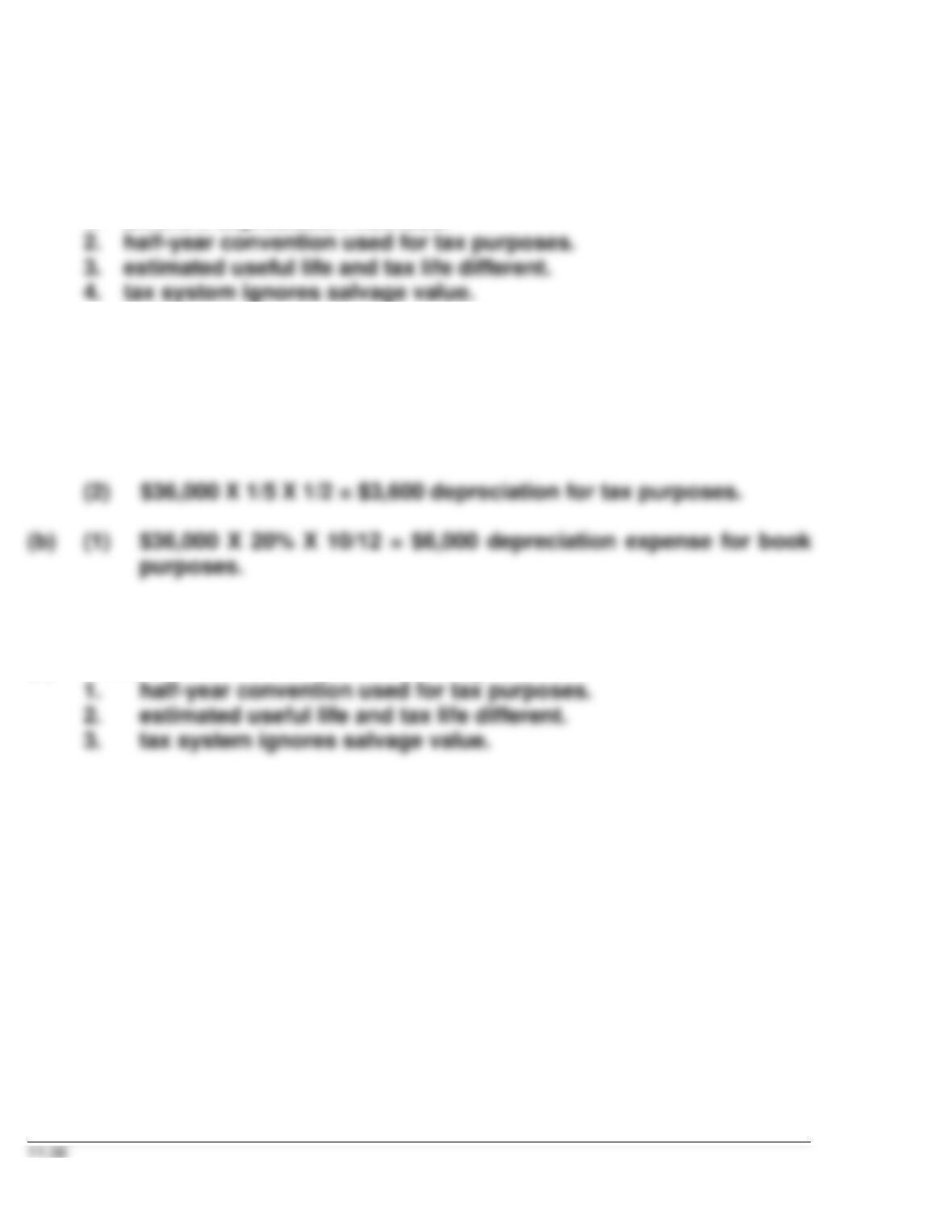
2012
2013
(b)
Revenues ……………………………………………………..
$200,000
Operating expenses (excluding depreciation) …
Depreciation* ………………………………………………..
Taxable income …………………………………………….
$ 61,800
$ 56,880
*EXERCISE 11-25 (Continued)
(c) Book purposes ($41,000 – $6,000) $35,000
Tax purposes (entire cost of asset) $41,000
(d) Differences will occur for the following reasons:
1. different depreciation methods.
*EXERCISE 11-26 (15–20 minutes)
(a) (1) ($36,000 – $3,000) X 1/10 X 10/12 = $2,750 depreciation expense
for book purposes.
(2) $36,000 X 20% = $7,200 depreciation expense for tax purposes.
(c) Differences will occur for the following reasons:
TIME AND PURPOSE OF PROBLEMS
Problem 11-1 (Time 25–30 minutes)
Purpose—to provide the student with an opportunity to compute depreciation expense using a number
of different depreciation methods. The problem is complicated because the proper cost of the machine
to be depreciated must be determined. For example, purchase discounts and freight charges must be
considered. In addition, the student is asked to select a depreciation method that will allocate less
depreciation in the early years of the machine’s life than in the later years.
Problem 11-2 (Time 25–35 minutes)
Purpose—to provide the student with an opportunity to compute depreciation expense using the
following methods: straight-line, units-of-output, working hours, sum-of-the-years’-digits, and declining
balance. The problem is straightforward and provides an excellent review of the basic computational
issues involving depreciation methods.
Problem 11-3 (Time 40–50 minutes)
Purpose—to provide the student with an opportunity to compute depreciation expense using a number
of different depreciation methods. Before the proper depreciation expense can be computed, the
accounts must be corrected for a number of errors made by the company in its accounting for the
assets. An excellent problem for reviewing the proper accounting for plant assets and related deprecia–
tion expense.
Problem 11-4 (Time 45–60 minutes)
Purpose—to provide the student with an opportunity to correct the improper accounting for Semitrucks
and determine the proper depreciation expense. The student is required to compute separately the
errors arising in determining or entering depreciation or in recording transactions affecting Semitrucks.
Problem 11-5 (Time 25–30 minutes)
Purpose—to provide the student with a problem involving the computation of estimated depletion and
depreciation costs associated with a tract of mineral land. The student must compute depletion and de–
preciation on a units-of–production basis (tons mined). A portion of the cost of machinery associated
with the product must be allocated over different periods. The student may experience some difficulty
with this problem.
Problem 11-6 (Time 25–30 minutes)
Purpose—to provide the student with a problem involving the proper accounting for depletion cost. This
problem involves timberland for which a depletion charge must be computed. In addition, a computation
of a loss that occurs because of volcanic activity must be determined.
Problem 11-7 (Time 25–35 minutes)
Purpose—to provide the student with a problem involving depletion and depreciation computations.
Problem 11-8 (Time 25–35 minutes)
Purpose—to provide the student with a comprehensive problem related to property, plant, and
equipment. The student must determine depreciable bases for assets, including capitalized interest,
and prepare depreciation entries using various methods of depreciation.
Problem 11-9 (Time 15–25 minutes)
Purpose—to provide the student with an opportunity to analyze impairments for assets to be used and
assets to be disposed of.
Problem 11-10 (Time 45–60 minutes)
Purpose—to provide the student with an opportunity to solve a complex problem involving a number of
plant assets. A number of depreciation computations must be made, specifically straight-line, 150%
declining balance, and sum-of-the-years’-digits. In addition, the cost of assets acquired is difficult to
determine.

11–38
Time and Purpose of Problems (Continued)
Problem 11-11 (Time 30–35 minutes)
Purpose—to provide the student with the opportunity to solve a moderate problem involving a machinery
purchase and the depreciation computations using straight-line, activity, sum-of-the-years’-digits, and
the double-declining-balance methods, first for full periods and then for partial periods.
*Problem 11-12 (Time 25–35 minutes)
Purpose—to provide the student with an opportunity to compute depreciation expense using a number
of different depreciation methods. The purpose of computing the depreciation expense is to determine
which method will result in the maximization of net income and which will result in the minimization of
net income over a three-year period. An excellent problem for reviewing the fundamentals of depreciation
accounting.
SOLUTIONS TO PROBLEMS
PROBLEM 11-1
(a) 1. Depreciable Base Computation:
Purchase price …………………………
$85,000
Less: Purchase discount (2%) …..
1,700
Installation ……………………………….
3,800
Less: Salvage value …………………
2012—Straight line: ($86,400 ÷ 8 years) X 2/3 year = $7,200
2. Sum-of-the-years’-digits for 2013
Machine Year
Total
Depreciation
2012
2013
1
8/36 X $86,400 =
2
7/36 X $86,400 =
3. Double-declining-balance for 2012
($87,900 X 25% X 2/3) = $14,650
(b) An activity method.
11–40
PROBLEM 11-2
Depreciation Expense
2012
2013
(a)
Straight-line:
($89,000 – $5,000) ÷ 7 = $12,000/yr.
2012: $12,000 X 7/12
$7,000
2013: $12,000
$12,000
(c)
Working hours:
($89,000 – $5,000) ÷ 42,000 hrs. = $2.00/hr.
2012: $2.00 X 6,000
12,000
2013: $2.00 X 5,500
11,000
(d)
Sum-of-the-years’-digits:
1 + 2 + 3 + 4 + 5 + 6 + 7 = 28 or
n(n + 1)
=
7(8)
= 28
2
2
2012: 7/28 X $84,000 X 7/12
2013: 7/28 X $84,000 X 5/12 = $ 8,750
6/28 X $84,000 X 7/12 = 10,500
$19,250
(e)
Declining-balance:
Rate = 2/7
2012: 7/12 X 2/7 X $89,000
14,833
2013: 2/7 X ($89,000 – $14,833) = $21,191
2013: 5/12 X $10,595
$21,190*
(b)
($89,000 – $5,000) ÷ 525,000 units = $.16/unit
2012: $.16 X 55,000
2013: $.16 X 48,000