WHAT’S NEW IN THE SEVENTH EDITION:
A new
In the News
feature on “Monitoring Inflation in the Internet Age” has been added.
LEARNING OBJECTIVES:
By the end of this chapter, students should understand:
➢ how the consumer price index (CPI) is constructed.
➢ why the CPI is an imperfect measure of the cost of living.
➢ how to compare the CPI and the GDP deflator as measures of the overall price level.
➢ how to use a price index to compare dollar figures from different times.
➢ the distinction between real and nominal interest rates.
CONTEXT AND PURPOSE:
Chapter 11 is the second chapter of a two-chapter sequence that deals with how economists measure
output and prices in the macroeconomy. Chapter 10 addressed how economists measure output. Chapter
11 develops how economists measure the overall price level in the macroeconomy.
11
MEASURING THE COST OF
LIVING
198 ❖ Chapter 11/Measuring the Cost of Living
KEY POINTS:
• The consumer price index (CPI) shows the cost of a basket of goods and services relative to the cost
of the same basket in the base year. The index is used to measure the overall level of prices in the
economy. The percentage change in the consumer price index measures the inflation rate.
• The consumer price index is an imperfect measure of the cost of living for three reasons. First, it
• Like the consumer price index, the GDP deflator measures the overall level of prices in the economy.
The two price indexes usually move together, but there are important differences. The GDP deflator
differs from the CPI because it includes goods and services produced rather than goods and services
consumed. As a result, imported goods affect the consumer price index but not the GDP deflator. In
addition, while the consumer price index uses a fixed basket of goods, the GDP deflator automatically
changes the group of goods and services over time as the composition of GDP changes.
• Dollar figures from different times do not represent a valid comparison of purchasing power. To
compare a dollar figure from the past to a dollar figure today, the older figure should be inflated
using a price index.
• Various laws and private contracts use price indexes to correct for the effects of inflation. The tax
laws, however, are only partially indexed for inflation.
CHAPTER OUTLINE:
I. The Consumer Price Index
A. Definition of consumer price index (CPI): a measure of the overall cost of the goods
and services bought by a typical consumer.
B. How the Consumer Price Index Is Calculated
1. Fix the basket.
a. The Bureau of Labor Statistics uses surveys to determine a representative bundle of
goods and services purchased by a typical consumer.
b. Example: 4 hot dogs and 2 hamburgers.
Table 1
Chapter 11/Measuring the Cost of Living ❖ 199
2. Find the prices.
a. Prices for each of the goods and services in the basket must be determined for each time
period.
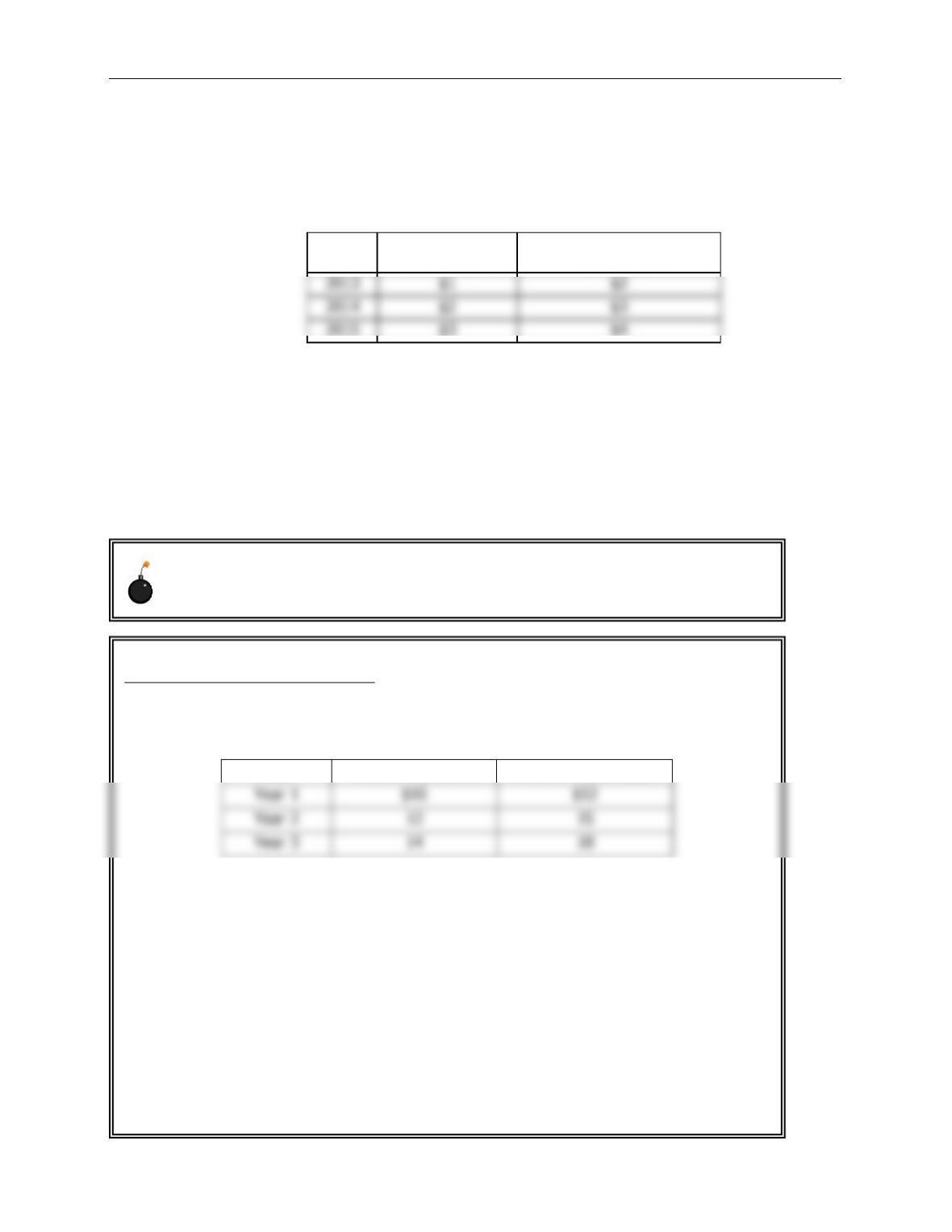
b. Example:
Year
Price of
Hot Dogs
Price of
Hamburgers
3. Compute the basket’s cost.
a. By keeping the basket the same, only prices are being allowed to change. This allows us
to isolate the effects of price changes over time.
b. Example:
Cost in 2013 = ($1 × 4) + ($2 × 2) = $8.
Cost in 2014 = ($2 × 4) + ($3 × 2) = $14.
Cost in 2015 = ($3 × 4) + ($4 × 2) = $20.
ALTERNATIVE CLASSROOM EXAMPLE:
Using the example from Chapter 10:
1. Fix the basket: 3 footballs and 4 basketballs.
2. Find the prices:
Year
Price of Footballs
Price of Basketballs
3. Compute the Cost of the Basket:
Cost in Year 1 = (3 × $10) + (4 × $12) = $78
Cost in Year 2 = (3 × $12) + (4 × $15) = $96
Cost in Year 3 = (3 × $14) + (4 × $18) = $114
4. Using Year 1 as the base year, compute the index:
CPI in Year 1 = ($78/$78) × 100 = 100
CPI in Year 2 = ($96/$78) × 100 = 123.08
CPI in Year 3 = ($114/$78) × 100 = 146.15
5. Compute the inflation rate:
Inflation rate for Year 2 = [(123.08 – 100)/100] × 100 = 23.08%
Inflation rate for Year 3 = [(146.15 – 123.08)/123.08] × 100 = 18.74%
It is very important that students understand how to make these calculations.
Students often have a difficult time recreating the steps taken in class without the
instructor’s help.
200 ❖ Chapter 11/Measuring the Cost of Living
4. Choose a base year and compute the index.
a. The base year is the benchmark against which other years are compared.
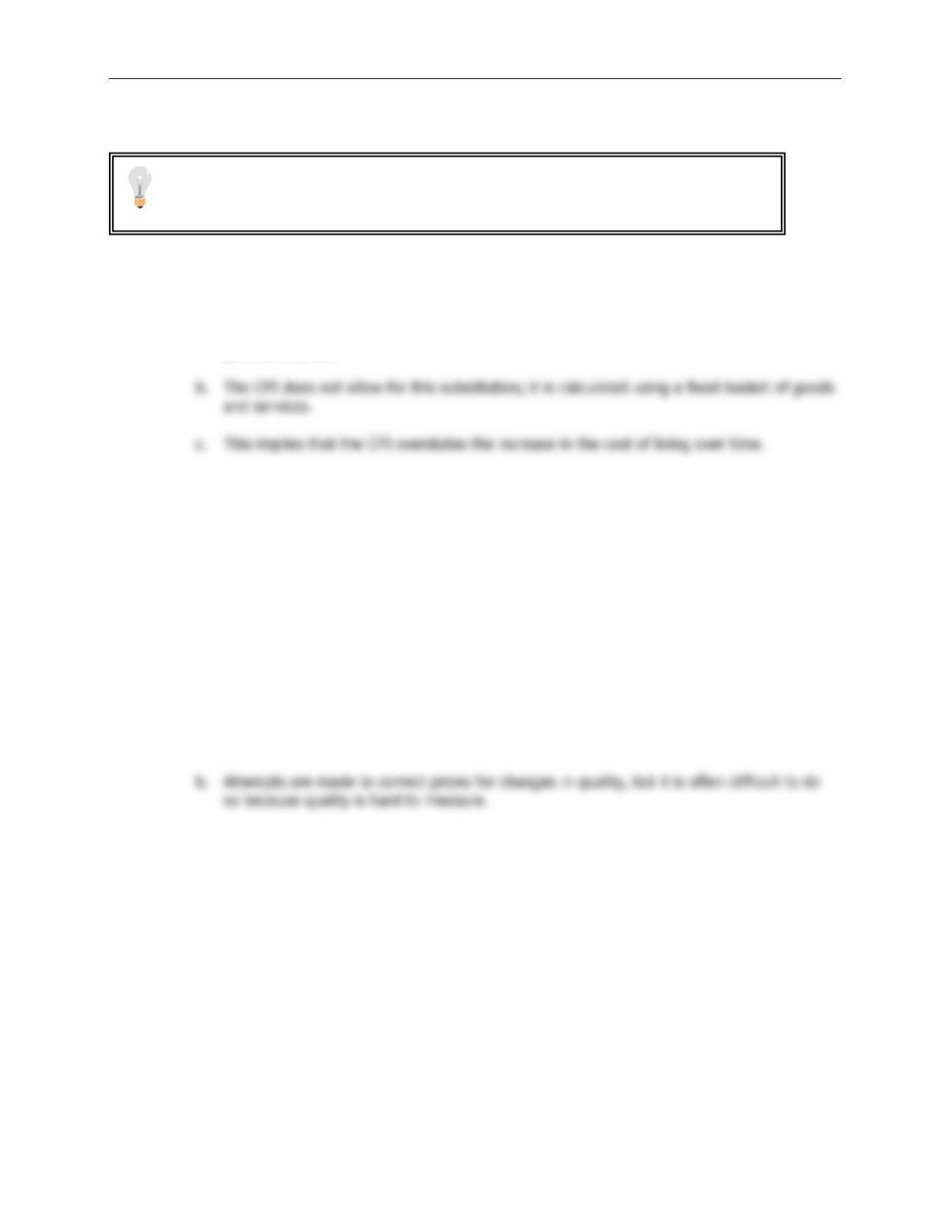
b. The formula for calculating the price index is:
100
=yearbaseinbasketoficePr
yearcurrentinbasketoficePr
CPI
Activity 1—Create a Student Price Index
Type: Take-home assignment
Topics: Consumer price index
Class limitations: Works in any size class
Purpose
This assignment gives students a practical look at how price indices are measured. It also
establishes base prices for calculating inflation rates later in the term.
Instructions
The students should pick real transaction prices for goods they actually purchase. If the
Points for Discussion
This assignment makes a good introduction to a discussion of market basket selection for
price indices. The goods that students usually pick for their market basket account for a
relatively small portion of consumer spending compared to housing, medical care,
transportation, etc. Ask the students which goods are likely to change price frequently.
This can be used to introduce problems with the measurement of the consumer price index.
Assignment
The consumer price index includes the prices of hundreds of goods purchased by consumers.
It is possible to construct many other price indexes.
Your mission: Create a personalized student price index.
1. Choose five (or more) different products.
— be specific e.g., unleaded gasoline, Budweiser beer
At the end of the semester, have students find the prices for these same five products and
recalculate the cost of their market basket. Then, have the students calculate their SPI
(Student Price Index) and the rate of inflation.
Chapter 11/Measuring the Cost of Living ❖ 201
c. Example (using 2013 as the base year):
5. Compute the inflation rate.
a. Definition of inflation rate: the percentage change in the price index from the
preceding period.
b. The formula used to calculate the inflation rate is:
c. Example:
Inflation Rate for 2014 = (175 – 100)/100 × 100 = 75%.
Inflation Rate for 2015 = (250 – 175)/175 × 100 = 43%.
C. The Producer Price Index
1. Definition of producer price index (PPI): a measure of the cost of a basket of goods
and services bought by firms.
D.
FYI: What is in the CPI’s Basket?
1. Figure 1 shows the makeup of the market basket used to compute the CPI.
Figure 1
Be sure to point out to students that it is possible for the CPI to fall if deflation is
present. Point out to students that, even though they have not experienced deflation
in their lifetimes, it has occurred during several periods of U.S. history (especially
during the Great Depression).
Make sure that you explain that inflation does not mean that the prices of all goods
in the economy are rising. Inflation means that prices
on average
are rising. In fact,
the prices of many electronic goods (such as computers and DVD players) have fallen
over time.
Point out that the CPI must be equal to 100 in the base year.
202 ❖ Chapter 11/Measuring the Cost of Living
2. The largest category is housing, which makes up 41% of a typical consumer’s budget.
E. Problems in Measuring the Cost of Living
1. Substitution Bias
a. When the price of one good changes, consumers often respond by substituting another
good in its place.
2. Introduction of New Goods
a. When a new good is introduced, consumers have a wider variety of goods and services
from which to choose.
b. This makes every dollar more valuable, which lowers the cost of maintaining the same
level of economic well-being.
c. Because the market basket is not revised often enough, these new goods are left out of
the bundle of goods and services included in the basket.
3. Unmeasured Quality Change
a. If the quality of a good falls from one year to the next, the value of a dollar falls; if
quality rises, the value of the dollar rises.
4. The size of these problems is also difficult to measure.
5. Many economists believe that the CPI overstates the rate of inflation by approximately one–
half percentage point per year.
6. The issue is important because many government transfer programs (such as Social Security)
are tied to increases in the CPI.
F.
In the News: Monitoring Inflation in the Internet Age
1. The internet provides different ways to collect data on the overall price level.
2. This article from
Slate
describes some new price indices that take advantage of information
available on the web.
One way to highlight this is to draw the pie chart on the board without the category
names and let the students decide what goes where. Most likely, they will be
surprised by the sizes of recreation and medical care.
Chapter 11/Measuring the Cost of Living ❖ 203
G. The GDP Deflator versus the Consumer Price Index
1. The GDP deflator reflects the prices of all goods produced domestically, while the CPI reflects
the prices of all goods bought by consumers.
3. Figure 2 shows the inflation rate as measured by both the CPI and the GDP deflator.
II. Correcting Economic Variables for the Effects of Inflation
A. Dollar Figures from Different Times
1. To change dollar values from one year to the next, we can use this formula:
2. Example: Babe Ruth’s 1931 salary in 2012 dollars:
3.
FYI: Mr. Index Goes to Hollywood
a. Reports of box office success are often made in terms of the dollar values of ticket sales.
Figure 2
Price level in Year 2
Value in Year 2 dollars Value in Year 1 dollars Price level in Year 1
=
ALTERNATIVE CLASSROOM EXAMPLE:
Your father graduated from school and took his first job in 1982, which paid a salary of
$15,000. What is this salary worth in 2012 dollars?
CPI in 1982 = 96.5
CPI in 2012 = 229.5
Value in 2012 dollars = 1982 salary × (CPI in 2012/CPI in 1982)
Value in 2012 dollars = $15,000 × (229.5/96.5) = $35,674
204 ❖ Chapter 11/Measuring the Cost of Living
B. Indexation
1. Definition of indexation: the automatic correction of a dollar amount for the effects
of inflation by law or contract.
2. As mentioned above, many government transfer programs use indexation for the benefits.
The government also indexes the tax brackets used for federal income tax.
3. There are uses of indexation in the private sector as well. Many labor contracts include cost–
of-living allowances (COLAs).
C. Real and Nominal Interest Rates
1. Example: Sally Saver deposits $1,000 into a bank account that pays an annual interest rate
of 10%. A year later, she withdraws $1,100.
2. What matters to Sally is the
purchasing power
of her money.
a. If there is zero inflation, her purchasing power has risen by 10%.
Activity 2—You Paid How Much?
Type: Take-home assignment
Topics: Consumer price index
Class limitations: Works in any size class
Purpose
This assignment gives students a chance to see how dollar values have changed over time. It
also provides them some practice at using the formula to calculate changes in dollar values
over time.
Instructions
Have students ask their parents (or grandparents) how much they paid for their first car and
Use an example to make the importance of real interest rates clear. Suppose a
student has $100 in his savings account earning 3% interest. Ask students what will
happen to the purchasing power of that money if prices rise 3% during the year.
Then, change the inflation rate to 5% and then 1% and go through the example
again.
Chapter 11/Measuring the Cost of Living ❖ 205
3. Definition of nominal interest rate: the interest rate that measures the change in
dollar amounts.
4. Definition of real interest rate: the interest rate corrected for inflation.
5.
Case Study: Interest Rates in the U.S. Economy
a. Figure 3 shows real and nominal interest rates from 1965 to the present.
SOLUTIONS TO TEXT PROBLEMS:
Quick Quizzes
1. The consumer price index measures the overall cost of the goods and services bought by a
Questions for Review
1. A 10% increase in the price of chicken has a greater effect on the consumer price index than
Figure 3
real interest rate nominal interest rate inflation rate=−
206 ❖ Chapter 11/Measuring the Cost of Living
Quick Check Multiple Choice
1. c
Problems and Applications
2. a. Find the price of one unit of each good in each year:
Year
Cauliflower
Broccoli
Carrots
Chapter 11/Measuring the Cost of Living ❖ 207
c. This would lower my estimation of the inflation rate because the value of a bottle of
prices constant.
208 ❖ Chapter 11/Measuring the Cost of Living
8. a. If the elderly consume the same market basket as other people, Social Security would
9. a. When inflation is higher than was expected, the real interest rate is lower than expected.