CHAPTER 11
Corporations: Organization, Stock
Transactions,
Dividends, and Retained Earnings
LEARNING OBJECTIVES
1. DESCRIBE THE MAJOR CHARACTERISTICS OF A
CORPORATION.
2. EXPLAIN HOW TO ACCOUNT FOR THE ISSUANCE OF
COMMON AND PREFERRED STOCK.
3. EXPLAIN HOW TO ACCOUNT FOR TREASURY
STOCK.
4. EXPLAIN HOW TO ACCOUNT FOR CASH DIVIDENDS.
5. EXPLAIN HOW TO ACCOUNT FOR STOCK DIVIDENDS
AND SPLITS.
*9. COMPARE THE ACCOUNTING FOR STOCKHOLDERS’
EQUITY UNDER GAAP AND IFRS.
CHAPTER REVIEW
The Characteristics of a Corporation
1. (L.O. 1) A corporation is an entity created by law that is separate and distinct from its owners
2. The characteristics that distinguish a corporation from proprietorships and partnerships are:
a. The corporation has separate legal existence from its owners.
Forming a Corporation
3. A corporation is formed by grant of a state charter. Upon receipt of its charter from the state of
incorporation the corporation establishes by-laws which are the internal rules and procedures for
Stockholders’ Rights
4. When chartered, the corporation may begin selling ownership rights in the form of shares of stock.
Each share of common stock gives the stockholder the following ownership rights:
Stock Issue Considerations
5. Authorized stock is the amount of stock a corporation is allowed to sell as indicated by its charter.
6. A corporation has the choice of issuing common stock directly to investors or indirectly through an
investment banking firm (brokerage house). Direct issue is typical in closely held companies,
whereas indirect issue is customary for a publicly held corporation.
8. No-par stock is capital stock that has not been assigned a value in the corporate charter. In
Corporate Capital
9. Owner’s equity in a corporation is identified as stockholders’ equity, shareholders’ equity, or
Accounting for Stock Transactions
12. (L.O. 2) The primary objectives in accounting for the issuance of common stock are to (a) identify
13. When par value common stock is issued for cash, the par value of the shares is credited to Common
Stock and the portion of the proceeds that is above or below par value is recorded in a separate
paid-in capital account.
Issuing Common Stock for Services or Noncash Assets
15. When common stock is issued for services or noncash assets, cost is either the fair value of the
consideration given up or the consideration received, whichever is more clearly determinable.
Preferred Stock
16. Preferred stock has contractual claims that give it priority over common stock. Preferred
Treasury Stock
18. (L.O. 3) Treasury stock is a corporation’s own stock that has been issued, fully paid for, and
reacquired but not retired.
Dividends
19. (L.O. 4) A dividend is a distribution by a corporation to its stockholders on a pro rata (proportional)
basis. Dividends may be in the form of cash, property, scrip, or stock.
Dividend Preferences
22. A cumulative dividend provides that preferred stockholders must be paid both current and prior
year dividends before common stockholders receive any dividends.
23. Preferred stockholders must be paid any unpaid prior year dividends before common stockholders
receive dividends.
Stock Dividends
24. (L. O. 5) A stock dividend is a pro rata distribution to stockholders of the corporation’s own stock.
A stock dividend results in a decrease in retained earnings and an increase in paid-in capital. At a
minimum, the par or stated value must be assigned to the dividend shares; in most cases,
however, fair value is used.
25. When the fair value of the stock is used, the following entry is made at the declaration date:
a. Common Stock Dividends Distributable is reported in paid-in capital as an addition to common
stock issued.
Stock Splits
27. A stock split involves the issuance of additional shares of stock to stockholders according to their
percentage ownership.
Stockholders’ Equity Presentation
28. (L.O. 6) Retained earnings is net income that is retained in the business. The balance in retained
earnings is part of the stockholders’ claim on the total assets of the corporation.
a. A net loss is recorded in Retained Earnings by a closing entry in which Retained Earnings is
29. In some cases there may be retained earnings restrictions that make a portion of the balance
currently unavailable for dividends. Restrictions result from one or more of the following causes:
legal, contractual or voluntary. Retained earnings restrictions are generally disclosed in the notes
to the financial statements.
30. A prior period adjustment is the correction of a material error in reporting net income in previously
issued financial statements. The correction is:
31. Many corporations prepare a retained earnings statement to explain the changes in retained
earnings during the year.
32. In the stockholders’ equity section, paid-in capital and retained earnings are reported and the
specific sources of paid-in capital are identified. Within paid-in capital, two classifications are
recognized.
33. A widely used ratio that measures profitability from the common stockholder’s viewpoint is return
*Stockholders’ Equity Statement
*Book Value Per Share
*35. (L.O. 8) Book value per share represents the equity a common stockholder has in the net
assets of the corporation from owning one share of stock.
*Compare the Accounting for Stockholders’ Equity Under GAAP and IFRS
*36. (L.O. 9) The following are the key similarities and differences between GAAP and IFRS as related
to stockholders’ equity, dividends, retained earnings, and income reporting.
a. Similarities
(1) The accounting for the issuance of shares and the purchase of treasury shares are
b. Differences
(1) Under IFRS the term reserves is used to describe all equity accounts other than
contributed (paid-in) capital accounts.
(2) Many countries have a different mix of investor groups than the U. S., e.g., financial
institutions as opposed to private investors.
LECTURE OUTLINE
A. The Corporate Form of Organization.
1. The prevailing legal interpretation of a corporation is an entity separate
and distinct from its owners.
B. Characteristics of a Corporation.
1. Separate legal existence. As an entity separate and distinct from its
owners, the corporation acts under its own name rather than in the name
of its stockholders.
5. Continuous life. The life of a corporation is stated in its charter. It may be
perpetual or it may be limited to a specific number of years.
C. Forming a Corporation.
1. A corporation is formed by grant of a state charter which describes the
name and purpose of the corporation, the types and number of shares of
D. Stockholder Rights.
1. Each share of common stock gives the stockholder the following ownership
rights:
a. Each share of stock entitles the owner to vote in the election of the
board of directors and in corporate actions that require stockholder
approval.
2. Proof of stock ownership is evidenced by a form known as a stock
certificate.
E. Stock Issue Considerations.
1. Authorized stock. The charter indicates the amount of stock that a corpo–
ration is authorized to sell.
INVESTOR INSIGHT
Shares in excess of a billion are often traded daily on the New York Stock
Exchange. For each listed security, the financial press reports the total volume of
stock traded for a given day, the high and low price for the day, the closing
market price, and the net change for the day.
How are the dollar prices per share established for stocks traded on organized
stock exchanges? What factors might influence the price of shares in the market-
place?
F. Corporate Capital.
1. Owners’ equity in a corporation is identified as stockholders’ equity,
shareholders’ equity, or corporate capital.
2. The stockholders’ equity section of a corporation’s balance sheet consists of:
a. Paid-in (contributed) capital. Paid-in capital is the total amount of
cash and other assets paid in to the corporation by stockholders in
G. Accounting for Stock Transactions.
1. The primary objectives in accounting for the issuance of common stock
are to:
2. When the company records issuance of common stock for cash, it credits
3. When no-par common stock has a stated value, the entries are similar to
those for par value stock.
H. Preferred Stock.
1. To appeal to more potential investors, a corporation may issue an additional
class of stock, called preferred stock.
I. Accounting for Treasury Stock.
1. Treasury stock is a corporation’s own stock that it has issued, fully paid
for, and reacquired, but not retired.
ACCOUNTING ACROSS THE ORGANIZATION
Reebok at one time bought back nearly a third of its shares which dramatically
reduced its available cash. Critics suggested that Reebok’s management was
repurchasing shares to make it less likely that another company would acquire
Reebok.
What signal might a large stock repurchase send to investors regarding man–
agement’s belief about the company’s growth opportunities?
J. Dividends.
1. A dividend is a corporation’s distribution of cash or stock to its stockholders
on a pro rata (proportional) basis.
K. Cash Dividends.
1. A cash dividend is a pro rata distribution of cash to stockholders.
a. The declaration date: the date the board of directors formally declares
4. Preferred stock has priority over common stock in regard to dividends.
Preferred stockholders must be paid any unpaid prior-year dividends before
common stockholders receive dividends if the preferred stock is cumulative.
L. Stock Dividends.
1. A stock dividend is a pro rata distribution to stockholders of the corporation’s
own stock.
3. If a company issues a small stock dividend (less than 25% of the cor-
M. Stock Splits.
1. A stock split, like a stock dividend, involves issuance of additional shares
to stockholders according to their ownership percentage.
N. Retained Earnings.
1. Retained earnings is net income that a company retains for use in the
O. Retained Earnings Restrictions.
1. Retained earnings restrictions make a portion of the retained earnings
balance currently unavailable for dividends.
2. Restrictions result from one or more of the following causes:
3. Companies generally disclose retained earnings restrictions in the notes
to the financial statements.
P. Prior Period Adjustments.
1. A prior period adjustment is the correction of an error in previously issued
financial statements.
Q. Retained Earnings Statement.
1. The retained earnings statement shows the changes in retained earnings
R. Statement Presentation and Analysis.
Within paid-in capital, two classifications are recognized
1. Capital stock. This category consists of preferred and common
3. Instead of presenting a detailed stockholders’ equity section in the
balance sheet and a retained earnings statement, many companies
*S. Stockholders’ Equity Statement.
1. A stockholders’ equity statement shows the changes in each stock–
holders’ equity account and in total stockholders’ equity during the year.
*T. Book Value Per Share.
1. Book value per share represents the equity a common stockholder
has in the net assets of a corporation from owning one share of stock.

IFRS
A Look at IFRS
The accounting transactions related to stockholders’ equity, such as issuance of
KEY POINTS
SIMILARITIES
• Aside from the terminology used, the accounting transactions for the
issuance of shares and the purchase of treasury stock are similar.
DIFFERENCES
• Under IFRS, the term reserves is used to describe all equity accounts other
than those arising from contributed (paid-in) capital. This would include, for
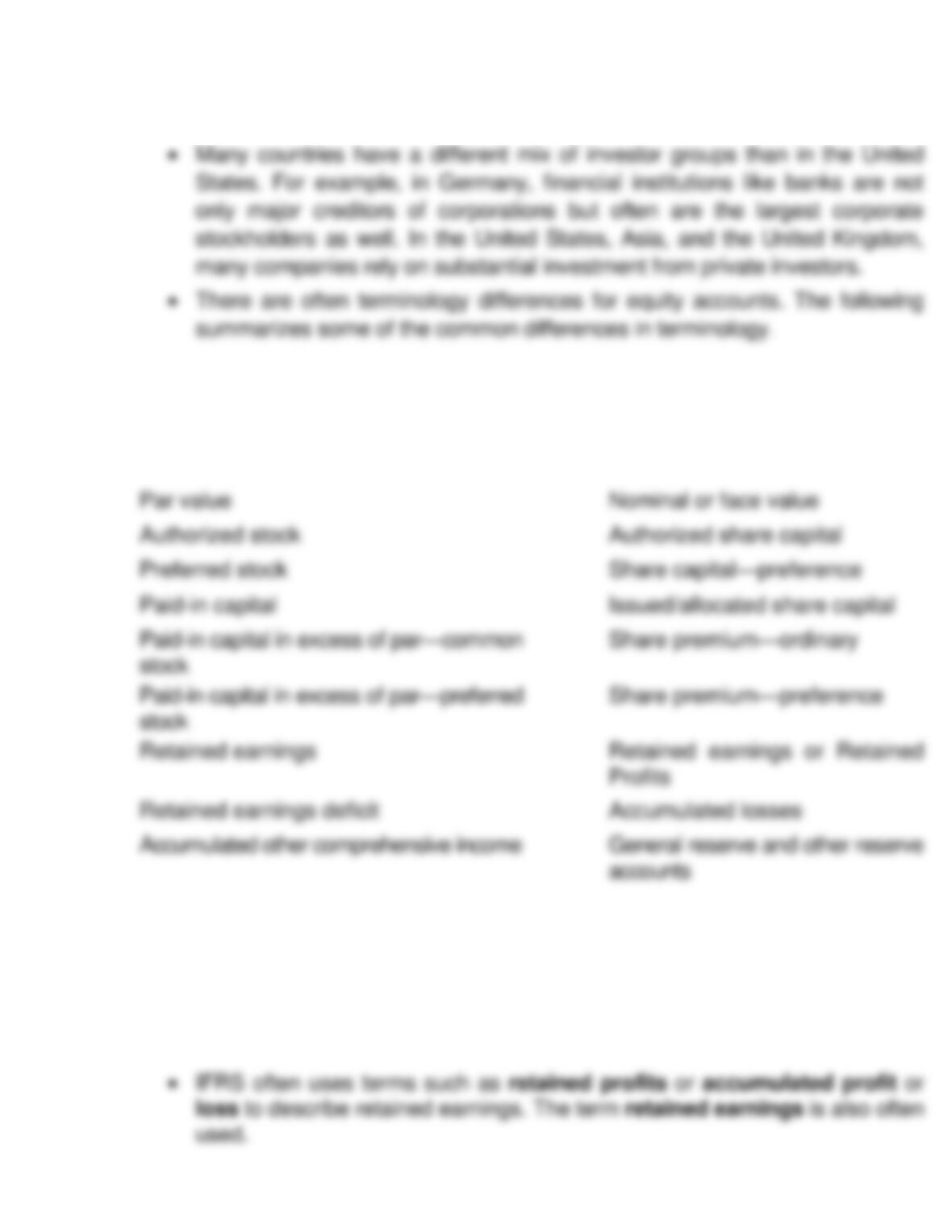
example, reserves related to retained earnings, asset revaluations, and fair
value differences.
GAAP
IFRS
Common stock
Share capital—ordinary
Stockholders
Shareholders
Par value
Nominal or face value
Retained earnings deficit
Accumulated losses
• A major difference between IFRS and GAAP relates to the account
Revaluation Surplus. Revaluation surplus arises under IFRS because
companies are permitted to revalue their property, plant, and equipment to
fair value under certain circumstances. This account is part of general
reserves under IFRS and is not considered contributed capital.
• Equity is given various descriptions under IFRS, such as shareholder’s
equity, owners’ equity, capital and reserves, and shareholders’ funds.
LOOKING TO THE FUTURE
The IASB and the FASB are currently working on a project related to financial
20 MINUTE QUIZ
Circle the correct answer.
True/False
1. The cost method derives its name from the fact that the Treasury Stock account is
maintained at the cost of shares purchased.
True False
2. When treasury stock is sold for an amount greater than cost, the difference should be
credited to Gain on Sale of Treasury Stock and reported as other income on the Income
Statement.
True False
3. Stockholders’ liability is generally unlimited; therefore, creditors have recourse to
stockholders’ personal assets as well as corporate assets.
True False
4. Retained earnings is net income retained in a corporation and is often referred to as
earned capital.
True False
5. A corporation is bound to a contract entered into by one of its stockholders.
True False
6. Issued shares of stock less outstanding shares equals treasury stock.
True False
7. The cumulative feature of stock only applies to preferred stock.
True False
8. Dividends in arrears are not considered a liability because no obligation exists until the
dividend is declared by the board of directors.
True False
9. A prior period adjustment always includes a credit to Retained Earnings.
True False
10. Three important dates relating to cash dividends are: date of declaration, date of record,
and date of payment.
True False
Multiple Choice
1. Par value
a. represents what a share of stock is worth.
b. represents the original selling price for a share of stock.
c. is the legal capital established for a share of stock.
d. is established for a share of stock after it is issued.
2. If a company has 900,000 shares of common stock authorized, and has 750,000 shares
issued, and holds 30,000 shares of common stock as treasury stock, the general ledger
account for common stock, $1 par value would have a balance of
a. $870,000.
b. $750,000.
c. $720,000.
d. $150,000.
3. A company purchases 1,500 shares of its $25 par value stock at $35 per share. It then
reissues 500 shares at $40 per share. The entry upon reissue of the stock would include
a credit to
a. Cash for $2,500.
b. Treasury Stock for $2,500.
c. Retained Earnings for $2,500.
d. Paid-in Capital from Treasury Stock for $2,500.
4. Preferred stock would least likely have which characteristic?
a. The right of the holder to vote at stockholders’ meetings.
b. The right of the corporation to redeem or retire the stock.
c. Preference as to assets upon liquidation of the corporation.
d. Preference as to dividends.
5. A company had outstanding 80,000 shares of $10 par value common stock. During the
period a 10% stock dividend was declared and distributed. The market value was $25 a
share. As a result of this stock dividend, retained earnings should increase (decrease) by
a. $0.
b. $(80,000).
c. $(200,000).
d. $80,000.

ANSWERS TO QUIZ
True/False
Multiple Choice