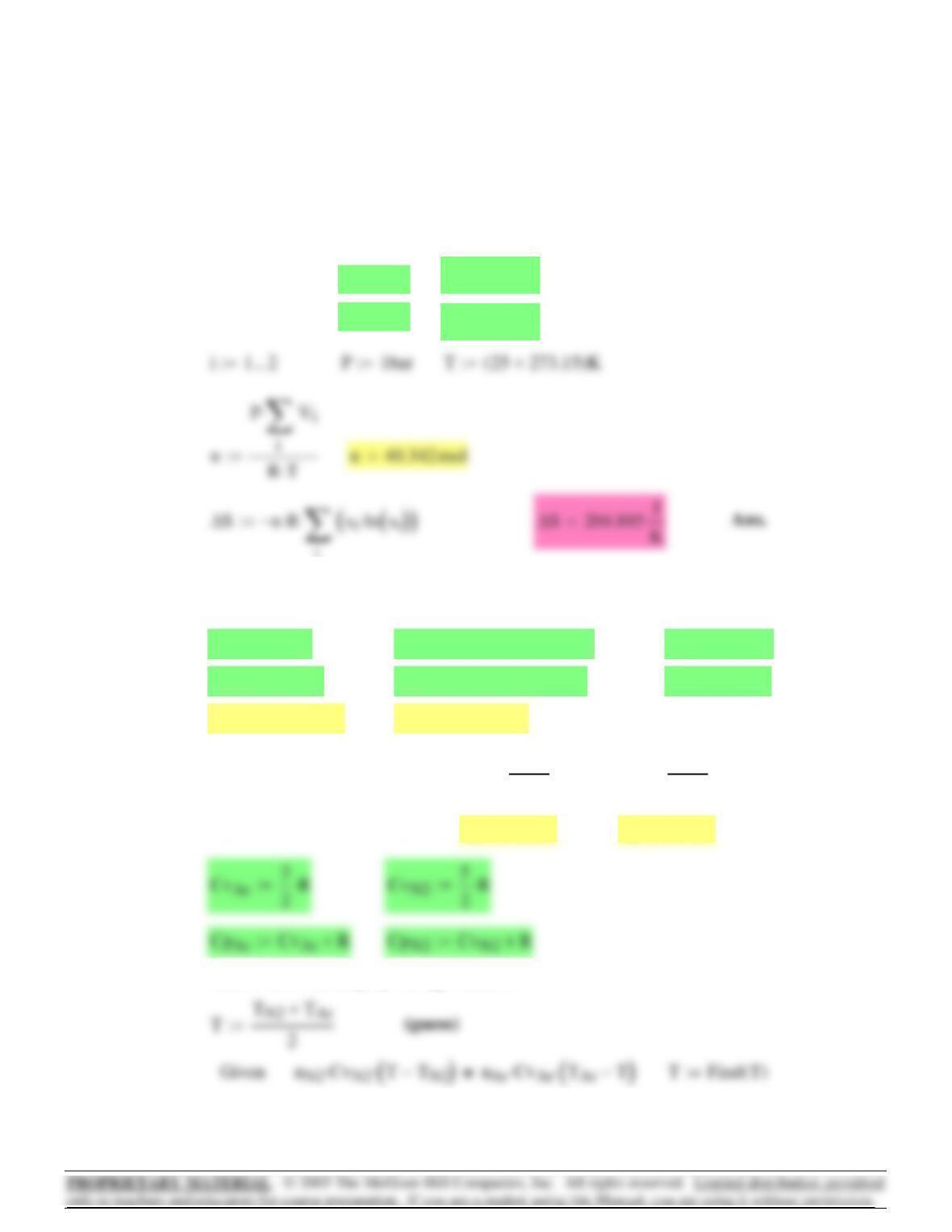
nAr 2.5 mol⋅:= TAr 130 273.15+()K⋅:= PAr 20 bar⋅:=
TN2 348.15 K=TAr 403.15 K=i12..:=
ntotal nN2 nAr
+:= x1
nN2
ntotal
:= x2
nAr
ntotal
:=
x10.615=x20.385=
Find T after mixing by energy balance:
Chapter 11 – Section A – Mathcad Solutions
11.1 For an ideal gas mole fraction = volume fraction
CO2 (1): x10.7:= V10.7m3
:=
N2 (2): x20.3:= V20.3m3
:=
i
11.2 For a closed, adiabatic, fixed-volume system, ∆U =0. Also, for an ideal
gas, ∆U = Cv ∆T. First calculate the equilibrium T and P.
nN2 4 mol⋅:= TN2 75 273.15+()K⋅[]:= PN2 30 bar⋅:=
341
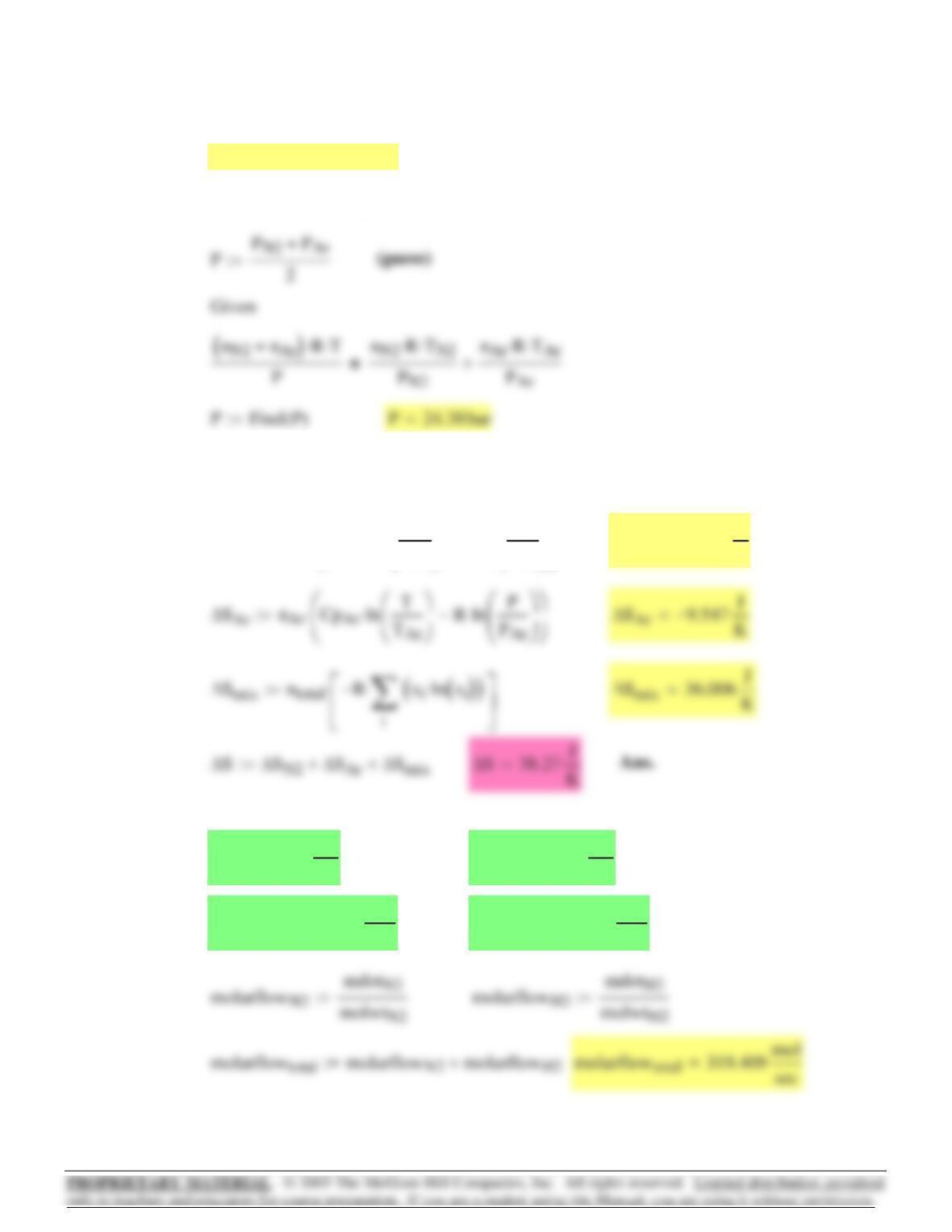
i12..:=
molwtH2 2.016 gm
mol
⋅:=molwtN2 28.014 gm
mol
⋅:=
mdotH2 0.5 kg
sec
⋅:=mdotN2 2kg
sec
⋅:=
11.3
⎜
⎜
⎜
∆SN2 11.806 J
K
=∆SN2 nN2 CpN2 ln T
TN2
⎛
⎜
⎝
⎞
⎠
⋅Rln P
PN2
⎛
⎜
⎝
⎞
⎠
⋅−
⎛
⎜
⎝
⎞
⎠
⋅:=
Calculate entropy change by two-step path:
1) Bring individual stream to mixture T and P.
2) Then mix streams at mixture T and P.
Find P after mixing:
T 273.15 K⋅− 90 degC=
342
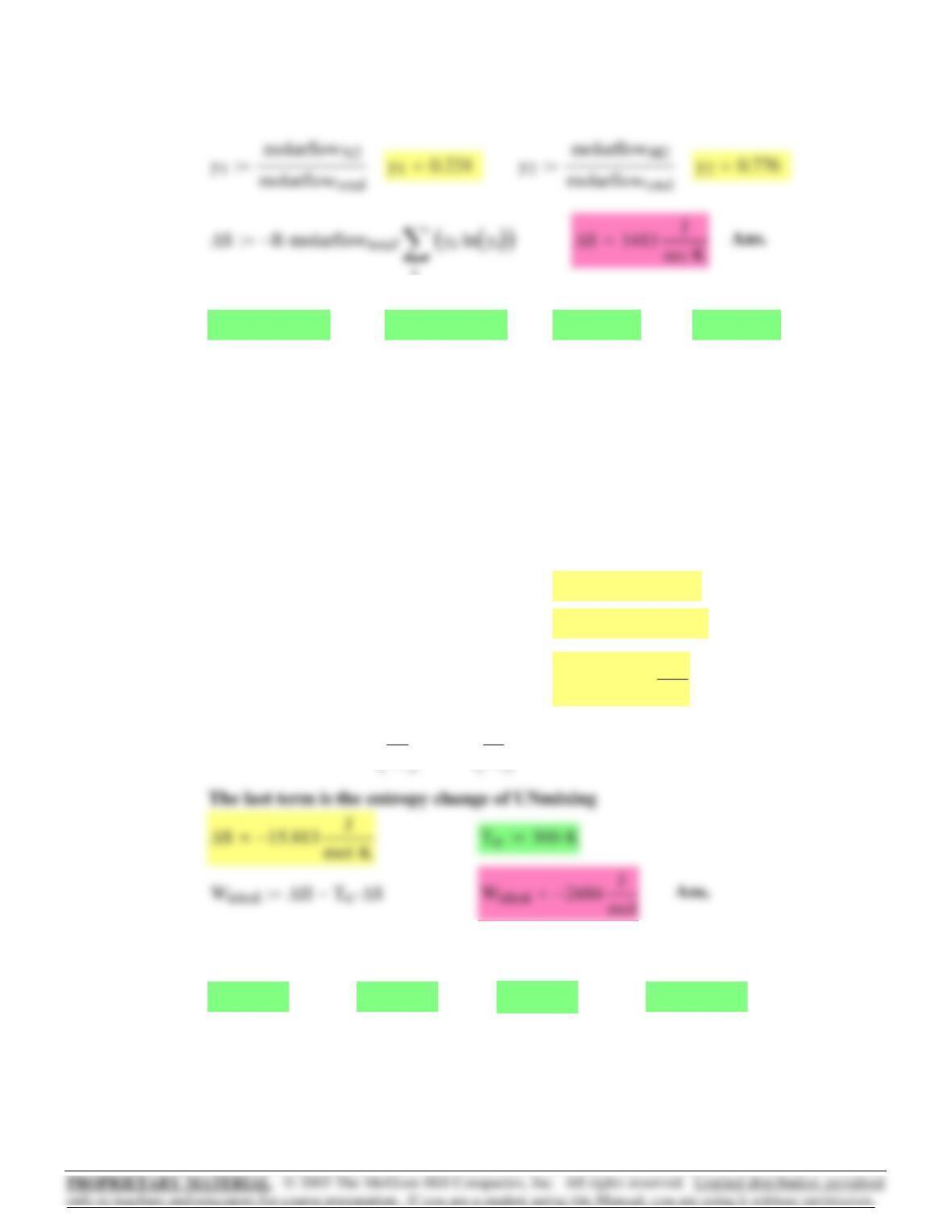
MCPSmix 6.161=
∆H R MCPHmix
⋅T2T1
−
()
⋅:= ∆H 7228−J
mol
=
∆S R MCPSmix
⋅ln T2
T1
⎛
⎜
⎞
⋅Rln P2
P1
⎛
⎜
⎞
⋅− R2⋅0.5⋅ln 0.5()⋅+:=
11.5 Basis: 1 mole entering air.
y10.21:= y20.79:= ηt0.05:= Tσ300 K⋅:=
Assume ideal gases; then ∆H0=
The entropy change of mixing for ideal gases is given by the equation
following Eq. (11.26). For UNmixing of a binary mixture it becomes:
i
11.4 T1448.15 K⋅:= T2308.15 K⋅:= P13 bar⋅:= P21 bar⋅:=
For methane:
MCPHmMCPH T1T2
,1.702,9.081 10 3−
⋅, 2.164−10 6−
⋅, 0.0,
()
:=
MCPSmMCPS T1T2
,1.702,9.081 10 3−
⋅, 2.164−10 6−
⋅, 0.0,
()
:=
For ethane:
MCPHeMCPH T1T2
,1.131,19.225 10 3−
⋅, 5.561−10 6−
⋅, 0.0,
()
:=
MCPSeMCPS T1T2
,1.131,19.225 10 3−
⋅, 5.561−10 6−
⋅, 0.0,
()
:=
MCPHmix 0.5 MCPHm
⋅0.5 MCPHe
⋅+:= MCPHmix 6.21=
MCPSmix 0.5 MCPSm
⋅0.5 MCPSe
⋅+:=
343
Fi
Zi1−
Pi
:=
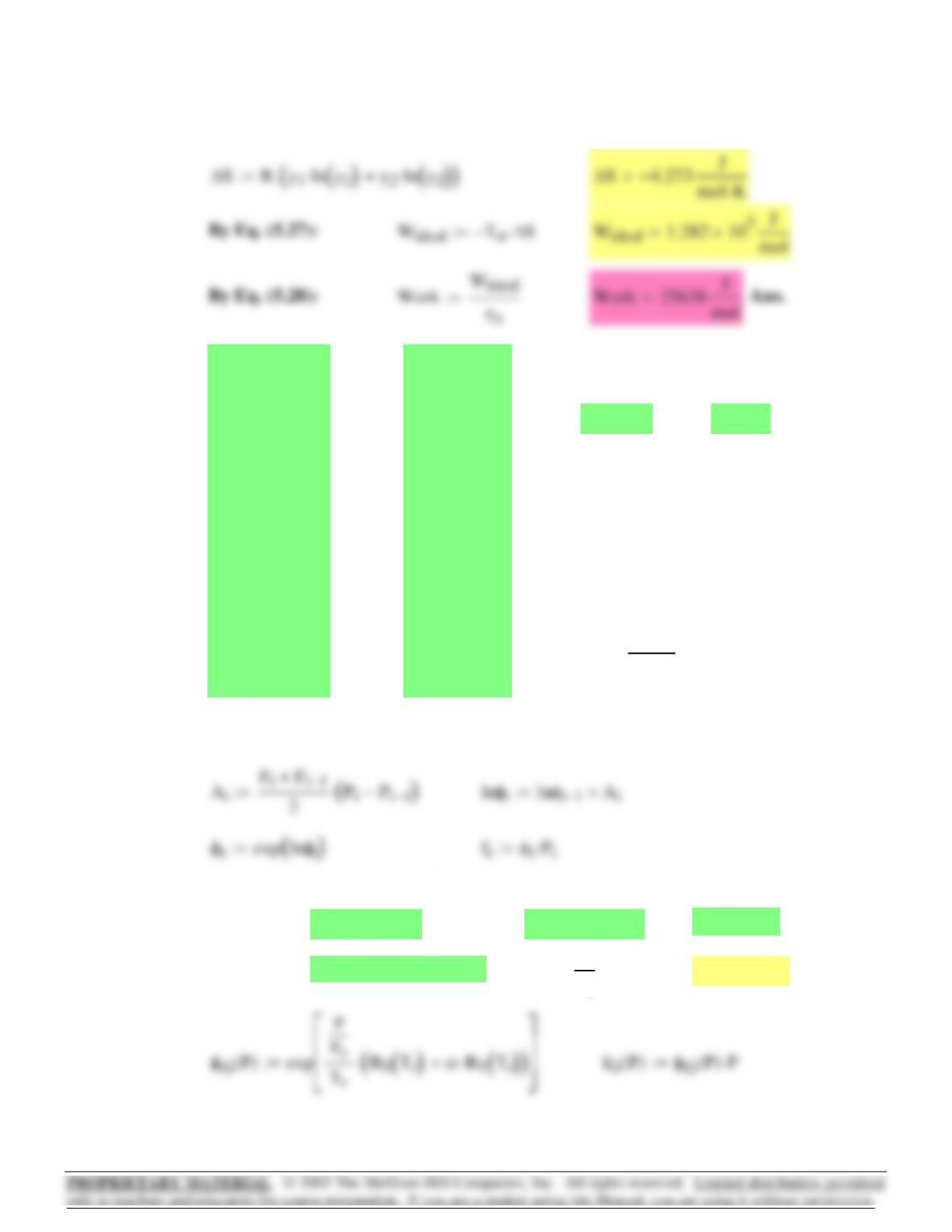
Fi is a well behaved function; use the trapezoidal rule to integrate Eq.
(11.35) numerically.
Generalized correlation for fugacity coefficient:
For CO2: Tc304.2 K⋅:= Pc73.83 bar⋅:= ω 0.224:=
T 150 273.15+()K⋅:= Tr
T
Tc
:= Tr1.391=
⎢
⎥
11.16
lnφ10:= φ11:=
P
0
10
20
40
60
80
100
200
300
400
500
⎛
⎜
⎜
⎜
⎜
⎜
⎜
⎜
⎜
⎜
⎜
⎜
⎜
⎜
⎜
⎝
⎞
⎟
⎟
⎟
⎟
⎟
⎟
⎟
⎟
⎟
⎟
⎟
⎟
⎠
bar⋅:= Z
1.000
0.985
0.970
0.942
0.913
0.885
0.869
0.765
0.762
0.824
0.910
⎛
⎜
⎜
⎜
⎜
⎜
⎜
⎜
⎜
⎜
⎜
⎜
⎜
⎜
⎜
⎝
⎞
⎟
⎟
⎟
⎟
⎟
⎟
⎟
⎟
⎟
⎟
⎟
⎟
⎠
:=
end rows P():=
i 2 end..:=
344
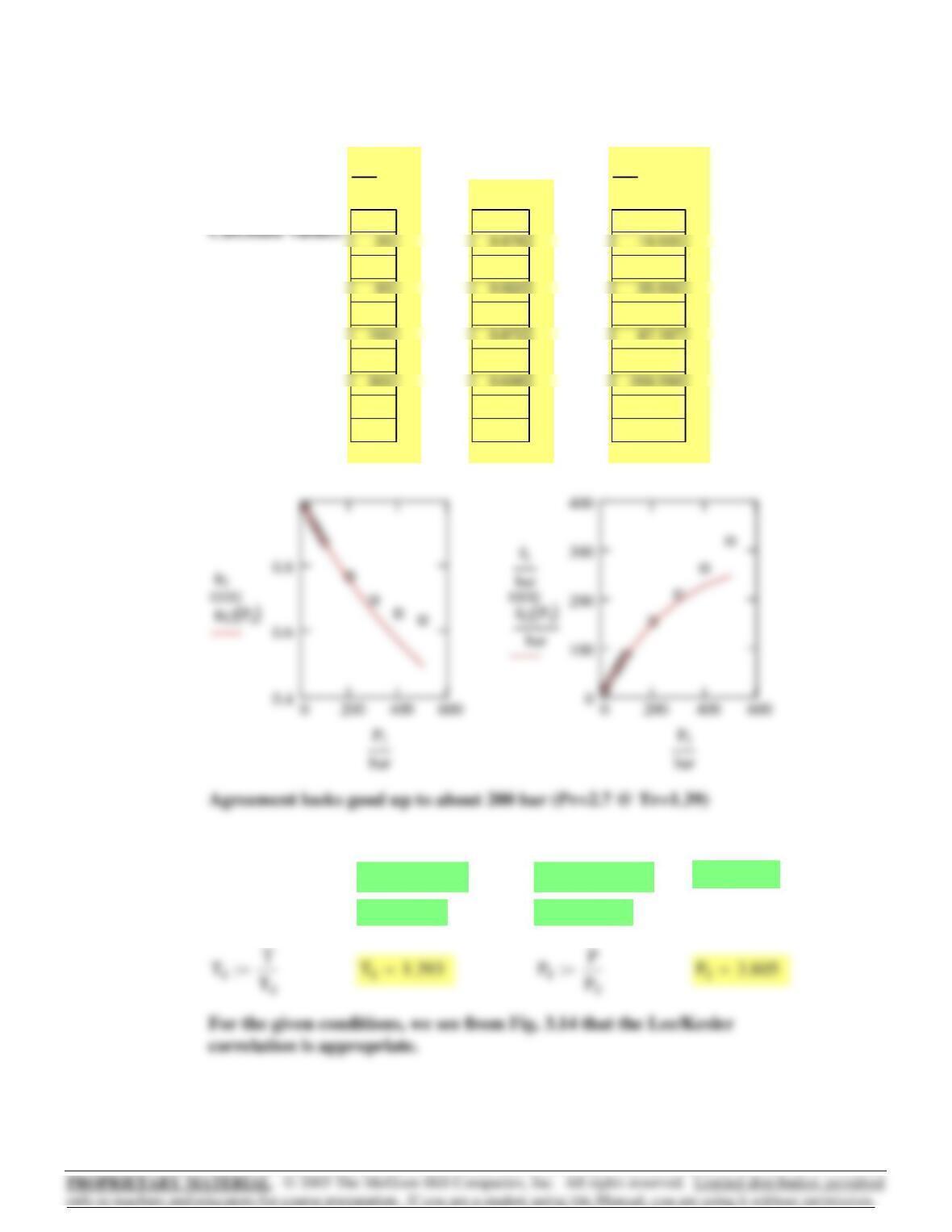
P 300 bar⋅:=T 600 K⋅:=
ω0.245:=Pc78.84 bar⋅:=Tc430.8 K⋅:=
For SO2:11.17
φi
0.993
0.949
0.896
0.77
0.656
0.636
=
fi
bar
9.925
37.973
71.676
153.964
262.377
317.96
=
Pi
bar
10
40
80
200
400
500
=
345
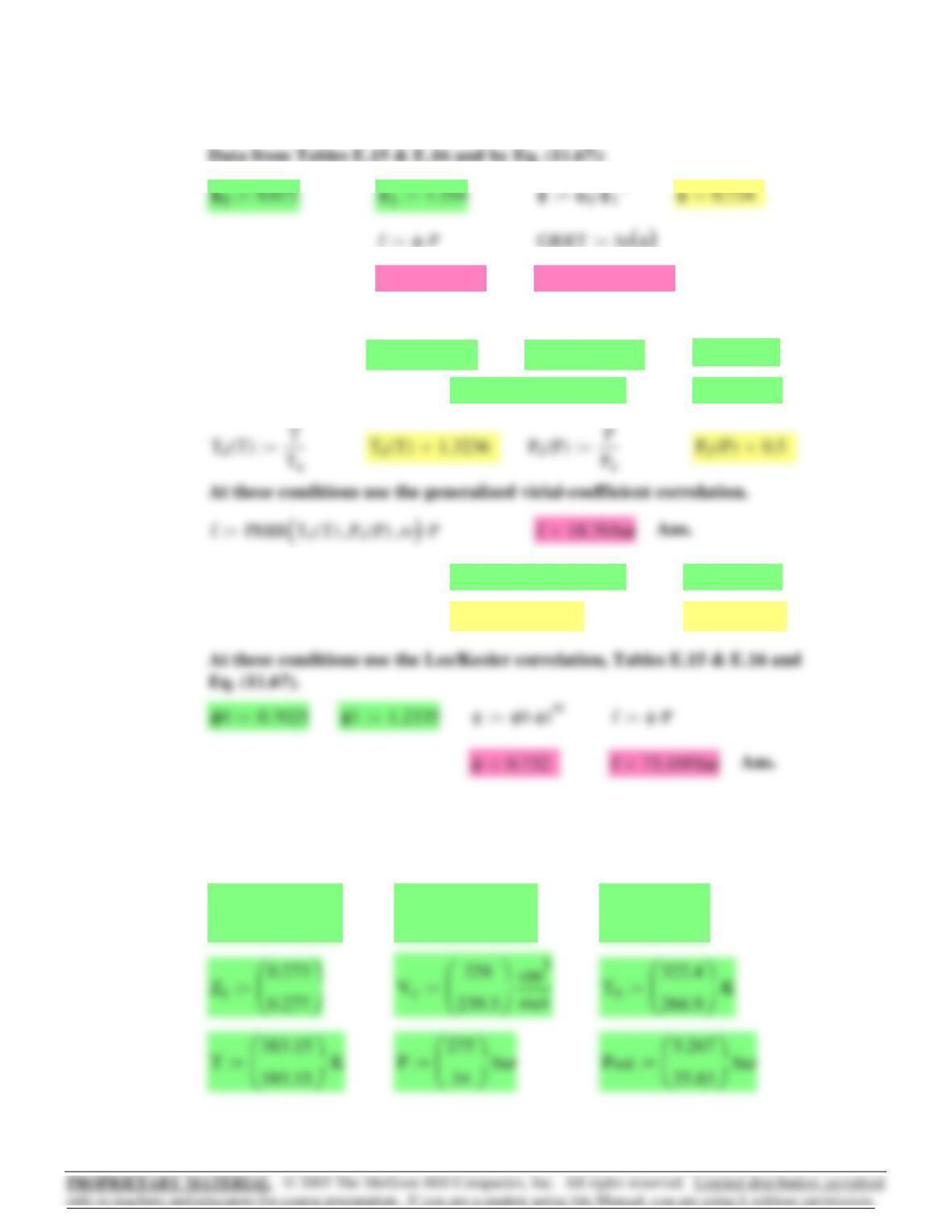
b) At 280 degC and 100 bar: T 280 273.15+()K⋅:= P 100 bar⋅:=
TrT( ) 1.3236=PrP( ) 2.5=
11.19 The following vectors contain data for Parts (a) and (b):
(a) = Cyclopentane; (b) = 1-butene
Tc
511.8
420.0
⎛
⎜
⎝
⎞
⎠K⋅:= Pc
45.02
40.43
⎛
⎜
⎝
⎞
⎠bar⋅:= ω0.196
0.191
⎛
⎜
⎝
⎞
⎠
:=
⎜
⎜
⎜
⎜
⎜
⎜
ω
f 217.14 bar=GRRT 0.323−= Ans.
11.18 Isobutylene: Tc417.9 K⋅:= Pc40.00 bar⋅:= ω 0.194:=
a) At 280 degC and 20 bar: T 280 273.15+()K⋅:= P 20 bar⋅:=
346
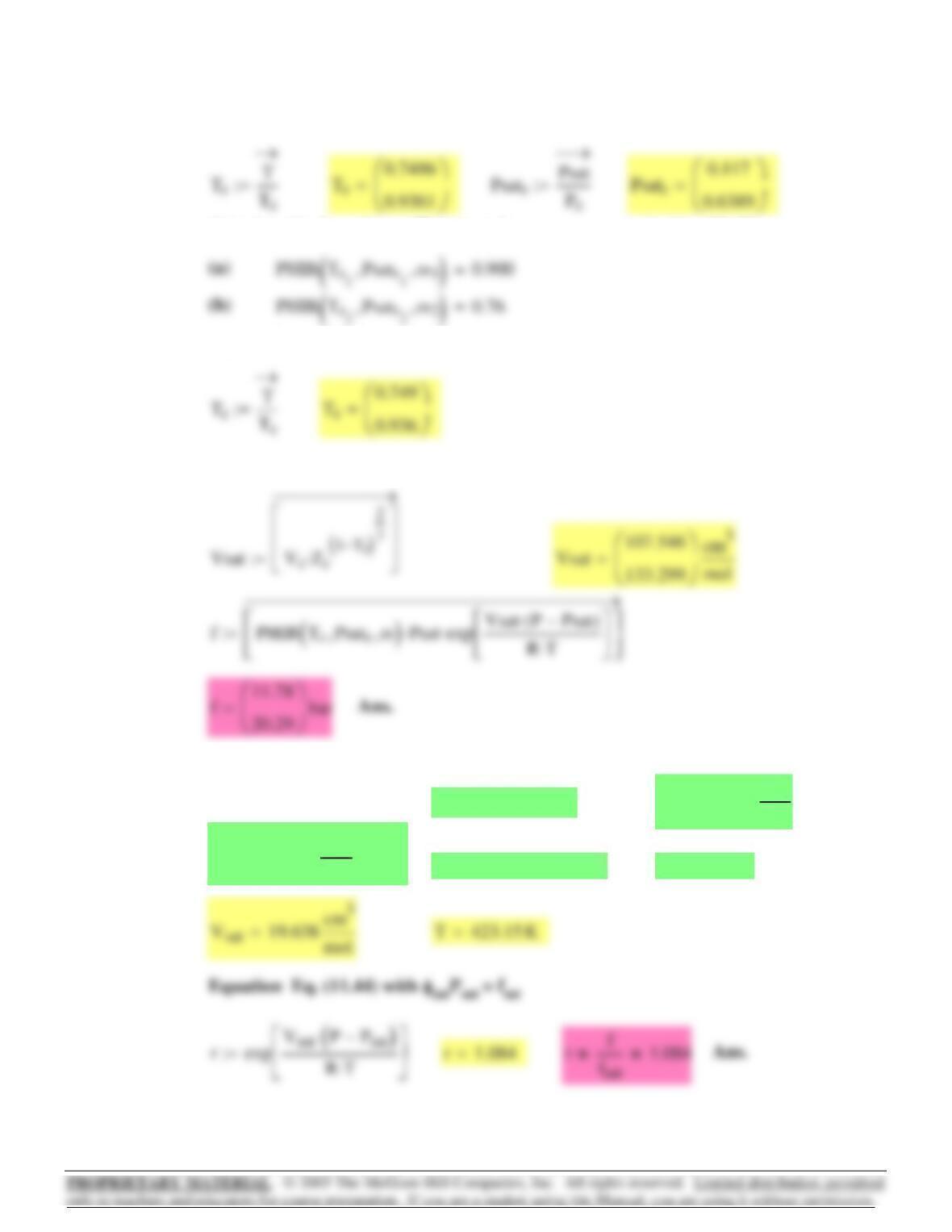
11.21 Table F.1, 150 degC: Psat 476.00 kPa⋅:= molwt 18 gm
mol
⋅:=
Vsat 1.091 cm3
gm
⋅molwt⋅:= T 150 273.15+()K⋅:= P 150 bar⋅:=
Calculate the fugacity coefficient at the vapor pressure by Eq. (11.68):
Eq. (3.72), the Rackett equation:
Eq. (11.44):
347
Tn
309.2
266.3
266.9
⎛
⎜
⎜
⎜
⎝
⎞
⎟
⎠
K⋅:=
Vc
313.0
238.9
239.3
⎛
⎜
⎜
⎜
⎝
⎞
⎟
⎠
cm3
mol
⋅:=Zc
0.270
0.275
0.277
⎛
⎜
⎜
⎜
⎝
⎞
⎟
⎠
:=
ω
0.252
0.194
0.191
⎛
⎜
⎜
⎜
⎝
⎞
⎟
⎠
:=
Pc
33.70
40.0
40.43
⎛
⎜
⎜
⎜
⎝
⎞
⎟
⎠
bar⋅:=
Tc
469.7
417.9
420.0
⎛
⎜
⎜
⎜
⎝
⎞
⎟
⎠
K⋅:=
(c) = 1-Butene:(b) = Isobutylene(a) = n-pentane
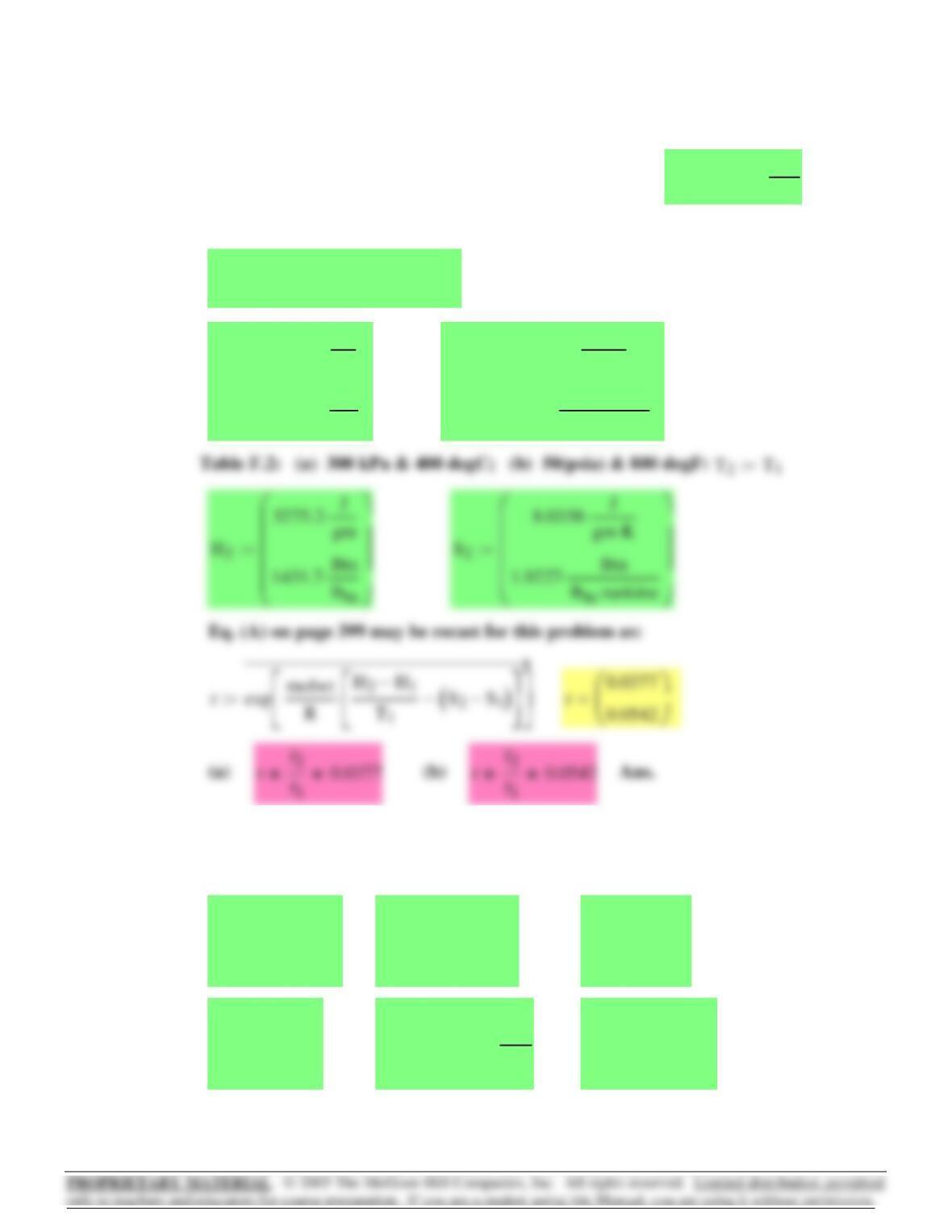
The following vectors contain data for Parts (a), (b), and (c):11.23
S1
6.2915 J
gm K⋅
⋅
1.5677 Btu
lbmrankine⋅
⋅
⎛
⎜
⎜
⎜
⎜
⎝
⎞
⎟
⎟
⎠
:=
H1
3121.2 J
gm
⋅
1389.6 Btu
lbm
⋅
⎛
⎜
⎜
⎜
⎜
⎝
⎞
⎟
⎟
⎠
:=
T1
400 273.15+()K⋅
800 459.67+( ) rankine⋅
⎡
⎢
⎣
⎤
⎥
⎦
:=
Table F.2: (a) 9000 kPa & 400 degC; (b) 1000(psia) & 800 degF:
molwt 18 gm
mol
⋅:=
The following vectors contain data for Parts (a) and (b):11.22
348
⎜
⎜
⎜
⎜
⎜
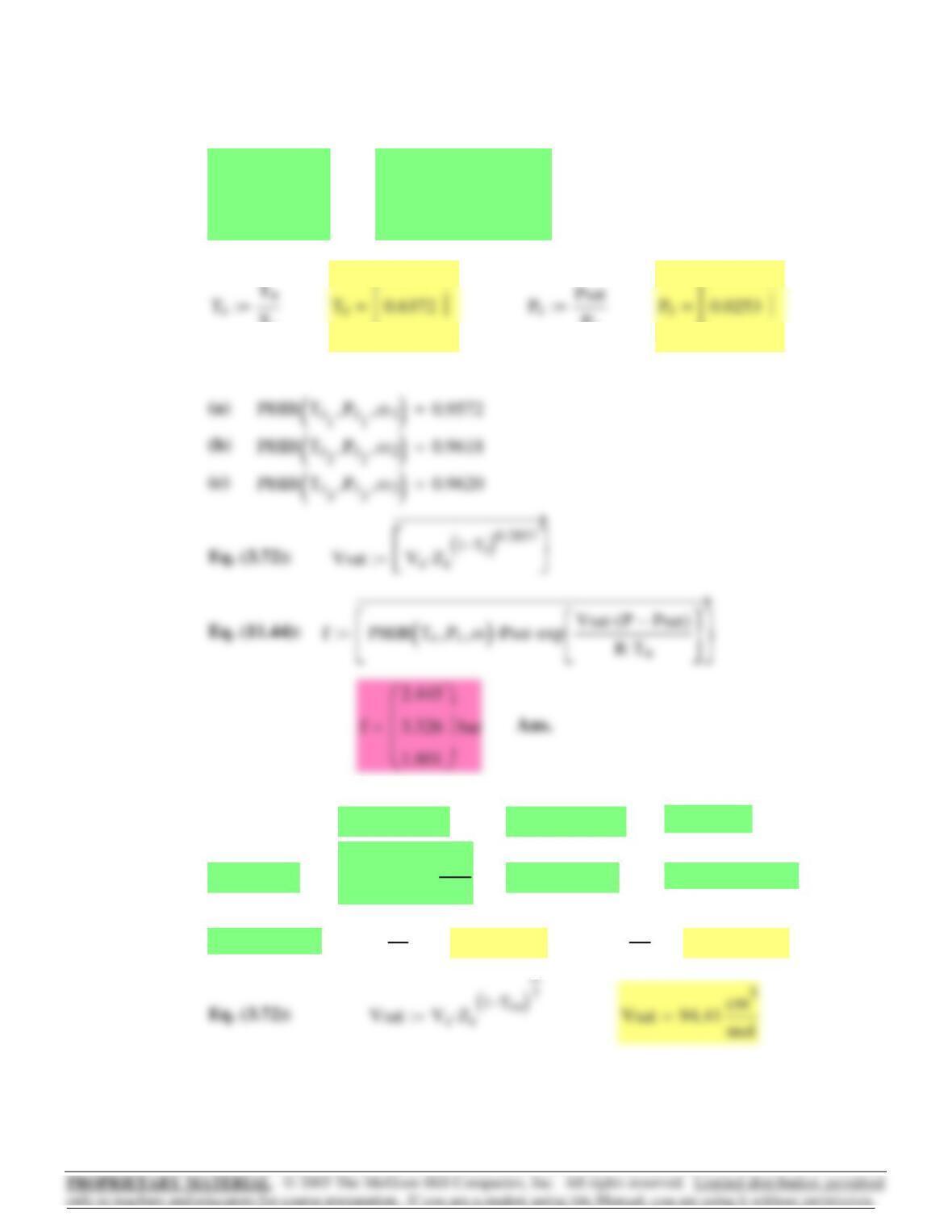
11.24 (a) Chloroform: Tc536.4 K⋅:= Pc54.72 bar⋅:= ω 0.222:=
Zc0.293:= Vc239.0 cm3
mol
⋅:= Tn334.3 K⋅:= Psat 22.27 bar⋅:=
T 473.15 K⋅:= Tr
T
Tc
:= Tr0.882=Trn
Tn
Tc
:= Trn 0.623=
2
P
200
300
150
⎛
⎜
⎜
⎜
⎝
⎞
⎟
⎠
bar⋅:= Psat
1.01325
1.01325
1.01325
⎛
⎜
⎜
⎜
⎝
⎞
⎟
⎠
bar⋅:=
⎜
⎜
Tc
→
⎯
0.6583
0.6355
⎛
⎜
⎝
⎞
⎠
Pc
→
⎯
⎯
0.0301
0.0251
⎛
⎜
⎝
⎞
⎠
Calculate the fugacity coefficient at the nbp by Eq. (11.68):
⎯
⎯
⎯
⎯
⎜
⎜
349
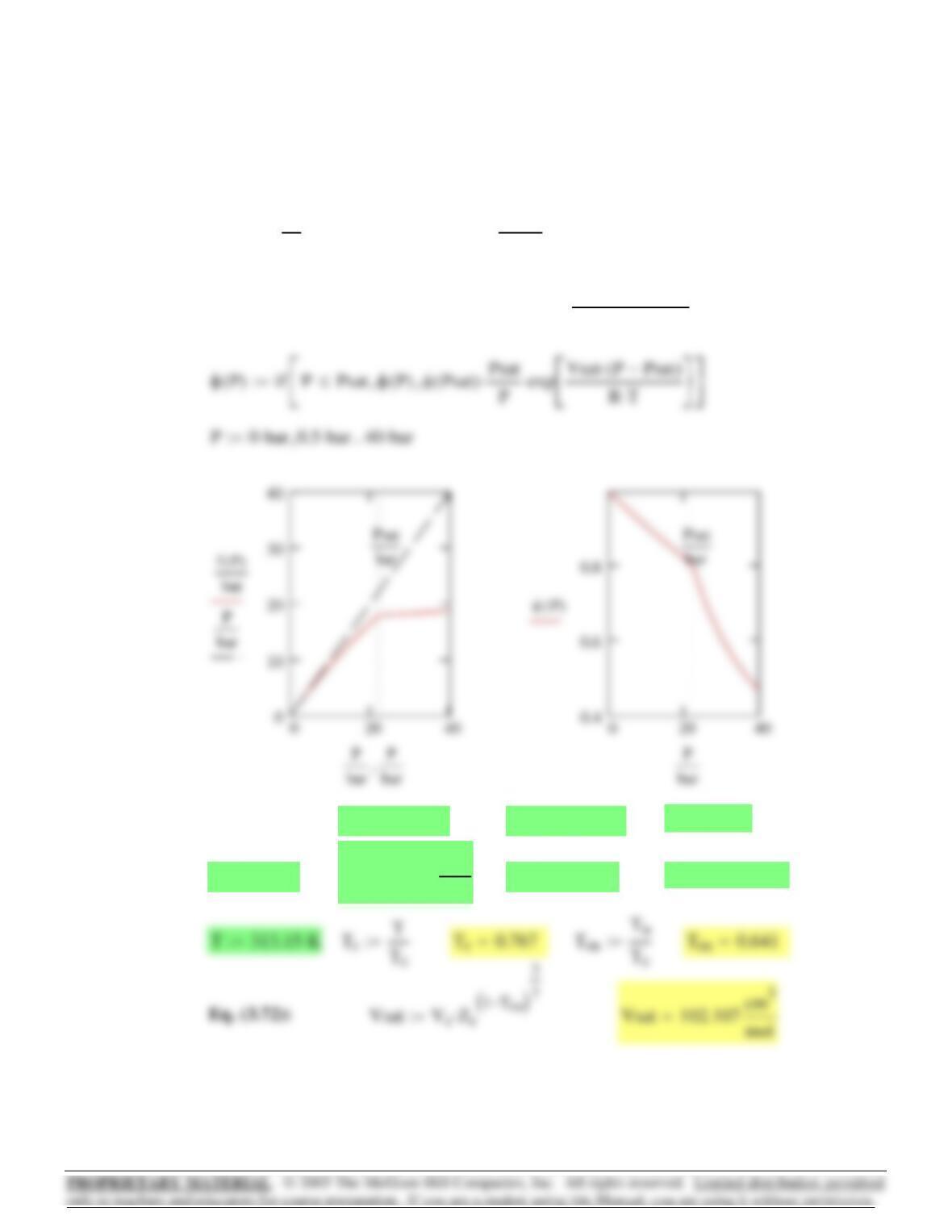
Psat 5.28 bar⋅:=Tn261.4 K⋅:=Vc262.7 cm3
mol
⋅:=Zc0.282:=
ω0.181:=Pc36.48 bar⋅:=Tc408.1 K⋅:=
Isobutane(b)
⎢
⎥
⎢
⎥
fP( ) if P Psat≤φP()P⋅,φPsat( ) Psat⋅exp Vsat P Psat−()⋅
RT⋅
⎡
⎢
⎣
⎤
⎥
⎦
⋅,
⎡
⎢
⎣
⎤
⎥
⎦
:=
φP( ) exp PrP()
Tr
B0Tr
()
ωB1Tr
()
⋅+
()
⋅
⎡
⎢
⎣
⎤
⎥
⎦
:=
PrP() P
Pc
:=
Calculate fugacity coefficients by Eqs. (11.68):
350
Vc 131.0
188.4
⎛
⎜
⎝
⎞
⎠
cm3
mol
⋅:=Zc 0.281
0.289
⎛
⎜
⎝
⎞
⎠
:=
w0.087
0.140
⎛
⎜
⎝
⎞
⎠
:=
Pc 50.40
46.65
⎛
⎜
⎝
⎞
⎠bar⋅:=
Tc 282.3
365.6
⎛
⎜
⎝
⎞
⎠K⋅:=
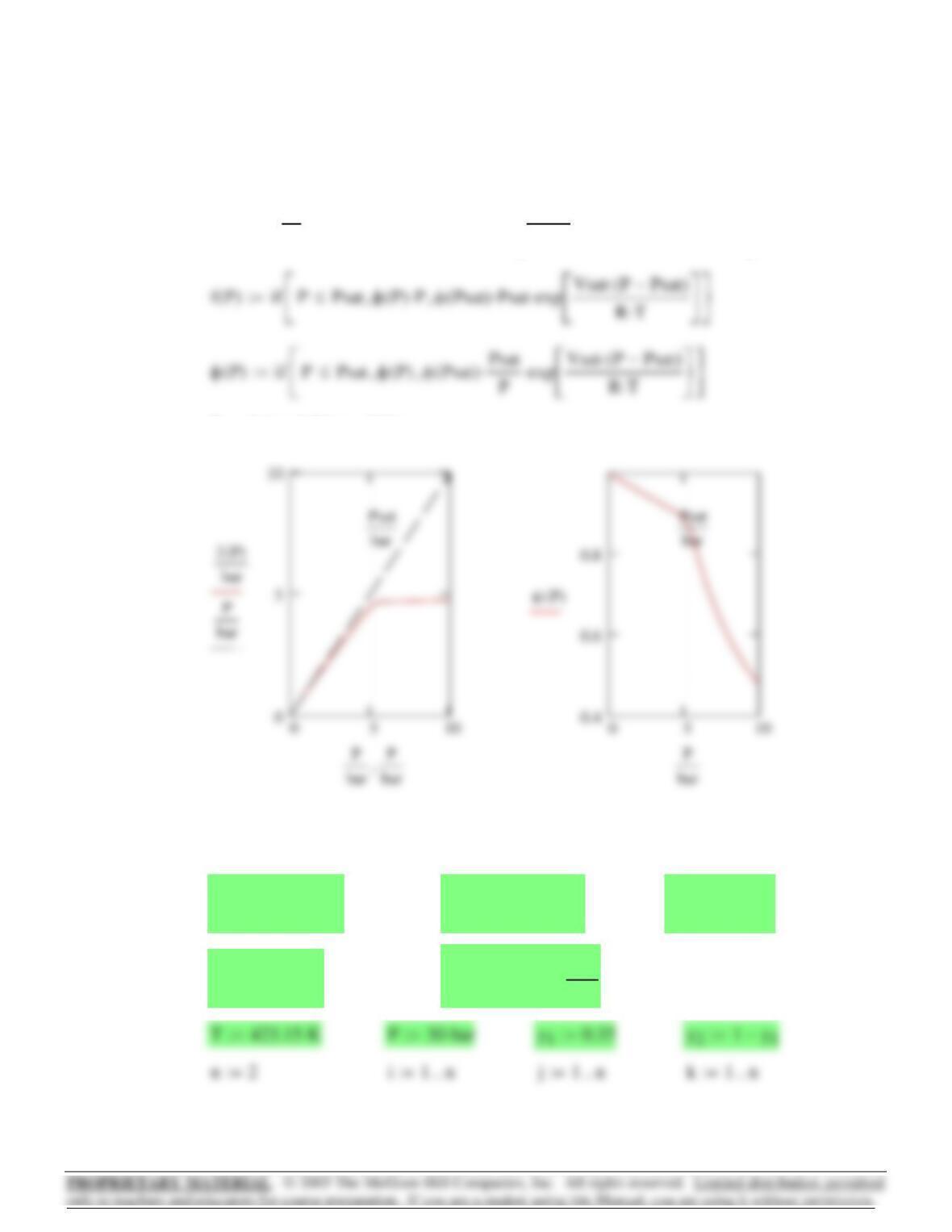
Ethylene = species 1; Propylene = species 211.25
P 0 bar⋅0.5 bar⋅, 10 bar⋅..:=
φP( ) exp PrP()
Tr
B0Tr
()
ωB1Tr
()
⋅+
()
⋅
⎡
⎢
⎣
⎤
⎥
⎦
:=
PrP() P
Pc
:=
Calculate fugacity coefficients by Eq. (11.68):
351
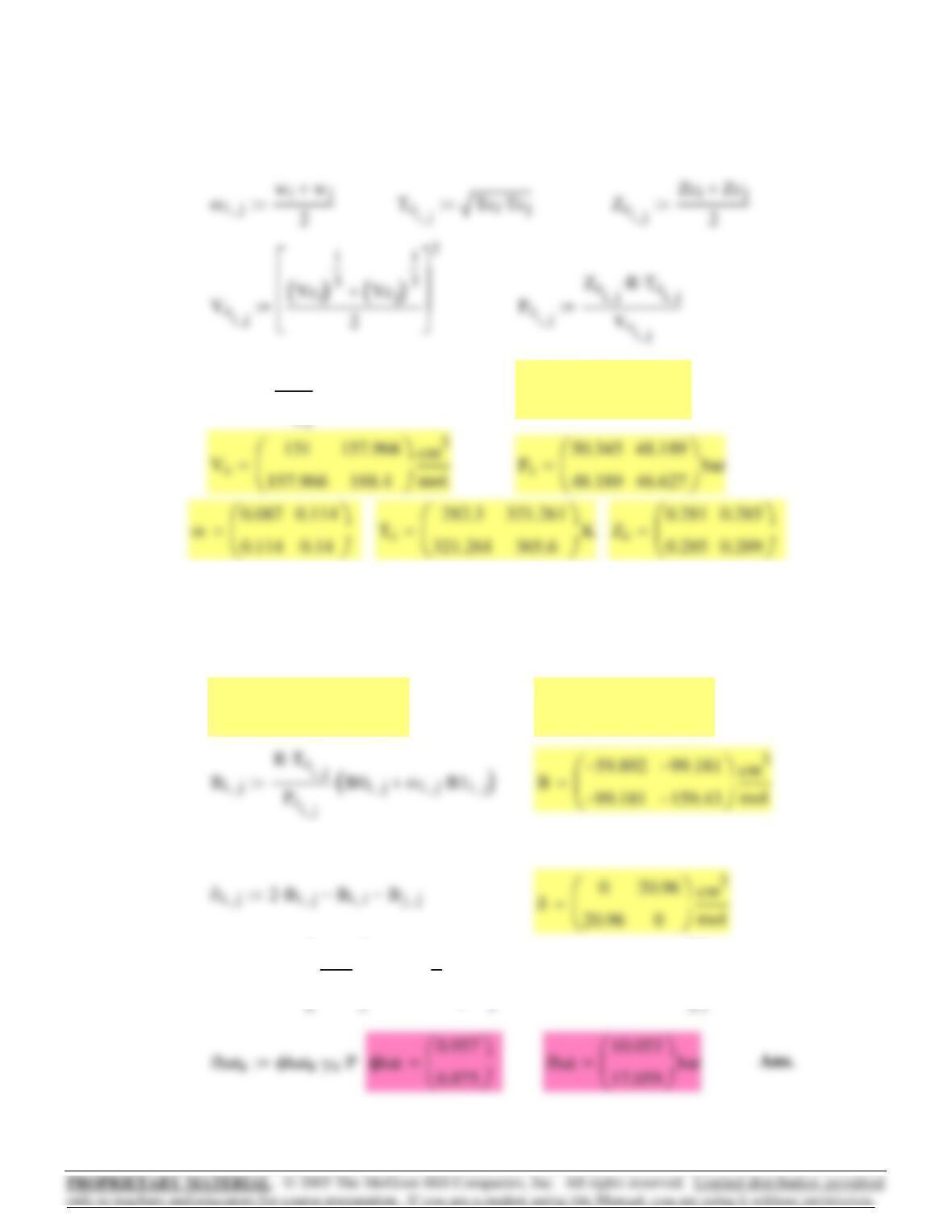
φhatkexp P
RT⋅Bkk,1
2
ij
yiyj
⋅2δik,
⋅δ
ij,
−
()
⋅
⎡
⎣
⎤
⎦
∑∑
⋅+
⎡
⎢
⎢
⎤
⎥
⎥
⋅
⎡
⎢
⎢
⎤
⎥
⎥
:=
⎜
By Eq. (11.64):
⎜
B1 0.108
0.085
0.085
0.046
⎛
⎜
⎝
⎞
⎠
=
B0 0.138−
0.189−
0.189−
0.251−
⎛
⎜
⎝
⎞
⎠
=
B1ij,B1Trij,
()
:=B0ij,B0Trij,
()
:=
By Eqs. (3.65) and (3.66):
⎜
⎜
⎜
⎜
⎜
Tr
1.499
1.317
1.317
1.157
⎛
⎜
⎝
⎞
⎠
=
Trij,
T
Tcij,
:=
⎢
⎥
By Eqs. (11.70) through (11.74)
352
⎜
⎜
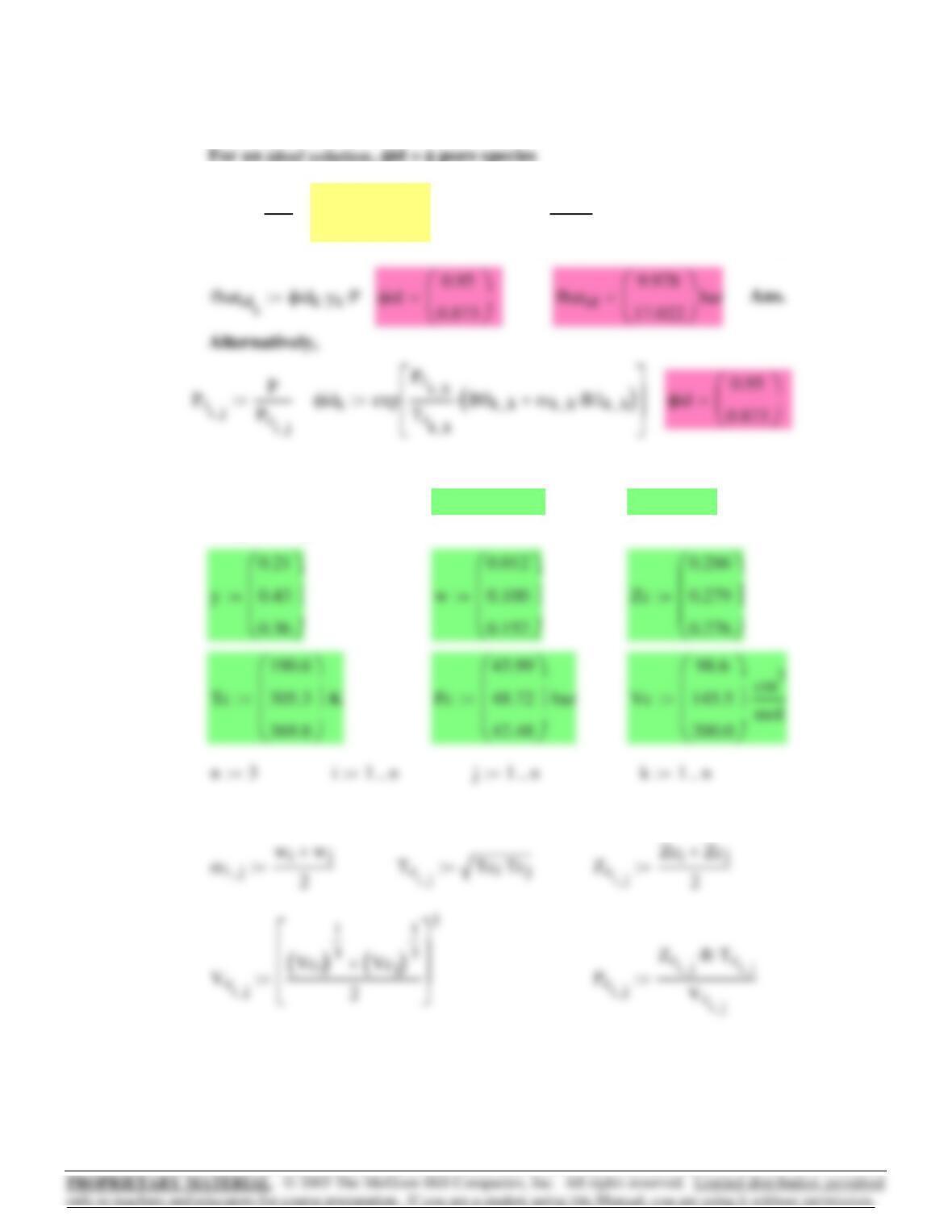
By Eqs. (11.70) through (11.74)
⎢
⎥
Prk
P
Pck
:= Pr
0.595
0.643
⎛
⎜
⎝
⎞
⎠
=φidkexp
Prk
Trkk,
B0kk,ωkk,B1kk,
⋅+
()
⋅
⎡
⎢
⎢
⎣
⎤
⎥
⎥
⎦
:=
⎜
⎜
⎢
⎢
⎥
⎥
⎜
11.27 Methane = species 1
Ethane = species 2
Propane = species 3
T 373.15 K⋅:= P 35 bar⋅:=
353
⎜
⎜
⎜
⎜
⎜
⎜
δ
0
30.442
107.809
30.442
0
23.482
107.809
23.482
0
⎛
⎜
⎜
⎜
⎝
⎞
⎟
⎠
cm3
mol
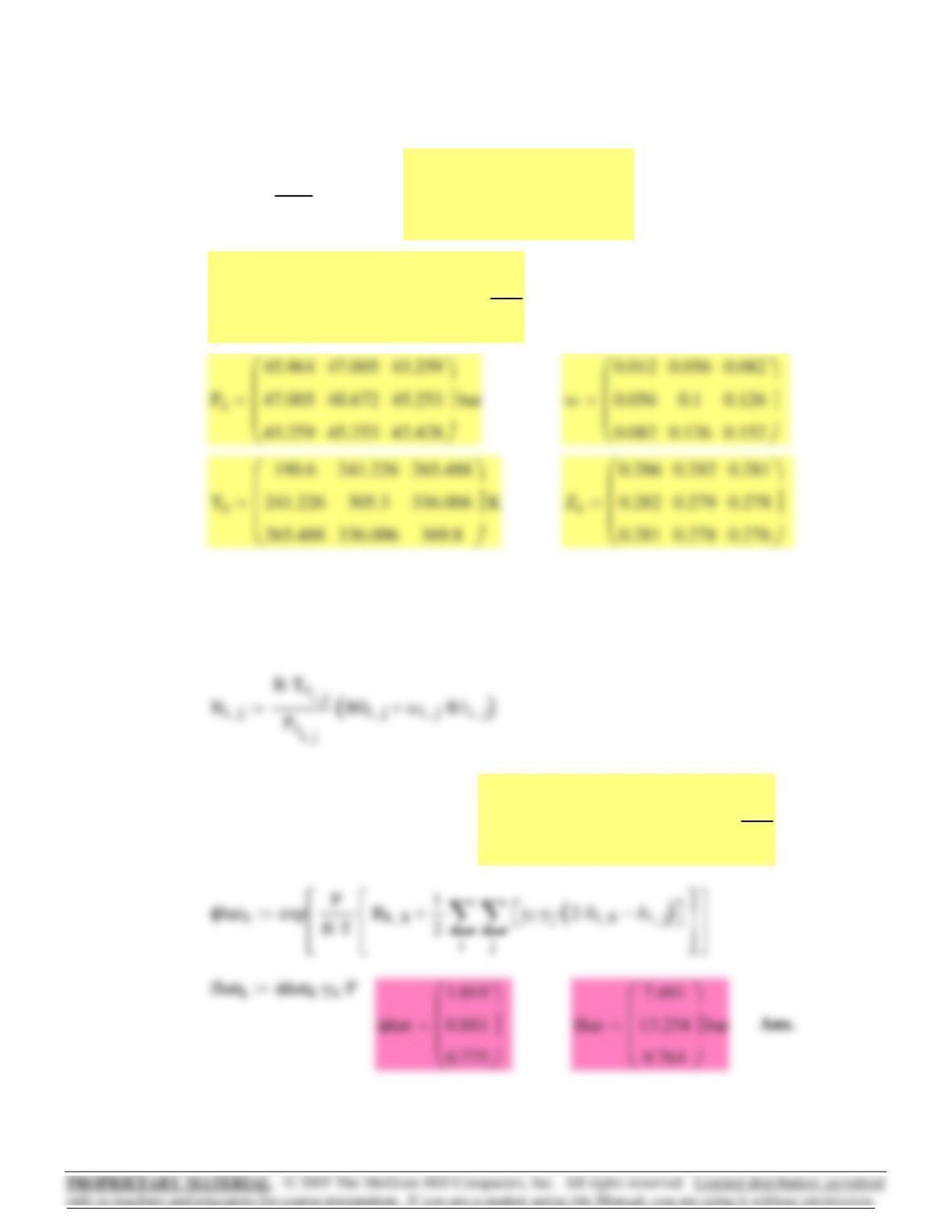
=δij,2B
ij,
⋅Bii,
−Bjj,
−:=
By Eq. (11.64):
B0ij,B0Trij,
()
:= B1ij,B1Trij,
()
:=
By Eqs. (3.65) and (3.66):
⎜
⎜
⎜
⎜
⎜
⎜
⎜
⎜
Vc
98.6
120.533
143.378
120.533
145.5
171.308
143.378
171.308
200
⎛
⎜
⎜
⎜
⎝
⎞
⎟
⎠
cm3
mol
=
Tr
1.958
1.547
1.406
1.547
1.222
1.111
1.406
1.111
1.009
⎛
⎜
⎜
⎜
⎝
⎞
⎟
⎠
=
Trij,
T
Tcij,
:=
354
⎜
⎜
⎜
⎜
⎢
⎢
⎥
⎥
⎢
⎢
⎥
⎥
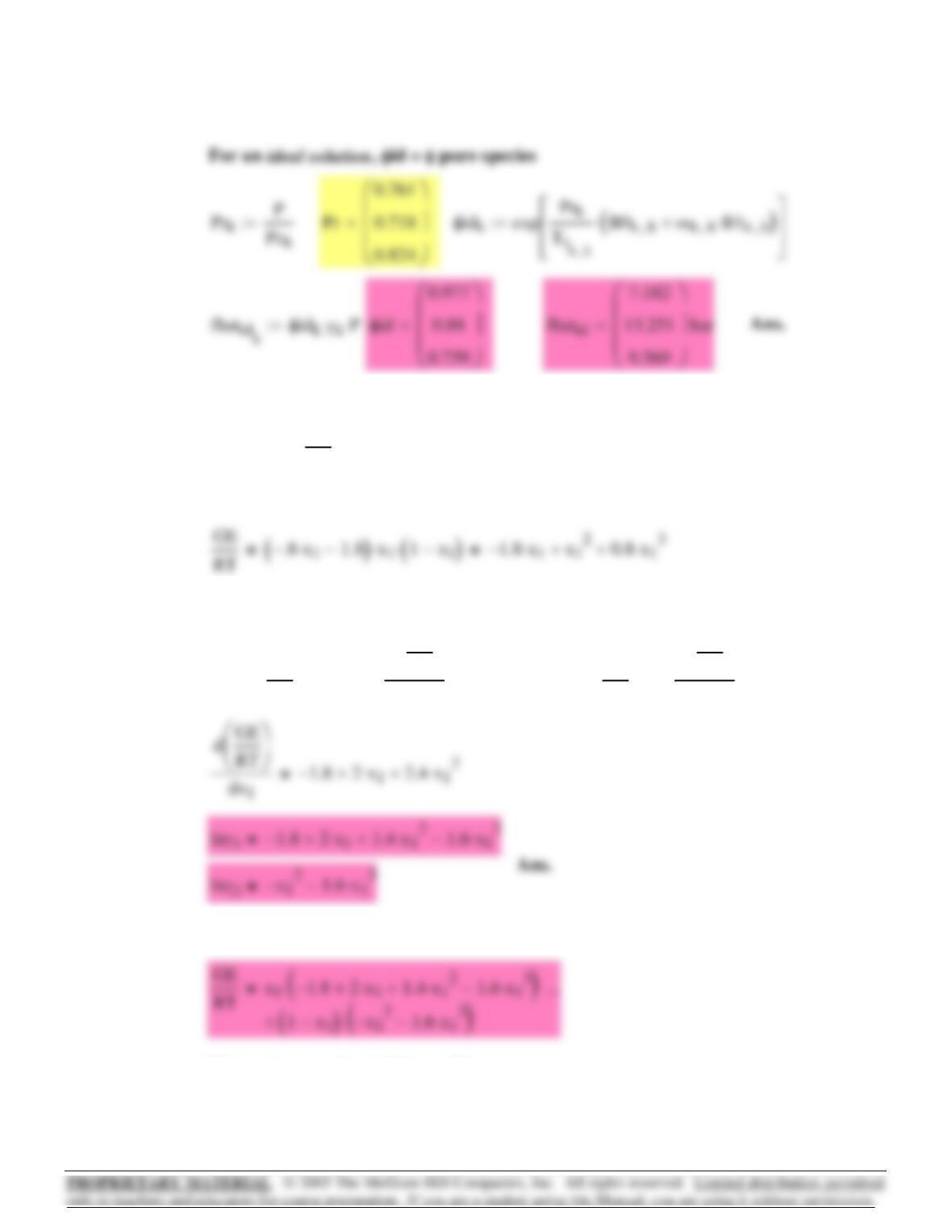
This reduces to the initial condition:
Apply Eq. (11.100):(b)
⎜
lnγ2
GE
RT x1
dGE
RT
⎛
⎜
⎝
⎞
⎠
dx1
⋅−=lnγ1
GE
RT 1x
1
−
()
dGE
RT
⎛
⎜
⎝
⎞
⎠
dx1
⋅+=
Apply Eqs. (11.15) & (11.16) for M = GE/RT:
Substitute x2 = 1 – x1:
(a)
GE
RT 2.6−x1
⋅1.8 x2
⋅−
()
x1
⋅x2
⋅=
Given:11.28
355
gx
1
()
1.8−x1
⋅x12
+0.8 x13
⋅+:=
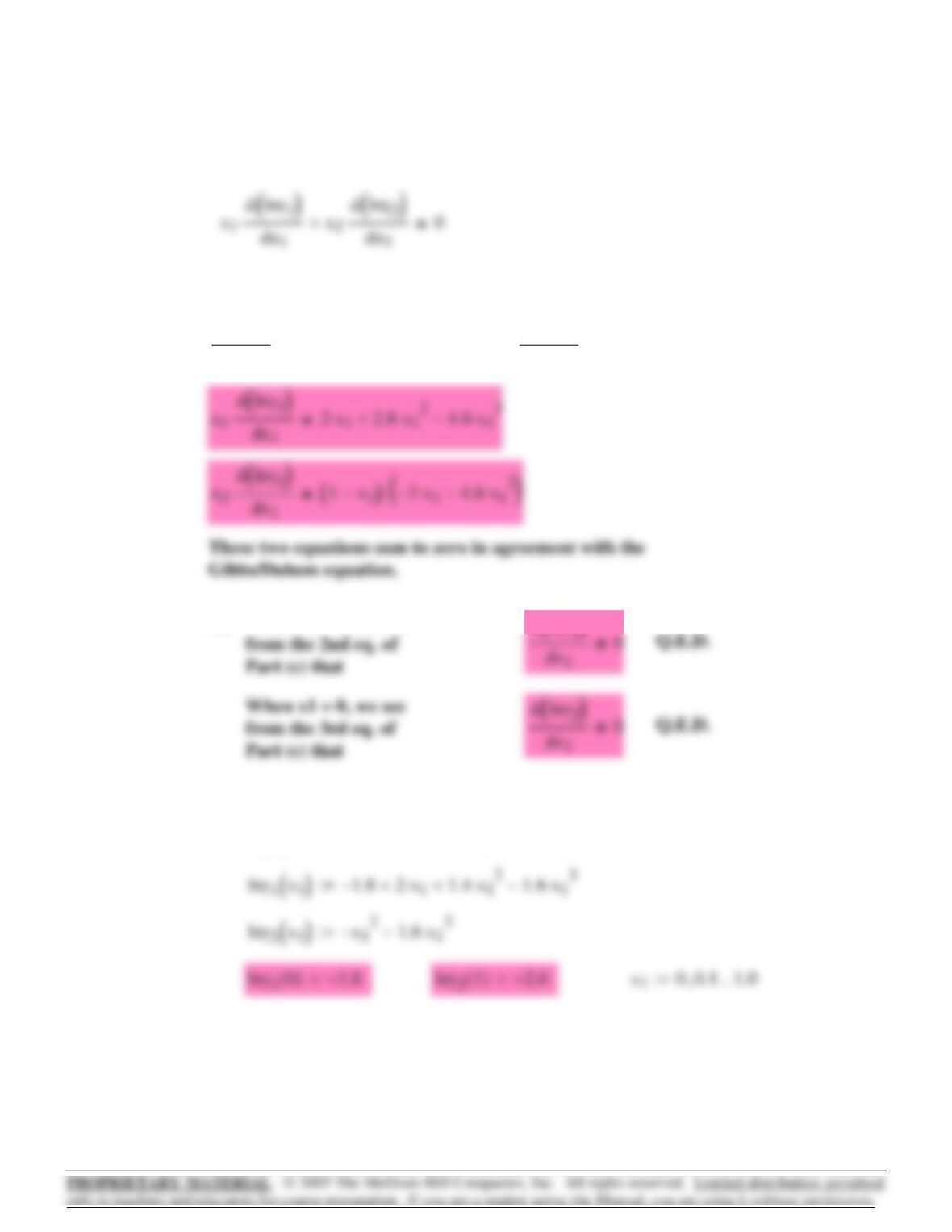
DEFINE: g = GE/RT(e)
dlnγ1
()
When x1 = 1, we see
(d)
dlnγ2
()
dx1
2−x1
⋅4.8 x12
⋅−=
dlnγ1
()
dx1
2 2.8 x1
⋅+ 4.8 x12
⋅−=
Differentiate answers to Part (a):
Divide Gibbs/Duhem eqn. (11.100) by dx1:(c)
356
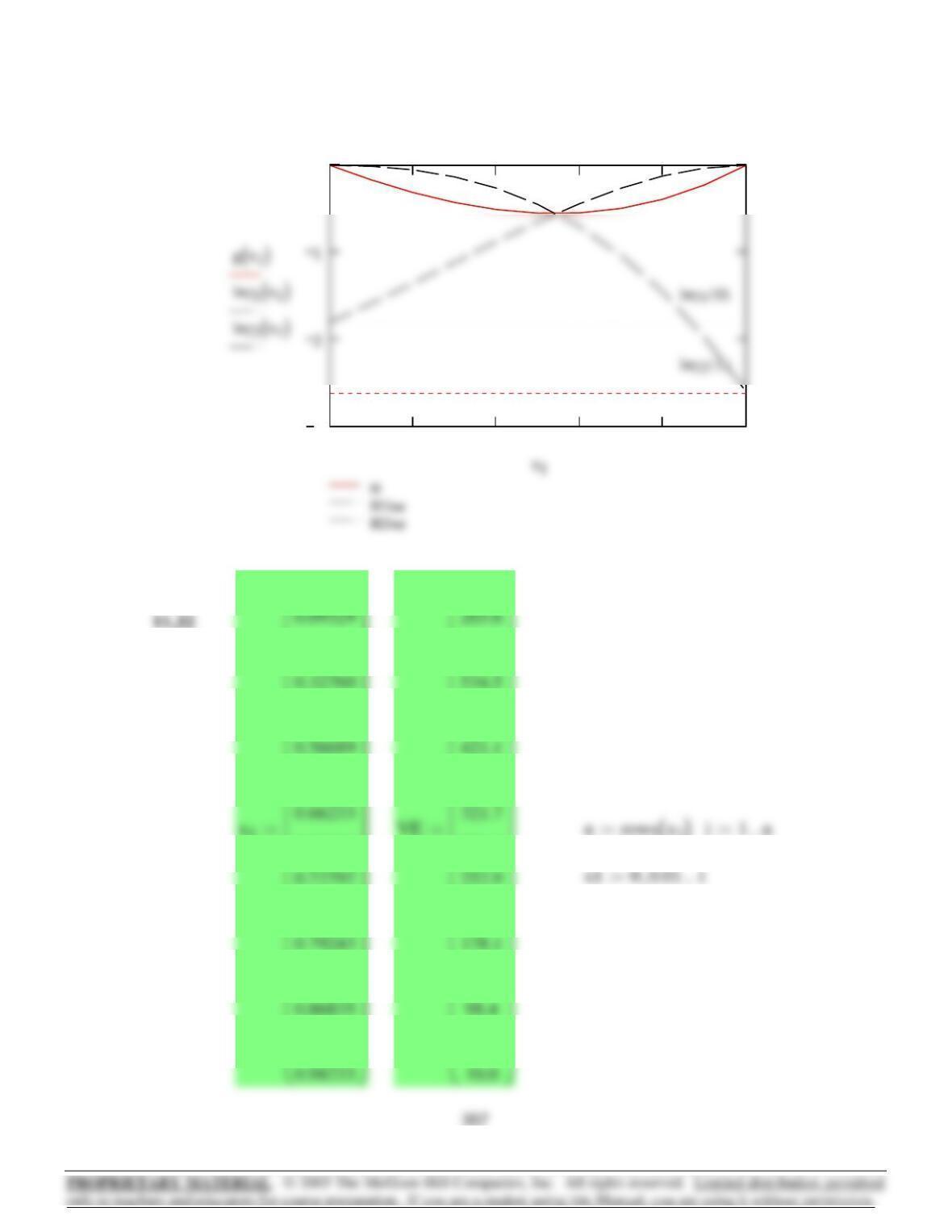
0 0.2 0.4 0.6 0.8
3
0
0.02715
0.17490
0.40244
0.63128
0.69984
0.77514
0.82954
0.93287
⎛
⎜
⎜
⎜
⎜
⎜
⎜
⎜
⎜
⎜
⎜
⎜
⎜
⎜
⎜
⎜
⎜
⎞
⎟
⎟
⎟
⎟
⎟
⎟
⎟
⎟
⎟
⎟
⎟
⎟
⎟
⎟
⎟
87.5
417.4
531.7
347.1
276.4
190.7
138.4
37.6
⎛
⎜
⎜
⎜
⎜
⎜
⎜
⎜
⎜
⎜
⎜
⎜
⎜
⎜
⎜
⎜
⎜
⎞
⎟
⎟
⎟
⎟
⎟
⎟
⎟
⎟
⎟
⎟
⎟
⎟
⎟
⎟
⎟
()