CASE 11
SUGGESTED ANSWERS TO DISCUSSION QUESTIONS
(1)
Statistical sampling requires the auditor to establish risk parameters prior to the
start of a testing procedure. Thus, a desired level of assurance (and, conversely,
an acceptable level of risk) is always defined whenever statistical concepts and
mathematical formulas are to be utilized. The auditor is aware in advance of the
possibility of a mistaken conclusion. Such information is especially important if
(2)
As the partner-in-charge of the Lakeside examination, Cline must ensure that
sufficient, competent evidence has been obtained to satisfy himself that the
(3)
Although based on mathematical concepts, statistical sampling relies heavily on
the auditor’s professional judgment. Such judgments can be seen throughout the
sampling plans discussed by the Abernethy and Chapman audit team in Case
11:
The auditors had to decide whether to test the 283 invoices by sampling or
by examining the entire population.
(4)
In the competitive times that now preside over the public accounting profession,
the auditor cannot afford to rely on unnecessarily slow and time-consuming
techniques. More importantly, though, the auditor can never afford to do an
(5)
If the auditor is seeking to measure a rate of occurrence, sampling for attributes
is utilized. Consequently, this type of statistical sampling is often associated with
tests of controls where an error rate is being estimated. If, however, the auditor
(6)
Given the risk parameters that have been established by the auditor, the actual
total of the differences in the client’s population is estimated to lie between an
120
SUGGESTED ANSWERS TO EXERCISES
(1)-(A)
ABERNETHY AND CHAPMAN
DETERMINATION OF SAMPLE SIZE
SAMPLING FOR VARIABLES
Client: The Lakeside Company
Form Completed By: Carole Mitchell
Audit Area: Accrued Expenses
Date of Testing: 2/4/13 Year Ending: 12/31/12
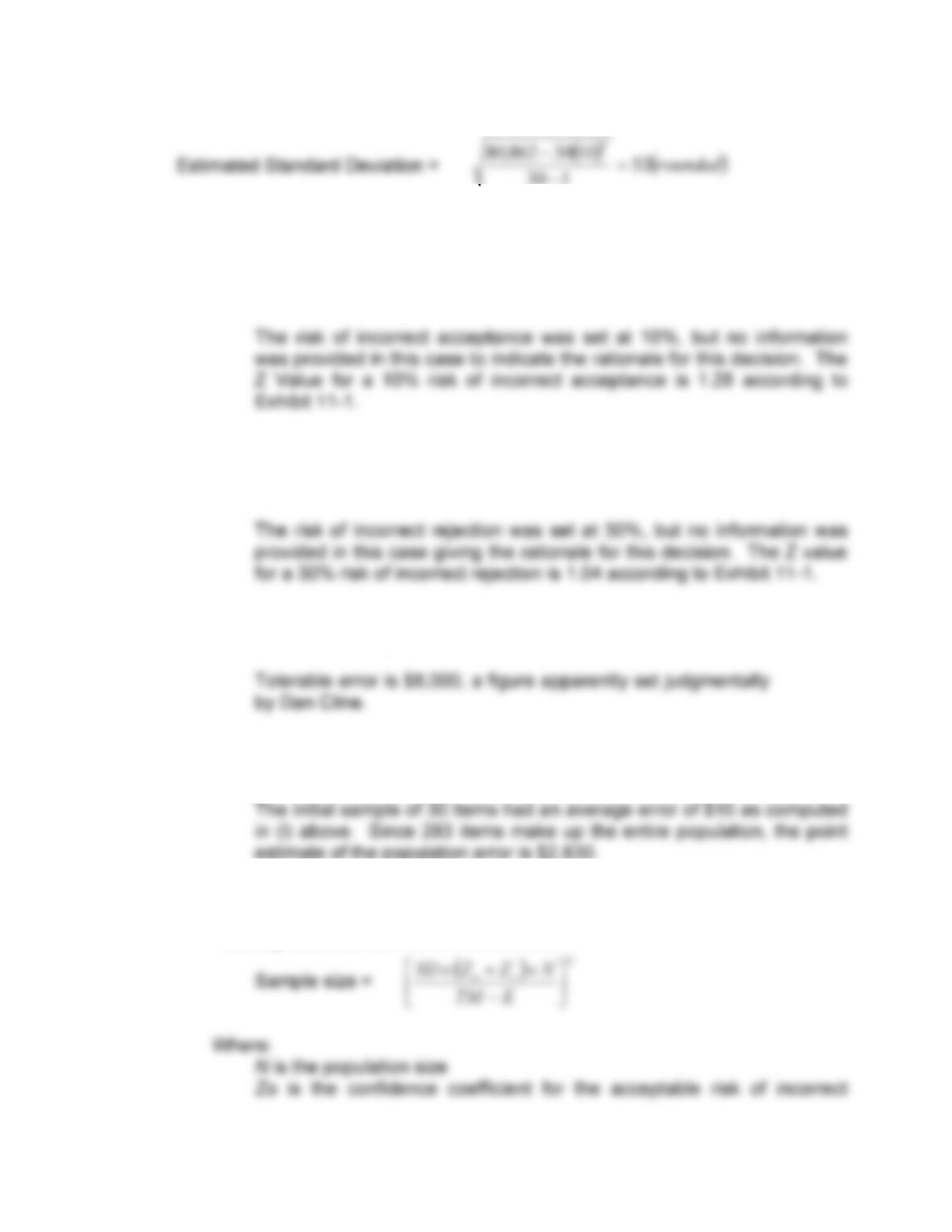
(1) – Estimate the standard deviation of the population. Show the formula being
used and identify each element within this formula.
e (e)2
205 42,025
121
(2) – Specify the acceptable level of risk for incorrect acceptance. Identify the
confidence coefficient (Z value) for this percentage. Include any
considerations that were used in arriving at this parameter:
(3) – Specify the acceptable level of risk for incorrect rejection. Identify the
confidence coefficient (Z value) for this percentage. Include any
considerations that were used in arriving at this parameter:
(4) – Specify a tolerable error for this population. Include any considerations that
were used in arriving at this parameter:
(5) – Specify a point estimate of the population error. Describe the method by
which this determination was made:
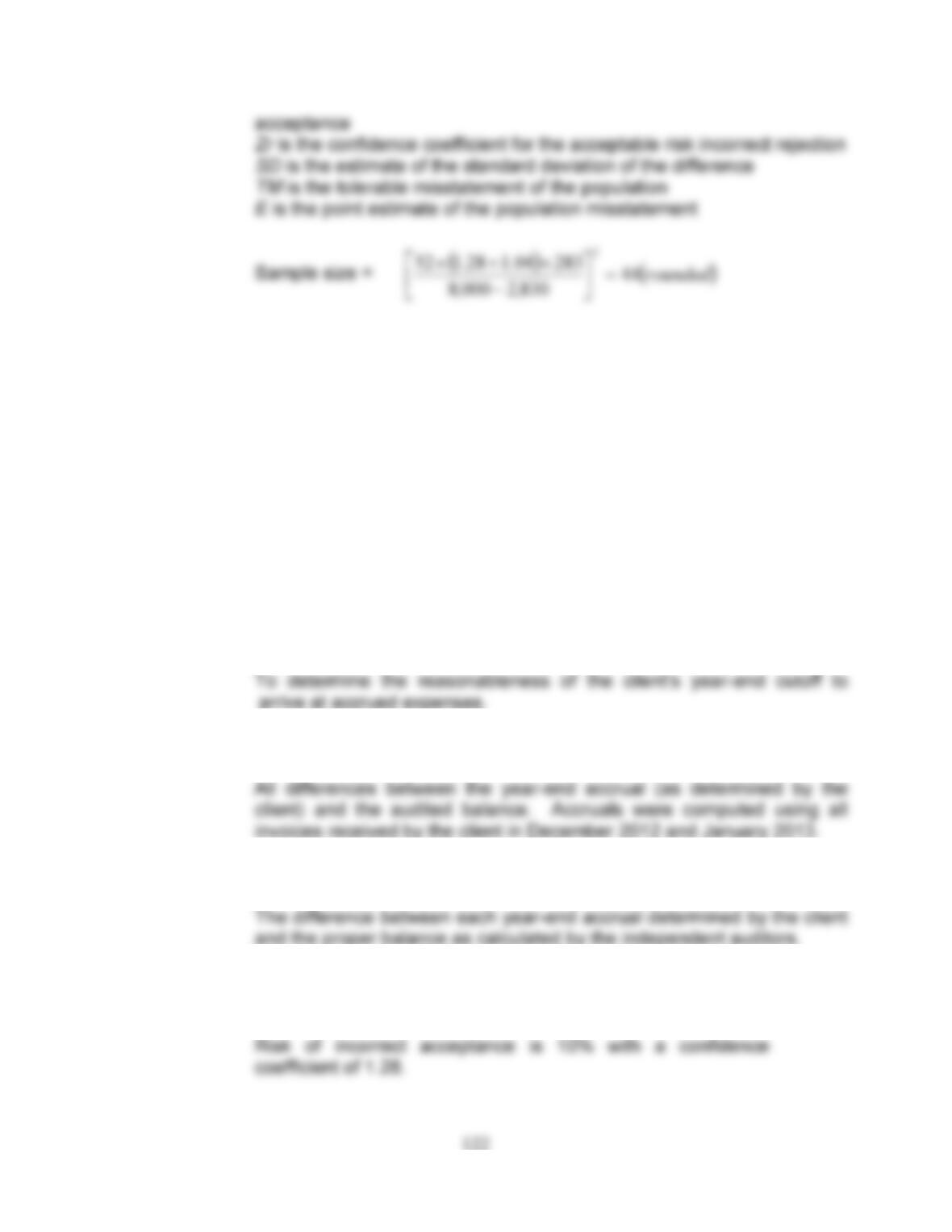
(6) – Calculate the appropriate sample size. Show the formula being used and
identify each element within this formula:
(1)-(B)
ABERNETHY AND CHAPMAN
SAMPLING FOR VARIABLES –
DIFFERENCE ESTIMATION
Client: The Lakeside Company
Form Completed By: Carole Mitchell
Audit Area: Accrued Expenses
Date of Testing: 2/4/13 Year Ending: 12/31/12
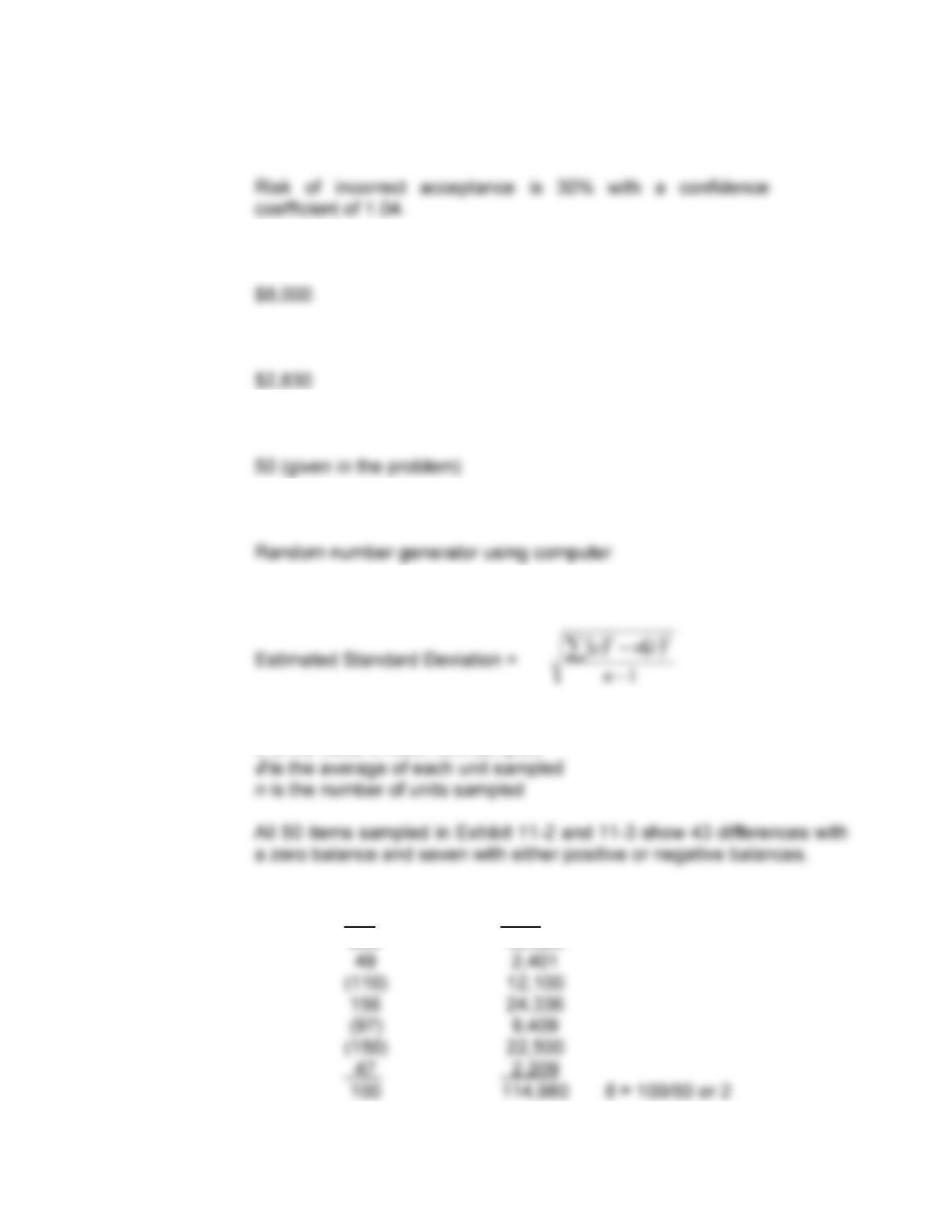
(1) – State the objectives of the audit testing:
(2) – Define the population:
(3) – Define the sampling unit:
(4) – Specify the acceptable level of risk for incorrect acceptance and identify the
confidence coefficient (Z value) for this percentage:
123
(5) – Specify the acceptable level of risk for incorrect rejection and identify the
confidence coefficient (Z value) for this percentage:
(6) – Specify a tolerable error for this population:
(7) – Specify a point estimate of the population error:
(8) – Calculate appropriate sample size (all computations should be attached):
(9) – Indicate the method used to draw a random sample:
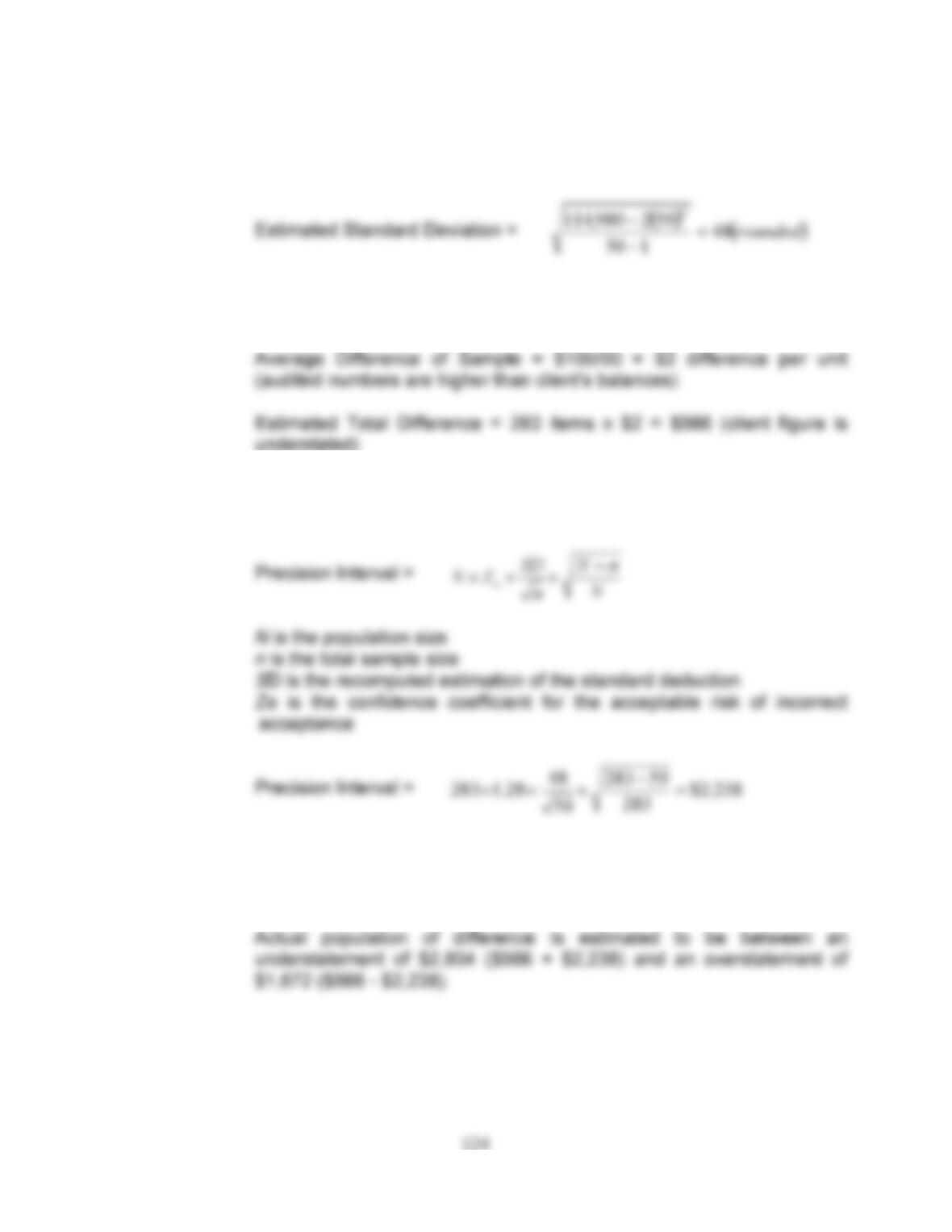
(10) – Recompute the standard deviation using the entire sample selected:
Where:
e is the value of each unit sampled
e (e)2
205 42,025
(11) – Calculate the average difference within the sample and extend this figure
to the entire population:
(12) – Determine the precision interval. Show the formula being used and identify
each element within this formula (all computations should be attached):
(13) – Identify the upper and lower confidence limits of the population based on
the precision interval and the average difference of the sample:

125
(14) – Conclusions/Recommendations: