CHAPTER 10 – 1
CHAPTER 11
RISK AND RETURN
Answers to Concepts Review and Critical Thinking Questions
1. Some of the risk in holding any asset is unique to the asset in question. By investing in a variety of
assets, this unsystematic portion of the total risk can be eliminated at little cost. On the other hand,
there are systematic risks that affect all investments. This portion of the total risk of an asset cannot
be costlessly eliminated. In other words, systematic risk can be controlled, but only by a costly
reduction in expected returns.
3. a. systematic
b. unsystematic
c. both; probably mostly systematic
d. unsystematic
e. unsystematic
f. systematic
5. No to both questions. The portfolio expected return is a weighted average of the asset returns, so it
must be less than the largest asset return and greater than the smallest asset return.
CHAPTER 10 – 2
8. Yes. It is possible, in theory, to construct a zero beta portfolio of risky assets whose return would be
equal to the risk-free rate. It is also possible to have a negative beta; the return would be less than the
risk-free rate. A negative beta asset would carry a negative risk premium because of its value as a
diversification instrument.
Solutions to Questions and Problems
NOTE: All end-of-chapter problems were solved using a spreadsheet. Many problems require multiple
steps. Due to space and readability constraints, when these intermediate steps are included in this solutions
manual, rounding may appear to have occurred. However, the final answer for each problem is found
without rounding during any step in the problem.
Basic
1. The portfolio weight of an asset is total investment in that asset divided by the total portfolio value.
First, we will find the portfolio value, which is:
xB = .3257
2. The expected return of a portfolio is the sum of the weight of each asset times the expected return of
each asset. The total value of the portfolio is:
Total value = $2,750 + 3,900
Total value = $6,650
CHAPTER 10 – 3
3. The expected return of a portfolio is the sum of the weight of each asset times the expected return of
each asset. So, the expected return of the portfolio is:
4. Here, we are given the expected return of the portfolio and the expected return of each asset in the
portfolio, and are asked to find the weight of each asset. We can use the equation for the expected
return of a portfolio to solve this problem. Since the total weight of a portfolio must equal 1 (100%),
the weight of Stock Y must be one minus the weight of Stock X. Mathematically speaking, this means:
E(Rp) = .122 = .13xX + .095(1 – xX)
5. The expected return of an asset is the sum of the probability of each state occurring times the
rate of return if that state occurs. So, the expected return of each asset is:
E(R) = .30(–.11) + .70(.21)
E(R) = .1140, or 11.40%
7. The expected return of an asset is the sum of the probability of each state occurring times the
rate of return if that state occurs. So, the expected return of each asset is:
E(RA) = .10(.02) + .50(.10) + .40(.15)
E(RA) = .1120, or 11.20%
CHAPTER 10 – 4
To calculate the standard deviation, we first need to calculate the variance. To find the variance, we
find the squared deviations from the expected return. We then multiply each possible squared deviation
by its probability, and then sum. The result is the variance. So, the variance and standard deviation of
each stock is:
A2 = .10(.02 – .1120)2 + .50(.10 – .1120)2 + .40(.15 – .1120)2
A2 = .00150
8. The expected return of an asset is the sum of the probability of each return occurring times the
probability of that return occurring. So, the expected return of the asset is:
E(R) = .20(.092) + .35(.111) + .45(.138)
E(R) = .1194, or 11.94%
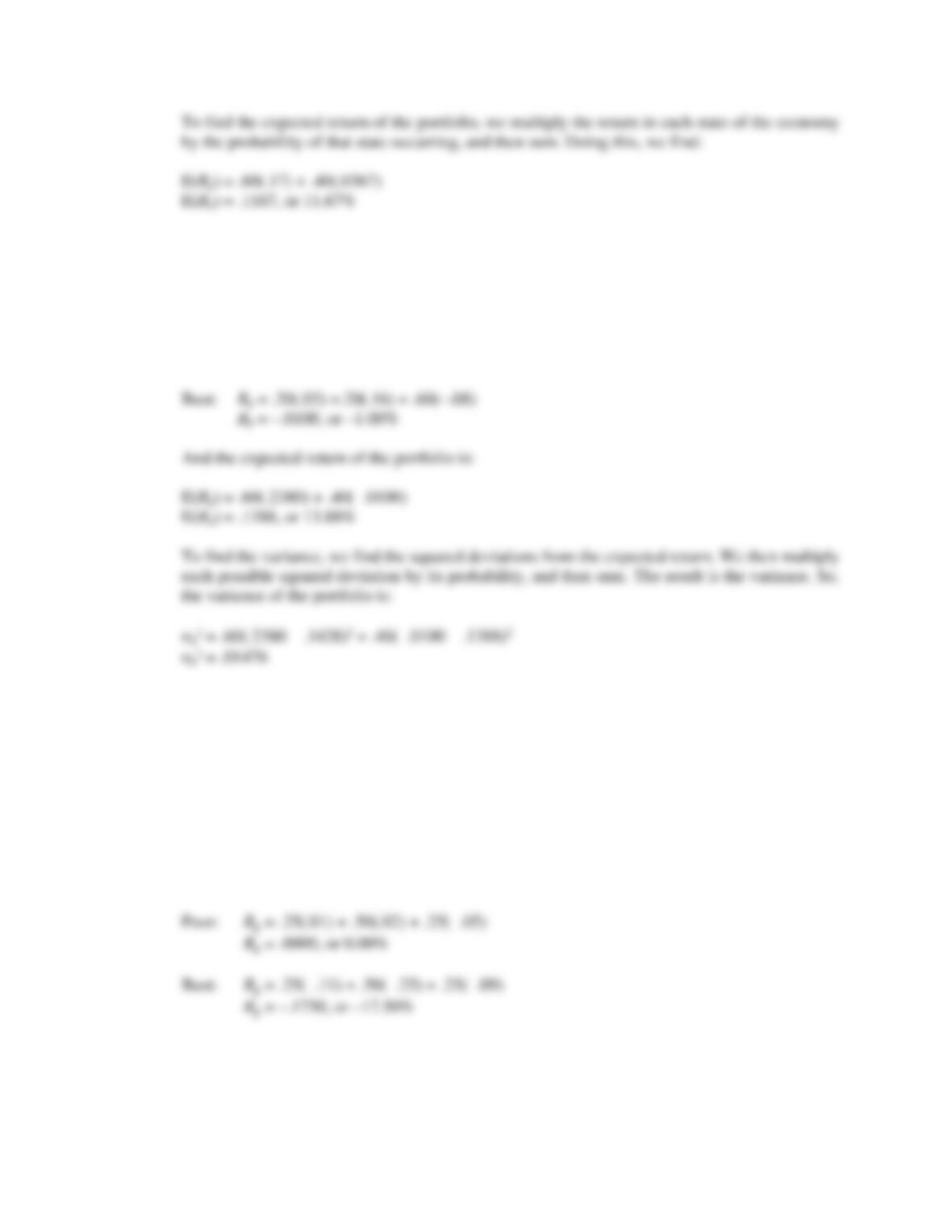
9. a. To find the expected return of the portfolio, we need to find the return of the portfolio in each
state of the economy. This portfolio is a special case since all three assets have the same weight.
To find the expected return in an equally weighted portfolio, we can sum the returns of each asset
and divide by the number of assets, so the expected return of the portfolio in each state of the
economy is:
CHAPTER 10 – 5
b. This portfolio does not have an equal weight in each asset. We still need to find the return of the
portfolio in each state of the economy. To do this, we will multiply the return of each asset by its
portfolio weight and then sum the products to get the portfolio return in each state of the economy.
Doing so, we get:
Boom: Rp = .20(.15) +.20(.02) + .60(.40)
Rp = .2380, or 23.80%
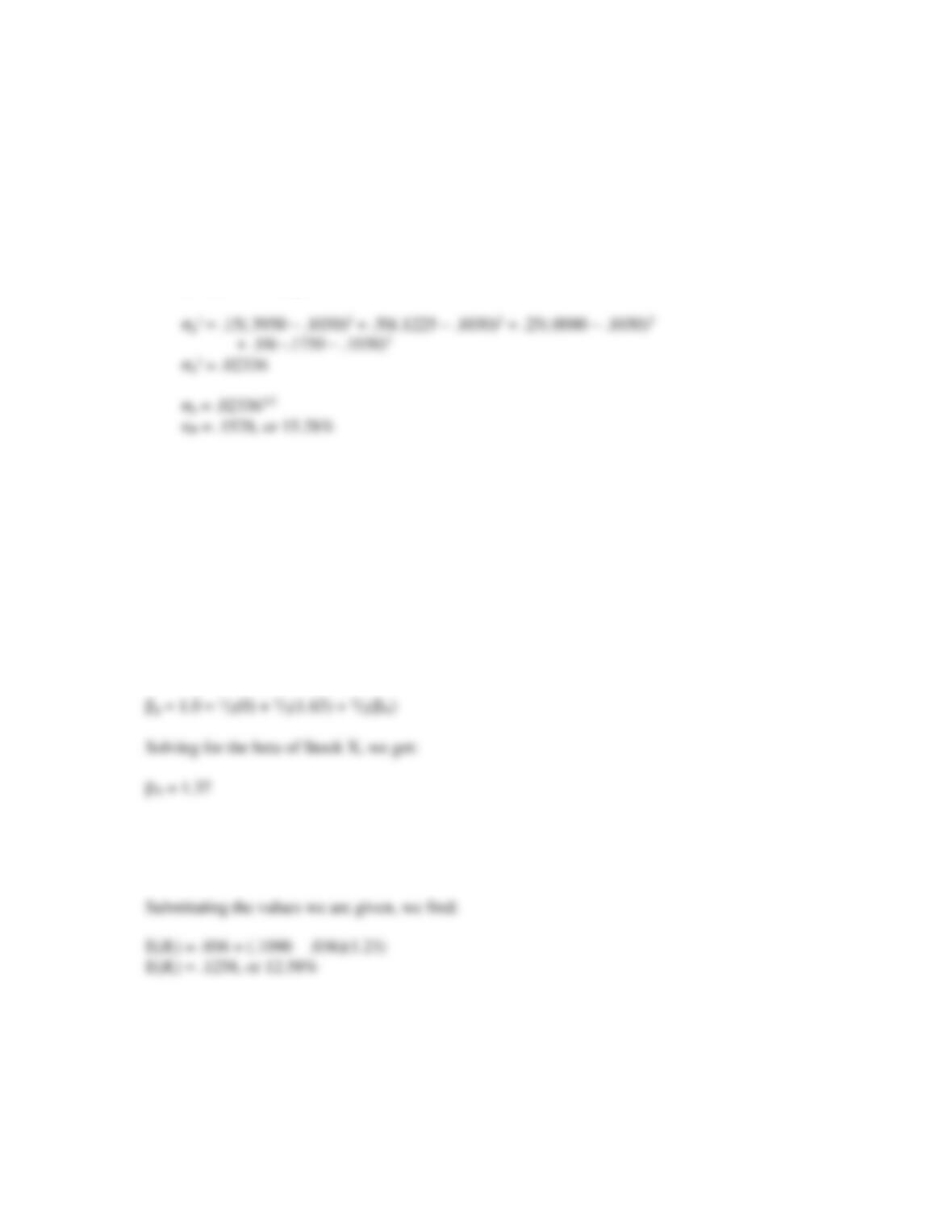
10. a. This portfolio does not have an equal weight in each asset. We first need to find the return of the
portfolio in each state of the economy. To do this, we will multiply the return of each asset by its
portfolio weight and then sum the products to get the portfolio return in each state of the economy.
Doing so, we get:
Boom: Rp = .25(.35) + .50(.45) + .25(.33)
Rp = .3950, or 39.50%
Good: Rp = .25(.12) + .50(.10) + .25(.17)
Rp = .1225, or 12.25%
CHAPTER 10 – 6
And the expected return of the portfolio is:
E(Rp) = .15(.3950) + .50(.1225) + .25(.0000) + .10(–.1750)
E(Rp) = .1030, or 10.30%
b. To calculate the standard deviation, we first need to calculate the variance. To find the variance,
we find the squared deviations from the expected return. We then multiply each possible squared
deviation by its probability, and then sum. The result is the variance. So, the variance and standard
deviation of the portfolio is:
11. The beta of a portfolio is the sum of the weight of each asset times the beta of each asset. So, the beta
of the portfolio is:
p = .15(.75) + .25(.87) + .40(1.26) + .20(1.76)
p = 1.19
12. The beta of a portfolio is the sum of the weight of each asset times the beta of each asset. If the portfolio
is as risky as the market, it must have the same beta as the market. Since the beta of the market is one,
we know the beta of our portfolio is one. We also need to remember that the beta of the risk-free asset
is zero. It has to be zero since the asset has no risk. Setting up the equation for the beta of our portfolio,
we get:
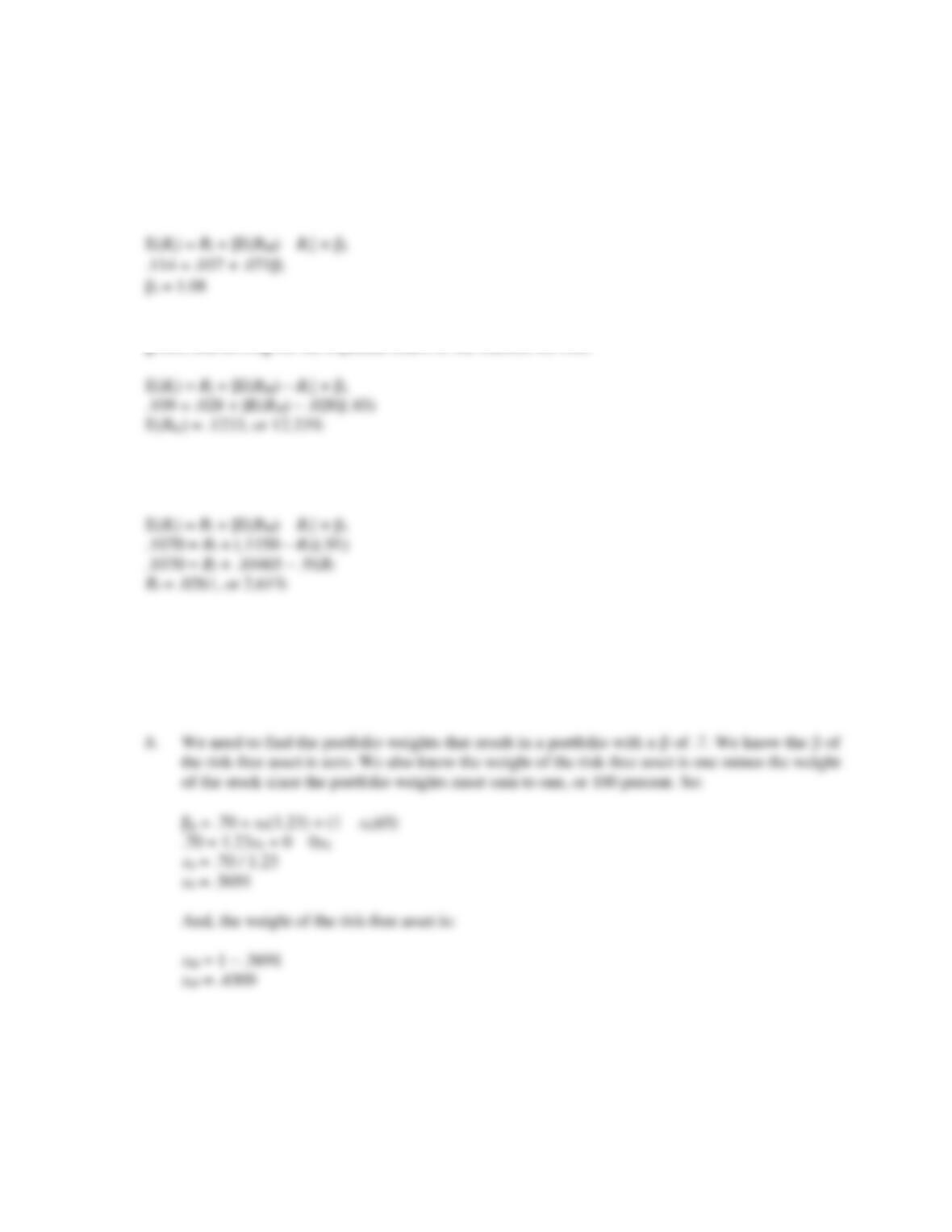
13. The CAPM states the relationship between the risk of an asset and its expected return. The CAPM is:
E(Ri) = Rf + [E(RM) – Rf] × i
CHAPTER 10 – 7
14. We are given the values for the CAPM except for the of the stock. We need to substitute these values
into the CAPM, and solve for the of the stock. One important thing we need to realize is that we are
given the market risk premium. The market risk premium is the expected return of the market minus
the risk-free rate. We must be careful not to use this value as the expected return of the market. Using
the CAPM, we find:
15. Here, we need to find the expected return of the market, using the CAPM. Substituting the values
given, and solving for the expected return of the market, we find:
16. Here, we need to find the risk-free rate, using the CAPM. Substituting the values given, and solving
for the risk-free rate, we find:
17. a. Again, we have a special case where the portfolio is equally weighted, so we can sum the returns
of each asset and divide by the number of assets. The expected return of the portfolio is:
E(Rp) = (.117 + .035) / 2
E(Rp) = .0760, or 7.60%
CHAPTER 10 – 8
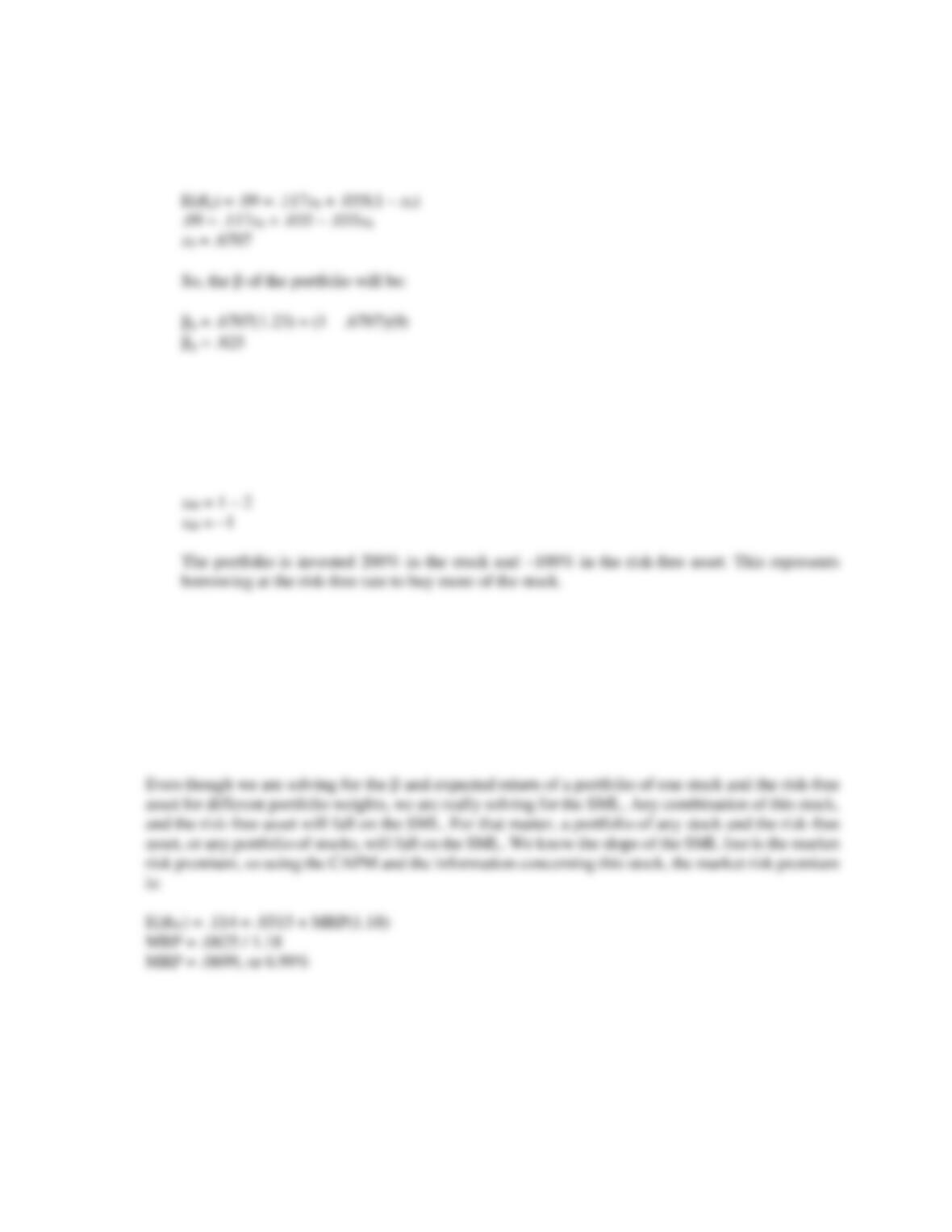
c. We need to find the portfolio weights that result in a portfolio with an expected return of 9
percent. We also know the weight of the risk-free asset is one minus the weight of the stock since
the portfolio weights must sum to one, or 100 percent. So:
d. Solving for the of the portfolio as we did in part a, we find:
p = 2.46 = xS(1.23) + (1 – xS)(0)
xS = 2.46 / 1.23
xS = 2
18. First, we need to find the of the portfolio. The of the risk-free asset is zero, and the weight of the
risk-free asset is one minus the weight of the stock, so the of the portfolio is:
ßp = xW(1.18) + (1 – xW)(0) = 1.18xW
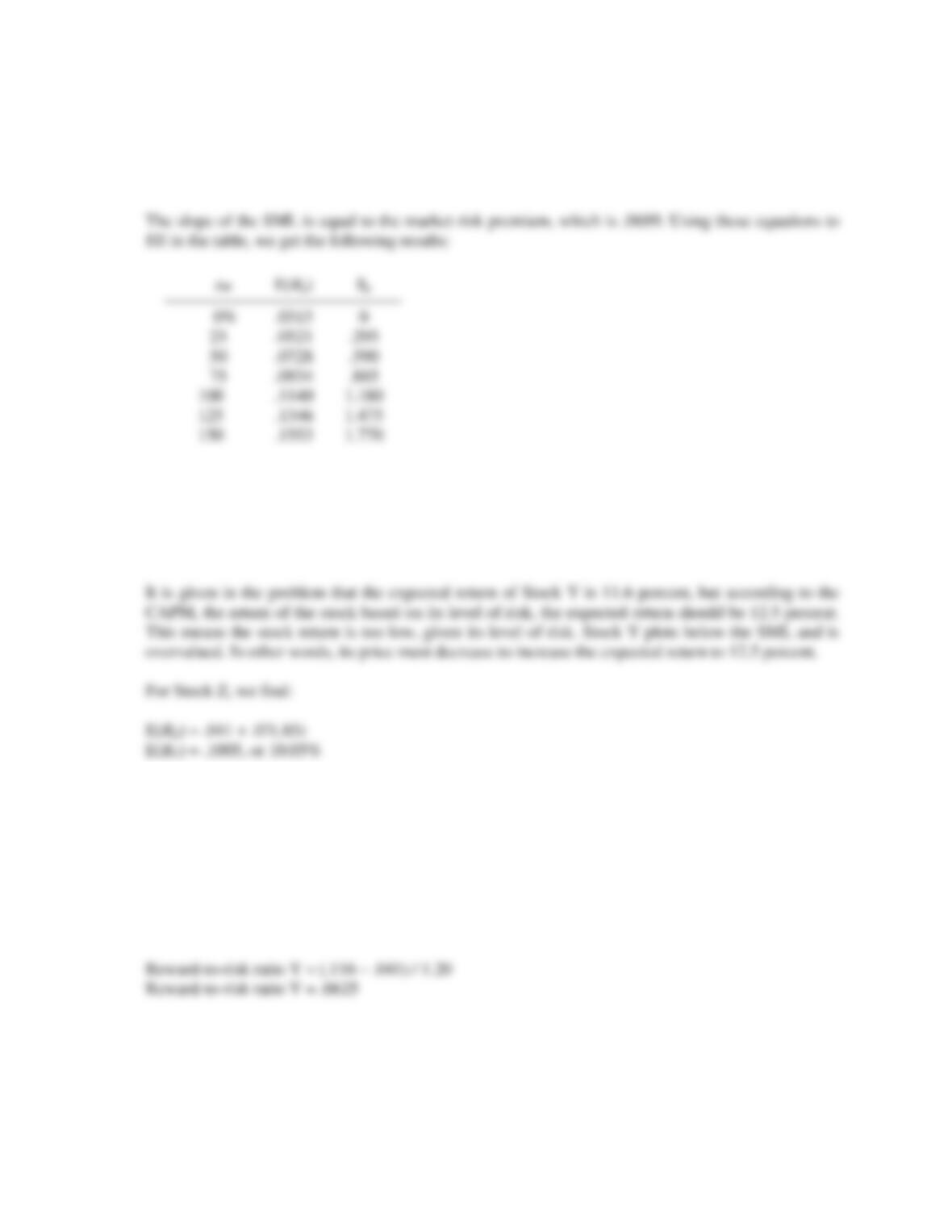
So, to find the of the portfolio for any weight of the stock, we simply multiply the weight of the
stock times its .
CHAPTER 10 – 9
So, now we know the CAPM equation for any stock is:
E(Rp) = .0315 + .0699p
19. There are two ways to correctly answer this question. We will work through both. First, we can use
the CAPM. Substituting in the value we are given for each stock, we find:
E(RY) = .041 + .07(1.20)
E(RY) = .1250, or 12.50%
The return given for Stock Z is 10.3 percent, but according to the CAPM the expected return of the
stock should be 10.05 percent based on its level of risk. Stock Z plots above the SML and is
undervalued. In other words, its price must increase to decrease the expected return to 10.3 percent.
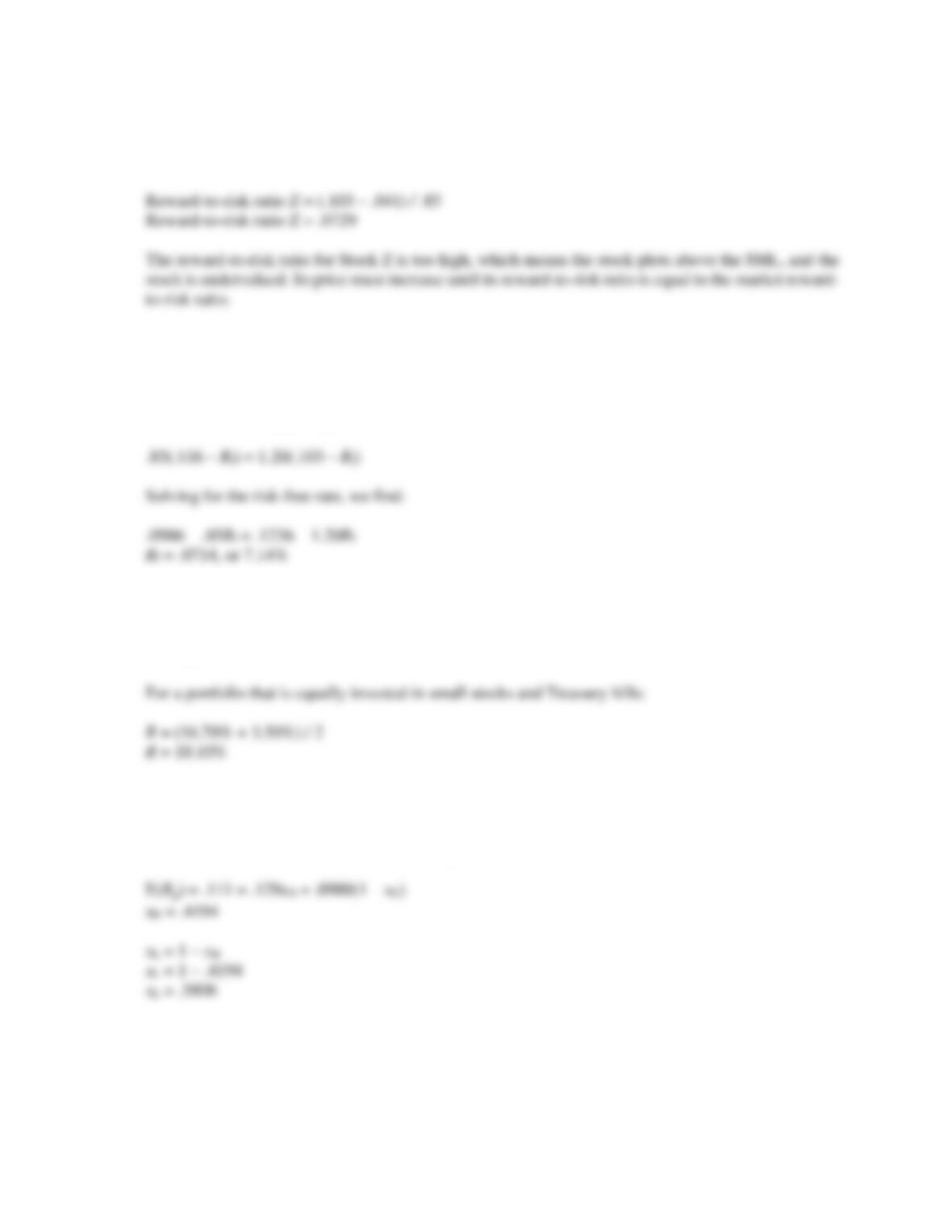
We can also answer this question using the reward-to-risk ratio. All assets must have the same reward-
to-risk ratio. The reward-to-risk ratio is the risk premium of the asset divided by its . We are given
the market risk premium, and we know the of the market is one, so the reward-to-risk ratio for the
market is .07, or 7 percent. Calculating the reward-to-risk ratio for Stock Y, we find:
CHAPTER 10 – 10
The reward-to-risk ratio for Stock Y is too low, which means the stock plots below the SML, and the
stock is overvalued. Its price must decrease until its reward–to–risk ratio is equal to the market reward-
to-risk ratio. For Stock Z, we find:
20. We need to set the reward-to-risk ratios of the two assets equal to each other, which is:
(.116 – Rf) / 1.20 = (.103 – Rf) / .85
We can cross multiply to get:
21. For a portfolio that is equally invested in large-company stocks and long-term corporate bonds:
R = (12.10% + 6.40%) / 2
R = 9.25%
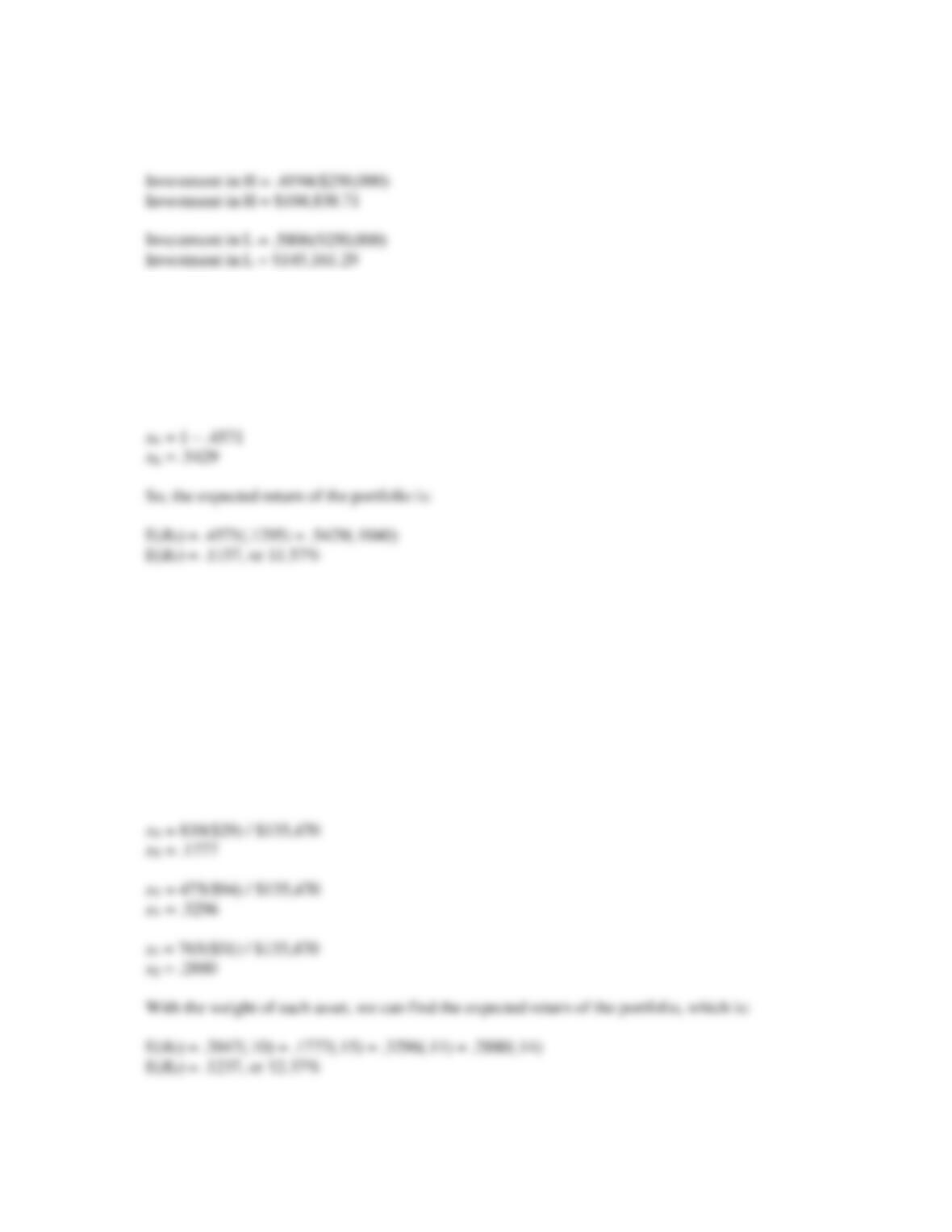
22. Here, we are given the expected return of the portfolio and the expected return of the assets in the
portfolio and are asked to calculate the dollar amount of each asset in the portfolio. So, we need to find
the weight of each asset in the portfolio. Since we know the total weight of the assets in the portfolio
must equal 1 (or 100%), we can find the weight of each asset as:
CHAPTER 10 – 11
So, the dollar investment in each asset is the weight of the asset times the value of the portfolio, so the
dollar investment in each asset must be:
23. To find the expected return of the portfolio we first need to find the weight of each asset in the portfolio.
The weights of the assets sum to 1 (or 100%), so we can solve for the weights, using the betas of the
each asset and the beta of the portfolio. Doing so, we find:
ßp = 1 = xJ(1.19) + (1 – xJ)(.84)
xJ = .4571
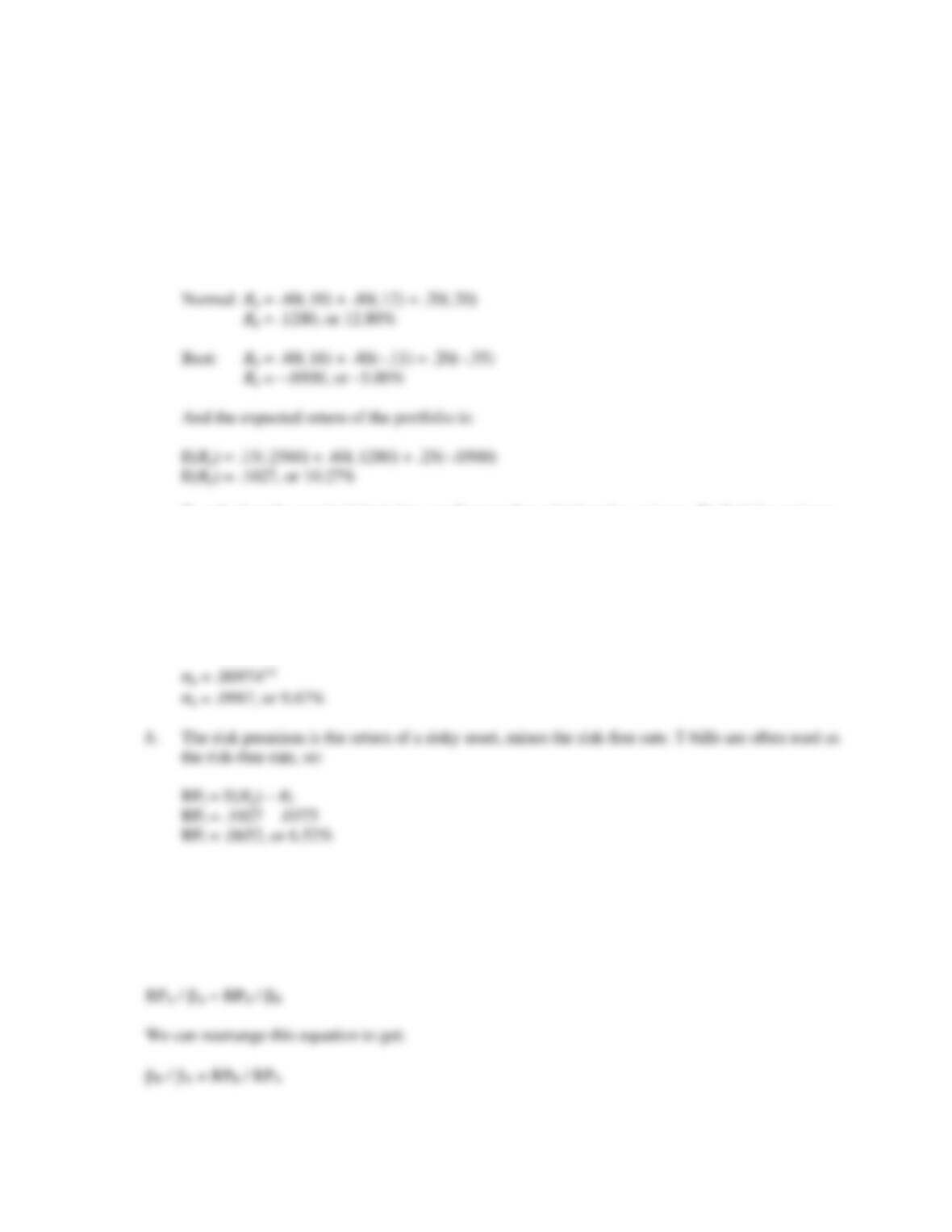
24. To find the expected return of the portfolio, we first need to find the weight of each asset in the
portfolio. The weight of each asset is the dollar investment of that asset divided by the total dollar
value of the portfolio, so:
Portfolio value = 645($43) + 830($29) + 475($94) + 765($51)
Portfolio value = $135,470
And the weight of each asset in the portfolio is:
xW = 645($43) / $135,470
xW = .2047
CHAPTER 10 – 12
Intermediate
25. a. We need to find the return of the portfolio in each state of the economy. To do this, we will
multiply the return of each asset by its portfolio weight and then sum the products to get the
portfolio return in each state of the economy. Doing so, we get:
Boom: Rp = .40(.02) + .40(.32) + .20(.60)
Rp = .2560, or 25.60%
To calculate the standard deviation, we first need to calculate the variance. To find the variance,
we find the squared deviations from the expected return. We then multiply each possible squared
deviation by its probability, and then sum. The result is the variance. So, the variance and standard
deviation of the portfolio are:
2p = .15(.2560 – .1027)2 + .60(.1280 – .1027)2 + .25(–.0500 – .1027)2
2p = .00974
26. We know that the reward-to-risk ratios for all assets must be equal. This can be expressed as:
[E(RA) – Rf] / A = [E(RB) – Rf] / ßB
The numerator of each equation is the risk premium of the asset, so:
CHAPTER 10 – 13
If the reward-to-risk ratios are the same, the ratio of the betas of the assets is equal to the ratio of the
risk premiums of the assets.
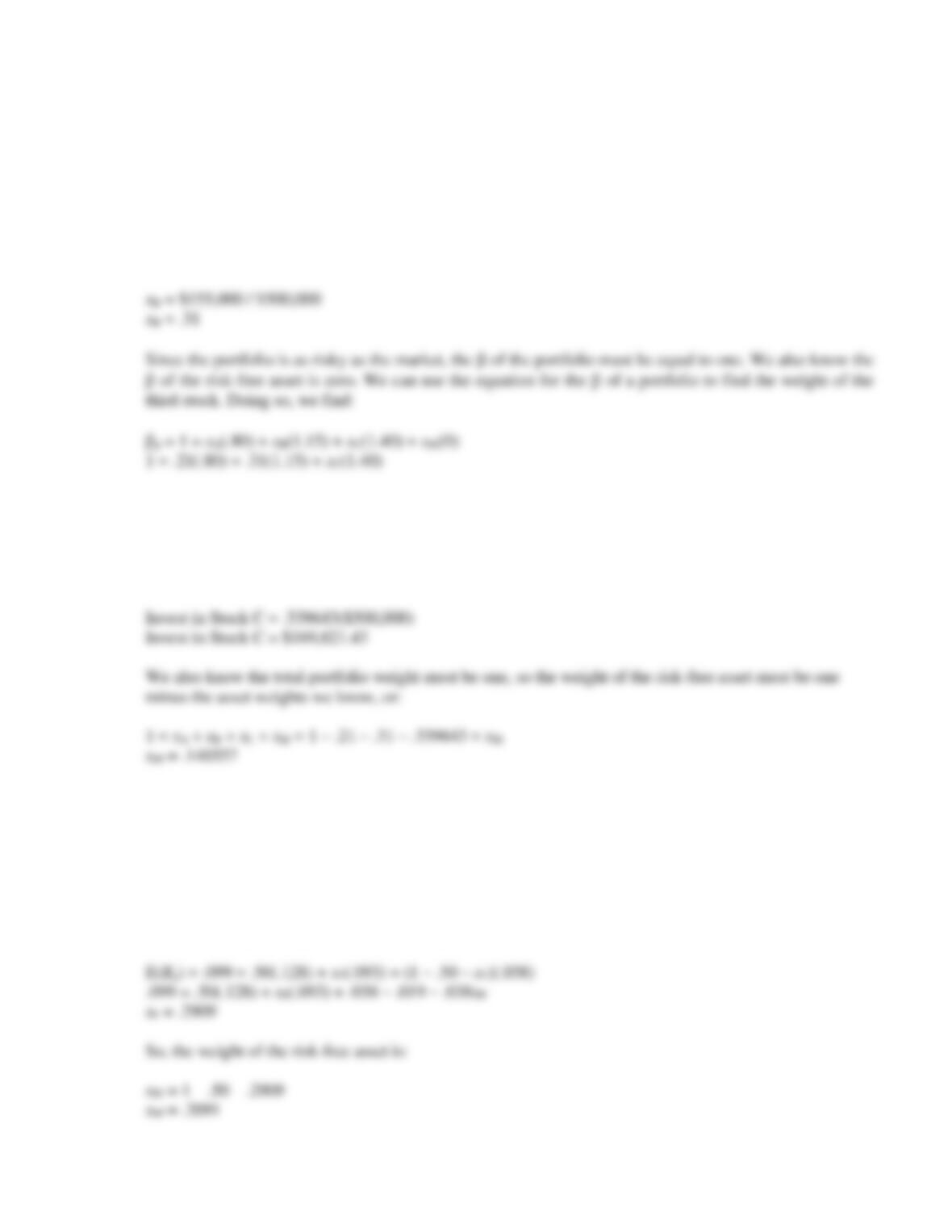
27. We know the total portfolio value and the investment of two stocks in the portfolio, so we can find the
weight of these two stocks. The weights of Stock A and Stock B are:
xA = $105,000 / $500,000
xA = .21
Solving for the weight of Stock C, we find:
xC = .339643
So, the dollar investment in Stock C must be:
So, the dollar investment in the risk-free asset must be:
Invest in risk-free asset = .140357($500,000)
Invest in risk-free asset = $70,178.57
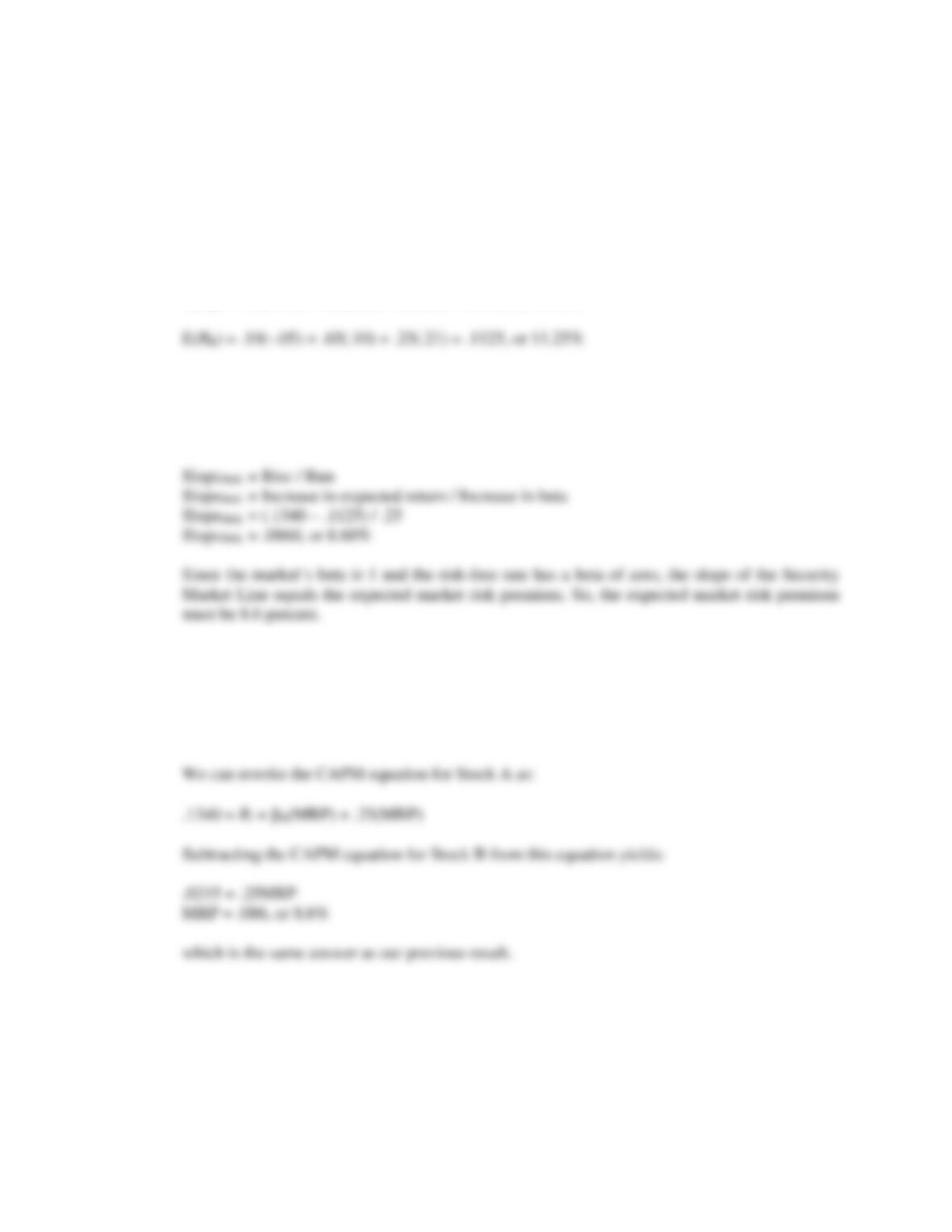
28. We know the expected return of the portfolio and of each asset, but only one portfolio weight. We
need to recognize that the weight of the risk-free asset is one minus the weight of the other two assets.
Mathematically, the expected return of the portfolio is:
CHAPTER 10 – 14
And the amount of Stock F to buy is:
Amount of stock F to buy = .2909($100,000)
Amount of stock F to buy = $29,090.91
29. a. The expected return of an asset is the sum of the probability of each state occurring times the rate
of return if that state occurs. So, the expected return of each asset is:
E(RA) = .10(–.12) + .65(.09) + .25(.35) = .1340, or 13.40%
b. We can use the expected returns we calculated to find the slope of the Security Market Line. We
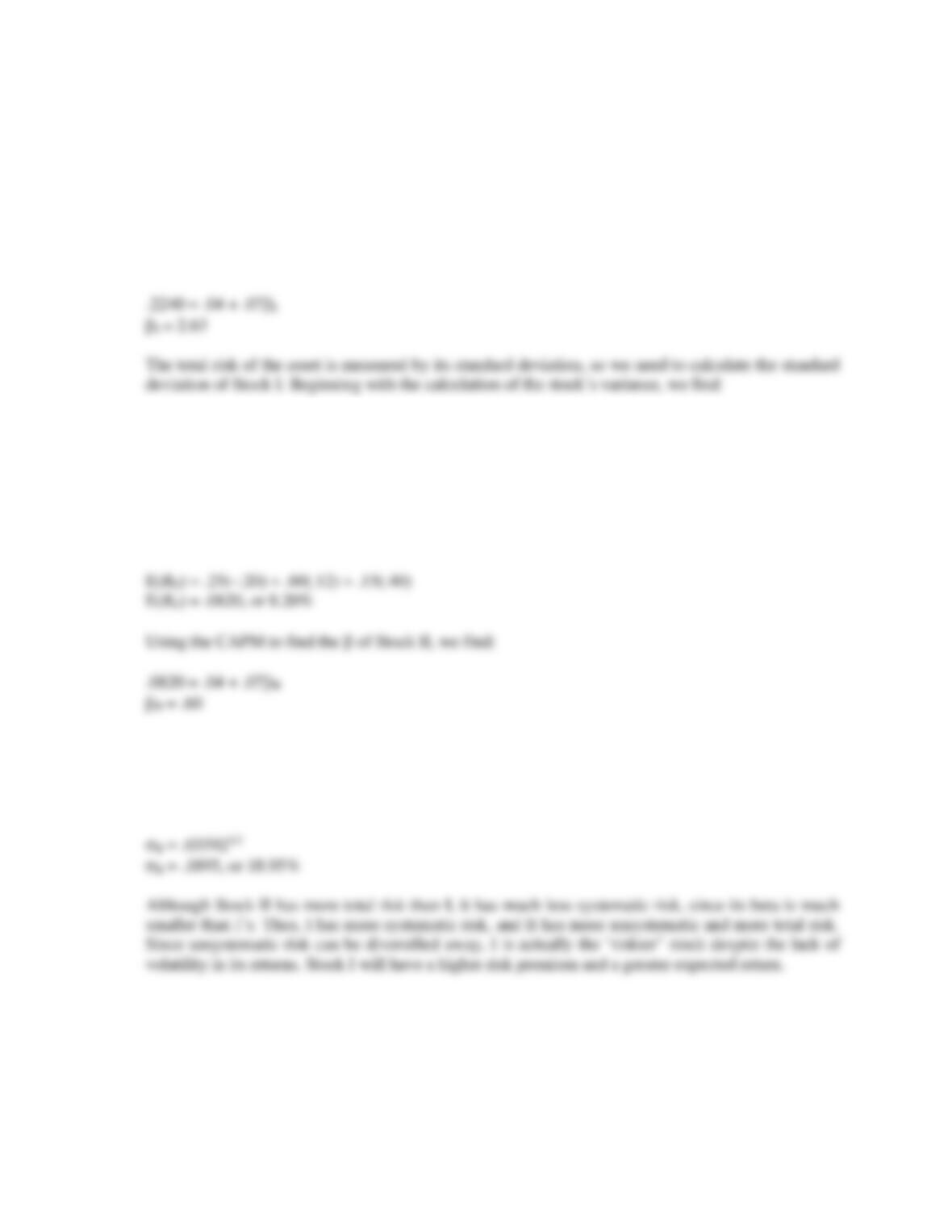
know that the beta of Stock A is .25 greater than the beta of Stock B. Therefore, as beta increases
by .25, the expected return on a security increases by .0215 (= .1340 – .1125). The slope of the
security market line (SML) equals:
We could also solve this problem using CAPM. The equations for the expected returns of the two
stocks are:
E(RA) = .1340 = Rf + (B + .25)(MRP)
E(RB) = .1125 = Rf + B(MRP)
CHAPTER 10 – 15
30. The amount of systematic risk is measured by the of an asset. Since we know the market risk
premium and the risk-free rate, if we know the expected return of the asset, we can use the CAPM to
solve for the of the asset. The expected return of Stock I is:
E(RI) = .25(.02) + .60(.32) + .15(.18)
E(RI) = .2240, or 22.40%
Using the CAPM to find the of Stock I, we find:
I2 = .25(.02 – .2240)2 + .60(.32 – .2240)2 + .15(.18 – .2240)2
I2 = .01622
I = .016221/2
I = .1274, or 12.74%
Using the same procedure for Stock II, we find the expected return to be:
And the standard deviation of Stock II is:
II2 = .25(–.20 – .0820)2 + .60(.12 – .0820)2 + .15(.40 – .0820)2
II2 = .03592