P11-30B Journalizing and posting liabilities
Learning Objectives 1, 2
1d. Rent Revenue $2,625
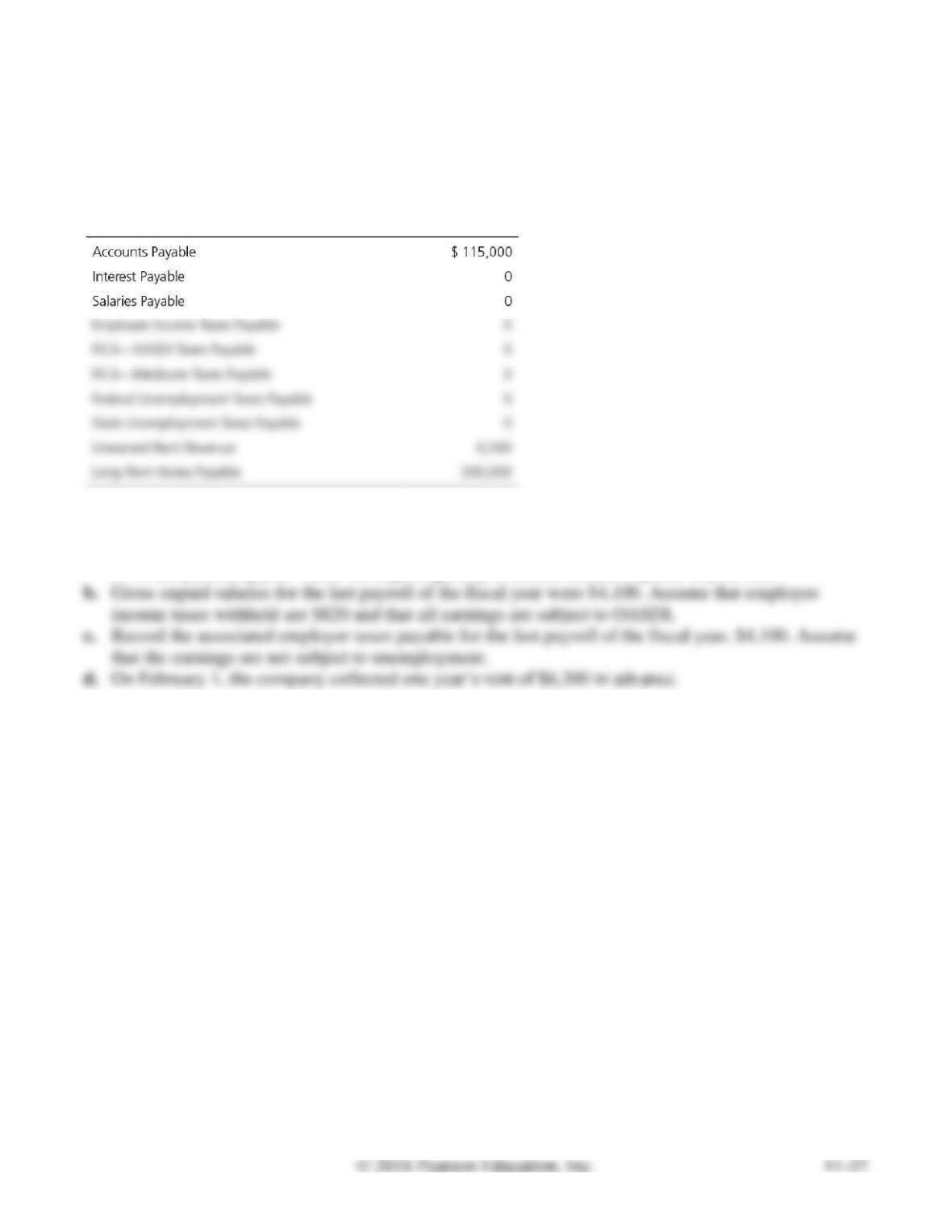
The general ledger of U-R-Shipping at June 30, 2016, the end of the company’s fiscal year, includes the
following account balances before payroll and adjusting entries.
The additional data needed to develop the payroll and adjusting entries at June 30 are as follows:
a. The long-term debt is payable in annual installments of $60,000, with the next installment due on
July 31. On that date, U-R-Shipping will also pay one year’s interest at 8%. Interest was paid on July
31 of the preceding year. Make the adjusting entry to accrue interest expense at year-end.
Requirements
1. Using T-accounts, open the listed accounts and insert the unadjusted June 30 balances.
2. Journalize and post the June 30 payroll and adjusting entries to the accounts that you opened.
Identify each adjusting entry by letter.
3. Prepare the current liabilities section of the balance sheet at June 30, 2016.
SOLUTION
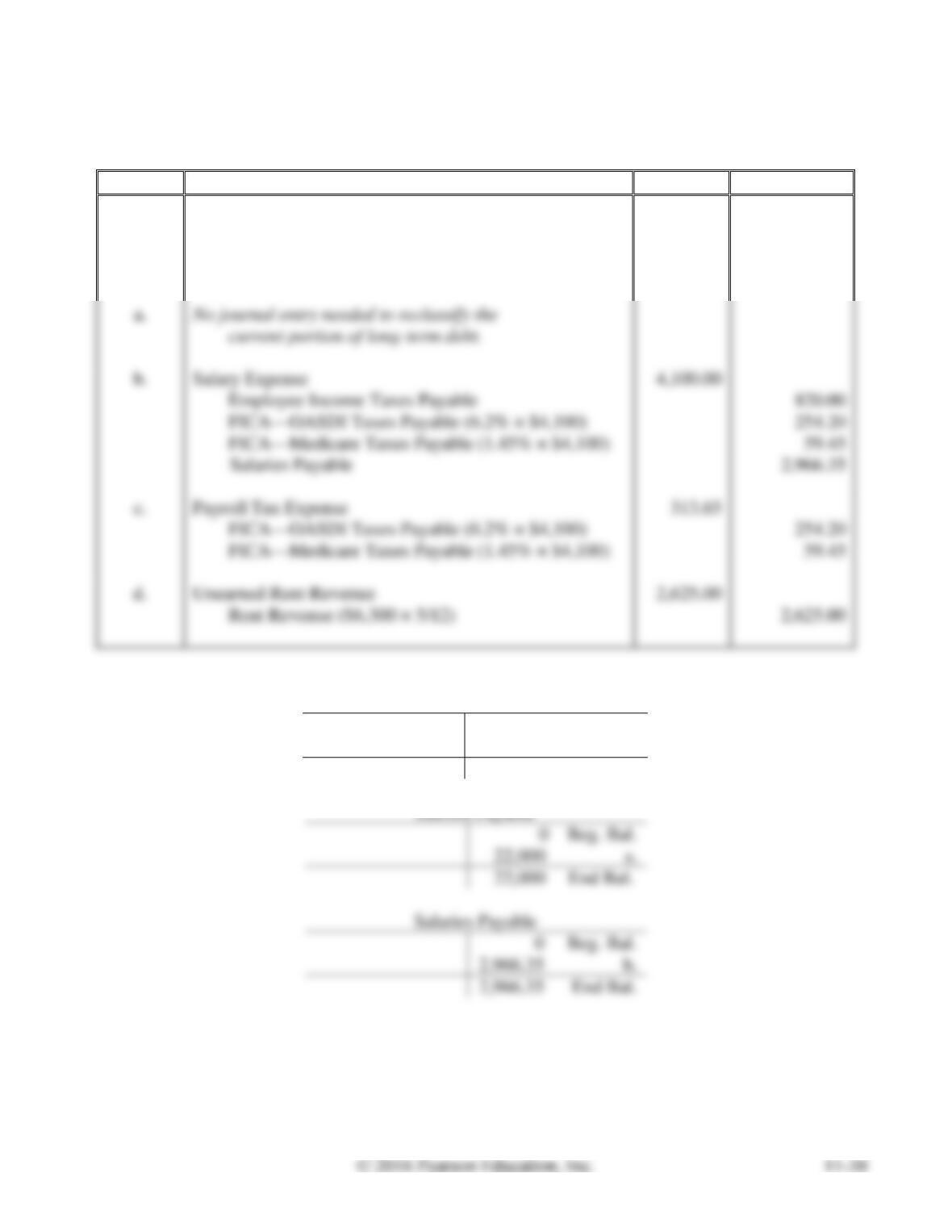
Requirements 1 and 2
Date
Accounts and Explanation
Debit
Credit
2016
Jun. 30
a.
Interest Expense
22,000.00
Interest Payable ($300,000 × 8 % × 11/12)
22,000.00
a.
Salary Expense
Employee Income Taxes Payable
Salaries Payable
c.
Payroll Tax Expense
Unearned Rent Revenue
Rent Revenue ($6,300 × 5/12)
Accounts Payable
115,000 Beg. Bal.
115,000 End Bal.
22,000 a.
22,000 End Bal.
P11-30B, cont.
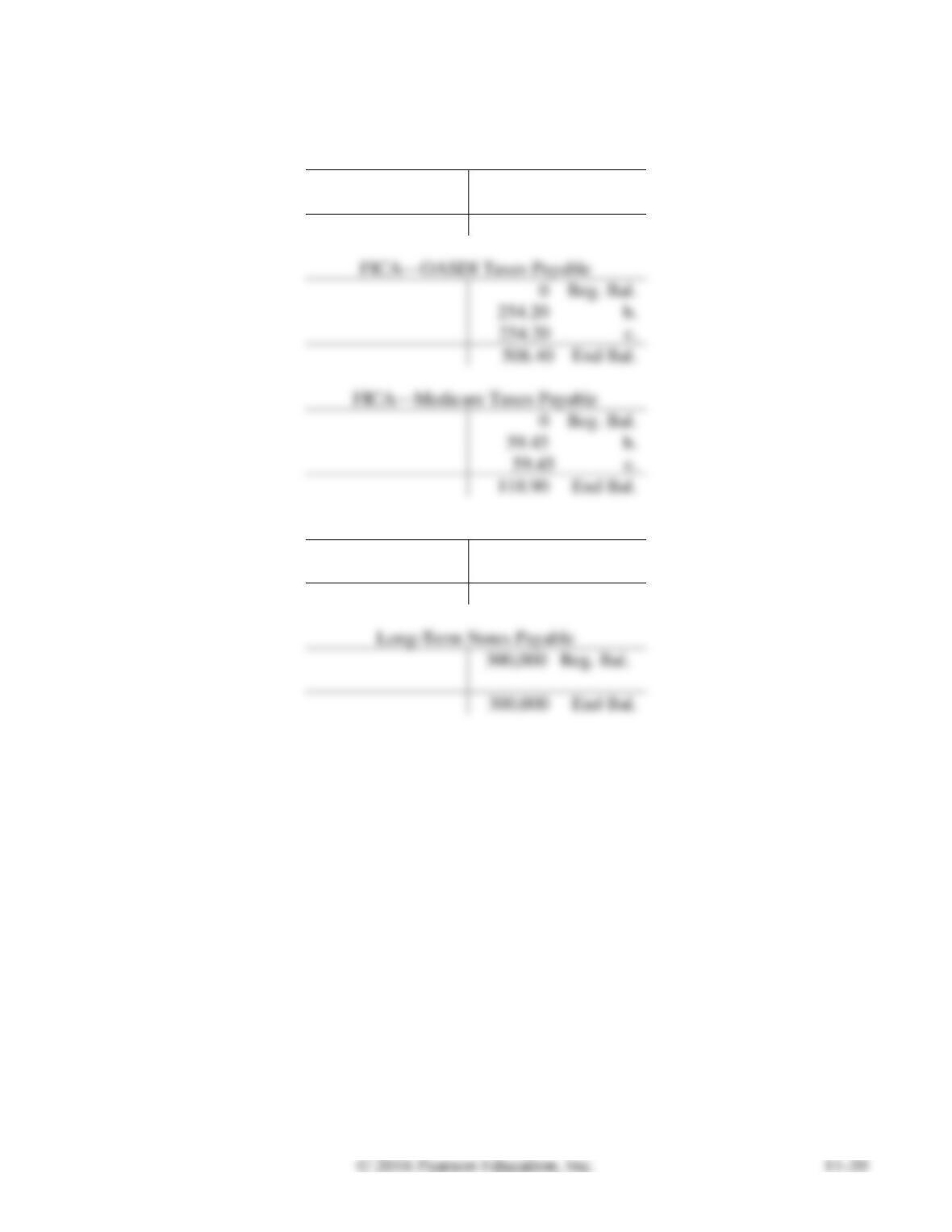
Requirements 1 and 2, cont.
Employee Income Taxes Payable
0 Beg. Bal.
820 b.
820 End Bal.
0 Beg. Bal.
0 Beg. Bal.
Unearned Rent Revenue
6,300 Beg. Bal.
d. 2,625
3,675 End Bal.
300,000 Beg. Bal.
P11-30B, cont.
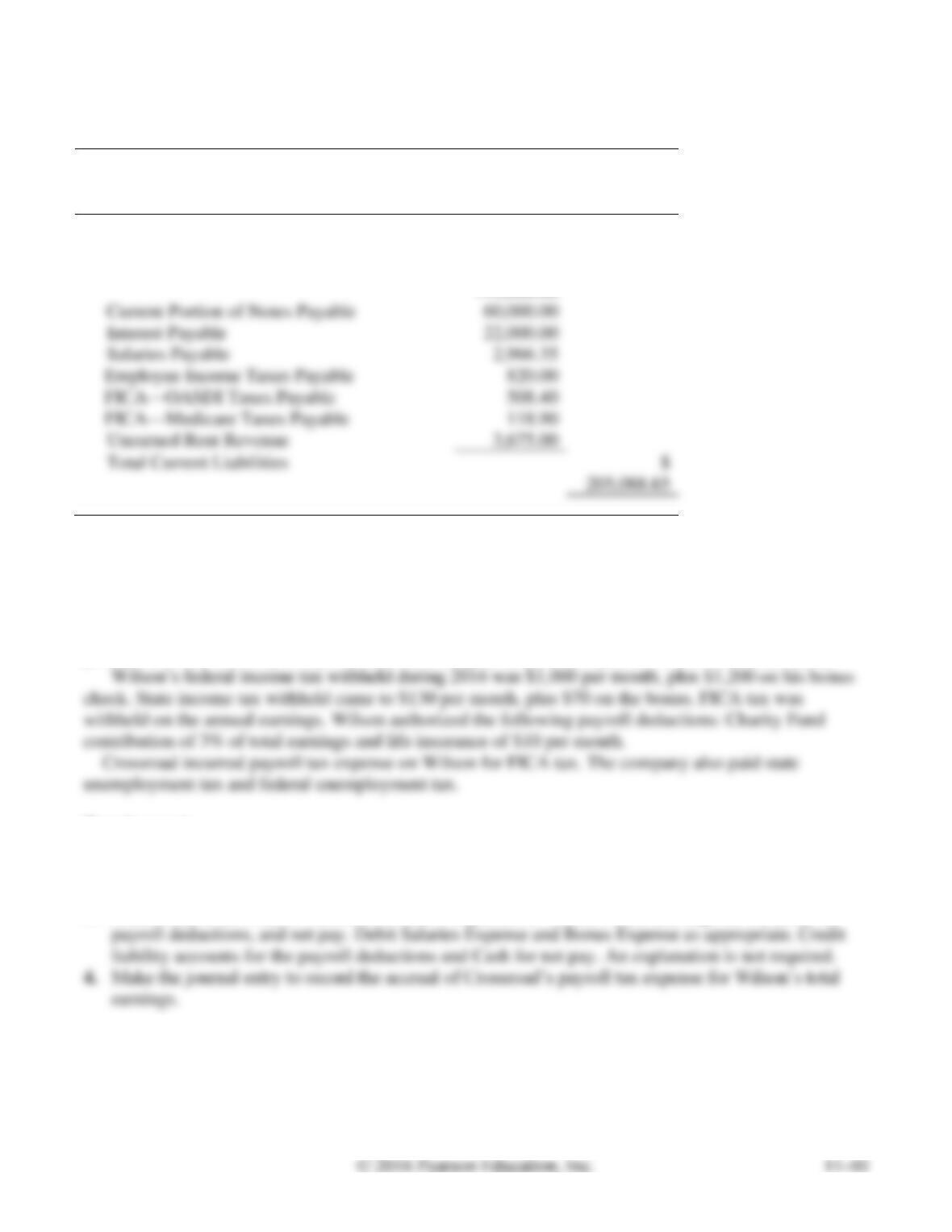
Requirement 3
U-R-SHIPPING
Balance Sheet (Partial)
June 30, 2016
Liabilities
Current Liabilities:
Accounts Payable
$
115,000.00
Current Portion of Notes Payable
Interest Payable
Salaries Payable
Unearned Rent Revenue
Total Current Liabilities
$
205,088.65
P11-31B Computing and journalizing payroll amounts
Learning Objective 2
1. Net Pay $156,895
Len Wilson is general manager of Crossroad Salons. During 2016, Wilson worked for the company all
year at a $14,200 monthly salary. He also earned a year-end bonus equal to 10% of his annual salary.
Requirements
1. Compute Wilson’s gross pay, payroll deductions, and net pay for the full year 2016. Round all
amounts to the nearest dollar.
2. Compute Crossroad’s total 2016 payroll tax expense for Wilson.
3. Make the journal entry to record Crossroad’s expense for Wilson’s total earnings for the year, his
SOLUTION
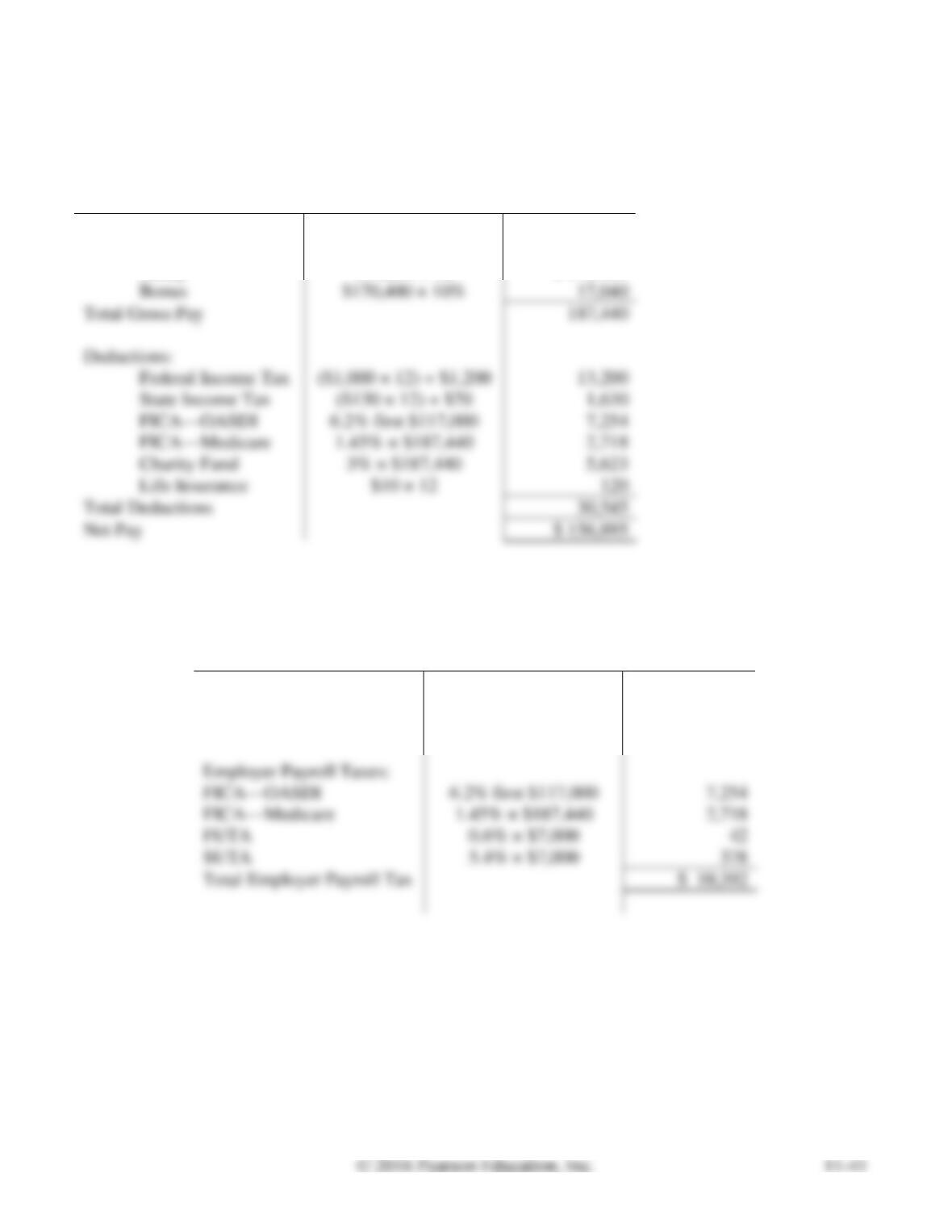
Requirement 1
Len Wilson
Payroll for the year ended December 31, 2016
Calculation
Annual
Gross Pay:
Salary
$14,200 × 12
$ 170,400
Bonus
Total Gross Pay
Deductions:
Federal Income Tax
State Income Tax
Charity Fund
Life Insurance
Total Deductions
Net Pay
$ 156,895
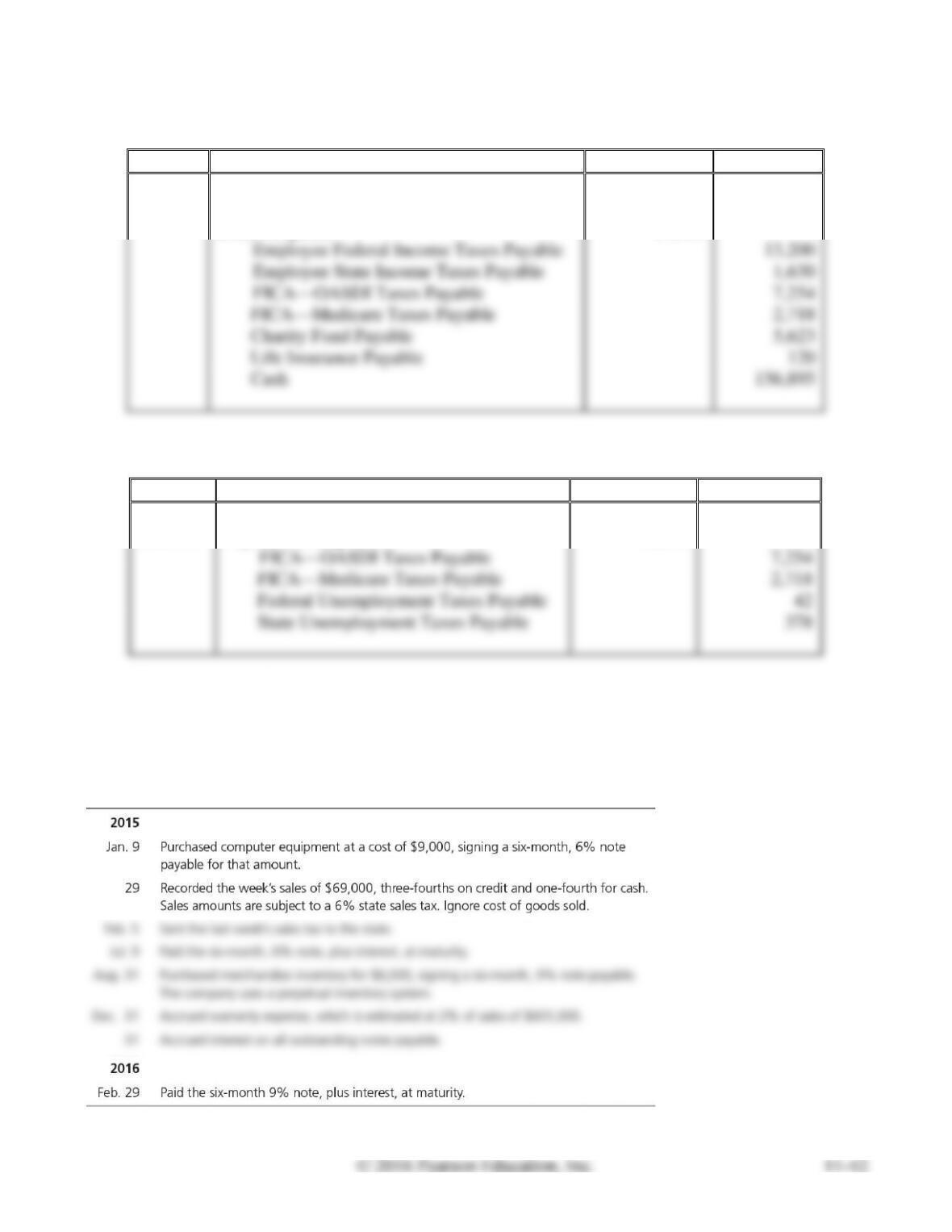
Requirement 2
Len Wilson
Employer Payroll Expense for the year ended December 31, 2016
Calculation
Annual
Gross Pay
$ 187,440
Employer Payroll Taxes:
FUTA
SUTA
Total Employer Payroll Tax
P11-31B, cont.
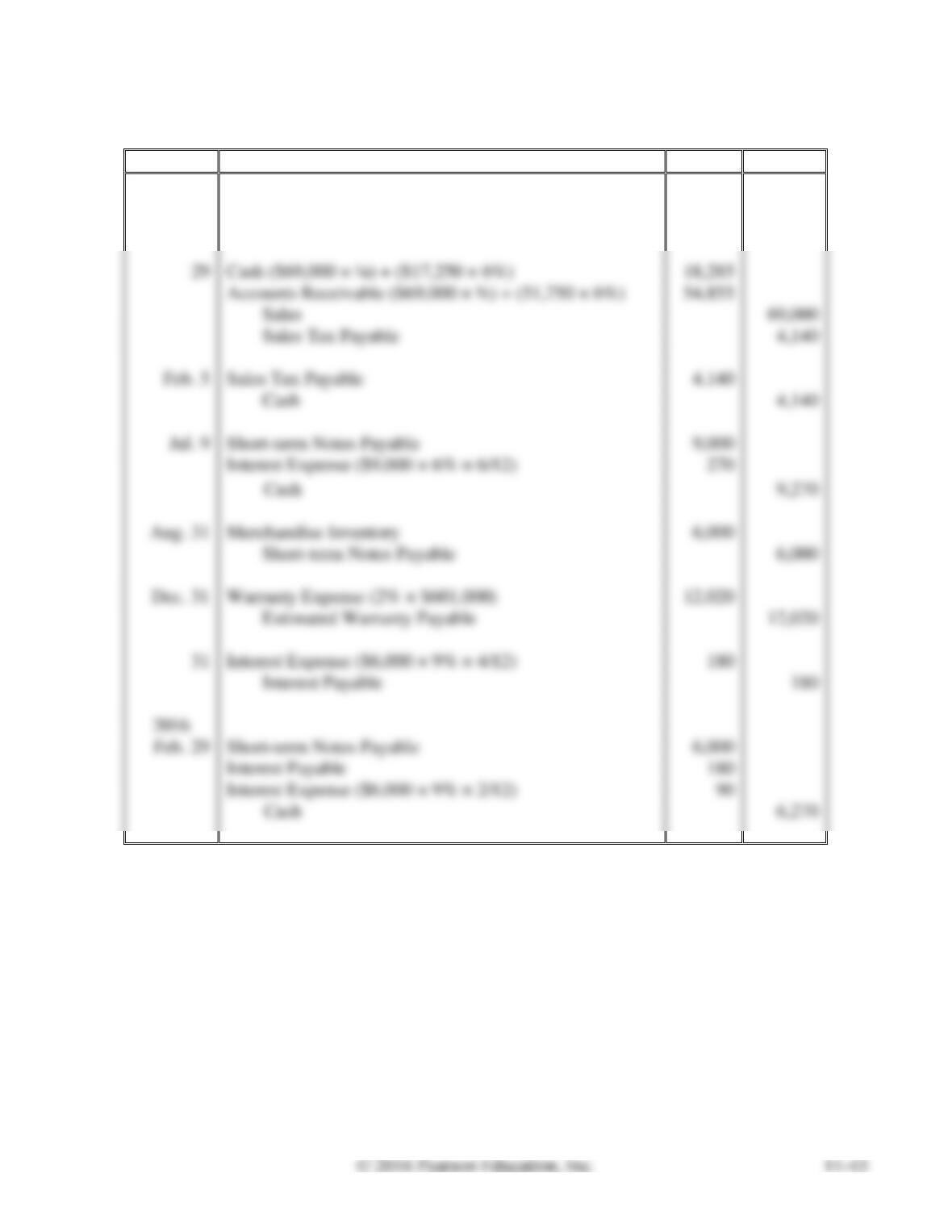
Requirement 3
Date
Accounts and Explanation
Debit
Credit
2016
Dec. 31
Salaries Expense
170,400
Bonus Expense
17,040
1,630
7,254
2,718
5,623
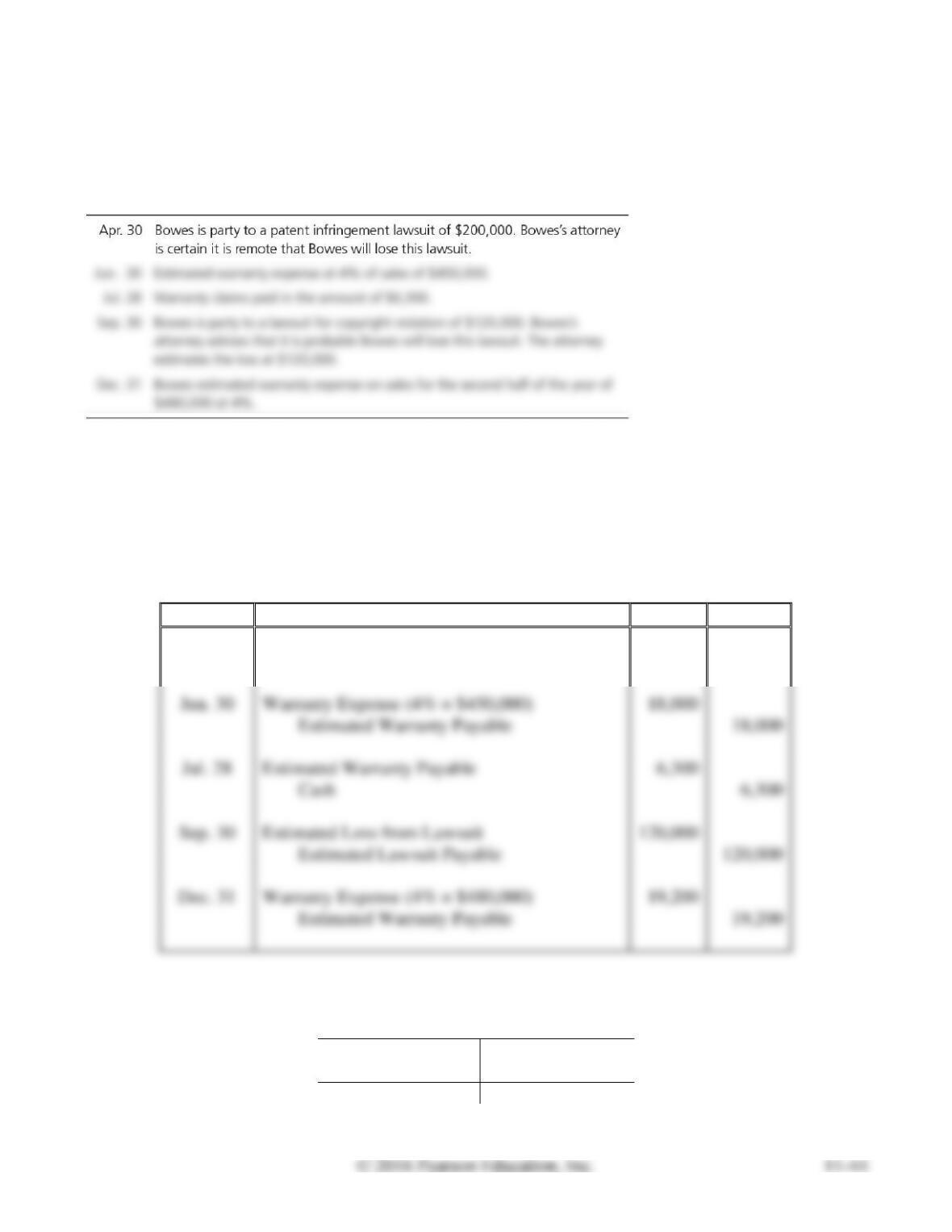
Requirement 4
Date
Accounts and Explanation
Debit
Credit
2016
Dec. 31
Payroll Tax Expense
10,392
P11-32B Journalizing liability transactions
Learning Objectives 1, 3
Jan. 29 Cash $18,285
The following transactions of San Francisco Pharmacies occurred during 2015 and 2016:
Journalize the transactions in San Francisco’s general journal. Explanations are not required.
SOLUTION
Date
Accounts and Explanation
Debit
Credit
2015
Jan. 9
Computer Equipment
9,000
Short-term Notes Payable
9,000
Cash ($69,000 × ¼) + ($17,250 × 6%)
Accounts Receivable ($69,000 × ¾) + (51,750 × 6%)
4,140
Sales Tax Payable
4,140
4,140
Short-term Notes Payable
9,000
9,270
Merchandise Inventory
6,000
6,000
Warranty Expense (2% × $601,000)
Interest Expense ($6,000 × 9% × 4/12)
Short-term Notes Payable
6,000
Interest Payable
Interest Expense ($6,000 × 9% × 2/12)
6,270
P11-33B Journalizing liability transactions
Learning Objectives 3, 4
1. June 30 Warranty Expense $18,000
The following transactions of Percy Bowes occurred during 2016:
Requirements
1. Journalize required transactions, if any, in Bowes’s general journal. Explanations are not required.
2. What is the balance in Estimated Warranty Payable assuming a beginning balance of $0?
SOLUTION
Requirement 1
Date
Accounts and Explanation
Debit
Credit
2016
Apr. 30
No entry required
Warranty Expense (4% × $450,000)
18,000
Estimated Warranty Payable
Estimated Loss from Lawsuit
120,000
Dec. 31
Warranty Expense (4% × $480,000)
19,200
Requirement 2
Estimated Warranty Payable
18,000 Jun. 30
Jul. 28 6,300
19,200 Dec. 31
30,900 End Bal.
P11-34B Computing times-interest-earned ratio
Learning Objective 5
1. Net Income $5,790
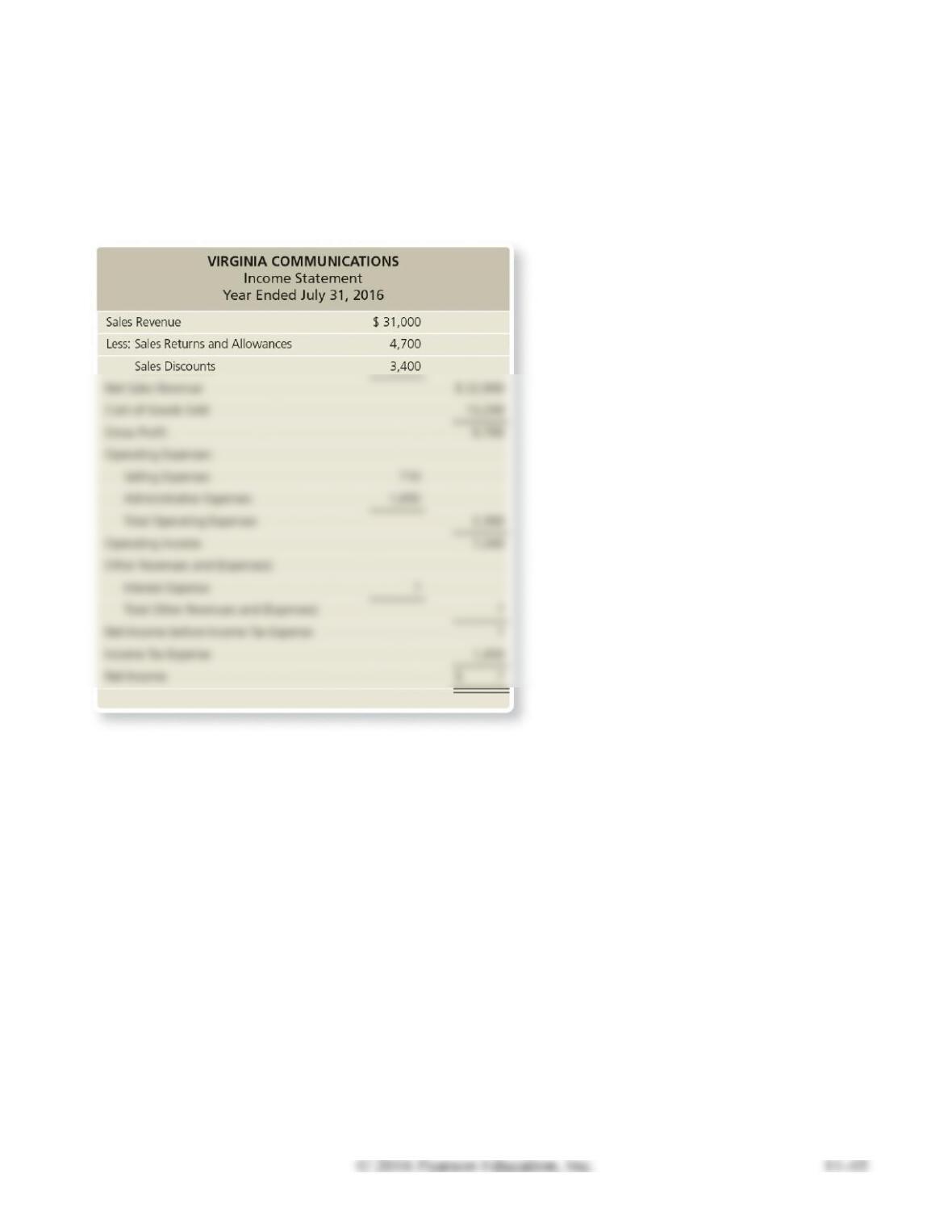
The income statement for Virginia Communications follows. Assume Virginia Communications signed
a 120-day, 6%, $10,000 note on June 1, 2016, and that this was the only note payable for the company.
Requirements
1. Fill in the missing information for Virginia’s year ended July 31, 2016, income statement.
2. Compute the times-interest-earned ratio for the company.
SOLUTION
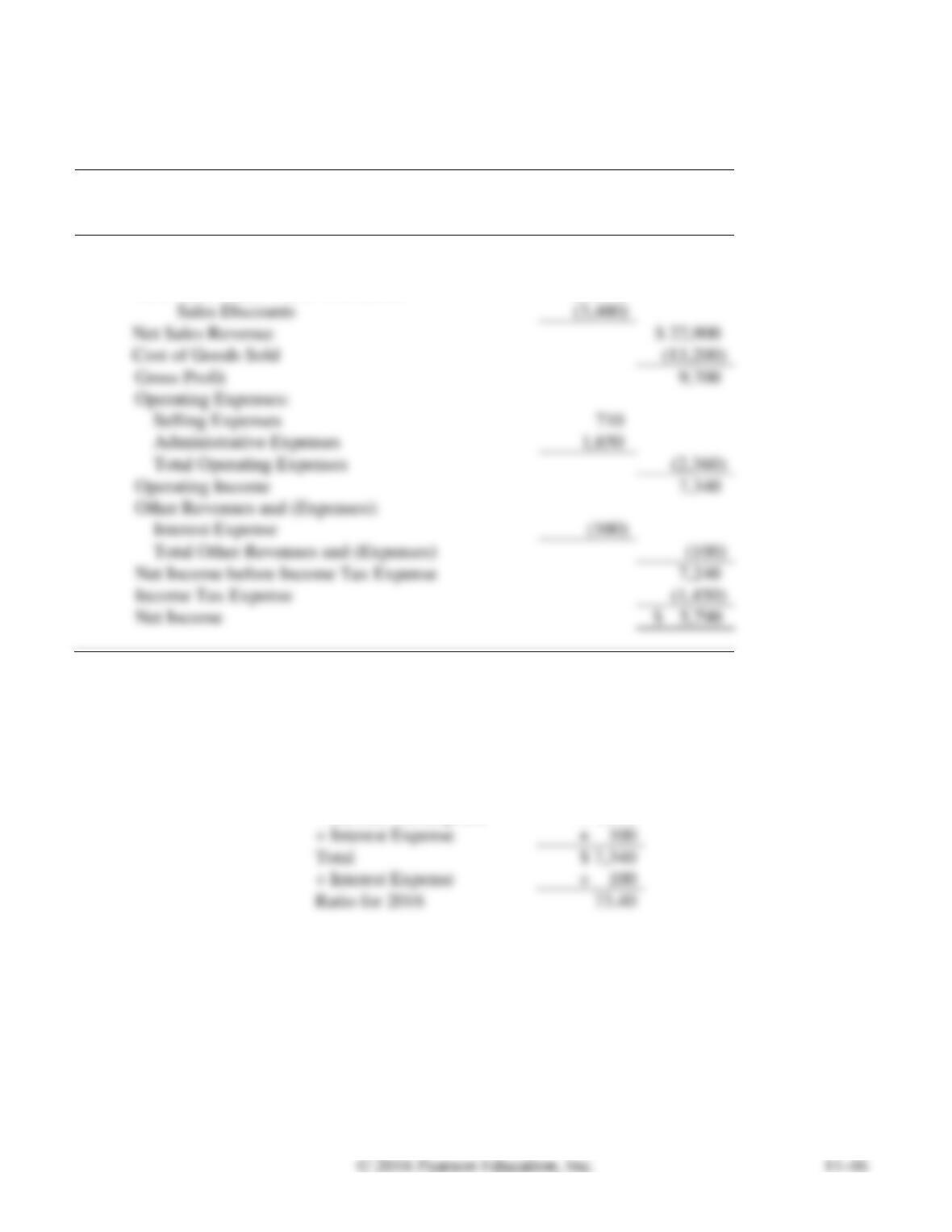
Requirement 1
VIRGINIA COMMUNICATIONS
Income Statement
Year Ended July 31, 2016
Sales Revenue
$ 31,000
Less: Sales Returns and Allowances
(4,700)
(3,400)
$ 22,900
Gross Profit
9,700
Operating Expenses:
(2,360)
Operating Income
7,340
Other Revenues and (Expenses):
Net Income before Income Tax Expense
7,240
Income Tax Expense
(1,450)
Net Income
Interest Expense = $10,000 × 6% × 60/360 = $100
Requirement 2
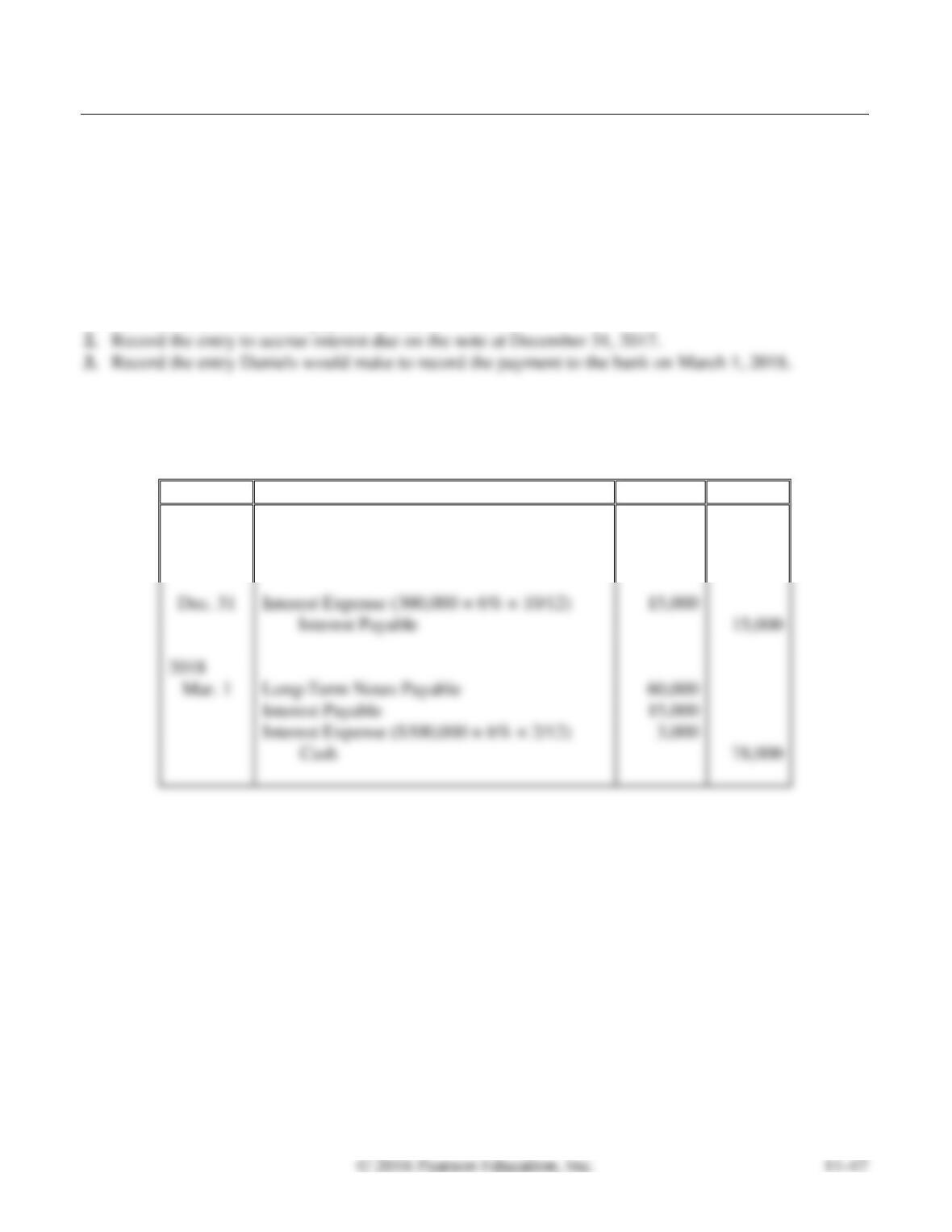
Times-interest-earned ratio
Net Income
$ 5,790
+ Income Tax Expense
+ 1,450
+ Interest Expense
Total
$ 7,340
÷ Interest Expense
Ratio for 2016
Continuing Problem
P11-35 Accounting for liabilities of a known amount
This problem continues the Daniels Consulting situation from Problem P10-23 of Chapter 10. Daniels
Consulting believes the company will need to borrow $300,000 in order to expand operations. Daniels
consults the bank and secures a 6%, five-year note on March 1, 2017. Daniels must pay the bank
principal in five equal installments plus interest annually on March 1.
Requirements
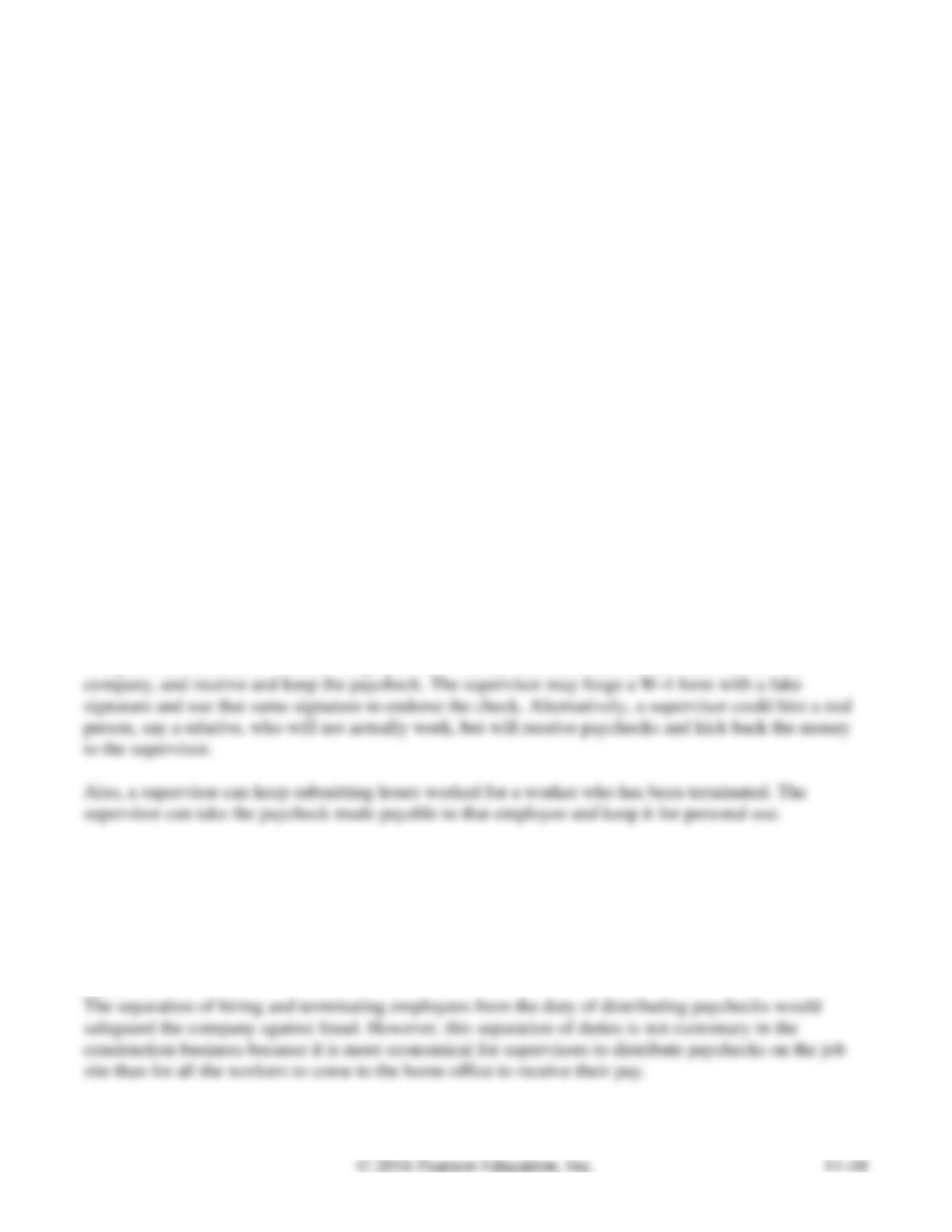
1. Record the $300,000 note payable on March 1, 2017.
SOLUTION
Requirements 1, 2, 3
Date
Accounts and Explanation
Debit
Credit
2017
Mar. 1
Cash
300,000
Long-Term Notes Payable
300,000
Interest Expense (300,000 × 6% × 10/12)
Interest Payable
2018
Mar. 1
Long-Term Notes Payable
Interest Payable
Interest Expense ($300,000 × 6% × 2/12)
Critical Thinking
Decision Case 11-1
Golden Bear Construction operates throughout California. The owner, Gaylan Beavers, employs 15
work crews. Construction supervisors report directly to Beavers, and the supervisors are trusted
employees. The home office staff consists of an accountant and an office manager.
Because employee turnover is high in the construction industry, supervisors hire and fire their own
crews. Supervisors notify the office of all personnel changes. Also, supervisors forward the employee
W-4 forms to the home office. Each Thursday, the supervisors submit weekly time sheets for their
crews, and the accountant prepares the payroll. At noon on Friday, the supervisors come to the office to
get paychecks for distribution to the workers at 5 p.m.
The company accountant prepares the payroll, including the paychecks. Beavers signs all paychecks.
To verify that each construction worker is a bona fide employee, the accountant matches the employee’s
endorsement signature on the back of the canceled paycheck with the signature on that employee’s W-4
form.
Requirements
1. Identify one way that a supervisor can defraud Golden Bear Construction under the present system.
2. Discuss a control feature that the company can use to safeguard against the fraud you identified in
Requirement 1.
SOLUTION
Requirement 1
A supervisor can enter a fictitious employee on a weekly time sheet, submit the time sheet to the
Requirement 2
To safeguard against the company fraud identified in Requirement 1, Beavers (or a home office
employee) should make unscheduled visits to construction sites and distribute payroll checks. If a
paycheck is payable to an employee not present to receive it, Beavers can ask other workers if the absent
person has been working on that job. If the workers say no, Beavers will have uncovered a possible
fraud.
Decision Case 11-2
Sell-Soft is the defendant in numerous lawsuits claiming unfair trade practices. Sell-Soft has strong
incentives not to disclose these contingent liabilities. However, GAAP requires that companies report
their contingent liabilities.
Requirements
1. Why would a company prefer not to disclose its contingent liabilities?
2. Describe how a bank could be harmed if a company seeking a loan did not disclose its contingent
liabilities.
3. What ethical tightrope must companies walk when they report contingent liabilities?
SOLUTION
Requirement 1
A company would prefer not to disclose its contingent liabilities because they cast a shadow on the
Requirement 2
A contingent liability creates risk for a company. If the contingent liability is not reported, the bank may
Requirement 3
Reporting of contingent liabilities often depends on subjective judgment about whether an outcome is
Ethical Issue 11-1
Many small businesses have to squeeze down costs any way they can just to survive. One way many
businesses do this is by hiring workers as “independent contractors” rather than as regular employees.
Unlike rules for regular employees, a business does not have to pay Social Security (FICA) taxes and
unemployment insurance payments for independent contractors. Similarly, it does not have to withhold
federal, state, or local income taxes or the employee’s share of FICA taxes. The IRS has a “20 factor
test” that determines whether a worker should be considered an employee or a con- tractor, but many
businesses ignore those rules or interpret them loosely in their favor. When workers are treated as
independent contractors, they do not get a W-2 form at tax time (they get a 1099 instead), they do not
have any income taxes withheld, and they find themselves subject to “self–employment” taxes, by which
they bear the brunt of both the employee’s and the employer’s shares of FICA taxes.
Requirements
1. When a business abuses this issue, how is the independent contractor hurt?
2. If a business takes an aggressive position—that is, interprets the law in a very slanted way—is there
an ethical issue involved? Who is hurt?
SOLUTION
Requirement 1
The contractor must pay “self–employment tax” which represents both the employer’s and the
Requirement 2
Businesses may take aggressive positions on tax issues, and those positions may be tested in court. It is
Financial Statement Case 11-1
Requirements
1. Give the breakdown of Starbucks’s current liabilities at September 29, 2013.
2. Calculate Starbucks’s times-interest-earned ratio for the year ending September 30, 2012.
SOLUTION
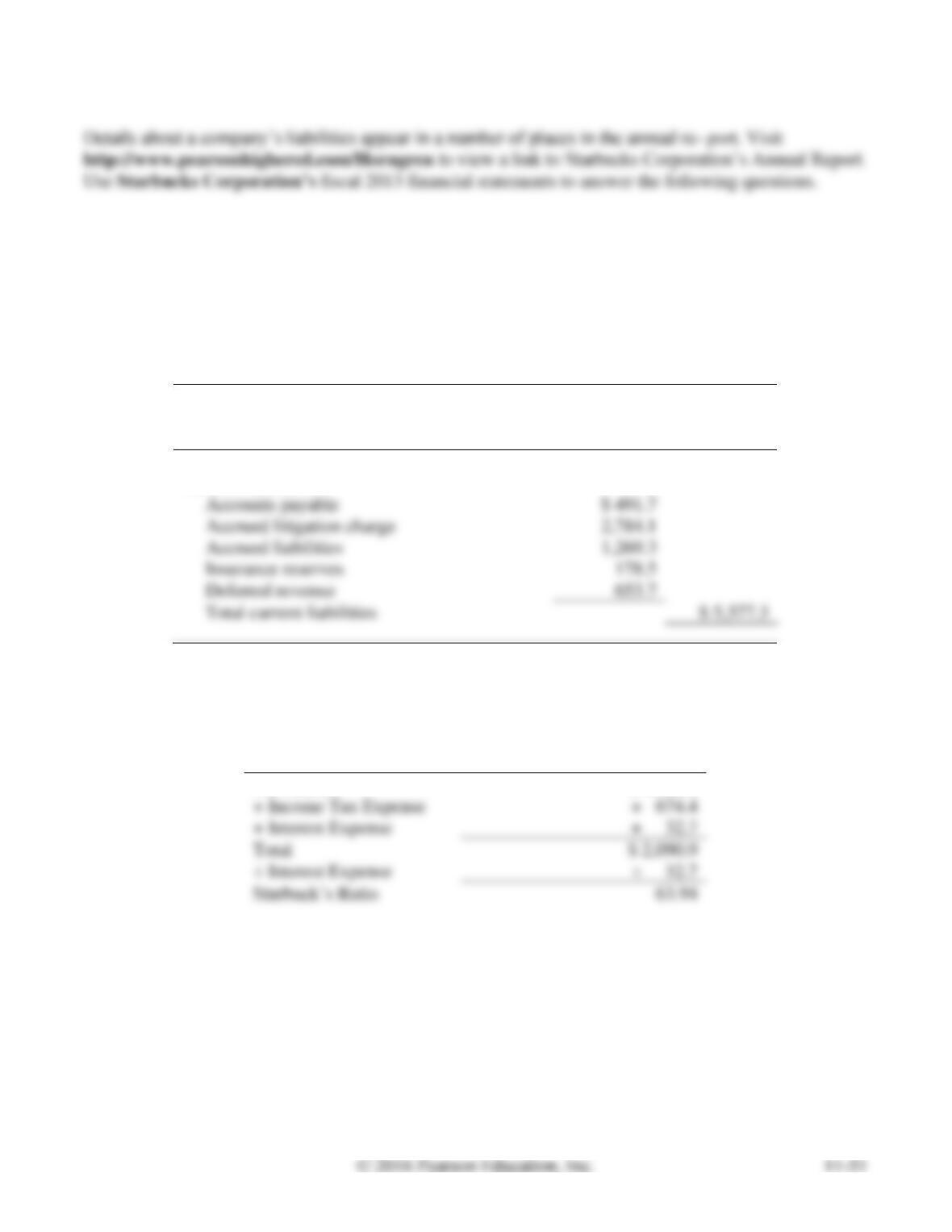
Requirement 1
STARBUCKS
Balance Sheet (partial)
September 29, 2013 (In millions)
Liabilities
Current Liabilities:
Accounts payable
Accrued litigation charge
Accrued liabilities
Insurance reserves
Deferred revenue
Total current liabilities
Requirement 2
Times-Interest-Earned Ratio
September
30, 2012
Net Income
$ 1,383.8
+ Income Tax Expense
+ Interest Expense
Total
$ 2,090.9
÷ Interest Expense
Communication Activity 11-1
In 150 words or fewer, explain how contingent liabilities are accounted for.
SOLUTION
How businesses record or don’t record contingent liabilities is based on one of three likelihoods of the
event occurring in the future: remote, reasonably possible, or probable.