Combinatorial Properties of Reaction Systems
September 4, 2008
1. Preliminaries
a. Define an (r-i)-reaction.
2. Probability That a Reaction Is Enabled
This section develops formulae for the probability that a random reaction is enabled for a
random state. In particular, we develop closed formulae for various forms of the
following definition:
Definition 1. Let r, i, n and m be integers with n ≥ r + i ≥ 2 and n ≥ m ≥ r.
Example 1. Let r = 3, i = 1, n = 100 and m = 50.
For any fixed 100-element background set S, there are 15,684,900 combinations of a
We next develop a closed formula for the special case of probenabled (3, 1, n, m). Later,
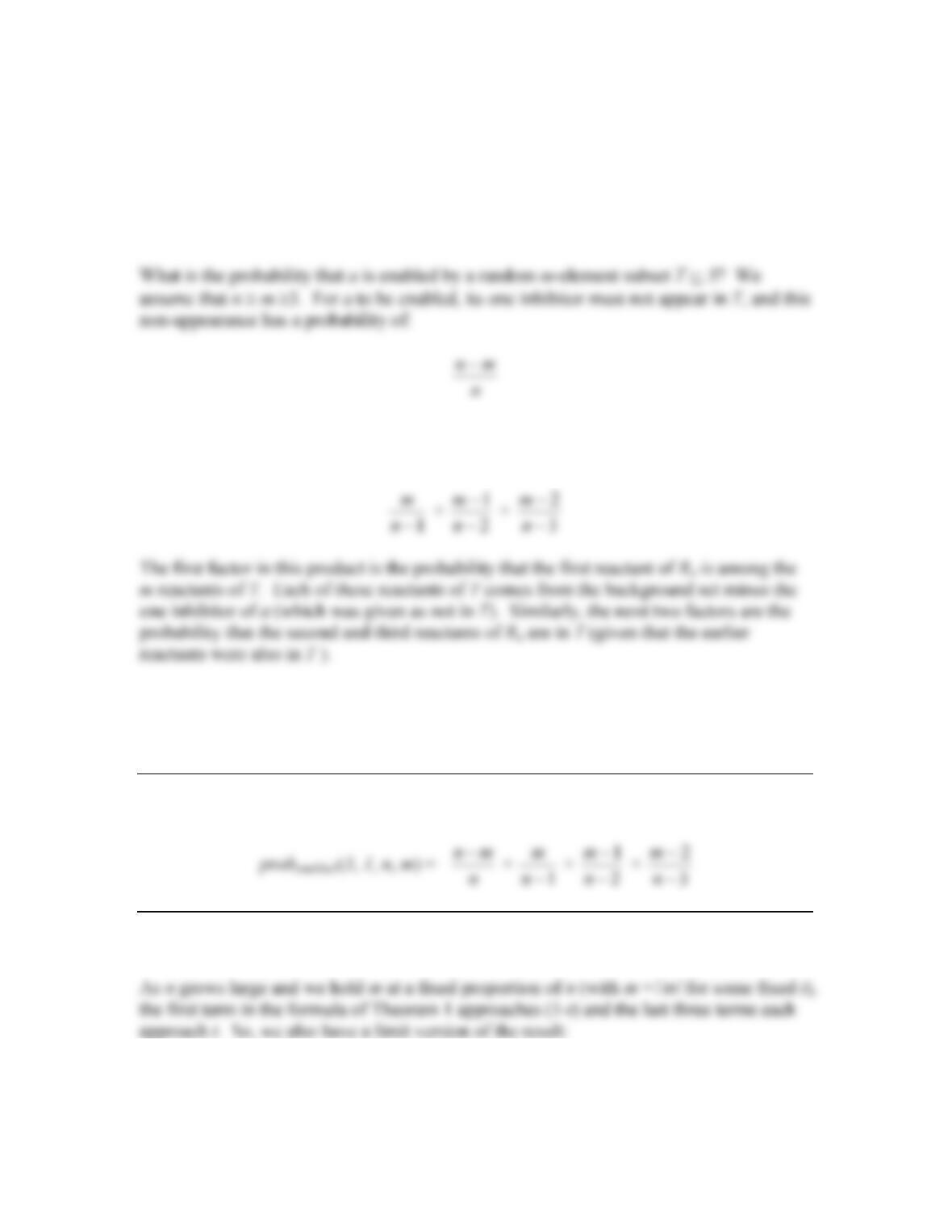
the formula is generalized for any r and i, and a limit version of the formula is shown for
any fraction s ∈ [0..1] to be:
2.1. Probability That a (3,1)-Reaction Is Enabled
Let a be some (3,1)-reaction over a background set S of n elements (with n ≥ 4). Recall
that our definition requires a’s one inhibitor is not also in its three-element reactant set
(since otherwise, it has no chance of ever being enabled).
We also require that the reactant set of
a
is a subset of
T
; given that the inhibitor is not in
T
, this probability (that
R
a
⊆
T
) is:
Multiplying all the terms together and simplifying gives:
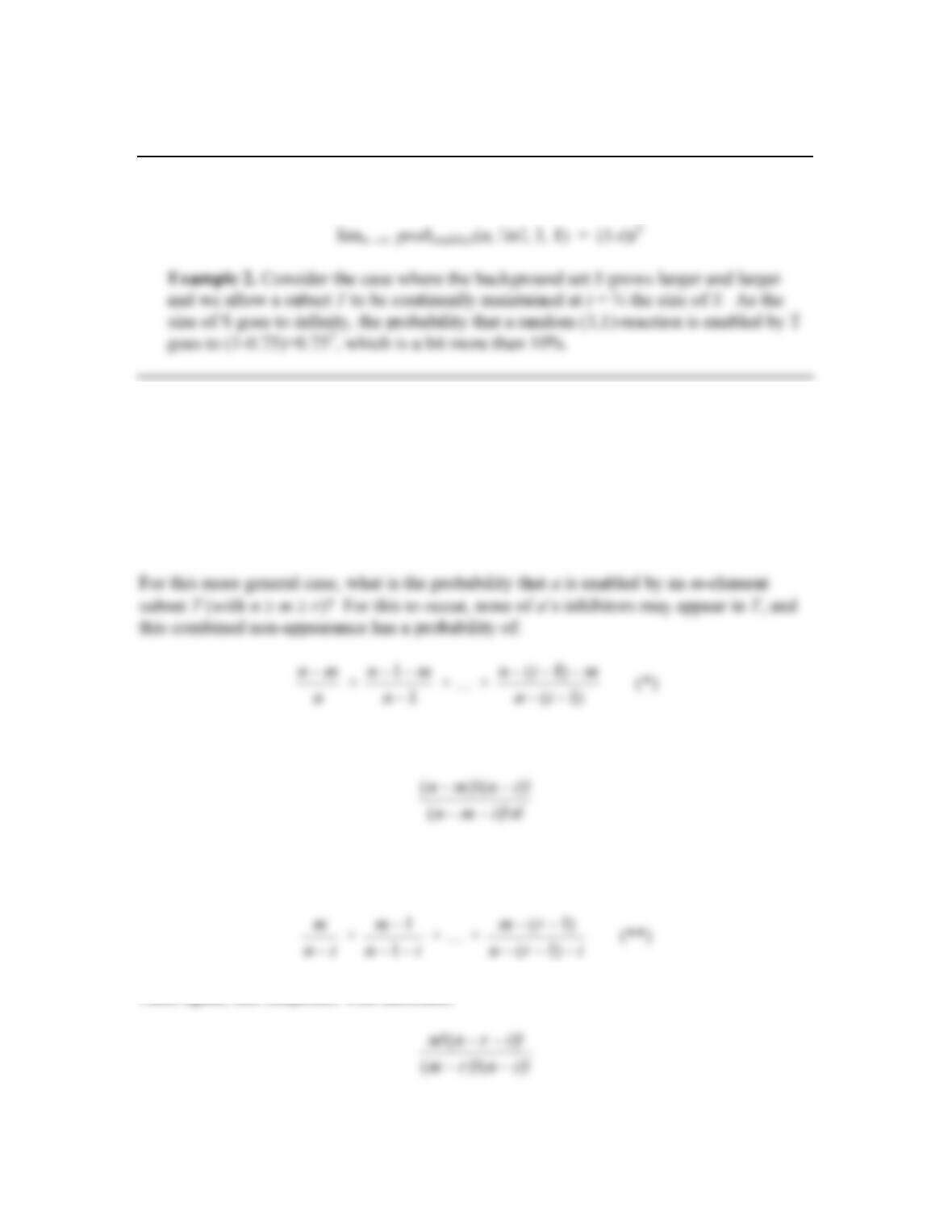
Theorem 1.
Let n and m be integers with n ≥ 4 and n ≥ m ≥ 3. Then:
Theorem 2.
Let t ∈ [0..1] be a constant. Then:
2.2. Probability That an (r,i)-Reaction Is Enabled
This section generalizes the results of the previous section to the case of an (r,i)-reaction.
For this, we consider a to be an (r,i)-reaction over a background set of n elements with
n ≥ r + i. As always, the reactant set of a is disjoint from its inhibitor state.
Using factorials, this simplifies to:
Given that none of the inhibitors are in T, we can express the probability that all of the r
reactants are in T as:
Once again, this simplifies with factorials:
Multiplying the two parts of the probability together and canceling terms gives the first
result of this section:
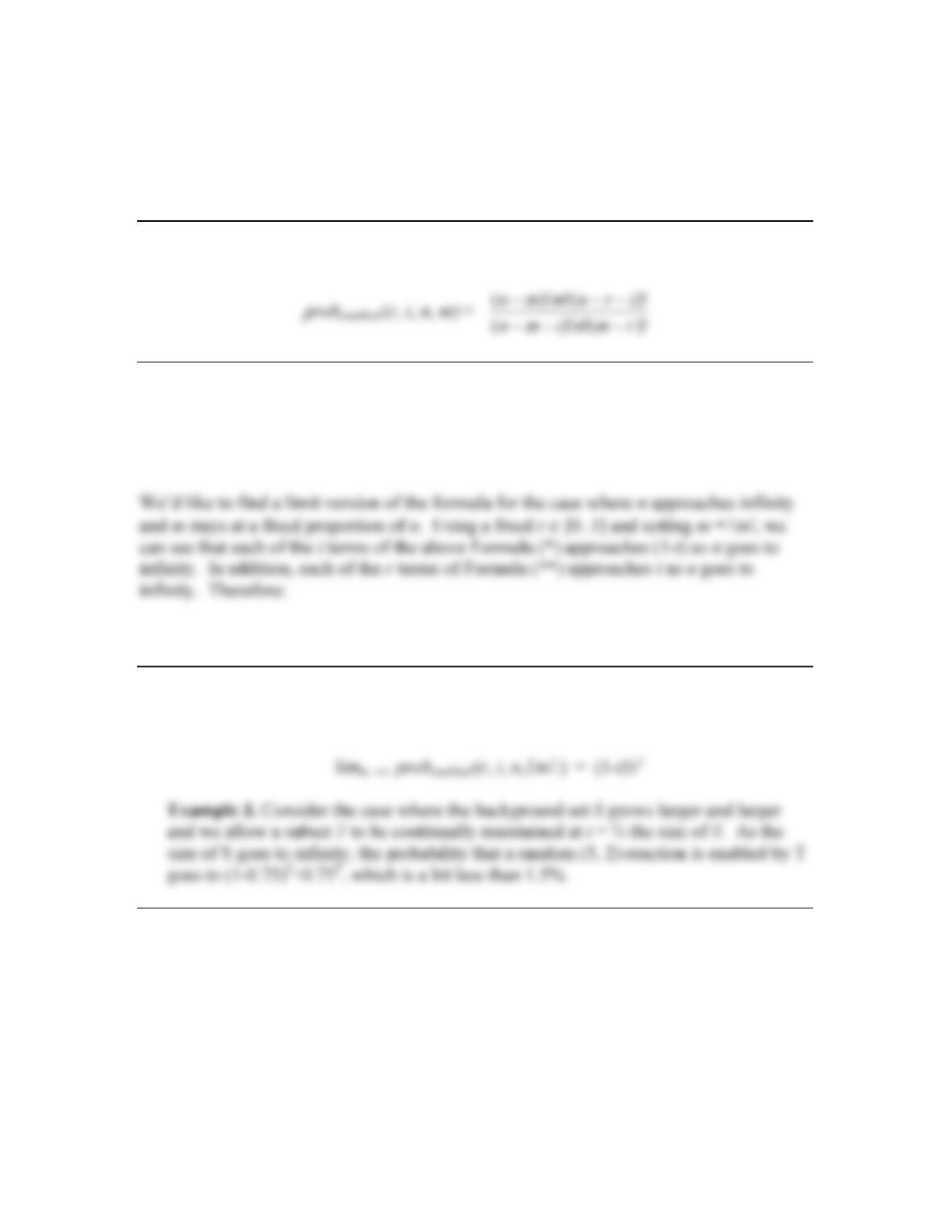
Theorem 3.
Let n, m, r and i be natural numbers with n ≥ r+i and n ≥ m ≥ r. Then:
In the special case of (3,1)-reactions, this simplifies to Theorem 1 from the previous
section.
Theorem 4.
Let t ∈ [0..1] be a real number. Also let r and i be natural numbers.
Then:
3. The Size of a Result State
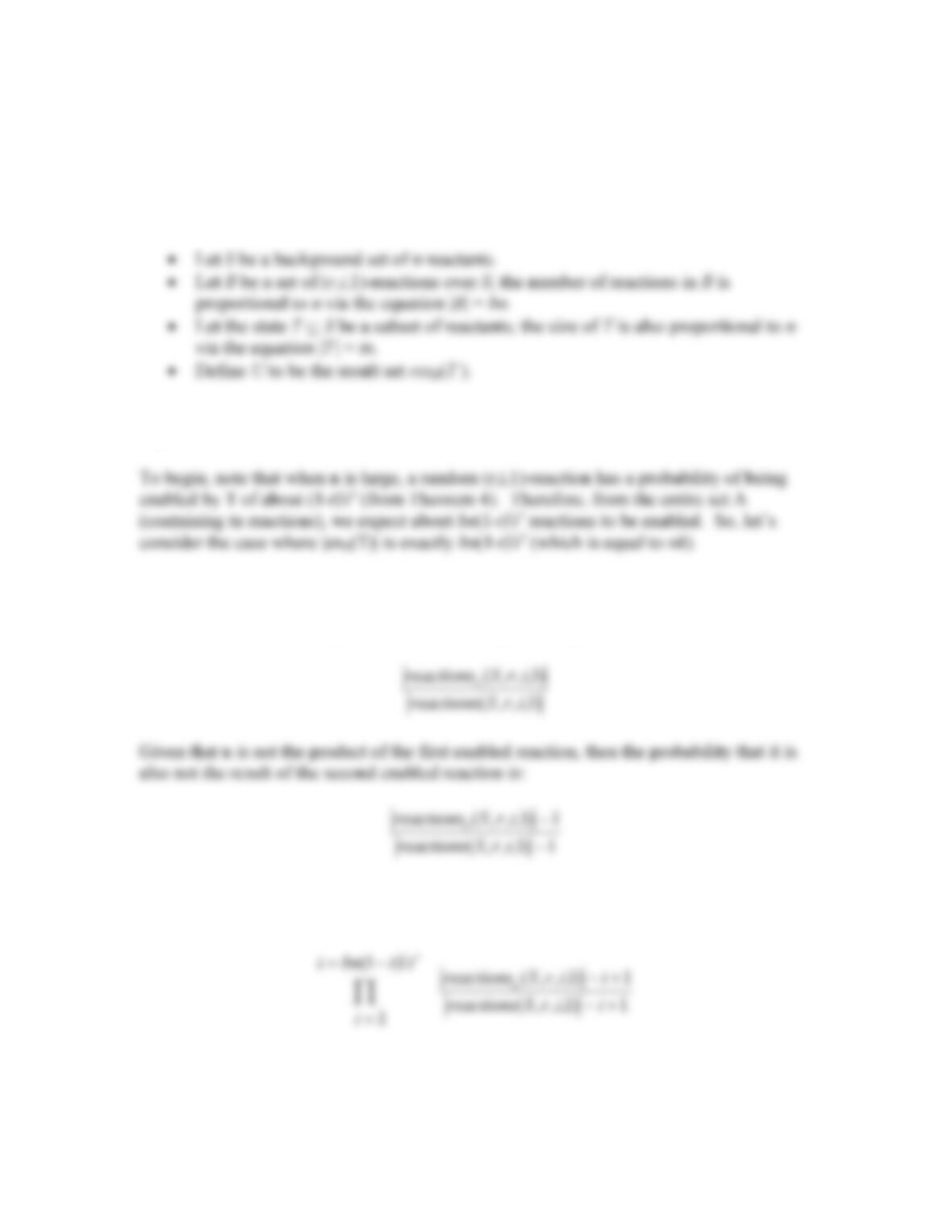
Throughout this section, let r, i, and n be integers, let t ∈ [0..1], and let b ∈ [0..∞). We
assume that n ≥ r + i ≥ 0. Also:
We will examine a particular case where b and t are related in a way that makes the
expected size of U close to that of T.
We want to determine the expected size of U. For this, consider any reactant u ∈ S.
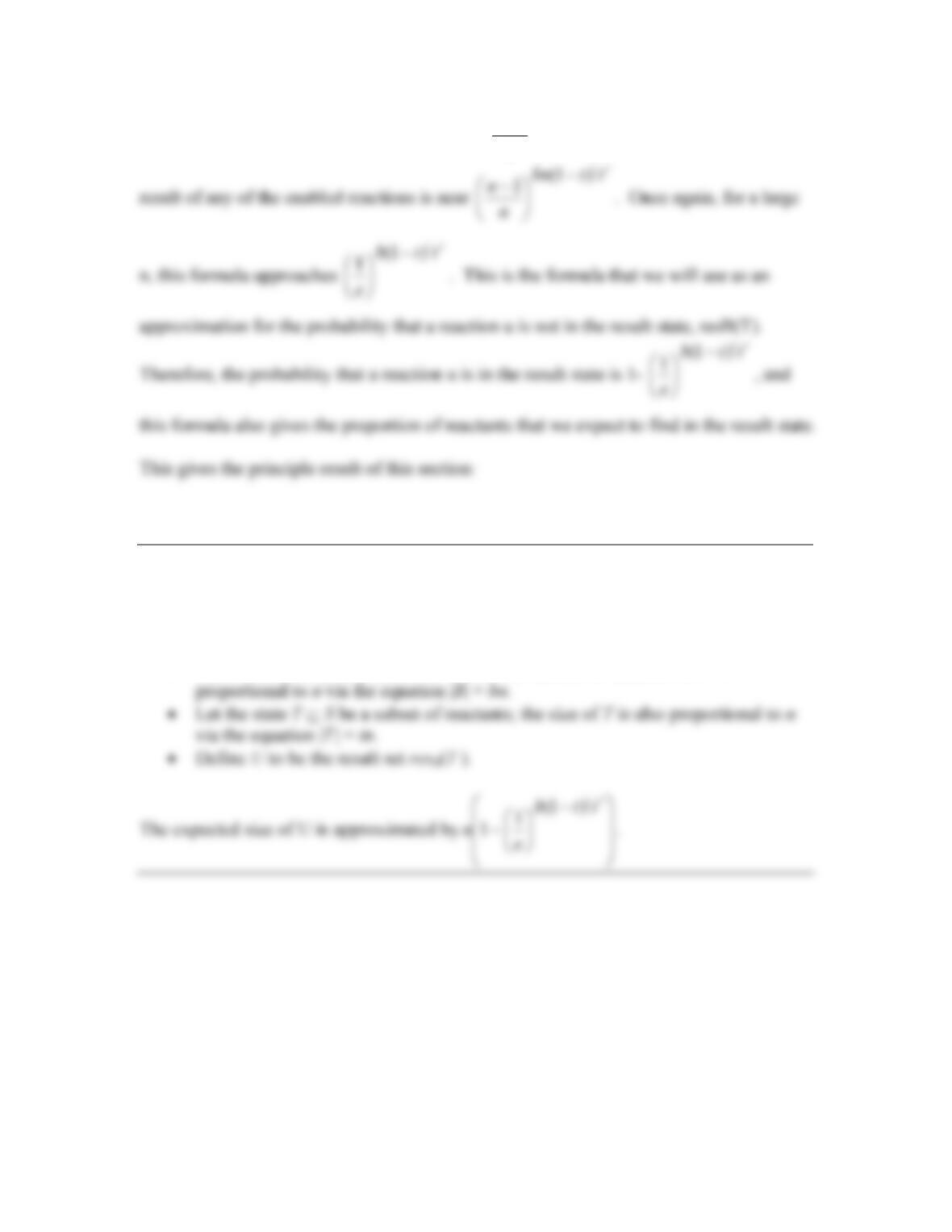
What is the probability that u is not in U? If so, then it must not be the result of the first
enabled reaction in en
A
(T), which occurs with a probability of
Continuing this argument, the probability that u is not the result of any of the enabled
reactions is obtained by the multiplicative product:
For a large n, each of these factors approaches
n
n1
−
, so the probability that u is not the
Theorem 5.
Let r, i, and n be integers, let t ∈ [0..1], and let b ∈ [0..∞). We assume that
n ≥ r + i ≥ 0. Also:
•
Let S be a background set of n reactants.
•
Let B be a set of (r,i,1)-reactions over S; the number of reactions in B is
4. Simulations and Cycles
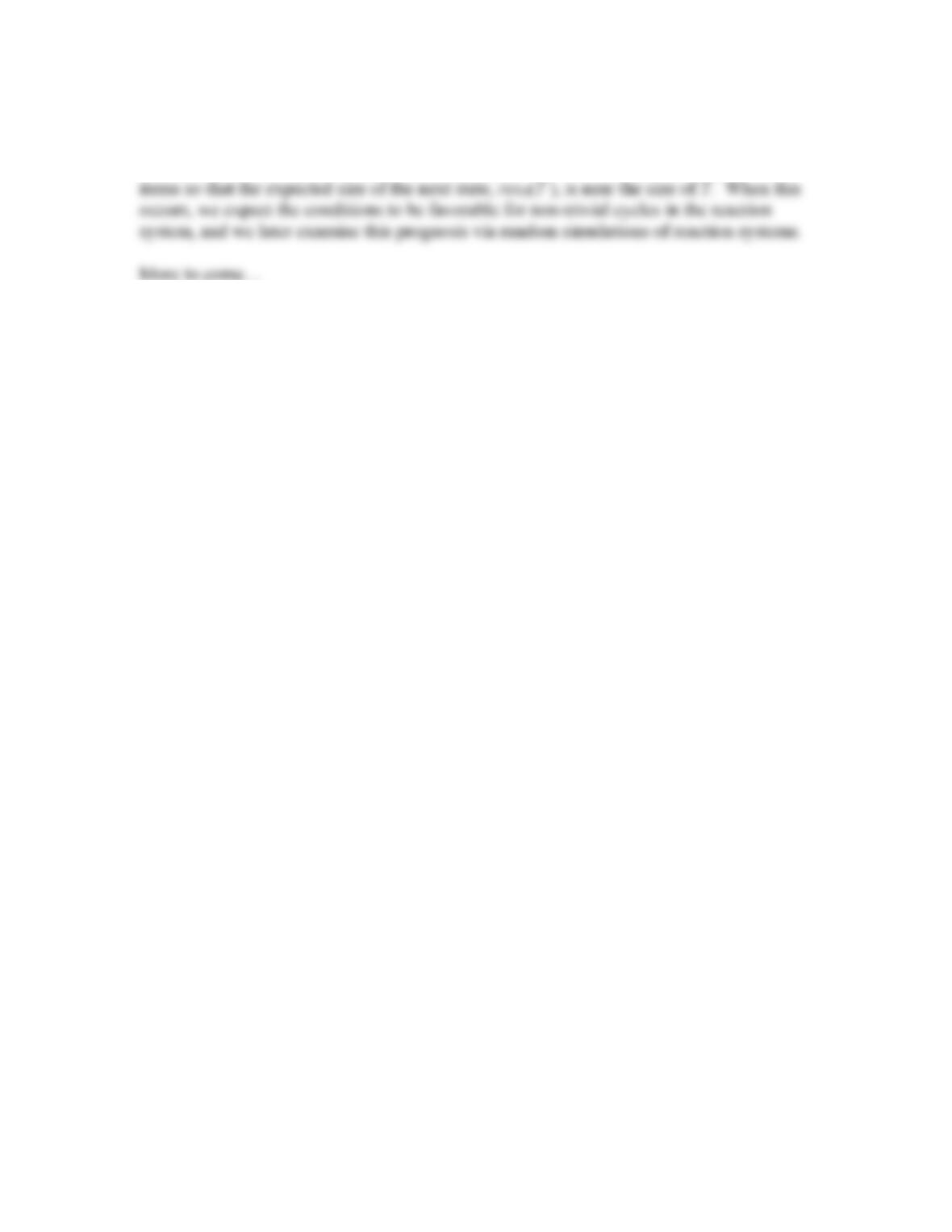
Consider a reaction system (S, B) and a state T ⊆ S. This section parameterizes these