11–61
CA 11-1 (Continued)
If Burnitz is not profitable now, it would not benefit from higher deductions now and should
CA 11-2
(a) (1) The unit method of recording depreciation involves the treatment of plant assets or substantial
(2) Under the group or composite-life methods, assets are aggregated into accounting units. Such
grouping might be horizontal, vertical, or geographical. Horizontal grouping assembles together
all assets of similar physical characteristics, such as trucks, presses, returnable containers,
etc. A vertical or functional grouping comprises all assets contributing to a common economic
function, such as a sugar refinery, a service station, etc. The geographical grouping includes
all assets in a district or region, such as telephone poles.
(b) 1. Arguments for the use of the unit method are:
i. The method is simple in that it does not require involved mathematical computations.
ii. The gain or loss on the retirement of a particular asset can be computed.
iii. For cost purposes, depreciation on idle equipment can be isolated.
iv. The method results in a more accurately computed depreciation provision in any given
year, as the total depreciation charge represents the best estimate of the depreciation of
each asset and is not the result of averaging the cost over a longer period of time.
2. Arguments for the use of the group and composite-life methods are:
i. The methods require less detailed bookkeeping.
ii. The application of depreciation to the whole group tends to average out or offset errors,
economic or operating, caused by under-depreciation or over-depreciation.
iii. Periodic income is not distorted by gains or losses on disposal of assets.
CA 11-2 (Continued)
iv. A more useful charge to expense is derived from these methods because of their
recognition that depreciation estimates are based on averages and that gains and losses
on individual assets are of little significance.
Arguments against the use of the group and composite-life methods would include:
i. The methods would conceal faulty estimates for a long period of time.
ii. When there is an early heavy retirement of assets a debit balance might appear in the
(c) Under the unit method, retirements are recorded by removing from the accounts the cost of the
asset and its related accumulated depreciation. The difference between the two accounts, adjusted
for salvage and disposal costs, if any, is recognized as gain or loss.
CA 11-3
Situation I. This position relates to the omission of a provision for depreciation during a strike. The same
question could be raised with respect to plant shut-downs for many reasons, such as for a lack of sales
or for seasonal business.
If the company employs a units-of-production method, however, it would be appropriate not to depreciate
the asset during this period. Even in this latter case, however, if the strike were prolonged, it might be
desirable to record some depreciation because of the obsolescence factors related to the passage of
time.
11–63
CA 11-3 (Continued)
(b) In determining the depreciation method to be used for the machine, the objective should be to
allocate the cost of the machine over its useful life in a systematic and rational manner, so that
costs will be matched with the benefits expected to be obtained. In addition to demand, considera-
tion should be given to the items discussed below, their interrelationships, the relative importance
of each, and the degree of certainty with which each can be predicted:
The operating efficiency of the machine may change with its age. A decrease in operating
efficiency may cause increases in such costs as labor and power; if so, an accelerated method
is indicated. If operating efficiency is not expected to decline, the straight-line method is
indicated.
by evaluating such consideration as the anticipated periodic usage.
An example of the interrelationship of the items discussed above is the effect of the repairs
and maintenance policy on operating efficiency and physical life of the machine. For instance,
if only minimal repairs and maintenance are undertaken, efficiency may decrease rapidly and
life may be short.
Situation III. Depreciation rates should be adjusted in order that the operating sawmills which are to be
replaced will be depreciated to their residual value by the time the new facility becomes available. The
step-up in the depreciation rates should be considered as a change in estimate and prior years’
financial statements should not be adjusted.
CA 11-4
To: Phil Perriman, Supervisor of Canning Room
From: Your name, Accountant
Date: January 22, 2012
Subject: Annual depreciation charge to the canning department
This memo addresses the questions you asked about the depreciation charge against your department.
Admittedly this charge of $625,000 is very high; however, it is not intended to reflect the wear and tear
which the machinery has undergone over the last year. Rather, it is a portion of the machines’ cost
which has been allocated to this period.
You also mentioned that using straight-line depreciation would result in a smaller charge than would
the current double-declining-balance method. This is true during the first years of the equipment’s life.
Straight-line depreciation expenses even amounts of depreciation for each canning machine’s twelve–
year life. Thus the straight-line charge for this and all subsequent years would be $47,500 per machine
for total annual depreciation of $285,000.
The straight-line method would result in fewer charges against your department this year. However,
consider this: when the asset is new, additional costs for service and repairs are minimal. Thus a
greater part of the asset’s cost should be allocated to this optimal portion of the asset’s life. After a few
years, your department will have to absorb the additional burden of repair and maintenance costs.
During that time, wouldn’t you rather have a lower depreciation charge?
CA 11-5
(a) The stakeholders are Beeler’s employees, including Prior, current and potential investors and
creditors, and upper-level management.

11–65
CA 11-5 (Continued)
(c) Prior should review the estimated useful lives and salvage values of the depreciable assets.
Since they are estimates, it is possible that some should be changed. Any changes should be
11–66
FINANCIAL REPORTING PROBLEM
(a) P&G classifies its property, plant and equipment under three descrip–
tions in its balance sheet: Buildings, Machinery and equipment, and
Land.
(c) P&G depreciates its assets based on estimated useful lives of 15 years
for machinery and equipment, 3 to 5 years for computer equipment and
capitalized software, and 3 to 20 years for manufacturing equipment.
Buildings are depreciated over an estimated useful life of 40 years.
COMPARATIVE ANALYSIS CASE
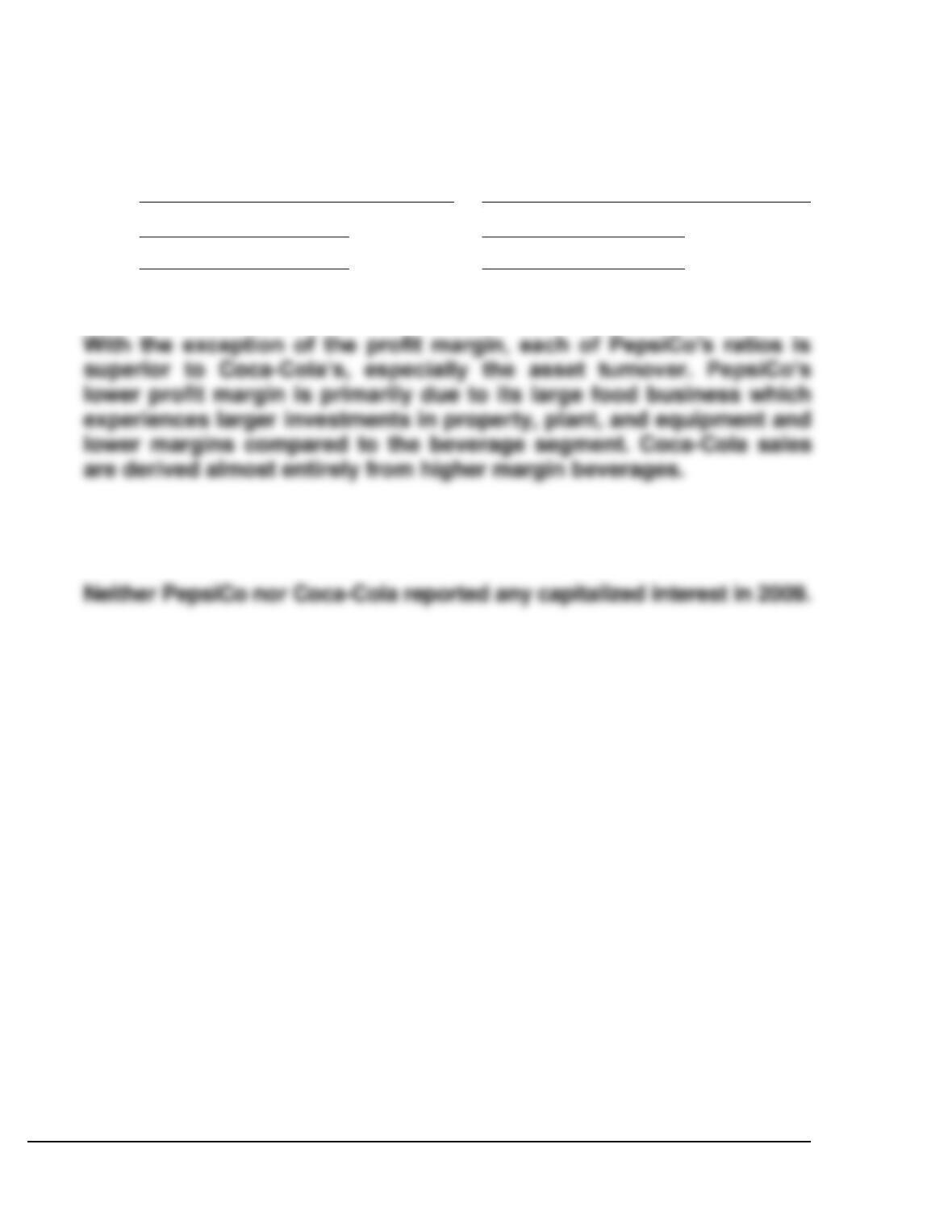
(a) Property, plant, and equipment, net of accumulated depreciation:
Coca-Cola at 12/31/09 $ 9,561 million
PepsiCo at 12/26/09 $12,671 million
(b) Coca-Cola and PepsiCo depreciate property, plant, and equipment
principally by the straight-line method over the estimated useful lives
of the assets. Depreciation expense was reported by Coca–Cola (includes
amortization) and PepsiCo as follows:
(c) (1) Asset turnover:
Coca-Cola
PepsiCo
$30,990
= 0.69
$43,232
= 1.14
$48,671 + $40,519
$39,848 + $35,994
2
2
PepsiCo
11–68
COMPARATIVE ANALYSIS CASE (Continued)
(3) Rate of return on assets:
Coca-Cola
PepsiCo
$6,824
= 15.30%
$5,946
= 15.68%
$48,671 + $40,519
$39,848 + $35,994
2
2
(d) Coca-Cola’s capital expenditures were $1,993 million in 2009 while
PepsiCo’s capital expenditures were $2,128 million in 2009.
11–69
FINANCIAL STATEMENT ANALYSIS CASE
(a) McDonald’s used the straight-line method for depreciating its property
and equipment.
(c) The schedule of cash flow measures indicates that cash provided by
operations is expected to cover capital expenditures over the next few
years, even as expansion continues to accelerate. It is obvious that
11–70
ACCOUNTING, ANALYSIS, AND PRINCIPLES
Accounting
(a) Undiscounted future cash flows = (4 years X $4 million per year) = $16
Book value = $36 million – $10 million = $26 million
$16 million < $26 million; the impairment test suggests an impairment
charge is necessary.
(b) Undiscounted future cash flows = (10 years X $2.72 million per year) =
$27.2 million
Analysis
If the stores are in the process of being sold, they would likely be
considered ‘held for sale’ for financial reporting purposes. If they are held
for sale, the impairment test is based on the discounted cash flows, instead
of undiscounted. Essentially, it is a lower-of-cost–or-market approach.

11–71
ACCOUNTING, ANALYSIS, AND PRINCIPLES (Continued)
Principles
Under GAAP, once an asset is written down to an impairment value, it can
11–72
PROFESSIONAL RESEARCH
(a) According to FASB ASC 360–10-05 (Property, Plant, and Equipment)
05-2 The guidance in the Overall Subtopic is presented in the
following two Subsections:
a. The General Subsections address the accounting and
05-4 The Impairment of Disposal of Long-Lived Assets Subsections
provide guidance for:
35–21 A long-lived asset (asset group) shall be tested for recoverability
whenever events or changes in circumstances indicate that its
carrying amount may not be recoverable. The following are
examples of such events or changes in circumstances:
a. A significant decrease in the market price of a long-lived
PROFESSIONAL RESEARCH (Continued)
e. A current-period operating or cash flow loss combined with
a history of operating or cash flow losses or a projection or
(c) According to FASB ASC 360-10–35-36, For long-lived assets (asset
groups) that have uncertainties both in timing and amount, an expected
present value technique will often be the appropriate technique with
which to estimate fair value.
According to FASB ASC 820-10–35–37 through 43 (Fair Value Hierarchy):
35–37 To Increase consistency and comparability in fair value
measurements and related disclosures, the fair value hierarchy
prioritizes the inputs to valuation techniques used to measure
fair value into three broad levels. The fair value hierarchy gives
11–74
PROFESSIONAL RESEARCH (Continued)
35–38 The availability of inputs relevant to the asset or liability and
the relative reliability of the inputs might affect the selection of
appropriate valuation techniques. However, the fair value
35–39 The remainder of this guidance is organized as follows:
a. Level 1 inputs
b. Level 2 inputs
35–40 Level 1 inputs are defined in this Subtopic as quoted prices
35–41 A quoted price in an active market provides the most reliable
evidence of fair value and shall be used to measure fair value
whenever available, except as discussed in paragraphs 820–10–
35–16D, 820–10–35–42, and 820–10–35–43.
35–41A A Level 1 fair value measurement for the liability is a quoted
price in an active market for the identical liability at the
11–75
PROFESSIONAL RESEARCH (Continued)
an active market should be adjusted for factors specific to the
liability and the asset (see paragraph 820–10–35-16D). Any
adjustment to the quoted price of the asset shall render the fair
value measurement of the liability a lower level measurement.
35–42 If the reporting entity holds a large number of similar assets or
liabilities (for example, debt securities) that are required to be
measured at fair value, a quoted price in an active market
35–43 In some situations, a quoted price in an active market might
not represent fair value at the measurement date. That might
be the case if, for example, significant events (principal-to–
principal transactions, brokered trades, or announcements)
Alternative methods for estimating fair value are addressed at FASB ASC
820–10–35-28 through 36:
35–28 Valuation techniques consistent with the market approach,
income approach, and/or cost approach shall be used to
measure fair value. The definitions and key aspects of those
approaches follow.