Problem 11-21 (continued)
Each of these hypotheses is questionable to some degree. For example,
in the case of Applied Pharmaceuticals, R&D yield is not the sole driver
of the customers’ perception of first–to–market capability. More
Problem 11-22 (30 minutes)
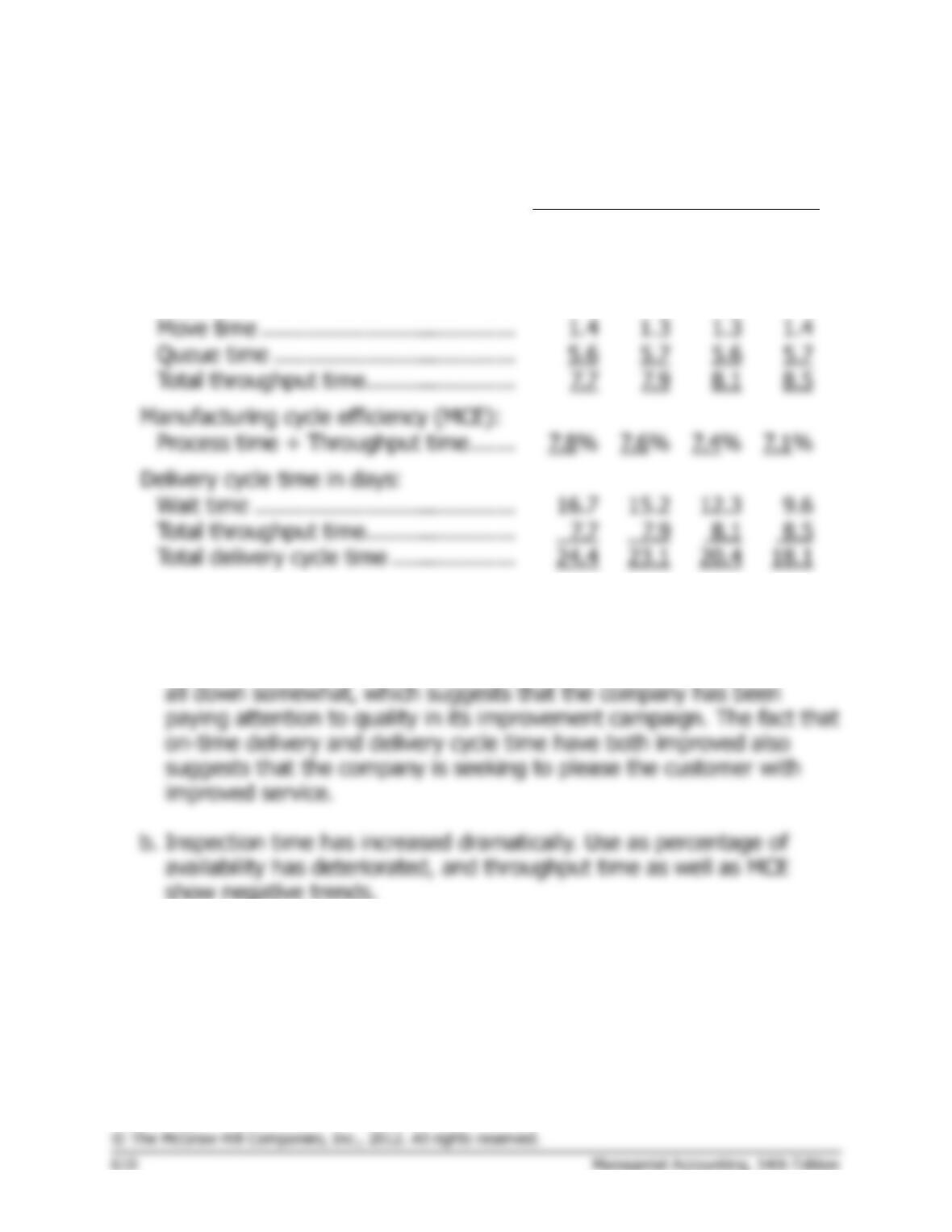
1. a., b., and c.
Month
1
2
3
4
Throughput time in days:
Process time ………………………………
0.6
0.6
0.6
0.6
Inspection time …………………………..
0.1
0.3
0.6
0.8
Move time …………………………………
1.4
1.3
1.3
1.4
Queue time ……………………………….
5.6
5.7
5.6
5.7
Manufacturing cycle efficiency (MCE):
Delivery cycle time in days:
Wait time ………………………………….
9.6
Total throughput time …………………..
Total delivery cycle time ……………….
2. a. The company seems to be improving mainly in the areas of quality
control, material control, on-time delivery, and total delivery cycle
time. Customer complaints, warranty claims, defects, and scrap are
Problem 11-22 (continued)
c. While it is difficult to draw any definitive conclusions, it appears that
the company has concentrated first on those areas of performance
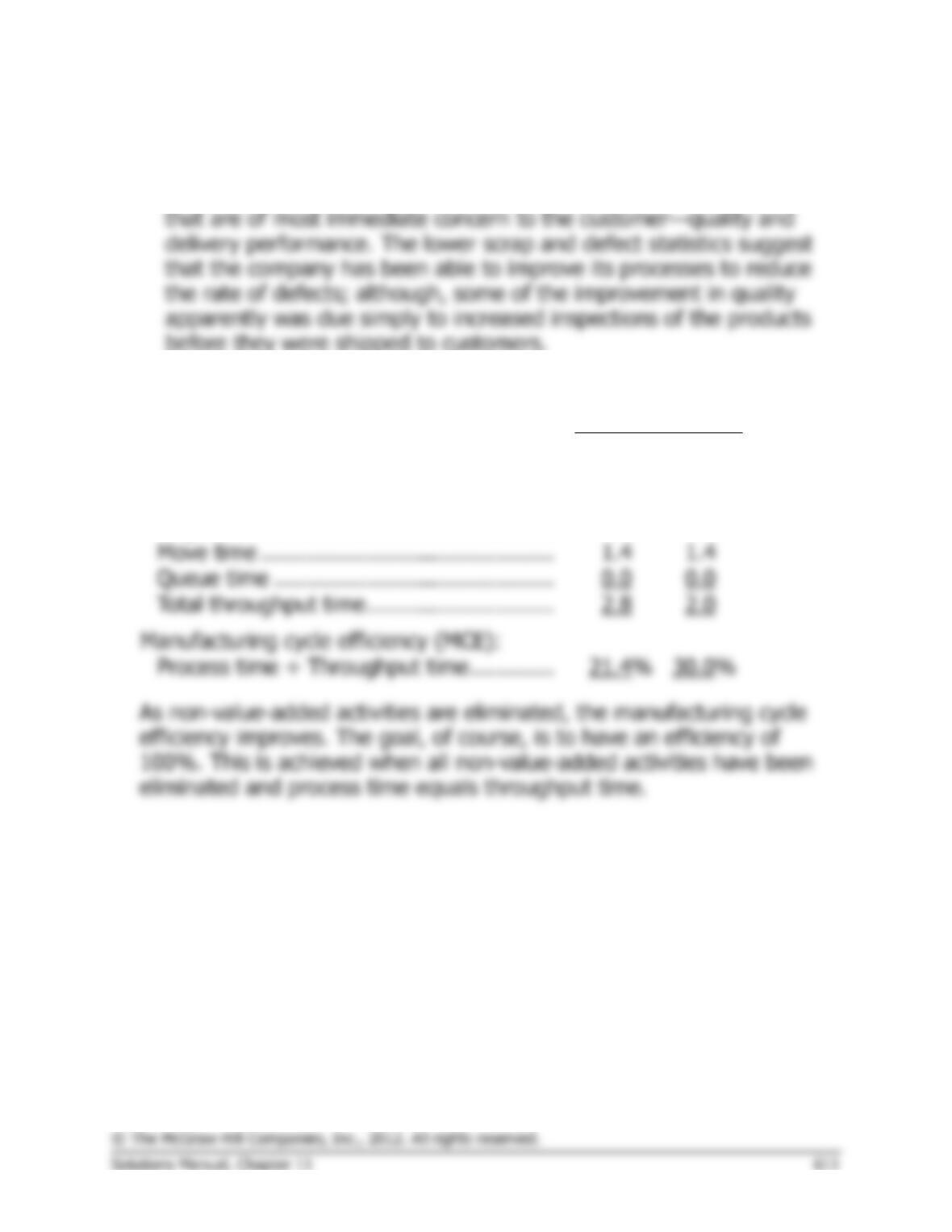
3. a. and b.
Month
5
6
Throughput time in days:
Process time ……………………………………
0.6
0.6
Inspection time ………………………………..
0.8
0.0
Move time ………………………………………
1.4
1.4
Queue time …………………………………….
0.0
0.0
+
+
Internal
Customer
Financial
Case 11-23 (60 minutes)
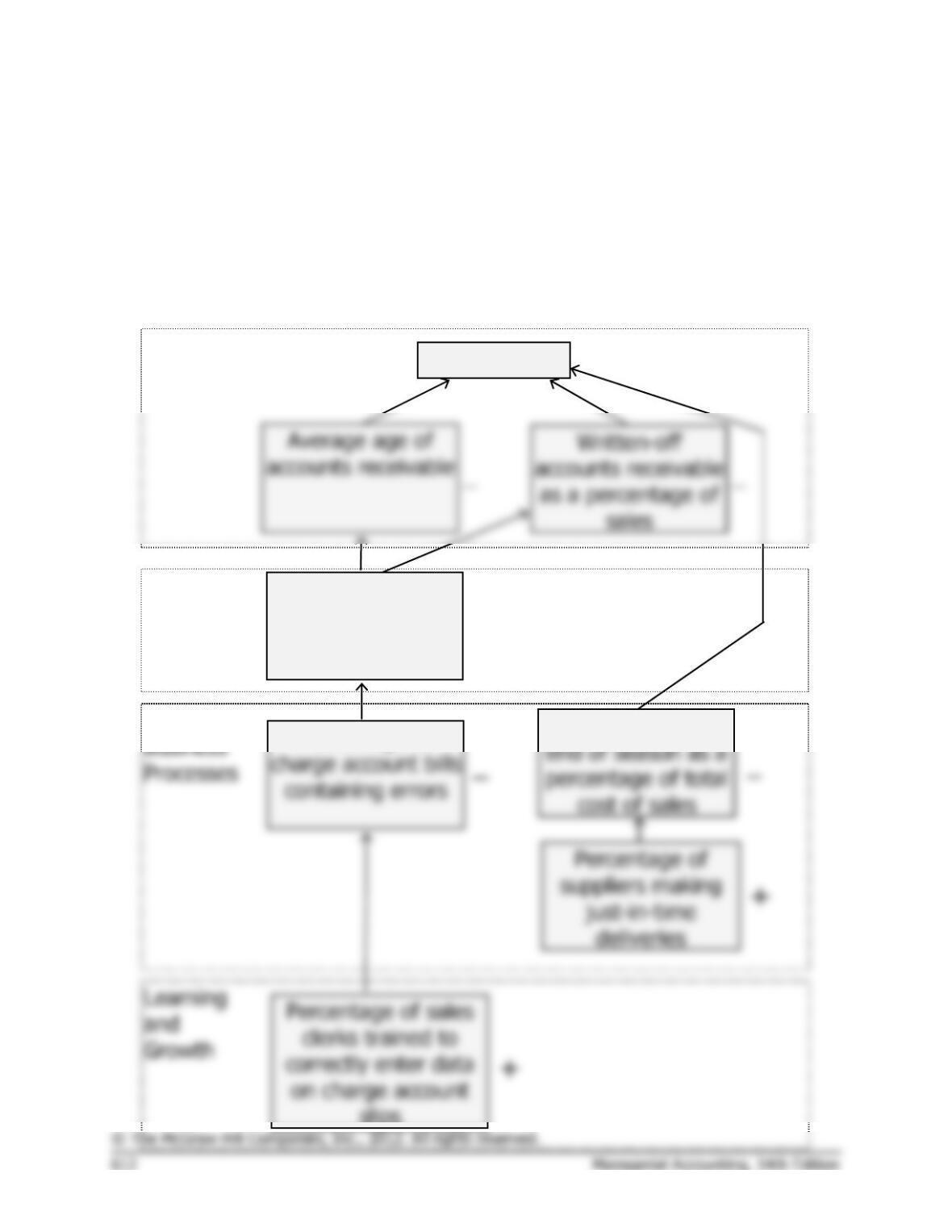
1. Answers may differ concerning which category—learning and growth,
internal business processes, customers, or financial—a particular
performance measure belongs to.
Total profit
Customer
satisfaction with
accuracy of charge
account bills
Percentage of
Unsold inventory at
slips
+
+
Case 11-23 (continued)
A number of the performance measures suggested by managers have
not been included in the above balanced scorecard. The excluded
2. The results of operations can be exploited for information about the
company’s strategy. Each link in the balanced scorecard should be
regarded as a hypothesis of the form “If …, then …”. For example, the
balanced scorecard on the previous page contains the hypothesis “If
Case 11-23 (continued)
3. a. This evidence is inconsistent with two of the hypotheses underlying
the balanced scorecard. The first of these hypotheses is “If customers
express greater satisfaction with the accuracy of their charge account
bills, then there will be improvement in the average age of accounts
receivable.” The second of these hypotheses is “If customers express
billing errors to improving the internal business processes dealing
with collections and credit screening. And in that case, the balanced
scorecard should be modified.
b. This evidence is inconsistent with three hypotheses. The first of these
is “If the average age of receivables declines, then profits will
increase.” The second hypothesis is “If the written-off accounts
receivable decrease as a percentage of sales, then profits will
increase.” The third hypothesis is “If unsold inventory at the end of
the season as a percentage of cost of sales declines, then profits will
increase.”
Case 11-23 (continued)
The reduction in unsold inventories at the end of the season as a
percentage of cost of sales could have occurred for a number of
reasons that are not necessarily good for profits. For example,
Appendix 11A
Transfer Pricing
Exercise 11A-1 (20 minutes)
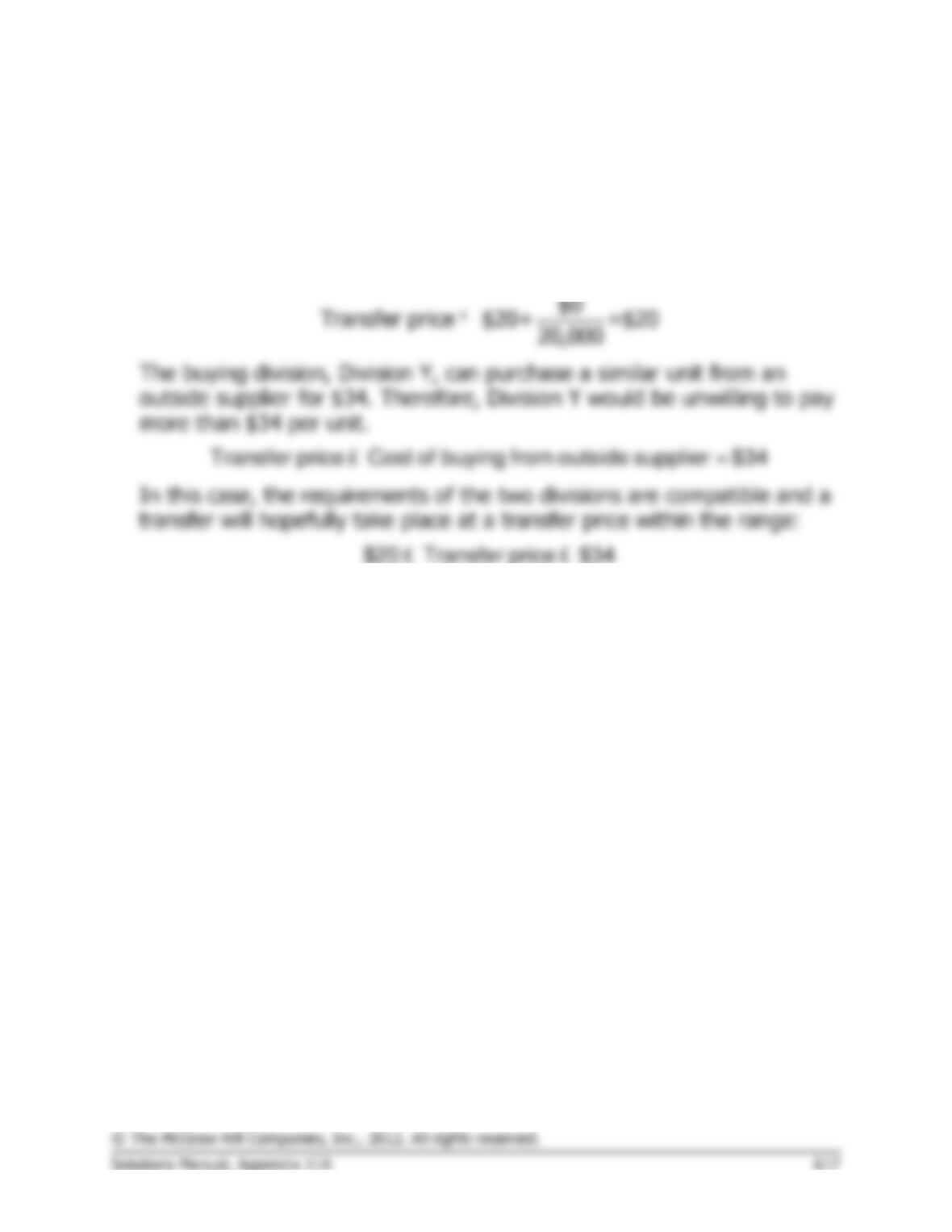
1. The lowest acceptable transfer price from the perspective of the selling
division is given by the following formula:
Total contribution margin
on lost sales
Variable cost
Transfer price +
per unit Number of units transferred
³
Exercise 11A-1 (continued)
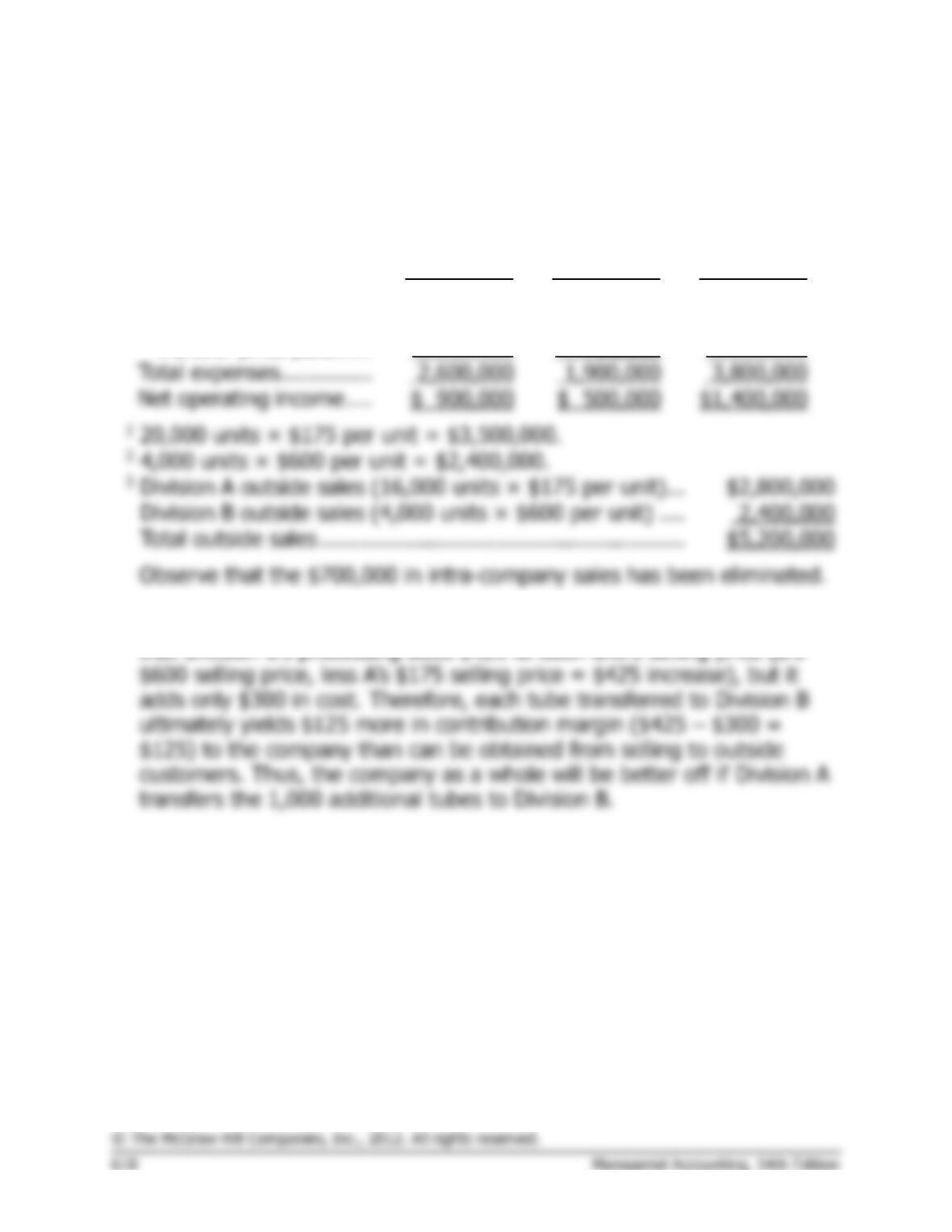
2. In this case, Division X has enough idle capacity to satisfy Division Y’s
demand. Therefore, there are no lost sales and the lowest acceptable
price as far as the selling division is concerned is the variable cost of
$20 per unit.
Exercise 11A-2 (20 minutes)
1.
Division A
Division B
Total
Company
Sales ……………………….
$3,500,000
1
$2,400,000
2
$5,200,000
3
Expenses:
Added by the division .
2,600,000
1,200,000
3,800,000
Transfer price paid ……
—
700,000
—
Total expenses …………..
Net operating income ….
$1,400,000
20,000 units × $175 per unit = $3,500,000.
4,000 units × $600 per unit = $2,400,000.
Division A outside sales (16,000 units × $175 per unit) …
Division B outside sales (4,000 units × $600 per unit) ….
Total outside sales ………………………………………………..
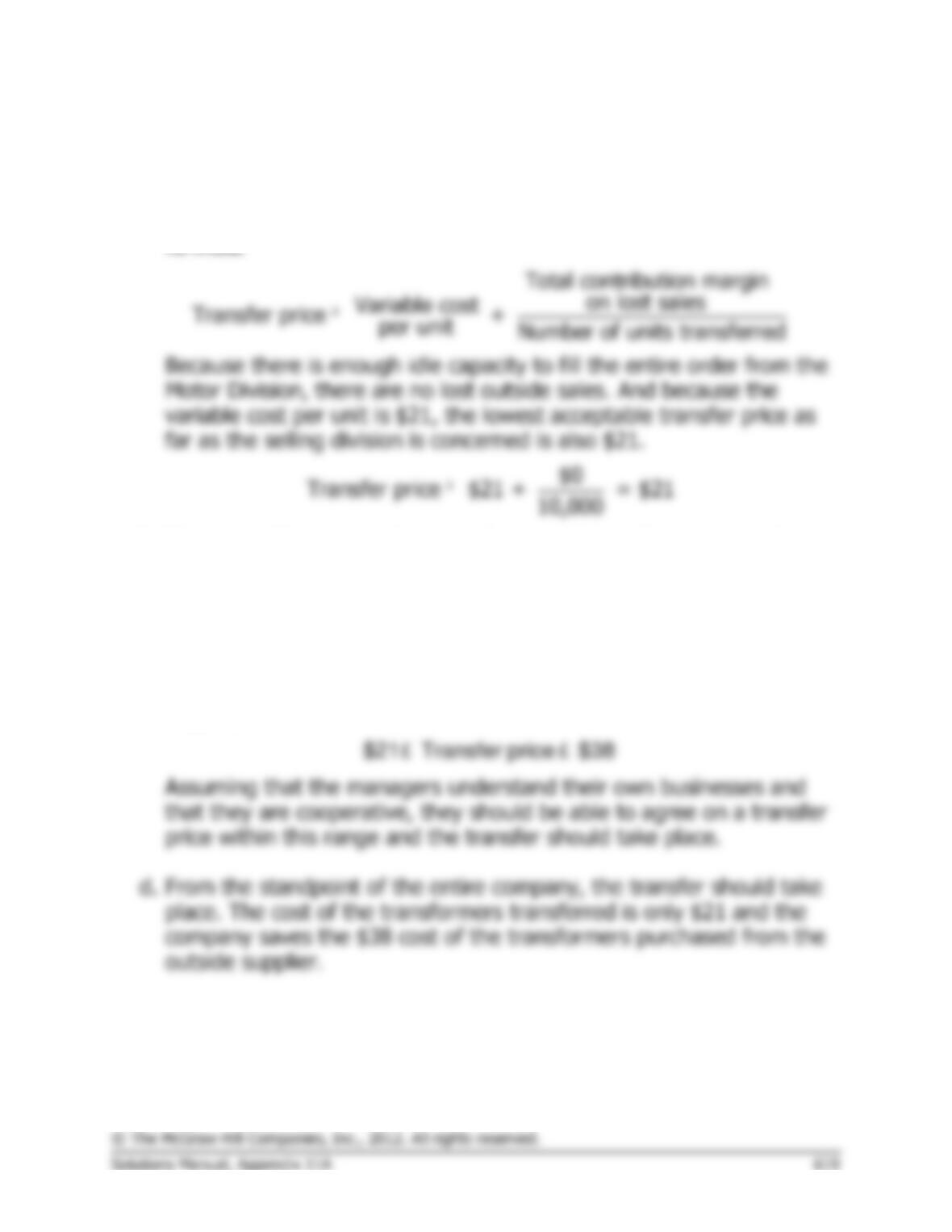
2. Division A should transfer the 1,000 additional units to Division B. Note
Exercise 11A-3 (30 minutes)
1. a. The lowest acceptable transfer price from the perspective of the
selling division, the Electrical Division, is given by the following
b. The Motor Division can buy a similar transformer from an outside
supplier for $38. Therefore, the Motor Division would be unwilling to
pay more than $38 per transformer.
£Transfer price Cost of buying from outside supplier = $38
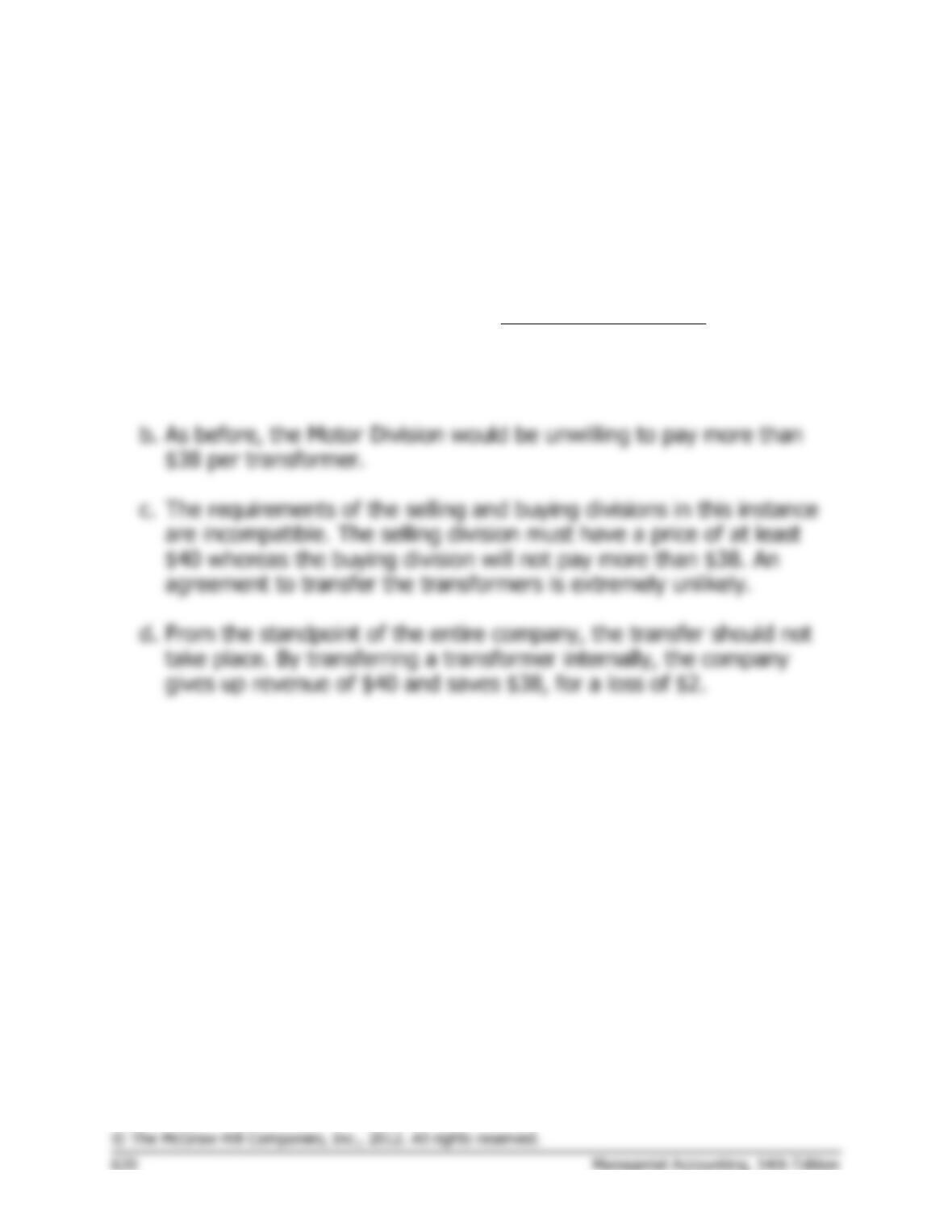
c. Combining the requirements of both the selling division and the
buying division, the acceptable range of transfer prices in this
situation is:
Exercise 11A-3 (continued)
2. a. Each of the 10,000 units transferred to the Motor Division must
displace a sale to an outsider at a price of $40. Therefore, the selling
division would demand a transfer price of at least $40. This can also
be computed using the formula for the lowest acceptable transfer
price as follows:
( )
( )
$40 – $21 × 10,000
Transfer price $21 + 10,000
= $21 + $40 – $21 = $40
³
Problem 11A–4 (45 minutes)
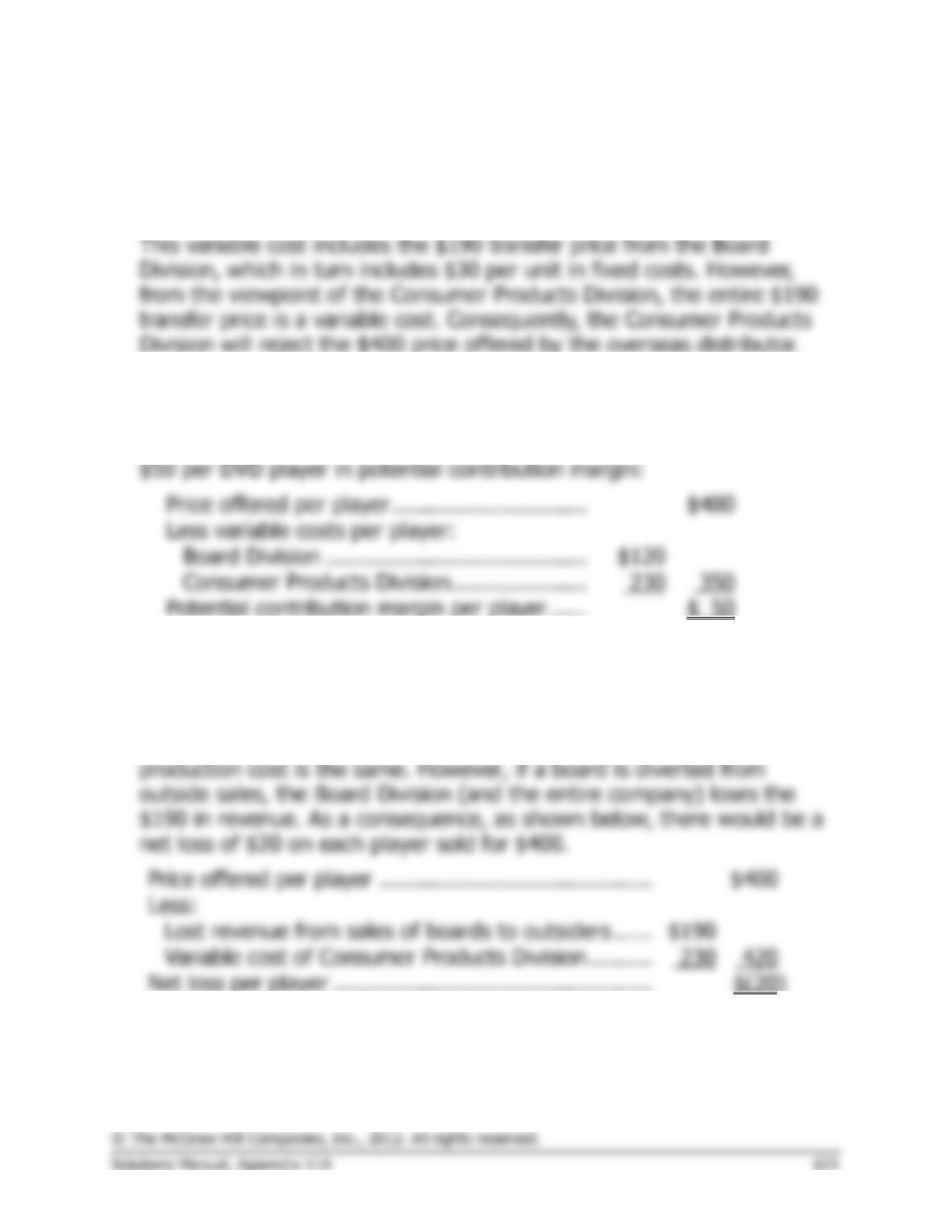
1. The Consumer Products Division will probably reject the $400 price
because it is below the division’s variable cost of $420 per DVD player.
2. If both the Board Division and the Consumer Products Division have idle
capacity, then from the standpoint of the entire company the $400 offer
should be accepted. By rejecting the $400 price, the company will lose
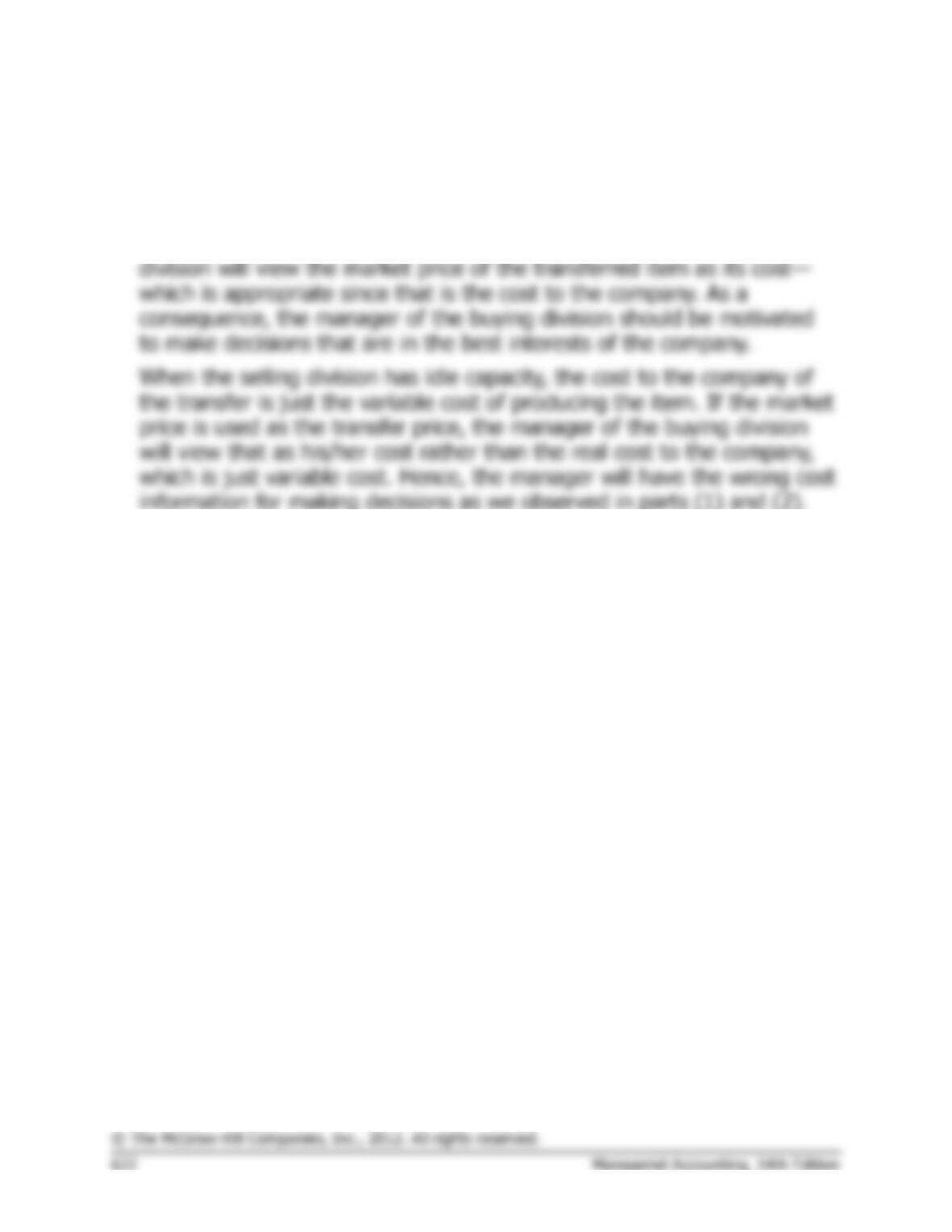
3. If the Board Division is operating at capacity, any boards transferred to
the Consumer Products Division to fill the overseas order will have to be
diverted from outside customers. Whether a board is sold to outside
customers or is transferred to the Consumer Products Division, its
Problem 11A–4 (continued)
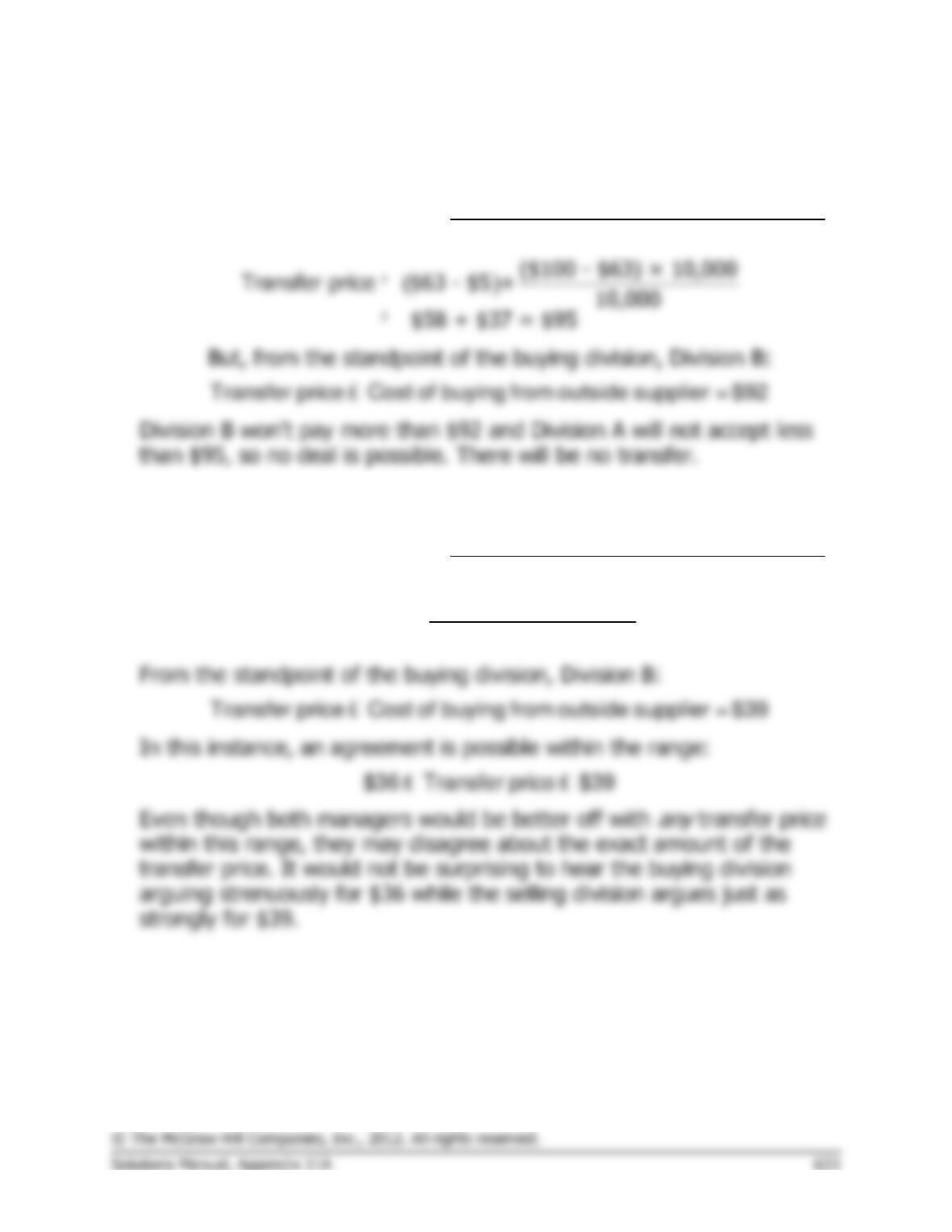
4. When the selling division has no idle capacity, as in part (3), market
price works very well as a transfer price. The cost to the company of a
transfer when there is no idle capacity is the lost revenue from sales to
outsiders. If the market price is used as the transfer price, the buying
Problem 11A-5 (60 minutes)
1. From the standpoint of the selling division, Division A:
Total contribution margin on lost sales
Variable cost
Transfer price +
per unit Number of units transferred
³
2. a. From the standpoint of the selling division, Division A:
Total contribution margin on lost sales
Variable cost
Transfer price +
per unit Number of units transferred
³
( )
($40 – $19) × 70,000
Transfer price $19 – $4 + = $15 + $21 = $36
70,000
³