Problem 11.59
Supersonic airflow enters an adiabatic, constant area pipe (inside diameter 0.1 m
=
) with
1
M
a2.0=. The pipe friction factor is 0.02. If a standing normal shock is located right at the
pipe exit, and the Mach number just upstream of the shock is
1
.2, determine the length of
the pipe.
Solution 11.59
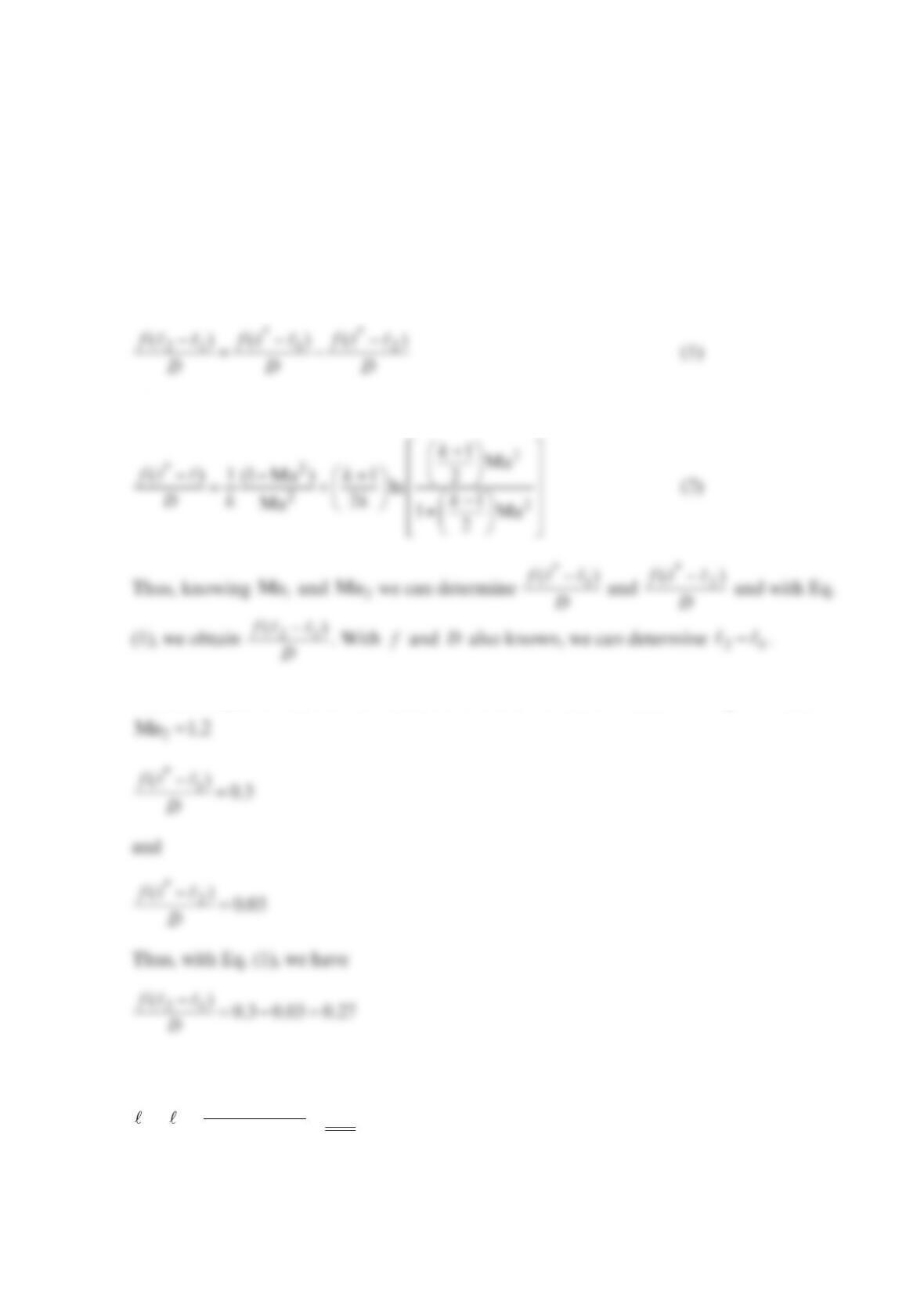
We note that
where
Alternatively, we could use the Fanno Flow Table or Chart to find, for =
1
Ma 2.0 and
and
−= =
21
(0.27)(0.1m) 1.35 m
0.02
Problem 11.60
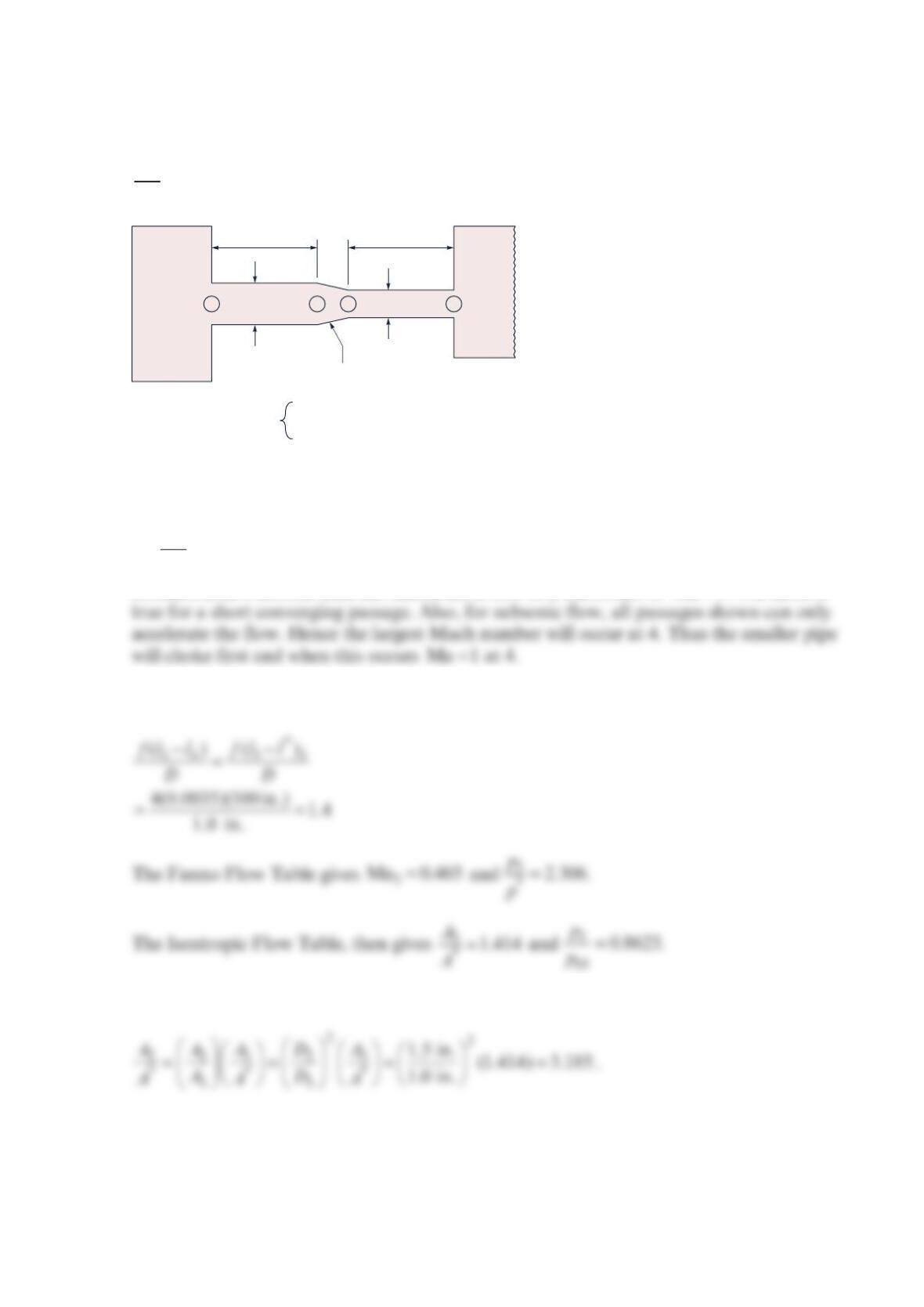
Consider the flow of air through the piping system shown in the figure below. If the system
is choked, determine the location where the Mach number is 1. Calculate the pressure ratio
01
B
p
p
that causes choking in this system.
Solution 11.60
As
01
B
p
p is decreased, the Mach number at the inlet of the system is increased. However, a
constant area frictional duct can accelerate a flow to a maximum of =Ma 1. The same is
When the flow just chokes =
4
Ma 1 and ==
*
4B
p
pp
. Thus
p
Then
100 in.
1.5 in. diameter 1 in. diameter
Short
nozzle
100 in.
p
B
f
=
2
1 3 4
p
01
T
0
0.0030 in. 1.5 in. pipe
0.0035 in. 1 in. pipe
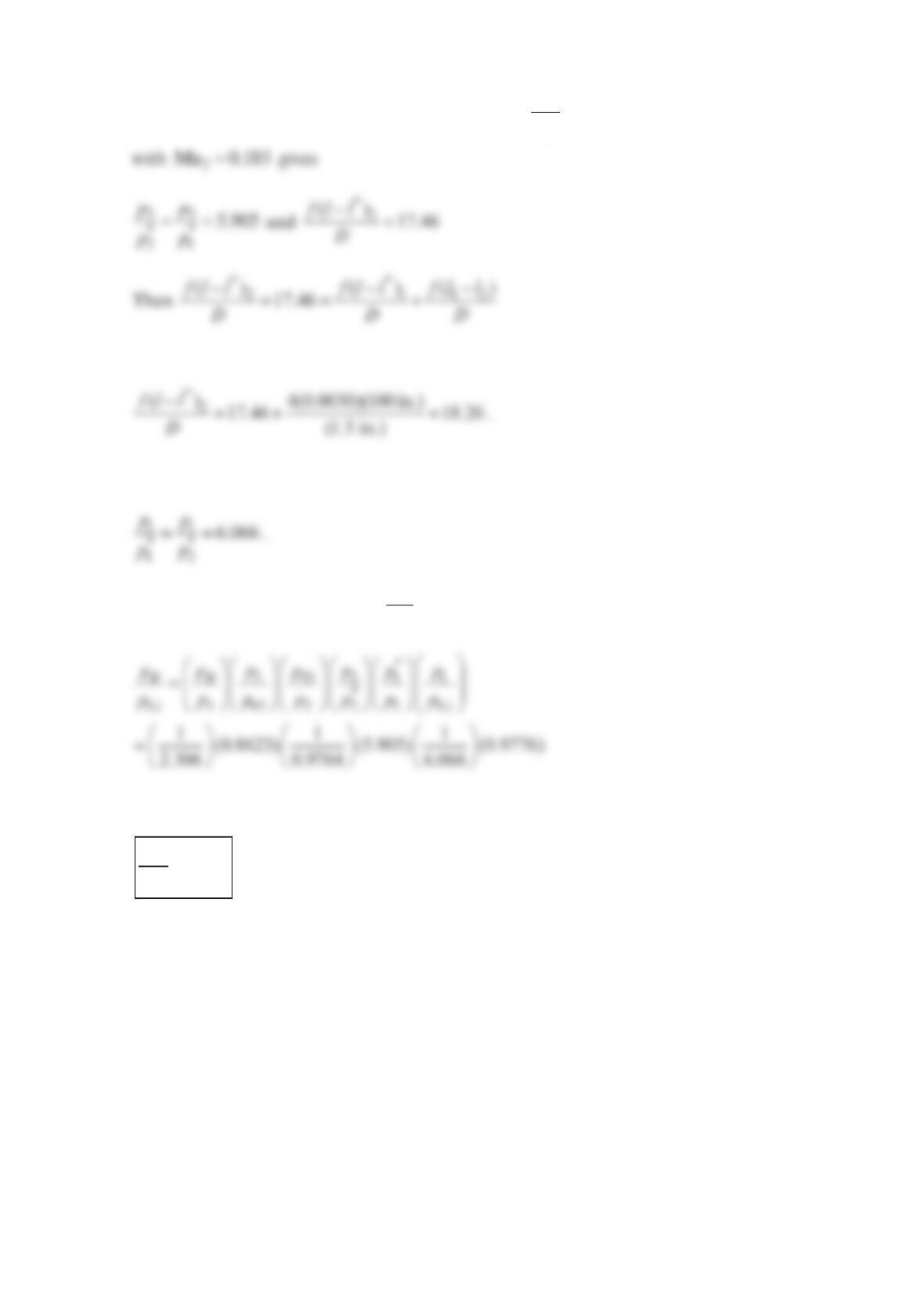
The Isentropic FlowTable gives =
2
Ma 0.185 and =
2
02
0.9764
p
p. The Fanno Flow Table
or
The Fanno Flow Table gives =
1
Ma 0.18 and
The Isentropic FlowTable gives 1
01
0.9776
p
p=. Then
or
=
0,1
0.364
B
p
p
Problem 11.61
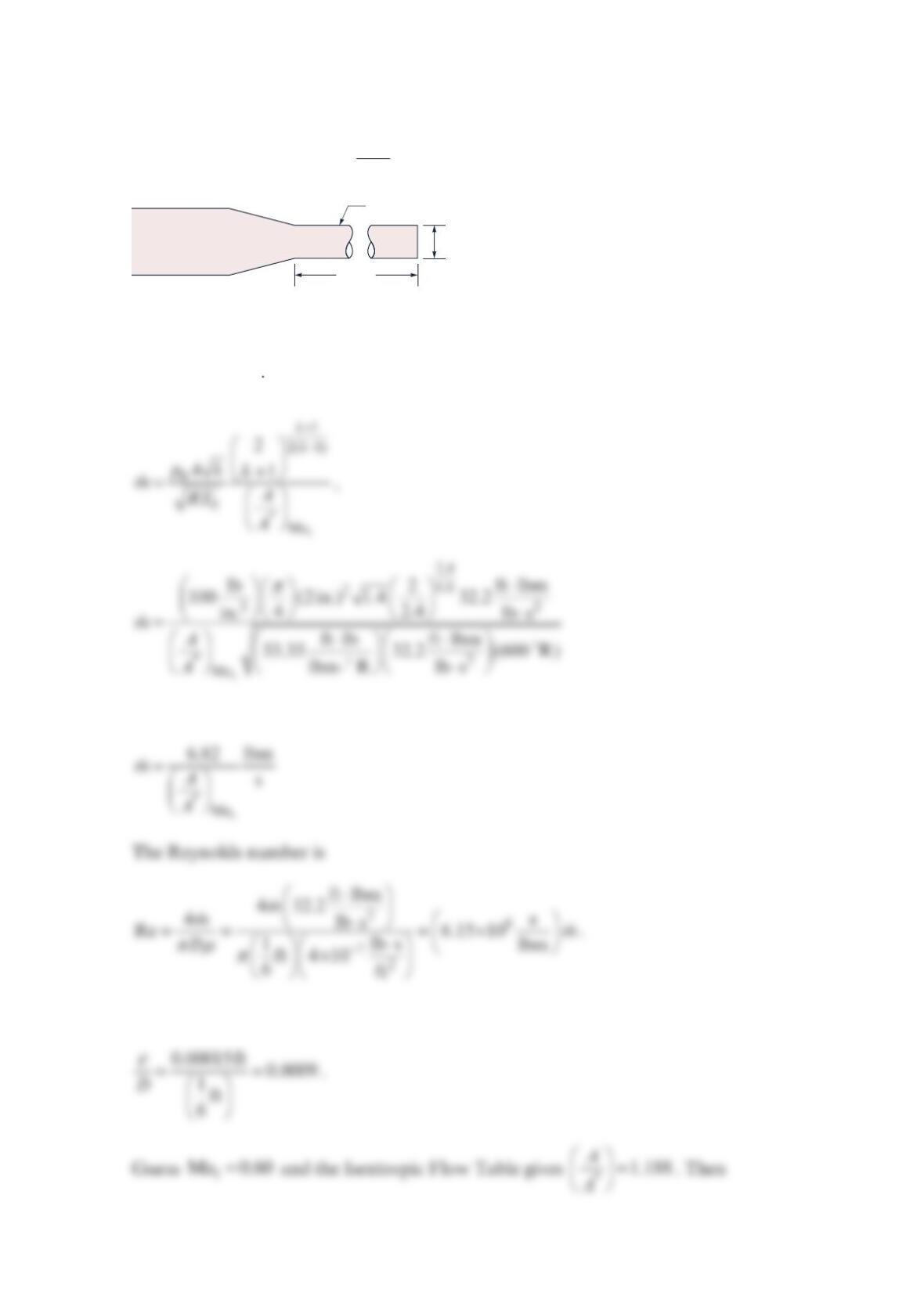
Estimate the maximum mass flowrate of air that can be passed by the duct as shown in the
figure below for
µ
−⋅
=× 7
2
lb s
410 ft .
Solution 11.61
The maximum m occurs when the flow is choked or =Ma 1
e. Then
or
An iteration procedure is required. The Moody chart gives
ε
=0.00015ft so
Insulated steel pipe
2 in. diameter
20 in.
p
0
= 100 psia
T
0
= 140°F
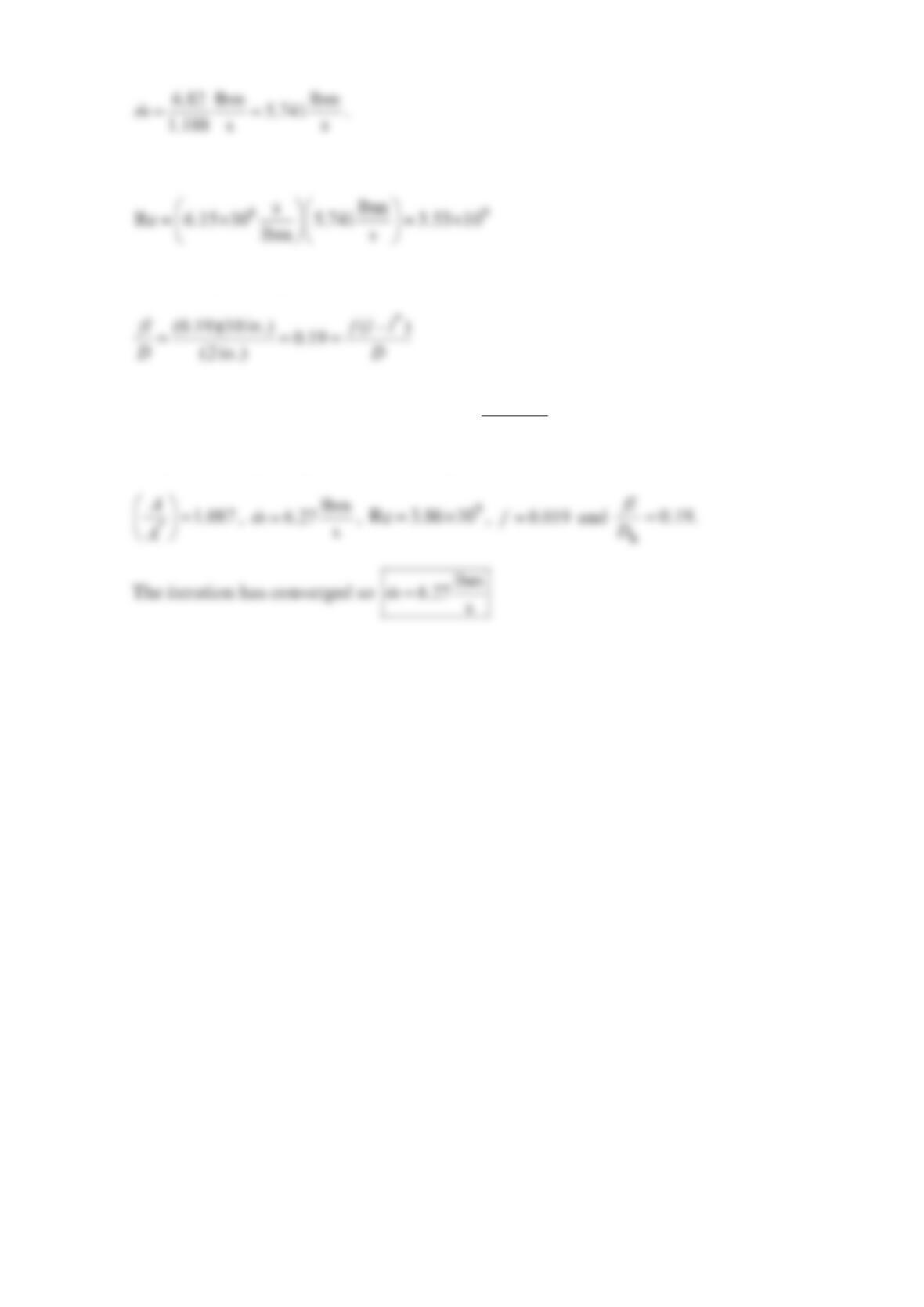
The Reynolds number is
The Moody chart gives =0.019f so
The Fanno Flow Table gives =Ma 0.71 for −=
*
()
0.19
fl l
D so try another guess,
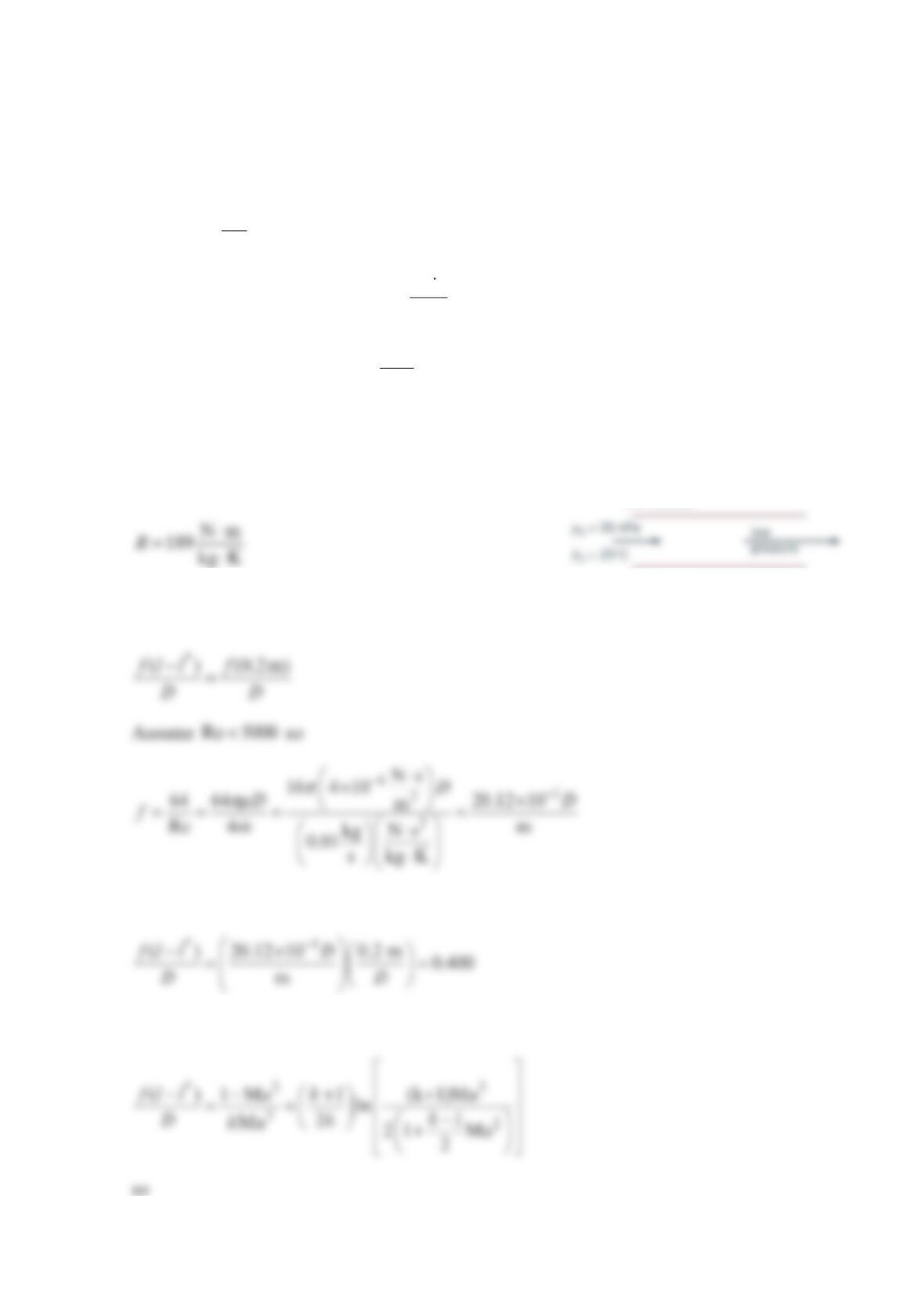
=
1
Ma 0.71. Repeating the calculations gives
Problem 11.62
Waste gas ( 2
CO ) is vented to outer space from a spacecraft through a circular pipe 0.2 m
long. The pressure and temperature in the spacecraft are 35kPa and 25 °C. The gas must
be vented at the rate of 0.01 kg/s. The friction factor for the flow in the pipe is given by
=64
Re
f, <Re 5000 ,
=0.013f, >Re 5000 ,
π
µ
=4
Re m
D.
The viscosity (
µ
) is
µ
−⋅
=× 4
2
Ns
410 m. Determine the required pipe diameter.
Solution 11.62
For CO2
The waste gas is vented to outer space, which can be approximated as a vacuum. Thus the
pressure at the exit is very low and hence the flow will be choked. Thus
and
Then recall
k
= 1.3 and
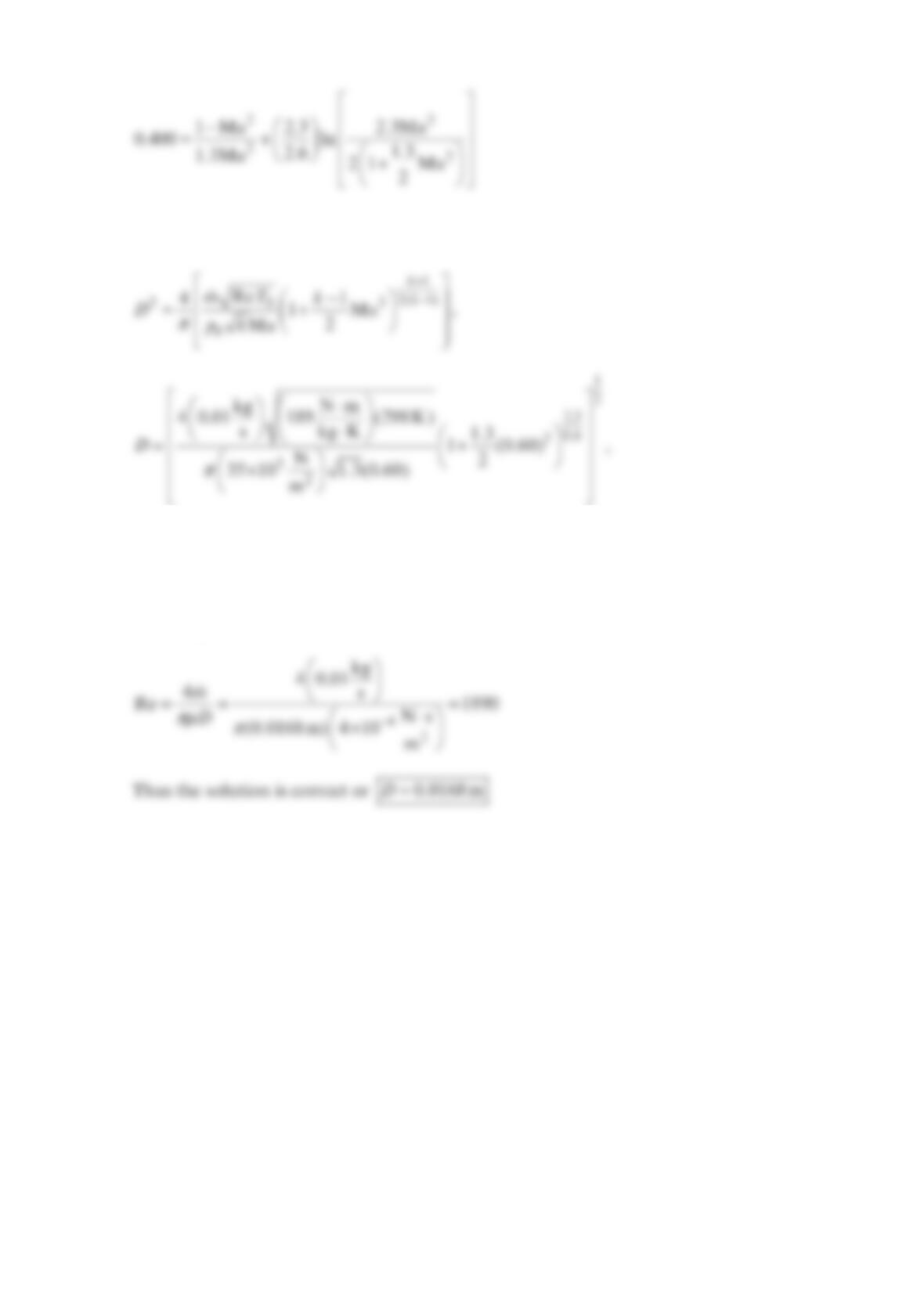
The above equation can be solved by trial and error to yield two solutions, a subsonic value
and a supersonic value. We are interested in the subsonic value which is
M
a0.60=. Then
or
=0.0168 mD
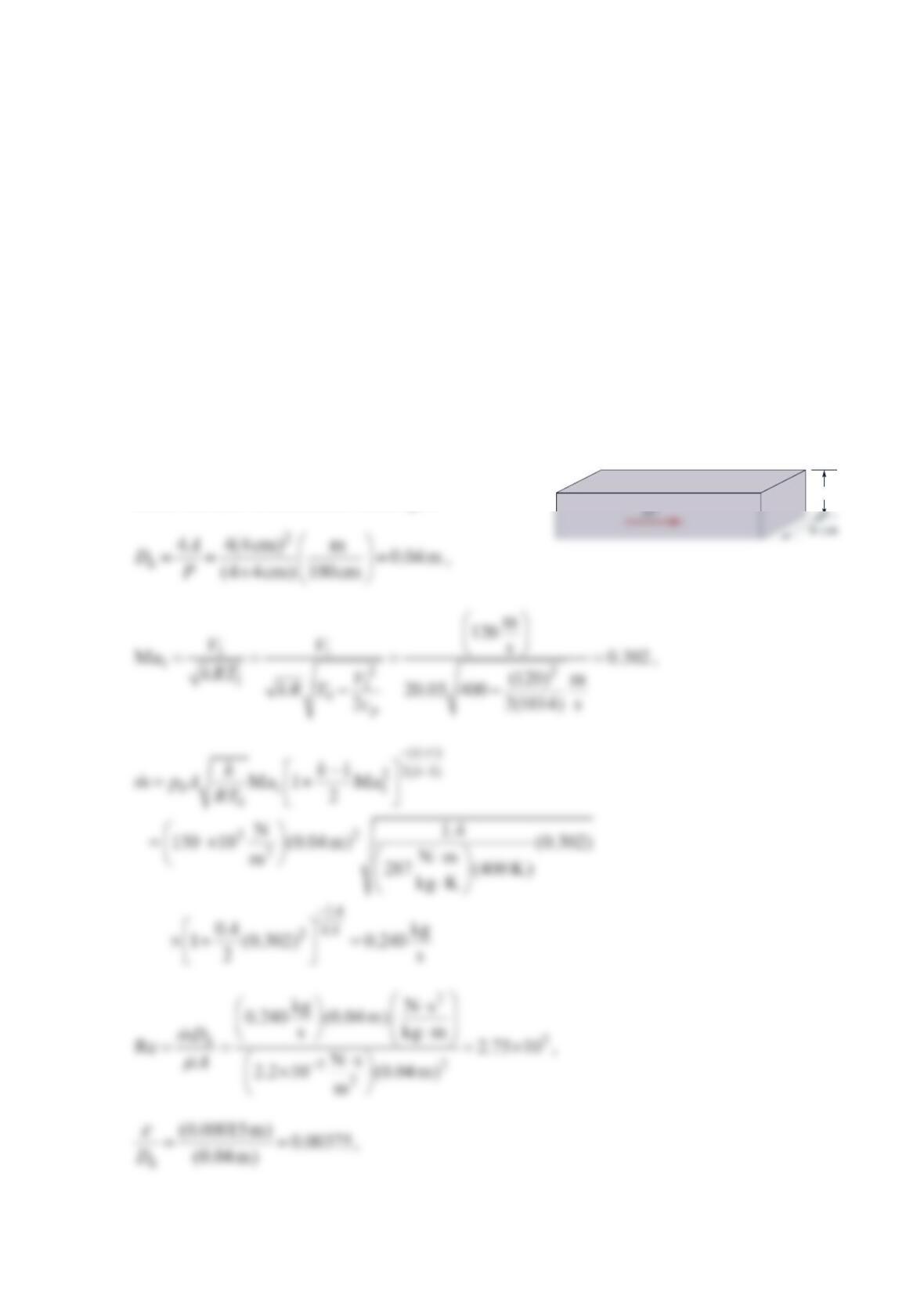
Checking the assumption then <Re 5000
Problem 11.63
Air enters a 4-cm-square galvanized steel duct with =
0150 kPap, =
0400 KT, and
=
1120 m/s.V (Note:
µ
−
=× ⋅
52
2.2 10 N s/m ).
(a) Compute the maximum possible duct length for these conditions.
(b) If the actual duct length is 0.75 times the maximum value, calculate the mass flowrate,
the exit pressure, and the stagnation pressure.
(c) If the actual duct length is 1.3 times the maximum value for the stated conditions,
compute the new mass flowrate and inlet velocity. Assume a low back pressure and use the
same value of f as used in the maximum possible duct length case.
Solution 11.63
Using a table of air properties and the Moody
chart, the known numerical values give
4 cm
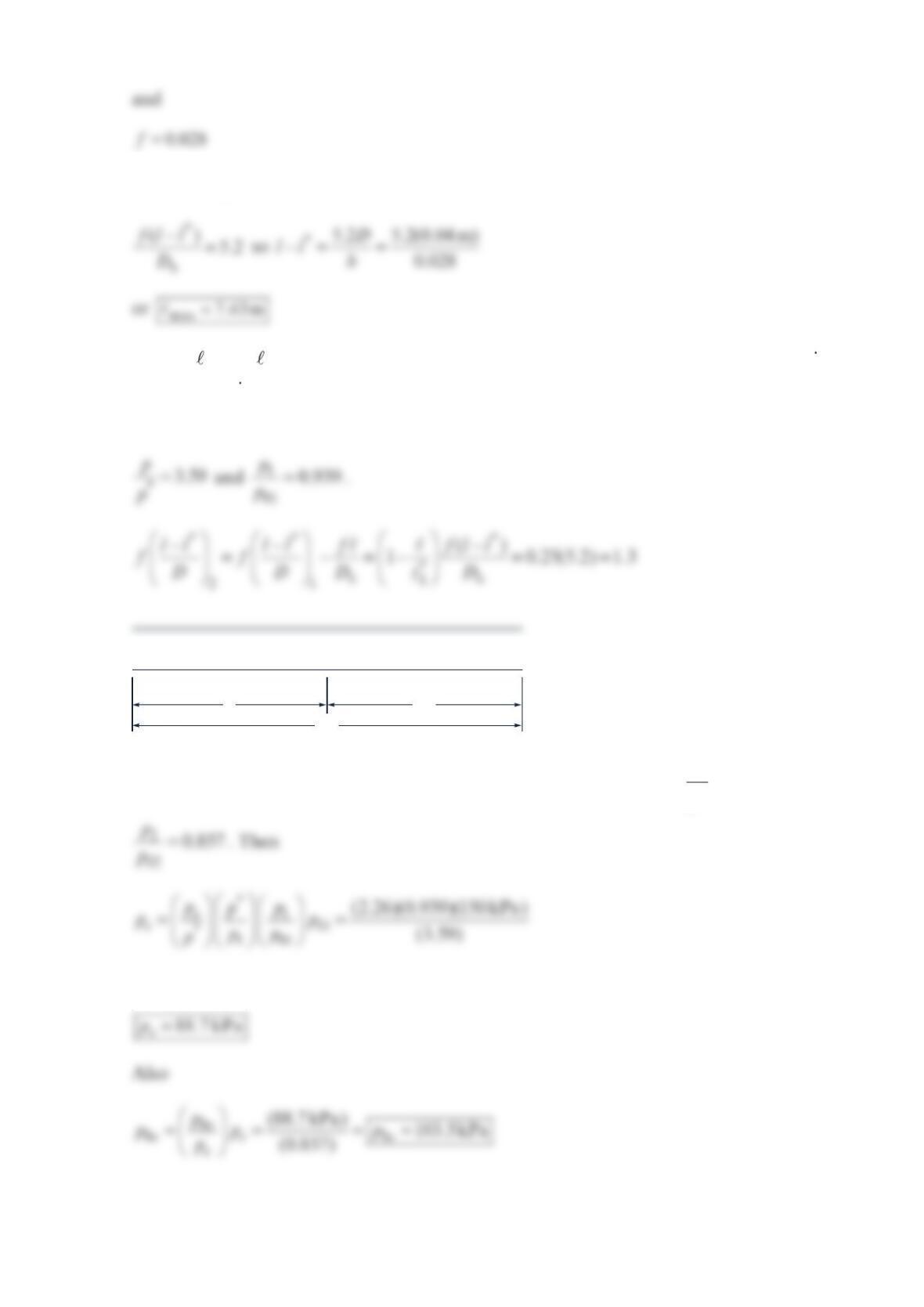
(a) For =
1
Ma 0.302
(b) For == =
max
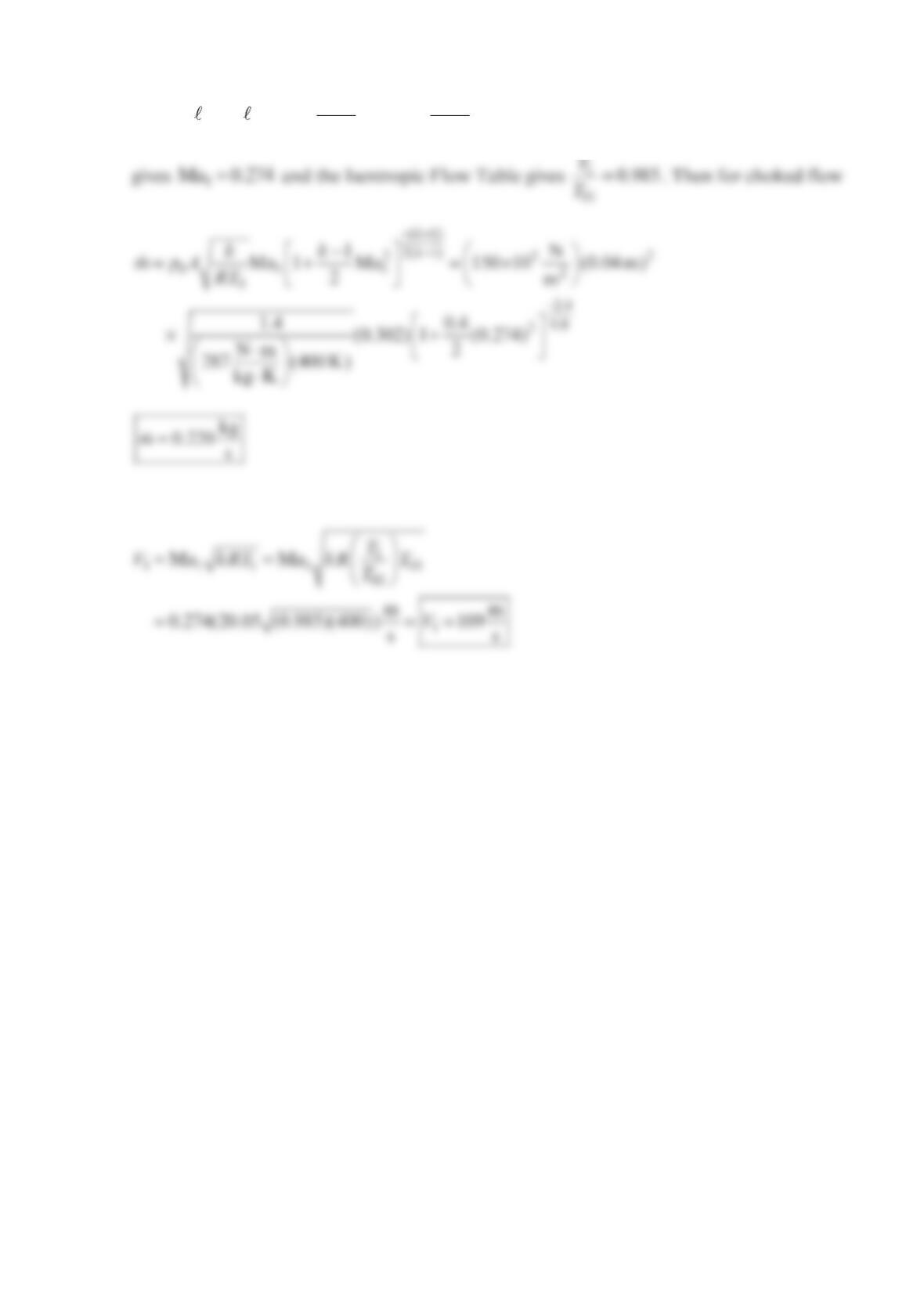
0.75 0.75(7.43m) 5.57 m and assuming the exit pressure changes, m is
unchanged ( m would be reduced if the duct length were increased for the same exit
pressure). For =
1
Ma 0.302 , the Isentropic Flow and Fanno Flow Tables give
The Fanno Flow Table and Isentropic Flow Table give =
2
Ma 0.475 , =
*2.26
p
p, and
or
ℓℓ
2
∗
ℓ
1
∗
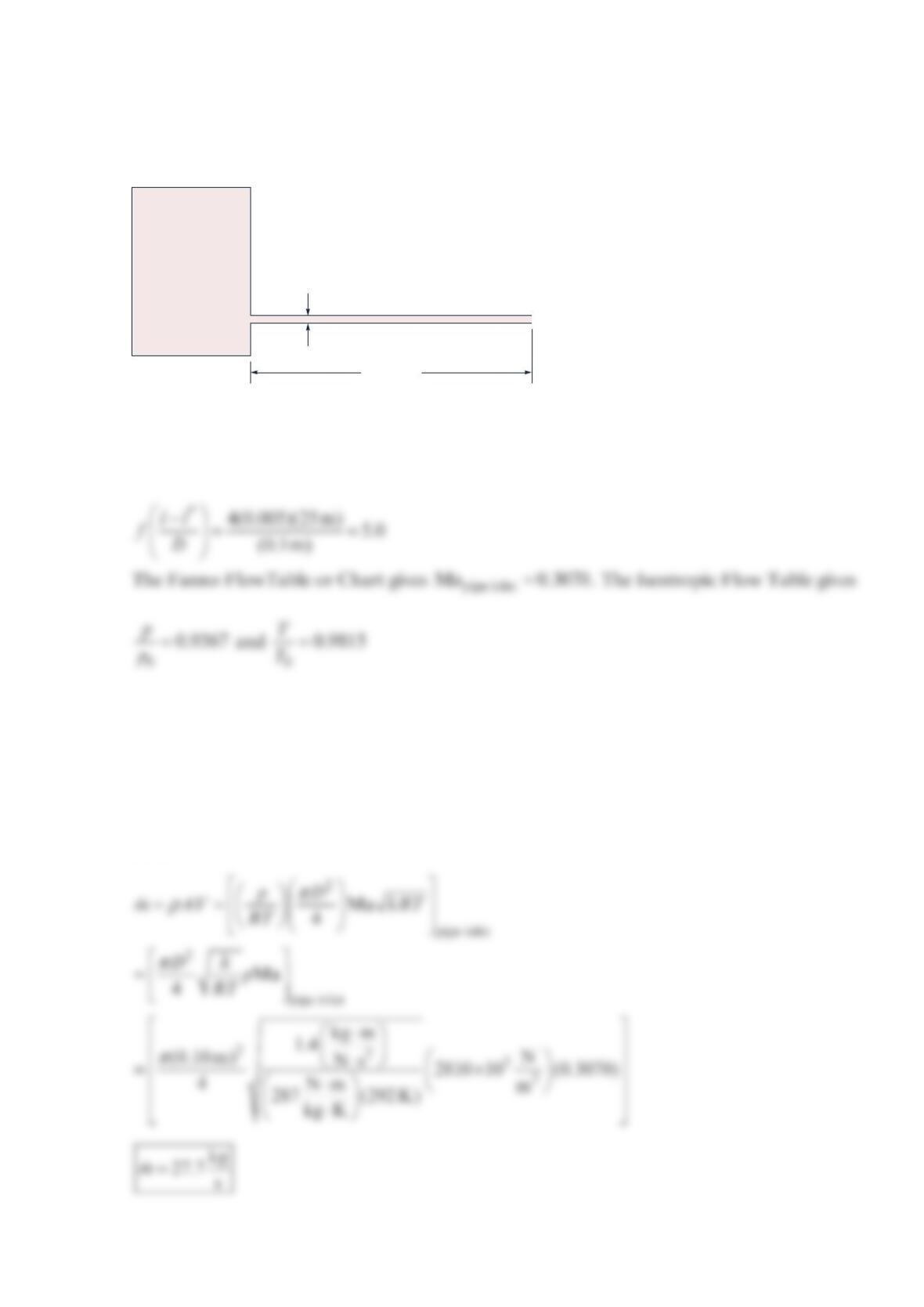
(c) For =max
1.3 ,
**
part (a)
1.3 1.3(5.2) 6.76
ll ll
ff
DD
−−
===
, the Fanno FlowTable
Then
Problem 11.64
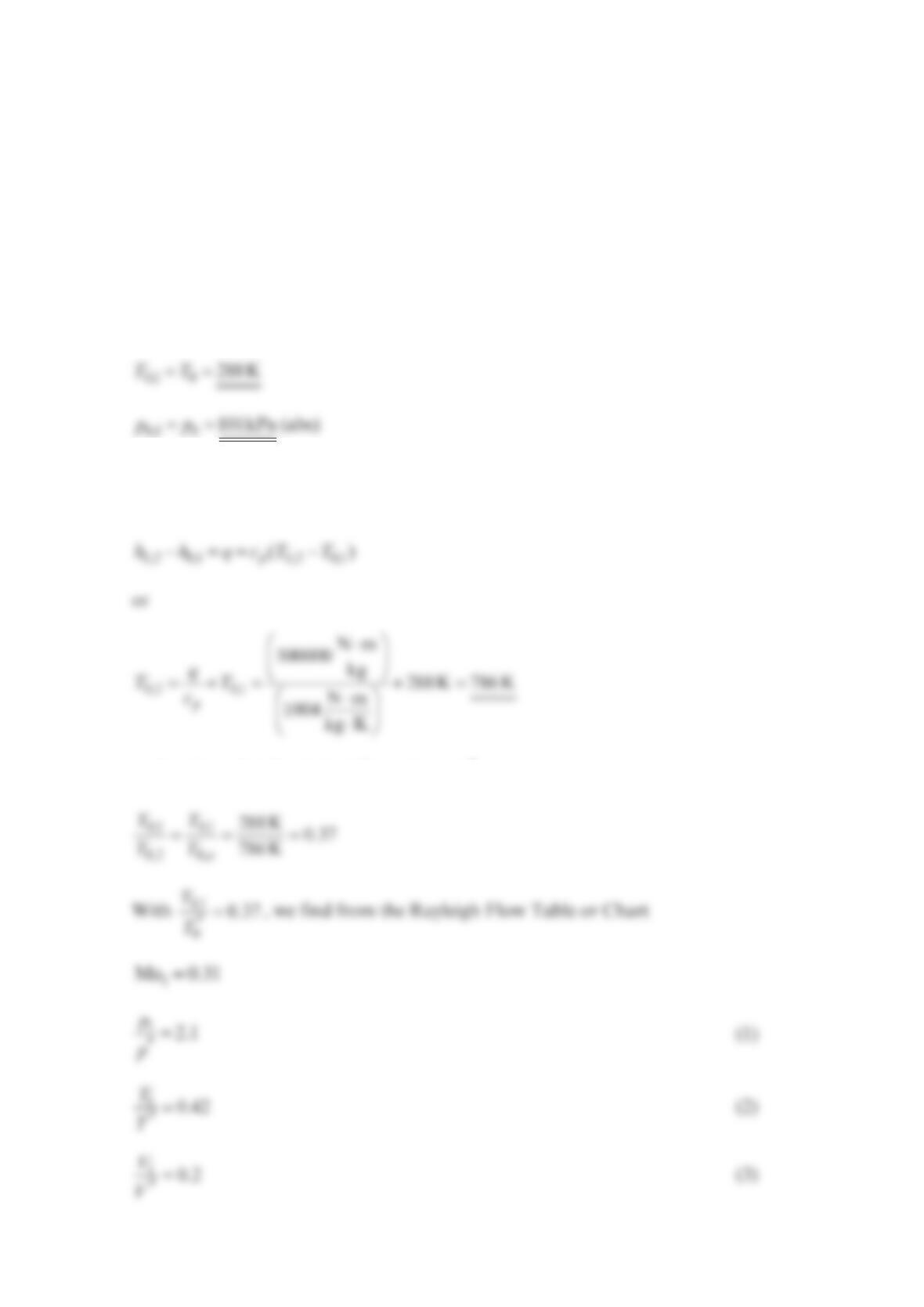
The figure below shows an insulated pipe attached to a tank of air. Estimate the maximum
mass flowrate that the pipe could exhaust from the tank.
Solution 11.64
The maximum flowrate occurs if the flow is choked and the Mach number is 1.0 at the end
of the pipe. Now
so
==×=
6
0
0.9367 0.9367(3 10 Pa) 2810 kPapp
and
== =
0
0.9815 0.9815(298K) 292 KTT
Then
L = 25 m
D
= 10 cm
f
= 0.02
p
= 3 MPa
T = 298 K
Problem 11.65
Standard atmospheric air
[
]
==
00
288K, 101kPa (abs)Tp is drawn steadily through an
isentropic converging nozzle into a frictionless diabatic ( =500 kJ/kgq) constant area duct.
For maximum flow, determine the values of static temperature, static pressure, stagnation
temperature, stagnation pressure, and flow velocity at the inlet [section (1)] and exit [section
(2)] of the constant area duct. Sketch a temperature–entropy diagram for this flow.
Solution 11.65
For maximum flow, the Rayleigh flow is choked. For the isentropic nozzle,
To determine the static state at the nozzle exit (which is the Rayleigh flow inlet), we need
the value of 1
M
a. To determine 1
Ma , we use
and nothing that for choked flow, =*
0,2 0
TT
we get
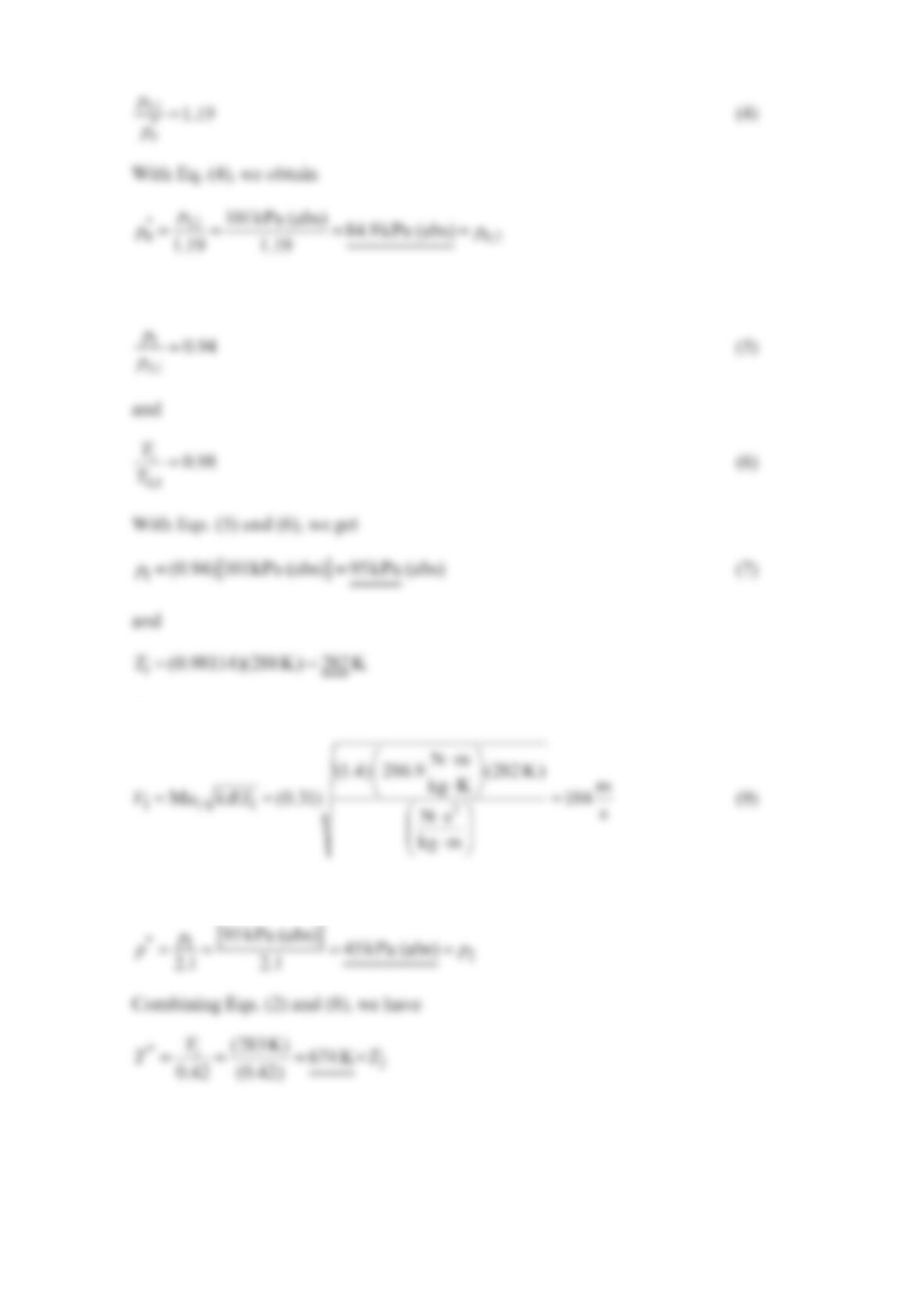
With =
1
Ma 0.31, we find from the Isentropic Flow Table or Chart
Thus
Combining Eqs. (1) and (7), we obtain
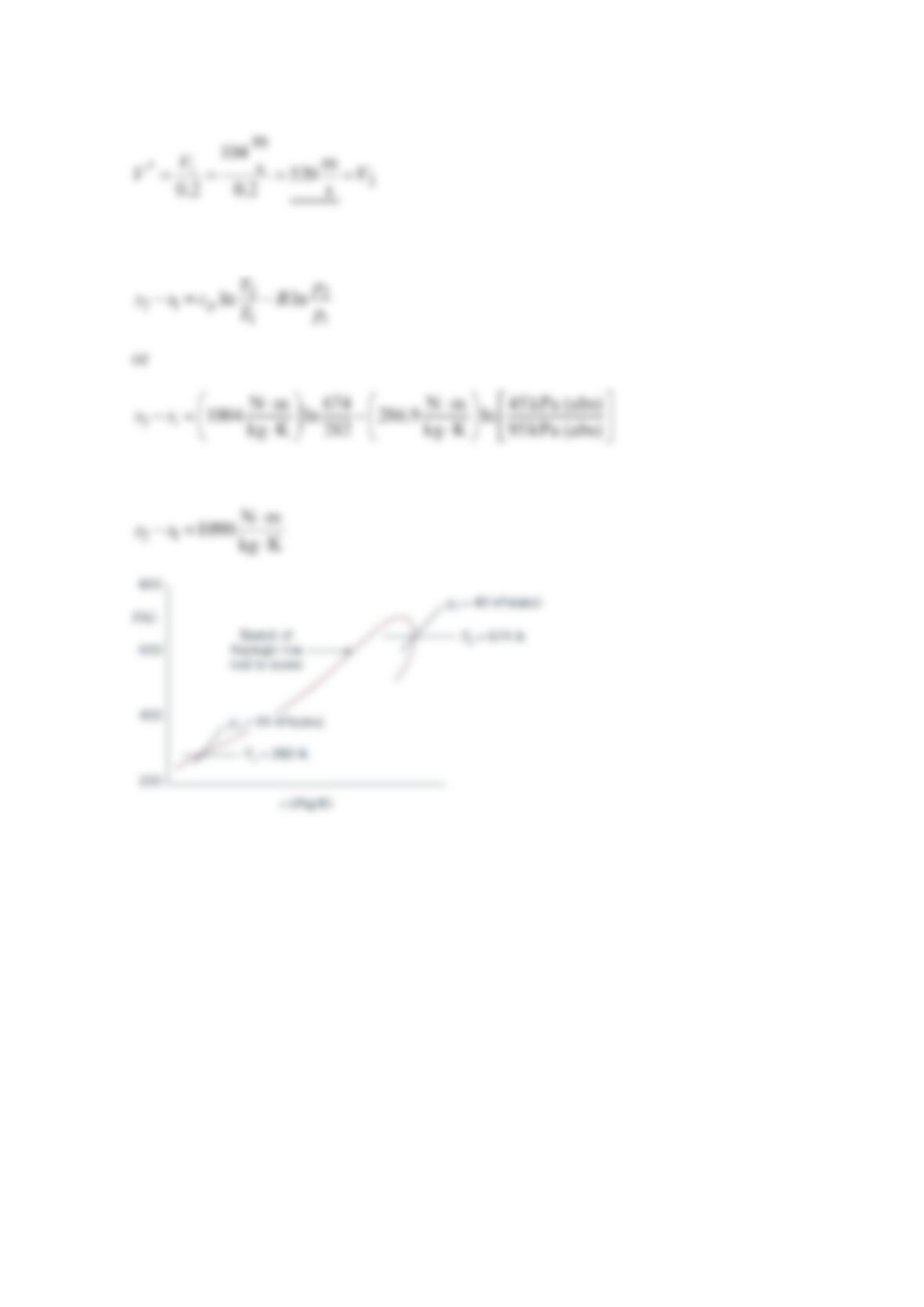
Combining Eqs. (3) and (9), we have
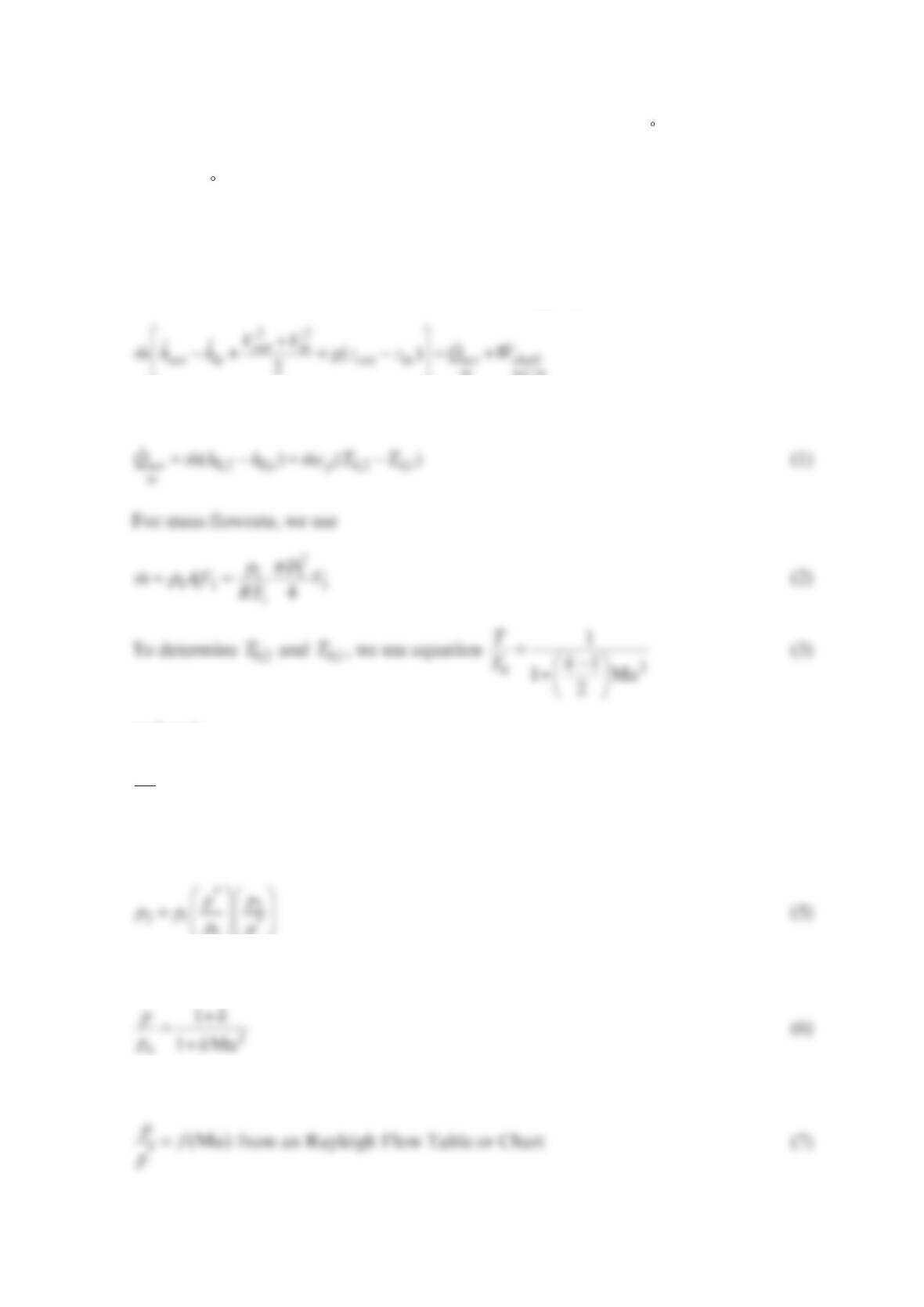
To sketch a T–s diagram, we obtain −
21
ss
from
and
Problem 11.66
Air enters a 0.5–ft inside diameter duct with =
120 psiap, =
180 FT, and =
1200 ft/sV.
What frictionless heat addition rate in Btu/s is necessary for an exit gas temperature
=
21500 FT? Determine 2
p
, 2
V, and 2
Ma also.
Solution 11.66
To determine the heat transfer rate, we use the energy equation
in net in
to get
or for air,
=
0
(Ma)
Tf
T from an Isentropic Flow Table or Chart (4)
To determine 2
p
, we use
1
where for Rayleigh flow
or for air,
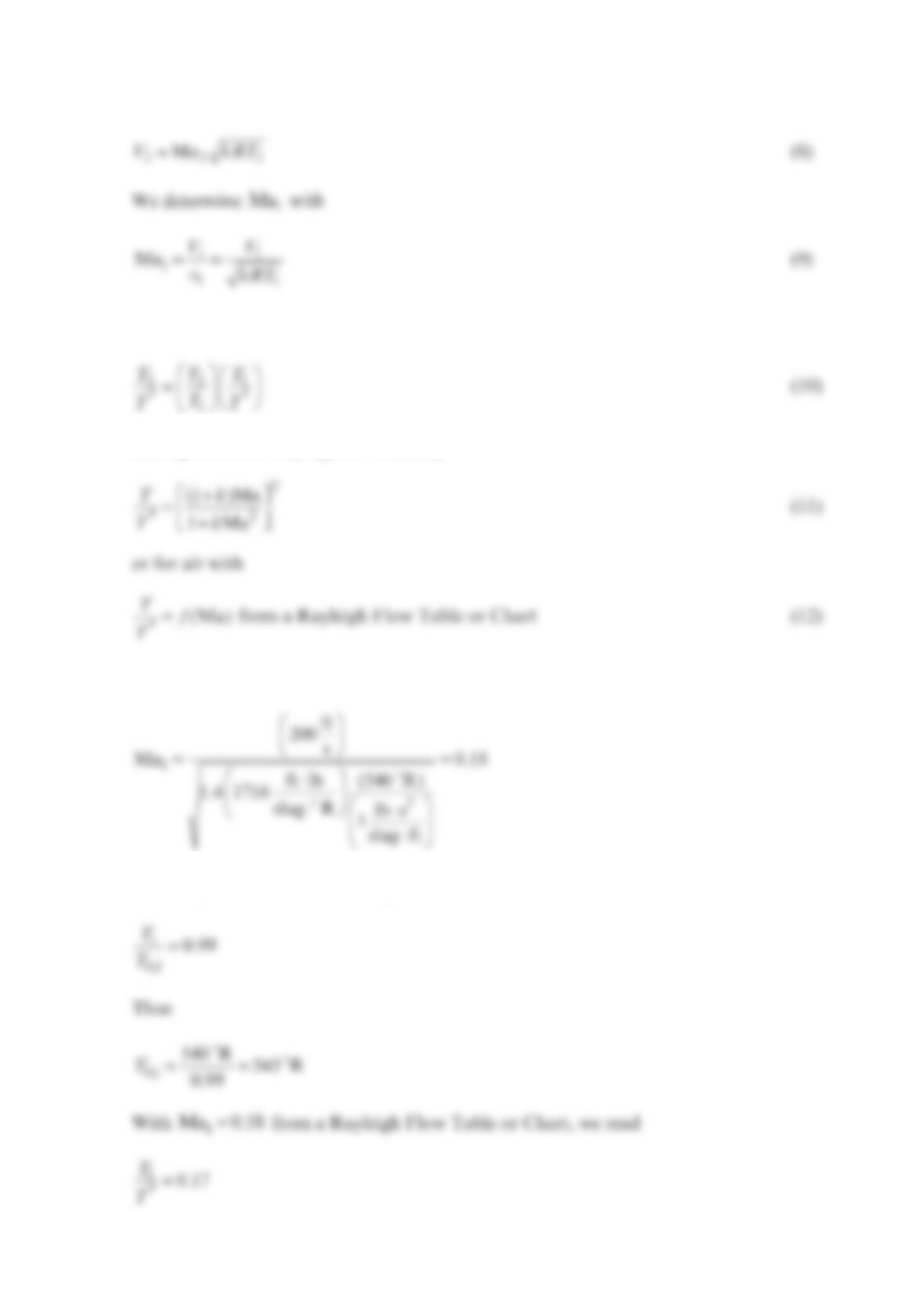
For exit velocity, 2
V, we use
and we determine 2
Ma with
and equation for Rayleigh flow, namely
For air, we determine 1
Ma with Eq. (9). Thus,
For =
1
Ma 0.18 from an Isentropic Flow Table or Chart
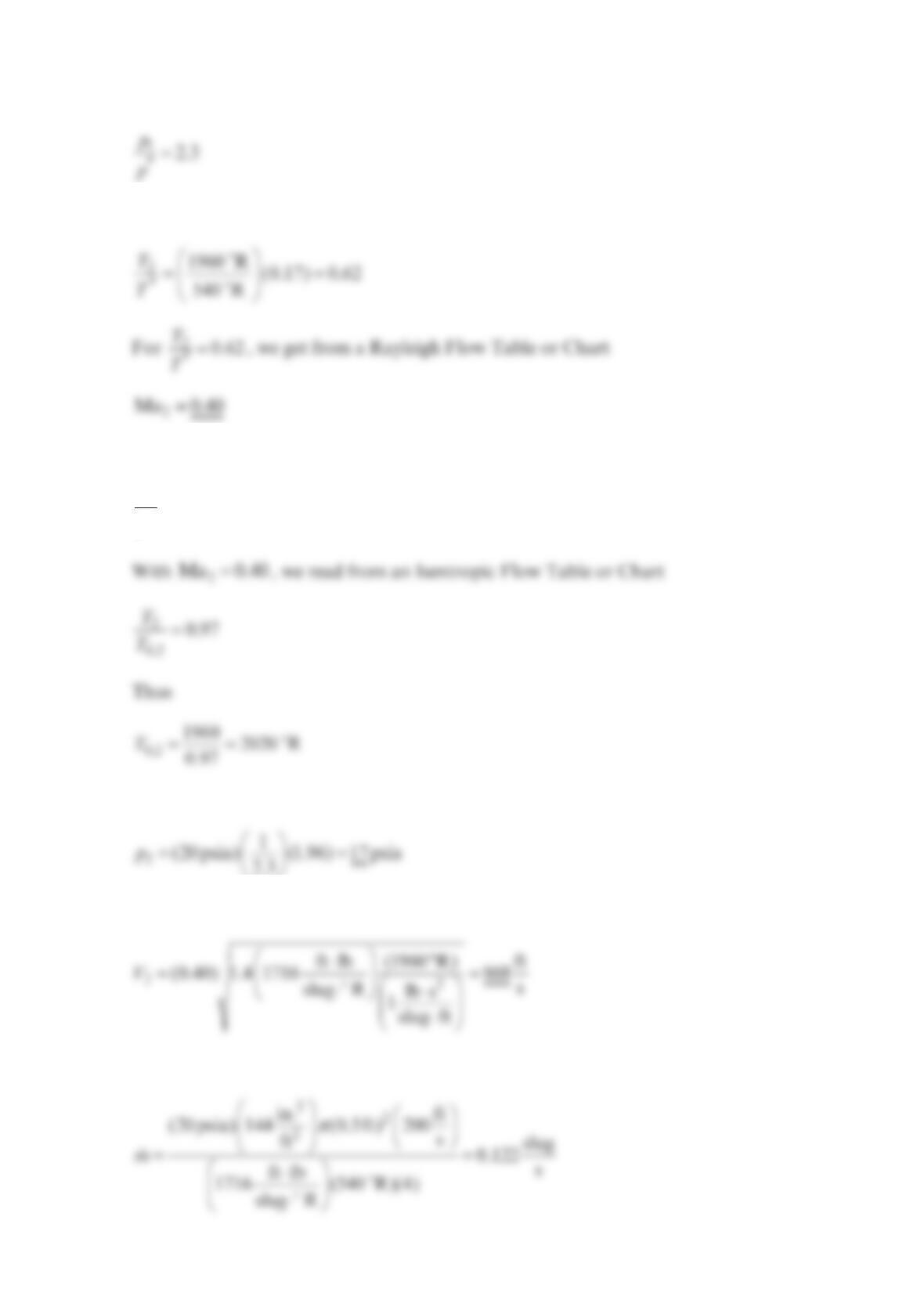
and
Thus with Eq. (10), we obtain
and
=
2
*1.96
p
p
Then with Eq. (5), we have
With Eq. (8), we have
With Eq. (2), we get
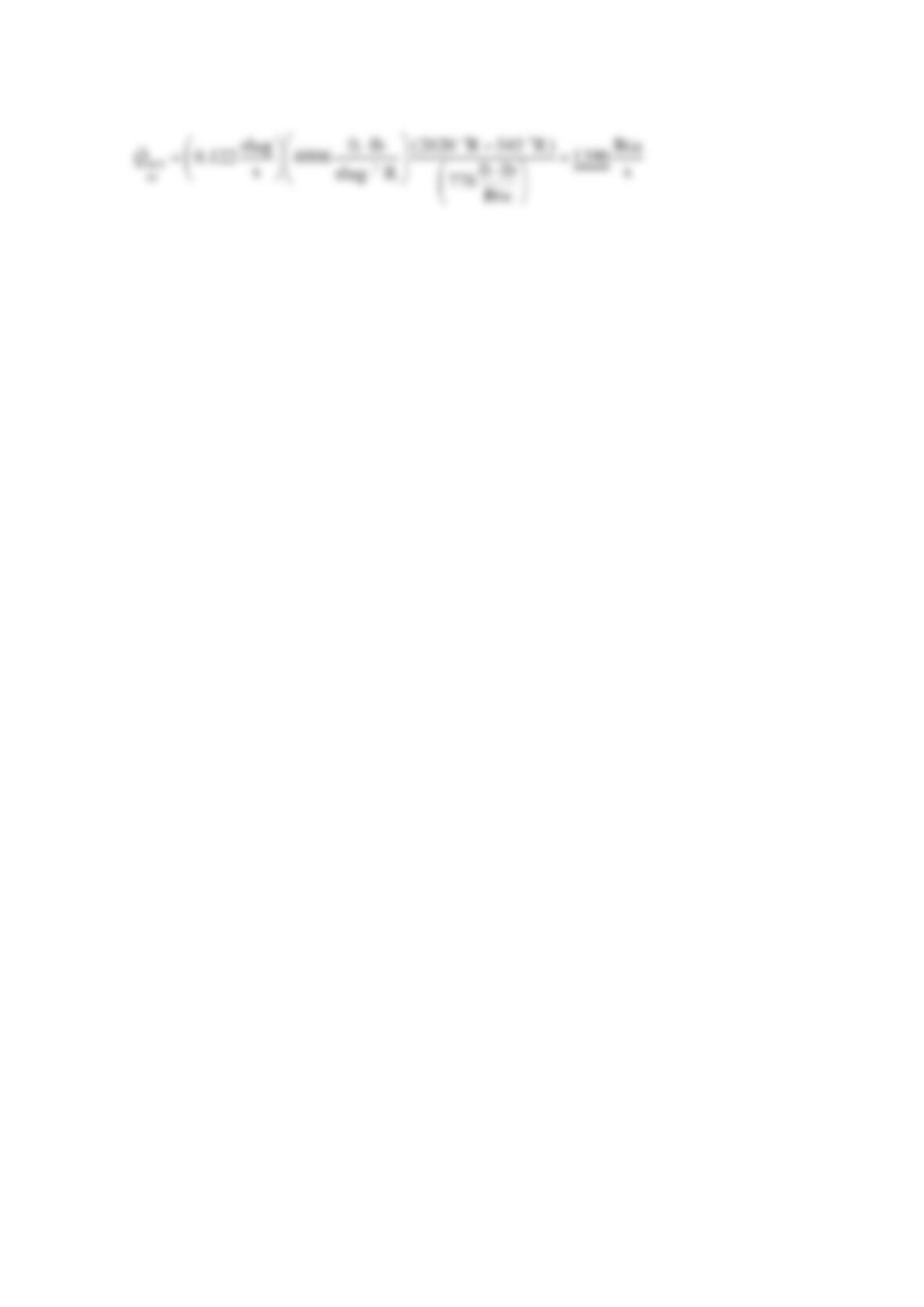
and with Eq. (1), we obtain
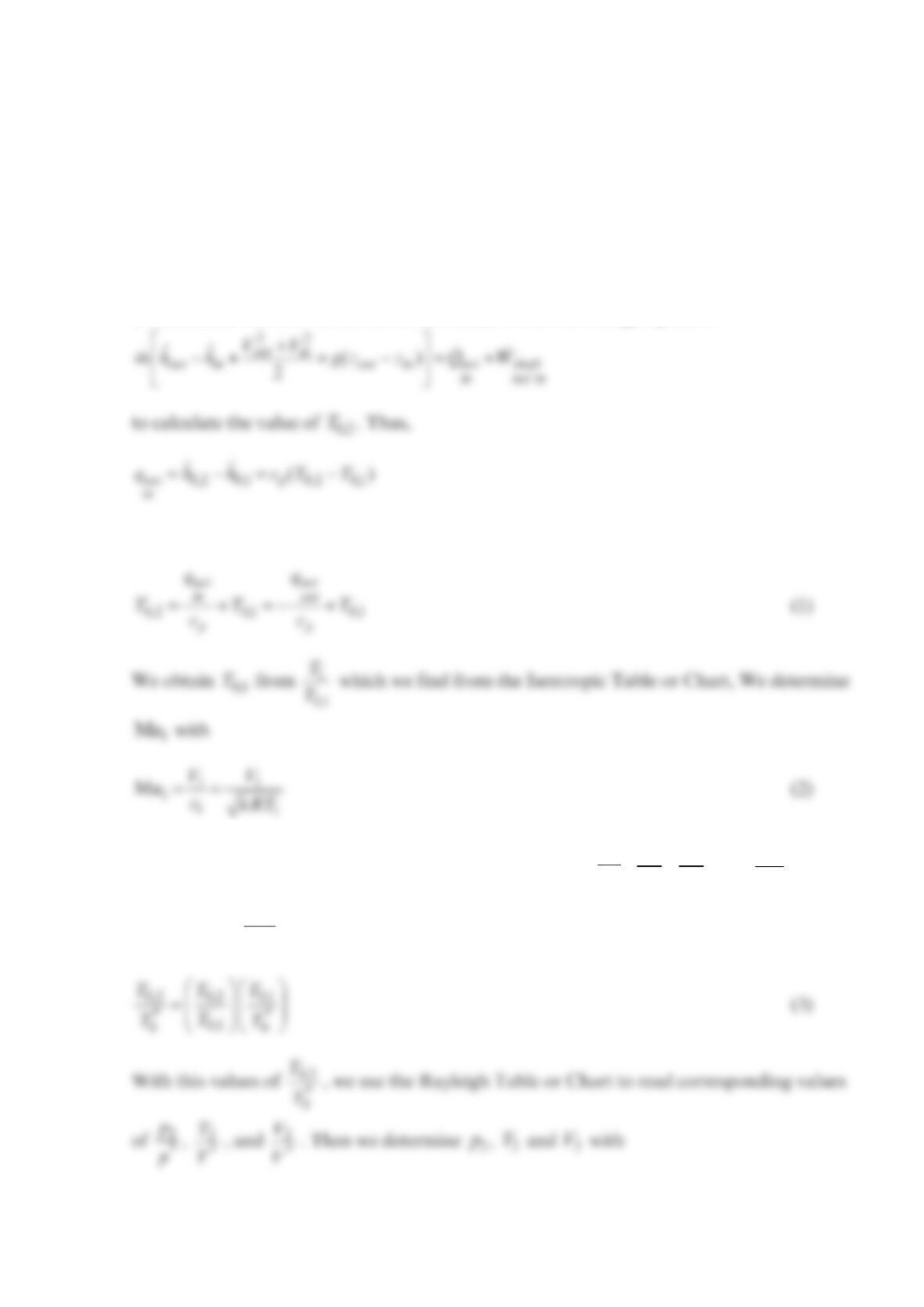
Problem 11.67
Air enters a length of constant area pipe with =
1200 kPa (abs)p, =
1500 KT, and
=
1400 m/sV. If 500 kJ/kg of energy is removed from the air by frictionless heat transfer
between sections (1) and (2), determine 2
p
, 2
T, and 2
V. Sketch a temperature–entropy
diagram for the flow between sections (1) and (2).
Solution 11.67
To determine the state of the air at section (2), we use the energy equation
or
With 1
Ma , we also find from the Rayleigh Table or Chart 1
*
p
p
, 1
*
T
T, 1
*
V
V, and 0,1
*
0
T
T. Then
we determine 0,2
*
0
T
T with
p
p