11.50: PROBLEM DEFINITION
Situation: The problem statement describes a 1.5-mm sphere moving in oil.
Find: Terminal velocity of the sphere.
PLAN Apply the equilibrium principle. To find the drag force, assume Stokes drag.
SOLUTION
Equilibrium. Since the ball moves at a steady speed, the sum of forces is zero.
Eq. (1) becomes
The solution is
Vo=1.55 mm/s
Check Reynolds number
REVIEW
The value of Re is within Stokes’ range (Re ≤0.5), so the use of Stokes’ law is valid.
61
11.51: PROBLEM DEFINITION
Situation:
•A120lbf (534 N) skydiver is free-falling at an altitude of 6500 ft (1981 m).
•LapseratefortheU.S.Standardatmosphereisα=0.00587 K/m.
Find:
Estimate the terminal velocity in mph.
a.) Case A (maximum drag) CDA=8ft
2(0.743 m2).
b.) Case B (minimum drag) CDA=1ft
2(0.0929 m2).
PLAN
At terminal velocity, the force of drag will balance weight. The only unknown is fluid
density—this can be found by using the ideal gas law along with the equations from
chapter 3 that describe the US Standard atmosphere. Use SI units throughout.
SOLUTION
Atmospheric pressure variation (troposphere)
62
Ideal gas law
Equilibrium
2
Calculations give
Case B.
Since CDAdecreases by a factor of 8, the speed will increase by a factor of √8.
63
11.52: PROBLEM DEFINITION
Situation: A falling hail stone is described in the problem statement.
Find: Terminal velocity of hail stone.
PLAN
Apply the ideal gas law, then calculate the drag force and apply the equilibrium
principle.
SOLUTION
Ideal gas law
Substitute for drag force and weight
Assume CD=0.5
Check Reynolds number
REVIEW
The drag coefficient will not change with further iterations.
64
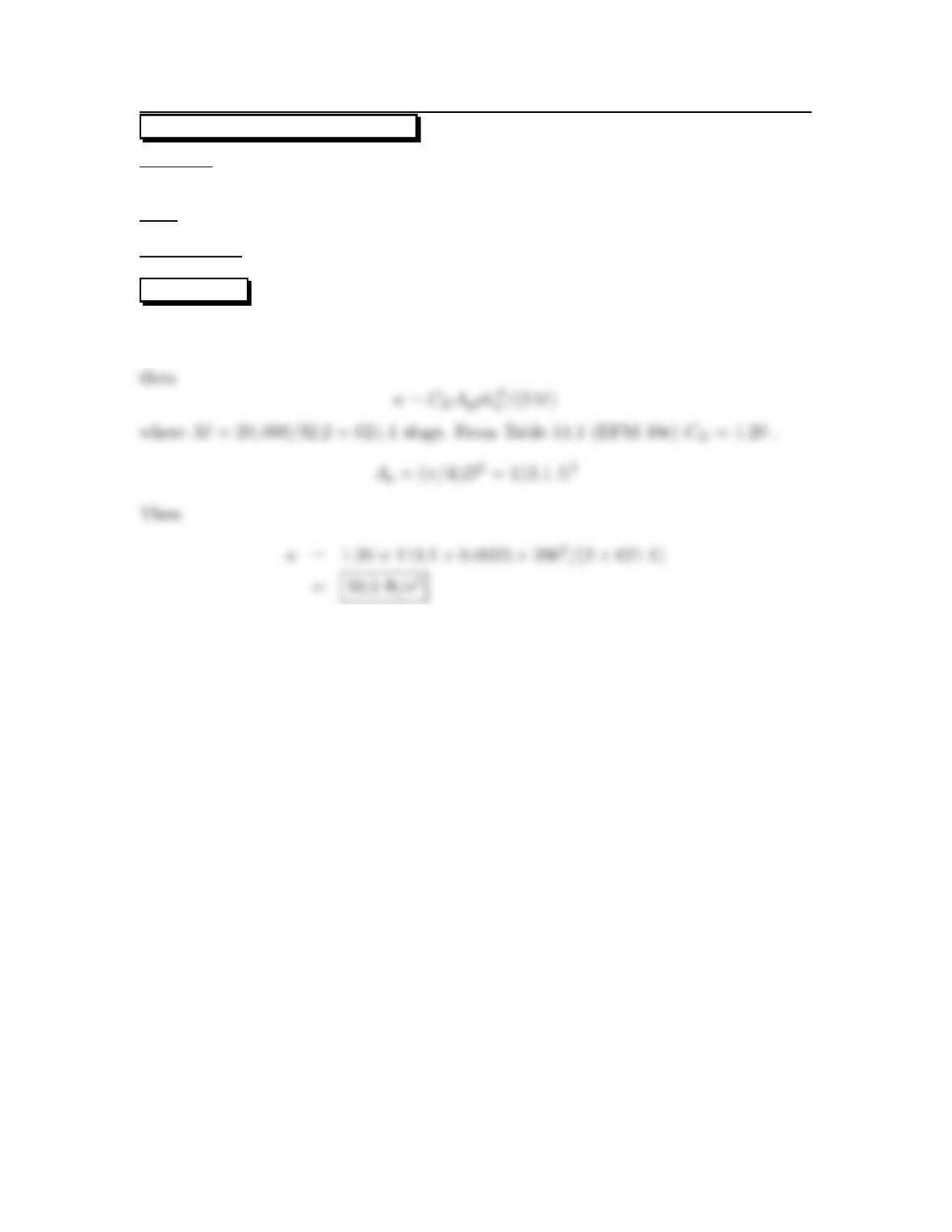
11.53: PROBLEM DEFINITION
Situation: A drag chute is used to decelerate an airplane–additional details are
provided in the problem statement.
Find: Initial deceleration of aircraft.
Assumptions: Density, ρ=0.075 lbm/ft3=0.0023 slug/ft3.
SOLUTION
Drag force
FD=CDApρV 2
0/2=Ma
65
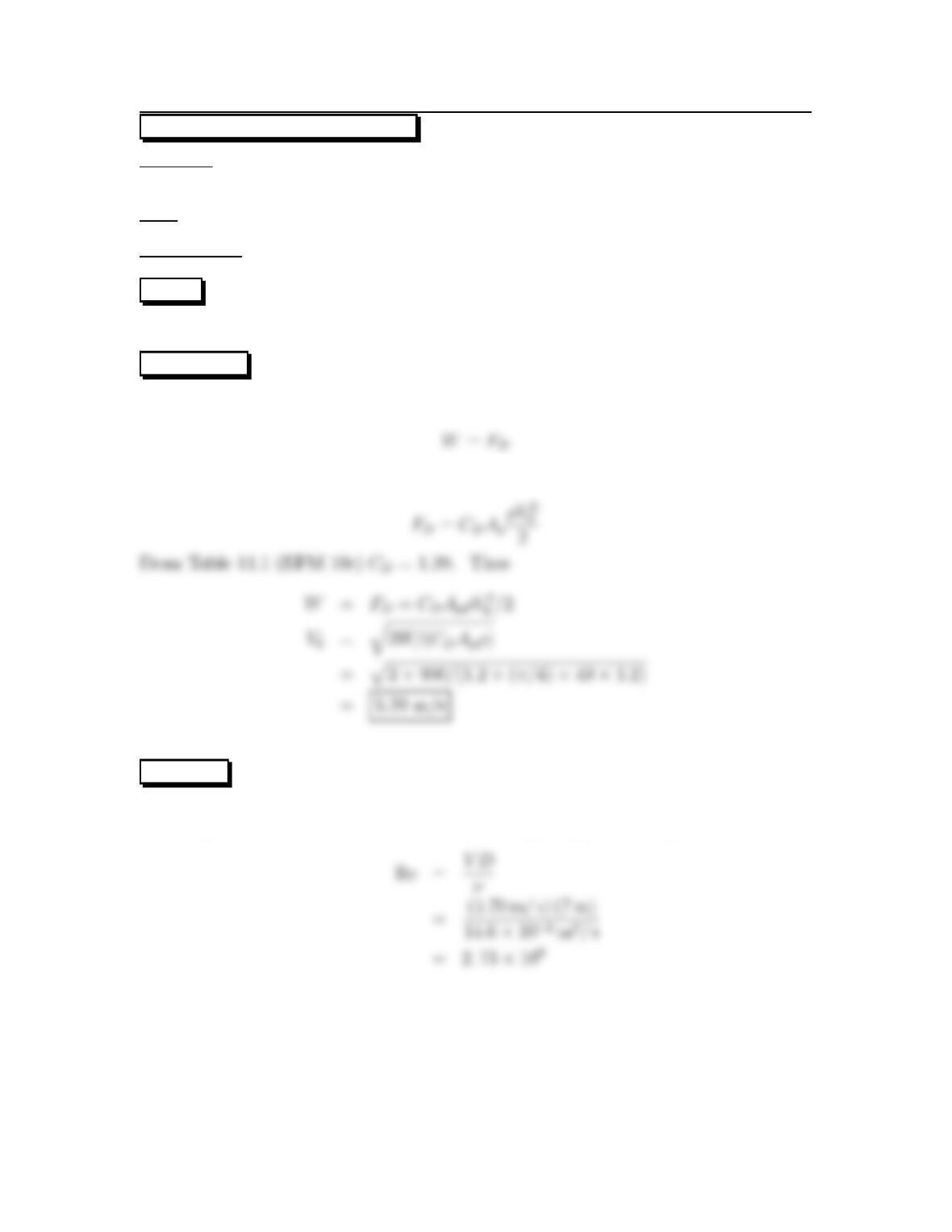
11.54: PROBLEM DEFINITION
Situation: A paratrooper falls using a parachute—additional details are provided in
the problem statement
Find: Descent rate of paratrooper.
Assumptions: Density, ρ=1.2kg/m3
PLAN
In equilibrium, drag force balances weight of the paratrooper.
SOLUTION
Equilibrium
Drag Force
REVIEW
1. Reynolds number based on terminal velocity is approximately:
2. While a Reynolds number of 2.7×10⁶is an order of magnitude less than the
valuegiveninTable11.1(EFM10e),thedragcoefficient is not strongly effected
by Reynolds number for Reynolds numbers exceeding 104. Note the drag on a
hemispherical shell in Table 11.1 (EFM 10e).
66
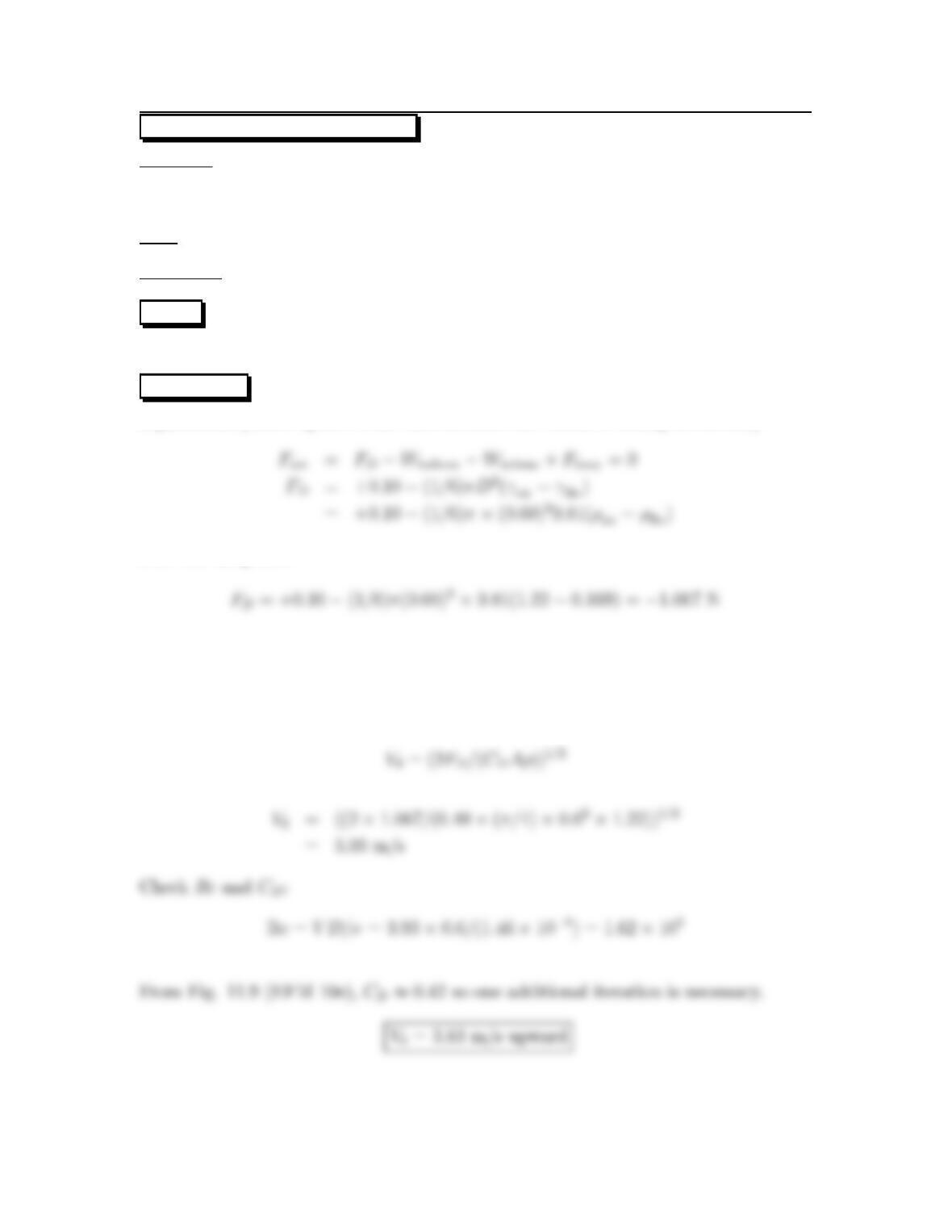
11.55: PROBLEM DEFINITION
Situation:Ahelium–filled balloon moves through air
W=0.10 N
D=0.6m
Find: Terminal velocity of the balloon.
Properties:atT=15
◦C:ρair ≈1.22 kg/m3;ρHe =0.169 kg/m3
PLAN
Apply equilibrium with the weight, drag force and buoyancy force.
SOLUTION
Equilibrium (based upon a FBD that assumes the ballon is falling downward)
Solve for drag force
Ahah! Having calculated a negative FD, we realize that the balloon must have been
moving upward! We are in fact calculating the terminal velocity for an upward-rising
balloon.
Assume CD≈0.40 Then, for velocity from drag force equation
67
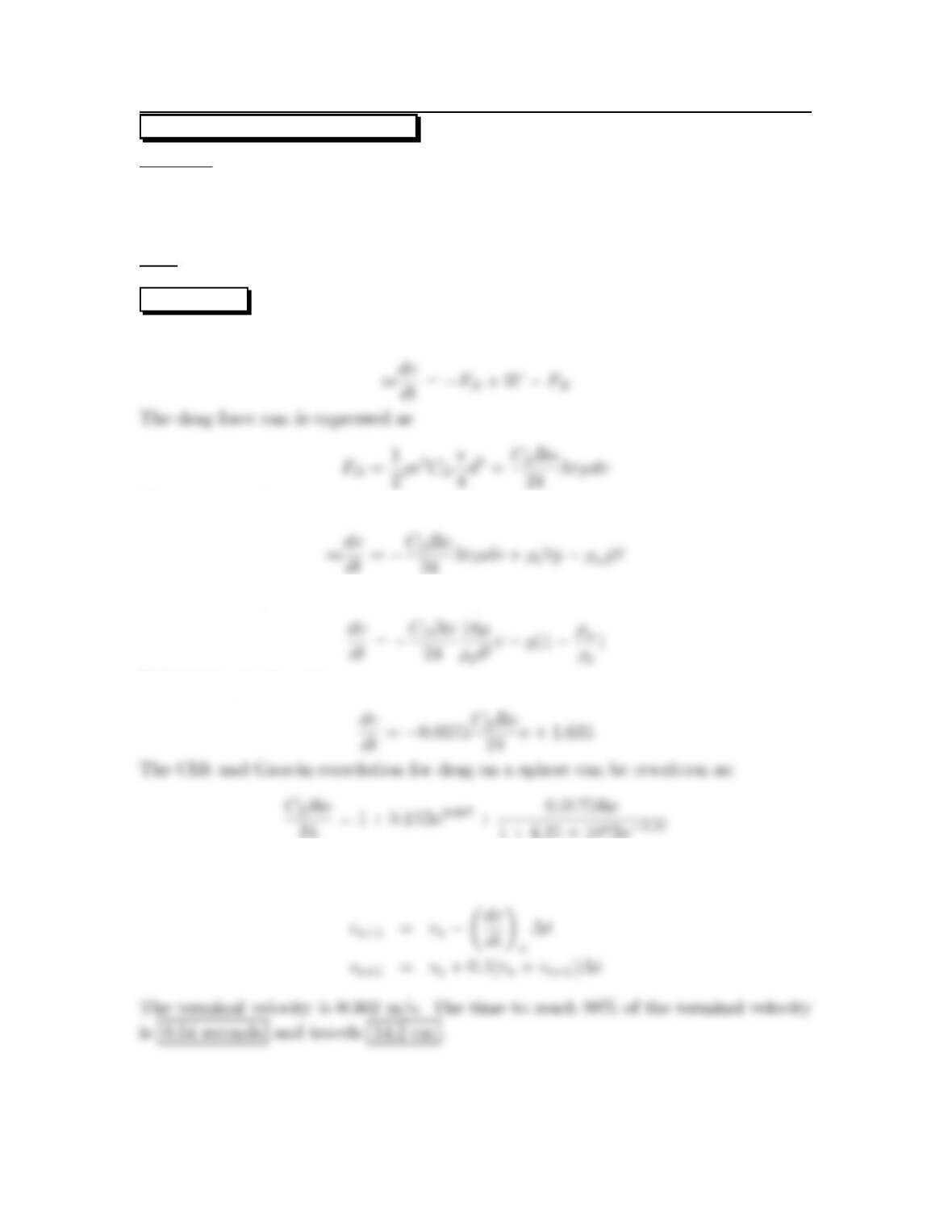
11.56: PROBLEM DEFINITION
Situation:
A 2cm plastic ball with specific gravity of 1.2 is released from rest in water
(T=20 ◦C)
Additional details are provided in the problem statement.
Find: Time and distance to achieve 99% of terminal velocity.
SOLUTION
The equation of motion for the plastic sphere is
The equation of motion becomes
Dividing through by the mass of the ball gives
Substituting in the values
This equation can be integrated using the Euler method
68

Problem 11.57
No solution provided.
69
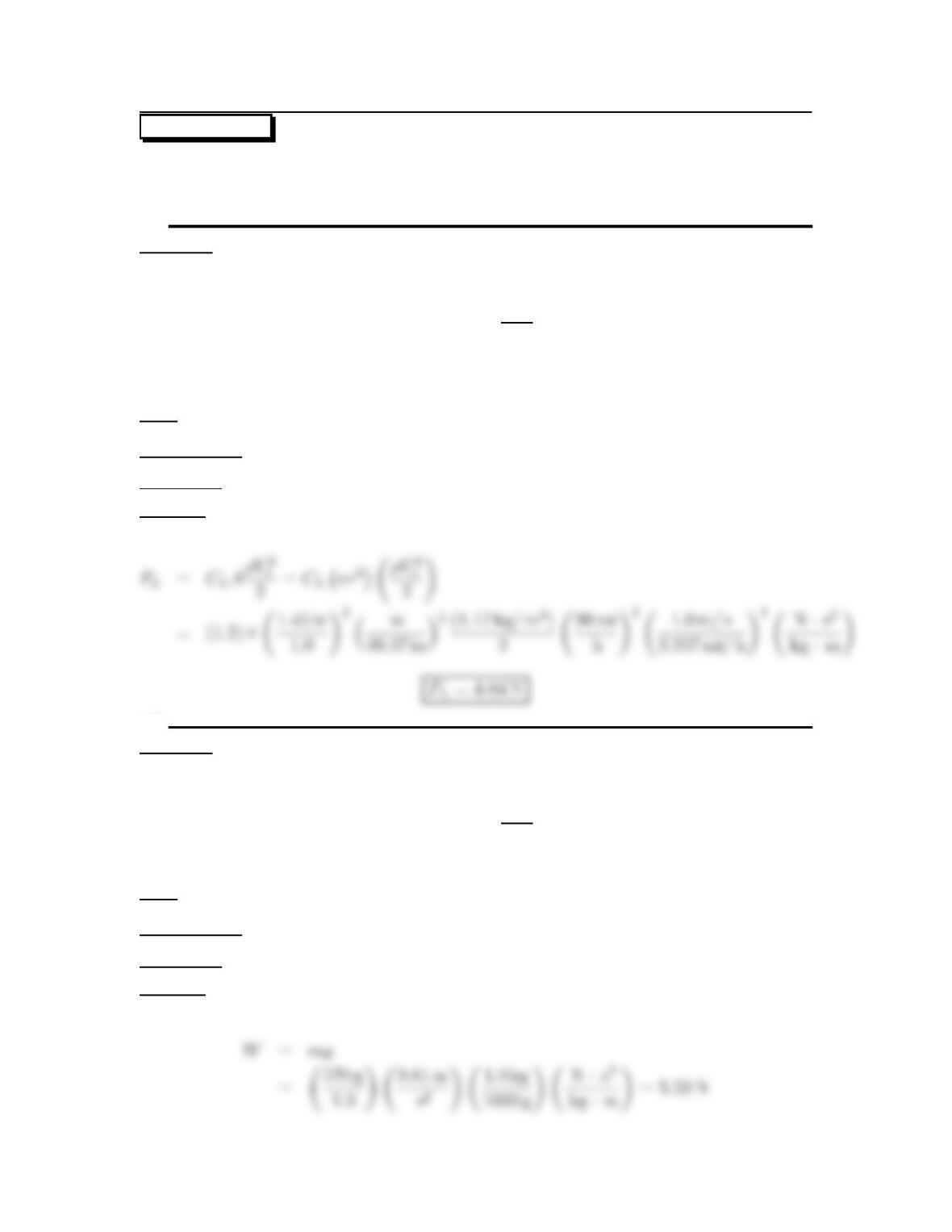
Problem 11.58
Apply the grid method to each situation described below. Note: Unit cancellations
are not shown in this solution.
a.)
Situation:
Lift force acts on a rotating baseball.
Lift force equation:
FL=CLAρV 2
o
2
CL=1.2,V
o=90mph.
A=πr2,r=1.45 in.
Find: Lift force (newtons).
Assumptions: Air temperature on a typical summer day is 30 ◦C.
Properties:Air(30 ◦C,1 atm), Table A.5 (EFM 10e), ρ=1.17 kg/m3.
Solution:
a.)
Situation:
Amodel(m=570g)aircraft is flying in straight & level flight.
Lift force equation:
FL=CLAρV 2
o
2
CL=1.2,V
o=80mph.
Find:Wingsize(areafromatopviewinmm
2).
Assumptions:Straightandlevelflight so weight balances lift force.
Properties:Air(30 ◦C,1 atm), Table A.5 (EFM 10e), ρ=1.17 kg/m3.
Solution:
Calculate weight
70
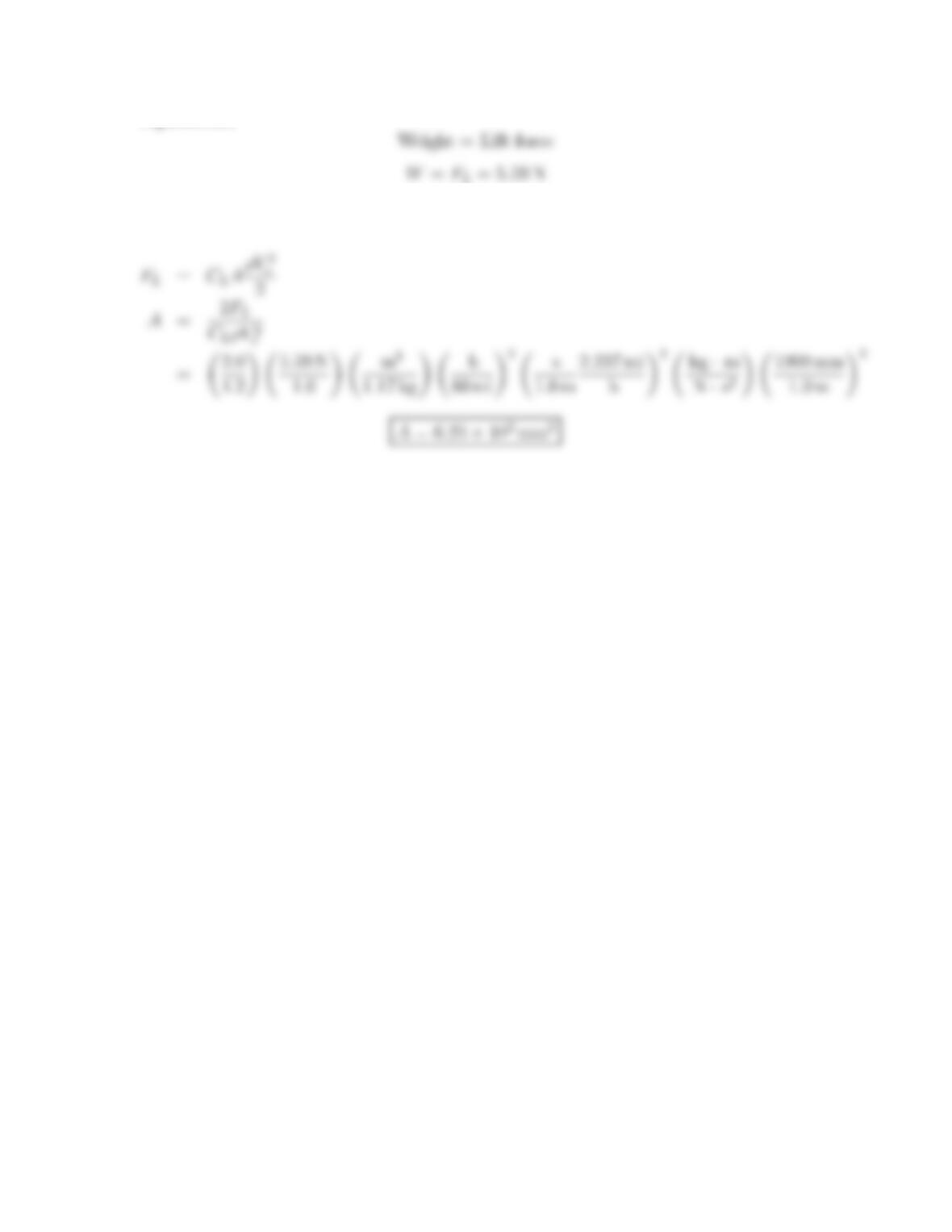
Equilibrium
Lift force equation
71
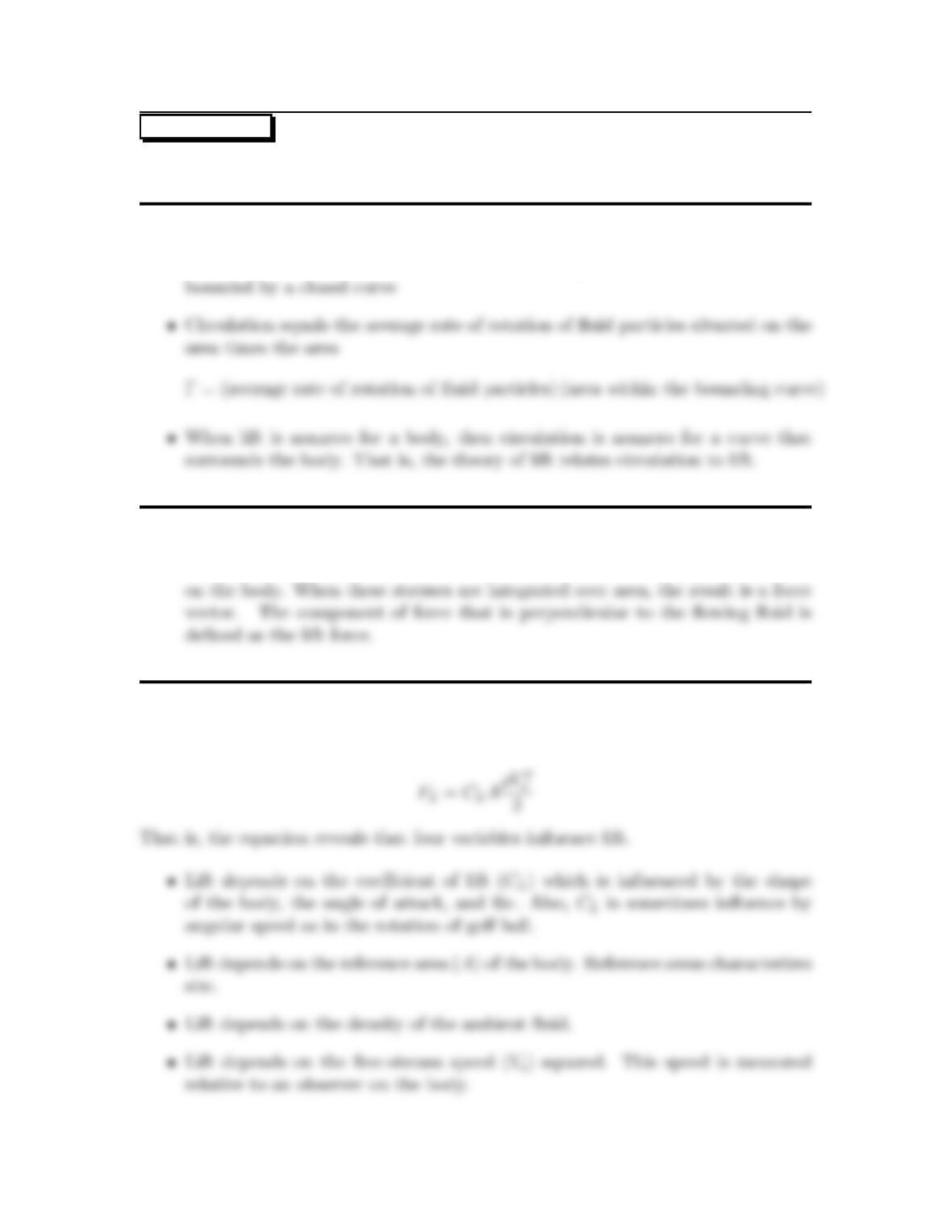
Problem 11.59
Answer the questions below.
a. What is circulation? Why is it important?
•Circulation is a measure of rotation of the fluidparticlesthatliesonanarea
b. What is lift force?
•When fluid flows past a body, the fluid exerts normal and tangential stresses
c.) What variables influence the magnitude of the lift force?
To identify the variables, apply logical reasoning to the lift force equation:
72

Problem 11.60
Situation:
A spinning baseball is thrown from west to east.
Find: Direction the baseball will ”break.”
SOLUTION
73
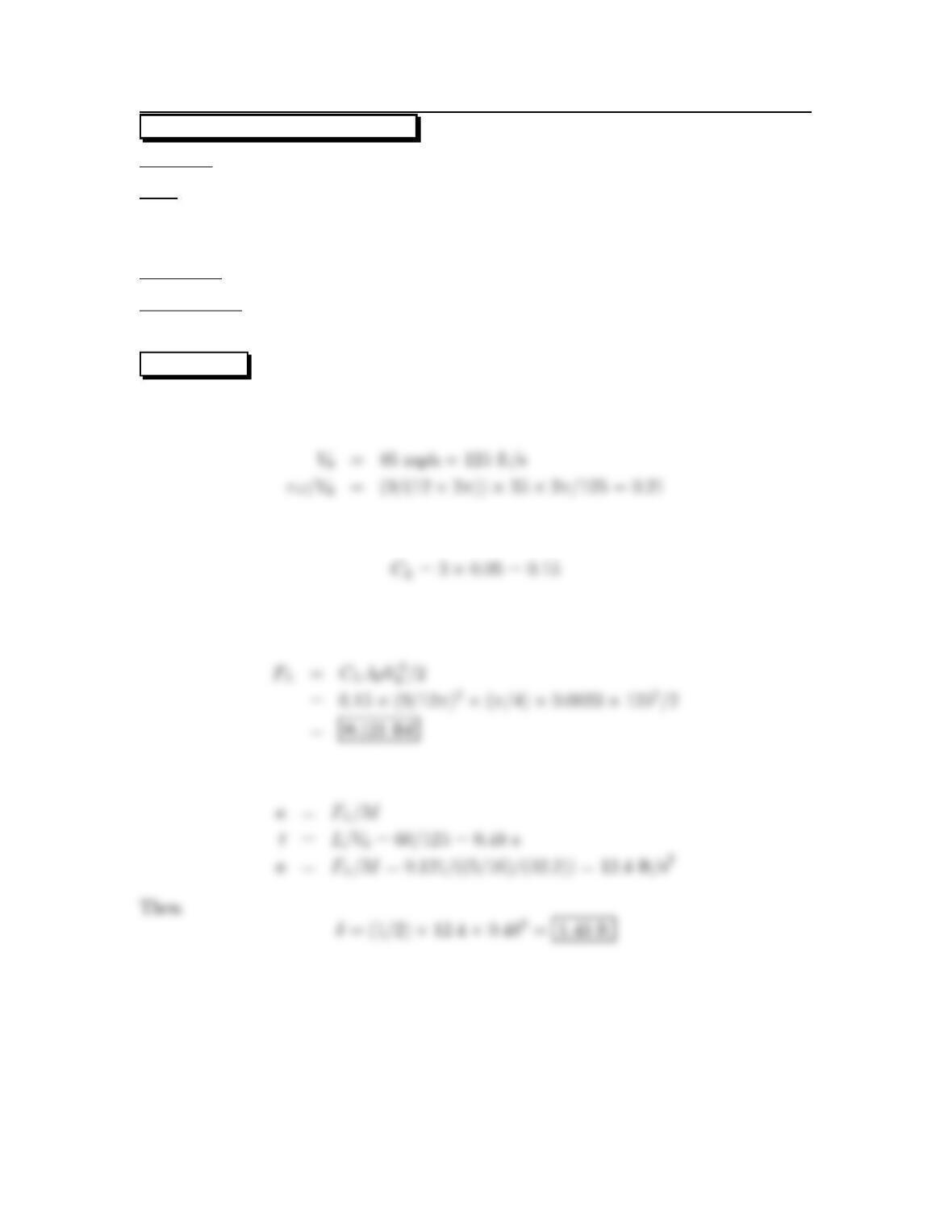
11.61: PROBLEM DEFINITION
Situation: A rotating baseball is described in the problem statement.
Find:
(a)Liftforceonthebaseball.
(b) Deflection of the ball from its original path.
Properties:FromTableA.3(EFM10e),ρ=0.0023 slugs/ft3.
Assumptions: Axis of rotation is vertical, standard atmospheric conditions (T=
70◦F).
SOLUTION
Rotational parameter
Lift force. From Fig. 11.18 (EFM 10e)
Then
Deflection will be δ=1/2at2where ais the acceleration
74
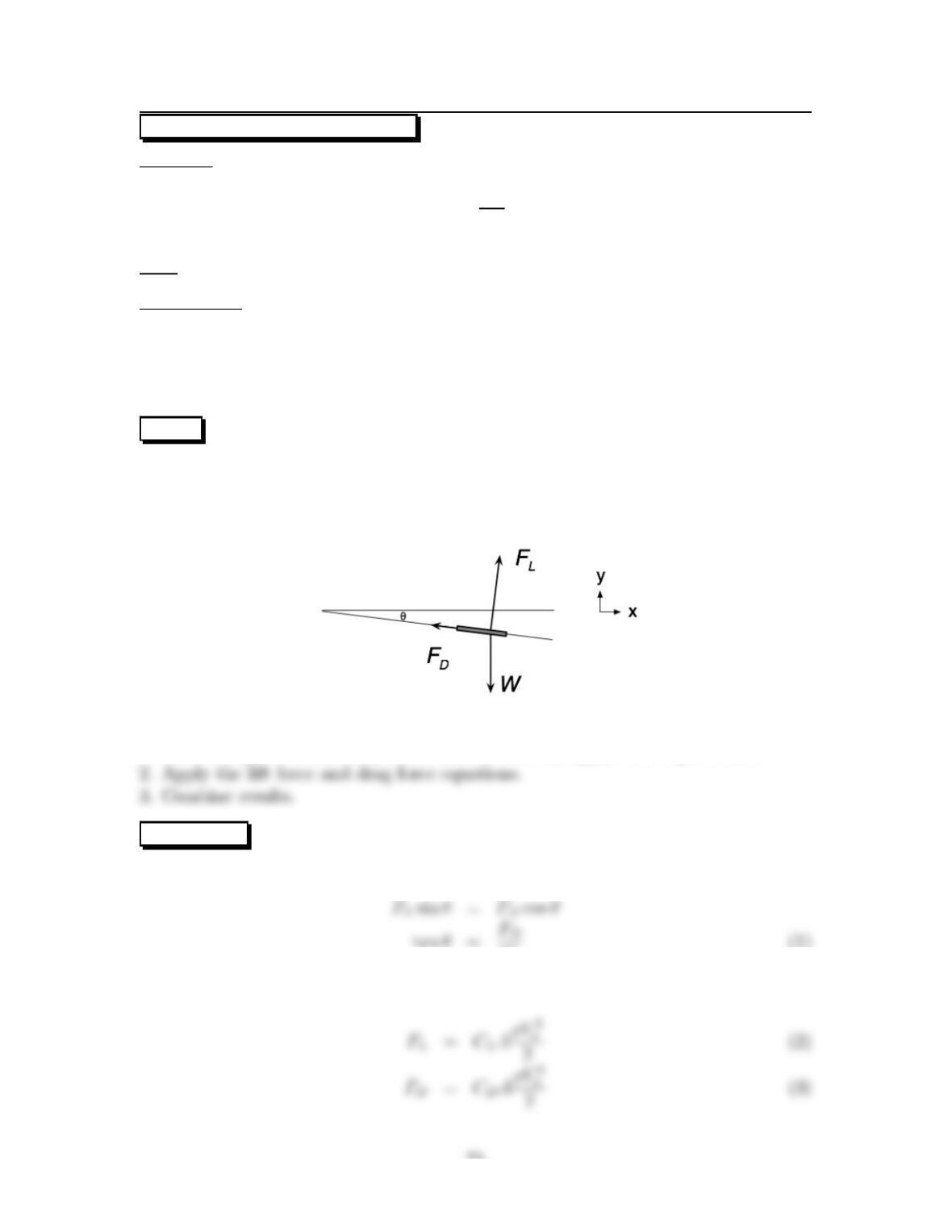
11.62: PROBLEM DEFINITION
Situation: A glider will move along glide path with an angle of
θ=CD
CL
Find: Prove the above statement.
Assumptions:
Steady speed.
Straight path.
Glide angle is shallow so tan θ≈θ.
The lift and drag equations use the same reference area.
PLAN
The motion of the glider is determined by three forces: weight, the lift force, and the
drag force
1. Since the glider is traveling with constant velocity, apply force equilibrium.
SOLUTION
1. Equilibrium (horizontal direction; this eliminates weight).
FL
2. Lift and drag force equations.
75

3. Combine Eqs. (1) to (3).
REVIEW
The glide angle can be as large as 60 to 1. This means that the glider will travel 60
m of horizontal distance for every meter of vertical distance.
76
11.63: PROBLEM DEFINITION
Situation:
A rotating sphere (D=0.1m) is situated in a flow of water
ω=286rpm =30s
−1,V
o=1.5m/s.
Find: Lift force (in newtons) on the sphere.
Properties:Water(15 ◦C), Table A.5 (EFM 10e), ρ=999kg/m3.
PLAN
1. Find CLusing Fig. 11.18 (EFM 10e).
SOLUTION
1. Coefficient of lift
2. Lift force equation
77