AMORTIZATION OF INTANGIBLE ASSETS
➢ The cost of an intangible asset with a finite useful life is amortized.
➢ The cost of an intangible asset with an indefinite useful life is not
amortized.
▶ Goodwill is the most common intangible asset with an indefinite useful
life.
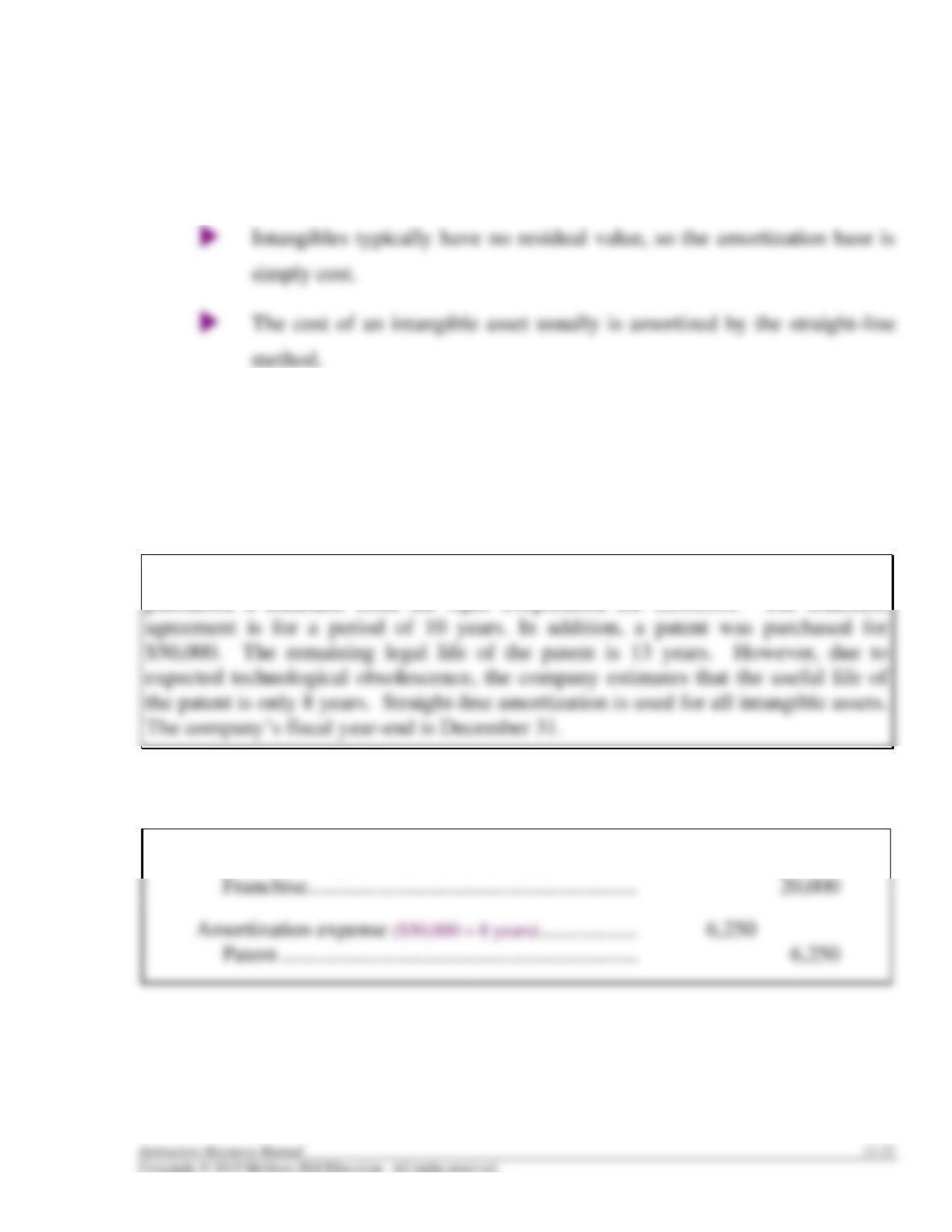
Hollins Corporation began operations in 2016. Early in January, the company
purchased a franchise from the Ajax Corporation for $200,000. The franchise
The journal entries to record a full year of amortization for these intangibles are as
follows:
Amortization expense ($200,000 ÷ 10 years) ………….. 20,000
Illustration 11-12

11-22 Intermediate Accounting, 8/e
INTERNATIONAL FINANCIAL REPORTING STANDARDS
Valuation of Intangible Assets. IAS No. 38 allows a company to value an intangible asset
subsequent to initial valuation at (1) cost less accumulated amortization or (2) fair value, if fair value
can be determined by reference to an active market. If revaluation is chosen, all assets within that
class of intangibles must be revalued on a regular basis. Goodwill, however, cannot be revalued.
U.S. GAAP prohibits revaluation of any intangible asset.
revaluation surplus for that asset.
Consider the following illustration:
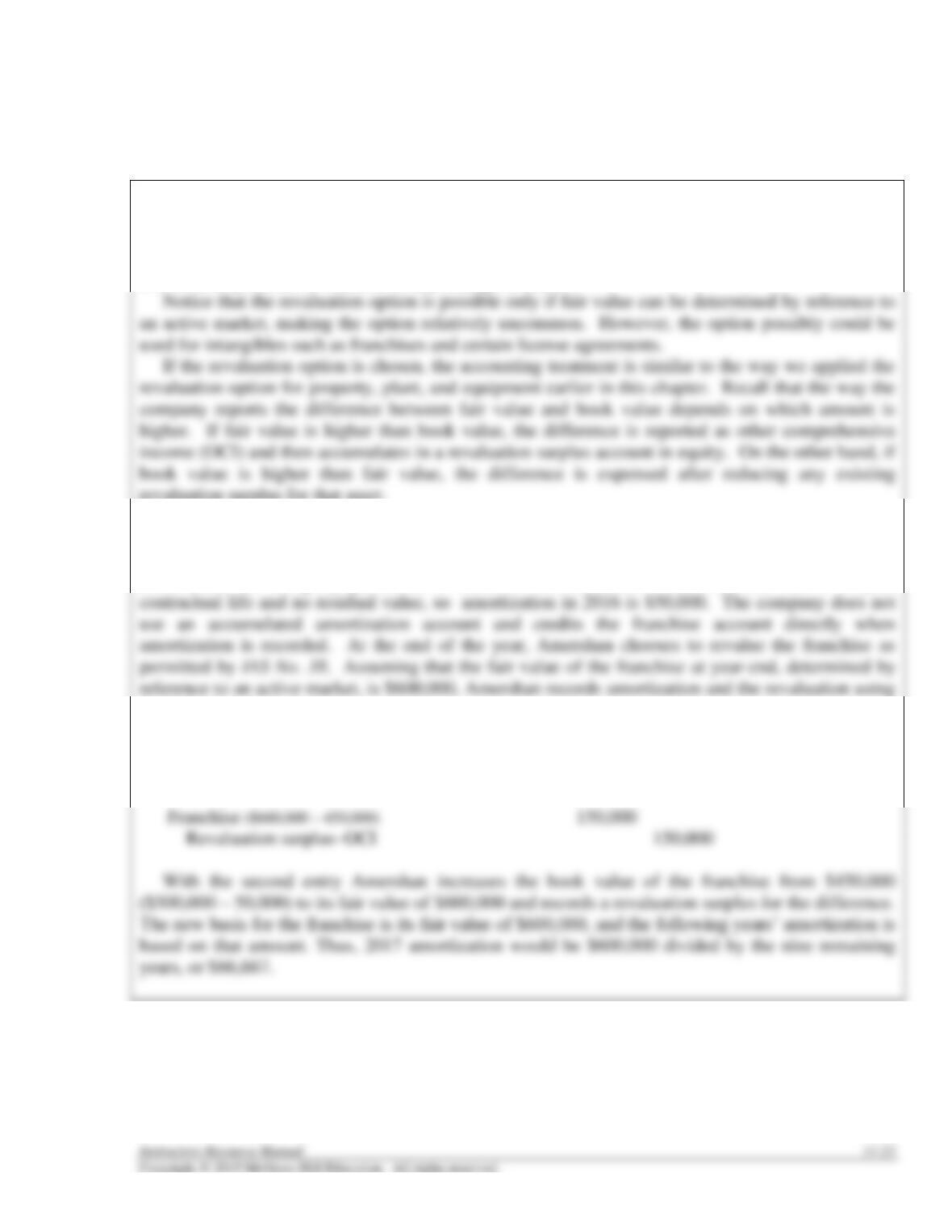
Amershan LTD. prepares its financial statements according to IFRS. At the beginning of its 2016
fiscal year, the company purchased a franchise for $500,000. The franchise has a 10-year
the following journal entries:
Amortization expense ($500,000 10 years) 50,000
Franchise 50,000
T11-11
11-24 Intermediate Accounting, 8/e
PARTIAL PERIODS
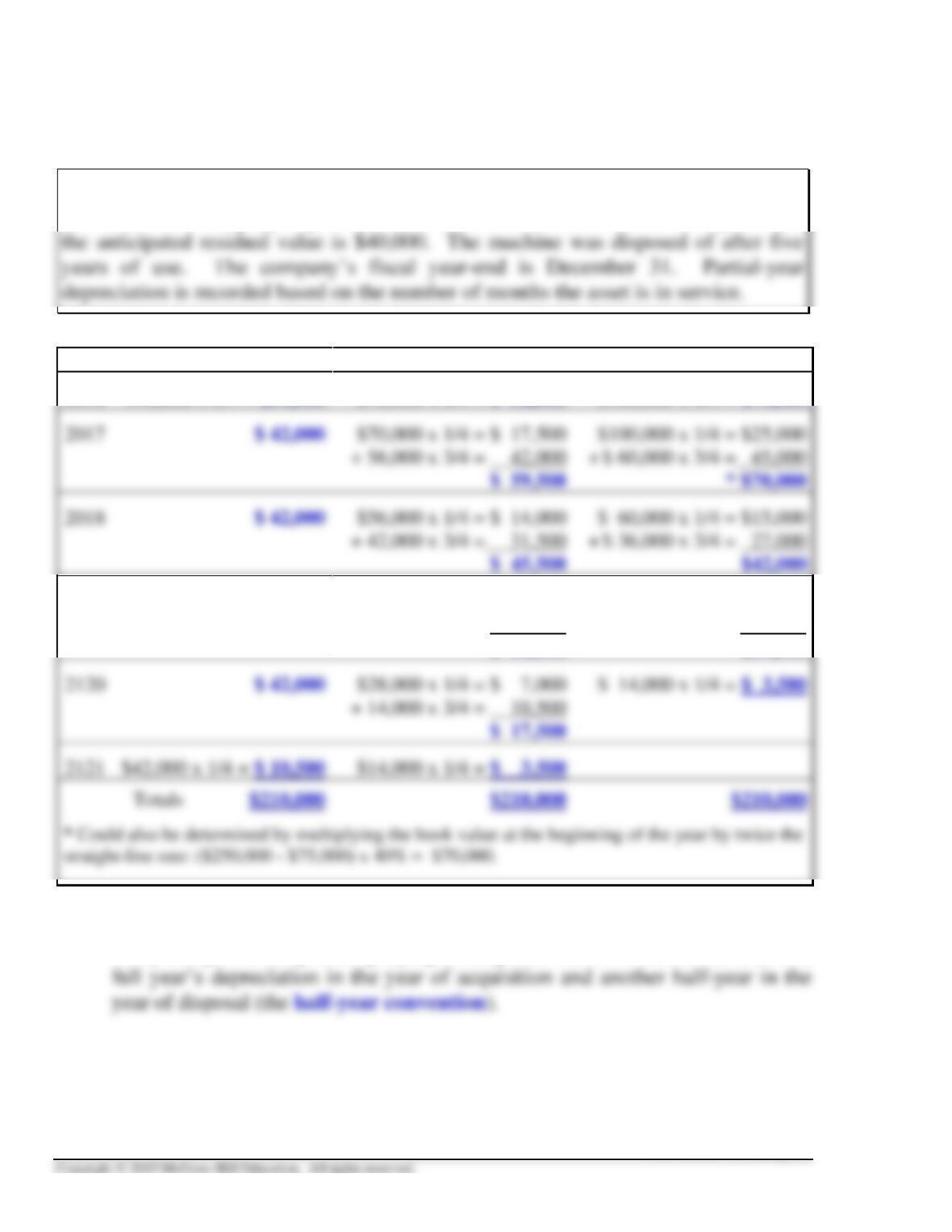
On April 1, 2016, the Hogan Manufacturing Company purchased a machine for
$250,000. The company expects the service life of the machine to be five years and
Year
Straight line
Sum-of-the-Years’ Digits
Double-Declining Balance
2016
$42,000 x 3/4 = $31,500
$70,000 x 3/4 = $ 52,500
$100,000 x 3/4 = $75,000
$ 59,500
$ 45,500
$42,000
2019
$ 42,000
$42,000 x 1/4 = $ 10,500
+ 28,000 x 3/4 = 21,000
$ 31,500
$ 36,000 x 1/4 = $ 9,000
+ $ 14,000 x 3/4 = 10,500
$19,500
$ 17,500
2121
$14,000 x 1/4 = $ 3.500
$210,000
$210,000
Illustration 11-14B
Many companies adopt a simplifying assumption such as to record one-half of a
T-12
CHANGES IN ESTIMATES
➢ Changes in estimates are accounted for prospectively.
➢ When a company revises a previous estimate, prior financial
statements are not restated.
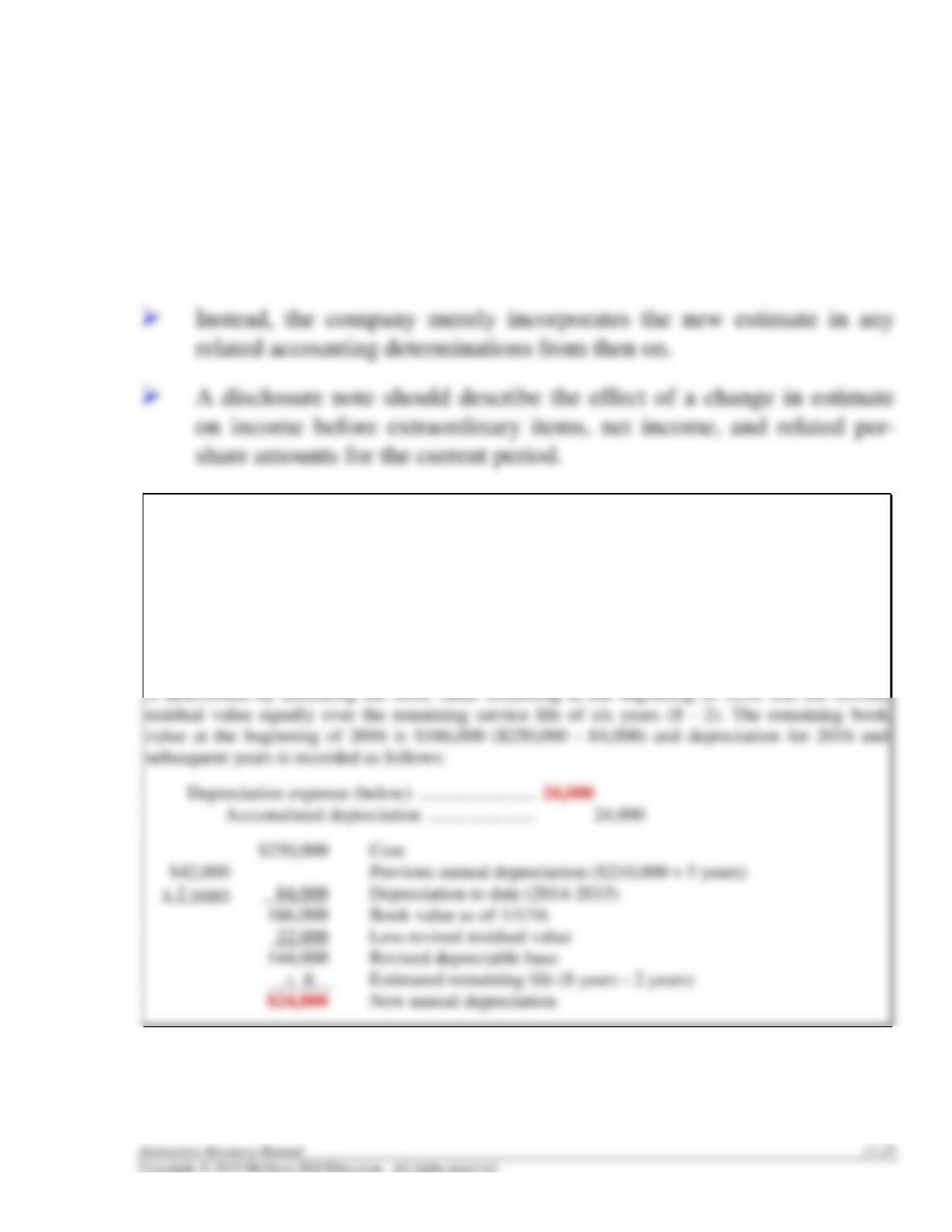
On January 1, 2014, the Hogan Manufacturing Company purchased office furniture and fixtures
for $250,000. The company expects the service life of the office furniture and fixtures to be five
years and the anticipated residual value to be $40,000. The company’s fiscal year-end is December
31 and the straight-line depreciation method is used for all depreciable assets. During 2016, the
company revised its estimate of service life from five to eight years and also revised estimated
residual value to $22,000.
For 2014 and 2015, depreciation is $42,000 per year [($250,000 – 40,000) 5 years] or $84,000
for the two years. However, with the revised estimate, depreciation for 2016 and subsequent years
Illustration 11-15
T11-13
11-26 Intermediate Accounting, 8/e
CHANGE IN DEPRECIATION,
AMORTIZATION, OR DEPLETION METHOD
➢ Changes in depreciation, amortization, or depletion method are
accounted for prospectively, in the same way as we account for
changes in estimates.
On January 1, 2014, the Hogan Manufacturing Company purchased office
equipment for $250,000. The company expects the service life of the office
Depreciation expense (below) ………….. 20,000
Accumulated depreciation ………… 20,000
DDB depreciation:
*Double the straight-line rate for 5 years ([1/5 = 20%] x 2 = 40%)
$250,000 Cost
A disclosure note reports the effect of the change on net income and earnings per
share along with clear justification for changing depreciation methods.
Illustration 11-17
ERROR CORRECTIONS
➢ Any previous years’ financial statements that were incorrect
as a result of the error are retrospectively restated to reflect
the correction.
T11-15
11-28 Intermediate Accounting, 8/e
ERROR CORRECTIONS
(continued)
In 2016, the controller of the Hathaway Corporation discovered an error
in recording $300,000 in legal fees to successfully defend a patent
Analysis:
($ in thousands)
Correct Incorrect
(Should have been recorded) (as recorded)
2014 Patent 300 Expense 300
Cash 300 Cash 300
During the two-year period, amortization expense was understated by
$120 thousand, but other expenses were overstated by $300 thousand, so
net income during the period was understated by $180 thousand (ignoring
income taxes). This means retained earnings is currently understated by
that amount.
Illustration 11-19
T11-15 (continued)
IMPAIRMENT OF VALUE
➢ An asset should be written down if there has been a
significant impairment of value.
Property, Plant, and Equipment and Finite-Life
Intangible Assets
➢ The loss recorded is the amount by which book value exceeds
the fair value of the asset or group of assets when those fair
values are readily determinable.
determine fair value.
T11-16
11-30 Intermediate Accounting, 8/e
IMPAIRMENT OF PROPERTY, PLANT, AND
EQUIPMENT AND FINITE-LIFE INTANGIBLE ASSETS
(continued)
The Dakota Corporation operates several factories that manufacture medical
equipment. Near the end of the company’s 2016 fiscal year, a change in business
climate related to a competitor’s innovative products indicated to management that
Change in circumstances. –The change in business climate related to a
competitor’s innovative products requires Dakota to investigate for possible
impairment.
Step 2. Measurement of impairment loss. The impairment loss is $35 million,
determined as follows:
Book value $170 million
T11-16 (continued)
IMPAIRMENT OF PROPERTY, PLANT, AND
EQUIPMENT AND FINITE-LIFE INTANGIBLE ASSETS
(continued)
Asset Impairment Disclosure – Sears Holding Corporation
Impairment of Long-lived Assets (in part)
In accordance with accounting standards governing the impairment or disposal of long-lived assets, the
carrying value of long-lived assets, including property and equipment and definite-lived intangible assets, is
evaluated whenever events or changes in circumstances indicate that a potential impairment has occurred
Note 13—Store Closing Charges, Severance Costs and Impairments (in part)
Long-Lived Assets
In accordance with accounting standards governing the impairment or disposal of long-lived assets, we
Illustration 11-21
T11-16 (continued)
11-32 Intermediate Accounting, 8/e
INTERNATIONAL FINANCIAL REPORTING STANDARDS
Impairment of Value: Property, Plant, and Equipment and Finite-Life Intangible Assets.
Highlighted below are some important differences in accounting for impairment of value for
property, plant, and equipment and finite-life intangible assets between U.S. GAAP and IAS No. 36.
U.S. GAAP IFRS
When to Test When events or changes in Assets must be assessed for indicators of
circumstances indicate that impairment at the end of each reporting
Measurement The impairment loss is the The impairment loss is the difference between
difference between book book value and the “recoverable amount” (the
value and fair value. higher of the asset’s value–in-use and fair
value less costs to sell).
Subsequent Prohibited. Required if the circumstances that caused the
Reversal of Loss impairment are resolved.
Let’s look at an illustration highlighting the important differences described above.
What amount of impairment loss should Jasmine Tea recognize, if any, under U.S. GAAP? Under
IFRS?
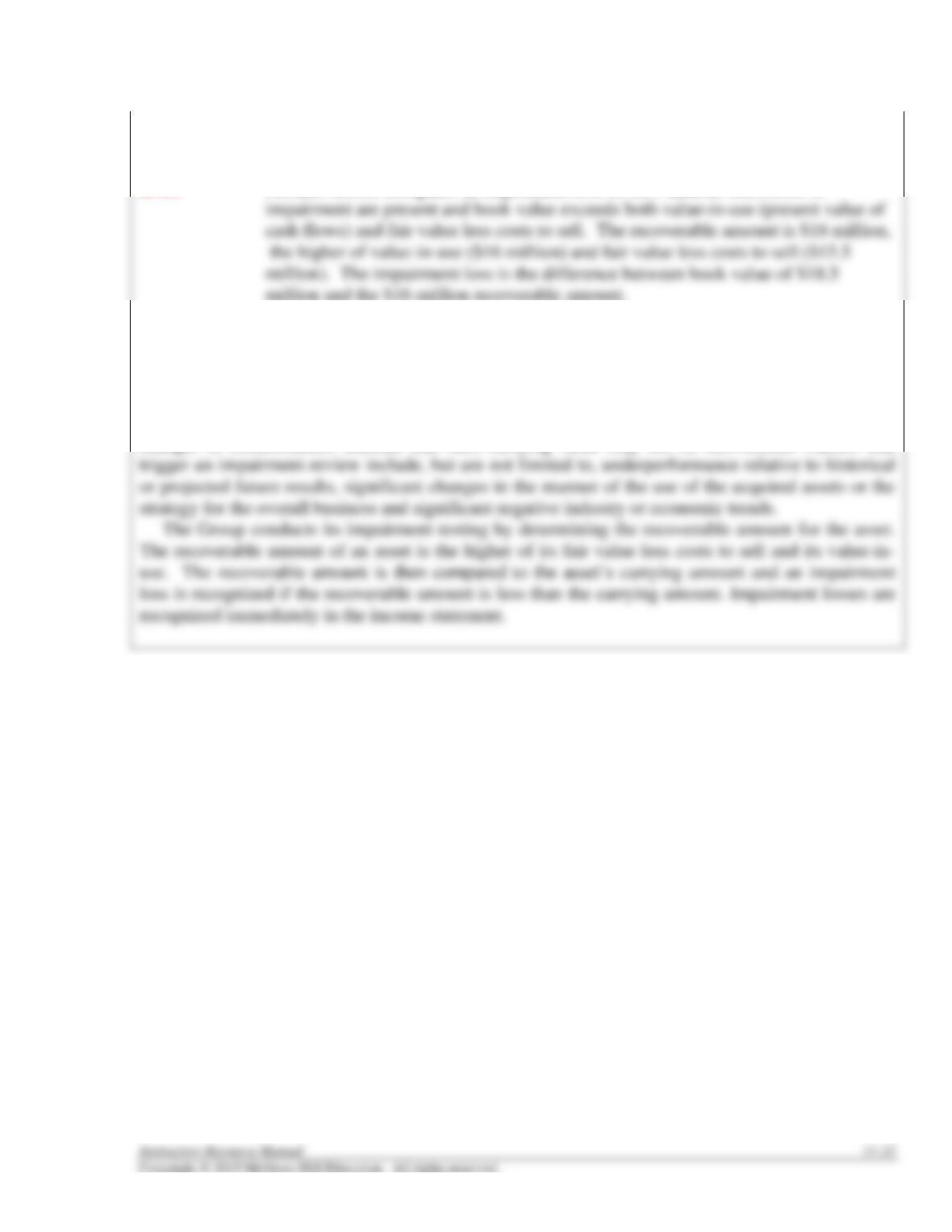
U.S. GAAP There is no impairment loss. The sum of undiscounted estimated future cash flows
exceeds the book value.
IFRS Jasmine should recognize an impairment loss of $2.5 million. Indicators of
million and the $16 million recoverable amount.
Nokia, a Finnish company, prepares its financial statements according to IFRS. The following
disclosure note describes the company’s impairment policy:
Assessment of the recoverability of long-lived assets, and intangible assets, and goodwill (in part)
The carrying value of identifiable intangible assets and long-lived assets is assessed if events or
changes in circumstances indicate that such carrying value may not be recoverable. Factors that
T11-17
11-34 Intermediate Accounting, 8/e
INTERNATIONAL FINANCIAL REPORTING STANDARDS
Impairment of Value: Indefinite-Life Intangible Assets Other than
Goodwill. Similar to U.S. GAAP, IFRS requires indefinite-life intangible
assets other than goodwill to be tested for impairment at least annually.
sell.
IFRS requires the reversal of an impairment loss if the circumstances
that caused the impairment are resolved. Reversals are prohibited under
U.S. GAAP.
IMPAIRMENT OF VALUE – GOODWILL
➢ A goodwill impairment loss is indicated when the fair value of the reporting unit is
less than its book value.
➢ A goodwill impairment loss is measured as the excess of the book value of the
In 2015, the Upjane Corporation acquired Pharmacopia Corporation for $500 million. Upjane
recorded $100 million in goodwill related to this acquisition because the fair value of the net assets
of Pharmacopia was $400 million. After the acquisition, Pharmacopia continues to operate as a
separate company and is considered a reporting unit.
Step 1. – Recoverability. Because book value of the net assets of $440 million exceeds the $360
million fair value of the reporting unit, an impairment loss is indicated.
Step 2. – Measurement of impairment loss. The impairment loss is $75 million, determined as
follows:
Determination of implied fair value of goodwill:
Fair value of Pharmacopia $360 million
Illustration 11-22
T11-19
11-36 Intermediate Accounting, 8/e
IMPAIRMENT OF VALUE – GOODWILL
(continued)
Goodwill Impairment Disclosure – Alcoa Inc.
Goodwill and Other Intangible Assets (in part)
For Primary Metals, the estimated fair value as determined by the
discounted cash flow model was lower than the associated carrying value.
Illustration 11-24
INTERNATIONAL FINANCIAL REPORTING STANDARDS
Impairment of Value: Goodwill. Highlighted below are some important differences in accounting
for the impairment of goodwill between U.S. GAAP and IAS No. 36.
U.S. GAAP IFRS
Level of testing Reporting unit – a Cash-generating unit (CGU) – the smallest
segment or a component identifiable group of assets that generates cash
Measurement A two-step process: A one-step process:
1. Compare the fair value Compare the recoverable amount of the CGU
of the reporting unit with to book value. If the recoverable amount is
IAS No. 36 requires goodwill to be tested for impairment at least annually. U.S. GAAP allows a
reversal of goodwill impairment losses.
Let’s look at an illustration highlighting these differences.
Canterbury LTD. has $38 million of goodwill in its balance sheet from the 2014 acquisition of
Denton, Inc. At the end of 2016, Canterbury’s management provided the following information for
the year-end goodwill impairment test ($ in millions):
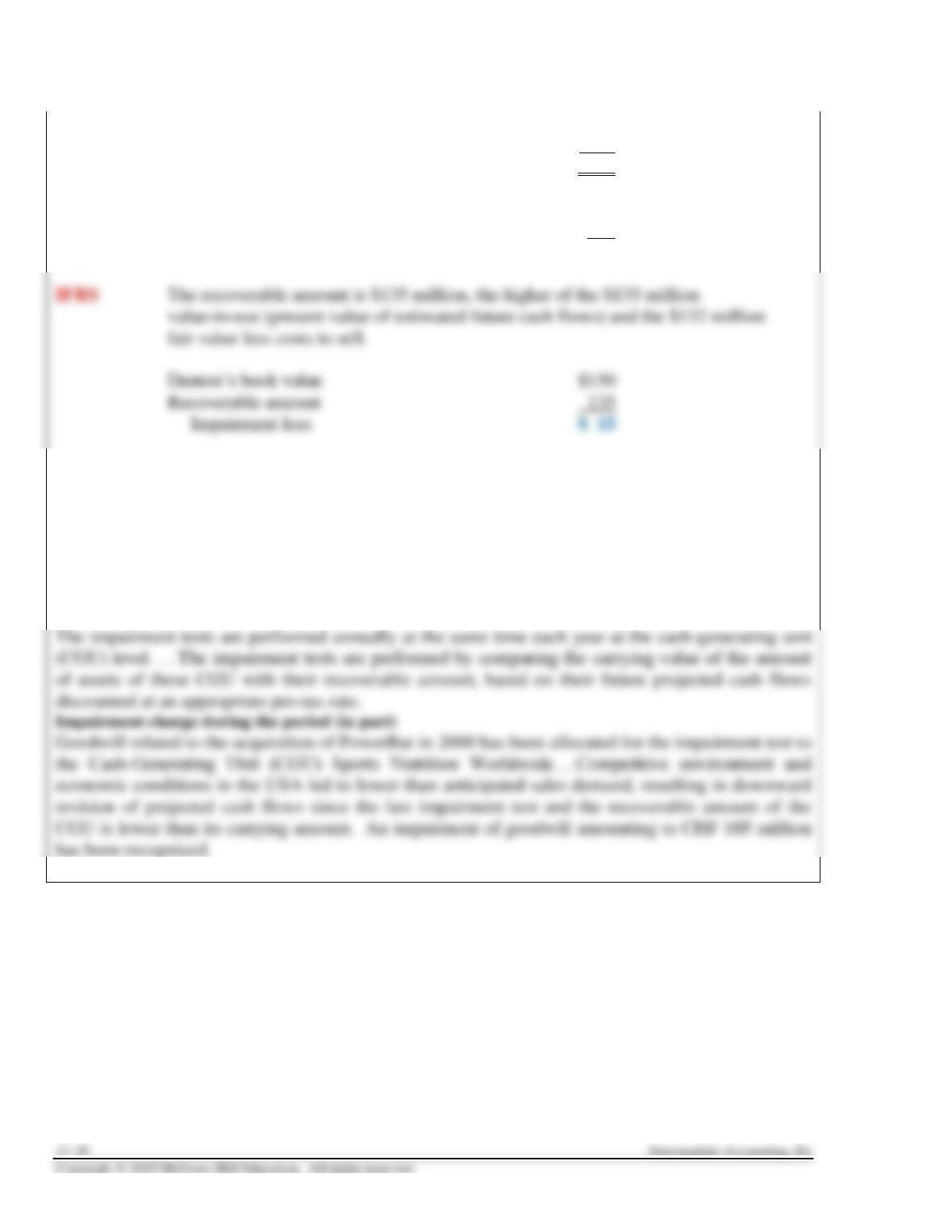
U.S. GAAP Fair value of Denton $132
Fair value of Denton’s net assets (excluding goodwill) 120
Implied fair value of goodwill $ 12
Book value of goodwill $38
Implied fair value of goodwill 12
Impairment loss $26
Nestle SA, a Swiss company, is one of the largest food and nutrition companies in the world. The
company prepares its financial statements according to IFRS. The following disclosures describe the
company’s goodwill impairment policy as well as a $105 million Swiss franc goodwill impairment
loss related to its Sports Nutrition unit.
Impairment of Goodwill (in part)
Goodwill is tested for impairment at least annually and upon the occurrence of an indication of
impairment.
T11-20