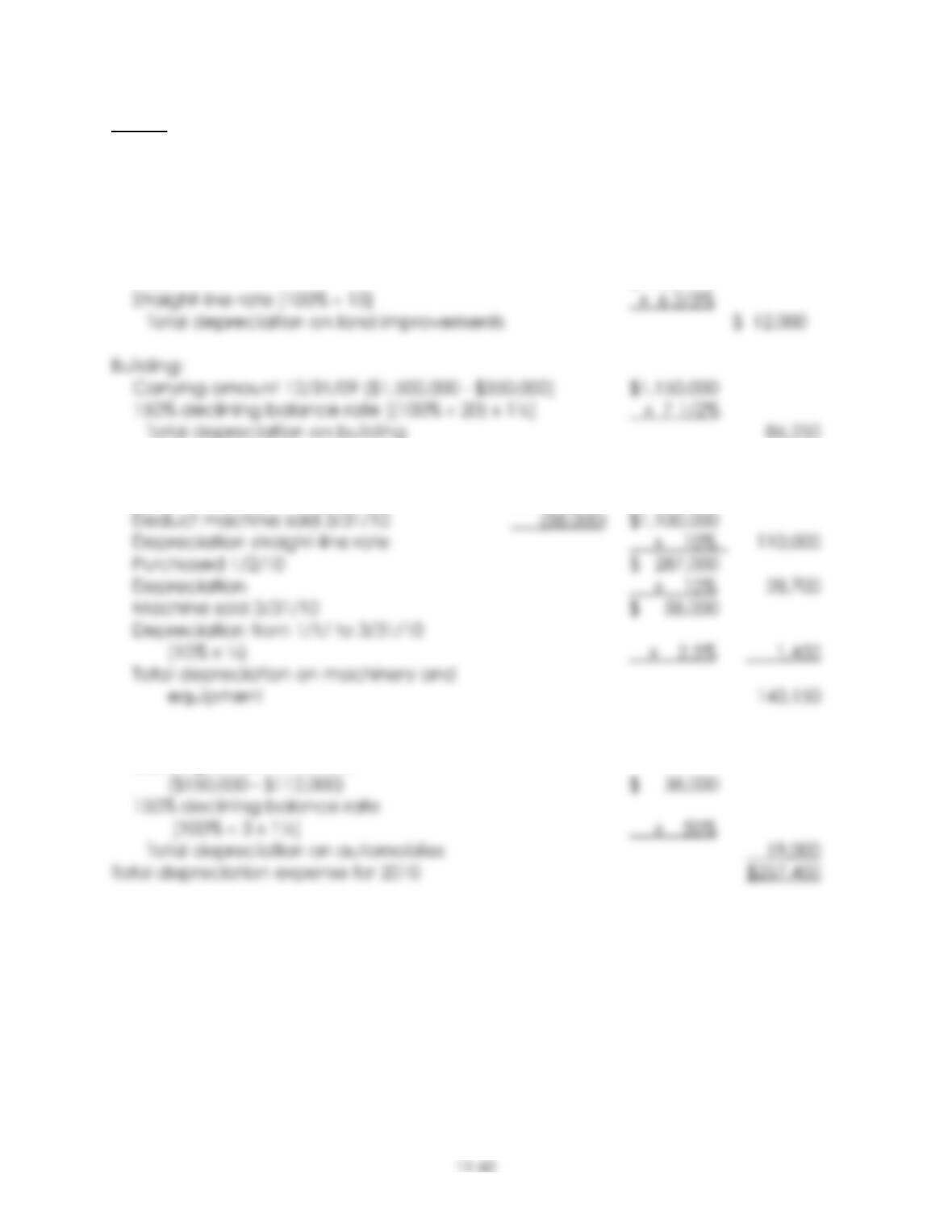
P11-21 (continued)
2. PELL CORPORATION
Depreciation Expense
For the Year Ended December 31, 2010
Land improvements:
Cost $ 180,000
Machinery and equipment:
Balance, 12/31/09 $1,158,000
Automobiles:
Carrying amount 12/31/09
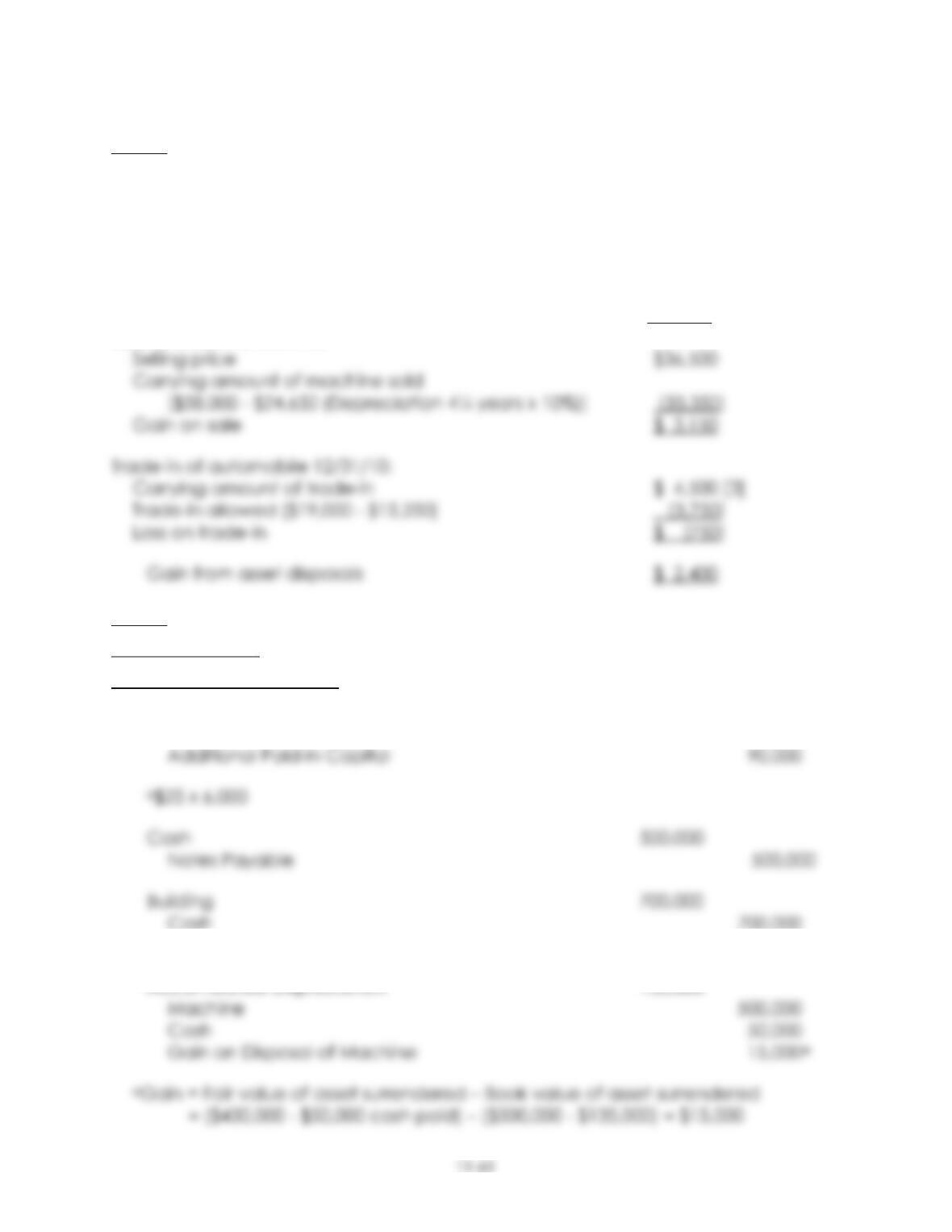
P11-21 (continued)
3. PELL CORPORATION
Gain or Loss from Plant Asset Disposals
That Would Be Recognized in Income Statement
For the Year Ended December 31, 2010
Gain
or (loss)
Sale of machine 3/31/10:
P11-22
Note to Instructor: This problem includes material from previous chapters.
Journal entries during 2010:
(1) Land 150,000a
Common Stock, $10 par 60,000
(2) Machine 430,000
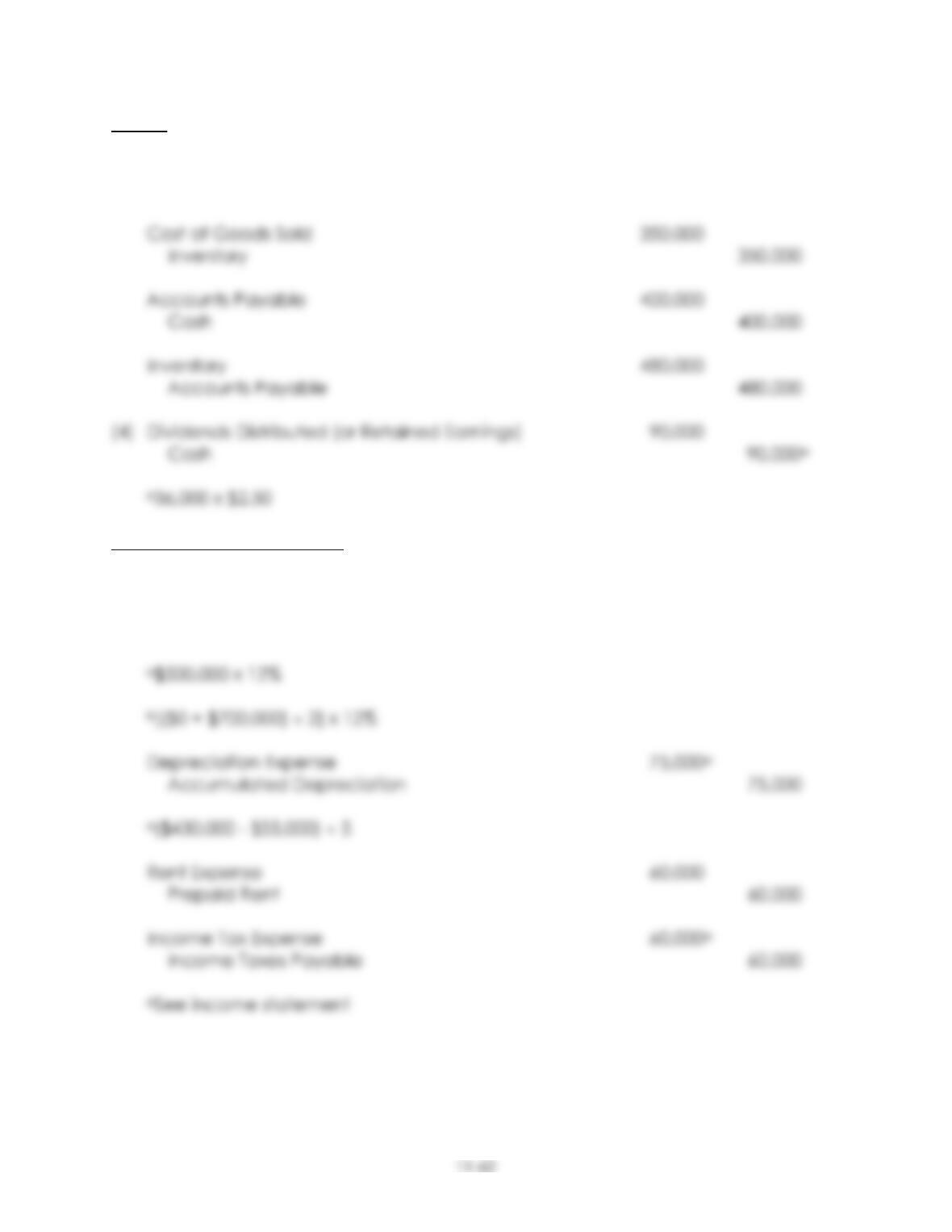
P11-22 (continued)
(3) Cash 700,000
Sales Revenue 700,000
Adjustments at End of 2010:
Interest Expense 18,000
Building 42,000
b
Interest Payable 60,000a
11-63
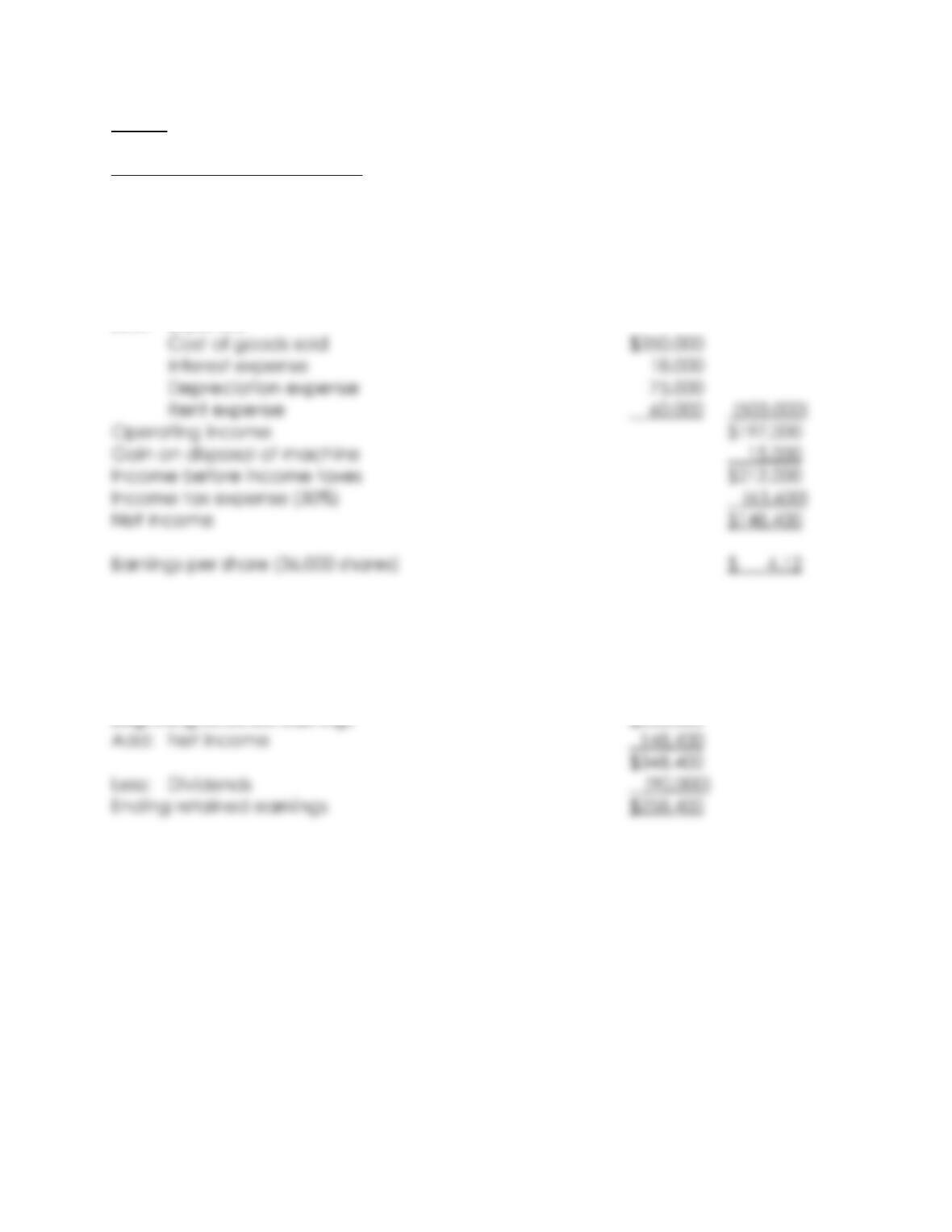
P11-22 (continued)
Financial Statements for 2010:
LURCH COMPANY
Income Statement
For Year Ended December 31, 2010
Sales revenue $700,000
Less: Expenses
LURCH COMPANY
Statement of Retained Earnings
For Year Ended December 31, 2010
Beginning retained earnings $200,000
P11-22 (continued)
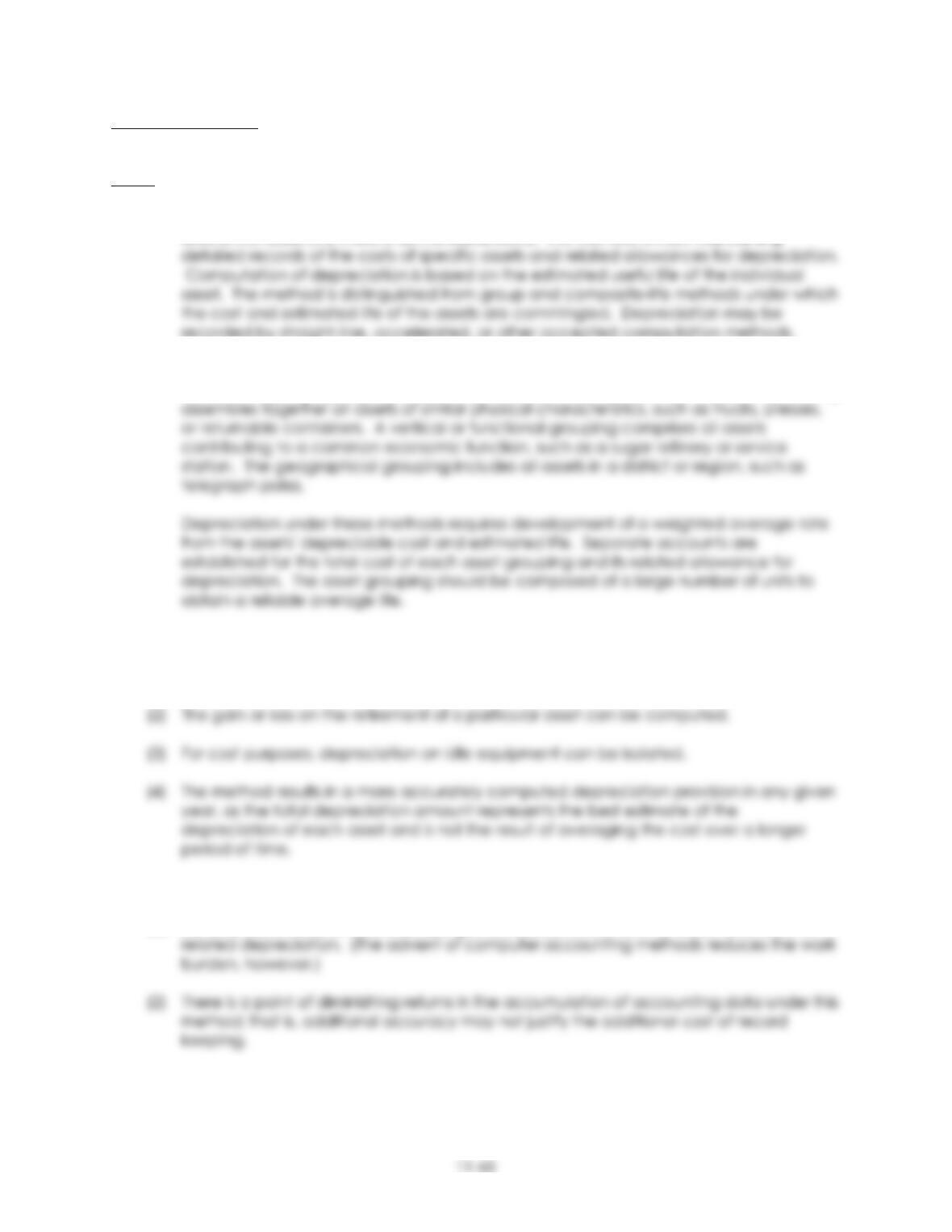
LURCH COMPANY
Balance Sheet
December 31, 2010
Assets
Liabilities and Equities
Cash
Inventory
$ 500,000a
580,000b
Accounts payable
Notes payable
$ 480,000c
500,000
ANSWERS TO CASES
C11-1 (AICPA adapted solution)
1. a. The unit method of recording depreciation involves the treatment of fixed assets or
substantial additions thereto as individual items. The method entails maintaining
recorded by straight-line, accelerated, or other accepted computation methods.
b. Under the group or composite-life methods, assets are aggregated into accounting
units. Such grouping might be horizontal, vertical, or geographical. Horizontal grouping
2. Arguments for the use of the unit method of computing depreciation include:
(1) The method is simple in that it does not require involved mathematical computations.
Arguments against the unit method are as follows:
(1) Considerable additional bookkeeping is necessary to account for each asset and its
11-66
C11-1 (continued)
2. (continued)
(3) Under a decentralized financial control system where a measure of the division’s
(4) There may be reluctance on the part of a division manager to replace equipment not
the division’s profits in the year of replacement.
Among arguments for the use of the group and composite-life methods are the following:
(1) The methods require less detailed bookkeeping.
Arguments against the use of the group and composite-life methods would include:
(1) The methods would conceal faulty estimates for a long period of time.
(4) Under a decentralized financial control system where a measure of the division’s
efficiency is the rate of return on the gross book value of the investment, to improve a
3. Under the unit method, retirements are recorded by removing from the accounts the cost of
11-67
C11-1 (continued)
3. (continued)
Under the group and composite-life methods, the cost of the retired asset is removed from
C11-2 (AICPA adapted solution)
1. The costs that should be capitalized when equipment is purchased for cash include the
gross invoice price of the equipment less discounts plus all incidental costs relating to its
2. The physical factors that cause the equipment to depreciate are wear and tear from
3. The factors that should be considered in computing depreciation expense are the cost of
4. Accelerated depreciation methods are justified based on the following assumptions:
a. An asset is more efficient in the earlier years of its estimated useful life. Therefore, larger
C11-3 (AICPA adapted solution)
1. a. The capitalized cost for the computer includes all costs reasonable and necessary to
prepare it for its intended use. Examples of such costs are the cash purchase price,
C11-3 (continued)
2. The rationale for using accelerated depreciation methods is based on the following
assumptions:
• An asset is more productive in the earlier years of its estimated useful life.
3. Patrick should record depreciation expense to the date of disposal. Recording
depreciation updates the carrying amount of the automobile. If the carrying amount of the
C11-4 (AICPA adapted solution)
1. Portland should have selected the straight-line depreciation method when approximately
the same amount of an asset’s service potential is used up each period. If the reasons for
2. Portland should record depreciation expense to the date of the exchange. If the original
truck’s carrying amount is greater (less) than its fair value, a loss (gain) results. The truck’s
3. a. By associating depreciation with a group of machines instead of each individual
machine, Portland’s bookkeeping process is greatly simplified. Also, since actual
machine lives vary from the average depreciable life, unrecognized net losses on early
11-69
C11-5 (AICPA adapted solution)
Note to Instructor: This case requires a brief discussion of the statement of cash flows. Students
should be able to provide an answer based on the discussion in Chapter 5.
1. Relative to plant assets, a cost incurred or an expenditure made, that is assumed to benefit
only the current accounting period is called an operating (revenue) expenditure and is
expensed in the period believed to benefit. A capital expenditure is similarly a cost incurred
or an expenditure made but is expected to yield benefits either in all future accounting
periods (acquisition of land) or in a limited number of accounting periods. Capital
2. Depreciation is the accounting process of allocating an asset’s historical cost (recorded
3. The factors relevant in determining the annual depreciation for a depreciable asset are the
initial recorded amount (cost), estimated salvage value, estimated useful life, and
depreciation method.
Assets are typically recorded at their acquisition cost, which is in most cases objectively
C11-5 (continued)
3. (continued)
Selecting the depreciation method is generally a judgment decision; but, a method may be
4. Because revenue usually represents an inflow of cash, and expense usually represents an
outflow of cash, net earnings represent a net inflow of cash. Depreciation reduces reported
C11-6 (AICPA adapted solution)
1. a. The conventional concept of depreciation accounting usually is defined as a system of
b. (1) This is a static concept of depreciation in which the initial cost or other value is not
changed during the life of the asset; thus, total depreciation over the life of an asset is
equal to the initial cost or value of the asset less any salvage value.
(2) The matching concept requires that the portion of the cost (or value basis) of the
asset to be allocated to each accounting period should be matched with the
expected revenue or net revenue contribution of the period. Matching can take the
11-71
C11-6 (continued)
1. b. (continued)
(3) Since this concept merely requires that the allocation be systematic and rational,
2. a. Since the conventional accounting concept of depreciation is a process of cost
(1) Establishing the depreciation base. Since an asset may be sold before its service
value is completely consumed, the depreciation base is the cost of asset services that
(2) Estimating the service life. This involves selecting the unit in which the service life of
the asset is to be measured and then estimating the total number of units of service
embodied in the asset.
Although service life usually is measured in units of time, it may be more appropriate to
use units of output or activity, which usually are expressed in physical units such as tons,
(3) Choosing the method of cost apportionment. The issue here is to determine the
C11-6 (continued)
2. a. (continued)
The two major variables to be considered in reaching the systematic and rational
(1) On the basis of time
(a) A constant amount per period; that is, the straight-line method.
(2) On an output measure basis
(a) An amount based upon a ratio of a constant cost to net revenue contribution;
C11-7
1. Depreciation is a method for allocating the cost of an asset over its service life. Even though
the plant was shut down for part of the year, its service life may have been reduced and,
2. Depreciation does not provide funds for the replacement of an asset. Also, depreciation is
an attempt to allocate the cost of an asset over the time when benefits are derived from it.
The increasing-amount method does not follow this matching concept unless the asset
C11-8 (AICPA adapted solution)
1. Accounting for depreciation is a system of accounting to distribute the cost (or other book
value) of tangible capital assets, less salvage, over their useful lives in a systematic and
2. The proposed depreciation method is, of course, systematic. Whether it is rational in terms of
cost allocation depends on the facts of the case. It produces an increasing depreciation
amount, which is usually not justifiable in terms of the benefit from the use of the asset
because manufacturers typically prefer to use their new equipment as much as possible
and their old equipment only as needed to meet production quotas during periods of peak
3. a. Depreciation neither recovers nor creates funds. Revenue-producing activities are the
sources of funds from operations: If revenues exceed out-of-pocket costs during a
b. Depreciation may affect funds in two ways. First, depreciation affects reported income
and hence may affect managerial decisions such as those regarding pricing, product
selection, and dividends. For example, the proposed method would result initially in
11-74
C11-8 (continued)
3. b. (continued)
Using the proposed method for tax purposes would reduce the total tax bill over the life
of the assets (1) if the tax rates were increased in future years or (2) if the business were
doing poorly now but were to do significantly better in the future. The first condition is
C11-9
1. Since there were no generally accepted accounting principles for asset write-downs, CBS
and NBC had two alternatives:
A. Continue to report the asset (the rights) at cost until the sporting event has occurred
and report any profit or loss in that period. The profit or loss is the difference between
B. Write down the asset as soon as evidence is available that the cost of the asset will not
be recovered through revenues (advertising sales and syndication fees). This approach
2. Two primary opportunities exist for earnings management. First, the company can influence
the period in which the write-down is recognized. Although GAAP has established rules that
require the writedown in the period that “events or changes in circumstances indicate that
11-75
C11-10
1. Coca Cola uses principally the straight-line method (p. 74), presumably because it expects
approximately constant (or increasing) benefits over the lives of its assets.
C11-11
Note to Instructor: This case does not have a definitive answer. From a financial reporting
perspective, GAAP is identified and summarized. From an ethical perspective, various issues
are raised for discussion purposes.
C11-11 (continued)
From an ethical perspective, the primary issue is the apparent lack of concern by the CFO
about applying professional judgment and the inappropriate measurement of income and
ANSWERS TO RESEARCH SIMULATIONS
R11-1
Note to Instructor: Students are expected to cite references to GAAP in their research of this
1. To: President, Magic Movie Company
From: Student
I have researched the issues of accounting for the production of movies. The applicable
principles are defined by AICPA Statement of Position No. 00-2. (FASB Cod. # 926-10-15 and
# 926-605-25). The major issues are:
A. What costs are included in film assets (asset valuation)? Costs to produce a film are
B. How is the film asset amortized (income recognition)? The asset is amortized by the
2. Two primary opportunities exist for earnings management. First, the company can maximize
the costs that are capitalized to each movie, thereby reducing expenses during the filming
R11-2
Note to Instructor: Students are expected to cite references to GAAP in their research of this
1. To: President, Scientific Software
From: Student
I have researched the issues of revenue recognition and amortization as follows:
A. According to the AICPA Statement of Position 97-2, (FASB Cod. # 985-605), revenue
B. According to the FASB Statement of Concepts No. 6, par. 149, many assets yield their
benefits over several periods. Expenses resulting from their use are reported in the
periods of their estimated lives by a “systematic and rational” allocation procedure.
There is no question that the cost of the software produced is an asset of this type and
should be amortized over its useful life. The issue is what is the appropriate life? In the
2. The company probably selected such a long amortization period in order to reduce the
expense recognized each period, thereby raising net income and asset values.