Chap. 11 Mats
11.1 Explain the reasoning behind the statements in Section 11.2 that mat foundations on
cohesioness soils do not have bearing capacity problems, but that bearing capacity must be
checked on cohesive soils.
Solution
Mat foundations have a large width, B, so the shear surface for a bearing capacity failure
Chap. 11 Mats
11.2 How has the development of powerful and inexpensive digital computers affected the
analysis and design of mat foundations? What changes do you expect in the future as this
trend continues?
Solution
Before the widespread availability of digital computers and associated software, it was
necessary to make a number of simplifying assumptions in order to compute the distribution
Chap. 11 Mats
11.3 A mat foundation supports forty two columns for a building. These columns are spaced
on a uniform grid pattern. How would the moments and differential settlements change if we
used a nonrigid analysis with a constant ks in lieu of a rigid analysis?
Solution
The rigid analysis uses a bearing pressure distribution that is either uniform (for concentric
loads) or linearly varying across the mat (for nonconcentric loads). In contrast, the nonrigid

Chap. 11 Mats
11.4 According to a settlement analysis conducted using the techniques described in Chapter 8,
a certain mat will have a total settlement of 2.1 inches if the average bearing pressure is 5500
lb/ft2. Compute the average ks and express your answer in units of lb/in3.
Solution
Chap. 11 Mats
11.5 A 25–m diameter cylindrical water storage tank is to be supported on a mat foundation
located 2 m below the ground surface. The weight of the tank and its contents will be 50,000
kN and the weight of the mat will be 12,000 kN. According to a settlement analysis
conducted using the techniques described in Chapter 8, the total settlement will be 40 mm.
The groundwater table is at a depth of 5 m below the ground surface. Using the pseudo-
coupled method, divide the mat into zones and compute ks for each zone. Then indicate the
high-end and low-end values of ks that should be used in the analysis.
Solution
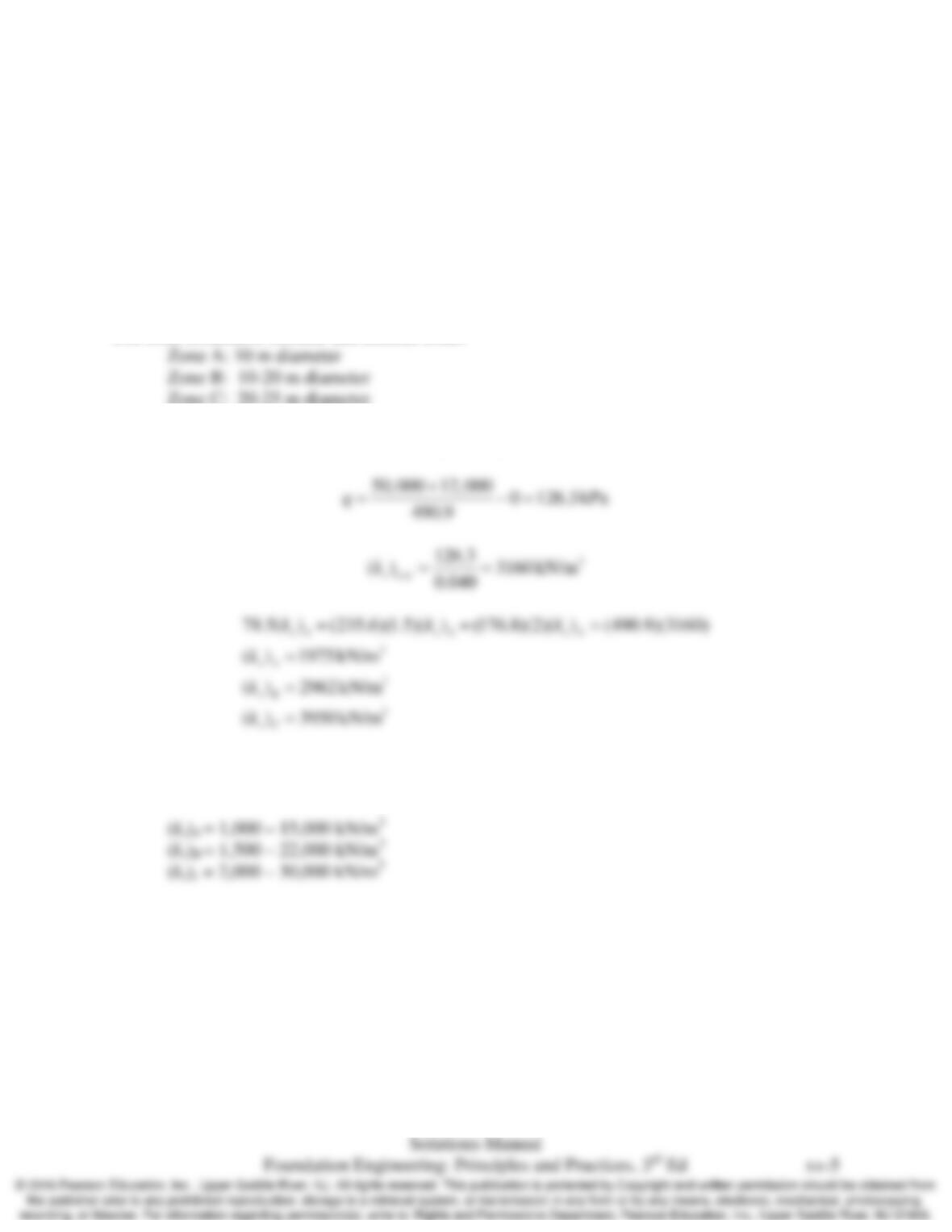
Use three concentric circular and annular zones
Zone C: 20-25 m diameter
The areas are 78.5, 235.6, and 176.8 m2, respectively, for a total of 490.9 m2
For analysis and design, use one-half the computed value and five or ten times the computed
value and design for worst case
Chap. 11 Mats
11.6 An office building is to be supported on 150–ft x 300–ft mat foundation located 8 ft below
the ground surface. The sum of the column loads plus the weight of the mat will be 90,000 k.
According to a settlement analysis conducted using the techniques described in Chapter 8,
The total settlement will be 1.8 inches. The groundwater table is at a depth of 12 ft below the
ground surface. Using the pseudo–coupled method, divide the mat into zones and compute ks
for each zone. Then indicate the high–end and low-end values of ks that should be used in the
analysis.
Solution
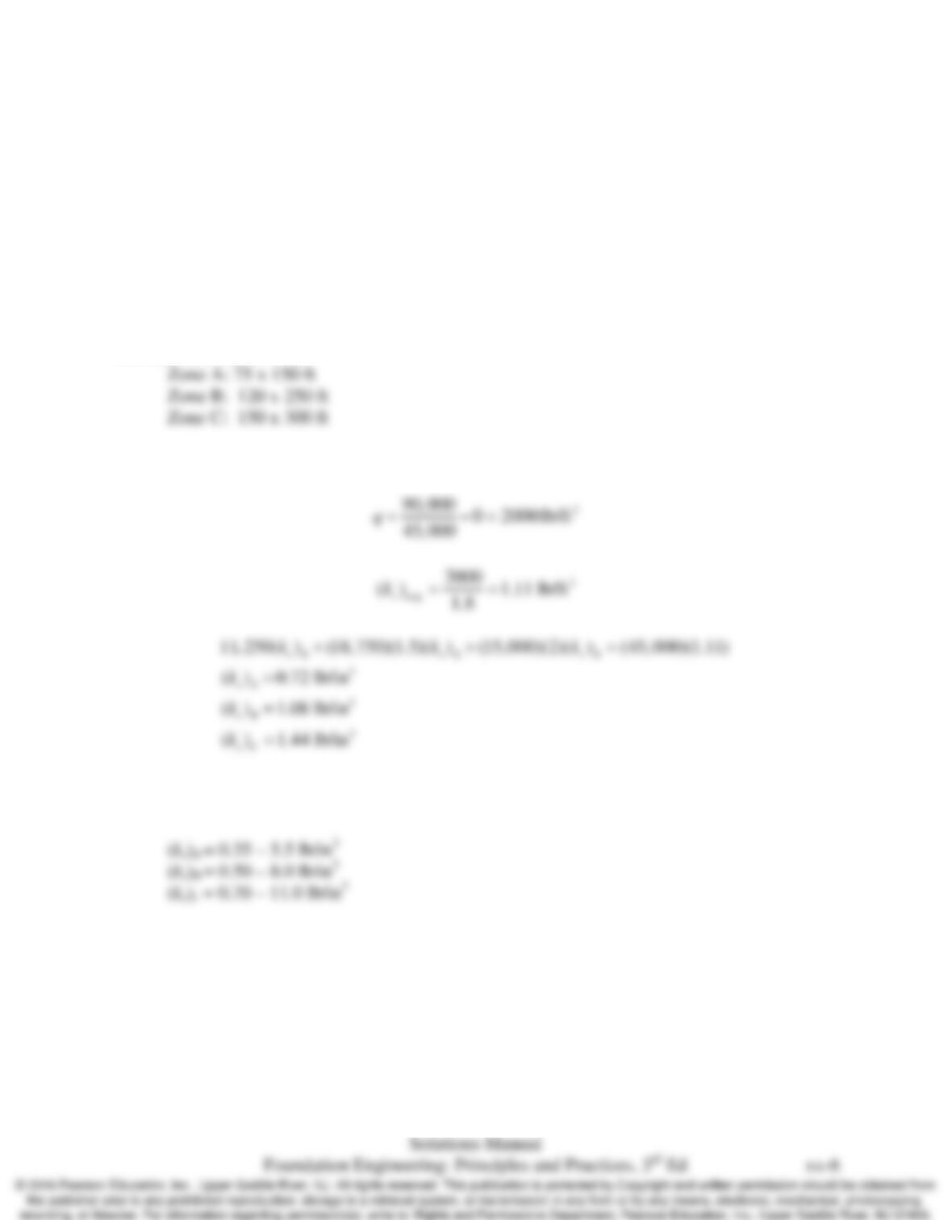
Use three concentric zones
The areas are 11,250; 18,750 and 15,000 ft2, respectively, for a total of 45,000 ft2
For analysis and design, use one-half the computed value and five or ten times the computed
value and design for worst case