Problem 11.50
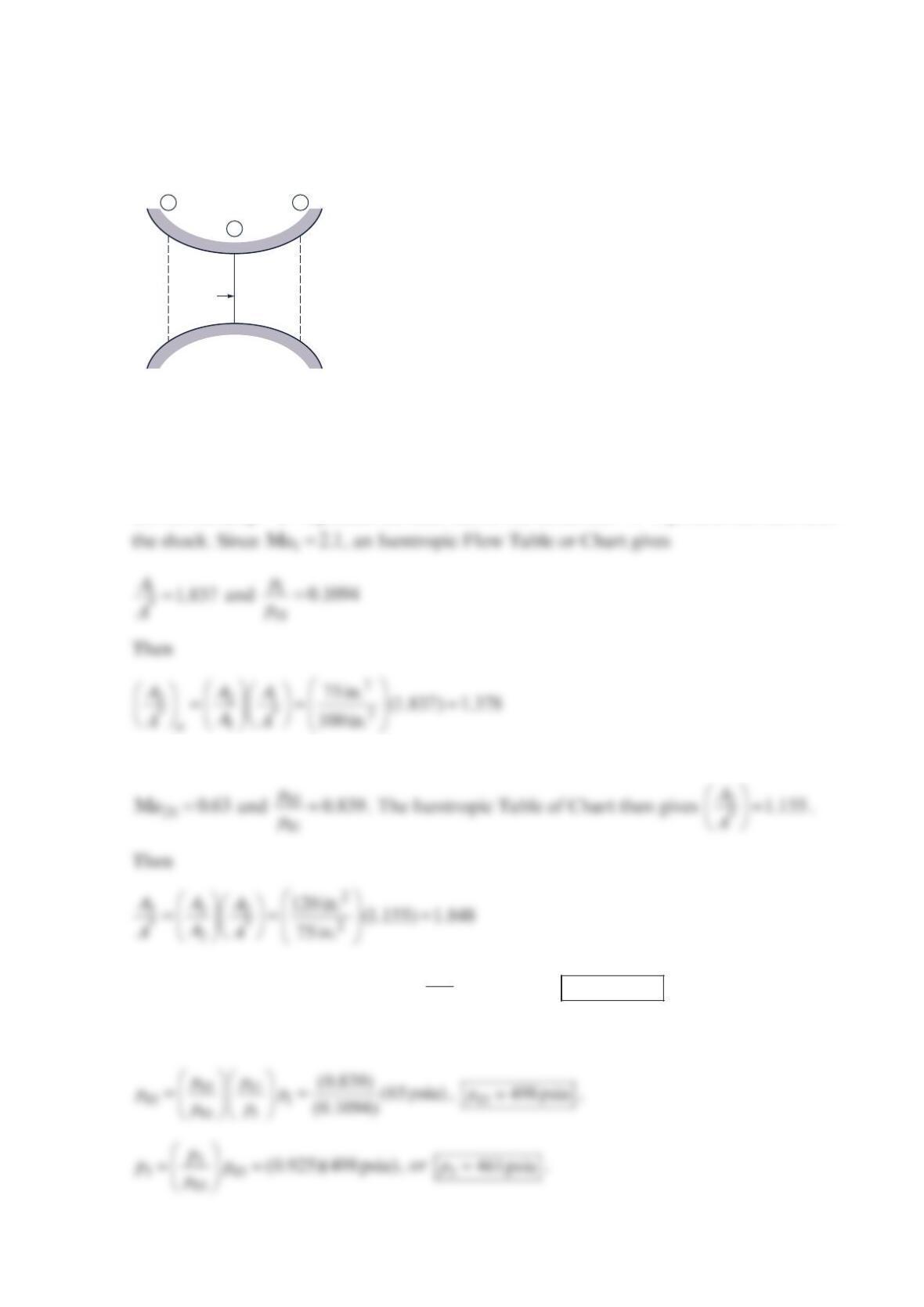
Air flows in the channel as shown in the figure below. Determine the Mach number, static
pressure, and stagnation pressures at station 3. Assume isentropic flow except for the
normal shock wave.
Solution 11.50
Let the subscript “a” represent the state before the shock and “b” represent the state after
and the Isentropic Flow Table or Chart gives =
2
Ma 1.74
a. The Shock Table or Chart gives
The Isentropic Table or Chart gives =
3
01
0.925
p
p and =
3
M0.335a.
Then
Shock
wave
A
1
= 100 in.
2
Ma
1
= 2.1
p
1
= 65 psia
A
3
= 120 in.
2
A
2
= 75 in.
2
2
1 3
Problem 11.51
A jet engine is to be designed for an altitude of 12,000 m , where the atmospheric pressure is
19.3kPa . The jet nozzle has a supersonic exit Mach number and is perfectly expanded. The
stagnation pressure and temperature of the gas are 100kPa and 600 C . The flowrate of gas
is 45 kg/s. Calculate the throat area, exit area, and exit velocity. Use =1.4k and
=⋅260J/kg KR for the gas.
Solution 11.51
The perfect expansion implies == ×
3
19.3 10 Pa
eB
pp .
Then
11
⋅
2
mkg m
=2
0.458m
e
A
=2
0.32 m
t
A
⋅
⋅
Nm
1.3 260 (873K)
kg K
Problem 11.52
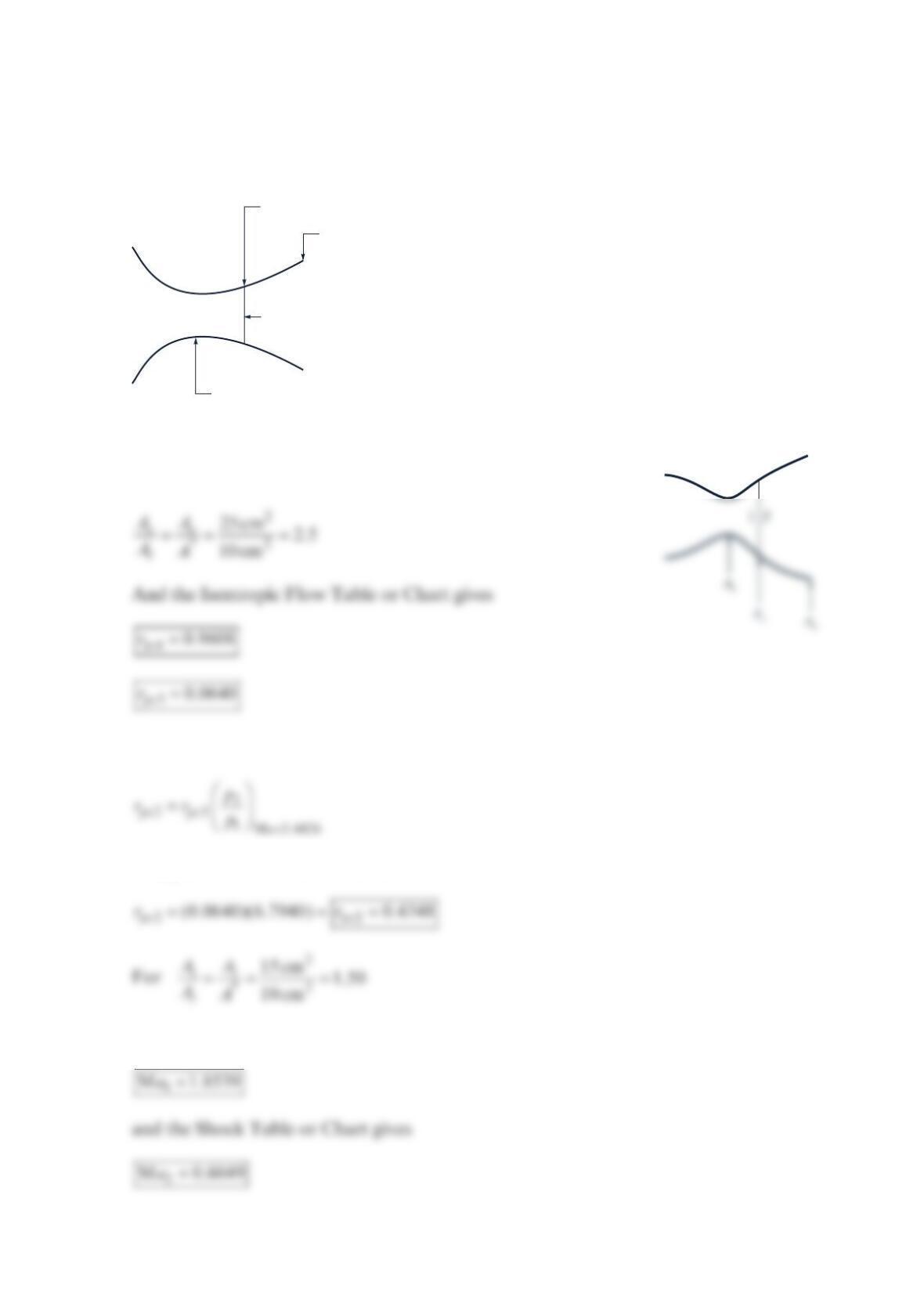
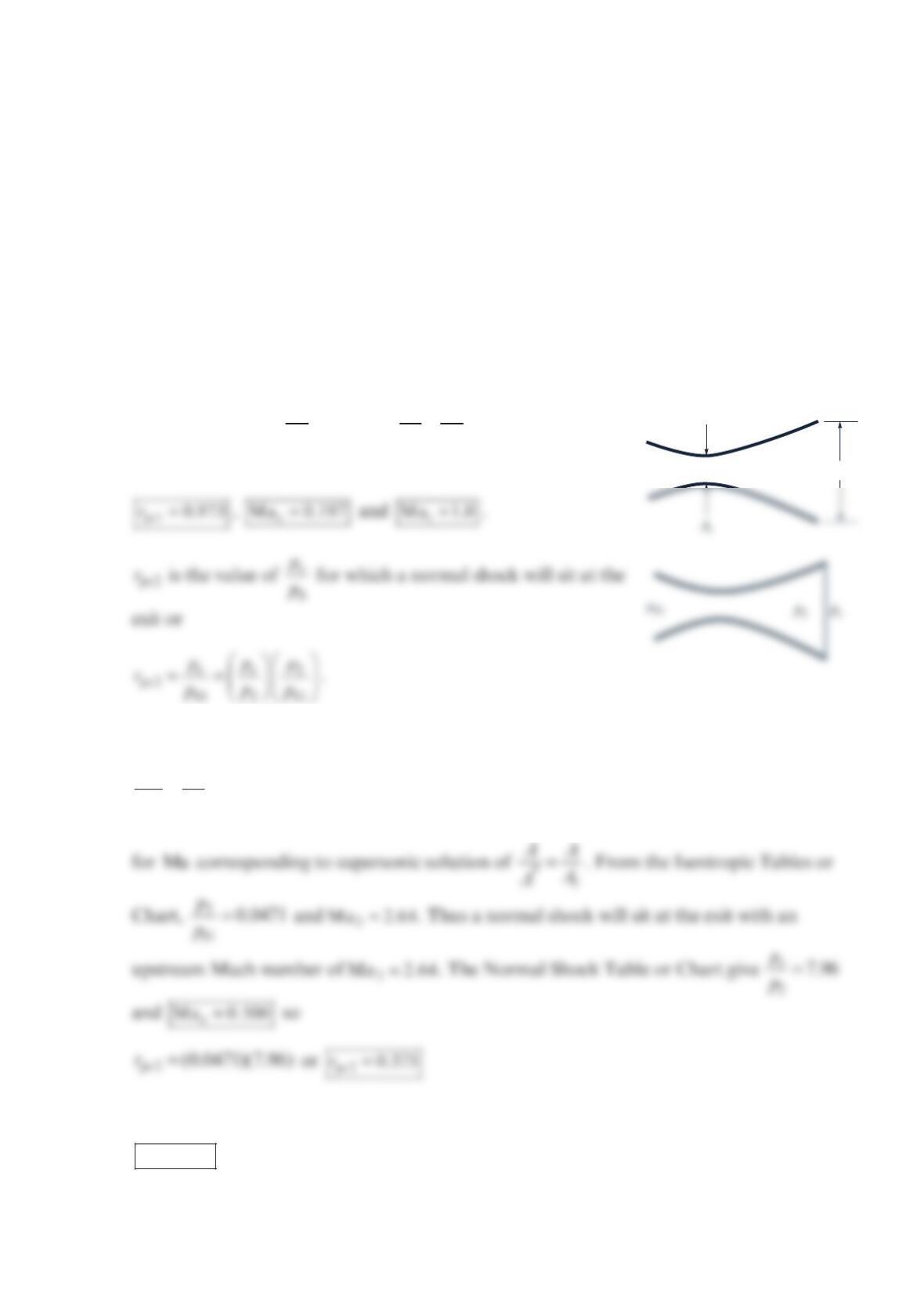
Air is flowing in the converging–diverging nozzle as shown in the figure below. Determine
the three critical pressure ratios and the Mach numbers immediately upstream and
immediately downstream from the shock.
Solution 11.52
Assuming isentropic flow except for across the shock,
the area ratio
And =Ma 2.4426
e. The second critical pressure ratio is found from
Using the Shock Table or Chart,
The Isentropic Table or Chart gives
A = 15 cm
2
A
e
= 25 cm
2
A
t
= 10 cm
2
Shock
Problem 11.53
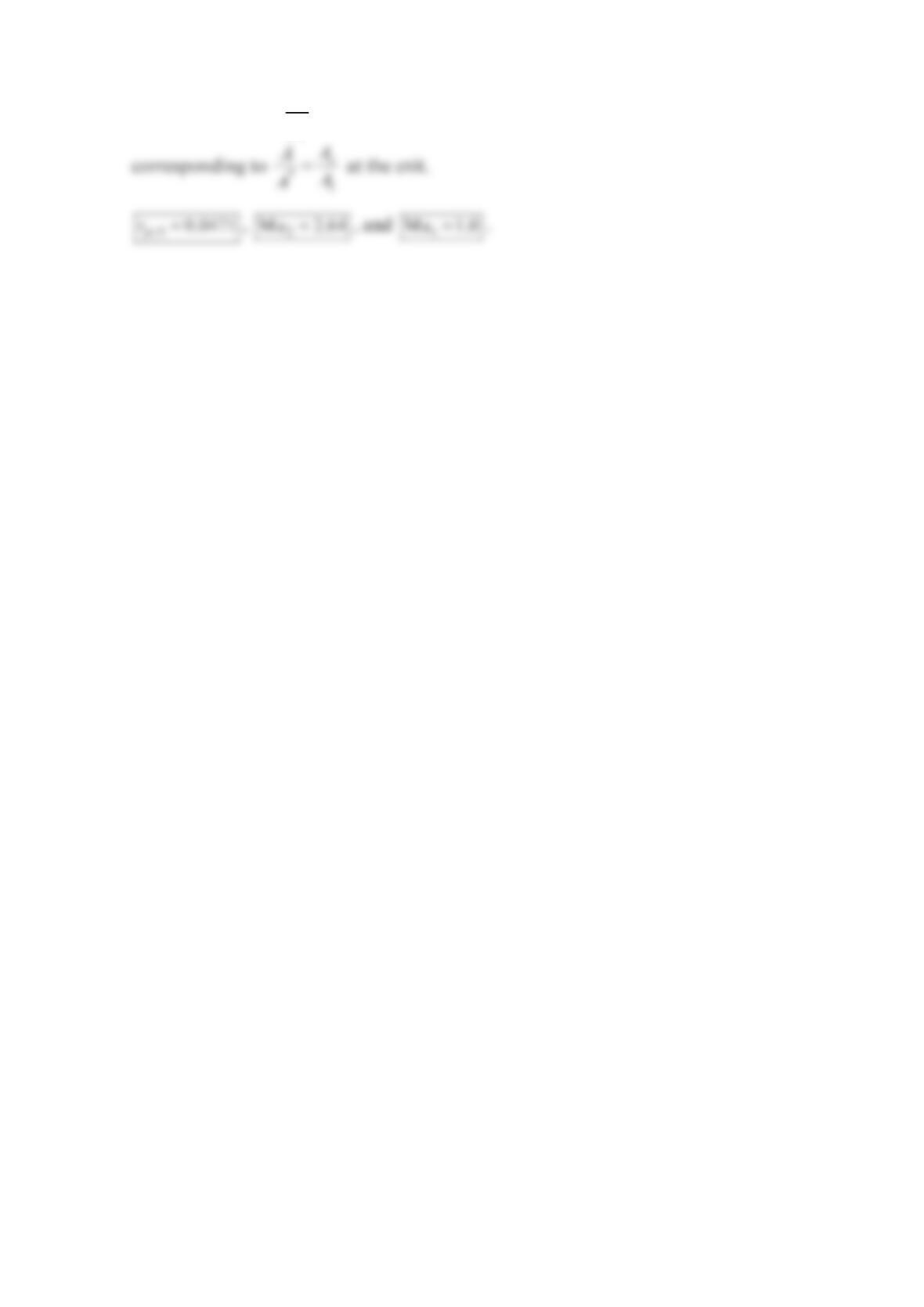
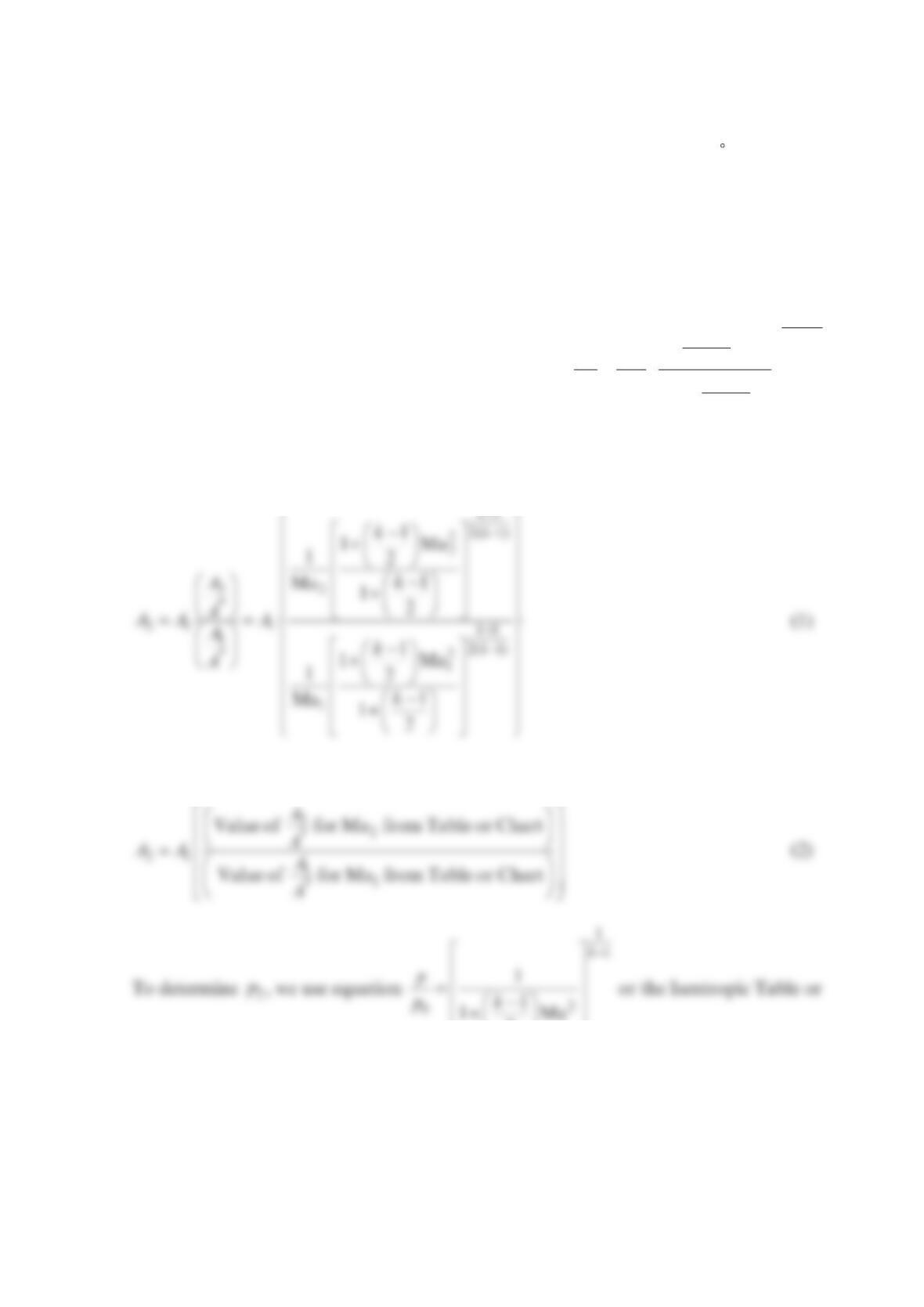
A convergent–divergent nozzle has an exit throat area ratio of
3
.0. It is to be supplied with
air. Find:
(a) The first, second, and third critical pressure ratios;
(b) The exit plane Mach number in each case;
(c) The throat Mach number in each case.
Solution 11.53
1
p
c
r is the value of
0
e
p
p for which =*
e
t
AA
AA with subsonic Ma
at exit. From the Isentropic Table or Chart
Now
=
2
01 0
pp
pp
The flow is choked so
=Ma 1.0
t
Ae
p
01
p
3
p
c
r is the value of
0
e
p
p such that the flow is perfectly expanded to the supersonic solution
Problem 11.54
An ideal gas flows isentropically through a converging–diverging nozzle. At a section in the
converging portion of the nozzle, =2
10.1 mA, =
1600 kPa (abs)p, =
120 CT, and
1
M
a0.6=. For section (2) in the diverging part of the nozzle, determine 2
A
, 2
p
, and 2
T if
=
2
Ma 3.0 and the gas is air.
Solution 11.54
Assume that k = 1.4. To determine 2
A, we use equation
+
−
−
+
=
−
+
1
2( 1)
2
*
(1)
1Ma
12
(1)
Ma 12
k
k
k
A
k
A or
the Isentropic Table or Chart
Thus,
or
2
Chart. Thus,
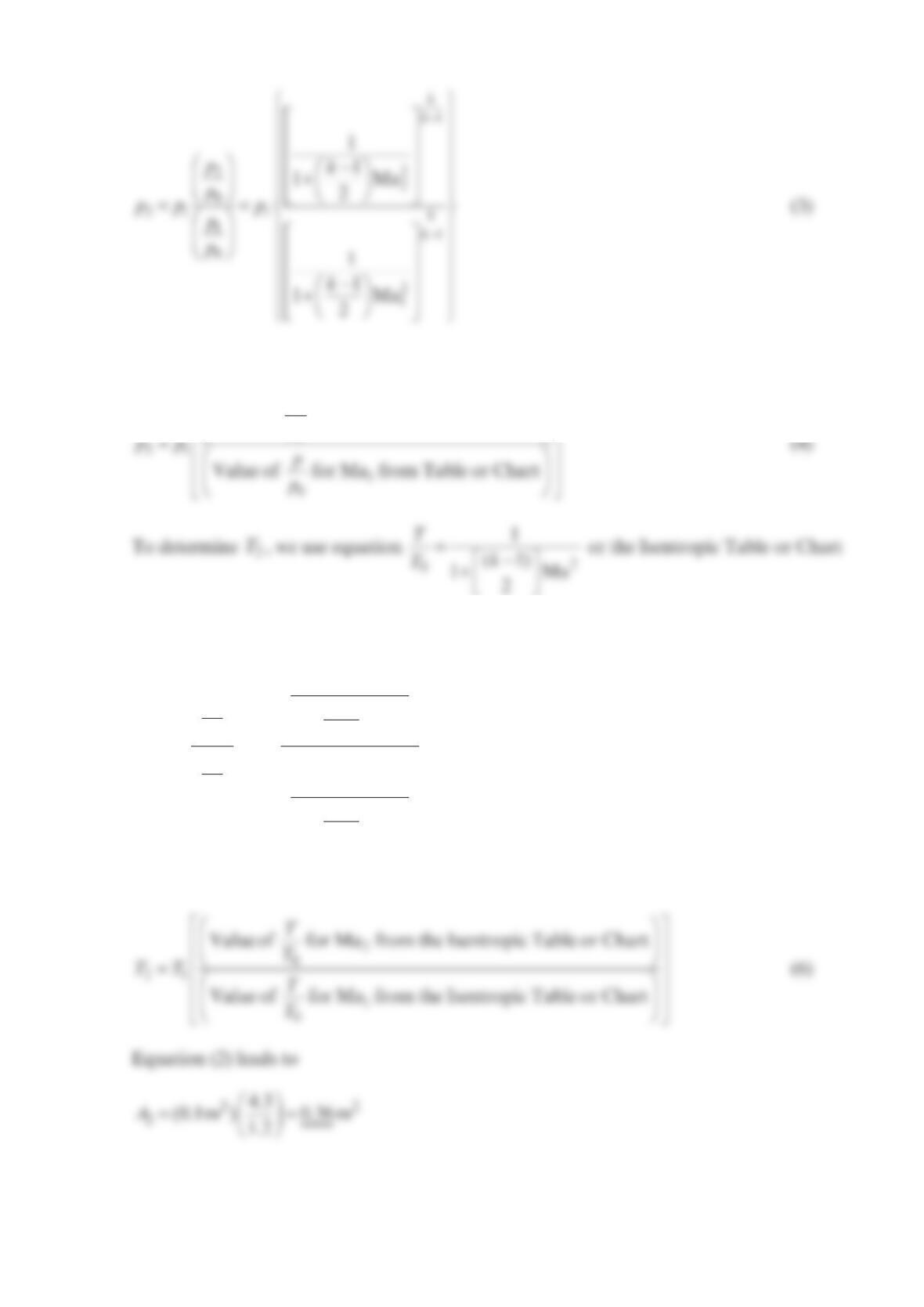
or
2
0
Value of for Ma from Table or Chart
p
p
Thus,
−
+
==
−
+
2
22
0
21 1
1
0
2
1
1
1
1Ma
2
1
1
1Ma
2
Tk
T
TT T
T
T
k
(5)
or
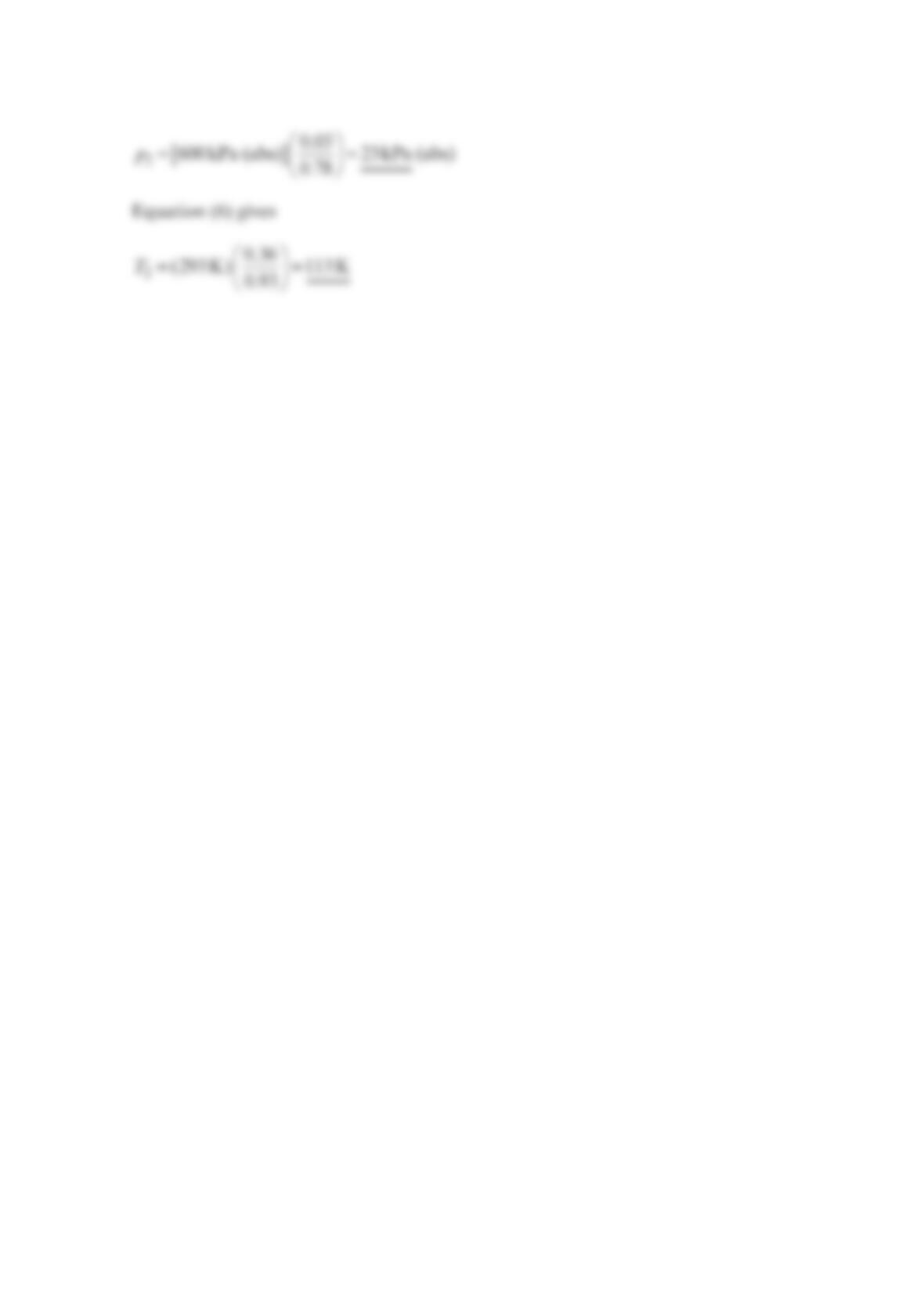
Equation (4) leads to
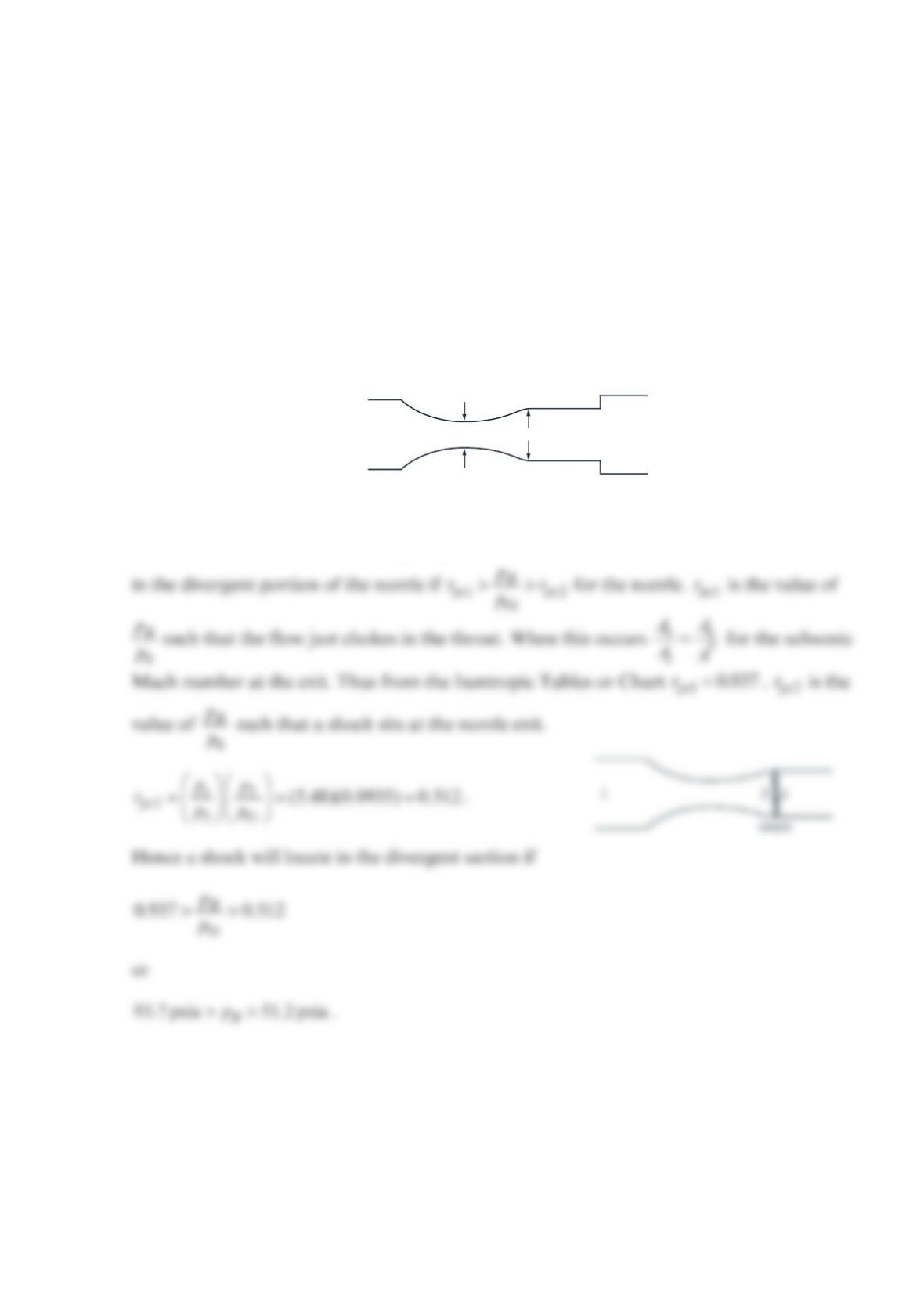
Problem 11.55
Air is supplied to a convergent–divergent nozzle from a reservoir where the pressure is
100 kPa . The air is then discharged through a short pipe into another reservoir where the
pressure can be varied. The cross-sectional area of the pipe is twice the area of the throat of
the nozzle. Friction and heat transfer may be neglected throughout the flow. If the
discharge pipe has constant cross-sectional area, determine the range of static pressure in
the pipe for which a normal shock will stand in the divergent section of the nozzle. If the
discharge pipe tapers so that its cross-sectional area is reduced by 25% , show that a normal
shock cannot be drawn to the end of the divergent section of the nozzle. Find the maximum
strength of shock (as expressed by the upstream Mach number) that can be formed.
Solution 11.55
Assume frictionless adiabatic flow
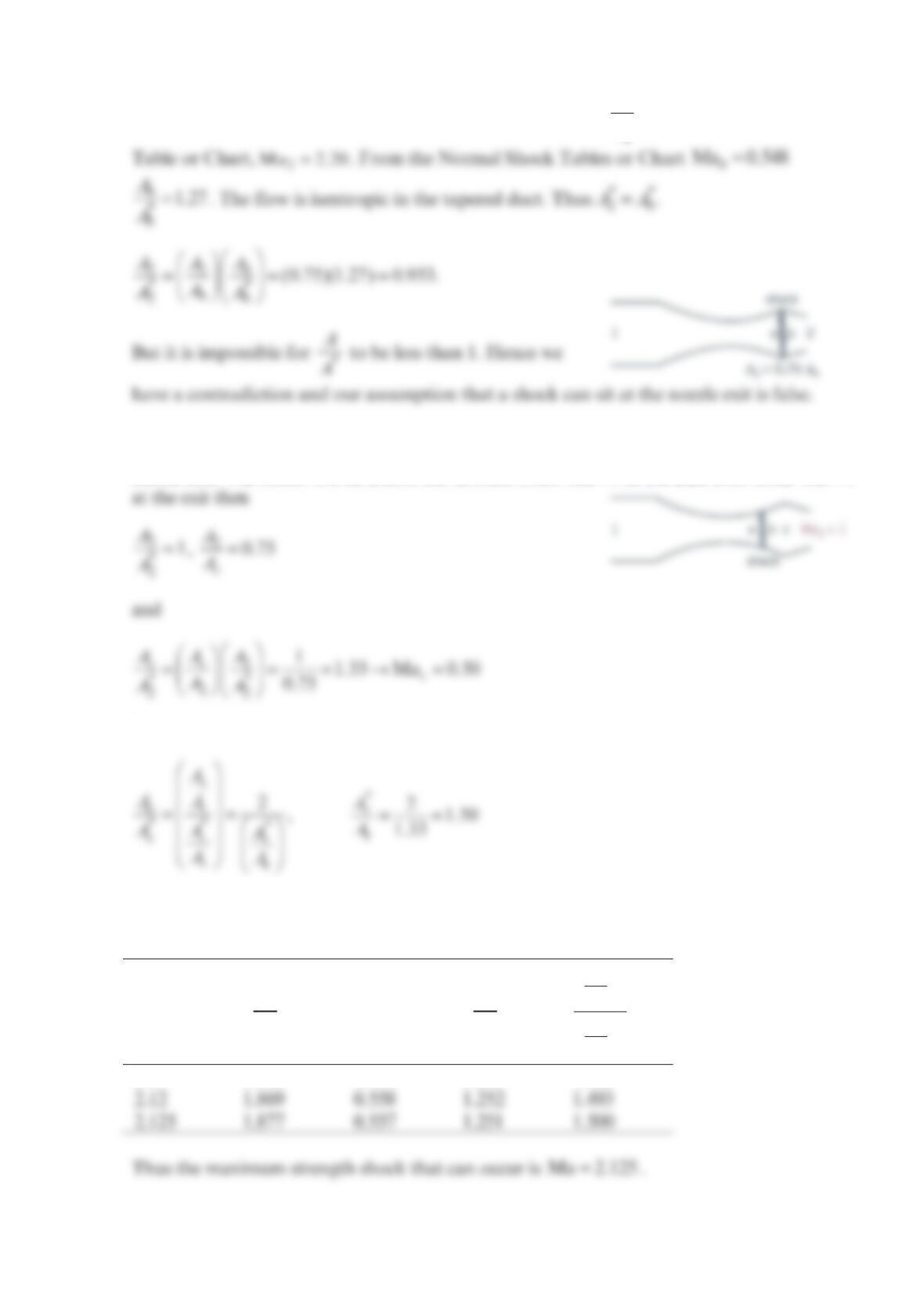
If the duct is constant area then =
Be
p
p (frictionless, adiabatic flow). Thus a shock will sit
A
e
= 2A
t
A
t
p
01 = 100
kPa
p
B
(b) Assume that a shock does locate at the nozzle exit. Then =
*2
a
a
A
A. From the Isentropic
(c) Part (b) proved that a shock cannot be drawn to the nozzle exit. This means that the
flow in the duct will choke ( =Ma 1 at the exit (2) before the shock can be drawn to the
nozzle exit. The shock will be drawn the farthest when =Ma 1 at the duct exit. Since =Ma 1
Now
But t
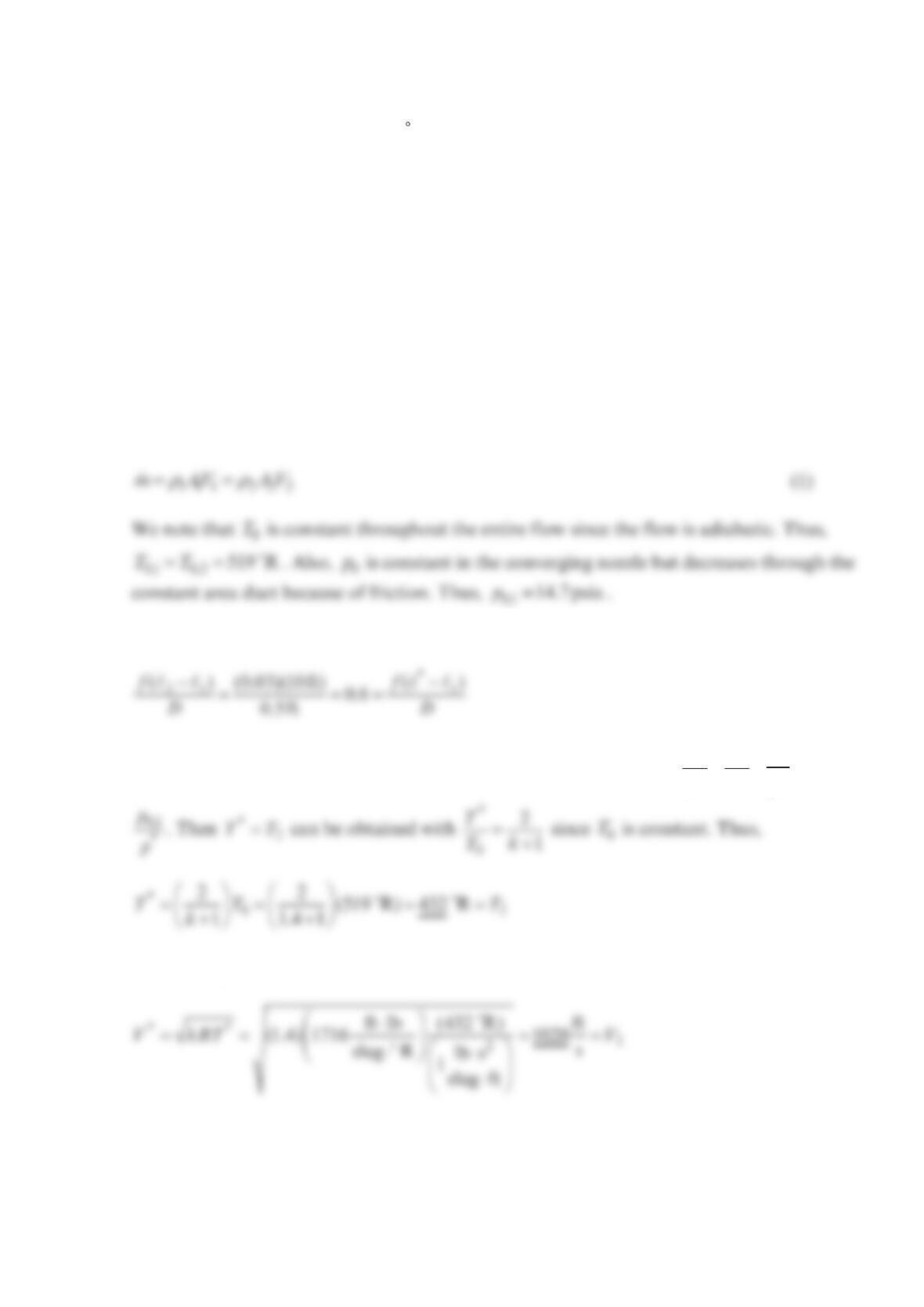
A is the critical area upstream of the shock. Hence we need to find an Ma such the
ratio of downstream to upstream critical areas is 1.50 . Let’s try an iteration.
Maa
*a
A
A Mab
*b
A
A
*
*
a
b
A
A
A
A
2.14 1.901 0.555 1.250 1.521
Problem 11.56
Standard atmospheric air ( =
059 FT, =
014.7 psiap) is drawn steadily through a
frictionless and adiabatic converging nozzle into an adiabatic, constant cross-sectional area
duct. The duct is 10ft long and has an inside diameter of 0.5ft . The average friction factor
for the duct may be estimated as being equal to 0.03. What is the maximum mass flowrate
in slugs/s through the duct? For this maximum flowrate, determine the values of static
temperature, static pressure, stagnation temperature, stagnation pressure, and velocity at
the inlet [section (1)] and exit [section (2)] of the constant area duct. Sketch a temperature–
entropy diagram for this flow.
Solution 11.56
The maximum flowrate through the duct will occur when the constant area duct chokes and
the Mach number at the duct exit [section (2)] is
1
.0. The maximum flowrate can be
obtained with
For choked flow
and from the Fanno Flow Table or Chart, we can read values of
M
a, 1
*
T
T, 1
*
V
V, 1
*
p
p
, and
and =
*
2
VV
can be determined with
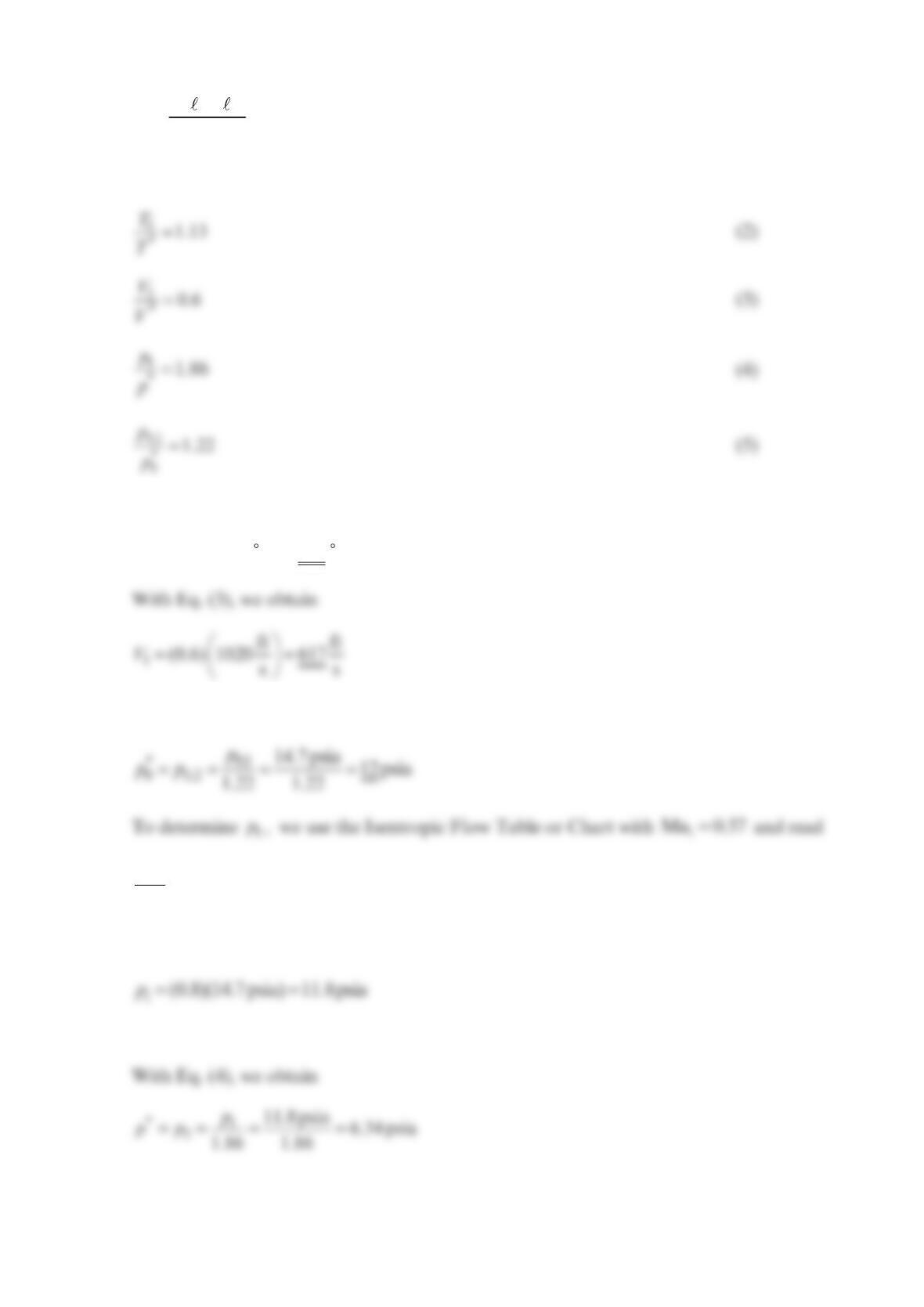
For −=
*
1
()
0.6
f
D, from the Fanno Flow Table or Chart
=
1
Ma 0.57
From Eq. (2), we get
==
1(1.13)(432 R) 488 RT
With Eq. (5), we have
=
1
0,1
0.8
p
p
and
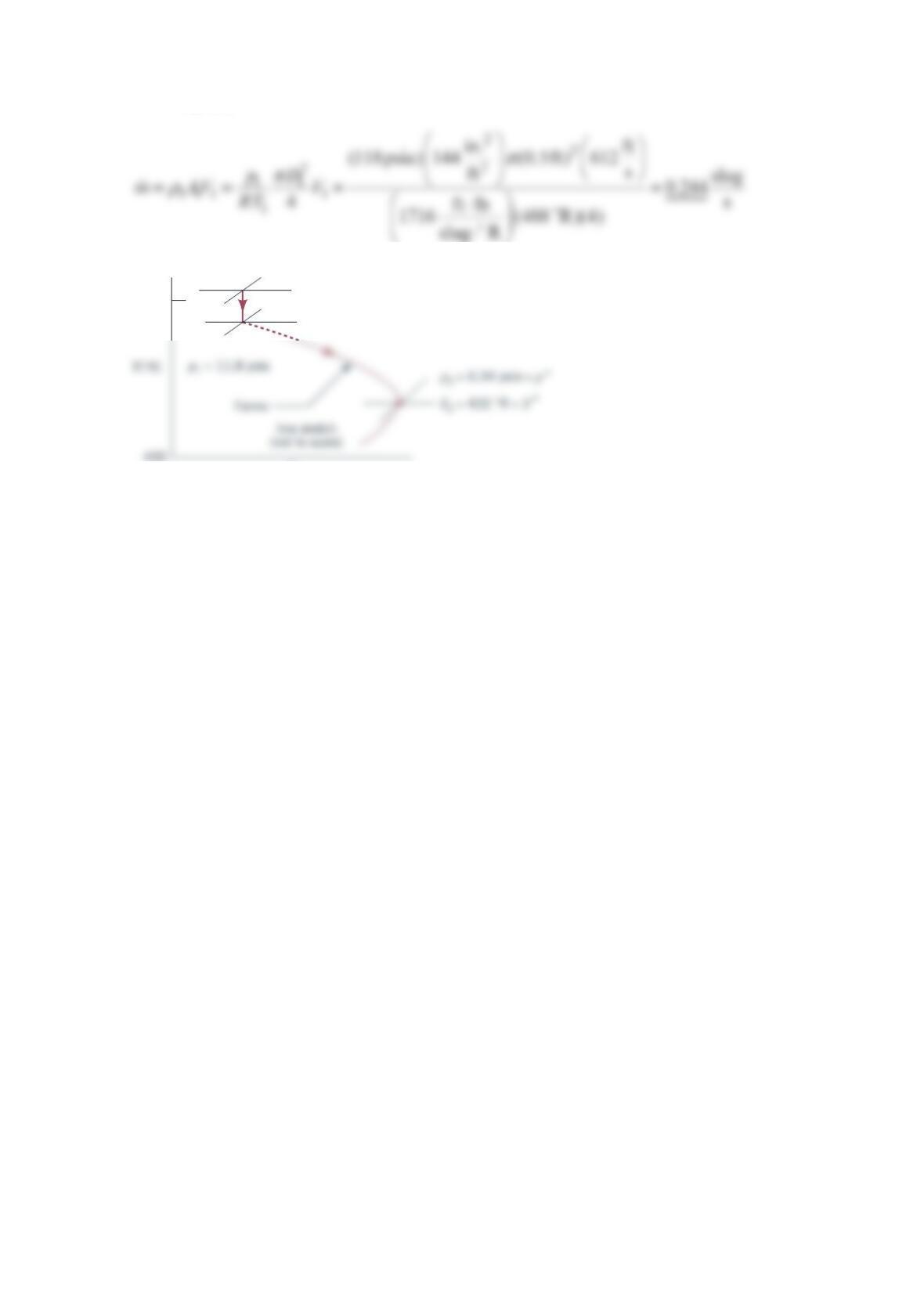
With Eq. (1), we have
500
p0 = 14.7 psia
T0 = 519 °R
T1 = 488 °R
s
Problem 11.57
Air flows adiabatically between the two sections in a constant area pipe. At upstream
section (1), =
0,1 100 psiap, =
0,1 600 RT, and 1
M
a0.5=. At downstream section (2), the
flow is choked. Estimate the magnitude of the force per unit cross-sectional area exerted by
the inside wall of the pipe on the fluid between sections (1) and (2).
Solution 11.57
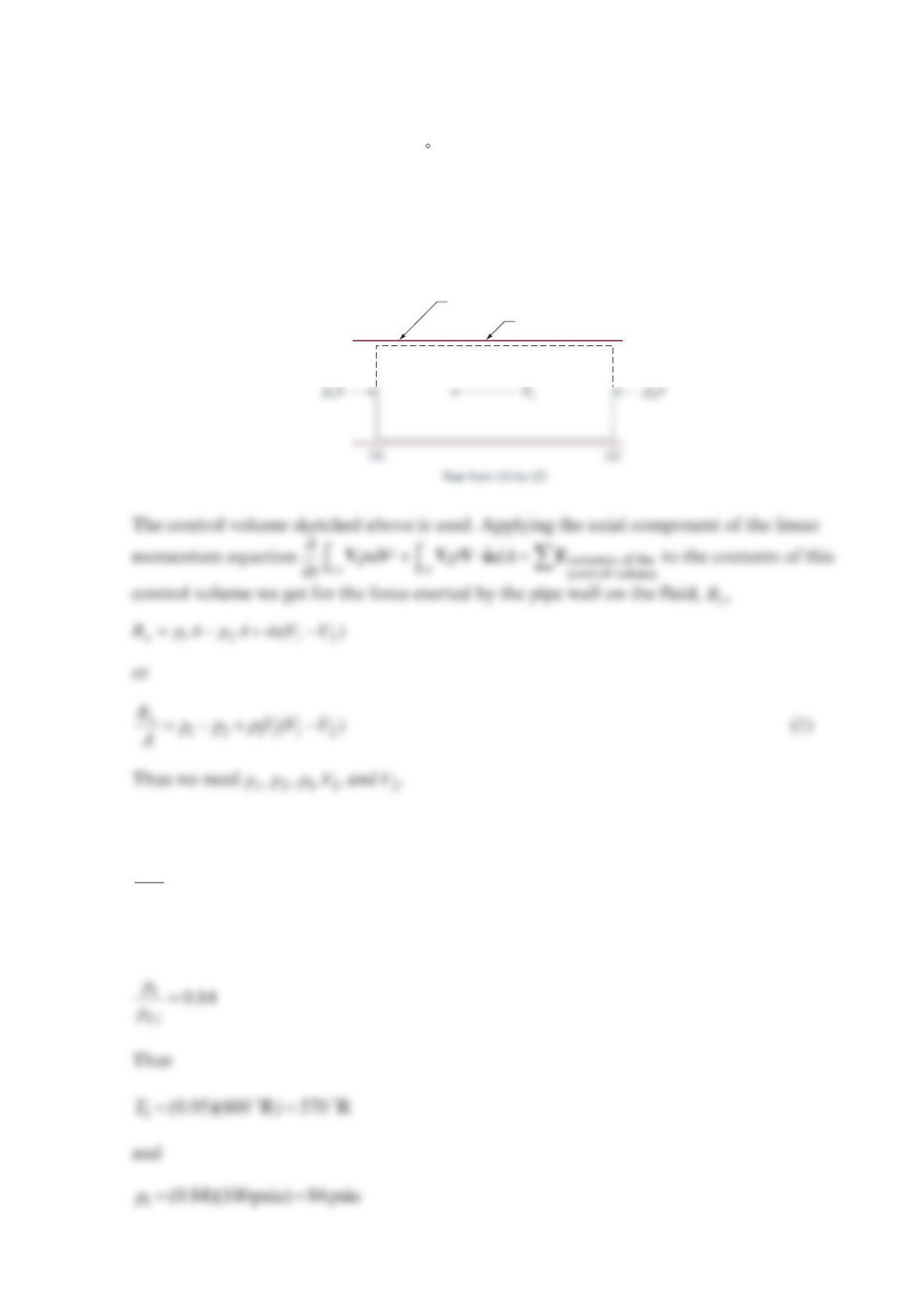
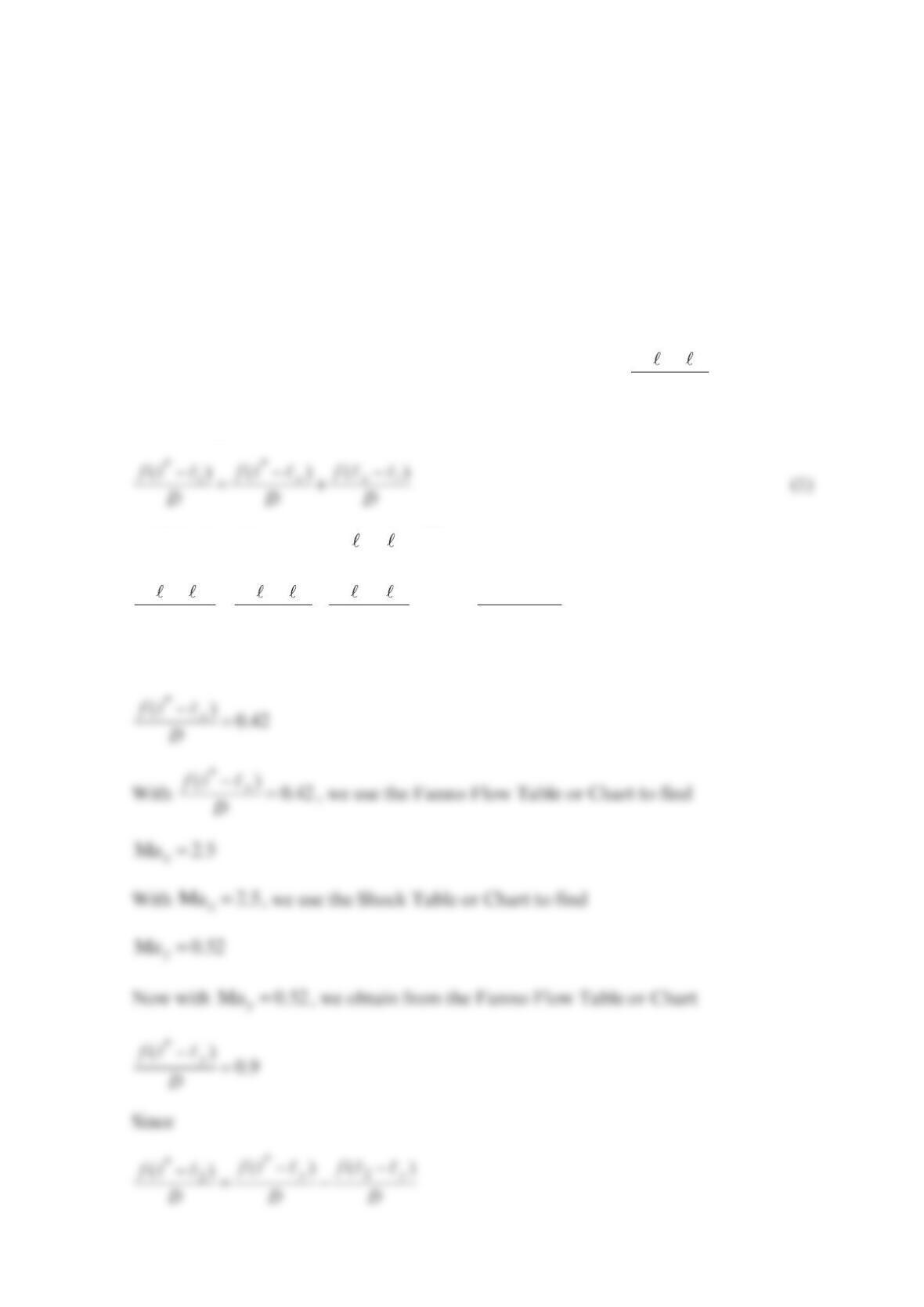
(a) For air, we use the figure below with =
1
Ma 0.5 and get
=
1
0,1
0.95
T
T
and
constant area pipe
control volume
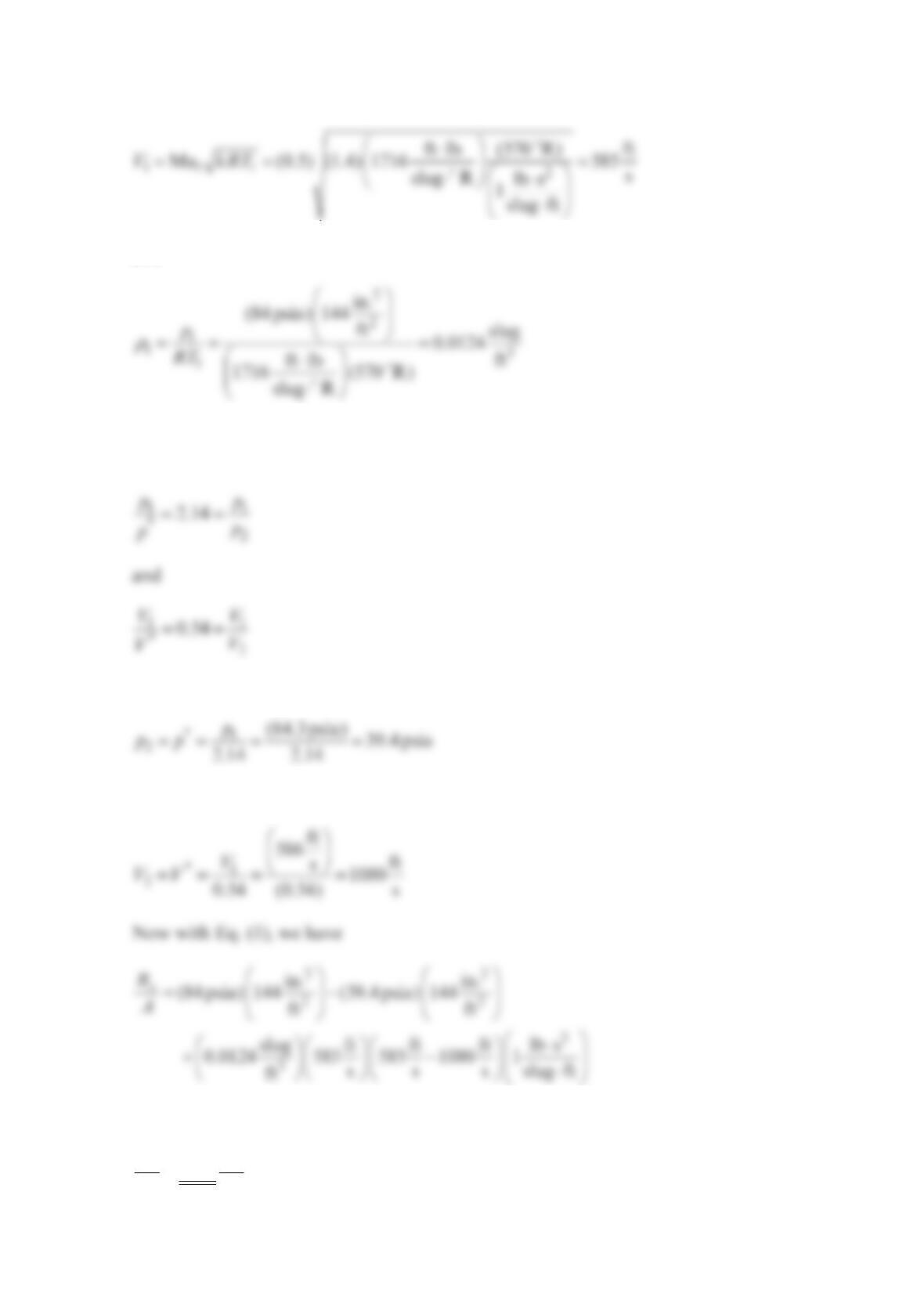
Then
and
At section (2), the flow is choked. Thus, we use the * state of the Fanno flow. Using the
Fanno Flow Chart or Table at =
1
Ma 0.5 , we read
Thus
and
and
=2
lb
2830 ft
x
R
A
Problem 11.58
Supersonic airflow enters an adiabatic, constant area (inside diameter =1ft ) 30-ft-long
pipe with =
1
Ma 3.0 . The pipe friction factor is estimated to be 0.02 . What ratio of pipe
exit pressure to pipe inlet stagnation pressure would result in a normal shock wave standing
at (a) =5ftx, or (b) =10ftx, where x is the distance downstream from the pipe entrance?
Determine also the duct exit Mach number and sketch the temperature–entropy diagram
for each situation.
Solution 11.58
With =
1
Ma 3.0 , we use the Fanno Flow Table or Chart to get −=
*
1
()
0.52
f
D
We note that
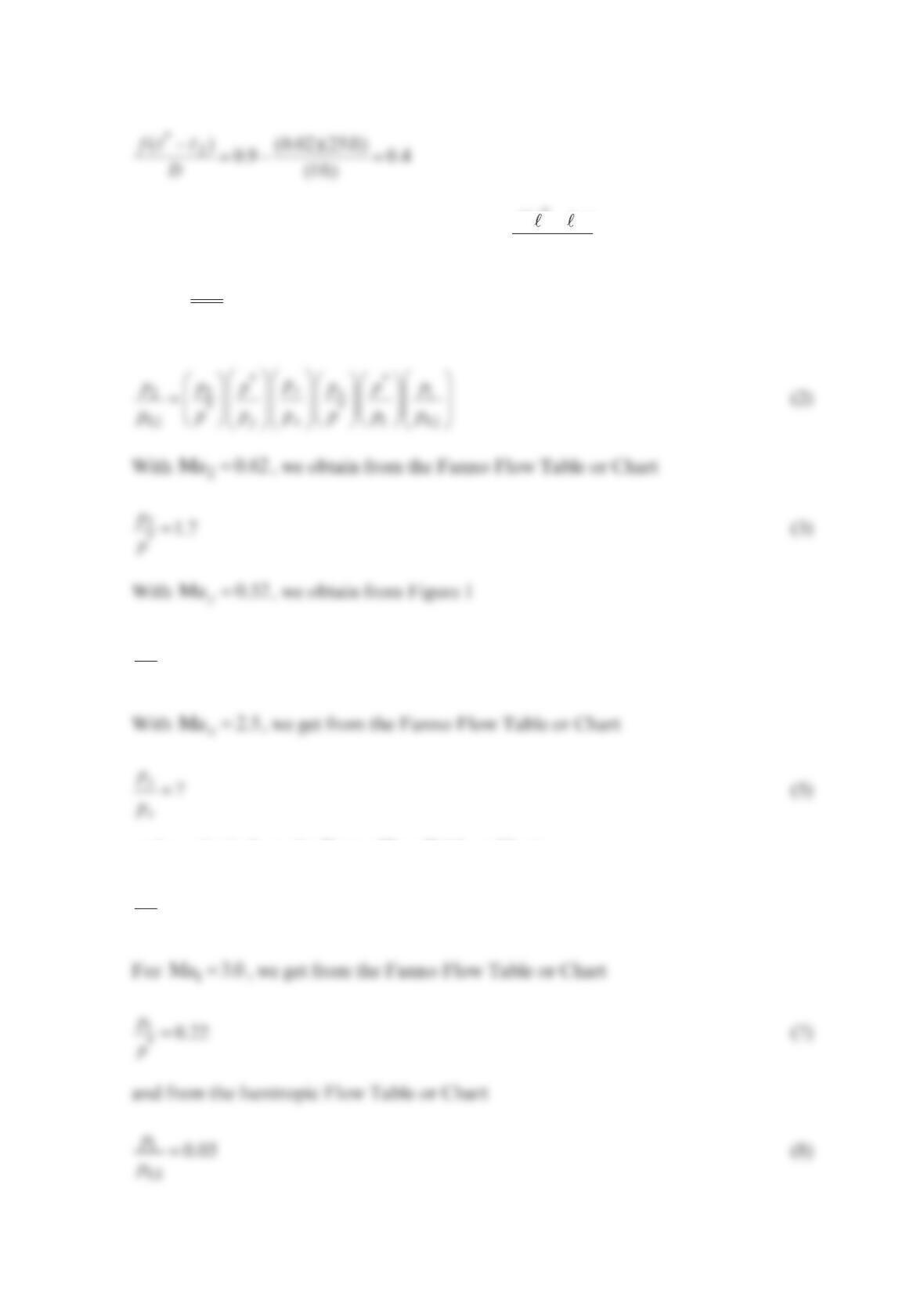
(a) With Eq. (1), we get for −=
15ft
x
−−
−
=− =−
**1
1
() ()
() (0.02)(5ft)
0.52 (1ft)
xx
ff
f
DDD
or
we get
And from the Fanno Flow Table or Chart with −=
*
2
()
0.4
f
D, we obtain
=
2
Ma 0.62 (subsonic flow)
Now we note that
=
*2.05
y
p
p (4)
and we obtain from the Fanno Flow Table or Chart
=
*0.3
x
p
p (6)
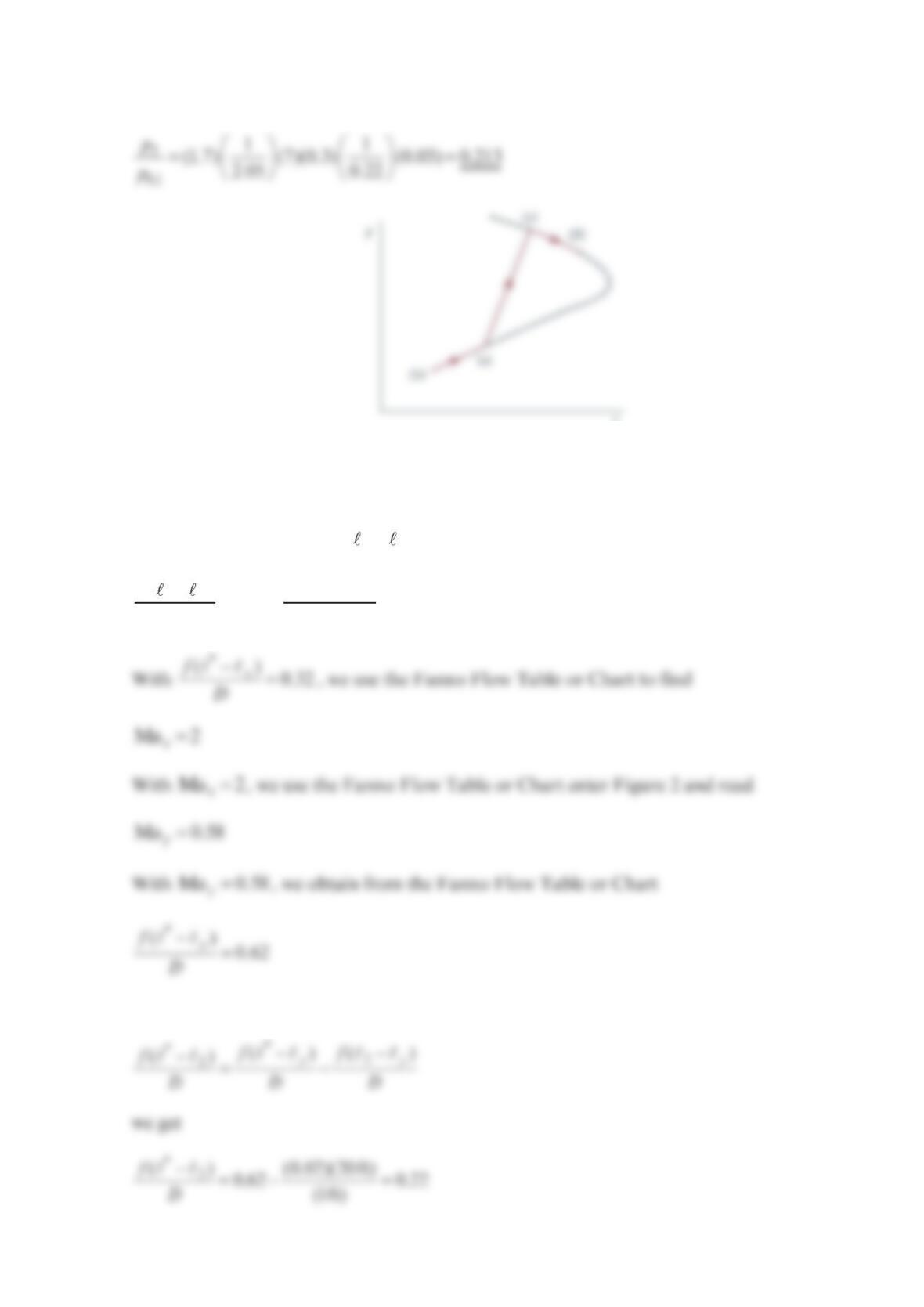
Combining Eqs. (2) through (8), we obtain
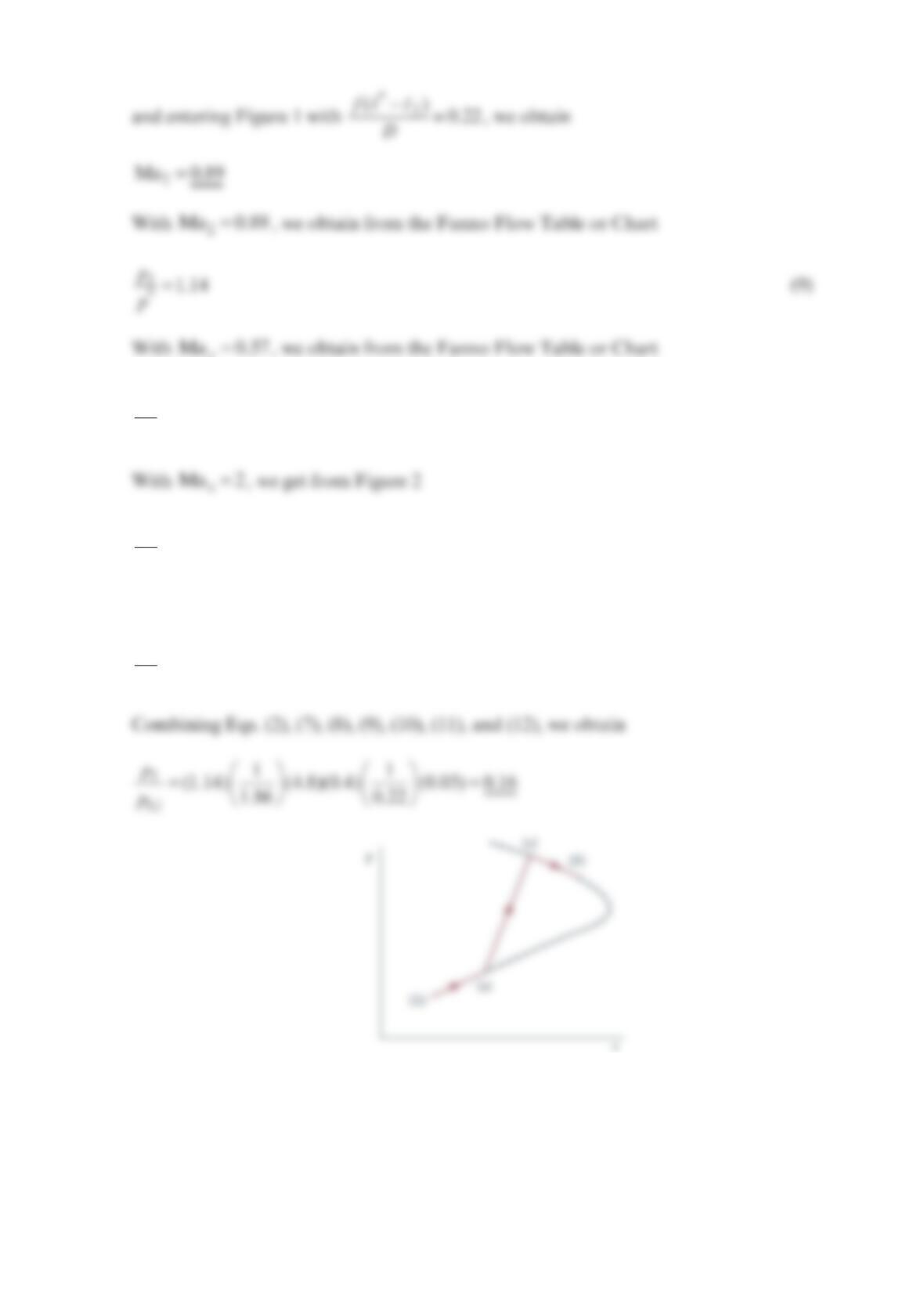
Since we do not have values of temperature or pressure anywhere in the flow, we can only
sketch qualitatively what happens on T–s coordinates. The T–s diagram will be similar to
the one of Fig. E 11.21 (b) as indicated above.
(b) With Eq. (1), we get for −=
110 ft
x
−=− =
*
() (0.02)(10ft)
0.52 0.32
(1ft)
x
f
D
Since
s
y, we obtain from the Fanno Flow Table or Chart
=
*1.86
y
p
p (10)
=4.8
y
x
p
p (11)
and we obtain from Figure 1
=
*0.4
x
p
p (12)