PROBLEM 10.35
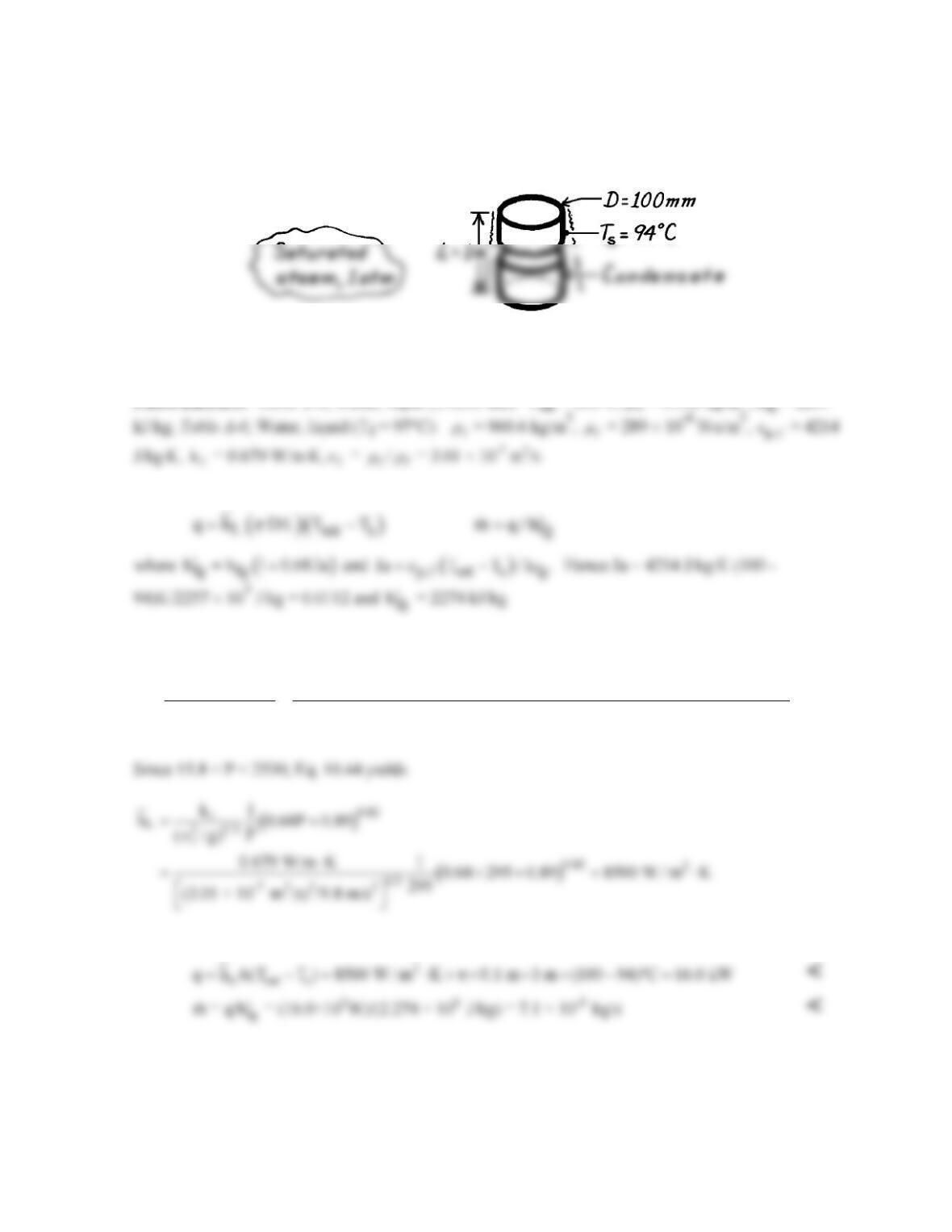
KNOWN: Vertical tube experiencing condensation of steam on its outer surface.
FIND: Heat transfer and condensation rates.
SCHEMATIC:
ASSUMPTIONS: (1) Film condensation, (2) Negligible non-condensibles, (3) D/2 >> δ, vertical
plate behavior.
PROPERTIES: Table A-6, Water, vapor (1.0133 bar): Tsat = 100°C, ρv = 0.596 kg/m3, hfg = 2257
ANALYSIS: The heat transfer and condensation rates are
Eq. 10.42 yields,
sat s
2 1/ 3 1/3
-6 2 3 -7 2 2 2
fg
kL(T T ) 0.679 W/m K × 1 m (100 94)°C
P 295
h ( / g) 289×10 N s/m × 2274 × 10 J/kg × (3.01 × 10 m /s) /9.8 m/s
ν
− ⋅ ×−
= = =
′
µ
⋅
Then from Eqs. 10.33 and 10.34,
COMMENTS: To determine whether the assumption D/2 >> δ is satisfied, use Eq. 10.26 to estimate
δ(L) ≈ 0.12mm. Despite the laminar film assumption, clearly the assumption is justified and the
vertical plate correlation is applicable.
PROBLEM 10.36
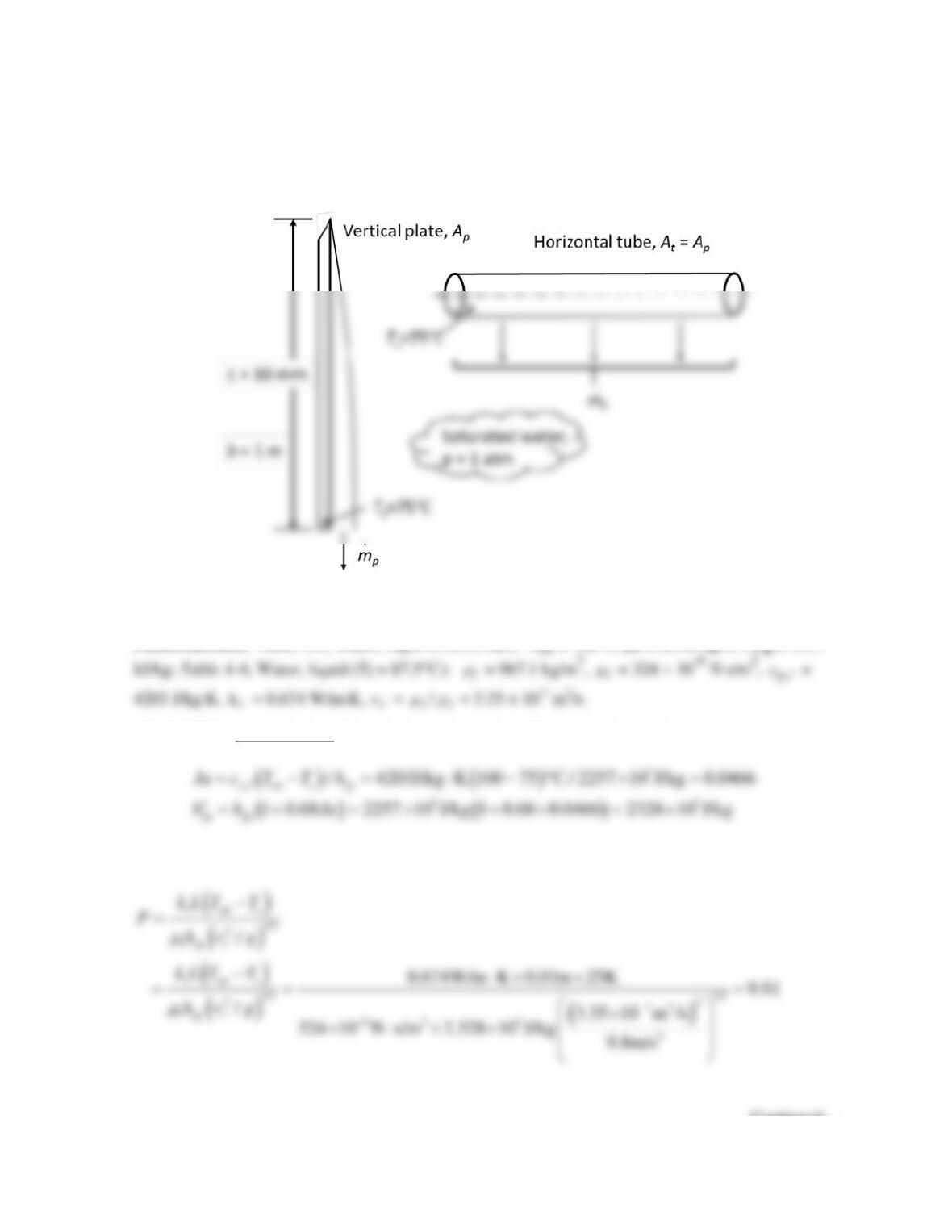
KNOWN: Dimensions and temperature of a vertical plate exposed to steam at atmospheric pressure.
FIND: Condensation rate on plate, and on horizontal tube of the same length and surface area.
SCHEMATIC:
ASSUMPTIONS: Constant properties.
PROPERTIES: Table A-6, Water, vapor (1.0133 bar): Tsat = 100°C, ρv = 0.596 kg/m3, hfg = 2257
ANALYSIS: Vertical plate. The Jakob number and modified latent heat values are
From Eq. 10.42,
Continued…
PROBLEM 10.36 (Cont.)
Hence, Eq. 10.43 applies:
( )
1/ 4
0.943 9.91 0.532
L
Nu
−
= =
From which,
Therefore, the heat rate is
Horizontal tube. From the problem statement, At = Aplate or πD = L where At is the tube area, yielding
D = L/π = 3.18 mm. Equation 10.46 may be used with C = 0.729:
77.2
=
Then
2
/ 77.2 0.674W/m K / 0.00318m 16,400W/m K
tD
l
h Nu k D==×⋅ = ⋅
and the heat rate is
COMMENTS: The heat transfer and condensation rates are nearly the same for the plate and the
tube. The analysis of laminar condensation for the vertical plate is sometimes applied to other
geometries that experience laminar condensation. If the flows were not both laminar, agreement in the
heat and condensation rates would not be expected.
PROBLEM 10.37
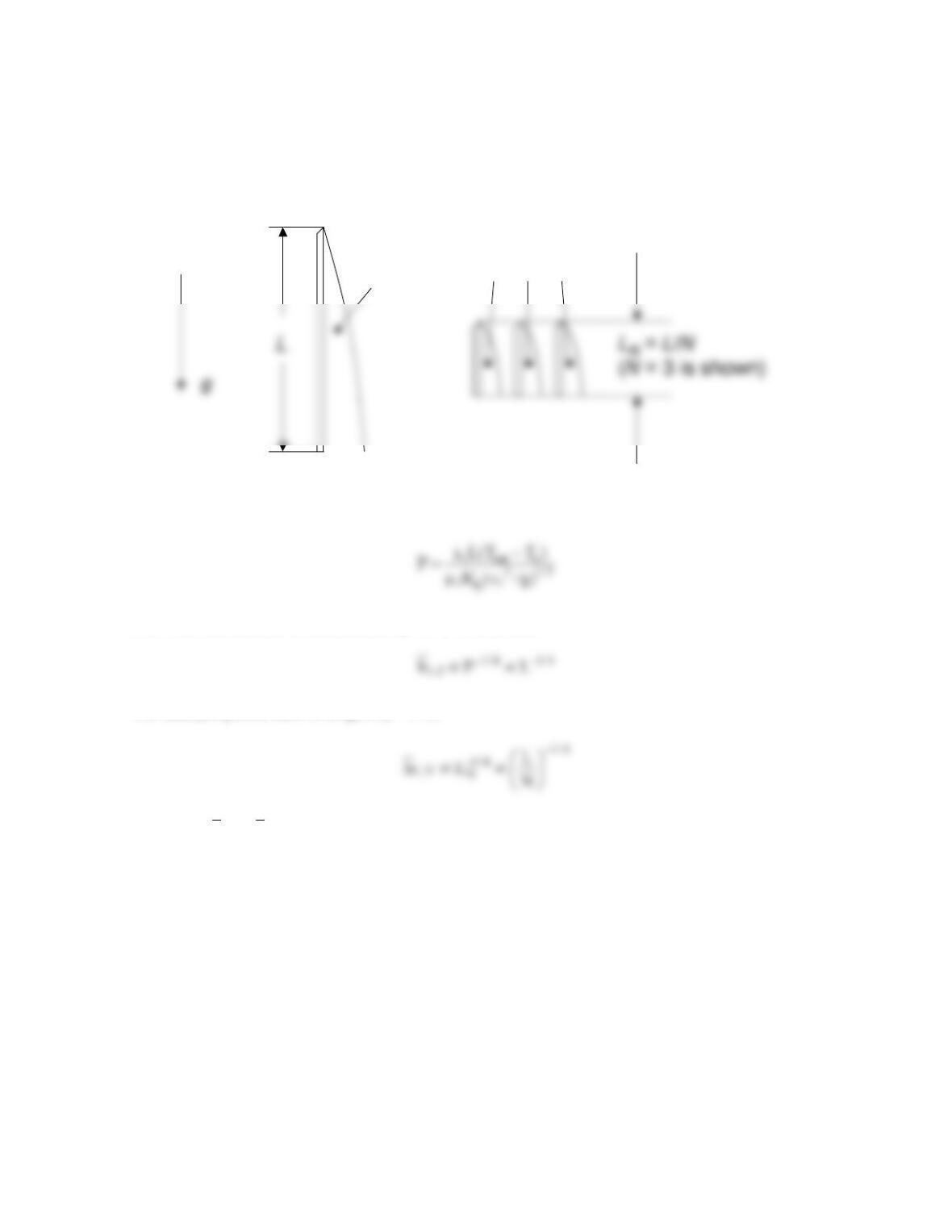
KNOWN: Length of isothermal vertical plate, L, experiencing wave–free laminar condensation.
FIND: Expression for the average heat transfer coefficients for N plates each of length LN = L/N to
the average coefficient for the single plate.
SCHEMATIC:
ASSUMPTIONS: (1) Constant properties.
ANALYSIS: Equation 10.42 gives
For wave free laminar condensation, Eq. 10.43 reveals that
For multiple plates, each of length LN = L/N,
Therefore,
1/4
, ,1
/
LN L
hhN=
<
COMMENTS: By breaking the single plate into shorter segments, the average liquid film thickness is
reduced, resulting in a modest increase in the average heat transfer coefficient, resulting in heat
transfer enhancement.
Condensing
liquid
Condensing
liquid
PROBLEM 10.38
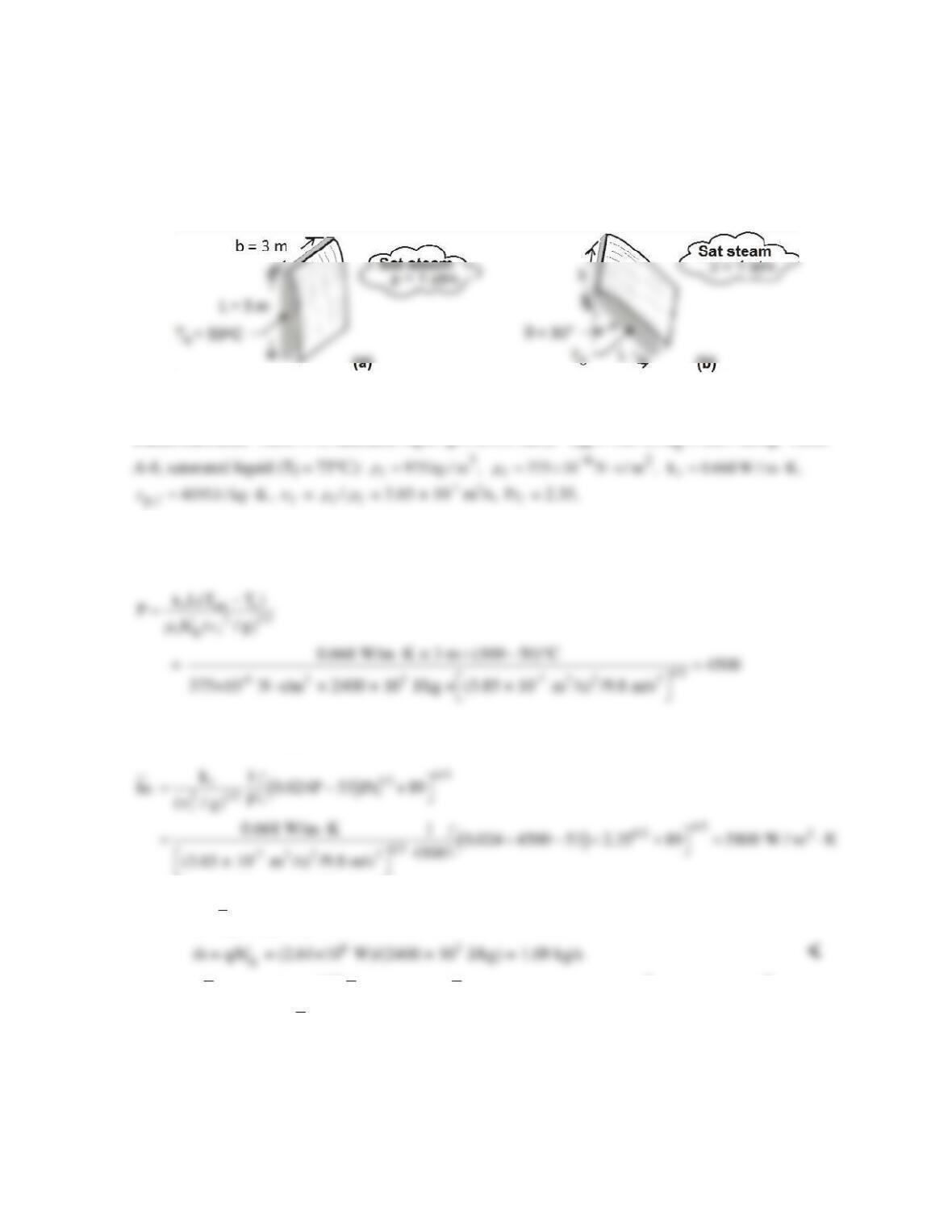
KNOWN: Plate dimensions, temperature and inclination. Pressure of saturated steam.
FIND: (a) Heat transfer and condensation rates for vertical plate, (b) Heat transfer and condensation
rates for inclined plate.
SCHEMATIC:
ASSUMPTIONS: (1) Constant properties.
PROPERTIES: Table A-6, saturated vapor (p=1.0133 bars): Tsat = 100°C, hfg = 2257 kJ/kg. Table
ANALYSIS: (a) Equation 10.27 gives fg fg p, sat s
h h 0.68c (T T )= 2400 kJ/kg.
′=+ −
Then, from Eq.
10.42,
Therefore, Eq. 10.45 applies, and
From Eqs. (10.33) and (10.34) the heat and condensation rates are then
26
Lsats
q h A(T T ) 5800 W / m K 3 m 3 m (100 50) C 2.61 10 W=−= ⋅×××−°=× <
(b) With
()
()
1/4
Lincl L
hcosh,
≈ we obtain
()
22
L incl
h 0.965 5800 W / m K 5600 W / m K.≈× ⋅= ⋅ If
the inclination reduces L
h by 3.5%, the heat and condensation rates are reduced by equivalent
amounts. Hence,
6
q 2.52 10 W, m 1.05 kg / s=× =
<
COMMENTS: The small tilt angle (30°) has little effect on the condensation rate.
PROBLEM 10.39
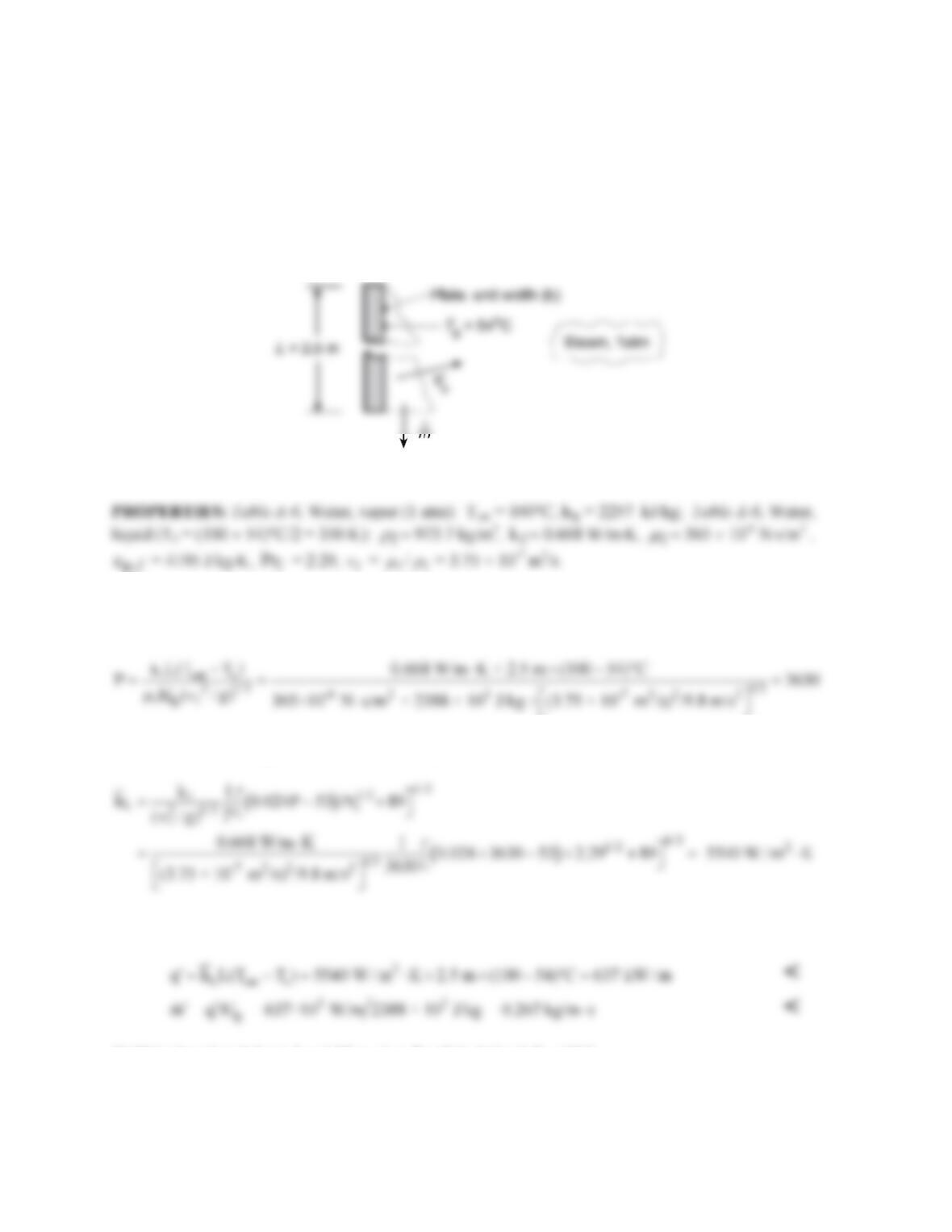
KNOWN: Vertical plate 2.5 m high at a surface temperature Ts = 54°C exposed to steam at atmospheric
pressure.
FIND: (a) Condensation and heat transfer rates per unit width, (b) Whether flow regime would stay the
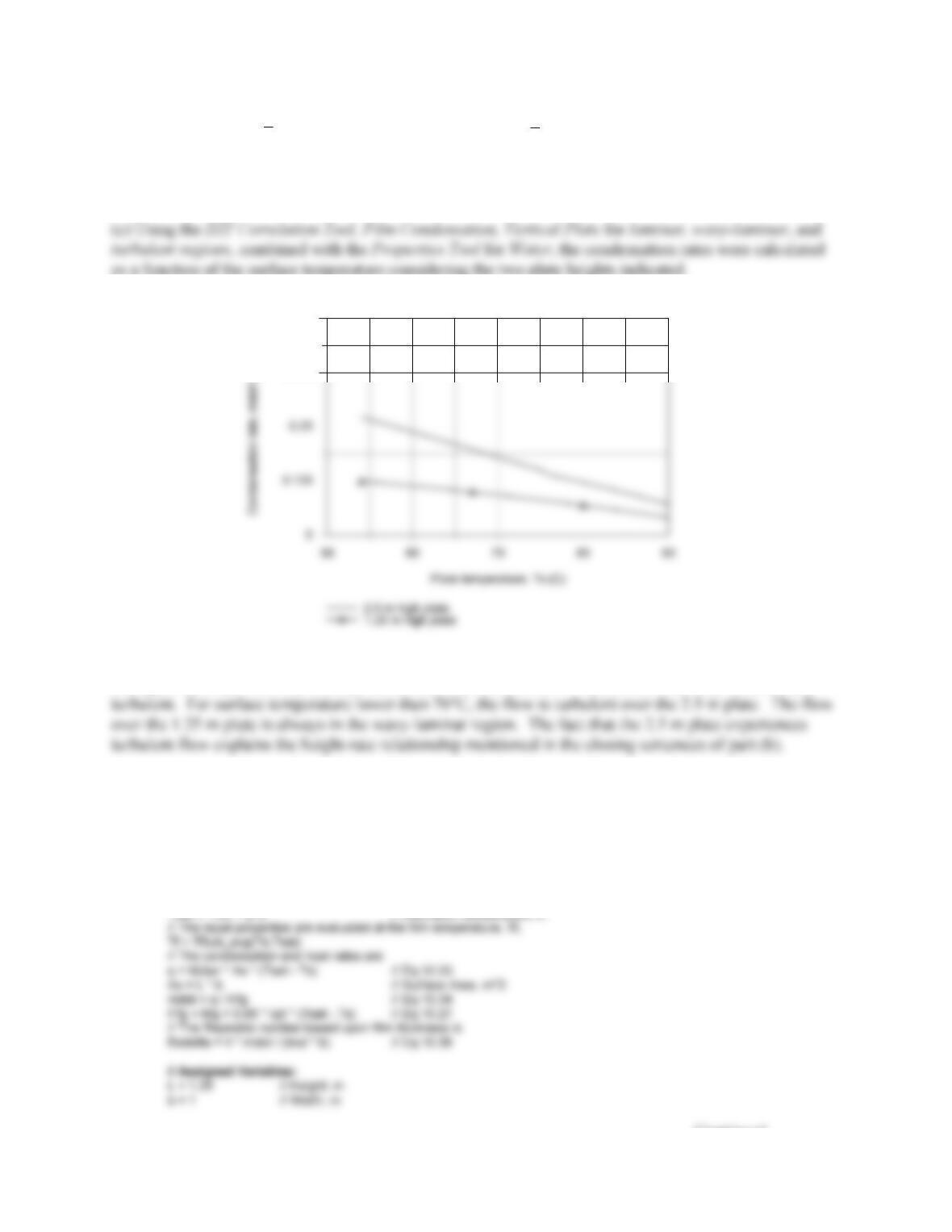
same or change if the height were halved, and (c) Compute and plot the condensation rates for the two
plate heights (2.5 m and 1.25 m) as a function of surface temperature for the range, 54 ≤ Ts ≤ 90°C.
SCHEMATIC:
ASSUMPTIONS: (1) Film condensation, (2) Negligible non-condensables in steam.
ANALYSIS: (a) From Equation 10.27,
fg fg p, sat s
h h 0.68c (T T )= 2388 kJ/kg.
′=+−
Then Eq. 10.42
yields,
Since P > 2530, the regime is turbulent and Eq. 10.45 yields
Then from Eqs. 10.33 and 10.34,
(b) If the length is halved, L = 1.25 m, then P will be halved, P = 1810.
Since 15.8 < P < 2530, the flow regime changes to wavy laminar flow. <
Continued…
PROBLEM 10.39 (Cont.)
Eq. 10.44 then yields
2
L
h 5190 W / m K= ⋅
and we find
L sat s
q h L(T T ) 299 kW / m
′= −=
and
fg
m = q /h = 0.125 kg/m s
′ ′′ ⋅
. Note that the height was decreased by a factor of 2 while the rates
decreased by a factor of 2.13. Would you have expected this result?
0.375
0.5
The condensation rate decreases nearly linearly with increasing surface temperature. The inflection in
the upper curve (L = 2.5 m) corresponds to the flow transition at P = 2530 between wavy-laminar and
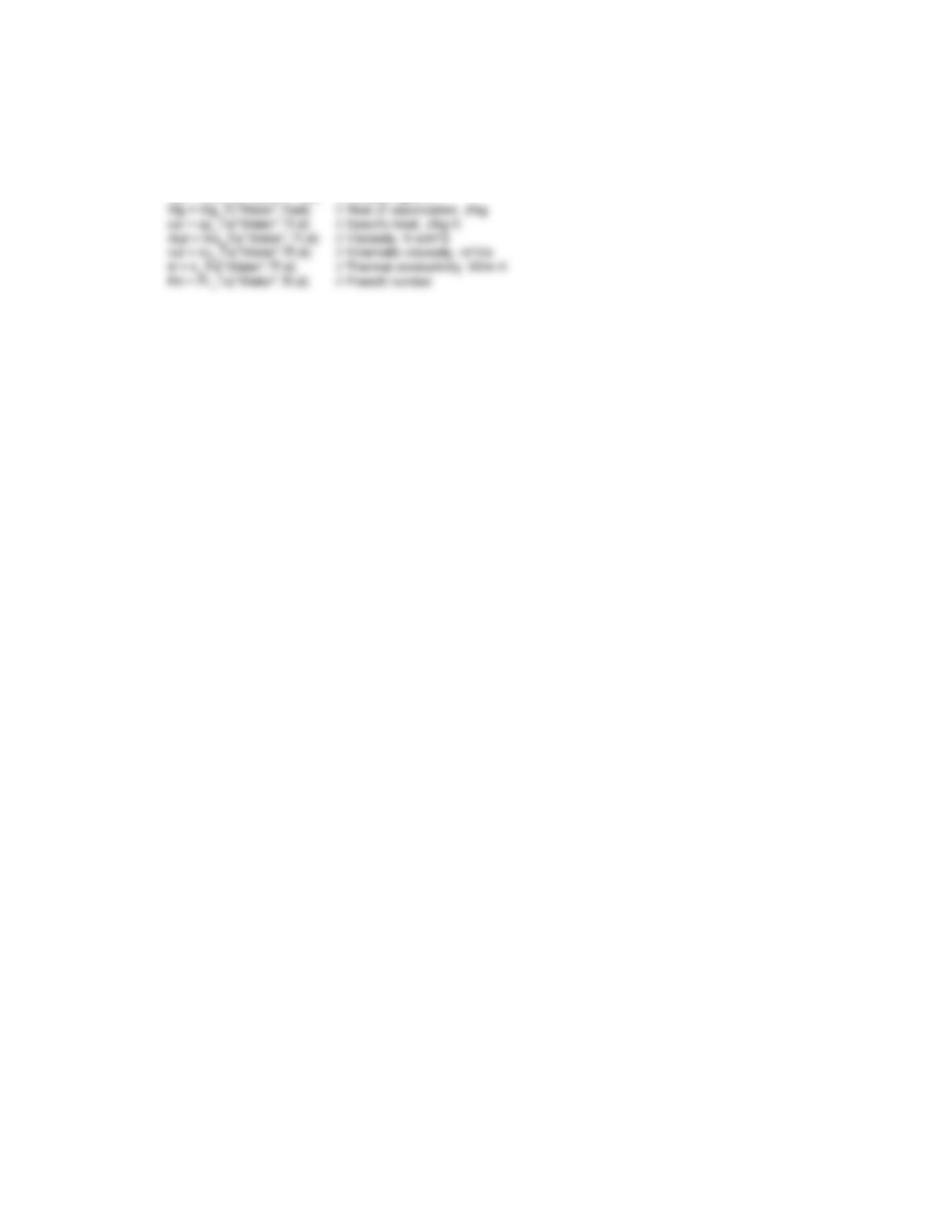
COMMENTS: A copy of the IHT model used to generate the preceding plot is shown below.
/* Correlations Tool
– Film Condensation, Vertical Plate, Laminar, wavy–laminar and turbulent regions: */
NuLbar = NuL_bar_FCO_VP(Redelta,Prl) // Eq 10.38, 39, 40
NuLbar = hLbar * (nul^2 / g)^(1/3) / kl
g = 9.8 // Gravitational constant, m/s^2
Ts = Ts_C + 273 // Surface temperature, K
Ts_C = 54 // Part (a) design condition
Tsat = 100 + 273 // Saturation temperature, K
Continued…
PROBLEM 10.39 (Cont.)
// Properties Tool – Water:
// Water property functions :T dependence, From Table A.6
// Units: T(K), p(bars);
xl = 0 // Quality (0=sat liquid or 1=sat vapor)
rhol = rho_Tx(“Water”,Tf,xl) // Density, kg/m^3
PROBLEM 10.40
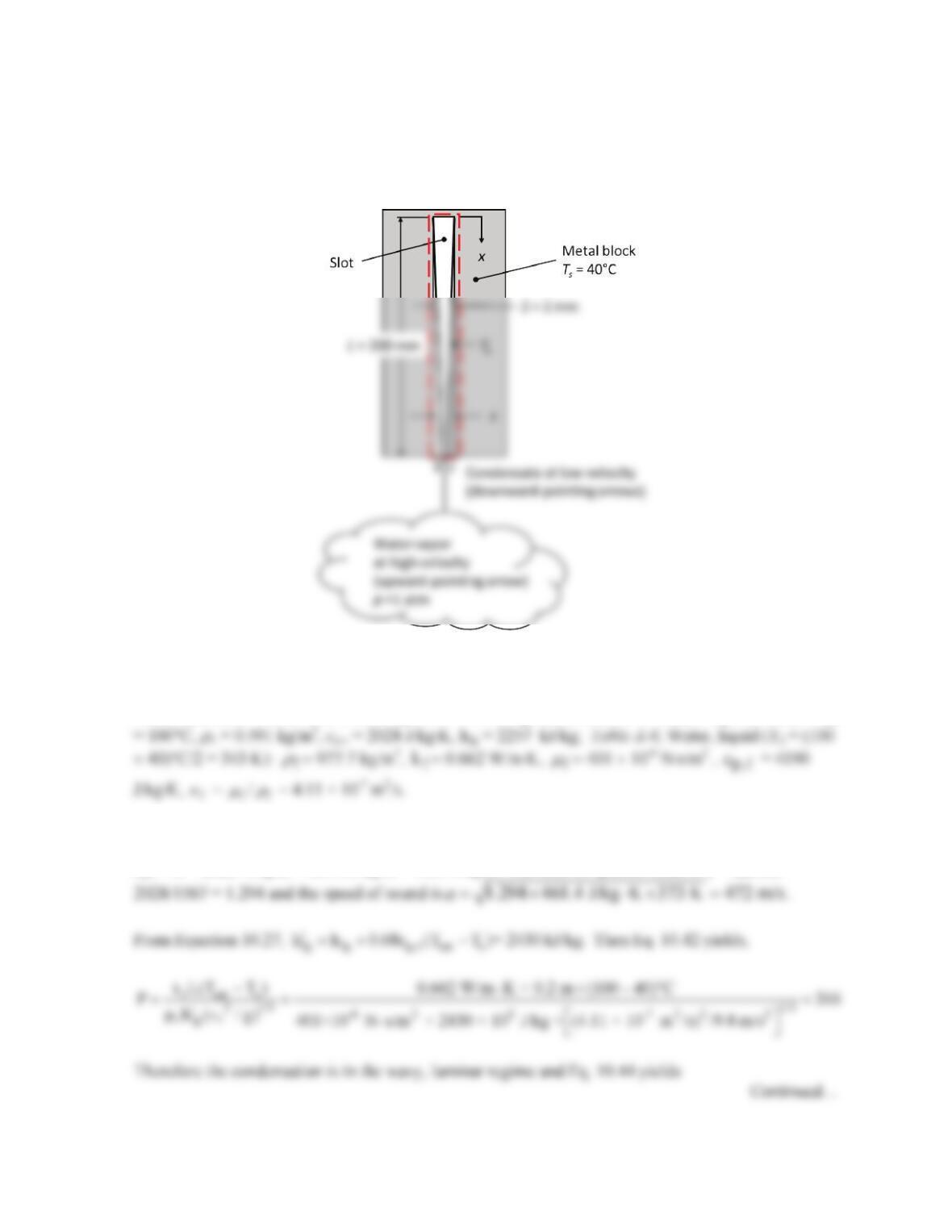
KNOWN: Dimensions of slot in metal block, condensation on slot surfaces. Temperature of slot
surfaces and pressure of saturated water.
FIND: Mach number of water vapor entering slot, and slot width corresponding to Ma = 1.
SCHEMATIC:
ASSUMPTIONS: (1) Isothermal surfaces, (2) Constant properties, (3) Water vapor is ideal gas, (4)
Flow of vapor in the slot does not disturb the falling condensate.
PROPERTIES: Table A-4, Water, vapor, M = 18.02 kg/kmol; Table A-6, Water, vapor (1 atm): Tsat
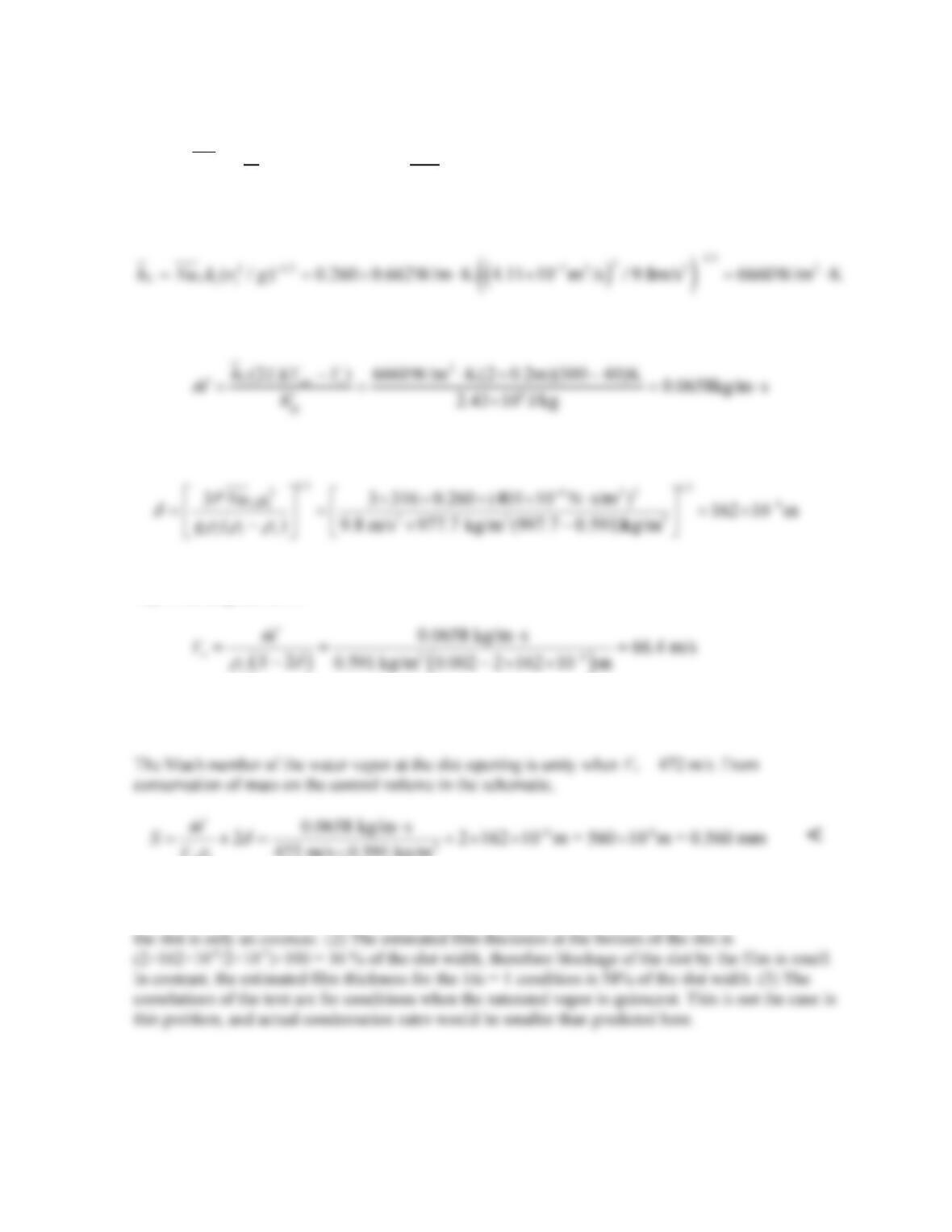
ANALYSIS: The speed of sound for water vapor may be determined using the analysis of Section
6.4.2. The water gas constant is R = R/M = 8315 J/kmol∙K/18.02 kg/kmol = 461.4 J/kg∙K and cv,v =
cp,v – R = 2028 J/kg∙K – 461.4 J/kg∙K = 1567 J/kg∙K. The ratio of specific heats is
γ
= cp,v/cv,v =
PROBLEM 10.40 (Cont.)
( ) ( )
0.82 0.82
11
0.68 0.89 0.68 316 0.89 0.260
316
L
Nu P
P
= += ×+=
for which the convection coefficient is
The condensation rate per unit slot length is
Equations 10.37 and 10.41 are used to estimate the film thickness at the bottom of the slot:
From conservation of mass applied to the control volume of the schematic, the velocity of the water
vapor entering the slot is
and the Mach number is Ma = Vv/a = 66.4/472 = 0.141. <
472 m/s 0.591 kg/m
vv
ρ
×
COMMENTS: (1) Equation 10.37 is for the wave-free laminar regime, while the condensation here
occurs in the wavy–laminar regime. Therefore, the calculation of the film thickness at the bottom of
PROBLEM 10.41
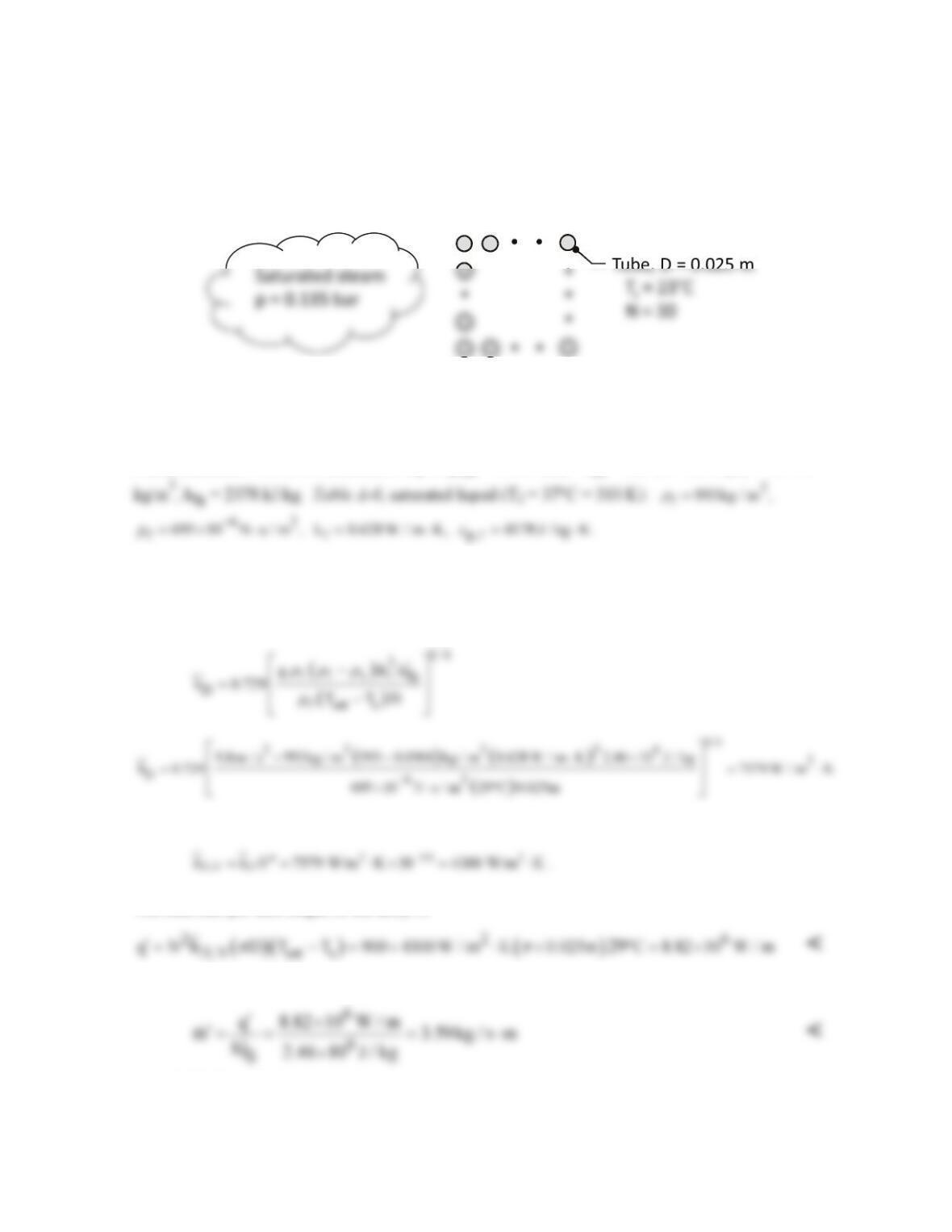
KNOWN: Number, diameter and wall temperature of condenser tubes in a square array. Pressure of
saturated steam around tubes.
FIND: Rates of heat transfer and condensation per unit length of the array.
SCHEMATIC:
ASSUMPTIONS: (1) Spatially uniform cylinder temperature, (2) Negligible concentration of
noncondensable gases in steam, (3) Average heat transfer coefficient varies with tube row as n = –1/6
in Eq. 10.49.
PROPERTIES: Table A-6, saturated vapor (psat = 0.135 bar): Tsat = 325 K = 52°C,
ρ
v = 0.0904
ANALYSIS: Equation 10.46 may be used to find the convection coefficient for the top, unfinned
tube. With
( )
p, sat s fg
Ja c T T / h 0.051= −=
and
fg fg
hh
′=
(l + 0.68 Ja) = 1.03 (2.378 × 10⁶ J/kg) =
2.46 × 10⁶ J/kg,
From Eq. 10.49 the array-averaged convection coefficient is
The heat rate per unit length of the array is
The corresponding condensation rate is
COMMENTS: The heat transfer rate could be increased by adding fins to the tubes.
PROBLEM 10.42
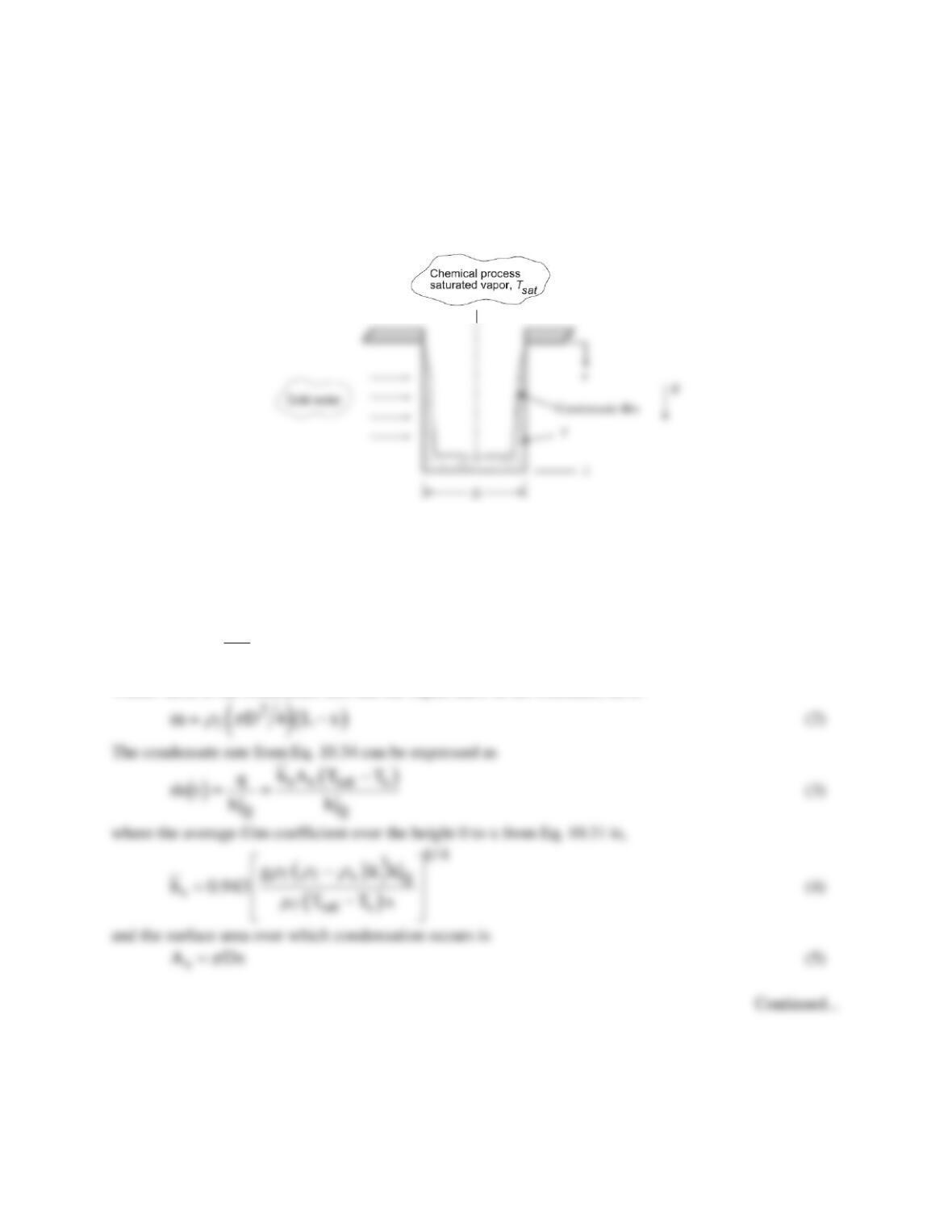
KNOWN: Inner surface of a vertical thin–walled container of length L and diameter D experiences
condensation of a saturated vapor. Container wall maintained at a uniform surface temperature by
flowing cold water across its outer surface.
FIND: Expression for the time, tf , required to fill the container with condensate assuming the condensate
film is laminar. Express your result in terms of D, L, (Tsat − Ts), g, and appropriate fluid properties.
SCHEMATIC:
ASSUMPTIONS: (1) Laminar film condensation on a vertical surface, (2) Uniform temperature
container wall surface, and (3) Mass of liquid condensate in the laminar film negligible compared to
liquid mass on bottom of container.
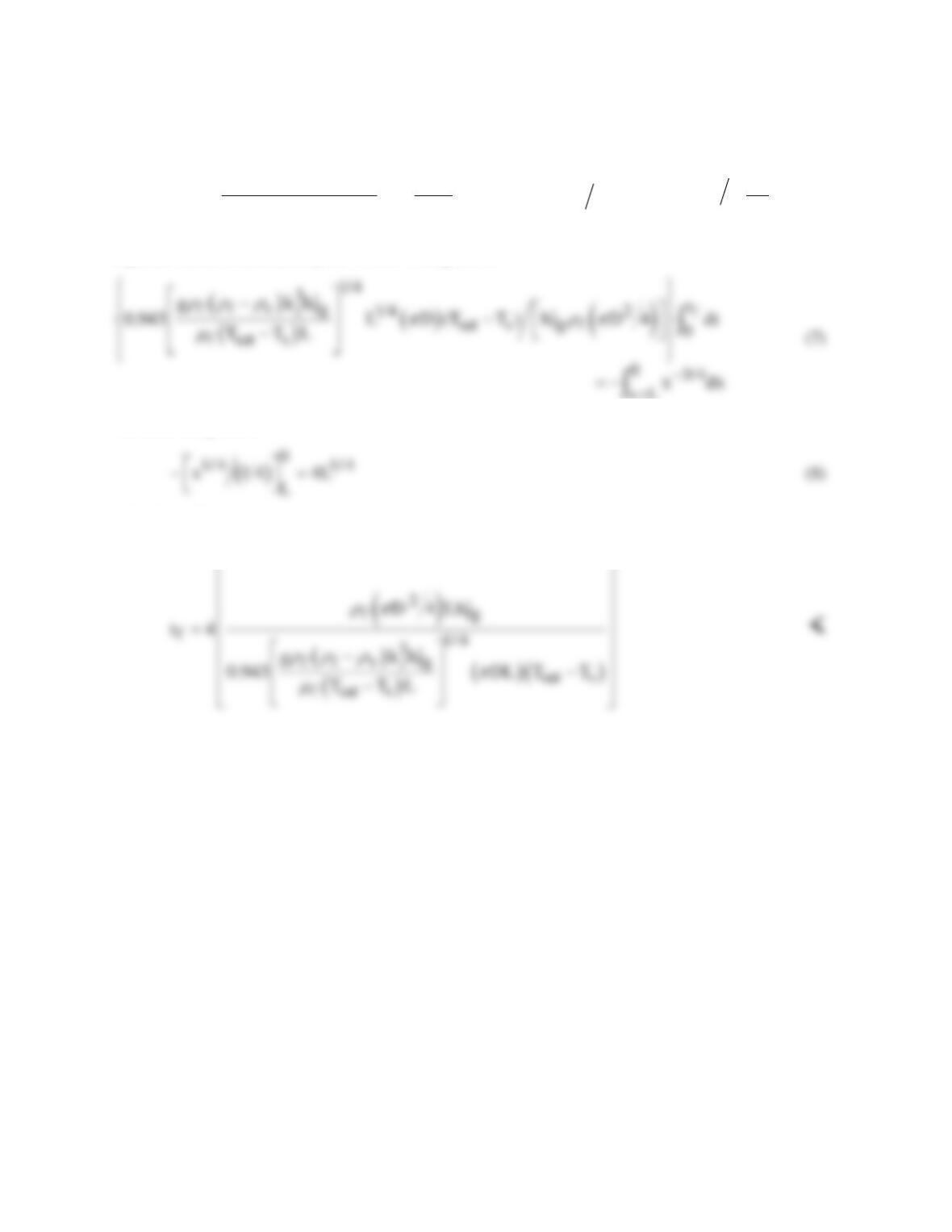
ANALYSIS: From an instantaneous mass balance on the container,
dm
m(t) dt
=
(1)
Where
m
(t) is the condensate rate and the liquid mass in the container, m, is
PROBLEM 10.42 (Cont.)
Substituting Eqs (2-5) into Eq. (1),
( )
( )
( )
()
1/ 4
31/ 4
fg 2
sat s fg
1/ 4
sat s
g kh L dx
0.943 Dx (T T ) h D 4
T T L dt
x
′
−
′
−=−
−
ν
ρρ ρ π ρπ
µ
(6)
Separate variables and identify the limits of integration,
xL
=
The RHS integrates to
and solving for tf,
COMMENTS: The numerator and denominator in the bracketed expression are of special significance.
The numerator is the product of the mass in the filled container and the latent heat of vaporization; that
is, the total energy removed by the cold water. What is the physical significance of the denominator?
Can you interpret the time-to–fill, tf , expression in light of these terms?
PROBLEM 10.43
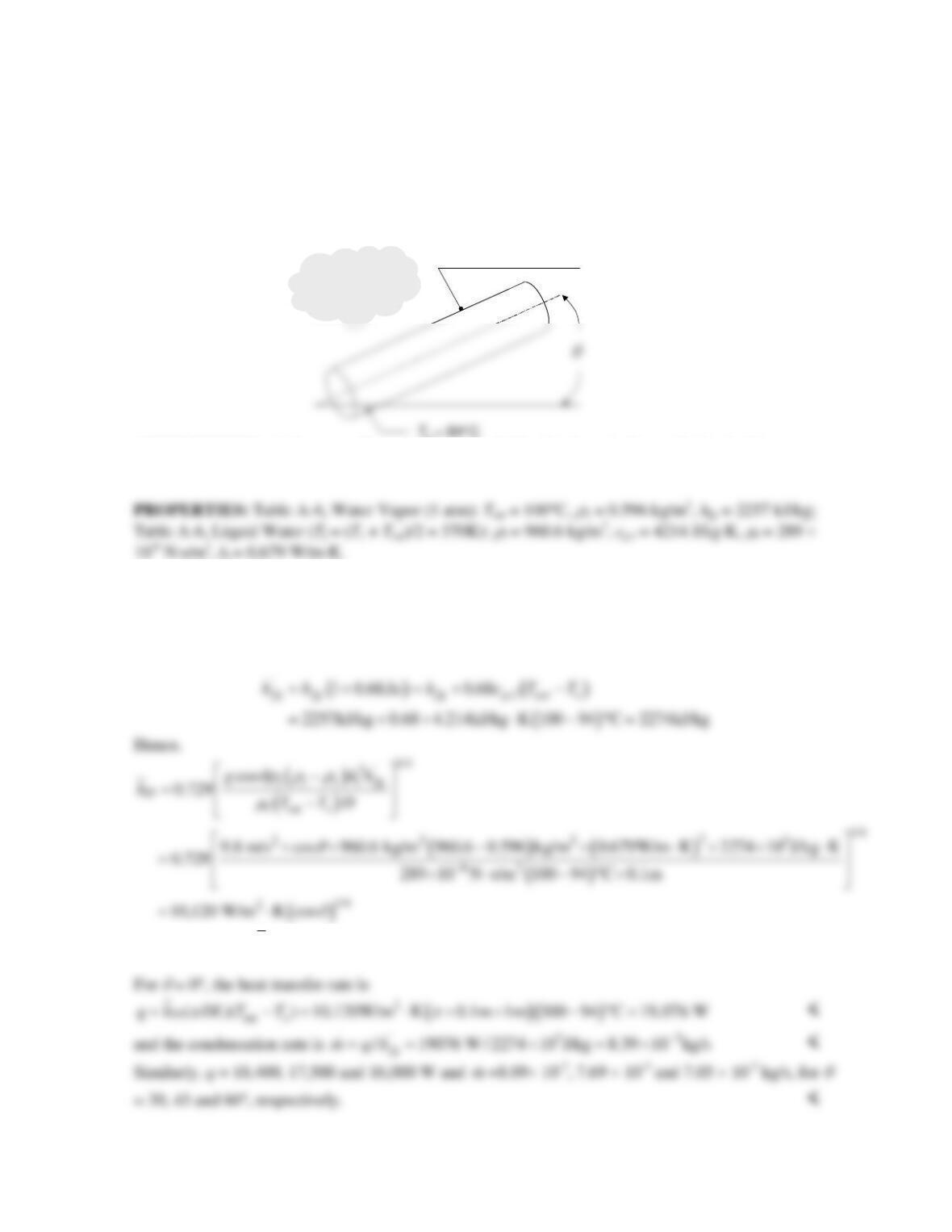
Determine the total condensation rate and heat transfer rate for the process of Problem 10.35 when the
pipe is oriented at angles of
= 0, 30, 45 and 60° from the horizontal.
KNOWN: Dimensions and surface temperature of tube exposed to steam. Non-vertical orientation
angles.
FIND: Heat transfer and condensation rates.
SCHEMATIC:
ASSUMPTIONS: (1) Laminar film condensation, (2) Negligible end effects, (3) Negligible
concentration of non-condensable gases in steam.
ANALYSIS: The tube’s length to diameter ratio, L/D = 10, must exceed B = 1.8tan
in order to use
Equation 10.46. The value of B is 0, 1.039, 1.8, and 3.118 for
= 0, 30, 45 and 60°, respectively.
Therefore, Equation 10.46 may be used by replacing g with gcos
where the modified latent heat is
found from Equation 10.27
and the values of
D
hare 10,120, 9760, 9280 and 8510 W/m2⋅K for
= 0, 30, 45 and 60°, respectively.
COMMENTS: The condensation rates decrease with increasing
. Why?
Saturated
steam, 1 atm
s
Tube,
D= 0.1m,
L= 1m
PROBLEM 10.44
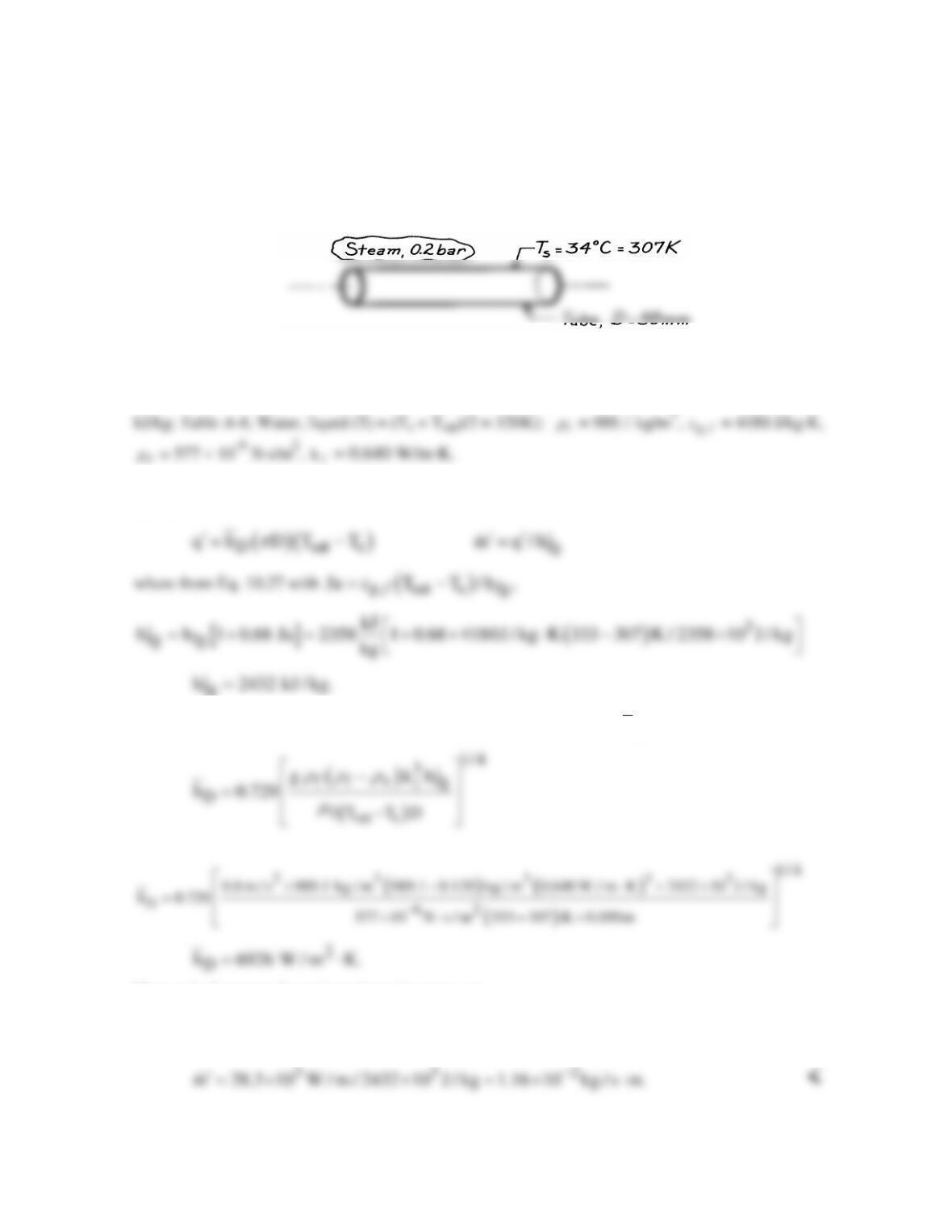
KNOWN: Horizontal tube, 50mm diameter, with surface temperature of 34°C is exposed to steam at
0.2 bar.
FIND: Estimate the heat transfer and condensation rates per unit length of the tube.
SCHEMATIC:
ASSUMPTIONS: (1) Laminar film condensation, (2) Negligible non-condensibles in steam.
PROPERTIES: Table A-6, Saturated steam (0.2 bar): Tsat = 333K, ρv = 0.129 kg/m3, hfg = 2358
ANALYSIS: From Eqs. 10.33 and 10.34, the heat transfer and condensate rates per unit length of the
tube are
For laminar film condensation, Eq. 10.46 is appropriate for estimating
D
h
with C = 0.729,
Hence, the heat transfer and condensation rates are
( )( )
2
q 6926 W / m K 0.050m 333 307 K 28.3kW / m
π
′= ⋅× − =
<
PROBLEM 10.45
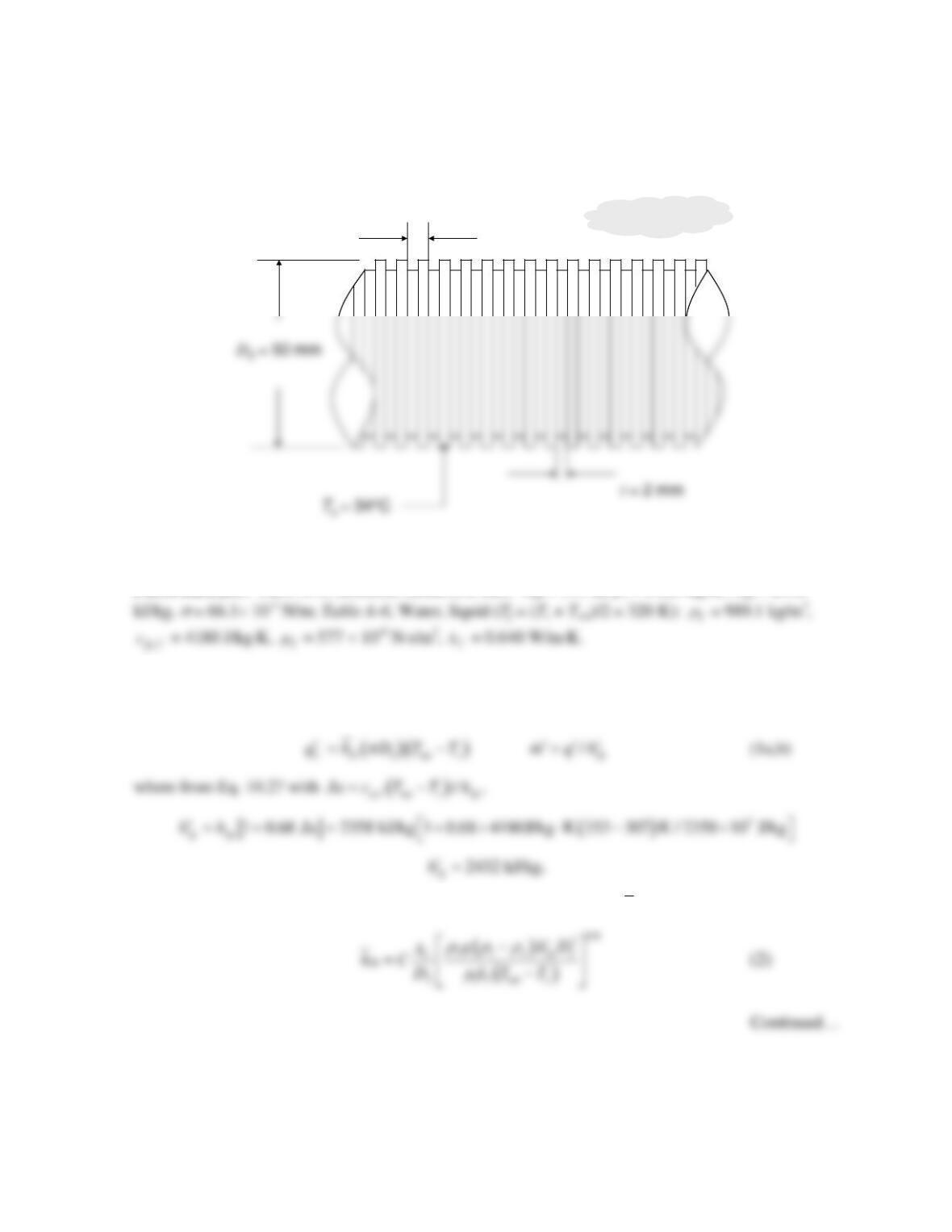
KNOWN: Dimensions and surface temperature of grooved horizontal tube exposed to steam at 0.2
bar.
FIND: Minimum condensation and heat transfer rates per unit length of the tube.
SCHEMATIC:
ASSUMPTIONS: (1) Laminar film condensation, (2) Negligible non-condensable gas in steam.
PROPERTIES: Table A-6, Saturated steam (0.2 bar): Tsat = 333 K,
ρ
ANALYSIS: The heat transfer rate of Problem 10.44 is based upon an unmilled tube of diameter D2
= 50 mm. From Eqs. 10.33 and 10.34, the heat transfer and condensation rates per unit length for this
tube are
For laminar film condensation, Eq. 10.46 is appropriate for estimating
D
h
with C = 0.729,
S= 2 mm
Steam, 0.2 bar
PROBLEM 10.45 (Cont.)
Hence, the heat transfer and condensation rates for the smooth large tube are
The portions of the larger tube that are not milled away serve as fins. Therefore, the heat transfer rate
from the grooved large tube is related to the heat transfer rate from a corresponding smooth tube of
smaller diameter D1 = 46 mm, modified by the enhancement ratio, Eq. 10.48. We must first determine
the heat transfer rate
uft,1
q′
from a smooth tube of diameter D1. From Eqs. (2) and (1a) above, with D2
replaced by D1, and the same value for
fg
h′
:
uft,1 26.6 kW/mq′=
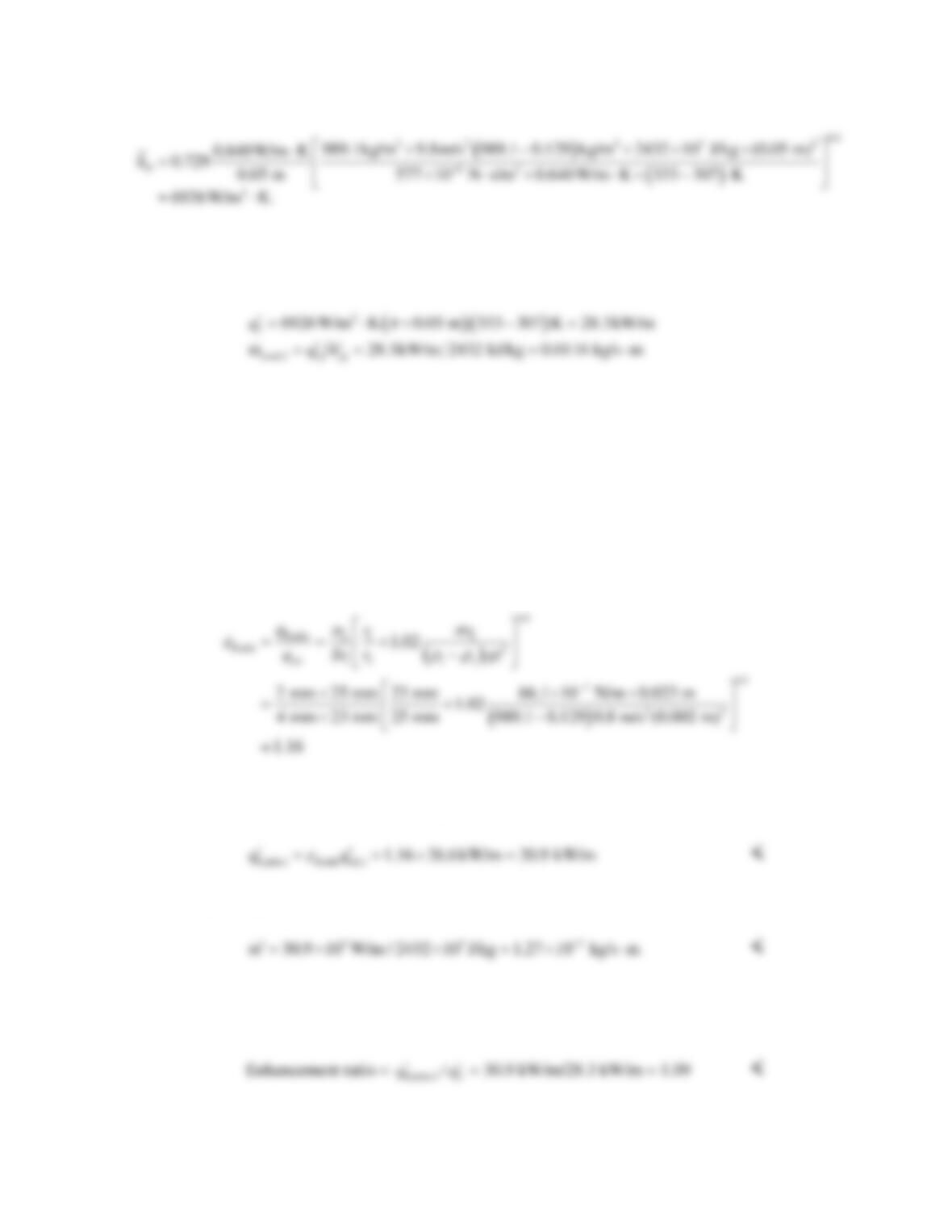
The enhancement factor is given by Eq. 10.48.
Thus the minimum heat transfer rate for the grooved tube is
The corresponding condensation rate is
The enhancement due to milling the larger diameter tube, for either heat transfer or condensation rate,
is therefore
COMMENTS: For a given fluid and operating conditions would an optimum groove geometry exist?
PROBLEM 10.46
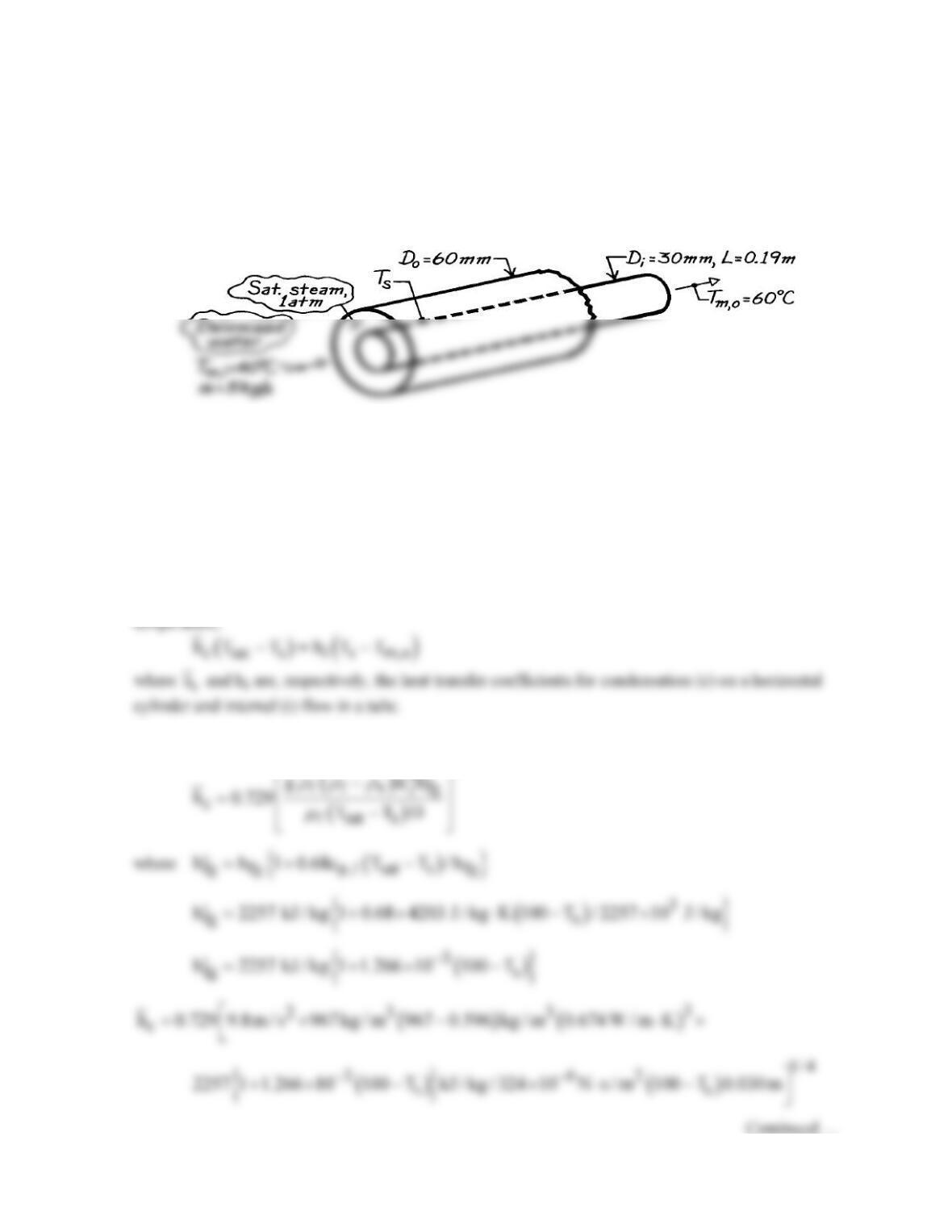
KNOWN: Thin-walled concentric tube arrangement for heating deionized water by condensation of
steam.
FIND: Estimates for convection coefficients on both sides of the inner tube. Inner tube wall outlet
temperature. Whether condensation provides fairly uniform inner tube wall temperature
approximately equal to the steam saturation temperature.
SCHEMATIC:
ASSUMPTIONS: (1) Negligible thermal resistance of inner tube wall, (2) Internal flow is fully
developed.
PROPERTIES: Deionized water (given): ρ = 982.3 kg/m3, cp = 4181 J/kg⋅K, k = 0.643 W/m⋅K, µ =
548 × 10-6 N⋅s/m2, Pr = 3.56; Table A-6, Saturated vapor (1 atm): Tsat = 100°C, ρv = (1/vg) = 0.596
kg/m3, hfg = 2257 kJ/kg; Table A-6, Saturated water (assume Ts ≈ 75°C, Tf = (75 + 100)°C/2 =
360K):
ρ
= (1/vf) = 967 kg/m3,
µ
= 324 × 10-6 N⋅s/m2,
k
= 0.674 W/m⋅K,
p,
c
= 4203 J/kg⋅K.
ANALYSIS: From an energy balance on the inner tube at the outlet assuming a constant wall
Condensation. From Eq. 10.46, for the horizontal tube,
1/ 4
Continued …
PROBLEM 10.46 (Cont.)
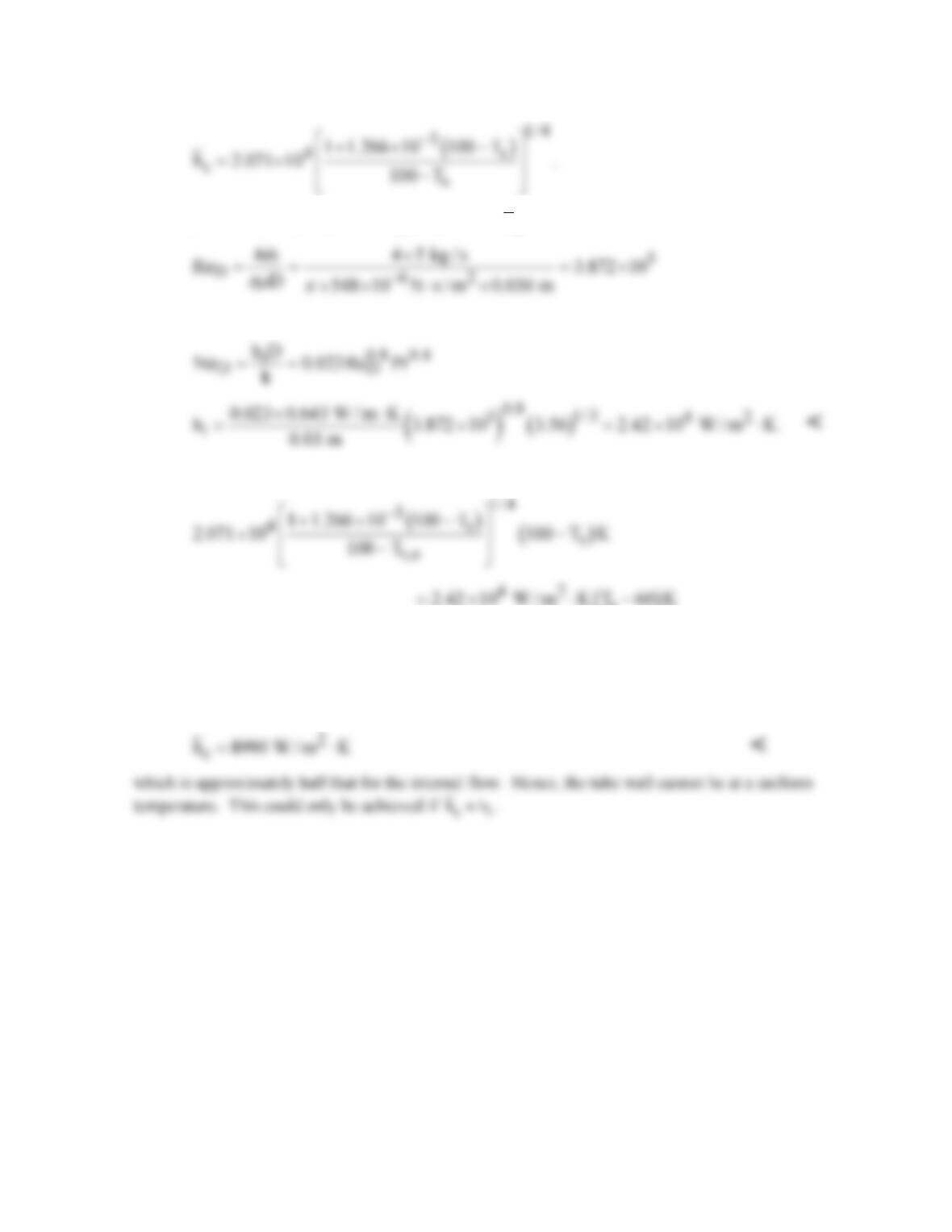
Internal flow. From Eq. 8.6, evaluating properties at
m
T,
find
and for turbulent flow use the Dittus Boelter equation,
Substituting numerical values into the energy balance relation,
( )
s
2.42 10 W / m K T 60 K=× ⋅−
and by trial-and-error, find
s
T 70.8 C.š
With this value of Ts, find that
PROBLEM 10.47
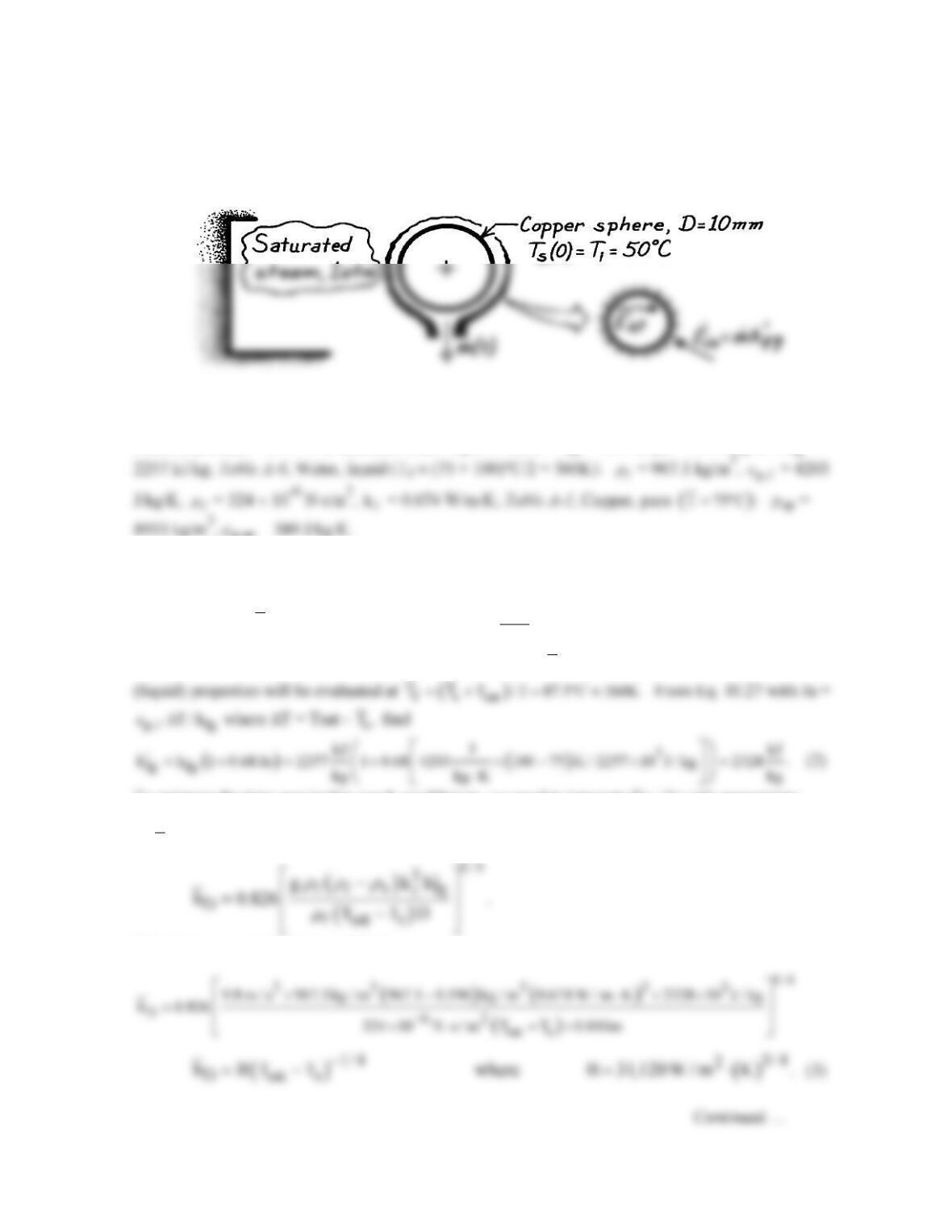
KNOWN: Copper sphere of 10 mm diameter, initially at 50°C, is placed in a large container filled
with saturated steam at 1 atm.
FIND: Time required for sphere to reach equilibrium and the condensate formed during this period.
SCHEMATIC:
ASSUMPTIONS: (1) Laminar film condensation, (2) Negligible non-condensables in vapor, (3)
Sphere is spacewise isothermal, (4) Sphere experiences heat gain by condensation only.
PROPERTIES: Table A-6, Saturated water vapor (1 atm): Tsat = 100°C, ρv = 0.596 kg/m3, hfg =
ANALYSIS: Using the lumped capacitance approach, an energy balance on the sphere provides,
in out st
EE E−=
( )
s
fg D s sat s sp p,sp s
dT
mh h A T T c V .
dt
ρ
′= −=
(1)
Properties of the sphere, ρsp and cp,sp, will be evaluated at
( )
s
T 50 100 C / 2 75 C,=+°=°
while water
To estimate the time required to reach equilibrium, we need to integrate Eq. (1) with appropriate
limits. However, to perform the integration, an appropriate relation for the temperature dependence
of
D
h
needs to be found, as discussed in Chapter 5. Using Eq. 10.46 with C = 0.826,
Substitute numerical values and find,