10-38
P10-11 (continued)
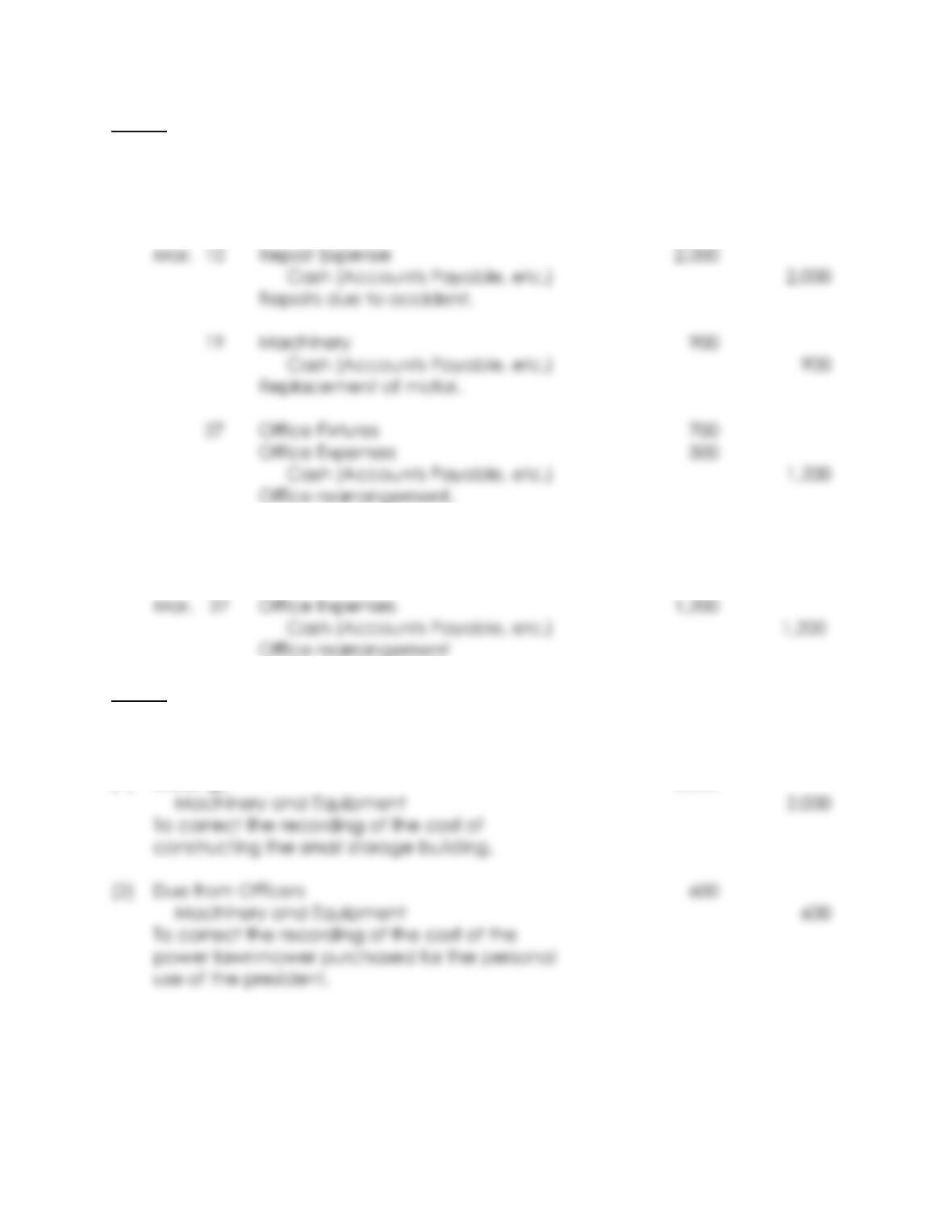
Feb. 14 Repair Expense 700
Cash (Accounts Payable, etc.) 700
Repairs to machine.
2. Under IFRS, the cost of reorganizing PP&E is expensed. Therefore, the journal
entry on March 27 would be:
P10-12 (AICPA adapted solution)
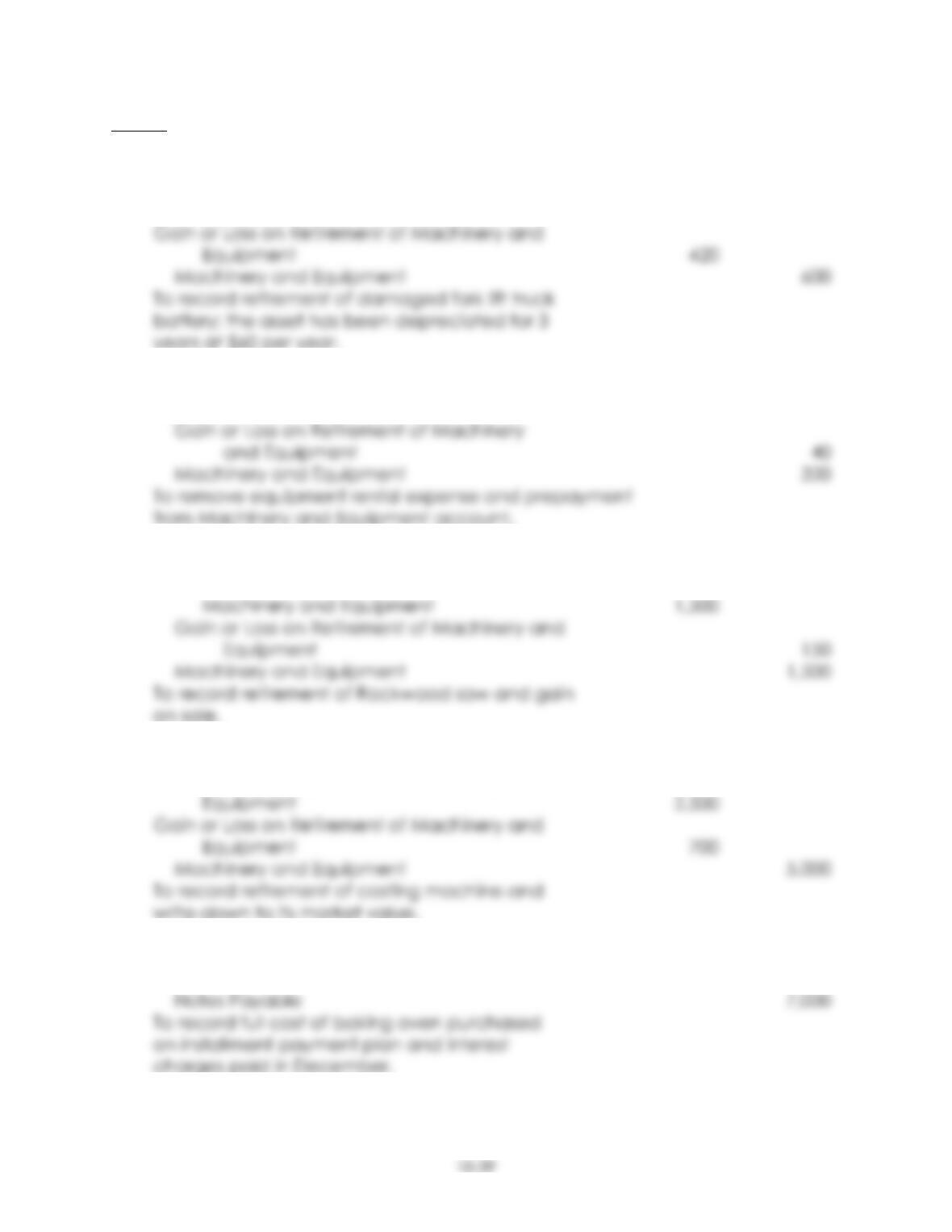
1. Adjusting journal entries, December 31, 2010
(1) Buildings 2,000
P10-12 (continued)
1. (continued)
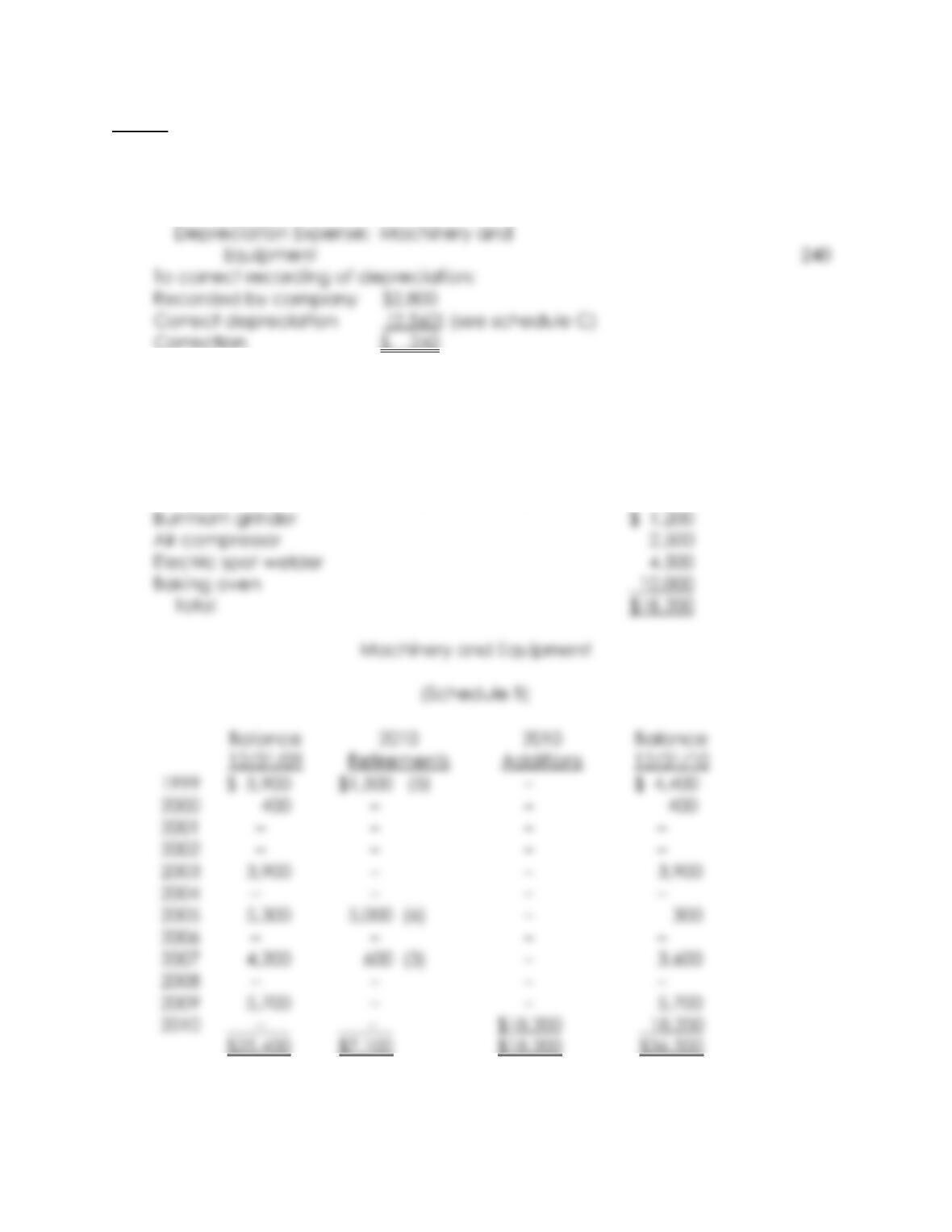
(3) Accumulated Depreciation: Machinery and
Equipment 180
(4) Prepaid Equipment Rental Expense 180
Equipment Rental Expense 180
(5) Machinery and Equipment 150
Accumulated Depreciation:
(6) Machinery and Equipment Held for Sale 1,800
Accumulated Depreciation: Machinery and
(7) Machinery and Equipment 6,964
Interest Expense 36
10-40
P10-12 (continued)
1. (continued)
(8) Accumulated Depreciation: Machinery and
Equipment 240
2. Schedules
THE DEWOSKIN COMPANY
Machinery and Equipment Acquisitions
December 31, 2010
(Schedule A)
P10-12 (continued)
2. (continued)
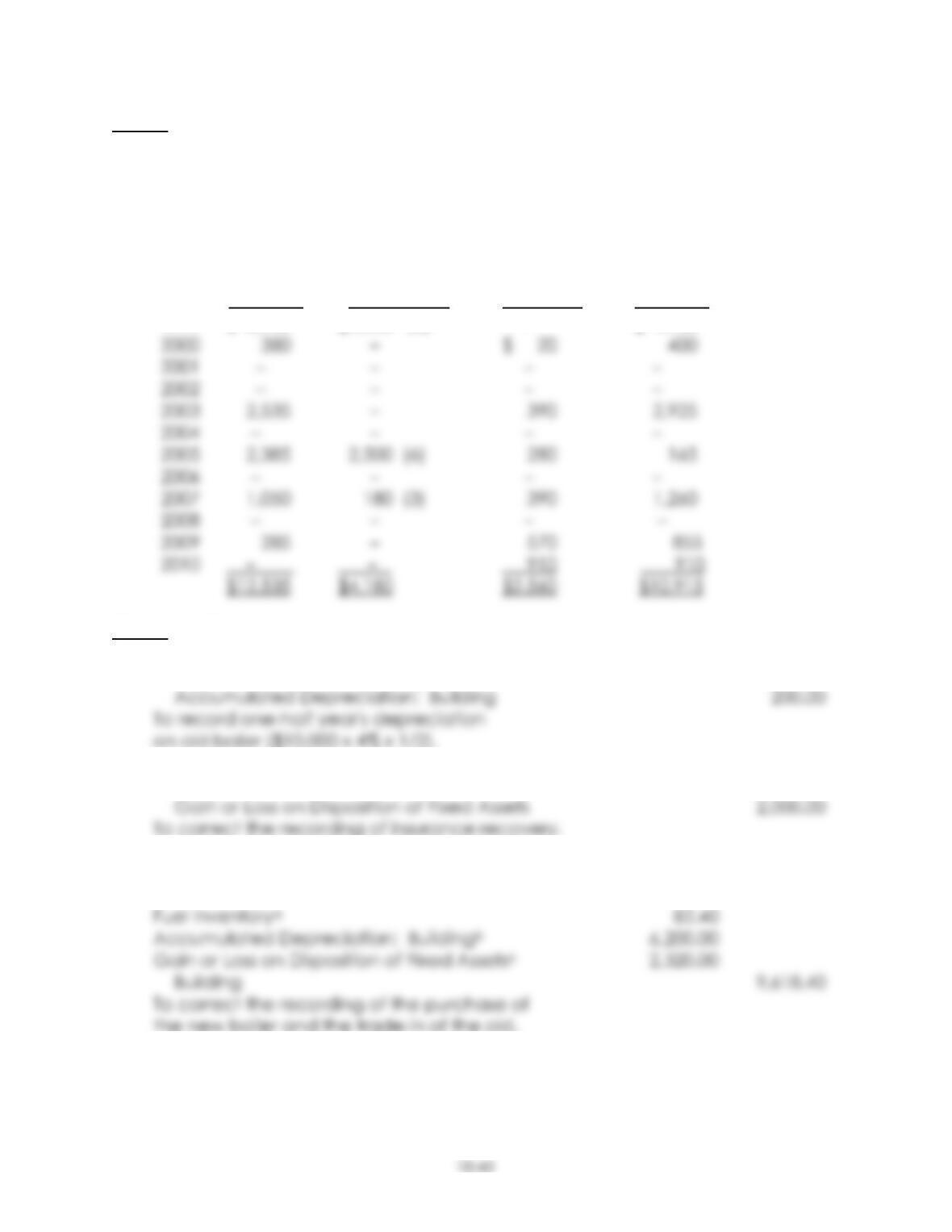
Accumulated Depreciation
(Schedule C)
Balance
12/31/09
2010
Retirements
2010
Additions
Balance
12/31/10
1999
$ 5,900
$1,500 (5)
–
$ 4,400
P10-13 (AICPA adapted solution)
1. Depreciation Expense: Building 200.00
2. Building 2,000.00
3. Purchase Discountd 274.40
Fuel Expensea 741.60
P10-13 (continued)
3. (continued)
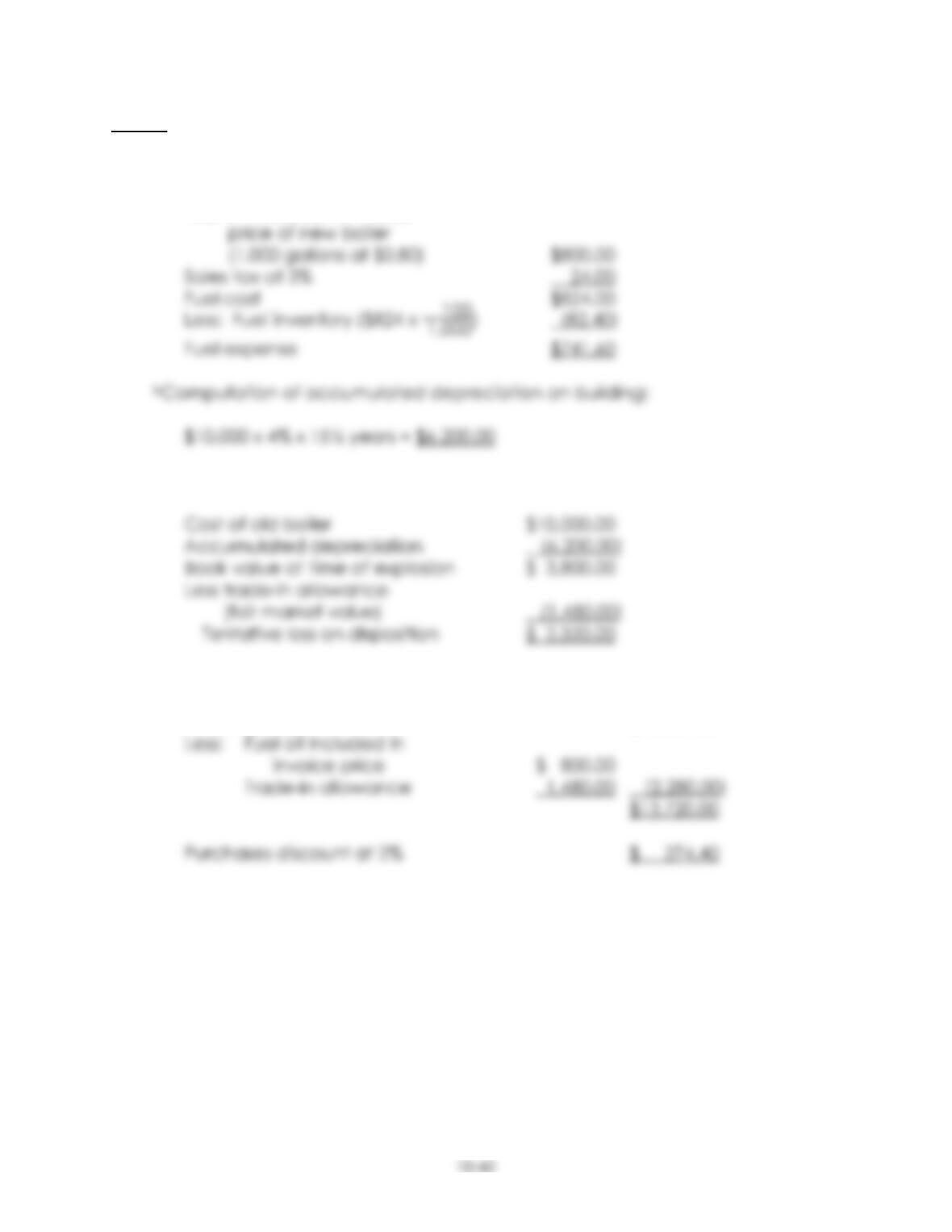
aComputation of fuel expense
Fuel oil included in invoice
cComputation of gain or loss on disposition of fixed assets:
dComputation of cash discount on purchase of boiler:
Invoice price $16,000.00
P10-13 (continued)
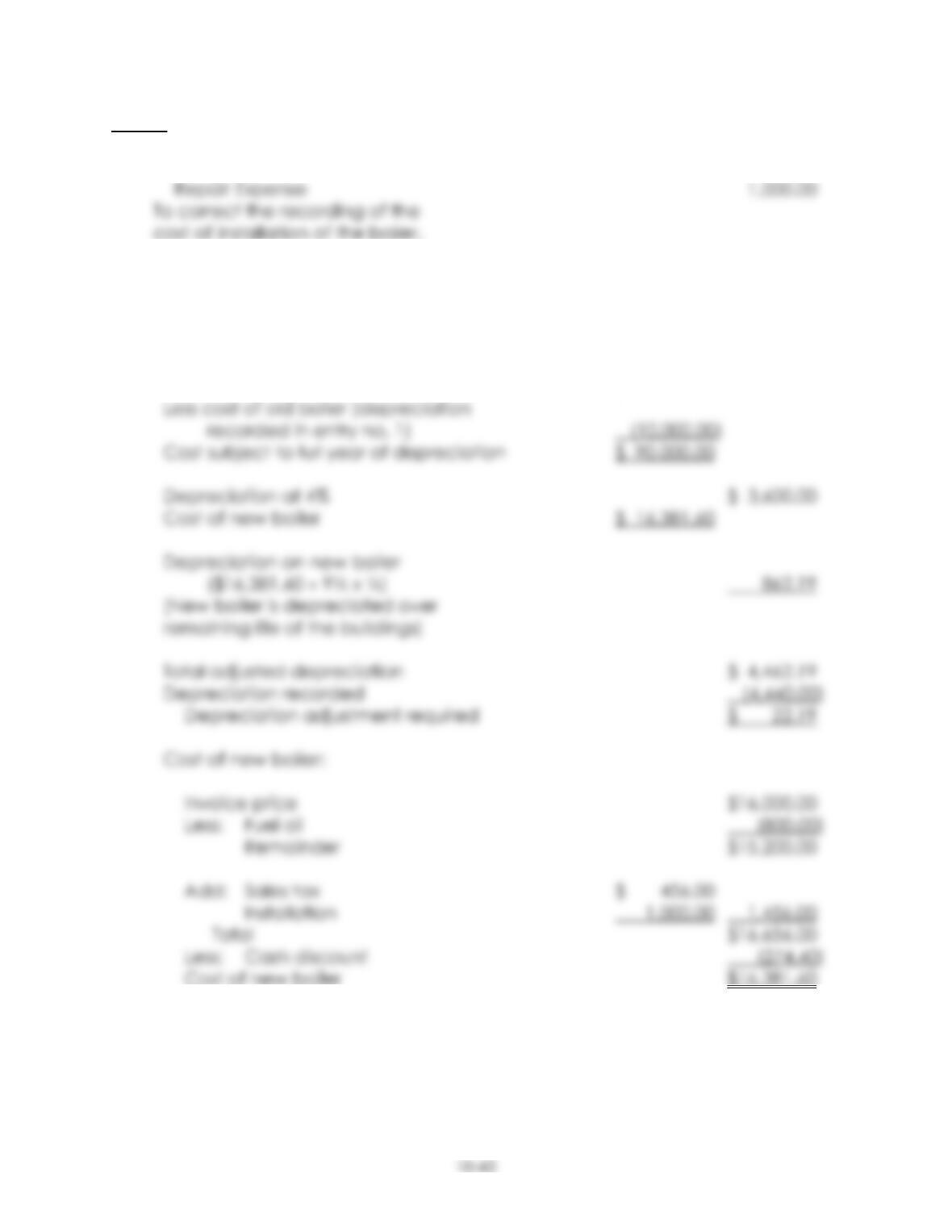
4. Building 1,000.00
5. Depreciation Expense: Buildinge 22.19
Accumulated Depreciation: Building 22.19
To correct recorded depreciation expense
on the building and the new boiler.
eCost of building $100,000.00
10-44
P10-14
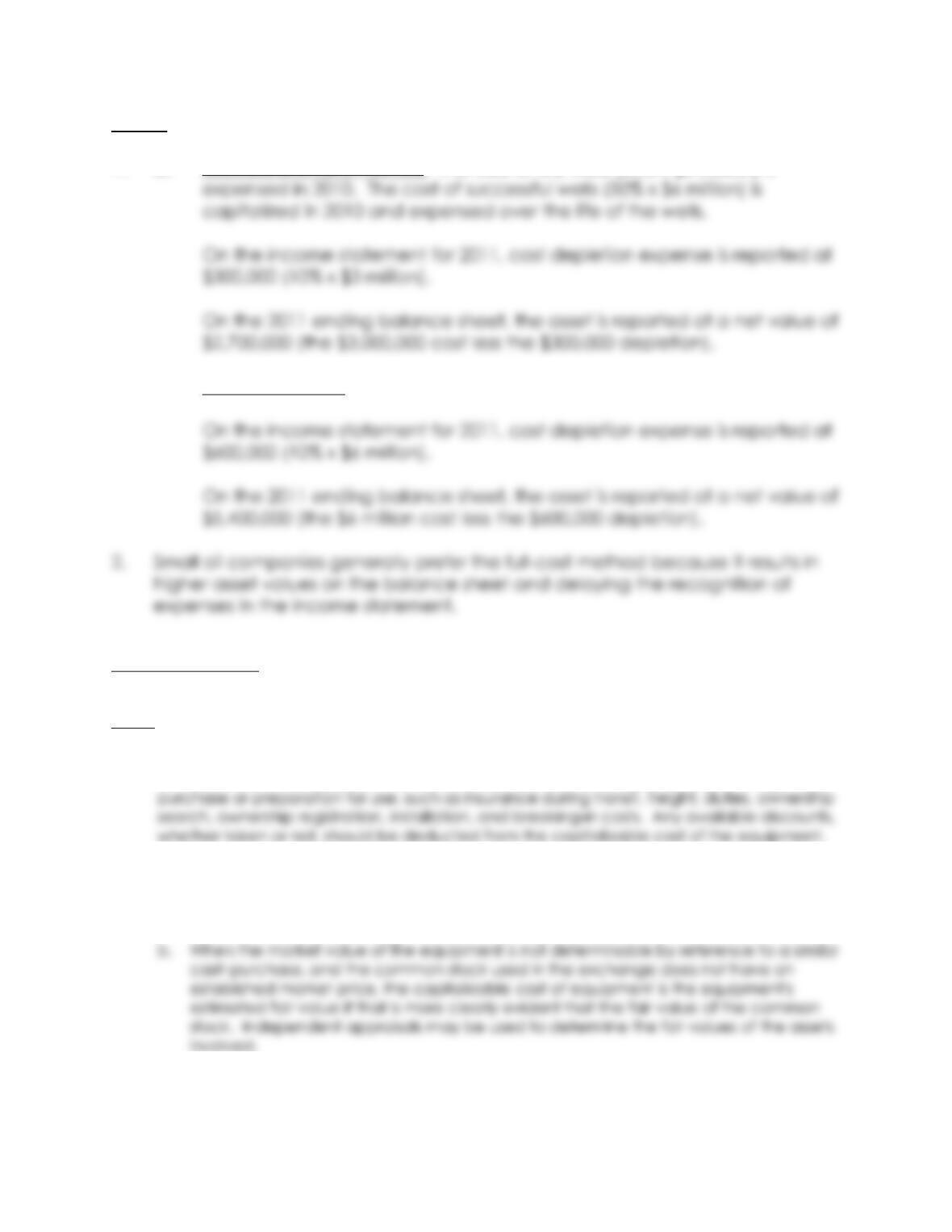
1. a. Successful-efforts method: The cost of dry wells (50% x $6 million) is
b. Full-cost method: The total cost of $6 million is capitalized in 2010.
ANSWERS TO CASES
C10-1 (AICPA adapted solution)
1. The expenditures that are capitalized when equipment is acquired for cash include the
invoice price of the equipment (net of discounts) plus all incidental outlays relating to its
2. a. When the market value of the equipment is not determinable by reference to a similar
cash purchase, the capitalizable cost of equipment purchased with bonds having an
established market price is the market value of the bonds.
10-45
C10-1 (continued)
2. (continud)
c. When the market value of equipment acquired is not determinable by reference to a
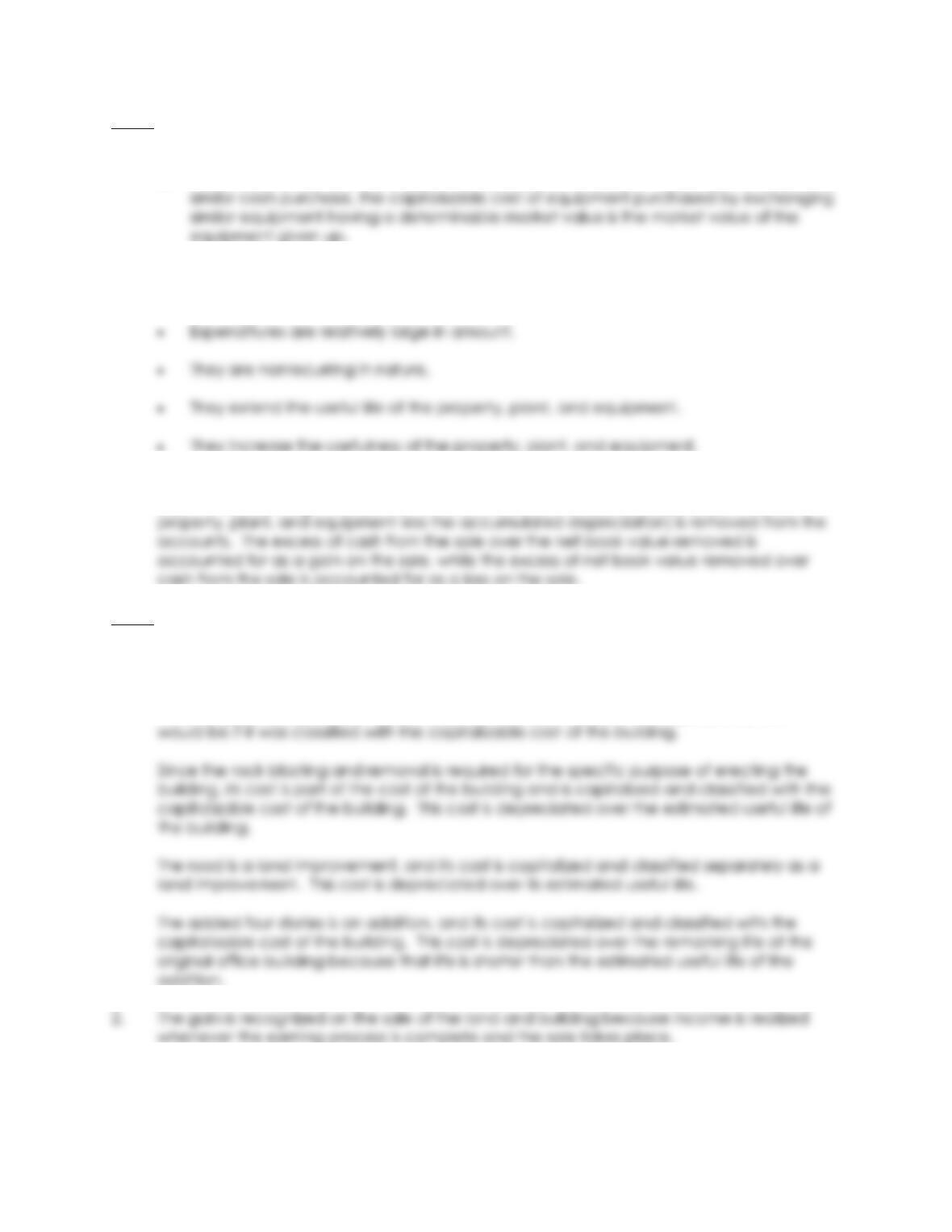
3. The factors that determine whether expenditures relating to property, plant, and
equipment already in use are capitalized are as follows:
4. A company accounts for the gain or loss on the sale of property, plant, and equipment for
cash in the following manner. The net book value at the date of the sale (cost of the
C10-2 (AICPA adapted solution)
1. Expenditures are capitalized when they benefit future periods. The cost to acquire the
land is capitalized and classified as land, a nondepreciable asset. Since tearing down the
small factory is readying the land for its intended use, its cost is part of the cost of the land
and is capitalized and classified as land. As a result, this cost is not depreciated as it
10-46
C10-2 (continued)
2. (continued)
The book value at the date of the sale is composed of the capitalized cost of the land, the
C10-3 (AICPA adapted solution)
1. The capitalizable cost includes all costs relating to purchase or preparation for use. Such
2. Normal maintenance performed on the new machine should not be capitalized as part of
the machine’s cost. It should be expensed as incurred if the machine is not used in the
3. The wing added to the manufacturing building should be capitalized. The addition should
4. The leasehold improvements made to the office space should be capitalized. The
leasehold improvements should be depreciated (amortized) over their estimated useful
C10-4 (AICPA adapted solution)
1. The following costs, if applicable, should be capitalized as a cost of land:
(a) Negotiated purchase price
(b) Brokers’ commission
10-47
C10-4 (continued)
1. (continued)
2. A plant asset acquired on a deferred-payment plan should be recorded at an equivalent
cash price excluding interest. If interest is not stated in the sales contract, an imputed
3. In general, plant assets should be recorded at the fair value of the asset surrendered plus
(minus) cash paid (received).
C10-5 (AICPA adapted solution)
2. a. The purchase price of the land should be capitalized. The land should be shown as a
noncurrent asset on the balance sheet at its original cost and it is not subject to
depreciation.
b. The cost of constructing the factory should be capitalized and depreciated over the
expected life of the factory. The depreciation should be added to cost of inventory,
c. The cost of grading and paving the parking lot should be capitalized and
depreciated over the expected life of either the factory or parking lot, whichever is
d. The cost of maintaining the factory once production has begun is a “revenue type”
expenditure. However, since it is a factory cost, it should be added to cost of
C10-6
1. a. It is clear that considerable value attaches to the television rights. A conservative
approach to the valuation is to compute the present value of the cash flows
b. The value assigned to the television rights is considered depreciable because the
service provided by the franchise (that is, playing the games) is partially used up each
c. The purchase price assignable to player contracts is the present value of the benefits
generated by the player less the salaries payable under current contracts. This is a
subjective valuation that would be very difficult to determine in practice.
2. Students may raise ethical issues, such as:
a. Conflicts between the interests of different stakeholders–particularly management,
stockholders, and the government.
C10-7
1. There is no doubt that the first 2,000 acres qualifies for interest capitalization because it
meets the various criteria of GAAP. It meets the criteria of a qualifying asset and the three
C10-7 (continued)
1. (continued)
It is less definite whether the adjacent parcel of land qualifies for interest capitalization.
The decision will probably be determined by how the company has developed its plans. If
2. The company could commence activities on all the land, by starting such activities as
planning the future expansion. Since GAAP states that the term activities is to be
C10-8
Capitalize at $100,000: The option costs are not applicable to the purchase price and are,
therefore, not a cost of the land. Rather, they are an expense incurred during the year
C10-9
According to GAAP, donated assets are recorded at their fair value. The controller’s
argument of no payment by the company is what makes the acquisition a nonreciprocal
transfer and thus governed by GAAP. This procedure also makes the recording of the
C10-10 (AICPA adapted solution)
1. The valuation of assets that are acquired by a corporation in exchange for its own
common stock is sometimes difficult because of:
a. The absence of a readily determinable fair value for the assets acquired because
they are not traded actively.
2. a. The directors of Brahe Corporation appraised the leases at $600,000 and the
transaction involving the stock issuance to Messrs. Moses and Price supports that
appraisal. In the exchange transaction, a price of $6 per share was imputed to the
b. Brahe Corporation might have taken additional steps to demonstrate the
reasonableness of the $600,000 appraisal of leases so that more information would be
available if questions were raised about their possible overvaluation. Because the
C10-10 (continued)
3. Based on available information, Brahe Corporation should charge 1/10 of the value of the
leases against income at December 31, 2010, in accordance with generally accepted
C10-11
Note to Instructor: This case does not have a definitive answer. From a financial reporting
perspective, GAAP is identified and summarized. From an ethical perspective, various
issues are raised for discussion purposes.
From a financial reporting perspective, there are 3 issues. The first issue relates to when
error because there was a misapplication of accounting principles. The error would be
accounted for as a prior period adjustment. So the CEO has to accept the “good” of
maximizing the interest capitalization in 2010 and the “bad” of admitting to an error in
applying accounting principles (even though income in 2009 will be increased by the error
correction). Of course, the suggestion of including 2009’s interest capitalization in 2010 is
not appropriate.
10-52
ANSWERS TO RESEARCH SIMULATIONS
R10-1
Note to Instructor: Students are expected to cite references to GAAP in their research of
1. To: President, Tenth National Bank
From: Student
I have researched the issue of how to account for the costs of removing the asbestos from
the two buildings. According to the FASB Statement of Concepts No. 6, par. 25 and 26,
assets are probable future economic benefits obtained or controlled by a particular entity
extend the useful life or improve the physical structure beyond the state in which it was
originally intended to be used. Under this argument, the cost would be expensed.
The second issue is the shopping mall in which the asbestos problem was not known at the
time the building was acquired. The following alternatives may be considered:
a. Expense the $1 million because it is a “maintenance” cost that does not extend the
10-53
R10-1 (continued)
1. (continued)
Another issue is how to classify the expense. Three alternatives are:
a. Report as an extraordinary item because it is considered to be unusual and infrequent
(APB 30, par. 20) (FASB Cod. # 225-20-45). This alternative is difficult to justify because
2. Students may raise ethical issues, such as:
a. Conflicts between the interests of different stakeholders–particularly management,
R10-2
Note to Instructor: Students are expected to cite references to GAAP in their research of
1. To: President, Perry Park Company
From: Student
I have researched the various issues involved in the exchange of the shares for the land
and building. I will address each of the major issues you raised:
a. Does the transaction qualify as an exception to the general rule to use fair value.
Since no cash was exchanged, it is a nonmonetary exchange. However, according
b. What is the value to place on the transaction and its components? According to the
APB 29, par. 18 (FASB Cod. # 845-10-30, either the value of the shares or the value of
2. Students may raise ethical issues, such as:
a. Conflicts between the interests of different stakeholders–particularly management,
stockholders, and the government.