and
()
== =
1
1
1
2
ft
21.6 s1.29
ft
32.2 8.7 ft
s
n
V
Fgy
This root does not satisfy our problem statement since the flow upstream of the sluice gate
is given as subcritical. For =
2
ft
37.7 s
q,
which is in agreement with the problem statement. Therefore,
=
2
ft
37.7 s
q (a) and =
1
ft
4.33 s
V (c)
The height 2
y
is found from
where
so
The velocity after the hydraulic jump is
The energy loss rate in the hydraulic jump is −−
== =
33
32
23
()
(6.29 ft 1.74 ft) 2.15ft
4 4(1.74 ft)(6.29 ft)
L
yy
hyy
.
Per unit of channel width, the rate of power loss is
or
ρρ
−+ − = −
22
11 2 2 2 2 1 1
F pyb p y b y bV ybV .
The force per unit width is
The numerical values give
–
p
= gage pressures
=
←⎯ ⎯ ⎯ ⎯⎯
lb
1010 ft
on water
F
b. (e)
Assuming a hydrostatic pressure distribution on the sluice gate, the force is
Problem 10.83
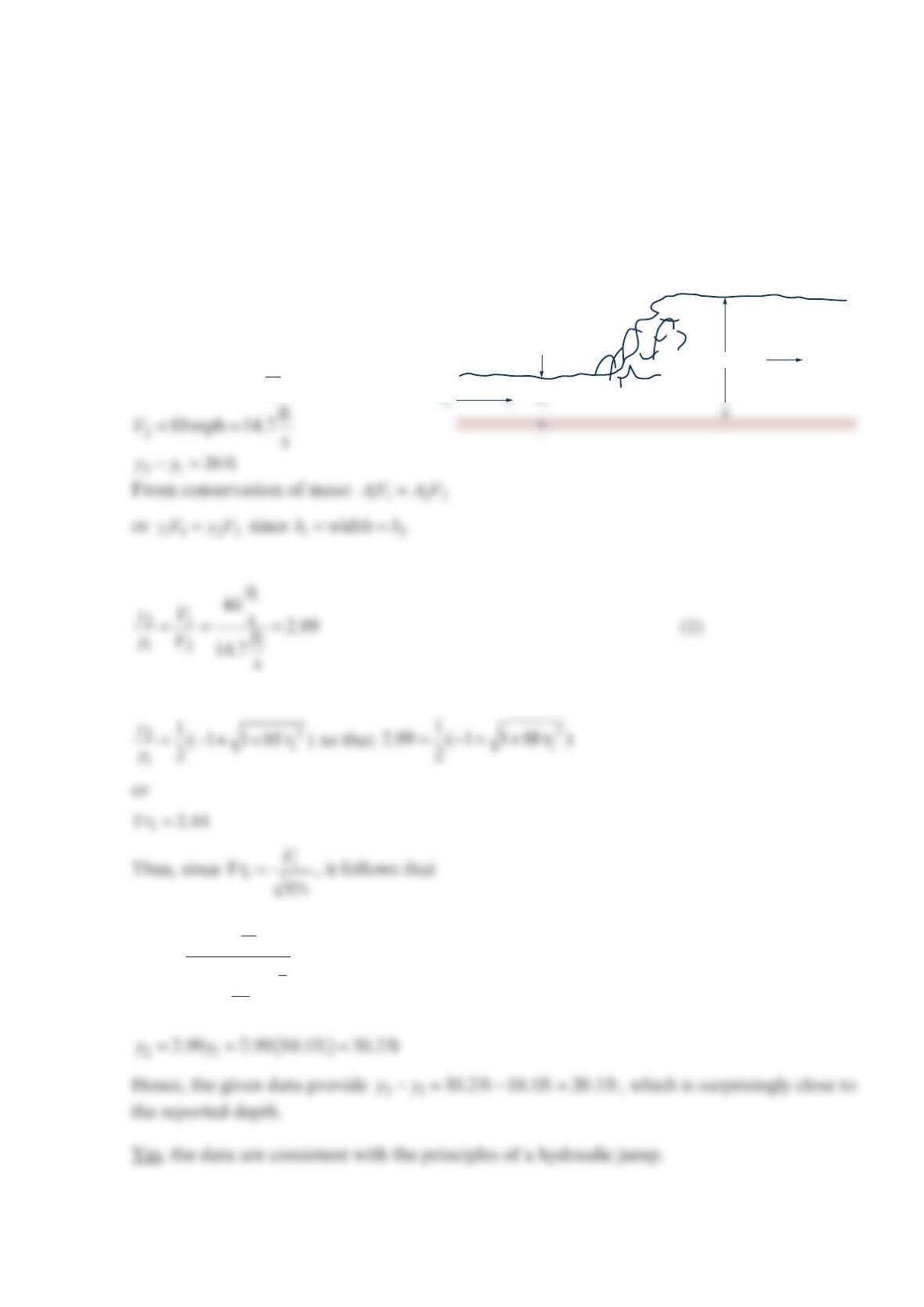
During the flood of 1983 , a large hydraulic jump formed at “Crystal Rapid” on the
Colorado River. People rafting the river at that time report “entering the rapid at almost
30 mph , hitting a 20-ft- tall wall of water, and exiting at about 10 mph .” Is this
information (i.e., upstream and downstream velocities and change in depth) consistent with
the principles of a hydraulic jump? Show calculations to support your answer.
Solution 10.83
Is the given data consistent with a
hydraulic jump?
==
1
ft
30 mph 44 s
V
Thus,
Also, for a hydraulic jump
=
1
2
1
2
ft
44 s
2.44
ft
32.2 sy
or =
110.1fty so that from Eq. (1),
y
2
V
2
y
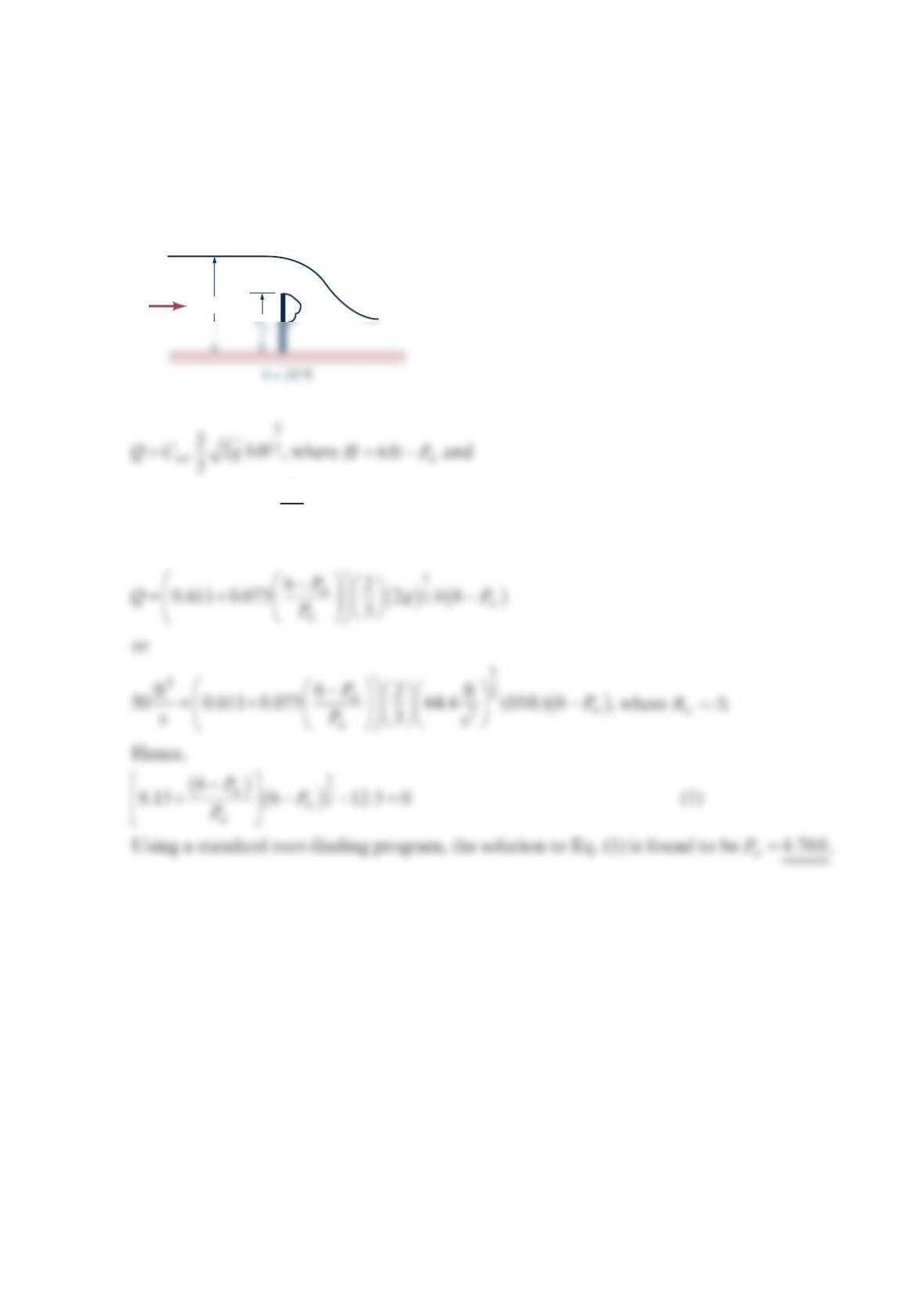
Problem 10.84
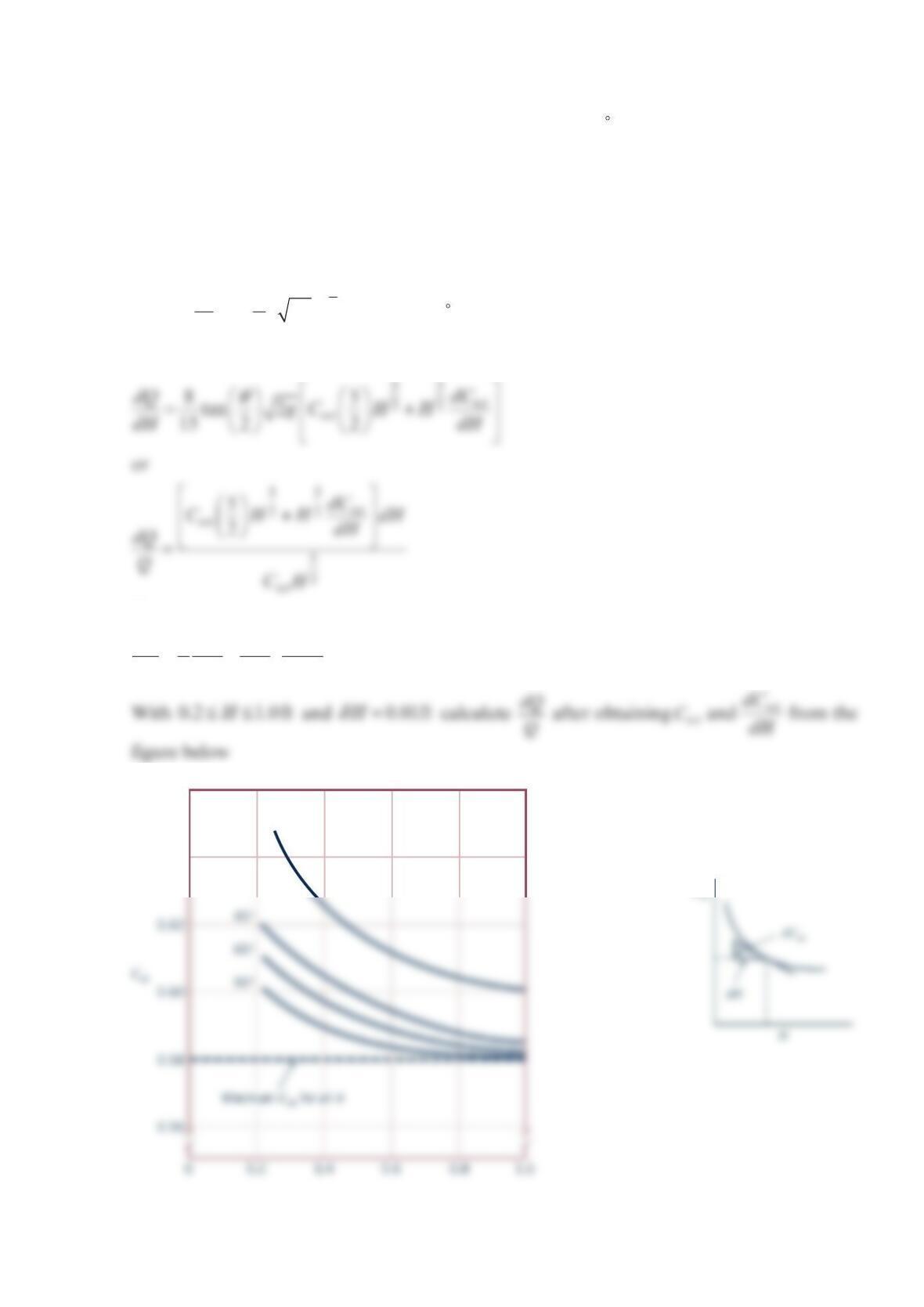
A rectangular sharp-crested weir is used to measure the flowrate in a channel of width 10 ft .
It is desired to have the upstream channel flow depth be 6ft when the flowrate is 50 cfs .
Determine the height, w
P, of the weir plate.
Solution 10.84
0.611 0.075
wr
w
H
C
P
=+
Thus,
6 ft
Q
= 50 ft
3
–––
s
Problem 10.85
Water flows over a sharp-crested triangular weir with =90
θ
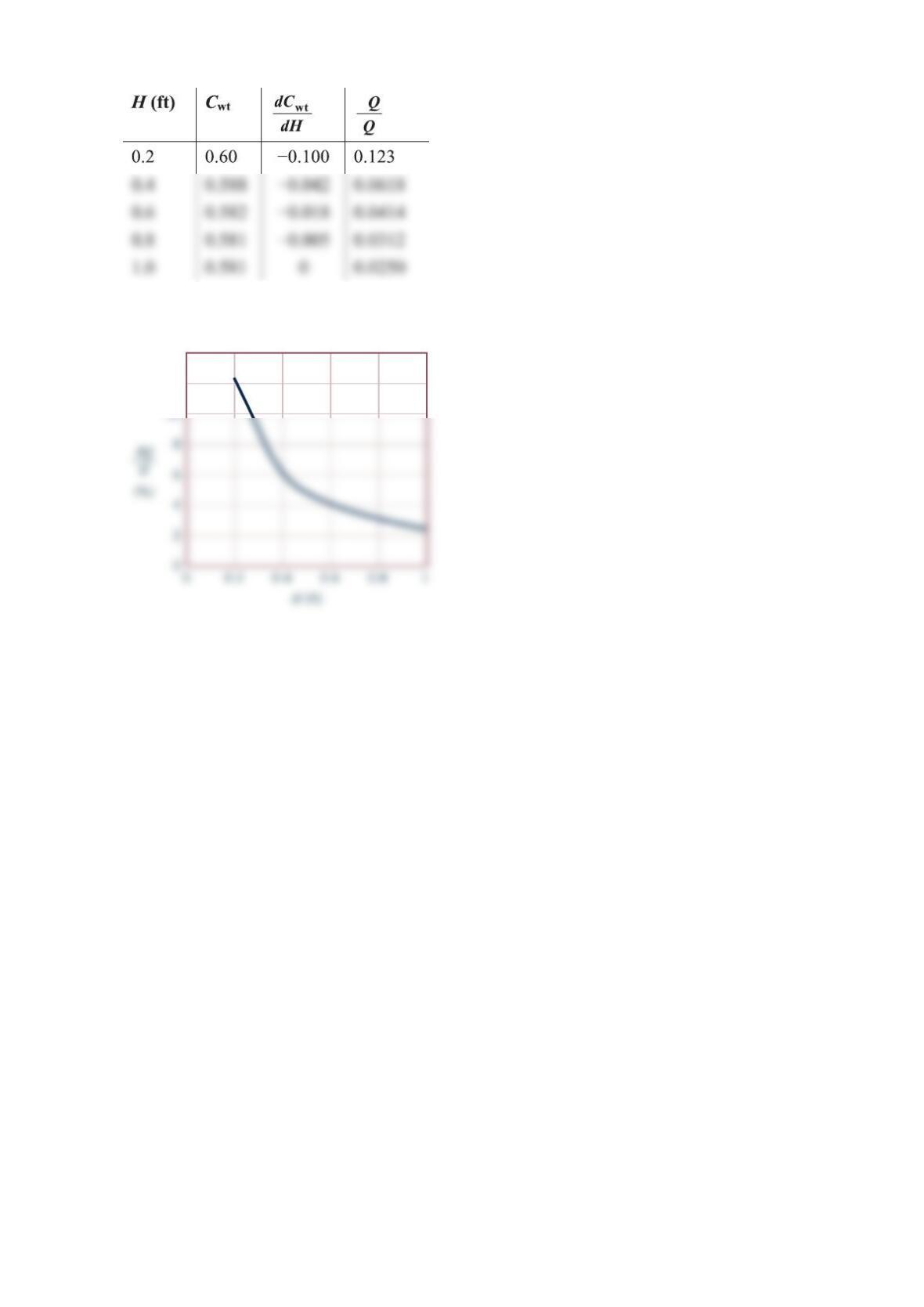
. The head range covered is
≤≤0.20 1.0 ftH and the accuracy in the measurement of the head, H, is
δ
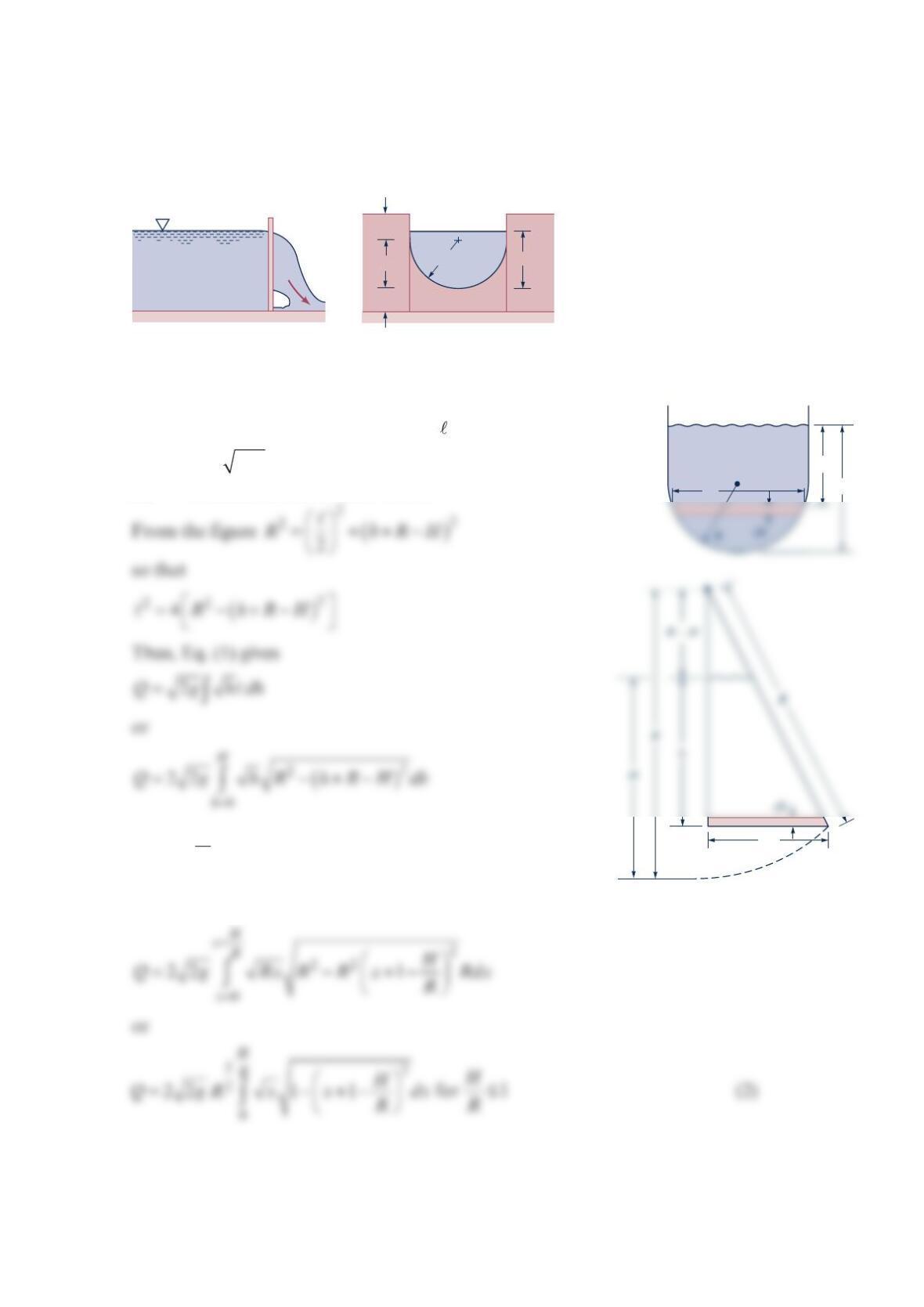
=±0.1ftH. Plot
a graph of the percent error expected in Q as a function of H.
Solution 10.85
5
2
8tan 2
15 2
wt
QC gH
θ
=
, where
θ
=90
Thus,
Hence,
51
2
wt
wt
dC
QH H
QHCdH
δδ δ
=+
(1)
0.66
0.64
= 20°
θ
C
δ
The above results are plotted below:
14
12
Problem 10.86
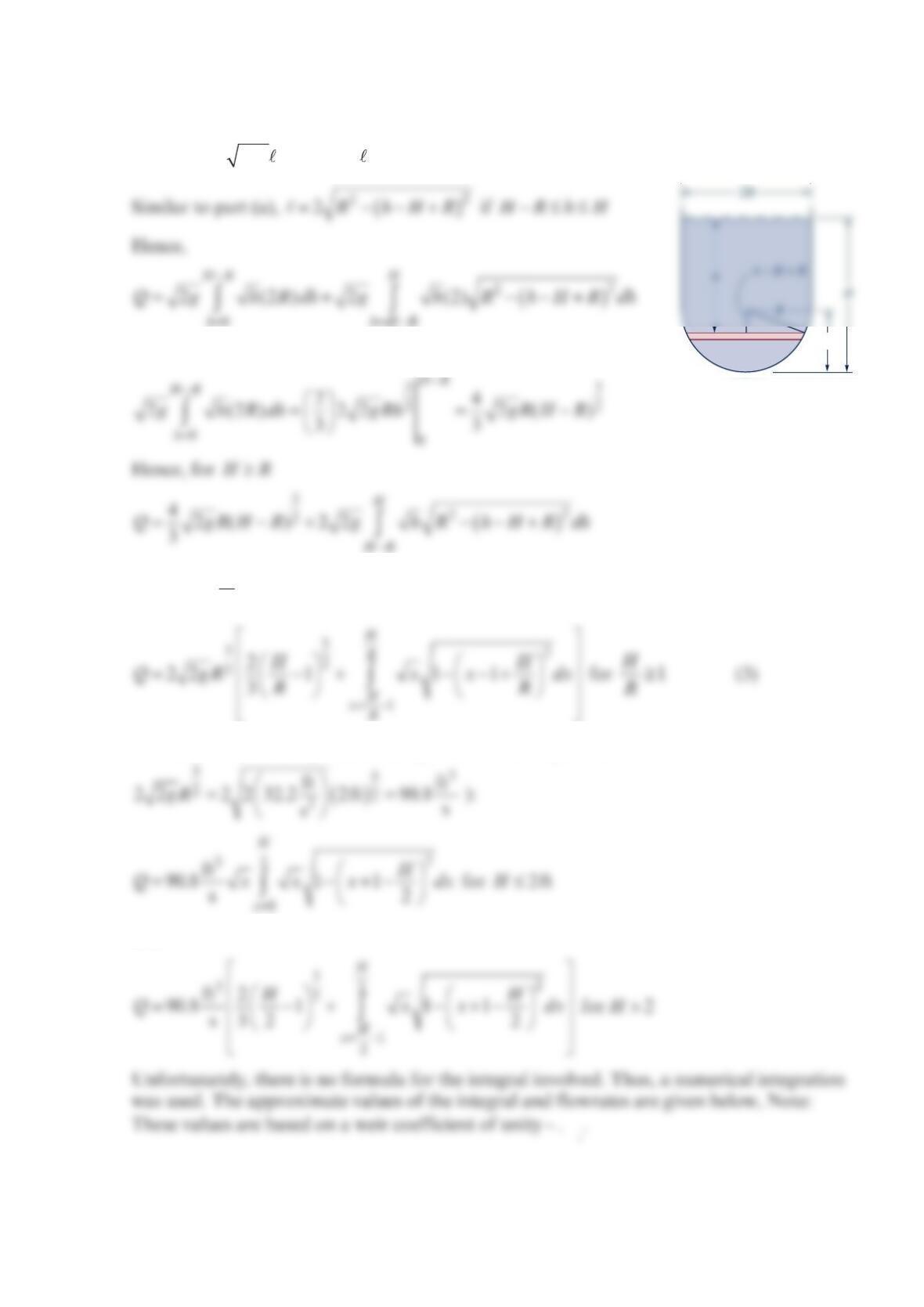
Water flows over the sharp-crested weir shown in the figure below. The weir plate cross
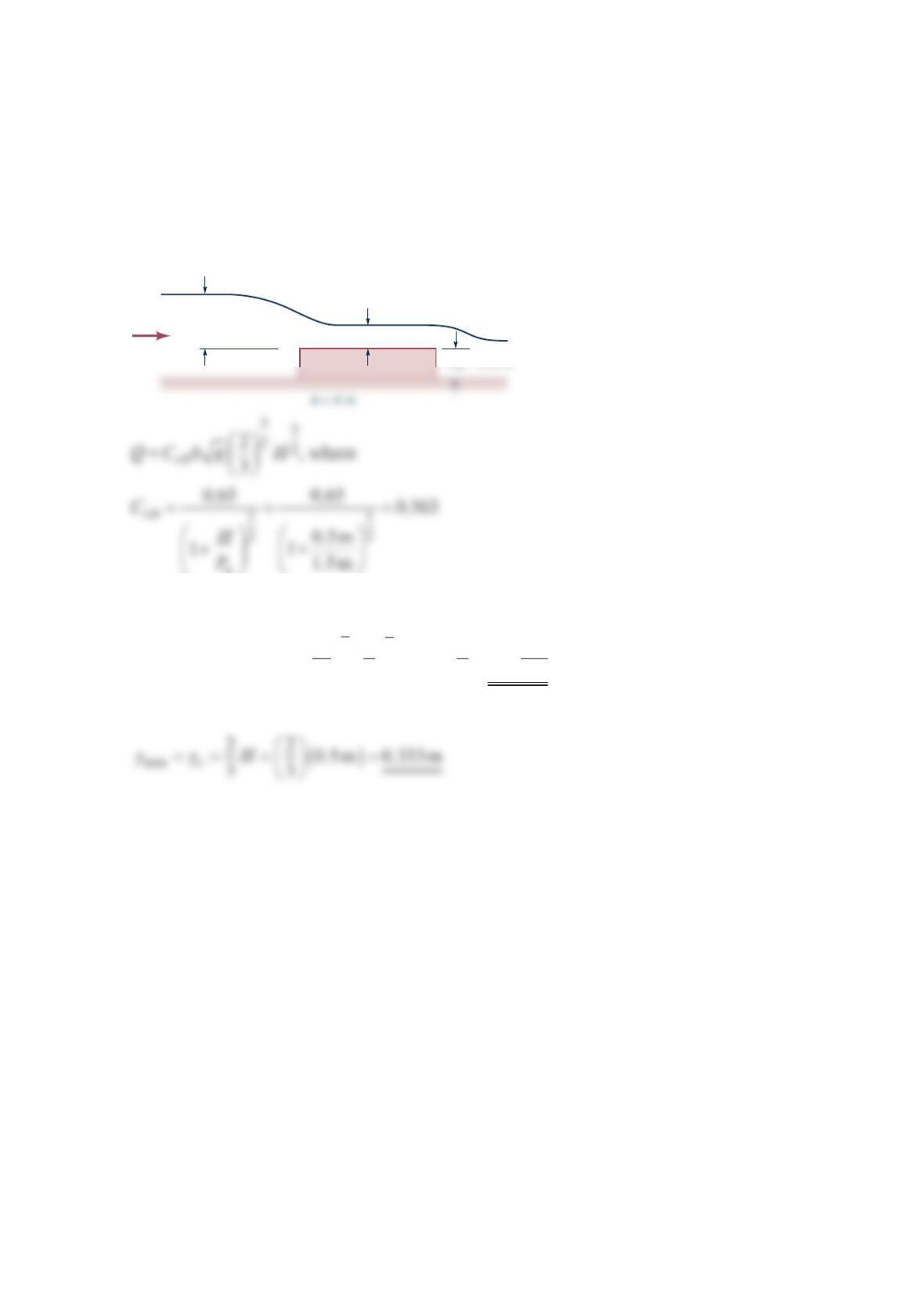
section consists of a semicircle and a rectangle. Plot a graph of the estimated flowrate, Q, as
a function of head, H. List all assumptions and show all calculations.
Solution 10.86
As done for other shape weirs, =
2
Qudh
(1)
where ≈
22ugh
(a) Consider the case where ≤HR
Let =h
xR be a dimensionless variable of integration.
Thus, =hRx
and =dh Rdx so that the above expression for Q becomes
2 ft
1.5 ft
1.5 ft
H
h
H
ℓ
__
2
ℓ
(b) Consider the case where ≥HR
Thus, =2Qghdh
where =2R if ≤≤ −0hHR
But the first integral is
or with =h
xR, this is
Thus, with =2ftR, Eqs. (2) and (3) give the following (since
and
R
ℓ
/2
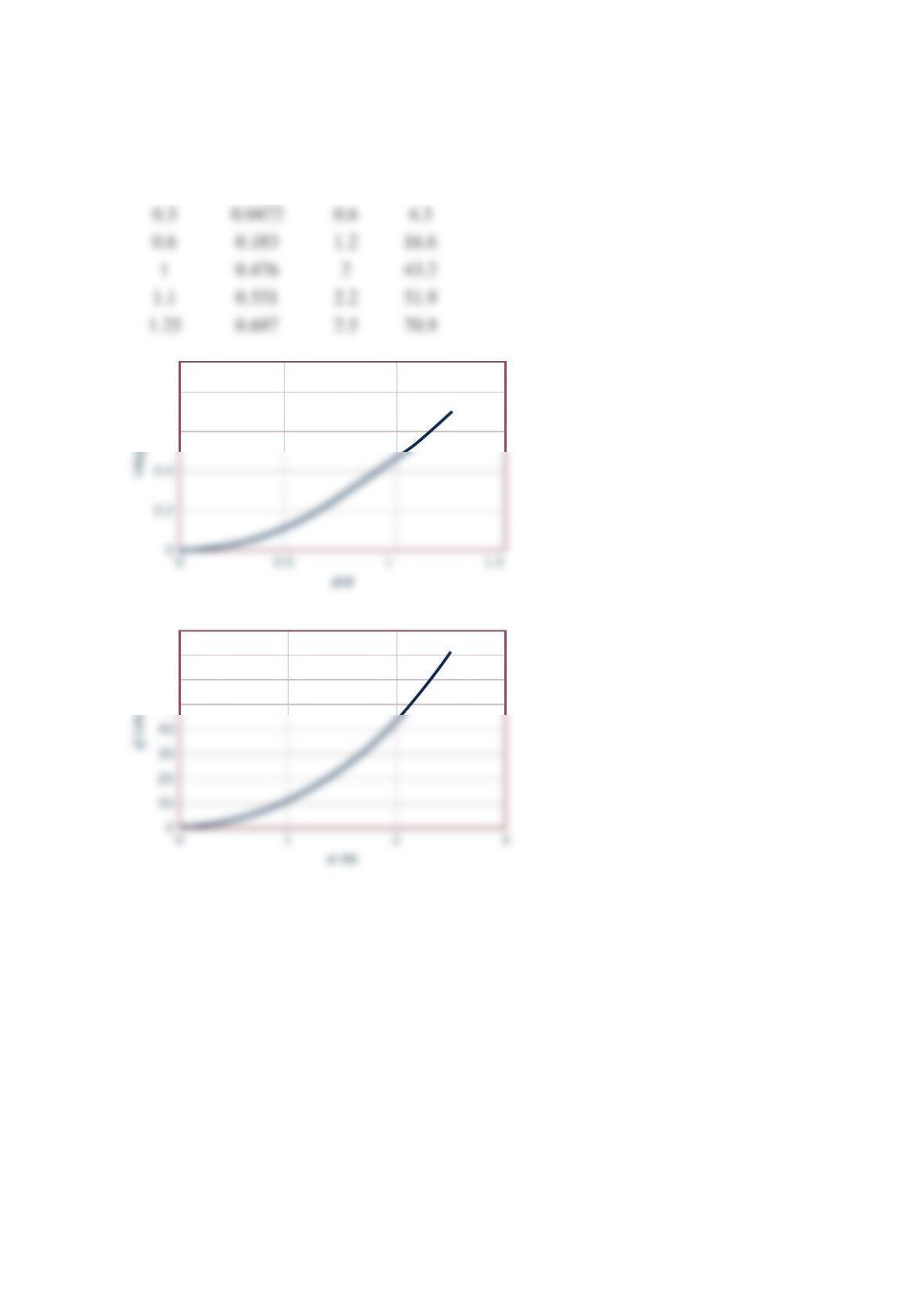
H/R Integral H (ft) Q (cfs)
0 0 0 0.0
0.1 0.00497 0.2 0.5
0.2 0.0209 0.4 1.9
0.8
0.6
Flowrate vs Water Depth
50
60
70
80
Problem 10.87
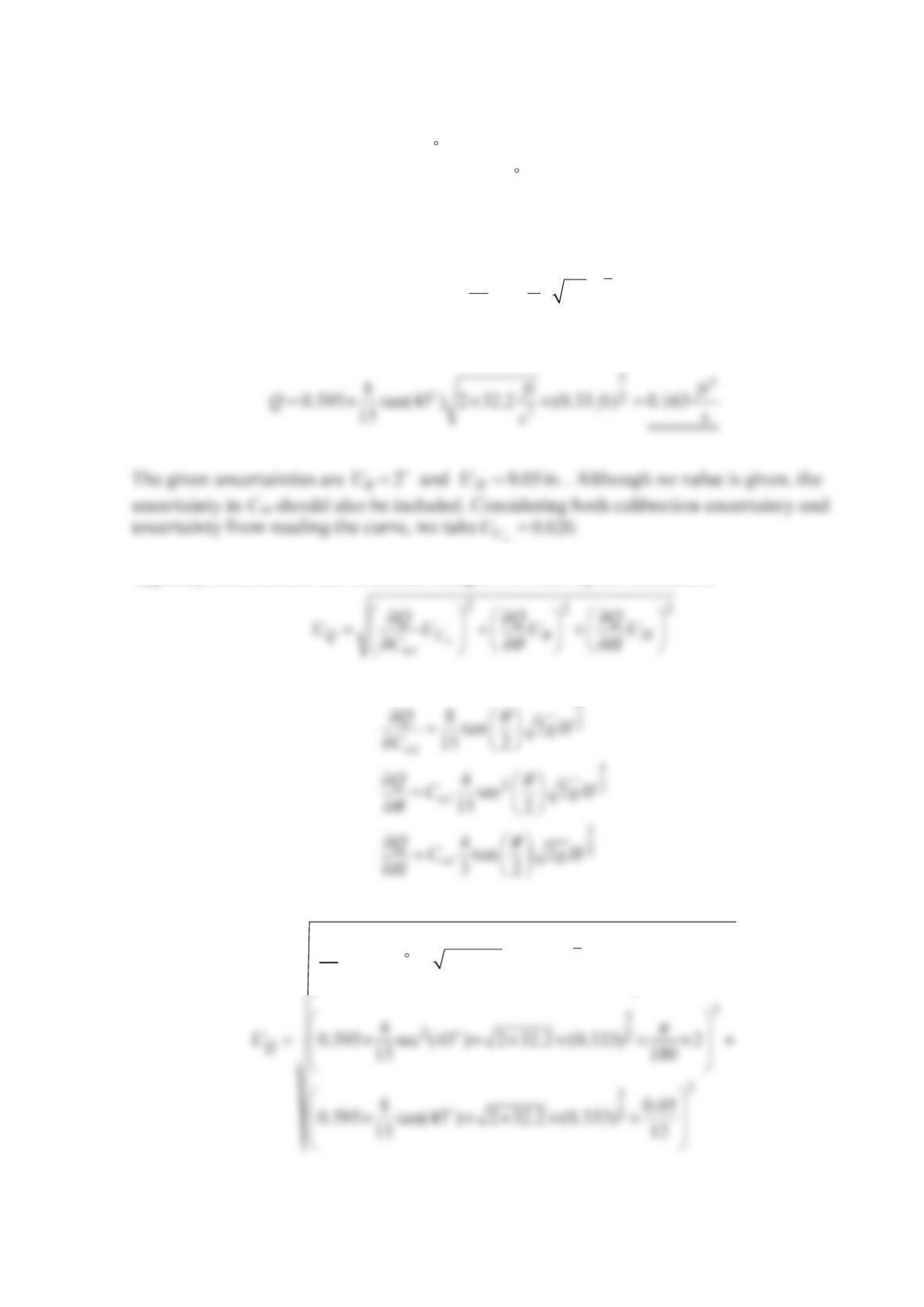
Water flows over a broad-crested weir that has a width of 4m and a height of 1.5 m
w
P=.
The free-surface well upstream of the weir is at a height of 0.5 m above the surface of the
weir. Determine the flowrate in the channel and the minimum depth of the water above the
weir block.
Solution 10.87
w
Thus,
()() ()
==
133
22
2
m2 3 m
0.563 4 m 9.81 0.5 m 1.36
32s
s
Q
Also,
H
= 0.5 m
P
y
min
Q
Problem 10.88
An engineering laboratory experiment uses a triangular weir in an open channel to measure
flowrate. The nominal weir angle is
9
0. In a certain test, the head of water above the weir
was 4in. The uncertainty in the weir angle is ±2 and the uncertainty in the depth
measurement is ±0.05 in . Compute the flowrate and the uncertainty in the flowrate.
Solution 10.88
The flowrate is
5
2
8tan 2
15 2
wt
QC gH
θ
=
From the triangular weir calibration curve 0.595
wt
C
≈so
Typically, uncertainties are combined using a root-sum-square calculation
The derivatives are
Substituting values
×××××+
2
5
2
8tan(45 ) 2 32.2 (0.333) 0.02
15

Problem 10.89
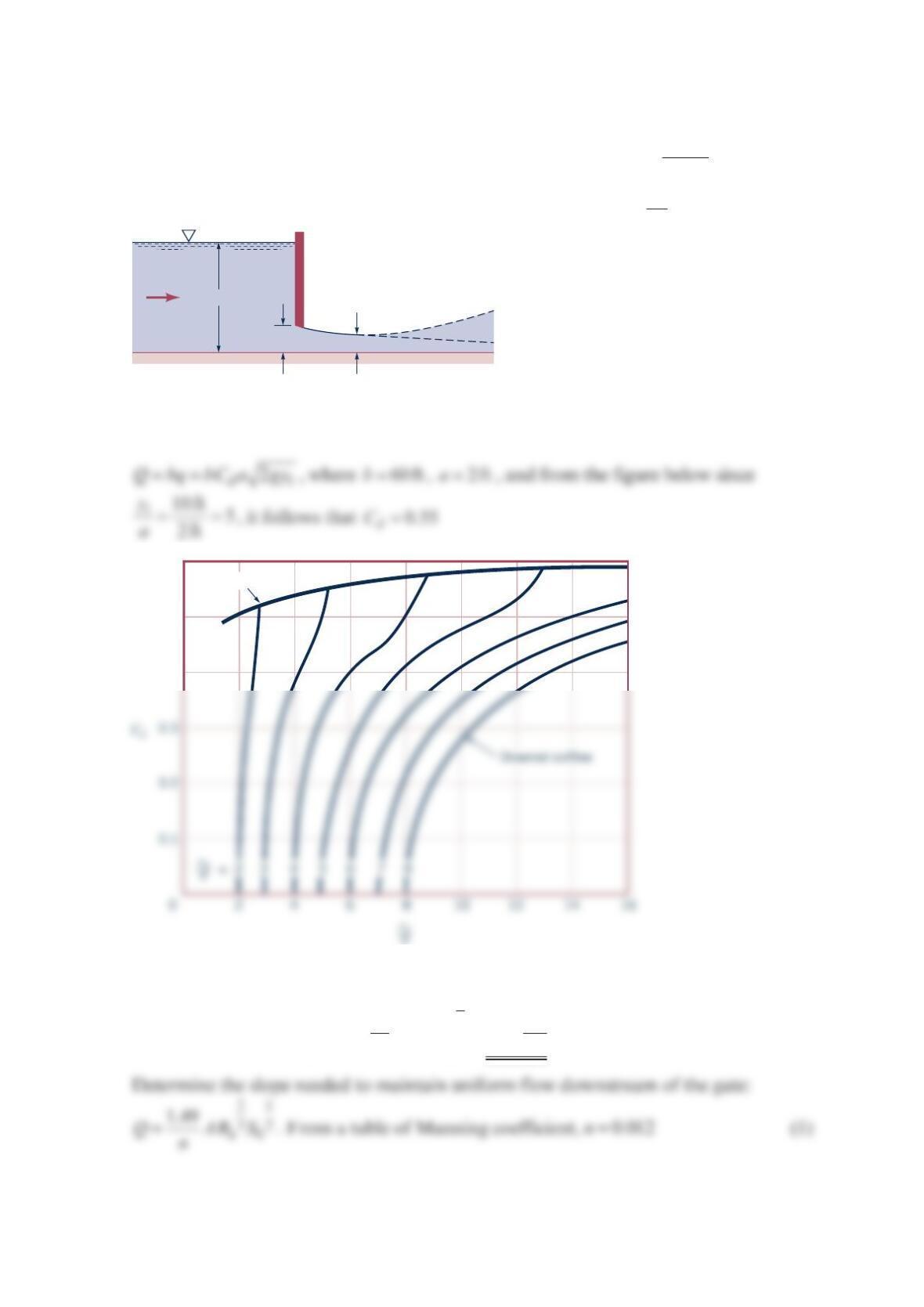
Water flows under a sluice gate in a 60-ft- wide finished concrete channel as is shown in the
figure below. Determine the flowrate. If the slope of the channel is 2.5ft
200 ft , will the water
depth increase or decrease downstream of the gate? Assume ==
20.65
c
y
C
a. Explain.
Solution 10.89
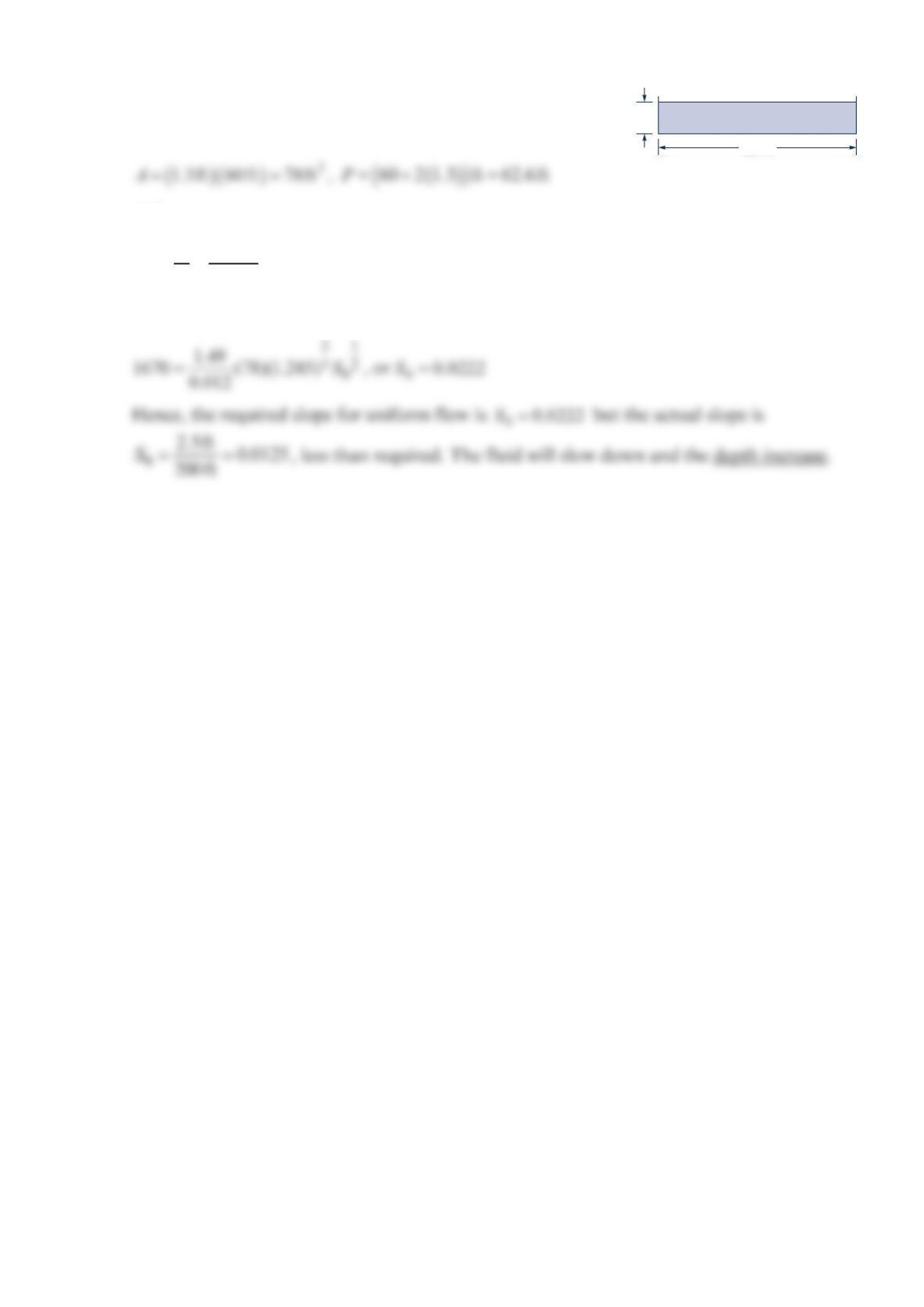
Hence,
()()() ()
==
13
2
2
ft ft
60 ft 0.55 2 ft 2 32.2 10 ft 1670 s
s
Q
a = 2 ft
y2
10 ft
Q
Free outflow
0.6
0.5
0.4
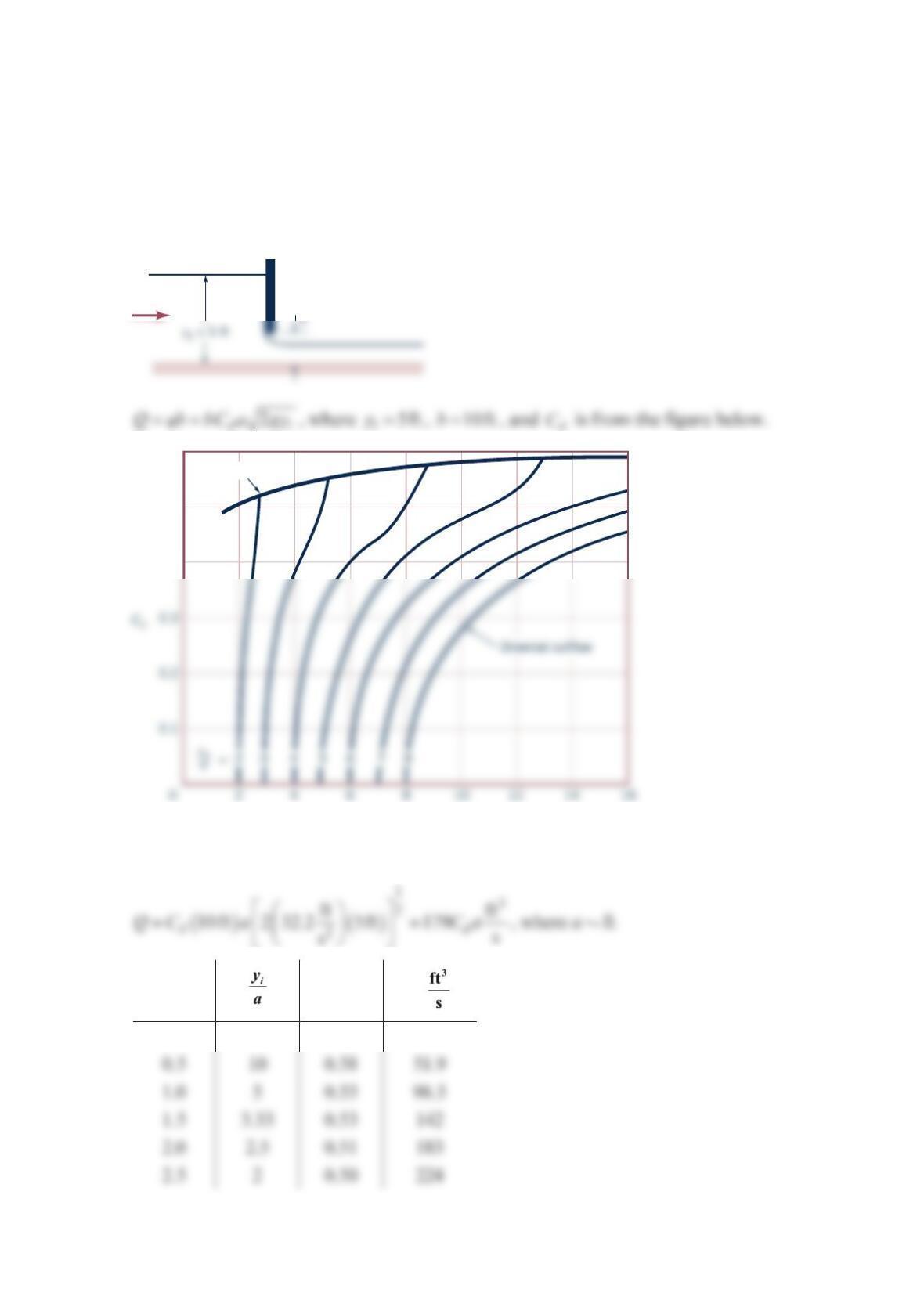
Also, == =
20.65(2 ft) 1.3ft
c
yCa
so that
and
== =
2
78ft 1.245 ft
62.6 ft
h
A
RP
Thus, from Eq. (1)
60 ft
1.3 ft
Problem 10.90
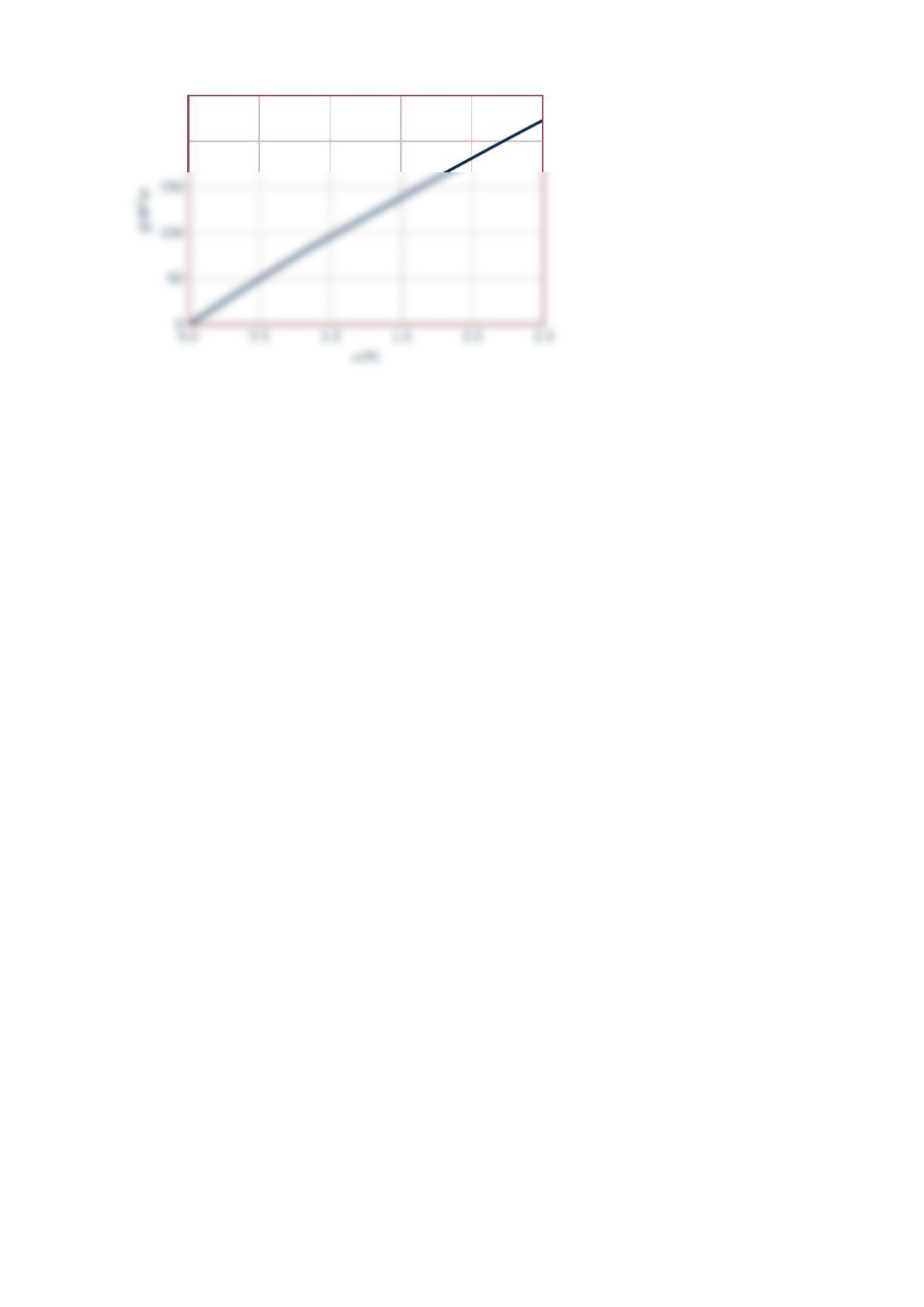
Water flows under a sluice gate in a channel of 10-ft width. If the upstream depth remains
constant at
5
ft, plot a graph of flowrate as a function of the distance between the gate and
the channel bottom as the gate is slowly opened. Assume free outflow.
Solution 10.90
Thus,
a (ft) Cd Q
0 ∞ 0.6 0
Q
Free outflow
0.6
0.5
0.4
y
1__
a
250
200
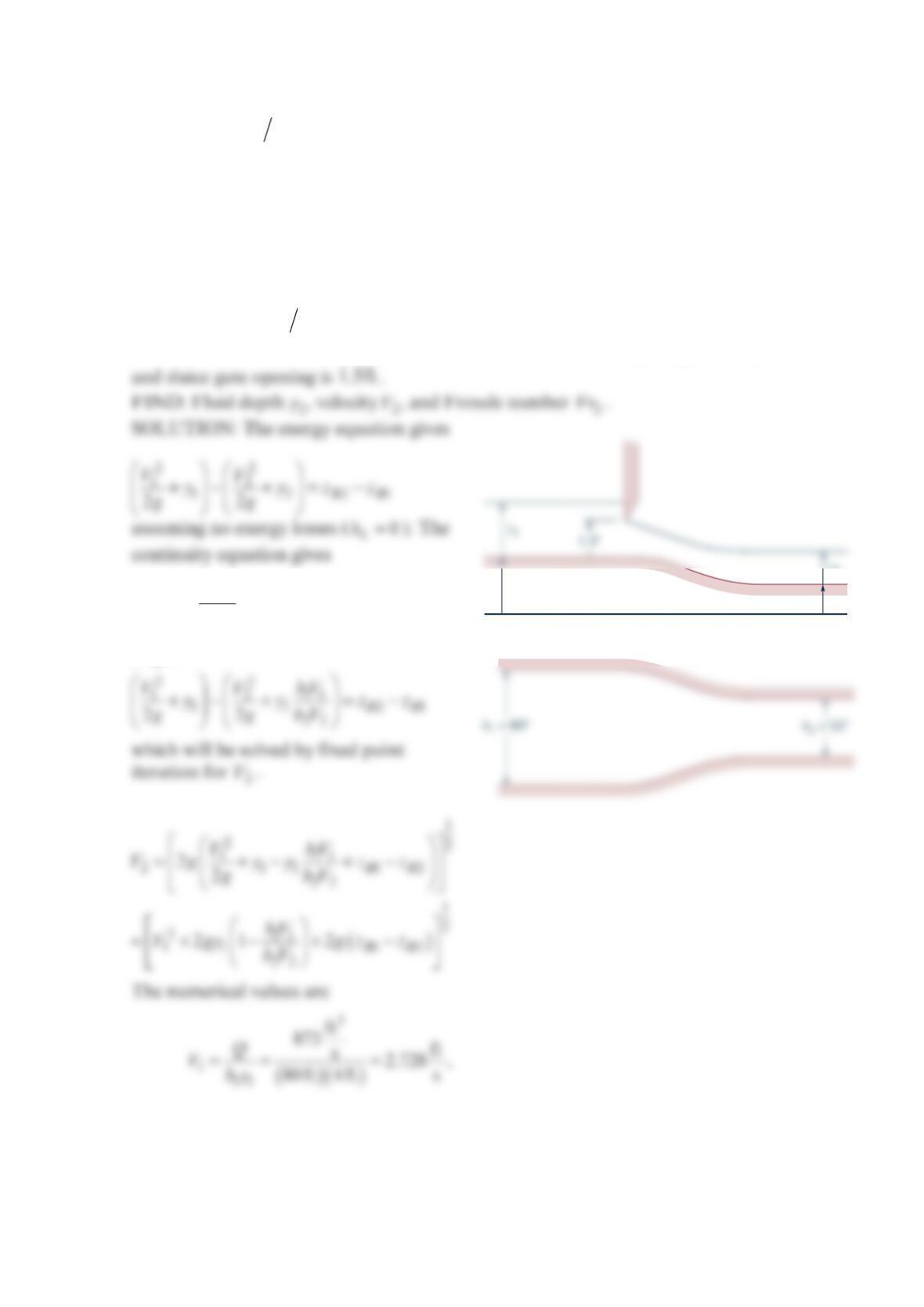
Problem 10.91
A flow of 3
873ft s passes under a sluice gate in a rectangular channel having a gradual
contraction in width from 80 ft to 52ft . The channel bed has scoured to a level that is 6in.
below the upstream channel bed, owing to the increased velocity caused by the sluice gate
and the contraction. If the upstream flow depth is 4ft and the sluice gate opening is 1.5ft ,
compute the depth, velocity, and Froude number of the flow at the end of the contraction.
Solution 10.91
GIVEN: =3
873ft sQ passes under a sluice gate in a rectangular channel having gradual
contraction from =
180 ftb to =
252 ftb. Channel bed drops so 12
6in.
BB
zz−=, =
14fty,
=
11
21
22
bV
yy
bV
to get
y
2
z
B
1
z
B
2
reference
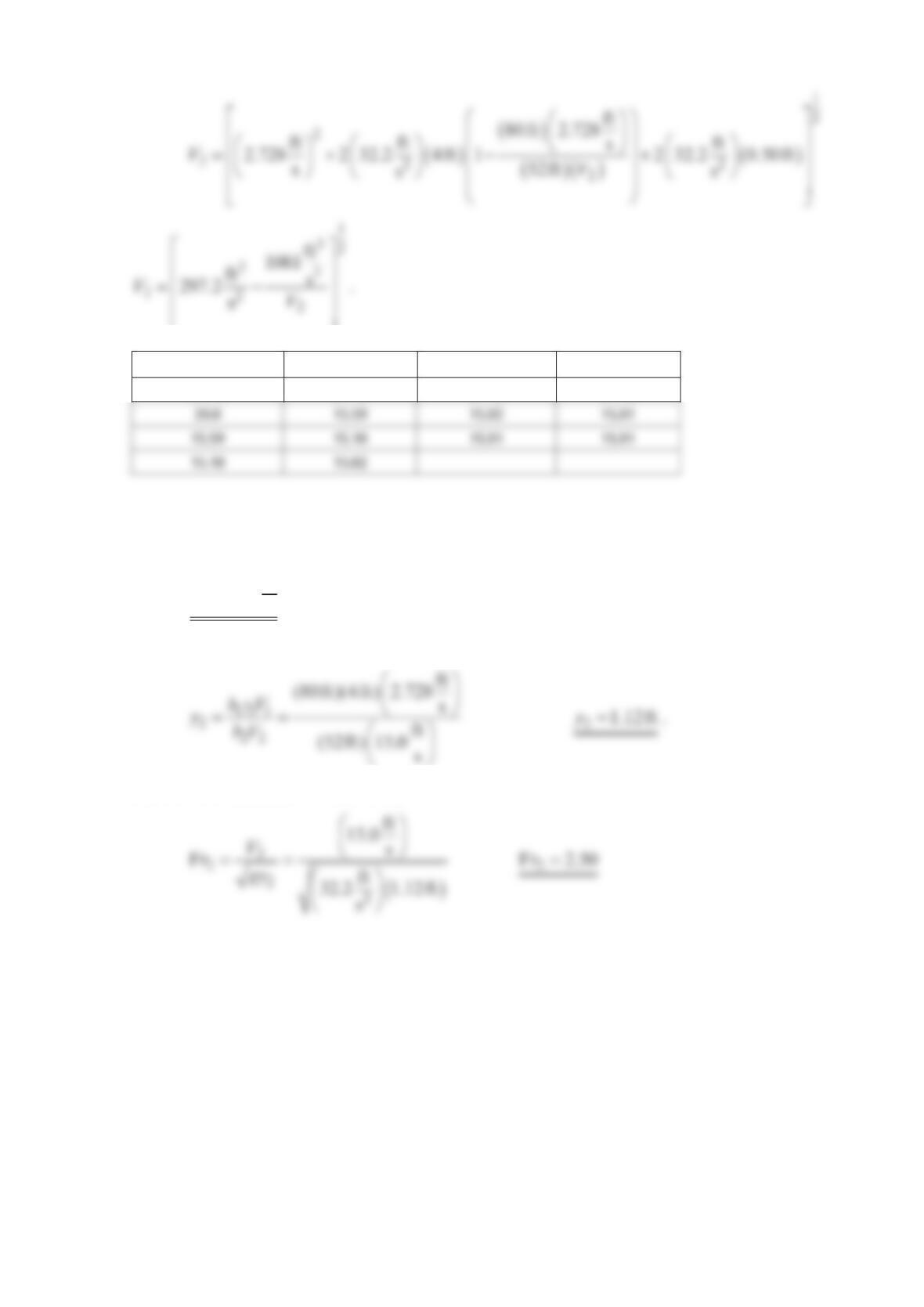
guess of V2 calc V2 guess of V2 calc V2
(ft/s) (ft/s) (ft/s) (ft/s)
The solution could also be obtained from an equation solver to find the roots
=
2
ft
15.0 s
V.
The continuity equation gives
The Froude number is found from